ESCUELA TÉCNICA SUPERIOR DE INGENIEROS
I
NDUSTRIALES Y DET
ELECOMUNICACIÓNUNIVERSIDAD DE CANTABRIA
Trabajo Fin de Grado
Recovery of zinc from spent pickling baths by
the combination of liquid membranes and
electrowinning technologies
(Recuperación de zinc de ácidos de decapado
agotados mediante la combinación de
tecnologías de membranas líquidas y
electrodeposición)
Para acceder al Título de
Graduado/a en Ingeniería Química
Content
1. Scope ... 4
1.1. The importance of zinc as anticorrosive agent ... 4
1.2. Zinc-based surface treatment processes ... 5
1.3. Technological background for SPB management ... 7
2. Objectives ... 10
3. Experimental methodology ... 10
3.1. Membrane-based solvent extraction experiments ... 11
3.2. Electrowinning experiments ... 13
4. Results ... 18
4.1. Task 1: Influence of the applied current ... 18
4.2. Task 2: influence of the initial concentration of zinc ... 21
4.3. Task 3: Influence of the electrolyte matrix ... 23
4.4. Task 4: comparison between divided cell reactor and single cell reactor ... 28
5. Conclusions... 30
List of figures
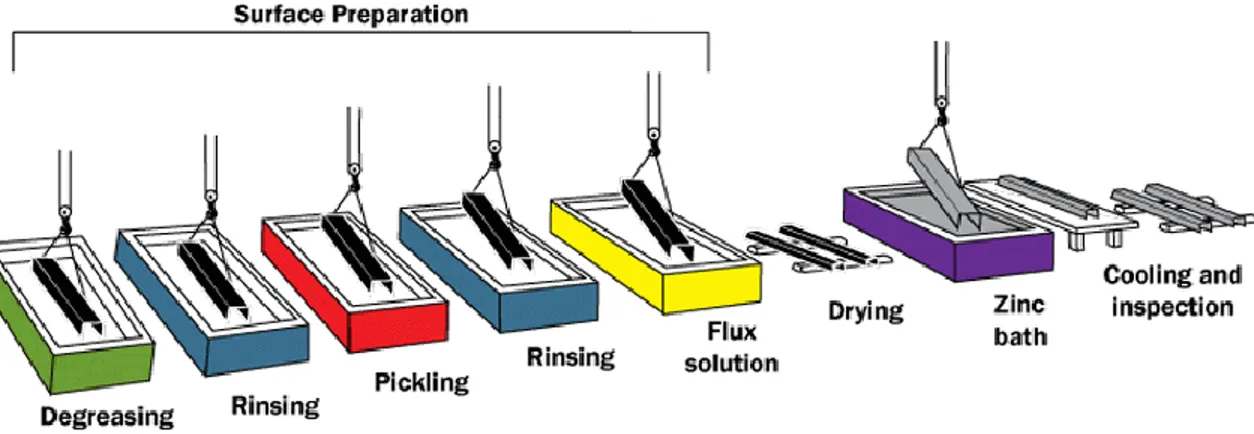
Figure 1.1. Galvanizing process steps ... 5
Figure 1.2. Zinc price [11] ... 7
Figure 3.1. EPT experimental setup [7] ... 12
Figure 3.2. Experimental work space: undivided cell reactor ... 13
Figure 3.3. FAAS equipment: Perkin Elmer 3110B ... 16
Figure 3.4. Experimental work space: divided cell reactor [7] ... 18
Figure 4.1. Conversion of Zinc for different applied current ... 19
Figure 4.2. Evolution of current efficiency ... 20
Figure 4.3. Deposited zinc (Exp. 3) ... 21
Figure 4.4. Moles of zinc deposited at different initial concentrations ... 22
Figure 4.5. Conversion of zinc for different initial concentrations of zinc ... 23
Figure 4.6. Zinc moles evolution (Exp. 6) ... 24
Figure 4.7. Zinc evolution conversion (Exp. 6) ... 25
Figure 4.8. Zinc conversion comparison for real SPB ... 26
Figure 4.9. Deposited zinc (Exp. 7) ... 27
Figure 4.10. Synthetic and real behaviour comparison ... 28
Figure 4.11. Zinc conversion comparison between single and divided cell reactor ... 29
Figure 4.12. Current efficiency comparison between single and divided cell reactor ... 29
List of tables
Table 3.1. Composition of real SPB ... 12Table 3.2. Experimental conditions ... 15
Table 4.1.Purity evaluation ... 21
1. Scope
1.1. The importance of zinc as anticorrosive agent
Surface treatment industry aims to modify metallic or plastic surfaces in order to clean their surfaces for decorative purposes, protect them against corrosion or to improve their superficial properties [1, 10]. The improvement of corrosion resistance has a special interest in this industry.
By the moment, steel is one of the most used metals all over the world. It satisfies the greater part of the demand of the major industries because of its technical and economic quality. However, steel has a limited resistance against corrosion thus affecting its structural capacity making it unable to be reused.
One of the most important characteristics of zinc is its capacity to protect metal components from rusting, corrosive substances from reaching the metal, to protect it from the environment in general [6, 10, 15]. The protection is based on the physical barrier and a cathodic protection that provides an increment of the useful life of those components. Zinc’s corrosion velocity is between 15 and 50 times lower than steel’s. Furthermore, zinc is anodic regarding steel, what means that when they are in contact in electrolyte presence, zinc is corroded preferably. Thus, zinc provides a cathodic protection or a sacrificial protection [10]. Consequently, zinc coating provides a triple protection:
a. Barrier protection
Insulating barrier formed by zinc coat and zinc passivation layer (basic zinc carbonate)
b. Cathodic protection
In case of faults or discontinuities of the coat, the zinc provides a cathodic protection for steel because of its anodic nature with respect to steel.
c. Restoration coating discontinuities
1.2. Zinc-based surface treatment processes
The most important zinc-based surface treatment processes are as follows:
Hot dip galvanizing process [6]: the pieces to be treated are immersed into a bath of molten zinc at a temperature between 445 and 465oC after having been prepared
mechanically or chemically.
Electrolytic galvanizing process: the pieces to be treated are immersed into a bath of brine solution that contains zinc and a direct current is applied to the metal piece in order to deposit zinc over the metal surface. It provides a thinner (8-12 μm) and more uniform coat of zinc. It is performed at ambient conditions.
The most used technic for metal’s surface protection is hot dip galvanizing process. In this process there are several steps before the real application of the zinc coat that prepare the metal surface.
The galvanizing process consists of several steps [1] as depicted in Figure 1.1: alkaline or acidic degreasing, rinsing with water, pickling with dilute hydrochloric or sulphuric acid, rinsing with water, fluxing in aqueous ZnCl2/NH4Cl baths, drying and dipping into molten
zinc at temperatures of about 450oC for a defined period. Among all these steps, many
effluents are produced that will need to be treated before disposal.
The pickling step, previous to the dipping into liquid zinc, is a metal surface treatment used to remove impurities such as strains, inorganic contaminants, rust or scale by its attack with HCl, contains high concentrations of ZnCl2, FeCl2 in acid media [7, 10, 15] and, consequently,
they have to be treated previous to their disposal.
While the pickling process takes place, the concentration of the metallic components increases but, on the other hand, the free chlorine concentration decreases and the chloride concentration remains constant. As the free chlorine is consumed, it can be reintroduced until the iron solubility limit in the solution (around 150 g/L) when the pickling process losses its efficacy and its substitution is required [7].
The management of SPB must be performed by an authorized manager for treatment. However, the traditional treatment process, which consists in the effluent neutralization and the precipitation of iron and zinc as hydroxides, presents as disadvantages the high consumption of chemical products together with the generation of a hazardous sludge that has to be treated [7].
It is important to point out the volume of SPB produced. The value of the volume produced in Europe is 300.000 m3/year and after its neutralization is around 150.000 ton/year [10].
After the analysis of the current situation, it has been detected the necessity of new process in order to treat the spent pickling baths aiming the solution of the existing problems or, at least, reduce their impacts allowing at the same time the recovery of valuable materials in order to compensate the cost associated to the treatment process.
Traditional treatments aim to process the residual effluents to avoid pollution [13], in contrast, zinc recovery is an alternative treatment that at the same that prevents contamination, recovers an interesting element whose natural reserves are decreasing and besides its high cost.
Zinc is an expensive element (above 2000 $/ton [11]) as shown in Figure 1.2 greatly used all over the world. That picture shows zinc’s price fluctuations in the last 8 years. It shows a
dramatic decrease in the year 2008 when the economic crisis hit the world and a weak increase the following years that lead to a stabilization around the actual value already said.
Figure 1.2. Zinc price [11]
1.3. Technological background for SPB management
Nowadays, the management of SPB address its treatment as a hazardous waste, which generates additional waste such as sludge from the physicochemical treatment. The current management involves a monetary cost for the galvanizing enterprises and a huge environmental impact; therefore, from the economic-environmental point of view, the objective is obtaining a zero discharge solution and recovering the greater part of the SPB. The valorisation methods are based in [10]:
Mineral acids recovery
o Membrane technology
The best available technique for pickling bath regeneration is membrane distillation technology [10, 13]. This technology allows water and HCl transport through the membrane, in vapour state. On the other hand, the membrane retain non-volatile compounds as salts and metals.
o Pyrometallurgical techniques
Fluidized bed and spray roasting are well applied methods to recover HCl from pickling solutions at industrial scale. Unluckily, this methods need to be done after removing zinc. Both techniques present an evaporations step where metal oxide is produced and a vapour stream (HCl) that is condensed later to recover the acid.
o Ionic exchange
This technique is developed by means of ionic exchange resins. The acid remains retained with the resins, while the metals leave the bed with the aqueous stream. Finally, the acid is recovered from the resins in the backwashing step. o Precipitation/neutralization
The bath is neutralized with NaOH or KOH and it is obtained iron hydroxide and zinc hydroxide. Then it is filtered and disposed in the landfill.
Majority metals recovery o Ionic exchange
This method requires the use of two ionic exchange columns in series. The first one will recover the zinc and the second one will recover Fe3+, however, Fe2+ will
pass through them. Both of the columns are strongly basic. o Chemical precipitation
This method aims to deposit iron salts to be removed from the effluent. It involves high amount of reagent consumption.
o Electrolytic deposition
By this method, metallic ions are reduced and deposited in the cathode of the electrolytic cell. Afterwards, the material is removed from the cathode to be refined, recycled or disposed. Waste water and sludge generated is relatively
low compared to other techniques. On the other hand, it requires high energy consumption.
In previous works [4, 7, 9, 10, 15], different membrane-based solvent extraction (MBSX) process configurations namely Emulsion Pertraction Technology (EPT) and Non-Dispersive Solvent Extraction (NDSX), which differ in the way of contacting the fluid phases and the number of the membrane contactors involved, have proved to be efficient alternatives to perform the selective separation of zinc over iron in HCl media employing tributylphosphate (TBP) and water as extraction and stripping agents, respectively.
In addition, the effect of several process variables on the kinetics and selectivity of zinc over iron separation was analysed [9] in order to obtain a highly concentrated zinc solution with a negligible content of iron to allow for further recovery of zinc by electrowinning. It was concluded that the kinetics of extraction and stripping of zinc and iron were promoted by EPT configuration in comparison with NDSX configuration, and increasing the TBP concentration in the range between 20% (v/v) and 50% (v/v). Therefore, a suitable selection of the optimal operation conditions is required to maximize the molar ratio zinc/iron in the stripping solution.
On the other hand [5-7], zinc recovery from SPB by means of an electrochemical membrane reactor, which avoids the redissolution of the zinc deposits by the attack of the chlorine generated in the anode, has been successfully applied in order to obtain metallic zinc that can be directly reintroduced into the galvanizing process. However, the anomalous co-deposition among zinc and iron [6, 7] avoids the possibility of recovering all the zinc present in the SPB without iron presence in the deposit.
In this context, this work proposes the combination of electrowinning and membrane-based solvent extraction technologies in order to create a hybrid process to maximize both the yield and selectivity of zinc recovery from spent pickling baths.
2. Objectives
This work has been conducted in the research group Advanced Separation Processes at the Department of Chemical and Biomolecular Engineering of the University of Cantabria. The research group demonstrates a wide experience in the overall management of spent pickling baths. Previous works have been focused on: i) the application of liquid membrane technology using membrane contactors to perform the selective separation and recovery of zinc [3, 4, 7, 9, 11, 16], ii) the recovery of HCl by membrane-based diffusion dialysis [9, 12] and iii) the recovery of electrolytic zinc by electrowinning using a membrane-divided cell electrochemical reactor [2, 5-9]
This works aims first at the analysis of the selective recovery of zinc from the stripping solution previously obtained by the membrane-based solvent extraction technology using a single cell electrochemical reactor; secondly, the performance of the process was compared with the results previously obtained working with a divided electrochemical reactor [7].
In order to fulfil the aforementioned objective several tasks were performed: Task 1. Influence of the applied current
Task 2. Influence of the initial zinc concentration Task 3. Influence of the electrolyte matrix
Task 4. Comparison of divided cell and single cell reactors
3. Experimental methodology
The electrowinning experiments were performed at bench scale working with either synthetic solutions or the stripping phases obtained by the treatment of spent pickling baths (SPB) by membrane-based solvent extraction. The following sections will describe the experimental methods.
3.1. Membrane-based solvent extraction experiments
These experiments were performed in the framework of a previous work [9] where the effect of several process variables on the kinetics and selectivity of zinc over iron separation was analysed in order to obtain a highly concentrated zinc stripping solution with a negligible content of iron to allow for further recovery of zinc by electrowinning.
The experiments were performed at laboratory scale using one mesoporous hollow fibre membrane contactor (HFMC, Liqui-Cel®Extra-Flow 2.5x8, Hoechst Celanese) containing 10,200 polypropylene fibres with an effective mass-transfer area of 1.4 m2 and an effective
mass-transfer length of 0.15 m. The fibres had a nominal porosity of 40%, an average pore size of 0.03 m and an internal diameter of 240 lm with a wall thickness of 30 m. Figure 3.1 shows the experimental set-up used for the extraction and back-extraction of zinc from the aqueous systems using the Emulsion Pertraction Process configuration. In EPT configuration the extraction and back extraction of the target species were conducted in a single membrane module and the non-dispersive contact occurred between the feed SPB and the pseudo-emulsion prepared by dispersing the stripping solution into the organic phase. The difference in the transmembrane pressure between the aqueous phase and the emulsion phase was maintained constant at approximately 0.15 bars in order to avoid the dispersion of the organic fluid into the feed aqueous phases. The organic and the stripping phases can be easily separated by gravity settling. Further details of the experimental procedure are found elsewhere [4].
Figure 3.1. EPT experimental setup [7]
The feed solutions consist of 250 mL of SPB provided by a local industry and containing mainly zinc, iron, chloride and free acid (Table 3.1). The organic solution was formulated by dilution of the extractant TBP (97%, Sigma-Aldrich) in the aliphatic solvent Shellsol D70 (Kremer Pigmente). Tap water was utilized as stripping solution in all the experiments. The pseudo-emulsion was formulated by dispersing 200 mL of the stripping solution into 800 mL of the organic phase using a stirrer MRVS-08 (SBS).
Table 3.1. Composition of real SPB
Component Concentration [H+] (mol L-1) 1.10±0.04 [Zn2+] (mol L-1) 1.87±0.05 [Fe]TOTAL(g L-1) 1.70±0.05 [Fe2+] (g L-1) 1.66±0.04 [Fe3+] (g L-1) 0.04±0.03 [Cl-] (g L-1) 8.48±0.08
Zinc and iron determination was performed by atomic absorption spectrophotometry (AAS). The determination of zinc was performed on a Perkin–Elmer model Analyst 100 atomic absorption spectrophotometer using a zinc hollow cathode lamp at 213.9 nm
Spent pickling bath
Pseudo-emulsion Hollow Fiber Contactor
Stripping solution
wavelength, 0.7 nm spectral bandwidth and an operating current of 5 mA. The iron concentration was performed using the same equipment with a Fe hollow lamp; the wavelength selected was 248.3 nm, the applied operating current was 5 mA and the spectral bandwidth was 0.2 nm.
3.2. Electrowinning experiments
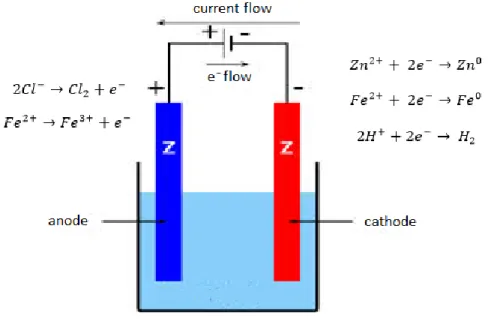
The experiments carried out in the context of the present project were done in a single cell reactor by means of a simple crystal vessel (beaker). Figure 3.2 shows and scheme of the process on the reactor and the reactions occurring in each electrode.
Figure 3.2. Experimental work space: undivided cell reactor
The reactor is filled with a volume of 250 cm3. The cathode was formed by four cylindrical
graphite bars, with an effective area of 28.30 cm2, the anode by a titanium electrode and
as a reference electrode a standard electrode of Ag/AgCl saturated with KCl was used. Both cathode and anode were completely immersed in the solution.
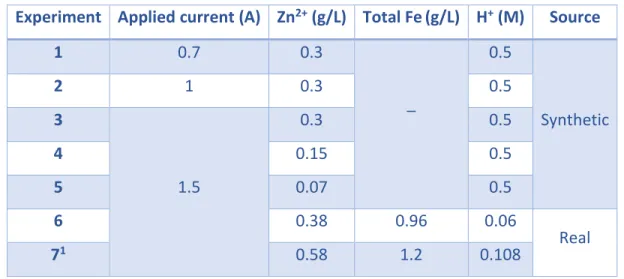
Furthermore, the solution used was the stripping described above. Not all the experiments were performed with real solutions. Experiments 1-5 (Table 3.2) were developed with synthetic solution which included zinc added in the form of ZnCl(s), HCl(l) to reproduce the
acidity conditions of the real pickling solution and distilled water. Experiments 6-7 were carried out with real solutions obtained by the treatment of SPB by EPT. Experiment 6 was carried out directly as previous experiments performed with synthetic solutions. In experiment 7, performed with real solution, iron was removed by precipitation before the electrowinning stage in order to avoid its co-deposition.
Firstly, in order to make it precipitate [14] Fe2+ should be transformed into Fe3+. The way to
do it is warming and oxygenating it by the addition air until the Fe3+ stability. After that, the
precipitation itself is done by means of sodium hydroxide (NaOH) until the pH reaches a value of 4 and finally the solution is cooled down and filtered so that the iron is well removed. Finally, the precipitated iron is removed by vacuum filtration. Has to be taken into account the fact that the addition of NaOH results in the neutralization of the solution, so the solution acidity disappears. It is advantageous since the protons interferes the zinc’s evolution, this way most of the applied power will be used to transform Zn2+ into Zn0, so the
process will be more efficient. Furthermore, the acidity reduction would also beneficiates the later disposal of the sludge generated.
The length of the experiments was different in each one, for the experiments with synthetic solution it was possible to control zinc concentration in real time so the experiment was performed until concentration stabilization. In the case of real solution experiments the length was pre-calculated with the data obtained in the synthetic solution experiments already performed. All the experiments were performed at room temperature.
Experiments were performed at different applied currents, from 0.7 A to 1.5 A. The applied current was provided by a power supply. Potential, cell voltage, current, pH and were recorded during the electrowinning. Samples were taken from the reactor every 30 minutes in order to quantify the evolution of the deposition.
The experimental conditions employed are shown in Table 3.2. There, experiments are grouped in different categories with the aim of analysing the influence on the efficiency:
task 1) the applied current (experiments 1-3), task 2) the initial concentration of zinc (experiments 3-5) and task 3) the iron presence (experiments 6 and 7).
Table 3.2. Experimental conditions
Experiment Applied current (A) Zn2+ (g/L) Total Fe(g/L) H+ (M) Source
1 0.7 0.3 _ 0.5 Synthetic 2 1 0.3 0.5 3 1.5 0.3 0.5 4 0.15 0.5 5 0.07 0.5 6 0.38 0.96 0.06 Real 71 0.58 1.2 0.108
1 Conditions considered before iron removal
The analytical method employed differs from one experiment to another. When the experiments were developed with synthetic solutions (Exp. 1-5) zinc and protons concentration were measured by titration.
Zinc measurement was performed taking 0.5 mL of sample, increasing pH with NaOH until pH 7 and then with buffer solution until pH 10, afterwards two drop of Eriochrome black are added and titrated with EDTA 0.1 M until turning.
Protons measurement was performed diluting the sample 1/20, taking 5 mL of the diluted sample, afterwards adding two drops of Bromophenol blue and finally it is titrated with NaOH 0.1 N until turning.
When the experiments were performed with real pickling bath (Exp. 7) to control the effectiveness of iron removal, iron concentration was measured with an UV-visible spectrophotometer before and after the precipitation.
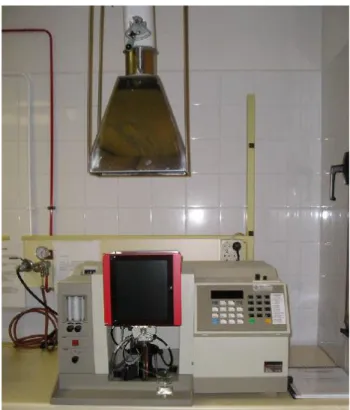
In iron presence titration could not be used anymore to control zinc concentration evolution because the iron came between the analyses, so then zinc had to be measured in another way. Thus, zinc started to be measured by means of a furnace atomic absorption
spectroscopy (FAAS). The equipment used for the absorption measurements was Perkin Elmer 3110B, shown in Figure 3.3. In order to be measured, the concentration of zinc has to be between 0 and 1 ppm, so it has to be diluted with 1% of nitric acid. To measure zinc the specific zinc lamp has to be introduced and several parameters have to be fixed: wave length of 213.9 nm, energy of 10, slit of 0.7 nm.
Finally, what was analysed is the purity of the obtained deposit. In order to be analyse by FAAS, as before, it had to be redissolved and it was done by means of nitric acid (HNO3).
Around 100-150 mg of the deposit were taken and dissolved with 50 mL of HNO3 until
complete dissolution at heat and stirring conditions. Then, it was diluted in order to be measured in FAAS.
Figure 3.3. FAAS equipment: Perkin Elmer 3110B
In order to select the most favourable conditions to maximize the yield of the recovery, several electrodeposition operation parameters were analysed. With this aim, zinc and iron concentration were recorded during the experiments and this data were used afterwards to compliment the corresponding figures (Figures 4.1-4.12). In the same way protons
evolution was analysed, due to the fact that during the electrodeposition process the hydrogen conversion reaction is produced as a secondary reaction that reduces the efficiency of the zinc conversion. Firstly, the zinc, iron and protons removal rates are determined using Eq. (1):
𝑥(𝑡) =𝐶𝑜− 𝐶(𝑡) 𝐶𝑜
(1)
where 𝐶𝑜 (𝑀) is the initial concentration of the metal involved and 𝐶(𝑡) (𝑀) is the
concentration of the metal at a given time. Moreover, the current efficiency, that is an indicator of zinc deposition efficiency, relates the current used with the real current applied and is calculated by Eq. 2:
∅(𝑡) =𝑛 · 𝐹 · (𝐶𝑜− 𝐶(𝑡)) · 𝑉 ∫ 𝐼(𝑡) · 𝑑𝑡0𝑡 · 100
(2)
where n is the number of electrons exchanged in the metal deposition, F is the Faraday’s constant, 𝑉 (𝐿) is the reactor volume and 𝐼(𝑡) (𝐴) is the applied current at a given moment. The experiments performed in a single cell reactor were compared with the performance of a divided cell reactor which was previously analysed in collaboration with researchers of the Polytechnic University of Valencia [8]. Those experiments were developed in a two-compartment reactor, which were separated by an ionic exchange membrane.
Ionic exchange membrane are synthetic semipermeable membranes that allow only passing positive charged ions when cationic membranes and negative charged ions when anionic membranes.
The behaviour of a divided cell reactor not only allows the production of a brine solution and a diluted one from the feed solution. It also separate of different charged ions, allowing the removal of cationic impurities from an electrolyte that aims the obtaining anions or even the separation of different charge cations based on the membrane selectivity.
A schematic representation of the divided cell reactor is shown in Figure 3.4, which also includes the main reaction for both electrodes. The membrane reactor is filled, after the cell assembly, with an equal volume of 250 cm3 of catholyte and anolyte in their respective
compartments. The cathode and anode used for this experiments were the same that were used in single compartment reactor which has been described above.
The membrane used in the reactor was an IONICS AR-204-SZRA-4112 anion-exchange membrane (AEM) which was placed between both compartments. Furthermore, the catholyte used was formulated as the stripping solution used in the single compartment reactor while the anolyte consisted of a 0.1 M HCl synthetic solution prepared from analytical grade reagents and distilled water.
Figure 3.4. Experimental work space: divided cell reactor [7]
4. Results
4.1. Task 1: Influence of the applied current
The experiments were done with a solution of 20 g/L of zinc in different current conditions, 0.7 A, 1 A and 1.5 A, those are represented in Table 3.2 (Exp. 1-3). The feed solution used in this first approach was a synthetic solution that was made in the laboratory in order to
perform this set of experiments. Note the fact that this set of experiments were performed in iron absence.
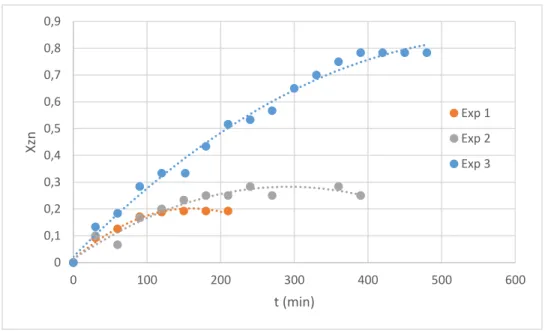
The zinc fractional conversion is represented in Figure 4.1. As shown in the figure, an increase in the applied current in absolute value, increases the zinc deposited in the cathode. Thus, the higher conversion is the one obtained with 1.5 A (Exp. 3) reaching a conversion of nearly 80 per cent of the initial zinc. However, to reach this conversion much time is required, 480 minutes, this contrasts with Exp. 1 developed at 0.7 A which obtains just 20% of zinc and only requires 200 minutes. It should be remarked also that at that moment in Exp. 3 50% of initial zinc was recovered. Besides it was noticed that between 1 A and 0.7 A there is no remarkable influence of the applied current.
Figure 4.1. Conversion of Zinc for different applied current
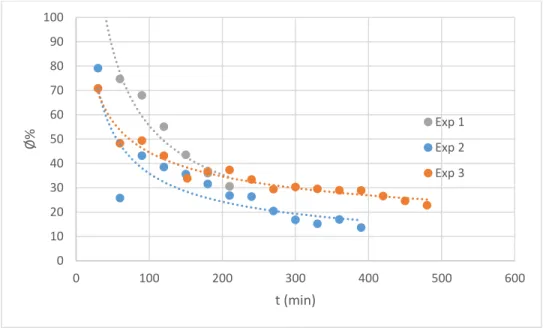
Figure 4.2 presents the time evolution of zinc current efficiency as function of the applied
current for the same experimental conditions as those presented previously. In all the cases, the efficiency initially reaches high values but then it suddenly decreases to 40% due to zinc
0 0,1 0,2 0,3 0,4 0,5 0,6 0,7 0,8 0,9 0 100 200 300 400 500 600 Xzn t (min) Exp 1 Exp 2 Exp 3
deposition from the solution and the consequently increase of secondary reactions, as hydrogen evolution reaction (HER). It is worth to note that under these experimental conditions the HER is present from the beginning of the electrolysis and, as a consequence, zinc current efficiency never reaches the 100% value for any applied current. For a given instant time, the higher the applied current is the lower the value of the calculated zinc current efficiency. This is associated with the fact that the increase in the applied current not only favours the zinc depletion, but it also favours the secondary reactions.
Figure 4.2. Evolution of current efficiency
Besides, the purity of the deposition obtained with the synthetic solution (Figure 4.3) was analysed to check if there was mass losses. It is worth to note the quality of the deposit in terms of definition and solidity. What was observed with prepared solutions is, as depicted in the figure below, that the deposition was a strong and thick coat of zinc, easy to remove.
0 10 20 30 40 50 60 70 80 90 100 0 100 200 300 400 500 600 Ø% t (min) Exp 1 Exp 2 Exp 3
Figure 4.3. Deposited zinc (Exp. 3)
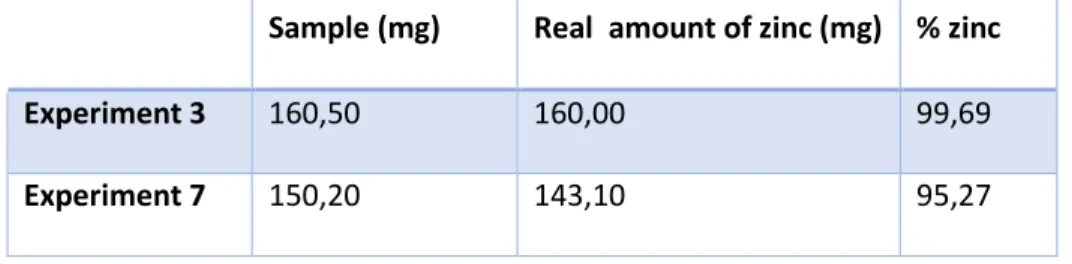
Table 4.1 below contains the data of the results obtained for the analysis of the deposition purity for both cases that were developed. As referenced in Table 3.2, experiment 3 refers to one developed with synthetic solution while experiment 7 to one with real SPB. The procedure to measure the purity of the deposition is explained above in section 3. Experimental methodology. The quality obtained was a purity of nearly 100% as the table below presents. This matches with what was predicted because there is no other metal added in the solution to be recovered.
Table 4.1.Purity evaluation
Sample (mg) Real amount of zinc (mg) % zinc
Experiment 3 160,50 160,00 99,69
Experiment 7 150,20 143,10 95,27
4.2. Task 2: influence of the initial concentration of zinc
Once concluded that the best performing condition was 1.5 A, the present section evaluates the influence of the initial zinc concentration on the electrowinning process. As reported in Table 3.2, several experiments were performed with three different concentrations of zinc in the range from 0.07 to 0.3 M (experiments 3-5), with the same solution acidity (0.5 M of
HCl) and all of them with the same applied current (1.5 A. In this case the feed solution was the same as before, a synthetic solution.
From Figure 4.4, which shows the evolution of the moles of zinc deposited with time when the applied current is 1.5 A, it was observed that the variation in the initial concentration does not affect to a large degree the quantity of zinc deposited on the cathode surface. This behaviour is explained by the fact that if the applied current remains invariable, the amount of zinc deposited remains constant independently of its initial concentration value, as the current density is proportional to the global reaction velocity.
Figure 4.4. Moles of zinc deposited at different initial concentrations
On the other hand, as shown in Figure 4.5 the fractional conversion of zinc is greatly affected by the change in the initial concentration. The cause of this behaviour is that under the same applied current the zinc deposition rate remains constant and thus, the time needed to obtain a 100% zinc fractional conversion grows as the initial zinc concentration increases. The actual conversion obtained for this set of experiments fall between 70 and 80% of initial
0 0,05 0,1 0,15 0,2 0,25 0,3 0 100 200 300 400 500 600 zn d ep (m o l) t (min) Exp 3 Exp 4 Exp 5
concentration, but even though initial concentration does not affect the recovery percentage.
Figure 4.5. Conversion of zinc for different initial concentrations of zinc
4.3. Task 3: Influence of the electrolyte matrix
Finally, the last influence that was tested is the influence of the electrolyte. To illustrate the real relevance of what was studied it had to be tested also in a real solution to check if the synthetic solution does actually represent the real behaviour of the real process and if this solution without a membrane between the cathodes is actually a good performance to achieve the objective: the zinc recovery.
The performance of these experiments were done in the acidity and applied current as in the previous case and those conditions are, as before, shown in the Table 3.2 labelled as experiments 6 and 7.
Experiment 6 was performed as the previous experiments, directly working with the stripping solution obtained by the treatment of the SPB solution by the membrane–based solvent extraction technology.
0 0,1 0,2 0,3 0,4 0,5 0,6 0,7 0,8 0,9 0 100 200 300 400 500 600 Xzn t (min) Exp 3 Exp 4 Exp 5
Figure 4.6 shows the evolution of zinc concentration over time in experiment 6. What during the experiments was notice is that the zinc deposition was not as fast as with synthetic solution but also far away from the behaviour of the performance with the reactor with two compartments.
Figure 4.6. Zinc moles evolution (Exp. 6)
In this case what was reached was only to recover the half of the initial concentration as depicted in Figure 4.7, leaving 0.2 M of zinc, in comparison with the first experiments, Figure 4.1-Exp. 3, where it was possible to recover around the 80% of the initial concentration, leaving only 0.05 M of zinc.
0 0,05 0,1 0,15 0,2 0,25 0,3 0,35 0,4 0 100 200 300 400 500 600 [Zn ] (M) t (min) Exp 6
Figure 4.7. Zinc evolution conversion (Exp. 6)
Both pictures above present a valley where there was no change in zinc concentration, where the conversion is around 30% of initial zinc, this means that the conversion remained stopped for 150 minutes approximately. The explanation of this behaviour could be iron presence, at that moment secondary reactions are supposed to be favoured so that inhibits zinc recovery. After that valley, zinc recovery is reactivated enabling an extra 20 per cent of zinc recovery.
What was supposed with this experiment was iron interference against zinc deposition as a result iron precipitation was proposed as solution. Iron precipitation was performed as explained in section 3. Experimental methodology. The efficiency of the precipitation was analysed and it revealed a removal of nearly 90 per cent of iron.
However, during iron filtration the solution suffered the loss of zinc also. This is because the transformation of iron from Fe2+ to Fe3+ leads to colloids formations. These colloids provide
a reddish colour and turbidity and are good adsorbents, this ends up retaining the zinc in the colloids and being removed with it. The amount of zinc lost was around the 30 per cent of initial zinc concentration.
0 0,1 0,2 0,3 0,4 0,5 0,6 0,7 0,8 0,9 1 0 100 200 300 400 500 600 Xzn t (min) Exp 6
Figure 4.8 shows a comparison among experiments developed with real solutions. As previously stated Exp. 6 correspond to non-precipitation experiment and Exp. 7 to precipitated experiment. This comparison exhibits the benefit of iron removal for zinc recovery which provides a better recovery, around 90 per cent of initial zinc concentration.
Figure 4.8. Zinc conversion comparison for real SPB
The analysis of the final deposition gave the information about the purity of the deposition which was developed as the previous. Figure 4.9 presents the deposition obtained in experiment 7 with real SPB. This deposition differs from the one in Figure 4.3 in definition and strength, this presents more branches and less uniformity. Besides, it is worth to note the reddish colour that appear in the deposition, which comes from the iron colloids produced during electrowinning experiment.
0 0,1 0,2 0,3 0,4 0,5 0,6 0,7 0,8 0,9 1 0 100 200 300 400 500 Xzn t (min) Exp 6 Exp 7
Figure 4.9. Deposited zinc (Exp. 7)
Table 4.2 shows the quantity of zinc disappeared from the solution (Converted zinc) and the mass deposited that was weighted.
Table 4.2. Mass balance (Exp. 7)
Converted zinc Weighted deposition
Mass (mg) 3976.48 4200
With these data a mass balance was performed to check the deposition purity. 𝑃𝑢𝑟𝑖𝑡𝑦 =𝑑𝑖𝑠𝑎𝑝𝑝𝑒𝑎𝑟𝑒𝑑 𝑚𝑎𝑠𝑠
𝑤𝑒𝑖𝑔ℎ𝑡𝑒𝑑 𝑚𝑎𝑠𝑠 · 100 =
3976.48
4200 = 94.67%
Afterwards, with analysis in FAAS it was obtained that with this method the purity of was around 95 per cent (Table 4.1.Purity evaluation) which is a really good purity. The procedure to measure the purity of the deposition is explained above in 3. Experimental methodology. The impurities that both methods show proceed from other metals that contain the effluent, considering also the remained iron.
Figure 4.10 shows the comparison between real stripping and synthetic stripping behaviour. There can be observed that synthetic solution performs a behaviour quite similar to real solution obtaining even more zinc recovered in real solutions.
Figure 4.10. Synthetic and real behaviour comparison
4.4. Task 4: comparison between divided cell reactor and single cell reactor Finally, the performance of single cell reactor developed after iron precipitation and divided cell reactor studied before in collaboration with researcher of the Polytechnic University of Valencia [8] are compared.
The results dealing with the time evolution of the zinc fractional conversion depicted in Figure 4.11 show similar zinc conversion rates (90 per cent of initial zinc concentration) in both cases but it takes more time to get all the zinc recovered in the single-cell reactor. On the other side, there is the fact that in the case of the divided cell reactor the iron is not obtained on the cathode surface due to the fact that the iron cannot pass through the membrane. 0 0,1 0,2 0,3 0,4 0,5 0,6 0,7 0,8 0,9 1 0 100 200 300 400 500 600 Xzn t (min) Exp 3 Exp 7
Figure 4.11. Zinc conversion comparison between single and divided cell reactor
Figure 4.12 below represents the comparison between both systems in terms of current efficiency. What is observed from the graph is that the efficiency for the divided cell reactor is higher what means that more of the energy applied is used to the zinc deposition itself, it is a more efficient system.
Figure 4.12. Current efficiency comparison between single and divided cell reactor 0 0,1 0,2 0,3 0,4 0,5 0,6 0,7 0,8 0,9 1 0 100 200 300 400 500 600 Xzn t (min) Exp 7
Divided cell reactor
0 10 20 30 40 50 60 70 80 90 100 0 100 200 300 400 500 600 Ø% t (min) Exp 7
5. Conclusions
This work contributes to the overall management of spent pickling baths generated in the hot-dip galvanizing process which aims at the zinc deposition on the surface of metallic components. These waste effluents are generated in huge quantities by the metallurgic industry, due to the importance of pickling operation and its frequency. Although the typical composition of those wastes is complex, the most concentrated elements are: iron, zinc and residual hydrochloric acid. The objective of the overall treatment process is to reduce the toxicity of the effluent allowing at the same time the recovery of compounds with high added value.
The main specific objective of the present Final Degree Project is the analysis of the selective recovery of zinc from the stripping solution previously obtained by the membrane-based solvent extraction technology using a single cell electrochemical reactor and compare the performance of the process with the results previously obtained working with a divided electrochemical reactor.
Stripping solutions with different concentrations of zinc, iron, chloride and free acid obtained by the pre-treatment of spent pickling baths by membrane–based solvent extraction technology under different operation conditions, were treated by electrowinning to analyse the viability of the process.
Regarding the effect of the applied current on zinc electrowinning of the stripping solution showed that an increase in the applied current in absolute value produced an increase of the mass of zinc recovered, reaching a conversion of 80 per cent of the initial concentration of zinc with 1.5 A. A current of 1.5 A was chosen to be the one that most favours zinc deposition. Moreover, an increase in the applied current provides a higher zinc recovery but at a higher energy costs. On the other hand, the fractional conversion of zinc is greatly affected by the change in the initial concentration. The reason of this behaviour is that under the same applied current the zinc deposition rate remains constant and thus, the time needed to obtain a 100% zinc fractional conversion grows as the initial zinc concentration increases.
The zinc recovery in a single compartment reactor presents a good performance when the used solution is a synthetic one free of iron; however the process efficacy is affected when real stripping solutions containing iron are testes. Therefore, a previous step of iron precipitation was performed thus confirming a similar performance working with either synthetic or real solutions. Finally, the results obtained with undivided cell reactor were compared with the performance of a two compartments reactor containing an anionic membrane. Although both technologies reported similar results, a slight improvement on the zinc recovery was observed working with the divided reactor; however, the scaling of the anionic membrane at industrial scale can be a problem, because this membrane has to be replaced and regenerated from time to time which leads to stopping the operation increasing the costs of the process. A balance between the costs, the effectiveness and zinc loss must be carried out in order to decide which methodology better fits our needs.
6. References
[1] AMERICAN GALVANIZERS ASSOCIATION. [Web site]. 2015. Colorado: AGA. [Consulted: 15 April 2015]. Available at: http://www.galvanizeit.org/hot-dip-galvanizing/what-is-hot-dip-galvanizing-hdg/hdg-process
[2] J. Carrillo-Abad, Estudio de la recuperación del zinc presente en los baños de decapado procedentes de las industrias de galvanizado de zinc en caliente mediante técnicas electroquímicas. GARCÍA GABALDÓN, M., PEREZ HERRANZ, V., directores. Tesis doctoral, Universidad politécnica de Valencia. (2014)
[3] H. Samaniego, M. F. San Román, and I. Ortiz, Kinetics of Zinc Recovery from Spent Pickling Effluents, Industrial & Engineering Chemistry Research (2007).
[4] J. A. Carrera, E. Bringas, M.F. San Roman, I. Ortiz, Selective membrane alternative to the recovery of zinc from hot-dip galvanizing effluents, J. Membr. Sci. 326 (2009) 672– 680.
[5] J. Carrillo-Abad, M. García-Gabaldón, E. Ortega, V. Pérez-Herranz, Electrochemical recovery of zinc from the spent pickling baths coming from the hot dip galvanizing industry. Potentiostatic operation, Separation and Purification Technology (2011). [6] J. Carrillo-Abad, M. García-Gabaldón, E. Ortega, V. Pérez-Herranz, Recovery of zinc
from spent pickling solutions using an electrochemical reactor in presence and absence of an anion-exchange membrane: Galvanostatic operation, Separation and Purification Technology (2012).
[7] J. Carrillo-Abad, M. Garcia-Gabaldon, I. Ortiz-Gandara, E. Bringas, A.M. Urtiaga, I. Ortiz, V. Perez-Herranz, Selective recovery of zinc from spent pickling baths by the combination of membrane based solvent extraction and electrowinning technologies, Separation and Purification Technology (2015).
[8] J. Carrillo-Abad, M. García-Gabaldón, V. Pérez-Herranz. Treatment of spent pickling baths coming from hot dip galvanizing by means of an electrochemical membrane reactor, Desalination 343 (2014) 38-47.
[9] J. Laso, V. García, E. Bringas, A. M. Urtiaga, I. Ortiz, Selective Recovery of Zinc over Iron from Spent Pickling Wastes by Different Membrane-based Solvent Extraction Process Configurations, Ind. Eng. Chem. Res. 54 (2015) 3218-3224.
[10] J. Laso, Evaluación de la tecnología de membranas líquidas selectivas como alternativa en la gestión de baños de decapado agotados. BRINGAS. E, director. Trabajo fin de carrera, Universidad de Cantabria. (2013)
[11] LONDON METAL EXCHANGE. [Web site]. 2015. London: LME. [Consulted: 6 May 2015]. Available at: http://www.lme.com/en-gb/metals/non-ferrous/zinc
[12] M.F. San Román, I. Ortiz Gándara, R. Ibañez, I. Ortiz, Hybrid membrane process for the recovery of major components (zinc, iron and HCl) from spent pickling effluents, Journal of Membrane Science 415-416 (2012) 616-623.
[13] Magdalena Regel-Rosocka, A review on methods of regeneration of spent pickling solutions from steel processing, Journal of Hazardous Materials, Volume 177, Issues 1–3, 15 May 2010, Pages 57-69, ISSN 0304-3894.
[14] P. A. Orrego, J. Jara, C. Celpa, Precipitación de hierro con NaOH previa oxidación de Fe2+ desde soluciones de lixiviación conteniendo elementos de raras tierras,
CONAMET/SAM-2008.
[15] H. Samaniego, Valorización de efluentes de decapado ácido metálico. Recuperación de zinc. ORTIZ URIBE, I, SAN ROMAN SAN EMETERIO, M, directoras. Tesis doctoral, Universidad de Cantabria. (2006)
![Figure 1.2. Zinc price [11]](https://thumb-us.123doks.com/thumbv2/123dok_es/6914747.295875/7.918.173.759.208.542/figure-zinc-price.webp)
![Figure 3.1. EPT experimental setup [7]](https://thumb-us.123doks.com/thumbv2/123dok_es/6914747.295875/12.918.321.602.103.346/figure-ept-experimental-setup.webp)
![Figure 3.4. Experimental work space: divided cell reactor [7]](https://thumb-us.123doks.com/thumbv2/123dok_es/6914747.295875/18.918.246.674.473.756/figure-experimental-work-space-divided-cell-reactor.webp)