UNIVERSIDAD TÉCNICA DE AMBATO
DIRECCIÓN DE POSGRADO
MAESTRÍA EN LA ENSEÑANZA DEL IDIOMA INGLÉS COMO
LENGUA EXTRANJERA
Tema: “COMMUNICATIVE ACTIVITIES IN THE SPEAKING SKILL DEVELOPMENT”
Trabajo de Investigación, previo a la obtención del Grado Académico de Magíster en la Enseñanza del Idioma Inglés como Lengua Extranjera
Autora: Licenciada Janneth Mercedes Guailla Guaranga
Directora: Doctora Wilma Elizabeth Suárez Mosquera Magíster
.
Ambato – Ecuador 2019
ii
A la Unidad de Titulación de la Universidad Técnica de Ambato
El Tribunal receptor del Trabajo de Investigación presidido por el Doctor Héctor Fernando Gómez Alvarado, Presidente de Tribunal e integrado por los señores: Licenciado Wilber Orlando Romero Villarroel Magister, Licenciada Elsa Mayorie Chimbo Cáceres Magister. Evaluadores del Trabajo de Titulación, designados por la Unidad de Titulación de la Universidad Técnica de Ambato, para receptar el Trabajo de Investigación con el tema: “COMMUNICATIVE ACTIVITIES IN THE SPEAKING SKILL DEVELOPMENT”, elaborado y presentado por la Licenciada Janneth Mercedes Guailla Guaranga, para optar por el Grado Académico de Magíster en la Enseñanza del Idioma Inglés como Lengua Extranjera; una vez escuchada la defensa oral del Trabajo de Investigación el Tribunal aprueba y remite el trabajo para uso y custodia en las bibliotecas de la UTA.
………. Dr. Héctor Fernando Gómez Alvarado Presidente del Tribunal ……… Lic. Wilber Orlando Romero Villarroel, Mg Miembro del Tribunal ……….……… Lic. Elsa Mayorie Chimbo Cáceres, Mg. Miembro del Tribunal
iii
AUTORÍA DEL TRABAJO DE INVESTIGACIÓN
Las responsabilidad de las opiniones, comentarios y críticas emitidas en el Trabajo de Investigación presentado con el tema “COMMUNICATIVE ACTIVITIES IN THE SPEAKING SKILL DEVELOPMENT”, le corresponde exclusivamente a: Licenciada Janneth Mercedes Guailla Guaranga, Autora; bajo la Dirección de la Doctora Wilma Elizabeth Suárez Mosquera Magíster, Directora del Trabajo de Investigación y el patrimonio intelectual a la Universidad Técnica de Ambato.
Licenciada Janneth Mercedes Guailla Guaranga cc. 0603812694
AUTORA
Doctora Wilma Elizabeth Suárez Mosquera Magíster cc. 1802859841
iv
DERECHOS DE AUTOR
Autorizo a la Universidad Técnica de Ambato, para que el Trabajo de Investigación, sirva como un documento disponible para su lectura, consulta y procesos de investigación, según las normas de la Institución.
Cedo los Derechos de mi trabajo, con fines de difusión pública, además apruebo reproducción de este, dentro de las regulaciones de la Universidad.
Licenciada Janneth Mercedes Guailla Guaranga cc. 0603812694
v CONTENTS
PORTADA ... i
A la Unidad de Titulación de la Universidad Técnica de Ambato ... ii
AUTORÍA DEL TRABAJO DE INVESTIGACIÓN ... iii
DERECHOS DE AUTOR ... iv
CONTENTS ... v
LIST OF TABLES ... viii
LIST OF FIGURES ... ix
GREATFULNESS ... x
DEDICATION ... xi
RESUMEN EJECUTIVO ... xii
ABSTRACT ... xiii INTRODUCTION ... 1 CHAPTER I ... 3 RESEARCH PROBLEM ... 3 1.1 Research topic ... 3 1.2 Problem statement ... 3
1.2.1 Contextualization of the problem ... 3
1.2.2 Critical analysis. ... 5
1.2.3 Prognosis ... 7
1.2.4 Problem formulation ... 8
1.2.5 Research questions ... 8
1.2.6 Delimitation of the research object ... 8
1.3 Justification ... 8 1.4. Objectives ... 9 2.1 Research background ... 10 2.2 Philosophical foundation ... 14 2.2.1 Ontological basis ... 14 2.2.2 Epistemological basis ... 14 2.2.3 Axiological basis ... 15 2.3 Legal basis ... 15
vi
2.4 Conceptual Framework ... 16
2.4.1 Independent variable theoretical support ... 17
English as Foreign Language ... 17
English as a foreign language methodology ... 17
Communicative language teaching ... 18
Communicative activities ... 19
2.4.2. Dependent variable theoretical support ... 23
Language ... 23 Language skills ... 24 Productive skills ... 25 Speaking skills... 25 CHAPTER III ... 31 METHODOLOGY ... 31 3.1. Research approach ... 31 3.2. Research modality ... 31 3.2.3 Quasi-experimental research ... 32
3.3 Level or type of research ... 32
3.4. Population and sampling ... 32
3.5 Variable operationalization ... 34
CHAPTER IV ... 38
ANALYSIS AND INTERPRETATION ... 38
5.1. Survey ... 38 Teachers’ survey ... 38 5.2. Students’ survey ... 47 5.3. Pre-test ... 55 5.4. Post-test ... 59 CHAPTER V ... 67
CONCLUSIONS AND RECOMMENDATIONS ... 67
5.1. Conclusions ... 67
5.2. Recommendations ... 68
CHAPTER VI ... 69
THE PROPOSAL ... 69
vii 6.2. Justification ... 70 6.4 Objectives ... 70 6.4.1 General ... 70 6.4.2 Specific objectives... 70 6.5. Feasibility analysis ... 70 6.6. Proposal foundation ... 71 6.7. Proposal development ... 77
Countries and Nationalities Show ... 85
References ... 109
viii
LIST OF TABLES
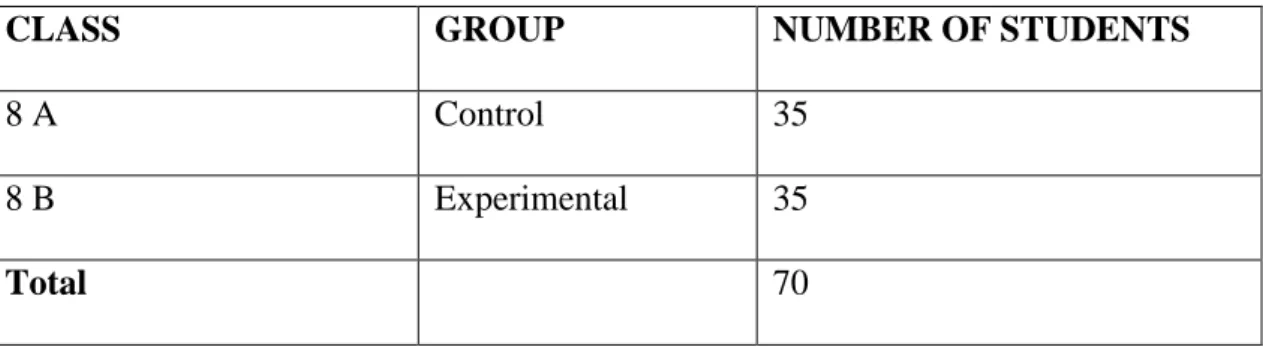
Table 1 . Population ... 33
Table 2. Groups ... 33
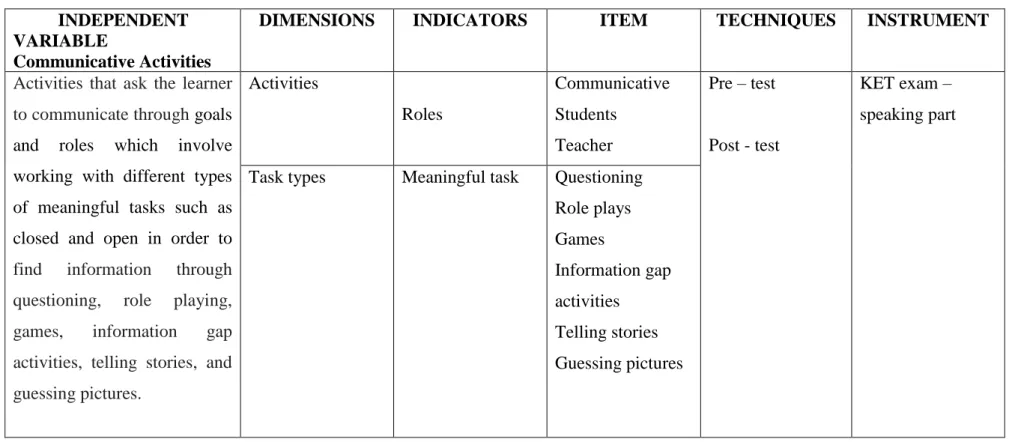
Table 3. Variable operationalization. Independent variable ... 34
Table 4. Variable operationalization. Dependent variable ... 35
Table 5. Communicative activities to improve speaking skills ... 38
Table 6. Learning through interaction ... 39
Table 7. Communicative activities advantages ... 40
Table 8. Teaching activities ... 42
Table 9. Number of communicative activities in class ... 43
Table 10. Role of the teacher ... 44
Table 11. Communicative activities to improve speaking skill... 45
Table 12. Speaking sub-skills ... 46
Table 13. Students' perception about the implementation of communicative activities 47 Table 14. Students' perception about their learning through interaction ... 48
Table 15. Students' perceptions about communicative activities advantages ... 49
Table 16. Students' best learning ways ... 50
Table 17. Number of communicative activities in the classroom ... 51
Table 18 . Role of the teacher in the classroom ... 52
Table 19. Communicative activities to improve speaking skill... 53
Table 20. Speaking sub-skills ... 55
Table 21. Control group results. Pre-test ... 56
Table 22. Pre-test Control group summary ... 56
Table 23. Experimental group results. Pre-test... 57
Table 24.General results. Experimental group. Pre-test ... 58
Table 25. Control group. Post-test general results ... 59
Table 26. Post-test. Control group general results ... 60
Table 27. Post-test. Experimental group ... 61
Table 28. Post-test- Experimental group general results ... 62
Table 29. Normality. Pre-test. Control group ... 63
Table 30. Normality test. Experimental group. Pre-test ... 63
Table 31. Levene test - Pre-test ... 64
Table 32. Independent sample test ... 65
ix
Table 1. Operating model for proposal………78
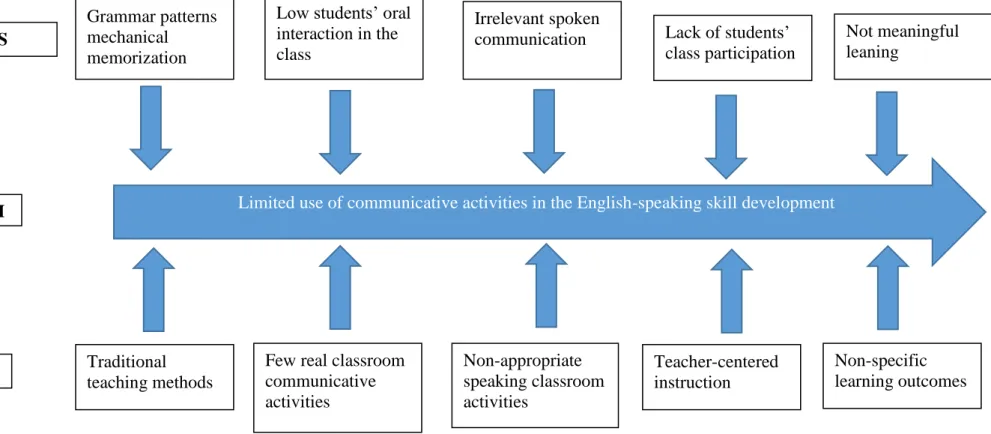
LIST OF FIGURES Figure 1. Critical analysis ... 5
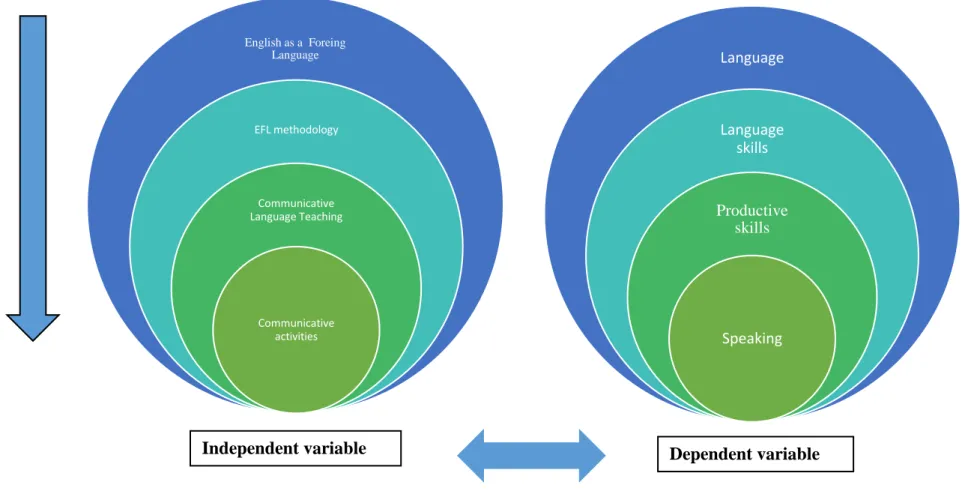
Figure 2. Conceptual framework ... 16
Figure 3. Communicative activities to improve speaking skill ... 39
Figure 4 . Learning through interaction ... 40
Figure 5. Communicative activities advantages ... 41
Figure 6. Teaching activities ... 42
Figure 7. Number of communicative activities in class ... 43
Figure 8. Role of the teacher ... 44
Figure 9. Communicative activities to improve speaking skill ... 45
Figure 10. Speaking sub-skills ... 46
Figure 11. Students' perception about the implementation of communicative activities 47 Figure 12. Students' perception about their learning through interaction ... 48
Figure 13. Students' perceptions about communicative activities advantages ... 49
Figure 14. Students' best learning ways ... 50
Figure 15. Number of communicative activities in the classroom ... 51
Figure 16. Role of the teacher in the classroom ... 52
Figure 17. Communicative activities to improve speaking skill ... 54
Figure 18. Speaking sub-skills ... 55
Figure 19. Pre-test control group histogram ... 56
Figure 20. Pre-test. Control group. ... 57
Figure 21. Pre-test Experimental group histogram ... 58
Figure 22. Pre-test- Experimental group ... 59
Figure 23. Post-test control group histogram ... 60
Figure 24. Control group. Post-test ... 61
Figure 25. Post-test. Experimental group data histogram ... 62
x
GREATFULNESS
My eternal gratitude to all the people who contributed with my professional development through their valuable support during this learning process; in special manner to all the staff at Universidad Técnica de Ambato who kindly helped me with their experience and knowledge for this successful accomplishment.
xi
DEDICATION
This important step in my life is dedicated to my beloved family who have
supported me all the time. With love
xii
UNIVERSIDAD TÉCNICA DE AMBATO DIRECCIÓN DE POSGRADO
MAESTRÍA EN LA ENSEÑANZA DEL IDIOMA INGLÉS COMO LENGUA EXTRANJERA
TEMA: “COMMUNICATIVE ACTIVITIES IN THE SPEAKING SKILL DEVELOPMENT”
AUTHOR: Licenciada Janneth Mercedes Guailla Guaranga
DIRECTOR: Doctora Wilma Elizabeth Suarez Mosquera Magíster FECHA: 5 de Agosto del 2019
RESUMEN EJECUTIVO
Este estudio tuvo como objetivo principal el investigar si la implementación de actividades comunicativas en el proceso de aprendizaje del idioma mejora la habilidad verbal de los estudiantes de octavo año de educación general básica. Para determinar la efectividad de las actividades comunicativas en el mejoramiento de la destreza verbal de los estudiantes, se aplicó un pre-test y un post-test del desenvolvimiento verbal. Estos tests se estructuraron en base al examen internacional KET (Key English Test) y fueron tomados por los estudiantes de Octavo año de educación general básica de la Unidad Educativa Pedro Vicente Maldonado durante el período escolar 2018-2019. Se diseñó un folleto con planes de clase los cuales sirvieron de guía para la implementación de este estudio en el aula de clase con los estudiantes del grupo experimental. Estos planes de clases contenían principalmente actividades comunicativas tales como preguntas, juego de roles, juegos, vacíos de información, contar historias, y describir dibujos. Todas estas actividades estaban combinadas con sub-destrezas verbales a saber gramática, pronunciación, comunicación interactiva, reparación y repetición, y exactitud. Todas las actividades realizadas estaban enfocadas en la comunicación oral de los estudiantes quienes demostraron mejoramiento después de este proceso. Concluida la intervención en el aula, se tomó un post-test el cual tuvo el mismo enfoque que el pre-test. Luego se realizó el procesamiento de los datos obtenidos para su posterior análisis e interpretación a través de la Prueba T de Student. Los resultados demostraron que la implementación de las actividades comunicativas mejora la habilidad verbal de los estudiantes. Descriptores: Aprendizaje – actividades comunicativas – juego de roles - historias - juegos – dibujos - hablar – verbal
xiii
UNIVERSIDAD TÉCNICA DE AMBATO DIRECCIÓN DE POSGRADO
MAESTRÍA EN LA ENSEÑANZA DEL IDIOMA INGLÉS COMO LENGUA EXTRANJERA
THEME: “COMMUNICATIVE ACTIVITIES IN THE SPEAKING SKILL DEVELOPMENT”
AUTHOR: Licenciada Janneth Mercedes Guailla Guaranga
DIRECTOR: Doctora Wilma Elizabeth Mosquera Suarez Magíster DATE: August 5th, 2019.
ABSTRACT
The main objective of this study was to investigate whether the implementation of communicative activities in the English language learning process improves the speaking skill of students belonging to eighth year of basic general education. To determine the effectiveness of communicative activities in improving students' speaking skill, a pre-test and a post-test of verbal development were applied. These exams were structured based on the KET (Key English Test) international exam and were taken by the students of the 8th grade of basic general education of the Unidad Educativa Pedro Vicente Maldonado during the 2018-2019 academic period. A booklet with class plans was designed which served as a guide for the implementation of this study in the classroom with the students of the experimental group. These class plans mainly contained communicative activities such as questions, role plays, games, information gaps, storytelling, and describing pictures. All these activities were combined with speaking sub-skills namely grammar, pronunciation, interactive communication, repair and repetition, and appropriacy. All the activities carried out were focused on the oral communication of the students who demonstrated improvement after this process. Having finished the intervention in the classroom, a post-test was taken which had the same approach as the pre-test. Then, the processing of the data obtained for subsequent analysis and interpretation was performed through the Student's T-Test. The results demonstrated that the implementation of the communicative activities enhances the speaking skill of the students.
Key words: Learning – communicative activities- role play - stories - games - drawings - speaking - verbal
1
INTRODUCTION
Communication is the human capability (Yule, 2010) to transfer knowledge and information from one place to another, from one person to another, or from one generation to the next. The communication includes at least two people, the person who sends the message and the person who receives it. However, the transmission of the message can be affected by a series of things including the level of language performance among other factors. In these circumstances, communication skills should be well developed in order to achieve communication goals such as being understood and understand the others.
English language is an important part of human communication because it is considered as the global language. Therefore, it is important to assume those challenges to help our students in their learning process to achieve communication goals through communicative activities. Those communicative activities have been implemented with the students of Unidad Educativa Pedro Vicente Maldonado in order to help students to improve their speaking skill.
In this regard, the present research is centered on communicative activities for enhancing
students’ speaking skill.
CHAPTER I introduces the problem and its contextualization. Additionally, the critical analysis, prognosis, and establishment of the problem, research questions, and delimitation of the study, justification, and objectives are presented.
CHAPTER II shows the research background, philosophical foundation, and legal foundation as well as the key categories, the theoretical foundation and hypotheses.
CHAPTER III presents the methodology for this research the type of research, and population. In addition, the operationalization of variables, the method of data collection and analysis are displayed.
CHAPTER IV details about the obtained data analysis and interpretation including the hypothesis verification by applying T student mathematical test.
2
CHAPTER V shows the conclusions and recommendations.
CHAPTER VI introduces a proposal based on communicative activities in order to improve the students’ speaking skill.
3 CHAPTER I RESEARCH PROBLEM 1.1 Research topic
Communicative activities in the English speaking skill development 1.2 Problem statement
Limited use of communicative activities in the English speaking skill development 1.2.1 Contextualization of the problem
English is a vital language for all kinds of professional and personal goals. Nowadays, many people around the world communicate through it either as a first language, second language or as foreign language (Pandarangga, 2015). Thus, learning this language involves the four skills which all are very significant since listening and speaking help oral communication while reading and writing help the written communication Djouadselma (2015). Besides, English is considered as the “lingua franca” (Northrup, 2013), one of the most important languages of the world. Spoken by more than 380 million people in the United Kingdom, the United States, and the former British Empire, it is the largest of the Western languages.
However, students’ English level in Latin America is low (Education First, 2016). The results in the standardized international exams such as TOEFL, IELTS, and FCE are below the expected average for a good language competence. Educational policies in Latin American countries are not preparing students to have good English competences. Schools are not able to impart good quality classes generally, and others do it with low quality. In Ecuador, until 2000, learning the English language in schools was optional. However, Ministerial agreement number 052-14 states that teaching English is mandatory in public schools from second year of Basic Education to the third year of baccalaureate. The main goal for that agreement is that learners enhance their level of English.
Acording to the Education First (2019) Ecuador is in the 65th place out of 88 around the world. This mean that level of English performance is low. For this reason, the Ecuadorian Board of Education acknowledged the importance of reinforcing of the English language teaching as it is a great communication tool. Hence, a new national curriculum was designed to contribute
4
to the development of students’ ability to live together in their local communities and to take a proactive role as world citizens in the 21st century by integrating the Communicative-Functional Language Approach and the Common European Framework of Reference (CEFR) (Board of Education of Ecuador, 2014). Thus, students can reach a minimum B1 language proficiency according to the CEFR, so that they can study abroad and have many opportunities.
The teachers who work at Unidad Educativa Pedro Vicente Maldonado support learners and encourage them to speak with coherence and fluency. Nevertheless, they face some problems for students are not well-prepared. After finishing the academic year, the high school teachers agreed that more than 60 percent of the students do not achieve the communicative goals for the eighth year of basic education. In other words, they do not develop the expected level on their language skill, specially the speaking skill. The Ecuadorian government has implemented and designed some strategies and methods that are applied in the classroom environment to enhance the students’ abilities. One of the methods that have been promoted in English teaching is the Content and Language Integrated Learning (Villalva & Rosero, 2012) which enhances the English learning.
Communicative activities play a crucial role in Communicative Language Teaching (CLT) to make students’ learning easier. Since the central theoretical concept in CLT is “communicative competence”, CLT aims to promote the development of the functions of the language through learners’ participation in communicative events (Savignon, 2002). Besides, the Communicative Approach has been implemented in the Ecuadorian classrooms which aims to use the target language for meaningful and communicative purpose.
The Unidad Educativa Fiscal Pedro Vicente Maldonado is one of the most important high schools in Riobamba. This institution has the International baccalaureate program. Nevertheless, after a period of observation, in the eighth year of basic education, students face some problems to speak English; because, they do not accomplish a good English competence after finishing the seventh year of Basic Education. It could happen because teachers do not use the appropriate activities for language learning in the classroom context.
5 1.2.2 Critical analysis.
Figure 1. Critical analysis
Grammar patterns mechanical memorization
Low students’ oral interaction in the class
Irrelevant spoken
communication Lack of students’ class participation
Not meaningful leaning
Traditional teaching methods
Few real classroom communicative activities Non-appropriate speaking classroom activities Teacher-centered instruction Non-specific learning outcomes EFFECTS PROBLEM CAUSES
Created by: Guailla, J. (2019)
6 Critical analysis
Speaking is the outcome skill that students must master to accomplish communicative goals (Lackman, 2010). In the current time, English is the global language; therefore, people should effectively communicate with others. Nevertheless, it is not possible at all because there is a limited use of communicative activities in the classroom.
First, traditional teaching methods are used in the classroom and they focus on memorization of grammar patterns. Teachers apply traditional methods in the language classroom. They center their duties on teaching grammar instead of focusing on communication in real life. Susanto (2011) states that grammar patterns are learned and memorized by adults better than children. Students face some problems in the grammar patterns retention while the communication skill is not practiced. Students only fill grammar exercises worksheets or they repeat exercises which are not as meaningful as communicative activities.
Second, few real classroom communicative activities exist for real communication which produces low students’ oral interaction in the classroom. Lawtie (2018) affirms that this problem occurs because teachers work with large classes. It is the case of Unidad Educativa Pedro Vicente Maldonado. According to the registers, there are more than thirty-five students in each classroom. This is a disadvantage for the students because there is a limited interaction between teacher and students which do not let the second group to improve their oral skill.
Moreover, there are non-appropriate speaking classroom activities which are not useful to upgrade the students’ speaking development. Therefore, there is an irrelevant spoken interaction in among students which ends in serious problems when students need to communicate with their peers during classroom tasks and projects. According to Davis (2016) teachers must design classroom planning by looking for students’ interests and need. It motivates and engage students in their learning.
Furthermore, another big problem is that there is still a teacher-centered instruction. Ive (2017) states that teacher-centered classrooms make students to do what the teachers order only; and the class activities are not focused on the students’ needs and interests
7
either. In these circumstances, teachers do not promote and transmit enough motivation to his or her students. If the learning environment is centered on the teacher rather than the students, the learning process is ineffective and learners’ participation is low. Therefore, language learners are not interested and engaged in the activities and for this reason, they do not experience an active participation.
Finally, the learning outcomes which are established in the class planning are non-specific which makes the learning experience irrelevant and non-meaningful. As it was mentioned above, students must learn according to their needs (Ive, 2017). However, teachers do not emphasize on communication development; in consequence, learning moments lack of students’ interest.
In sum, all of the causes mentioned above stop and limit the students’ improvement of their speaking skill.
1.2.3 Prognosis
If the current research is not implemented, students’ low level of speaking skill would continue. The students would not effectively interact with people from other cultures in real situations. Besides, they would not be able to get their B1 level of performance when they finish high school. Furthermore, teachers would not improve their teaching practices for their students’ sake. Classroom tasks would be ineffective and the students would remain in their low level of performance; since teachers would not look for class opportunities to use the target language in a meaningful way. Consequently, class participation would limit the students’ improvement because they face nervousness when they use language.
On the other hand, if there is a positive modification in the teaching practice from traditional to new teaching practices, for instance, communicative activities; the English students’ speaking skill will face a reliable enhancement. Furthermore, students will be able to communicate with others in a second language. Therefore, an effective teaching processes like using communicative activities should be applied to promote a good quality of education.
8 1.2.4 Problem formulation
How do communicative activities enhance the English speaking skill in students of the Eighth grade of basic education from Unidad Educativa Fiscal Pedro Vicente Maldonado?
1.2.5 Research questions
• Which communicative activities enhance the English speaking skill?
•
Which speaking sub-skills are developed the most with the use of communicative activities?• What is the difference between students that attend intervention classes and the student who do not have any intervention process?
1.2.6 Delimitation of the research object 1.2.6.1 Content delimitation
1.2.6.2 Field: Methodology 1.5.1.2 Area: EFL methodology
1.5.1.3. Subject: Communicative activities in the speaking skill development 1.5.1.4 Spatial delimitation
Unidad Educativa Fiscal Pedro Vicente Maldonado 1.5.1.5 Time delimitation
Academic year : 2018-2019 1.3 Justification
Leaning about how to improve students’ English language skills is essential for all the humanity. Carrying out this study is necessary because learners of Unidad Educativa Pedro Vicente Maldonado need to improve their speaking skills. It is widely known that English is considered as an international language, so students must be proficient in their language performance to face global challenges.
This is interesting because promotes extreme motivation to English teachers to change their ways of classroom management by using more effective teaching methodology. This research also transmits knowledge with teacher to have a basis of how communicative activities could be applied inside the classroom to teach a language like English.
9
Furthermore, it is important because English teachers at Unidad Educativa Pedro Vicente Maldonado are aware of the necessity of improving their teaching development. They are eager to implement communicative activities in the classroom, too. Those activities are crucial in language teaching for the development of English communicative competence.
The beneficiaries in this study are the students and teachers of Unidad Educativa Pedro Vicente Maldonado. They have the opportunity to share their knowledge and use the communicative activities as sources of motivation and learning of English as a foreign language.
Finally, this research work is feasible because all the technological resources and didactic materials are available and easily afforded by the researcher. Besides, the authorities and teachers of the institution want to improve their teaching methodology according to the Common European Framework of Reference requirements.
1.4. Objectives
1.4.1 General objective
To investigate if the implementation of communicative activities enhances the speaking skill in students of eight year of basic education Unidad Educativa Pedro Vicente Maldonado in Second Quimestre in year 2019.
1.4.2 Specific objectives
• To analyze which communicative activities are the most effective to develop the speaking skill.
• To identify which speaking sub-skills are most developed through the use of communicative activities.
• To compare the difference between students that attend intervention classes and the student who do not have any intervention process.
10 CHAPTER II
THEORETICAL FRAMEWORK
2.1 Research background
After examining some previous studies at the repository of the Technical University of Ambato and other national and international universities, it was evident that other researchers gave attention to the use of communicative activities in the classroom for enhancing English speaking skill. As a result, it was marked, that communicative activities play an important role in the development of the students’ speaking skill. However, the research topic has not been researched before at Unidad Educativa Pedro Vicente Maldonado from Riobamba. Hence, this topic is the first one aligned to the English language at this institution. Then, it is important to mention the previous studies to the current research.
Owen and Razali (2018) concluded that there was a significant difference of students’ speaking after developing a research about communicative activities in the classroom. This study aimed to apply communicative activities in the classroom. Those communicative activities dealt with information gap activities and games which affected students’ speaking performance (Owen & Razali, 2018). This was a quasi-experimental research whose intended population (secondary students from a Libyan school) formed the control and the experimental groups of study. According to the authors, after the implementation of communicative activities, students’ oral speaking performance improved; but the best scores had the female population. The type of activities used for this study allowed students had their own experience using the language for real communication.
Yunita, Marzuki, and Novitri (2015) developed a research about the effect of communicative activities on the speaking ability. The researcher performed an experimental research through pre-test and post-test. The pre-test was in oral form, in order to find out the students’ speaking skill level. After teaching by using communicative activities, a post-test was administered to measure how the treatment succeeded in developing students’ speaking ability. The results evinced that implementation of the communicative activities had beneficial effects in teaching speaking. Therefore,
11
communicative activities were good in teaching speaking and gad a good effect for students’ speaking ability (Yunita, Marzuki, & Novitri, 2015)
Moreover, Oradee (2012) reports that English teaching and learning have the goal of using English for communication. This research is based on the following objectives: study and compare English speaking skills using discussion, problem solving, and role-playing during the classroom experience. The other objective is to analyze the students’ position with relationship to teach the speaking skill using the communicative activities previously mentioned (Oradee, 2012). Furthermore, this research adopted a quali-quantitative methodology. The quali-quantitative data come from a speaking and a survey that gathers the students’ perceptions about the study. The qualitative data are drawn from a log, an interview, and a journal made for the teacher. The author concludes that the students’ English speaking have been enhanced through communicative activities.
Additionally, Samperio and Toledo (2016) explain that communicative activities in the classroom are necessary to be included for developing communicative skills. This analysis is centered on answering two main questions such as 1) do English language learners have a preference for communicative activities 2. does the teacher’s number of use of communicative activities match students’ preference for the communicative activities? The primary aim of this research is to identify students’ preferences for communicative activities carried out in the classroom by the teacher. Besides, this research work is based on quantitative research and gathered data through a questionnaire administered to 263 students and 20 teachers to observe students’ preferences and teachers’ number of communicative activities usage. The researcher concludes that teachers are aware about the benefits of including communicative activities in their students’ communicative performance.
In the same line of research, Thu and Ngoc (2017) explain that communicative activities not only develop speaking skill but also improve attitudes toward teaching speaking. The aim of the research is to investigate the fact of using communicative activities in learners and teachers. The authors base on the following topics 1) types of communicative activities, 2) students’ opinions about communicative activities; and, 3) students’ difficulties (Thu & Ngoc, 2017). In order to collect data, the researchers used a questionnaire and an observation sheet. The questionnaire is focused on the application
12
of communicative activities in speaking class and the students’ opinion about those activities. The observation sheet is conducted in order to explore teaching and discover the students’ participation. The conclusion refers that teachers and learners must apply communicative activities in a speaking class. Nevertheless, two aspects affected the success of these activities such as the group work and teamwork diversity and flexibility. Besides, teachers correct learners’ errors too much without taking into consideration that communicative activities are the best way to speak in the class.
A research carried out by Ismaili and Bajrami (2016) confirmed that information gap activities were part of communicative activities. Information gap activities played an important role in the enhancement of the speaking skill. The core objective was to investigate the methodological strategies that information gap techniques provide and their effectiveness to increase speaking competence. Further, two research questions were identified 1) what is the students’ perception on the information gap activities in the classroom; and, 2) can information gap activities foster autonomy in academic setting. The authors performed a quasi-experimental research and the collection of data was obtained from two groups of students. The authors applied a pre-test, post-test and a rubric for assessing the students’ oral interaction before and after implementing information gap activities. Therefore, the results showed that the improvement of the students’ speaking skills was highly related to the use of information gap activities in the teaching-learning process (Ismaili & Bajrami, 2016).
Another study conducted by Farooq (2015) aims to find out the teachers’ perceptions regarding CLT in their classroom and to observe whether CLT improves students’ communicative competence. He conducted his research in five questions such as 1) what teaching approaches/methods are adopted by the English language teachers, 2) how do they perceive CLT in their classrooms, 3) how do they create a CLT environment in their classrooms, 4) what problems do they face in establishing a CLT environment in the classroom and 5) how can implementation of CLT improve communicative competence of the students (Farooq, 2015). Thus, the research used a mixed approach as a collection of qualitative and quantitative data in his research. A questionnaire and a classroom observation were used like instruments to develop the research. A questionnaire was also used to look for teachers’ perceptions about CLT. Classroom observation sheet was made in order to get a real picture about why teachers were interested in use CLT to improve
13
the environment. Nevertheless, the author accepted that there was a considerable number of English language teachers who were aware of the CLT and a that time were implementing it in their classrooms. On the other hand, female teachers were more interested in CLT to improve communicative competence of their students.
According to Ganguly (2015), communicative language teaching is the most effective method for second or foreign leaners. The main goal for this research focuses on the incidence of communicative activities in English education. For achieving this aim, he uses an exploratory-quantitative-interpretative type of research. This research is exploratory in the sense that quantitative approach, supported with qualitative perspectives, provides deeper insights into the problems (Ganguly, 2015). The researcher collects the data using simultaneously different instruments like survey, FGDs questionnaires, and interviews. The questionnaire is applied before the teacher’s class intervention. He also conducts FGDs with students in class in any schedule and he interviews to ten teachers. The conclusion refers to students' learning styles, strategies, and attitudes that are affected due to the difficulties of communicative challenges and lack of support system.
Mulyanah, Ishak, and Dewi, (2018) report that speaking is an essential skill for learners, therefore the aim of their research is to find out significance difference of learners’ speaking skill before and after the use of communicative language teaching. The teacher uses different activities like information gap, games, and simulation which let students speak fluently and make them confident. In order to get the aim, they apply an experimental research and for collecting data, they use a pre-test and a post-test. The authors also work with an experimental and a control group. Finally, the result shows that communicative language teaching is a suitable method to teach speaking.
On the other hand, Masduki, Zakaria, and Ismail (2017) establish that shy children have big problems to communicate because they have low self-esteem. The researchers are centered in the following areas: a) level of students’ shyness; b) the implementation’s level of communication activities; and, c) the effectiveness of communication activities in the co-curricular program towards children who experience shyness (Series, 2018). For achieving these aims, Masduki, Zakaria, and Ismail (2017) used a non-experimental descriptive research design. The results of the investigation were that communication
14
activities in benefited learners in terms of increasing their self-confidence and reducing their timidity. They also reported that teachers should encourage their students to talk and report their activities to the rest of the class.
2.2 Philosophical foundation
This study was based on the critical- propositional paradigm. This paradigm makes a wide analysis of the phenomena in order to identify the causes of a problem through explanation, prediction and control. This paradigm helps the researcher to look for the causes of a problem and to propose a solution. It conveys the use of theory to set a hypothesis. This hypothesis was tested along the process of this research. critical- propositional paradigm also helps the researcher to look for strategies to determine the solutions of a problem. Those solutions are beneficial for the society because they let the improvement on the quality of life of that society. Based upon the considerations above, this paradigm constitutes the light for the present research because it pretends to contribute with the students’ speaking skill improvement.
2.2.1 Ontological basis
The ontological basis for this study focuses on the establishment of rules that allow human beings to be part of any society. In this case, students and teachers establish communication through English since they are active parts of the society who live in Riobamba. This study entitled communicative activities in the speaking skill aimed to highlight real language use in order to improve interaction among students as well as with their teacher to promote meaningful learning.
2.2.2 Epistemological basis
The epistemological foundation for this study is based on the consideration that knowledge is the most important element in the education process. Since, human beings are in constant change and improvement, they learn from every single experience in during their life; for this reason, teachers should help them to polish their background knowledge and go beyond their highest expectations. Therefore, this research which is student-center was a good opportunity to support the them through the application of communicative activities with a student- centered focus during the learning process (Abdelmalak & Trespalacios, 2017).
15 2.2.3 Axiological basis
The axiological basis for the current research is focused on teaching values. Values are essential parts of the good communication among people. Therefore, being important part of the human interaction, people should share what they know and help others. Besides, in the education field, teachers and students are essential in the development of the society because they help and learn from each other and contribute with the rest. In this context, students and teachers must contribute with the society advancement. This contribution consists in being proactive, competitive, autonomous, and good problem-solvers.
2.3 Legal basis
The current research is based on Art. 26 of the Ecuadorian Constitution and the Art. 1 of the Board of Education agreement number 0052-14. Both of them constitute the legal basis for this research because they involve the rights, which are related to learning a foreign language, which is English in this case.
Constitución de la República del Ecuador
Art. 26.- La educación es un derecho de las personas a lo largo de su vida y un deber ineludible e inexcusable del Estado. Constituye un área prioritaria de la política pública y de la inversión estatal, garantía de la igualdad e inclusión social y condición indispensable para el buen vivir. Las personas, las familias y la sociedad tienen el derecho y la responsabilidad de participar en el proceso educativo.
Ministerio de Educación del Ecuador
Art. 1 (0052-14).- Disponer que la enseñanza del idioma inglés, a partir del año lectivo 2016- 2017 régimen Sierra y 2017-2018, régimen Costa sea obligatorio desde segundo año de educación básica hasta tercer curso de bachillerato para todas las instituciones, públicas, fisco- misionales y particulares del país.
16 2.4 Conceptual Framework
Figure 2. Conceptual framework
Created by: Guailla, J. (2019)
English as a Foreing Language EFL methodology Communicative Language Teaching Communicative activities Language Language skills Productive skills Speaking Dependent variable Independent variable ble
17 2.4.1 Independent variable theoretical support English as Foreign Language
English is known as a universal language and it is considered the language of the mass media newspapers, radio and television. It is the official language of institutions, local and central government and education (Broughton, Brumfit, Flavell, & Peter Hill, 1980). According to Nordquist (2017), non-native speakers learn English as a foreign language.
Foreign language learning deals with the three circles of English (Kachru ,1985 as cited in Edwards & Laporte, 2015). Those three circles represent the way in which English is acquired, learned, and used. The first circle which is called as the inner circle represents the use of English as the first language. In the inner circle some countries such as the United States of America, The United Kingdom, Ireland, Canada, Australia, and New Zealand take part because their inhabitants are native speakers of the target language. The second circle, the outer or extended circle, refers to places where language users have English as their second language because they are part of a multicultural setting such as India, Singapore, and Malawi among other 50 countries. The third circle, the expanding or extending circle, involves using English as a foreign language. It happens in countries like Japan, China, Greece, Poland, among other territories where English is taught and learned as a foreign language (Edwards & Laporte, 2015).
According to Dakowska (2018) foreign language teaching is centered on verbal communication because it is a natural social phenomenon. This verbal communication involves contexts, domains, and natural situational varieties. It is also described as a natural process that takes place in the mind of the language user. After familiarizing with the new language, the person is able to comprehend and produce discourse in several situations.
English as a foreign language methodology
The British Council (2019) states EFL involves learning and employment English as an additional language in a place where English is not the native language. Additionally, EFL methodology includes producing teaching and learning materials which are focused on “survival English”. It refers to the knowledge of the target language when a person starts to live in an English speaking country.
18
According to Harmer (2006) a method is the approach put into action. The methods include activities, roles of both teachers and students, the needed material, and the syllabus organization. In other words, methods need techniques and processes. Teaching approaches involve the theory about language concept and learning. Torres (2010) reports that those theories are put into practice during language instruction process which include objectives, syllabus, types of activities, roles of teachers and learners, materials, and so forth.
Villalva and Rosero (2012) in the National Curriculum of English for Ecuadorian education state that taking into account that English is considered as the “lingua franca” in all the fields of human development. Besides, it must be leaned in order to establish meaningful communication with people worldwide. That is the reason why Ecuadorian curriculum is aligned with the Common European Framework of Reference standards. In these circumstances, the communicative approach is accepted in Ecuadorian teaching and learning processes.
Communicative language teaching
According to Harmer (2006) Communicative Approach or Communicative Language Teaching is a set of beliefs that includes two important aspects of language teaching. Those aspects are summarized in what and how to teach. The former aspect focuses on the language functions rather than grammar issues. While the latter or “how to teach” centers on the teachers’ involvement of their students in realistic communication activities. Some activities that are centered on these aspects can be simulations and role plays which mainly involve students’ real communication.
Furthermore, Herrera (2011) states that the students’ desire for communication is the most important factor that classrooms with communicative language teaching focus promote. Communicative Language Teaching Approach aims to achieve real life communication moments in the classroom. It means that learners have a better language learning because they experience meaningful classroom moments. The classroom activities which are based on this approach engage the learners into meaningful and real communication tasks through the use of authentic material (British Council, 2018).
19
The Communicative language teaching appeared after the second half of the twentieth century because the Grammar-Translation Approach defaulted. It proposed a new way of teaching which was centered on learning a language for communication purposes. Vygotsky (1978 as cited in Herrera 2011) stated that learning happens in the zone of proximal development. It is also known as the part of the brain which is composed by the learner’s background knowledge. This knowledge is improved or sometimes changed by the education and the teacher’s support.
Chomsky (1986 as cited in Herrera, 2011) considered that Communicative Approach was also based on the constructivism approach. This approach was based on the idea that the human beings born with a genetic capacity to learn a language. This idea stated that a person was born with an inherent system that serves for language acquisition and use that was called as the LAD (Language Acquisition Device). It helps the human beings to develop interaction in a natural process. In this regard, the language users interact in order to gather the linguistic information to develop a language. He also claimed that languages have a common grammar structure called “universal grammar”.
Furthermore, Harmer (2006) argued that the communicative language teaching mainly centers on the students’ ability to establish communication instead of practicing grammar rules. Furthermore, the communicative language teaching considers the vocabulary learning as an important part of the learning process. Moreover, this kind of teaching is not only focused on ‘conversation’ but it is learner-centered, content-based (Taylor, 2003). Besides, this approach is also known as functional-notional approach because it helps to develop the language through functions in order to apologize, request, invite, and promise, among others (Canale & Swain, 1980)
Communicative activities
According to Littlewood (2002) the communicative activities are important pieces of work that engage the language learners in its use to achieve their own goals. These activities are performed to promote the language use in real life such as to talk in order to share knowledge or discover things from others. Effective communication is always promoted through these classroom tasks because learners need to understand and be understood. In the same way, Harmer (2001) claims that communicative activities are
20
very helpful to develop real classroom communication and language improvement. These activities have certain characteristics such as:
a) Desire.
It includes the will that the students have to establish interaction among them. b) Purpose
It involves the goal of communication that is focused on an intended action such as buying a ticket, write an apology letter, invite somewhere, etc.
c) Content
It is based on essence of the ideas not their form. It includes the appropriate vocabulary use in order to be understood.
d) Variety of words
It means that the language learner uses some ways of saying an idea rather than only one language structure or word.
e) Teacher’s intervention
In the communicative language classroom, the teacher’s intervention is almost null because he or she must promote individual and autonomous work without any interruption.
f) Materials
In communicative language teaching there is no materials control because it may be a kind of retention of creativity to develop the students’ learning.
Harmer (2006) also argues that communicative activities are visible at the end of the class through students’ interaction. Students participate in class projects that provide them both desire and motivation to meaningful communication and use of language. Furthermore, information gap activities are very useful to the accomplishment of communication goals (Harmer, 2001). Therefore, the teacher should create information gap in the classroom activities in order to promote a real communication scenario.
To sum up, classroom communicative activities are tasks that include students in the production, comprehension, or interaction through the use of the target language to communicate with a purpose. These tasks are developed in the classroom by the students who are placed in different situations. The teacher encourages the students to speak in the target language in order to produce it in real and meaningful situations.
21 Purposes of communicative activities
Communicative activities promote students’ involvement in learning through the use of the target language and contribute with their learning. Littlewood (2002) reports about some purposes of communicative activities.
First, they promote task practice in order to exercise with all the language skills. This gives the teachers the opportunity to provide students a series of communicative activities which are planned according to the students’ levels and needs. One another purpose of communicative activities is the improvement of motivation in learning process. In this case the teacher encourages his or her students to participate by creating an engaging environment in the classroom. Therefore, the students are motivated to establish communication channels through the use of the target language. Yet another purpose for communicative activities is building a natural learning process. The teacher allows his or her students to establish personal relationship among students and a good communication with their teacher. This relationship would support to the students in their language learning.
Type of communicative activities
The communicative activities that are used in the classroom motivate the students to use the language for interaction and communication purposes. Some of them are questions and answers, information gap activities, games, conversation and telling stories.
Questions and answers involve questioning activities because the students ask and give response to each other. Klippel (1991) claims that these activities can be developed inside many others like warm up activities, interviews and surveys (when they do not understand the proposed question), guessing, and jigsaw among others. Furthermore, most of the classes start with simple yes/no questions as well as information questions to look for the students’ background knowledge. Klippel (1991) also states that warm up activities are suitable to motivate and give ideas about the topic that is going to be addressed and to give a clear idea about the task.
22
Information gap activities are important tasks for communication in CLT. Richards (2006) refers to these kinds of activities like very active and meaningful because the students use them in order to discover information they do not have. Information gap activities provide a knowledge gap between peers that can be bridged through the language. Littlewood (2002) calls the information gap activities “functional” which let them share knowledge and its processing; for example, personal information, differences and similarities on pictures, role-plays, etc.
Games are enjoyable activities which have rules or terms against each other (Hadfield, 2005). They are helpful to motivate the students to master the language learning without stressing them. There are a number of kinds of games that are used in speaking class, for example spelling, search, matching, jigsaw, among others.
Conversation is the task that students perform whose main goal is the interaction. This is a real-life activity which provides meaningful content for a wide range of communication situations. Furthermore, conversation provides the practice of functions and domains of the language which let the learners practice of interaction. In this case, the students introduce new topics and take turns. Conversation also provides the students the opportunity to show their own personality.
Among communicative activities are telling stories. The main goal of these activities consists in letting students to produce longer connected text. Furthermore, the students develop their imagination and produce the language in a real way (Klippel, 1991). These activities can be developed through some tasks such as chains of stories, picture stories, tales, among others.
Benefits of communicative activities
According to Muhassin (2016) communicative activities in the classroom are beneficial because they make the teaching-learning process more effective. Communication can be very useful for students who travel to another country to study because if a student knows the language of the other country it is going to be very easy to understand and get information. Developing the speaking skill gives the opportunity to study in a deeper way because sometimes some books, articles or web sites are only in English, and students
23
cannot understand. Therefore, speaking another language has its advantages at a certain time.
The English teachers at Unidad Educativa Pedro Vicente Maldonado argue that the ability to communicate is very important because the speakers are able to express their ideas. The teachers use the communication for both teaching and to learning. They also argue that this ability let them to listen and understand to their students. Teachers say that the main skill that learners should improve on is the ability to communicate and express ideas.
2.4.2. Dependent variable theoretical support
Language
Scarino and Liddicoat (2009) define language as the main goal of language teaching and learning; therefore, teachers should be aware about what language is. This happens because the understandings of language affect teachers’ performance in the classroom. Language is widely used in any society that helps to understand and been understood by others. In this regard, the language makes learning experience more engaging for students. Language is not only a subject be studied but also a way of seeing, understand, and share ideas about the world; in doing this, each speaker uses his or her language differently. People use language for purposeful communication and learning, so, a new language involves realizing how to use words, and rules in order to communicate with others (Yule, 2010).
Furthermore, a language should not simply see as a means of knowledge to be learnt but as a social practice that lets participation. Language is performed in daily lives and is used to express, convey, and give meanings and to establish and keep social and interpersonal relationships.
Language is a social practice where meaning-making and interpretation plays and important role. Hence, language learners not only need knowledge about grammar and vocabulary rules but their use and application in order to be understood. The learners must create and represent meanings and consequently transmit that meaning with others in order to be active parts of social interaction. Educators understanding becomes part of their professional stance that influences their curriculum, planning and classroom
24
management. Teachers who consider the language as a code for acquiring grammar and vocabulary do not accomplish the ultimate goal of language learning. Within such a limited approach, students do not have the opportunity to develop real communication but simply an exercise which requires memorization.
The understanding of language also affects the classroom management and the ways in which learners understand the relationship between their mother tongue and the new language. If the language learning program centers on that code; it shows a theory of language in which the relationship between two languages becomes a code replacement. In this case the only difference that can be determined is the vocabulary. On the other hand, the language pedagogy focuses on the interpretation and creation of meaning; therefore, the language is learned as a system of personal connection with a new world, where learners necessarily interact with other members of the society (Scarino & Liddicoat 2009)
Language skills
There are two main categories of classroom activities. The first kind involves those that provide the students with language input. The second kind of activities relates to those which motivate the students to produce output. All of those classroom activities help to improve the language abilities or the widely known as language skills. The ability to retrieve these skills give the learners the learners the possibility to produce and use the language which is stored in the brain. Learners reproduce the language in the output through the combination of units that were received in the stage of input.
Language skills are divided into two main groups. The input refers to skills which provide information such as listening and reading. The former is received by the listener, through auditory signals, who assimilates the information and processes to understand it. The listening skill can be addressed through radio programs, YouTube videos, TV programs, Furthermore, reading skill provides information through the sight. Information in the classroom can be obtained from textbooks, magazines, newspapers articles, and so on. All of these resources provide good input of language.
The second group is called as output. The output includes the production of the language through writing and speaking. Through the input received, the learners can produce conversation, make questions, write letters, summaries, e-mails. The students can also
25
reproduce what they have listened or read in big explanations and socialization of information. As it was stated, the language skills form a kind of cycle where the input is received and according to it the output is produced.
Productive skills
Harmer (2006) states that productive skills refer to the autonomous production of the language, in other words, students write or speak. The students can rehearse language production and experiment in different ways. When students work on their language production, they operate towards their communicative goal.
As it was stated, the production of language is the main goal in the language classroom because it helps to evaluate how the teaching process in going on and what aspects can be improved or changed. In this regard, activities such as language drills are not considered as productive skills even though they are orally performed. In the same way, writing sentences are not considered as written production of the language even though they can be useful to practice a grammar point. The language production refers to the holistic use of the language to establish real communication.
Speaking skills
A productive communication skill that requires an interactive process which engages people for social interaction by developing the students' ability to communicate which establishes mutual agreement in a given meaningful context as a way to verbally interact using paralinguistic features in a specific spoken discourse for social purposes.
Speaking is also considered as the ability to orally communicate with fluency. It includes a wide knowledge of language features and the ability to process information and language on the very moment of listening something in order to immediately answer. Language features
Among the element necessary for spoken production (as opposed to the production of practice examples in language drills, for example), are the following:
A fluent English speaker has the ability to produce connected speech. It includes modification of sounds or assimilation, omitting or elision, adding or linking, or
26
weakening through contractions and stress patterning. For this reason, educators should engage students in activities which are specifically designed to improve their connected speech to be fluent (Steele, 2019).
English speakers have the ability to change the pitch and stress in certain parts of their utterances. They also can vary volume and speech, and use other physical and non-verbal (paralinguistic) signs to show how they feel (especially in face-to-face interaction). In other words, they produce expressive devices. The use of these devices contributes to convey meaning. Teachers should provide the learning moments to deploy at least some of such suprasegmental features and devices in order to engage the students in effective communication.
Lexis and grammar are other important speaking skill features. Since unplanned speech is marked by the use of lexical phrases, especially in the production of certain language functions. Therefore, teachers should provide a variety of phrases for different functions for example, agreeing or disagreeing, expressing surprise, shock, or approval. Language users are involved in specific speaking contexts like job interviews, they can take advantage of their knowledge of lexis and grammar for producing good interaction. A good performance of speaking skill involves negotiation of meaning. This characteristic helps the language user to ask for clarification and understand what he or she is listening.
Mental/ social processing of language
The speaking skill involves the ability to process information and produce words and ideas in the fastest way possible with mental processing skills.
Language processing occurs in the language users’ brain. After the input, the information is processed into coherent order so that it comes out in forms that are not only comprehensible but with meaning. Language processing is the retrieval of vocabulary from memory and their use into syntactically and propositionally appropriate sequences. One of the main reasons for including speaking activities in language lessons is to motivate students to develop habits of fast language processing in English.
27
Most speaking classroom moments involve interaction with a partner or with the whole group. Therefore, a good listening skill is necessary. The student needs to listen first, then, understand, and finally promote meaningful interaction and communication.
Information processing is another characteristic because the language user listens and needs to process the information rapidly to give a response. This means that people must not use too much time to understand and answer about something. It could indicate that the listener is not hearing or understanding either (Harmer, 2006).
Speaking sub-skills Grammar
Littlewood (1992) states that grammar is the study of the structures in a sentence. In this context, students are encouraged to analyze patterns with the teacher in order to understand and memorize the places each unit of the language, word, comes. The author states that grammar includes sets of rules which have regulations and exceptions that control a language.
According to Harmer (2006) communicative approach does not emphasizes grammar teaching in isolation. It is taught in context in terms of functions of the language. It happens because grammar patterns are used for many communication purposes. Norquist (2018) reports that the term grammar comes from the Greek which means “craft of letters”. In other words, grammar is the systematic study and description of a language through rules and examples which involve syntax and morphology analysis.
Fluency
According to Wood (2017) fluency describes language performance and production. Fluency has been taught as a function of pauses and hesitations which are connected with pragmatic and structure. In this context, fluency is perceived as the integration of notions of automaticity and language units formulation into classroom practice. Besides, fluency also studies how the human beings store and retrieve words that are stored in the long-term memory. That is because language can be spontaneous in real life discourse.
Furthermore, Lewis (2019) states that achieving fluency is very hard because fluency means speaking in a natural way. It means that a person who is fluent speaks pretty much