
Fostering self efficacy for descriptive writing in a group of a1 adolescent learners through the use of learning logs
74
0
0
Texto completo
(2) FOSTERING SELF-EFFICACY FOR DESCRIPTIVE WRITING IN A GROUP OF A1 ADOLESCENT LEARNERS THROUGH THE USE OF LEARNING LOGS. Mejorar La Auto-eficacia En La Escritura Descriptiva En Un Grupo De Aprendices Adolescentes A1 A Través Del Uso De Bitácoras. Cerca de Piedra School, Colombia. 2.
(3) TABLE OF CONTENTS Table of Contents ...............................................................................................................................3 Abstract ..............................................................................................................................................3 Introduction ........................................................................................................................................7 Literature Review ...............................................................................................................................9 Self-monitoring and metacognition ................................................................................................9 Self- efficacy and Social Cognitive theory ...................................................................................12 Self-efficacy and Writing .............................................................................................................13 Learning logs................................................................................................................................14 Descriptive writing .......................................................................................................................16 Objective ......................................................................................................................................18 Context .....................................................................................................................................18 Stages and Data Collection ...........................................................................................................21 Techniques ...............................................................................................................................21 Keeping the learning logs: Process and Structure ....................................................................21 Pedagogical implementation ........................................................................................................25 Data Analysis ...............................................................................................................................27 Findings ....................................................................................................................................29 Conclusions and implications .......................................................................................................41 Pedagogical Implications .............................................................................................................43 References ........................................................................................................................................46. Illustration 1- Data Analysis Procedures ..........................................................................................28 Illustration 2- Final Categories .........................................................................................................30. Table 1- Learning Log Questions ....................................................................................................22 3.
(4) Table 2 - Students excerpts Criteria: Identifying weaknesses. ..........................................................32 Table 3 - Students excerpts Criteria: Thinking about the significance of self-reflection. .................36 Table 4 - Students excerpts Criteria: Reflecting on the self-directed learning experience. ...............36 Table 5 - Student extracts on monitoring learner improvement ........................................................38 Table 6- Student extracts on difficulties in effectiveness in writing ................................................38 Table 7 - Student extracts on planning goals ....................................................................................39 Table 8- Student extracts on scaffolded instruction ........................................................................40 Table 9 - Teacher's Journal Excerpt on descriptive text ..................................................................44 Table 10 - Teacher's Journal Excerpt on awareness .........................................................................41 Table 11 - Teacher's Journal Excerpt on learning experience ...........................................................41 Table 12 - Teacher's Journal Excerpt on descriptive text .................................................................42. Appendix 1- Consent letters ..........................................................................................................52 Appendix 2- Preliminary questionnaire ......................................................................................53 Appendix 3- Students´ descriptive paragraphs ..........................................................................54 Appendix 4- Rubric for the post-test ...............................................................................................55 Appendix 5- Timeline .......................................................................................................................56 Appendix 6- Learning Logs ..............................................................................................................57 Appendix 7- Lessons plan ................................................................................................................59 Appendix 8- Response Frequency Distribution………………………………………………………………………….. 62 Appendix 9- Coding Data…………………………………………………………………………………………………………… 66 Appendix 10- Checklists ……………………………………………………………………………………………………………….74. 4.
(5) ABSTRACT This qualitative study was carried out with students at a public school. The population for this study was students between 16-17 years old, boys and girls. This includes a discussion of the concepts of the different self-directed learning strategies, the development of self-efficacy in descriptive writing. The data analysis method selected was framed upon the principles of the grounded theory with the basis of the pedagogical intervention of the learning logs within the Self-Directed Learning approach.. Data collected during the. implementation consisted of students’ learning logs, the teacher´s journal, checklists and documentary evidence of the process such as descriptive texts from visuals, a pre-test and a post-test. Results revealed the existence of a positive and significant influence in the development of self-efficacy in the descriptive writing ability. Findings indicated that students developed awareness of the descriptive writing process by setting learning goals, identifying particular areas for improvement and self-monitoring of their learning and progress. The pedagogical implications will be addressed in terms of learning English as a Foreign Language (EFL). in self-directed learning contexts. This provides a new. pedagogical alternative to foster self-efficacy with the implementation of learning logs. This self-directed learning strategy seeks the development of a responsible attitude. Key words: learning logs; self-efficacy; descriptive writing; self-monitoring; setting goals; self-directed learning.. 5.
(6) Resumen Este estudio cualitativo se llevó a cabo con estudiantes en una escuela pública. La población de este estudio fueron alumnos entre 16 a 17 años de edad, niños y niñas. Este estudio incluye un análisis de los conceptos de las diferentes estrategias de aprendizaje auto dirigido, el desarrollo de la auto-eficacia en la escritura descriptiva. El método de análisis de datos seleccionado se enmarca en los principios de la teoría fundamentada con base en la intervención pedagógica de los registros de aprendizaje en el enfoque de aprendizaje auto dirigido. Los datos recogidos durante la implementación consistieron en registros de aprendizaje de los alumnos, diario del profesor, listas de verificación y pruebas documentales del proceso, tales como textos descriptivos de imágenes, un pre-test y un post-test. Los resultados revelaron la existencia de una influencia positiva y significativa en el desarrollo de la auto-eficacia en la capacidad de escritura descriptiva. Los resultados indicaron que los estudiantes tomaron conciencia del proceso de escritura descriptiva mediante el establecimiento de objetivos de aprendizaje y la identificación de áreas específicas para la mejora y el autocontrol de su aprendizaje y progreso. Las implicaciones pedagógicas se abordarán en términos de aprendizaje de Inglés como Lengua Extranjera (EFL) en contextos de aprendizaje auto dirigido. Este estudio proporciona una nueva alternativa pedagógica para fomentar la auto-eficacia en la aplicación de los registros de aprendizaje. Esta estrategia de aprendizaje auto dirigido busca el desarrollo de una actitud responsable. Palabras clave: diarios de aprendizaje, autoeficacia, metas de ajuste; escritura descriptiva, el autocontrol de aprendizaje auto dirigido. 6.
(7) INTRODUCTION What kinds of learning strategies and learners’ judgments based on what they can accomplish are associated with proficiency in foreign language learning? This is a very relevant question that relates to learner-centered approaches, self-directed learning strategies and self-efficacy, all three of these are constructs are considered important in terms of research into Second Language Development. The integration of these concepts would provide a response to the research question due to the fact that teachers need to encourage students to be more self-directed and efficient in their own learning in order to obtain higher levels of proficiency in language skills (Blumberg, 2009). In other words, efficient learners can be self-directed and engaged in learning by taking advantage of modeling the learning process guided by the teacher through periodically questioning students and by verifying that students understand. Furthermore, students can be in charge of their own learning by developing self-directed skills such as goal setting, processing, decision making skills and self-awareness, using self-directed strategies and the necessary attitudes to overcome most learning difficulties. This study was based on two theories: Self-Efficacy and Self-Directed Learning both of which are concerned with enhancing students to improve their learning abilities with Self-Efficacy and their empowerment in their own learning with Self-Efficacy. The influential role of self-efficacy in learning, writing in our case has had support from studies that have related this construct to the writing outcomes (Multon, Brown, & Lent, 1991; Pajares 2003; Pajares & Johnson, 1996; Pajares, Miller, & Johnson, 1999; Pajares & Valentine, 1997, 1999; Zimmermman& Risemberg, 1997). 7.
(8) Based on the above studies, the researcher determined that the rationale for this project was to find a way to encourage students to improve their writing skill as they had difficulties in the construction of paragraphs. This was confirmed after the analysis of various descriptive paragraphs produced by the students and the needs analysis conclusions. In addition, the low scores in the students’ educational contexts through the previous school years supported this study. After examining different self-directed strategies based on learner centered, selfdirected learning principles, the researcher opted for learning logs, on the expectation that this strategy would improve their self-efficacy in learning by making them aware of their learning abilities so that they could organize as well as accomplish the strategies in order to accurately perform in a given task. The value of this proposal is that through the implementation of this pedagogical alternative; the students can transform their self-beliefs which can move them to act with self- confidence. The study explores the ability of a learning log to track changes in cognitive strategies and meta-cognitive abilities of students. It argues that the learning log enables students to demonstrate an increasing awareness of their own learning and an enhanced ability to process concepts. This will help learners to relate new knowledge to prior knowledge thereby enabling students to build new knowledge. Furthermore, this pedagogical alternative attempts to address the national requirements from the Colombian Ministry of Education, paying special attention to the improvement in English proficiency, particularly the written skill. This skill is evaluated 8.
(9) by the national test, PRUEBA SABER 11, where the following achievement indicator is used “students are able to produce simple and coherent texts on topics which are familiar or of interest to them.” (ICFES). LITERATURE REVIEW. The literature search identified several possible theoretical frameworks to help our students improve their descriptive writing skill. These included self-monitoring and metacognition, Self- efficacy and Social Cognitive theory, Self-efficacy and Achievement, Self-efficacy and Writing, learning logs, and descriptive writing. At this point, it is important to clarify that in this literature search no local projects relating to this research were found.. Self-monitoring and metacognition Metacognition has been a subject of study for cognitive theorists, teachers among others. Metacognition can be defined as “thinking about thinking” (Flavell, 1976). It describes a process that can be the result of an understanding of oneself as a thinker and a learner. Researchers in the field of cognitive psychology have continued with similar definitions: “Awareness and management of one’s own thought” (Kuhn & Dean, 2004, p. 270). 9.
(10) “The monitoring and control of thought” (Martinez, 2006, p. 696) Phil Race, (2002) says that reflecting causes us to make sense of what we have learned, why we learned it and how that increase of learning occurred. Race explains that in cognitive psychology, metacognition is defined as a reflecting form that includes monitoring and self-regulation. Moreover, reflection is about connecting one growth of learning to the wider perspective of learning. During this reflective learning the student internally examines and explores a concern, activated by an experience, which creates and clarifies meaning in terms of self and in which the results may guide a change of perspective. According to Boyd and Fales (1983) the act of reflective learning is personal and implies metacognitive competencies. Metacognition has two components: knowledge about cognition and monitoring of cognition (Whitebread et al., 2009). In other words, knowledge and process are two features of metacognition defined as such; 1) reflection—thinking about what we know; and 2) self-regulation-dealing how we go about learning. These processes together build a relevant aspect of learning and development of becoming reflective learners. The development of metacognitive knowledge is related to both adult and young learners. The Self-Directed Learning approach involves self-directed learners who use several thinking strategies to improve their own learning into a continual process of: selfmanagement, self-monitoring and self-modification. Self-directed learners establish clear goals in the self-management process (goal setting).. They consider thoughts, plans,. decisions and actions while making the monitoring process consciously their own thinking. 10.
(11) (metacognition). Finally, they revise the effectiveness of the strategies based on feedback on the self-modification process. Metacognition is studied as one part of the broad construct of self-regulated learning. In general, a good self-regulating learner uses a quantity of diverse strategies to monitor their cognition in a way that supports them in achieving their goals.. Good writers also engage in purposeful self-monitoring of these processes and strategies. Self-monitoring is considered to be one of the first steps to self-regulated behavior and research shows that learners at any grade level benefit from self-monitoring intervention (Schunk, 2001). Self-monitoring can help learners consciously apply learning strategies, develop self-efficacy and assess their own performance by planning, monitoring, and controlling their own cognition. This process can be evidenced in writing, "a great part of skill in writing is the ability to monitor and direct one's own composing processes". (Flower & Hayes, 1980). Planning precedes the performance of a learning task. For instance, language learners may decide on their learning goals and the means to achieve them. When using monitoring as a self-reflective strategy, learners analyze their own language learning and ask themselves how they are doing, whether they are performing tasks with or without problems. Monitoring results of self-assessment regarding the progress or difficulties made encountered during learning. Evaluating, on the other hand, results in judgments of the. 11.
(12) outcome of the use of use of a strategy. Learners focus on the result of a learning task and the means of which that result was achieved.. Self- efficacy and Social Cognitive theory According to Bandura, (1977) self-efficacy is an aspect of social cognitive theory, which is an approach to understand human cognition and motivation. This theory refers to people that have the ability to reflect and regulate their actions. In the field of Second Language Development, self-efficacy may play a relevant role in language learning. This was evidenced in the study carried out by Templin (1999), in which, he found that in an English test, high efficacious students incurred higher grades than low efficacious students. Another study carried out by Armstrong and Crombie, (2000) noted that students studying different languages experienced different levels of self-efficacy. In this field, self-efficacy is related to people's beliefs in their. abilities to exercise. control over their events and situations that affect their lives. Most of the behaviors people assume depend on their beliefs and how efficient they act in the different areas of their lives.. Self-efficacy and Achievement People with a high degree of efficacy to sustain the persistent effort demonstrate success. In other words, examining self-efficacy, we notice how this is related to what one can do with what knows or what one is able to learn, which involves a deep knowledge of 12.
(13) our own competencies. Research studies imply self-efficacy in academic settings by demonstrating how efficacy beliefs related to psychological constructs the fostering of academic motivation and consequently achievement (Pajares, 2002). In addition, self-efficacy is the belief in its own capabilities for both self-regulated learning and for academic achievement; Risemberg & Zimmerman, (1992), Zimmerman & Bandura, (1994) demonstrated that academic self-efficacy affects the self-efficacy for selfregulated learning on academic achievement directly as well as indirectly by increasing students’ grade goals. Other studies note that students who believe they are able to perform academic tasks use more cognitive and self-reflective strategies and continue longer than those who do not (Pintrich & Garcia, 1994).. Self-efficacy and Writing Pajares and Valiante (2001) examined the influence of writing self-efficacy, writing anxiety, perceived efficacy of writing and writing capacity on the essay-writing performance of 218 fifth grade students. They found that self-efficacy beliefs made influence to the prediction of performance despite the expected outcome of writing aptitude.. Another study examined Self-efficacy in writing, “Self-efficacy and outcome expectancy mechanisms in reading and writing achievement” by Shell, Duane F.; Murphy, Carolyn C.; Bruning, Roger H. in 1989. This study concluded that self-efficacy influences for significant modification in writing achievement.. 13.
(14) Hidi, Berndorff, and Ainley (2002) investigated the relation between learners’ common awareness in writing and their genre-specific liking and self-efficacy in writing. The findings revealed that children’s genre-specific liking and self-efficacy in writing are strictly associated and that both of these issues are also associated with their common awareness in writing. Andrade, Wang, Du, and Akawi (2009) examined the relation between long and short-term rubric use (including self-assessment), gender and self-efficacy for writing by elementary and middle school students (N = 268). Finding revealed that the girls’ selfefficacy was higher than the boys’ self-efficacy before they began writing.. Learning logs Learning logs are immersed in a broad construct that is called learning strategies which are “mental steps or operations that learners use to learn a new language and regulate their efforts to do so” (Wenden, 1995). He stated that in cognitive psychology, there are self-management strategies which are related to self-reflective strategies or regulatory skills, as well as, self-directed Learning strategies (1991). They are used by language learners to plan, monitor and evaluate their learning. A learning log is one of the self-directed strategies that is assumed to improve learning through recording what students are learning as they progress; the learners register their reflections as they improve problems found and ways by which they might resolve them. It is a learning strategy in which students evaluate their own daily progress. In other words, learning logs are a kind of “record of experiences and events” (Wellington, 2000).. 14.
(15) A Learning log is a personal document in which content may be structured and relevant to each learner. It is a valuable tool because it helps students think about how to organize learning after writing their own interpretation and reflection on their experiences. As for writing, Wellington (2000) recommends to write not only the information related to their experiences about how to write a paragraph but also the relevant difficulties in doing so. There is no way of organizing learning logs that suit all students. The option depends on the individual’s own way of registering, organizing and retrieving information. These different processes demonstrate that learning logs are a self-directed strategy, more specifically, a self-monitoring, that makes self-reflection visible. Learning logs also require learners to begin to organize their learning by identifying what it is they are attempting to learn. This awareness allows them to notice a reason for the tasks that teachers require them to do. Learning logs foster learning by helping learners to recognize what they have learned and the areas in which they need to improve and it is possible through reflection on these aspects. Developing this ability takes time and practice, but it helps students become aware learners. There are some studies related to the implementation of learning logs. One of these is ¨Developing weekly learning logs to support students’ reflection on learning¨ by Alison Whelan at Tytherington High School, Cheshire. This study was carried out for over fifteen months with two hundred and ten, year 8 learners in 2007. One of her findings was to increase knowledge of the learning skills. 15.
(16) There is another study, “The Effect of Learning logs on the Academic Performance of University Students”, which is a case study is referring to Second Year Psychology Students at Jimma University carried out by Tekle Ferede and Mekonnen Gorfu in 2008. They found out that there was a significant difference between the performances of the participants who used learning logs and those who did not. The reflective reports of the participants indicated that the learners developed positive attitudes towards using learning logs. Moreover, Goodson and Sikes, (2001) mentioned the importance of learning logs in their study because they supply information that helps to interpret the learners’ process, their opinions and their reflections on their learning experiences. (Marefat, 2002). It can be concluded based on the former studies that the writing of learning logs involves recording data concerning students´ learning. In other words, learning logs are useful because they show evidence of learning. In this sense, using them is an excellent self-directed strategy that fosters metacognition. Although there is a personal characteristic in learning logs, the teacher may invite the students to share their reflections.. Descriptive writing For some authors, writing is a goal-directed activity, scaffolded by a source of cognitive processes and strategies for paragraph production. In other words, in such writing experience, teaching should involve effective modeling in instruction, engaging opportunities to write successfully to make improvements in the student’s self-efficacy for writing. For instance, Calkins’ 2-year 16.
(17) longitudinal case study of the process of writing included assessment of one child’s internalization of writing and checking strategies (Pritchard & Honeycutt, 2006). She concluded that as the child obtained insight into the strategies used, her writing products improved because these strategies guide self-efficacy. Writing is one of the language skills that need to develop a deep mental process which goes first from generating ideas, then organizing them, next capturing them and finally obtaining awareness of the mistakes. This writing process influences purpose, audience and type of writing; such aspects are developed in different genres, being descriptive writing one of them. Descriptive writing vividly describes a person, place or thing in such a way that the reader can imagine the topic and feel like they are involved in the experience. This genre is characterized by the use of sensory details and vivid and precise adjectives. In this project, the writing skill was developed through the description of visuals. Visuals are a powerful way to provide context and background for any writing. Students can describe a scene or a set of pictures from slides or photos. They permit the writing of descriptions, narrations and many other types of texts. At the same time, they are resourceful materials in order to work with tenses, vocabulary and structure. Research Design This chapter gives an overview of the research methodology, describes the type of research, the context, researchers’ role, participants, the instruments used to collect data and its validation process. 17.
(18) Objective The main purpose of the study was to determine whether the usage of self-monitoring strategy (through learning logs) fostered self-efficacy in the descriptive writing in a group of A1 EFL tenth graders.. Context In Colombia, the Ministry of Education requires that the English syllabus in public institutions must be based on both the Common European Framework of Reference for Languages and The National Bilingual Program, created by the Ministry of Education in 2004. The existence of both policies forces teachers to plan taking into account strategies that include ICT (Technologies for the Information and Communication). The target school has been fortunate enough to receive some computers from the Computers to Teaching program led by the Colombian Ministry of Education. However, the opportunities learners have to improve English outside the school are limited. This study was carried out in a public school in Chía, Cundinamarca (Colombia). This institution offers preschool, primary and secondary education. When referring to the students’ social and economic context, it is necessary to clarify that a large proportion of the students come from young dysfunctional families with a low socioeconomic base. The study was carried out with a tenth-grade class, (10.02 Group) with twenty eight learners composed of 13 girls and 15 boys whose average age was 17 with A1 proficiency level of English with little knowledge of English and limited writing skills, due to both, 18.
(19) their low interest developed in their learning process of English as a Foreign Language (EFL) and a lack of writing practice in this language. Furthermore, they have problems in writing in English because of a lack of vocabulary and grammatical structures. This group of students does not know how to use the dictionary which resulted in difficulties when selecting the appropriate word use. The technological resources teachers have in this public school to teach English are a tape recorder, video beam, and one technology room and in few opportunities students can access to Internet to promote interaction inside and outside the classroom It is important to clarify that this qualitative study explored only thirteen students from this group; these students accepted the invitation to participate in this study. The students and their parents were asked to sign a consent letter authorizing the researcher to use the participants’ writings, learning logs and any other artifact required for the development of the project. It was explained that participation in this project was voluntary and anonymous. Therefore, consent letters were given to the participants, their parents and signed by parties involved. (Appendix 1) This action research project was carried out under the principles of qualitative study which aims to study social and cultural aspects through the interpretations of the different experiences registered through detailed descriptions by means of observations, interviews, questionnaires, documents and texts, and the researcher´s reflections (Myers, 2007). Action research is a type of self-reflective enquiry carried out by participants in order to increase the rationality of their practices (Carr & Kemmis, 1986).. 19.
(20) The researcher took into account action research to develop an intervention plan to bring about the desired change. The action research was used because this study could be improved by combining collecting, interpreting, conducting library research and reporting. The interpretation of data started from the beginning of the project and sufficient time was allotted to test it thoroughly through the development of eight different tasks. It may be said that this study is an action research into an innovative academic writing program. The researcher wanted to get close to the students´ perspective through learning experiences by observing and analyzing the influence of self-monitoring strategy (through learning logs) in fostering self-efficacy with personal entries in the teachers’ personal journal. The researcher planned and carried out the intervention which consisted of the development of eight lesson plans. Moreover, the students were empowered to record their own individual learning logs focused on the development of self-efficacy in a descriptive writing learning process. Additionally checklists were employed along with pre-test and post-test designed for this purpose. Ethical Considerations The principal, the participants and their parents and were informed about the process and topics to be used during the research project. Moreover, they were given a consent letter clarifying that participation in this study was anonymity and voluntary would be maintained (See Appendix 1).. 20.
(21) Stages and Data Collection Techniques Data was collected in a formal academic context during a process oriented through an intervention plan, with eight lessons, where each lesson had duration of 60 minutes designed to develop students´ abilities in descriptive writing. During the data collection, the researcher used instruments that permitted gathering information on students´ goal setting, their self-monitoring and their reflection about their own learning process by asking them to write entries in their learning logs. These instruments were learning logs, checklists (Appendix 10), the teacher´s journal, documentary evidence of the process such as descriptive texts from visuals or pictures, a pre-test and a post-test that were piloted previously with a co-worker.. Keeping the learning logs: Process and Structure The main instrument used to analyze data were students’ learning logs, where they were supposed to write important reflections on the learning process by recording their feelings concerning their new language experiences. In other words, learning logs sought to provide an opportunity for participants to expand their reflection on the learning of the writing process in order to achieve the main goal in this study. Learning logs incorporated opportunities for learners' self-reflection. In this way, they were afforded the opportunity to constantly analyze their strengths, weaknesses as well as suggestions on how to overcome their limitations. This process was aimed at strengthening 21.
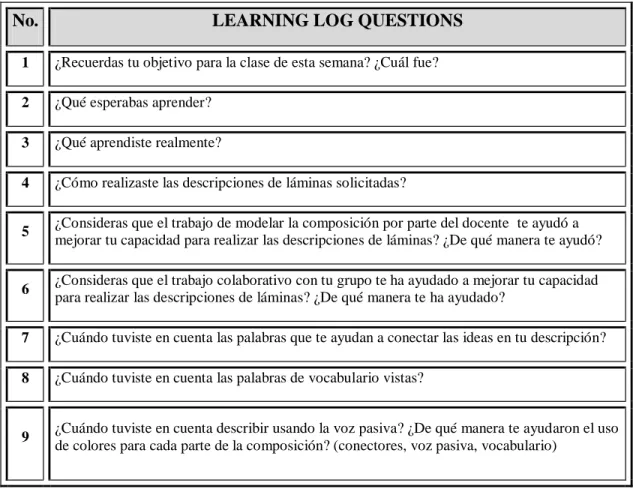
(22) the development of self-reflection. Each participant wrote eight learning logs, therefore the total number of learning log entries investigated was sufficient in to carry out the research. The learning log questions were designed specifically for the purpose of the present study:. No.. LEARNING LOG QUESTIONS. 1. ¿Recuerdas tu objetivo para la clase de esta semana? ¿Cuál fue?. 2. ¿Qué esperabas aprender?. 3. ¿Qué aprendiste realmente?. 4. ¿Cómo realizaste las descripciones de láminas solicitadas?. 5. ¿Consideras que el trabajo de modelar la composición por parte del docente te ayudó a mejorar tu capacidad para realizar las descripciones de láminas? ¿De qué manera te ayudó?. 6. ¿Consideras que el trabajo colaborativo con tu grupo te ha ayudado a mejorar tu capacidad para realizar las descripciones de láminas? ¿De qué manera te ha ayudado?. 7. ¿Cuándo tuviste en cuenta las palabras que te ayudan a conectar las ideas en tu descripción?. 8. ¿Cuándo tuviste en cuenta las palabras de vocabulario vistas?. 9. ¿Cuándo tuviste en cuenta describir usando la voz pasiva? ¿De qué manera te ayudaron el uso de colores para cada parte de la composición? (conectores, voz pasiva, vocabulario) Table 1 - Learning Log Questions. Another instrument used in order to collect data were checklists, in which the prompts helped students in becoming more strategic and systematic in their progress through the descriptive writing tasks. Data was collected until the end of the intervention process.. 22.
(23) Moreover, the researcher kept a journal, recording the most relevant information about her interpretations of the students´ learning logs and observations for academic progress in the students´ descriptive writing skill. The innovation was implemented in three main stages. The first one was the preplanning stage that consisted of one preliminary questionnaire which aimed at knowing the students´ profile, their needs, their proficiency in writing and their learning strategies. This questionnaire was applied to plan the intervention stage. (Appendix 2) After that, the participants were introduced to the learning log theory during the first week of its implementation by providing them information about the purpose of the project, the purposed methodology and some instructions on the formats they were supposed to complete. Then, a diagnosis of learners’ writing skill with a descriptive text (pre-test) was applied. After assessing student knowledge with the pre-test, the first stage of the intervention began. This stage included the learner training in skills and strategies that might promote metacognition. These skills and strategies included directing goal-setting, self-reflection, self-monitoring, self-assessment and the use of language in sequenced descriptive writing tasks. All the above mentioned tasks were related to writing self-reflections in the learning logs. Learning how to use the dictionary and being able to identify the parts of speech in a visual or picture, so that the learners could make an inventory of words needed for the writing activity (descriptive paragraphs) were complementary tasks to this first stage.. 23.
(24) The second stage of the intervention was dedicated to developing an introspective procedure which started with the data collection processes involved during the implementation of learning logs. The learners kept learning logs of their learning process, difficulties with vocabulary, the students’ writing progress and any other factors considered, which were having an effect on the learning awareness. At this stage, the teacher was modeling the construction of descriptive composition, by using the target grammar structures students were working on for their descriptive pieces. Then, students wrote descriptive paragraphs by themselves (Appendix 3). Finally, the post-test applied consisted in writing a piece of descriptive text from the same picture used for the pre-test in order to check the impact of the project. This assessment was checked through the use of a rubric (Appendix 4) During the implementation, the researcher organized the data and open coding strategies were used initially to analyze them. Data collection instruments for this implementation were applied during all eight sessions. This activity took place in order to discover explanations and to generate the final report and conclusions of the study. In terms of validation, each instrument applied was made accessible to the research circle in which the researcher participated. Additionally, the research circle counselor and the members of the research team suggested modifications, which were later made. In this way the revision and validation process examined how coherent each instrument was to answer the research question and to attain the planned research objectives. The relevance of the information was maintained in accordance with how the learning logs were collected on a regular basis, returned and treated anonymously. 24.
(25) Pedagogical implementation The pedagogical intervention aimed for students to be able: . To establish clear goals to be accomplished after their learning process, teacher´ modeling and scaffolding of the learning process.. . To develop the self-monitoring strategy by recording their reflections about the different behaviors and attitudes of their learning experiences in their learning logs.. . To increase their awareness of their strengths and weaknesses in the writing skill.. The pedagogical intervention described two procedures carried out in this study. (See appendix 5) First, the instructional design and second the steps in the implementation of learning logs. The instructional design was framed upon two teaching methods, Communicative Language Teaching (CLT) and Content and Language Integrated Learning (CLIL). Collaborative work and fostering reflection were also components of the target learning goals in each class. Content and Language Integrated Learning (CLIL) was used for the learning and teaching of both content and language in a meaningful context. A methodology for developing the writing skill based on visuals was administered for learners during eight classes. The students had work sheets with the same content (vocabulary, grammar and. 25.
(26) activities), where they had to cut out the processes to be organized and written; cardboard was provided so that they could write descriptive compositions. The instructional design is an adaptation from reflective models that focus on the theory from learning that states that learning is a constructive process (Bruner, 1990). For the implementation, the researcher planned a timeline for data collection and implementation that was divided into three stages: planning, implementing and analyzing (Appendix 5). The data collection instruments were designed taking into account the theoretical framework. At the beginning of the intervention learners established specific, short-term goals in relation to the competencies to be developed during the implementation of the learning strategy. The goals provided a standard to determine students´ progress and focused on the student´s self-efficacy and achievement, followed by the learners writing in their learning logs. There were various adjustments that were done to the design of the learning log so as to guide a better reflection on the learning process (Appendix 6) The teacher focused on the preparation tasks designed in the lesson plans which were based on the CLIL lesson plan template designed by staff members at Universidad de La Sabana. (Appendix 7) These tasks instructed the students to write descriptive texts throughout the intervention, where they gradually moved from simple texts toward more elaborated ones. During this period the teacher evaluated students’ drafts and the assessment task to verify the evolution of their writing, as it was a valuable aspect to analyze data on students´ achievement (Sagor, 2000). Students’ artifacts provided sufficient data to help the research better determine how self-efficacy for writing was evidenced.. 26.
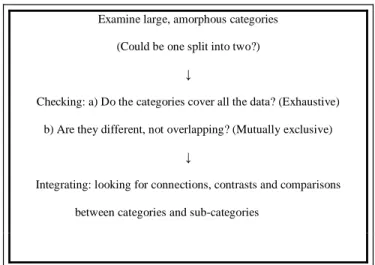
(27) A file was opened in order to store the collected information from each student. The names and identities were changed to numerical codes ranging from S1 to S13. The goals proposed were achieved and the problem was solved partially.. Data Analysis The Grounded Theory approach was the theory used to analyze data for this qualitative action research due to the fact that it offers the researcher a set of guidelines for building conceptual issues that specify the relationships among categories. (Strauss & Corbin, 1990) The analysis was based on the learning logs along with the triangulation of the data instruments. The researcher started to identify and pinpoint significant aspects from participants´ responses. (Appendix 8) The following illustration shows the flow of the data analysis procedures (Wellington, 2000): Data divided into ‘units of meaning’ ↓ Units grouped/classified into categories ↓ New units of data subsumed under these, or Used to develop new categories (Assimilation and accommodation) ↓ Search for similar categories (Could be two merged into one) ↓. 27.
(28) Examine large, amorphous categories (Could be one split into two?) ↓ Checking: a) Do the categories cover all the data? (Exhaustive) b) Are they different, not overlapping? (Mutually exclusive) ↓ Integrating: looking for connections, contrasts and comparisons between categories and sub-categories. Illustration 1- Data Analysis Procedures. The qualitative coding techniques were divided into several steps: from codes to subcategories and categories. The researcher arranged these to form explanatory patterns that allowed her come to an understanding of the phenomenon under study. It showed the system coding that consisted of an initial coding for themes that involved recognizing concepts (opinions, feelings, attitudes and behaviors) and giving them different labels by using keywords. For instance, the first code was the result of some common patterns in the data. In the second code there were categories grouped under subcategories more generalized that is simple to analyze and address the subject of study (Appendix 8). This summary is the result of data that came from different sources. To do so, data was read and revised and notes and keywords were written. Then, color-coding was used to recognize commonalities and salient categories. Finally, the researcher used index cards to write patterns of each source of data and examined how they could be matched to other presented patterns. Through this process (axial coding), categories were linked to define a core category (Corbin and Strauss, 2008).. 28.
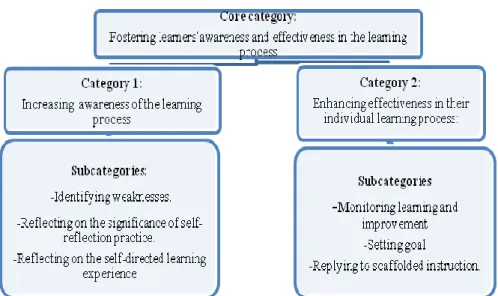
(29) The researcher identified commonalities among the instruments by reducing data by means of the identification of tendencies. In other words, these axial categories and their subcategories were related to results of the implementation of learning logs on learners´ experience. Upon the analysis of the axial categories, there were intervening circumstances that referred to the learners´ feelings, and their perceptions towards self-reflection and self-efficacy practices in a self-directed learning environment. Verification to the above interpretations was done by checking the data several times.. Findings In the process of coding the data a number of patterns were identified (e.g. building language, content language, building awareness of learning, attitudes, behaviors and selfdirected strategy as a part of the instructional design). Thus, after common patterns were organized, they resulted into a category which looked to respond to the research question. This core category had these patterns; learners had developed their awareness of the language learning process and had fostered effectiveness in their individual learning. The researcher recognized a core category that had a connection between codes and the described categories. In the present study, they are shown as follows: Core category: Fostering learners’ awareness and effectiveness in the learning process.. 29.
(30) Category 1: Increasing awareness of the learning process. Subcategory 1: Identifying weaknesses. Subcategory 2: Reflecting on the significance of self-reflection practice. Subcategory 3: Reflecting on the self-directed learning experience. Category 2: Enhancing effectiveness in their individual learning process. Subcategory 1: Monitoring learning and improvement. Subcategory 2: Setting goal Subcategory 3: Replying to scaffolded instruction.. Illustration 2- Final Categories. Core category: Fostering learners’ awareness and effectiveness in the learning process.. 30.
(31) This core category includes the main topics of the research which are learner’s awareness seen through the reflection and self-monitoring in the learning logs extracts and effectiveness in the learning process, in this project, specifically self- efficacy in the writing process. Both features worked together during the intervention. According to data analysis the first led to the second one. In order to display a detailed analysis of this core category, two categories are presented as support with the corresponding subcategories.. Category 1: Increasing awareness of the learning process: At the end of the intervention, it was evident that participants had enhanced their awareness of the learning process by expressing their weaknesses, strengths and achievements into a reflective learning and a selfdirected learning context, as the following subcategories will illustrate it.. Subcategory: Identifying weaknesses. One of the instruments that helped to identify participants ‘weaknesses in composition was the pre-test, participants wrote isolated words and few ideas in their compositions which can be seen below. Moreover, through the learning logs, learners mentioned the weakness in the aspects that needed further practice, such as vocabulary. In most cases, the comments were made in relation to contents studied in class, their difficulties, and anxieties, as it can be seen in the following excerpts:. 31.
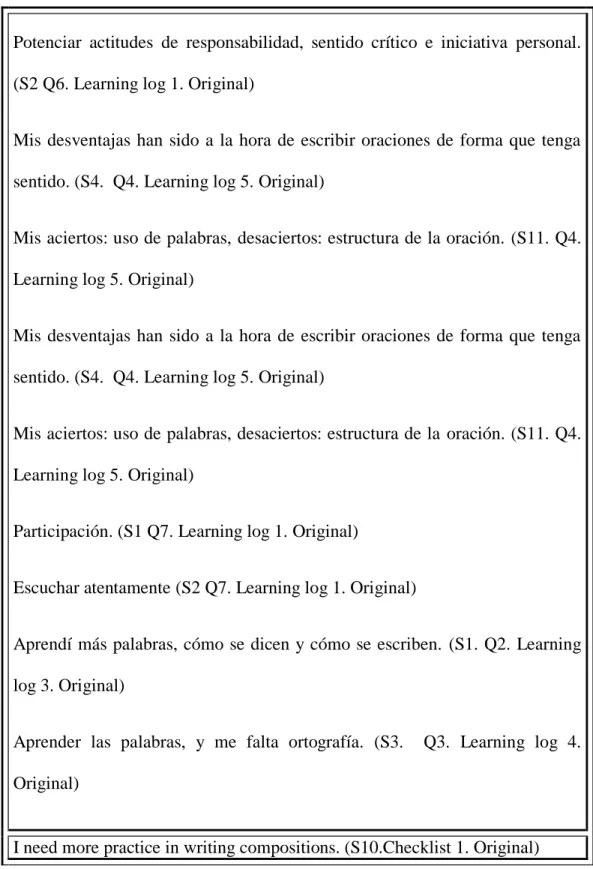
(32) Potenciar actitudes de responsabilidad, sentido crítico e iniciativa personal. (S2 Q6. Learning log 1. Original) Mis desventajas han sido a la hora de escribir oraciones de forma que tenga sentido. (S4. Q4. Learning log 5. Original) Mis aciertos: uso de palabras, desaciertos: estructura de la oración. (S11. Q4. Learning log 5. Original) Mis desventajas han sido a la hora de escribir oraciones de forma que tenga sentido. (S4. Q4. Learning log 5. Original) Mis aciertos: uso de palabras, desaciertos: estructura de la oración. (S11. Q4. Learning log 5. Original) Participación. (S1 Q7. Learning log 1. Original) Escuchar atentamente (S2 Q7. Learning log 1. Original) Aprendí más palabras, cómo se dicen y cómo se escriben. (S1. Q2. Learning log 3. Original) Aprender las palabras, y me falta ortografía. (S3.. Q3. Learning log 4.. Original). I need more practice in writing compositions. (S10.Checklist 1. Original) Table 2 - Students excerpts Criteria: Identifying weaknesses.. 32.
(33) Such increasing awareness of the learning process is important because it makes being aware of academic domains and helps them to keep focused on the learning difficulties. Therefore, awareness of this process facilitates people’s learning permanently, and in demanding tasks. These findings illustrate how students are becoming aware of their learning process by the learning logs that reviewed their weaknesses (Weinstein & Mayer, 1986). Subcategory 2: Thinking about the significance of self-reflection. Learners undertook their reflective role as it was expected in terms of their learning process because some participants expanded their level of reflection about participation in the different tasks. As seen in the comments below, thereby revealing the process participants went through. At the end of the intervention, it was evident that participants had enhanced their self-reflection practice.. Interesada y a la misma vez con ciertos nervios al saber que iba a poner en práctica mis conocimientos. . (S2. Q1. Learning log 2. Original) Nervioso y a la vez feliz, porque iba a demostrar lo que sabía del tema. (S3. Q1. Learning log 2. Original) Porque, aunque no es mucho lo que se poco a poco, siento que me defiendo más. (S11. Q2. Learning log 6. Original). 33.
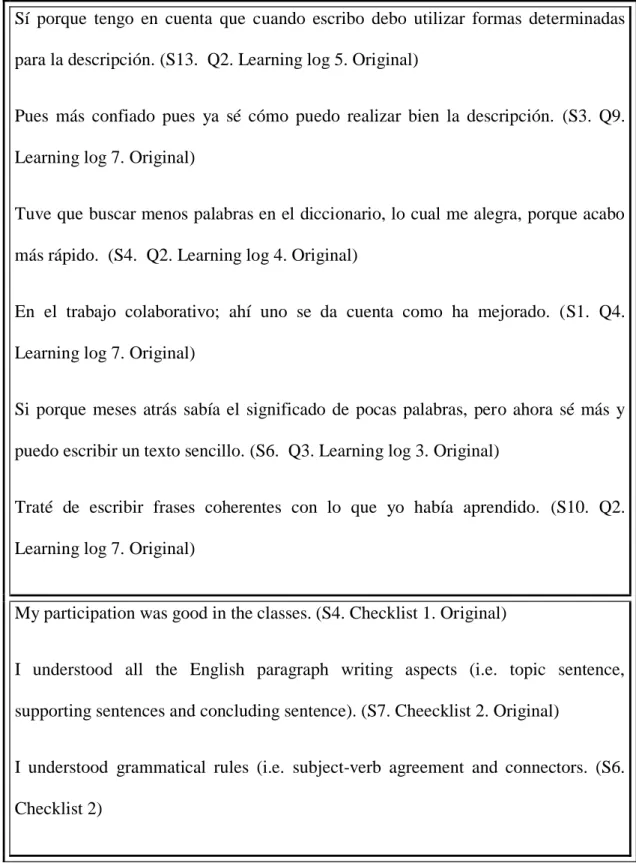
(34) Sí porque tengo en cuenta que cuando escribo debo utilizar formas determinadas para la descripción. (S13. Q2. Learning log 5. Original) Pues más confiado pues ya sé cómo puedo realizar bien la descripción. (S3. Q9. Learning log 7. Original) Tuve que buscar menos palabras en el diccionario, lo cual me alegra, porque acabo más rápido. (S4. Q2. Learning log 4. Original) En el trabajo colaborativo; ahí uno se da cuenta como ha mejorado. (S1. Q4. Learning log 7. Original) Si porque meses atrás sabía el significado de pocas palabras, pero ahora sé más y puedo escribir un texto sencillo. (S6. Q3. Learning log 3. Original) Traté de escribir frases coherentes con lo que yo había aprendido. (S10. Q2. Learning log 7. Original). My participation was good in the classes. (S4. Checklist 1. Original) I understood all the English paragraph writing aspects (i.e. topic sentence, supporting sentences and concluding sentence). (S7. Cheecklist 2. Original) I understood grammatical rules (i.e. subject-verb agreement and connectors. (S6. Checklist 2). Table 3 - Students excerpts Criteria: Thinking about. 34. the significance of self-reflection..
(35) Moon (1999) describes reflection as “a form of mental processing with a purpose and/or anticipated outcome that is applied to relatively complex or unstructured ideas for which there is not an obvious solution” (p. 23). This process forms awareness in learning, and awareness creates confidence. This is related to Eric Jensen (2008a) that says this awareness process is a relevant component of successful learning, citing Lozanov's comment, "If the learner is confident, learning increases." (p. 115). Subcategory 3: Reflecting on the self-directed learning experience. Students recognized the importance commitment and responsibility as relevant behaviors required in the self-directed learning experience. They asked for more commitment in relation to their learning process. This demonstrates that some participants’ concerns are very positive aspects. As this subcategory shows, when students worked in groups, they wrote compositions better. Participants were able to reflect on the functions of connectors in a paragraph prior to using them, this fact means that they were using strategies to write better in a self-directed context.. 35.
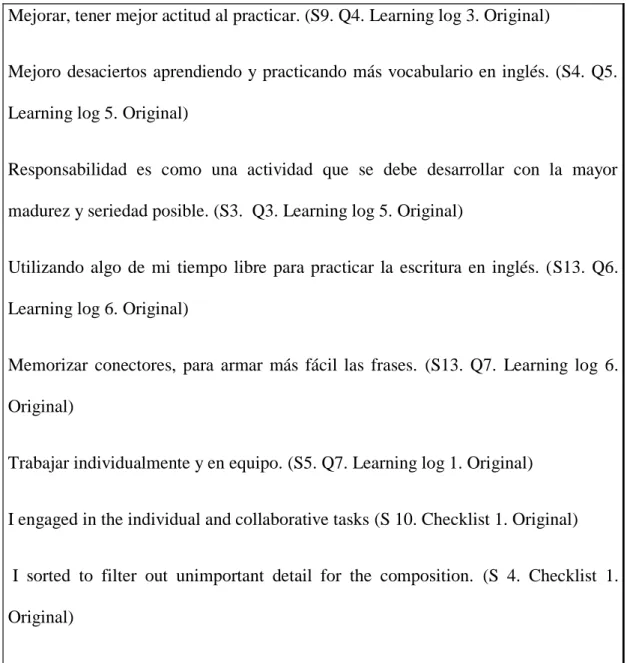
(36) Mejorar, tener mejor actitud al practicar. (S9. Q4. Learning log 3. Original) Mejoro desaciertos aprendiendo y practicando más vocabulario en inglés. (S4. Q5. Learning log 5. Original) Responsabilidad es como una actividad que se debe desarrollar con la mayor madurez y seriedad posible. (S3. Q3. Learning log 5. Original) Utilizando algo de mi tiempo libre para practicar la escritura en inglés. (S13. Q6. Learning log 6. Original) Memorizar conectores, para armar más fácil las frases. (S13. Q7. Learning log 6. Original) Trabajar individualmente y en equipo. (S5. Q7. Learning log 1. Original) I engaged in the individual and collaborative tasks (S 10. Checklist 1. Original) I sorted to filter out unimportant detail for the composition. (S 4. Checklist 1. Original). Table 4 - Students excerpts Criteria: Reflecting on the self-directed learning experience.. Benson (2001) claims that: “Self-directed learning tends to refer simply to learning that is carried out under the learner’s own direction, rather than under the direction of others” (p. 34). Referring how cooperation conducts learners to become self-directed learners, it is ironically but students cooperate with their peers. (Guthrie, Alao, & Rinehart, 1997) 36.
(37) Findings presented in the category Increasing awareness of the learning process demonstrate there was a gradual improvement in learners’ engagement in the language learning process when detecting weaknesses and using self-reflective and self-directed strategies.. Category 2: Enhancing effectiveness in their individual learning process.. It is observable that learners were monitoring their progress and following teacher’s instruction in order to reach their goals related to writing coherent descriptive paragraphs. Coherent compositions have to do with how well a learner learns to monitor his own writing process by identifying problems with writing as well as solutions to those difficulties. All thirteen respondents admit that they learned to describe better and know the compositions needed linking words. As illustrated in the rubric (Appendix 4) which was applied for the post-test, most of the students selected the accomplished rank for the organization of the text referring to main ideas, sequential details and for the item related to writing complete sentences.. Subcategory: Monitoring learning improvement This subcategory was detected in the expressions of learning behaviors and outcomes that demonstrated the progress in their learning process. As participants monitored their learning process, they felt encouraged to become more actively involved in their competence in writing. 37.
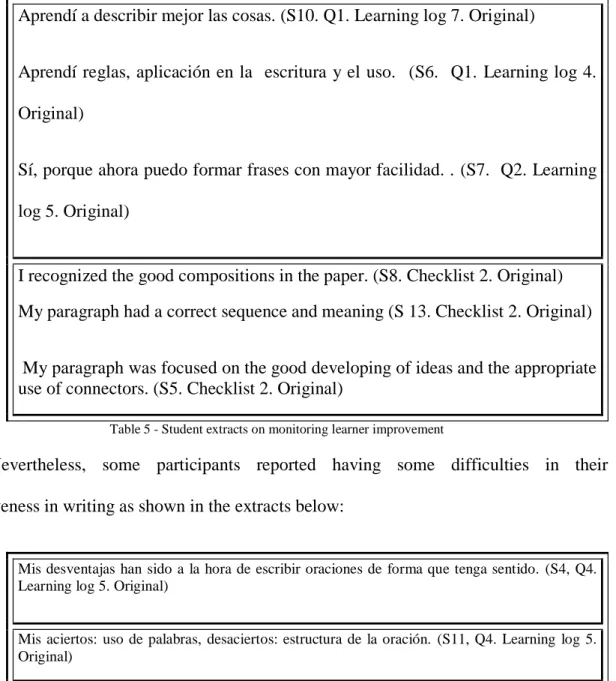
(38) Another instrument that allowed the researcher to know how profitable the work done was is the post-test, evidencing that participants could write better compositions.. Aprendí a describir mejor las cosas. (S10. Q1. Learning log 7. Original) Aprendí reglas, aplicación en la escritura y el uso. (S6. Q1. Learning log 4. Original) Sí, porque ahora puedo formar frases con mayor facilidad. . (S7. Q2. Learning log 5. Original). I recognized the good compositions in the paper. (S8. Checklist 2. Original) My paragraph had a correct sequence and meaning (S 13. Checklist 2. Original) My paragraph was focused on the good developing of ideas and the appropriate use of connectors. (S5. Checklist 2. Original) Table 5 - Student extracts on monitoring learner improvement. Nevertheless, some participants reported having some difficulties in their effectiveness in writing as shown in the extracts below:. Mis desventajas han sido a la hora de escribir oraciones de forma que tenga sentido. (S4, Q4. Learning log 5. Original). Mis aciertos: uso de palabras, desaciertos: estructura de la oración. (S11, Q4. Learning log 5. Original) Sí, porque ahora puedo formar frases con mayor facilidad. (S7, Q2. Learning log 5. Original) Table 6 - Student extracts on difficulties in effectiveness in writing. 38.
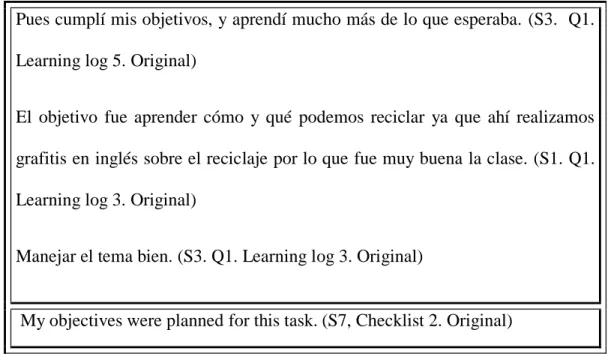
(39) These findings are coherent with Zimmerman (1998) that indicates that selfmonitoring improves self-efficacy of the learning process and this was one of the processes developed in the learning logs. In addition, self-efficacy has been described as beliefs in person´s abilities to organize the action to generate given achievements (Bandura, 1977).. This has been described in the way how. participants monitored their learning outcomes and individual progress, and how specific limitations might have encouraged the level of effectiveness in their own learning process.. Subcategory: Setting goal Students started to assume their self-directed learners’ role based on teacher’s guidelines in the learning log by stating clear goals for each lesson. Furthermore, students displayed being engaged with their learning. With the support of the learning logs they planned their own goals to be achieved. Pues cumplí mis objetivos, y aprendí mucho más de lo que esperaba. (S3. Q1. Learning log 5. Original) El objetivo fue aprender cómo y qué podemos reciclar ya que ahí realizamos grafitis en inglés sobre el reciclaje por lo que fue muy buena la clase. (S1. Q1. Learning log 3. Original) Manejar el tema bien. (S3. Q1. Learning log 3. Original). My objectives were planned for this task. (S7, Checklist 2. Original) Table 7 - Student extracts on planning goals. 39.
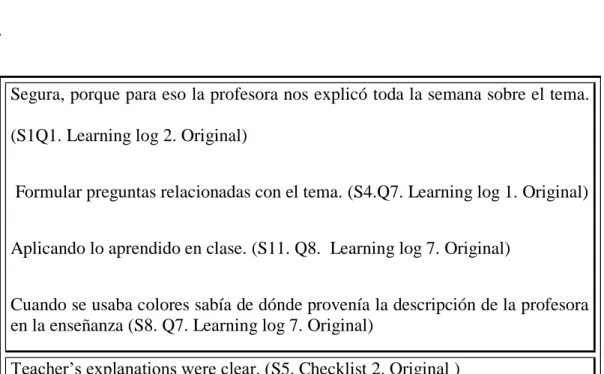
(40) Evidently, students need autonomy in their writing choices and goals. Setting goal is the key and the goals should be focused on progress (Bandura, 1997). In addition, when teachers help students identify short-term goals, they are helping learners take charge of their learning (Marshall, 2002). Subcategory: Replying to scaffolded instruction In this research project the teacher was a facilitator of the learning and tasks that took place in the classroom. It can thus be noticed that during the intervention process the teacher scaffolded the instruction, such as the fact that she explained topics required for the descriptive writing. These results show that with insight, students can demonstrate interest in learning.. Segura, porque para eso la profesora nos explicó toda la semana sobre el tema. (S1Q1. Learning log 2. Original) Formular preguntas relacionadas con el tema. (S4.Q7. Learning log 1. Original) Aplicando lo aprendido en clase. (S11. Q8. Learning log 7. Original) Cuando se usaba colores sabía de dónde provenía la descripción de la profesora en la enseñanza (S8. Q7. Learning log 7. Original) Teacher’s explanations were clear. (S5. Checklist 2. Original ) Table 8 - Student extracts on scaffolded instruction. 40.
(41) As stated by Mocker and Spear (1982), teacher’s role is important to help learners take control of their own learning process. In other words, the teacher’s influence in the learning environment may affect learners’ attitudes, effort and improvements. (Dornyei, 2002) The students were motivated to clarify doubts and asked with interest what they had to do in the collaborative work. (Extract from Teachers Journal, September 7, 2012) Findings presented in the category Enhancing effectiveness in their individual learning process participants monitored their personal improvement, set goals, and responded accurately to scaffolded instruction.. Conclusions and implications. Referring to the substantive outcomes the following aspects are established. First of all this study is beneficial to teachers and students, in view of the fact that it is concerned with improving the immediate educational environment since it involves qualitative and subjective reflection on the learning process. Writing strategies were presented as tools to develop self-monitoring. This process made students could familiarize themselves with descriptive texts. (Extract from Teachers Journal, August 24, 2012) Learning logs allow students to foster effectiveness by monitoring their own performance, identifying their weaknesses and self-reflecting on their individual 41.
(42) achievements. In other words, when students were able to recognize a weakness, their awareness of their learning process was enhanced and in the long run their level of responsibility for their learning process was also enhanced. The awareness and understanding of the students´ learning process were essential in improving the participants´ self-efficacy as they made progress on obtaining some effectiveness over their descriptive writing. In conclusion, when learning is reflected, students understand most aspects of what is required for learning, and the learning experience pushes them to greater understanding and effectiveness. An excerpt from the teacher’s journal highlights the students’ interest in writing in their learning logs.. In reference to the lesson described, it is worthwhile mentioning that it engaged the students because they were interested in writing in their learning logs without a problem. In other words their reflective space was relevant. (Extract from Teachers Journal, September 7, 2012) Table 9 - Teachers Journal. Although, participants reported having some difficulties in their effectiveness in writing at the beginning of the intervention by the end of it, the students were able to identify what was learned in terms of language and strategies referring to the process of learning English as a foreign Language (EFL). The researcher has made reflections by writing notes about the students ‘reactions to the different tasks proposed and have modified teaching according to those reflections. 42.
(43) referring to the difficulties that students have found.(Extract from Teacher´s journal, August 17, 2012) As it is observed in the discussion, learners expressed all the positive aspects that they could reflect on from working on the different proposed tasks. They felt that they could reach their goal, which was to improve writing.. I analyze the post-test and I could appreciate a better organization in the descriptive paragraph, the students have assimilated the knowledge required for developing this task efficiently. (Extract from Teachers Journal, September 7th) Table 10 - Teacher's Journal Excerpt on awareness. Pedagogical Implications As a result of this study there are various pedagogical implications to be considered: 1) supply learning logs in the learning processes where guided questions are contained that lead students’ awareness; 2) allow students to produce when they are 'ready', recognizing that improvement comes from reflecting on the learning process.; 3) look for motivation when there is lack of success or, perception of progress.; 4) help learners to identify the strategies and develop ways in which they can record their own progress.. Many different kinds of learning experiences have contributed to the perception of being more motivated in the academic setting, as opposed to the lazy reaction to work on the activities some before this intervention. (Extract from Teachers Journal, August 31, 2012) Table 11 - Teachers Journal, Learning Experience. This project is important and valuable for the institution because it increases its students’ confidence and it will be reflected in their Pruebas Saber” results. The co-workers. 43.
(44) obtain better teaching environment because this study creates good attitudes toward learning. This paper is intended to enlighten teachers on how to manipulate reflective journals as a means to improving language teaching. Recommendations for second language teachers are suggested in order to help students achieve higher writing competence. These suggestions take on the role of permanent reflection on learning which are built around learning logs. There is a need for setting goals and self-monitoring strategies as well as for the creation of solid scaffolded pedagogical strategies to encourage self-efficacy.. My intervention was thought to help my students improve their levels of writing descriptive texts in English and give them the confidence to achieve higher scores on written tests. (Extract from Teachers Journal, August 3, 2012 ). Table 12 - Teacher's Journal Excerpt on descriptive text. Although the findings in general of this research study were relevant, there were some limitations. There was a limitation related to the data collected on some of the Learning logs due to the fact that some participants did not provide enough comments. In reference to the techniques of data collection it is also necessary to consider other instruments such as the data from the interview from students on their learning experience because the students were able to express more reflections about ways of approaching learning how to write and the teacher could have guide the learning process and Learning logs questions better. Due to the limitations of the study it would be necessary to conduct further research. The above mentioned conclusions should be looked at as a starting point for further 44.
(45) investigation rather than final statements. It would be good to repeat the research in other educational contexts in order to give more reliability and to see what results will emerge. It would then be very important for future research to consider how useful Learning logs could aid in the development of the other language skills or as a way to integrate all the language skills together.. 45.
(46) REFERENCES Armstrong, P. I., & Crombie, G. (2000). Compromises in adolescents’ occupational aspirations and expectations from grades 8 to 10. Journal of Vocational Behavior, 56, 82-98. Bandura, A, (1977). Self-efficacy. Toward a unifying theory of behavior change. Psychological Review, 84, 191-251. Bandura, A. (1991a). Self-efficacy mechanism in physiological activation and healthpromoting behavior. In J. Madden, IV (Ed.), Neurobiology of learning, emotion and affect (pp. 229- 270). New York: Raven. Benson, P. (2001). Teaching and researching autonomy in language learning. Harlow: Pearson Education Limited. Blumberg, P. (2009). Developing Learner-Centered Teaching: A practical guide for faculty. San Francisco: Jossey-Bass. Boyd, E. & Fales, A. (1983). Learning: the key to learning from experience. Journal of Humanistic Psychology, 23(2), 99-117 Bruner, J. (1990). Acts of meaning. Cambridge, MA: Harvard University Press. Carr,W., & Kemmis, S. (1986). Becoming critical: Education, knowledge and action research. London: Falmer. Dornyei, Z. (2001). Teaching and researching motivation. London: Pearson Education Ltd. Flavell, J. H. (1976). Metacognitive aspects of problem solving. In L. B. Resnick (Ed.), The nature of intelligence (pp. 231-236). Hillsdale, NJ: Erlbaum. Flower, L. & Hayes, J. (1980a) The cognition of discovery: Defining a rhetorical problem. College Composition and Communication 31, 21-32. Garcia, T. & Pintrich, P.R. (1994). Regulating motivation and cognition in the classroom: The role of self-schemas and self-regulatory strategies. NJ, Hillsdale, Lawrence Erlbaum Associates. 46.
(47) Goodson, I. F., & Sikes, P. (2001). Life history research in educational settings: Learning from the lives. Buckingham, UK: Open University. Guthrie, J.T., & Alao, S. (1997). Designing contexts to increase motivation for reading. Educational Psychologist, 32, 95-105. Retrieved from http://www.readingonline.org/articles/handbook/guthrie/ Hidi, S., Berndorff, D., & Ainley, M. (2002). Children’s argument writing, interest & selfefficacy: An intervention study. Learning and Instruction. 12, 429-446. Jensen, E. (2008). Brain-based learning (2d ed.). Thousand Oaks, CA: Corwin Press. Marefat, F. (2002). The impact of diary analysis of teaching/learning writing. RELC Journal. 33 (V1): 105-110. Marshall, B. (2002). Preparing for success: A guide for teaching adult English language learners. Washington, D.C.: Center for Applied Linguistics & Delta Systems. Martinez, M. E. (2006). What is metacognition? Phi Delta Kappan, V87, N9, P696-699, May 2006. Mehisto, P, Marsh, D., Frigols, M. (2008). Uncovering CLIL, Content and Language Integrated Learning in bilingual and multilingual education. Oxford: Macmillan. Moon, J. (1999). A handbook of reflective and experiential learning. London: Routledge.. Multon, K. D., Brown, S. D. & Lent, R. W. (1991). Relation of self-efficacy beliefs to academic outcomes: A meta-analytic investigation. Journal of Counseling Psychology, 38, 30-38. Myers, M.D. (2007). Qualitative Research in Information Systems. MIS Quarterly, 21(2), 241-242. Pajares, F. (2003). Self-efficacy beliefs, motivation, and achievement in writing: A review of the literature. Reading & Writing Quarterly, 19, 139-158 Pajares, F. (2002). Self-efficacy beliefs in academic contexts: An outline. Retrieved from http://www.uky.edu/~eushe2/Pajares/efftalk.html 47.
(48) Pajares, F., & Johnson, M.J. (1994). Confidence and competence in writing: The role of writing self-efficacy, outcome expectancy and apprehension. Research in the Teaching of English (RTE), 28, 313-331. Pajares, F., & Valiante, G. (1997). Influence of writing self-efficacy beliefs on the writing performance of upper elementary students. Journal of Educational Research, 90, 353-360. Pajares, F., Miller, M.D., & Johnson, M.J. (1999). Gender differences in writing self-beliefs of elementary school students. Journal of Educational Psychology, 91, 50-61. Pajares, F. and Valianate, G. (2001). Influence of self-efficacy on elementary students’ writing. The Journal of Educational Research. 90 (6), 353-360. Pritchard, R.J., & Honeycutt, R.L. (2006). The process approach to writing instruction: Examining its effectiveness. In C.A. MacArthur, S. Graham, & J. Fitzgerald (Eds.), Handbook of writing research (pp. 275–290). New York: Guilford. Race, P (2002) Evidencing reflection: putting the 'w' into reflection (ESCALATE Learning Exchange) Retrieved from http://escalate.ac.uk/resources/reflection/04.html Richards, J. & Rogers, T., 2001. Approaches and methods in language teaching. Second Edition. New York: Cambridge University Press. Risemberg, R., & Zimmerman, B.J. (1992). Self-regulated learning in gifted students. Roeper Review, 15 (2), 98-101. Sagor, R. (2000). Guiding school improvement with action research. Alexandria, VA: Association for Supervision and Curriculum Development. Savin-Baden, M. & Major, C.H. (2004) Foundations of Problem-based learning. Buckingham: SRHE/Open University Press. Schunk, D. H. (2001). Social cognitive theory and self-regulated learning. Mahwah, NJ: Lawrence Erlbaum Associates, Inc. Schunk, D. H., & Swartz, C. W. (1993). Goals and progress feedback: Effects on selfefficacy and writing achievement. Contemporary Educational Psychology, 18, 337– 354 48.
(49) Strauss, A., Corbin, J. (1990). Basics of Qualitative Research: Grounded Theory, Procedures and Techniques. Newbury Park, CA: Sage Publications. Templin, S.A. (1999). The relationship between self-efficacy and language learners’ grades. JALT Journal, 21 (1), 112-124. Wenden, A. (1995). Learner training in context: A Knowledge-Based approach. In L. Dickinson and A. Wenden (Eds.) Special Issue on Autonomy System 23:2:183-194. Wellington, J. (2000). Educational research: Contemporary issues and practical approaches. London: Continuum. Whitebread, D., Coltman, P., Pasternak, D. P., Sangster, C., Grau, V., Bingham, S.,Almeqdad, Q., & Demetriou, D. (2009). The development of two observational tools for assessing metacognition and self-regulated learning in young children. Metacognition and Learning, 4(1), 63-85. Zimmerman, B.J., & Risemberg, R. (1997). Becoming a self-regulated writer: A social cognitive perspective. Contemporary Educational Psychology, 22, 73-101. Zimmerman, B. J. & Bandura, A. (1994). Impact of self- regulatory influences on writing course attainment. American Educational Research Journal, 31, 845-862. Zimmerman, B. J., Bandura, A. & Martinez-Pons, M. (1992). Self-motivation for academic attainment: The role of self-efficacy beliefs and personal goal setting. American Educational Research Journal, 29, 663-676. Zimmerman, B.J., & Schunk, D.H. (1989). Self- regulated learning and academic achievement: Theory, Research, and Practice. New York: Springer.. 49.
(50) APPENDIX 1 CONSENT LETTERS. 50.
(51) APPENDIX 2 QUESTIONNAIRE FOR NEEDS ANALYSIS. NEEDS ANALYSIS QUESTIONNAIRE: Learnig Logs and self-regulatory process. Speciality: Academic High School. Date:. Area: WRITING. OBJECTIVE: To get knowledge what you know about: “learning Logs” and the characteristics you have to improve to be applied. 1. Personal background Sex. Age. Level of English before the entrance to this school. Current level of English according to CEF scale A1. How much t knowledge did you have in writing Learning Logs before this project? Tick √ an appropriate line ___ very much ___ basic knowledge ____none. _____ not much. 2. Interest, importance Are you interested in learning how to use learning logs? Yes, very much. Yes. Not much. Not interested at all. How important do you think learning logs is in improvement your writing skill? Very important. Average important as. No important. 3. Feedback to study content (LEARNING LOGS) Topic. very useful. Writing summarizes in your own words any kind of content Discussing in detail what you think you learn, and possibly how you learn it. Describing which idea is the most challenging for you to understand. And explaining why you find it difficult. 51. Useful. not useful.
Figure
+6
Documento similar
No obstante, como esta enfermedad afecta a cada persona de manera diferente, no todas las opciones de cuidado y tratamiento pueden ser apropiadas para cada individuo.. La forma
The objectives of this study were, first, to develop a questionnaire allowing, first, to assess the kind of messages through which students self-regulate their learning on the
Figure 7 presents the forest plot for the 27 effect sizes of self-assessment interventions for self-efficacy. These results support the positive effect of self-assessment
A Youth Club that is created on the basis of a participation structure that looks after the participatory self-enhancement of the people involved generates a process of learning
The data for learning self-regulation (higher values in this variable mean that the students used more strategies oriented to learning goals) is coming from the
which has been designed to stimulate interest and learning ability of students through the use of technologies that are familiar and particularly attractive
The Council for Transparency and Good Governance of Spain, with the State Agency for Evaluation of Public Policies and Quality of Services (AEVAL), has developed a
This descriptive analysis of the presence of proximity cyber media in social networks has showed us that the use of social media (as in the case of somosmalasana.com and
