S H O R T G E N O M E R E P O R T
Open Access
Draft genome sequence of
chloride-tolerant
Leptospirillum ferriphilum
Sp-Cl
from industrial bioleaching operations in
northern Chile
Francisco Issotta
1, Pedro A. Galleguillos
2,3*, Ana Moya-Beltrán
1, Carol S. Davis-Belmar
4, George Rautenbach
4,
Paulo C. Covarrubias
1,5, Mauricio Acosta
2, Francisco J. Ossandon
1, Yasna Contador
2, David S. Holmes
1,5,
Sabrina Marín-Eliantonio
2, Raquel Quatrini
1,5and Cecilia Demergasso
2,3*Abstract
Leptospirillum ferriphilum
Sp-Cl is a Gram negative, thermotolerant, curved, rod-shaped bacterium, isolated from an
industrial bioleaching operation in northern Chile, where chalcocite is the major copper mineral and copper
hydroxychloride atacamite is present in variable proportions in the ore. This strain has unique features as compared
to the other members of the species, namely resistance to elevated concentrations of chloride, sulfate and metals.
Basic microbiological features and genomic properties of this biotechnologically relevant strain are described in this
work. The 2,475,669 bp draft genome is arranged into 74 scaffolds of 74 contigs. A total of 48 RNA genes and 2,834
protein coding genes were predicted from its annotation; 55 % of these were assigned a putative function. Release
of the genome sequence of this strain will provide further understanding of the mechanisms used by acidophilic
bacteria to endure high osmotic stress and high chloride levels and of the role of chloride-tolerant iron-oxidizers in
industrial bioleaching operations.
Keywords:
Leptospirillum ferriphilum
, Acidophilic, Iron oxidizing, Thermotolerant, Chloride tolerant, Bioleaching,
Secondary copper sulfides, Atacamite
Introduction
Extremely acidophilic leptospirilli exhibit considerable
physiological and genetic variation [1] and have been
clas-sified into four species groups according to 16S rRNA
phylogeny [2
–
4]. Group I is represented by
Leptospirillum
ferrooxidans
, Group II by
L. ferriphilum
and Group III by
“L. ferrodiazotrophum”
[5, 6]
.
Recently, metagenomic
evidence has supported the recognition of a new species
ascribed to Group IV [7].
As all leptospirilli, Group II members are aerobic and
obligatly chemolithotrophic, ferrous iron oxidizing
bac-teria. However, they differ from the other groups in their
G + C molar ratios, the number of copies of
rrn
genes
and the size of 16S-23S rRNA gene spacers, as well as in
their capacity to grow at 45 °C [5].
L. ferriphilum
has been shown to be the dominant
microorganism in commercial biooxidation tanks in
South Africa [5] and in PLS from heap bioleaching
pro-cesses in Chile [8
–
10].
L. ferriphilum
Sp-Cl is a key
bio-logical member in industrial biomining applications,
becoming the most abundant or even the exclusive
microorganism in certain stages of processes involving
ferrous iron oxidation [11, 12]. Competitive growth of
L.
ferriphilum
Sp-Cl has been explained by the elevated
temperature, particular electrochemical conditions and
certain metal concentrations that develop during mineral
leaching.
Leptospirillum
group II spp. have also been
documented to act as the dominant primary producers
on floating biofilms obtained from the Richmond Mine
at Iron Mountain in USA [13, 14].
* Correspondence:[email protected];[email protected]
2
Centro de Biotecnología“Profesor Alberto Ruiz”, Universidad Católica del Norte, Antofagasta, Chile
Full list of author information is available at the end of the article
The genomes of three isolates of
L. ferriphilum
are
available: the draft genome of the type strain DSM
14647 obtained from an acid mine drainage in Peru [15],
the complete genome of strain ML04 isolated from
acidic water near a hot spring in China [16] and the
complete genome of strain YSK [NCBI NZ_CP007243]
isolated from an acid mine drainage in China. In addition,
draft genomes for other three Group II members,
‘
C75
’
[13],
‘
5-way CG
’
[17, 18] and
‘L. rubarum’
[19] have been
derived from metagenomic studies of acid mine drainages
in the USA, together with several genomic variants
emerging on short time evolutionary scales [13].
This work reports the microbiological and genomic
properties of the first industrial isolate of
L. ferriphilum.
Strain Sp-Cl (DSM 22399) was isolated from the
leach-ing solutions drainleach-ing from bioleachleach-ing heaps at the
Spence mine located in the Atacama Desert (northern
Chile), where chalcocite is the major copper mineral
and copper hydroxychloride atacamite [Cu
2Cl(OH)
3] is
present in variable proportions in the ore. The
dissol-ution of atacamite is the main source of chloride in the
PLS of the leaching process at Spence mine, which
ranges between 1.5 and 12.5 g L
−1. The isolation of this
industrially important, chloride tolerant, iron oxidizing
acidophile is highly significant for both basic and
ap-plied reasons, being a relevant model for chloride
leaching studies.
Organism information
Classification and features
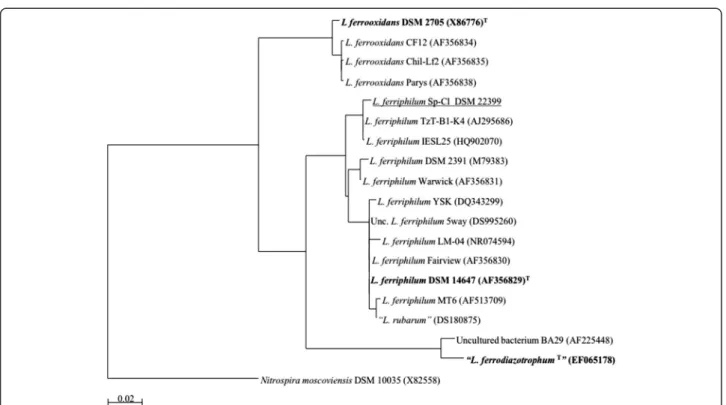
Phylogenetic analysis of the 16S rRNA gene sequence of
the isolate Sp-Cl, and other 17 isolates and/or clones
representing currently recognized leptospirilli groups
and species, revealed its close relation to
L. ferriphilum
(Fig. 1).
L. ferriphilum
Sp-Cl cells are morphologically
very similar to other
L. ferriphilum
strains described
pre-viously [5, 15]. Sp-Cl cell are small sized (0.3 to 0.9
μ
m),
curved rods (Fig. 2), depending on the culture state. The
Gram stain for the Sp-Cl is consistently negative and a
single polar flagellum enables its motility.
Like other known strains of the species, the Sp-Cl
iso-late utilizes ferrous iron as an energy source, but neither
sulfur nor RISCs can be oxidized with energy
conserva-tion. It is also able to fix inorganic carbon (CO
2) and
ni-trogen (N
2) [20, 21]. The pH for growth ranges from 1.3
to 2.0 and the registered highest tolerated temperature is
45 °C, with an optimum between 30 and 37° (Table 1).
Previous work on related
L. ferriphilum
strains has
con-firmed the greater tolerance to copper, silver and sulfate
by this species as compared to
L. ferrooxidans
and
‘L.
ferrodiazotrophum’
members [10, 16, 22]. In addition,
L. ferriphilum
Sp-Cl has shown notable resistance to
chloride (Cl
−) and iron concentrations being able to oxidize
ferrous iron (3 g/L) in the presence of Cl
−(12 g/L), making
it a candidate for bioleaching with proportions of seawater
Fig. 1Phylogenetic affiliation of 16S rRNA gene sequences highlighting the position ofL. ferriphilumstrain Sp-Cl (underlined) relative to other
type strains (bold) and non-type strains within the genusLeptospirillum. Database accession numbers are indicated between brackets (type strains =T).
[11, 12], which is an attractive opportunity in arid areas
such as northern Chile and parts of Australia, or for
chal-copyrite chloride leaching [23].
Genome sequencing information
Genome project history
The organism was selected for sequencing on the basis of
its phylogenetic position and 16S rRNA similarity to
mem-bers of the genus
Leptospirillum
. This Whole Genome
Shotgun project has been deposited at GenBank under the
accession LGSH00000000 [24]. The version described in
this paper is the first version, LGSH01000000. Table 2
presents the project information and its association
with MIGS version 2.0 compliance [25].
Growth conditions and genomic DNA preparation
Leptospirillum ferriphilum
strain Sp-Cl (DSM 22399),
was isolated from the PLS draining from a bioleaching
Fig. 2Confocal image of a culture ofL. ferriphilumstrain Sp-Cl stained with DAPI (4',6-diamidino-2-phenylindole)
Table 1
Classification and general features of
Leptospirillum ferriphilum
Sp-Cl according to the MIGS recommendations [22]
MIGS ID Property Term Evidence codea
Classification DomainBacteria TAS [38]
Phylum“Nitrospirae” TAS [38]
Class“Nitrospira” TAS [38]
Order“Nitrospirales” TAS [38] Family“Nitrospiraceae” TAS [1,38]
GenusLeptospirillum TAS [39]
SpeciesLeptospirillum ferriphilum TAS [5]
Strain Sp-Cl TAS [5]
Gram stain Negative TAS [5]
Cell shape Curved rod IDA
Motility Motile TAS [5]
Sporulation Non-spore forming TAS [5]
Temperature range 25° to 45 °C NAS
Optimum temperature 30° to 37 °C NAS
pH range, optimum 1.3 to 2.0; NA IDA
Carbon source CO2 IDA
MIGS-6 Habitat chloride, metal-rich and acidic environment IDA
MIGS-6.3 Salinity 0-12 g/L Cl- IDA
MIGS-22 Oxygen requirement Aerobic TAS [5]
MIGS-15 Biotic relationship Free-living IDA
MIGS-14 Pathogenicity None TAS [5,22]
MIGS-4 Geographic location Spence mine, Atacama Desert, Chile IDA
MIGS-5 Sample collection 2007 IDA
MIGS-4.1 Latitude 22°.81 S IDA
MIGS-4.2 Longitude 69°.26 W IDA
MIGS-4.4 Altitude 1700 IDA
a
heap at Spence mine, in the Antofagasta Region, Chile.
The enrichment and isolation was performed at the
Biotechnology Center (CBAR-UCN). Enrichment was
performed using a PLS sample as inoculum followed by
se-quential dilutions and finally the culture was streaked on
ABS solid media [26]. After repeated streaking of
individ-ual colonies growing on solid media an individindivid-ual colony,
designated Sp-Cl, was transferred to liquid medium.
The Sp-Cl strain was grown at 37 °C in liquid ABS
medium (pH 1.5) containing 50 mM Fe2+ on an orbital
shaker at 150 rpm. The DNA was isolated from cells
collected on a nitrocellulose filter (0.22
μ
m pore), using a
High Pure PCR Template Preparation kit according to the
manufacturer
’
s instructions (Roche, Germany). The total
amount of DNA was 10.4
μ
g (measured by Pico green
assay). The quality of the DNA was assessed by agarose
gel electrophoresis (0.8 % w/v).
Genome sequencing and assembly
The genome of
L. ferriphilum
strain Sp-Cl was sequenced
at Beckman Coulter Genomics using 454 sequencing
technology and mate pair libraries with insert sizes of
~500 bp [27]. Pyrosequencing reads were assembled
de
novo
using Newbler (v2.0.00.22). The final draft assembly
contained 74 contigs in 74 scaffolds. The total size of the
genome is ~2,5 Mbp and the final assembly is based on 61
Mbp of 454 data, which provides an average 20 × coverage
of the genome.
Table 2
Project information
MIGS ID Property Term
MIGS 31 Finishing quality Draft
MIGS-28 Libraries used GS FLX Titanium paired end libraries
MIGS 29 Sequencing platforms Roche 454 GS FLX
MIGS 31.2 Fold coverage 20 ×
MIGS 30 Assemblers Newbler 2.0.00.22
MIGS 32 Gene calling method Glimmer 3.02
Locus Tag LGSH01000001-LGSH01000074
Genbank ID LGSH00000000
GenBank Date of Release 31-12-2015
GOLD ID Gp0119878
BIOPROJECT PRJNA290892
MIGS 13 Source Material Identifier PLS-Parcela-21
Project relevance Biomining, Tree of Life
Table 3
Genome statistics
Attribute Value % of Totala
Genome size (bp) 2,475,669 100.00
DNA coding (bp) 2,270,652 91.71
DNA G + C (bp) 1,347,012 54.41
DNA scaffolds 74 100.00
Total genesb 2,882 100.00
Protein coding genes 2,834 99.33
RNA genesc 48 1.66
Pseudo genesd NA NA
Genes in internal clusters 1,294 45.65
Genes with function prediction 1,631 56.59
Genes assigned to COGs 1,239 41.83
Genes with Pfam domains 1,778 61.69
Genes with signal peptides 221 7.66
Genes with transmembrane helices 633 21.96
CRISPR repeats 0 0.00
a) The total is based on either the size of the genome in base pairs or the total number of genes in theannotated genome.
b) Includes tRNA, tmRNA, rRNA. c) Includes 23S, 16S and 5S rRNA. d) n.d.: not determined
Table 4
Number of genes associated with general COG
functional categories
Code Value % agea Description
J 133 4.69 Translation, ribosomal structure and biogenesis
A 1 0.03 RNA processing and modification
K 51 1.79 Transcription
L 71 2.50 Replication, recombination and repair
B 1 0.03 Chromatin structure and dynamics
D 14 0.49 Cell cycle control, Cell division, chromosome partitioning
V 27 0.95 Defense mechanisms
T 100 3.53 Signal transduction mechanisms
M 98 3.45 Cell wall/membrane biogenesis
N 50 1.76 Cell motility
U 23 0.81 Intracellular trafficking and secretion
O 59 2.08 Posttranslational modification, protein turnover, chaperones
C 79 2.78 Energy production and conversion
G 55 1.94 Carbohydrate transport and metabolism
E 109 3.85 Amino acid transport and metabolism
F 50 1.74 Nucleotide transport and metabolism
H 93 3.28 Coenzyme transport and metabolism
I 41 1.44 Lipid transport and metabolism
P 54 1.91 Inorganic ion transport and metabolism
Q 9 0.31 Secondary metabolites biosynthesis, transport and catabolism
R 62 2.18 General function prediction only
S 36 1.27 Function unknown
- 1595 58.17 Not in COGs
a
Genome annotation
Genes were identified using Glimmer 3.02 [28] as part of
the RAST annotation pipeline [29]. The tRNA and
tmRNA identification was achieved using ARAGORN
v1.2.36 [30] and the rRNA prediction was carried out via
HMMER3 [31]. Additional gene prediction analysis and
functional annotation was performed at the Center for
Bioinformatics and Genome Biology and at the Center
for Biotechnology. The predicted CDSs were used to
search the National Center for Biotechnology
Informa-tion non-redundant database, UniProt, TIGRFam, Pfam,
PRIAM, KEGG, COG and InterPro databases. Protein
Fig. 3COG functional categories profiles in sequencedL. ferriphilumgenomes. Values are expressed as percentages of the total protein
complement of each strain. In black the Sp-Cl strain, in dark grey the ML-04 strain, in light grey the YSK strain and in white the type strain DSM 14647. COG categories codes for genes with assigned function are detailed in Table 4. W: Extracellular structures
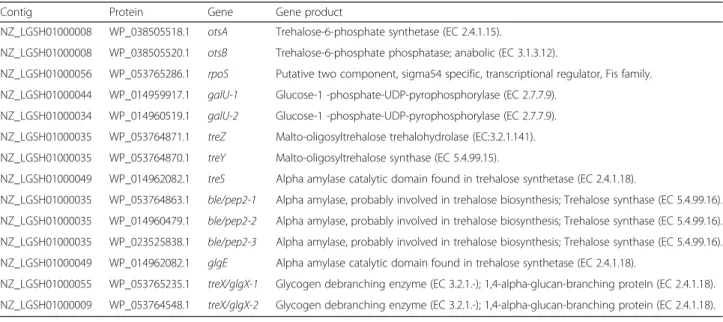
Table 5
Putative genes involved in threhalose synthetic pathway found in
L. ferriphilum
Sp-Cl genome (source NCBI)
Contig Protein Gene Gene product
NZ_LGSH01000008 WP_038505518.1 otsA Trehalose-6-phosphate synthetase (EC 2.4.1.15).
NZ_LGSH01000008 WP_038505520.1 otsB Trehalose-6-phosphate phosphatase; anabolic (EC 3.1.3.12).
NZ_LGSH01000056 WP_053765286.1 rpoS Putative two component, sigma54 specific, transcriptional regulator, Fis family.
NZ_LGSH01000044 WP_014959917.1 galU-1 Glucose-1 -phosphate-UDP-pyrophosphorylase (EC 2.7.7.9).
NZ_LGSH01000034 WP_014960519.1 galU-2 Glucose-1 -phosphate-UDP-pyrophosphorylase (EC 2.7.7.9).
NZ_LGSH01000035 WP_053764871.1 treZ Malto-oligosyltrehalose trehalohydrolase (EC:3.2.1.141).
NZ_LGSH01000035 WP_053764870.1 treY Malto-oligosyltrehalose synthase (EC 5.4.99.15).
NZ_LGSH01000049 WP_014962082.1 treS Alpha amylase catalytic domain found in trehalose synthetase (EC 2.4.1.18).
NZ_LGSH01000035 WP_053764863.1 ble/pep2-1 Alpha amylase, probably involved in trehalose biosynthesis; Trehalose synthase (EC 5.4.99.16).
NZ_LGSH01000035 WP_014960479.1 ble/pep2-2 Alpha amylase, probably involved in trehalose biosynthesis; Trehalose synthase (EC 5.4.99.16).
NZ_LGSH01000035 WP_023525838.1 ble/pep2-3 Alpha amylase, probably involved in trehalose biosynthesis; Trehalose synthase (EC 5.4.99.16).
NZ_LGSH01000049 WP_014962082.1 glgE Alpha amylase catalytic domain found in trehalose synthetase (EC 2.4.1.18).
NZ_LGSH01000055 WP_053765235.1 treX/glgX-1 Glycogen debranching enzyme (EC 3.2.1.-); 1,4-alpha-glucan-branching protein (EC 2.4.1.18).
coding genes were analyzed for signal peptides using
SignalP v4.1 [32] and transmembrane helices using
TMHMM v2.0 [33].
Genome properties
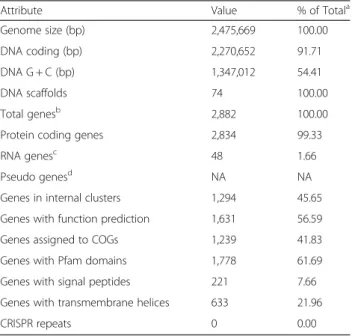
The draft genome size is 2,475,669 nucleotides, with an
average G + C content of 54.41 % (Table 3). From a total
of 2,882 genes, 2,834 were protein coding genes and 48
are RNA genes. A total of 41.83 % of the genes were
assigned a putative function while the remaining ones
were annotated as hypotheticals. The distribution of
genes into COGs functional categories for
L. ferriphilum
Sp-Cl is presented in Table 4 and its comparison against
the other sequenced
L. ferriphilum
genomes is presented
in Fig. 3.
Insights from the genome sequence
Genomic analysis of
L. ferriphilum
strains Sp-Cl allowed
several genes involved in the three known trehalose
bio-synthetic pathways in bacteria to be identified (Table 5):
GalU-OtsA-OtsB (I); TreY-TreZ-TreX (V) and TreS (IV)
[34, 35]. Genes of IV and V synthetic pathways, considered
as less-prominent routes for trehalose synthesis [36], were
found in the genomes of
L. ferriphilum
DSM 14647
T, and
strains Sp-Cl and LF-ML04 in similar genomic contexts as
well as in
A. ferrooxidans
. Similar organization has
previ-ously found in
Achromobacter xylosoxidans
and
Ralstonia
eutropha
H16 (NCBI accession numbers NC_023061.1
and NC_008313.1, respectively), suggesting co-regulation
between both pathways. The enzyme encoded by TreS
can also produce maltose from either glycogen or
malto-oligosaccharides and therefore TreS could also have
glycogen debranching enzyme activity [36] and possibly
maintain trehalose in equilibrium depending upon the
osmotic requirement. In addition, another gene for a
trehalose synthetase (Ble/Pep2) protein was located in
the same genomic context in
L. ferriphilum
and strains
Sp-Cl and LF-ML04 (Table 5) next to a gene for a
malto-syltransferase (GlgE) in a similar configuration shown
previously [34].
Recently, genes for both trehalose and ectoine
bio-synthetic pathways were identified in the draft
gen-ome of the
L. ferriphilum
type strain DSM 14647
[15]. Transcriptomic studies of
L. ferrooxidans
strain
L3.2 (isolated from the Rio Tinto, Spain) have pinpointed
genes involved in the synthesis of trehalose, ectoine and
systems for the transport of potassium in response to the
increase of sulfate [37]. In addition, all of the components
involved in trehalose and ectoine synthetic pathways
have been identified in proteomic analysis performed
in biofilms populated by
L. ferriphilum
and
‘L.
ferro-diazotrophum’
[19].
Conclusions
The 2.4 Mbp draft genome sequence of
L. ferriphilum
strain Sp-Cl is arranged in 74 high quality scaffolds,
re-sembling in size the type strain DSM 14647 and the
Chinese strain ML-04. It encodes 2,834 protein-coding
genes, 42 % of which were assigned putative functions,
exceeding the predicted gene content of the type strain,
the ML-04 strain and the YSK strain, and suggesting
re-cent acquisition of additional functions. A total of 48
RNA genes partitioned into 44 tRNAs, 1 tmRNA and 1
rRNA operon. The most abundant COG functional
cat-egory in
L. ferriphilum
strain Sp-Cl and all sequenced
strains of the species were translation, ribosomal structure
and biogenesis (J), amino acid and transport metabolism
(E) and cell wall and cell membrane biogenesis (M).
Re-lease of the genome sequence of this strain will provide
further understanding of the mechanisms used by
acido-philic bacteria to endure high osmotic stress and high
chloride levels and of the role of chloride-tolerant
iron-oxidizers in industrial bioleaching operations.
Abbreviations
PLS:pregnant leach solutions; RISCs: reduced inorganic sulfur compounds.
Competing interests
The authors declare that they have no competing interests.
Authors’contributions
CSDB and GR provided the samples from the Spence mine and performed the enrichment. MAG and YC conducted the isolation and the
microbiological characterization of the isolate. SME maintained the culture and purified genomic DNA. CD, RQ and DSH performed the sequencing. FI, AMB and FJO did the assembly and annotation. PCC and RQ curated the annotation. PAG did the phylogenetic analysis. CD, PAG and RQ conceived the study, and drafted and reviewed the manuscript. All authors read and approved the final manuscript.
Acknowledgements
This work was performed under the auspices of the following projects: Innova CORFO 08CM01-03, Joint BHP Billiton-UCN-FCV Phase I, Fondef D04i1169 and IT13I20042, Fondecyt 1140048, 1130683 and 3140005. We would like to acknowledge Dr. Francisco Remonsellez, Dr. Cristina Dorador, Dr. Lincoyán Ainol and Mónica Gonzales for technical assistance.
Author details
1Fundación Ciencia & Vida, Santiago, Chile.2Centro de Biotecnología
“Profesor Alberto Ruiz”, Universidad Católica del Norte, Antofagasta, Chile. 3Centro de Investigación Científica y Tecnológica para la Minería, Antofagasta, Chile.4BHP Billiton Chile, Santiago, Chile.5Facultad de Ciencias Biologicas, Universidad Andres Bello, Santiago, Chile.
Received: 14 September 2015 Accepted: 12 December 2015
References
1. Daims H. 59 The FamilyNitrospiraceae. In: Rosenberg, Eugene DeLong EF, Lory S, Stackebrandt E, Thompson F, editors. The Prokaryotes. Other Major Lineages of Bacteria and The Archaea. Fourthth ed. Berlin Heidelberg: Springer; 2014. 2. Harrison Jr AP, Norris PR.Leptospirillum ferrooxidansand similar bacteria:
some characteristics and genomic diversity. FEMS Microbiol Lett. 1985. http://www.sciencedirect.com/science/article/pii/0378109785903726. 3. Sand W, Rhode K, Sobotke B, Zenneck C. Evaluation ofLeptospirillum
4. Bond PL, Banfield JF. Design and Performance of rRNA Targeted
Oligonucleotide Probes for in Situ Detection and Phylogenetic Identification of Microorganisms Inhabiting Acid Mine Drainage Environments. Microb Ecol. 2001. http://link.springer.com/article/10.1007%2Fs002480000063. 5. Coram NJ, Rawlings DE. Molecular relationship between two groups of the
genusLeptospirillumand the finding thatLeptospirillum ferriphilumsp. nov. dominates South African commercial biooxidation tanks that operate at 40 °C. Appl Environ Microbiol. 2002. http://dx.doi.org/10.1128/AEM.68.2.838-845.2002. 6. Tyson GW, Lo I, Baker BJ, Allen EE, Hugenholtz P, Banfield JF.
Genome-directed isolation of the key nitrogen fixerLeptospirillum ferrodiazotrophum
sp. nov. from an acidophilic microbial community. Appl Environ Microbiol. 2005. http://dx.doi.org/10.1128/AEM.71.10.6319-6324.2005.
7. Aliaga-Goltsman DS, Dasari M, Thomas BC, Shah MB, VerBerkmoes NC, Hettich RL, Banfield JF. New group in theLeptospirillumClade: cultivation-independent community genomics, proteomics, and transcriptomics of the new species“LeptospirillumGroup IV UBA BS”. Appl Environ Microbiol. 2013. http://dx.doi.org/10.1128/AEM.00202-13.
8. Demergasso CS, Galleguillos PA, Escudero LV, Zepeda VJ, Castillo D, Casamayor E. Molecular characterization of microbial populations in a low-grade copper ore bioleaching test heap. Hydrometallurgy. 2005. http://dx.doi.org/10.1016/j.hydromet.2005.07.013.
9. Demergasso CS, Galleguillos F, Soto P, Serón M, Iturriaga V. Microbial succession during a heap bioleaching cycle of low-grade copper sulfides: does this knowledge mean a real input for industrial process design and control? Hydrometallurgy. 2010. http://dx.doi.org/10.1016/j.hydromet.2010.04.016. 10. Galleguillos PA, Hallberg KB, Johnson DB. Microbial diversity and genetic
response to stress conditions of extremophilic bacteria isolated from the Escondida copper mine. Adv Mater Res. 2009. http://dx.doi.org/10.4028/ www.scientific.net/AMR.71-73.55.
11. Davis-Belmar CS, Cautivo D, Demergasso C, Rautenbach G. Bioleaching of copper secondary sulfide ore in the presence of chloride by means of inoculation with chloride-tolerant microbial culture. Hydrometallurgy 2014. http://dx.doi.org/10.1016/j.hydromet.2014.09.013.
12. Rautenbach GF, Davis-Belmar CS, Demergasso CS. A method of treating a sulphide mineral. Patent publication number CA2728924 C, 8 Apr 2014, Chile. 13. Denef VJ, Banfield JF. In situ evolutionary rate measurements show
ecological success of recently emerged bacterial hybrids. Science. 2012. http://dx.doi.org/10.1126/science.1218389.
14. Wilmes P, Remis JP, Hwang M, Auer M, Thelen MP, Banfield JF. Natural acidophilic biofilm communities reflect distinct organismal and functional organization. ISME J. 2009. http://dx.doi.org/10.1038/ismej.2008.90. 15. Cárdenas JP, Lazcano M, Ossandon FJ, Corbett M, Holmes DS, Watkin E.
Draft genome sequence of the iron-oxidizing acidophileLeptospirillum ferriphilumType strain DSM 14647. Genome Announc. 2014. http://dx.doi.org/10.1128/genomeA.01153-14.
16. Mi S, Song J, Lin J, Che Y, Zheng H, Lin J. Complete genome ofLeptospirillum ferriphilumML-04 provides insight into its physiology and environmental adaptation. J Microbiol. 2011. http://dx.doi.org/10.1007/s12275-011-1099-9. 17. Tyson GW, Chapman J, Hugenholtz P, Allen EE, Ram RJ, Richardson PM, et
al. Community structure and metabolism through reconstruction of microbial genomes from the environment. Nature. 2004;428(6978):37–43. http://www.nature.com/nature/journal/v428/n6978/full/nature02340.html. 18. Simmons SL, DiBartolo G, Denef VJ, Aliaga-Goltsman DS, Thelen MP,
Banfield JF. Population genomic analysis of strain variation inLeptospirillum
Group II bacteria involved in acid mine drainage formation. PLoS Biology. 2008. http://dx.doi.org/10.1371/journal.pbio.0060177.
19. Aliaga-Goltsman DS, Denef VJ, Singer SW, VerBerkmoes NC, Lefsrud M, Mueller RS, Dick GJ, Sun CL, Wheeler KE, Zelma A, Baker BJ, Hauser L, Land M, Shah MB, Thelen MP, Hettich RL, Banfield JF. Community genomic and proteomic analyses of chemoautotrophic iron-oxidizing
Leptospirillum rubarum(Group II) andLeptospirillum ferroziazotrophum
(Group III) bacteria in acid mine drainage biofilms. Appl Environ Microbiol. 2009. http://dx.doi.org/10.1128/AEM.02943-08. 20. Galleguillos PA, Demergasso CS, Johnson DB, Quatrini R, Holmes DS,
Hallberg KB. Identification and analysis of diazotrophy in strains of
Leptospirillum ferriphilumfrom heap bioleaching operations. Changsha, China: Biohydrometallurgy 2011: Biotech key to unlock Mineral Resources value, Proceedings of the 19th International Biohydrometallurgy Symposium; 2011.
21. Galleguillos PA, Music V, Acosta M, Salazar C, Quatrini R, Shmaryahu A, Holmes D, Velasquez A, Espoz C, Pinilla C, Demergasso CS. Temporal
dynamics of genes involved in metabolic pathways of C and N ofL. ferriphilumin the industrial bioleaching process of Escondida mine, Chile. Adv Mater Res. 2013. http://dx.doi.org/10.4028/www.scientific.net/AMR.825.162. 22. Arias DN. Efecto del aumento de la concentración de sulfato de magnesio
sobre la expresión de proteínas de la bacteria biolixivianteLeptospirillum ferriphilum. Chile: Tesis para optar al Título Profesional de Bioquímico, año 2013, Facultad de Ciencias de la Salud, Universidad de Antofagasta; 2013. 115. 23. Liddicoat J, Dreisinger D. Chloride leaching of chalcopyrite.
Hydrometallurgy. 2007. http://dx.doi.org/10.1016/j.hydromet.2007.08.004. 24. Leptospirillum ferriphilumstrain Sp-Cl, whole genome shotgun sequencing
project. Gene bank accession: http://www.ncbi.nlm.nih.gov/nuccore/ LGSH00000000.
25. Field D, Garrity G, Gray T, Morrison N, Selengut J, Sterk P, Tatusova T, Thomson N, Allen MJ, Angiuoli SV, et al. The minimum information about a genome sequence (MIGS) specification. Nat Biotechnol. 2008. http://www.nature.com/nbt/journal/v26/n5/full/nbt1360.html.
26. Johnson DB. Selective solid media for isolating and enumerating acidophilic bacteria. J Microbiol Methods. 1995;23(2):205–18. http://www.sciencedirect. com/science/article/pii/016770129500015D.
27. Droege M, Hill B. The Genome Sequencer FLX System–longer reads, more applications, straight forward bioinformatics and more complete data sets. J Biotechnol. 2008. http://dx.doi.org/10.1016/j.jbiotec.2008.03.021. 28. Delcher AL, Bratke KA, Powers EC, Salzberg SL. Identifying bacterial
genes and endosymbiont DNA with Glimmer. Bioinformatics. 2007. http://dx.doi.org/10.1093/bioinformatics/btm009.
29. Overbeek R, Olson R, Pusch GD, Olsen GJ, Davis JJ, Disz T, Edwards RA, Gerdes S, Parrello B, Shukla M, Vonstein V, Wattam AR, Xia F, Stevens R. The SEED and the Rapid Annotation of microbial genomes using Subsystems Technology (RAST). Nucleic Acids Res. 2014.
http://dx.doi.org/10.1093/nar/gkt1226.
30. Laslett D, Canback B. ARAGORN, a program to detect tRNA genes and tmRNA genes in nucleotide sequences. Nucl. Acids Res. 2004. http://dx.doi.org/10.1093/nar/gkh152.
31. Huang Y, Gilna P, Li W. Identification of ribosomal RNA genes in metagenomic fragments. Bioinformatics. 2009. http://dx.doi.org/10.1093/ bioinformatics/btp161.
32. Petersen TN, Brunak S, von Heijne G, Nielsen H. SignalP 4.0: discriminating signal peptides from transmembrane regions. Nat Methods. 2011. http://dx.doi.org/10.1038/nmeth.1701.
33. Krogh A, Larsson B, von Heijne G, Sonnhammer EL. Predicting transmembrane protein topology with a hidden Markov model: application to complete genomes. J Mol Biol. 2001. http://dx.doi.org/10.1006/jmbi.2000.4315. 34. Chandra G, Chater KF, Bornemann S. Unexpected and widespread connections between bacterial glycogen and trehalose metabolism. Microbiol. 2011. doi:10.1099/mic.0.044263-0.
35. Ruhal R, Kataria R, Choudhury B. Trends in bacterial trehalose metabolism and significant nodes of metabolic pathway in the direction of trehalose accumulation. Microb Biotechnol. 2013. doi:10.1111/1751-7915.12029. 36. Pan Y, Carroll JD, Asano N, Pastuszak I, Edavana VK, Elbein AD. Trehalose
synthase converts glycogen to trehalose. FEBS J. 2008. doi:10.1111/j.1742-4658.2008.06491.x.
37. Parro V, Moreno-Paz M, González-Toril E. Analysis of environmental transcriptomes by DNA microarrays. Environ Microbiol. 2007. doi:10.1111/j. 1462-2920.2006.01162.x.
38. Garrity GM, Holt JG. Taxonomic Outline of the Archaea and Bacteria. Bergey’s Manual of Systematic Bacteriology. 2001;1:155–66.
39. Hippe H. 2000.Leptospirillumgen. nov. (ex Markosyan 1972), nom. rev., includingLeptospirillum ferrooxidanssp. nov. (ex Markosyan 1972), nom. rev. andLeptospirillum thermoferrooxidanssp. nov. (Golovacheva et al. 1992). Int J Syst Evol Microbiol. 2000. http://dx.doi.org/10.1099/00207713-50-2-501. 40. Ashburner M, Ball CA, Blake JA, Botstein D, Butler H, Cherry JM et al. Gene
![Table 1 Classification and general features of Leptospirillum ferriphilum Sp-Cl according to the MIGS recommendations [22]](https://thumb-us.123doks.com/thumbv2/123dok_es/3683593.638980/3.892.86.810.491.1058/table-classification-general-features-leptospirillum-ferriphilum-according-recommendations.webp)