
Economic Effect of Plant Growth Regulator in the Landscape Maintenance
24
0
0
Texto completo
(2) ZAMORANO AGRIBUSINESS ADMINISTRATION DEPARTMENT. Economic Effect of Plant Growth Regulator in the Landscape Maintenance Special graduation project presented as a partial requirement to qualify to the title of Agribusiness Engineer in the Bachelor’s Degree. Presented by:. Jose Enrique Velasco Ortiz. Zamorano, Honduras November, 2019 i.
(3)
(4) Economic Effect of Plant Growth Regulators in the Landscape Maintenance Jose Enrique Velasco Ortiz. Abstract. The green industry is an important contributor for the US economy and among all the sectors Landscape services is the most important segment in sales, employment and business taxes (Hodges, Hall, Palma, & Khachatryan, 2015). It gives more than1.1 Million jobs and over USD 80 Billion revenues. It is the fastest growing sector. Landscape and horticulture provide labor-intensive services (pruning, mowing, weeding, etc.). Landscape services are more dependent on labor than other segments, in addition seasonality of services, increasing wages and tight labor market threaten the industry´s profit. New technologies, such as Plant Growth Regulator (PGR´s), are used to work on these issues; they are used to improve the quality and speed of manual labor and reduce labor costs and improve productivity. This study provides information to understand if the extra cost of using PGR´s is justified by the reduction of labor needed. Economic analysis such as a partial budget analysis and sensitivity analysis where done to evaluate the benefits of using PGR´s in the landscape industry. It was found that PGR´s can reduce labor needs due to lower shrub and lower pruning needs, in the study was found that the pruning time was reduced from 83 to 97%. Labor availability and increasing wages can increasingly impact labor savings due to PGRs. Key words: Economic analysis, labor, plant growth regulators (PGR´s), savings, wages. Resumen. La industria verde es un contribuyente importante para la economía de los Estados Unidos y, entre todos los sectores, estos servicios son el segmento más importante en ventas, empleo y los impuestos comerciales (Hodges, Hall, Palma, & Khachatryan, 2015). Aporta más de 1.1 millones de empleos y más de USD 80 mil millones en ingresos. El paisaje y la horticultura brindan servicios de mano de obra intensiva (poda, corte, desmalezado, etc.). Dependen más de la mano de obra que otros segmentos, la estacionalidad de los servicios, el aumento de los salarios y la escasez del mercado laboral amenazan las ganancias de la industria. Las nuevas tecnologías, como los Reguladores de Crecimiento Vegetal (PGR), se utilizan para trabajar en estos problemas; son manipulados para mejorar la calidad y la velocidad de la mano de obra, reducir los costos laborales y mejorar la productividad. Este estudio proporciona información para comprender si el costo adicional de usar los PGR está justificado por la reducción de mano de obra necesaria. El análisis económico, como el análisis parcial del presupuesto y el análisis de sensibilidad, se realizaron para evaluar los beneficios del uso de los PGR en la industria del paisajismo. Se descubrió que las PGR pueden reducir las necesidades de mano de obra debido a las menores necesidades de podas de arbustos, en el estudio se encontró que el tiempo de poda se redujo del 83 al 97%. La disponibilidad de mano de obra y el aumento de los salarios pueden afectar cada vez más el ahorro de mano de obra debido a los PGR. Palabras clave: Ahorros, análisis económico, mano de obra, reguladores de crecimiento vegetal (PGR´s), salarios.. iii.
(5) CONTENT Cover .............................................................................................................. Signature page ................................................................................................ Abstract .......................................................................................................... Content ........................................................................................................... List of tables .................................................................................................... i ii iii iv v. 1. INTRODUCTION ......................................................................... 1 2. METHODOLOGY ........................................................................ 3 3. RESULTS AND DISCUSSION .................................................... 10 4. CONCLUSIONS ............................................................................ 15 5. RECOMMENDATIONS............................................................... 16 6. REFERENCES .............................................................................. 17. iv.
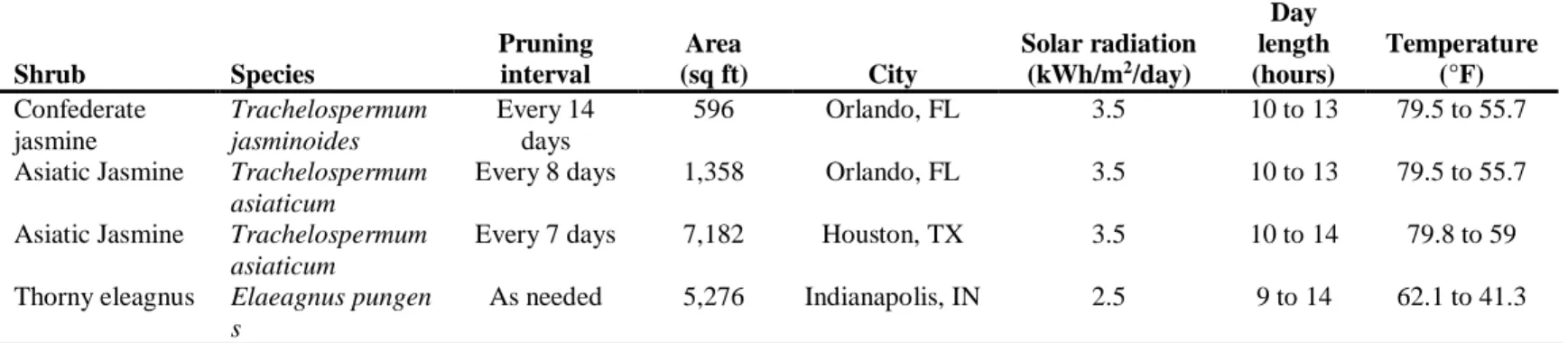
(6) LIST OF TABLES. Tables. Pages. 1. Description of three shrub species, pruning interval, area of control and treatment experiments, and location characteristics of ........................................... 4 2. Description of data collected from four experiments on shrub species.................. 5 3. Pruning data collected for control and treated shrub species. ................................ 6 4. Agrochemical data collected for control and treated shrub species. ...................... 7 5. List of variables used for the estimations of pruning and agrochemical costs. ...... 9 6. Pruning costs for each shrub specie in control and treatment groups. ................... 11 7. PGR and surfactant costs for each shrub specie in control and treatment groups. . 12 8. Partial budget analysis for each shrub specie in the control and treatment group. ...................................................................................................................... 13 9. Partial sensitivity analysis for each shrub specie in the control and treatment group ....................................................................................................... 14. v.
(7) 1.. INTRODUCTION. The Green Industry, or environmental horticulture industry, is one of the fastest growing segments of the U.S. economy .Among all sectors of the Green Industry, businesses providing landscape services have been historically the biggest contributors of sales, employment, and business taxes (Hodges, Hall, Palma, & Khachatryan, 2015). To illustrate, landscape maintenance businesses contributed over 1.1 million jobs and USD80 billion in revenues in 2013; an impact predicted to increase in the coming years (Lawn and Landscape, State of the Industry Report, 2015). However, labor issues, such as shortages, increasing wages, and availability of skilled employees, are threatening the sustainability of the landscape maintenance industry (Bellenger, Fields, Tilt, & Hite, 2008). Labor is the single largest expense in agriculture, and the landscape maintenance industry is no exception. Landscape maintenance, the fastest growing service provided by landscape businesses (Lawn and Landscape, State of the Industry Report, 2015), is also the costliest business activity, with labor costs accounting for up to 60% of all costs (Amir, 2019). Maintenance services include activities such as pruning trees and shrubs, mowing, and weeding. In order to provide labor-intensive services and remain profitable, labor savings has become a major objective for business owners and managers of landscape businesses to survive the current business climate. In looking for cost-effective ways to lower labor costs, plant growth regulators (PGRs) have been introduced to the landscape industry as a tool to reduce labor expenses. PGRs applications (e.g. paclobutrazol) are common in ornamental plant production to help control plant growth (Gent & McAvoy, 2000) by blocking the production of phytohormones associated with plant cell elongation and biomass production (Hedden & Graebe, 1985). Some potential benefits of PGRs on shrub maintenance are reduction of time and number prunes, reduction of spring and early summer pruning demand, increased labor safety, and improved plant appearance (Smiley, Holmes, & Fraedrich, 2009). By reducing shrub growth and number and time of pruning events, business managers could potentially allocate employees to other jobs in the same site, reduce labor hours per site, or increase the number of served sites per day. Using a partial budget analysis, this study investigates the economic effect of PGRs on labor costs of four experiments on three shrub species. The partial budget analysis uses only the additional inputs and outputs generated due to the use of PGRs in shrubs, rather than an entire company budget. Similar studies have used partial budget analysis to understand the money saving effect of technologies in agriculture (Barrett, Zhao, & Hodges, 2012) (Maughan, Curtis, Black, & Drost, 2015) (Rivard, Sydorovych, O'Connell, Peet, & Louws, 2010) (Taylor, Bruton, Fish, & Roberts, 2008), but none have investigated the economic 1.
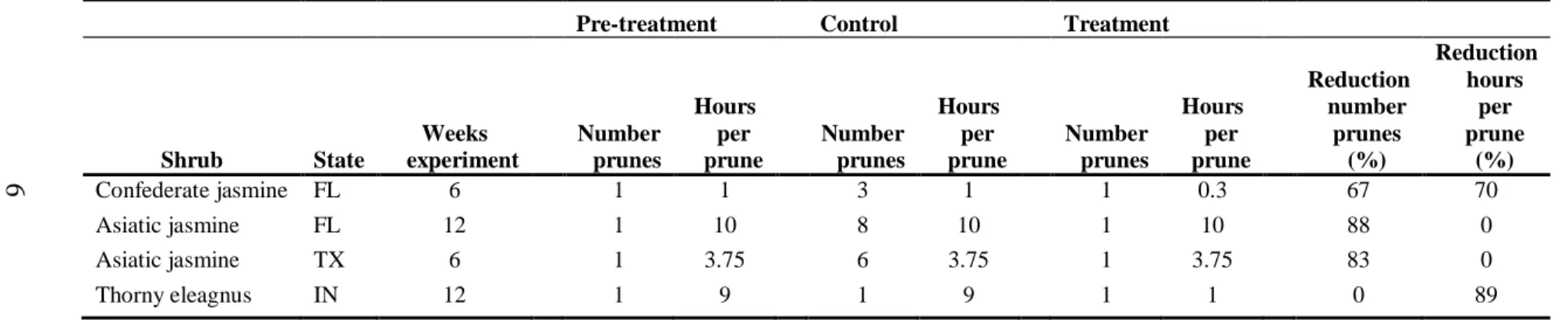
(8) effect of PGRs on labor costs of landscape maintenance. We also performed a sensitivity analysis on labor wages to understand how labor costs respond to changes in hourly wages due to labor shortages or salary changes (Boardman, 2018). Finally, we draw conclusions on potential labor reallocation savings and labor safety. Among all plants, shrubs are an essential part of the landscapes. The structural complexity and green benefits offered by shrubs in residential and commercial landscapes is appealing to customers of landscape maintenance businesses (Harris, Kendal, Hahs, & Threlfall, 2018). Shrubs provide color, forms, textures, shades, coverage, and noise-cancelling features to the place they are set. Shrubs in landscape draw attention at first sight, and their impact can be negative if they are not correctly maintained. In other words, shrub maintenance is a major way for landscape maintenance companies to convey the quality of their services. Due to the complexity of the techniques and safety issues, pruning labor is among the highest paid occupation in the landscape industry (Bureau of Labor Statistics, 2018). For example, the U.S. average hourly wage for pruners is USD 18.55, which is 25% higher than the average wage in the landscape industry. Average hourly wages for pruners can also be vary depending on the location and are positively correlated with big population centers. For example, the top paying states for pruners are Washington D.C. (USD27.39), New Jersey (USD25.23), and Illinois (USD25.03); while top paying metropolitan areas are San Francisco, CA (USD31.89), Chicago, IL (USD29.29), and New York, NY (USD27.98). In the U.S., there are about 55,000 pruners, most of them working in California, Texas, and Pennsylvania (Bureau of Labor Statistics, 2018). Historically, landscape businesses are more dependent on labor than other segments of the Green Industry (Hodges, Hall, Palma, & Khachatryan, 2015). The seasonality of the services and the tight labor market make temporary jobs in this industry a hard sell. Moreover, industry maturity, immigration policies, and economic and political shocks are threatening the availability of skilled labor for landscape services (Hall, 2010) (Zahniser, Taylor, Hertz, & Charlton, 2018). As a way of dealing with labor shortages, landscape businesses hire seasonal migrant workers through the H-2B visa program, but changes and reductions to the program have hit hard the landscape industry (Bruno, 2018). Although PGRs are widely accepted in the Green Industry, its adoption among landscape maintenance companies is limited. PGR costs and lack of economic feasibility analyses undermine their adoption. Lack of information of plant response to PGRs due to external (weather, location) and internal (plant specific, watering and fertilization regimes) factors is also deterring its widespread use (Smith, Ferrell, & Koschnick, 2014). The objectives of this study were to: Assess if PGRs reduce labor needs in landscape businesses Calculate the economic advantage (or disadvantage) of using PGRs for shrub maintenance Understand the impact of changes in wages on labor savings. 2.
(9) 2.. METHODOLOGY. Data collection. Data for this study comes from experiments conducted between April and May of 2016. Account managers of landscape maintenance companies collected data on four experiments in three states (Florida, Texas, and Indiana). Experiments were conducted to investigate the effect of PGRs on pruning intervals and time of pruning of three shrub species, namely Confederate jasmine (Trachelospermum jasminoides), Asiatic jasmine (Trachelospermum asiaticum), and Thorny eleagnus (Elaeagnus pungens). Area of treated (treatment) and untreated (control) shrubs was measured at the beginning of the experiment. Table 1 illustrates shrub names and species, pruning interval, area of experiment, as well as the location characteristics such as the average solar radiation, daylength, and temperature. Area of control and treatments were the same between control and treatment, but varied by species. For example, Confederate jasmine (Trachelospermum jasminoides) (FL) treatment and control occupied 596 square feet each, while each control and treatment of Asiatic jasmine (Trachelospermum asiaticum) (FL), Asiatic jasmine (Trachelospermum asiaticum) (TX), and Thorny eleagnus (Elaeagnus pungens) (IN) occupied 1,358, 7,182, and 5,276 square feet, respectively.. 3.
(10) Table 1 Description of three shrub species, pruning interval, area of control and treatment experiments, and location characteristics of experiments conducted in 2016.. Area (sq ft) 596. Solar radiation (kWh/m2/day) 3.5. Day length (hours) 10 to 13. Temperature Species City (°F) Trachelospermum Orlando, FL 79.5 to 55.7 jasminoides Trachelospermum 1,358 Orlando, FL 3.5 10 to 13 79.5 to 55.7 asiaticum Asiatic Jasmine Trachelospermum Every 7 days 7,182 Houston, TX 3.5 10 to 14 79.8 to 59 asiaticum Thorny eleagnus Elaeagnus pungen As needed 5,276 Indianapolis, IN 2.5 9 to 14 62.1 to 41.3 s Note: Data for location radiation, daylength, and temperature were obtained from US Climate data Confederate jasmine (Buena vista) started on April 18, Asiatic jasmine (MOT) started on April 19, Asiatic jasmine (Cinco Ranch) started on May 5, and Thorny eleagnus (Raceway) started on April 20 of 2016. Shrub Confederate jasmine Asiatic Jasmine. Pruning interval Every 14 days Every 8 days. 4.
(11) Table 2 describes the data collected from the experiments, including number and time of pruning events and agrochemical (PGR and surfactant) applications, by shrub specie. A general prune (pre-treatment) was performed to all shrubs at the beginning of the experiment. Shrubs in the treated group were applied once with PGR (Paclobutrazol; Trimtect; Rainbow Treecare Science; Minnetonka, MN) and surfactant (Glycerin, diethylene glycol and alkyl polyglucoside; Audible 90; Exacto Inc.; Sharon, WI) solution via spray after general prune. PGR and surfactant rates followed product manufacturer recommendations (6.4 to 9.6 fl. oz/gal for PGR and 2ml/gal for surfactant). Time of agrochemical application and ready-to-use solution (RTU) were recorded at time of application. Account managers performed visual evaluations at 6-7 weeks after treatment (WAT), depending on shrub specie.. Table 2 Description of data collected from four experiments on shrub species. Treatment. Variable. Pre-treatment. Number of prunes. Description Number of prunes prior to the start of experiment, also called general prune. Hours per prune. Number of hours spent on pruning each shrub at each location. Number of prunes. Number of prunes to shrubs in control group during experiment. Hours per prune. Number of hours spent on pruning each control shrub. Number of prunes. Number of prunes to shrubs in treatment group during experiment. Hours per prune Number applications. Number of hours spent on pruning each treated shrub. Control Treatment. Applications rate RTU Spray time. Number of applications of agrochemicals during experiment Agrochemical rate in fluid ounces per gallon (PGR) and milliliters per gallon (surfactant) Ready-to-use solution Hours of application of agrochemical solution (PGR and surfactant). 5.
(12) Table 3 illustrates the pruning data collected during the length of the experiment. Number of additional prunes and time of pruning were recorded for the totality of the experiment (6 to 12 weeks, depending on the shrub specie and location). We computed reduction of number of prunes and hours per prune between control and treated shrubs. Table 3 reports the number and hours per prune for control and treatment groups, as well as the reduction in number and time of pruning events between control and treatment groups. For example, treated Confederate jasmine (Trachelospermum jasminoides) (FL) had 67% fewer number of prunes and 70% fewer hours per prune when compared to the control group. Time of pruning (in hours) for each control and treated groups remained the same across the length of the experiment. Control and treatment groups received similar fertilization and pesticide regimes throughout the calendar year.. Table 3 Pruning data collected for control and treated shrub species. Pre-treatment. 6. Shrub Confederate jasmine Asiatic jasmine Asiatic jasmine. State FL FL TX. Thorny eleagnus. IN. Weeks experiment 6 12 6 12. Control. Treatment. Number prunes 1 1 1. Hours per prune 1 10 3.75. Number prunes 3 8 6. Hours per prune 1 10 3.75. Number prunes 1 1 1. Hours per prune 0.3 10 3.75. Reduction number prunes (%) 67 88 83. 1. 9. 1. 9. 1. 1. 0. Reduction hours per prune (%) 70 0 0 89.
(13) Table 4 reports the PGR and surfactant application data collected during the length of the experiment. PGR rate of application was similar for most species (9.6 fl. oz./gal), except in the experiment conducted with Asiatic Jasmine (Trachelospermum asiaticum) in Texas (6.4 fl. oz./gal). The recommended rates of application by the manufacturer varies depending of the specie, for Thorny eleagnus (Elaeagnus pungens) the suggested rate of PGR application is 9.5 to 13 fl.oz./gal, for Asiatic jasmine (Trachelospermum asiaticum) is 4.5 to 9 fl.oz/gal and for Confederate jasmine (Trachelospermum jasminoides) is 6.5 to 9 fl.oz/gal. Table 4 also illustrates the amount of RTU (Ready-To-Use) solution, which is the PGR diluted on water in order to complete foliar applications in gallons per application. Spray time is the time spent in applying the RTU solution composed of PGR and surfactant. Table 4. Agrochemical data collected for control and treated shrub species. Pre-treatment. 7. Shrub Confederate jasmine Asiatic jasmine Asiatic jasmine Thorny eleagnus. State FL FL TX IN. Weeks experiment 6 12 6 12. Number prunes 1 1 1 1. Hours per prune 1 10 3.75 9. Control. Number prunes 3 8 6 1. Treatment. Hours per prune 1 10 3.75 9. Number prunes 1 1 1 1. Hours per prune 0.3 10 3.75 1. Reduction number prunes (%) 67 88 83 0. Reduction hours per prune (%) 70 0 0 89.
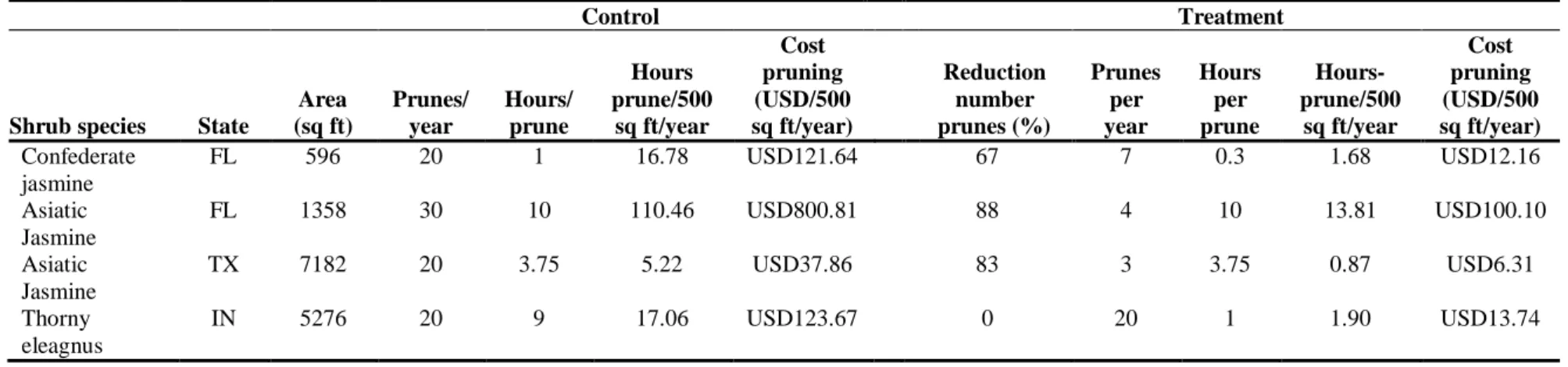
(14) Economic analysis. A partial budget analysis was used to investigate the change in labor costs due to PGR applications on shrubs. The partial budget analysis was conducted using labor data obtained from the experiments and reported by account managers of landscape maintenance operations. Shrubs in the control group received between 20 (Confederate jasmine (Trachelospermum jasminoides) in FL, Asiatic jasmine (Trachelospermum asiaticum) in TX, and Thorny eleagnus (Elaeagnus pungens) in IN) and 30 prunes (Asiatic jasmine (Trachelospermum asiaticum) in FL) in the 2016 calendar year, as reported by account managers. To conduct the annual partial budget analysis, we forecasted annual number of prunes for treated shrubs by multiplying the annual number of prunes of shrubs in the control group (reported by account managers) and the percentage reduction in number of prunes for treated shrubs (computed for the length of the experiment, Table 3). Forecasted annual number of prunes for treated shrubs resulted between 3 and 20 prunes, depending on shrub specie. For example, forecasted number of prunes for Confederate jasmine (Trachelospermum jasminoides) resulted in 7 annual prunes for treated shrubs (a 67% reduction from 20 annual prunes for control shrubs). While Thorny eleagnus (Elaeagnus pungens) received the same number of annual prunes (20 prunes) for both treatment and control group, the time of each prune was significantly lower for treated than control shrubs (1 hour/prune for treated vs 9 hour/ prune for control). Account managers reported that each pruning event for treated Thorny eleagnus (Elaeagnus pungens) plants was described as the removal of runners and escapes, in contrast to whole shrub shearing for the control group. Table 5 illustrates the list of variables used for the estimations of pruning and agrochemical costs. Variables used to compute the partial budget analysis included area of experiment, number of prunes per year (reported for control and forecasted for treatment), hours per prune, number of PGR applications per year, hours of agrochemicals application per year, PGR application rate in fluid ounces per gallon (fl. oz/gal), and surfactant application rate in milliliters per gallon (ml/gal). Each of the variables were recorded to provide accurate estimates for labor, agrochemicals, and total pruning costs. Sources and prices for materials and labor used were identified to develop the partial budget analysis.. 8.
(15) Table 5. List of variables used for the estimations of pruning and agrochemical costs. Variable Description Area Area of control and treated shrubs in square feet Prunes per year Average number of prunes per calendar year as reported by account managers (control) or forecasted (treatment) Hours per prune Number of labor hours in a pruning event hours-prune/500 Number of hours of pruning for 500 square feet in one year sq-ft/year Cost pruning Cost of pruning in dollars per year per 500 square feet App/year Number of applications of agrochemicals per year Rate Rate of agrochemical application (fluid ounces per gallon for PGR and milliliters per gallon for surfactant) RTU Ready-to-use solution of PGR and surfactant in gallons in 500 square feet Cost PGR Cost of PGR applications in dollars per year per 500 square feet Cost surfactant Cost of surfactant applications in dollars per year per 500 square feet. In order to standardize variables and due to the fact that area of experiments varied across shrub specie and location, we converted all variables to dollars per 500 square feet per year (USD/500 sq ft/year). For example, cost of pruning was standardized to dollars spent in pruning in 500 square feet per year, a value computed from number of hours of pruning 500 square feet in a calendar year and the Federal minimum wage rate at USD7.25 per hour (Bureau of Labor Statistics, 2018). To obtain hours spent in pruning 500 square feet, we converted the number of hours spent in a pruning event into hours per prune in 500 square feet and multiplied by the number of pruning events in a calendar year. Similar to labor calculations, PGR and surfactant application rates were converted to gallons per 500 square feet per year (gallon/500 sq ft/year). PGR and surfactant costs were then computed from gallon/500 sq ft/year and agrochemical costs reported by manufacturing company at 2016 prices. PGR (Trimtect) was reported at a cost of USD145.00 per gallon, while the cost of surfactant (Audible 90) was USD31.42 per gallon. Total labor and agrochemical costs were calculated for every shrub specie and location. Partial net costs (estimated at USD/500 sq ft/year) were calculated by subtracting the pruning labor cost and agrochemicals for the treated shrubs (treatment) from the cost of pruning labor of untreated shrubs (control). The economic analyses do not account for other maintenance costs (e.g., fertilization, pesticide applications, etc.). Lastly, sensitivity analyses were conducted to compare the effect of changes in hourly wages on the partial budget analysis for each shrub. Sensitivity analysis was carried out using the range of hourly wages in the landscape industry, which includes the federal minimum agricultural wage (USD7.25 per hour) and the average wage of high skilled agricultural employees (USD22.73per hour).. 9.
(16) 3.. RESULTS AND DISCUSSION. Cost of pruning and agrochemicals. Table 6 illustrates the calculations of cost of pruning for each shrub specie in control and treatment groups. Cost of pruning is expressed in dollars per 500 square feet per year (USD/500 sq ft/year) which was obtained by multiplying number of hours spent pruning 500 square feet of each shrub specie in a calendar year by the federal minimum agricultural wage (USD7.25). The number of total hours spent in pruning 500 square feet in a year reduced between 83 to 90%, depending on the shrub specie. Confederate jasmine (Trachelospermum jasminoides) (FL) went from 16.78 hours prune/500 sq ft/year in the control group to 1.68 hours prune/500 sq ft/year in the treated group, a reduction of 90% of hours. The number of total hours spent in pruning 500 square feet in a year for Asiatic jasmine (Trachelospermum asiaticum ) (FL) and Asiatic jasmine (Trachelospermum asiaticum ) (TX) in treated groups reduced by 88% and 83% from control shrubs, respectively. The total number of pruning hours for Thorny eleagnus (Elaeagnus pungens) reduced from 17.06 hours prune/500 sq ft/year (control) to 1.90 hours-prune/500 sq ft/year (treatment), a reduction of 89%. Table 6 also illustrates the pruning costs (in USD/500 sq ft/year) between control and treatment groups. Considering that the treatments groups experienced an important reduction of hours per prune due to PGRs, the cost of pruning also experienced important reductions. The highest cost savings in pruning labor was experienced by Asiatic jasmine (Trachelospermum asiaticum) in Florida, with a cost savings of USD700.71/500 sq ft/year. Interestingly, cost savings for Asiatic jasmine (Trachelospermum asiaticum) in Texas had the smallest reduction, by USD31.55 in 500 square feet in a year. This difference can be explained by the higher labor demand (i.e. number of prunes and hours per prune) for Asiatic jasmine (Trachelospermum asiaticum) in Florida when compared to Texas (Table 6).. 10.
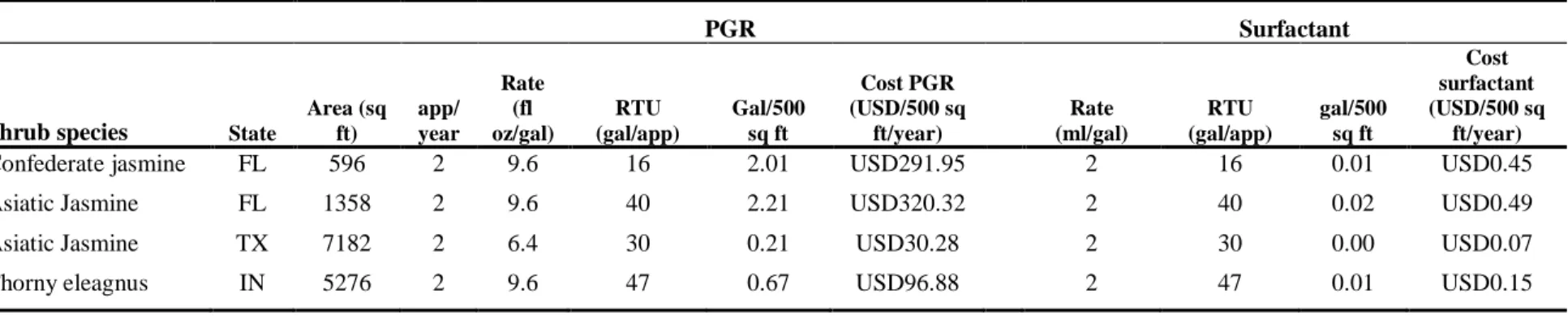
(17) Table 6. Pruning costs for each shrub specie in control and treatment groups.. Control. Shrub species Confederate jasmine Asiatic Jasmine Asiatic Jasmine Thorny eleagnus. Treatment Cost pruning (USD/500 sq ft/year) USD121.64. Reduction number prunes (%) 67. Prunes per year 7. Hours per prune 0.3. Hoursprune/500 sq ft/year 1.68. Cost pruning (USD/500 sq ft/year) USD12.16. State FL. Area (sq ft) 596. Prunes/ year 20. Hours/ prune 1. Hours prune/500 sq ft/year 16.78. FL. 1358. 30. 10. 110.46. USD800.81. 88. 4. 10. 13.81. USD100.10. TX. 7182. 20. 3.75. 5.22. USD37.86. 83. 3. 3.75. 0.87. USD6.31. IN. 5276. 20. 9. 17.06. USD123.67. 0. 20. 1. 1.90. USD13.74. 11 Table 7 reports PGR and surfactant costs for each shrub specie based on two applications, as suggested by the manufacturer (Rainbow Treecare Science; Minnetonka, MN). Similar to pruning hours, agrochemical variables were standardized to 500 square feet per year by multiplying the price per gallon of PGR (USD141 per gallon; Trimtect) and surfactant (USD37 per gallon; Audible 90) and the amount of agrochemical applied in 500 square feet. Interestingly, Asiatic jasmine (Trachelospermum asiaticum) was both the cheapest (Texas: USD30.28/500 sq ft/year) and most expensive (Florida: USD320.32/500 sq ft/year) treatment. This difference can be explained by the difference in PGR application rates between Texas (6.54 fl oz/gal) and Florida (9.6 fl oz/gal), which resulted in significant differences in the amount of PGR (gal/500 sq ft) applied at each location. For example, Asiatic jasmine (Trachelospermum asiaticum) in Florida received 2.21 gallons of RTU solution per 500 square feet, while the same shrub in Texas received only 0.21 gallons per 500 square feet, a 91% reduction in PGR amount. Different application rates may be explained by weather conditions in each location and experiment design, which may be associated with the total number of pruning hours between Florida (110.46 hours prune/500 sq ft/year) and Texas (5.22 hours prune/500 sq ft/year) in Table 6..
(18) Table 7. PGR and surfactant costs for each shrub specie in control and treatment groups. PGR. Surfactant. Gal/500 sq ft. Cost PGR (USD/500 sq ft/year). Rate (ml/gal). RTU (gal/app). gal/500 sq ft. Cost surfactant (USD/500 sq ft/year). State. Area (sq ft). app/ year. Rate (fl oz/gal). FL. 596. 2. 9.6. 16. 2.01. USD291.95. 2. 16. 0.01. USD0.45. Asiatic Jasmine. FL. 1358. 2. 9.6. 40. 2.21. USD320.32. 2. 40. 0.02. USD0.49. Asiatic Jasmine. TX. 7182. 2. 6.4. 30. 0.21. USD30.28. 2. 30. 0.00. USD0.07. Thorny eleagnus. IN. 5276. 2. 9.6. 47. 0.67. USD96.88. 2. 47. 0.01. USD0.15. Shrub species Confederate jasmine. RTU (gal/app). 12. Partial Net Cost analysis. Table 8 illustrates the partial net cost analysis. The partial cost analysis compares the total cost of the control group (i.e. pruning labor) to the total cost of PGR treatment (i.e. pruning labor, application labor, and agrochemicals), and does not include other shrub maintenance costs (fertilization, pest control, etc.). The importance of Table 8 lies in the economic benefit of labor hours saved in each pruning event and the reduction of pruning events after applying PGRs. The cost savings between the total cost control and total cost treatment is revealed in monetary terms, after standardizing all variables to dollars per 500 square feet per year (USD/500 sq ft/year). Three out of four shrub experiments incurred in cost savings after PGR applications. PGR treatments of Asiatic jasmine (Trachelospermum asiaticum) (FL and TX) and Thorny eleagnus (Elaeagnus pungens) (IN) resulted in cost savings of USD 377.23, USD 0.10, and USD12.10 per 500 square feet per year, respectively. The amount of cost savings is mainly due to high demand of pruning hours in each specie, which was offset by suppressed growth after PGR applications (as reported in Table 6). Regardless of higher PGR costs (Table 7), Asiatic jasmine (Trachelospermum asiaticum) in Florida had the highest cost savings (USD 377.23/500 sq ft/year), which may be explained by the higher demand of pruning events and hours for this experiment, and the highest reduction in number of prunes (as seen in Table 3). Interestingly, Asiatic jasmine (Trachelospermum asiaticum) in Texas had the lowest cost savings (USD 0.10/500 sq-ft/year), may be explained by weather and low demand of pruning time. Confederate jasmine (Trachelospermum jasminoides) (FL) resulted in a negative economic impact after PGR application. The dollar difference between the control and treatment groups resulted in a monetary loss of USD 185.34/500 sq ft/year after PGR application. This negative impact is likely to be the result of two main factors considered in this analysis: 1) a high rate of PGR application (9.6 fl.
(19) oz/gal) for this shrub, which resulted in “curved leaves” as reported by account managers; and 2) low demand of pruning hours, which combined with low wage rates used in the analysis (USD 7.25/hour) translated into low cost of pruning for the control group (Table 6).. Table 8. Partial budget analysis for each shrub specie in the control and treatment group. Control. Treatment. State FL. Cost pruning USD121.64. Partial net cost USD121.64. Cost pruning labor USD12.16. Asiatic Jasmine. FL. USD800.81. USD800.81. USD100.10. USD2.67. Asiatic Jasmine Thorny eleagnus. TX IN. USD37.86 USD123.67. USD37.86 USD123.67. USD6.31 USD13.74. USD1.09 USD0.80. Shrub species Confederate jasmine. Cost application labor USD2.43. Cost PGR USD291.9 5 USD320.3 2 USD30.28 USD96.88. Cost surfactant USD0.45. Partial net cost USD306.99. Cost Savings -USD185.34. USD0.49. USD423.58. USD377.23. USD0.07 USD0.15. USD37.76 USD111.57. USD0.10 USD12.10. 13. Sensitivity Analysis. Table 9 reports the results of the sensitivity analysis computed using increasing wages from the minimum federal (USD7.25) to the percentile 75 in mean hourly wage according to (Bureau of Labor Statistics, 2018) on tree trimmers and pruners (USD22.73). Table 9 illustrates how changes in wages, which may be the result of tighter labor market or increasing wages, can impact the cost savings of using PGRs on each shrub specie. As seen in Table 9, all PGR experiments resulted in cost savings for hourly wages higher than USD19/hour, a value close to the average hourly wage for pruners in the industry. Table 9 shows how cost savings differ across experiments at different hourly wages. For example, Asiatic jasmine (Trachelospermum asiaticum ) (FL) experienced the highest cost savings as wages increase from USD 7.25/hour to USD 22/hour. An explanation may be due to the labor demand for pruning maintenance can be greatly offset by reduced shrub growth due to PGR applications. Results from this study illustrate how, depending on the specie and location, pruning costs can be greatly reduced by applying PGRs to shrub maintenance..
(20) Table 9. Partial sensitivity analysis for each shrub specie in the control and treatment group Pruner Wages (USD/Hour) Shrub species Confederate jasmine Asiatic Jasmine Asiatic Jasmine Thorny eleagnus. State. 7.25. 8. 9. 10. 11. 12. 13. 14. 15. 16. 17. 18. 19. 20. 21. 22. FL. -185. -174. -159. -145. -130. -115. -100. -85. -71. -56. -41. -26. -11. 3. 18. 33. FL. 378. 450. 546. 642. 739. 835. 931. 1028. 1124. 1220. 1317. 1413. 1509. 1606. 1702. 1798. TX. 0. 3. 7. 11. 16. 20. 24. 28. 32. 37. 41. 45. 49. 53. 57. 62. IN. 22. 34. 50. 67. 83. 99. 116. 132. 148. 165. 181. 198. 214. 230. 247. 263. 14.
(21) 4.. CONCLUSIONS. Finding from this study show that, depending on the shrub specie, PGRs can reduce the labor needs in the landscape maintenance due to a reduction of pruning events and time of pruning per event. Applying PGRs can reduce the number of pruning events up to 83% (Asiatic jasmine in Texas) and hours per prune up to 89% (Thorny eleagnus in Indiana). Results from our study show that, after accounting for PGR and surfactant costs, application of PGRs can result in annual cost savings. Experiments with Asiatic jasmine in Florida resulted in annual cost savings of USD 377.23 per 500 square feet per year (when considering hourly wages at USD 7.25). Beyond reducing labor needs, using PGR for shrub maintenance can also reduce travel time and other maintenance costs including fuel, wear, and tear of vehicles and equipment. PGRs can save money to landscape businesses as long as the cost of application is lower than labor costs due to pruning for untreated shrubs. Results show that cost savings of PGR applications is strongly correlated with hourly wages. At the current federal minimum wage (USD 7.25 per hour), PGRs incurred in cost savings for three out of the four experiments. Monetary losses after PGR applications (i.e. Confederate jasmine in Texas) was mainly due to a high PGR rate and a low number of pruning hours for untreated shrubs. In other words, cost savings due to PGRs can increase as the demand for pruning increases. As labor market availability decreases and hourly wages increase, the economic importance of PGRs increases. Our findings suggest applying PGR for shrub maintenance may incur in cost savings for all shrub species in our study when hourly wages are USD 20/hour or higher. The low availability of skilled employees and tight labor market for temporary employees is a threat that affects not only the quality and availability of landscape services, but also the profitability of the industry, issues that could be partially solved with the use of PGRs.. 15.
(22) 5.. RECOMMENDATIONS. . Create a survey addressed to Landscape Services Businesses to identify potential benefits of applying PGR´s Create and run a survey about Labor reallocation to understand what potential benefits could businesses obtain with their hypothetical labor free time. . Future studies could help to understand how are waste disposal savings going to affect the use of PGR´s in the landscape service because of the lower labor expenses in waste disposal and lower amount of waste. 16.
(23) 6.. REFERENCES. Amir, A. (2019). IBISWorld Industry Report: 56173. Landscaping Services in the US. . IBISWorld. Barrett, C. E., Zhao, X., & Hodges, A. W. (2012). Cost Benefit Analysis of Using Grafted Transplants for Root-knot Nematode Management in Organic Heirloom Tomato Production. HortTechnology, 252–257. Bellenger, M., Fields, D., Tilt, K., & Hite, D. (2008). Producer Preferences for Migrant Labor and the Wage, Hours, and Gross Sales Effects in Alabama's Horticulture Industry. HortTechnology, 301-307. Boardman, A. E. (2018). Cost-benefit analysis. Concepts and practice (5th ed.). Cambridge: Cambridge University Press. Bruno, A. (2018). The H-2B Visa and the Statury Cap: In Brief. Congressional Research Service. Bureau of Labor Statistics. (2018). Occupational Employment and Wages. Tree trimmers and Pruners. Retrieved May 7, 2019, from https://www.bls.gov/oes/current/oes373013.htm Fare, D. C. (2008). Best Management Practices for Pruning Landscape Trees, Shrubs and Ground Covers . University of Tennessee Extension. Gent, M., & McAvoy, R. (2000). Plant growth regulators in agriculture and horticulture: Their role and commercial uses. A.S. Basara (ed.). Plant growth regulators in agriculture and horticulture: Their role and commercial uses, 89-145. Hall, C. R. (2010). Making Cents of Green Industry Economics. HortTechnology, 832–835. Harris, V., Kendal, D., Hahs, A. K., & Threlfall, C. G. (2018). Green space context and vegetation complexity shape people’s preferences for urban public parks and residential gardens. Landscape Research, 43, 150–162. Hedden, P., & Graebe, J. E. (1985). Inhibition of gibberellin biosynthesis by paclobutrazol in cell-free homogenates ofCucurbita maxima endosperm andMalus pumila embryos. J Plant Growth Regul (Journal of Plant Growth Regulation), 4, 111-122. Hodges, A. W., Hall, C. R., Palma, M. A., & Khachatryan, H. (2015). Economic Contributions of the Green Industry in the United States in 2013. HortTechnology, 805-814. Kuhns, M. (1998). Pruning Landscape Trees: An Overview. Utah University Extension. Lawn and Landscape. (2015). State of the Industry Report. Lawn and Landscape. Lawn and Landscape. (2018). State of the Industry Report. Lawn and Landscape. Maughan, T. L., Curtis, K. R., Black, B. L., & Drost, D. T. (2015). Economic Evaluation of Implementing Strawberry Season Extension Production Technologies in the U.S. Intermountain West. HortScience, 50(3), 395–401.. 17.
(24) Norcini, J. G., Hudson, W. G., Garber, M. P., Jones, R. K., & Chase. (1996). Pest Management in the U.S. Greenhouse and Nursery Industry: III. Plant Growth Regulation. HortTechnology, 207–210. Purcell, L. (2015). Tree Pruning Essentials. Forestry and Natural Resources. Purdue Extension. Rivard, C. L., Sydorovych, O., O'Connell, S., Peet, M. M., & Louws, F. J. (2010). An Economic Analysis of Two Grafted Tomato Transplant Production Systems in the United States. HortTechnology, 794–803. Setia, R. C., Bhathal, G., & Setia, N. (1995). Influence of paclobutrazol on growth and yield of Brassica carinata A.Br. Kluwer Academic Publishers, 16, 121–127. Smiley, E. T., Holmes, L., & Fraedrich, B. R. (2009). Paclobutrazol Foliar Sprays to Suppress Growth on Landscape Shrubs. Arboriculture Ruban Forestry, 35, 300304. Smith, H. C., Ferrell, J. A., & Koschnick, T. J. (2014). Flurprimidol Performance on Ornamental Species in Relation to Trimming Time and Method of Application. HortScience, 49, 1305–1308. Taylor, M., Bruton, B., Fish, W., & Roberts, W. (2008). Cost benefit analyses of using grafted watermelon transplantsfor Fusarium wilt disease control. Acta Hortic. (Acta Horticulturae), 343–350. Zahniser, S., Taylor, J. E., Hertz, T., & Charlton, D. (2018). Farm Labor Markets in the United States and Mexico Pose Challenges for U.S. Agriculture. United States Department of Agriculture. Economic Research Service.. 18.
(25)
Figure


+5


Documento similar
These variables were: average altitude (Alt), number of observations (No), relative presence per number of species detected by biogeographic area (Pb), relative
In this application example, the results show that the area grows linearly with the number of bits of each state variable, and the clock frequency is dominated by the width of one
The areas of the economic freedom index “Size of Govern- ment: Expenditures, Taxes and Enterprises” published by the Economic Freedom Network from the year 2000 to the year 2009,
The horizontal axis shows total expenditure in % of GDP, the vertical axis reflects economic performance as measured by real output growth, per capital GDP (PPP)
For the early planting period, the surface area of maize fields, the proportion of edges, and the plant- ing period (number of weeks in the year) were positively related to
The Dwellers in the Garden of Allah 109... The Dwellers in the Garden of Allah
Average by location of elongation, date of growth start (Julian day), date of growth end (Julian day), duration of shoot growth and final height (two- year-old) for a
Number of submissions included in the study as well as number of positive Chicken 413 proventricular necrosis virus (CPNV) RT-PCR per year.. Proventriculus, transmissible
