
TítuloDeep Artificial Neural Networks and Neuromorphic Chips for Big Data Analysis: Pharmaceutical and Bioinformatics Applications
26
0
0
Texto completo
(2) Int. J. Mol. Sci. 2016, 17, 1313. 2 of 26. The development of a drug has different phases; in the first step a set of molecular representation, or descriptors, are selected. These descriptors represent the relevant properties of the molecules of interest. The encoded molecules are compared to one another using a metric or scoring scheme. Next, the data set is usually divided into three parts: training set, validation set and test set. The final step involves the use of ML methods to extract features of interest that can help to differentiate active compounds from inactive ones. Quantitative Structure-Activity Relationship (QSAR) is used to find relationships between the structure of a compound and its activity, both biological and physicochemical [4]. There are similar mathematical models that look for other relationships, such as Quantitative Structure-Property Relationship (QSPR), Quantitative Structure–Toxicity Relationship (QSTR) or Quantitative Structure–Pharmacokinetic Relationship (QSPkR) [5]. It is of major importance to select the right descriptors to extract valuable features from the input data. The accuracy of these data, and the statistical tools used, are also relevant in the development process [4]. Over the past decades, the ML techniques used in pharmaceutical and bioinformatics applications were “shallow”, with only a few layers of feature transformations. Some of the most used algorithms are: principle component analysis, k-means clustering, decision trees, Support Vector Machines (SVMs) and Artificial Neural Networks (ANNs) [1,4]. The ANNs have been applied to pharmacology and bioinformatics for more than two decades. Historically, the first report on the application of ANNs in these fields was published by Qian and Sejnowski in 1988 [6]. They used ANNs for the prediction of the protein secondary structure. In 1990, Aoyama et al. presented the first report on the application of ANNs to QSAR [7], whereas in 1993, Wikel and Dow disclosed an application of the ANNs in the description of the pruning step of QSAR [8]. An example of an effective application of ANNs was with a data set of HIV-1 reverse transcriptase inhibitors, in the descriptor selection process [9]. Kovalishyn et al. developed a pruning method based on an ANN trained with the Cascade-Correlation learning method in 1998 [10]. These are some examples of early applications of ANNs, but a huge advance had been made in these ML techniques. To get a historical perspective, and to understand in detail the applications of ANNs, and other ML algorithms, to pharmacology and bioinformatics, the reader is referred to these reviews [1–5,11–18]. Although ANNs were soon identified as useful tools for pharmacology and bioinformatics, SVMs and random forest made great progress, dominating the field until recently. The reasons of the limited application of ANNs were: “scarcity” of data, difficulty to understand the features extracted, and the computational cost entailed by the network training. Over the past decade, DNNs have become the state-of-the-art algorithms of ML in speech recognition, computer vision, natural language processing and many other tasks. This was made possible by the advancement in Big Data, Deep Learning and the exponential increase of the chip processing capabilities, especially GPGPUs. The Big Data term can be understood by the exponential grow of data, since 90% of the data in the world today has been created in the last two years alone. This data explosion is transforming the way research is conducted, making it necessary to acquire skills in the use of Big Data to solve complex problems related to scientific discovery, biomedical research, education, health, national security, among others. In genomic medicine, this can be illustrated by the fact that the first sequenced human genome cost nearly $3 billion, today it can be done for less than $1000. In cancer research, data produced by researchers can be analyzed to support this research. Multiple protein sequences can be analyzed to determine the evolutionary links and predict molecular structures. In Medicine and Bioinformatics, there are numerous opportunities to make the most of the huge amount of data available. Some of the challenges include developing safer drugs, reducing the costs of clinical trials, as well as exploring new alternatives, such novel antibiotics, to fight against resistant microorganisms; and finally, extracting value information from the vast amount of data generated by the public health. In order to make the most of the huge amount of information available, different data analysis software frameworks, such as Hadoop, have been created [19]. These frameworks allow the use of simple programming models to process large data sets from thousands of computers. Figure 1 shows a general workflow for Big Data..
(3) Int. J. Mol. Sci. 2016, 17, 1313. 3 of 26. simple programming models to process large data sets from thousands of computers. Figure 1 3 of 26 Big Data.. Int. J. Mol. 2016, 17, 1313 shows a Sci. general workflow for. Figure 1. Big Data Workflow. Workflow.. DL is the brain and data abstraction created by DL is aa new new area area of ofML MLresearch, research,which whichisisinspired inspiredbyby the brain and data abstraction created multiple stages of processing. The DL algorithms allow high-level abstraction from the data, and this by multiple stages of processing. The DL algorithms allow high-level abstraction from the data, is helpful automatic features extraction and for pattern analysis/classification. A key aspectA ofkey DL and this isfor helpful for automatic features extraction and for pattern analysis/classification. was the development of unsupervised training methods to make the best use of the huge amount of aspect of DL was the development of unsupervised training methods to make the best use of unlabeled data available [11]. Deep Feedforward Neural Networks (DFNN), Deep Belief Networks the huge amount of unlabeled data available [11]. Deep Feedforward Neural Networks (DFNN), (DBN),Belief DeepNetworks AutoEncoder Networks, Deep Boltzmann Machines (DBM), Deep Convolutional Deep (DBN), Deep AutoEncoder Networks, Deep Boltzmann Machines (DBM), Neural Networks (DCNN) and Deep Recurrent Neural Networks (DRNN) are examples of artificial Deep Convolutional Neural Networks (DCNN) and Deep Recurrent Neural Networks (DRNN) are neural networks with deep learning. They have been applied to fields such as computer vision, examples of artificial neural networks with deep learning. They have been applied to fields such automatic speech or natural language processing, whereprocessing, they havewhere been they shown to as computer vision,recognition automatic speech recognition or natural language have produce state-of-the-art results on multiples tasks, (see Table 1). The idea of building DNNs is not been shown to produce state-of-the-art results on multiples tasks, (see Table 1). The idea of building new but there wasbut a historical called “vanishing problem” It is difficult DNNs is not new there was problem, a historical problem, called gradient “vanishing gradient[20]. problem” [20]. It to is train these types of large networks with several layers when the backpropagation algorithm is used difficult to train these types of large networks with several layers when the backpropagation algorithm toused optimize the weights, because the gradients which propagate backwards rapidly diminish in is to optimize the weights, because the gradients which propagate backwards rapidly diminish magnitude as the depth of the network increases, thusthus the weights in the layers changes very in magnitude as the depth of the network increases, the weights in early the early layers changes slowly [21]. DNNs have become the leading ML technology for a range of applications since very slowly [21]. DNNs have become the leading ML technology for a range of applications since Geoffrey Hinton Hinton examined examined the the issues issues around around training training large large networks networks [22], [22], and and came came up up with with aa new new Geoffrey approach that had consequences for the cost of training of these networks [23,24]. Over the past approach that had consequences for the cost of training of these networks [23,24]. Over the past decade, decade, a variety of algorithms and techniques have been developed to design and train different a variety of algorithms and techniques have been developed to design and train different architectures architectures of DNN [25–31]. of DNN [25–31]. Table 1.1. Deep Deep Artificial Artificial Neural Neural Networks Networks Achievements. Achievements. Adapted from a slide developed by Yann Table Lecun, Facebook and and NYU NYU [32]. [32]. Task (Year) Task (Year) Handwriting recognition (2009) Handwriting recognition (2009) Volumetric brain image segmentation (2009) Volumetric brain image segmentation (2009) OCR in the OCRWild in the(2011) Wild (2011) Traffic sign recognition (2011)(2011) Traffic sign recognition HumanRecognition Action Recognition Human Action (2011)(2011) Breastcell cancer cell mitosis detection Breast cancer mitosis detection (2011)(2011) Object Recognition (2012) Object Recognition (2012) Scene Parsing (2012) SceneSpeech Parsing (2012) (2012) Recognition Asian handwriting recognition (2013) Speech Recognition (2012) Pedestrian Detection (2013) Asian handwriting recognition (2013) Scene parsing from depth images (2013) Pedestrian Detection (2013) Playing Atari games (2013) Scene parsing from depth images (2013) Game of Go (2016) Playing Atari games (2013) Game of Go (2016). Competition Competition MNIST (many), Arabic HWX (IDSIA) MNIST (many), Arabic HWX (IDSIA) Connectomics (IDSIA, MIT) Connectomics (IDSIA, MIT) StreetView House Numbers (NYU and others) StreetView House Numbers (NYU and others) GTSRB competition (IDSIA, NYU) GTSRB competition (IDSIA, NYU) Hollywood II dataset (Stanford) Hollywood II dataset (Stanford) MITOS (IDSIA) MITOS (IDSIA) ImageNet competition (Toronto) ImageNet competition (Toronto) Stanford bgd, SiftFlow, Barcelona datasets (NYU) Stanford bgd,modeling SiftFlow,(IBM Barcelona datasets (NYU) Acoustic and Google) ICDAR competition (IDSIA) Acoustic modeling (IBM and Google) INRIA datasets and others (NYU) ICDAR competition (IDSIA) NYU RGB-D dataset (NYU) INRIA datasets and others (NYU) 2600 Atari games (Google DeepMind Technologies) NYU RGB-DWorld dataset (NYU) AlphaGo vs. Human Champion 2600 Atari games (GoogleTechnologies) DeepMind Technologies) (Google DeepMind AlphaGo vs. Human World Champion (Google DeepMind Technologies). Finally, GPUs were created to process graphics, especially for gaming and design. Some researchers programmed GPUs using API, but this was a difficult task [33]. In 2007, NVIDIA published “Compute Finally, GPUs were created to process graphics, especially for gaming and design. Some Unified Device Architecture” (CUDA) [34], a programming language based on C to optimize GPGPU researchers programmed GPUs using API, but this was a difficult task [33]. In 2007, NVIDIA application. CUDA allows researchers to make the most of the computing capabilities of GPUs for published “Compute Unified Device Architecture” (CUDA) [34], a programming language based on parallel programming. Nowadays, almost every supercomputer in the TOP500 combines CPUs and C to optimize GPGPU application. CUDA allows researchers to make the most of the computing GPUs [35]. GPUs are beneficial for DL because the training of DNN is very intensive, so this training capabilities of GPUs for parallel programming. Nowadays, almost every supercomputer in the can be parallelize with GPUs and a performance improvement greater than 10× can be obtained. However, the ongoing work on design and construction of neuromorphic chips should be pointed out,.
(4) Int. J. Mol. Sci. 2016, 17, 1313. 4 of 26. as they represent a more efficient way to implement DNNs [36]. The neuromorphic chips attempt to mimic the neuronal architectures present in the brain in order to reduce several orders of magnitude in terms of energy consumption and to improve the performance of the information processing. However, to run DNNs in a neuromorphic chip, they should be mapped in a spiking artificial neural network (SNN) [37]. In this review, the main architectures of DNNs and their applications in pharmacology and Bioinformatics are presented. The future need for neuromorphic hardware for DNNs is also discussed, and the two most advanced chips that have already implemented DL are reviewed: IBM TrueNorth and SpiNNaker. In addition, this work points out the importance of considering astrocytes in DNNs and neuromorphic chips, given the proven importance of this type of glial cells in the brain. 2. Deep Artificial Neural Networks in Pharmacology and Bioinformatics DL is a branch of ML that attempts to mimic the information processing in layers of neurons in the neocortex. DNNs are trained to learn to recognize patterns in digital representations of sounds, images, and other data. Usually, there is an unsupervised pre-training process, which helps to initialize the weights. There are different DNN architectures, but in this review, only the most representative types are briefly explained, we divided them in: Deep Auto-Encoder Networks (DAENs), Deep Convolutional Neural Networks (DCNNs) and Deep Recurrent Neural Networks (DRNNs). DAENs encompass Deep Feedforward Neural Networks (DFNNs), Deep Belief Networks (DBNs), Deep Restricted Boltzmann Machines (DRBMs) and Deep Auto-Encoder Networks. There are differences between these architectures, but they have in common big differences with respect to DCNNs and DRNNs. These differences are highlighted, and some featured applications in Pharmacology and Bioinformatics of each architecture are presented in Table 2. For a more detailed analysis of the DL architecture, the differences, the training and the historical perspective, the reader should refer to these reviews [25–31]. Table 2. Applications of different Deep Neural Networks (DNNs) architectures. Network Architecture. Pharmacology. Bioinformatics. DAEN DCNN DRNN. [1–7,23] [18] [22,23]. [8–17] [19–21] [24]. 2.1. Deep Auto-Encoder Networks As previously mentioned, the breakthrough of how to train DAENs was made by Hinton and his team [23,24]. DAENs are models composed of multiple layers of neurons, trained one by one, and could be stacked to as many as possible layers. Different DL architectures, such as DFNN, DBN, DRBM and Deep Auto-Encoder Networks, were grouped together by us. There are some differences between these architectures, but in general the idea of DAENs is stacking various layers of neurons, to be pre-trained one by one, using each layer to train the next one. In the first layer, neurons learn to recognize low level features. In an image, they could recognize basic forms such as lines, edges, etc. The intermediate layers detect more abstract features, the ones detected depending on the data set used to train the networks. For example, if a data set of faces is used, the intermediate layers can recognize parts of the faces like eyes, mouth or ears. Finally, the last layer is trained to detect the most abstract features, for example to recognize a person, a car or an animal in an image. Usually, the training falls into two steps: the first step is layer-wise pre-training and the second step is fine-tuning. Compared to how a neural network is traditionally trained, the first step can also be seen as a clever way of initialization, whereas the second step can be as simple as backpropagation, depending on the model to be trained..
(5) Int. J. Mol. Sci. 2016, 17, 1313. 5 of 26. 2.1.1. Pharmacology A team led by George Dahl, from Hinton’s group, won the Merck Molecular Activity Challenge organized by Kaggle in 2012, indicating the high potential of DL in drug design, and drawing the attention of the pharmacology community. Merck’s data sets include on-target and ADME (absorption, distribution, metabolism, and excretion) activities. Each molecule is represented by a list of features, i.e., descriptors in QSAR nomenclature The DAEN have three hidden layers, each layer having 2000 neurons, so the network has over 24 million tunable values. Generative unsupervised pretraining and the procedure of dropout are used to avoid overfitting [38,39]. However, the small scale of Merck’s data set, 11,000 descriptors, 164,000 compounds, and 15 drug targets, does not allow assessing the value of DL in drug target prediction. In 2014, Unterthiner et al. analyzed the performance in a bigger data set, similar to the in-house data of pharmaceutical companies [40]. The ChEMBL database has 13 million compound descriptors, 1.3 million compounds, and 5000 drug targets. DAEN was compared to seven target prediction methods, including two commercial predictors, three predictors deployed by pharmaceutical companies, and ML methods that could scale to this data set. DAEN outperformed all the other methods and surpassed the threshold to make VS possible. This showed the potential of DL to become a standard tool in industrial drug design [40]. Unterthiner’s team won Tox21 Data Challenge within the “Toxicology in the 21st Century” (Tox21) initiative launched by the United States agencies (NIH, EPA and FDA). The goal of this challenge was to assess the performance of computational methods in predicting the toxicity of chemical compounds. The DAEN used by Unterthiner’s team clearly outperformed all the other participating methods [41]. In the first column of Table 3 this method is shown, and the area under the Receiver Operating Characteristic curve (AUC) value is presented in the second column. The last column shows the p-value of a paired Wilcoxon with the alternative hypothesis that the DAEN has on average a larger AUC [40]. Table 3. Performance of target prediction methods analyzed by Unterthiner et al., in terms of mean AUC (Area Under the Receiver Operating Characteristic curve) across targets [40]. Method. AUC. p-Value. Deep Auto-Encoder Network Support Vector Machine Binary Kernel Discrimination Logistic Regression k-Nearest neighbor Pipeline Pilot Bayesian Classifier Parzen-Rosenblatt Similarity Ensemble Approach. 0.830 0.816 0.803 0.796 0.775 0.755 0.730 0.699. – 1.0 × 10⁻⁷ 1.9 × 10−67 6.0 × 10−53 2.5 × 10−142 5.4 × 10−116 1.8 × 10−153 1.8 × 10−173. Dahl et al. also performed an experiment on assay results deposited in PubChem (see Table 4); they used a DAEN to learn a function that predicts activities of compounds for multiple assays at the same time, which is called multi-task. Cellular and biochemical assays were included in the dataset. Multiple related assays, for example assays for different families of cytochrome P450, were used [42,43]..
(6) Int. J. Mol. Sci. 2016, 17, 1313. 6 of 26. Table 4. List of assays from Pubchem that were used for the study of Dahl et al. [42,43]. Article Identifier. Assay Target/Goal. Assay Type. #Active. #Inactive. 1851(2c19) 1851(2d6) 1851(3a4) 1851(1a2) 1851(2c9) 1915 2358 463213 463215 488912 488915 488917. Cytochrome P450, family 2, subfamily C, polypeptide 19 Cytochrome P450, family 2, subfamily D, polypeptide 6, isoform 2 Cytochrome P450, family 3, subfamily A, polypeptide 14 Cytochrome P450, family 1, subfamily A, polypeptide 2 Cytochrome P450, family 2, subfamily C, polypeptide 9 Group A Streptokinase Expression Inhibition Protein phosphatase 1, catalytic subunit, α isoform 3 Identify small molecule inhibitors of tim10-1 yeast Identify small molecule inhibitors of tim10 yeast Identify inhibitors of Sentrin-specific protease 8 (SENP8) Identify inhibitors of Sentrin-specific protease 6 (SENP6) Identify inhibitors of Sentrin-specific protease 7 (SENP7) Identify inhibitors of Sentrin-specific proteases (SENPs) using a Caspase-3 Selectivity assay Identify inhibitors of the two-pore domain potassium channel (KCNK9) Identify inhibitors of Mdm2/MdmX interaction Inhibitor hits of the mitochondrial permeability transition pore Inhibition of Trypanosoma cruzi NIH/3T3 (mouse embryonic fibroblast) toxicity Identify molecules that bind r (CAG) RNA repeats. Biochemical Biochemical Biochemical Biochemical Biochemical Cell Biochemical Cell Cell Biochemical Biochemical Biochemical. 5913 2771 5266 6000 4119 2219 1006 4141 2941 2491 3568 4283. 7532 11,139 7751 7256 8782 1017 934 3235 1695 3705 2628 1913. 488918 492992 504607 624504 651739 615744 652065. Biochemical. 3691. 2505. Cell Cell Cell Cell Cell Cell. 2094 4830 3944 4051 3102 2966. 2820 1412 1090 1324 2306 1287. In a series of empirical studies performed by Google and Stanford, several aspects of the use of massively multi-task framework for VS were analyzed. To characterize each molecule, Extended Connectivity Fingerprints (ECFP4) was used. This method decomposes each molecule in fragments that are centered on a non-hydrogen atom. The fragments are labeled with an identifier, and all the identifiers from a molecule are stored into vector of fixed length which represents the molecular fingerprint. The results showed that both additional data and additional tasks improve accuracy. Overall, 259 data sets, containing 37,800,000 experimental data points for 1,600,000 compounds, were used [44]. 2.1.2. Bioinformatics Yanjun Qi et al. [45] created a DAEN to predict local properties of a protein based on its sequence. Some of the properties predicted were the solvent accessible surface area, transmembrane topology, DNA-binding residues, signal peptides and the secondary structure (see Figure 2). The DAEN used the amino acid sequence as an input to predict the class labels. The method has three levels: first is a layer for the feature extraction from the amino acid; the second is a layer for sequential feature extraction; and, third, different layers of ANN. This method obtained state-of-the-art results [45]. DL architectures could be applied to predict the protein contact map. A group from the University of California used a method with three levels of resolution steps. In the first step, coarse contacts and orientations between elements of the secondary structure were predicted using 2D RNN. Subsequently, to align these elements, a method based on energy was used, and the contact probabilities between residues in strands or α-helices were predicted. In the third step, the information over space and time was integrated to refine the predictions. The DL methods only achieve a 30% of accuracy, but this represents an important improvement over other methods [46]. Eickholt and Cheng predicted contacts between protein residues using a DAEN. The method was evaluated with the official Critical Assessment of protein Structure Prediction (CASP) assessors, and with the cluster accuracy and cluster count metrics. The predictor achieved better results predicting long-range contacts than residue-residue contacts. For the top L/10 long-range contacts, the DAEN obtained a 66% of accuracy, using a neighborhood of size 2 [47,48]..
(7) Int. J. Mol. Sci. 2016, 17, 1313 Int. J. Mol. Sci. 2016, 17, 1313. 7 of 26 7 of 26. Figure 2. 2. Deep Deep neural neuralnetwork networkarchitecture architecturefrom fromYanjun Yanjun [45]. The input to the layer is Figure QiQi et et al. al. [45]. The input to the firstfirst layer is the the protein sequence represented by the single-letter amino acid code, for example the letter “A” (in protein sequence represented by the single-letter amino acid code, for example the letter “A” (in green) green) represents “Alanine”. This method a sliding window input k},in in this this case case kk == 7. represents “Alanine”. This method uses auses sliding window input {S1 , {S S21, .S.2.…SkS}, 7. The first first layer layer consists consists aa PSI-Blast PSI-Blast feature feature module module and and an an amino amino acid acid embedding embedding module, module, the the green green The boxes represent in in both modules. In the second layer, the boxes represent the the feature featurevector vectorderived derivedfrom fromthe theAlanine Alanine both modules. In the second layer, feature vectors are concatenated to facilitate identification of local sequence structure. Finally the the feature vectors are concatenated to facilitate identification of local sequence structure. Finally Deep Artificial Artificial Neural Neural Network. Network. derived vector is fed into the Deep. In 2014, Lyons et al. published a paper about the use of a DAEN to predict the backbone Cα In 2014, Lyons et al. published a paper about the use of a DAEN to predict the backbone Cα angles angles and dihedrals based on the sequences of proteins. The mean absolute error for the predicted and dihedrals based on the sequences of proteins. The mean absolute error for the predicted angles angles was between 34 degrees for τ and 9 degrees for θ. The structures constructed of 10 residue was between 34 degrees for τ and 9 degrees for θ. The structures constructed of 10 residue fragments fragments based on the prediction, only differ 1.9 Å in average, measured with the root-mean-square based on the prediction, only differ 1.9 Å in average, measured with the root-mean-square distance [49]. distance [49]. A more complete study, published in Nature, showed the potential of DL for the A more complete study, published in Nature, showed the potential of DL for the prediction of the prediction of the protein secondary structure, solvent accessibility and local backbone angles. To protein secondary structure, solvent accessibility and local backbone angles. To evaluate the DL evaluate the DL method, a test data set with 1199 proteins was used. The DAEN predicted the method, a test data set with 1199 proteins was used. The DAEN predicted the secondary structure secondary structure of the proteins with 82% accuracy, while the predicted and the real solvent of the proteins with 82% accuracy, while the predicted and the real solvent surface area had a 76% surface area had a 76% correlation. The backbone angles had mean absolute errors between 8 and correlation. The backbone angles had mean absolute errors between 8 and 32 degrees [50]. DAENs can 32 degrees [50]. DAENs can also be applied to assess the quality of the protein models, and obtain also be applied to assess the quality of the protein models, and obtain better results than the methods better results than the methods based in energy or scoring functions. A DL method was proposed by based in energy or scoring functions. A DL method was proposed by Nguyen et al., and it was called Nguyen et al., and it was called DL-Pro. The distance between two residues C-α atoms was used to DL-Pro. The distance between two residues C-α atoms was used to create a representation that is create a representation that is independent of the orientation. A dataset from the CASP competition independent of the orientation. A dataset from the CASP competition was used, and the DL-Pro was used, and the DL-Pro achieve better results than the state-of-the-art methods [51]. achieve better results than the state-of-the-art methods [51]. Tan et al. applied DAENs to unsupervised feature construction and knowledge extraction to Tan et al. applied DAENs to unsupervised feature construction and knowledge extraction to analyze the gene expression data from a breast cancer database. The constructed features extracted analyze the gene expression data from a breast cancer database. The constructed features extracted valuable information, from both a clinical and molecular perspective. This DAEN learnt to valuable information, from both a clinical and molecular perspective. This DAEN learnt to differentiate differentiate samples with a tumor, the state of estrogen receptor, and molecular subtypes [52]. samples with a tumor, the state of estrogen receptor, and molecular subtypes [52]. DAENs were trained by a group from the University of California, Irvine, to annotate the pathogenicity of genetic variants using training data consisting of 16M observed variants and 49M.
(8) Int. J. Mol. Sci. 2016, 17, 1313. 8 of 26. Int. J. Mol. Sci. 2016, 17, 1313 Int. J. Mol. Sci. 2016, 17, 1313. 8 of 26 8 of 26. DAENs were trained by a group from the University of California, Irvine, to annotate simulated variants. This model improved considerably the ofof16M other methods, around the pathogenicity genetic variants using training data consisting of simulated variants.of This model improved considerably theperformance performance otherobserved methods,variants around 15% [53]. and 15%49M [53].simulated variants. This model improved considerably the performance of other methods, The genes are around [53]. The15% genes arevery veryimportant importantininall allbiological biologicalprocesses, processes,and andnowadays nowadaystheir theirstudy studyhas hasbeen been facilitated due to the DNA microarray technology. The expression of thousands of genes The genes are very important in all biological processes, and nowadays their study has been facilitated due to the DNA microarray technology. The expression of thousands of genes isis measured inin one go, and this aa huge amount ofof data. Gupta al. proposed aa DL facilitated to the DNA technology. expression of thousands genes is measured measured due one go, andmicroarray this produces produces hugeThe amount data. Gupta etetof al. proposed DL architecture to learn the structure in gene expression, with an application to gene clustering [54]. in one go, and produces a hugeinamount of data. Gupta et al. proposedto a DL to learn architecture tothis learn the structure gene expression, with an application genearchitecture clustering [54]. the structure in gene expression, with an application to gene clustering [54]. 2.2. 2.2.Deep DeepConvolutional ConvolutionalNeural NeuralNetworks Networks 2.2. Deep Convolutional Neural Networks The CNN are inspired by The CNN are inspired by the the structure structure ofof the the visual visual cortex, cortex, discovered discovered by by Hubel Hubel and and Wiessel isis formed pattern ofof neurons that toto small The[55], CNN are inspired by the by structure of the visual cortex, discovered byare Hubel and Wiessel [55], Wiessel [55], which which formed by aa complex complex pattern neurons that are sensitive sensitive small sub-regions, creating which act filters. The images, and which is formed by areceptive complexfields pattern of neurons that are sensitive to small sub-regions, creating sub-regions, creating receptive fields which actas aslocal local filters. Thenatural natural images, andother othertypes typesofof data, present a strong correlation between nearby pixels, or input data points, and this relationship receptive fieldsa which as local filters. Thenearby naturalpixels, images, other of data, present a strong data, present strongact correlation between orand input datatypes points, and this relationship can be exploited by these receptive fields to extract valuable patterns of features. The CNNs correlation between nearby pixels, or input data points, and this relationship can be exploited by can be exploited by these receptive fields to extract valuable patterns of features. The CNNsmimic mimic this architecture and have convolutional layers in which each neuron is connected with a subset of these receptive fields extract valuable patterns features. The CNNsismimic this architecture and this architecture and to have convolutional layers inofwhich each neuron connected with a subset of neurons of the previous layer [56]. For example, in Figure 3, the neurons of the layer m are connected have convolutional layers in which each neuron is connected with a subset of neurons of the previous neurons of the previous layer [56]. For example, in Figure 3, the neurons of the layer m are connected to layer m-1, therefore each neuron only receives layer [56]. For from example, Figure 3, the neurons of the layer m are connected to 3 neuronsfrom fromthe the to 33 neurons neurons from the thein layer m-1, therefore each neuron only receives information information from the sub-region of the input space. layer m-1, therefore eachspace. neuron only receives information from the sub-region of the input space. sub-region of the input. Figure3.3.Convolutional Convolutionallayers layersthat thatextract extractfeatures featuresof ofthe theinput inputto tocreate createaafeature featuremap. map.The Theartificial artificial Figure Figure 3. Convolutional layers that extract features of the input to create a feature map. The artificial neuronsare arerepresented representedby bythe thecircles, circles,and andthe theweights weightsby bythe thenarrows. narrows.Weights Weightsof ofthe thesame samecolor colorare are neurons neurons are represented by the circles, and the weights by the narrows. Weights of the same color are shared, constrained to be identical [56]. shared, constrained to be identical [56]. shared, constrained to be identical [56].. The natural images learnt totorecognize different patterns ininthe pixels. Each The CNNstrained trainedwith with natural images learnt to recognize different patterns the pixels. TheCNNs CNNs trained with natural images learnt recognize different patterns thein pixels. Each neuron acts like a filter, but only on a subset of the input space. The neurons from the top layers Each neuron acts like a filter, but only on a subset of the input space. The neurons from the top layers neuron acts like a filter, but only on a subset of the input space. The neurons from the top layers integrated integrated information from more pixels, thus they can detect more abstract patterns. CNNs [25–28] integratedinformation informationfrom frommore morepixels, pixels,thus thusthey theycan candetect detectmore moreabstract abstractpatterns. patterns.CNNs CNNs[25–28] [25–28] were designed to recognize visual patterns from insufficiently preprocessed pixels and can recognize were were designed designed to to recognize recognize visual visual patterns patterns from from insufficiently insufficiently preprocessed preprocessed pixels pixels and and can can recognize recognize patterns patterns with extreme variability, exhibiting robustness to distortions and transformations. There are patternswith withextreme extremevariability, variability,exhibiting exhibitingrobustness robustnessto todistortions distortionsand andtransformations. transformations.There Thereare are three types of layers: convolutional, Max-Pooling and fully-connected (see Figure 4). CNNs are not three types of layers: convolutional, Max-Pooling and fully-connected (see Figure 4). CNNs are not three types of layers: convolutional, Max-Pooling and fully-connected (see Figure 4). CNNs are not limited tototwo-dimension two-dimension input data, images, and be 1,1, 3more limited input data, likelike images, and can becan applied to 1, 3 ortoto even dimensions limited to two-dimension input data, like images, and can be applied applied 3 or or even even more more dimensions ofofdata, one dimension audio for recognition and 44dimension of data, for example one dimension audio for speech recognition and 3 or 4 dimension functional dimensions data,for forexample example one dimension audio forspeech speech recognition and33or orfor dimension for magnetic resonance magnetic resonance imaging. forfunctional functional magnetic resonanceimaging. imaging.. Figure 4. Architecture of a Deep Convolutional Neural Network (DCNN), alternating the Figure 4. Architecture of a Deep Convolutional Neural Network (DCNN), alternating the Figure 4. Architecture of a Deep (DCNN), alternating the convolutional convolutional layer and the Convolutional max-pooling Neural layer Network (or sub-sampling layer), and finally the convolutional layer and the max-pooling layer (or sub-sampling layer), and finally the layer and the max-pooling layer (or sub-sampling layer), and finally the fully-connected layer [56]. fully-connected layer [56]. fully-connected layer [56]..
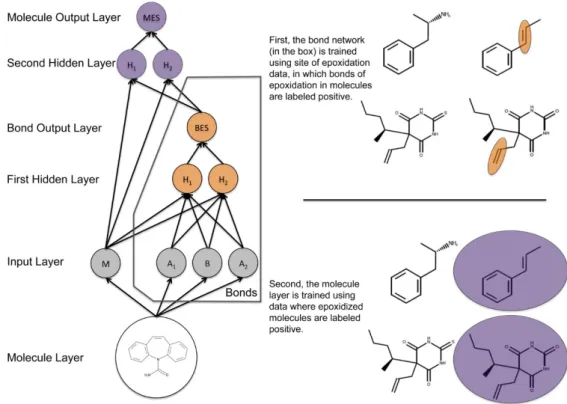
(9) Int. J. Mol. Sci. 2016, 17, 1313 Int. J. Mol. Sci. 2016, 17, 1313. 9 of 26 9 of 26. 2.2.1. Pharmacology 2.2.1. Pharmacology DCNNs have been used to predict drug toxicity both at the atomic and molecular level. DCNNs have been used to predict drug toxicity both at the atomic and molecular level. Hughes et al. published a study that described a new system, used to predict the formation of reactive Hughes et al. published a study that described a new system, used to predict the formation of epoxide metabolites. This method needs to be combined with additional tools in order to predict the reactive epoxide metabolites. This method needs to be combined with additional tools in order to toxicity of drugs. For example, while this model predicts the formation of formation epoxides, it not score predict the toxicity of drugs. For example, while this model predicts the ofdoes epoxides, it thedoes reactivity of these epoxides (see Figure 5) [57]. not score the reactivity of these epoxides (see Figure 5) [57].. Figure 5. This diagram represents a simplification structure epoxidation model, which Figure 5. This diagram represents a simplification of of thethe structure of of thethe epoxidation model, which was was made up of one input layer, two hidden layers, and two output layers. The actual model had made up of one input layer, two hidden layers, and two output layers. The actual model had several several additional nodes in the input and hidden layers. In the input layer, M represents the molecule additional nodes in the input and hidden layers. In the input layer, M represents the molecule input input node, B is the bond input node, and two atom input nodes (for each atom associated with the node, B is the bond input node, and two atom input nodes (for each atom associated with the bond). bond). The bond epoxidation score (BES) quantifies the probability that the bond is a site of The bond epoxidation score (BES) quantifies the probability that the bond is a site of epoxidation based epoxidation based in the input from the nodes of the first hidden layer (H1 and H2). The molecule in the input from the nodes of the first hidden layer (H1 and H2 ). The molecule epoxidation score epoxidation score (MES) reflects the probability that the molecule will be epoxidized. This score is (MES) reflects the probability that the molecule will be epoxidized. This score is calculated with the calculated with the information from the all molecule-level descriptors and the BES. The bond information from the all molecule-level descriptors and the BES. The bond network and the molecule network and the molecule network are represented in orange and purple respectively [57]. network are represented in orange and purple respectively [57].. Figure 6 shows how information flowed through the model, which was composed of one input Figure shows layers, how information flowed through model, whichawas composed of one input layer, two6hidden and two output layers. This the model computed molecule-level prediction for two eachhidden test molecule well as predictions for This each model bond within that test molecule [57].prediction for layer, layers,asand two output layers. computed a molecule-level each test molecule as well as predictions for each bond within that test molecule [57]. 2.2.2. Bioinformatics 2.2.2. Bioinformatics DCNNs were used to predict the target of microRNA, which regulates genes associated with various diseases. Cheng al. presented a DCNN that outperforms the existing target prediction DCNNs were used toetpredict the target of microRNA, which regulates genes associated with algorithms and achieves significantly higher sensitivity, specificity and accuracy with values of various diseases. Cheng et al. presented a DCNN that outperforms the existing target prediction 88.43%, 96.44% and 89.98%, respectively DCNNsspecificity can also be applied to predict the sequence algorithms and achieves significantly higher[58]. sensitivity, and accuracy with values of 88.43%, specificities of DNA and RNA binding proteins. Alipanahi et al. developed a DL approach called 96.44% and 89.98%, respectively [58]. DCNNs can also be applied to predict the sequence specificities DeepBind that outperforms other state-of-the-art methods, even when training on in vitro data and of DNA and RNA binding proteins. Alipanahi et al. developed a DL approach called DeepBind that testing on in vivo data (see Figure 6) [59,60]. outperforms other state-of-the-art methods, even when training on in vitro data and testing on in vivo data (see Figure 6) [59,60]..
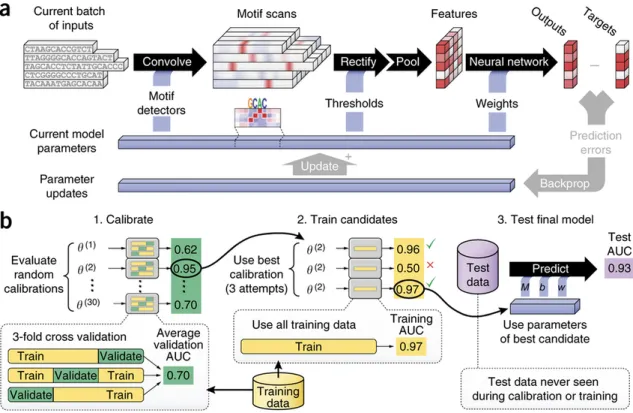
(10) Int. J. Mol. Sci. 2016, 17, 1313. 10 of 26. Int. J. Mol. Sci. 2016, 17, 1313 Int. J. Mol. Sci. 2016, 17, 1313. 10 of 26 10 of 26. Figure 6. Details of inner workings of DeepBind developed by Alipanahi et al. and its training procedure. In “a”, five independent sequences of DNA are being processed in parallel, each Figure and its its training training Figure6.6. Details Details of of inner inner workings workings of of DeepBind DeepBind developed developed by Alipanahi Alipanahi et al. and composed by a string of letters (C, G, A and T) which represent the nucleotides. The scores are procedure. In “a”, five independent sequences of DNA are being processed in parallel, each composed procedure. In “a”, five independent sequences of DNA are being processed in parallel, each represented in white(C, and red tones, and therepresent outputs the are nucleotides. compared to The the targets to improve the by a string of A and T)G, which scores are composed byletters a string ofG,letters (C, A and T) which represent the nucleotides. Therepresented scores are model using In outputs “b”, The Calibration, training, and tasting procedure ismodel represented in white andbackpropagation; redwhite tones, and the to compared the targets improve using represented in and red tones, andare thecompared outputs are totothe targetsthe to improve the in more detail [59].In “b”, The Calibration, training, and tasting procedure is represented in more backpropagation; model using backpropagation; In “b”, The Calibration, training, and tasting procedure is represented detail [59]. in more detail [59].. 2.3. Deep Recurrent Neural Networks. 2.3.Deep Deep Recurrent Neural Networks 2.3. Recurrent Neural Networks RNNs are a type of ANN that has recurrent connections, thus the network represents a directed cycle RNNs [61]. The can exhibit dynamic temporal behavior thus so they can process sequence of inputs areRNNs typeof ofANN ANN that has recurrent connections, RNNs are aatype that has thus the the network networkrepresents representsaadirected directed due to their internal memory containing the recurrent connections. This makes them well suited to cycle[61]. [61].The TheRNNs RNNscan canexhibit exhibit dynamic dynamic temporal temporal behavior behavior so cycle so they they can can process processsequence sequenceof ofinputs inputs be applied to tasks memory like handwriting recognition with unsegmented characters [62] or speech due to their internal containing the recurrent connections. This makes them well suited to due to their internal memory containing the recurrent connections. This makes them well suited recognition [63]. In a feedforward neural network, the depth is measured as the number ofspeech layers be applied to tasks like handwriting recognition with unsegmented characters [62] or to be applied to tasks like handwriting recognition with unsegmented characters [62] or speech between the [63]. inputInand output. Unfortunately, this definition does not apply trivially to a recurrent recognition feedforward neural network, network, the recognition [63]. In aa feedforward neural the depth depth is is measured measured as as the the number numberof oflayers layers neural network (RNN) because of its temporal structure. A DRNN is a DNN with recurrent between the input and output. Unfortunately, this definition does not apply trivially to a recurrent between the input and output. Unfortunately, this definition does not apply trivially to a recurrent connections in each layerbecause [64,65]. When the network is updated, the information flows in both neuralnetwork network (RNN) its temporal structure. A is DRNN a DNN with recurrent neural (RNN) because of itsoftemporal structure. A DRNN a DNNiswith recurrent connections directions, up and down, thus the sequential information can be learned (see Figure 7). The sequence in eachWhen layer the [64,65]. When the network is updated, flows the information flows inupboth inconnections each layer [64,65]. network is updated, the information in both directions, and of updates up allows the networks to integrate the information in different time scales, creating a directions, and down, thus the sequential information can be learned (see Figure 7). The sequence down, thus the sequential information can be learned (see Figure 7). The sequence of updates allows temporal hierarchy. of networks updates allows the networks to integrate the information different time scales, creating a the to integrate the information in different time scales,increating a temporal hierarchy. temporal hierarchy.. Figure 7. 7. Different Different Recurrent Recurrent Neural Neural Networks Networks architectures, architectures, the the white white circles circles represent represent the the input input Figure Figure 7. Different Recurrent Neural Networks architectures, the white circles represent the input layers, the the black black circles circles the the hidden hidden layers, layers,and andthe thegrey greycircles circlesthe theoutput outputlayers layers[65]. [65]. layers, layers, the black circles the hidden layers, and the grey circles the output layers [65]..
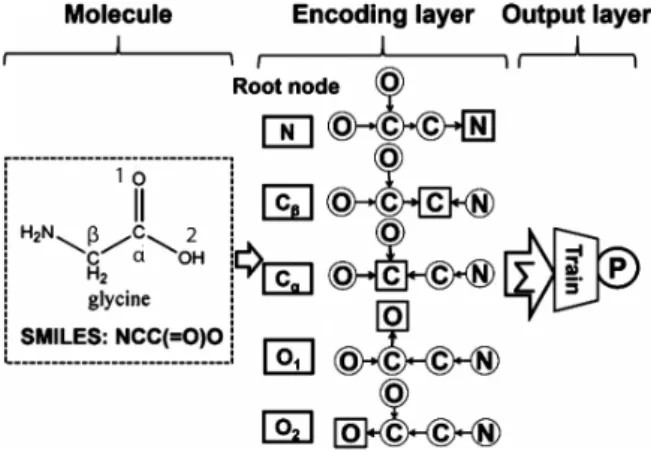
(11) Int. J. Mol. Sci. 2016, 17, 1313 Int. J. Mol. Sci. 2016, 17, 1313. 11 of 26 11 of 26. 2.3.1. Pharmacology 2.3.1. Pharmacology Lusci et al. presented a brief overview of some applications of DRNNs aimed at the prediction of Lusci et al. presented brief overview of some applications DRNNs at the molecular properties, such asaaqueous solubility. Undirected cyclicofgraphs areaimed usually usedprediction to describe of molecular properties, such as aqueous solubility. Undirected cyclic graphs are usually to to the molecules; however, the RNN typically uses directed acyclic graphs. Therefore, there wasused a need describe the molecules; however, the RNN typically uses directed acyclic graphs. Therefore, there develop methods that would address the discrepancy by considering a set of DRNN associated with a need to develop methods would address discrepancy by considering a set of DRNN all was possible vertex-centered acyclicthat orientations of thethe molecular graph. The results obtained proved associated with all possible vertex-centered acyclic orientations of the molecular graph. The results that the DRNN performance is equal to or better than the other methods [66]. obtained proved the DRNN performance is equal to or better the other methods [66]. to the Over the pastthat 50 years, drug-induced liver injury has costthan a huge amount of money Over the past 50 years, drug-induced liver injury has cost a huge amount of money to the pharmaceutical companies due to the drug withdrawal caused by this problem. DL methods has been pharmaceutical companies due to the drug withdrawal caused by this problem. DL methods has successfully applied to predict drug-induced liver injury Xu et al. compared different DL architectures been successfully applied to predict drug-induced liver injury Xu et al. compared different DL to predict drug-induced liver injury using four large data sets, and the best results were obtained by architectures to predict drug-induced liver injury using four large data sets, and the best results a novel type of DRNN (see Figure 8). The structure of glycine is converted into a primary canonical were obtained by a novel type of DRNN (see Figure 8). The structure of glycine is converted into a SMILES structure. Subsequently, each of the atoms in the SMILES structure is sequentially defined as a primary canonical SMILES structure. Subsequently, each of the atoms in the SMILES structure is root node. Finally, the as information forFinally, all the other atoms is transferred alongatoms the shortest possible sequentially defined a root node. the information for all the other is transferred paths. The model achieved an accuracy of 86.9%, sensitivity of 82.5%, of 92.9%, and area along thebest shortest possible paths. The best model achieved an accuracy of specificity 86.9%, sensitivity of 82.5%, under the curve (AUC) of 0.955 [67]. specificity of 92.9%, and area under the curve (AUC) of 0.955 [67].. Figure 8. Schematic diagram of Youjun Xu et al. network encoding glycine, first using primary Figure 8. Schematic diagram of Youjun Xu et al. network encoding glycine, first using primary canonical SMILES strucuture. Then, each of the atoms in the SMILES structure is sequentially canonical SMILES strucuture. Then, each of the atoms in the SMILES structure is sequentially defined defined as a root node. Finally, information for all other atoms is transferred along the shortest as a root node. Finally, information for all other atoms is transferred along the shortest possible paths, possible paths, in which case is obtained following the narrows [67]. in which case is obtained following the narrows [67].. 2.3.2. Bioinformatics 2.3.2. Bioinformatics DRNNs can be used to analyze biological sequence data, like predicting the subcellular location DRNNs be usedetto sequence like predicting location of proteins.can Sønderby al.analyze created biological a DRNN using only data, the protein sequence,the andsubcellular achieved 92% of of accuracy proteins. inSønderby et al. created a DRNN using only the protein sequence, and achieved 92% the prediction of the location of proteins, outperforming the current state-of-the-art of algorithms. accuracy inThe the prediction the location proteins, outperforming the currentfilters state-of-the-art performanceofwas improvedofby the introduction of convolutional and the algorithms. The performance improved by the introduction of convolutional authors experimented with an was attention mechanism that let the network focus on specificfilters parts and of thethe protein [68]. authors experimented with an attention mechanism that let the network focus on specific parts of the protein [68]. 3. Neuromorphic Chips 3. Neuromorphic Chips Since Alan Turing created the first computer, the progress in computer science has been remarkable. progress was by Gordon Moore inin1965, who foretold the number of Since AlanThis Turing created thepredicted first computer, the progress computer science that has been remarkable. transistors that could be manufactured on a single silicon chip would double every 18 months to two This progress was predicted by Gordon Moore in 1965, who foretold that the number of transistors years. It be is known as Moore’s and over the century it has been18accomplished by years. making that could manufactured on aLaw, single silicon chippast would double every months to two It is transistors increasingly smaller. As CMOS transistors get smaller they become cheaper to make, known as Moore’s Law, and over the past century it has been accomplished by making transistors faster, andsmaller. more energy-efficient. This win-win scenario driven the society to afaster, digitaland eramore in increasingly As CMOS transistors get smaller theyhas become cheaper to make, which computers play a key role in almost every walk and aspect of our lives [22]. energy-efficient. This win-win scenario has driven the society to a digital era in which computers play However, Moore’s Law has limitations when it comes to shrinking transistors; there is a a key role in almost every walk and aspect of our lives [22]. physical limit in the size of the atom. At this scale, around 1 nm, the properties of the semi-conductor.
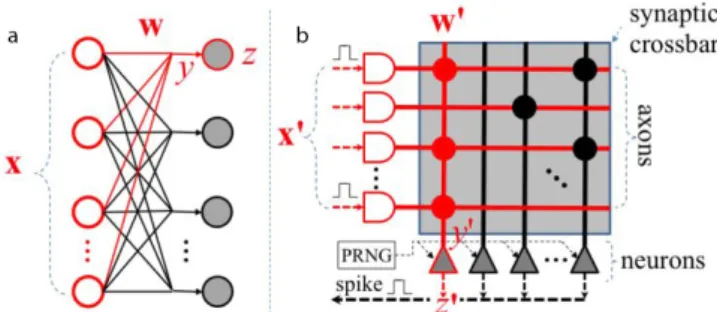
(12) Int. J. Mol. Sci. 2016, 17, 1313. 12 of 26. However, Moore’s Law has limitations when it comes to shrinking transistors; there is a physical limit theSci. size of 17, the1313 atom. At this scale, around 1 nm, the properties of the semi-conductor material Int.in J. Mol. 2016, 12 of 26 in the active region of a transistor are compromised by quantum effects like quantum tunneling. In addition, are also otheroflimitations, the energy by wallquantum [69,70] and memory wall [71], material inthere the active region a transistorsuch are as compromised effects like quantum tunneling. addition, there density are also and otherlow limitations, as the energy wall [69,70] which denoteInthe high power memorysuch bandwidth [72,73]. There are and alsomemory economic wall [71],since whichthe denote the high power density andcost low of memory bandwidth [72,73]. There also limitations, cost of designing a chip and the building a fabrication facility areare growing economic[74]. limitations, since the cost of designing a chip and the cost of building a fabrication facility alarmingly areTrying growing [74]. to alarmingly avoid some of these limitations, in the early years of this century, all of the major Trying to avoid some these limitations, in theclock earlyspeeds years of this century, all of theOver majorthe microprocessor manufacturersofmoved from ever-faster to multicore processors. microprocessor manufacturers moved from ever-faster clock speeds to multicore processors. Over past decade, instead of creating faster single-processor machines, new systems include more processors past decade, instead of with creating faster single-processor new systems include more perthe chip. Now we have CPUs multicores, and GPUs withmachines, thousands of cores [22]. processors per chip. Now we have CPUs with multicores, and GPUs with thousands of cores [22]. As already stated, DNNs have become the state-of-the-art algorithms of ML in many tasks. As already stated, DNNs have become the state-of-the-art algorithms of ML in many tasks. However, both training and execution of large-scale DNNs require vast computing resources, leading However, both training and execution of large-scale DNNs require vast computing resources, to high power requirements and communication overheads. The ongoing work on design and leading to high power requirements and communication overheads. The ongoing work on design construction of neuromorphic chips, the spike-based hardware platforms resulting from the book and construction of neuromorphic chips, the spike-based hardware platforms resulting from the about VLSI (Very Large Scale Integration) written by Lynn by Conway and Carver published book about VLSI (Very Large Scale Integration) written Lynn Conway andMead, Carverand Mead, and in the 1980s [75], offered an alternative by running DNNs with significantly lower power consumption. published in the 1980s [75], offered an alternative by running DNNs with significantly lower power However, the neuromorphic chips have to overcome hardware limitations in terms of noiseinand limited consumption. However, the neuromorphic chips have to overcome hardware limitations terms of weight as weight well as precision, noise inherent in as thenoise sensor signalin[36]. it is[36]. necessary to design noiseprecision, and limited as well inherent the Moreover, sensor signal Moreover, it is thenecessary structure,toneurons, network input, and weights DNNand during training, to efficiently map those design the structure, neurons, networkofinput, weights of DNN during training, to networks to SNN in thenetworks neuromorphic Figure 9) [76]. efficiently map those to SNNchips in the(see neuromorphic chips (see Figure 9) [76].. Figure 9. Mapping a Deep Artificial Neural Network (DANN) (a) to a neuromorphic chip like the Figure 9. Mapping a Deep Artificial Neural Network (DANN) (a) to a neuromorphic chip like the TrueNorth (b). The input neurons are represented with the red and white shapes (x and x’), and the TrueNorth (b). The input neurons are represented with the red and white shapes (x and x’), and the output neurons with the grey shapes (z and z’). The weights (w) to the neuron z are approximated output neurons with the grey shapes (z and z’). The weights (w) to the neuron z are approximated using a Pseudo Random Number Generator (PRNG), resulting in the weights (w’) to the neuron z’ in using a Pseudo Random Number Generator (PRNG), resulting in the weights (w’) to the neuron z’ in the neuromorphic chip [74]. the neuromorphic chip [74].. Focusing on projects involving neuromorphic hardware, the IBM TrueNorth chip [77] is one of Focusing on projects involving neuromorphic hardware, the IBM TrueNorth chip [77] one the most impressive silicon implementation of DNNs. SpiNNaker, a project developed by isthe of the most impressive silicon of results DNNs.implementing SpiNNaker, DNNs. a project developed University of Manchester, alsoimplementation achieved excellent Both [78] chipsby arethe digital, they compute the also information using the binary system. However, some neuromorphic chipsare University of Manchester, achieved excellent results implementing DNNs. Both [78] chips are analog, they consist of neuromorphic elements information is processed with digital, they compute the information usinghardware the binary system.where However, some neuromorphic chips analog signals; that is, they do not operate with binary values, as information is processed with are analog, they consist of neuromorphic hardware elements where information is processed with continuous [22]. In analog there is binary no separation hardware and software, analog signals;values that is, they do not chips, operate with values, between as information is processed with because the hardware configuration is in charge of performing all the computation and can modify continuous values [22]. In analog chips, there is no separation between hardware and software, itself [79]. A good example is the HiCANN chip,ofdeveloped at the of Heidelberg, because the hardware configuration is in charge performing all University the computation and canwhich modify uses wafer-scale above-threshold analog circuits [80]. There are also hybrid neuromorphic chips,which like itself [79]. A good example is the HiCANN chip, developed at the University of Heidelberg, the Neurogrid from Stanford [81], which seek to make the most of each type of computing. It usually uses wafer-scale above-threshold analog circuits [80]. There are also hybrid neuromorphic chips, like processes in analog and communicates in digital. This review will focus only on digital the Neurogrid from Stanford [81], which seek to make the most of each type of computing. It usually neuromorphic chips, the IBM TrueNorth and the SpiNNaker chip, because are the most advanced processes in analog and communicates in digital. This review will focus only on digital neuromorphic projects, obtained the best results implementing DNNs and published the highest number of chips, the IBM TrueNorth and the SpiNNaker chip, because are the most advanced projects, obtained technical papers. For further details about other projects and the differences between digital, analog the best results implementing DNNs and published the highest number of technical papers. For further and hybrid neuromorphic chips, the reader should refer to other reviews [82,83]..
(13) Int. J. Mol. Sci. 2016, 17, 1313. 13 of 26. details about other projects and the differences between digital, analog and hybrid neuromorphic chips, the reader should refer to other reviews [82,83]. Int. J. Mol. Sci. 2016, 17, 1313. 3.1. TrueNorth International Business Machines (IBM). 13 of 26. 3.1. TrueNorth International BusinessofMachines (IBM) Adaptive Plastic Scalable Electronics) initiative The DARPA SyNAPSE (System Neuromorphic selected and theSyNAPSE proposal “Cognitive via Synaptronics and Scalable Supercomputing (C2S2)” Thefunded DARPA (System of Computing Neuromorphic Adaptive Plastic Electronics) selected and funded proposal “Cognitive Computing Synaptronics and [77]. of theinitiative Cognitive Computing Group atthe IBM Research-Almaden directed byvia Dharmendra Modha Supercomputing (C2S2)” of the Cognitive Computing Group at IBMchip Research-Almaden directed by has The project is based on the design and creation of a neuromorphic called TrueNorth, which Dharmendra Modha [77]. The project is based on the design and creation of a neuromorphic chip a non-von Neumann architecture. It is characterized by modularity, parallelism and scalability. It is called TrueNorth, which has a non-von Neumann architecture. It is characterized by modularity, inspired by the brain and its function, low power, and compact volume (see Figure 10). This chip can parallelism and scalability. It is inspired by the brain and its function, low power, and compact be used to integrate spatio-temporal and real-time cognitive algorithms for different applications [84]. volume (see Figure 10). This chip can be used to integrate spatio-temporal and real-time cognitive Currently in the phase of the project, the researchers created a board 16 TrueNorth algorithms forfinal different applications [84]. Currently in the final phase of the project,with the researchers neuromorphic chips, capable of simulating 16 million neurons and four billion synapses. In 2015, created a board with 16 TrueNorth neuromorphic chips, capable of simulating 16 million neurons they assembled a system consisting of 128 chips and 128 million neurons [85]. The next goal and four billion synapses. In 2015, they assembled a system consisting of 128 chips and 128 million is to integrate 4096 chips single which would represent and one trillion neurons [85]. Theinto nextagoal is torack, integrate 4096 chips into a singlefour rack,billion which neurons would represent four billionconsuming neurons and one trillion consuming around 4 kW of power [86]. synapses, around 4 kWsynapses, of power [86].. Figure 10.The (A)neurosynaptic The neurosynaptic is loosely inspired of a canonical cortical Figure 10. (A) core iscore loosely inspired by the by ideathe of aidea canonical cortical microcircuit; microcircuit; (B) A network of neurosynaptic cores is inspired by the cortex’s two-dimensional (B) A network of neurosynaptic cores is inspired by the cortex’s two-dimensional sheet,sheet, the brain theare brain regions arein represented in different colors; (C) The multichip is inspired by the regions represented different colors; (C) The multichip network network is inspired by the long-range long-range connections between cortical regions shown from the macaque brain; (D–F) Structural connections between cortical regions shown from the macaque brain; (D–F) Structural scheme of the scheme of the core, chip and multi-chip level. The white shapes represent axons (inputs) and the grey core, chip and multi-chip level. The white shapes represent axons (inputs) and the grey shapes the shapes the neurons (outputs); (G–I) Functional view at different level; (J–L) Image of the physical neurons (outputs); (G–I) Functional view at different level; (J–L) Image of the physical layout [77]. layout [77].. The TrueNorth prototype waswas created in 2011 [87],[87], andand it was a neurosynaptic core with 256256 digital The TrueNorth prototype created in 2011 it was a neurosynaptic core with digital leaky integrate-and-fire neurons [37] and up to 256,000 synapses. The core is composed of leaky integrate-and-fire neurons [37] and up to 256,000 synapses. The core is composed of memory memory and processor, and the communication takes places all-or-none through all-or-none spike events. This an and processor, and the communication takes places through spike events. This allows allows an efficient implementation of a parallel asynchronous communication and Address Event efficient implementation of a parallel asynchronous communication and Address Event Representation Representation (AER) [88,89]. In this communication system, the neurons have a unique identifier, (AER) [88,89]. In this communication system, the neurons have a unique identifier, called address, called address, and when a neuron spikes, the address is sent to other neurons. In 2012, Compass and when a neuron spikes, the address is sent to other neurons. In 2012, Compass [90] was developed, [90] was developed, a simulator to design neural networks to be implemented in the neuromorphic a simulator to design networks to be implemented in the neuromorphic chip.compiler. Compass is chip. Compass is a neural multi-threaded, massively parallel functional simulator and a parallel a multi-threaded, massively functional and a parallel and compiler. It uses the It uses the C++ language,parallel sends spike eventssimulator via MPI communication uses OpenMP for C++.
(14) Int. J. Mol. Sci. 2016, 17, 1313. 14 of 26. language, sends spike events via MPI communication and uses OpenMP for thread-level parallelism. A simulator GPGPU Int. J. Mol. for Sci. 2016, 17, 1313[91] was also developed. Modha’s team simulated in 2007 the brain 14 ofof 26 a rat in an IBM BlueGene/L supercomputer [92]. In 2010, they simulated a monkey’s brain [93] in IBM thread-level parallelism. A simulator for GPGPU [91] also developed. Modha’s team simulated BlueGene/P supercomputers from a network map ofwas long-distance neural connections in the brain in 2007 the brain of a rat in an IBM BlueGene/L supercomputer [92]. In 2010, they simulated a obtained with 410 anatomical studies (Collation of Connectivity data on the Macaque brain). Later that monkey’s brain [93] in IBM BlueGene/P supercomputers from a network map of long-distance same year, they published the results of a simulation with Compass of 2048 billion neurosynaptic cores neural connections in the brain obtained with 410 anatomical studies (Collation of Connectivity data 11 neurons and 1.37 × 10¹⁴ synapses [94]. The execution was 1542× times slower than real and 5.4 10Macaque on × the brain). Later that same year, they published the results of a simulation with time,Compass and 1.5 million Gene/Q supercomputers were 11 neurons and 1.37 × 10¹⁴ synapses [94]. of 2048 Blue billion neurosynaptic cores and 5.4 × 10needed. A program in was the TrueNorth consists of time, a definition the inputs and outputs to the network The execution 1542× timeschips slower than real and 1.5 of million Blue Gene/Q supercomputers and the weretopology needed. of the network of neurosynaptic cores. The parameters of the neurons and the A program in the consists a definition of the inputs and outputs to the synaptic weights should beTrueNorth specified, chips as well as theofinterand intra-core connectivity [84,95]. network and the topology of thehas network neurosynaptic cores. Theisparameters ofwhich the neurons and an The programming paradigm four of levels: The lowest level the corelet, represents the synaptic weights should be specified, as well as only the interand intra-core connectivity [84,95]. abstraction of a TrueNorth program like a blackbox, showing the inputs and outputs, and hiding The programming paradigm has four levels: The lowest level is the corelet, which represents an the other details. The next level is the Corelet Language which allows the creation and combination abstraction of a TrueNorth program like a blackbox, only showing the inputs and outputs, and of corelets. The validated corelets are included in the Corelet Library and can be reused to create hiding the other details. The next level is the Corelet Language which allows the creation and new combination corelets. This is like aThe repository makes up the in third level. Library The lastand level Corelet of corelets. validated and corelets are included the Corelet can is be the reused Laboratory, a programming environment to develop new applications. It is integrated with Compass, to create new corelets. This is like a repository and makes up the third level. The last level is the the TrueNorth simulatora [84]. Corelet Laboratory, programming environment to develop new applications. It is integrated with The corelet has asimulator collection of several functions that were implemented in the TrueNorth Compass, thelibrary TrueNorth [84]. The corelet library has a collection several functions that were implemented the TrueNorth chip verified and parameterized. Someof examples are algebraic, logical and in temporal functions, chip verified and parameterized. Some examples are algebraic, logical and temporal functions, convolutions, discrete Fourier transformations and many others. Using these functions different convolutions, discrete Fourierintransformations andchip, manylike others. Using functions different algorithms were implemented the TrueNorth CNN (seethese Figure 11) and Restricted algorithms were implemented in the TrueNorth chip, like CNN (see Figure 11) and Restricted Bolztmann Machines for feature extraction, hidden Markov models, spectral content estimators, liquid Bolztmann Machines for feature extraction, hidden Markov models, spectral content estimators, state machines, looming detectors, logistic regression, backpropagation and some others. The corelet liquid state machines, looming detectors, logistic regression, backpropagation and some others. The algorithm be re-used different there are different corelet implementations coreletcan algorithm canin be re-usedapplications, in differentand applications, and there are different corelet for the same algorithm, showing the flexibility of the corelet construction [76,96]. implementations for the same algorithm, showing the flexibility of the corelet construction [76,96]. TrueNorth waswas used in in different suchas asrecognition recognition voices, composers, digits, TrueNorth used differentapplications, applications, such of of voices, composers, digits, sequences, emotions or eyes. It was avoidanceand and optical flow [96,97]. sequences, emotions or eyes. It wasalso alsoused usedin in collision collision avoidance optical flow [96,97]. TrueNorth appliedtotobioinformatics bioinformatics by thethe University of Pittsburgh, TrueNorth waswas alsoalso applied by aagroup groupfrom from University of Pittsburgh, who used the RS130 protein secondary structure data set to predict the local conformation of theof the who used the RS130 protein secondary structure data set to predict the local conformation polypeptide chain and classified it into three classes: α helices, β-sheets, and coil [74]. polypeptide chain and classified it into three classes: α helices, β-sheets, and coil [74].. Figure 11. Mapping of aofCNN totoTrueNorth. network features for one group at Figure 11. Mapping a CNN TrueNorth. (A) (A) Convolutional Convolutional network features for one group at one topographic location implemented using using neurons TrueNorth core,core, withwith their their one topographic location areare implemented neuronson onthe thesame same TrueNorth corresponding filter support regionimplemented implemented using lines, andand filterfilter weights corresponding filter support region usingthe thecore’s core’sinput input lines, weights implemented using core’s synapticarray. array.The The inputs inputs are with white shapes, and the implemented using thethe core’s synaptic arerepresented represented with white shapes, and the grey triangles represent the neurons. The filter used in each case is implemented mapping the matrix grey triangles represent the neurons. The filter used in each case is implemented mapping the matrix of weights (the numbers in the green boxes) into the synaptic array (grey circles); (B) For a neuron of weights (the numbers in the green boxes) into the synaptic array (grey circles); (B) For a neuron (blue points) to target multiple core inputs, its output (orange points) must be replicated by neuron (blue points) to target multiple core inputs, its output (orange points) must be replicated by neuron copies, recruited from other neurons on the same core, or on extra cores if needed [76]. copies, recruited from other neurons on the same core, or on extra cores if needed [76]..
Figure
![Table 1. Deep Artificial Neural Networks Achievements. Adapted from a slide developed by Yann Lecun, Facebook and NYU [32]](https://thumb-us.123doks.com/thumbv2/123dok_es/7386937.376789/3.892.171.724.728.976/table-artificial-neural-networks-achievements-adapted-developed-facebook.webp)

![Table 3. Performance of target prediction methods analyzed by Unterthiner et al., in terms of mean AUC (Area Under the Receiver Operating Characteristic curve) across targets [40].](https://thumb-us.123doks.com/thumbv2/123dok_es/7386937.376789/5.892.249.643.697.866/performance-prediction-methods-analyzed-unterthiner-receiver-operating-characteristic.webp)
![Table 4. List of assays from Pubchem that were used for the study of Dahl et al. [42,43].](https://thumb-us.123doks.com/thumbv2/123dok_es/7386937.376789/6.892.119.771.165.447/table-list-assays-pubchem-used-study-dahl-et.webp)
+7
![Figure 2. Deep neural network architecture from Yanjun Qi et al. [45]. The input to the first layer is the protein sequence represented by the single-letter amino acid code, for example the letter “A” (in green) represents “Alanine”](https://thumb-us.123doks.com/thumbv2/123dok_es/7386937.376789/7.892.268.629.127.609/figure-architecture-protein-sequence-represented-example-represents-alanine.webp)
![Figure 4. Architecture of a Deep Convolutional Neural Network (DCNN), alternating the convolutional layer and the max-pooling layer (or sub-sampling layer), and finally the fully-connected layer [56]](https://thumb-us.123doks.com/thumbv2/123dok_es/7386937.376789/8.892.126.762.940.1091/figure-architecture-convolutional-network-alternating-convolutional-sampling-connected.webp)
Documento similar