
Assessing politeness of requestive speech acts produced by Japanese learners of English in a spoken corpus
34
0
0
Texto completo
(2) Assessing politeness of requestive speech acts produced by Japanese learners of English in a spoken corpus. different levels of proficiency. In order to investigate pragmatic competences, the author examines requests as speech acts, focusing especially on interactions in shopping role plays in the oral interview tests contained in the National Institute of Information and Communications Technology Japanese Learner English (NICT JLE) Corpus. The findings of the study extracting criterial features of pragmatic competence should be of interest to educators involved in teaching foreign languages. Adolphs (2008: 133) notes that the context-sensitive descriptions of the pragmatic function in a corpus of spoken discourse should be important for English language teaching (ELT) as a “shift in focus towards a communicative approach”. However, corpus-based pragmatic studies tend to concentrate on the surface forms of linguistic patterns extracted in the concordance lines, i.e. pragmalinguistic features. Pragmatic competence is composed of pragmalinguistic competence and sociopragmatic competence (Kasper and Roever 2015, Leech 2014). Kasper (1997) defines that pragmalinguistics includes “pragmatic strategies such as directness and indirectness, routines, and linguistic forms which can intensify or softening communicative acts” (Section 1, Paragraph 2). On the other hand, sociopragmatics refers to “the social perceptions underlying participants’ interpretation and performance of communicative action”, which may differ depending on speakers’ and hearers’ speech communities (Kasper 1997, Section 1, Paragraph 3). The present study aims to give pedagogical implications to those who instruct EFL learners to communicate successfully in their target language, by clarifying how they develop their pragmatic competence in L2. Sociopragmatic competence is also necessary for learners’ successful communicative acts, in addition to pragmalinguistic competence. Therefore, the study further explorers whether it is possible to annotate the degree of politeness according to the pragmalinguistic features the learners used in their requests. An online survey was conducted to elicit native and non-native EFL instructors’ assessment of the sociopragmatic competence of Japanese learners of English in their requestive speech acts.. Language Value 9 (1), 184–217 http://www.e-revistes.uji.es/languagevalue. 185.
(3) Aika Miura. II. PRAGMATIC PRODUCTION: DIFFICULTIES IN CONDUCTING CORPUS STUDIES IN INTERLANGUAGE PRAGMATICS To date, a number of studies have investigated learners’ pragmatic competence by focusing on requests produced by learners of English using various methods of collecting data about learners’ production. Examples of such methods include role plays, discourse completion tasks (DCTs), and authentic discourse including learner corpora (see Kasper and Dahl 1991, Kasper and Rose 2002, Kasper and Roever 2005, Leech 2014, Schauer 2009). Leech (2014: 16) states that “pragmalinguistic politeness is assessed on the basis of the meaning of the utterance out of context”, while “sociopragmatic politeness […] is a matter of judging politeness in context” (2014: 17). Leech (2014: 271) also argues that “the learner corpus movement has so far contributed rather little to the study of politeness”. Corpora of spoken interlanguage mainly allow researchers “to systematically examine lexico-grammatical patterns and syntactic structures that are part of the grammar of conversation” (Callies 2013: 17). By taking a corpus-based approach to the field of interlanguage pragmatics (ILP), it is easy to extract concordance lines from the large-scale data and examine lexical behaviours, such as discourse markers (e.g. Fung and Carter 2007, Müller 2004, 2005, Romero-Trillo 2002, 2008). With this type of corpus-based approach, politeness can be “studied as how it is conveyed or manifested” in the surface forms of lexico-grammatical features, namely, pragmalinguistics (Leech 2014: 13). Unfortunately, without conducting contextual analyses manually, extracting concordance lines automatically only allows researchers to analyse “language forms, not [...] functions” (Adolphs 2008: 9). Sociopragmatics, in contrast, deals with social judgements of politeness not only regarding the words in the utterances and their meanings, but also about the occurring contexts, and the prosody and word stress (Leech 2014). This should be the main reason why the prevalent approaches to the investigation of speech acts are DCTs or similar elicitation formats (Adolphs 2008). Data collection in ILP requires researchers to control “contextual parameters” (Kasper and Roever 2005: 325). Besides, Granger (2002: 5) admits “the difficulty of controlling the variables that affect learner output in a non-experiment context”, so that much of non-corpus-based “SLA research tends to be based on a relatively narrow empirical base”. Language Value 9 (1), 184–117 http://www.e-revistes.uji.es/languagevalue. 186.
(4) Assessing politeness of requestive speech acts produced by Japanese learners of English in a spoken corpus. III. PRAGMATIC AWARENESS: PAST STUDIES ON ASSESSMENT OF POLITENESS IN REQUESTS In contrast with the studies on pragmatic production in the previous section, Schauer (2009) notes that only a limited number of studies investigated L2 learners’ pragmatic awareness, and this area has not been studied extensively. Leech (2014: 250) notes that such tasks where “the respondent has to [make a] judgement as to how (in)appropriate to the situation, how (im)polite, etc., it is” went out of fashion in the 1990s as they tended to test pragmalinguistic politeness out of context, avoiding the sociopragmatic factors governing politeness. Apart from the drawbacks of this outdated methodology, the current section reviews the major studies on assessing politeness of requests since the learners’ requests extracted from the corpus are judged by native and non-native speakers of English in the present study. As questionnaire-type instruments in ILP, multiple choice (MC) and rating scales are used for “the contextual appropriateness of speech act realisations”, designed to elicit “possible respondent preferences” of the utterances (Kasper and Roever 2005: 328). In scaled-response formats, respondents are asked “to assess situational contexts and instances of speech acts” (327), which “are suitable for sociopragmatic and pragmalinguistic assessment” (328). Tanaka and Kawade (1982) conducted a study to test the validity of Lakoff’s politeness strategies, based on his claim that “politeness increases with decreasing imposition” (18) and “certain linguistic features can mark the varying degree of politeness in the speech act of requesting” (19). They replicated the study of Carrel and Konneker (1981), who highlighted the contribution of grammatical mood (e.g. interrogative, declarative and imperative) to politeness. Tanaka and Kawade (1982: 19) presented groups of native speakers of English and of non-native ESL learners with a set of request sentences with various linguistic features such as “mood, modals negation, tags, and tense or modals”. The subjects were asked to rank the request sentences with different linguistic features in “situationally-null contexts” (23) and in a situation where someone borrows an item with varying degrees of “social distance and psychological distance” (24). As a result, in the null situations, there were no significant differences Language Value 9 (1), 184–217 http://www.e-revistes.uji.es/languagevalue. 187.
(5) Aika Miura. between the subjects (10 native and 10 non-native speakers) in terms of judging the politeness based on grammatical features. However, in the second settings with a varying degree of distance-politeness, advanced ESL learners of 32 adults with different language backgrounds did not show the use of the target language as appropriately as a group of 53 native speakers of American English. As a cross-linguistic study, Olshtain and Blum-Kulka (1985) asked 172 American native speakers of English and 160 native speakers of Hebrew to rate six different request patterns in an “asking for a loan” situation in their native languages as “not appropriate”, “more or less appropriate” or “most appropriate”. As a result, for five out of six linguistic patterns, high levels of agreement (above 50%) were observed among the informants. A “negative-politeness-oriented indirect pattern” such as “Could you possibly lend me the money?” in the English language was assessed as the most appropriate with more than 80% of agreement. Kitao (1990) compared how ESL learners and native speakers judged politeness in requests differently, with the use of rank-ordering questionnaires in which informants (80 natives, 34 ESL and 103 EFL Japanese speakers) were asked to rate 61 requests with direct and conventionally indirect strategies on a scale of 1-10. He found that there were no significant differences between natives and Japanese. To sum up, the aforementioned studies basically show no significant differences between the native and learner judgments of politeness in the request utterances. Leech (2014: 250-251) also argues that “pragmalinguistic politeness, or context-invariant politeness” can be assessed out of context, based on his study in which 45 native speakers of English were asked to judge the utterances from most polite to least polite. As a result, an overall consensus of 89% on their judgements was observed. His attempt was to see whether native speakers reached an agreement on the “default interpretation of speech events” (250), out of context without giving any definitions of politeness to the respondents. In the present study, applying and using the research methodologies in the past studies described above, the author attempts to test whether their remarks on general agreement on politeness by native and non-native speakers are valid and applicable to learner data taken from the NICT JLE Corpus. The assessment survey is conducted for the following. Language Value 9 (1), 184–117 http://www.e-revistes.uji.es/languagevalue. 188.
(6) Assessing politeness of requestive speech acts produced by Japanese learners of English in a spoken corpus. reasons. First, the NICT JLE Corpus lacks audio data, which might be useful contextual information for judging the politeness of the produced requests, and it is only available as written transcripts of oral interview tests with a few extra-linguistic tags such as pauses, repetitions and overlaps (Izumi et al. 2002, The NICT Japanese Learner English (JLE) Corpus 2012). Next, being a non-native speaking EFL instructor, the author has little confidence in determining whether particular pragmalinguistic features in certain contexts are sociopragmatically appropriate in terms of politeness in the target language. Therefore, using the methods of MC questionnaires and rating scales, groups of native and non-native English language instructors in tertiary education in Japan, having similar vocational backgrounds to the author, were asked to assess the learner production extracted from the NICT JLE Corpus. The extent to which they reached a consensus on their judgements is investigated. If the agreement among respondents is significantly high, it should be possible to assess the sociopragmatic competence of learners in the NICT JLE Corpus. The author also compares the judgements made by native and non-native speakers. The paper addresses the following research questions (RQs). RQ1. What kinds of different pragmalinguistic features and functions of requests are observed in the NICT JLE Corpus? RQ2. What kinds of pragmalinguistic features and functions obtain higher values of agreement among the respondents when they evaluate the appropriateness of the requests? Are there any differences between the judgements made by English-speaking and Japanese-speaking respondents? RQ3. What are the distributions of highly evaluated pragmalinguistic features by the respondents in the NICT JLE Corpus?. IV. CLASSIFICATION OF REQUESTS BASED ON THE CROSS-CULTURAL SPEECH ACT REALISATION PROJECT (CCSARP) AND APPLYING IT TO STUDIES ON LEARNER LANGUAGE The classification of requests in the present study is based on the coding scheme developed by Blum-Kulka et al. (1989) in the CCSARP, which aims to crossLanguage Value 9 (1), 184–217 http://www.e-revistes.uji.es/languagevalue. 189.
(7) Aika Miura. linguistically compare requests and apologies across different languages and language varieties including English, Hebrew, German, amongst others. First of all, as Blum-Kulka et al. (1989: 275-276) note, the head act is identified as the core of the request sequence, preceded by an alert and/or followed by a supportive move as in “Excuse me (i.e. alert), could you give me a lift to town (i.e. head act)?” and “Could you clean up this mess (i.e. head act)? I’m having some friends over for dinner tonight (i.e. supportive move)”. Then, head acts can be classified into one of the following request strategies: direct, conventionally indirect and non-conventionally indirect strategies. Direct strategies are realised in the form of imperatives, obligations (e.g. “must”, “have to”), performatives (e.g. “ask”, “require”), wishes (e.g. “would like”) and desires (e.g. “want”, “need”). By using this strategy, “a requester wants to make the illocutionary point of his/her utterance explicit” (Flores Salgado 2011, p. 248). The second type are conventionally indirect strategies, realised as linguistic features such as ability (e.g. “could”, “can”), willingness (e.g. “would you”) and suggestion (e.g. “How about”). According to Blum-Kulka (1989: 33), “certain forms habitually used to perform certain acts become the conventional ways for performing these acts”. Therefore, conventionally indirect strategies are different from non-conventionally indirect ones “where the speaker’s intentions are not clearly stated and the hearer has to infer the request” (Flores Salgado 2011: 249). For example, “The kitchen seems to be in a bit of mess” can be reformulated as the request asking “Could you clean up this mess?” Head acts can be modified both internally and externally. Internal modification can be divided into syntactic downgraders (e.g. interrogatives, negation), lexical and phrasal downgraders (e.g. politeness marker “please”) and upgraders (e.g. “really”). External modification functions as a supportive move, for example as grounders (reasons and explanations), threats, cost minimisers, disarmers, promises and confirmations (BlumKulka et al. 1989, Flores Salgado 2011). The coding scheme of the CCSARP has been modified and applied to various studies of the requests and apologies made by language learners at different levels of proficiency, sometimes in comparison to the native speakers’ production (e.g. Hill 1997, Kaneko 2004, Flores Salgado 2011, Trosborg 1995). Targeting Japanese learners of English,. Language Value 9 (1), 184–117 http://www.e-revistes.uji.es/languagevalue. 190.
(8) Assessing politeness of requestive speech acts produced by Japanese learners of English in a spoken corpus. Hill (1997) employed a DCT method, and Kaneko investigated the extracts from the NICT JLE Corpus. The aforementioned studies based on the CCSARP coding scheme indicate that learners at higher proficiency levels tended to produce more indirect strategies, in a similar way to the native speakers, than lower-level learners. Leech (2014) in fact points out that some classifications and distinctions of the head acts and modifications such as downgraders in the CCSARP are rather vague, noting that “the CCSARP coding scheme and its more recent variants are not ideal for investigating politeness” (267). However, Leech (2014) also admits that a number of studies of speech acts drew on the scheme so that it is advantageous when comparing results across various research settings, such as comparing the tendencies of learners with different mother tongues.. V. THE BACKGROUND TO THE STUDY V.1. The NICT JLE Corpus The NICT JLE Corpus consists of one million words from the written transcripts of the 15-minute oral interview test, called the Standard Speaking Test (SST), taken by Japanese learners of English (Izumi et al. 2004). The SST, which draws on the Oral Proficiency Interview (OPI) of the American Council on the Teaching of Foreign Languages (ACTFL), is composed of five stages: (1) answering warm-up questions (3– 4 minutes), (2) describing a single picture (2–3 minutes), (3) engaging in a role-play scenario with the interviewer (1–4 minutes), (4) narrating picture sequences (2–3 minutes), and (5) answering questions, the purpose of which is to wind down the subjects’ tension (1–2 minutes). In the role-play stage (3), the interlocutor (who is a Japanese-speaking approved interviewer) selects a suitable task for a test-taker (i.e. interviewee), according to his or her proficiency level, from the five topics that are made available, such as “Invitation”, “Landlord”, “Shopping”, “Travel” and “Train”, with three levels of difficulty: beginner, intermediate and advanced. The present study investigates the data referring to “Shopping” taken from the role-play stage. In the beginner and intermediate version, the interlocutor plays the role of a shop assistant, and the interviewee is given a task. Language Value 9 (1), 184–217 http://www.e-revistes.uji.es/languagevalue. 191.
(9) Aika Miura. consisting in purchasing a particular item as a customer. The advanced version contains a situation where the interviewee has to negotiate a refund or exchange of the purchased item with the interlocutor. In the SST, the test-takers are holistically evaluated into nine proficiency levels: Novice (SST Levels 1, 2, and 3), Intermediate Low (Levels 4 and 5), Intermediate Mid (Levels 6 and 7), Intermediate High (Level 8), and Advanced (Level 9). Based on studies which attempt to align the proficiency levels provided by the SST and ACTFL OPI with the CEFR levels (Kaneko and Izumi 2012, Tschirner and Bärenfänger 2012), Level 3 groups learners as CEFR A1 learners, Levels 4 and 5 as A2, and Levels 6, 7, and 8 as B1 in the present study.. V.2. The Multi-Layered Scheme for Extracting Requests from the NICT JLE Corpus Drawing on the coding scheme proposed by Blum-Kulka et al. (1989), the author (Miura, 2015) used the UAM CorpusTool to build an annotation scheme for requests, which has a multi-layered structure. The present section describes two annotation schemes: the first is to extract and annotate various linguistic features of the requests, and the second is to annotate the functions of the requests by identifying the situations. By identifying the linguistic features and their functions cross-schematically across different proficiency levels, learners’ pragmalinguistic developmental stages are revealed as criterial features. Firstly, the manual annotations were conducted based on the coding scheme of the CCSARP, as a top-down procedure, by applying to the shopping role-play data comprising 68 learners corresponding to A1 learners, 114 learners of A2, and 66 B1 learners in the NICT JLE Corpus. However, it was necessary to add a bottom-up analysis, as the author encountered difficulties in applying the scheme to some parts of the target spoken learner data. The reason underlying these problems was that they contained a number of erroneous and developmental productions, in addition to the fact that the requests occurred in a rather limited situation, namely, shopping.. Language Value 9 (1), 184–117 http://www.e-revistes.uji.es/languagevalue. 192.
(10) Assessing politeness of requestive speech acts produced by Japanese learners of English in a spoken corpus. IV.2.1. Requests Tables 1, 2, and 3 show a set of multi-layered annotation schemes for extracting requestive speech acts. Tables 1 and 2 represent schemes for direct strategies and conventionally indirect strategies with some examples taken verbatim from the written scripts in the corpus, respectively. Non-conventionally indirect strategies in the CCSARP, in which requests were not manifested in the surface linguistic forms, were not taken for analysis since there were no ways to confirm the meanings of the speakers’ utterances. The CCSARP coding scheme was modified. For example, the categories “nonsentential phrase”, “statement”, “not classifiable” and “yes/no” in the direct strategies in Table 1 were characteristic of the learner data. The categories “existence” and “intention” in Table 2 were added as patterns which were especially commonly observed in a shopping situation. Thus, “existence” was created referring to Leech’s (2014: 143) comment that “Got a pen?” is a “highly conventionalised” request. Table 3 shows the scheme for extracting linguistic features of internal modification. The three tables below show verbatim transcripts from the corpus and most of them indicate erroneous and developmental patterns, which are characteristic of learner language.. Table 1. Annotation scheme for extracting direct strategies of requests Category Obligation Non-sentential phrase. Desire. Imperative. Statement Request verb Not classifiable Yes/No. Subcategory should must item please item only want need would rather would like imperative please imperative only. Example “So I think you should take it back.” “I must pay I must pay.” “This please?” “This one.” “I want to buy it.” “I need to get a new one.” “So I’d rather pay the gap.” “I’d like to buy this by this card.” “Please show me.” “So let me know about it.” explanation “My size is M.” declarative purchase “I buy it.” other “I try it.” interrogative “So do you have some recommend?” “I’m asking you if we could if we could ur exchange or refund it.” “Buy it.” “No?”. Language Value 9 (1), 184–217 http://www.e-revistes.uji.es/languagevalue. 193.
(11) Aika Miura Table 2. Annotation scheme for extracting conventionally indirect strategies. Category Ability/Permission. Subcategory can could may will you. Willingness. do/would you mind would you. Suggestory. why not how/what about possible. Possibility subjunctive wonder if/whether Subjectiviser. Existence. Intention. appreciate if/whether hope that do you have (item) is there (item) I look for (item) I will I like I decided to I come/am here to. Example “Can I, can I try it?” “Could I, could I use credit card?” “And may I open it?” “Will you exchange it?” “So would you mind changing another er shirts instead?” “So would you change a sweater?” “Why don’t you go to outside and look at the color with with me?” “So what about just refund?” “Is it possible to take back this notebook computer today?” “So I’m OK if you um if you give me a red sweater with no no extra money.” “I was wondering if I can get another colour or if you don’t have one. “I appreciate if you could change eh with change it with other ones.” “So I hope you can exchange other bigger one.” “Do you have, do you have any jacket?” “Is there a walking shoes?” “I’m looking for uum jacket.” “I will have it.” “I prefer this ten thousand yen.” “I decided to buy this one.” “Today, I I come to here to to see some personal computers.”. Table 3. Annotation scheme for linguistic features of internal modification. Category Subcategory Politeness marker please I mean interpersonal marker. you know well maybe. Discourse marker. downtoner. possibly little (bit). DM subjectiviser. If clause. I think. I hope upgrader just if you can other if clause if possible If you don’t mind. Example “I can get brown one, please.” “Do you have a some cigar like a urm I mean like ten hundred yen?” “I was wondering, you know, if I can get refund or change to something else.” “Uhm well um ehm another one, please.” “I would like you to other um change to another another skirt, or maybe, pay back um pay back money.” “I wonder if you could possibly err replace this shirt.” “So I play the guitar for you, mm could you discount a little bit?” “Well, I think I’ll go ahead and make this I’ll go ahead and take this six-hundred-dollar one.” “Uum um m more s small T-shirts I I hope so.” “So if you can, I really want you to change exchange.” “Just just I I I I want to buy this.” “So if you can, I really want you to change exchange.” “But urm if I can, I I want to refund.” “If possible, nn could you nn discount, please?” “So, if erm if you don’t mind, I wanna return this stuff.. Language Value 9 (1), 184–117 http://www.e-revistes.uji.es/languagevalue. 194.
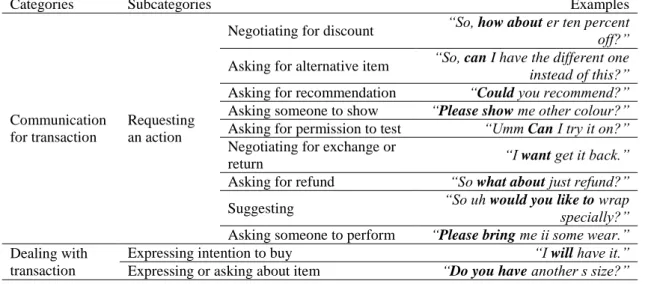
(12) Assessing politeness of requestive speech acts produced by Japanese learners of English in a spoken corpus. V.2.2. Situations: Identifying Functions of Requests Independent from the schemes for extracting request strategies in the previous section, the requests were classified into one of two function groups: (1) “commutation for transaction” and (2) “dealing with transaction”. The first group contains nine functions of requests made to the interlocutor in a transaction (see Table 4). The requests in the second group are further divided into subgroups: (1) “expressing intention to buy” and (2) “expressing or asking about item”, which are typically evident when purchasing a particular item and paying for it. The scheme was originally devised by the author to identify the functions of requests in shopping transactions on the basis of the bottom-up manual annotation.. Table 4. Annotation scheme for identifying functions of utterances. Categories. Subcategories Negotiating for discount Asking for alternative item. Communication for transaction. Requesting an action. Asking for recommendation Asking someone to show Asking for permission to test Negotiating for exchange or return Asking for refund Suggesting. Dealing with transaction. Asking someone to perform Expressing intention to buy Expressing or asking about item. Examples “So, how about er ten percent off?” “So, can I have the different one instead of this?” “Could you recommend?” “Please show me other colour?” “Umm Can I try it on?” “I want get it back.” “So what about just refund?” “So uh would you like to wrap specially?” “Please bring me ii some wear.” “I will have it.” “Do you have another s size?”. VI. STUDY 1: JUDGING THE APPROPRIATENESS OF REQUESTS VI.1. Methodology The judgement survey was conducted to investigate the degree of appropriateness of requests extracted from the NICT JLE Corpus in terms of politeness. The survey was given to the respondents online, using the SurveyMonkey® tool (see Appendix A).. VI.1.1. The Respondents. Language Value 9 (1), 184–217 http://www.e-revistes.uji.es/languagevalue. 195.
(13) Aika Miura. All of the respondents were experienced English language instructors (including parttime and full-time lecturers, associate professors and professors) in tertiary education in Japan, comprising 10 native speakers of English and 10 Japanese speakers. Table 5 summarises their personal information and Table 6 shows the respondents’ length of stay in Japan and their experience in teaching English to Japanese students.. Table 5. Respondents’ personal information. Respondents. Number of Respondents. Native Japanese. 10 10. Gender Male Female 9 1 2 8. 30s 4 0. 40s 4 4. Age 50s 60s 1 1 4 1. 70s 0 0. 80s 0 1. Table 6. Length of stay and experience teaching English in Japan. Questions How many years have you lived in Japan? How many years have you taught (or did you teach) English in Japan?. Respondents Native Japanese Native* Japanese. 3 to 5 years 1 0 0 0. 6 to 10 years. Over 10 years. 1 0 1 2. 8 10 8 8. Note: *One respondent did not answer the question regarding teaching experience in Japan.. VI.1.2. The Online Survey The respondents were informed of the following conditions before answering the questionnaire: (1) The survey is to investigate how people respond to various expressions used in a shopping situation, and the questionnaire is only given to those who teach English in tertiary education in Japan; (2) the respondents are given some excerpts of conversations between a shop assistant and a customer, and are asked whether the customers’ utterances are appropriate or not, from the perspective of a shop assistant; (3) there are some erroneous utterances included in the conversations as some of them were produced by Japanese learners of English; and (4) the excerpts do not contain information regarding the speakers’ gestures and pronunciation, which might be useful information to rate the appropriateness. They were also asked not to think and spend too much time answering the questionnaires, and asked to follow their instinct without being too prescriptive as an English teacher. The respondents were not instructed or trained to become familiar with the methods of analysing politeness or. Language Value 9 (1), 184–117 http://www.e-revistes.uji.es/languagevalue. 196.
(14) Assessing politeness of requestive speech acts produced by Japanese learners of English in a spoken corpus. pragmatic competence. The main purpose of the present study was not to attempt to achieve consensus among the respondents on social judgement of politeness, but to see whether they reach an agreement and, if so, how much their agreement is statistically significant, by observing Japan-based instructors’ general perceptions towards Japanese EFL learners’ pragmalinguistic choice for their requests. The online survey contained the following three kinds of situations with various linguistic features: (1) “negotiating for exchange or return”, (2) “asking for permission to test”, and (3) “expressing intention to buy”, selected from the annotation scheme for identifying the functions of requests (see Table 4). In each situation, two types of questions were given: (1) to select a response/s they would like to hear as a shop assistant, and (2) to choose the degree of appropriateness for each response from appropriate (i.e. polite enough), a little appropriate (i.e. a little too polite or a little impolite) or inappropriate (i.e. too polite or very impolite).. VI.1.2.1. Situation 1: Negotiating for Exchange or Return The questionnaire begins with the following interaction with the customer’s possible response in blank, as shown in Figure 1. The interaction below was actually taken verbatim from a subcorpus of the native speakers who took the same interview test in the NICT JLE Corpus.. <Shop Assistant> Good afternoon, madam. How can I help you? <Customer> Hi. I just bought this shirt. And when I got home, I just realised that it was the wrong size. ______________.. Figure 1. Prompt for Situation 1. The respondents were asked to answer a set of two questions (i.e. choosing the responses they like and rating them). Ten responses (numbered from E-1 to E-10 in Table 7, where E stands for “exchanges”) were taken verbatim from the data of learners and a native speaker in the NICT JLE Corpus. As explained in the section “V.1 The NICT JLE Corpus”, a negotiation task was given to the advanced interviewees, who belong to the CEFR B1 level (i.e. SST Levels 6, 7 and 8). The direct head acts of the Language Value 9 (1), 184–217 http://www.e-revistes.uji.es/languagevalue. 197.
(15) Aika Miura. sentences numbered as E-1 and E-2 are internally modified with “if clauses”. E-3 is a combination of conventionally indirect “intention” and direct “imperative please”. E-4, E-5, E-6, E-8 and E-9 contain various patterns of conventionally indirect strategies. Externally modified by “Is that possible?”, E-7 is also a conventionally indirect pattern. E-10 was intentionally selected by the author as it sounds quite offensive as a response.. Table 7. Responses given for situation 1: Negotiating for exchange or return. No.. Strategy. Linguistic Feature. E-1 Direct E-2. E-3. Direct & Conv. Indirect. E-4 E-5 Conv. Indirect. E-8 E-9 E-10. intention & imperative please. Other. SST Level. “So if you can, I really want you to exchange. But is it OK?”. 7. “So, if possible, I’d like to change this one to another, a little bit smaller one.”. 6. “I’ll take another shirt, a bigger one. So please exchange it.”. 6. “So can you exchange it?” “So would you change a shirt?” “I was wondering if I could exchange it for subjectiviser something else.” subjectiviser & “I thought I could exchange this into external modification another one. Is that possible?” suggestory “Why can’t you exchange it?” “Would it be possible for me to exchange it possibility to the other size?” “If it says M, I think I have a right to get that one because I wanted to buy a smaller shirt at first.” ability/permission willingness. E-6 E-7. desire. want & IM*: if clause would like & IM: if clause. Sentence. 7 6 Native Speaker 8 8 8 8. Note: *IM stands for “internal modification”.. VI.1.2.2 Situation 2: Asking for Permission to Test The interaction for the second situation is given in Figure 1, and six responses are shown in Table 8. The responses numbered as T-1, T-2, T-3 and T-4 (where T stands for “test”) were typical requests made by learners at the SST Level 3 (i.e. CEFR A1) and/or Level 4 (i.e. A2). There were no patterns with “could” (T-5) and “subjectiviser” (T-6) in the NICT JLE Corpus, but they were formulated deliberately by the author. <Shop Assistant> May I help you, ma'am? <Customer> Yeah. _______________. Figure 2. Prompt for situation 2. Language Value 9 (1), 184–117 http://www.e-revistes.uji.es/languagevalue. 198.
(16) Assessing politeness of requestive speech acts produced by Japanese learners of English in a spoken corpus. Table 8. Responses given for Situation 2: Asking for permission to test. No.. Strategy. Linguistic Feature. T-1. Direct. desire. T-2 T-3 T-4 T-5. intention Conventionally Indirect. T-6. ability/permission. subjectiviser. Sentence “Um I want to try on this want shirt.” “I will try on this shirt.” can “Can I try on this shirt?” may “May I try on this shirt?” “Could I try on this could shirt?” “I am wondering if I could try on this shirt.”. SST Level 3&4 4 3&4 3&4 N/A N/A. VI.1.2.3 Situation 3: Expressing Intention to Buy The third situation involves requests expressing an intention to buy a particular item, as Figure 3 shows. Nine responses (from P-1 to P-8, where P stands for “purchase”) were given (see Table 9), all of which were taken verbatim from the NICT JLE Corpus. The responses include the data from A1 (Level 3) and A2 (Levels 4 and 5) learners as well as one native speaker.. <Shop Assistant> May I help you, ma’am? <Customer> __________________.. Figure 3. Prompt for Situation 3 Table 9. Given responses for situation 3: Expressing intention to buy. No. P-1 P-2 P-3 P-4 P-5 P-6 P-7 P-8. Strategy. Direct. Conventionally Indirect Direct & Conv. Indirect. Linguistic Feature Sentences want “Er I want to buy a jacket.” would like “Er I’d like to buy a jacket.” desire would like “Yes. I’d like to purchase this & IM: please jacket, please.” declarative purchase “Uhm Today I buy my jacket.” intention “I’m here to look for a jacket.” “Yeah. Ahh I’m looking a new jacket.” existence “OK. I’m searching a jacket.” desire & “Thank you. I want to buy a jacket. want existence Do you have that?”. Language Value 9 (1), 184–217 http://www.e-revistes.uji.es/languagevalue. SST Level 3 4 Native Speaker 3 5 3 3 5. 199.
(17) Aika Miura. VI.2. Results and Discussion VI.2.1. Degree of Agreement among the Respondents Kendall’s Coefficient of Concordance, W, was calculated for the second questions (i.e. rating scales) from three situations in the survey, in order to see the degree of agreement among the respondents. The results are summarised in Table 10. The agreement of all the respondents including native and Japanese speakers was only moderately high and significant in the first situation, i.e. “exchanges”, (W=0.64, p<0.0001). In contrast, the W values of the remaining situations, i.e. “test” and “purchase”, were smaller than or equal to 0.5. While a group of native speakers of English in the first two situations showed high and significant agreements with values higher than 0.7, a group of Japanese speakers showed the lowest values, which were around 0.4. The current section summarises the results of the rating scales of the situations only when Kendall’s W was significant and higher than 0.6. For the first and second situations, see sections VI.2.1.1 and VI.2.1.2. The results of the third situation, where a consensus among the respondents was not reached, are shown in Appendix B.. Table 10. Kendall’s coefficient of concordance, W, for three situations. Situation. Total (Native & Japanese). Native Instructors. Japanese Instructors. 1. Negotiating for Exchange or Return. W=0.64 df=9, ChiSq=115.08 p<0.0001. W=0.75 df=9, ChiSq=67.42 p<0.0001. W=0.56 df=9, ChiSq=51.59 p<0.0001. 2. Asking for Permission to Test 3. Expressing Intention to Buy. W=0.50 df=5, ChiSq=49.77 p<0.01 W=0.41 df=7, ChiSq=56.87 p<0.0001. W=0.73 df=5, ChiSq=36.34 p<0.01 W=0.47 df=7, ChiSq=33.23 p<0.0001. W=0.41 df=5, ChiSq=20.49 p<0.01 W=0.38 df=7, ChiSq=26.61 p=0.0004. VI.2.1.1 Ranking of Responses for Negotiating for Exchange or Return Table 11 shows the results of the rating scales of ten requests in the first situation assessed by native (abbreviated as “N”) and Japanese-speaking respondents (i.e. “J”), based on the scale: “inappropriate”, “a little appropriate” and “appropriate” (abbreviated as “Inapp.”, “Little” and “App.” respectively). In Table 11, the 10 responses are ordered. Language Value 9 (1), 184–117 http://www.e-revistes.uji.es/languagevalue. 200.
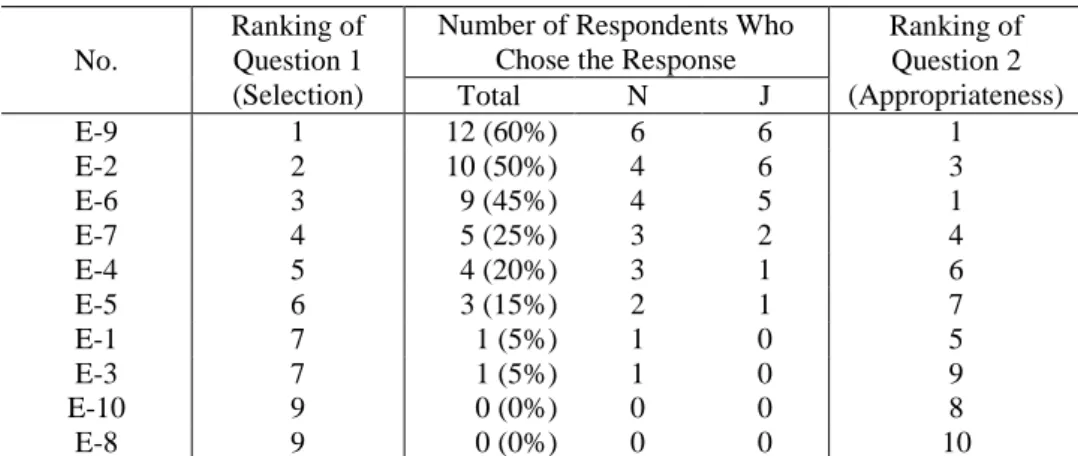
(18) Assessing politeness of requestive speech acts produced by Japanese learners of English in a spoken corpus. according to the values of the weighted average scores (i.e. “Av.”). Each response is indicated as its number and a simplified form of the linguistic features with a strategy type (i.e. CI or D, where CI stands for “conventionally indirect strategy” and D stands for “direct strategy”). As a result, E-6 and E-9 were rated as the most appropriate features in terms of politeness, followed by a direct pattern, E-2. Then, E-7 was moderately appropriate, showing slightly higher scores than those of E-1 and E-4. While the evaluation of three of the Japanese respondents on E-6 was “inappropriate” or “a little appropriate”, all of the natives agreed that it was “appropriate”. In contrast, Japanese respondents tended to evaluate E-1, E-5 and E-10 more highly than a group of native speakers. E-3 is the second least appropriate type of request, although one Japanese respondent regarded it as “appropriate.” E-8 was the only request on which there was consensus among the respondents, which turned out to be the least appropriate. Interestingly, those which scored lower, such as E-10 and E-8, were the requests produced by high intermediate learners, who belong to the SST Level 8, and had the highest proficiency level among a group of B1 learners (see Table 7).. Table 11. Ranking of rating scales of ten responses made by natives and Japanese: “exchanges”. Rank. Av.. No.. Linguistic Feature. 1 1 3 4 5 6 7 8 9 10. 2.80 2.80 2.65 2.40 2.05 2.00 1.60 1.35 1.30 1.00. E-6 E-9 E-2 E-7 E-1 E-4 E-5 E-10 E-3 E-8. CI: “I was wondering if I could …” CI: “Would it be possible…” D: “If possible, I’d like…” CI: “I thought I could... Is that possible?” D: “If you can, I really want you…” CI: “Can you…?” CI: “Would you…?” Other: “I think I have a right … I wanted…” CI&D: “I’ll take… So please…” CI: “Why can’t you...?”. Inapp. N J 0 1 1 0 1 0 1 0 3 0 2 2 7 3 8 6 8 7 10 10. Little App. N J N J 0 2 10 7 0 2 9 8 2 3 7 7 5 5 4 5 5 8 2 2 6 6 2 2 3 5 0 2 2 4 0 0 2 2 0 1 0 0 0 0. Thus, Table 12 compares the ranking of selections conducted in the first question with that of rating scales (i.e. Table 11). In the questionnaire, the respondents were asked to choose any numbers of the given responses they liked, but the number of selections differed greatly from one respondent to another. There were no responses which all of the respondents preferred to hear from their customers. However, the first three requests. Language Value 9 (1), 184–217 http://www.e-revistes.uji.es/languagevalue. 201.
(19) Aika Miura. in the ranking (E-9, E-2 and E-6) were rated highly by most of the respondents as “appropriate” patterns. The requests other than these top three were chosen by less than 25% of the respondents. In fact, E-1 and E-3 were chosen by only one single nativespeaking respondent.. Table 12. Comparison between rankings of selections and rating of appropriateness.. No. E-9 E-2 E-6 E-7 E-4 E-5 E-1 E-3 E-10 E-8. Ranking of Question 1 (Selection) 1 2 3 4 5 6 7 7 9 9. Number of Respondents Who Chose the Response Total N J 12 (60%) 6 6 10 (50%) 4 6 9 (45%) 4 5 5 (25%) 3 2 4 (20%) 3 1 3 (15%) 2 1 1 (5%) 1 0 1 (5%) 1 0 0 (0%) 0 0 0 (0%) 0 0. Ranking of Question 2 (Appropriateness) 1 3 1 4 6 7 5 9 8 10. VI.2.1.2 Ranking of Responses for Asking for Permission to Test Table 13 shows the ranking based on the ratings of six requests evaluated by the native speakers. Although Kendall’s W was not significant among Japanese respondents, their weighted average and distribution values are also shown in brackets. Six of the native respondents rated the “intention” pattern “I will” as “a little appropriate” in this situation, while two of them did so in the previous situation (see Table 11). However, none of the native respondents selected this pattern as the response they would prefer to hear from their customers. The lower value of Kendall’s W among the Japanese respondents might be attributed to the idiosyncratic ratings made by the two Japanese, who underrated the conventionally indirect linguistic features such as a modal verb “could” (T-5), “may” (T-4) and “can” (T-3) and a subjectiviser “I am wondering if…” (T-6), but overrated a desire verb “want” (T-1).. Language Value 9 (1), 184–117 http://www.e-revistes.uji.es/languagevalue. 202.
(20) Assessing politeness of requestive speech acts produced by Japanese learners of English in a spoken corpus Table 13. Ranking of rating scales of six responses by the native speakers: “test”. Rank 1 1 3 4 5 6. Av. N 3.0 3.0 2.9 2.7 2.2 2.2. (J) (2.6) (2.9) (2.9) (2.1) (2.3) (1.6). No.. Linguistic Feature. T-5 T-4 T-3 T-6 T-1 T-2. CI: Could I…? CI: May I…? CI: Can I…? CI: I am wondering… D: I want to… D: I will…. Inapp. N (J) 0 (0) 0 (0) 0 (0) 1 (3) 1 (0) 1 (6). Little App. N (J) 0 (4) 0 (1) 1 (1) 1 (3) 6 (7) 6 (2). App. N (J) 10 (6) 10 (9) 9 (9) 8 (4) 3 (3) 3 (2). VII. STUDY 2: DISTRIBUTIONS OF REQUESTS IN THREE SITUATIONS IN THE NICT JLE CORPUS The distribution of each linguistic feature investigated in the judgement survey was retrieved from the NICT JLE Corpus, based on the annotated information regarding three different situations: (1) “negotiating for exchange or return”, (2) “asking for permission to test” and (3) “expressing intention to buy”.. VII.1. Results and Discussion VII.1.1. Distribution of B1 Learners’ Requests in Negotiating for Exchange or Return As Table 14 shows, the major linguistic features produced by 66 B1 learners are 37 desire verbs (“want” and “would like”) and 28 modal verbs of ability/permission (“can” and “could”), out of 93 speech acts in the first situation. The two top-ranked features – “possible” (E-9) and “wonder if” (E-8) – had only four occurrences, in comparison to “would like” (E-2), which was in the third place and turned out to be the most frequent form used by the learners.. Language Value 9 (1), 184–217 http://www.e-revistes.uji.es/languagevalue. 203.
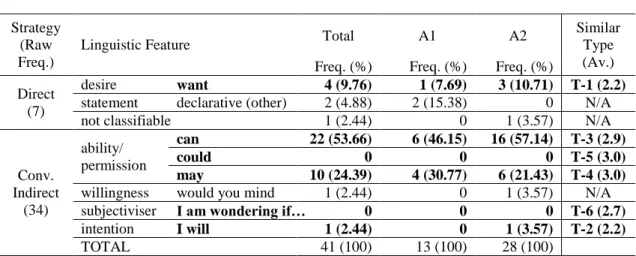
(21) Aika Miura. Table 14. Distribution of linguistic features of requests in negotiating for exchange or return. Similar Strategy Linguistic Feature Raw Freq. Percentage Type (Raw Freq.) (Av.) want 17 18.28 E-1 (2.05) desire would like 20 21.51 E-2 (2.65) yes/no 2 2.15 N/A Direct imperative please 1 1.08 E-3 (1.3) (44) imperative imperative only 1 1.08 N/A obligation should 2 2.15 N/A request-verb ask 1 1.08 N/A can 10 10.75 E-4 (2.0) ability/permission could 18 19.35 N/A will you 2 2.15 N/A willingness do/would you mind 3 3.23 N/A would you 2 2.15 E-5 (1.6) why not 4 4.03 E-8 (1.0) Conventionally suggestory Indirect how/what about 1 1.08 N/A (49) wonder if 1 1.08 E-6 (2.8) appreciate if 1 1.08 N/A subjectiviser hope that 1 1.08 N/A think/thought that 2 2.15 E-7 (2.4) possible 3 3.23 E-9 (2.8) possibility subjunctive 1 1.08 E-10 (1.0) TOTAL 93 100. VII.1.2. Distribution of A1 and A2 Learners’ Requests in Asking for Permission to Test Table 15 summarises the distribution of requests produced by 68 A1 and 114 A2 learners. The most frequent pattern is a modal verb “can” (T-3), which was rated highly by native respondents (see Table 13). However, no-one from either the A1 or the A2 group produced “could” (T-5), which was rated as the most appropriate. “May” (T-4), which also ranks the highest, was not used as frequently as “can”.. Language Value 9 (1), 184–117 http://www.e-revistes.uji.es/languagevalue. 204.
(22) Assessing politeness of requestive speech acts produced by Japanese learners of English in a spoken corpus Table 15. Distribution of Linguistic Features of Requests in Asking for Permission to Test. Strategy (Raw Freq.) Direct (7). Conv. Indirect (34). Linguistic Feature. Total. Freq. (%) desire want 4 (9.76) statement declarative (other) 2 (4.88) not classifiable 1 (2.44) can 22 (53.66) ability/ could 0 permission may 10 (24.39) willingness would you mind 1 (2.44) subjectiviser I am wondering if… 0 intention I will 1 (2.44) TOTAL 41 (100). A1 Freq. (%) 1 (7.69) 2 (15.38) 0 6 (46.15) 0 4 (30.77) 0 0 0 13 (100). A2 Freq. (%) 3 (10.71) 0 1 (3.57) 16 (57.14) 0 6 (21.43) 1 (3.57) 0 1 (3.57) 28 (100). Similar Type (Av.) T-1 (2.2) N/A N/A T-3 (2.9) T-5 (3.0) T-4 (3.0) N/A T-6 (2.7) T-2 (2.2). VII.1.3. Distribution of A1 and A2 Learners’ Requests in Expressing Intention to Buy Table 16 shows that there were 282 requests altogether, and desire verbs (P-1, P-2, P-3 and P-8) accounted for 48.2% of the total, followed by conventional expressions including “I look for item” (P-6 and P-7), which were used more frequently by A2 learners than those at level A1. The results seem to suggest that as the level of proficiency increased, the ratio of the direct pattern “declarative purchase” (i.e. “Uhm Today I buy my jacket” (P-4)) decreased, while the ratio of “intention” with “I-will” as an indirect pattern increased. This increase may be reflecting the fact that A1 learners employed more unnatural and erroneous productions, compared to A2 learners. Conversely, the raw frequencies of “would-like” were only 6 (6.25%) at level A1, but 28 (15.05%) at level A2. However, as respondents failed to reach an agreement for this situation, it would be difficult to assume that A2-level learners tended to behave more politely than A1 learners due to their development of sociopragmatic competences.. Language Value 9 (1), 184–217 http://www.e-revistes.uji.es/languagevalue. 205.
(23) Aika Miura Table 16. The Distribution of Linguistic Features of Requests in Expressing Intention to Buy. Strategy (Raw Freq.). Linguistic Feature want. Direct (172). desire declarative ability/ permission. Conv. Indirect (110). existence. intention. need would like purchase can could may do you have item Is there item I look for item I will I like I decided to I come/am here to. TOTAL. Total Freq. (%) 101 (35.82) 1 (0.35) 34 (12.06) 21 (7.45) 4 (1.42) 0 1 (0.35) 5 (1.77) 3 (1.06) 35 (12.41) 52 (18.44) 2 (0.71) 7 (2.48) 1 (0.35) 282 (100). A1. A2. Similar Types. Freq. (%). Freq. (%). 41 (42.71). 60 (32.26). P-1, P-8. 0 6 (6.25) 11 (11.46) 3 (3.12) 0 1 (1.04) 2 (2.08) 1 (1.04) 8 (8.34) 13 (13.54) 0 1 (1.04) 0 96 (100). 1 (0.54) 28 (15.05) 10 (5.38) 1 (0.54) 0 0 3 (1.61) 2 (1.08) 27 (14.52) 39 (20.97) 2 (1.08) 6 (3.23) 1 (0.54) 186 (100). N/A P-2, P-3 P-4 N/A N/A N/A P-8 N/A P-6, P-7 N/A N/A N/A P-5. VIII. SUMMARY AND CONCLUSION Regarding RQ1, using the NICT JLE Corpus, various pragmalinguistic patterns of direct and conventionally indirect request strategies, with internal modifiers, were observed in different situations. In addition to the original coding scheme developed by Blum-Kulka et al. (1989), learner-specific features which contain erroneous and developmental characteristics were evident, especially in the category of direct strategies, as “non-sentential phrase”, “statement”, “not classifiable” and “Yes/No” patterns. Furthermore, specific to shopping role plays, asking for the “existence” of particular items and showing an “intention” to purchase a particular item were added to the non-conventionally indirect category. In answer to RQ2, the situations “negotiating for exchange or return” and “asking for permission to test” were the ones where respondents, especially native speakers of English, reached an agreement. However, no consensus was obtained for the situation “expressing intention to buy”. The order of rating scales for the “exchanges” situation is somewhat in line with the results obtained by Tanaka and Kawade (1982). In the present study, the top four ranked features were “I was wondering if I could…”, “Would it be possible…”, “If possible, I’d like…” and “I thought I could… Is that possible?”, most of which were conventional indirect patterns of “subjectiviser” and “possibility” with Language Value 9 (1), 184–117 http://www.e-revistes.uji.es/languagevalue. 206.
(24) Assessing politeness of requestive speech acts produced by Japanese learners of English in a spoken corpus. “if clauses”. Tanaka and Kawade (1982) investigated assessment of pragmalinguistic features in requesting a hearer to turn down the radio, and concluded that the top ranked features shared by 10 Japanese and 10 American respondents were “I’d appreciate…”, “Could you…?”, and “Would you…?”. These conventionally indirect features were followed by the use of ability modal “can”, direct verbs (i.e. “want” and “would like”), imperatives with tag questions (such as “won’t you” and “will you”), and suggestory (i.e. “why don’t you…?”). The lowest ranked items were the use of the imperative (i.e. “Turn down X.”) and item (“X (the radio)!). The obtained coefficient of concordance, W, was .74 for the rank orderings made by American respondents, and .88 for those by Japanese respondents. The value W of the native respondents in the present study was approximately the same as the American respondents in the study conducted by Tanaka and Kawade (1982), but the value of the Japanese instructors was relatively lower. In Carrell and Konneker (1981), on the other hand, the value of Kendall’s W for 42 native speakers was .56 and for 73 ESL learners, .61. The W values were not as high as the results in Tanaka and Kawade (1982), probably due to the larger number of respondents. Thus, “Could you…X?” represented the highest degree of politeness in a situation where a speaker purchases tobacco, followed by a group of “Can you…X?”, “I’d like…X.” and “Do you have …X?”, then “I’ll have…X”, “I want…X.”, and the lowest group was “Give me X.” and “X.” (Carrell and Konneker 1981:28). In comparison, the native speakers’ ranking of requesting strategies to “test” an item in the current study showed a similar tendency: “could”, “may”, “can”, “I am wondering”, “I want to”, and “I will”. Besides, the Kendall’s W was .73, which was higher compared to the results of Tanaka and Kawade (1982) and Carrell and Konneker (1981). To summarise, although the past studies showed that the degree of agreement amongst native speakers was lower than that amongst learners, this was not the case in the current study. Finally, regarding RQ3, conventionally indirect features such as “I was wondering if I could…” and “would it be possible for me to…?”, which were the most highly rated by the respondents, were rarely used by the learners of any levels in the NICT JLE Corpus. In the “exchanges” situation, the most frequently used patterns were the desire verbs “want” and “would like”, as well as “could”. “Can” was the most frequent in the “test”. Language Value 9 (1), 184–217 http://www.e-revistes.uji.es/languagevalue. 207.
(25) Aika Miura. situation, and “want” in the “purchase” situation. There seems to be a big gap between the learners’ production and native EFL instructors’ preferences of types of pragmalinguistic features in their pragmatic awareness. To conclude, the present study suggests that Japanese-speaking instructors should be aware of the need for explicit teaching of conventional expressions in requests. Leech (2014) indicated the possibility of reaching an agreement on politeness of requests referring only to pragmalinguistic features but not to contextual features. However, it seems difficult to verify the validity of his hypothesis and unrealistic to annotate the information regarding sociopragmatic judgements to the NICT JLE Corpus.. ACKNOWLEDGEMENTS This work was supported by LET Kanto Chapter Research Grant Program (2015) and JSPS KAKENHI Grant Number 16K02937. The author is grateful to the informants who participated in the online survey for this study as well as the anonymous reviewers for their valuable comments on an earlier version of this paper.. REFERENCES Adolphs, S. 2008. Corpus and Context. Investigating Pragmatic Functions in Spoken Discourse. Amsterdam: John Benjamins. Blum-Kulka, S. 1989. “Playing it Safe: The Role of Conventionality and Indirectness”. In Blum-Kulka, S., J. House and G. Kasper (Eds.) Cross-Cultural Pragmatics. Requests and Apologies. Norwood, NJ: Ablex, 37–70. Blum-Kulka, S., House, J. and Kasper, G. 1989. Cross-Cultural Pragmatics: Requests and Apologies. Norwood, NJ: Ablex. Callies, M. 2013. “Advancing the Research Agenda of Interlanguage Pragmatics: The Role of Learner Corpora.” In Romero-Trillo, J (Ed.) Year Book of Corpus Linguistics and Pragmatics 2013. New Domains and Methodologies. Dordrecht: Springer. 9-36.. Language Value 9 (1), 184–117 http://www.e-revistes.uji.es/languagevalue. 208.
(26) Assessing politeness of requestive speech acts produced by Japanese learners of English in a spoken corpus. Carrel, P. L. and Konneker, B. H. 1981. “Politeness: Comparing native and nonnative judgements.” Language Learning, 31, 17-30. Fung, L. and Carter, R. 2007. “Discourse markers and spoken English: Native and learner use in pedagogic settings.” Applied Linguistics, 28, 410-39. Granger, S. 2002. “A Bird’s-Eye View of Learner Corpus Research”. In Granger, S., J. Hung and S. Petch-Tyson (Eds.) Computer Learner Corpora, Second Language Acquisition and Foreign Language Teaching. London: Longman, 3-18. Hawkins, J. A., and Filipović, L. 2012. Criterial Features in L2 English: Specifying the Reference Levels of the Common European Framework. Cambridge: Cambridge University Press. Hill, T. 1997. The Development of Pragmatic Competence in an EFL Context. (Unpublished Doctoral Dissertation.) , Tokyo: Temple University. Izumi, E., Uchimoto, K. and Isahara, H. (Eds.) 2004. Nihonjin 1200-nin noEEigo Speaking Corpus. [L2 Spoken Corpus of 1200 Japanese Learners of English]. Tokyo: ALC. Kaneko, T. 2004. “Nihonjin Eigogakushusha no Youkyu no Hatsuwa no Hattatsu [Development of request speech acts in Japanese learners of English]”. In Izumi, E., K. Uchimoto and H. Isahara, H (Eds.) 113–128. Kaneko, E. and Izumi, E. 2012, September. NICT JLE Corpus no CEFR Level Saibunrui (Chukanhokoku). [Assigning the CEFR Level to the NICT JLE Corpus (An Interim Report).] Paper presented at the Meeting for Comprehensive Research of Identification and Application of Criterial Features of English CEFR Levels in Learner Corpora” (Grants-in-Aid for Scientific Research Conducted by Yukio Tono). Kyoto. Kasper, G. 1997. “Can pragmatic competence be taught?” (NetWork #6) [HTML document]. Honolulu: University of Hawai'i, Second Language Teaching & Curriculum Center. Retrieved [April 9th, 2017] from the World Wide Web: http://www.nflrc.hawaii.edu/NetWorks/NW06/. Language Value 9 (1), 184–217 http://www.e-revistes.uji.es/languagevalue. 209.
(27) Aika Miura. Kasper, G. and Dahl, M. 1991. “Research methods in interlanguage pragmatics.” Studies in Second Language Acquisition ,12 (2): 215-247. Kasper, G. and Rose, K. R. 2002. Pragmatic Development in a Second Language. Oxford: Blackwell. Kasper, G. and Roever, C. 2005. “Pragmatics in Second Language Learning.” In Hinkel, E. Handbook of research in second language learning and teaching. Mahwah, NJ: Erlbaum, 317-334. Kitao, K. 1990. “A study of Japanese and American perceptions of politeness in requests.” Doshisha Studies in English, 50, 178-210. Leech, G. 2014. The Pragmatics of Politeness. Oxford: Oxford University Press. Miua, A. 2015. Extracting criterial features from requests produced by Japanese lowproficiency learners of English. Paper presented at the third International Learner Corpus Research Conference, Van der Valk Hotel Cuijk, Nijmegen, The Netherlands. Müller, S. 2004. “‘Well you know that type of person’: Functions of well in the speech of American and German students.” Journal of Pragmatics, 36, 1157-1182. Müller, S. 2005. Discourse Markers in Native and Non-native English Discourse. Amsterdam: John Benjamins. O’Donnell, M. 2013. UAM CorpusTool Version 3.0. Tutorial introduction. June 2015 <http://www.wagsoft.com/CorpusTool/Documentation/UAMCorpusToolTutoria l3.0.pdf> Olshtain, E. and Blum-Kulka, S. 1985. “Degree of approximation: Nonnative reactions to native speech act behavior.” In S. M. Gass, S. M. and C. G. Madden (Eds.) Input in Second Language Acquisition. Rowley, MA: Newbury House, 302-323. Romero-Trillo, J. 2002. “The pragmatic fossilization of discourse markers in nonnative speakers of English.” Journal of Pragmatics, 34: 769-84.. Language Value 9 (1), 184–117 http://www.e-revistes.uji.es/languagevalue. 210.
(28) Assessing politeness of requestive speech acts produced by Japanese learners of English in a spoken corpus. Romero-Trillo, J. 2008. “Introduction: Pragmatics and Corpus Linguistics - a Mutualistic Entente.” In Romero-Trillo, J (Ed.) Pragmatics and Corpus Linguistics. A Mutualistic Entente. Berlin: Mouton de Gruyter, 1-10. Flores Salgado, E. 2011. The Pragmatics of Requests and Apologies. Developmental Patterns of Mexican Students. Amsterdam: John Benjamins. Schauer, G. A. 2009. Interlanguage Pragmatic Development: The Study Abroad Context. York: Continuum. Tanaka, S. and Kawade, S. 1982. “Politeness strategies and second language acquisition.” Studies in Second Language Acquisition, 5, 18-33. The NICT Japanese Learner English (JLE) Corpus. National Institute of Information and. Communications. Technology.. 2013. April. https://alaginrc.nict.go.jp/nict_jle/index_E.html Trosborg, A. 1995. Interlanguage Pragmatics. Requests, Complaints and Apologies. Berlin/New York City: Mouton de Gruyter. Tschirner, E. and Bärenfänger, O. 2012. Assessing Evidence of Validity of Assigning CEFR Ratings to the ACTFL Oral Proficiency Interview (OPI) and the Oral Proficiency Interview by Computer (OPIC) (Technical Report 2012-US-PUB-1). White Plains, NY: Language Testing International. Walters, J. 1979. “Strategies for requesting in Spanish and English: Structural similarities and differences.” Language Learning, 29 (2), 277–293.. Language Value 9 (1), 184–217 http://www.e-revistes.uji.es/languagevalue. 211.
(29) Aika Miura. APPENDIX A. Language Value 9 (1), 184–117 http://www.e-revistes.uji.es/languagevalue. 212.
(30) Assessing politeness of requestive speech acts produced by Japanese learners of English in a spoken corpus. Language Value 9 (1), 184–217 http://www.e-revistes.uji.es/languagevalue. 213.
(31) Aika Miura. Language Value 9 (1), 184–117 http://www.e-revistes.uji.es/languagevalue. 214.
(32) Assessing politeness of requestive speech acts produced by Japanese learners of English in a spoken corpus. Language Value 9 (1), 184–217 http://www.e-revistes.uji.es/languagevalue. 215.
(33) Aika Miura. Appendix B Table 17. The ratings for expressing intention to buy. No. P-2 P-3 P-5 P-1 P-8 P-6 P-7 P-4. Av. N 2.8 2.9 2.6 2.6 2.3 2.3 2.1 1.4. J 2.8 2.6 2.2 2.1 2.0 1.9 1.7 1.4. Linguistic Feature D: I’d like to buy… D: I would like to purchase, … please. CI: I’m here to buy… D: I want to… D&CI: I want… Do you have? CI: I’m looking… CI: I’m searching… D: I buy…. Inapp. N J 1 0 0 1 1 1 1 2 1 3 2 3 2 5 7 6. Little App. N J 0 2 1 2 2 6 2 5 5 4 3 5 5 3 2 4. App. N 9 9 7 7 4 5 3 1. J 8 7 3 3 3 2 2 0. Received: 10 January 2017 Accepted: 20 February 2017. Language Value 9 (1), 184–117 http://www.e-revistes.uji.es/languagevalue. 216.
(34) Assessing politeness of requestive speech acts produced by Japanese learners of English in a spoken corpus. Cite this article as: Miura, Aika. 2017. “Assessing Politeness of Requestive Speech Acts Produced by Japanese Learners of English in a Spoken Corpus”. Language Value 9 (1), 184-217. Jaume I University ePress: Castelló, Spain. http://www.e-revistes.uji.es/languagevalue. DOI: http://dx.doi.org/10.6035/LanguageV.2017.9.8 ISSN 1989-7103 Articles are copyrighted by their respective authors. Language Value 9 (1), 184–217 http://www.e-revistes.uji.es/languagevalue. 217.
(35)
Figure



+7




Documento similar
In this dissertation we have examined the development of foreign accent and comprehensibility in the oral productions of 25 adolescent Spanish learners of English before
Candidates have 78% more chances of being promoted if the committee includes, by luck of the draw, a strong connection such as their doctoral thesis advisor or a co-author; the
I STATE that the present study, entitled “The Historiography of English Language Teaching in Spain: A Corpus of Grammars and Dictionaries (1769-1900)” presented by Alberto
Document management - a key technology for the construction industry, In: Information and Communications Technology (ICT) in the Practice of Building and Civil
Comparing Spanish and Japanese against the English language we found that both languages have fewer vowel and consonant sounds than in English. In the case of
Given the much higher efficiencies for solar H 2 -generation from water achieved at tandem PEC/PV devices ( > 10% solar-to-H 2 energy efficiency under simulated sunlight) compared
TipC and the chorea-acanthocytosis protein VPS13A regulate autophagy in Dictyostelium and human HeLa cells.. Sandra Muñoz-Braceras a , Rosa Calvo a & Ricardo
This study presents the findings of a year-long e-mail exchange between learners of English at Nebrija University in Madrid and learners of Spanish at Trinity College Dublin during
