
Structure, physiognomy and floristic composition of a Schinopsis balansae (Anacardiaceae) forest in the southern Chaco, Argentina
11
0
0
Texto completo
(2) 1014. REVISTA DE BIOLOGlA TROPICAL. Mussetti and AlconcheI1986), in the middle of the elevation gradient between Prosopis nigra (Gris.) Hier. varo ragonesei Burk. forests ("Algarrobales") and the mixed dense forests ("Bosques chaqueños") (Lewis and Pire 1981). The Quebrachales were heavily lumbered in the first half of�s century for tapnin and later on, and until present times, for fuel . extraction . charcoal production. Plant communities can be floristically or' physiognomically analysed. An association is a community with defined floristic composition and a forroation is defined on the physiognomy and structure of the component plants (Mueller Dombois and Ellenberg 1974). Key structural properties include the height of trees, whether they tend to have their crowns in layers or not, their spatial distribution and canopy architecture and the presence of different kinds of climbers and epiphytes. Physiognomic properties include whether or not the forest is evergreen, tree crown shape, morphology of the leaves (size, shape, thickness, margin), presence of spines, etc. (Whitmore 1990). The floristic composition, horizontal and vertical structure and the physiognomy of several cOmnlunities of different areas of the Chaco have been analysed at different scales by Ragonese and Covas (1940), Ragonese and Castiglioni (1970), Sarmiento (1972), Sejzer (1973), Lewis and Pire (1981), Graffe et al. (1991), Lewis (1991), Spichiger et al. (1991), Prado (1993a,b), as weÍl as many other authors. However there is not a detailed analysis at a fine scale of aS. balansae forest ("Quebrachal") of the Santa Fe Forest Wedge with special reference to its horizontal and vertical structure, physiognomy and floristic composition. Therefore, the object of this paper is to analyse these aspects in a stand of Quebrachal near Vera (Santa Fe, Argentina), ptevious to a long term study of its dynamics.. MATERIAL ANO METHODS The study area: It is located in the experimental center of the Provincial Ministry of' Agriculture at Las Gamas, near Vera (29°28'S - 60°12'W), Provlnce of Santa Fe. Although this stand is not completely mature, not even in a steady state, it is partially recovered and cattl e grazing, mild wood. extraction and sporadic ftres are the main disturbances. Data collection and analysis: On March 1989, 22 contiguous 10 x 10 m plots were sampled along a transect and another ten plots of the same size were sampled along a second discontinuous transect parallel to the frrst one. All individuals were counted and . mapped on a grid of quadrats, their crown diameters were measured and the height of some individuals was measured with a clinometer. With these data cartographic diagrams and vegetation profiles (Davis and Richards 1933, Richards 1952) were draWh (Fig 2 and 3). The general cover of woody species of each plot was measured from the cartographic diagrams with a leaf-area meter. Woody species were classified in five classes according to their growth forro and maximum height: 1) trees taller than 10 m . 2 ) trees from 8 t o 1 0 m . 3 ) trees smaller than 8 m. 4) shrubs taller than 2 m. and 5) shrubs smaller than 2 m high. Voucher specimens were collected and deposited in the University of Rosario Herbarium (UNR). Leaf size of all woody species present in the stand was determined measuring 20 leaves (leaflets in the case of compound leaves) taken randomly from one mature individual. Leaf sizes were grouped into Raunkiaer (1934) leaf size classes (microphyllous = 2.25-20.25 cm2, nanophyllous = 2.25-0.25 cm2, leptophyllous = lessthan 0.25cm2). Leaves were classified as well in four texture classes: . filmy, coriaceous membranous, or succulent (Dansereau 1957). Species were considered evergreen when mature individuals have green leaves the whole year around. Different degrees of deciduousness were not distinguished. The presence of spines, including any thorny structure either on foliage, branches or trunk was recorded (Sarmiento 1972). RESULTS Eighteen tree and 14 shrub species were found in the stand. However, some were so tare that they were notrecorded in the sampled,plots (Caesalpinia paraguariensis (D. Parodi) Burk. ladina rhombifolia Hook. et Am. Patagonula americana L. Ruprechtia laxiflora Meissner and Banara umbraticola Arechav.). Although some species, likeS. balansae, lose their leaves only.
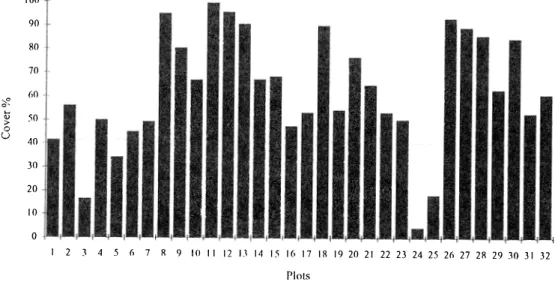
(3) 1015. Lewis et al.: Structur;:, physiognomy ano floristic composition. species (Senna pendula varo paludicola (WiIld.). dominant species, acompanied by Sideroxylon obtusifolium (Roem. et Schult.) quebracho Aspmospem¡a and Pemúngton blanco Schlecht. The other stratum about 9 m high "has Acacia praecox as the dominant species,acompanied by Prosopis sp. (P. alba. Irwin et Bameby) with compound leaves (Table. Gris. P. nigra (Gris.) Hieron. and their hybrids). for a short penod,most species are deciduous, with small leaves and often with spíny structures. There were neither tree species with succulent. leaves, nor. 8hmb. species. with. conaceous leaves. There was only one shrub. the. 1). Of aH individuals recorded (N=459) 84.7%. and other species inc1uding young individuals. were. of the highest stratum species. Both strata. deciduous,. with. single. (6 1.7%),. (54.9%) membranous leaves (52.3%), and with spiny stmctures (79.3%) (Table 2). Similar results were obtained when crown cover was analysed (Table 2). microphyHous. Acacia praecox Gris. and S. balansae were the most abundant tree species, and Celtis palUda Torrey the most abundant shmb. These two tree species also have tlle highest cover, while the cover of most other species is minirnal. Shrub cover (9%) is not very high, unless Achn.tocarpus praecox Gris. (10% cover), which is considered a smaU tree in this paper, were considered a shrub. Acacia praecox is also one of the relatively most frequent tree species, buí sorne other species with a cornparatively high re1ative frequency, like Geoffroea deco11Ícans (Hook. et Am.) Burk. cover very littIeground surface (Table 1). The S. balansae forests are open forests, with open spaces. The general cover of woody species is 63% and there is a 35% overIap in cover of woody individuals. PIot cover is not uniform,as there are sorne places with a dense canopy, like in plots 8, 11, 12, 13 and 26 where woody species covér is 90% or more,and others with low cover like in plots 3 and 25, where the general caver of woody species is less than 20%, or less than 4% in pIot 24 (Fig. 1). Some plots, like 16 and 21, have notrees rooted inside the plots,but they have a relative high tree cover, which is the result of tree crowns of neighbouring areas. IndividuaIs of woody species are clumped. Therefore tree canopy is very dense at sorne places, but discontinuous, so all along the transects there are gaps of different sizes (Fig. 2). In large gaps there is a dense understory of grasses,while the more shadowy parts of the forest are invaded by spiny bromeliads (Aechmea distichn.ntha Lemaire and Bromelia serra Gris.). There are two upper tree strata, which are not always easy to segregate frorn each other. The stratum higher than 10 m has S. balansae as. not. do form a continuous canopy, and leave gaps. that sometimes can be rather large. Below the upper tree simta there is a layer of Achatocarpus. praecox and C. pallida and young individuals of all of the higher tree layers. Below them, there is a very discontinuous and grouped shmb layer,about 2 m high,forming thickets where it is present (Fig. 3).. DISCUSSION The general cover of woody vegetation is. not 100% and the degree of overlapping is not very high,meaning that in sorne pIaces one or more tree strata are absent. The two higher tree strata do not always overlap,in fact,as shown. in Fig. 3, in many places they are segregated from each other,but when they overlap their lirnits. are. diffuse.. The. shmb. layer. is. discontinuous, forming very dense clumps in certain pIaees, while it i5 absent in. many. others. As a result of the uneven distribution of strata and individuals, the structure of this forest is very complexo The complex structure., the clumped distribution of individuals and the uneven distribution ofspecies hypothetically is the result of environmental heterogeneity. Though dynamics and successional proeesses may also change the structuralcharacteristies of this forest. Soil suface is very irregular, so there are plaees that often fIood while others are well. drained (pers. obs.). Most woody species whileG. deco11Ícans. grow on the drier soils,. and sometimes Prosopis sp. grow on more wet soíls. on flooded soils there is only herbaceous vegetation, mostly grasses and sedges (pers. obs.). As a result of edapruc heterogeneity, the clurnped distribution of trees together with their dífferent leaf architeeture, probably creates a heterogeneous would. be. light many. environment, so . kinds. of. there. biotopes..
(4) 1016. REVISTA DE BIOLOGIA TROPICAL. Nevertheless, the environmental heterogeneity of this forest is in need of further research. Although all woody. species of this forest have small leaves or leaflets, the larger tree species as well as the smaller ones have relatively wide leaves, whíle the intermediate, like Acacia pr(U?cox and Prosopis sp. are leptophyllous (bipinnate leaves with tiny leaflets). Shrubs of this forest almost always have relatively large leaves. The leaf size spectrum of this forest is similar to that shown by Sarmiento (1972) who found that 32%, 56% and 12% of the eastern Chaco woody species were mesophyUous, microphyIlous and nanophyIlous plus leptophyllous, respectively. It must be borne in mind that the Forest Wedge is the southernmost portion of the eastern Chaco, thus, as a possible consequence of the temperature gradient Sarmiento's (1972) data have more species and also more species with larger leaf sizes. Moreover, at the south of the Forest Wedge is the Peristeppic Thornforest where prickly Mimosoideae (leptophyllous) are dominant (Lewis and Collantes 1973). When leaf size is weighted by abundance or crown cover, the percentage of leptophyllous trees increases in the southern Chaco. Therefore, in the Eastern Chaco towards the south decrease the number of species, as well as individuals, with large leaves. Leaf size spectra of the humid Chaco given by Sejzer (1973) and Eskuche (1986) also show a larger average size of leaves than in· the Forest Wedge, whíle the dry Chaco has a smaller average size of leaves (Sejzer 1973). Although 61% of aU tree species have spines, almost 90% of the trees are spiny. in the case of shrubs only about 36% of the species are spiny, but 56% of the individuals have spines. Generally, spines are woody structures, but A. quebracho-blanco and J. rhombifolia have non-woody spines on the tips of leaves. S. balansae has thorns only during the juvenile stage. This forest is similar to other S. balansae forests of the Santa Fe Forest Wedge (Lewis and Pire 1981). In other S. balansae forests Ragonese and Covas (1940) did not record sorne species observed in thís forest (Zizyphus mistol Gris.· Grabowskia duplicata Arnott, Acacia caven (Mol.) Mol. Lycium cuneatum Dammer, Celtis iguanea (Jacquin) Sargent, J. rhombifolia and Sapium haematospermum Müll. Arg.) but. they recorded several others, such as Scutia buxifolia Reisseck, Eugenia unijlora L. Prosopis vinalillo Stuck. Schaefferia sp. Capparis tweediana Eichler, Allophyllus edulis (St. Hil.) Radlk. and Berberis ruscifolia. Lamarck, whích were not observed in this foresto They also recorded C. paraguariensis, P. americana, R. laxijlora and B. umbraticola which were observed but not recorded in the plots in this forest because they were very rareo However, they recorded most of these species farther north, reflecting that species richness increases northwards (Lewis 1991). Ragonese and Covas (1940) did not differentiate the Quebrachal from mixed dense forests as we dJ (Lewis and Pire 1981, Lewis et al. 1994). The Quebrachal of the Santa Fe Forest Wedge differs from the Quebrachal of the Argentinian western Chaco where the dominant species are S. quebracho-colorado and A. quebracho-blanco (Adámoli et al. 1972, Adámoli et al. 1990, Sennhauser 1991). In the dry Paraguayan Chaco, Spichíger and Ramella (1989) and Rarnella and Spichiger (1989) also mention a "Quebrachal" with sorne of the same species (A. quebracho-blanco, Capparis retusa Gris. Z. mistol), but S. quebracho-colorado and A. quebracho-blanco are the dorninants and S . balansae is absent. In the humid Paraguayan Chaco Spichiger et al. (1991) mention a xero mesophytic forest of S. balansae and Astronium balansae Engl. but they also did not differentiate the S. balansae "Quebrachal" from the mixed dense forest (Lewis et al. 1994). According to Prado (1993b) in the eastern Chaco there are four different kinds of true chaquenian forests, (S. balansae "Quebrachal", Prosopis sp. "Algarrobal", palm forests of Copemicia alba Morong, and Stetsonia coryne (Salm. Dyck) Br. et Rose "Cardonal") and an Austro-Brazilían Transitional Forest with species of chaquenian and amazonian lineage. The two major woody communities of the eastern Chaco have been repeatedly mistaken for a single one (Prado 1993a), the Quebrachal of S. balansae and the Austro-Brasilian Transitional Forest or mixed dense forests (Lewis and Pire 1981, Prado 1991, Lewis et al. 1994), a1though Morello and Adámoli (1974) reported differences between them. The S. balansae forest is characteristic of the Santa Fe Forest Wedge and is probably rnaínly confined to thís area. The ecological optimum for S ..
(5) Lewis et al.: Structure. physiognomy and floristic composition. balansae is in !bis part of the Chaco (MoreHo and Adámoli 1974) as witnessed by the loeation of the most important tannin industries. It must be borne in rnind that this forest, like all the forests of the Chaco, has been heavily disturb in the past, and probably now there is not a single stand that is in a steady state or near climax stage. Therefore, after this analysis was eompleted, one of the transects has been c10sed with a fenee to prevent cattle grazing. In this way sorne aspects of the dynamics and further evolution of this forest can be studied. ACKNOWLEDGMENTS Financial aid from the CONICET (Couneil for Scientifical and Technical Research, Argentina) is grateful acknowledged. The authors are indebted to the Santa Fe Ministry of Agriculture for logistic support and the staff of Las Gamas Experimental Center for their invaluable help. J. L. Vesprini and E. Brnieh helped with fieId work and P. S. Torres and J. R. Femández with computing. We thank three anonymous reviewers for their criticism and useful suggestions that helped us to improve this paper.. RESUMEN Amazonia y el Gran Chaco son las unidades fitogeográficas más grandes de Sud América tropical y subtropical. La porción más austral del Chaco oriental es la Cuña Boscosa de Santa Fe, donde la comunidad característica y más difundida es el bosque de Schinopsis balansae (Quebrachal). En uno de estos bosques cerca de Vera, Provincia de Santa Fe, República Argentina. se esTablecieron 32 parcelas contiguas de 10 x 10 m a lo largo de 2 transectas paralelas y en las mismas se hizo un detallado análisis florístico, fisonómico y estructural de la vegetación. Todos los individuos leilosos de más de 0,60 m de altura fueron identificados y se les midió la altura y el diámetro de sus copas. Con estos datos se construyeron perfiles de vegetación y mapas cartográficos con la ubicación de los individuos. Las especies leilosas fueron clasificadas de acuerdo al tarnailo, y textura de sus hojas, presencia de espinas y fenología. Este quebrachal es un bosque abierto de estructura muy compleja y composición florística heterogénea. La mayoría de las especies leilosas de. este bosque son deciduas, con hojas pequeñas y frecuentemente con estructuras espinosas. Tiene dos estratos arbóreos altos de S. balansae y Acacia praecox. y uno arbóreo bajo de Achatocarpus praecox con individuos juveniles de las especies de los estratos superiores. Existe asimismo un estrato arbustivo de 2 m de altura. El dosel arbóreo es discontinuo y tiene aberturas que pueden ser bastante grandes, donde el suelo está cubierto por un. 1017. denso estrato grarninoso. Este bosque es similar a otros bosques de S balansae de la Cuña Boscosa de Santa Fe, pero muy diferente de la mayoría de los bosques de otras áreas del Gran Chaco.. REFERENCES Adámoli, 1. R. Neumann, A.D.R. de Colina & 1. MoreHo. 1972. El Chaco aluvional salteño (Convenio INTA Prov. de Salta). Rev. Inv. Agropec. INTA, Serie 3, Clima y Suelo 9: 165-237. Adámoli, 1. E. Sennhauser, J.M. Acero & A. Rescia. 1990. Stress and disturbance: vegetation dynarnics in the dry Chaco region of Argentina. J. Biogeogr. 17: 491-500. Burgos, J.J. 1970. El clima de la región noreste de la República Argentina. BoL Soco Arg. Bot. 11 (suplemento): 37-102. Cabrera. A.L. 1971. Fitogeografía de la Argentina. Bol. Soco Arg. Bot. 14: 1-42.. República. Cabrera, A.L. & A. Willink. 1980. Biogeografía de América Latina. Monografías científicas, serie biológica 13. Secretaría General de la O.E.A. Washington, D.C. 122 p. Dansereau, P. 1957. Biogeography. An perspective. Ronald, Nueva York. 394 p.. ecological. Davis, T.A.W. & P.W. Richards. 1933. The vegetation of !he Moraballi Creek, British Guiana. an ecological study of a limited area of tropical rainfores!. Part l. J. Ecol. 21: 350-384. Eskuche, U. 1986. Berich über die 17-lnternationale Exkursion Pflanzengeographische durch Nordargentinien. VerMf. Geobot. Inst. ETH, Stiftung Rübel, Zürich 91: 12-117. Espino, L.M. M.A. Seveso & M.A. Sabatier. 1983. Mapa de suelos de la Prov. de Santa Fe. Torno n. MAG Santa Fe-INTA EERA Rafaela, Argentina. 220 p. Gollan, J. & D.A. Lachaga. 1939. Aguas de la provincia de Santa Fe. lns!. Experim. de lnv. y Fomento Agríe. Ganadero. Public. Técn. W12. Santa Fe, Argentina. Grliffe, W. M. Brassiolo, M. Simón, A. Fumagalli & R. Renolfi. 1991. Explotación eficaz y protección de recursos en la región de la Cuila Boscosa, departamento Vera, provincia de Santa Fe. Area de Sistemas Silvopastoriles de la Facultad de Ciencias Forestales de la Universidad Nacional de Santiago del Estero. Santiago del Estero, Argentina. 83 p. Lewis, lP. 1991. Three levels of floristical variatíon in the forests of Chaco, Argentina. 1. Veg. Sci. 2: 125-130..
(6) 1018. REVISTA DE BIOLOGIA TROPICAL. Lewis, lP. .& M.E. Collantes. 1973 .. El .espinal periestépico. Ciencia e Investigación 29: 360-377. Lewis, lP..& E.F. Pire. 1981. Reseña sobre la vegetación del Chaco santafesino. Serie Fitogeográfica 18. INTA, Buenos Aires. 42 p. Lewis, lP. E.F. Pire, D.E. Prado, S.L. Stofella, E.A. Franceschi .& NJ. Carnevale. 1990. Plan! cornrnunities and phytogeographical position of a ¡arge depression in tbe Great Chaco, Argentina. Vegetatio 86: 25-38. Lewis, lP. E.F. Pire .& lL. Vesprini. 1994. The mixed dense fores! of tbe Southem Chaco. Contribution to the study of flora and vegetation of the Chaco VIII. Candollea 49: 159-168.. Ragol1cse, AB. .& G. Covas. 1940. La distribución geográfica de los quebrachales en la provincia de Santa Fe. Rev. Arg.. Agron. 8: 176-184. Ragonese, A.E. .& J.C. Castiglioni. 1970. La vegetación del parque chaqueño. Bol. Soco Arg. Bot. 11 (suplemento): 133-160. Ramella L. .& R. Spichigel'. 1989. Interpretación preliminar del medio físico y de la vegetación del Chaco boreal. Contribución al estudio de la flora y de la vegetación del Chaco I. Candollea 44: 639-680. Raunkiaer, e. 1934, The life forms of plants and statisticaI plant geography. Clarendoll, Oxford. 632 p. Richards, P.w. 1952. The tropical rain fores!. Cambridge University,Cambridge. 450 p.. Morello,1..& 1. Adámoli. 1974. Las grandes unidades de vegetación y ambiente del Chaco argentino. Segunda prute: vegetación y ambiente de la provincia del Chaco. Serie Fitogeográfica 13. I.N.T.A. Buenos Aires. 130 p.. Sarmiento, G. 1972. Ecoíogical and floristic convergences between seasonal plant formations of tropical and subtropical South America. 1. Eco!. 60: 367-410.. MueIler-Dombois, D. .& H. ElIenberg. Airns and methods of vegetation ecology. 10ho Wiley .& Sons, Nueva York. 547 p.. Sejzer, D. 1973: Variación de caracteres estructurales y funcionales en comunidades vegetales chaqueñas. Ecología. Asoc. Arg. Eco!. 1: 25-28.. Mussetti, M . .& D. Alconchel. 1986. Mapa de suelos del Centro Operativo De. Tito Livio Coppa. Las Gamas, Depto. Vera, Santa Fe. Dir. Gral. Ext. e Invest. Agrop. Santa Fe, Argentina. 22 p.. Sennhauser, E. 1991. The concept of stability in connection with ¡he gallery forests of tbe Chaco regíon. Vegetatío 94: 1-13.. Prado, D.E. 1991. A critical evaluation of the floristic links between Chaco 'and' Caatingas vegetatiol1 in Sou!h America. Ph. D. thesis, University of St. Andrews, St. Andrews, Scotland.. Spichiger, R. .& L. Ramella. 1989. The forest of the Paraguayan Chaco, p. 259-270. In Holm-Nielsen, L.E. ef al. (eds.), Tropical forests, botanical dynarnics, speciation and diversity. AcadeIDÍc Press, Londres,. Prado, D.E. 1993a. What is the Gran Chaco vegetation in South America? r. A review. Contlibution to !he study of the flora and vegetation of ¡he Chaco V. Candollea 48: 145-172.. Spichiger, R. L. Ramella, R. Palese .& F. Mereles. 1991. Proposición de leyenda para la cartografía de las formaciones vegetales del Chaco paraguayo. ContJibución al estudio de la flora y de la vegetación del Chaco m. Candollea 46: 541-564.. Prado, D.E. 1993b. What is the Gran Chaco vegetation i.n South America? H. A redefmition. Contribution to tbe study of the flora and vegetation of !he Chaco VII. Candollea 48: 615-629.. Whitmore, T.e. 1990. An introduction to tropical rail1forests. Clarendon Press, Oxford. 226 p..
(7)
(8) TABLE2. Leaf characteristics of a Schinopsis balansae forest near Vera (Sta. Fe) in percentage of species. ituiíviduals. and cover. Species. Individuals Total Shrubs. Trees. Shrubs. Total. 54.90 12.20 32.90. 38041 13.78 47.81. 83.20 16.05 0.74. 43.30 14.03 42.66. 3.52 78.17 0.00 18.31. 39043 52.29 2.61 5.66. 52.82 44.00 3.18 0.00. 2.01 74.68 0.00 23.30. 47.26 47.36 2.83 2.55. 55.52. 0.00. 38.34. 52.82. 0.09. 47.05. 89.91. 55.63. 79.30. 92.65. 50.25. 88.02. 60048. 91.44. 293.0. 2680.1. Trees. Shrubs. Total. Trees. 55.56 16.67 27.78. 78.57 14.29 7.14. 65.63 15.63 18.75. 38.17 14.83 47.00. 92.25 6.34 1041. Membranous Coriaceous Succulent. 38.89 50.00 IUI 0.00. 21.43 64.29 0.00 14.29. 31.25 56.25 6.25 6.25. 55.52 40.69 3.79 0.00. Leaf type:compound. 33.33. 7.14. 21.88. Spines. 6UI. 35.71. 50.00. Leaf size MicrophylIous NanophyIlous Leptophyllous. Cover. Leaf texture. Fllmy. Deciduousness. 83.33. 57.14. 71.87. 88.90. 75045. 84.73. 95.24. Total (100%). 18. 14. 32. 317. 142. 459. 2387.1.
(9) REVISTA DE BIOLOOIA TROPICAL. l020-a. 100 90 80 . 70 '-o. 60 -. o-. �. o U. 50 40 ·. 30 20 10 o. ",1, 1 2. 3. 4. 5. "" ,. ". 6 7. 8. 9. lO. 11. 12. n. 14 15 16 17. IR. .I'-¡��I 19 20 21 22 23 24 25 26 27 28 29. l 30. 31 32. Plots Fil!:. l. General cover of tree layers on different plots.. Fig. 2. Cartographic diagrams of woody vegetation of plots 6 to 9 (above) and plots \O to 12 (below). Al: Aloysia gratissima, Ap: Acacia praecox, Aq: Aspidosperma quebraclw-blanco, Bo: Sideroxylon obtusifolium, Ca: Coccoloba argentinensis, Cb: Senna pendula varo paludicola, Ci: Celtis iguanea, Cr: Capparis retusa, Cs: Celtis pallida, Be: Myrcianthes cisplatensis, Gd: Geoffroea deconicans, Gw: Grabowskia duplicata, 8t: Holmbergia tweedii, Mv: Maytenus vitis-idaea, Pr: Prosopis sp. Sb: Schinopsis balansae, Sp: Schinus fasciculatus, Tn: Achatocarpus praecox, Va: Lycium cuneatum, Zy: Zizyphus mistol.. Fig. 3. Profile of the vegetation of the same plots as in Fig. 2. Species symbols a1so as in Fig. 2 ..
(10) East. 5rn.
(11) 10m.
(12)
Figure
Documento similar
In the preparation of this report, the Venice Commission has relied on the comments of its rapporteurs; its recently adopted Report on Respect for Democracy, Human Rights and the Rule
In the Fornax cluster a larger fraction of galaxies tend to have lower SF activity, a smaller amount of atomic and molecular gas, and a higher SFE from the atomic or the total
The results of this study revealed that oil palm plantations developed on land cover from secondary forest or shrubs had an impact on the number of species and the diversity
scleroxylon, one of the most valuable and fragile timber species from the Chiquitano forest in Santa Cruz de la Sierra, Bolivia, (ii) to quantify the changes in
The presence of both luminescent species at the interface, as well as the organization of the TSPP underneath the Ir-complex matrix in Langmuir and LS films, is inferred by surface
The position of the ostracod species within the morphospace allows the computation and comparison of the morphological disparity in different groups, as well as their
Even, authors such as Napier (1964) [25], suggested that this species could have moved with a similar gait like the ducks, due to the inability to transfer the weight of the body
In the previous sections we have shown how astronomical alignments and solar hierophanies – with a common interest in the solstices − were substantiated in the
