
A new species of anole lizard, genus Norops (Squarnata: Polychrotidae), from the Cordillera de Talamanca, Costa Rica
5
0
0
Texto completo
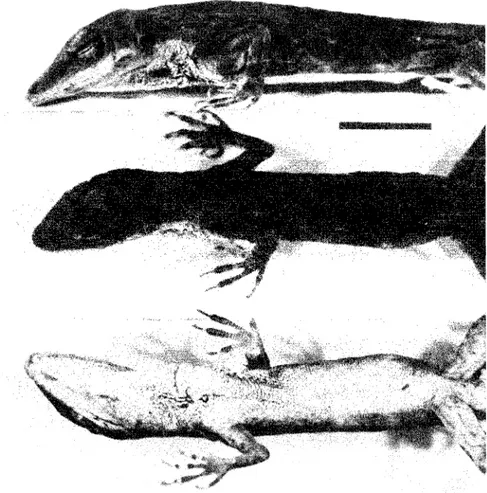
(2) REVISTA DE BIOLOGIA TROPICAL. 806. Diagnosis:. A small, yellowish-tan, short. legged member of the. Norops fuscoauratus. and anterior nasal. Usually. 2 (occasional1y 1). scale rows between supraocular semicireles.. posteloacals and a large, bicolored pink and. 12 smaller supercilimies, the latter > 2 times larger. orange dewlap in males and a small, plain. than lateral granules. Canthus dístinct, formed by. species group characterized by having enlarged. One greatly enlarged supercíliary followed by. dewlap not contrasting in color with the rest of. 5-6 enlm'ged keeled scales. 6-8 loreal scales. the throat in females.. between posterior canthals, these pustulose; the. General Morphology Head: Head scales. moderate in size, keeled at tip of snout, smooth. row aboye the supralabials. >2 times size of other. loreals. Temporals granular, enlarging and flatten. or rugose throughout rest of head except for. ing. supraocular semicireles and canthals.. Interparietal large, flat, plate-like;. 8-10. gradually. in. supratemporal. region.. 2-3 scales. scales separate second canthals across top of. between interparietal and supraocular semicir. head, these forming a distinct dish posteriorly.. eles. Suboculars in contact with supralabials.. Usually. (usually. 1 (occasíonally 2) scale between rostral. Fig. l. Views of head and anterior body of holotype (CRE 5290) of Norops dIe: dorsal view, below: ventral view. Scale. bar"! cm.. 6-8 7) sublabials to level of center of eye.. pandoellsis, Ilew species; aboye: lateral view, mid.
(3) SAVAGE & GUYER: A new.speciesofanole lizard,gemis Naraps. Mentalswider thandeep. Subla,bials 2::2 times size of gulars. Traní'ition between sublabials and gulars abrupt. Male dewlap large, extending well posterior to level ofaxilla; small, plain, whitedewlappresent in females. Trunk: 2�4 middorsal scales about twice size of granular lateral scales; transition between these regions gradual. Dorsalmost scales very weakly keeled andweaklyimbri cate. Ventralscales smooth (occasionalIy very weakly keeled) and weakly imbricate.. 807. DOrsUlll usually q¡n-yellowbut changing toctark er col ors, olive-green todark brown when cape tured. Darker obliqueJateral bars on flanks may be present o One female with a broad middorsal light tan stripe bordered laterally by dark brown area that fades to light tan from head lo tip of tail and .1aterally. Anotherfemale' had a Iess distinct middorsal lighter brown stripe with a series of eltmgate, rectangular dark brown markings down the midline from. the neck lo the base .of the tail. Supra- and infralabials white to pale yellow.. TABLE 1 Characteristics that differentiate Norops pandoensis fmm similar species fmm lawer Central America.. a/tae. exul. fartunensis. 49.5-53 49-60. 32-52 39-47. 39-47 46. 48. 44-53 46-54. ear. 'ear. ear. between. shoulder. pandaensis. SL adult males adult females Adpressed leg to Scales between supraocular semicircles Slightly enlarged rows. 1-2. 1-2. 2. O. O. usually 2. usually 1. preselH. absent. 2-4. kemptani. shoulder.andear. 3. 2-4. O. orange,. reddish. red,orange. margin. orange,. spot on. cherry-red. margin red. iÍIlterior. yellow. yellow. white. W. Panama. W. Panama. W. Panalna. of dorsals. Enlarged postcJoacals. chest. Dcwlap infemales. Igewlap .colorin males. plain. white. pink, anterior. just. posteriono arrn insertion ítbsent. margin orange. Color ofenJar$ed dewlap. margin white. scales Distributíon. Costa. �ica. . white Costa Rica. Limbs andDigits: Hind legsshort;Jourth toe of adpressed hind Jimb reachinglevelof tympa num� Supradigital scale� weakly.multicarinate. 31-32 Jamellae under 4th toe; 15 to lq lamellae undet phalanges ii + ¡ji. TaiJ: Scales at rniddorsumandmidventer of tail slightly(<2 times) larger thaIl lateralscales and strongly keeled. Tail laterally compressed ; Enlarged postcloacal scales in males; Col�l'tlti()n in Lif�:Apparently having some ability forcolor changeor with.a greenish cast.. Dewlap in males mostly pink, anteriorone-fourth orange, scales white; plain white. in females. Venter white to yellow-white; inunaculateorsuf fused with brown laterally. Iris orange-red. In Preseryátive: Generallytandorsally \Vith darker markil1gs more evidenL The parietal peritoneum ÍSi black. .. gtÍl to '"144 mm; mmi� sta,ndard ¡engIh,. fe.rn¡tles 49.60 mm; taiUepgth(.iiViqed bystandardlellgth. Measlll"'ements: Total.len. males 49.5-53. 1.7-2.0, inadults..
(4) 808. REVISTADE BIOLOGIA TROPICAL. Habitat: This diurnal species is found in the herbaceous and low shrub zone (up to 1.5 m) in Lower Montane Rainforest (Holdrige, 1967; Tosi,1969).. Comparisons: N. pandoensis is a member of the fuscoauratus species group. Lizards of this group are small to moderate in size, have small head scales, small dorsal scales, mostIy smooth ventrals, long tails that are round to subcylindrical in cross-section. Members of this group usually have an inscriptional rib for mula of 3: 1 (Etheridge, 1965) as is the case with N. pandoensis. Among Central American members of the fuscoauratus group the new species is unlikely. to be confused with Norops limifrons (inc1uding N.biscutiger) or Norops polylepis both of which have long legs, i.e., the tip of the 4th toe reaches beyond the orbit when the leg is adpressed alongthe side of the body. In addi tion, the dewlap in male N. limifrons is white with a basal yellow to orange spot and is uni form orange in male N. polylepis. Among short-legged members of the fus coauratus group, N. pandoensis can be distin guished immediately from the lowland Norops carpenteri which is green, smaller (standard length 35-45 mm) and with a uniform orange dewlap . color in males. Comparisons with the four short-legged species most similar to N.. �. 1. METER 3000 2000. :. 10 0. ?t�t:. Ay'?:. 1. Fig 2. Distribution of montane shor-legged Norops of the fuscoauratus group in Costa Rica and westem Panama. N. attae (elosed cireles); N. exsul and N. fortunensis (square); N. kemptoni (open cireles); N. pandoensis (star). One symbol may repre. sent several adjacent localities..
(5) SAVAGE & GUYER: A new species of anole lizard, genus Norops. pandoensis in general appearance are summa rized in Table 1. AH are upland forms and one or more of them may prove to occur sympatrically with N. pandoensis.. ACKNOWLEDGMENT S. 809. REFERENCES Arosemena, F. A. & R. Ibañez. 1 993. Una especie nueva de Anolis (Squamata: Iguanidae) del grupo fuscoauratus de Fortuna, Panamá. Rev. Biol. Trop. 4 1 : 267-272. Arosemena, F. A. & R. Ibañez. 1 994. Un sauio nuevo del genero Anolis (Reptilia, Polychrotidae), grupo fuseoau. ratus, de las tierras altas de Chiriquí, Panamá. Carib. J.. Karen R. Lips, St. Lawrence University, col lected most of the type series and generously make available her fieldnotes on the new taxon. Juan Diego Alfaro of the Servicio de Parques Nacional of Costa Rica, arranged for necessary permíts and aided study of the Biosphere Reserve in many other ways. Bruce E. Grayson prepared the photographs for Fig. 1.. Sci. 30: 222-227. Dunn, E. R. 1 930. Notes on Central American Anolis. Proc. New Engl. Zool. Club 1 2: 1 5-24. Dunn, E. R. 1 940. New and noteworthy herpetological material from Panama. Proc. Acad. Nat. ScL Phila. 92: \05- 1 22. Etheridge, R. E. 1 965. T he abdominal skeletons of lizards in the family Iguanidae. Herpetologica 2 1 : 1 6 1 - 168.. RESUMEN Se describe una especie nueva de lagartija del grupo de. Norops fuscoauratus de Talamanca, Costa Rica. Difiere de las especies emparentadas de Costa Rica (Norops attae) y Panamá (Norops exsul, N. fortunensis y N. kemptoni) bási camente porque una estructura masculina ("dewlap") se extiende hasta el nivel de la axila y por ser rosado con un margen exterior anaranjado. También tiene patas más largas. que N. fortunensis y N. kemptoni; difiere de este último y de. N. attae y N. exsut en que tiene 2-4 filas ligeramente agrandadas de escamas medio-dorsales La especie nueva solo se conoce de Cerro Pando (frontera entre Costa Rica y Panamá).. Holdrige, L. R. 1 967. Life zone ecology. Tropical Science Center, San José, Costa Rica. 206 p. Tosi, J. A., Ir. 1 969. Mapa ecológico, República de Costa Rica. Tropical Science Center, San José, Costa Rica..
(6)
Figure

Documento similar
Given some initially unperturbed distribution of particles, and taking into account the primordial power spectrum as initial condition, one can model the evolution and
Clearly for our choice of cosmological parameters, haloes at these mass scales are more massive in strongly coupled cosmolo- gies but can have similar masses in cosmologies with
In advanced nations, small and medium size enterprises have also played significant roles in the diffusion of innovations, especially in the earlier phases of product
It is also shown that the foreign debt is sustainable if (1) share of capital income is small, i.e., inequality is small, (2) initial ratio of the foreign debt to GDP is
In this section we apply the results of Section 3 to show the existence of unitary embeddings of p-compact groups whose orbit categories of centric radical subgroups have small
Given the small error obtained in the results offered by the average day model in the calculation of the cost of energy, in this section, dedicated to the optimisation of the sizing
Even though these birds, just like chickens or hens, are small and, therefore, should adjust to the metaphor that conceptualizes attractive females in the guise of
14 Within the small group of Italian survival family firms, most are very small businesses, often operating like craftsmen, and these companies have invested little or nothing in
