
Analysing EFL learners’ written corpus for a better teaching and learning of gerund and toinfinitive structures
17
0
0
Texto completo
(2) Journal for Educators, Teachers and Trainers, Vol. 10 (1) ISSN 1989 – 9572 http://www.ugr.es/~jett/index.php. Analysing EFL learners’ written corpus for a better teaching and learning of gerund and to-infinitive structures Análisis de un corpus de aprendices de inglés como lengua extranjera para la enseñanza-aprendizaje de los verbos que requieren gerundio o infinitivo Hanane Benali Taouis, The American University of the Middle East, Kuwait [email protected] Sidoni López Pérez, International University of La Rioja, Spain [email protected]. Abstract This investigation analyzes the use of gerund and to-infinitive verbs by Spanish learners of English using AntConc, a free concordance software program that scrutinizes the corpus for frequency, concordance, clusters and collocates. We analyzed these verb forms because there are few studies that focus on this aspect of English grammar (Mair 2000; Gries 2010) and also because the Spanish language has infinitive use but does not employ the gerund form after verbs (Niño-Murcia 1995). Our genuine corpus includes 155 participants and 247 writing samples by students in the Bachelor’sDegree in Early Childhood Education in the subject, ICT tools applied to the learning of English language, from the academic year 2013-2014 to 2015-2016. The aim of this research is to analyze the errors of Spanish learners of English for frequency and collocates to find out whether the errors are a result of frequency, L1 interference (Ellis 1994; Gass and Selinker 2001) and/or a mere aftereffect of a poor teaching method. The results of the corpus analysis thereof demonstrated that in most cases the errors have shown themselves to be a manifestation of interlanguage output. The implications of this study are useful to both teachers and learners. Resumen Esta investigación analiza el uso de los verbos que van con gerundio o infinitivo por estudiantes españoles de inglés utilizando AntConc, un programa informático de concordancia gratuito que analiza el corpus por frecuencia, concordancia, agrupaciones y colocados. Se han elegido estas formas verbales porque hay pocos estudios que se centran en estos aspectos de la gramática inglesa (Mair 2000; Gries 2010) y también porque el idioma español tiene el uso del infinitivo, pero no emplea el gerundio después de los verbos (Niño-Murcia 1995). El corpus utilizado en este estudio es una auténtica producción escrita compilada a través de la plataforma de UNIR, que incluye 155 sujetos y 247 muestras de los alumnos del Grado en Maestro en Educación Infantil en la asignatura, Herramientas TIC aplicadas al aprendizaje de la lengua inglesa, desde el curso académico 2013-2014 hasta 2015-2016. El objetivo de esta investigación es analizar los errores de los estudiantes españoles de inglés por frecuencia y colocados con el fin de averiguar si los errores son el resultado de la frecuencia con la que se utilizan los mismos en las distintas lenguas, la interferencia de la L1 (Ellis 1994; Gass y Selinker 2001) y/o un mero efecto de un método de enseñanza inadecuado. Los resultados del análisis del corpus previamente mencionado demostraron que en la mayoría de los casos los errores eran una manifestación de la interlingua. Obviamente, las implicaciones de este estudio son útiles para profesores y alumnos. Keywords Foreign language teaching and learning; Grammar (verb forms); Error analysis; L1 interference Palabras clave La enseñanza de idiomas y el aprendizaje; Gramática (formas verbales); Análisis de errores; La interferencia de la L1 Journal for Educators, Teachers and Trainers JETT, Vol. 10 (1); ISSN: 1989-9572. 85.
(3) 1. Introduction Although the use of gerund and to-infinitive verbs in English continues to pose several problems for L2 learners and is considered to be among the most difficult areas to deal with by ESL teachers (Petrovitz, 2001), few studies have focused on these problematic constructions (Gries, 2010; Mair, 2000; Schwartz & Causarano, 2007). They are “a continuing source of errors even among advanced learners” (Petrovitz, 2001: 172) and their different structures and meanings are commonly confused and mistaken by Spanish learners of English. Some studies have suggested that one of the aspects causing this error production is related to the fact of teaching and introducing both gerund and infinitive constructions in a single unit (Petrovitz, 2001), without clearly teaching and explaining the syntactical and semantic differences among them. However, other types of research have focused on theories of frequency and language transfer (Kartal & Sarigul, 2017; Schwartz & Causarano, 2007) in order to account more efficiently for the errors and mistakes commonly made by L2 learners regarding this type of structures. The role of frequency in second language acquisition (SLA) has been investigated by many researchers and scholars (Bybee & Hopper, 2001; Brown, 2007; Demuth, 2007; Ellis, 1994; Ellis, 2002a, 2002b; Gass & Mackey, 2002; Kartal & Sarigul, 2017; Koprovski, 2005; LarsenFreeman, 2002; Schwartz & Causarano, 2007). Frequency, which is generally defined as “the number of times a specific word, structure, or other defined element of language draws the attention of a learner” (Brown, 2007: 293), is considered to be one of the factors influencing the development, process and production of the language (Demuth, 2017; Ellis, 1994). As Demuth (2017: 385) points out, “the more frequently a certain linguistic unit occurs, the harder it is for the learner to ignore it”. In this sense, and regarding the role that frequency can play in the appropriate use of gerund and infinitive constructions, both Schwartz and Causarano (2007) have reached the conclusion that if these structures are highly frequent in both the native language (NL) and the second language (SL)–as is the case with infinitive structures–, the use of these constructions by Spanish learners of English will also be of high-frequency when using the SL, with a low language interference. However, if these structures do not occur frequently or do not exist in the NL–as is the case with gerund constructions in Spanish–language interference is more likely to occur and the errors made by L2 students can even be more dominant than those in infinitive structures. This suggests that although frequency has an important role in SLA (Brown, 2007; Demuth, 2007; Ellis, 2002a, 2002b; Kartal & Sarigul, 2017), there are other factors that also interact with it when learning a SL (Ellis, 1994; Gass & Mackey, 2002). In the case of infinitive and gerund structures, language transfer (LT) seems to be one of the aspects that certainly contributes to the misuse of these problematic constructions by Spanish learners of English, giving rise to what has been labeled as interlingual errors, that is, those errors “caused by the learner’s native language” (Richards & Schmidt, 2002: 26). According to Odlin (1989: 27), LT is defined as “the influence resulting from the similarities and differences between the target language and any other language that has previously (and perhaps imperfectly) acquired”. At the same time, LT can impact the learning of a SL in both positive and negative ways. Whereas positive transfer takes place “when the prior knowledge benefits the learning task – that is, when a previous item is correctly applied to present subject matter” (Brown, 2000: 94), negative transfer usually happens “when previous performance disrupts the performance of a second task” (Brown, 2000: 95). The latter is also referred to as interference (Brown, 2000), which is usually viewed as “the transference of elements of one language into the learning of another at various levels of linguistics which include: phonology, morphology, syntax and the orthography of the languages” (Offiong & Okon, 2013: 899). In addition, this type of negative transfer can result from the differences or similarities that can be found between the NL and the (SL) (Schwartz & Causarano, 2007). Regarding the use of infinitive and gerund structures, we hypothesise that if the NL has an infinitive and/or gerund construction for certain verbs, it is likely that this structure will transfer quite easily to the SL. On the contrary, if the NL does not have these constructions, the acquisition of these structures will be more difficult to occur and to internalize by L2 learners, while ultimately resulting in frequent error production.. Journal for Educators, Teachers and Trainers JETT, Vol. 10 (1); ISSN: 1989-9572. 86.
(4) For our study1, we have chosen to analyze four verb constructions in English (2 gerund and 2 to-infinitive structures) by native speakers of Spanish with a B1 level in the learner corpus from the platform of UNIR. The selection of the verbs was based on a detailed list retrieved from the online Cambridge Dictionary, which was compared and contrasted with many other lists available online to make sure we included the most common verbs. As said before, the aim of this research is to specifically find out whether the errors commonly made by the students are a result of frequency, NL interference and/or a simple consequence of an ineffective pedagogical and teaching method. Therefore, the aim behind this study is to track the types of errors that our non-native students make as Spanish learners of English, to explain the reason behind their errors, and help both teachers and students to find an appropriate way to focus on this aspect of the English language. To start with, we will look at examples of gerund constructions because although they are not really used in Spanish and the students do not make a wide use of them (at least in our corpus), they present themselves as verb structures commonly used in English and L2 learners often have problems with them. Later, we will also analyze to-infinitive structures in English because Spanish has the infinitive construction and there are many verbs which are followed by to-infinitives, as is the case of the Anglo-Saxon language. However, both languages have a different structure when a complement construction is used after these verb structures and this is another aspect that we intend to analyze because it is here where our students frequently make mistakes. In addition, and as we will see in subsequent sections, error production also appears when L2 learners need to make a choice between the use of gerund or to-infinitive after certain verbs that require only one specific structure, and this is another reason why we have considered it appropriate to specifically examine and analyze both gerund and toinfinitive structures.. 2. The structure of gerund and to-infinitive constructions Gerunds and infinitives are sometimes referred to as verb complements because they are used after certain verbs, that is, they function as the object of another verb. In the case of gerunds, they can occur at the beginning of a sentence when used as a subject (e.g. Smoking is not healthy), as an object following the verb (e.g. I don’t mind telling you the truth), and as an object after a preposition (e.g. She counted on passing her exams). Likewise, infinitives can also be used as a subject at the beginning of a sentence (e.g. To travel is a pleasure), as an object following a verb (e.g. I want to buy that bag), and as a complement of an object (e.g. He allowed her to enter the building). For the purpose of our research, we have focused on gerund and toinfinitive constructions functioning as objects followed by verbs (Verb+Gerund and Verb+Infinitive) and also onto-infinitive structures acting as complements of an object (Verb + Object + Infinitive). The reason for our choice is simply because these constructions continue to be challenging for L2 learners and also because frequent and common mistakes are made regarding the correct use of these problematic structures. In addition, there are also verbs in English which can be followed by either to-infinitives or gerunds. On the one hand, there are verbs which trigger either to-infinitive or gerund structures with little or no difference in meaning. Such is the case of the verb start, which can appear with a to-infinitive or gerund construction, without really changing the meaning of the sentences: 1) I started to study for my exams yesterday. 2) I started studying for my exams yesterday. On the other hand, there are certain verbs which are also followed by either a to-infinitive or gerund structure but their meaning is different. A clear example is provided with the verb remember:. 1. This work has been carried out in the frame of the emerging research project “Detección y análisis del comportamiento lingüístico de producciones escritas de estudiantes universitarios”, (Project reference: B0036-1617-104-ETEL. Universidad Internacional de La Rioja, 2016-2017).. Journal for Educators, Teachers and Trainers JETT, Vol. 10 (1); ISSN: 1989-9572. 87.
(5) 1) Just remember to open the door (in this case the fact of remember-ing becomes an action). 2) I remember opening the door (in this case the action comes before remembering). Although these verbs are not always used correctly by L2 learners and sometimes students make some mistakes, they are not the focus of our study. First, because error production here is not as prevalent and notorious as it is in the case of verbs followed by only gerunds or toinfinitives. One of the reasons for this low-frequency error production is because these verbs are extensively explained in ESL textbooks providing long lists of these verbs with their particular constructions and differences in meaning. As Schwartz and Causarano (2007) point out, “because of the overlap in these verb + complement structures, it is not uncommon for ELLs to produce frequent errors” (p. 46). Second, because they are not frequent in our corpus and finally, because we think they would require a separate research and analysis due to their different patterns and semantic disparity.. 3. The study 3.1. Corpus design and compilation The current study uses a comparable original corpus in form of complete texts produced by intermediate Spanish learners of English (B1 level) in the Bachelor’s Degree in Early Childhood Education from the International University of La Rioja (UNIR). This monolingual corpus was a result of the students’ participation in the compulsory forums of the subject, ICT tools applied to the learning of the English language, from the academic year 2013-2014 to 2015-2016, and it includes 247 writing samples of 155 participants. In addition, the corpus used in this investigation was compiled by two members of the research group ENTELEARN (English, Technologies, and Learning) at UNIR. The participations of the students in two forums tackling the use of ICT in the English classrooms were uploaded into the UNIR platform to be later on collected by the researchers and used as the project corpus. The students’ contributions in the two forums were received in a word format and were therefore transformed into a plain text format (TXT) to be recognized and analyzed by the Antconc program. As shown in Figure 1 below, another important step in the transformation of the collected corpus to be effectively analysed was organizing the data into different Excel folders including the codification, the number of students, the number of contributions, the name of the course, the academic years, the different semesters and the number of words.. Journal for Educators, Teachers and Trainers JETT, Vol. 10 (1); ISSN: 1989-9572. 88.
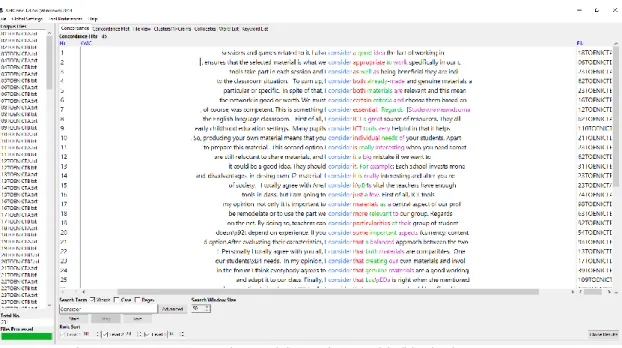
(6) Figure 1. Table of records sample 3.2. Analysis of the Corpus The first step of this study is to retrieve a complete list of verbs that are followed by gerund or to+infinitive. After scrutinising several grammar books by Longman, Oxford and Cambridge and different academic official websites, we selected the list provided by the online Cambridge Dictionary for being the largest one. The list includes a total of 104 verbs followed by gerund or to-infinitive, most of which were proved to be difficult for Spanish learners of English. The verbs were checked in our corpus to count their frequency of use by our participants. Based on this first analysis conducted using the AntConc program, we could track four verbs that were mostly used by our students. Thus, the verbs that gave more hits in the AntConc analysis were: avoid, consider, need and want. Consequently, we started the second analysis by evaluating each of the hits of these four verbs at a time. Our second analysis was not concerned with the frequency of use but with the number and the type of errors that our corpus presents. By reading all the sentences in which our participants used these verbs and examining their accuracy, we could judge if these were the verbs that demonstrate themselves to be problematic for our Spanish learners of English. Then, obviously because the four previously mentioned verbs were used inaccurately by the students, we decided to analyse them and base our study on them rather than others. The verbs were scrutinized alphabetically to analyse the 403 sentences in which the selected verbs were used focusing on the incorrect use of the verbs in structure and meaning. The reasons behind this inaccuracy in gerund and infinitive structures were inferred and explained to give the results of the actual study. As can be seen in the different examples, the error by the students are presented in italics to highlight the type of inaccuracy. The first verb that we analyze in the corpus is avoid, a term that is followed by a gerund construction in English. As shown in Figure 2 below, it appears on 13 occasions, only three of which are considered to be completely wrong. Although this clearly indicates that our students. Journal for Educators, Teachers and Trainers JETT, Vol. 10 (1); ISSN: 1989-9572. 89.
(7) are making a good use of the verb avoid in most of the cases, it is worth noticing that in most of these sentences the term avoid is used with a noun phrase serving as a Direct Object (hits 2 to 5, 8 to 10 and 12 are excellent examples) and not precisely another verb (only two examples have been located in hits 4 and 6):. Figure 2. Frequency and use of the verb “avoid” in the learner corpus As can be observed in hit number 13, the student is making use of an infinitive construction after the verb avoid. Although this structure is accurate in Spanish (the term avoid, which is translated as “evitar”, is used with an infinitive construction in the Spanish language), it is completely inaccurate in English as a gerund structure is obligatorily required: (13) Young students are digital native, but I think that we must avoid to offer them to much stimuli. Whereas the right structure for this sentence would be “avoid offering them”, our students continue making the same mistake in two more sentences. In hit number 1 and 11 above, the grammar construction that these students are using for the verb avoid is not correct because when this verb is followed by an object, it must also be followed by a gerund structure. However, in these cases the students make use once again of a bare infinitive construction after the object of the sentence: (1) You have to prepare this activity before, and organize it to avoid children get bored. (11) However, one of the disadvantage could be that you need to prepare and organize the class very well to avoid they get bored. Although in this case the Spanish structure would be different because a subjunctive is required, it is clear that the students have not internalized the use of the gerund construction with the verb avoid when an object is following. Whereas the right structure in the two sentences above would be “to avoid children getting bored” and “to avoid them getting bored”, the students consider the infinitive construction as the most appropriate without realizing how wrong this structure is in English. In this sense, it seems to be clear that the students’ native language is interfering in the appropriate and accurate use of the gerund construction required with the verb avoid.. Journal for Educators, Teachers and Trainers JETT, Vol. 10 (1); ISSN: 1989-9572. 90.
(8) The second verb that we analyse in our corpus is consider (see Figure 3 below). This verb in its active form is only followed by a gerund construction, although in the passive form (be considered) is used with an infinitive structure. As shown in the chart below, the verb consider appears on 45 occasions, although in none of the cases was it used with its passive or participle form. On the contrary, in its active form the verb is used correctly in almost all the sentences (specifically in those in which consider is followed by a that-clause or a noun phrase):. Figure 3. Frequency and use of the verb “consider” in the learner corpus However, the first incorrect use of this verb could be observed in (hit 11) because the term is followed by the verb to be in Simple Present (see Figure 3 above): (11) This second option I consider is really interesting when you need, etc. In this occasion the student does not use a noun or an object after consider, but he /she uses the verb to be in Simple Present. In addition, the structure of the sentence provided by the student is not correct, since “this second option” is the Direct Object of the sentence, not the Subject. Therefore, in order to make an accurate use of the verb consider in this sentence, two different constructions may be used. Whereas the first one suggests the use of a passive construction: “I consider this second option to be really interesting”, the second structure should include the use of a that-clause: “I consider that this second option is really interesting”.. Journal for Educators, Teachers and Trainers JETT, Vol. 10 (1); ISSN: 1989-9572. 91.
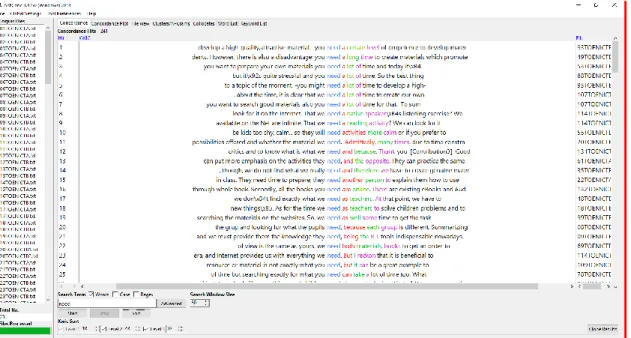
(9) Figure 4. Frequency and use of the verb “consider” in the learner corpus In addition, its use is also wrong in hit 41 because the term is followed by another verb with a toinfinitive structure (see Figure 4 above): (41) Nevertheless, whether we consider to choose adjusting an already made material or creating a new one we should master the ability to manage time. As we can see, the use of the verb consider with a to-infinitive construction is not accurate because this verb in its active form must be followed by a gerund structure in English: “consider choosing”. This suggests that our students are confused and mistaken about the appropriate construction of this term, which is followed by a bare infinitive in Spanish: “consideramos elegir”. In this case, it rather seems that Spanish students of English have difficulties when internalizing and learning about the use of a gerund construction with the verb consider and we think that this could be basically due to NL interference. With regard to the verb need, the third term in our analysis, although its use is correct in most of the cases (we have located 241sentences out of which only 12 wrong uses have been identified), it continues to pose several problems for our students. As can be observed in Figure 5 below, when the term need is not followed by a verb, the students make a good and accurate use of the verb (sentences 1 to 25 serve as good examples).. Journal for Educators, Teachers and Trainers JETT, Vol. 10 (1); ISSN: 1989-9572. 92.
(10) Figure 5. Frequency and use of the verb “need” in the learner corpus However, when the verb need is followed by another verb, students make several mistakes because they do not always use the appropriate structure. Although in most cases the students make an accurate use of the to-infinitive (we have located 107 sentences in which the use of this structure is correct), we have also identified some sentences in which the use of this structure is completely wrong. In these cases, L2 learners use different types of structures that are not grammatically correct in English and are usually similar to the patterns and structures employed in Spanish. For example, in hit 33 (see Figure 6 below) the student uses a past form after the verb need, without taking into consideration the to-infinitive structure required for this term: (33) On the one hand, producing our own materials and resources is very enriching because we will create the concrete material we need focused in our reality and context.. Figure 6. Frequency and use of the verb “need” in the learner corpus. Journal for Educators, Teachers and Trainers JETT, Vol. 10 (1); ISSN: 1989-9572. 93.
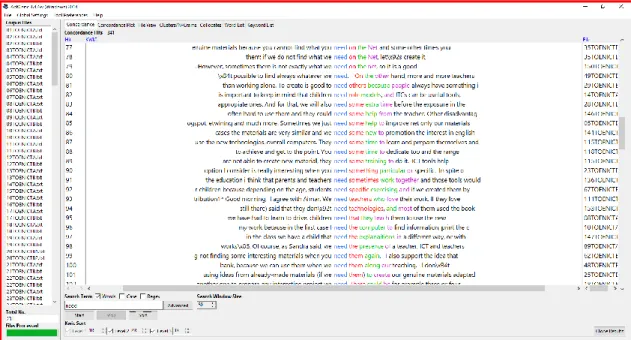
(11) In other cases, the students use the bare infinitive after the verb need, a structure which is also erroneous and inaccurate in English. However, this construction is used in Spanish, since the verb “necesitar” requires a bare infinitive in this language. The examples located in hits 42 (Figure 6 above) and 91(Figure 6 below) clearly illustrate the wrong use that L2 learners make regarding this problematic structure: (42) A very advanced century, and education need go grow with the society. (91) As a teacher and a professional of the education i think that parents and teachers need sometimes work together and those tools would be very good for it. Besides making a wrong use of the “to-infinitive” structure required for the verb need, the two verbs that the student is using after need in sentence 42 do not make sense. Thus, it remains unclear whether the student wanted to use only one verb (in which case it should be grow) or both verbs (in which case one possibility would be “education needs to go (on) growing with the society”). In addition, the student also forgot to include the –s for the third person singular in the Present Simple and wrote “education need” instead of “education needs”. Therefore, the sentence is both grammatically and semantically incorrect in its whole structure. On the other hand, we have also found two cases in which “to” is used after need. However, the students do not use a verb after it and they use a noun instead. In hit 86 (Figure 7 below) the student writes the noun “promotion” where he/she should write the verb promote and in hit 152 (Figure 8 below) the student writes the noun ear where he/she should write the verb hear: (86) I really like to be creative, for me it\x92s not a problem and I enjoy thinking about new topics and new ways to learn. In many cases the materials are very similar, and we need some new to promotion the interest in English. (152) Besides, I would like to encourage Laila to use ITC tools in her class, as it is very entertainment to kids that are just learning a new language and they need to hear from English native speakers.. Figure 7. Frequency and use of the verb “need” in the learner corpus. Journal for Educators, Teachers and Trainers JETT, Vol. 10 (1); ISSN: 1989-9572. 94.
(12) Figure 8. Frequency and use of the verb “need” in the learner corpus At the same time, the cases in which the students make use of the preposition “of” and a gerund form after the verb need are also found in some sentences. Such as the case of hit 73 (Figure 9 below) in which the student chooses the structure “of + gerund form”, instead of using the “toinfinitive”. The same happens in hit 74 (Figure 9 below) as the student makes use of the same structure (although in this case need is used as a noun and not as a verb): (73) I need of creating my own material taking this webquest ideas that I found great but incorporating Vokis that could explain with a single click we want children to do. (74) Kids were restless, bored of waiting for their turn...and it sparked the need of designing something more fun. The term need is also used as a noun in hit 75 (Figure 9 below), but in this case the student does not employ the gerund form after the preposition “of”. Instead our student makes use of a base-infinitive, a structure which is commonly used in Spanish: (75) We are running out of time always, so where is the need of spend time if you can find and use it in seconds?. Figure 9. Frequency and use of the verb “need” in the learner corpus. Journal for Educators, Teachers and Trainers JETT, Vol. 10 (1); ISSN: 1989-9572. 95.
(13) At the same time, we have also located one sentence in hit 39 (Figure 6 above) in which the student makes use of the preposition “for” after the verb “need”, a structure which is used in Spanish: (39) … but as a teacher you must spend time looking for that specific material you need for working whatever you\x92re doing with your students. In addition, there is also one case in hit 95 (Figure 7 above) in which the verb need is used with a that-clause, an aspect that also reflects the interference of the student’s native language: (95) Children have a innate facility for use but, I do not remember where, I law a theory that looked at me right, like we were born when cars already were invented, and we have had to learn to drive, children need that they teach them to use the new technologies, and it is like that, for that they open a world you of Possibilities in all directions. As we can see, the different structures above are not correct because in both cases a toinfinitive is needed. However, the constructions that our students make use of are widely used in Spanish and again we think that NL interference causes Spanish learners of English to make a wrong use of the structure required. In hit 74, “the need of designing” translates directly from the Spanish “la necesidad de”, and in hit 53, “children need that they teach” also translates directly from “los niños necesitan que les enseñen” in Spanish. Therefore, it seems safe to say that the role of our students’ native language plays a fundamental role in the inaccurate and wrong use of the to-infinitive structure with the verb need. In addition, there are also other cases in the learners’ corpus in which the to-infinitive construction is not used accurately with this term either. A clear example is the use that our students make of the to-infinitive structure acting as a complement of an object (Verb + Object + To-Infinitive). We have located two sentences in hits 30 (Figure 6 above) and 55 (Figure 9 above) in which the students make a wrong use of this particular structure. Instead of using the to-infinitive construction with an object, the students employ a gerund construction preceded by the preposition “for”: (30) So I decided to try to show them that they need English for speaking in other countries. (55) … and in the second case I need it for showing the videos to the children. The structures used by our students in both sentences are similar to the grammar constructions used in Spanish for the verb need. In this language, the preposition “for” is used after the verb with a bare infinitive but there is no way in which the term can be used with a gerund form as it happens in English. In hit 30, for example, the structure “they need English for speaking” translates directly from the Spanish “ellos necesitan inglés para hablar”, and in hit 55, the construction “I need it for showing” is translated into Spanish as “yo lo necesito para mostrar”. However, Spanish language does not allow the use of a gerund form after a preposition, that is, only a bare infinitive construction is allowed after a preposition (“para hablar”, “para mostrar”). Therefore, we can say that our students have used the Spanish structure required for the verb need, but they have also added a typical English construction when using the gerund form after the preposition (“for speaking”, “for showing”), which is not accurate in this case. In this sense, we can say once again that the influence of the NL continues to be clear and noticeable when using this type of structures since the students tend to resort to the grammatical patterns used in their native language. The fourth term studied in this investigation is the verb want, which is the most frequent one in the data with a total of 104 hits in the results of the AntConc analysis. Out of all the hits that were found, only three incorrect usages of this verb were detected, as shown in figure 10 below:. Journal for Educators, Teachers and Trainers JETT, Vol. 10 (1); ISSN: 1989-9572. 96.
(14) Figure 10. Frequency and use of the verb “want” in the learner corpus In hits 35, 38 and 39 (Figure 10 above) the students used the verb want followed by a thatclause, which is a common error by Spanish learners of English translating the structure from their mother tongue,“si quieres que …” or “quiero decir…” as observed in the following hits: (35) On the other hand I want say, as some of my partners already have (38) If you really want that children learn (39)…if we want that they acquire … Another error found in the data is the one in hit 41, as can be seen below: (41) …You can choose how you want the information appears… In this case, the student is respecting the rule of Present Simple subject and verb agreement by adding an “S” to the verb appear, having in mind that “information” is a singular noun, and meaningfully assuring that he/she ignores the rule of use of the verb want indicating that this verb should be followed by a to-infinitive form. The last inappropriate use of the verb want could be observed in hit 43: (43) If we want the project ends successfully. Grammatically the verb want should be followed by a complement that can be a noun or a pronoun (object), a verb in the to-infinitive form, or an object plus a verb in the to-infinitive form. However, in this occasion (hit 43) the verb is followed by an object (the project) plus a verb in simple present (ends) which makes the sentence inaccurate. Regarding this specific error, there is no mother tongue interference and the explanation that can be given is an overgeneralization of the rule that the student applied to show he or she was referring to the present (ends). From the aforementioned information about the frequency of the verb want in the data and the number and types of the errors found, we can conclude that the use of this verb should be considered as a tricky aspect of English that should be explained and practiced in class.. Journal for Educators, Teachers and Trainers JETT, Vol. 10 (1); ISSN: 1989-9572. 97.
(15) 4. Conclusions While learning any subject, although in this case our point of concern is restricted to SLA, learners tend to make hypotheses about the rules generalizing some and transferring others from their mother tongue or any other L1 they happened to learn before. As part of their learning strategies, learners normally try to use the rules in their performance and negotiate meaning to check their accuracy and consequently confirm or modify the rule. To support the learners in this process, error analysts offer a conscious treatment of the students’ production by observing, analyzing and classifying their errors for a better understanding of the rules and a successful performance. In this study our error analysis of the data included in the research shows that the basic types of errors were due to frequency, language interference and, to a lesser extent, overgeneralization. It is clear that our students do not make a high use of gerund constructions (only 13 hits have been located for avoid and 45 hits have been found for consider), whereas to-infinitive structures are of high-frequency among our participants (241 hits have been located for need and 189 hits have been found for want). This suggests that our students make a higher use of those verb constructions which occur more frequently in their NL – as is the case of to-infinitive structures – and a quite lower use of those verb constructions which are not used or do not exist in their NL – as is the case of gerund structures. On the other hand, the analysis in our corpus also reveals that error production is more frequent in verb constructions that do not exist in the students’ NL–in the case of gerund structures, 1 mistake is found every 4 sentences for avoid and 1 mistake is found every 22 sentences for consider– whereas in the case of to-infinitive constructions, error production is quite lower among our participants–1 mistake is found every 20 sentences for need and only 1 mistake is located every 37 sentences for want–. It is clear then that the students either allow a negative transfer of a Spanish rule and apply it in English or use a specific rule in an incorrect occasion thinking that it can be utilized with different structures or verbs and ignoring rule restrictions or exceptions. This explains why students make these types of errors while writing and gives teachers clues on how to deal with the incorrect use of to-infinitive and gerund structures by predicting the errors and highlighting them in the teaching act. Moreover, we can clearly deduce that the errors of our students in the analyzed structures are not only a result of the mother tongue interference but also of an inadequate acquisition of the target language that includes ignorance of some grammatical rules and obviously implies overgeneralizing other rules to consciously or unconsciously cover the lack of grammatical and syntactical knowledge. As previously mentioned, the overgeneralization errors are less frequent in our data, an aspect that highlights the fact that students tend to have more difficulties in learning the usage of those verbs that are used in a different structure in their mother tongue and they even face problems in learning verb structures missing in their native language. Nevertheless, all types of errors should always be a highly appreciated indicator by language teachers because they show the learners’ strategies and they track the way to analyze the difficulties. They also point out the problematic areas of the language and help teachers develop new methodologies and teaching materials.. 5. Pedagogical and teaching implications As we have seen throughout our analysis, the use of gerund and to-infinitive structures continues to be a notoriously confusing area among Spanish learners of English. Whereas the use of these constructions comes naturally to native speakers, for L2 learners getting it right may take some time and effort. Although it is evident that the mistakes that our students make are mostly due to NL interference, we should not overlook the importance of teaching and explaining these structures properly. It remains true that the teaching and pedagogical methods employed to teach the students about the correct use of the gerund and to-infinitive structures are not always suitable and effective. According to Petrovitz (2001), the problem lies in the fact that these constructions are usually presented in a single unit or lesson in grammar books and this is why it is highly recommended that these structures be taught separately (Petrovitz, 2001; Schwartz and Causarano, 2007). In this sense, Petrovitz (2001) suggests starting first by introducing and explaining the infinitive structures because of their high-frequency. Once the. Journal for Educators, Teachers and Trainers JETT, Vol. 10 (1); ISSN: 1989-9572. 98.
(16) students have learned and internalized the use of these constructions in English, the use of gerund structures could be introduced and explained. According to Schwartz and Causarano (2007: 53), “this may lead to less ambiguity, a more manageable set of items to learn; thus, enhancing the possibility that ELLs will internalize the gerund construction of English”. After the students have had some practice using both gerunds and to-infinitives structures in separate lessons, it would be a good idea to start combining them so that they could learn to use both constructions indistinctively. Since a good command of these problematic structures requires a lot of practice and there is no rule to help, Azar (2000) also suggests that L2 learners practice both gerund and to-infinitives orally and in writing until they begin to sound natural and right. In addition, it is also recommended that the students draw their attention to a reference list with a selection of the verbs that they need to learn so as to refer to it or to memorize it. Although practice through different exercises (both in writing and orally) is the most recommended task for an appropriate and accurate use of these constructions, some students may choose to learn these verbs by heart. For this reason, we think it would be useful to teach and help them memorize these structures with a verb they are familiar with, accompanying the gerund or the to-infinitive structure (e.g. allow to do, need to do vs. avoid saying, risk saying). In this way, our students could better internalize and assimilate the structures used with both gerund and to-infinitive verbs. Besides this and in order to help L2 learners to practice and become familiar with the correct uses of these constructions, practice activities such as songs, dialogues and short stories with fill-in the gaps exercises including these structures and visual cues would also be helpful. In addition, we also think it would be a good idea to use corpus linguistics as part of the teaching material so that teachers could show their students their own mistakes found in the data and could likewise help them to self-correct those errors. At the same time, teachers could also employ techniques from Data Driven Learning and Discovery Learning. To sum up, students often have problems knowing when to use gerund or to-infinitive constructions and we must resort to different types of activities and methodologies to help them use these structures effectively and accurately.. 6. References Azar, S. B. (2000). Understanding and using English grammar. West Plains, NY: Addison Wesley Longman. Brown, Douglas H. (2000). Principles of language learning and teaching. 4th ed. New York: Addison Wesley Longman. Brown, Douglas H. (2007). Principles of language learning and teaching. 5th ed. White Plains, New York: Pearson Education. Bybee, J. & Hopper, P. (2001). Frequency and the emergence of linguistic structure. Amsterdam: John Benjamins Publishing Company. Cambridge Dictionary. Retrieved from http://dictionary.cambridge.org/es/gramatica/gramaticabritanica/verb-patterns/verb-patterns-verb-infinitive-or-verb-ing Ellis, N. (2002a). Frequency effects in language processing: A review with implications for theories of implicit and explicit language acquisition. Studies in second language acquisition, 24, 143-188. Ellis, N. (2002b). Reflections on frequency effects in language processing. Studies in second language acquisition, 24, 297-339. Ellis, R. (1994). The study of second language acquisition. Oxford: Oxford University Press. Gass, S. & Selinker, L. (2001). Second language acquisition: An introductory course. (2nded.). Mahwah, NJ: Lawrence Erlbaum. Gass, S. M., & Mackey, A. (2002). Frequency effects and second language acquisition. A complex picture? Studies in Second Language Acquisition, 24, 249–260. Gries, S. (2010). Behavioral Profiles: A fine-grained and quantitative approach in corpus-based lexical semantics. The Mental Lexicon, 5(3), 323-346. Kartal, G. & Sarigul, E. (2017). Frequency effects in second language acquisition: An annotated survey. Journal of Education and Training Studies, 5(6), 1-8.. Journal for Educators, Teachers and Trainers JETT, Vol. 10 (1); ISSN: 1989-9572. 99.
(17) Koprowski, M. (2005). Investigating the usefulness of lexical phrases in contemporary coursebooks. ELT Journal, 59(4), 322-332. Larsen-Freeman, D. (2002). Making sense of frequency. Studies in second language acquisition, 24, 275-285. Mair, C. (2000). Three changing patterns of verb complementation in late modern English: a real-time study based on matching text corpora. English Language and Linguistics, 6, 105-131. Demuth, K. (2007). The role of frequency in language acquisition. In I. Gülzow & N. Gagarina (Eds.), Frequency effects in language acquisition. Studies on Language Acquisition (SOLA) series (pp. 383-388). Berlin: Mouton De Gruyter. Niño-Murcia, M. (1995). The gerund in the Spanish of the north Andean Region. In C. SilvaCorvalán. (Ed.), Spanish in four continents: Studies in language contact and bilingualism. (pp.83-100).Washington, D.C.: Georgetown University Press. Odlin, T. (1989). Language Transfer: Cross-linguistic influence in language learning. Cambridge: Cambridge University Press. Offiong, O. & Okon, B. (2013). Code switching as a countenance of language interference: The case of the EFIK bilingual. International Journal of Asian Social Science, 3(4), 899-912. Petrovitz, W. (2001). The sequencing of verbal-complement structures. ELT journal, 55: 172177. Richards, J. C. & Schmidt, R. (2002). Longman dictionary of teaching and applied linguistics. 3rd ed. London: Pearson Education. Schwartz, M. & Causarano, P.L. (2007). The role of frequency in SLA: An analysis of Gerunds and Infinitives in ESL written discourse. Arizona Working Papers in SLA & Teaching, 14, 43-57.. Journal for Educators, Teachers and Trainers JETT, Vol. 10 (1); ISSN: 1989-9572. 100.
(18)
Figure

+2

Documento similar
1. S., III, 52, 1-3: Examinadas estas cosas por nosotros, sería apropiado a los lugares antes citados tratar lo contado en la historia sobre las Amazonas que había antiguamente
In the previous sections we have shown how astronomical alignments and solar hierophanies – with a common interest in the solstices − were substantiated in the
While Russian nostalgia for the late-socialism of the Brezhnev era began only after the clear-cut rupture of 1991, nostalgia for the 1970s seems to have emerged in Algeria
Also, It has vocabulary, some examples and exercises that will help the learner to understand the topic.. Keywords: EFL,verb
The expansionary monetary policy measures have had a negative impact on net interest margins both via the reduction in interest rates and –less powerfully- the flattening of the
Jointly estimate this entry game with several outcome equations (fees/rates, credit limits) for bank accounts, credit cards and lines of credit. Use simulation methods to
In our sample, 2890 deals were issued by less reputable underwriters (i.e. a weighted syndication underwriting reputation share below the share of the 7 th largest underwriter
A>ending the Organic Law Amending the Organic Law of Educa9on (LOMLOE), the following didac9c unit targets competency-based learning in the consolida9on of
