ADVISOR´S APPROVAL
In my role as Advisor of the research paper under the title “INTERACTIVE
STRATEGIES TO IMPROVE TOURISM SERVICES IN SAN PEDRO, SANTA ELENA, 2016”.; prepared by Fulton Ramirez Pozo undergraduate student of the English Teaching Career, Faculty of Education and Languages at
Peninsula of Santa Elena State University, I declare that after oriented, studied
and reviewed the project, I approve it in its entirety, because it meets the
requirements and is sufficient for its submission to the evaluation of the academic
tribunal.
Sincerely
………. Msc. SARA GONZALEZ
Advisor´s Full Name
STATEMENT OF AUTHORSHIP
I, Fulton Germán Ramirez Pozo with ID number. 0917517732 undergraduate
student from the Peninsula of Santa Elena State University, Faculty of Education
and Languages, as a prerequisite to obtain a Bachelor´s degree in English, in my
role as author of the research paper INTERACTIVE STRATEGIES TO
IMPROVE TOURISM SERVICES IN SAN PEDRO, SANTA ELENA, 2016”,certify that this work is of my authorship, except for the quotes and reflections used in this research paper.
__________________________
Fulton Germán Ramírez Pozo
BOARD OF EXAMINER´S SIGNATURE
______________________________
_____________________________________
Dra. Nelly Panchana Rodríguez, MSc. Lcda. Glenda Pinoargote Parra, M.A. Ed. FACULTY OF EDUCATION AND ENGLISH TEACHING CAREER DIRECTOR
LANGUAGES DEAN
________________________________
___________________________________
Lcda. Sara González Reyes. MSc. Specialist Professor´s Name and Last
names ADVISOR SPECIALIST PROFESSOR
DEDICATION
The dedication of this proposal project is for my God, who has given to me his
loving and motivation to finish this job, because with my own forces I would have
had the perseverance and strength every day to achieve the culmination of this
work.
I dedicate this work to my beloved father and mother who encouraged me every
day and motivated to be constant to finish this task.
To my wife Anita Panimboza, who gave me the necessary support and
understanding during the development of this paper, so she have hold up to me
even in my bad moments.
I want to give a special recognition to my teacher Sara Gonzalez for giving me the
guidance and the patient that she has given me in all the process of this activity, if
I get it, it will be for God and You. For that reason my eternal gratitude.
ACKNOWLEDGMENT
First of all I thank God, who guided me throughout this process, to my advisor,
who would have never accepted anything less than my best efforts, to UPSE for
all the support during these 5 years and to all my professors for their dedication
and patience.
This work is given for Biologist Gladys Santos Marin, manager to
EMUTURISMO E.P., to give me all the support that I needed to do this job.
Furthermore, I appreciate the collaboration of Mister Alfonzo Valerio, President
of Asociación de Cabañeros San Pedro Playita Linda for giving me the
opportunity to do my job in this institution.
DECLARATION
“The Content of the following Graduation Work is my responsibility; the
intellectual property belongs to the Peninsula of Santa Elena State University”.
_______________________________ FULTON GERMAN RAMÍREZ POZO
TABLE OF CONTENTS
Page
Title page in English I
Title page in Spanish II
Advisor´s approval III
Statement of Authorship IV
Board of examiner´s signature V
Dedication
VI
Acknowledgement
VII
Declaration of intellectual property
VIII
Index (table of contents)
IX
List of tables
X
List of figures
XI
Abstract
XV Introduction
XVI
CHAPTER I THE PROBLEM
1.1Problem statement
1 1.2 Context of the problem
3
1.2.1 Problem tree
1.3 Research questions
6
1.4Rationale
6
1.5Research objective
7
1.6Idea to defend 7
1.7Scientific tasks 7
CHAPTER II
THEORETICAL BASIS
2.1 PHILOSOPHICAL BASIS
2.1.1 Plato´s philosophy 8
2.1.2 Vygotsky theory 8
2.2 EDUCATIONAL BASIS
2.2.1 English for specific purposes
9
2.2.2.1 The importance of English for specific purposes
10
2.2.2.2 Absolute characteristics and variable characteristics of ESP
10
2.2.2.3 Objectives in Teaching ESP
11
2.2.2.4 Approaches to ESP
11
Skills-Based Approach
11
Discourse Analysis Approach
12
Learning centered approach
13
Communicative Approach
13
2.2.2 Communicative competence
14
2.2.3 Listening and speaking skills
15
2.2.4 What is strategy?
16
2.2.4.1 Kind of strategies
16
2.2.4.2 Theories of foreign language learning strategies
17
2.2.4.3 Foreign and second language learning strategies
18
2.2.4.4 General features of language learning strategies
18
2.2.4.5 Content of learning strategies 20
2.2.4.6 Categorızatıon of language strategıes
20
2.2.4 Cognitive strategies
20
2.2.5.1 Kind of cognitive strategies
21
2.2.5.2 Social and affective strategies
22
2.2.6 The importance of tourism to a Destination's Economy
2.2.6.1 Benefits of tourism
22
2.2.6.2 Touristic service
23
2.2.6.3 Types of services
23
2.2.6. English language for tourism 24
2.2.6.1 Role of English language for tourism 24
2.2.7 Programs to develop interactive resource 25
2.2.7.1 Visual study. net. – Definition
25
2.2.7.2 Visual study.net 2010
25
2.3 Legal basis
26
CHAPTER III
RESEARCH METHODS
3.1 Research design
29
3.1.1 Level or type of research
30
3.2 Population and sample
30
3.2.1 Population
3.3 Data Collection (methods techniques and research tools)
31
3.3.1 Survey
31
3.3.2 Interview
31
3.3.3 Data Collection Plan 32
3.3.4 Data processing Plan 33
3.4 Data analysis (qualitative and quantitative) 34
3.4.1 Conclusion
44
3.4.2 Recommendation
45
CHAPTER IV
THE PROPOSAL
4.1 Title
46
4.2 Description
46
4.2.1 Information data
47
4.2.1.1 Proposal background 48
4.2.1.2 Significance 49
4.2.2 Design and development of the proposal
4.2.2.1 Design of Proposal
51
4.2.2.2 ESP- course design 52
4.2.2.3Kind of Learning strategies to apply in the course design for tourism
4.2.2.4 Development of the interactive resource
56
4.2.2.5 Impacts
57
4.2.2.6 Topics of the tourism course design
58
4.2.2.7 Developed activities used in Tourism Course Design
59
4.3 Achievement and results
81
4.3.1 Achievement
81
4.3.2 Results
82
4.4 Conclusions and recommendations
83
4.4.1 Conclusions
4.4.2 Recommendations
84
4.6 Timetable
85
4.7 Resources
86
4.8 References
88
APPENDIXES
94
A. Anti-plagiarism report
B. Institution´s consent letter
C. Institution´s certificate of completion of research
D. Other
LISTS OF TABLES
Page Chart # 1 Population
31
Chart # 2 Data Collection plan
32
Chart # 3 Data processing plan
33
Chart # 5 the communication
35
Chart # 6 the service using English language
36
Chart # 7 English language in tourism service
37
Chart # 8 language practice
38
Chart # 9 knowledge level of English
39
Chart # 10 Communicative competence
40
Chart # 11 the communication of English language
41
Chart # 12 course design
42
Chart # 13 English resource
43
Chart # 14 Topics of the tourism course design 58
Chart # 15 Timetable 85
Chart # 17 Human 86
Chart # 18 material
86
Chart # 19 technological
87
Chart # 20 Economic
87
GRAPHS
Chart # 1 Touristic service
34
Chart # 2 the communication
35
Chart # 3 the service using English language
36
Chart # 4 English language in tourism service
37
Chart # 5 language practice
38
Chart # 6 knowledge level of English
39
Chart # 7 Communicative competence
40
Chart # 8 the communication of English language
41
Chart # 9 course design
Chart # 10 English resource
43
PICTURES
Page
Illustration # 1 San Pedro Community
46
Illustration 2: touristic service providers
47
Illustration 3: Cognitive strategies
54
Illustration 4: Affective strategies
55
Illustration 5: Social cultural strategies
55
Illustration 6: Interface of connection
56
Illustration 7: Welcome interface
57
Illustration 8: Learning interactive strategies
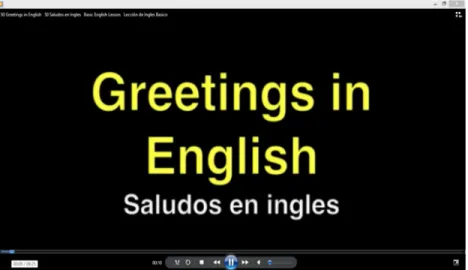
Illustration 9: Greetings
59
Illustration 10: Elaboration
60
Illustration 11: interactive resource. Cookware
61
Illustration 12: interactive resource vegetables and fruits
63
Illustration 13: Grouping
63
Illustration 14: Vegetables classification
64
Illustration 15: deduction
64
Illustration 16: video about fruits
65
Illustration 17: Cooperative strategies
65
Illustration 18: Present tense
Illustration 19: Guessing
67
Illustration 20: Foods
68
Illustration 21: days on the week
70
Illustration 22: Activities on vacation
72
Illustration 23: recognizing
73
Illustration 24: Cooperation strategy 74
Illustration 25: Offering a service
75
Illustration 26: video about service in restaurant
75
Illustration 27: Elaboration strategy
77 Illustration 28: translation strategy
77
Illustration 29: Repetition strategy
Illustration 30: Deduction strategy
78
Illustration 31: recognizing strategy
78 Illustration 32: question for clarification
79
Illustration 33: practicing strategy
79 Illustration 34: elaboration strategy
80 Illustration 35: substitution strategy
80 Illustration 36: affective strategy
80 Illustration 37: Cooperation strategy
PENÍNSULA OF SANTA ELENA STATE UNIVERSITY
FACULTY OF EDUCATION AND LANGUAGES
ENGLISH TEACHING CAREER
“INTERACTIVE STRATEGIES TO IMPROVE TOURISM SERVICES IN SAN PEDRO, SANTA ELENA, 2016”.
Author: Fulton Germán Ramírez Pozo. Advisor: Lcda. Sara González Reyes, MSc.
ABSTRACT
For decades tourism industry growth has been a major contributor to increased
economic activity throughout the U.S. and the world. It has created jobs in both
large and small communities and is a major industry in many places. It is the
dominant economic activity in some communities. Yet, the impacts of tourism to
a community are not widely understood – even where tourism is growing
dramatically and should be of the greatest interest or concern.
Most people think of tourism in terms of economic impacts, jobs, and taxes.
However, the range of impacts from tourism is broad and often influences areas
beyond those commonly associated with tourism. Leaders as well as residents
who understand the potential impacts of tourism can integrate this industry into
their community in the most positive way.
This research aims for getting communicative competence in listening and
speaking skills in English language through a course for tourism based in learning
interactive strategies as a alternative to better the service in restaurants to English
speaking people in the tourism area. This English course is focused according to
the needs of touristic service providers in restaurants (owners, helpers and cookers
in restaurants) because this proposal is consider as a resource to develop the
potential that they have according to the place where they live as a form of
Keywords: Language learning strategies, ESP for tourism, communicative competence, listening and speaking skills.
INTRODUCTION
Nowadays, English language is important around the world because it is used to
communicate with foreign people with different purposes for business, education
tourism and others. English is the most important language around the world. In
the tourism area is important the knowledge of English language because
speaking English people have the needs to know all the places that Ecuador can
give around the world.
The purpose of this investigation is to use learning interactive strategies as an ESP
for tourism to get communicative competence in listening and speaking skills
because these strategies will give to tourism service providers several new ways to
get English language according to their needs. This research paper is organized by
chapters and each one covers different aspects of this work.
Chapter I describe the problem statement, context of the problem, research
questions, rationale, research objective, idea to defend and scientific tasks.
Chapter II is about literature review, it contains philosophical basis, educational
basis and legal basis.
Chapter III is based on the research design, population and sample, data collection
(methods, techniques and research tools) and data analysis (qualitative or
Finally, Chapter IV is about the title, description (information data, design and
development of the proposal), achievement and results, conclusions and
recommendations, timetable, resources and references.
CHAPTER # 1 THE PROBLEM
1.1. PROBLEM STATEMENT
The foreign tourism has shown a high potential in the development of some
countries of the region, Ecuador is not an exception about this fact. According to
statistics from the newspaper “EL COMERCIO” published in September 30th,
2015 in the article “Siete datos claves sobre el desarrollo turístico de Ecuador”.
Thiscountry of the Latin American region has the highest growth rate of foreign
tourists since 2010, 48.7%. For that reason, the tourism industry has been
relevant in Ecuador in the last years and today, it is being considered one of the
most important sources of income in the country.
Sandra Naranjo (ex- Minister of Tourism): "Tourism became a national priority.
All the ministries have within their strategic lines the tourism. We see the results,
in arrivals Ecuador grew three times faster than the world average and twice as
fast as in the region. Locally, the government has taken real importance in the
tourism area, because they can see the average of incomes that receive for this
area.
Nowadays, the tourism industry has changed the expectance about the
transformation of the productive matrix of certain sectors of Ecuador. Foreign
tourists come to the country to know the Touristic alternatives that it can offer to
them. The main goal is that the tourism area will be considered as the first
alternative of development for the production in this country until 2018.
This reality should be interesting for Ecuadorian people for the opportunities that
they are not ready to receive foreign people, especially speaking English people,
who seek to know the benefits, as well as receive a good service. The problem is
because they do not use a correct language to transmit information according to
the service that they offer in their business.
The service that offers might be best, if tourism service providers could get
English language in order to communicate with speaking English people. Lots of
foreign people, especially speaking English people visit the regions for different
aspects. The wonderfulness of each region is one of these aspects. For example,
speaking English people like to know the beaches, the culture, traditions, sports
and delicious dishes of Coast Region. The service that tourism service providers
offer is fundamental for speaking English people, because they seek to enjoy the
accommodation in the region. For this reason, the service about using English
language might be an excellent complement in order to meet the needs of
speaking English people, if tourism service providers could communicate with
them in this language.
The service offered to speaking English people is not good because English
communication is inadequate in touristic places in Santa Elena province. The
reason is that tourism service providers misuse the language. Although, there are
programs focused to the learning of English language in each community of this
province. Therefore, tourism service providers need to use mimics, gesture to
transmit any information to speaking English people. As a consequence, speaking
English people do not feel completely satisfied for the service. In conclusion, the
use of English language in tourist service providers for communication will be
important for the improvement of service in touristic places in Santa Elena
province to speaking English people.
The programs that the province government of Santa Elena comes carrying in this
entire province have gotten an advance in different aspects of the services,
because they have the goal about the improvement of service. Especially courses
Nevertheless, this kind of courses does not guarantee the application of the
acquisition of knowledge in the real need of tourism service providers. Also, these
English courses are not focused in an ESP for tourism according to the necessity
of tourism service providers. As a consequence, tourism service providers have
not acquired listening and speaking skills in a basic level in English language for
communication with English speaking people with these courses.
As a conclusion of this, it is important the use of English language in touristic
places for communication with English speaking people. The problem is that
tourism service providers can not listen and speak with English speaking people,
because they misuse the language using another kind of communication as a
unique form to transmit any information.
1.2. CONTEXT OF THE PROBLEM
The service that is offered to English speaking people is not well because English
communication is not appropriated in touristic places in Santa Elena Province.
The reason is that tourist service providers misuse the language; they are using
other inappropriate kind of language, such as gesture, mimics and even Spanish
language. Although, there are programs focused to the learning of English
language in each community of this province. Therefore, English speaking people
do not feel completely satisfied about the service.
The lacking of communication of touristic service providers at restaurants in San
Pedro Playita Linda is due to the following causes: General Courses to get English
language, Poor knowledge of English language, Courses focused in 4 skills of
English language.
General Courses to get English language is not appropriated to their needs
because they do not learn English for using in their jobs, although they want to
priority to focus in an English language that they can use constantly and therefore
they have the needs to use in their lifetime.
Another cause for what Tourist service providers have poor knowledge of English
language because they do not have training in listening and speaking skills.
Although, they believe that English language is important for the improvement of
the tourism in the area, they do not have competence in English language. It is
they don’t have any way to learn listening and speaking skills.
Finally, the development courses in the community of San Pedro are focused in
the 4 skills of English language, which do not permit to get a certain skill, it
means touristic service providers learn a lot of things but there is not real
knowledge of specific skills such as listening and speaking English language.
The problem takes place in the communities from Santa Elena in where the
tourism service providers give many services to English speaking people in
tourism industry. So, English speakers come to these places to enjoy of the several
touristic services such as the visiting of natural resources, to know the culture of
each place, the practicing of a certain sports and enjoy the services.
The choosing place is San Pedro community located in Santa Elena Province,
where the learning of English language developed a program executed for the
provincial government of Santa Elena. The problem radiates in the way of
communication for English speakers. It is not good, because many times, tourism
service providers use mimics, gestures, and signs to transmit any idea to English
speakers, when they want to offer any service. The tourism service providers
cannot offer traditional dishes in restaurants, the services of extreme sports, the
selling of beverage, juices or the promotion of anything using English language.
The English language should be developed for the needs of the touristic spaces,
where it can see the amount interest for improving the services. This kind of
communication does not give a good perspective of foreign people and to get that
communication using English language of the owners of restaurants does not
permit that foreign people.
This research is focused on tourism service providers in restaurants of the
Asociación de Cabañeros San Pedro “Playita Linda”. The Prefectura of Santa
Elena offered an English course, but they have attended to an English course
offered by the Prefectura of Santa Elena, but only 25% of them attended this
course. This means, just 10 people attended this course. They could receive the
English book and the classes during 3 weeks. According to the research they
remembered only a few words in English; the pronunciation was not well; they
answer three words of fifteen words, which has shown that the course was not
successful. In other hand, the other 75% of tourism service providers in
restaurants, who did not attend to this course, know nothing of English language.
1.2.1 PROBLEM TREE
PROCESS PEOPLE MATERIAL
ENVIRONMENT
Lacking of communication in English language in touristic service providers at restaurants of Asociación de Cabañeros San Pedro Playita Linda.
Courses focused in 4 skills of English language Poor knowledge of English
language General Courses to get
English language English course are not according to the needs of job
There is not application of knowledge
Providers do not have training in listening and
speaking skill
There is not the development of the language Lacking of competence in
English language
They do not get specific skills to communicate
Community is visited to English speaking people
1.3 RESEARCH QUESTIONS
Why is communication with speaking English people in San Pedro community
important for good tourism service?
Why do tourism service providers in San Pedro community consider necessary to
get the English language?
How do touristic service providers in San Pedro community communicate with
speaking English people?
How can touristic service providers in San Pedro community improve the services
in the tourism industry?
1.4 RATIONALE
The main reason to undertake this research is that tourism service providers, who
offer service in restaurants, will have possibilities to get speaking and listening
skills of English language in a basic level (A1) as the appropriate way to
communicate with English speaking people for giving a good service in this
tourism area.
The benefits of this research will be to get the English speaking and listening
skills in a basic level (A1) of English language in tourism service providers for
giving a good service in tourism industry. And so, the tourism service providers
can transmit ideas in English language to express their feeling, emotions, opinions
and suggestions in a tourism activity focused in restaurants. Another benefit will
be satisfaction of speaking English people because they will feel well and
comfortable talking with tourism service providers using English language for
giving and receiving any information, suggestions, and so on.
The direct beneficiaries would be English speaking people, because they might
receive a service in a restaurant using their native language, not exactly a fluency
language but they might understand what tourism service providers offer to them, Properly to get competence in
and they may request any dish on the menu. Also, they will feel good
communicating with tourism service providers.
Other direct beneficiaries would be tourism service providers, who offer service in
restaurants, because they will be able to attract more international tourism, so they
need of this touristic activity. Therefore, they would get speaking and listening
skills of English language in a basic level (A1) for giving a good service to
English speaking people. This is, tourism service providers might give any
information using English language in order to communicate with speaking
English people. Some information such as: greetings, ingredients, menu,
suggestions, etc.
Other indirect beneficiaries are the tourism service providers´ children and
helpers, who will have opportunities to practice speaking and listening skills
during the process because they might be participants of this proposal.
1.5 RESEARCH OBJECTIVE
To improve English listening and speaking skills through interactive strategies to
the touristic service providers at Asociación de Cabañeros San Pedro Playita
Linda in San Pedro community.
1.6. IDEA TO DEFEND
The application of learning strategies will help to develop listening and speaking
skills in touristic service providers.
1.7. SCIENTIFIC TASKS
To identify the main researches and theories related to the topic.
To determine the methodology applied for the development of this
To determine the interactive strategies to be applied for developing
listening and speaking skills in English Language.
CHAPTER II: THEORETICAL BASIS 2.1 PHILOSOPHICAL BASIS
2.1.1. Plato´s philosophy
This philosophy argued that the pure knowledge is gotten through experiences of
certain aspect of the life as a form to use the reason and the appropriate resources
that people can apply in the knowledge of anything as a form of overcoming in
their daily activities.
Plato uses unassisted reason to gain “pure knowledge,” and thus is considered a
rationalist (Blackburn, 1996, p. 381). We offer this example as helpful for
experiential educators, because we need to consider: the limits of what can be
known experientially; and appropriate learning strategies for educating
complexities inaccessible to experience (see Higgins, in press, pp.7-9).
According to Plato the reality is always changing – knowledge of reality is
individual, it is particular, it is knowledge only to the individual knower, and it is
not universal. Plato argued that societies are invariably formed for a particular
purpose. Individual human beings are not self-sufficient; no one working alone
can acquire all of the genuine necessities of life. In order to resolve this difficulty,
we gather together into communities for the mutual achievement of our common
goals. This succeeds because we can work more efficiently if each of us
specializes in the practice of a specific craft:
Plato wanted motivation and interest in learning. He was against the use of force
in education. "Knowledge which is acquired under compulsion obtains no hold on
2.1.2 Vygotsky theory
The acquisition of language is possible when people have an interaction behavior
in society, as this contributes to the development of thought so that thought
acquires knowledge in the face of a particular need. This means that learners can
acquire a language when they are willing to develop it without being immersed in
a school classroom.
Therefore, Vygotsky focused on the connections between people and the cultural
context in which they act and interact in shared experiences (Crawford, 1996).
According to Vygotsky, humans use tools that develop from a culture, such as
speech and writing, to mediate their social environments. Initially children
develop these tools to serve solely as social functions, ways to communicate
needs.
The development of language is due to the need that people can have in a
determinate situation according to the environment and the possibility to get a
communication, so for that reason the connection is fundamental between people
and cultural context to get a language in order to interact with other people.
Socio cultural is a theory about the development of human cognitive and higher
mental function. The theory specially emphasizes the integration of social,
cultural and biological elements in learning processes and stresses the
socio-cultural circumstances’ central role in human’s cognitive development. Lantolf
and Thorne point out: “Learning is embedded within social events and occurring
as an individual interacts with people, objects, and events in the environment”.
2.2 EDUCATIONAL BASIS 2.2.1. English for specific purposes
The definition of ESP can be several for many authors, although the goal is taken
communicate with speaking English people in order to develop their jobs. Mackay
and Mountford (1978: 2).
The needs analysis is fundamental to determine the kind of skills that touristic
service providers need in order to develop English language and so it is possible
to focus the application of these skills to their occupations as the service in
restaurants.
2.2.2.1 The Importance of English for specific purposes
The most important difference lies in the learners and their purposes for learning
English.
Lorenzo (2005) stated that “ESP students are usually adults who already have
some acquaintance with English and are learning the language in order to
communicate a set of professional skills and to perform particular job-related
functions” (para. 1).
According to Lorenzo, touristic service providers know the importance of English
language and the advantages that it can give them if they might communicate in
this language. They are awareness that they need to use this language for their job
with the goal to permit to get the overcoming in tourism area.
An ESP program is therefore built on an assessment of purposes and needs and the functions for which English is required. In ESP, it is a needs analysis that
determines which language skills are most needed by the learners, and the
syllabus is designed accordingly. An ESP program, might, for example,
emphasize the development of reading skills in students who are preparing for
graduate work in business administration; or it might promote the development of
spoken skills in students who are studying English in order to become tourist
guides. According to this, the touristic service providers need to get listening and
2.2.2.2 Absolute characteristics and variable characteristics of ESP.
Strevens (1988) makes a distinction between absolute characteristics and variable
characteristics of ESP. The absolute characteristics are that ESP courses are:
Designed to meet the specific needs of the learner;
Related in content to particular disciplines or occupations;
Centered on language specific to those disciplines or occupations;
In contrast to General English.
The variable characteristics are that courses may:
Be restricted in the skills to be learned;
Not be taught according to a particular methodology.
Robinson (1991) also suggests two absolute criteria for defining ESP courses. The
first is that ESP programs are normally goal-oriented. The second is that they
derive from a needs analysis. The needs analysis will state as accurately as
possible what the learners will have to do when speaking the language.
2.2.2.3 Objectives in Teaching ESP
The main aims of the teaching and learning process is to enable the learners to
acquire information in its general sense. Concerning ESP Basturkmen (2006: 133)
states the existence of five broad objectives, which are also applied to ELP, on
which specific teaching process is based and should be reached.
2.2.2.4 Approaches to ESP
English specific purposes (ESP) might use some approaches in order to get the
knowledge in listening and speaking skills. The following approaches are
Skills-Based Approach
Skills-Based Approach is a methodology centered on the development of a skill
set throughout a lifetime. There are ways users can create their own ‘learning
plans’ within the application. It is possible to merge traditional learning programs
with newer ones based on acquiring skill competencies.
Material developers take the skills priorities of the students into account to create
appropriate ESP teaching materials. In Keith Morrow’s (1977: 13-14) words, ESP
learners are required to use ESP materials which employ the same skills and
strategies as would be required in the target situation.
Discourse Analysis Approach
The Discourse-Analysis Approach has tended to concentrate on “how sentences
are used in the performance of acts of communication” and to generate materials
based on functions.
Fred Chambers defines the latter as follows:
“By the language I mean the language of the target situation. Thus, Needs
Analysis should be concerned primarily with the establishment of communicative
needs and their realizations, resulting from an analysis of the communication in
the Target Situation – what I will refer to from now on as Target Situation
Analysis” (TSA) (1980: 29-30).
The conception of pedagogic Needs Analysis came to set off Target–Situation
Needs Analysis. The forms of Needs Analysis should be seen as complementing
Target- Situation Needs Analysis, rather than being alternatives. This includes
three types of analyses:
a. Deficiency Analysis;
b. Strategy Analysis; and,
Deficiency Analysis gives information about what the learners’ learning needs are
i.e., and in which of their target-situation needs the learners are lacking or feel that
they lacking. This view of needs analysis gains momentum when one considers
the point that the question of priorities is ignored by standard needs analysis. In
discussing learners’ perceptions of their needs, deficiency analysis takes into
account ‘lacks’ and ‘wants’, as well as objective needs of the learners (1982).
Strategy Analysis seeks to establish how the learners wish to learn rather than
what they need to learn. By investigating the learners’ preferred learning styles
and strategies, the Strategy Analysis provides a picture of the learner’s conception
of learning.
Means Analysis, on the other hand, investigates precisely those considerations
that John Munby excluded. These relate to the educational environment in which
the ESP course is to take place (1989: 79-90).
Learning centered approach
Hutchinson and Water (1987: 14) emphasize on the importance of a learning
approach that is more effective to ESP unlike the traditional trends which focus on
what people usually do with the language. They also state that everything within
the teaching environment should aim at helping learners meet goals by using their
own learning strategies; learners have to be involved in the making of curricula
from the beginning.
Communicative Approach
The recent approach that emerges from the concept of authenticity in the
development of ESP is that of Communicative Approach. Today most of ESP
programs focus on developing communicative competence in specific fields such
as aviation, business, tourism, technology etc.
The communicative approach is a philosophy, which is focused on obtaining
communicative competence, that is, learners should achieve to get skills (speaking
situation in order to give them a god services. Widdowson (1989), believe that
learners need knowledge of the language as well as the ability to use this
knowledge in real-life situations.
Communicative approach has been designed "to provide learners with
opportunities for communicating in the second language" (Ellis, 1993, p. 91).it is
the chance to interact to get the goal of communicative approach is to develop
what Hymes (1972) referred to as communicative competence.
Hymes’ theory of communicative competence was a definition of what a speaker
needs to know in order to be communicatively competent in a speech community.
In addition, Hymes held that linguistic theory needed to be seen as part of a more
general theory incorporating communication and culture. In other words,
communicative competence considers language as a tool used for communication.
Not only does this competence aim to focus on the development of four language
skills, but it also depends on the correlation between the skills.
A central aspect in Communicative Language Teaching is communicative
competence. Hymes defines competence as what a speaker needs to know in order
to be communicatively competent in a speech community. This includes both
knowledge and ability for language use. In his book Teaching Language as
Communication (1978) (quoted in Richards, Rodgers 1986: 71) Widdowson
presented a view of the relationship between linguistic systems and their
communicative values in text and discourse.
2.2.2 COMMUNICATIVE COMPETENCE
According to Pulido (2004) “it is the ability of the learner to learn a language to
express, interpret and negotiate sociocultural meanings in the interaction between
two or more persons or between a person and an oral or written texts, so that the
communication process is efficient and is qualified by appropriate modes of
According to Jack C. Richards “communicative competence is an important
dimension of language learning, it is clearly not all that is involved in learning a
language since one can master the rules of sentence formation in a language and
still not be very successful at being able to use the language for meaningful
communication.
Andrew Cohen “Adult learners may have a keen sense of just what it is they may
need to commit to memory and what they can leave to more automatized language
learning, often referred to as acquisition.
“Communicative competence is the ability to use language to convey and
interpret meaning” by Hymes (1972). Communicative competence suggests an
adequate level of communication skills to function within the environment; it does
not imply total master of the art of communication. Naiman, Frohlich, Stern and
Todesco (1978) have argued that total mastery of a language is rarely, if ever
achieved, even by native speakers.
it was later divided by Canale and Swain (1980) into four separate components:
grammatical competence (which relates to the learner’s knowledge of the
vocabulary, phonology and rules of the language), discourse competence (which
relates to the learner’s ability to connect utterances into a meaningful whole),
sociolinguistic competence (which relates to the learner’s ability to use language
appropriately) and strategic competence (which relates to a learner’s ability to
employ strategies to compensate for imperfect knowledge).
Littlewood (1981) stresses the need to give learners extensive opportunities to use
the target language for real communicative purposes, and believes that the ability
to communicate effectively is more important than perfect mastery. So, tourism
service providers can receive an ESP design for tourism with certain situations to
2.2.3 LISTENING AND SPEAKING SKILLS
Chamot (1981) argued "To develop classroom speaking skills, children need
opportunities to participate in small group discussion, to present oral reports, and
to respond adequately to teacher questioning..."
"The skills of listening comprehension and pronunciation are interdependent. If
they cannot hear well, they are cut off from language. If they cannot be
understood easily, they are cut off from conversation with native speakers." For
this reason is important to get a good level in speaking skill in English language.
2.2.4 WHAT IS STRATEGY?
A strategy is a set of procedures aimed at a specific objective: meaningful
learning, It is conscious and intentional, requires planning and execution control
and select resources and techniques.
A strategy is focused to the application of these procedures to get a specific goal,
in many aspects; it can be in Education, in the industry, etc. In the case of this
project: the learning of English language through the application of learning
Interactive strategies that permit the communication between tourism service
providers and English speaking people.
2.2.4.1 Kind of strategies
The strategies can be: of teaching and of learning.
Teaching strategies are experiences or conditions that the teacher creates
to bring on the student´s learning.
Learning strategies are procedures (set of actions) that the learners get and
use in an intentional way to learn significantly and resolve problems and
This proposal is going to use learning strategies as procedures to get learners
acquire the communicative competence in listening and speaking skills in English
language.
2.2.4.2 Theories of foreign language learning strategies There are some definitions about language learning strategies:
Tarone (1983) defined learning strategies of second language as “an intention for
developing the linguistic and socio- linguistic competence in a target language to
incorporate it in inter-lingual competence”.
For Rubin (1987), the learning strategies are “Strategies that contribute to the
development of the language system that the learning construct and affect directly
the learning.
O`Malley and Chamot (1990) define the strategies as “Special thoughts or
behaviors that the people use to help themselves to appropriate, learn or hold new
information.
Finally, Rebecca Oxford mentions language learning strategies as: “specific
actions, behaviours, steps, or techniques that students (often intentionally) use to
improve their progress in developing L2 skills. These strategies can facilitate the
internalization, storage, retrieval, or use of the new language. Strategies are tools
for the self-directed involvement necessary for developing communicative ability.
(Oxford, 1992/1993, p. 18)
According to the Rebecca Oxford`s definition, the learning strategies have to
develop in learners the communicative competence of a second language, so these
strategies are given for learners for getting an active role and responsibility in the
learning of a second language. (Oxford, 1990) defines language learning strategies
as “specific actions taken by the learner to make learning easier, faster, more
enjoyable, more self-directed, more effective, and more transferable to new
2.2.4.3 Foreign and second language learning strategies
According to Macintyre (1994) establish that “one of the more fertile areas of
research in the learning of language, in recent years is the topic of language
learning strategies”.
There has also been a suggestion that there is a positive relationship between
Language Learning Strategies and communicative competence (Stern, 1992;
Lessard- Clouston, 1997 and Oxford, 1990).
2.2.4.4 General features of language learning strategies
The general features of language learning strategies, according to Oxford, are the
following (1990:9-13):
1. Contribute to the main goal: communicative competence. For example,
cognitive strategies help learners to regulate their cognition and to focus, plan and
evaluate their progress. Affective strategies develop self-confidence and
perseverance needed to become involved in language learning situations. Social
strategies increase interaction and empathy in communication.
2. Allow learners to become more self-directed. Learners do not need to have
the teacher around to guide them all the time. They are trained to rely more on
themselves and be more responsible for their learning. They are expected to gain
more confidence, involvement and proficiency.
3. Expand the role of teachers. The traditional roles of teachers as authority
figures, managers and directors of learning, leaders, controllers and evaluators are
changed into a new direction to leave space to a new teacher who acts as
facilitator, helper, guide, consultant, adviser and co-communicator.
4. Are problem-oriented. Learning strategies are tools which are used because
5. Are specific actions taken by the learners. Learning strategies are specific
actions or behaviors accomplished by the students to enhance their learning.
Examples of these actions are: taking notes, planning for a language task,
self-evaluating, etc.
6. Involve many aspects of the learner, not just the cognitive. Learning
strategies are not restricted to cognitive functions. They also include
metacognitive functions like planning, evaluating, and arranging one’s own
learning, and emotional and affective functions as well.
7. Support learning both directly and indirectly. Some Learning strategies
involve direct learning, but others like metacognitive, social or affective strategies
have an indirect effect.
8. Are not always observable. Some Learning strategies are not observable to
the human eye. For example, the act of making mental associations cannot be
seen. So, we need the learner’s cooperation to explore the non-observable
Learning strategies.
9. Are often conscious. Learning strategies are often conscious, but as Oxford
suggests, after a certain amount of practice and use they may act in an automatic
or subconscious way.
10. Can be taught. Another important hypothesis stated by Oxford is that
Learning strategies are easy to teach and modify through strategy training. This
training is most effective when students learn why and when specific strategies
are important, how to use these strategies and how to transfer them to new
situations.
11. Are flexible. Learning strategies are not always found in predictable
sequences. There is a great deal of individuality in the way learners choose,
12. Are influenced by a variety of factors. Many factors affect the choice of
strategies: degree of awareness, stage of leaning, teacher expectations, age, sex,
general learning style, personality traits, motivation level, etc.
2.2.4.5 CONTENT OF LEARNING STRATEGIES
Griffiths (2008) mention that two approaches are therefore recommended to
counter the criticisms levelled at the use of pre-existing instruments:
• adaptation according to the needs of the particular learners, situations, goals and research purpose; and
• construction of a new instrument specifically designed to accommodate the unique characteristics of the situated target research population.
2.2.4.6 CATEGORIZATION OF LANGUAGE STRATEGIES
Oxford (1990) refined the categories to eliminate overlap and encourage greater
theoretical cohesion, resulting in four strategy categories: cognitive, affective,
sociocultural-interactive. This proposal is going to focus in cognitive, affective
and sociocultural strategies, so it is properly to apply on the resource to get direct
action with the material.
2.2.5 COGNITIVE STRATEGIES
Cognitive strategies involve interacting with the material to be learned,
manipulating the material mentally or physically, or applying a specific technique
to a learning task.
People can use this kind of strategies in a course design for tourism because they
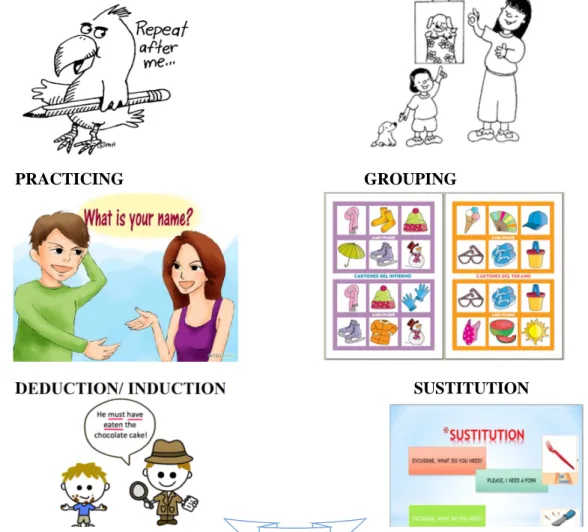
2.2.5.1 Kind of cognitive strategies
This kind of strategies involves interacting and materials to be learned:
1. Imagery. Learners listen to the sound to relate with the needs.
2. Repeating: Imitating a language model, including overt practice and silent
rehearsal. The listening carefully and repeat meaningful words and phrases
to yourself.
3. Recognizing: the use of patterns or formulas like greetings can help
learners to get communicative competence.
4. Practicing: the participation in a real situation in which learners can apply
their language in a natural way and the constantly practicing might help to
get listening and speaking fluency.
5. Grouping: Ordering, classifying or labeling material used in a language
task based on common attributes. Activities focusing on the development
of grouping can vary from simple activities - where learners are given a set
of words from various topics and their task is to put these words to certain
categories.
6. Deduction/ induction: Consciously applying learned or self- developed
rules to produce or understand the target language.
7. Substitution: selecting alternative approaches revised plan or different
words or phrases to accomplish a language task.
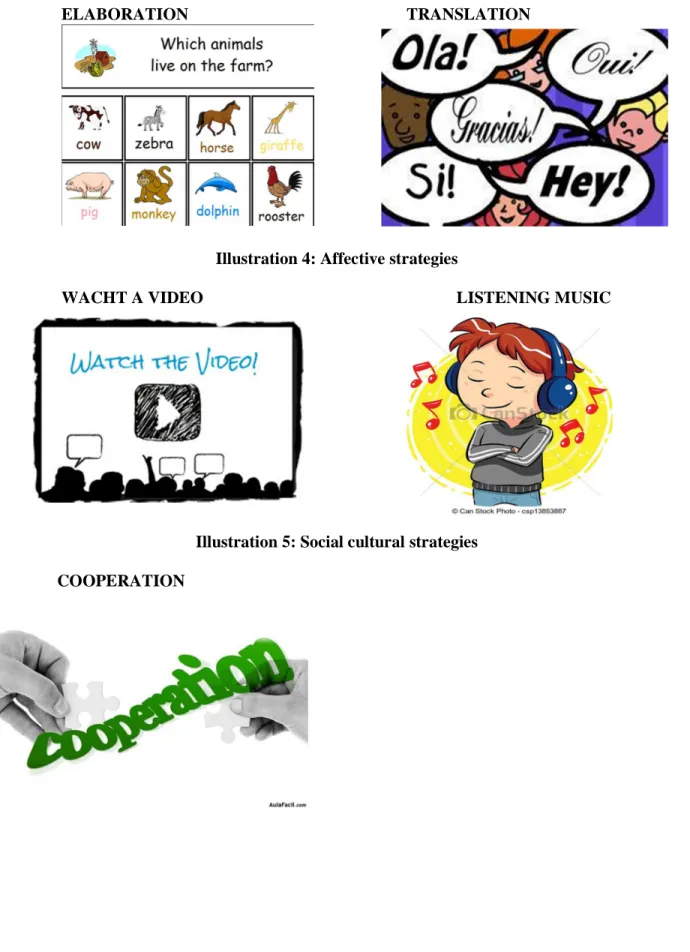
8. Elaboration: relating new information to prior knowledge. This strategy
guides learners to make connections which might be personally relevant
for them, e.g. based on their prior knowledge or experience, or it might be
an original solution to a problem.
9. Translation: rendering ideas from one language to another in a certain
2.2.5.2 Affective and social cultural strategies
Learning strategies involve interacting with another person to assist learning or
using affective control to assist a learning task.
Questioning for clarification: Asking for explanation, verification,
rephrasing or examples about the material; asking for clarification or
verification about the task.
Cooperation: working together with peers to solve problem, information,
check the learning task, model a language activities, or get feedback on
oral or listening performance.
Self-task: reducing anxiety by using mental techniques that make one feel
competent to do learning task.
Self-reinforcement: providing personal motivation by arranging rewards
for one when a language learning activity has been successfully
completed.
2.2.6 The importance of tourism to a Destination's Economy
Tourism is one of the most complex industries in the world, involving, in its
activity, the entire society. At the same time, tourism reflects society as a whole
and can be considered a defining component of modern civilization. (Ionescu,
2000)
Tourism represents, in the context of contemporary civilization, through its
content and its role, a distinct area of activity, and a segment of essential
importance in the economic and social life of the majority of countries in the
world.
2.2.6.1 Benefits of tourism
Economically speaking, the tourist is a goods consumer and a services
beneficiary. Tourism can support the economic development of both local
foreign visitors.
A major benefit of tourism in stimulating economic growth is represented by the
increase in the number of available jobs in that tourist destination, both directly
and indirectly, within the companies which provide services necessary for tourists.
One of the most visible benefits of tourist activities within a destination is
represented by the jobs involved in the direct administration of hotels,
restaurants, stores and transportation.
Tourism also boosts the export of local products. It is estimated that 15-20% of
the total tourist expenditure is spent for gifts, clothing, and souvenirs. The extent
to which these products are made in the destination area directly affects the local
economy.
2.2.6.2 Touristic service
The touristic service is the set of activities, which are different among them, but
they are closely related, because they operate in a coordinated and harmonious
manner in order to meet the service demands raised by the socio- economic
composition of a particular tourist flow.
2.2.6.3 Types of services Accommodation
Location of a facility that provides space for the night, may also offer
complementary services.
Attractions
It is a crucial element in the tourist motivation to travel, and generally the influx
of tourists to a places generate related economic activity such as hotels,
and development of infrastructure for access and enjoyment of the touristic
attraction.
Supplementary
Set of services not included in the main activity that provides tourist
accommodation. Complementary services are those which as its name implies,
complement the needs of tourists in any area.
Restaurants
A restaurant is a business in most cases, where the public pays for the food and
drink for consumption on the premises.
The application of this research should be focused in the service of restaurant,
although, it is fundamental to apply the research in all touristic service.
2.2.6 English language for tourism
Willy Brantdt, a former German Chancellor commented “If I am selling to you, I
speak your language”. It means that people cannot comprehend what someone
else demands if people cannot converse to other people in their own terms. This
mentions that English language creates greater interest among people who need
this language to offer any service.
2.2.6.1 Role of English language for tourism
The role of English language is important for tourism industry as a means to
communicate, negotiate, and execute transactions with tourists by tourism
employees. Tourism service providers have the needs to get communicative
competence about listening and speaking skills in English language in relationship
2.2.7 PROGRAMS TO DEVELOP INTERACTIVE RESOURCE 2.2.7.1 Visual study.net 2010
Microsoft visual study is an environment of integrated development (IDE) to
operative systems Window. It supports multiples program language such as C++,
C#, visual basic. Net, F#, java, Python, Ruby, PHP; like web development
environments such ASP.NET MVC, Django.
Visual study provides a dizzying array of editors, controls, designers and
supporting tools for developing software; it permits to the developers to create
applications, sites and web applications, so as web services in any virtual
environment that support the platform. NET. So you can create applications that it
can communicate between workstations, web sites, mobile devices, consoles.
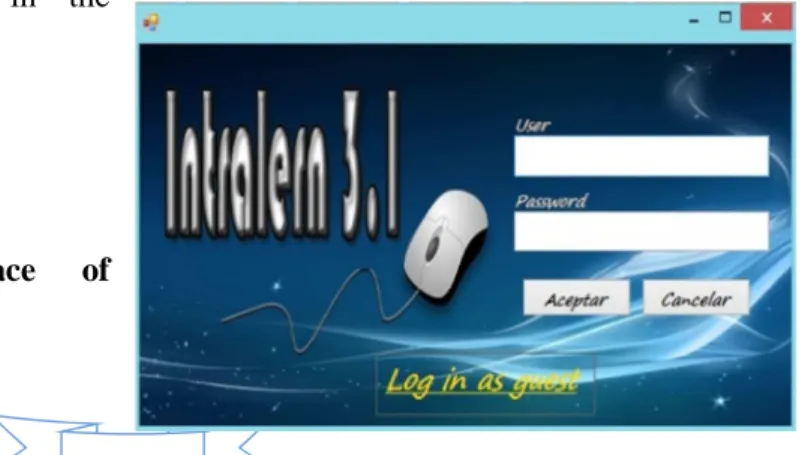
The interactive resource is made in the first stage with the application of
programming language called visual study. Net 2010, which it is possible to made
desk platform, web platform and this use interfaces to form a net friend work
(system). In this proposal the use of a desk platform is going to be useful for
users, who do not have the possibility to use the web (internet) as a resource to
learn English language. One of the features of this software is that this can be
connected directly the database with the application through a database
programming MSQL for OBDC, so, it is possible to connect to the application.
Another feature is that visualstudy.net 2010 offers an dynamic environment,
some more dynamic, that is, more events or actions that it made, for example
the sounds, box text, events can be produced in each action, each time that the
programmer going to the database.
2.2.7.2 MySQL
It is a free version of motor of database, in which the user designs a database. It
can be connected directly with the visualstudy.net 2010 with the use of a
users can make a table: questions bank, vocabulary in the database and
automatically the information appear in the interface in visual study.net 2010.
2.3 LEGAL BASIS
This research is based in the article 2 about the principles from the organic law of
inter- cultural education. It is also focused in the objectives (3- 4- 10) of “National
Plan of good living regimen” in the 10th about the production of the productive
matrix. It is priority to mention the tittle I of generalities, chapter I, and article 4
from the organic law of tourism; which is based in tourism. Finally, it was
collected data in “design strategic plan for sustainable tourism development
Ecuador Plandetour 2020”.
Nowadays, the intention of the government of Ecuador is to get students can
communicate in a basic level of English language in the elemental education, for
that, there are variety of politician norms in order to people can develop the
English skills, although, it is not just students need to learn English language, all
people need to get those skills to develop the environment with citizen formation,
how is pointed out in the organic law of inter- cultural education, before
mentioned. In the same way, in the guideline about the change and develop of the
productive matrix, which mention “the citizen is essential part, and for that it is
required the development of abilities and skills in different leadings axis in where
it is mentioned the TOURISM”.
This change of the productive matrix respond to the regulatory “National Plan of
good living regimen” in the goals (3- 4- 10) where it can be summarized
“Improving the quality of provision of care services in different areas such as
tourism, could be run through the learning of a foreign language like English
language under international standards to boost tourism as a priority sector
through generation of technical capabilities within the framework of collective
The Ecuadorian State should follow the goal of promoting the technic and
professional training of people, who give a service in tourism area. And it can be
mentioned the goals of Plandetour 2020, is to create the conditions in order to that
the tourism will be an axis in Ecuadorian economic that looks for improving the
life quality of population and the satisfaction of the touristic demand.
It is essential to mention that Ecuador is changing certain conditions in order to
generate goods and services quality. such changing is contemplated in the
productive matrix, which is the set of interactions among the different actors of
the society that use the resources that are available, and the objective is to
generate production process. In the process are included the products, the
productive process and social relations resulting from these process.
Ecuador has taken importance to the social actors into the productivity, as a
fundamental axis in the generation of innovation, investment, employ, production,
etc. therefore, it has considered applying a new productive matrix focused to the
use of the capacities and the knowledge of the population.
It is true that, the country had had a productive matrix before, which was based in
the exploitation of the resources like the petroleum; but due to the competence of
another countries and the globalization of the technology, the country can`t
maintain the before productive matrix, so it was necessary to transform it with a
productive matrix based in the diversified production, and services based in the
knowledge economy and diversity.
The project about the transformation of the productive matrix has the main axis:
“Promotion of the exploitation of new products, particularly from the popular
economy or greater added value including fresh and processed food, apparel,
2.6. HYPOTHESIS
The application of Learning Interactive Strategies will improve the competence in
listening and speaking skills of English Language to the tourism service providers
in order to communicate with English.
2.7. VARIABLES OF THE STUDY Dependent Variable:
Tourism service.
CHAPTER III RESEARCH METHODS 3.1RESEARCH DESIGN
The methodology that will be applied is the Quali- Quantitative, so it´s
fundamental to study groups in a community for the analysis of the behavior,
which will give us a reasonable explanation, as also the solution to the problem;
similarly carried out the collection of information, so when there isn´t enough
information and the process is not clear, it is useful to get this with experience and
so it has a subjective idea about the problem.
This process mentions the collection of information about the level of knowledge
of English from the touristic service providers, who offer a service from San
Pedro community in Santa Elena Province; in turn allows that the researcher can
analyze the real level and the need of English language through a survey to the
principal authors (touristic service providers), which will give a real information
about the need of learning English.
Another of the method to use is the deductive- inductive because it is so important
to begin from the particular (effect) until the general (cause); the problem is the
lacking of resources to get communicative competence in listening and speaking
skills in English language for the touristic service providers, who offer a service in
San Pedro community in Santa Elena Province (effects) and its causes are which
through the research is going to resolve this problem, giving as a solution: the
application of interactive strategies to get a communicative competence in
listening and speaking skills in English language.
It is considered to apply the historical-logical methodology because it is
paramount to mention and elaborate an research about information of the San
Pedro Community such as location, geography, quantity of population who are
dedicated to the tourism, history of the Community, with the objective of apply