
Reflecting teaching strategies: An approach to enrich the english teaching professional practice
82
0
0
Texto completo
(2) REFLECTING TEACHING STRATEGIES: AN APPROACH TO ENRICH THE ENGLISH TEACHING PROFESSIONAL PRACTICE. Marian OLAYA. Research Report submitted in partial fulfillment of the requirements for the degree of Master in English Language Teaching for Self-directed Learning. Directed by Claudia ACERO RIOS. Department of Foreign Languages and Cultures Universidad de La Sabana Chía, Colombia Abril 2016.
(3) Running Head: REFLECTING TEACHING: AN APPROACH TO ENRICH THE ENGLISH TEACHING PROFESSIONAL PRACTIE. Declaration I hereby declare that my research report entitled: Reflecting Teaching Strategies: An Approach to Enrich the English Teaching Professional Practice . Is the result of work done individually as declared and specified in the text;. . Is neither substantially the same as nor contains substantial portions of any similar work submitted or that is being concurrently submitted for any degree or diploma or other qualification at the Universidad de La Sabana or any other university or similar institution except as declared and specified in the text;. . Complies with the word limits and other requirements stipulated by the Research Subcommittee of the Department of Foreign Languages and Cultures;. . Has been submitted by or on the required submission date.. Date: April. 2016. Full Names: Marian Lissett Olaya Mesa. Signature:. ii.
(4) Running Head: REFLECTING TEACHING: AN APPROACH TO ENRICH THE ENGLISH TEACHING PROFESSIONAL PRACTIE. Acknowledgements. I am really grateful with my English teachers who guided me along the way. I should also like to express my particular gratitude to my family who made me strong along the way to make this project possible Finally, I would like to thank to my research advisor Claudia Acero for giving me invaluable feedback and who has given me support and constructive criticism in the process of making this project, and for her unfailing patience.. iii.
(5) Running Head: REFLECTING TEACHING: AN APPROACH TO ENRICH THE ENGLISH TEACHING PROFESSIONAL PRACTIE. Abstract Reflecting Teaching Strategies: An Approach to Enrich the English Teaching Professional Practice is an exploratory study which considered studies on the field from 2008 until 2016. The study provides an overview and exploration of twenty three reflective teaching national and international research reports. The purpose of this study is to determine the extent that reflective teaching could become a strategy for language teaching professional development. Based on content analysis four main topics emerged: 1) reflective teaching as an approach to improve English teaching professional practices, 2) strategies that facilitate the achievement of Reflective Teaching, 3) reflection to enhance language teaching education and 4) in-service teacher training to facilitate reflection. Results indicated that reflective teaching as an alternative to raise awareness about English language teaching, and as a means to encourage teachers to open their minds, update their teaching methodologies and make adjustments to their lessons. The findings highlight significant improvements of development of professional practices through the implementation of reflective teaching strategies as a daily process. When reflection becomes habitual, crucial changes are perceived not only within the academic community, but especially in the classroom. Additionally, based on the findings, a reflective teaching protocol is proposed in order to promote reflective teaching. Finally, some implications for further research are also discussed.. Key words and expressions: Reflective Teaching (RT), Reflective Teaching Strategies (RTS), English teaching professional practices (ETPC), professional development. iv.
(6) Running Head: REFLECTING TEACHING: AN APPROACH TO ENRICH THE ENGLISH TEACHING PROFESSIONAL PRACTIE. Resumen Reflecting Teaching Strategies: An Approach to Enrich the English Teaching Professional Practice es un estudio exploratorio que tuvo en cuenta estudios realizados entre 2008 y 2016. El interés principal de este estudio es explorar la enseñanza reflexiva para contribuir con el mejoramiento de las prácticas profesionales de los profesores de inglés. Este estudio exploratorio se centra en la identificación y explicación de las estrategias de enseñanza reflexiva y la comprensión de veintitrés informes de investigación llevados a cabo en ámbitos nacionales e internacionales. Basado en un análisis de contenido cuatro áreas de exploración emergieron: 1) las contribuciones y los usos de la enseñanza reflexiva como enfoque, 2) las estrategias que pueden facilitar el logro de la enseñanza reflexiva, 3) la reflexión como oportunidad de mejoramiento profesional y 4) el entrenamiento de profesores en prácticas reflexivas.. Los. resultados indicaron que la enseñanza reflexiva parecía ser la mejor alternativa para crear conciencia y como un medio para animar a los profesores a abrir sus mentes, actualizar sus metodologías de enseñanza y hacer ajustes a sus lecciones. Estos resultados destacan la importancia de un enriquecimiento de las prácticas profesionales a través de la implementación de estrategias de enseñanza reflexiva como un proceso diario, que cuando se convierte en un hábito, cambios importantes se dan no son sólo dentro de la comunidad académica, sino sobre todo en las aulas. Adicionalmente, se propone un protocolo para promover la reflexión en la enseñanza. Finalmente, algunas implicaciones sobre posibles oportunidades de investigación se presentan.. v.
(7) Running Head: REFLECTING TEACHING: AN APPROACH TO ENRICH THE ENGLISH TEACHING PROFESSIONAL PRACTIE. Palabras claves y expresiones: enseñanza reflexiva (RT, por sus siglas en Inglés), estrategias de enseñanza reflexiva (RTS, por sus siglas en Inglés), Prácticas Profesionales en la Enseñanza de Inglés (ETPC, por sus siglas en Inglés).. vi.
(8) Running Head: REFLECTING TEACHING: AN APPROACH TO ENRICH THE ENGLISH TEACHING PROFESSIONAL PRACTIE. TABLE OF CONTENTS. Acknowledgements .................................................................................................................... iii Abstract ..................................................................................................................................... iv Resumen ..................................................................................................................................... v List of Tables .............................................................................................................................. ix List of Figures .............................................................................................................................. x 1. INTRODUCTION ...................................................................................................................11 1.1 Research question .............................................................................................................16 2 Research objectives ..............................................................................................................16 2. JUSTIFICATION ......................................................................................................................17 3. THEORETICAL FRAMEWORK ................................................................................................22 3.1 Reflective teaching: significant definitions ................................................................................ 22 3.2 Challenges and benefits of reflective teaching .............................................................................. 25 3.3 Reflective teaching process .......................................................................................................... 29 3.3.1 Reflective Teaching Strategies ................................................................................................ 30 3.3.2 Journals ............................................................................................................................... 32 3.3.3 Lesson reports ..................................................................................................................... 33 3.3.4 Self-monitoring methods ....................................................................................................... 34 3.3.5 Audio and Video Recordings ............................................................................................... 35 3.6 Professional development practices ............................................................................................ 37 3.6.1 Definition of professional development ................................................................................. 37 3.6.2 Reflective teaching as professional development path ............................................................ 38. 4. RESEARCH DESIGN ...............................................................................................................40 DATA COLLECTION INSTRUMENTS AND PROCEDURES...............................................................40 4.1. Type of study ......................................................................................................................... 40. 4.1. 2 Identification of the area to be explored ................................................................................ 42 4.1.3 Constant reflection and analysis ............................................................................................ 44 4.1.4 Monitoring and Content Analysis .......................................................................................... 47. vii.
(9) Running Head: REFLECTING TEACHING: AN APPROACH TO ENRICH THE ENGLISH TEACHING PROFESSIONAL PRACTIE. 4.1.5 Generating data ..................................................................................................................... 48 4.1.6 Designing a reflective teaching protocol ................................................................................ 49 5.2 Researcher’s role ......................................................................................................................... 49 5.3 Ethical considerations ................................................................................................................ 50. 5. RESULTS ...............................................................................................................................51 5.1 Characterization of reflective teaching studies .............................................................................. 51 5.2 Impact on teacher´s performance .................................................................................................. 55 5.2.1 Support, time and effort ......................................................................................................... 56 5.3.1 Reflecting Teaching as an approach to improve English language teaching professional practices ........................................................................................................................................ 59 5.3.2 Strategies that facilitate the achievement of Reflecting Teaching ........................................ 62 5.3.3 Reflection to enhance language teacher education................................................................ 63 5.3.4 In- service teachers training ..................................................................................................... 65. 6. SUGGESTED PEDAGOGICAL INTERVENTION: A PROTOCOL TO FOLLOW ...............................67 6.1 Definition of protocol................................................................................................................. 67 6.2 Reflective teaching protocol proposal ........................................................................................... 67 6.3 Reflective teaching protocol for in service teachers .................................................................... 68. 6.3.1 Purpose ..........................................................................................................................68 6.3.2 Observation stage ...........................................................................................................68 6.3.3 Writing stage .................................................................................................................69 6.3.4 Action plan .....................................................................................................................70 6.3.5 Reflective feedback.........................................................................................................70 6.3.6 English teachers meeting with administrative staff .........................................................70 7.1 Pedagogical implications............................................................................................................ 73 7.2 Limitations of the study ............................................................................................................. 74 7.3 Further research ......................................................................................................................... 74. REFERENCES ..............................................................................................................................75 Appendix ...................................................................................................................................81. viii.
(10) Running Head: REFLECTING TEACHING: AN APPROACH TO ENRICH THE ENGLISH TEACHING PROFESSIONAL PRACTIE. List of Tables Table 1. Preliminary participant’s background. It illustrates the language teachers in the initial exploration.. 20. Table 2. Journals used during the literature review. 43. Table 3. Characterization of national sources. 45. Table 4. Characterization of international sources. 46. ix.
(11) Running Head: REFLECTING TEACHING: AN APPROACH TO ENRICH THE ENGLISH TEACHING PROFESSIONAL PRACTIE. List of Figures. Figure 1. Strengthen and development of foreign language skills project. Illustrates the four axes by “Programa Nacional de Inglés Colombia, very well!!. 18. Figure 2. Exploratory research steps. 41. Figure 3. Categorization of sources. 48. x.
(12) Running Head: REFLECTING TEACHING: AN APPROACH TO ENRICH THE ENGLISH TEACHING PROFESSIONAL PRACTIE. 1. INTRODUCTION. The strengthening of teachers’ professional development in Colombia has become an important concern for the Ministry of Education (MEN) within the bilingual educational policies and programs developed so far, for example the Program Colombia Bilingüe 20142018 which is focused on three main strategies: pedagogical design, English language teachers professional development and English language teaching materials. Improving English language professional practices requires training teachers in materials and curriculum development, teachers´ evaluation, and English language proficiency skills as MEN has appointed. Therefore, teacher training becomes one of the key actions to fulfil the program goals. The Colombian Ministry of Education assessed English language teachers in 2005 with the Quick Placement Test (QPT), designed by University of Cambridge; then, results showed a very low level of language proficiency. However, many concerns about the validity of the assessment analysis rose from Colombian language teachers, since the test mode familiarity could have an impact on test results. The fact that English language Colombian teachers had a low English language level persuaded the national government to start implementing the In-service Certificate in English Language Teaching (ICELT) and the cascade model as the main professional development strategies for language teachers. However, as the model was conceived, and following what Hipkemoi (2016) stated “the cascade model [could be] founded on the notion of an “expert” delivering valuable ideas to often “inexperienced” or “ignorant” teachers. [Fact which may not consider that] teachers have unique needs and experiences and when these are ignored or rubbished at the altar of perceived superior advice, the process is set to fail from the start”(p.4). Not in vein, 11.
(13) Running Head: REFLECTING TEACHING: AN APPROACH TO ENRICH THE ENGLISH TEACHING PROFESSIONAL PRACTIE. Gonzalez (2009) argued that “the ICELT model favors the adoption of a top down model in which teachers do not have voices, are not invited to teach reflectively, and are not agents of their own development” (p. 317). Gonzalez also stated “The ICELT model does not advocate the need to have autonomous reflective practitioners that participate in networks. Its most notorious limitation is probably the failure to recognize and value teachers’ expertise and knowledge outside the dominant discourses” (p.319). Cárdenas et al. (2010) “proposed considering teachers’ development, not training, which would imply an ongoing process” (p.54) (author´s translation); it means that professional development programs which consider teachers´ experiences, interests, and work collaborative are more effective. Considering Gonzalez and other researchers’ reflections on the program proposed by the MEN, it can be said that the implementation of ICELT stated by MEN is inadequate as the main option for professional development for language teachers because it does not take into account the real teaching Colombian context. According to Castro and Martinez (2016) “Teachers’ professional development is an ongoing process in which teachers engage to transform some of their conceptions and practices around pedagogy, methodology, and didactics in order to find new roads that allow them to meet the needs and interests of their own contexts” ( p. 40). From that sense, language training programs should strive to improve language competence and teaching methodologies that meet the standards of excellence in education. Consequently, there is a need for appropriate professional development programs for Colombian language teachers that meet real requirements of the constant changing Colombian educational system. What implies that English language teachers become more reflective in such a way that their practices improve as a direct consequence of a conscious 12.
(14) Running Head: REFLECTING TEACHING: AN APPROACH TO ENRICH THE ENGLISH TEACHING PROFESSIONAL PRACTIE. application of government guidelines. From that sense, the purpose of this study is to explore how the inclusion of reflective teaching into the teaching practices may enhance professional development process for English language teachers; since reflective teaching involves going beyond teaching instructional techniques. Teachers who explore their attitudes towards the teaching profession through critical reflection can benefit their professional practices as well as the improvement of their students’ learning education. Considering what was said above, this exploratory study “Reflecting Teaching: an Approach to Enrich the English Teaching Professional Practice” considered the need for teachers to be engaged in a reflective process that at the end is going to truly impact their classrooms and the students; to think about their teaching and analyze what could be improved becomes a fundamental component of their professional growth to provide learners with a better language teaching process, not only to achieve the requirements of MEN, but also to improve English language teachers professional practices in a reflective way. English language teachers may monitor their own teaching instruction as a continuing improvement of language education. Teachers could analyze difficulties or new trends in their classroom and look for different teaching alternatives. Moreover, teachers can expand their teaching knowledge-based, and promote effective language acquisition to have a positive learning environment to be able to understand their learners’ needs and interests. From that perspective, the researcher embarked in this exploratory study to find out practical possibilities to benefit the professional development programs that facilitate the English language teachers’ improvement in the Colombian city of Sogamoso, Boyacá; consequently, reflective teaching was found as a possible and effective strategy to be implemented by the local governments. Reflective teaching, then, become as the strategy that could encourage teachers to be more critical and reflective about their performance in 13.
(15) Running Head: REFLECTING TEACHING: AN APPROACH TO ENRICH THE ENGLISH TEACHING PROFESSIONAL PRACTIE. class, and be able to identify the need for a change not only in their language proficiency level, but also in their teaching methodology. In order to achieve that reflective stage, teachers require a continuous professional development through different reflective teaching strategies in the classroom as evidenced in this exploratory study. Camacho et al. (2012) supported the idea that English language teachers need training to comprehend what has to be changed in a classroom to benefit learners. He considers that “reflection gave teachers the opportunity to analyze how and why they acted as they did and how they could think of changes or new ways of teaching, when thinking took place during teaching, trainee teachers adapted their actions whilst the class was being taught” (p. 56). This idea suggests two important facts: first, the process of reflection is necessary to raise teachers’ awareness. Educators should revisit the development of their practice and have the opportunity to reteach in a better way. Second, reflection allows a better understanding of how students actually learn a foreign language. Understanding how students learn provides a better quality of language learning processes by incorporating different strategies. All in all, reflection allows a language teacher translate students’ needs into actions that would facilitate their learning. In this study, the researcher concentrated her efforts on a careful exploration of some existing national and international literature to determine how reflective teaching has been interpreted and implemented in these contexts. In that sense, twenty three research studies were considered: eleven national reports and twelve international reports published between 2008 and 2016. This exploration supported the idea that reflective teaching helped language teachers to raise their perceptions about their teaching and open their minds for making a change in their classrooms.. 14.
(16) Running Head: REFLECTING TEACHING: AN APPROACH TO ENRICH THE ENGLISH TEACHING PROFESSIONAL PRACTIE. In this exploratory study, the researcher focused on four aspects. First, reflective teaching as an approach which is focused on the contributions of reflection and the uses of reflective teaching in language education. Second, strategies that facilitate the achievement of reflective teaching such as journals, self-monitoring methods and lesson reports proposed as facilitators of the incorporation of reflection to enhance English language professional practices. Third, reflection to enhance language teacher education appeared as the process of improving teaching skills and envisioning them in the future as a means of a change into the language education. Fourth, in-service training emphasizes updating the teacher's knowledge base and teaching skills to keep up with a society in constant transformation. This research study is divided into seven sections: The first part outlines the justification, research question and objectives. Then, the literature review focuses on reflective teaching (RT) and reflective teaching strategies (RTS). Readers would also find how RT has been implemented in the Colombian and international contexts. Then, the research design explains how the research process was done to obtain data for the content analysis. Then a reflective teaching protocol is presented as a tool that may facilitate the reflective process. The final chapter offers the conclusions and implications of the study.. 15.
(17) Running Head: REFLECTING TEACHING: AN APPROACH TO ENRICH THE ENGLISH TEACHING PROFESSIONAL PRACTIE. 1.1 Research question The researcher explored twenty three research studies focused on reflective teaching strategies into the English teaching process to enhance English language professional practices. The author attempted the following research question:. To what extent can. reflective teaching become a strategy to enrich the English teaching professional practice? 2 Research objectives The objectives of this study are: 1. To describe how the incorporation of reflective teaching may help language teachers to improve their professional practices. 2. To analyze the incorporation and impact of reflective teaching strategies. on the. progress of English teaching professional practices 3. To propose a reflective teaching protocol that assists teachers to reflect individually and cooperatively.. 16.
(18) Running Head: REFLECTING TEACHING: AN APPROACH TO ENRICH THE ENGLISH TEACHING PROFESSIONAL PRACTIE. 2. JUSTIFICATION Reflective Teaching should be recognized as a continuous learning and developed routine that requires teachers to think critically about their teaching practices to incorporate changes into their classrooms. After the exploration of eleven national and twelve international research reports, it became clear to the researcher that teachers require professional development programs in areas such as curriculum development, new educative approaches, learning styles, English language re-training and a reorganization of English language policies. The participation in professional development programs could be addressed through the incorporation of reflection into teaching as Iqbal et al (2015) revealed “involvement of teachers in reflective practices affected their professional teaching practices and helped them out to construct professional knowledge” (p. 377). Teachers need opportunities to implement different strategies to have an impact in their classrooms, to motivate students and to demonstrate their expertise in their daily teaching practices. It is imperative that teachers examine what happens in their classrooms to implement a variety of strategies to solve problems or improve the way they have been teaching for many years and then analyze the benefits of incorporating reflection in their daily teaching practice.. According to Johnson and Huwe (2003), “Reflection and. mentoring expand more opportunities for teachers´ professional development as compared to traditional ways of professional growth” (as cited in Iqbal et. al, 2015, p. 377). Exploring the incorporation of reflective teaching to enhance English language teaching professional practices requires an understanding of the Colombian bilingualism context and how the government has incorporated a variety of programs including the last one: Colombia Very Well! 2015-2025. The MEN has regional offices in each department along the country and certified local authorities which have more than 150.000 inhabitants. These 17.
(19) Running Head: REFLECTING TEACHING: AN APPROACH TO ENRICH THE ENGLISH TEACHING PROFESSIONAL PRACTIE. regional offices have the aim of implementing and incorporating training programs for English language teachers. Among the activities that regional offices are administering there is a collection of educative content in English which “is a set of strategies to strength learning environments of foreign language in the country, implying an impact in every aspect of improving the quality of the educational cycle (Colombia, Very Well! Programa Nacional de Inglés, p. 37) (author´s translation). The aim of Colombia, Very Well! Program is to empower English language teaching and learning in the country; the program is divided into four imperative axes which promote English skills within students and teachers to reach at least B1 level. The first axe is the pedagogical academic content is focus on training English language teachers in teaching materials; the second one is training and supporting teachers, this is a special axe because training is conceived in four different teaching levels: for trainers, tutors, teachers and beneficiaries. The third axe corresponds to institutional management, which provides every regional office with enough economic resources and promotes appropriate institutional conditions for English projects to become effective and sustainable; the last one is the assessment and monitoring stage which ensures an analysis of every teaching context; its needs, strengths and weakness (See Figure 1). The Colombia, Very Well! Program is also intended to measure the impact of the bilingualism projects implemented in the different regions of the country. However, as the Colombia, Very Well! Program. 2015-2025. and other strategies. implemented by the national government run, such as the ICELT or the cascade training model, it can be said that English language teachers may not play an active role in the programs, and therefore, their professional growth could be affected by the government change those polices. According to Gonzalez (2009) “The model [implemented by the 18.
(20) Running Head: REFLECTING TEACHING: AN APPROACH TO ENRICH THE ENGLISH TEACHING PROFESSIONAL PRACTIE. government] does not allow for the presence of theory produced by the teacher through exploration. Moreover, the content presentation takes up most of the course time, thus limiting the space for reflection on the action taken” (p. 322). The English language teaching and learning policies have been set with an absence of discussion and language teachers’ voices have not been heard. From that sense, there is a need of a construction of a professional development program based on the understanding on local needs and the teachers’ active participation to foster an adequate English language educational change. .. Figure 1. Taken from Proyecto de fortalecimiento al desarrollo de competencias en lenguas extranjeras. Illustrates the four axes by “Programa Nacional de Inglés Colombia, very well!! Copyright, MEN July 2014. Considering the need to explore the incorporation of reflective teaching to enhance English language teaching professional practices, and following a personal interest of the 19.
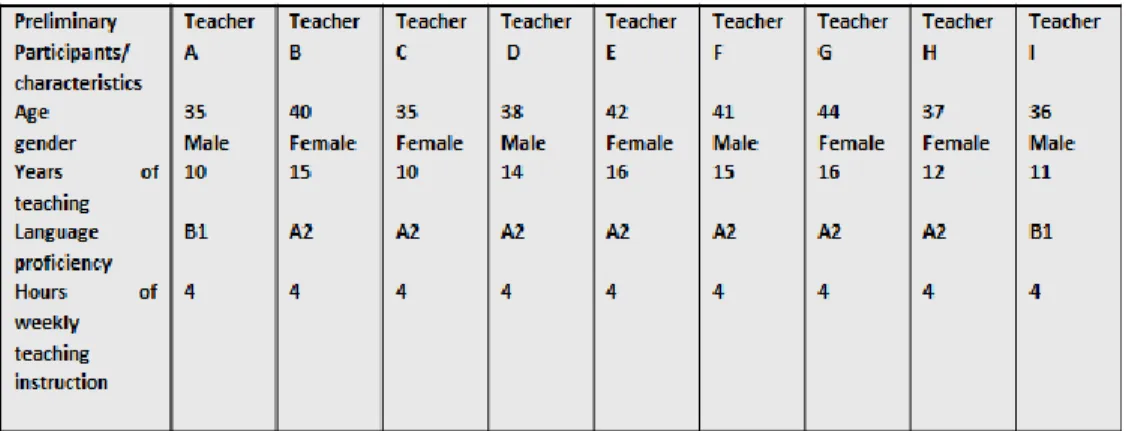
(21) Running Head: REFLECTING TEACHING: AN APPROACH TO ENRICH THE ENGLISH TEACHING PROFESSIONAL PRACTIE. researcher, a preliminary exploration online survey was designed to be used with nine English language teachers out of the 40 in the city of Sogamoso, a small town near the capital, Bogotá DC (See Table 1). It was implemented in December, 2014 to determine whether English language teachers practiced any type of reflection as a daily practice. The survey also permitted an initial exploration to find out if English language teachers had participated in any professional development activity on their own or held by MEN (See Appendix A).. The participants of this preliminary exploratory survey were English. language teachers who voluntarily accepted to participate.. Table 1. Preliminary participant’s background illustrates the language teachers in the initial exploration. Results showed that none of the nine teachers surveyed had participated in any professional development program stated by MEN or on their own. It means that English language teachers from Sogamoso require being involved in activities or programs to improve their teaching and to grow professionally. Under those antecedents, the relation between the preliminary survey and this exploratory study strived on how the incorporation of reflective teaching could help English language teachers enhance their professional practices, especially in the city of Sogamoso because some of them have not been engaged in professional development programs. From that perspective, reflective teaching is an. 20.
(22) Running Head: REFLECTING TEACHING: AN APPROACH TO ENRICH THE ENGLISH TEACHING PROFESSIONAL PRACTIE. effective strategy for professional growth because reflection prevents language teachers to settle down in traditional paradigms and plays an imperative role for the professional development. This study may have some impact on the language teachers in the city of Sogamoso, and may become a new exploration to support further studies that consider reflective teaching as a strategy to improve professional practices. The incorporation of reflection will positively impact language teacher’s education and will provide them with opportunities to grow professionally because it is adequate for real teaching needs. Additionally, the incorporation of reflective teaching strategies into the daily practice will benefit students from having an updated and motivating classroom in the sense that teachers would understand how learners learn a second language more effectively.. 21.
(23) Running Head: REFLECTING TEACHING: AN APPROACH TO ENRICH THE ENGLISH TEACHING PROFESSIONAL PRACTIE. 3. THEORETICAL FRAMEWORK The theoretical framework is divided in two parts. The first provides a review on reflective teaching significant definitions, its benefits and challenges. Then, the process of incorporating reflection which includes reflective teaching strategies. The second part outlines the definition of professional development including reflective teaching as. a. professional path. 3.1. Reflective teaching: significant definitions. The purpose of this section is to show that the integration of reflection into teaching has many benefits including making English language teachers aware of the need for a change in the classroom. Therefore, developing reflection into the English language teaching in Colombia becomes a key alternative for professional practice enrichment that can give solutions to specific classroom issues. This section is organized in two parts; first, the literature review provides a summary of what RT is; its benefits and challenges and how RT has been interpreted and implemented, and then how the incorporation of reflection serves as professional development to enhance English language teaching professional practices. RT applied in the classroom is an imperative interpretation of how language education may improve. Reflective Teaching or becoming critical of oneself has gained importance in the professional practice of English language teachers as a result of the benefits it can have on teaching practices and on teachers’ professional life. Dewey introduced the term reflective teaching in 1933: He considered it to be “an active and deliberative cognitive process that involves sequences of interconnected ideas that take into account underlying beliefs and knowledge. 22.
(24) Running Head: REFLECTING TEACHING: AN APPROACH TO ENRICH THE ENGLISH TEACHING PROFESSIONAL PRACTIE. School’s actions became routine and needed to change. Reflection is considered as a thinking process, resulting in creating alternatives of teaching. He further stated that teachers who are unreflecting about their teaching often uncritically accept this everyday reality in their schools and concentrate their efforts on finding the most effective and efficient means to solve problems” (as cited in Pedro, 2006, p. 130). In this regard, the idea that teachers need reflection not only to change their everyday routines within a classroom, but also to realize what problems are arising must become a current belief for language teachers. It is common to recognize that teachers tend to implement routinized teaching methods, perhaps because of their teaching beliefs or lack of professional development. Dewey´s theory allowed the researcher to understand that this process of reflection is not an easy process. Being reflective requires an understanding of why certain actions appear in the way teachers teach, where knowledge-based comes from, their language skills, and the will to change. It means that reflection should involve more than a simple reflective session or training. A teacher must be able to accept and consider other current teaching ideas which can be found by reading recent research reports or by participating in any professional development program. Zalipour (2015) defined “reflective practice for teaching is for those teachers who are disposed to think about their teaching practices, and are willing to put reflective practice into action. Reflective practice challenges teachers who have unquestioned assumptions about good teaching, and encourages them to examine themselves and their practices in the interest of continuous improvement” (p.4). It implies teachers’ commitment to study their 23.
(25) Running Head: REFLECTING TEACHING: AN APPROACH TO ENRICH THE ENGLISH TEACHING PROFESSIONAL PRACTIE. teaching practices to make changes based on weaknesses and develop action plans to improve the quality of their education instruction. Impedovo and Malik (2016) stated that “To be a reflective practitioner, a teacher can implement different strategies. They could, for example, analyze and question happenings within the teaching–learning context; show consideration for feelings and behaviors; keep a regular or daily record of significant events; share stories about students’ learning; ask colleagues and students’ families for their insights; or read professional literature to learn more about changing the environment and materials to support students’ learning” (p.102). Zalipour, Impedovo and Malik contributions are at a certain point similar to Dewey’s. They all agree that reflection is a process of rethinking and analyzing certain actions in class so students and teachers reach their teaching and learning objectives. Additionally, MacKinnon’s reflective cycle which consisted of three phases: initial problem setting, reframing and resolution (as cited in Tairab, 2003, p.3) was derived from Schön´s conception of reflection: framing and reframing. The previous contributions on reflecting teaching enable teachers to analyze their actions in the sense of providing outcomes. Al- Issa & -Bulushi (2010) argued “for reflection on teaching and learning to be effective, it has to be systematic and public (making one’s teaching and work accessible for critical peer review and use)” (p. 42). It means, the incorporation of reflection has to be a daily process, a vital part of the English language teaching profession to see effective changes in the classroom. Further, Al-Issa & Bulushi (2010) stated that “trainers have the important task of educating themselves in depth about reflection and reflective teaching, which should have positive implications for their trainees’ performance”(p. 60).. 24.
(26) Running Head: REFLECTING TEACHING: AN APPROACH TO ENRICH THE ENGLISH TEACHING PROFESSIONAL PRACTIE. In the Colombian context reflective teaching appears as the ability to think about the teaching performance in the classroom. According to Trujillo (2015) ”it is not only to reflect about the everyday doing as a teacher, it is to make a decision and implement this decision to really improve teaching actions and acquire knowledge from experience as a teacher and promote students learning” (p.29). At this point, it is necessary to add that reflection has been contemplated in the national context as a way to create a learning environment to motivate teachers not only to examine their classroom performance, but also to foster their research practices. In addition to this, supporting teachers by training programs is an open door for the improvement of English language teaching and learning in Colombia. Reflective teaching, by international researchers, has been considered as an essential component of teaching and learning a language. According to Ahmad et al (2013) “Reflectivity is one of the characteristics of effective teachers” (p. 73) in that sense reflection encourages languages teachers to be more competent because they develop critical thinking and problem solving skill that play a vital role in the effectiveness of language education. 3.2 Challenges and benefits of reflective teaching Surely teachers are required to make hundreds of decisions in a single class day as they observe their students´ learning as well as each student's style of learning. Therefore, they may keep observing problems and issues of education in the same way; as part of their daily classes and do not find any other way to address problem issues. The challenge here is to provide language teachers with the opportunity to start analyzing themselves as educators. According Ditchburn (2015) “Creating opportunities for pre-service teachers (PSTs) to critically reflect on and theorize about their practice is frequently regarded as an 25.
(27) Running Head: REFLECTING TEACHING: AN APPROACH TO ENRICH THE ENGLISH TEACHING PROFESSIONAL PRACTIE. essential component of professional experience” (p.94).This quote suggests that language teachers need chances to analyze the way they have been teaching and notice they do not have to make a decision just because a problem appears. Instead, there has to be an action plan to uncover possible issues and to have a second plan. In other words, teachers should implement continuous phases of reflection to identify what is going on in the classroom as an opportunity to improve their professional practices. When referring to the reflective teaching processes, responsibility appears as an important component to facilitate the enrichment of English language professional practice. The responsibility of teachers’ actions regarding the effects on students´ learning process is considered an imperative component to change English language teaching. It means the responsibility to offer high -quality instruction and understand students’ attitudes towards their language learning performance is a vital component so language learners would feel more confident when trying to produce the English language . The process of reflection might have consequences of teaching on the whole academic community and on teachers themselves. Attitudes, perceptions, emotions and feelings can be modified when involved in re- thinking how they perceive language education. According to Tairab (2003) “reflection was found to be characterized by the nature of reframing which occurred over the teaching practice period” (p. 18). In that sense, certain actions and attitudes would need adjustments; however, there are other actions more spontaneous that are not expressed which cannot easily be explained. Tairab´s contribution complements Dewey’s initial conceptions stated above; mainly because thinking and reflecting on teaching are needed as well as paying careful attention to what needs to be reflected; for example, teaching methods, learning styles and classroom management. By examining how they teach and how they manage a class 26.
(28) Running Head: REFLECTING TEACHING: AN APPROACH TO ENRICH THE ENGLISH TEACHING PROFESSIONAL PRACTIE. through the incorporation of reflection in the classroom, teachers can criticize their beliefs and actions to improve.. That examination would be transformed into teaching. contributions which allow to a comprehensive awareness of what is possible in reflection and what we can do with those underpinnings. In that sense, becoming critical about oneself means to analyze classroom outcomes and teaching procedures in a thoroughly and routinized way to reach specific objectives including the improvement of the teaching practices. Besides, by implementing RT, Erginel (2006) concluded that “teachers were open and responsible while giving and receiving feedback. In this process, they accepted guidance wholeheartedly, in a mature manner underlining that feedback helped them raise their awareness towards their teaching and develop themselves professionally” (p.86). Reflection can be interpreted in different ways. It is understood as what the teacher is able to do into the classrooms and what they can adapt to create a new perspective on their classroom actions. It is also evident that every teacher is a different person and her-his concept of reflection to target effective teaching practices is totally different, even when they work in the same context. It means every teacher can reflect on different issues to mark a variety of aims. Erginel (2006) also stated that “teachers developed self-awareness towards their teaching and own progress. The involvement in a range of experiences enabled selfanalysis, and guided them to become aware of changes in their perceptions of teaching and of themselves” (p.87). It means, English language teachers should be encouraged to reflect based on their personal interests, experiences, and kind of learners by themselves because they can develop their full teaching potential. Shaping and facing the several challenges language teachers deal in the classroom require an ongoing process of reflection, examination, and restructuration of the teaching instruction, students ´ learning styles and 27.
(29) Running Head: REFLECTING TEACHING: AN APPROACH TO ENRICH THE ENGLISH TEACHING PROFESSIONAL PRACTIE. interests, the teaching context, the real problems and issues of the educative system in general. Back in 2008, Jerez noted that several skills are necessary to implement reflective teaching actions in the teaching profession. She conducted a study called “Teachers’ Attitudes towards Reflective Teaching: Evidences in a Professional Development Program,” in which she reported that “teachers participation in the program served to allow teachers to raise awareness and question the need to reflect. It meant more thinking and observing their acting and making changes in their practice. It also enabled them to develop particular skills to become reflective such as to start working with colleagues, communicate ideas, look critically at their actions and evaluate the process they were following” (p. 103). In sum, she found out that RT is a process that requires training teachers to be able to assess their performance in class and provide specific action on their teaching practices. In this respect, reflection as it so far is understood is a broad thinking process that involves not only being critical about one, but also to evaluate teacher performance. It means to be able to empower them into a society in constant re-creation. It underlines how important reflective teaching is for the transformation of a community and to be more precise for learners specifically, who are becoming more active in their learning process. Following that perspective, Erginel (2006) noted that “ reflective teaching on teacher education contributes to pre- and in-service teachers’ meaning making processes by enabling them to consider different experiences and by interpreting these experiences in light of theory and own value judgments influenced by social factors” (p.17). These international contributions proved the benefits of the incorporation of reflection into the daily teaching practice which allows the researcher to define reflection as an analytical and. 28.
(30) Running Head: REFLECTING TEACHING: AN APPROACH TO ENRICH THE ENGLISH TEACHING PROFESSIONAL PRACTIE. critical process of different actions, attitudes, and decisions to progress more efficiently on the teaching practices by the teachers. Soisangwarn and Wongwanich (2013) argued that “reflective teaching is effective for professional teacher development in that it encourages the teacher to look at ways of managing the classroom and children from differing perspectives, based on assessment data” ( p.2505). From that perspective reflective language teachers develop their teaching but also and start doing research to gather important data about their teaching Another international contribution to the discussion is provided by Mathew (2012) who stated that: “The practice of reflection involves critical examination of self-motivation and thinking. It is a move towards critical thinking to improve productivity in teaching and students’ learning. Learning involves acquiring competence through action and experience while teaching involves engaging the learners in a process of activity that is likely to result in success of intended learning outcomes. Helping learners to understand the reasons for failures and creating awareness in selfcorrection can improve students’ classroom performance” (p.206). From Mathew´s arguments it is possible to say that reflective teaching as a critical examination of teacher´s performance is mainly determined to the way they self-evaluate because the self-evaluation process requires a deep understanding of how language teachers teach and to try to find reasons of why they teach in certain ways. 3.3 Reflective teaching process In Colombia researchers have proposed different ways of practicing RT. Pardo & Tellez (2015) conducted the research Reflection on Teachers’ Personal and Professional Growth through a Materials Development Seminar in which. they concluded that. 29.
(31) Running Head: REFLECTING TEACHING: AN APPROACH TO ENRICH THE ENGLISH TEACHING PROFESSIONAL PRACTIE. “reflection raises teachers’ awareness of personal and professional growth by enhancing their discipline knowledge, pedagogical practices, and research projects as well as fostering self-confidence, creativity, and self-esteem” (p. 66) what Pardo and Tellez suggested is that the process of reflection helps not only to reinforce the English language instruction in the classroom but also teachers´ personal and professional life. In this process of reflection teachers may start creating their own teaching materials and transforming their classroom into possible research projects. Another aspect that builds the process of reflection in the Colombian educational system has been also highlighted by Viáfara (2005) “a reflective approach has been satisfactory in order to cope with many of the constraints in terms of time, resources and the difficult social situation of school students that generates concern and anxiety in future teachers” ( p .65). Within this perspective, reflecting on what is actually going on in public schools´ settings (class size, culture background, and social status) should generate the transformation of giving valuable and viable alternatives to meaningful learning.. it is evident that language teachers do not make the policies but they have the commitment to make contribution on their profession. It means that an effective professional development practice should take into consideration the real teachers´ needs as well as learners interest and context. 3.3.1 Reflective Teaching Strategies The main purpose of this section is to show how the process of reflective teaching can be incorporated to enhance English teaching professional practices within a classroom or in a whole academic community. In fact RT helps teachers to be aware of what it has to be changed or modified inside their classrooms. Along this literature exploration readers 30.
(32) Running Head: REFLECTING TEACHING: AN APPROACH TO ENRICH THE ENGLISH TEACHING PROFESSIONAL PRACTIE. would find some strategies - journals, lesson reports, video and audio recording and selfobservation methods- that can be used in order to incorporate reflection into the personal professional practice. It is necessary to mention that the researcher found some other important strategies suggested by several scholars such as video recordings, selfobservation, peer observation, portfolios, journals, lesson reports, questionnaires, analyzing critical incidents and case analysis. However, the strategies mentioned in this section are selected as options for the implementation of RT in the daily teaching process by in serviceteachers. The researcher emphasized on journals, lesson reports, self-monitoring methods that include audio and video. These strategies were selected because first, teachers can implement them either by themselves or with the help of colleagues, they do not need any expert support. Second, they are easy to manage; for example, teachers can write in a journal what and how they feel after teaching a class and they can also have fun because teachers can take advantage of technology devices. Teachers can write their reflections on a blog and receive feedback from other teachers, so that, they can receive advices or suggestions on what they wrote. Third, in-service teachers can evaluate their teaching performance by videotaping and observing themselves after class. Fourth, English teachers develop a deep thinking process to understand what and how they teach. Finally, if teachers are interested, thanks to the results of the implementation of any of these strategies within a classroom may help to improve their teaching practices. It means teachers can collect information, find an issue to be solved and implement any action plan. The implementation of reflective teaching may consider some important stages that will help teachers become more critical of their performances to improve their English teaching professional practices. However, English teachers are free to implement the. 31.
(33) Running Head: REFLECTING TEACHING: AN APPROACH TO ENRICH THE ENGLISH TEACHING PROFESSIONAL PRACTIE. reflective strategy depending on their interests; fact that agrees with what Ma and Ren (2011) suggested: “reflective teaching increases the degree of “professionalism (p. 154). 3.3.2 Journals. For many educators journals might be a known or common strategy; however, this precise strategy acts as a reminder of what really happens in the classroom and how teachers perceive themselves as educators. The purpose of writing journals is to collect information and self-evaluate the performance in class on order to offer students a better instruction and sets of different learning strategies to foster their knowledge. According to Chennat ( 2014) “journal writing happens in terms of just narrating what happened in the class and school without much reflection, slowly developing into an analytical mode of ‘how did I teach’, which is more technique oriented to improve practice” (p. 11). It means, this strategy can be applied as a starting point to become reflective teachers because its implementation can be done individually without any expertise. The advantages of keeping a journal were clearly seen along the theoretical exploration which is well summarized by Zalipour (2015), “journals should be able to demonstrate the ability to learn from reflective practice, and the ways practice have developed” (p.12). This strategy is helpful because teachers can attach what they plan for the class to what they do. From that sense, teachers can discover what is missing about their instruction and how it can be improved. This is also an important strategy because it shapes the process of reflection when teachers are asked to write; then, they are forced to think about their performance within a lesson. Maroof (2007) stated that the implementation of journals helped teachers since “writing a reflective journal helped them in their teaching and learning process and that it assisted them in identifying mistakes or weaknesses in their 32.
(34) Running Head: REFLECTING TEACHING: AN APPROACH TO ENRICH THE ENGLISH TEACHING PROFESSIONAL PRACTIE. teaching” (p. 214). In sum, keeping journals is a strategy not only about writing a description of what occurs in the classroom, but it is also a connection between theory and practice. One of the advantages of using journals is that “through analysis and interpretation of the writings, patterns and themes emerge that assist with future planning” (Rayford, 2010, p. 28). Rayford suggests a meaningful stage of writing journals due to the fact that teachers should first write how they felt in the class, to later on, write about how they dealt with it. Then, the interpretation of that writing is a fundamental key to add changes to the teaching instruction that would finally be considered as professional practice for personal enrichment. 3.3.3 Lesson reports. Lesson reports are mentioned by the author to encourage teachers to write and to plan their classes. According to Burton et al (2009) “The reflective writing process begins with a description of, for example, an incident, a phenomenon observed, or an unresolved teaching puzzle” (p. 7). In a lesson report a teacher describes what happened during a lesson, it is usually done right after each lesson. This strategy is very helpful because teachers can self-evaluate their classes every day. However, it is a time consuming strategy. According Christodoulou (2010), “In a lesson report a teacher describes what happened during a lesson, it is usually done shortly after the lesson which means that the account cannot be precise” (p. 26); additionally to that fact, it is important to mention that this strategy can be demanding and exhaustive because teachers must describe their lessons in detail. Widayati (2009) may offer a possible saver to the strategy since he perceives it as “an alternative approach to lesson reporting [which will simply imply] for the teacher to spend a few minutes after a lesson writing answers to questions such as the following: What were the main goals. 33.
(35) Running Head: REFLECTING TEACHING: AN APPROACH TO ENRICH THE ENGLISH TEACHING PROFESSIONAL PRACTIE. of the lesson? or What did the learners actually learn in the lesson? What teaching procedures did I use?” (p.203). From that perspective, this strategy is focused on self-examining the way teachers actually criticize all details within a lesson. Finally, Rayford (2010) stated that “when teachers think about their teaching and what improvements need to be made, they grow professionally” (p.30); fact that supports the researcher´s initial statement: that the analysis of the incorporation of reflective teaching strategies is evidenced in the progress of English teaching professional practices.. 3.3.4 Self-monitoring methods According to Armstrong et al. (1985) “Self-monitoring or self-observation refers to a systematic approach to the observation, evaluation, and management of one’s own behavior in order to achieve a better understanding and control of the behavior” (as cited in Richards & Farrell, 2005, p. 34). Self-monitoring methods are mentioned as an encouragement of self-reflection too. This strategy enables observation as its main component. Observation can be looked from different perspectives, and it is implemented for diverse purposes. Observation is mentioned as a guide to train teachers to self-evaluate, to train them to be judges of their work. Wajnryb (1992) stated that observation is “a focused activity to work on while observing a lesson in progress and states some main reasons to use it: “as there are a lot of different things to assert in every lesson, the tasks enable the observer to focus on one or two particular aspects of teaching and let the observer concentrate on collecting the data instead of trying to make an opinion in the course of the lesson” (as cited in Christodoulou (2010, p. 25- 29). This specific definition allows teachers to practice peer reflection and collaborative work with colleagues or even students which also helps teachers to build a meaningful working environment.. 34.
(36) Running Head: REFLECTING TEACHING: AN APPROACH TO ENRICH THE ENGLISH TEACHING PROFESSIONAL PRACTIE. At this point of the reflective teaching process, English language teachers have to show their commitment and effort for making improvements in their teaching performance, in that way, teachers themselves would diagnose how their professional practices have grown. 3.3.5 Audio and Video Recordings Orlova (2009) stated that audio and video recordings are “observing, analyzing, and discussing classroom performance enhanced by the use of videotaping” (p. 31). This particular strategy is characterized by the collaboration of a colleague. Richards & Farrell (2005) argued that the strategy “shifts the responsibility for initiating improvement in teaching practices from an outsider, such as a supervisor, to the teacher” (as cited in Christodoulou, 2010, p. 26). Jerez (2008) mentioned that it is one of the strategies that generates more anxiety and discomfort in many teachers. It is imperative to train teachers to be observed, to be judged not because they are bad or good teachers but as a means of improvement and strengthening confidence. For the purposes of this study, this strategy is very important because teachers can discover their attitudes, skills, strengths and weaknesses. In this study the author considered these four reflective teaching strategies as a special form for learning on their own. From that way, teachers can connect their teaching from their real teaching experiences. The implementation of any reflective teaching strategy requires that the teacher think of a topic that is going to be observed, read or analyzed. Then, teachers must decide what they would do with that information. It is important to clarify that reflection requires outcomes; for example, a small project; or a different class. According to Orlova (2009), there are five steps in order to have a successful video 35.
(37) Running Head: REFLECTING TEACHING: AN APPROACH TO ENRICH THE ENGLISH TEACHING PROFESSIONAL PRACTIE. recording session: first, preparation for micro-teaching and videotaping a lesson; second, self-viewing for the first emotional response; third, repeated self-viewing and reflection after a period of time; fourth, viewing the recording with a friend; and fifth, viewing the recording with a supervisor. It is important to take into consideration that teachers may shape their teaching performance, but also they raise awareness about how they were teaching for years and it opens a door for improvements that would be transformed into an effective learning environment. In general terms, the incorporation of these four reflective teaching strategies suggested by the author let teachers start practicing reflection as natural daily performance. Reflective teaching strategies are considered as important opportunities to grow professionally by taking viable actions in the classrooms that is why they can also gather data every time they consider, so they raise awareness of their real circumstances and teaching contexts. Basically, these four strategies would help teachers to collect information from their classes. Readers would find that the selected strategies have been mentioned by different researchers and their reasons to be a help for teachers to reflect critically upon themselves are also mentioned. Lesson reports, journals, audio and video recordings and selfmonitoring methods are strategies which have been suggested by several theorists cited in Christodoulou (2010, p.20- 25). Despite the multiplicity of definitions and benefits, they all conceive these strategies as powerful tools to uncover classrooms insights, to be aware of right or wrong educative perceptions and to build an extensive knowledge of the teaching profession.. 36.
(38) Running Head: REFLECTING TEACHING: AN APPROACH TO ENRICH THE ENGLISH TEACHING PROFESSIONAL PRACTIE. 3.6 Professional development practices 3.6.1 Definition of professional development The understanding of the term professional development constitutes a “going beyond the traditional teaching”, instead, it implies changes in the teaching practices to improve professionally. According to Casteel & Ballantine (2010), “professional development refers to processes and practices that improve the job-related knowledge, skills, and attitudes of school employees. Ideally, these skills, knowledge, and attitudes should assure the intellectual, physical, emotional, and social development and well-being of each student within the school, regardless of their linguistic, cultural, economic, or national background”(p. 5). That means English language teachers must be engaged in practices to improve not only their academic performance but also their social and personal skills that would be clearly perceived by the students. Back in 2004 Kedzior claimed “professional development should respond to teachers’ self-identified needs and interests in order to support individual and organizational improvements” (p. 2). Attempting to provide a continuous professional development, it is a must to state that reflective teaching requires a constant effort from educators. Mizell (2010) stated that “effective professional development enables educators to develop the knowledge and skills they need to address students’ learning challenges. To be effective, professional development requires thoughtful planning followed by careful implementation with feedback to ensure it responds to educators’ learning needs” (p. 10). Following Mizell´s perspective, professional development programs should be supported by experienced educators or trainers in order to provide English language teachers with the right assessment. 37.
(39) Running Head: REFLECTING TEACHING: AN APPROACH TO ENRICH THE ENGLISH TEACHING PROFESSIONAL PRACTIE. According to Broad and Evans (2006)” Effective professional development needs to be sustained, ongoing, in-depth, requiring active engagement by the professional. Short term, “one-shot”, “pull-out” programs are seen to be ineffective in changing or developing practice” (p. 3). Broad and Evans´s definition highlights the integrity of a continuous professional development giving attention to the teacher´s life as a person and professional considering the effort to provide positives changes and improvements in the teaching experience to have efficient English language education In regards to the professional development components such as extended and ongoing which is basically a continuous engagement rather than only a training session, coherent and integrated that means professional development should meet English language real needs. There are other important considerations to take into account. For example, the connection between the teaching profession and students´ learning process. Moreover, the inclusion of assessment and reflection into the teaching practice and. the requirement of. time, support and resources are vital considerations to incorporate reflection to enhance the English language teaching professional practices. 3.6.2 Reflective teaching as professional development path There are different types of professional development programs; for example mentoring, collaborative inquiry, content guided instruction and lesson study. However RT is usually viewed as an alternative to enhance professional development practices because teachers can work collaboratively or individually, they can observe, analyze and improve themselves and their colleague’s performance. In this study, professional development is considered as a way to improve the teaching practices through the incorporation of reflection to enhance the teaching practices bearing 38.
(40) Running Head: REFLECTING TEACHING: AN APPROACH TO ENRICH THE ENGLISH TEACHING PROFESSIONAL PRACTIE. in mind motivation and self-evaluation of teachers’ performance in class. “Motivation is thought to be responsible for why people decide to do something, how long they are willing to sustain the activity and how hard they are going to pursue it" (Dörnyei, 2001a:8). Dörnyei stated four components of teachers’ motivation: intrinsic motivation which refers to the desire to educate people, contextual factors relates to the work environment, temporal dimension which is the decision to be a teacher as a lifelong career and negative influences that are all the elements that destroy the intrinsic motivation for example lack of classroom autonomy, imposition of policies and burnout. From that sense, the engagement of English language teachers into consistent activities of reflection, the understanding of the extent of teachers’ motivation including their attitudes and perceptions about language education and self-examination would lead to a better understanding of the English language education, and comply with a broadened understanding of how Colombian students can actually become better language users.. 39.
(41) Running Head: REFLECTING TEACHING: AN APPROACH TO ENRICH THE ENGLISH TEACHING PROFESSIONAL PRACTIE. 4. RESEARCH DESIGN DATA COLLECTION INSTRUMENTS AND PROCEDURES This section covers the type of research that was carried out, the context where the study took place, the researcher’s role and the explanation of the data collection instruments and procedures. 4.1 Type of study This research project was conducted under the principles and theoretical considerations of exploratory research which according to Burns and Grove (2003) “is a method focuses on new insights, new ideas that increase knowledge of a phenomenon” (p. 313). For this research, a supportable way to carry out the exploration of how reflective teaching may help language teachers improve their professional practices was implemented bearing in mind that teachers may wish to explore this particular area of English language to refine their thinking about teaching and to investigate different methodologies which further can be used in the classroom activities. According to Ponelis (2015) “exploratory studies are undertaken because the field to be studied is relatively new. Secondly, exploratory studies can be undertaken to define the central concepts and constructs in order to get a better understanding of the phenomenon” (p. 71). Consequently, the author attempted to explore reflective teaching to have a better understanding on how it could actually provide English language teachers with possible solutions to grow professionally. This research, “Reflecting Teaching: an Approach to Enrich the English Teaching Professional Practice” initiated based on Ashour´s steps (2008. p. 25) for conducting exploratory research. First, the author started to identify the area to be explored which was 40.
(42) Running Head: REFLECTING TEACHING: AN APPROACH TO ENRICH THE ENGLISH TEACHING PROFESSIONAL PRACTIE. the incorporation of reflective to enhance English language is teaching professional practices; it is basically reflecting on the area selected to get an understanding of the issue; it was the exploration of the twenty three research reports on how RT may help language teachers to improve professionally. Second, a constant reflection upon the sources was carried out, at this stage the researcher built the characterization of sources in tables. Third, according to Allwright and Lenzuen, (1997) monitoring became a ‘matter of gathering naturally occurring data about whatever [puzzled the researcher]” (as cited in Ashour, 2008) where the content analysis was done. Fourth, direct action to generate data and the categorization of the analysis emerged; finally, the source analysis outcomes facilitated the design of a reflective teaching protocol that would be offered to the community (See Figure 2). Readers would find in the next section the characterization of the study, the context and institutional setting, a brief description of the data collection instruments, the participants, the role of the researcher, the ethical considerations, content analysis and the protocol design.. 41.
(43) Running Head: REFLECTING TEACHING: AN APPROACH TO ENRICH THE ENGLISH TEACHING PROFESSIONAL PRACTIE. 1.. Identification of the area to be explored. 5. Design of. a RT protocol. 4. Data generation and categorization. 2. Constant reflection and analysis. 3. Monitoring and Content Analysis. Figure 2. Exploratory research steps. Exploratory Practice: An Alternative Tool for Understanding Life in the Language Classroom. Ashour (2008). The following section presents the manner in which the exploratory research steps previously explained were conducted. 4.1. 2 Identification of the area to be explored 4.1.2.1 Context. Based on the research question and objectives of this research, the first exploratory stage was developed through the literature exploration of several sources from which twenty three research reports were chosen. The selected studies were academic outcomes related to the reflective teaching strategies incorporation in schools and universities in public or private institutions. To do so the researcher conducted an online search using Google search and Science Direct. The author found around sixty articles, institutional. 42.
(44) Running Head: REFLECTING TEACHING: AN APPROACH TO ENRICH THE ENGLISH TEACHING PROFESSIONAL PRACTIE. reports and published journals not only in databases in Colombia but also in databases from Canadian, European, Indian, and Australian universities. The databases presented in Table 2 include the most relevant journals considered for the exploration. Table 2. Journals used for the literature review •. International Journal of Research in Humanities, Arts and Literature. •. Profile journal. •. How journal-asocopi. •. Ikala revista de lenguaje y cultura. •. Canadian center of science and education. •. International education journal. •. The journal of modern thoughts in education. •. Social and behavioral journal of teacher education. •. Academic publisher. •. Mediterranean journal of social sciences. However, only twenty three were selected based on the research question and objectives, and because of their importance in the English language and teaching community. More specifically, the articles needed to address research on reflective teaching, reflective teaching strategies, professional practices, and professional development. The abstracts, keywords titles, and findings were examined to help the researcher select those to be worked with, the following criteria were taken into account: 1.. Research reports or theoretical papers written in the last decade. 2. Investigations conducted in and outside the country 3. Research reports in which RT was the main construct and part of the pedagogical intervention. 43.
Figure



+2

Documento similar
In this paper, a new feature selection approach is proposed based on a modified Teaching- Learning-based Optimization (TLBO) combined with four new binarization methods: the
The benefits of using eTwinning start with the experience of being introduced to other cultures in Europe and encourages European teachers and students to work
I STATE that the present study, entitled “The Historiography of English Language Teaching in Spain: A Corpus of Grammars and Dictionaries (1769-1900)” presented by Alberto
Finally, four original activities will be presented on some English language collocations, in order to facilitate the teaching and learning of this type of
Ultimately, this study has revealed that instruction in L2 pragmatics with an EIL per- spective is possible, hence expanding the well-grounded idea of the teachability of prag-
In broad terms, in both groups of textbooks, most of the activities follow traditional patterns for practising pronunciation, there is a clear predominance of tasks to
The communicative approach popularized teaching activities which emphasised the need for learners to focus on meaning, fostering their participation in real
It is important to note that CLIL not a new method; rather it is the fusion of the teaching of content from the curriculum with the teaching of a non-native language, as well as
