
Interaction and interpersonal behavior in computer mediated academic forums
429
0
0
Texto completo
(2) DOCTOR IN EDUCATIONAL INNOVATION AND TECHNOLOGY (DOCTOR EN INNOVACIÓN Y TECNOLOGÍA EDUCATIVA). Approved by. Dr. Mark Bullen Dr. Jorge Braham Velasco Dr. José Guadalupe Escamilla de los Santos. Dr. José Ignacio Icaza Acereto Dr. Jaime Ricardo Valenzuela González.
(3) DEDICATION To my wife, for her unending patience: without you, here and now, mine would be a mis-guided story.. To my daughter, for our very special bonds: may God shed his light upon you and show you the way.. To the memory of my late father, for his limitations: you searched, but could not find.. To the memory of my late grandmother, for your support all those years: you tried to understand me, but not hard enough.. i.
(4) ACKNOWLEDGMENTS Any research work of this nature and scope cannot be produced without the aid of many people. I would like to thank, first and foremost, my wife Guadalupe (Muñe) for her constant encouragement, support, and patience throughout these four seemingly unending years. Without her constantly behind me, sharing joys and sorrows, I could not have reached my destination successfully. I also thank my supervising committee: Jorge Braham Velasco, José Guadalupe Escamilla de los Santos, José Ignacio Icaza Acereto, and Jaime Ricardo Valenzuela González for their acute guidance and unfaltering advice. A very special acknowledgment for Mark Bullen, my head advisor, for getting me started, for leading me through all the perils of the journey, for sharing his knowledge, and above all, for his friendship and understanding through both good and bad times. Lani Gunawardena, Jeannette McDonald, Ronald Rice, Robert Shelley, Fay Sudweeks, and Joseph Walther unselfishly and timely contributed with advice, papers, articles, and books whenever I needed. My admiration and thanks for them. Special thanks to Ana Isabel Landeros and Arturo Santillán for their time and ability in unraveling the labyrinth of statistics to a layman with such clarity and humor. My thanks also to Ruth McCalulky for reading the whole manuscript, and to Luzangélica Navarro for her patient formatting of the document. Last, but by no means least, a grateful recognition to Eduardo de la Garma and Luis Caraza for backing up this dream with their moral and economical contribution. Without their unselfish help, nothing could have been possible.. ii.
(5) ABSTRACT Computer-mediated communication (CMC) is rapidly emerging as a new modality of educational delivery, either as an alternative to face-to-face contact or as an additional resource to enhance and extend existing pedagogical processes. Computer-mediated technologies produce social environments that are different from traditional classrooms. As such, research is needed to review and redefine the character of online participation/interactivity, as well as to explore the nature of interpersonal aspects of online group learning. Interaction is considered a key issue in online knowledge building processes, while interpersonal issues tend to be regarded as disruptive. In this study, interactivity is viewed both as the degree of intermessage reference and as a personal attitude among participants. Thus, the type of interaction is considered as related to the degree of interpersonal or socioemotional content. The main purposes of this ex-post-facto, longitudinal case study study are to evaluate the amount and type of interaction and interpersonal content in messages posted among online postgraduate students, as well as to determine if there is an association between both variables. It focuses on a continuing interaction of a small group discussing on academic forums equally spaced throughout three semesters, on asynchronous, unstructured discussions based on reflection questions posed by a tutor. The study involves the same natural group working on multiple tasks of the same task type through an extended period of time and measured at three different points in its history. The online group relationship is considered as one homogeneous, holistic interaction. The results indicate that fostering appraisal, support, humor, and inquiry,. iii.
(6) while stimulating healthy opposition based upon personal experiences and factual information ensures a greater dose of reactivity/interactivity. This may increase significant participation and expand the depth of discussion. Moreover, aiding effective tutoring, mentoring and coaching of online groups may help bringing about the full potential of the medium and contribute to the development and maintenance of effective group exchanges. Finally, regulating the complexity of interactions and fostering the development of a cohesive group of participants may render more controlled patterns of online behavior and improve collective learning.. iv.
(7) TABLE OF CONTENTS DEDICATION...........................................................................…................................i ACKNOWLEDGMENTS…………..........................…........………………………...ii ABSTRACT……………………….…………………………………………………iii TABLE OF CONTENTS..............................................................................................v LIST OF TABLES.................................................................................................…..ix LIST OF FIGURES...................................................…................................................x CHAPTER 1 - INTRODUCTION................................................................................1 Introduction........................................................................................................1 Statement of the Problem and Purposes of the Study........................................5 Research Questions............................................................................................8 Purpose 1…………………………………………………...…9 Research Question 1 (Participation)………………..…9 Purpose 2…………………………………………………...…9 Research Question 2 (Interaction)…………………….9 Research Question 3 (Interpersonality)…………….…9 Purpose 3………………………………………………….…10 Research Question 4 (Interaction Related to Interpersonality)……………………………………...10 Purpose 4………………………………………………….....10 Research Question 5 (Participants’ Perceptions)…….10 Significance of the Study….............................................................................11 Setting and Scope of the Study........................................................................15 Definition of Terms.........................................................................................16 Asymmetry...........................................................................…17 Participation........................................................................….17 Interaction................................................................................18 Interpersonality........................................................................18 Research Assumptions and Biases...................................................................19 CHAPTER 2 - LITERATURE REVIEW....................................................................23 Computer-mediated Communication...............................................................24 Historical Background.......................................................…..25 Typology..................................................................................27 Attributes and Characteristics..................................................31 Computer Conferencing...........................................................34. v.
(8) Technical Attributes.....................................................35 Linguistic Characteristics.............................................43 Three Environments.................................................................46 Social Environments.....................................................46 Organizational Environments.......................................50 Educational Environments....................................…....54 Additional Comments...............................................................57 Group Interaction Processes in CMC..............................................................58 Asymmetry in CMC.................................................................62 Participation.............................................................….71 Interaction and Interactivity..................................…....77 Dimensions of Interaction Analysis.............................92 Interpersonality........................................................................93 Dimension of Interpersonal Analysis.........................105 Support-alignment/Adversarialityopposition.....………………………………....113 Self-disclosure/Reserve....................................115 Appraisal/Chastisement..........................…......118 Humor/Sarcasm................................................121 Other-orientedness-inquiry/Self-absorptionadvocacy...........................................................125 Informing-offer/Asking-request.......................127 Additional Issues Influencing Interaction and Interpersonality......................................................…129 Time.................................................................129 Anticipated Interaction.....................................134 Type of Task....................................................136 Gender..............................................................138 Culture and Language of Interaction...............140 Emerging Traits in Group CMC....................................................................142 Conclusions....................................................................................................155 CHAPTER 3 - STATEMENT OF THE PROBLEM/RESEARCH DESIGN...........162 Research Purpose, Research Questions, Hypotheses, and Data Sources.......162 Purpose 1………………………………………………...…164 Research Question 1 (Participation)……………..…164 Purpose 2………………………………………………...…166 Research Question 2 (Interaction)………………….166 Research Question 3 (Interpersonality)………….…167. vi.
(9) Purpose 3…………………………………………………...169 Research Question 4 (Interaction Related to Interpersonality)…………………………………….169 Purpose 4…………………………………………………...170 Research Question 5 (Participants’ Perceptions)…..170 Method Overview………………………………………………………..…171 Case Study Approach………………………………………173 Context Description, Subjects, and Sampling Procedures….176 Context Description………………………………...176 Subjects…..……………………………………..…..178 Participants…....…………………………...…179 Semester/Courses…………………………….180 Computer Conferences……………………….181 Threads……………………………………….186 Messages…...………………………………...188 Sentences…………………………………..…188 Data Collection Methods and Procedures…………………………………..190 Content Analysis……………………………………………191 Unit of Measure…………………………………………….196 Dimensions of Analysis for Interpersonality and Interaction Constructs………………………….……….….201 Coding Scheme…………………………………….....202 Definition, Explanation, and Indicators of Categories.204 Coding Procedure…………………………………….205 Characteristics of the Coders………………....206 Training and Preparation of Coders………….207 Definitions and Meaning of Coding Categories.……………………………………208 Instructions for the Coding Procedure……..…209 Information in the Coding Sheet……………...210 Reliability and Validity……………………………………………………..210 Reliabilty……………………………………………………211 Values and Discussion of Results…………………...214 Validity……………………………………………………..217 CHAPTER 4 - DATA ANALYSIS…………….......................................................219 Purpose 1……………………………………………………………….…..219 Research Question 1.1……………………………….……..221 Research Question 1.2……………….……………………..224 Purpose 2…………………………………………………………………...230. vii.
(10) Research Question 2.1…………………...…………..……..230 Research Question 2.2……………....……………………...232 Research Question 3.1……………...………………..……..235 Research Question 3.2…………...….……………………...237 Purpose 3…………………………………………………………………...248 Research Question 4…………......….……………………...248 Purpose 4……………………………………………………………….…..252 Research Question 5……………………………………..…252 Summary……………………………………………………………………254 CHAPTER 5 - DISCUSSION OF THE RESULTS…………..............…………....255 Findings Related to Study Purposes……………………………………...256 Purpose 1………………………………………………...…256 Research Question 1 (Participation)……………..…...256 Purpose 2………………………………………………...…263 Research Question 2 (Interaction)……………….…...263 Research Question 3 (Interpersonality)………….…...266 Purpose 3………………………………………………...…275 Research Question 4 (Interaction Related to Interpersonality)……………..………………………..275 Purpose 4………………………………………………...…277 Research Question 5 (Participants’ Perceptions)……..277 Limitations, Conclusions, and Implications for Practice…………………...284 Limitations………………………………………………...285 Method……………….….……………………………285 Focus………………………………………………….289 Conclusions…………………………………………….…292 Implications for Practice…………….…………………...294 APPENDIXES...........................................................................................................309 Appendix A – Subject Release Form……………………………………….309 Appendix B – Online Survey Format………………………………...…….311 Appendix C – Definition, Explanation, and Indicators of Categories…...…314 Appendix D – Examples of Separate Categories…………………………...321 Appendix E – Examples of Combined Categories………………………....336 Appendix F – Data Entry Forms……………………………………………351 Appendix G – Intercoder Reliability Data………………………………….355 Appendix H – Summary Tables of Raw Data………………………...…....361 Appendix I – Survey Messages Data……………………………………….375 REFERENCES..........................................................................................................379. viii.
(11) LIST OF TABLES TABLE 1: Summary of Research on Interaction and Interactivity in CMC...............89 TABLE 2: Summary of Research on Interpersonality in CMC................................101 TABLE 3: Summary of Research on Interpersonal Analysis....................................108 TABLE 4: Relationship of Purposes, Research Questions, Hypotheses, Intentions, Research Methods, and Types of Statistics………………….………………....…..163 TABLE 5: Types of UBC Courses Discussion Forums…………………………....184 TABLE 6: Relationship Among Sampling Levels………………………………....189 TABLE 7: Identification Codes for Interpersonality and Interaction Categories…..204 TABLE 8: Analysis of Variance for Messages and Sentences……………………..223 TABLE 9: Analysis of Variance for Threads and Messages……………………….226 TABLE 10: Mean Levels of Messages and Sentences per Day of the Week for all Forums…………………………………………………………………………..….227 TABLE 11: Frequency of Sentences and Statistical Analyses for Interaction Categories for Each Forum and for All Forums…………………………………....234 TABLE 12: Relationship of Sentences for Interpersonality Specific Categories for Each Forum and for All Forums………………………………….………………...240 TABLE 13: Frequency of Sentences and Statistical Analyses for Interpersonality Categories for Each Forum and for All Forums………………………………..….243 TABLE 14: Frequency of Sentences for Interpersonality and Interaction Categories for Each Forum and for All Forums………………………………………..…...…249 TABLE 15: Frequency and Percentage of Messages Evaluated by Participants…..253 TABLE 16: Acceptance or Rejection of the Null Hypotheses……………………..254 TABLE 17: Summary of Purposes, Research Questions, Hypotheses, Results, Implications and Recommendations for Practice……………………………….….301. ix.
(12) LIST OF FIGURES FIGURE 1: An interrelational typology among methods, instruments and modes in CMC......................................................................................................28 FIGURE 2: Dimensions for analyzing asymmetry in CMC.......................................69 FIGURE 3: Relational categories in CMC..................................................................73 FIGURE 4: One-way, two-way, and interactive communication (Rafaeli & Sudweeks, 1998)........................................................................................84 FIGURE 5: Dimensions for analyzing interactions in CMC.......................................92 FIGURE 6: Dimensions for analyzing interpersonality in CMC..............................113 FIGURE 7: Dimensions for analyzing interpersonality and interaction in CMC.....161 FIGURE 8: Response and explanatory variables and their coding categories..........203 FIGURE 9: Percentages of total amount of threads, messages, and sentences for each individual forum over time………………………………………………………....219 FIGURE 10: Mean registers for participation indicators for each individual forum over time……………………………………………………………………………220 FIGURE 11: Absolute number of messages per thread and sentences per thread in forums 1, 9, and 14…………………………………………………………………222 FIGURE 12: Correlation of sentences and messages in forums 1, 9, and 14………223 FIGURE 13: Absolute number of threads and messages for all forums………...…225 FIGURE 14: Thread-to-message ratio for all forums……………………………...226 FIGURE 15: Number of messages and sentences per day of the week for all forums………………………………………………………………………………228 FIGURE 16: Number of messages and sentences per day of the week for all forums (logarithmic scale)………………………………………………………………….228 FIGURE 17: Number of messages per day of the week per forum and for all forums………………………………………………………………………………229. x.
(13) FIGURE 18: Number of messages and sentences per message per day of the week for all forums……………………………………………………………………......….229 FIGURE 19: Number of sentences per interaction categories per forum…………..230 FIGURE 20: Percentage of sentences per interaction categories per forum…….....231 FIGURE 21: Percentage of the total number of sentences per composite interaction categories per forum……………………………………………………………......232 FIGURE 22: Number of sentences per interpersonal categories per forum…….….236 FIGURE 23: Percentage of sentences per interpersonal categories per forum…….237 FIGURE 24: Percentage of sentences per interpersonal composite categories per forum………………………………………………………………………………..238 FIGURE 25: Percentage of interpersonal sentences per bipolar categories per forum………………………………………………………………………………..239 FIGURE 26: Percentage of sentences per composite interpersonal categories per forum………………………………………………………………………………..247 FIGURE 27: Percentage of negative interpersonal and positive impersonal content per forum…………………………………………………………………………...248. xi.
(14) CHAPTER 1 - INTRODUCTION Introduction Computer-mediated communication (CMC) has become ubiquitous throughout the developed world (Spears, Lea, & Postmes, in press, p. 1). It is rapidly emerging as a new modality of educational delivery, either as an alternative to face-to-face contact or as an additional resource to enhance and extend existing pedagogical processes (Harasim, 1998; Dunham, 1997; Sargeant, 1997). In open and distance education (DE)1, as well as in distributed learning (DL)2, CMC is being used increasingly to achieve their pedagogical outcomes. It is currently becoming the most dynamic medium of enabling pedagogical processes- both education and training-to reach people who are geographically and temporally dispersed and employed full-time (Eastmond, 1997; Hiltz, 1995; McDonald, 1997). At the same time, CMC may also be one of the fastest growing areas of educational 1. The terms “distance education” or “distance learning” have been applied interchangeably by many different researchers to a great variety of programs, providers, audiences, and media. Its hallmarks are the separation of teacher and learner in space and/or time, the volitional control of learning by the student rather than the distant instructor, and noncontiguous communication between student and teacher, mediated by print or some form of technology (Sherry, 1996, p. 339). 2. A distributed learning environment is a learner-centered approach to education, which integrates a number of technologies to enable opportunities for activities and interaction in both asynchronous and real-time modes. The model is based on blending a choice of appropriate technologies with aspects of campus-based delivery, open learning systems and distance education. The approach gives instructors the flexibility to customize learning environments to meet the needs of diverse student populations, while providing both high quality and cost-effective learning (Institute of Academic Technology of the University of North Carolina, 1995).. 1.
(15) technology research and development (Romiszowski, 1997). Instructional paradigms in educational and training activities have driven much of the research done in education and training in the past thirty years, labeled as computer-assisted or computer–aided instruction (CAI), computer-based learning (CBL), and computer-assisted learning (CAL). Under a behaviorist approach, the emphasis was set on student-machine interaction as a means for automated instruction, focusing on the computer as a tool (Romiszowski, 1988). However, the increased capability of supporting complex interaction processes has recently shifted the emphasis to the cognitive-conversational paradigm (Dunham, 1997), which aims at collaborative learning and collective knowledge building under a more constructivist approach (Book & Putnam, 1992; Bullen, 1997; Christensen, 1991a, 1991b, 1991c, Gunawardena, 1995; Gunawardena, Lowe, & Anderson, 1997, 1998). An increased interest in cooperative learning as an instructional strategy fosters the emergence of student-student interaction through CMC as an important area for research and practice in education (Higgins, 1998). “Deep learning is promoted by active learner participation” (Newman, Webb, & Cochrane, 1995, p. 60), and strongly associated to socioemotional involvement and feelings of empathy and belonging supported by interaction (Brandon & Hollingshead, 1999; Johnson, Johnson, & Smith, 1991; Biggs, 1987; Holmberg, 1996b). Interactivity thus describes and prescribes the manner in which conversational interaction as an iterative process leads to jointly produced meaning (Rafaeli & Sudweeks, 1997).. 2.
(16) Two-way communication is thus considered by a growing number of researchers as a cornerstone of distance education (e.g., Holmberg, 1996b; Kaye, 1992; Kiesler, Siegel, & McGuire, 1984; Palloff & Pratt, 1999). While Palloff and Pratt (1999, p. 5) state that, “key to the learning process are the interactions among students themselves and the collaboration in learning that results from these interactions”, while McDonald (1997) demonstrated that positive social interaction creates group cohesion, while negative interaction disrupts the group constitution process, both directly impacting group performance, productivity and effectiveness. Within CMC, computer conferencing is increasingly becoming a popular delivery mode for education at a distance, a common component of higher education courses, and the main form of all teaching/learning processes in complete degree programs (Bullen, 1997; Kearsley, Lynch, & Wizer, 1995). As a means of group interaction, computer conferencing is “the most common application of asynchronous educational CMC in distance and higher education” (Higgins, 1998, p. 42). However, “conspicuously absent is an understanding of how computers are tools for connection and community” (Jones, 1995, p. 12). Although it is believed that computer mediation changes the nature of interaction in online academic groups, there is scarce research that examines either online group processes over time or the dynamics of online exchanges in natural learning environments (Haythornthwaite, 1998; McDonald, 1997). Mason (1992) states that “the published literature on educational computer conferencing consists, to a very large extent, of applicationoriented descriptions…Very few researchers tackle the difficulties of analyzing the. 3.
(17) educational quality of conference interactions” (p. 106), even when the type of language chosen to interact, either for action or for social maintenance, may help define the type of online relationship (Murray, 1991; Wellman & Gulia, 1999). On the one hand, studies on collaborative computer-mediated groups tend to focus more on technology development (improving task performance, overcoming time and space constraints, and speed and volume of information processing) of hardware and software than on picturing computers as a meeting place for individuals (Jones, 1995; McGrath & Hollingshead, 1994). On the other hand, the abundant research on the structure of pedagogical discourse interactions, either as a control and differentiation instrument or as a process for democratization and community building in the classroom, is still concentrated on face-to-face oral exchanges (Bernstein, 1994; Book & Putnam, 1992; Cazden, 1991; Hertenstein, 1991; Sorensen & Christophel, 1992). Course designers and online teachers, instructors, and moderators need to understand how students interact and how groups develop in computer-mediated environments. Research about interactive exchanges, the building and maintenance of online relationships, communication dynamics within natural and real-life academic electronic groups, and online relational patterns through time, especially in long term learning scenarios, may have important implications for educational practices. Research in these areas may contribute towards improving the efficiency and effectiveness of online asynchronous discussion forums (Brandon & Hollingshead, 1999; Eastmond, 1997; McGrath & Hollingshead, 1994; Rafaeli, Sudweeks, Konstan. 4.
(18) & Mabry, 1994) and may be essential to understand the way both individual participants and groups behave over time in order to effectively design online group learning. Moreover, it may help build a theoretical background for better defining the constructs of interactivity and interpersonality in online communication.. Statement of the Problem and Purposes of the Study As a new form of human communication, computer-mediated technologies “produce social environments that are different from traditional classrooms” (McDonald, 1997, p. 12). Attributes of computer conferencing as stated by Harasim (1990) (many-to-many communications, place-independent group communication, time-independent group communication, text-based communication and computermediated learning), foster the formation of groups among individuals who have never seen one another but nonetheless interact regularly and densely (McGrath & Hollingshead, 1994, p. 104). Some of the attributes of computer conferencing may also encourage a salient social climate that impacts online interactions and group dynamics (Gunawardena, 1995). Educational computer conferencing must then be considered a “unique mode of education different from face-to-face and distance education” (Bullen, 1997, p. 39). As such, research is needed to review and redefine the character of online participation/interactivity, as well as explore the nature of interpersonal aspects of online group learning. Significant issues that have not been properly addressed are the assessment of the quality of online interactions and the quality of the online learning. 5.
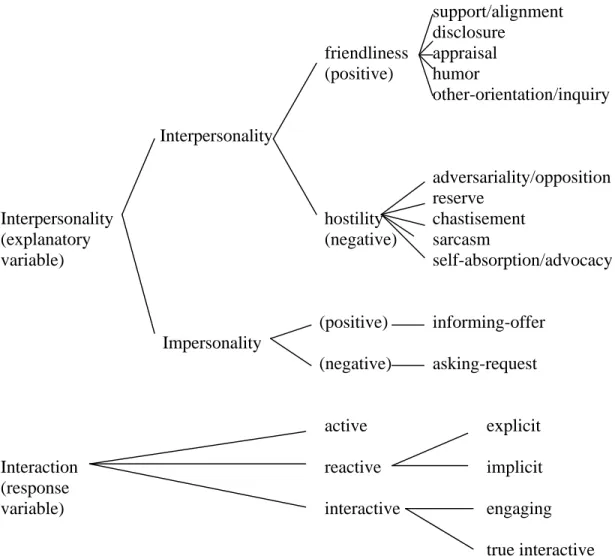
(19) experience (Gunawardena, Lowe, & Anderson, 1998). It is still a common belief that CMC equates interaction (Kiesler et al. 1984; Hiltz & Turoff, 1978; Sproull & Kiesler, 1995) and diminishes transmission of affect among participants (Hiltz, Johnson, & Turoff, 1986; Sproull & Kiesler, 1986) when compared to face-to-face communication. That is, CMC reduces asymmetry or dominance among participants and promotes impersonal content exchange when compared to face-to-face interactions. However, recent findings may indicate this may not hold in long-term computer-mediated interactions (Herring, 1996a, 1996b, 1996c, 1996d; Walther, 1996), and may not be valid when knowledge of anticipated future lasting interaction is present (Walther, 1994, 1996). On the one hand, interactivity-or intermessage referencing-may be the single most required feature of online communication aiming at the formation of knowledge building and the implementation of learning communities. Interactivity is not primarily a characteristic of the medium, but a quality of the communication relationship established by participants themselves. Interactivity is therefore a pivotal dimension of the social dynamics of group communication. It constitutes the precondition for online cooperative learning, critical thinking, and knowledge construction. Nonetheless, asymmetry in interactivity levels in CMC is a common issue. Only a small number of participants and messages get involved in exchange processes in academic group discussions (Rafaeli & Sudweeks, 1998). On the other hand, interpersonality-or communication content which deals with socioaffective relationship among group members (Sudweeks & Allbritton, 1996),. 6.
(20) has been repeatedly acknowledged as necessary for group cohesion (Lovaglia, 1997) and an issue that deeply affects the outcomes of a group (Galanes & Brilhart, 1997). However, its impact upon academic online exchanges remains unexplored. Most group theoretical and research studies assume that group relational processes are a fundamental basis by which group task performance is shaped. However, “the empirical evidence for such process/outcome relations are limited and mixed” (McGrath & Hollingshead, 1994, p. 99). Even when a number of studies have stressed the dynamics of group communication within the online learning process (Harasim, 1990; Hiltz, 1990; Hiltz, 1995), it is still a highly neglected issue in CMC. In CMC environments, the issue is threefold: to determine to what extent are interactivity and interpersonality present in CMC academic forums, to explore how both theoretical and empirical issues regarding both constructs may relate to each other, and in what way recent research upon them may be furthered. Thus, this study has four main purposes: 1. Describe the level and amount of participation in online academic discussion forums and determine the quantitative dimension of online participation through time. 2. Assess the relationship among messages (type of interaction) posted by participants in online academic forums over time, and identify and assess the type and amount of interpersonal content in messages posted to online academic forums over time. 3. Determine the level of association between interpersonal content and the type of interaction in discussion forums, as well as the behavior of the relationship. 7.
(21) through time. 4. Determine the understandings of students about interactional and interpersonal issues in online postings. Additionally, this study seeks to contribute to the design and development of both a coding instrument and a procedure to assess categories of interpersonal content and types of interaction in online CMC, and to expand pioneering efforts dedicated to explore the nature of online participation in computer-mediated groups (Barajas, 1996; Bullen, 1997; Higgins, 1998; McDonald, 1997; McElhearn, 1996; Rafaeli & Sudweeks, 1998; Rafaeli & Sudweeks, 1997; Sudweeks & Allbritton, 1996; Sudweeks and Rafaeli, 1996; Walther, 1996) by reframing the theoretical constructs of interactivity, interaction and participation. This study therefore analyzes online interactions both in structure and content as a requisite for online cooperative learning, critical thinking, and knowledge construction (Henri, 1991, in Newman, Webb, & Cochrane, 1995). It also considers the social dimension of computer conferencing, acknowledging the importance it may have for participation and interactivity.. Research Questions This study is guided by the following research questions and hypotheses derived from the research purposes that emerged from the literature review (Chapter 2):. 8.
(22) Purpose 1 Describe the level and amount of participation in online academic discussion forums and determine the quantitative dimension of online participation through time. Research Question 1 (Participation) What are the basic quantitative features of that interaction both for each individual forum and for all forums combined? a) How frequently and how much did students participate in online forums? b) How is that participation grouped through time? Purpose 2 Assess the relationship among messages (type of interaction) posted by participants in online academic forums over time, and identify and assess the type and amount of interpersonal content in messages posted to online academic forums over time. Research Question 2 (Interaction) To what degree are contributions in online academic discussion forums linked to each other and related among them? In other words, to what extent is online participation active, reactive or interactive? (semantic and operational definitions of these terms in Chapter 2 and Appendix C). c) Over the duration of the course, to what degree do the students’ contributions appear to reflect interactive content? Does it represent a significant amount of overall message content? d) Do levels of activity, reactivity and interactivity change over the duration of the study? Research Question 3 (Interpersonality) To what extent is interpersonal content present in online graduate students’ discussion forums? To what extent is online participation impersonal or interpersonal? (semantic and operational definitions of these terms in Chapter 2 and Appendix C). e) Over the duration of the course, to what degree do the students’ contributions appear to reflect interpersonal content? Does it represent a significant amount. 9.
(23) of overall message content? f) Do levels of interpersonality and impersonality change over the duration of the study? Purpose 3 Determine the level of association between interpersonal content and the type of interaction in discussion forums, as well as the behavior of the relationship through time. Research Question 4 (Interaction Related to Interpersonality) Is there an association between the amount of interpersonal content and the type of interaction in forums? To what extent do these relationships vary through time? g) Is there an association between the students’ amount of interpersonal content and the type of interaction in postings? Do these relationshipa vary through time? Purpose 4 Determine the understandings of students about interactional and interpersonal issues in online postings. Research Question 5 (Participants’ Perceptions) What were the students’ perceptions of the issues that influenced the type of interaction in online discussion forums? Is there any apparent relationship between students’ perceptions and the results of the quantitative research? h) Which traits do students find most likely to respond to in others’ online messages in discussion forums? Which are the traits they find less likely to respond to? i) Which traits do students perceive in their own messages that could foster interaction? Which are the traits they find that discourage interaction? j) Is there a perceived relationship between interpersonality and the type of interaction in participants’ messages? k) To what extent are students’ perceptions related to the findings in purposes 13? Data: Survey transcripts.. 10.
(24) Significance of the Study The potential of CMC in educational settings requires a better understanding of human communication processes, which help create or disrupt group balance and cohesion over time. The creation of learning communities and the building of collective knowledge through critical thinking rely strongly on the effectiveness and performance of each individual participant and of the group as a whole (Bullen, 1997). An in-depth study of the structure and content of online messages may reveal social issues about learners and their communicative process that may directly impact their educational outcomes. As early as 1989, Moore established the importance of student-student interaction as a theoretical construct for distance education. More recently, Palloff and Pratt (1999) indicate that “it is the relationship and interactions among people through which knowledge is primarily generated” (p. 15). Even though computer conferencing has the potential to allow for more student-student interaction, and even if its features indicate that participation may be more equal than in face-to-face groups (Harasim, Hiltz, Teles, & Turoff, 1996; Rice, 1994), unbalanced, differentiated and asymmetric contributions to computer conferences are a common issue (Palloff & Pratt, 1999). Several authors (e.g., Harasim, 1990; Harasim et al, 1996; Hiltz, 1995) were perhaps over-optimistic in describing the instructional advantages of CMC in the educational processes. Although they and others speak of collaboration, reflection and interactivity as inherent characteristics of the medium (Harasim, 1989; Kaye,. 11.
(25) 1989; Moore, 1991), its potential does not in itself determine collaborative online patterns for successful learning (Eastmond, 1997; Järvelä, 1997). Open access for a group of participants per se does not stimulate creative thinking, integration of ideas, or lasting educational change, nor does it automatically enable users to effectively and efficiently communicate ideas or discuss class content (Davies, 1989; Reil, 1993). Extended inclusion of all participants, absence of turn-taking as a rhetorical device, concurrency (the capacity for all participants to exchange messages simultaneously without interfering with each others’ messages), non-linearity or sequentiality of online discourse, and reduced social and physical cues in computer conferences, all considered as computer conferencing advantages versus face-to-face teaching environments, have been reported to produce communication anxiety and diminished participation due to delayed responses, topic disruption and decay, message overlapping, perceived irrelevant content, and information overload (Graddol, 1989; Harasim et al, 1996; Herring, 1999; Rojas, 1995; Sproull & Kiesler, 1986; Valacich, Paranka, George, & Nunamaker, 1993; Voiskounsky, 1997). These effects may be reflected in both levels of interaction as well as in interpersonal content in postings. Online success in academic asynchronous discussion forums depends on a variety of input factors, (such as students’ situational and dispositional factors, group attributes, task characteristics, subject matter, course design, instructor style, and context of implementation). However, technological issues have the least effect on. 12.
(26) quantitative and qualitative characteristics of participation (Bullen, 1997). Moreover, many of the traits attributed to computer conferencing are brought about by inner process variables, such as the interpersonal content of messages (McDonald, 1997; McGrath & Hollingshead, 1994). Online interactive participation and collaboration through computer conferencing can be “increased or diminished entirely by the way the students…stay ahead or behind the discussion…and [by] how messages volume ebb and flow” (Eastmond, 1997, p. 96). Thus, participants’ online behavior, much more than their personal and dispositional considerations or the technological attributes of the medium, may determine to a great extent whether computer conferencing is amplifying present social behaviors or qualitatively transforming them (Kiesler, 1997; Lawley, 1992). Therefore, although computer conferencing may facilitate or hinder interactivity for distant participants, it is not mainly a characteristic of the medium or even the nature of the task performed, but a quality of the communication relationship established by participants in the setting (Bullen, 1997; Rafaeli & Sudweeks, 1998), and the time span allowed for the group to consolidate (Walther, 1995). However, as McGrath & Hollingshead (1994) state Research on technology and groups to date has focused almost exclusively on the production function of those groups. Relatively little attention has been paid to how, and how well, those groups socialize, train, and support their members, nor to how, and how well, those groups take care of their own system maintenance. (p. 71) Better understanding interactions and socioemotional content in an electronic environment, and better interpreting their relationship within a computer-meditated. 13.
(27) course, may allow designers and educators to improve the quality of interactivity towards building stronger, healthier online communities (O’Keefe, 1995; Sudweeks, 1998). It may also help to inform learners about what to expect, how to participate more effectively, and how to avoid potential pitfalls in computer conferencing. Harasim, Hiltz, Teles, and Turoff (1996) state that “social communication is an essential component of educational activity…The forging of social bonds has important socioaffective and cognitive benefits for the learning activities” (p.137). Thus, insights into socioemotional and interpersonal content of postings may also help educators better structure and conduct online conferences to increase participation and expand depth of discussion (J. R. Llanes, personal communication, April 7, 1999). The study may also aid in bringing about the full potential of the medium, contributing to the development of effective tutoring, mentoring and coaching of online groups in order to sustain effective group exchanges that support cooperative and interactive learning and knowledge building processes (Berge, 1996; Bullen, 1997; Green, 1998a; Holmberg, 1996a, 1996b; McDonald, 1997; McDonald & Gibson, 1998; Paulsen, 1995b; Rohfeld & Hiemstra, 1995, Tagg & Dickinson, 1995), thus increasing participant satisfaction and retention rates. New, extended-bandwidth interfaces are being designed and new steps toward multimedia computing and desktop audio/video-conferencing constitute promising efforts towards improving online communication and thus enhancing distance education in the near future (Collis, 1996; Walther, Slovacek, & Tidwell, 2001).. 14.
(28) Access issues and bandwidth problems still constrain their use to limited scenarios, although this is a transitional phase (Bates, 1995; Collis, 1996). However, research on the mechanics and dynamics of text-based asynchronous online interactions may also provide useful findings for better understanding communications for the design and operation of future pedagogical CMC applications, when interactive digital video combines textual with nonverbal codes (Lee, 1997).. Setting and Scope of the Study It has been stated that CMC requires sustained dialogue over time for the knowledge building process to function effectively (Williams & Merideth, 1995). In order for the pedagogical possibilities of electronic systems to become realities, creative forms of conversation and dialogue must be developed, as well as the expertise and competence in creating and using new forms of social discourse through electronic devices must be attained (Graddol, 1989; Herring, 1996d). This non-experimental, ex post facto study focused on patterns of interpersonal relationships on a small, restricted-access group of distant participants in a postgraduate educational setting through asynchronous conference forums, primarily used for information exchange and argument sharing. Quantity and quality of online participation were reviewed longitudinally, regarding amount and length of contributions, the level of interaction they reflect, and the degree of interpersonal content in postings. Content analysis was used to explore the type and degree of interactivity and the type and amount of interpersonal content of message exchange in. 15.
(29) the group. Most of educational CMC has been experimental and laboratory based, with small groups formed by researchers for a specific, structured task during a short period of time (atypically captive audience and uncommonly small groups) (Bordia, 1997; Garton & Wellman, 1993; Herring, 1996d; Walther, 1992). Only recently, several non-experimental studies have focused on the dynamics of online exchanges and the content of messages over an extended period of time (Bullen, 1997; McDonald, 1997; McDonald & Gibson, 1998; Rafaeli & Sudweeks, 1998), studying the way participants respond to naturally occurring conditions. The size, the purpose, the task, the context-specific nature, and the restricted character of this single group study may limit the generalizability of the findings to other conferencing scenarios. Transfer of results may be done when the traits of new educational contexts resemble the ones portrayed in this study. Nonetheless, the results may be compared to other studies with similar populations and conditions. Thus the increasing usage of asynchronous communication devices in distance and open education for postgraduate programs may benefit from this research in restricted groups (McMillan & Schumacher, 1997).. Definition of Terms The theoretical constructs of asymmetry, (Linell & Luckman, 1991), participation (Bullen, 1997), interaction: reactivity (Henri, 1992) and interactivity (Rafaeli, 1998; Rafaeli & Sudweeks, 1998), and interpersonality (Walther, 1996) in. 16.
(30) electronic interactions encompass both posting behavior patterns and message properties of CMC groups over time.. Asymmetry Individuals in social interaction produce communication, and patterns of asymmetry or systematic inequalities are generated in actual social intercourse (Cohen, 1994). Asymmetry is a term used in linguistic analysis that refers to various sorts of inequivalences in communication processes. Asymmetry is sometimes referred to indistinctively in the literature as “inequality”, “dominance”, or “imbalance.” In this study, asymmetry as a linguistic construct is used as a theoretical support to frame online participation and interactivity. Two types of types of asymmetries were analyzed: quantitative asymmetry (number and length of postings) and interactional or qualitative asymmetry (interactivity or degree of intermessage referencing).. Participation Participation is understood as the amount, length and frequency of postings each participant contributes to the conference forums, which reflects its level of involvement. Participation may be related in many ways to interactivity, but not necessarily. High participation rates with low levels of reactivity and interactivity may lead to poor sociability and diminished knowledge construction.. 17.
(31) Interaction Potential for interaction is the most salient and most influential characteristic of computer conferencing; it alters the nature of learning and increases its quality (Harasim, 1989). However, interaction and interactivity are not equivalent terms. The former refers to the action of relating among individuals through communication exchanges. Interaction may be reactive or interactive. Even when the number, extent and degree of “intermessage references” (Bullen, 1997, p. 80) characterize both, the former happens when participants simply react to other’s contributions, either explicitly or implicitly (Henri, 1992b). True interactivity, however, refers to “the extent to which messages in a sequence relate to each other, and especially the extent to which later messages recount the relatedness of earlier messages” (Rafaeli & Sudweeks, 1998, p.175). Thus, interactive message segments are differentiated from active and reactive types of online interaction. While participation was likened to involvement, interactivity was associated to commitment. It is therefore a pivotal measure of the social dynamics of group communication.. Interpersonality Interpersonality in postings is conceived as communication in which individuals relate on a personal level to others, either personally to them or to their audiences. The most helpful rule of thumb in categorizing this variable is one of. 18.
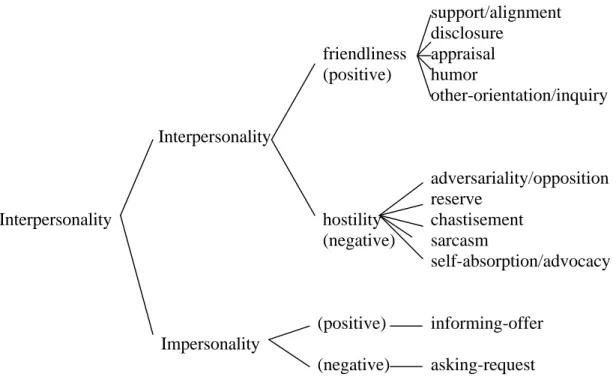
(32) ‘heart’ versus ‘head’ (McDonald, 1997, p. 35). Interpersonality is often referred to as social or personally oriented interaction or informal communication that addresses the creation of relationship norms among participants (Sudweeks & Allbritton, 1996; Sudweeks & Simoff, 1999). It is cited in opposition to information exchange, taskoriented, and formal or impersonal discourse (Rica & Love, 1987; Walther, 1996). Interpersonality is categorized by valence (positive/negative) (Bales, 1970; Bochner, Kaminski, & Fitzpatrick, 1977), and related to issues such as friendliness/hostility (Smith, McLaughlin, & Osborne, 1997), disclosure/reserve, appraisal/chastisement (or flaming), (Herring, 1996d; 1998; Mabry, 1997), humor/sarcasm (Baym, 1995a; Baym, 1997; Rafaeli & Sudweeks, 1998), support/adversariality (or alignment/opposition), and other/self-orientedness. Impersonality (Walther, 1996), traditionally considered as task-oriented style of interpersonal behavior, is related to an inform-offer/aski-request bipolar category.. Research Assumptions and Biases Every research project is as much supported on literature review as it is based upon the researcher’s own ideas, points of view, and assumptions about the world in general and the studied problem in particular. It is therefore a healthy measure to state those assumptions clearly: 1. All pedagogical interactions are mediated by the human word, be it oral or textual. There is no such thing as a non-mediated pedagogical communication (Laurillard, 1996; Peraya, 1996).. 19.
(33) 2. Education is the practice of a type of communication (Tiffin & Rajasingham, 1995). Learning is built through conversational exchanges between persons or among groups, involving the creation and interpretation of communication. Communication exchange is required among students in order to build knowledge (Bullen, 1997; Harasim, 1990). 3. People collaboratively construct beliefs and meanings, as well as state their differences through conversations (Gay & Lentini, 1995). Learning is thus an interactive, dialogue-based process among participants involved in a pedagogical interaction. Its purpose is to provide a social context where students can communicate and converse. “Speaking and listening are the motor and motivation of learning...Students who take an active role in constructing meaning … learn more and better” (O’Keefe, 1995, p. 3-4). Learning is a result of interaction. “Learning is essentially a social process that requires interaction for the purpose of expression, validation, and the development of the self as a knowledgeable learner” (Jaffee, 1997, p. 265). 4. Collaborative learning promotes higher achievement, higher-level reasoning, more frequent generation of ideas and solutions, and greater transfer of learning than individualistic or competitive learning strategies (Johnson, Johnson, & Smith, 1991). “Collaborative development of shared meaning requires a substantial amount of communication, perhaps even more so in on-line than in face-to-face groups” (Brandon & Hollingshead, 1999). 5. Online education constitutes a new teaching and learning environment in. 20.
(34) many ways different from traditional face-to-face environments (Ball-Rokeach & Reardon, 1988). 6. Small, online academic groups are autonomous, circular, and self-referenced systems of interaction whose properties are a consequence of its own organization. Change within those groups is reflected in the patterns of interaction among its members. “To discover the nature of a total system, it is necessary to interact with it and trace the circular pattern of interaction through which it is defined” (Morgan, 1997, p. 254). Although personality or situational factors may on their own explain some behavioral outcomes, most behavior is determined by the interaction of personality and situation (Magnusson & Endler, 1977). However, personality traits have low predictability in accounting for behavior across diverse social situations. Situational forces are much more influential than personality dispositions regarding behavioral outcomes in group processes (Mischel, 1968). 7. Asymmetries and systematic inequalities are essential properties of social interaction, of which communication processes are a special form. Differences between speakers regarding levels of participation, interactivity and interpersonal relations are displayed to some degree among participants in groups (Cohen, 1994). Those asymmetries may be imposed from outside (derived from social power and authority), but mostly they are dialogue produced or intrinsic, “as when derived from asymmetries between dialogue initiatives and responses as basic mechanisms of interaction” (Linell & Luckmann, 1991, p.10). 8. Socioaffective content marks human interactions. Emotions and affection are. 21.
(35) constitutive of human beings. They are a ubiquitous presence of lived experience. They determine, to a great extent, communication and learning, and are key issues in defining success or failure in the learning process (Maturana, 1992). The division between task-oriented and relationship-oriented communication in human relationships is artificial and no longer represents a viable model for understanding human learning (Watzlawick, Bavelas, & Jackson, 1967).. 22.
(36) CHAPTER 2 - LITERATURE REVIEW Computer-mediated communication (CMC) is considered a sociotechnical system combining both technical and social elements (Feenberg & Bellman, 1990), in which participants not only transmit, receive, and store information from each other through messages, but also the emotional and motivational aspects contained in those same messages (McGrath & Hollingshead, 1994). As a particular technology or device within CMC, computer conferencing provides the potential for a two-way communication necessary for intellectually constructive interactions (McDonald, 1997). Its growing inclusion for educational purposes in online courses since 1982 (Bullen, 1997) provide increased opportunities for ongoing group interaction. However, although theoretical attempts have been advanced in organizational, social, and academic settings, the literature reviewed indicates that there is at present no well established theory or substantial body of empirical research around the use of CMC and computer conferencing that can be of help to course designers, online tutors, and forum participants. Moreover, the existing body of literature seems to regard CMC and electronic academic forums as fundamentally impersonal and taskoriented, and thus especially well suited only for objective knowledge exchange. This chapter has two main sections. In the first section, various issues and concepts pertaining to CMC and computer conferencing are covered. A working definition and a historical background are offered, and a typology of diverse devices in CMC is attempted. Technical and linguistic attributes of asynchronous computermediated communication (ACMC, mainly electronic mail and computer. 23.
(37) conferencing) that potentially may affect group interaction are described. Some findings in social, organizational and educational environments that may have a direct impact upon the purposes of the study are also reviewed. The second section is mainly a theoretical and empirical review of literature that has a direct bearing upon the notions of interactivity and interpersonality in computer conferencing and to the purposes of the study. From a group interaction perspective, various interpretations of these two constructs are described and classified. Borrowing from the linguistic field, a framing model for online participation, interaction and interactivity is developed. Next, the importance and relevance of interpersonality and socioemotional aspects in group development and relational processes is reviewed. Issues affecting both interactivity and interpersonality are then examined, and finally, a set of dimensions for analyzing online interpersonal behavior is developed.. Computer-mediated Communication CMC is the interaction between humans using computers to connect with one another (Kiesler, 1997. p. ix). Broadly defined, composition, transfer, storage, and retrieval of electronically transmitted text are an integral part of CMC (Collins, 1/02/99; Lee, 1997). Narrowly defined, CMC refers to The use of computers and computer networks as communication tools by people who are collaborating with each other to achieve a shared goal, which do not require the physical presence or co-location of participants, and which can provide a forum for continuous communication free of time constraints. (Kaye in Burgstahler & Swift, 1996, p.2). 24.
(38) For the purpose of this study, a more human point of view is adopted. CMC can thus be understood as the “communication between human beings via the instrumentality of computers” (Herring, 1996a, p. 1) through electronic mail, group conferencing systems and interactive chat systems. It is also conceived as “communication taking place between people through the computer” (Olaniran, 1996, p. 134), thus setting the stress on people more than on the technology. Jones (1995) states it clearly: “CMC, of course, is not just a tool: it is at once technology, medium, and engine of social relations. It not only structures social relations, it is the space within which the relations occur and the tool that the individuals use to enter that space” (p. 16). Wellman et al. (1996) state that “when a computer network connects people, it is a social network...a set of people connected by a set of socially meaningful relationships” (p. 179). Computers are then conceived as a support for human communication (Santoro, 1995). CMC is thus here understood mainly as a social more than a technical phenomenon: it is about people communicating with other people (Chenault, 1998).. Historical Background Originally devised for military and research resource sharing purposes (Donath, 1999; Quarterman, 1991), computer networks (ARPANET) transformed themselves into person-to-person social networks and communication forums in scarcely 25 years, with commerce and education dominating the host domains (King, Grinter &. 25.
(39) Pickering, 1997). While the military network sought a highly distributed, asynchronous and autonomous communication system that could survive a massive nuclear attack, the researchers sought to capitalize on the efforts of dispersed members of their community. Presently, the uses of CMC range from transferring protocols to electronic commerce, from educational tutoring to political propaganda, from interpersonal support to conversation for action, from information exchange to maintenance of social cohesion. The primary purpose of computers when they first appeared in the corporate environment was the manipulation of numbers, mainly bookeeping and payroll tasks (Rapaport, 1991). During the 1960s, thanks to the development of direct access storage devices (DASD), file transfer protocols (FTP), and TELNET, text manipulation was possible. However, CMC consisted in the exchange of short, oneline instruction messages. Electronic mail (e-mail), not an original part of ARPANET in 1969 (Sproull & Kiesler, 1993), was first considered a ‘minor addition’ in the 1970s. Computer conferencing, the antecedent of online education pioneered by Murray Turoff and others in the early 1970s, was to be a “collective intelligence environment, which would use the computer to structure human communication for information exchange and effective problem solving” (Harasim, 1990, p. 41). However, educational computer conferencing as such started only in the early 1980s. The American Open University first made use of computer conferencing in 1983 to supplement learner-tutor communication, while the Jutland Open University in. 26.
(40) Denmark implemented computer conferencing the same year to deliver postgraduate courses (Harasim, et al. 1996; Nipper, 1989). Random Access Storage (RAS) made it possible for researchers to start thinking of computers as facilitators of human communication. By 1975, e-mail was the most used device on the network, and by 1977, electronic mailing lists or distribution groups were formalized (Quarterman, 1991). However, it was not until 1989 that text-based interaction was first introduced in distance education, when the British Open University implemented computer conferencing as a supplement of a massive distance education course to over 1,300 students (Harasim, et al. 1996). Presently, CMC includes, although in a limited fashion, a varied range of graphic, auditory, and/or tactile modalities either in combination or in substitution of mainly text-based activities performed through several technologies, and serves multiple purposes. However, the most important characteristic of CMC for educational purposes is interactive, linguistic exchange between individuals (Murray, 1991).. Typology CMC is not a unified field, although literature has frequently considered it as a single block. A thorough classification of CMC varieties has not yet been achieved, both due to the still ambiguous terminology and to the ever-expanding range of new applications. Devices (Paulsen, 1995a), systems (Rapaport, 1991), services (Bates, 1995; Quarterman, 1991), sub-contexts (Metz, 1994), and systems (Holmberg, 1996a;. 27.
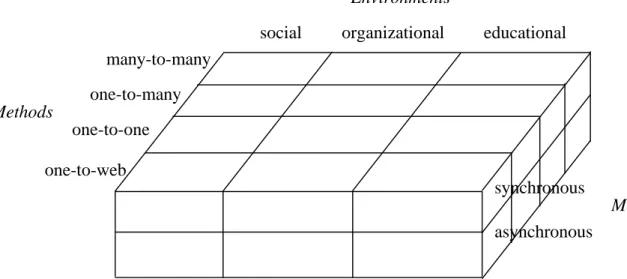
(41) Kollock & Smith, 1999) are an example of this present lack of clarity. These terms are used to refer to both asynchronous (e-mail, bulletin boards, computer conferencing) and synchronous applications of CMC. For the purpose of this study, the term devices will be used. Based on Harasim (1989), Paulsen (1995a, 1999), and Moore (1996a), a classification model for CMC is proposed: Environments social. organizational. educational. many-to-many one-to-many Methods one-to-one one-to-web synchronous Modes asynchronous. Figure 1. An interrelational typology among methods, environments and modes in CMC. Many-to-many social synchronous:. IRCs, MOOs, MUDs. Many-to-many organizational synchronous:. IRCs, CSCW, DSSs. Many-to-many educational synchronous:. IRCs, CSCW, MUDs, CSCL. Many-to-many social asynchronous:. LISTSERVs, USENETs, conferencing. Many-to-many organizational asynchronous:. Newsgroups, conferencing. Many-to-many educational asynchronous:. Newsgroups,. 28. MOOs,.
(42) conferencing One-to-many social synchronous:. IRCs, MOOs, MUDs. One-to-many organizational synchronous:. CSWS. One-to-many educational synchronous:. IRCs, CSCW, MOOs, MUDs. One-to-many social asynchronous:. BBs, Distribution lists, mailing lists. One-to-many organizational asynchronous. BBs, Distribution lists, mailing lists. One-to-many educational asynchronous:. BBs, Distribution lists, mailing lists. One-to-one social synchronous:. IRCs, Electronic mail. One-to-one organizational synchronous:. IRC, Electronic mail. One-to-one educational synchronous:. IRC, Electronic mail. One-to-one social asynchronous:. Electronic mail. One-to-one organizational asynchronous. Electronic mail. One-to-one educational asynchronous:. Electronic mail. One-to-web social synchronous:. -----. One-to-web organizational synchronous:. -----. One-to-web educational synchronous:. -----. One-to-web social asynchronous:. FTP, TelNet. One-to-web organizational asynchronous. FTP, TelNet. One-to-web educational asynchronous:. FTP, TelNet. This model allows a classification of devices so that research efforts may be carefully situated within the spectrum of CMC. Three interaction environments are identified (organizational, educational and social), four methods of interaction (oneto-web, or learner/content interaction; one-to-one, one-to-many, and many-to-many, or learner/instructor and learner/learner interaction), and two modes of interaction. 29.
Figure

+2

Documento similar
For a short explanation of why the committee made these recommendations and how they might affect practice, see the rationale and impact section on identifying children and young
In this study, the relationships among sleep habits (time in bed on weekends and weekdays and social jetlag), morningness-eveningness, academic achievement and cognitive
3) Static Benchmark and Static Regret: The static bench- mark [20] takes only one fixed action x ∗ over the entire time- horizon which minimizes the aggregate cost over T.. The
The Health Belief Model (HBM) [3], the Theory of Reasoned Action (TRA) [4] or Planned Behavior (TPB) [5], the Information- Motivation-Behavioral Skills Model (IMB) [6], and
This study presents the findings of a year-long e-mail exchange between learners of English at Nebrija University in Madrid and learners of Spanish at Trinity College Dublin during
Relationship between the total cluster stellar mass and the photometric blue fraction for the ALHAMBRA cluster and group sample stacked into different redshift bins. The galaxy
Undergraduate students can transfer credit to Tecnológico de Monterrey for studies completed at a foreign educational institution with which a cooperation agreement has
Undergraduate students can transfer credit to Tecnológico de Monterrey for studies completed at a foreign educational institution with which a cooperation agreement has
