Comparing supervised learning methods for classifying sex, age,
context and individual Mudi dogs from barking
Ana Larranaga • Concha Bielza • Peter Pongracz • Tamas Farago • Anna Balint • Pedro Larranaga
Abstract Barking is perhaps the most characteristic form of vocalization in dogs; however, very little is known about its role in the intraspecific communication of this species. Besides the obvious need for ethological research, both in the field and in the laboratory, the possible information content of barks can also be explored by computerized acoustic analyses. This study compares four different supervised learning methods (naive Bayes, classification trees, k-nearest neighbors and logistic regression) com-bined with three strategies for selecting variables (all variables, filter and wrapper feature subset selections) to classify Mudi dogs by sex, age, context and individual from their barks. The classification accuracy of the models obtained was estimated by means of K-fold cross-valida-tion. Percentages of correct classifications were 85.13 % for determining sex, 80.25 % for predicting age (recodified as young, adult and old), 55.50 % for classifying contexts (seven situations) and 67.63 % for recognizing individuals (8 dogs), so the results are encouraging. The best-per-forming method was k-nearest neighbors following a
A. Larranaga
Student at the Universidad Alfonso X El Sabio, Av. Universidad, 1, 28691 Villanueva de la Canada, Madrid, Spain
C. Bielza • P. Larranaga (E3)
Computational Intelligence Group, Universidad Politecnica de Madrid, Campus de Montegancedo, 28660 Boadilla del Monte, Madrid, Spain
e-mail: [email protected] P. Pongracz • T. Farago • A. Balint
Department of Ethology, Biological Institute, Eotvos Lorand University, 1117 Pazmany Peter setany 1/c, Budapest, Hungary
wrapper feature selection approach. The results for classi-fying contexts and recognizing individual dogs were better with this method than they were for other approaches reported in the specialized literature. This is the first time that the sex and age of domestic dogs have been predicted with the help of sound analysis. This study shows that dog barks carry ample information regarding the caller’s indexical features. Our computerized analysis provides indirect proof that barks may serve as an important source of information for dogs as well.
Introduction
Canine communication (including dog–human communi-cation) has become a well-studied topic among ethologists in the last decade. Most efforts have focused on how and to what extent dogs are able to understand different forms of human communication, through visual gestures (Reid
2009), voice recognition (Adachi et al. 2007), acoustic signals for ceasing or intensifying their activity (McCon-nell and Baylis 1985; McConnell 1990), and ostensive signals (Te´gla´s et al. 2012). However, it has also been found that dogs can get their message across to humans, for example, by turning their head or alternating their gaze between the human and their target (Miklo´si et al. 2000), and that dogs can emulate other behavioral forms so as to convey feelings, of guilt for example, in an appropriate situation (Hecht et al. 2012).
are regarded as highly conservative and uniformly con-structed within such broad groups of animals as avian and mammalian species. Morton (1977) provided a set of so-called motivation-structural rules to explain this point. According to his theory, the quality of the sound (pitch, tonality) strongly depends on the physical (anatomical) constraints of the animal’s voice-producing tract, which in turn depends on the physical features of the animal itself (size, for example). Stronger, larger specimens within a species will usually be the dominant, aggressive animals and smaller, younger individuals are usually the subordi-nates. Thus, the typical vocalizations (low pitched, broad-band, noisy) emitted by the larger, more aggressive individuals, for example, could, according to Morton, evolve into the trademarks of agonistic inner states. Simi-larly, the typical vocal features of a smaller, subordinate animal (high pitched, narrow band, tonal) could project the lack of aggressive intent communicative meaning.
Dogs have a rich vocal repertoire, see (Cohen and Fox
1976; Tembrock 1976; Yeon 2007), like other closely related wild members of the Canidae family. The etholog-ical analysis of the possible functions of canine vocaliza-tions has so far provided data about the individual-specific content of wolf howls (Mazzini et al. 2013; Root-Gutteridge et al. 2013), the indexical content of dog growls, related to the caller’s body size (Taylor et al. 2008, 2010; Farago´ et al.
2010a; Ba´lint et al. 2013), and the context-specific content of dog growls (Farago´ et al. 2010b; Taylor et al. 2009). However, even though barking is considered to be the most characteristic form of dog vocalization, exceeding the barks of wolves and coyotes both in its frequency of occurrence and variability (Cohen and Fox 1976), the functional aspects of dog barks are surprisingly little known. The theoretical framework for the information content and evolution of barking in the dog involves very different assumptions, ranging from the theory that it is a non-communicative byproduct of domestication (Coppinger and Feinstein
1991), through the low-information level mobbing signal theory (Lord et al. 2000), to the context-specific information source theory (Feddersen-Petersen 2000; Yin 2002; Pon-gra´cz et al. 2010). As dogs are the oldest domesticated companions of humans (Druzhkova et al. 2013), dog bark-ing may have acquired a ’new target audience’ in humans during the many 1,000 years of coexistence. A possible indirect proof of this is a series of playback experiments which showed that humans are able to correctly categorize barks according to their contexts (Pongra´cz et al. 2005). As for contextual content, human listeners also had consistent opinions about the inner state of the barking dogs, and the acoustic analysis of the barks revealed that humans base their decision on the kinds of acoustic parameters of the barks that were expected on the basis of Morton’s theory (Pongra´cz et al. 2006). Besides the pitch and the
harmonic-to-noise ratio, however, it was found that the inter-bark interval (or ‘pulsing’) of the barks is also important when assessing the inner state of the barking dog.
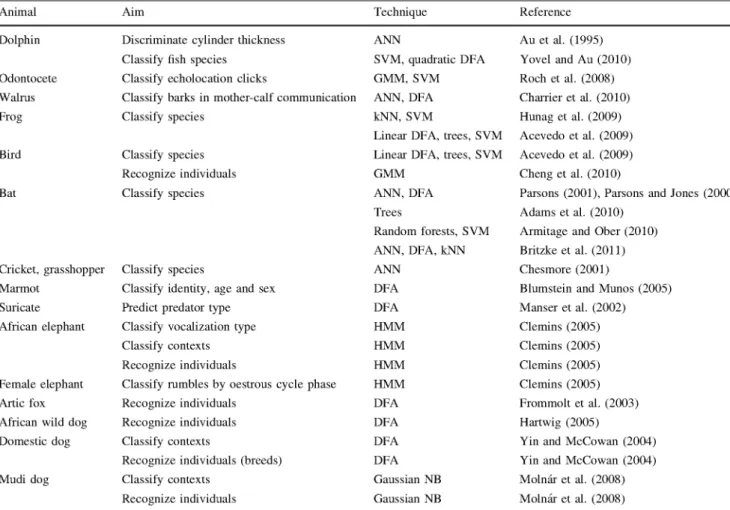
Table 1 Examples of machine learning technique usage from acoustic signals for different species with different aims
Animal Aim Technique Reference
Dolphin
Odontocete Walrus Frog
Bird
Bat
Cricket, grasshopper Marmot
Suricate African elephant
Female elephant Artic fox African wild dog Domestic dog
Mudi dog
Discriminate cylinder thickness Classify fish species
Classify echolocation clicks
Classify barks in mother-calf communication Classify species
Classify species Recognize individuals Classify species
Classify species
Classify identity, age and sex Predict predator type Classify vocalization type Classify contexts Recognize individuals
Classify rumbles by oestrous cycle phase Recognize individuals
Recognize individuals Classify contexts
Recognize individuals (breeds) Classify contexts
Recognize individuals
ANN
SVM, quadratic DFA GMM, SVM ANN, DFA kNN, SVM
Linear DFA, trees, SVM Linear DFA, trees, SVM GMM
ANN, DFA Trees
Random forests, SVM ANN, DFA, kNN ANN
DFA DFA HMM HMM HMM HMM DFA DFA DFA DFA Gaussian NB Gaussian NB
Au et al. (1995) Yovel and Au (2010) Roch et al. (2008) Charrier et al. (2010) Hunag et al. (2009) Acevedo et al. (2009) Acevedo et al. (2009) Cheng et al. (2010)
Parsons (2001), Parsons and Jones (2000) Adams et al. (2010)
Armitage and Ober (2010) Britzke et al. (2011) Chesmore (2001)
Blumstein and Munos (2005) Manser et al. (2002) Clemins (2005) Clemins (2005) Clemins (2005) Clemins (2005) Frommolt et al. (2003) Hartwig (2005)
Yin and McCowan (2004) Yin and McCowan (2004) Molna´r et al. (2008) Molna´r et al. (2008)
ANN artificial neural network, SVM support vector machine, DFA discriminant function analysis, GMM Gaussian mixture model, kNN k-nearest neighbor classifier, HMM hidden Markov model, NB naive Bayes
vector machines have been employed to automate the classification of calls of several frog and bird species (Acevedo et al. 2009). Gaussian mixture models have also been used for individual animal recognition in birds (Cheng et al. 2010). Bat species have been acoustically identified using artificial neural networks (Parsons 2001; Britzke et al. 2011), discriminant function analysis (Par-sons and Jones 2000; Britzke et al. 2011), classification trees (Adams et al. 2010), k-nearest neighbors (Britzke et al. 2011) as well as other classifiers (random forests and support vector machines) whose behavior has been com-pared (Armitage and Ober 2010). Artificial neural networks have been used to discriminate between the sounds of different animals within a group of British insect species (Orthoptera), including crickets and grasshoppers (Ches-more 2001). Blumstein and Munos (2005) found poten-tially significant information about identity, age and sex encoded in yellow-bellied marmots calls using discrimi-nant function analysis. For suricates, discrimidiscrimi-nant function analysis was chosen to predict the predator type (mammal, bird and snake) from the alarm calls (Manser et al. 2002).
Hidden Markov models have been used to analyze African elephant vocalizations and speaker identification, discrim-ination of rumbles in different contexts, and oestrous cycle phase determination from rumbles of female elephants (Clemins 2005). Moreover, other work has focused on identifying calls from different animals such as bears, eagles, elephants, gorillas, lions and wolves, with k-nearest neighbor classifiers, artificial neural networks and hybrid methods (Gunasekaran and Revathy 2011).
For canids, research analyzing the acoustic measures of barks with machine learning methods is limited, see Table 1. Discriminant functions have been used for indi-vidual recognition within a wild population of Arctic foxes (Frommolt et al. 2003) and African wild dogs (Hartwig
barks were recorded from ten dogs of six different breeds, and 120 variables were extracted from the spectrograms. More recently, 6,006 barks of 14 Mudi breed individuals were recorded under six different communicative situations (Molna´r et al. 2008). After processing the spectrograms of their signals, a genetic programming-based heuristic guided the construction of new descriptors. The aims were the same as in Yin and McCowan (2004), although the machine learning technique was a Gaussian naive Bayes classifier.
In this paper, we extend Molna´r et al.’s research in several ways. As in Molna´r et al. (2008), we classify barks into contexts and identify individual barks. Unlike Molna´r et al., we also investigate whether barks encode information about dog sex and age. Also, we specify context classifi-cation per individual dog and recognize individual bark per context. Therefore, we have six different classification problems concerning sex, age, contexts, contexts per indi-vidual, individuals and individuals per context. Moreover, for each of these six problems, a thorough set of four machine learning models (Gaussian naive Bayes, classifi-cation trees, k-nearest neighbors and logistic regression) are trained from a database of 800 barks corresponding to 8 Mudi dogs in seven behavioral contexts. Their performance is estimated using cross-validation (K-fold scheme) which assesses the ability to classify barks that had not been pre-viously encountered. Given an incoming Mudi dog bark, two models (Gaussian naive Bayes and logistic regression) output the probability of each class value, whereas the other two models deterministically provide the predicted class value. Gaussian naive Bayes assumes normality and inde-pendence of the features given the class value. Logistic regression uses the sigmoid function of a linear combination of the features as the probability of each class value. Classification trees hierarchically partition the feature space. Finally, k-nearest neighbors simply predicts the class value by majority voting in a feature space neighborhood. The diversity of these four models is representative of the available supervised classifiers. Rather than using all the extracted acoustic measures, we selected relevant features with two methods, filter and wrapper, for each machine learning model. Whereas wrapper methods use a predictive model to score feature subsets, filter methods use a proxy measure instead of the classification accuracy to score the selected features.
Methods
Subjects
Barks recorded from Mudi dogs were used for this study. The Mudi is a medium-sized Hungarian herding dog breed. The Mudi breed standard is listed as #238 with the FCI
(Federation Cynologique Internationale). Initially, we collected 7,310 barks from 27 individuals. The number of barks per dog ranged from 8 to 1,696. These barks were recorded in different number of bouts for each dog. Trying to minimize the effect of pseudoreplication, we only con-sidered dogs whose initial number of barks was greater than 300. From each of these 8 dogs, 100 barks were randomly selected using a systematic sampling procedure, thereby balancing the number of samples coming from each indi-vidual. Table 2 contains the characteristics of these selected 800 barks according to sex ratio (male-female 3:5), age (ranging from 1 to 10 years old), number of bouts for each dog (with a minimum of 5 and a maximum of 14) and number of barks per dog in each of the seven contexts. Age values are grouped into intervals to form a three-valued class variable: young dogs (1-3 years old), adult dogs (4-8 years old) and old dogs (more than 8 years old).
Recording and processing of the sound material
Recording contexts
Recordings were made using a Sony TCD-100 DAT tape recorder and Sony ECM-MS907 microphone on Sony PDP-65C DAT tapes. During recording of the barks, the experimenter held the microphone at a distance of 3 to 4 m from the dog. We collected bark recordings in seven different behavioral contexts. With the exception of two contexts (Alone and Fight), all recordings were done at the dog’s residence. Barks of the Fight context were recorded at dog training schools. The training school dogs were also taken to a park or other suitable outdoor area to record the Alone barks. The seven situations are as follows:
- Alone (N = 106 recordings): The owner and the experimenter (male, 23 years old) took the dog to a park or other outdoor area, where the dog was tied to a tree or fence by its leash. The owner left the dog and walked out of the dog’s sight, while the experimenter remained with the dog and recorded its barks.
- Ball (N = 131): The owner held a ball (or one of the dog’s favorite toys) approximately 1.5 m in front of the dog.
- Fight (N = 131): For dogs to perform in this situation, the trainer acts as if he intends to attack the dog-owner dyad. Dogs are expected to bark aggressively and even bite the trainer’s glove. The owner keeps the dog on a leash during this exercise.
- Food (N = 106): The owner held the dog’s food bowl approximately 1.5 m in front of the dog.
Table 2 Characteristics of the bark data set with seven context categories: Alone, Ball, Fight, Food, Play, Stranger and Walk Context
Number 1 2 3 4 5 6 7 8 Total
Dog Bogyo´ Deru¨s Fecske Guba Harmat Saba Ugyes Merse
Sex Male Female Female Female Female Female Male Male
Age (years) 1 2 2 5 4 6 10 7
Bouts 5 15 10 14 7 7 6 6
Alone
25 50
17 14 106
Ball
25 50
25 17 14 131
Fight
25
50 25 17 14 131
Food
50
25 17 14 106
Play 50
25
14 89
Stranger 50 50 25
50
17 14 206
Walk
17 14 31
Total 100 100 100 100 100 100 102 98 800
The experimenter recorded the barks emitted during this interaction.
– Stranger (N ¼ 206): The experimenter acted as the ’stranger’ for all the dogs and appeared at the dog owners’ garden or front door. The experimenter recorded the barking dog for 2–3 min. The owner was not in the vicinity (in the garden, or near to the entrance) during the recording.
– Walk (N ¼ 31): We asked the owner to behave as if he/she was preparing to go for a walk with the dog. For example, the owner took the dog’s leash in her/his hand and told the dog ‘We are leaving now.’
Initial processing of the sound material
The recorded material was digitalized with a 16-bit quan-tization and 44.10 kHz sampling rate using a TerraTec DMX 6Wre 24/96 sound card. As each recording could contain at least three or four barks, individual bark sounds were manually segmented and extracted. This process resulted in a final collection of 7,310 sound files containing only a single bark sound. Obviously, these sounds are not independent from a statistical point of view. As some of the machine learning methods used in this work assume that the samples are independent and identically distributed, we randomly selected non-consecutive barks, alleviating in this way the pseudoreplication effect. The final data set contains 800 barks from the initial 7,310 sound files.
Sound analysis
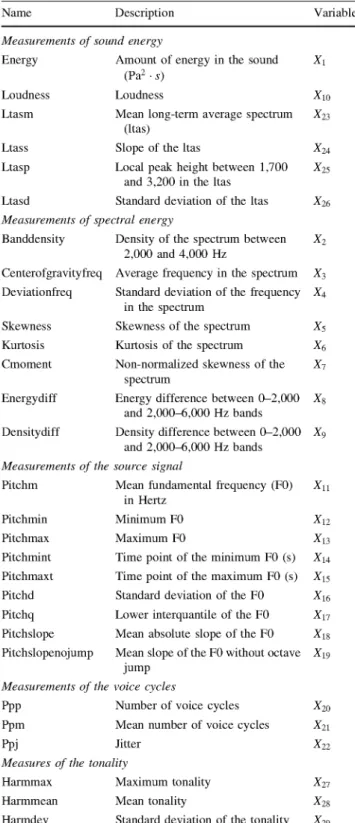
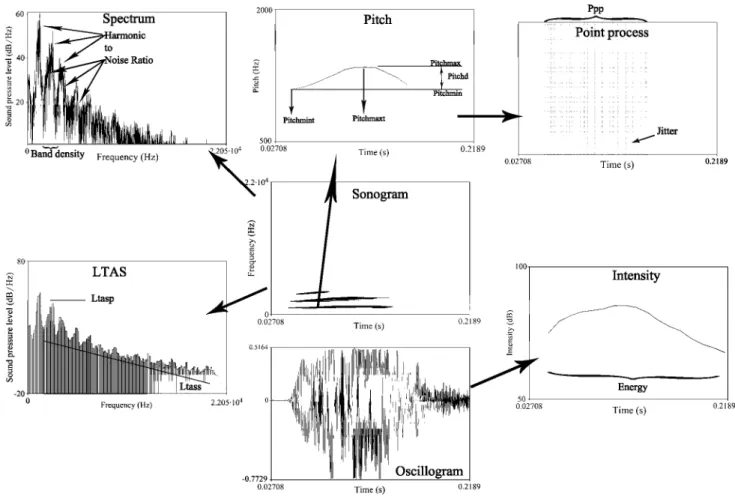
Based on the initial parameter set used in Molna´r et al. (2008), 29 acoustic measures were extracted from the bark samples with an automated Praat script, see Table 3 and Fig. 1.
The energy, loudness and the long-term average spec-trum (LTAS) are measurements of sound energy, and the
LTAS parameters reflect its change over time, whereas the spectral parameters show the distribution of energy over the frequency components.
According to the source–filter framework (Fant 1976), the fundamental frequency is the lowest harmonic com-ponent of the source signal that is produced in the larynx by the movements of the vocal fold. Measurements of the fundamental show the modulation of this source signal over time. One voice cycle is the unit of the movements of the vocal folds. During sound production, the repeated opening and closing of the vocal folds generates cyclic pressure changes in the exhaled air, which will be the sound wave itself. Measurements of the vocal cycles show the regularities in voice production.
Finally, tonality or harmonics-to-noise ratio gives the proportion of regular, tonal frequency components over the noise caused by the irregular movements of the vocal folds, or the turbulences in the air flow in the vocal tract. These measurements are capable of describing the quality of the sound and its change over time.
The process is illustrated in Fig. 2 (top).
Supervised classification
Table 3 Twenty-nine acoustic measures extracted from barking recordings
Name Description Variable
(dog barks) that are similar with respect to the features at hand.
In this paper, we apply supervised classification methods to automatically learn models from data. These models will
be used to separately predict dog sex, dog age, context and the individual dog from a set of predictor variables cap-turing the acoustical measures of the dog barks.
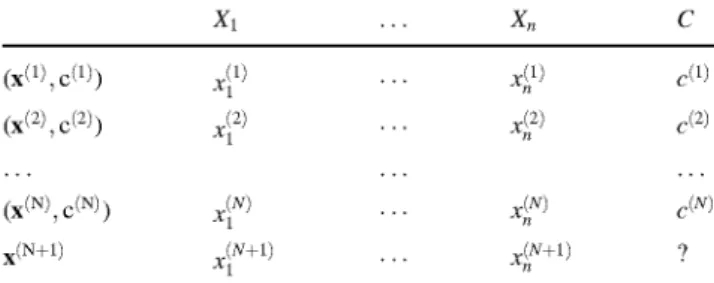
In a binary supervised classification problem, there is a feature vector X E Mn whose components, X1,.. .,Xn, are
called predictor variables, and there is also a label or class variable C taking values on {0,1}. The task is to induce classifier models from training data, which consists of a set of TV observations V^ = {(x^ , c1),..., (x*- , cN) } drawn from the joint probability distribution p(x,c), see Table 4. In our dog data set, n = 8 acoustical measures and TV = 800 bark sounds. The classification model will be used to assign labels to new instances, x(N+1), only char-acterized by the values of the predictor variables.
To quantify the goodness of a binary classification model, true positives (TP), true negatives (77V), false pos-itives (FP) and false negatives (FN) are counted over the test data and placed in a confusion matrix. This confusion matrix contains in its diagonal the TP and 77V observations. Then, we can define the error rate as -—'-p—-, where TV = \TP\ + \FP\ + |77V| + \FN\ is the total number of instances,
• <i u \TP\+\TN\ or equivalently, the accuracy as -—'-^—L.
Dog sex classification is binary, Qc = {Female, Male}, where there are two possible errors: predict a Male as a Female dog, and alternatively predict a Female as a Male.
The other classifications are multiclass, where C takes r > 2 possible class values. Let Qc = { 1 , 2 , . . . , r} denote this set. Thus, Qc = {Young, Adult, Old} for age, Qc = {Alone, Ball, Fight, Food, Play, Stranger, Walk} for con-texts, and Qc = {dog1,...,dog8} for individuals in our case. The r x r-dimensional confusion matrix contains all pair-wise counts, my, the number of cases out of TV from the real class Ci classified by the model as Cj. The accuracy is given by 2~ii=1 mii/N .
Accuracy estimation of supervised classification models
An important issue is how to honestly estimate the (expected) accuracy of a classification model when using this model for classifying unseen (new) instances. A simple method is to partition the whole data set into two subsets: the training subset and the test subset. According to this training and testing scheme, the classification model is learned from the training subset, and it is then used in the test subset for the purpose of estimating its accuracy. However, the information in the data set is under-used, as the classification model is learned from a subset of the original data set.
In this paper, we will use an estimation method called K-fold cross-validation (Stone 1974). This uses the whole data set to honestly learn the model. The data set is parti-tioned into K folds of approximately the same size. Each Measurements of sound energy
Energy Amount of energy in the sound X1 (Pa2 • s)
Loudness Loudness X1 0
Ltasm Mean long-term average spectrum X23 (ltas)
Ltass Slope of the ltas X24 Ltasp Local peak height between 1,700 X25
and 3,200 in the ltas
Ltasd Standard deviation of the ltas X26
Measurements of spectral energy
Banddensity Density of the spectrum between X2 2,000 and 4,000 Hz
Centerofgravityfreq Average frequency in the spectrum X3 Deviationfreq Standard deviation of the frequency X4
in the spectrum
Skewness Skewness of the spectrum X5 Kurtosis Kurtosis of the spectrum X6 Cmoment Non-normalized skewness of the X7
spectrum
Energydiff Energy difference between 0-2,000 X8 and 2,000-6,000 Hz bands
Densitydiff Density difference between 0-2,000 X9 and 2,000-6,000 Hz bands
Measurements of the source signal
Pitchm Mean fundamental frequency (F0) in Hertz
Pitchmin Minimum F0 Pitchmax Maximum F0
Pitchmint Time point of the minimum F0 (s) Pitchmaxt Time point of the maximum F0 (s) Pitchd Standard deviation of the F0 Pitchq Lower interquantile of the F0 Pitchslope Mean absolute slope of the F0 Pitchslopenojump Mean slope of the F0 without octave
jump Measurements of the voice cycles
Ppp Numberofvoice cycles Ppm Mean numberofvoice cycles Ppj Jitter Measures of the tonality
Harmmax Maximum tonality Harmmean Mean tonality
Harmdev Standard deviation of the tonality X 2 X 3
X14 X15
X17 X18
X19
X21
X22
Fig. 1 Main parameters measured for the acoustic analysis using Praat functions. The oscillogram shows the actual complex waveform of a single bark. The amplitude of the waveform shows the intensity change over time, which is represented here as the intensity profile. The energy parameter is the overall energy transferred by the sound over time. Fast Fourier transformation is used to create a sonogram which shows the frequency spectrum of the bark over time. Autocorrelation method was applied to extract the fundamental frequency and its profile depicted as the pitch object. The fundamen-tal frequency is the frequency of opening and closing cycles of the
vocal fold, which is represented by the point process object where every vertical line represents one vocal cycle. This can be used to measure the periodicity of the sound and irregularities in sound production (jitter). The spectrum shows the overall power of each frequency component. The harmonic-to-noise ratio gives the ratio of harmonic spectral components (the upper harmonics of the funda-mental frequency) over the irregular, noisy components. Finally, the long-term average spectrum (LTAS) represents the average energy distribution over the frequency spectrum
fold is left out of the learning process, which is carried out with the remaining K—1 folds, and used later as a test set. This process is repeated K times. Thus, every instance is in a test set exactly once and in a training set K — 1 times. The model accuracy is estimated as the mean of the accuracies for each of the K test sets. In our experiments, we will fix the value of K to 10.
Feature subset selection
The feature subset selection (FSS) problem (Liu and Mo-toda 1998) refers to the question of whether all the n pre-dictor features are really useful for classifying the instances with a given model. The FSS problem can be formulated as follows: Given a set of candidate features, select the best subset under some classification learning method.
This dimensionality reduction by means of an FSS process has several potential advantages for a supervised classification model, such as the reduction in the cost of data acquisition, an improved understanding of the final classification model, a faster induction of the classification model and an improvement in classifier accuracy.
FSS can be viewed as a search problem, where each state in the search space specifies a subset of selectable features. An exhaustive search of all possible feature sub-sets, given by 2n, is usually unfeasible in practice because of the large computational burden, and heuristic search is usually used.
alone ball fight food play stranger walk
Fig. 2 Diagram of the study: data preprocessing (top) and questions to be answered by machine learning models (bottom)
Table 4 Raw data in a supervised classification problem: N denotes the number of labeled observations, each of them characterized by n predictor variables, X1; . . .; Xn and the class variable C
X1 X„ c
(x(2',c(2>)
(x (N) c(N))
x(N+1)
J2)
JN+1)
1)
2)
I
N)
I
N+1)
«(1)
J2)
r(N)
? x(N+1) denotes the new observation to be classified by the supervised
classification model
a classifier guides the search for a good subset of features. We have used a greedy stepwise search in our experi-ments, i.e., one that progresses forward from the empty set selecting at each step the best option among adding a variable not yet included within the model and deleting a variable from the current model. The search is halted when neither of these options improves model accuracy. When the learning algorithm is not used in the evaluation function, the goodness of a feature subset can be assessed using only intrinsic data properties, such as an information theory based evaluation function. This is the filter approach to the FSS problem. In this paper, we apply both
wrapper and filter approaches to the FSS problem. For the second type, a multivariate filter based on mutual infor-mation, called correlation feature selection, is used (Hall
1999). This tries both to minimize redundancy between selected features and maximize correlation with the class variable.
Supervised classification methods
Given an instance x, supervised classification builds a function y that assigns to x a class label in Qc = { 1 , . . . , r}. We provide a short description of each supervised classi-fication method used.
n
maxp(c) I fi(jc;-|c). (1)
ceQ.c f 1
In a classification tree (Quinlan 1993), the learned function y is represented by a decision tree. Each (non-leaf) node specifies a value test of some variable of the instance. Each descendant branch corresponds to one of the possible val-ues for this variable. Each leaf node provides the class label given the values of the variables jointly represented by the path from the root to that leaf. Unseen instances are clas-sified by sorting down the tree from the root to some leaf node testing the variable specified at each node. A classi-fication tree is learned in a top-down manner (starting with the root node) by progressively splitting the training data set into smaller and smaller subsets based on variable value tests. This process is repeated on each derived subset in a recursive manner called recursive partitioning of the space representing the predictive variables. Key decisions are how to select which variable to test at each node in the tree, and how deep the tree should be, i.e., whether to stop splitting or select another variable and grow the tree fur-ther. These decisions make the differences between algo-rithms. The C4.5 algorithm used in this paper chooses variables by maximizing the gain ratio, which is the ratio of the information gain of Xj and C and the entropy of Xj, which are both concepts used in information theory. The algorithm incorporates post-pruning rules to avoid the tree becoming too deep thereby escaping from the training data overfitting, i.e., its failure to work well with new unseen instances.
The fe-nearest neighbor classifier (Fix and Hodges 1951) is a nonparametric method that assigns to a given instance x the class label most frequently found among its k nearest instances; that is, the predicted class is decided by exam-ining the labels of the k nearest neighbors and voting. A common distance used for obtaining the k nearest neigh-bors for a continuous variable x is the Euclidean distance. This classifier is a type of lazy learning where the function is only approximated locally and all computation is deferred until classification. In our experiments, we will fix k = 1.
Logistic regression (Le Cessie and van Houwelingen 1992), like naive Bayes, produces a posterior probability p(c\x) for a given instance x. For binary classification, the model assumes that it is a transformation of a linear combination of the input variables, given by
p(C = 1|x) = 1/[1 + g-(A0+f1*1+-+/U)]j
where /?0, /?1,..., (ln are model parameters estimated from data by maximum likelihood. If £(/?0, ...,/?„) denotes the
log-likelihood function of the data under this model, the problem is to find /?s that maximize this function. The ridge
logistic regression used in this paper adds a penalization term to £, and the problem is then to maximize the func-tion £(/?0, . . ., fin) ~ ^ YTi=1 Pi , for Ps where X > 0
con-trols the amount of penalization. This penalty forces the parameters to shrink to zero achieving a reduction in the variance of the parameter estimates with an overall increased accuracy. For multiclass classification, the pos-terior probability of c ^ r is given by
p(c\x)= jlj jl, , ; = 1 , . . . , r - 1
1 + Y!i=1 e( / 3 0 + / ?1 x1+'"+/3nxn)
(2)
and hence, p(r\x) is derived from the others since they all sum to one. Note that in this multiclass case, we need a set
of n + 1 parameters {/?0',f$\ , . . . , / ^ ' } for each I value,
l=1,...,r— 1; that is, a total of (n+1)(r— 1) parameters.
All the results were calculated using WEKA software (Hall et al. 2009).
Results
The six problems we will deal with are illustrated in Fig. 2 (bottom).
Sex
The fe-nearest neighbor classifier produced the best results, with an accuracy of 85.13 %, with a wrapper feature selection (in bold), see Table 5. This model contains 12 predictor variables, see Table 16. The groups that record spectral energy and source signal variables are under-rep-resented, according to the categorization of acoustic mea-sures provided in Table 3.
For the female barks, the misclassification rate is 9.40 % (47 false males out of 500 real females), and it is higher for males, 24.00 % (72 false females from a total of 300 real males).
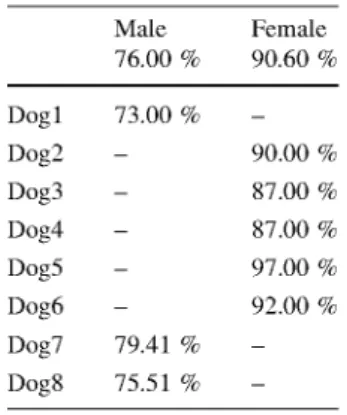
Table 6 shows the accuracies per dog of the fe-nearest neighbor model with 12 predictors. The model accuracy when predicting the five female dogs is around 90 %, with the worst predictions for dog3 and dog4 (87.00 %), and the best for dog5 (97.00 %). The three male dogs are predicted with accuracies ranging from 73.00 % for dog1 to 79.41 % for dog7.
Table 5 Sex prediction Table 7 Age prediction
All Filter Wrapper All Filter Wrapper
Naive Bayes 7 1 . 0 0 % 7 1 . 1 3 % 77.13 % Classification tree 7 8 . 1 3 % 7 2 . 7 5 % 81.50 % k-Nearest neighbors 82.00 % 64.25 % 85.13 % Logistic regression 76.88 % 70.50 % 78.63 % Accuracies of the twelve models: three selection feature methods for each of the four supervised classifiers
Table 6 Sex prediction per dog Male 76.00 %
Female 90.60 %
Accuracies of the best model in Table 5 for each of the eight dogs. The overall accuracy of this model over the eight dogs is 85.13 %
Dog1 Dog2 Dog3 Dog4 Dog5 Dog6 Dog7 Dog8
73.00 %
90.00 % 87.00 % 87.00 % 97.00 % 92.00 % 79.41 %
75.51 %
coefficients of the logistic regression model. For the k-nearest neighbor classifier, the data set constitutes the model and therefore it is not shown.
Age
Table 7 (left) shows the age results. As for the sex pre-diction problem, k-nearest neighbors with a wrapper fea-ture selection produced the best accuracy 80.25 %. The 15 selected variables in this model mainly contain measure-ments of spectral energy, sound energy and voice cycles. For this problem, the wrapper strategy outperformed the other strategies in the four supervised classification methods.
The confusion matrix in Table 7 (right) of the best model shows that a Young dog is classified as Old in only 2.67 % of cases (8 out of 300), while old dogs are mis-classified as Young in 6.86 % of cases (7 out of 102). The error rates classifying Young, Adult and Old dogs are 21.00, 17.59 and 24.51 %, respectively. These figures suggest that it is easier to get it wrong when classifying Young and Old dogs.
Table 8 contains the accuracies per dog of the best model. This model provides a 79.00 % of accuracy when predicting Young dogs. This percentage is very similar for each of the three young dogs (dog1, dog2 and dog3). However, for the four adult dogs the model shows a wide range of accuracies, varying from 66.00 % (dog6) to 90.00 % (dog5). Dog7, that is the only old dog, is classified with an accuracy of 75.49 %.
Naive Bayes 6 8 . 5 0 % 6 5 . 6 3 % 71.88 % Classification tree 7 0 . 8 8 % 6 9 . 1 3 % 74.13 % k-Nearest neighbors 78.63 % 79.13 % 80.25 % Logistic regression 75.63 % 73.88 % 76.00 %
Real class Predicted class
Young Adult Old
Young Adult Old
237 61 7
55 328
18
8 9 77 Accuracies of the twelve models: three selection feature methods for each of the four supervised classifiers (top table). Confusion matrix of the best model: k-nearest neighbors wrapper (bottom table)
Table 8 Age prediction per dog
Young 79.00 % Adult 82.41 % Old 75.49 % Dog1
Dog2 Dog3 Dog4 Dog5 Dog6 Dog7 Dog8
84.00 % 74.00 % 79.00 %
85.00 % 90.00 % 66.00 % 88.77 %
75.49 %
Accuracies of the best model in Table 7 for each of the eight dogs. The overall accuracy of this model over the eight dogs is 80.25 %
Supplementary Material contains the specifications of the best models for the prediction of the dog age.
Context
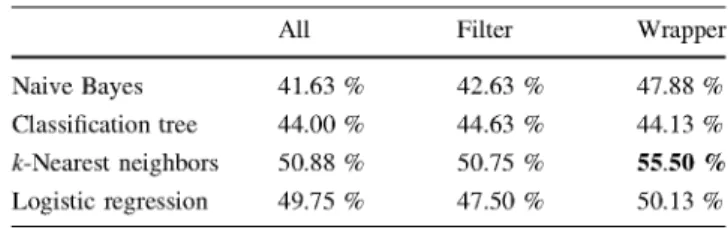
A single model for all dogs. Table 9 (left) shows the results of a single model learned from the 800 barks to discrimi-nate among the 7 contexts: Alone, Ball, Fight, Food, Play, Stranger and Walk.
k-nearest neighbor classifier and wrapper selection is once more the best-performing model with an accuracy of 55.50 %. The variables selected by this model correspond mainly to spectral energy and voice cycle measurements. Note that now we have a more difficult problem with more class values to be predicted (7 contexts) and consequently the estimated accuracy is expected to be lower.
Table 9 Context prediction
Naive Bayes Classification tree k-Nearest neighbors Logistic regression Real class Alone Ball Fight Food Play Stranger Walk All 41.63 % 44.00 % 50.88 % 49.75 % Predicted class Alone 46 11 8 7 8 12 0 Ball Fight 15 64 4 20 8 24 3 7 5 100 2 2 5 4 Food 17 22 3 55 10 26 5 Filter 42.63 % 44.63 % 50.75 % 47.50 % Play 6 5 4 3 44 13 6 Wrapper 47.88 % 44.13 % 55.50 % 50.13 % Stranger Walk 14 23 11 15 11 124 2 1 1 1 4 6 2 11 Accuracies of the twelve models: three selection feature methods for each of the four supervised classifiers (top table). Confusion matrix of the best model: k-nearest neighbors wrapper (bottom table)
context is often misclassified as Food and vice versa. The same holds for the Walk and Play pair. This is quite rea-sonable since both pairs define quite similar underlying concepts. Many barks under Fight or Alone situations are misclassified as Stranger. However, the Stranger context is usually confused with the Ball and Food context.
Table 10 contains the accuracies per dog of the best model. This model provides 43.40 % accuracy when predicting the Alone context, with extreme prediction accuracies for dog7 (52.94 %) and dog8 (14.29 %). The Ball context achieves 48.85 % accuracy, having dog7 and dog8 the worst (29.41 %) and best (64.29 %) predictions, respectively. These two dogs also present the worst and best predictions for the Food context. The model shows better accuracies for the Fight and Stranger contexts. In the Fight context, the 98.00 % of success for dog5 is noteworthy, whereas the worst behavior in the Stranger
context is for dog7 (35.29 %). The Play and Walk con-texts show highly variable accuracies for the different dogs.
Supplementary Material contains the specifications of the best models for the prediction of the dog context.
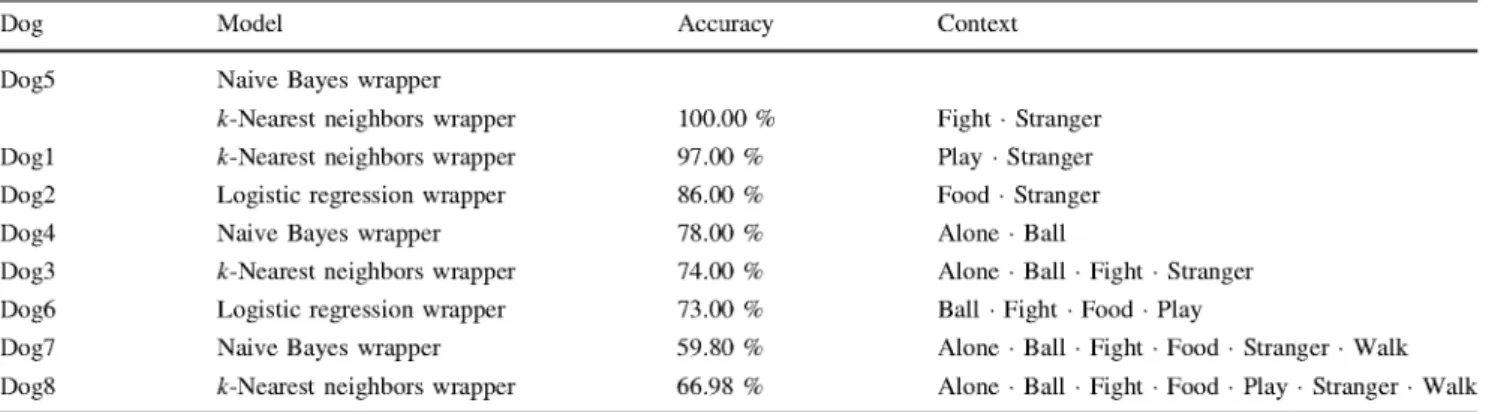
A model per dog. More refined dog-specific models are built here. By selecting instances from the same dog, the corresponding model will identify the context for that dog. A total of 96 models (8 dogs x 12 models per dog) have been considered, where only the performance of the best model is shown in Table 11.
Naive Bayes was the best model 3 times, k-nearest neighbors 4 times, and logistic regression in 2 cases. Regarding the feature subset selection methods, wrapper reports the best results for all 8 dogs.
Table 11 shows that accuracies decrease in proportion to the increase in the number of contexts. With two contexts, accuracies fall in the interval [78, 100 %]. The accuracies for the two dogs with four contexts are 74 and 73 %. Increasing the number of contexts to six and seven, the accuracies are 59.80 and 66.98 %, respectively.
Figure 3 displays, for the best models in Table 11, the mean number of selected variables by the five types of acoustic variables. Spectral energy and voice cycle mea-surements were the two groups with more often selected (in relative terms) variables regardless of the number of barks.
From the previous table, we select some models for the sake of illustration. Figure 4 shows the naive Bayes model which performed best for dog5, with only two observed contexts, Fight and Strange (see the first row in Table 11). The model is built with only five variables, Deviationfreq, Pitchmax, Pitchmaxt, Pitchd and Ppp selected by the wrapper approach. The missing arcs between predictor variables and the arcs from the class to the predictor variables encode the assumption of condi-tional independence underlying naive Bayes. Figure 4
also shows the parameters, p(c) and the mean and stan-dard deviation of the Gaussian distributions fj(xj\c) in Eq. (1).
Table 10 Context prediction per dog
Table 11 Context discrimination: A model per dog
Dog Model Accuracy Context
Dog5
Dog1 Dog2 Dog4 Dog3 Dog6 Dog7 Dog8
Naive Bayes wrapper k-Nearest neighbors wrapper k-Nearest neighbors wrapper Logistic regression wrapper Naive Bayes wrapper k-Nearest neighbors wrapper Logistic regression wrapper Naive Bayes wrapper k-Nearest neighbors wrapper
100.00 % 97.00 % 86.00 % 78.00 % 74.00 % 73.00 % 59.80 % 66.98 %
Fight • Stranger Play • Stranger Food • Stranger Alone • Ball
Alone • Ball • Fight • Stranger Ball • Fight • Food • Play
Alone • Ball • Fight • Food • Stranger • Walk Alone • Ball • Fight • Food • Play • Stranger • Walk Summary of the best models, accuracies and corresponding contexts for each dog. Dogs are organized by number of contexts and then by model accuracy
Sound Spectral Signal Voice
Groups of acoustic measures
Tonality
Fig. 3 Mean number of variables (Y-axis) selected by the best models per dog when predicting contexts (listed in Table 11), for each of the five groups of acoustic measures (X-axis): sound energy, spectral energy, source signal, voice cycles and tonality. Each of these groups of acoustic measures contain 6, 8, 9, 3 and 4 variables, respectively
Figure 5 displays the classification tree model which performed second best for dog1, with two observed con-texts, Play and Stranger (see the second row in Table 11). Note that three variables are required: Energydiff, Harm-mean and Ppj. Thus, if for a given bark, Energydiff = 10, Harmmean = 15 and Ppj = 0.05, then the dog is classified as barking at a stranger.
Figure 6 shows the 100 barks recorded for dog1, rep-resented as a point in the 3-D space of three of the five variables selected by the best model, a k-nearest neighbors wrapper. Barks in the Play context are colored blue (dark), whereas Stranger is shaded red (light). A new bark (an asterisk in the figure) would be classified as the context of its nearest neighbor bark, i.e., Play in this 3-D space,
although its nearest neighbor bark should be computed in the 5-D space, also including variables Deviationfreq and Harmmean.
Table 12 includes the details of the logistic regression model which performed best for dog2, with two observed contexts, Food and Stranger (see the second row in Table 11). This model is built from the five predictor variables in the first column. The regression coefficients
/?j for these variables would be used as in Eq. (2) to compute the posterior probability that yields the predicted class.
Individual
A single model for all contexts. Table 13 shows the results of a single model learned from the 800 barks for discrim-inating among the 8 dogs.
k-nearest neighbors wrapper is the best model, as in the three previous classification problems, with an extremely high accuracy, 67.63 %, in an 8 multi-class problem. Thus, feature subset selection methods have been proved to produce improvements in model performance.
The true positive rate for each of the classes can be computed from Table 14. Dogs numbers 8, 5 and 7 have high true positive rates: 0.77, 0.75 and 0.74, respectively. In contrast, dogs number 6 and 3 have the lowest true positive rates 0.51 and 0.58, respectively.
A model per context. More refined context-specific models are built here. By selecting bark sounds from the same context, the corresponding model will classify the individual dog for that context. Thus, a total number of 7 contexts (and their corresponding 12 x 7 models) have been considered, where the accuracy of the best model for each context is shown (see Table 15).
Fig. 4 Example of a naive Bayes wrapper model. It corresponds to the best model for context classification in dog5
M | fight>:
Context Wfight)=0.5
Mean=939.07 Stddev=175.61
f(x. | stranger;: Mean=428.61
Stddev=102.72
Mean=893.67 Mean=0.09 Stddev=176.38 Stddev=0.03
Mean=815.42 Mean=0.15
Mean=140.91 Mean=150.41 Stddev=69.14 Stddev=25.76
Mean=81.04 Stddev=l 24.44 Stddev=0.07 Stddev=47.36
Mean=188.06 Std dev=54.75
stranger play
Fig. 5 Example of a classification tree wrapper model. It corresponds to the second best model for context classification in dog1
cmoment 15
-5 -10
-15
energydiff
1000 800
600 pitchq
• play • stranger
Fig. 6 Example of a ^-nearest neighbors wrapper model. It corre-sponds to the best model for context classification in dog1 (Cmoment scale is divided by 109). Classification of a hypothetical bark (asterisk)
database with all the contexts. We now have fewer dogs to be identified, from 2 dogs for the Walk context to 5 dogs for Ball and Fight contexts, whereas the global model had
Table 12 Example of parame-ter values of a logistic regres-sion model
It corresponds to the best model for context classification in dog2
Table 13 Individual prediction
Variable Xj
Kurtosis Pitchd Pitchslope Ppp Ppm Intercept (b0)
ðFoodÞ bj
-0.0008 -0.0002 0.0001 -0.0143 -7,424.9241 31.5997
Naive Bayes Classification tree k-Nearest neighbors Logistic regression
All 54.50 % 53.13 % 63.87 % 63.00 %
Filter 55.63 % 51.37 % 58.62 % 61.75 %
Wrapper 63.00 % 56.37 % 67.63 % 65.75 % Accuracies of the twelve models: three selection feature methods for each of the four supervised classifiers
Table 14 Confusion matrix for the best model, k-nearest neighbors wrapper, identifying individual dogs
Dog
Real class 1 2 3 4 5 6 7 8
Predicted class
1 2 3 4 5 6 7 8
68 6 9 7 1 5 2 1
10 71 8 3 6 12 3 4
8 5 58 4 3 11 2 1
5 1 6 67 2 6 5 8
0 5 3 1
5 2 2 75 6 5 1
8 14 9 7 51 10 4
2 2 1 2 2 6 6 0 9 0 74 1 2 77
Table 15 Summary of the results of classifying individuals by context
Context No. barks No. dogs Accuracy Alone
Ball Fight Food Play Stranger Walk
106 131 131 106 89 206 31
94.34 % 80.92 % 88.55 % 87.74 % 97.75 % 80.58 % 100.00 % k-nearest neighbors performed best for Alone, Ball, Play and Walk contexts, naive Bayes for Fight and Walk, logistic regression for Stranger and Walk, and classification trees for Food context. All best models corresponded to a wrapper feature subset selection strategy
Predictor variables of sex, age, context and individual
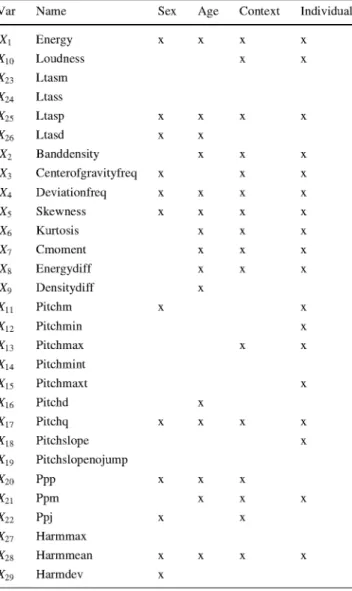
The number of selected variables in the best models (see Table 16) represents about 50 % of the 29 initial variables. These numbers were 12 for sex, 15 for age, 16 for context and 18 for individual. It is remarkable that some variables, like Ltasm, Ltass, Pitchmint, Pitchslopenojump and Harmmax were never chosen. On the other hand, the fol-lowing six variables occur in all four models: Energy, Ltasp, Deviationfreq, Skewness, Pitchq and Harmmean.
Harmdev appears to be specific for determining dog sex, since it was not selected in the rest of the problems. This also applies to Pitchd, only selected for discriminating dog age and to Pitchmaxt for individual determination.
Considering the blockwise organization of predictor variables in Table 3, sound energy (first block), source signal (third block) and tonality (fifth block) measurements are sparsely selected compared to a denser selection in the remaining blocks.
Discussion
Table 16 Predictor variables of sex, age, context and individual classification problems from the best model, k-nearest neighbors wrapper
Var Name Sex Age Context Individual
X1 Energy
X10 Loudness
X23 Ltasm
X24 Ltass
X25 Ltasp
X26 Ltasd
X2 Banddensity X3 Centerofgravityfreq X4 Deviationfreq
X5 Skewness
X6 Kurtosis
X7 Cmoment
X8 Energydiff
X9 Densitydiff
X13
X14 X15
^ 1 6
^ 2 0
^22
^ 2 7
X28
Pitchm Pitchmin Pitchmax Pitchmint Pitchmaxt Pitchd Pitchq Pitchslope Pitchslopenojump Ppp
Ppm Ppj Harmmax Harmmean Harmdev
The accuracies of these four models are 85.13 % for sex classification (Table 5), 80.25 % for age prediction (Table 7), 55.50 % for context categorization (Table 9) and 67.63 % for individual recognition (Table 13)
This work has empirically demonstrated the usefulness of supervised classification machine learning methods for inferring some characteristics of dogs from the acoustic measurements given by their barks. From the four classi-fication methods considered, k-nearest neighbors outper-formed naive Bayes, classification trees and logistic regression. Also, the wrapper feature subset selection method provided significant improvements over a filter selection or no-selection (all variables are kept).
A solution for two prediction problems, sex and age, never previously considered in the literature has been presented. The best of the 12 resulting models in this study was able to predict dog sex in 85.13 % of the cases. The age of the dog, categorized as Young, Adult and Old, was
inferred correctly in 80.25 % of the cases. An issue to be considered as future work is the prediction of age as a continuous variable, using a kind of regression task.
Determining the context of the dog bark, with seven possible situations, is a more difficult problem than clas-sification by sex and age. However, it was successfully solved for 55.50 % of the bark cases. This is an improve-ment on the results presented in Molna´r et al. (2008), where for six possible contexts the best model yielded a 43 % success rate. With an accuracy rate of 63 % for classifying three possible contexts, our results are similar to the find-ings reported by Yin and McCowan (2004). In addition, a model for each of the eight dogs with two or more different
x x
x x
x
x
x
x x
x
x x
contexts was induced from the barks associated with this specific dog. Thus, a total of 12 x 8 models have been considered. For almost all dogs, the fe-nearest neighbor model was the most successful, although naive Bayes, logistic regression and classification tree models provided the best accuracy results for some dogs. As a tendency, the wrapper feature subset selection strategy provided the best results. Model accuracy ranges from 59.80 to 100 %.
The individual identification, a hard classification problem with eight possible categories, produced up to 67.63 % accuracy in the best model. This result is extre-mely good when compared to the 52 % reported in Molnar et al. (2008) for 14 dogs, and the 40 % achieved by Yin and McCowan (2004) for a 10-dog problem. When the dog identification is performed within each context, the accu-racies of the best models are in the interval [80.58 %, 100 %].
Recent ethological research on dog barking revealed several features of the most characteristic acoustic com-munication type of dogs which proved that barks serve as a complex source of information for listeners (Yin and McCowan 2004; Pongracz et al. 2005, 2006). In experi-ments where human participants evaluated the pre-recor-ded dog barks, both the context and the possible inner state of the signaling animals were classified with sub-stantial success rates. However, the role of dog barks in dog-dog communication remained (and still remains) somewhat obscure, as there is a shortage of convincing field data for the usage of barks during intraspecific communication of dogs, though see Pongracz et al. (2014) for some positive evidence. The present study provides an alternative approach for discovering the potential infor-mation content encoded in dog barks. If one can prove that dog barks carry consistent cues encoding such features of the caller such as its sex, age or identity, this can prove indirectly that barks can serve as relevant sources of information to receivers that are able to decipher these types of information.
Previously, it was known that dogs can differentiate between individuals and contexts if they hear barks of other dogs in experiments based on the habituation-dishabitua-tion paradigm (Maros et al. 2008; Molnar et al. 2009). Our new results provide some possible details of how such a capacity for recognition might work. If dogs are sensitive to the sex-, age- and identity-specific details of barks, this can serve as an acoustic basis for the cognitive task of discriminating between or recognition of individuals. Although in dogs sex-related information is mostly (thought to be) transferred via chemical compounds (Goodwin et al. 1979), theoretically it would be adaptive if a dog could survey the gender of the other dogs living nearby (or farther) on the basis of hearing their barks as well. Deciphering the age of an individual based on their
vocalizations would be also beneficial in a highly social species, where age can be relevant in determining social rank, reproductive status or fighting potential (Mech 1999). Recognition of the context of barks was the least suc-cessful task for our supervised learning methods. Although present methods exceeded the accuracy of both the previ-ously employed machine learning approach (Molna´r et al.
2008) and the adult human listeners’ success rate (Pon-gra´cz et al. 2005), this accuracy still lags behind the other variables analyzed in this study. It is also true that human listeners perform almost as successfully when recognizing the context as the computerized models. The reason behind this result may be that the individual variability of dog barks can be considerable especially in particular contexts (such as before the walk, or asking for a toy/food). Another reason for the relatively low success rate of context rec-ognition may be that while the human listeners received short bark sequences, the computer worked with individual bark sounds. Therefore, the inter-bark interval served as an additional source of information for the humans (Pongra´cz et al. 2005, 2006), while this parameter was not involved in the computerized analysis. For humans at least, the inter-bark interval also seemed to be an important source of information when discriminating between individual dogs, as their performance improved with the length of bark sequences they received (Molna´r et al. 2006).
Supervised classification machine learning methods do not only provide indirect proof about the rich and biolog-ically relevant information content of dog barks, but they also offer a promising tool for applied research, too. For example, evaluating dog behavior has great importance for various organizations, as well as professionals and dog enthusiasts. Recognizing unnecessarily aggressive dogs can be a challenge for the personnel of dog shelters as well as for correspondents of breed clubs and for the experts of legal bodies (Netto and Planta 1997; Serpell and Hsu
2001). Similarly, diagnosing particular behavioral abnor-malities that can cause serious welfare issues for dogs, such as separation anxiety, can present a difficult task when the goal is to tell apart ’everyday’ and chronic stress reactions in a dog (Overall et al. 2001). Behavioral evaluation usu-ally does not cover the qualitative analysis of vocalizations in these cases. However, this could be addressed if a reli-able and easy to use acoustic analytic software could serve as an aid for behavioral professionals. With such a method, following a rigorous validating protocol, acoustic features indicative of high levels of aggression, fear, distress, etc. could be recognized in the subjects’ vocalizations.
species. In addition, all the dogs in this study were of the same breed, so our classifiers do not take any advantage of the different patterns expected from the diversity of breeds.
An interesting problem for the near future would be to see whether these methods would work for other breeds or for a mixed breed group. Also, simultaneously classifying the four dog features, sex, age, context and individual, might be of interest. This issue falls into a category of a new problem type called multi-dimensional classification problems (Bielza et al. 2011; Borchani et al. 2012; Sucar et al. 2014), where the dependence between the four class variables is relevant.
Acknowledgments This work has been partially supported by the Spanish Ministry of Economy and Competitiveness, projects Cajal Blue Brain (C080020-09; the Spanish partner of the Blue Brain Project initiative from EPFL) and TIN2013-41592-P, by the Ja´nos Bolyai Research Scholarship from the Hungarian Academy of Sci ences, and co-financed by a grant from OTKA K82020. The authors are thankful to Celeste R. Pongra´cz for the English proofreading of this manuscript and to Nikolett Czinege for help in preparing the bark databases.
References
Acevedo M, Corrada-Bravo C, Corrada-Bravo H, Villanueva-Rivera L, Aide T (2009) Automated classification of bird and amphibian calls using machine learning: a comparison of methods. Ecol Inform 4(4):206–214
Adachi I, Kuwahata H, Fujita K (2007) Dogs recall their owner’s face upon hearing the owner’s voice. Anim Cogn 10:17–21 Adams M, Law B , Gibson M (2010) Reliable automation of bat call
identification for Eastern New South Wales, Australia, using classification trees and AnaScheme software. Acta Chiropterol 12(1):231–245
Armitage D, Ober H (2010) A comparison of supervised learning techniques in the classification of bat echolocation calls. Ecol Inform 5(6):465–473
Au W, Andersen L, Roitblat ARH, Nachtigall P (1995) Neural network modeling of a dolphin’s sonar discrimination capabil ities. J Acoust Soc Am 98:43–50
Ba´lint A, Farago´ T, Do´ka A, Miklo´si A, Pongra´cz P (2013) ‘‘Beware, I am big and non-dangerous!’’—playfully growling dogs are perceived larger than their actual size by their canine audience. Appl Anim Behav Sci 148:128–137
Bielza C, Li G, Larran˜aga P (2011) Multi-dimensional classification with Bayesian networks. Int J Approx Reason 52:705–727 Blumstein D, Munos O (2005) Individual, age and sex-specific
information is contained in yellow-bellied marmot alarm calls. Anim Behav 69(2):353–361
Borchani H, Bielza C, Mart´ınez-Mart´ın P, Larran˜aga P (2012) Markov blanket-based approach for learning multi-dimensional Bayesian network classifiers: an application to predict the European Quality of Life-5 Dimensions (EQ-5D) from the 39-item Parkinson’s Disease Questionnaire (PDQ-39). J Biomed Inform 45:1175–1184
Britzke E, Duchamp J, Murray K, Swihart R, Robbins L (2011) Acoustic identification of bats in the Eastern United States: a comparison of parametric and nonparametric methods. J Wildl Manage 75(3):660–667
Charrier I, Aubin T, Mathevon N (2010) Mother-calf vocal commu nication in Atlantic walrus: a first field experimental study. Anim Cogn 13(3):471–482
Cheng J, Sun Y, Ji L (2010) A call-independent and automatic acoustic system for the individual recognition of animals: a novel model using four passerines. Pattern Recogn 43(11):3846–3852
Chesmore E (2001) Application of time domain signal coding and artificial neural networks to passive acoustical identification of animals. Appl Acoust 62(12):1359–1374
Clemins P (2005) Automatic Classification of Animal Vocalizations. PhD thesis, Marquete University
Cohen J, Fox M (1976) Vocalizations in wild canids and possible effects of domestication. Behav Process 1:77–92
Coppinger R, Feinstein M (1991) ‘‘Hark! Hark! the dogs barkldots’ ’ and bark and hark. Smithonian 21:119–128
Druzhkova A, Thalmann O, Trifonov V, Leonard J, Vorobieva N, Ovodov N, ASGraphodatsky, Wayne R (2013) Ancient DNA analysis affirms the canid from Altai as a primitive dog. PLoS ONE 8(e57):754
Duda R, Hart P, Stork D (2001) Pattern classification. Wiley, New York Fant G (1976) Acoustic theory of speech production. Mouton De
Gruyter.
Farago´ T, Pongra´cz P, Miklo´si A, Huber L, Vira´nyi Z, Range F (2010a) Dogs’ expectation about signalers’ body size by virtue of their growls. PLoS ONE 5(12):e15,175
Farago´ T, Pongra´cz P, Range F, Vira´nyi Z, Miklo´si A (2010b) The bone is mine’: affective and referential aspects of dog growls. Anim Behav 79(4):917–925
Feddersen-Petersen DU (2000) Vocalization of European wolves (Canis lupus lupus l.) and various dog breeds (Canis lupus f. fam.). Arch Tierz Dummerstorf 43(4):387–397
Fix E, Hodges JL (1951) Discriminatory analysis. Nonparametric discrimination: consistency properties. USAF Sch Aviat Med 4:261–279
Frommolt KH, Goltsman M, MacDonald D (2003) Barking foxes, Alopex lagopus: field experiments in individual recognition in a territorial mammal. Anim Behav 65:509–518
Goodwin M, Gooding KM, Regnier F (1979) Sex pheromone in the dog. Science 203:559–561
Gunasekaran S, Revathy K (2011) Automatic recognition and retrieval of wild animal vocalizations. Int J Comput Theor Eng 3(1):136–140
Hall M (1999) Correlation-based feature selection for machine learning. PhD thesis, Department of Computer Science, Univer sity of Waikato, UK
Hall M, Frank E, Holmes G, Pfahringer B, Reutemann P, Witten I (2009) The WEKA data mining software: an update. SIGKDD Explor 11(1):10–18
Hartwig S (2005) Individual acoustic identification as a non-invasive conservation tool: an approach to the conservation of the African wild dog Lycaon pictus (Temminck, 1820). Bioacoustics 15:35–50
Hecht J, Miklo´si A, Ga´csi M (2012) Behavioral assessment and owner perceptions of behaviors associated with guilt in dogs. Appl Anim Behav Sci 139:134–142
Hunag C, Yang Y, Yang D, Chen Y (2009) Frog classification using machine learning techniques. Expert Syst Appl 36(2):3737–3743 Jain A, Murty MN, Flynn P (1999) Data clustering: a review. ACM
Comput Surv 31(3):264–323
Le Cessie S, van Houwelingen JC (1992) Ridge estimators in logistic regression. Appl Stat 41(1):191–201
Liu H, Motoda H (1998) Feature selection for knowledge discovery and data mining. Kluwer Academic, Dordrecht
Manser M, Seyfarth R, Cheney D (2002) Suricate alarm calls signal predator class and urgency. Trends Cogn Sci 6(2):55–57 Maros K, Pongra´cz P, Ba´rdos G, Molna´r C, Farago´ T, Miklo´si A
(2008) Dogs can discriminate barks from different situations. Appl Anim Behav Sci 114:159–167
Mazzini F, Townsend SW, Vira´nyi Z, Range F (2013) Wolf howling is mediated by relationship quality rather than underlying emotional stress. Curr Biol 23:1677–1680
McConnell PB (1990) Acoustic structure and receiver response in domestic dogs, Canis familiaris. Anim Behav 39:897–904 McConnell PB, Baylis JR (1985) Interspecific communication in
cooperative herding: acoustic and visual signals from human shepherds and herding dogs. Z Tierpsychol 67:302–382 Mech LD (1999) Alpha status, dominance and division of labor in
wolf packs. Can J Zool 77:1196–1203
Meints K, Racca A, Hickey N (2010) Child-dog misunderstandings: children misinterpret dogs’ facial expressions. In: Proceedings of the 2nd Canine Science Forum, p 99
Miklo´si A, Polga´rdi R, Topa´l J, Csa´nyi V (2000) Intentional behaviour in dog-human communication: an experimental ana-lysis of ‘‘showing’’ behaviour in the dog. Anim Cogn 3:159–166 Minsky M (1961) Steps toward artificial intelligence. T Ins Radio Eng
49:8–30
Molna´r C, Pongra´cz P, Do´ka A, Miklo´si A (2006) Can humans discriminate between dogs on the base of the acoustic parameters of barks? Behav Process 73:76–83
Molna´r C, Kaplan F, Roy P, Pachet F, Pongra´cz P, Do´ka A, Moklo´si A (2008) Classification of dog barks: a machine learning approach. Anim Cogn 11:389–400
Molna´r C, Pongra´cz P, Farago´ T, Do´ka A, Miklo´si A (2009) Dogs discriminate between barks: the effect of context and identity of the caller. Behav Process 82(2):198–201
Morton E (1977) On the occurrence and significance of motivation— structural rules in some bird and mammal sounds. Am Nat 111:855–869
Netto W, Planta D (1997) Behavioural testing for aggression in the domestic dog. Appl Anim Behav Sci 52:243–263
Overall K, Dunham A, Frank D (2001) Frequency of nonspecific clinical signs in dogs with separation anxiety, thunderstorm phobia, and noise phobia, alone or in combination. J Am Vet Med Assoc 219:467–473
Parsons S (2001) Identification of New Zeeland bats (Chalinobus tuberculatus and Mystacina tuberculata) in flight from analysis of echolocation calls by artificial neural networks. J Zool 253(4):447–456
Parsons S, Jones G (2000) Acoustic identification of twelve species of echolocating bat by discriminant function analysis and artificial neural networks. J Exp Biol 203(17):2641–2656
Pongra´cz P, Molna´r C, Miklo´si A, Csa´nyi V (2005) Human listeners are able to classify dog (canis familiaris) barks recorded in different situations. J Comp Psychol 119:136–144
Pongra´cz P, Molna´r C, Miklo´si A (2006) Acoustic parameters of dog barks carry emotional information for humans. Appl Anim Behav Sci 100:228–240
Pongra´cz P, Molna´r C, Miklo´si A (2010) Barking in family dogs: an ethological approach. Vet J 183:141–147
Pongra´cz P, Szabo´ E, Kis A, Pe´ter A, Miklo´si A (2014) More than noise? Field investigations of intraspecific acoustic communica-tion in dogs (Canis familiaris). Appl Anim Behav Sci (in press) Quinlan R (1993) C4.5: programs for machine learning. Morgan
Kaufmann
Reid P (2009) Adapting to the human world: dogs’ responsiveness to our social cues. Behav Process 80:325–333
Roch M, Soldevilla M, Hoenigman R, Wiggins S, Hidebrand J (2008) Comparison of machine learning techniques for the classification of echolocation clicks from three species of odontocetes. Can Acoust 36(1):41–47
Root-Gutteridge H, Bencsik M, Chebli M, Gentle L, Terrell-Nield C, Bourit A, Yarnell RW (2013) Improving individual identification in captive Eastern grey wolves (Canis lupus lycaon) using the time course of howl amplitudes. Bioacoustics 23(1):39–53 Saeys Y, Inza I, Larran˜aga P (2007) A review of feature selection
techniques in bioinformatics. Bioinformatics 23(19):2507–2517 Serpell J, Hsu Y (2001) Development and validation of a novel method for evaluating behavior and temperament in guide dogs. Appl Anim Behav Sci 72:347–364
SmithA,BirnieA,LaneK,FrenchJ(2009) Production and perceptionof sex differences in vocalizations of wied’s black-tufted-ear mar-mosets (callithrix kuhlii). Am J Primatol 71:324–332
Stone M (1974) Cross-validatory choice and assessment of statistical predictions. J R Stat Soc B 36(2):111–147
Sucar E, Bielza C, Morales E, Hernandez-Leal P, Zaragoza J, Larran˜aga P (2014) Multi-label classification with Bayesian network-based chain classifiers. Pattern Recogn Lett 41:14–22 Taylor A, Reby D, McComb K (2008) Human listeners attend to size
information in domestic dog growls. J Acoust Soc Am 123(5):2903–2909
Taylor A, Reby D, McComb K (2009) Context-related variation in the vocal growling behaviour of the domestic dog (Canis familiaris). Ethology 115(10):905–915
Taylor A, Reby D, McComb K (2010) Size communication in domestic dog, Canis familiaris, growls. Anim Behav 79(1):205–210
Te´gla´s E, Gergely A, Kupa´n K, Miklo´si A, Topa´l J (2012) Dogs’ gaze following is tuned to human communicative signals. Curr Biol 22:1–4
Tembrock G (1976) Canid vocalizations. Behav Process 1:57–75 Volodin I, Volodina E, Klenova A, Filatova O (2005) Individual and
sexual differences in the calls of the monomorphic white-faced whistling duck dendrocygna viduata. Acta Ornithol 40:43–52 Wan M, Bolger N, Champagne F (2012) Human perception of fear in
dogs varies according to experience with dogs. PLoS ONE 7(e51):775
Yeon SC (2007) The vocal communication of canines. J Vet Behav 2:141–144
Yin S (2002) A new perspective on barking in dogs (Canis familiaris). J Comp Psychol 116:189–193
YinS, McCowan B (2004) Barking in domestic dogs: context specificity and individual identification. Anim Behav 68:343–355