NEW APPLICATIONS OF CORK IN BUILDING
Mercedes DEL RÍO MERINO.
Dpto. de construcciones arquitectónicas y su control. E. U. Arquitectura Técnica. U.Politécnica. Avda. Juan de Herrera nº 6. 28040 Madrid. España. [email protected]
ABSTRACT:
Several types of prefabricated elements for partitions and extrados, which improve the similar systems presently in the market, are presented in this research. These elements, manufactured with cork and lightened plaster, can be classified in two well defined groups. The first group is formed by lightened plaster panels for partitions of dimensions 60 x 265 cm (width, height) and of 7cm and 10 cm thickness. In the second group, panels for extrados with the same dimensions are included but with a thickness of 9.5 and 5 cm, including the 3 cm thickness of the incorporated high density expanded polystyrene sheet.
1. INTRODUCTION
After having rigorously studied and analyzed the market of plaster prefabricated elements for construction in Spain we can conclude that there are two types of prefabricated systems for plaster partitions in the Spanish market. On the one hand there is the “bricklayer system” derived from the work done by bricklayers and plaster-cladders. It is a system with a deep-rooted tradition in Spain and traded by small companies (Yesamsa, Sulfatos La Ribera, etc) or some international enterprises (Iberplaco, Uralita…). On the other hand there is the “carpenter system”, derived from the way carpenters work. This system has a greater tradition in countries like the U.S.A, France, Germany, etc. In Spain only large companies trade them (Yesos Ibéricos, Iberplaco, Knauff etc.).
In the system of prefabricated plaster partitions, the called “bricklayer system”, the elements used, be simple hollow brick or double hollow brick, or bigger ones such as air bricks are substituted by small dimension planks, generally 66x50 cm, also called plaster blocks and by floor-to-ceiling panels, made of plaster basically which are received with a gypsum or plaster based adhesives. They are usually one-leaf solutions, except for the special cases such as partitions with technical blocks. In Spain, due to the fact that there is gypsum all over the country, many companies have been created in the business of marketing this type of systems.
On the other hand, and in relation to the material used for panel production, the manufacturers in order to improve these elements lighten plaster with the addition of light aggregates such as perlite and vermiculite or reduce the weight of the panels by including cells in the nucleus. However, no bibliographic references have been found for the use of cork granules [1] for lightening plaster in the manufacturing of prefabricated elements for partitions.
They are prefabricated elements of a gypsum and water matrix. Sometimes gypsum may contain fibers or additions of aggregates or other additives, and even pigments for their differentiation. They have a flat surface and a tongue and groove joint on the side. The thickness is of 60, 70, 80 mm and the dimensions for the standardized panels specified in DIN 18.163 “gypsum panels” are 666 mm long and 500 mm high. There are several types of panels, for different uses: normal panels, light panels, non-load bearing panels or cladding panels for pillars or for fire protection in structures. They allow an easy and quick mounting due to the tongue and groove joint and are placed with gypsum mortar for bindings. The partitions made with these elements do not need any cladding allowing direct painting or tiling or wallpaper.
1.2.Floor-to-ceiling panels
The floor-to-ceiling panels presently in the market are made of a gypsum base with a minimum glass fiber strengthener, and are provided with vertical perforations with a circular section, in order to lighten the weight as well as to allow the installation of services inside of the panel. The binding among the panels is solved with a gypsum adhesive and a groove and tongue joint. The dimensions of the panel are: T-7 2900x620x70 mm; T-9 2900x500x90 mm.
1.3 Advantages and disadvantages of the plaster prefabricated partition
In general, partitions built with prefabricated gypsum panels show improved properties in relation to sound insulation and fire protection, and allow, due to its prefabricated condition, a quick-execution and a minimum time for drying at the construction site.
Due to the good hydrothermal performance of plaster, the panels contribute to the moisture environment, although in humid premises impermeable panels are used, with very low water absorption. Because they are manufactured with plaster, they can be easily worked and shaped with simple tools: they can be sawn, drilled, milled, permitting the placing of service pipes in the elements built with these panels [2].
The major advantages of these partitions, as opposed to the traditional ones are: the bricklayers and plaster-cladders tradition deeply rooted in our country is maintained, although with some changes; it does not need specially skilled laborers to place it; the output of the laborers is improved, and therefore this compound unit reduces cost prices; finally, another advantage is that their construction systems do not need mortar. The compound unit is left completely finished with the setting panels or planks only to be finally decorated (paint, wallpaper, etc). Because the pieces are manufactured in a workshop, one can obtain greatly planed surfaces using finishes with a minimum coating capacity (slick paint, etc).
drawbacks.
2. RESEARCH OBJECTIVES
Our main objective after studying the prefabricated systems for partitions has been to reduce the disadvantages that the most useful masonry systems present.
Once the drawbacks of the systems have been signaled, the following aims are to be pursued on the design to prevent those disadvantages:
1º A reduction in weight. This is achieved with the base material of the panels, that is, lightened plaster and with the panel design.
2º To obtain a similar mechanical resistance to the one of the prefabricated elements presently in the market while improving the deformation capacity of the whole. This is achieved with the base material for its fabrication.
3º To improve the sound insulation offered by the partition elements already in the market in order to obtain an acoustic partition. For it, we will work with the asymmetric geometry of the panels and also with the advantage of the sound insulation capacity of the material being used.
3. RESEARCH METHODOLOGY
In order to fulfil the planned objectives, two different lines of action have been followed:
On the one hand a test plan to characterize a gypsum based material has been established. In order to improve the drawbacks of plaster, light aggregates and glass fiber have been added to reduce its density and to improve its strain strength with compressing forces as well as the acoustic absorption capacity [3] [4].
On the other hand, the design of the panels is worked so that it can efficiently substitute the panels already in the market. Reducing the weight/m2 will also improve the handling and transportation to the work site and the new panel will also improve the acoustic insulation, following the theory of wall-spring-wall.
4. DEFINITION OF THE PANELS
4.1. Material
4.2.Actions followed towards the geometry of the panels
The panels have an asymmetrical shape and are formed by two planks with different thickness joined together through the rigidizing ribs made of a flexible material (lightened plaster) to take advantage of the double wall (wall-spring-wall) of different thickness [6].
The superficial finish of the internal faces of the panel, which constitute the intermediate chamber, is let rough to allow a greater sound wave absorption, therefore not needing a special absorbent material inside to perform this function.
Considering this, the following elements are proposed :
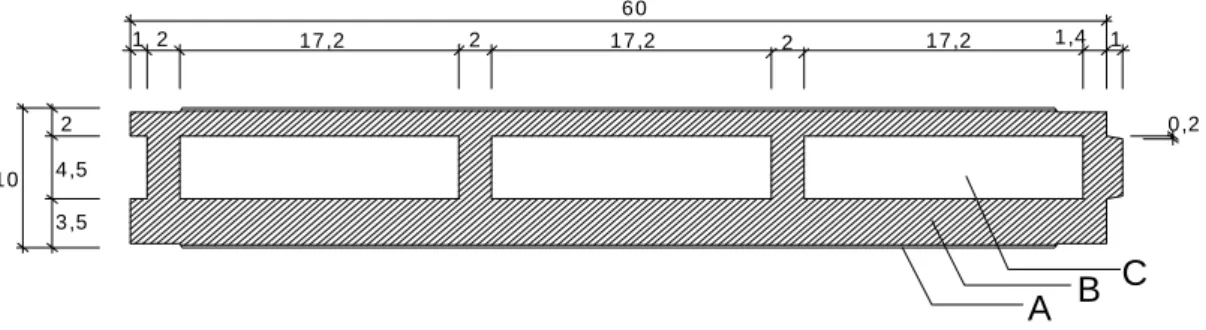
Fig 1. Type panel for partitions with a 10 cm thickness.
A horizontal section of an interior partition panel is presented (fig.1) with dimensions 265x60x10 cm, in which (A) is a floating skin of fine plaster of thickness 2 mm, made with a flat mold; (B) is a lightened plaster plank, faced opposed to the rough plaster of thickness 3.5 and 2 cm respectively (floating included); and (C) is an air chamber between the planks.
The planks are joined together with 4.5x2 cm ribs, allowing an intermediate chamber of thickness 4.5 for the services. The binding of the ribs with the planks is done through gypsum-adhesive.
17,2 17,2 17,2
2 2 2 1,4
60
1 1
0,2
10 2
3,5 4,5
C
B
A
1 7 ,2 1 7 ,2 1 7 ,2
2 2 2 1 ,4
6 0
1 1
0 ,2
7 2
2 3
Fig 2. Type panel for partitions of thickness 7 cm.
A horizontal section of a panel similar to the previous one is presented (fig.2), but with a 7 cm total thickness. It is formed by two equal planks, 2 cm each, and 3x2 cm ribs which allow an intermediate chamber of 3 cm. The ribs are 265x3x2 cm.
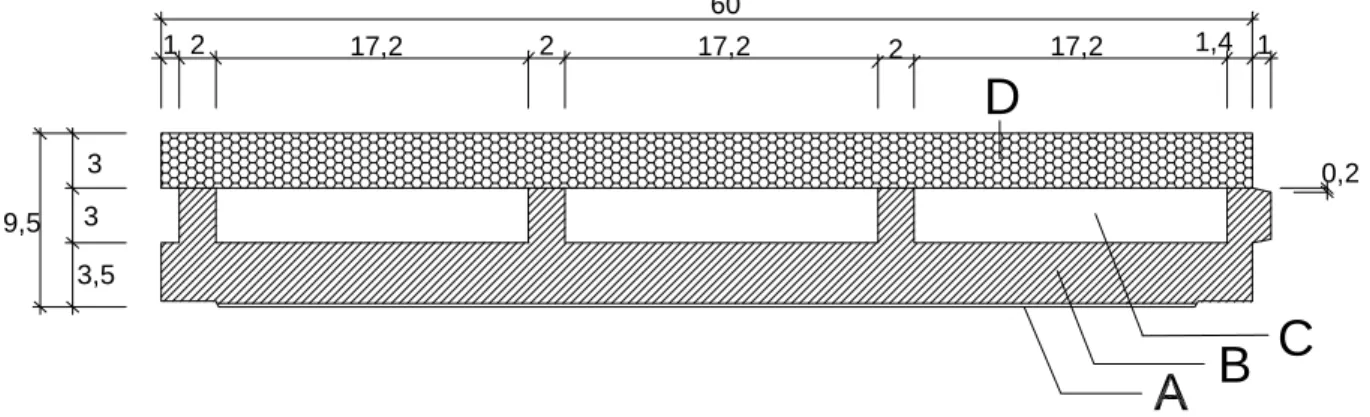
Fig 3. Panel for extrados with a 9.5 cm thickness.
A horizontal section of an extrados panel is presented (fig.3), with dimensions 265x60x9.5 cm, forming a 3.5 cm thick plank of lightened plaster (B) floated on its outer side and rough in the extrados (A), and a plank of expanded polystyrene of thickness 3 cm (D) joined to the lightened plaster, leaving an air chamber for the services (C). The binding of the ribs and the planks is done with gypsum-adhesive, and the joint with the expanded polystyrene is carried out with adhesive.
17,2 17,2 17,2
2 2 2 1,4
60
1 1
0,2 9,5
3
3,5 3
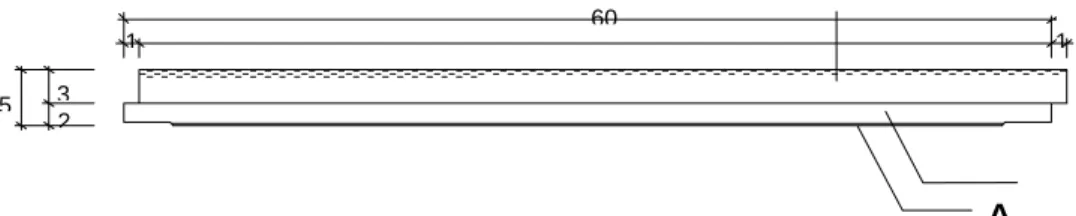
Fig 4. Panels for extrados of thickness 5 cm.
A horizontal section of an extrados panel is presented (fig.4) with a total thickness of 5 cm, composed by a lightened plaster (B) plank floated on one side, 2cm thick and rough in the extrados (A), an expanded polystyrene plank 3 cm, thick (D), joined directly to the lightened plaster plank by an adhesive.
5. TESTS PERFORMED ON THE LIGHTENED PLASTER PANELS
Finally to check the suitability of these panels and to assess the obtained improvements, mechanical strengths tests and tests for determining the physical properties are performed on fragments of lightened plaster panels made in laboratory and on similar sized fragments of the plaster panels in the market.
These fragments (Table 1) are tested for compression, and for hanging resistance. Their values for geometric density, sound insulation and superficial Shore C hardness are examined.
Panel Dimensions (cm)
Plaster 14x15x8
Honeycombed plaster 14x15x9
Lightened plaster 23x15.5x10
Table 1. Panels studied
5.1 Compressive Strength tests
The fragments of the analysed panels are placed between two steel plates of dimensions 4x4cm.
The machine used for this test is from Ibertest brand with a load capacity of 3 tons. For the compressive strength calculation the following formula has been used.
σf = P/A
1 1
5 2 3
Being P the ultimate load and A the section of the area on which the load is applied.
For determining superficial hardness in the analysed panels, the test C Shore is used. This test is defined in the UN 102.039-85 where six readings –three for each side—are established.
5.3. Test of hanging resistance
A non-standardized test of hanging resistance was performed on the different elements, obtaining the following data; 1º. Load value when the plug starts turning (P1) and 2º. Load value when the plug detaches itself from the plank (P2).
5.4. Test of an environmental sound insulation:
A non-standardized test of environmental sound insulation is performed on the different similar sized fragments of the plaster panels to be analyzed.
All the tests are performed in the same conditions: The sound source is constant and has a value of 81 dB (A). The sound measurements are tested with a sound meter.
6. TEST RESULTS
6.1. Physical tests
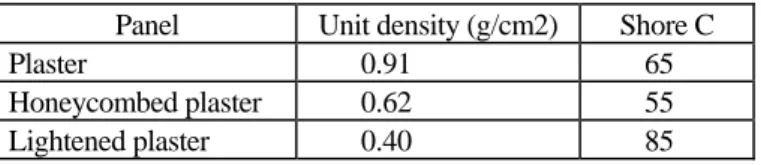
It is important to underline the great reduction of the unit density in relation to the plaster units already in the market, as well as to remark the important superficial hardness value, since the external face is a floating skin with a low A/E proportion. (Table 2)
Panel Unit density (g/cm2) Shore C
Plaster 0.91 65
Honeycombed plaster 0.62 55
Lightened plaster 0.40 85
Table 2. Average results of the tests performed on the panels.
6.2 Compressive strength tests
In table 3 the compressive strength tests results are presented. The load supported up to breakage in the lightened plaster panel, when the compression test is performed, is quite lower than the load supported by the other elements. Nevertheless, the deformation is far greater and is locally produced in the places where the pressure has been practiced.
As a conclusion to this test, we can point out that the lightened plaster panel is perfectly adapted to the expected structural deformations, and in the case of them being produced, the result is the following:
1.- On the one hand the floating skin on the joining area with the structure announces the process through the presence of small cracks, before fracturing, allowing the problem to be solved at the beginning.
2.- Once the fracture is produced, since the web of the panel is kept stable, the problem can be easily be solved by scraping the cracked area and a new floating skin.
3.- The deformation does not affect the rest of the panel, and so it will maintain its structure and finishes untouched.
Panel Compressive S. (MPa)
Plaster 4.375
Honeycombed plaster 2.936
Table 3 – Average results of the compression strength tests.
6.3 Test of hanging resistance
The results obtained with the Test of hanging resistance are presented in table 4:
Panel Dimensions (cm) 25 k 40 k 50 k 55 k 60 k 65 k 70 k
Plaster 14x15x8 yes P1 twists P2
Honeycombed plaster 14x15x9 yes P1 twists P2
Lightened plaster 23x15.5x10 yes yes P1 twists twists twists P2
Table 4. Average results of the hanging resistance tests performed on the panels.
As a result from the outcomes obtained, the great deformation capacity of the lightened plaster is confirmed, because as opposed to the other plaster planks which break and the plug comes off, the lightened plaster is deformed in such a way that the plug remains embedded inside the material with a lot heavier loads.
6.4 Test of an environmental sound insulation
Lightened plaster panel 10 cm...sound insulation obtained 16 dB (A)
Lightened plaster panel 7 cm...sound insulation obtained 9 dB (A)
Honeycombed plaster panel 9 cm...sound insulation obtained 9 dB (A)
Solid plaster block 9 cm...sound insulation obtained 6 dB (A)
From the results obtained we can conclude that although the lightened plaster panel mass is smaller, it greatly surpasses the results obtained for the similar elements presently in the market.
7. CONCLUSIONS
The great possibilities that these cork-gypsum products can have in the market of the prefabricated elements for partitions and extrados made with a plaster base have been proven. The following improvements have been achieved in relation to other similar elements nowadays commercialized:
- Improvement of the deformation capacity of the system, as shown by the mechanical tests. This will prevent the partition to support structural loads due to the deformation of adjacent structural materials. The direct consequence is that the deformation is not concentrated at the joints, and does not crack here, as it is the norm in the systems made presently.
- Improvement of the sound insulation, due to the panel design. This design is absolutely new in relation to the exiting ones in the market and it incorporates the advantage of the great sound absorption of the materials with which they are made (lightened plaster).
8. REFERENCES
[1] Río Merino, J; Hernández Olivares, F.- “Escayola aligerada con sólidos celulares”. Informes de la construcción, Vol 50. Nº458. 43-60. Noviembre-Diciembre 1998.
[2] AENOR.- UNE 102-020.- “Paneles prefabricados de yeso o escayola de paramento liso
para la ejecución de tabiques. Especificaciones” 1998.
[3] Río Merino Mercedes; Hernández Olivares Francisco. - “Escayola reforzada por la acción sinérgica entre aditivos del hormigón (superfluidificantes, fluidificantes y aireantes-plastificantes) y fibras de vidrio E”. Mater construcc Vol. 50 nº 260, 2000.
[4] Río Merino Mercedes; Hernández Olivares Francisco. - “Influencia del grado de dispersabilidad de la fibra de vidrio tipo E en el comportamiento mecánico y la trabajabilidad de la escayola”. Mater construcc. Vol. 51 nº 261, 2001.
[5] Hernández Olivares, F; Bollati M.R.; Río M; Parga-Landa, B.- “Development of cork-gypsum composites for building applications”. Construction and Building Materials 13. 1999.
[6] Río Merino, M; Santa Cruz, J; Hernández Olivares, F.- Yeso aligerado con corcho y su