Design and Implementation of
Conchoid and Offset Processing Maple Packages
Juana Sendra1, David G´omez2 and Valerio Mor´an2
1 Dpto. de Matem´atica Aplicada a la I.T. de Telecomunicaci´on.
Research Center on Software Technologies and Multimedia Systems for Sustainability (CITSEM)
Universidad Polit´ecnica de Madrid (UPM)
2 E.U.I.T.Telecomunicaci´on,
Universidad Polit´ecnica de Madrid E-28031 Madrid, Spain
Abstract. This paper is framed within the problem of analyzing the rationality of the components of two classical geometric constructions, namely the offset and the conchoid to an algebraic plane curve and, in the affirmative case, the actual computation of parametrizations. We recall some of the basic definitions and main properties on offsets (see [18]), and conchoids (see [20]) as well as the algorithms for parametrizing their rational components (see [1] and [21], respectively). Moreover, we implement the basic ideas creating two package in the computer algebra system Maple to analyze the rationality of conchoids and offset curves, as well as the corresponding help pages. In addition, we present a brief atlas where the offset and conchoids of several algebraic plane curves are obtained, its rationality analyzed, and parametrizations are provided using the created packages.
Key Words: Offset Curves, Conchoids Curves, Rational curves, parametrization, symbolic mathe-matical software, computer-aided geometric design.
Introduction
The main geometric objects that we deal with in this paper are the offsets and the conchoids to an algebraic plane curve. Whereas the offset operation is well known and implemented in most CAD-software systems, the conchoid operation is less known, although already mentioned by the ancient Greeks, and recently studied by some authors. These two operations are algebraic and create new objects from the given input objects. There is a surprisingly simple relation between the offset and the conchoid operation. There exists a rational bijective quadratic map which transforms a given curveF and its offset curve Fd to a curveG and its conchoidal curve Gd, and vice versa (see [15]).
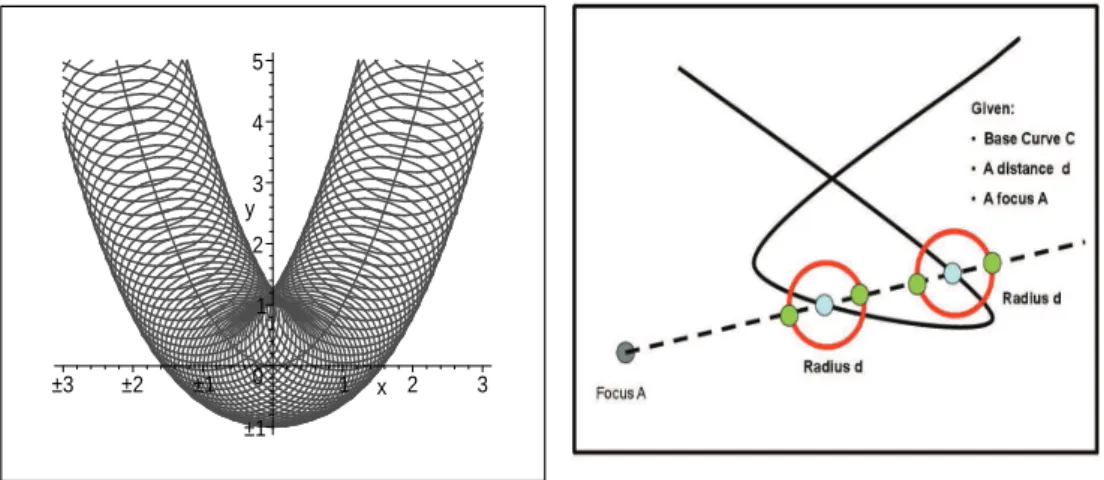
Essentially, the intuitive idea of these geometric constructions are the following. Let K be an algebraically closed field of characteristic zero (sayK=C), andCan irreducible curve inK2.The offset curve (or parallel curve) to C at distance d, denoted byOd(C), isessentiallythe envelope
of the system of circles centered at the points of C with fixed radiusd (see Fig.1, left and, for a formal definition, see [1]). In particular, ifC is parametrized byP(t) ∈K(t)2, the offset to C corresponds to the Zariski closure of the set inK2 generated by the formula
P(t)±d N(t)
kN(t)k
Email addresses:[email protected](Corresponding author: Juana Sendra),[email protected](David G´omez),[email protected](Valerio Mor´an)
The final journal version of this paper appears in Juana Sendra, David Gómez, Valerio Morán,
"Design and Implementation of Maple Packages for Processing Offsets and Conchoids"
II
whereN(t) is the normal vector toC associated withP(t).
The term “parallel” was apparently introduced by Leibniz in [8] for the case of plane curves. Also, in elementary texts on differential geometry or in some books on algebraic geometry (see [17]) some elementary aspects of parallel curves are studied. Nevertheless, in the 1980s, cagd (Computer Aided Geometric Design) community started to be interested on the topic, and they began to address problems related to offsets to curves and surfaces, due to the important role that offsets play in practical applications as tolerance analysis, geometric control, robot path-planning and numerical-control machining problems, etc. [6]. As a consequence of this applicability, many interesting questions directly related to algebraic geometry have been addressed (see, e.g. [1], [2], [4], [5], [9], [16], [18], [19] ) and, currently, the study of offsets continue being an active research area.
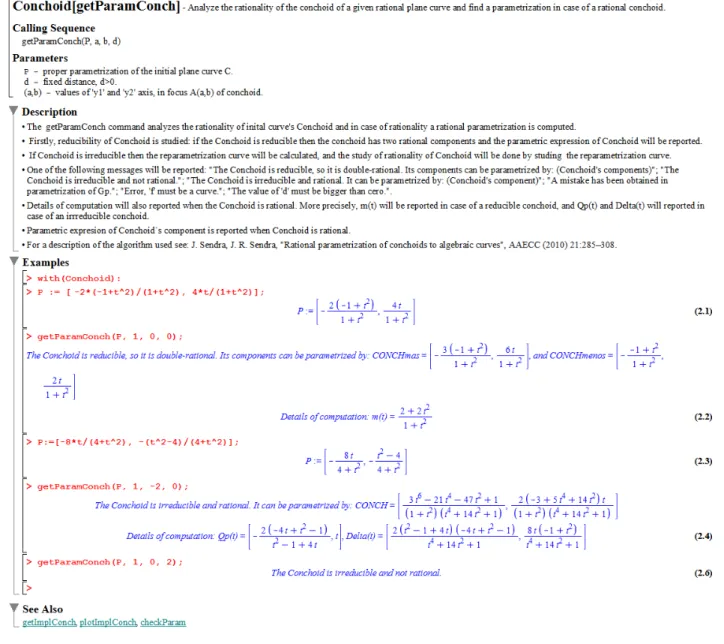
The conchoid of a plane curve arise in a big variety of practical applications, namely the design of the construction of buildings, in astronomy [7], in electromagnetism research [24], optics [3], physics [23], mechanical engineering and biological engineering [10], [11], in fluid mechanics [22], etc. The conchoid concept is rather intuitive. More precisely, given a plane curveC (base curve) and a fixed point A (focus), consider the line L joining A to a point P of C. Consider now the points Q of intersection of L with a circle of radius d centered at P. The geometric locus of Q as P moves along C is called the conchoid of C from focus A at a distance d and denoted by CA
d(C) (see Fig.1 right, for the geometric construction of the conchoid and, for a
formal definition, see [20]). TheConchoid of Nicomedesand theLimacon of Pascalare the two classic examples of conchoids, and the best known. They appear when the base curve is a line or a circle, respectively.
In [18], and [20] the authors analyze theoretically offsets and conchoids and the most im-portant properties of them, from the point of view of Algebraic Geometry. For this, incidence diagrams are used to give a formal definition of these concepts of an algebraic curve. Certain aspects as the rationality of the new curve and the possible inheritance of this property from the base curve have been treated by the authors. Furthermore, the study of the conchoids has been extended to surfaces (see [12], [13], [14]), and the relation between offset and conhcoid is an active problem (see [15]).
–1 0 1 2 3 4 5
y
–3 –2 –1 1 x 2 3
III
The paper is structured as follows. In Section 1, we recall some of the basic definitions and main properties on offsets and conchoids of algebraic plane curves (see [18], [20]). We provide algorithms to analyze the rationality of the components of these new objects (see [1], [21]), and in the affirmative case, rational parametrizations are given. In Section 2 we present the creation of two packages in the computer algebra system Maple to analyze the rationality of offset and conchoids curves respectively, whose procedures are based on the above algorithms, as well as the corresponding help pages. In Section 3, we illustrate the package running presenting a brief atlas where the offset and conchoids of several algebraic plane curves are obtained, and its rationality analyzed. Furthermore, in case of genus zero, a rational parametrization is computed.
1 Parametrization Algorithms
In this Section we summarize the results on the rationality of the offsets and conchoids of curves, presented in [1], [21] respectively, by deriving an algorithm for parametrizing them.
The Offset Rationality Problem
The rationality of the components of the offsets is characterized by means of the existence of parametrizations of the curve whose normal vector has rational norm, and alternatively by means of the rationality of the components of an associated curve, that is usually simpler than the offset. As a consequence, one deduces that offsets to rational curves behave as follows: they are either reducible with two rational components (double rationality), or rational, or irreducible and not rational.
For this purpose, we first introduce two concepts:Rational Pythagorean Hodographsandcurve of reparametrization of the offset. LetP(t) = (P1(t), P2(t))∈K(t)2be a rational parametrization of C. Then, P(t) is rph (Rational Pythagorean Hodograph) if its normal vector N(t) = (N1(t), N2(t)) satisfies that
N1(t)2+N2(t)2=m(t)2,
withm(t)∈K(t). For short we will express this fact writingkN(t)k ∈K(t). On the other hand, we define thereparametrizing curve ofOd(C) associated with P(t) as the curve generated by the primitive part with respect to x2 of the numerator of
x2 2P
0
1(x1)−P 0
1(x1) + 2x2P 0 2(x1),
wherePi0 denotes the derivative ofPi. In the following, we denote byGPO(C) the reparametrizing curve ofOd(C) associated withP(t).
Summarizing the results in [1], one can outline the following algorithm for offsets.
Algorithm: offset parametrization
– Given: a proper rational parametrizationP(t) of a plane curveC in K2 and d∈K. – Decide:whether the components of Od(C) are rational.
– Determine:(in the affirmative case) a rational parametrization of each component ofOd(C).
1. Compute the normal vector N(t) of P(t). If ||N(t)|| ∈ K(¯t) then return Od(C) has two
rational components parametrized byP(t)±||Nd(t)||N(t). 2. Determine GO
P(C), and decide whetherGPO(C) is rational. 3. If GO
IV
4. Else compute a proper parametrization R(t) = ( ˜R(t), R(t)) of GO
P(C) and return thatOd(C) is rational and that Q(t) =P( ˜R(t)) + 2d R(t)
N2( ˜R(t))(R(t)2+1)N( ˜R(t)) where N = (N1, N2), para-metrizes Od(C).
The Conchoid Rationality Problem
In [21], it is proved that conchoids having all their components rational can only be generated by rational curves. Moreover, it is shown that reducible conchoids to rational curves have always their two components rational (double rationality). From these results, one deduces that the ra-tionality of the conchoid component, to a rational curve, does depend on the base curve and on the focus but not on the distance. To approach the problem we use similar ideas to those for off-sets introducing the notion ofreparametrization curveas well as the notion ofrdf parametrization. The rdf concept allows us to detect the double rationality while the reparametrization curve is a much simpler curve than the conchoid, directly computed from the input rational curve and the focus, and that behaves equivalently as the conchoid in terms of rationality. As a consequence of these theoretical results [21] provides an algorithm to solve the problem. The algorithm analyzes the rationality of all the components of the conchoid and, in the affirmative case, parametrizes them. The problem of detecting the focuses from where the conchoid is rational or with two rational components is, in general, open.
We say that a rational parametrizationP(t) = (P1(t), P2(t))∈K(t)2 of Cis atrational distance to the focus A= (a, b) if
(P1(t)−a)2+ (P2(t)−b)2 =m(t)2,
with m(t) ∈ K(t). For short, we express this fact saying that P(t) is rdf or A-rdf if we need to specify the focus. On the other hand, we define thereparametrization curve of the conchoid
CA
d(C) associated to P(t), denoted by GPC(C), as the primitive part with respect to x2 of the numerator of
−2x2(P1(x1)−a) + (x22−1)(P2(x1)−b).
Algorithm: conchoid parametrization
– Given: a proper rational parametrizationP(t) of a plane curveC inK2, a focus A= (a, b), and d∈K.
– Decide:whether the components of the concchoidCA
d(C) are rational.
– Determine:(in the affirmative case) a rational parametrization of each component ofCAd(C).
1. Compute the primitive part g(x1, x2) w.r.t.x2 of the numerator of
−2x2(P1(x1)−a) + (x22−1)(P2(x1)−b). 2. If gis reducible return thatCA
d(C) is double rational and that P(t) + d
±kP(t)−Ak(P(t)−A) parametrize the two components. 3. Check whether the genus of GC
P is zero. If notreturn thatCAd(C) is not rational.
4. Compute a proper parametrization (φ1(t), φ2(t)) ofGPC andreturnthatCAd(C) is rational and
that P(φ1(t)) +±kP(φ1d(t))−Ak(P(φ1(t))−A) parametrizesCAd(C).
V
2 Implementation of conchoid and offset processing packages and help pages
In this section, we present the creation of two packages in the computer algebra system Maple, that we callConchoidand Offset. These packages compute the implicit equation, and analyze the rationality and the reducibility of conchoids and offset curves respectively, providing rational parametrizations in case of genus zero. In addition, it allows us to display plots. These packages consist in several procedures that are based on the above parametrization algorithms.
In the following, we give a brief description of the procedures and we show one of the help pages for one of the maple functions. The procedure codes and packages are available contacting with the corresponding author.
2.1 Procedures of the Conchoid Package
getImplConch
This procedure determines the implicit equation of the conchoid of an algebraic plane curve at a fixed focus and a fixed distance. For this purpose, we use Gr¨oebner Basis to solve the system of equations consisting on the circle centered at generic point of the initial curve C and radius d, the straight line from the focus A to the generic point of the initial curveC, and the initial curveC.
getParamConch
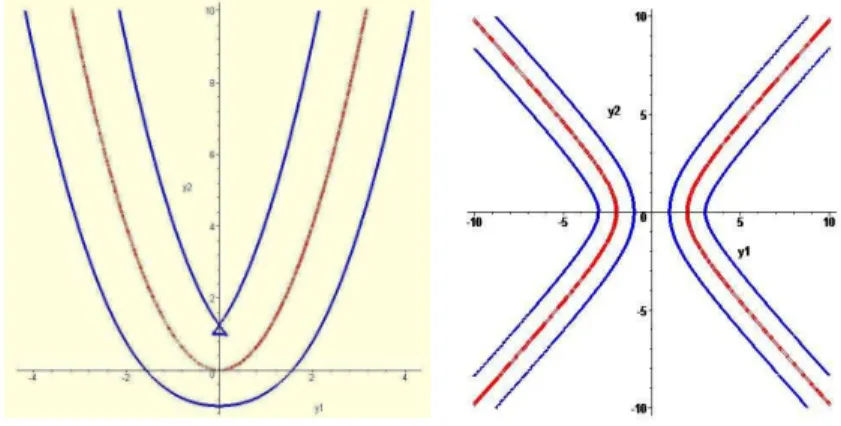
Firstly this procedure checks whether the conchoid of a rational curve is irreducible or it has two rational components. For this purpose, a proper rational parametrization of the initial curve is rdfis analized. In affirmative case, the procedure outputs a message indicating reducibility (the conchoid has two rational components) and a rational parametrization for each component is displayed. Otherwise, the conchoid is irreducible and the reparametrization curve is computed in order to study its rationality. In the affirmative case, it provides a rational parametrization by means of a rational parametrization of the reparametrizing curve and it outputs a message indicating irreducibility and rationality.
plotImplConch
This procedure computes the conchoids curve usinggetImplConch procedure, and then it plots both the initial curve and its conchoid within the coordinates axes interval [−a, a]×[−a, a].
2.2 Procedures of the Offset Package
ImplicitOFF
VI
OFFparametric
This procedure analyzes the rationality of the offset of a rational plane curve. For this purpose, first it decides whether the offset is irreducible or it has two rational components. In case of re-ducibility, the procedure outputs a rational parametrization for each component, using therph concept. Otherwise, it checks whether the offset is rational or not. In the affirmative case, it pro-vides a rational parametrization by means of a rational parametrization of the reparametrizing curve.
OFFplot
This procedure computes the offset curve at a generic distance,d, and then replaces d with a fixed value, dist. Finally, it plots both the initial curve and its offset at a distance dist within the coordinates axes interval [−a, a]×[−a, a].
Once we have implemented the conchoids and offset procedures in Maple, we have created a two packages containing them, called Conchoid and Offset, respectively. Now, if we want to use the package, first of all we have to specify, with the commandlibname, the directory where the file containing the offset procedures is located in our computer. Finally we have to use the commandwith followed by the name of the package, to charge the package in memory and then it will be ready to be used.
VII
Fig. 2.getParamConch help page.
3 Atlas of Conchoid and Offset Curves
VIII
of space limitations. The implicit equations, plots and more details of the computation of these atlas are available contacting with the corresponding author.
Offsets Curves
Base Curve Offset Degree Rationality Parametrization GP
Circle 4 ³ Double Rational
±(dt±2+1r)2t, ∓(d±r)(t 2−1)
t2+1
´
N/A
Parabola 6 ³(t2−1)(−t2−1+4datRational) 4at(t2+1) ,t
6−t4−t2+1+32dt3a 16at2(t2+1)
´ x2
2−1 + 4x2ax1
Hyperbola 8 Irreducible and non rational x22a2x1−x1a2−a2x2−b2x21x2
Ellipse 8 Irreducible and non rational −x2
2ax1+ax1+x2b−x2bx21
Cardioid 14
Rational ³
(−9+t2)(dt6−117dt4+3456t3−1053dt2+729d) (243t2+27t4+t6+729)(t2+9) , −18(dt6−16t5−21dt4+864t3−189dt2−1296t+729d)t
(243t2+27t4+t6+729)(t2+9)
´
32x2
2x31 − 6x2
2x1−32x31+ 6x1−48x2x21+
x2
Three-leafed
Rose 14 Irreducible and non rational
−5x2
2x1 + 3x22x31 +
5x1−3x3
1−12x2x21+
3x2x4 1+x2 Trisectrix of
Maclaurin 10 Irreducible and non rational
4x1x2
2 − 4x1 +
6x2x2
1 +x2x41 −
3x2 Folium of
Descartes 14 Irreducible and non rational
x2
2−2x22x31−1 +
2x3
1 + 4x2x1 −
2x2x4 1
Tacnode 20
Irreducible
and non
rational
486x2
2x61 + 2304x22x51 + 3882x22x41 + 3144x2
2x31+ 1303x22x21+ 256x22x1+ 17x22− 486x6
1 − 2304x51 − 3882x41 − 3144x31 − 1303x2
1 − 256x1 − 17 + 432x2x61 + 3960x2x51 + 9360x2x41 + 10080x2x31 + 5640x2x21+ 1604x2x1+ 184x2
Epitrochoid 10 Irreducible and non rational
32x2
2x31 −256x22x1 −32x31 +
256x1 −5x2x4
1 + 288x2x21 −
256x2 Ramphoid
Cusp 20 Irreducible and non rational
9x2
2x51−9x51+12x2x51−16x2x41+9x22x41− 9x4
1+4x2x31−6x31+6x22x31−4x2x21−6x21+ 6x2
2x21+x22x1−x1+ 4x2+x22−1 Lemniscata
of
Bernoulli
16 Irreducible and non rational
x2
2−3x22x41+3x22x21−x61x22−1+3x41− 3x2
1+x61+ 2x2−6x2x41−6x2x21+ 2x6
1x2
IX
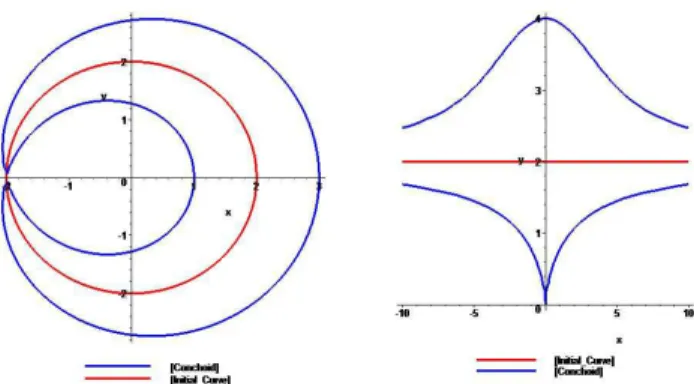
Fig. 3.Parabola (red curve) and the offset atd= 2. Hyperbola (red curve) and the offset atd= 1.5.
Fig. 4.Left: Ellipse (red curve) and the offset atd= 1. Right: Cardioid (red curve) and the offset atd= 1.
X
Conchoids Curves
Base Curve (C) Focus of Curve (O)
& Focus of Conchoid (A) Rationality Conchoid (C) Parametrization
Circle
x2
2+x21−4
A=O=(0,0) A∈ C,A=(-2,0) A6=O,A∈ C/ ,A=(-4,0)
Double Rational Irr. rational Irr. not rational
³
−2(−1+t2)±(1−t2) 1+t2 ,41+t±2t2t
´ ³
3t4−12t2+1 1+2t2+t4 ,
2t(−3+5t2) 1+2t2+t4
´
N/A
Parabola
x2−x2 1
A=O=(0,1/4) A∈ C,A=(0,0) A6=O,A∈ C/ ,A=(0,-2)
Double Rational Irr. rational Irr. not rational
³
t± 1+44tt2, t2±4t 2−1 1+4t2
´ ³
2t+2t3+1−2t2+t4
(−1+t2)(1+t2) ,2t(2t+2t
3+1−2t2+t4) (−1+t)2(1+t)2(1+t2)
´ N/A Hyperbola x2 1 16 − x2 2 9 −1
A=O=(5,0) A∈ C,A=(-4,0) A6=O,A∈ C/ ,A=(0,0)
Double Rational Irr. rational Irr. not rational
³
−2(9+t2)
3t ±
2(−t−6)(2t+3) 45+24t+5t2 ,t
2−9 2t ±
3(t2−9) 45+24t+5t2
´ ³
(45t6+129t4+311t2+27)
(1+t2)(−9+t2)(9t2−1) , 2(−63+81t 4−82t2)t (1+t2)(−9+t2)(9t2−1)
´ N/A Ellipse x2 1 25 + x2 2 16−1
A=O=(3,0) A∈ C,A=(0,4) A6=O,A∈ C/ ,A=(0,0)
Double Rational Irr. rational Irr. not rational
³
5(t2−1)
t2+1 ± t 2−4
t2+4,t28+1t ±t24+4t
´
((1−t2)(100(4t4+17t+100t2+4)(1+t3+4t4+17t2)t2+4), 2(−58t4+8t6−58t2+8−4t5−17t3−4t) (4t4+17t2+4)(1+t2) )
N/A
Cardioid
(x2
1 + 4x2 + x2
2)2 −16(x21 + x2
2)
A∈ C,A=(0,0) A∈ C/ ,A=(-9,0)
Double Rational Irr. not rational
³
−1024t3
(16t2+1)2 ±16−8t2+1t ,−128t
2(16t2−1)
(16t2+1)2 ± 1−16t 2 16t2+1
´
N/A
Three-leafed Rose
(x2
1 + x22)2 + x1(3x2
2−x21)
A∈ C,A=(0,0) A∈ C/ ,A=(-2,0)
Irr. rational Irr. not rational
³
2(t4−6t2+9)t2(t−1)(t+1) (t4+2t2+1)2 ,4t
3(t4−6t2+9) (t4+2t2+1)2
´
N/A
Trisectrix of Maclaurin
x1(x2
1 + x22) −
(x2 2−3x21)
A∈ C,A=(0,0) A∈ C/ ,A=(-4,0)
Irr. rational Irr. not rational
³
−2(−5t2+2t4+1) (t4+2t2+1) ,
−4t(−5t2+2t4+1) (t4+2t2+1)(t2−1)
´
N/A
Folium of Descartes
x3
1+x32−3x1x2
A∈ C,A=(0,0) A∈ C/ ,A=(-1,-1)
Irr. rational Irr. not rational
((−6t+6(t5t2++1)(t6−3t6t4−3+3t4t2+3−1+8t2−1+8t3)(tt3−1)() t+1), 2(−6t+6t5+t6−3t4+3t2−1+8t3)t
(t2+1)(t6−3t4+3t2−1+8t3) )
N/A
Tacnode
2x4
1 −3x21x2 + x2
2−2x32+x42
A∈ C,A=(0,0) A∈ C,A=(0,1)
Irr. not rational Irr. not rational
N/A N/A
Epitrochoid
x4
2 + 2x21x22 −
34x2
2 + x41 −
34x2
1+96x1−63
A∈ C,A=(3,0) A∈ C/ ,A=(0,0)
Double Rational Irr. rational
(−7t4(+288t2+16)t22+256±16−t 2
t2+16, −16t(5t2−16)
(t2+16)2 ±t(−82+16t))
N/A
Ramphoid Cusp
x4
1 + x21x22 −
2x21x2−x1x2 2+x22
A∈ C,A=(0,0) A∈ C/ ,A=(-1,-1)
Irr. not rational Irr. not rational
N/A N/A
Lemniscata of Bernoulli
(x2
1 + x22)2 −
4(x2 1−x22)
A∈ C,A=(0,0) A∈ C,A=(-2,0)
Irr. not rational Irr. not rational
N/A N/A
XI
Fig. 6.Left: Circle (red curve) and the conchoid (blue curve) at A = (−2,0) and d= 1 (Lima¸con of Pascal). Right: Straight line (red line) and the conchoid (blue curve) atA= (0,0) andd= 2 (Conchoid of Nicomedes).
Fig. 7.Left: Conchoid of Sluze (red curve) and the conchoid (blue curve) atA= (−2,0) andd= 1. Right: Folium of Descartes (red curve) and the conchoid (blue curve) atA= (0,0) andd= 2.
Fig. 8.Left: Lemniscata of Bernoulli (red curve) and the conchoid (blue curve) atA= (−2,0) andd= 1. Right: Parabola (red curve) and the conchoid (blue curve) atA= (0,1/4) andd= 1.
Acknowledgements.This work has been partially funded by the Spanish ”Ministerio de Econo-mia y Competitividad” under the project MTM2011-25816-C02-01.
References
1. E. Arrondo, J. Sendra, J.R. Sendra. Parametric Generalized Offsets to Hypersurfaces.Journal of Sym-bolic Computation23(2–3), 267–285, 1997.
2. E. Arrondo, J. Sendra, J.R. Sendra. Genus Formula for Generalized Offset Curves.Journal of Pure and Applied Algebra 136(3), 199–209, 1999.
XII
4. R.T. Farouki, C.A. Neff. Analytic Properties of Plane Offset Curves.Comput. Aided Geom. Des.7, 83–99, 1990.
5. R.T. Farouki, C.A. Neff. Algebraic Properties of Plane Offset Curves. Comput. Aided Geom. Des. 7, 100–127, 1990.
6. C.M. Hoffmann.Geometric and Solid Modeling.Morgan Kaufmann Publishers, Inc. 1993.
7. Kerrick A.H.,The limacon of Pascal as a basis for computed and graphic methods of determining astronomic positions. J. of the Institute of Navigation. vol.6, No.5. 1959.
8. G.W. Leibniz. Generalia de natura linearum, anguloque contactus et osculi povocationibis aliisque cognatis et eorum usibus nonnullis.Acta Eruditorum, 1692.
9. W. L¨uOffset-Rational Parametric Plane Curves.Comput. Aided Geom. Des.12, 601–617, 1995.
10. Menschik F., The hip joint as a conchoid shape. J. of Biomechanics. 1997 Sep; 30(9):971-3 9302622., 1997. 11. MyungJin Kang, Hip joint center location by fitting conchoid shape to the acetabular rim images. Engineering
in Medicine and Biology Society, 2004. IEMBS’04. 26th Annual International Conference. Vol 2. pp. 4477-4480 vol 6. ISBN:0-7803-8439-3, 2004.
12. Peternell, M. and Gruber, D. Conchoid surfaces of quadrics, Journal of Symbolic Computation, 2013. doi:10.1016/j.jsc.2013.07.003.
13. Peternell, M., Gruber, D. and Sendra, J.Conchoid surfaces of rational ruled surfaces, Comp. Aided Geom. Design 28, 427–435, 2011.
14. Peternell, M., Gruber, D. and Sendra, J.Conchoid surfaces of spheres, Comp. Aided Geom. Design 30, issue 1, pp. 35–44, 2013.
15. Peternell, M., Gotthart, L., Sendra, JR., and Sendra, J. The Relation Between Offset and Conchoid Con-structions, arXiv:1302.1859v2 [math.AG] 10 Jun 2013.
16. M. Peternell, H. Pottmann.A Laguerre geometric approach to rational offsets. Computer Aided Geo-metric Design,15, 223–249, 1998.
17. G. Salmon.A Treatise an the Higher Plane Curves. Chelsea, New York ,1960.
18. J. Sendra, J.R. Sendra. Algebraic Analysis of Offsets to Hypersurfaces. Mathematische Zeitschrift 234, 697–719, 2000.
19. J. Sendra, J.R. Sendra. Rationality Analysis and Direct Parametrization of Generalized Offsets to Quadrics.Applicable algebra in Engineering, Communication and Computing 11, 111–139, 2000.
20. Sendra J., Sendra J. R. . An Algebraic Analysis of Conchoids to Algebraic Curves. Applicable Algebra in Engineering, Communication and Computing vol. 19, pp. 413–428, 2008.
21. J. Sendra and J.R. Sendra. Rational parametrization of conchoids to algebraic curves, Applicable Algebra in Engineering, Communication and Computing, Vol.21, No.4, pp. 413–428, 2010.
22. Sultan A., The Lima¸con of Pascal: Mechanical Generating Fluid Processing. J. of Mechanical Engineering Science. vol. 219,Number 8/ 2005. pp. 813–822. ISSN.0954-4062, 2005.
23. Szmulowicz F., Conchoid of Nicomedes from reflections and refractions in a cone. American Journal of Physics, vol. 64, pp. 467–471, 1996.