Influence of Concentration and Solar Cell Size on the
Warranty Time of Triple Junction Solar Cells
Neftali Nuñez
1,2,a), Manuel Vazquez
1,2, Julen Tamayo-Arriola
3, Vincenzo
Orlando
1, Olga Alburquerque
1, Antonio Fernandez
2and Carlos Algora
11Instituto de Energía Solar, ETSI Telecomunicación, Universidad Politécnica de Madrid, Avda. Complutense 30,
Madrid, Spain
2 ETSIS Telecomunicación, Universidad Politécnica de Madrid, Calle Nikola Tesla s/n, Madrid, Spain. 3Instituto de Sistemas Optoelectrónicos y Microtecnología, ETSI Telecomunicación, Universidad Politécnica de
Madrid, Avda. Complutense 30, Madrid, Spain.
a)Corresponding author: [email protected]
Abstract. In a previous work the warranty time of commercial lattice-matched GaInP/Ga(In)As/Ge triple junction concentrator solar cells was evaluated under real climatic conditions. The solar cells had a size of 7x7 mm operating with an efficiency of 35% at 820×. For these particular solar cells the warranty time for three locations, Golden (CO-USA), Madrid (Spain), and Tucson (AZ-USA), exhibits a 4 to 1 ratio, which affects the LCOE (Levelized Cost of Electricity) in an important way. In this work, we go a step further evaluating the influence of concentration and solar cell size on the warranty for a specific thermal design.
INTRODUCTION
In order to have a wide deployment of CPV systems, one important pending issue is to demonstrate that their reliability is competitive with other energy generation technologies [1]. Temperature Accelerated Life Tests (ALTs) [2,3] are used in order to evaluate reliability functions and parameters at a fixed solar cell temperature. However, solar cell temperature in real operation conditions is variable [4] and this variation depends on the location and time where the CPV systems are installed.
In a previous work [5] we have evaluated the solar cell reliability for different locations taking into consideration the solar cell temperature at any time for a specific solar cell and CPV module. We have observed that the influence of the location on the solar cell reliability is important and that the solar thermal design should be customized for the location where CPV module is placed.
Once we have evaluated the solar cell reliability for a given CPV module (solar cell size of 7x7 mm2 operating at 820×) [5] we now extend the work to a wide range of concentrations and solar cells sizes. Accordingly, in this paper we evaluate the influence of solar cell size and concentration on the solar cell reliability for different locations.
MODEL
In order to evaluate the solar cell reliability parameters in a real application it is necessary to thoroughly evaluate the reliability from ALTs [3] and after that to determine the thermal behavior of the solar cell inside the CPV module [4]. The steps to extrapolate the reliability data obtained in an ALT for a given temperature to the real operation conditions of a location are the following [5]:
To evaluate the solar cell reliability for a specific location and year by using both the solar cell instantaneous temperature evaluated in the previous step and the reliability parameters obtained from a temperature ALT assuming a specific nominal solar cell temperature for reliability purposes [3].
To evaluate the influence of the solar cell size and light concentration on the thermal behavior of the solar cell. Taking into account the solar cell size of 7x7mm and the operation at 820× inside the real CPV module, that we have been thoroughly characterized in previous works [3-5], the influence of solar cell size and sun concentration is analyzed by means of thermal simulations.
Solar Cell Temperature Evaluation
In order to determine the solar cell temperature from atmospheric parameters we will use a simplified equivalent thermal circuit of the CPV module, which can be described by two series connected thermal resistances, _ (thermal resistance from solar cell junction to the back of the CPV module) and _ (thermal resistance from the back of the CPV module to ambient); see Fig. 1 of reference [5]. In this model we assume _ is not affected by wind speed because all the elements affecting _ are enclosed inside the CPV module. On the other hand, the elements affecting _ are outside the CPV module and therefore, _ is highly dependent on wind speed. In the thermal circuit model of the CPV module including the solar cell [5], the temperature increment depends on both the thermal resistances and the power dissipated by means of the following equations:
∙ _ (1)
∙ _ (2)
_ ° ∙ (3)
where _ depends has two terms: the value of under natural convection (equivalent to a negligible wind), and the improvement due to the effect of wind velocity, being Wf the wind factor, and the wind velocity (m/s). is solar cell junction temperature, is temperature in the back of CPV module and is ambient temperature.
The power dissipated as heat, , in the concentrator solar cell is:
∙ ∙ ∙ 1 (4)
where due to the concentrated light by a lens with a size ( ) is related to the impinging irradiance (also called Direct Normal Irradiance, DNI) and the optical and solar cell efficiencies, and ., respectively. It is important to note that ∙ , being the solar cell area and the geometrical concentration.
Therefore, the instantaneous temperature of the solar cell can be determined if the power dissipated in the solar cell, both thermal resistances and the instantaneous atmospheric data namely, ambient temperature ( , DNI and wind speed, are known:
∙ ∙ 1 ∙ _ ∙ ∙ ∙ 1 ∙ _ (5)
Evaluation of the Solar Cell Reliability in Real Conditions
In this section we will show how to extrapolate the reliability parameters from an ALT, assessed for a given solar cell temperature, to the real solar cell temperature. We assume that: a) the reliability parameters are accelerated by temperature and the obtained results follow an Arrhenius law [2-3] and b) the activation energy, 1.59eV, has been evaluated previously in the same ALT that has provided the solar cell reliability results [3]. A failure mechanism analysis has been described in [6].
In the ALT the reliability parameters have been obtained for a nominal temperature of 80 °C [3]. Therefore, it is possible to make a relationship between the operation time in real conditions at ( and the time at 80 °C by means of the Arrhenius law. This relationship is called Acceleration Factor (AF) of with respect to 80
°C, :
/ , , (6)
As derived from equation (6) if the solar cell temperature is lower than 80 °C, AF will be lower than 1 while if solar cell temperature is higher than 80 °C, AF will be higher than 1. AF also depends on the activation energy ( ) obtained in the ALT and has to be known beforehand. Taking into account the hours per year at each interval (1 °C width) of solar cell temperature and the AF of this temperature interval with respect to 80 °C, it is possible to evaluate the equivalent time at 80 °C for each interval of temperature of the temperature histogram. Adding the heights of this histogram allows us evaluate the yearly equivalent time at 80 °C [5].
This yearly equivalent time at 80 °C value, that depends on the solar cell temperature and , can be compared with the reliability results at 80 °C obtained in the temperature ALT as described in ref [3]. As an example, the yearly equivalent time at 80ºC in Tucson 2014 for the analysed solar cells corresponds to 13,464 hours [5], that compared to the warranty time measured in the ALT at 80ºC that was 206,225 hours [5], implies that in this location and year the warranty time is 206,225/13,464=15.3 years. This calculation can be done for any location and year if instantaneous atmospheric data are available.
Solar Cell Size and Sun Concentration Influence
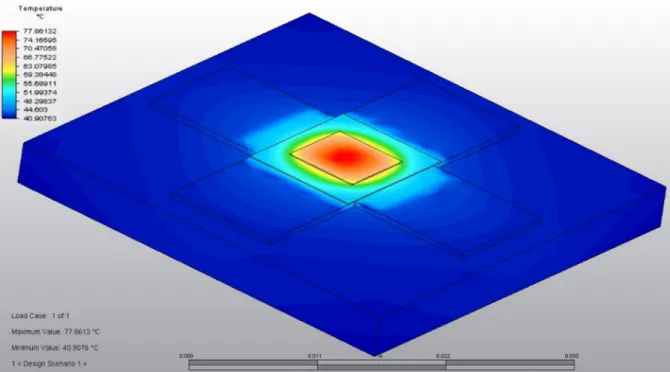
Once we have evaluated the reliability parameters of a solar cell at a given location and year, it is very important to analyze the influence of the solar cell size and sun concentration in the reliability parameters. In order to do that, we have evaluated the thermal parameters explained in previous section by means of thermal simulations made with Finite Element Analysis (FEA), see Fig. 1. For the evaluation of the thermal parameters, we have taken the following assumptions:
To extract the main parameters for the thermal simulations we have selected as reference a 7x7 mm solar cell area (A) at a geometrical concentration ratio (C) of 820× whose thermal and reliability parameters have been thoroughly characterized in [3-4].
The thermal design, materials, thickness and dimension of the aluminium heat spreader [4] are the same for the different solar cell sizes and concentrations.
The size of the rear aluminium plate will be the same than the lens size ( ). The thickness of the rear aluminium plate is 2 mm.
cell area (due to decreases). Simultaneously, since depends on the rear aluminium plate size (
), a higher means an improvement (decrease) of , but it also results in an increase of power. This increase of power implies an increase of the solar cell temperature that is not counterbalanced by the decrease. In conclusion, we have evaluated both and for a wide range of , , that together with the
solar cell reliability model explained in previous sections allow us to obtain the warranty time for different locations and years as described below.
FIGURE 1. Example of one of the thermal simulations to assess the thermal resistance parameters in real conditions, for the 7x7 mm2 triple junction solar cell at 820× at 5.5 m/s wind velocity. For the sake of simplicity, the image does not include neither the
secondary optics over the cell nor rear aluminium plate and tape cell bonding.
RESULTS
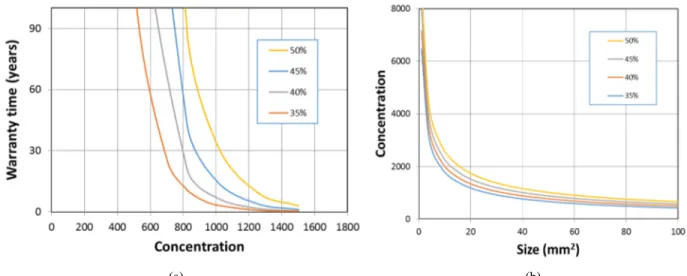
In order to analyze the influence of concentration we have carried out calculations using the 7x7 mm solar cell for different sun concentrations in a harsh environment (Tucson) with atmospheric data from 2014, Fig. 2-a. This solar cell, whose thermal dissipation was designed to work at 820× with a nominal temperature of 80ºC, does not achieve a 30 year warranty time in this location for low solar cell efficiencies (<40%).
Following with the case study of Tucson, we have also analyzed the influence of concentration, efficiency, and solar cell size to achieve a 30 year warranty time, see Fig. 2-b. This figure shows that with this thermal design, for smaller solar cell sizes the maximum achievable concentration for 30 years of warranty is very high (several thousand suns) and therefore, a cheaper and simpler thermal scheme could be used. In the other extreme, for larger solar cell sizes, the maximum concentration for 30 years warranty time is only some hundred suns and thus, a better thermal design will be required for working at concentrations above 1,000 suns
(a) (b)
FIGURE 2. a) Warranty time vs. concentration in Tucson (Arizona) 2014 for a 7mm x 7mm solar cell with the specified thermal design for different solar cell efficiencies. b) Maximum concentration values vs solar cell size to achieve a 30 years warranty
time target for different efficiencies, in Tucson (Arizona) 2014.
TABLE 1. Ambient and solar cell temperatures when DNI > 0 for Tucson; Madrid and Golden in 2014.
Temperatures, (ºC) Tucson Madrid Golden
Maximum ambient temperature 42.3 38.4 35.4
Average ambient temperature 26.5 21.1 15.4
Minimum ambient temperature 6.5 -3.6 -24.8
Maximum solar cell temperature 114.2 103.8 103.4
Average solar cell temperature 73.7 66.6 59.1
The results we have obtained here are very biased by the boundary conditions of using the real thermal dissipation scheme used in the real CPV module from which we have measurements. Therefore, more realistic and useful results about recommended concentration, solar cell size and efficiency for different locations would be achieved if a customization of the thermal dissipation were done what is now ongoing in our group.
SUMMARY AND CONCLUSIONS
An analysis of the influence of solar size and concentration on warranty time of CPV solar cells that takes into account climatic conditions has been carried out. The main conclusions are:
Solar cells below 25 mm2 operating at 1,000× or higher are able to achieve warranty times of more than 30 years for Tucson, Madrid and Golden using the selected thermal design of this paper.
This specific thermal design considered in this paper for 7mmx7mm solar cells is adequate for Madrid and Golden, but not for a harsher environment, such as Tucson.
A thermal design customization for different concentration, solar cell efficiency and size has to be done is order to achieve long warranty times.
ACKNOWLEDGMENTS
This work has been supported by the Spanish MINECO through the project TEC2014-54260-C3-1-P, by the Comunidad de Madrid through the project MADRID-PV (S2013/MAE-2780), and by UPM with the project RP150910B12.
REFERENCES
1. K. Araki et al., "Development of a new 550× concentrator module with 3J cells - performance and reliability," Conference Record of the Thirty-first IEEE Photovoltaic Specialists Conference, 2005. pp. 631-634. DOI: 10.1109/PVSC.2005.1488210
2. Núñez, N., González, J. R., Vázquez, M., Algora, C., & Espinet, P., "Evaluation of the reliability of high concentrator GaAs solar cells by means of temperature accelerated aging tests." Progress in Photovoltaics: Research and Applications 21.5 (2013): 1104-1113.
3. Espinet-González, P., Algora, C., Núñez, N., Orlando, V., Vázquez, M., Bautista, J., & Araki, K., "Temperature accelerated life test on commercial concentrator III–V triple-junction solar cells and reliability analysis as a function of the operating temperature." Progress in Photovoltaics: Research and Applications 23.5 (2015): 559-569.
4. Núñez, R., Antón, I., Askins, S., Sala, G., & Araki, K., Characterization of CPV arrays based on differences on their thermal resistances. In AIP Conference Proceedings (Vol. 1616, No. 1, pp. 144-148) (2014).
5. Vazquez, M., Tamayo-Arriola, J., Orlando, V., Nuñez, N., Alburquerque, O., & Algora, C., Reliability of commercial triple junction concentrator solar cells under real climatic conditions and its influence on electricity cost. Progress in Photovoltaics: Research and Applications, 25(11), (2017): 905-918.