There is continuing debate regarding the most advisable method for assessing Personality Disorders (PDs): questionnaires or interviews. Currently, considering the absence of external criteria for validating diagnoses, interviews based on the Diagnostic and Statistical Manual of Mental Disorders (DSM, American Psychiatric Association, 1980-2000) are consensually considered the gold standard approach for diagnosis. They are said to discard false positive diagnoses better than self-reports, both by discriminating more accurately enduring traits from psychopathological states and better determining trait dysfunctionality (McDermutt & Zimmerman, 2005; Segal & Coolidge, 2003; Widiger & Samuel, 2005). However, their high cost severely limits their use within clinical settings (Aboraya, 2009). On the other hand, self-reports
are most widely used in the assessment of PDs, outperforming interviews in terms of their psychometric properties (Widiger & Samuel, 2005), but they are said to grossly over-diagnose (Hyler, Skodol, Kellman, Oldham, & Rosnick, 1990; Wang et al., 2012).
Nonetheless, the question might be not whether questionnaires or interviews are the right method, but whether accurate PD assessments need to combine them. Although both methods agree poorly with each other (Duijsens, Bruinsma, Jansen, Eurelings-Bontekoe, & Diekstra, 1996; Guy, Poythress, Douglas, Skeem, & Edens, 2008; Perry, 1992; Zimmerman, 1994), a literature review suggests that self-reports and interviews provide complementary information (Blackburn, Donnelly, Logan, & Renwick, 2004; Hopwood et al., 2008; Miller, Bagby, & Pilkonis, 2005). In this line, it has been suggested that the most effi cient strategy in clinical settings is the initial administration of a questionnaire, followed by an interview-based assessment when self-reported information is positive (Widiger & Samuel, 2005). However, combining both requires a better understanding of their mutual relationship, currently unknown. We need to know to what degree diagnostic outputs differ; whether these differences can be improved by
Diagnostic agreement between the Personality Diagnostic
Questionnaire-4+ (PDQ-4+) and its Clinical Signi
fi
cance Scale
Natalia Calvo
1,2, Fernando Gutiérrez
3and Miguel Casas
1,21 Psychiatry Department. Hospital Vall d’Hebrón. CIBERSAM, 2 Universidad Autónoma de Barcelona and 3 Hospital Clinic Barcelona. IDIBAPS
Abstract
Resumen
Background: The Personality Diagnostic Questionnaire-4+ (PDQ-4+) is composed of a self-report and an interview, the Clinical Signifi cance Scale, but no studies have reported joint fi ndings. This study is the fi rst to examine the diagnostic agreement between the Spanish version of the PDQ-4+ self-report and its corresponding interview. Method: The sample comprised 235 psychiatric outpatients who were assessed with both instruments. Results:
The interview reduced to one half the number of diagnoses provided by self-report (83.4% to 38.3%; mean number of diagnoses 3.29 to .62). Diagnostic agreement was between fair and moderate (mean kappa .45 for PDQ-4+ total score). Conclusions: Findings suggest the utility of jointly administering the PDQ-4+ and its Clinical Signifi cance Scale to screen for the presence or absence of personality disorders (PDs). Modifi cations in the diagnostic cut-offs for individual PDs and the PDQ-4+ total score may improve the effi cacy of the instrument.
Keywords: PDD-4+; Clinical Signifi cance Scale; diagnostic agreement; personality disorders.
Concordancia diagnóstica entre el Personality Diagnostic Questionnaire-4+ (PDQ-4+) y su Escala de Signifi cación Clínica. Antecedentes: el Personality Diagnostic Questionnaire-4+ (PDQ-4+) está compuesto por un autoinforme y una entrevista, la Escala de Signifi cación Clínica, pero ningún estudio ha sido publicado con resultados conjuntos. Este trabajo es el primero en examinar la concordancia diagnóstica entre la versión española del cuestionario PDQ-4+ y su correspondiente entrevista. Método: la muestra estaba formada por 235 pacientes psiquiátricos ambulatorios que fueron evaluados con ambos. Resultados:
la entrevista reducía hasta la mitad el número de diagnósticos obtenido por el cuestionario (83,4% a 38,3%; número medio de diagnósticos de 3,29 a .62). La concordancia diagnóstica era de escasa a moderada (kappa media de .45 para la puntuación total del PDQ-4+). Conclusiones: nuestros datos sugieren la administración conjunta del PDQ-4+ y su Escala de Signifi cación Clínica para el cribage de presencia o ausencia de trastornos de personalidad (TPs). Modifi caciones en los puntos de corte para TPs específi cos y para la puntuación total del PDQ-4+ podrían mejorar la efi cacia del instrumento.
Palabras clave: PDQ-4+; Escala de Signifi cación Clínica; concordancia diagnóstica; trastornos de personalidad.
Received: March 5, 2013 • Accepted: July 9, 2013 Corresponding author: Natalia Calvo
simply changing the diagnostic thresholds; whether, contrarily, questionnaires and interviews measure distinct constructs; and whether these outcomes are the same for all individual disorders.
The Personality Diagnostic Questionnaire-4+ (PDQ-4+; Hyler, 1994) has been strongly recommended instead of a screening instrument (Abdin et al., 2011; Widiger & Samuel, 2005). The PDQ-4+ is a self-report, assessing ten specifi c PDs plus two PDs proposed in the DSM-IV (American Psychiatric Association, 1994), Appendix B. These 99 items, true-false format, literally refl ect a single DSM-IV diagnostic criterion. Besides, a brief structured interview (10-15 minutes), the Clinical Signifi cance Scale, follows the self-report and either confi rms or does not confi rm the diagnosis for each individual PD scoring over threshold. Unlike others, this interview directly refl ects the principal DSM-IV general criteria for PD assessing whether: (a) the trait is enduring (criterion D for DSM-IV); (b) it is present in the absence of a psychopathological state, the effects of a substance or any medical condition (criteria E and F); and (c) it leads to distress or impairment (criterion C). This format better refl ects the diagnostic procedure proposed by the DSM-IV and emphasized by the future DSM-5, but the increasing understanding that the intensity of a trait (i.e., personality) and its eventual harmfulness (i.e., disorder) can and must be distinguished (Hopwood, Thomas, Markon, Wright, & Krueger, 2012; Livesley, 2001; Parker & Barrett, 2000; Wakefi eld, 2008). So, using a single instrument that combines questionnaire and interview can avoid a pervasive problem of disagreeing diagnoses. Despite the apparent advantages informed by various authors (Abdin et al., 2011; de Reus, van den Berg, & Emmelkamp, 2011), there is no published research on diagnostic agreement with the Clinical Signifi cance Scale of the PDQ-4+.
The main objective of this study was to examine the diagnostic agreementbetween the Spanish version of the PDQ-4+ self-report and its corresponding interview, the Clinical Signifi cance Scale. Specifi cally, we wish to determine: (a) in which disorders the interview reduces prevalence; (b) the diagnostic indices Sensitivity, Specifi city, Positive Predictive Value, and Negative Predictive Value; and (c) the agreement diagnosis (kappa). A second goal was to examine the accuracy with which the questionnaire can predict interview-based diagnoses and to analyze the different diagnostic thresholds in order to improve its effi cacy.
Method
Participants
The sample was comprised of 235 outpatients, consecutively attended at the Psychology Department of a General Teaching Hospital in Barcelona, Spain. All of them completed the PDQ-4+ and the Clinical Signifi cance Scale.
Their mean age was 32.3 years (SD = 10.9, range 17-82 years). Regarding gender, 58.5% of them were men. Moreover, 76.2 (n = 179) patients received at least one DSM-IV Axis I diagnosis. The most frequent diagnoses were Anxiety Disorders (65.9%, n = 155) and Mood Disorders (56.2%, n =132).
Instruments
The Personality Diagnostic Questionnaire-4+ (PDQ-4+; Hyler, 1994) has been partly described above. The total PDQ-4+ self-report score provides an index of overall personality disturbance:
for scores under 20, PD is discarded; scores of 20-30 require further assessment; and scores above 30 indicate a probable PD diagnosis.
The interview-based Clinical Signifi cance Scale determines whether each self-reported disorder that reaches the diagnostic threshold fulfi lls the general criteria for PD: duration, state-independence, functional impairment, and distress. Like its previous versions (PDQ and PDQ-R), the PDQ-4+ has proven to have suitable psychometric properties both in its original version (Hyler, 1994) and in its adaptation to other languages and cultures, and in clinical and nonclinical samples (Abdin et al., 2011; Ha, Kim, Abbey, & Kim, 2007; Fossati et al., 1998; Fossati, Porro, Maffei, & Borroni, 2012; Hopwood et al., 2013; Kim, Choi, & Cho, 2000; Wang et al., 2012; Wilberg, Dammen, & Friis, 2000; Yang et al., 2000). The psychometric properties of the Spanish version of the self-report have been published previously, with acceptable fi ndings in clinical (Calvo, 2007; Calvo et al., 2002, 2012) and nonclinical samples (Fonseca-Pedrero, Lemos-Giráldez, Paino, & Muñiz, 2011; Fonseca-Pedrero, Santarén-Rosell, Paino, & Lemos-Giráldez, 2013).
Procedure
The study was approved by the hospital ethics committee. All patients agreed to participate voluntarily and provided written informed consent after receiving a complete explanation of the study. Exclusion criteria were psychosis, cognitive disorders and a current severe affective disorder.
The psychopathological assessment was carried out in 2 sessions by a clinical psychologist. The PDQ-4+ was completed individually. Patients who reached the diagnostic threshold, fulfi lling the general criteria for PD, were assessed with the Clinical Signifi cance Scale.
Data analysis
SPSS 15.0 and AMOS 7.0 were used for all the analyses. Prevalences of self-reported PDQ-4+ scales were analyzed using the DSM-IV thresholds. The Clinical Signifi cance Scale interview confi rmed the diagnosis for screening-positive disorders, leading to dichotomous present/absent outcomes.
PDQ-4+ design only allows for people who screened positive to be interviewed for confi rmation, false negatives must be assumed to be zero. To assess the effects of an eventual verifi cation bias (Begg & Greenes, 1983), a variable number of false negatives (up to 10% of the total negative screenings) were simulated for each disorder, and diagnostic indices were recalculated in order to test their robustness. A greater percentage of false negatives was considered improbable, as self-reports systematically tend toward false-positives (Clark & Harrison, 2001; Widiger & Samuel, 2005).
Results
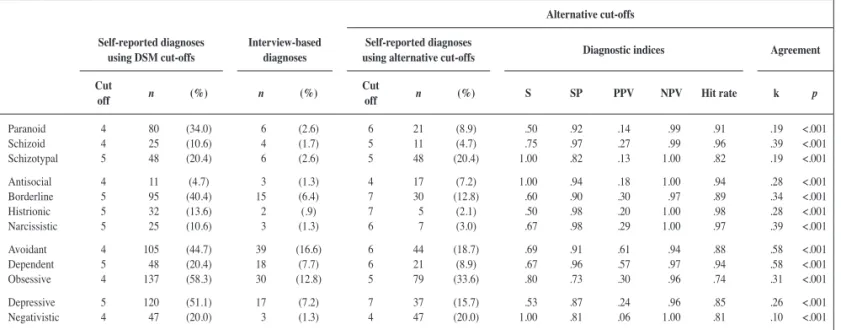
Table 1 (left) presents the prevalences of the PDQ-4+ scales using DSM-based cut-offs. Obsessive-Compulsive, Depressive, Avoidant and Borderline PDs had prevalences over 40%, whereas Antisocial was the least prevalent disorder (4.7%). Of patients, 83.4% had at least one PD diagnosis. We examined the degree to which the Clinical Signifi cance Scale interview reduced the prevalence of PDs. After the interview, total prevalence dropped to 38.3%. Moreover, the interview-based prevalence for individual PDs ranged from .9% (Histrionic) to 16.6% (Avoidant). Also, the mean number of diagnoses per subject dropped from 3.29 (SD = 2.47) by self-report to .62 (SD = .92) by the interview. That is, the interview produced a reduction of 81.1% in the total number of diagnoses and a reduction of 54.1% in the number of subjects with any diagnosis. If the interview is considered the gold standard, this entails percentages of over-diagnosis ranging from 62.5 to 93.8% for individual disorders.
Next, the extent to which each self-reported scale can predict its corresponding interview-based diagnosis was analyzed, as good predictions would indicate simple differences in threshold levels between methods. Logistic regression results revealed that seven interview-based disorders were exclusively predicted by their respective self-reported score, with low to moderate Nagelkerke R2 coeffi cients (R2
N). They were the Paranoid (.22),
Schizoid (.54), Schizotypal (.24), Histrionic (.48), Narcissistic (.48), Borderline (.34) and Dependent (.57) disorders. On the other
hand, the Antisocial (.32), Avoidant (.58), Obsessive-Compulsive (.25) and Depressive (.24) disorders were mainly predicted by their own scales, although other non-corresponding scales entered into the equation. Only the Negativistic disorder was exclusively predicted by a non-corresponding scale (Paranoid, .57). The mean Nagelkerke R2 for the most predictive scale was .40.
Alternative cut-offs were then established for the self-reported scales based on kappa statistics and ROC curves, and diagnostic indices were calculated (Table 1, right). For 9 of 12 self-reported scales, the best cut-off was located one or two criteria above the original DSM-IV threshold. Specifi city (M = .90, range: .73-.98) and negative predictive value (M =.98, range: .94-1.00) were good to excellent. On the contrary, sensitivity (M = .73, range .50 to 1.00) and positive predictive value (M = .27, range .06 to .61) were often unsuitable. Furthermore, whereas hit rates (M = .89, range .74 to .98) were good, kappa indices (M = .32, range: .10-.58, all ps<.001) indicated that many successful classifi cations, albeit signifi cant, were not far from those expected by chance. Additional analyses simulating a variable number (up to 10%) of false negatives in order to control for verifi cation bias produced severe losses of sensitivity, but had practically no effect on the remaining indices.
Regarding the PDQ-4+ total score, the optimal cut-off for the presence of PD was found to be 35, fi ve points above the proposed threshold. Despite this, diagnostic values were still in the moderate range: sensitivity = .81, specifi city = .67, positive predictive value = .60, negative predictive value = .85, hit rate = .72 and Kappa = .45 (p<.001).
Discussion and conclusions
Overall, using the PDQ-4+ self-report, our results found a prevalence of PDs that is within the expected range in clinical samples and consistent with the literature (83.4%, mean number of diagnoses 3.29) (de Reus et al., 2013; Fossati et al., 1998; Fossati et al., 2012; Wang et al., 2012; Wilberg et al., 2000). In agreement with previous studies, Obsessive-Compulsive, Borderline,
Table 1
Prevalence of self-reported and interview-based PDs in the PDQ-4+, and prevalence, diagnostic indices, and agreement for alternative cut-off points (n = 235)
Alternative cut-offs
Self-reported diagnoses using DSM cut-offs
Interview-based diagnoses
Self-reported diagnoses
using alternative cut-offs Diagnostic indices Agreement
Cut
off n (%) n (%)
Cut
off n (%) S SP PPV NPV Hit rate k p
Paranoid 4 080 (34.0) 06 (2.6) 6 21 (8.9) 0.50 .92 .14 0.99 .91 .19 <.001 Schizoid 4 025 (10.6) 04 (1.7) 5 11 (4.7) 0.75 .97 .27 0.99 .96 .39 <.001 Schizotypal 5 048 (20.4) 06 (2.6) 5 48 (20.4) 1.00 .82 .13 1.00 .82 .19 <.001 Antisocial 4 011 (4.7) 03 (1.3) 4 17 (7.2) 1.00 .94 .18 1.00 .94 .28 <.001 Borderline 5 095 (40.4) 15 (6.4) 7 30 (12.8) 0.60 .90 .30 0.97 .89 .34 <.001 Histrionic 5 032 (13.6) 02 (.9) 7 05 (2.1) 0.50 .98 .20 1.00 .98 .28 <.001 Narcissistic 5 025 (10.6) 03 (1.3) 6 07 (3.0) 0.67 .98 .29 1.00 .97 .39 <.001 Avoidant 4 105 (44.7) 39 (16.6) 6 44 (18.7) 0.69 .91 .61 0.94 .88 .58 <.001 Dependent 5 048 (20.4) 18 (7.7) 6 21 (8.9) 0.67 .96 .57 0.97 .94 .58 <.001 Obsessive 4 137 (58.3) 30 (12.8) 5 79 (33.6) 0.80 .73 .30 0.96 .74 .31 <.001 Depressive 5 120 (51.1) 17 (7.2) 7 37 (15.7) 0.53 .87 .24 0.96 .85 .26 <.001 Negativistic 4 047 (20.0) 03 (1.3) 4 47 (20.0) 1.00 .81 .06 1.00 .81 .10 <.001
Avoidant and Depressive PDs were the most prevalent diagnoses (Ha, Kim, Abbey, & Kim, 2007). However, in the absence of studies using the Clinical Signifi cance Scale allowing comparison, the interview-based prevalence of any PD (38.3%) was close to recent estimates in clinical samples (31.4% in Zimmerman, Rothschild, & Chelminski, 2005; 31.9% in Wang et al., 2012). Nevertheless, this similarity may be banal, as other studies have reported prevalences ranging from 11% to 72%, depending on the instrument, sample, or DSM version used (de Reus et al., 2013; Zimmerman et al., 2005). The differences found in diagnostic prevalence between the PDQ-4+ and the interview, though impressive, are similar to those usually reported (Abdin et al., 2011; de Reus et al., 2011; Wang et al., 2012). For instance, after its interview, the overall number of diagnoses was reduced by one fi fth, and the number of diagnosed subjects to less than one half. Concerning individual PDs, only between 6.2% and 37.5% of the subjects initially screened as positive were fi nally considered to have a disorder after the interview.
Concordance between the PDQ-4+ and its interview ranged from poor to moderate, as reported using any other combination of questionnaire and interview (Gárriz & Gutiérrez, 2009). The PDQ-4+ self-report seems well suited for discarding individual PDs within clinical samples: 98% of the participants who screened negative were indeed free from personality psychopathology (Negative Predictive Value), whereas nearly 90% of the non-PD participants were successfully screened as healthy (Specifi city). Furthermore, all diagnoses, except for Negativistic PD, are mainly, or even uniquely, predicted by their corresponding self-reported scales. In contrast, a mean R2
N of .40 and a mean kappa
of .32 for individual PDs suggest that much of the variation in the diagnosis is unrelated to the self-reported scores. The kappa index for the presence of any PD (.45) was also moderate, a poor outcome, considering that our attempt was to maximize kappa. Our results only partially outperform those reported in the literature. Brief screenings such as the Iowa Personality Disorder Screen (IPDS) or the Inventory of Interpersonal Problems (IIP-PD) show superior agreement (median kappa = .56); different versions of the Personality Diagnostic Questionnaire (PDQ) present median kappa of .42; the Temperament and Character Inventory (TCI) has a median kappa of .36; the Structured Clinical Interview for DSM-IV Axis II Personality Disorders (SCID-II) and the International Personality Disorder Examination (IPDE) screening tools have a median kappa of .29; and the different versions of the Millon Clinical Multiaxial Inventory (MCMI) presents a median kappa of .26 (Gárriz & Gutiérrez, 2009).
A weak association between self-report and interview is far more problematic than a simple difference in threshold. The evidence suggests that the inability of self-reports to predict fi nal diagnoses would really constitute more of a conceptual issue than just measurement concerns. Discordance among methods is partly attributable to a fl awed underlying model, the DSM. Indeed, disagreement between interviews and self-reports is similar to that between any two interviews, so the method is exonerated (Clark & Harrison, 2001). Agreement usually increases whenever disorders are measured dimensionally instead of categorically (Miller et al., 2005; Skodol, Oldham, Rosnick, Kellman, & Hyler, 1991). Second, agreement is not the same across different traits. In our study, Cluster C disorders showed the best kappa (.58), whereas Negativistic, Paranoid and Schizotypal PDs showed the worst one (.10 to .19). Similar heterogeneity has been found in other
studies, where Avoidant PD has shown higher agreement (Clark, Livesley, & Morey, 1997). Therefore, our research highlights that instruments cannot be better than the model they operationalize, and further improvement of our instruments necessarily entails reexamining our taxonomy (Clark et al., 1997).
Accordingly, it has been suggested that a considerable part of disagreement would be attributable to self-reports and interviews measuring different constructs. For example, we observed that many self-reported traits in our study did not refl ect personality but rather the individual’s current condition: transient psychopathological states, such as anxiety or distress, which were subsequently excluded by the interview. Self-reported instruments are more accurate than observable behaviors in assessing subjective experiences, especially those entailing undesirable consequences for others (Blackburn et al., 2004; Hopwood et al., 2008; Miller, Campbell, Pilkonis, & Morse, 2008). This would suggest that interviews are more capable of discriminating the enduring traits than the defi ning PD traits. However, personality pathology has been revealed to be more variable and fl uid than stated in previous literature: the course of pathological traits fl uctuates signifi cantly over periods as brief as six years (Zanarini, Frankenburg, Hennen, Reich, & Silk, 2005) and they are, in fact, less enduring than many Axis I disorders (Shea & Yen, 2003). As for taxonomists, they still need to clarify which duration turns a state into a trait. In this sense, whereas the PDQ-4+ interview stringently requires traits to be lifetime, the SCID-II requires fi ve years and the DIPD, two. On the other hand, a notable amount of self-reported traits are discounted by the interview because they do not cause distress or impairment. For example, our Obsessive-compulsive patients often reported that over-control decreases, instead of increasing, their distress, providing them with considerable advantages. Indeed, these patients have shown minimal evidence of impairment elsewhere (Costa, Samuels, Bagby, Daffi n, & Norton, 2005). Paranoid subjects see others as malevolent, so hyper-vigilance and mistrust seem to be the adequate response for this group. Similarly, many antisocial and narcissistic subjects are more detrimental to others than to themselves, and are overall benefi ted by their behavioral style (Mealey, 1995). Besides, we should abandon the idea that an extreme trait inevitably, or frequently, leads to a dysfunction. The relationship between trait intensity and maladaptation has almost been a premise in the fi eld, despite convincing argumentation to the contrary (Livesley, 2001; Livesley & Jang, 2000; Parker & Barrett, 2000; Wakefi eld, 2008). The issue of which assessment method is better is probably meaningless until these conceptual issues are clarifi ed. The task of determining whether the presence of certain traits or their detrimental consequences should decide the diagnosis, who (the patient, the clinician, or others) is the competent judge of such detriment, and how it should be operationalized is under way.
Despite these limitations, this study found that the routine administration of the Clinical Signifi cance Scale following the self-report seems warranted. The PDQ-4+ interview could be considered overall as an indicator of personality pathology severity following the general PD criteria. It unequivocally links the interview with the evaluation of durability, state-independence, and harmfulness for the future DSM-5. Therefore, the Clinical Signifi cance Scale interview provided complementary information about PDs, reducing false-positive diagnoses typical of the self-report PDQ-4+. Our fi ndings indicate that, with some thresholds for specifi c PDs (one or two criteria) and total score (5 points above), the PDQ-4+ could be modifi ed or changed to improve the diagnosis of PDs. These changes are likely to increase the validity
and reliability of the instrument and probably the diagnostic agreement.
Acknowledgements
There are no confl icts of interest with other projects.
The work was partially supported by public funds from the Pla Director de Salut Mental i Addiccions (Generalitat de Catalunya Health Department) and grants from the Obra Social - Fundació “La Caixa”.
This work was partially supported by a grant from the Spanish Ministerio de Educación y Ciencia (FIS 03/0464) awarded to F. Gutiérrez.
References
Abdin, E., Koh, K., Subramaniam, M., Guo, M.-E., Leo, T., Teo, C.,...Chong, S.A. (2011). Validity of the Personality Diagnostic Questionnaire-4 (PDQ-4+) among mentally ill prison inmates in Singapore. Journal of
Personality Disorders, 25(6), 834-841.
Aboraya, A. (2009). Use of structured interviews by psychiatrists in real clinical settings: Results of an open-question survey. Psychiatry
(Edgemont),6, 24-28.
American Psychiatric Association (1994). Diagnostic and statistical
manual of mental disorders (4th ed.). Washington, DC: Author.
Begg, C.B., & Greenes, R.A. (1983). Assessment of diagnostic tests when disease verifi cation is subject to selection bias. Biometrics, 39, 207-215. Blackburn, R., Donnelly, J.P., Logan, C., & Renwick, S.J.D. (2004).
Convergent and discriminative validity of interview and questionnaire measures of Personality Disorder in mentally disordered offenders: A multitrait-multimethod analysis using confi rmatory factor analysis.
Journal of Personality Disorders, 18(2), 129-150.
Calvo, N. (2007). Adaptació al castellà del Personality Diagnostic Questionnaire-4+: Propietats psicomètriques en población clínica i en estudiants [Spanish Adaptation of Personality Diagnostic Questionnaire-4+: Psychometric properties in clinical sample and students]. Doctoral Thesis. Department of Psychiatry and Legal Medicine. Faculty of Medicine. Autonomous University of Barcelona. Calvo, N., Caseras, X., Gutiérrez, F., & Torrubia, R. (2002). Adaptación
Española del Personality Diagnostic Questionnaire-4+ (PDQ-4+) [Spanish adaptation of the Personality Diagnostic Questionnaire-4+].
Actas Españolas de Psiquiatría, 30, 7-13.
Calvo, N., Gutiérrez, F., Andión, O., Caseras, X., Torrubia, R., & Casas, M. (2012). Psychometric properties of the Spanish version of the Personality Diagnostic Questionnaire-4+ (PDQ-4+) self-report in psychiatric outpatients. Psicothema, 24, 156-160.
Clark, L.A., & Harrison, J.A. (2001). Assessment instruments. In W.J. Livesley (Ed.), Handbook of personality disorders. Theory, research,
and treatment (pp. 277-306). New York: Guilford Press.
Clark, L.A., Livesley, W.J., & Morey, L. (1997). Personality disorder assessment: The challenge of construct validity. Journal of Personality
Disorders, 11, 205-231.
Costa, P.T., Samuels, J., Bagby, R.M., Daffi n, L., & Norton, H. (2005). Obsessive-compulsive personality disorder: A review. In M. Maj, H.S. Akiskal, J.E. Mezzich, & A. Okasha (Eds.), Personality disorders (pp. 405-439). Chichester, UK: Wiley.
de Reus, R.J., van den Berg, J.F., & Emmelkamp, P.M.G. (2013). Personality Diagnostic Questionnaire-4+ is not useful as a screener in clinical practice. Clinical Psychology and Psychotherapy, 20(1), 49-54. Duijsens, I.J, Bruinsma, M, Jansen, S.J.T., Eurelings-Bontekoe, E.H.M.,
& Diekstra, R.F.W. (1996). Agreement between self-report and semi-structured interviewing in the assessment of personality disorders.
Personality and Individual Differences, 21, 261-270.
Fonseca-Pedrero, E., Lemos-Giráldez, S., Paino, M., & Muñiz, J. (2011). Schizotypy, emotional-behavioural problems and personality disorder
traits in a non-clinical adolescent population. Psychiatry Research, 190, 316-321.
Fonseca-Pedrero. E., Santarén-Rosell, M., Paino, M., & Lemos Giraldez, S., (2013). Cluster A maladaptative personality patterns in a non-clinical adolescent population. Psicothema, 25(2), 171-178.
Fossati, A., Maffei, C., Bagnato, M., Donati, D., Donini, M., Fiorilli, M., …Ansoldi, M. (1998). Brief communication: Criterion validity of the Personality Diagnostic Questionnaire-4+ (PDQ-4+) in a mixed psychiatric sample. Journal of Personality Disorders, 12, 172-178. Fossati, A., Porro, F. V., Maffei, C., & Borroni, S. (2012). Are the
DSM-IV personality disorders related to mindfulness? An Italian study on clinical participants. Journal of Clinical Psychology, 68(6), 672-683. Gárriz, M., & Gutiérrez, F. (2009). Personality disorder screenings: A
meta-analysis. Actas Españolas de Psiquiatría, 37(3), 148-153. Guy, L.S., Poythress, N.G., Douglas, K.S., Skeem, J.L., & Edens, J.F.
(2008). Correspondence between self-report and interview-based assessment of antisocial PD. Psychological Assessment, 20, 47-54. Ha, J.H., Kim, E.E., Abbey, S.E., & Kim, T.S. (2007). Relationship
between personality disorder symptoms and temperament in the young male general population of South Korea. Psychiatry and Clinical
Neurosciences, 61, 59-66.
Hopwood, C.J., Donnellan, M.B., Ackerman, R.A., Thomas, K.M., Morey, L.C., & Skodol, A.E. (2013). The validity of the Personality Diagnostic Questionnaire-4 Narcissistic Personality Disorder Scale for assessing pathological grandiosity. Journal of Personality Assessment, 95(3), 274-283.
Hopwood, C.J., Morey, L.C., Edelen, M.O., Shea, M.T., Grilo, C.M., Sanislow, C.A.,… Skodol. A.E. (2008). A comparison of interview and self-report methods for the assessment of Borderline Personality Disorder criteria. Psychological Assessment, 20, 81-85.
Hopwood, C.J., Thomas, K.M., Markon, K.E., Wright, A.G.C., & Krueger, R.F. (2012). DSM-5 Personality traits and DSM-IV personality disorders. Journal of Abnormal Psychology, 121, 424-432.
Hyler, S.E. (1994). PDQ-4+ Personality Diagnostic Questionnaire-4+. New York: New York State Psychiatric Institute.
Hyler, S.E., Skodol, A.E., Kellman, H.D., Oldham, J.M., & Rosnick, L. (1990). Validity of the Personality Diagnostic Questionnaire-Revised: Comparison with two structured interviews. American Journal of
Psychiatry, 147, 1043-1048.
Kim, D.I., Choi, M.R., & Cho, E.C. (2000). The preliminary study of reliability and validity on the Korean version of the Personality Disorder Questionnaire-4+ (PDQ-4+). Journal of Korean Neuropsychiatric
Association, 39, 525-538.
Livesley, W.J. (2001). Commentary on reconceptualizing personality disorder categories using trait dimensions. Journal of Personality, 69(2), 277-286.
Livesley, W.J., & Jang, K.L. (2000). Toward an empirically based classifi cation of personality disorder. Journal of Personality Disorders,
McDermutt, W., & Zimmerman, M. (2005). Assessment instruments and standardized evaluation. In J.M. Oldham, A.E. Skodol, & D.S. Bender (Eds.), Textbook of personality disorders (pp. 89-101). Washington DC: American Psychiatric Association.
Mealey, L. (1995). The sociobiology of sociopathy: An integrated evolutionary model. Behavioral and Brain Sciences, 18(3), 523-599. Miller, J.D., Bagby, R.M., & Pilkonis, P.A. (2005). A comparison of the
validity of the fi ve-factor model (FFM) personality disorder prototypes using FFM Self-Report and interview measures. Psychological
Assessment, 17, 497-500.
Miller, J.D., Campbell, W.K., Pilkonis, P.A., & Morse, J.Q. (2008). Assessment procedures for Narcissistic Personality Disorder.
Assessment, 15, 483-492.
Parker, G., & Barret, E. (2000). Personality and personality disorder: Current issues and directions [Editorial]. Psychological Medicine, 30, 1-9.
Perry, J.C. (1992). Problems and considerations in the valid assessment of personality disorders. American Journal of Psychiatry, 149, 1645-1653.
Segal, D.L., & Coolidge, F.L. (2003). Structured interviewing and DSM classifi cation. In M. Hersen & S.M. Turner (Eds.), Adult psychopathology
and diagnosis (4th ed., pp. 72-103). New York: Wiley.
Shea, M.T., & Yen, S. (2003). Stability as a distinction between Axis I and Axis II disorders. Journal of Personality Disorders, 17, 373-386. Skodol, A.E., Oldham, J.M., Rosnick, L., Kellman, H.D., & Hyler, S.E.
(1991). Diagnosis of DSM-III-R personality disorders: A comparison of two structured interviews. International Journal of Methods in
Psychiatric Research, 1, 3-26.
Wakefi eld, J.C. (2008). The perils of dimensionalization: Challenges in distinguishing negative traits from Personality Disorders. Psychiatric
Clinics of North America, 31, 379-393.
Wang, L., Ross, C.A., Zhang, T., Dai, Y., Zhang, H., Tao, M., … Xiao, Z. (2012). Frequency of borderline personality disorder among psychiatric outpatients in Shanghai. Journal of Personality Disorders, 26(3), 393-401.
Widiger, T.A., & Samuel, D.B. (2005). Evidence-based assessment of personality disorder. Journal of Personality Assessment, 17, 278-287. Wilberg, T., Dammen, T., & Friis, S. (2000). Comparing Personality
Diagnostic Questionnaire-4+ with Longitudinal, Expert, All Data (LEAD) standard diagnoses in a sample with a high prevalence of Axis I and Axis II disorders. Comprehensive Psychiatry, 41, 295-302. Yang, J., McCrae, R.R., Costa, P.T., Yao, S., Dai, X., Cai, T., & Gao, B.
(2000). The cross-cultural generalizability of Axis II constructs: An evaluation of two personality disorder assessment instruments in the People’s Republic of China. Journal of Personality Disorders, 14, 249-263.
Zanarini, M.C., Frankenburg, F.R., Hennen, J., Reich, B., & Silk, K.R. (2005). The McLean Study of Adult Development (MSAD): Overview and implications of the fi rst six years of prospective follow-up. Journal
of Personality Disorders, 19, 505-523.
Zimmerman, M. (1994). Diagnosing personality disorders. A review of issues and research methods. Archives General of Psychiatry, 51, 225-245.
Zimmerman, M., Rothschild, L., & Chelminski, I. (2005). The prevalence of DSM-IV personality disorders in psychiatric outpatients. American