Breast neoplasm is the most frequent incident cancer among women worldwide (Ferlay et al., 2012). Although population screening programs for early detection have recently been surrounded by heated debates regarding their benefi ts(Miller et al., 2014), the majority of health organizations continue recommending the use of screening mammography to decrease mortality by reducing rates of advanced breast cancer. The cost effi ciency of these programs is only achieved if they cover the whole target population(Perry et al., 2008); therefore, the concern of public health organizations is to reach high participation rates. In Spain,
65% of the women invited to participate in these programs are recruited by the breast cancer early detection program. Participation rate in Asturias, the region in which this study was performed, is slightly better (74.2%) but it does not reach the desired rate (75.0%) for this kind of program (Castells et al., 2007).
Theoretically, women’s worries about cancer might encourage their adherence to cancer screening strategies (Hay, Mc Caul, & Magnan, 2006). However, once a woman has decided to join the screening program, experiencing anxiety during the mammography exam could infl uence her further participation(Consedine, Magai Krivoshekova,Ryzewicz, & Neugut, 2004; Magai, Consedine, Neugut, & Hershman, 2007; Watson-Johnson et al., 2011).
In this sense, it is known that mammography screening usually involves psychological or emotional discomfort. Many women experience anxiety due to fear of results (Brett, Bankhead, Henderson, Watson, & Austoker, 2005; Consedine et al., 2004; Mainiero, Schepps, Clements, & Bird, 2001).
ISSN 0214 - 9915 CODEN PSOTEG Copyright © 2015 Psicothema www.psicothema.com
A brief nursing intervention reduces anxiety before breast cancer
screening mammography
Ana Fernández-Feito, Alberto Lana, Ricardo Baldonedo-Cernuda and María Pilar Mosteiro-Díaz
Universidad de Oviedo
Abstract
Resumen
Background: Anxiety experienced by women during their participation in breast cancer screening programs can condition their adherence to the program. The aim was to determine whether a brief nursing intervention could reduce anxiety before screening mammography. Method: A randomized controlled trial carried out with 436 Spanish women aged between 50-69 years, who attended a population breast cancer screening program. The experimental group received an ad-hoc tailored intervention, which consisted of offering information about the screening program and the mammography exam, as well as of providing personal emotional support. Anxiety was assessed using the State-Trait Anxiety Inventory (STAI). Fear of screening outcome and fear of breast cancer were also assessed. Results:
Women of the experimental group had 60% less probability of having a high anxiety state (OR = 0.40; 95%: CI [0.25, 0.65]), after adjusting for sociodemographic and clinical variables. Regarding trait anxiety, no differences were observed between groups. The stratifi ed analysis showed that this positive impact was greater in women who did not fear the screening outcome (OR = 0.24; 95% CI [0.11, 0.52]) or breast cancer (OR = 0.07; 95% CI [0.01, 0.41]). Conclusions: A protocolized nursing intervention reduced the probability of being anxious when undergoing a screening mammography.
Keywords: Anxiety; Mammography; Nursing; Intervention Studies.
Una intervención enfermera breve disminuye la ansiedad antes de una mamografía de screening de cáncer de mama.Antecedentes: la ansiedad experimentada por las mujeres durante su participación en el examen de detección precoz del cáncer de mama puede condicionar su adherencia al programa. El objetivo fue determinar si una intervención enfermera breve disminuye la ansiedad antes de una mamografía de screening. Método:
ensayo clínico controlado y randomizado en 436 mujeres españolas de 50 a 69 años participantes en el programa de screening. El grupo experimental recibió una intervención diseñada ad-hoc, consistente en ofrecer información sobre el programa y la mamografía, así como proporcionar apoyo emocional. La ansiedad fue medida con el inventario de ansiedad estado-rasgo (STAI). También se evaluaron el miedo a los resultados y al cáncer de mama. Resultados: la probabilidad de tener ansiedad estado elevada fue un 60% menor en las mujeres del grupo experimental (OR = 0,40; IC95%: 0,25-0,65), tras ajustar por variables sociodemográfi cas y clínicas. Respecto a la ansiedad rasgo no se observaron diferencias entre grupos. El análisis estratifi cado mostró que el impacto positivo fue mayor en las mujeres sin miedo a los resultados (OR = 0,24; IC95%: 0,11-0,52) ni al cáncer de mama (OR = 0,07; IC95%: 0,01-0,41). Conclusiones: una intervención enfermera protocolizada disminuyó la probabilidad de tener ansiedad antes de la realización de una mamografía de screening.
Palabras clave: ansiedad; mamografía; enfermería; estudios de intervención.
Psicothema 2015, Vol. 27, No. 2, 128-133
doi: 10.7334/psicothema2014.203
Received: September 17, 2014 • Accepted: February 3, 2015 Corresponding author: Ana Fernández Feito
Other elements of the screening, such as the lack of information or long waiting lists, can also increase the negative view of this program (Brett et al., 2005). Moreover, obtaining an uncertain outcome, which requires complementary tests, also has a great emotional impact on women (Sandín, Chorot, Valiente, Lostao, & Santed, 2001).
Few interventions to reduce women’s anxiety in relation to a mammography have been tested. Their results are diverse. Two interventions based on relaxing music(Domar et al., 2005) or a cancer prevention video (Mainiero et al., 2001) have not had a positive impact on reducing anxiety. However, the intervention of Caruso (2001) reduced anxiety in women by providing information and emotional support. But, in this case, the trial was performed among women who had already been diagnosed with breast cancer and not in the context of a population screening program.
Thus, the aim of this study was to assess the impact of an intervention based on providing information and emotional support on anxiety and fear related to mammography screening.
Method
Participants
A randomized controlled trial was conducted during 2011 among women aged 50-69 who underwent a mammography in the context of the breast cancer population screening program in two Spanish state hospitals – the Hospital Foundation of Avilés (Hospital 1) and the Adaro Sanatorium Foundation in Langreo (Hospital 2). Women were randomly selected from the list of participants in the screening program (N = 8,781) and were invited to participate in the study. It was voluntary and none of the women received compensation. A sample of 436 women was recruited from January to December 2011, and then randomly assigned to study groups.
Instruments
Main outcomes: anxiety and fear.Anxiety was assessed using the State-Trait Anxiety Inventory (STAI; Spielberger, Gorsuch, & Lushene, 1970), which has been validated in Spain (Guillén-Riquelme & Buela-Casal, 2011). This questionnaire evaluates two components of anxiety: (a) State Anxiety, which is considered a subjective and temporary strain, and b) Trait Anxiety, which assesses the presence of a personal trait that tends to perceive certain situations as threatening. The STAI assesses each component with a 20-item scale which has four response options. These range from 0= (Not at all) to 3 (Very much) in State Anxiety, and from 0 (Almost never) to 3 (Almost always) in Trait Anxiety. The score for each component ranges from 0 to 60, so a higher score indicates a higher anxiety. In addition, we asked women whether they feared of the screening outcome and breast cancer.
Sociodemographic and clinical variables. We also collected data on variables which might be potential confounders of the study association. Specifi cally, we asked the women about the following socio-demographic characteristics: age in years, size of population of residence (<2,000; 2,000-10,000; or >10,000 inhabitants), medical center (hospital 1 or hospital 2), marital status (single, married/living together, divorced/separated or widowed), number of children (none, 1 child, 2 children, 3 or more children), and education level (none, primary school, secondary school/professional training or university). Moreover, we also
obtained some clinical information regarding health-related variables and family history of cancer: regular caffeine intake (yes or no), regular intake of anxiolytic and/or antidepressant drugs (yes or no), menopause (yes or no), presence of breast pathology (no, fi brocystic disease or other), family history of breast and non-breast cancer (yes or no). Finally, we collected data on several important screening-related variables: previous screening mammographies (yes or no), breast tenderness (yes or no), pain in previous mammographies (yes or no), fear of screening outcome (yes or no), fear of breast cancer (yes or no) and expected pain in the current mammography (yes or no).
Procedure
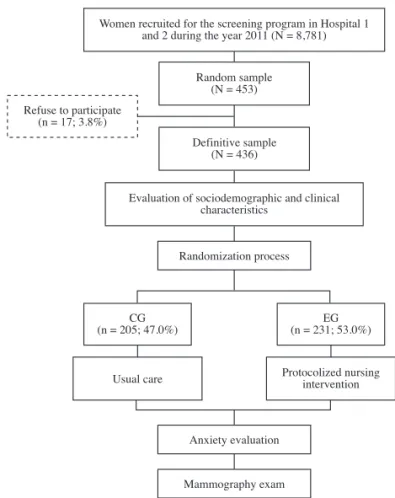
The control group (CG, n = 205) received normal care (i.e. the health staff followed the usual procedure), whereas women in the experimental group (EG, n = 231) also received a protocolized nursing intervention (see fl ow diagram in Figure 1). This intervention provided face-to-face general information about the population screening program as well as emotional support. In summary, before accessing the radiology room, a trained nurse provided general information on the screening program, such as the objectives of the program, the benefi ts of an early detection, and the whole procedure (from the recruitment to the results reception). Specifi c information on the mammography exam, such as what a mammography is, the length of the exam, the position of the women, and the feelings they may experience were also stated. Several images were used to support the explanation. Subsequently, the same nurse offered the women an opportunity
Women recruited for the screening program in Hospital 1 and 2 during the year 2011 (N = 8,781)
Random sample (N = 453)
Definitive sample (N = 436)
Evaluation of sociodemographic and clinical characteristics
Randomization process
CG (n = 205; 47.0%)
EG (n = 231; 53.0%)
Usual care Protocolized nursingintervention
Anxiety evaluation
Mammography exam Refuse to participate
(n = 17; 3.8%)
CG: Control Group, EG: Experimental Group
to talk about other topics related to the exam and breast cancer, as well as expressing their possible feelings of anxiety, fear, or asking questions. The whole intervention lasted around 10 minutes - 5 minutes for information and 5 minutes for emotional support. Anxiety was assessed just before performing the mammography, that is, after women of the EG had received the intervention, as well as after the usual care to women of the CG was provided (Figure 1).
The study was approved by the Ethics Committee of Clinic Research (Asturias Central University Hospital) and all participants gave their informed consent. The randomized control trial complied with the principles of the Declaration of Helsinki.
Data analysis
The comparison of both study groups (CG and EG) was performed using the Pearson’s chi-square test. The effect of the intervention on anxiety was assessed using two types of multivariate analyses. First, logistic regressions explored the probability of having an anxiety score higher than the sample median (i.e., state anxiety >13 points and trait anxiety >21 points) if the women belong to the EG, compared with those of the CG. Second, linear regressions were used to study the association between the study groups and the anxiety scores, considering them continuous variables. All odds ratios (OR), B coeffi cients and their 95% confi dence intervals (95% CI) obtained from regression analyses were adjusted according to the above-mentioned potential confounders. Moreover, we performed some stratifi ed analyses according to fear variables, as we found interaction between fear of screening outcome and fear of breast cancer with the components of anxiety (p<.05). Statistical signifi cance was set at 2-tailed p<.05. Statistical analyses and the process of randomization were both performed using the SPSS software version 21.0 (IBM Corporation).
Results
A total of 436 women took part in the randomized control trial, 231 (53.0%) in the CG and 205 (47.0%) in the EG (Figure 1). As shown in Table 1, most of the women were aged 55-59 years old, were recruited at hospital 2, were married, had two children and had attained reached only primary education. With regard to clinical variables, one out of four had been treated for anxiety or depression. Most of them had had some family experience of cancer and had no breast pathology at the time of the study. Randomization produced comparable groups for all sociodemographic and clinical variables of Table 1. Moreover, there was no difference between groups regarding pain variables. In the CG, 86.8% of the women had no pain prior to the mammography exam (breast tenderness). This percentage was 87.3% (p = .97) in the EG. In this sense, prevalence of pain in previous mammographies was similar (p = .98) between the CG (39.5%) and the EG (39.1%). Finally, there was no signifi cant difference in the expected pain rates: 20.0% in the CG and 25.5% in the EG (p = .17).
The overall effect of the intervention on the two components of anxiety is shown in Table 2. Women of the EG had 60% less probability of scoring in State Anxiety above the median (OR: 0.40, 95% CI [0.25, 0.65]). Moreover, when anxiety is considered a continuous variable, the adjusted mean (standard deviation) of the State Anxiety score was signifi cantly lower among the women of the EG (13.02 ± 7.61) compared with those of the CG (15.93 ±
6.16). In this sense, the linear regression showed that belonging to the EG diminished the mean State Anxiety score (B adjusted coeffi cient: -1.91; CI95%: [-3.10]-[-0.72]). These associations were not found for Trait Anxiety.
The stratifi ed analyses showed that the positive impact of the intervention was independent of both types of fear taken into account in our study: either fear of the mammography outcome or fear of breast cancer. However, in both cases, the intervention was more effective in women without fear (Table 3). According to the results of the linear regression, women without fear of the screening outcome had a lower State Anxiety score when they
Table 1
Sociodemographic and clinical characteristics of the sample and comparison between the study groups
Total CG EG p-value
Participants, n (%) 436 205 (47.0) 231 (53.0)
Age, % .91
50-54 years 55-59 years 60-64 years 65-69 years 24.3 30.3 23.2 22.2 23.9 30.7 22.0 23.4 24.7 29.9 24.2 21.1
Population, % .30
<2,000 inhabitants 2,001-10,000 inhabitants >10,000 inhabitants 29.2 19.3 51.5 32.7 19.0 49.3 26.1 19.6 54.3
Center, % .35
Hospital 1 Hospital 2 34.8 65.2 33.7 66.3 35.9 64.1
Marital status, % .52
Single Married Separated/Divorced Widow 5.0 73.4 7.6 14 5.9 70.2 7.8 16.1 4.3 76.2 7.4 12.1
Education level, % .77
None Primary school Secondary school University 10.8 61.2 18.6 9.4 9.8 61.0 18.5 10.7 11.7 61.5 18.6 8.2
Number of children, % .94
None One child Two children Three or more children
10.3 25.9 42.9 20.9 9.8 25.4 44.4 20.5 10.8 26.4 41.6 21.2
Regular caffeine consumption, % 64.7 62.9 66.2 .30
Anxiolytic or antidepressants, % 27.1 23.4 30.3 .07
Menopause, % 96.1 95.2 97.1 .59
Breast pathology, % .27
No Fibrocystic disease Other pathologies 77.5 11.9 10.6 77.1 10.2 12.7 77.9 13.4 8.7
Family history of cancer, % 62.8 66.6 61.8 .33
Family history of breast cancer, % 19.3 20.5 18.2 .54
Previous mammographies; % 96.3 97.6 95.2 .22
belong to the EG (11.92 ± 8.2) than when belonging to the CG (14.99 ± 8.3). The same fi gures for women without fear of breast cancer were: 11.26 ± 10.12, for those of the EG, and 14.82 ± 10.88 for the women of the CG. The matching coeffi cients of the linear regression showed that the intervention had a positive impact on the Trait Anxiety score among women without fear of the screening outcome (B adjusted coeffi cient: -3.06; 95%CI: [-4.69]-[-1.44]) and without fear of breast cancer (B adjusted coeffi cient: -3.56; 95%CI: [-5.74]-[-1.37]). As above, these results were found only for State Anxiety, never for Trait Anxiety.
Discussion
In this randomized control trial, a brief and protocolized intervention implemented by a trained nurse achieved a signifi cant reduction in the state of anxiety among Spanish women who participated in the breast cancer screening population program.
Although women who participate in breast cancer screening programs are usually healthy or asymptomatic, anxiety is one of the feelings most frequently mentioned (Brown Sofair & Lehlbach, 2008; Cardenal et al., 2008; Consedine et al., 2004). Some of the main causes of anxiety are expected pain during the mammography, the possibility of having to deal with a positive result, or being called back for another secondary examination (Sandin et al., 2001). Therefore, addressing anxiety should have a twofold purpose: (a) in the short-term, ensuring the highest level of well-being among women attending the service and (b) in the long-term, to increase women’s adherence to the screening program, since well-being during a mammography examination is likely to improve satisfaction with the program. Thus, theoretically, dealing with anxiety could increase the overall survival rates of the women screened.
In our study, there was a signifi cantly higher percentage of women with a lower State Anxiety score among the women who received the nursing intervention (EG). It was suspected that a brief informational intervention with some components of emotional support does not achieve a reduction in the trait anxiety. Modifi cation of trait anxiety probably needs a psychological and,
generally speaking, a more complex approach. However, reducing State Anxiety should be suffi cient to improve the overall satisfaction with breast cancer screening programs. This type of intervention had already proved to be effective in reducing both the anxiety and the pain of mammography examination during the clinical follow-up after breast cancer(Caruso et al., 2001). The benefi ts of these counseling interventions have also been observed in women who had obtained a previous abnormal result in a screening mammography (Bowland et al., 2003). However, our study seems to be the fi rst one to demonstrate that the interventions can also have a positive impact among women attending a routine screening program. Interventions tested by other researchers, which included relaxing audiotape music(Domar et al., 2005) or an educational videotape about breast cancer and mammography (Mainiero et
Table 2
Overall effect of the intervention on both components of anxiety
≤ Median > Median OR (95% CI)* p-value
State anxiety, % CG (n = 205) EG (n = 231)
45.9 59.7 54.1 40.3 1.00 (Ref.) 0.40 (0.25-0.65) <.001
Trait anxiety, % CG (n = 205) EG (n = 231)
52.7 51.5 47.3 48.5 1.00 (Ref.) 1.27 (0.76-2.08) .34
CG: Control group; EG: Experimental group
* Odds ratio from logistic regressions adjusted by: age (50-54, 55-59, 60-64 or 65-69 years), population size (<2,000, 2,001-10,000 or >10,000 inhabitants), center (hospital 1 or hospital 2), marital status (single, married, separated/divorced or widow), education level (none, primary, secondary or university), number of children (none, one, two, three or more children), regular caffeine consumption (yes or no), anxiolytic or antidepressants consumption (yes or no), menopause (yes or no), breast pathology (no, fi brocystic disease or others pathologies), family history of cancer (yes or no), family history of breast cancer (yes or no), breast tenderness (yes or no), previous screening mammographies (yes or no), pain in previous mammographies (yes or no), expected pain in the current exam (yes or no), fear of screening outcome (yes or no), fear of cancer (yes or no) and anxiety (state anxiety or trait when necessary)
Table 3
Effect of the intervention on both components of anxiety according to women’s fear of screening outcome and of breast cancer
≤ Median > Median OR (95% CI)* p-value
Without fear of outcome
State anxiety, % CG (n = 93) EG (n = 108)
53.8 75.0 46.2 25.0 1.00 (Ref.) 0.24 (0.11-0.52) <.001
Trait anxiety, % CG (n = 93) EG (n = 108)
57.0 56.5 43.0 43.5 1.00 (Ref.) 1.10 (0.46-2.59) .84
With fear of outcome
State anxiety, % CG(n = 112) EG (n = 123)
39.3 46.3 60.7 53.7 1.00 (Ref.) 0.54 (0.26-1.11) .09
Trait anxiety, % CG(n = 112) EG (n = 123)
49.1 47.2 50.9 52.8 1.00 (Ref.) 1.13 (0.56-2.30) .74
Without fear of cancer
State anxiety, % CG (n = 46) EG (n = 56)
54.3 78.6 45.7 21.4 1.00 (Ref.) 0.07 (0.01-0.41) .003
Trait anxiety, % CG (n = 46) EG (n = 56)
60.9 55.4 39.1 44.6 1.00 (Ref.) 5.30 (0.59-47.72) .14
With fear of cancer
State anxiety, % CG (n = 159) EG (n = 175)
43.3 53.7 56.6 46.3 1.00 (Ref.) 0.39 (0.22-0.70) .002
Trait anxiety, % CG (n = 159) EG (n = 175)
50.3 50.3 49.7 49.7 1.00 (Ref.) 1.20 (0.67-2.16) .53
CG: Control group; EG: Experimental group
al., 2001) did not achieve a positive impact on the anxiety level. The context in which the samples of these two studies were taken may mean that both the detection programs and the participating women are different from those of our study, and therefore are scarcely comparable. In any case, personal interaction can be the key element. Perhaps personal guidance and direct support while women are waiting for examination provides relaxation, as they are able to express their feelings, as well as to receive the answers to their questions regarding the procedure. Therefore our results suggest that trained staff should accompany women as they arrive at the radiology department. Subsequently, further research should test the hypothesis that lower anxiety improves adherence to the screening program. Moreover this hypothesis is coherent with the opinion of other experts, who point out that worry and fear of the examination are the main reasons for refusing to participate in a screening program (Barroso García, Ruiz Pérez, de Rojas, Parrón Carreño, & Corpas Nogales, 2009; Kang, Thomas, Kwon, Hyun, & Jun, 2008; Luengo-Matos, Polo-Santos, & Saz-Parkinson, 2006).
In the scientifi c literature, anxiety has usually been linked with fear, either of the procedure itself or of breast cancer(Mainiero et al., 2001; Brett et al., 2005). But the role of fear is complex. In some women, anxiety due to mammography may be largely due to fear of the screening outcome or fear of cancer. In these women, an intervention like ours, which was only focused on reducing anxiety, would not work properly. However, our intervention was effective in women with and without fear. That is to say that having more information and feeling accompanied decreased State Anxiety regardless of fear. This may be due to the fact that not all of the anxiety for these women was caused by fear of the screening outcome or fear of cancer; but of the mammography examination itself. Our intervention therefore seems effective in reducing anxiety caused by a mammography. For this reason, the
intervention was more effective in women who had no fear than in those who did.
Randomized controlled trials are arguably the best way of establishing causality; this was the main strength of our study. Another strong point was the adjustment for a large list of confounders, such as breast tenderness, pain in previous mammographies and expected pain in the current exam. All of these factors could be important modulators of anxiety. A key limitation of the study was the assessment of anxiety only after the intervention, so changes in anxiety could not really be assessed. But, as the intervention was brief, answering the same questionnaire for a second time only 10 minutes later could introduce a response bias. It would have been interesting to have measured anxiety level in both groups several days after the test in order to determine whether the effect of the intervention is maintained over time. In addition, random assignment of women achieved comparable study groups in all variables. Therefore, it is expected that they were also comparable in terms of anxiety before the intervention.
In conclusion, a brief nursing intervention based on providing information and emotional support may reduce state anxiety among the participants of a breast cancer screening program before a mammography exam. The effectiveness of the intervention was independent of fear concerning screening outcome and breast cancer; however it achieved a higher impact on women without fear.
Acknowledgements
The authors particularly acknowledge the voluntary participation of all women who took part in this research, as well as the invaluable contribution of the staff of the breast cancer screening units. Furthermore, authors want to exress their appreciation to Goretti Faya Ornia, our translator and language advisor.
References
Barroso García, P., Ruiz Pérez, I., de Rojas, F.P., Parrón Carreño, T., & Corpas Nogales, E. (2009). Factors related to non-participation in a breast cancer early detection program. Gaceta Sanitaria, 23(1), 44-48.
Bowland, L., Cockburn, J., Cawson, J., Anderson, H.C., Moorehead, S., & Kenny, M. (2003). Counselling interventions to address the psychological consequences of screening mammography: A randomised trial. Patient Education and Counselling, 49(2), 189-198.
Brett, J., Bankhead, C., Henderson, B., Watson, E., & Austoker, J. (2005). The psychological impact of mammographic screening. A systematic review. Psychooncology, 14(11), 917-938.
Brown Sofair, J., & Lehlbach, M. (2008). The role of anxiety in a mammography screening program. Psychosomatics,49(1), 49-55. Cardenal, M.C., Rodríguez, A., Cruzado, J.A., González, A., González,
M.J., & Roa, A. (2008). Anxiety, depression and quality of life during the stages of the mammographic screening among women from Madrid.
Psicooncología, 5(1), 129-146.
Caruso, A., Effi cace, F., Parrilla, A., Angelone, L., Ferranti, F., & Grandinetti, M.L. (2001). Pain and anxiety related to mammography in breast cancer patients. Psychological evaluation in an experimental study (ABSTRACT). Radiologia Medica, 102(5-6), 335-339.
Castells, X., Sala, M., Ascunce, N., Salas, D., Zubizarreta, R., & Casamitjana, M. (coordinadores) (2007). Descripción del cribado del cáncer en España. Proyecto DESCRIC (Informes de Evaluación de Tecnologías Sanitarias, AATRM núm. 2006/01). Madrid: Agència d’Avaluació de Tecnologia i Recerca Mèdiques de Cataluña.
Consedine, N.S., Magai, C., Krivoshekova, Y.S., Ryzewicz, L., & Neugut, A.I. (2004). Fear, anxiety, worry, and breast cancer screening behavior: A critical review. Cancer Epidemiology Biomarkers & Prevention,
13(4), 501-510.
Domar, A.D., Eyvazzadeh, A., Allen, S., Roman, K., Wolf, R., Orav, J., …, & Baum, J. (2005). Relaxation techniques for reducing pain and anxiety during screening mammography. American Journal of Roentgenology,
184(2), 445-447.
Ferlay, J., Soerjomataram, I., Ervik, M., Dikshit, R., Eser, S., Mathers, C., ..., & Bray, F. (2013). GLOBOCAN 2012 v1.0, Cancer Incidence and Mortality Worldwide: IARC CancerBase No. 11 [Internet]. Lyon, France: International Agency for Research on Cancer; 2013. Available from: http://globocan.iarc.fr, accessed on 12/09/2014.
Guillén-Riquelme, A., & Buela-Casal, G. (2011). Psychometric revision and differential item functioning in the State Trait Anxiety Inventory (STAI). Psicothema, 23(3), 510-515.
Hay, J.L., McCaul, K.D., & Magnan, R.E. (2006). Does worry about breast cancer predict screening behaviors? A meta-analysis of the prospective evidence. Preventive Medicine, 42(6), 401-408.
Kang, H.S., Thomas, E., Kwon, B.E., Hyun, M.S., & Jun, E.M. (2008). Stages of change: Korean women’s attitudes and barriers toward mammography screening. Health Care for Women International, 29(2), 151-164. Luengo-Matos, S., Polo-Santos, M., & Saz-Parkinson, Z. (2006).
Mammography use and factors associated with its use after the introduction of breast cancer screening programs in Spain. European
Magai, C., Consedine, N., Neugut, A.I., & Hershman, D.L. (2007). Common psychosocial factors underlying breast cancer screening and breast cancer treatment adherence: A conceptual review and synthesis.
Journal of Women’s Health (Larchmt), 16(1), 11-23.
Mainiero, M.B., Schepps, B., Clements, N.C., & Bird, C.E. (2001). Mammography-related anxiety: Effect of preprocedural patient education. Womens Health Issues, 11(2), 110-115.
Miller, A.B., Wall, C., Baines, C.J., Sun, P., To, T., & Narod, S.A. (2014). Twenty fi ve year follow-up for breast cancer incidence and mortality of the Canadian National Breast Screening Study: Randomised screening trial. British Medical Journal, 348, g366.
Perry, N., Broeders, M., de Wolf, C., Törnberg, S., Holland, R., & von Karsa, L. (2008). European guidelines for quality assurance in breast
cancer screening and diagnosis. Fourth edition-summary document.
Annals of Oncology, 19(4), 614-622.
Sandín, B., Chorot, P., Valiente R.M., Lostao, L., & Santed M.A. (2001). Ansiedad anticipatoria asociada a las pruebas complementarias de screening de cáncer de mama [Anticipatory anxiety in women recalled for further mammogram breast cancer screening]. Psicothema, 13(2), 240-246. Spielberger, C.D., Gorsuch, R.L., & Lushene, R.E. (1970). STAI manual
for the state-trait anxiety inventory (‘Self-evaluation questionnaire’). California: Consulting Psychologists Press.