Carbon footprint from helitankers: sustainable decision
making in aerial wildfire fighting
Sergio Alvarez
, Rosa Planelles
and Agustín Rubio
Abstract.
Carbon footprint (CF) can be a key factor stimulating innovation while driving sustainable decision making. The air transport sector and wildfires are considered to be relevant contributors to greenhouse gas emissions. Among the available resources for wildfire suppression, aerial firefighting - particularly using helitankers - is the most effective method. However the high economic costs and fuel-related emissions incurred by helitankers prevent their widespread use. This work aims to calculate the CF from helitankers in order to assess this new indicator for sustainable decision making. The CF is calculated here by a compound method based on the financia! accounts of a Spanish company that owns 20 helitankers. The total cumulative corporate CF in 2012 was 5497 t C02 equivalents. We discuss the influence ofthe method, its implications and future actions for the reduction of greenhouse gas emissions. Our experience should be considered as a pilot study providing further evidence of the value of using sustainable indicators in decision making.Additional keywords:
Carbonfeel, consumption-based emissions, environmental accounting, helicopters, MC3, Scope 3 em1ss1ons.lntroduction
Climate change is a matter of major concem to modem society (Solomon et al. 2007). The increase in greenhouse gas (GHG) emissions is clearly having an effect on climate systems (Stocker et al. 2013), with potential negative feedback for the health of ecosystems (Butchart et al. 2010). Forest ecosystems particularly play a crucial role in this global carbon (C) cycle, acting as a net C sink and storing between 40 and 60% of all terrestrial C, including c stored in vegetation and soil organic matter (Komer 2005; Fischlin et al. 2007; Bonan 2008; Pan etal. 2011).
In this context, the goal of sustainable development must be pursued through the use of new environmental sustainability indicators (Roca and Searcy 2012), and particularly the carbon footprint (CF) (Wiedmann and Minx 2008; Peters 2010). The target of reducing CF could be a key factor stimulating innova-tion while driving sustainable decision making. CF is an active research topic with a large number of initiatives currently underway in several countries (Wiedmann et al. 2011). Current methodological advantages in hybrid approaches allow CF to be implemented in a wide range of businesses and products (Suh
and Lippiatt 2012); however, its effectiveness as a new approach to drive sustainable decision making is still under study (Majeau-Bettez et al. 2011). There is a need for further research to demonstrate the feasibility ofthese new sustainable indicators in decision making. Positive results for early adopters may lead to future regulation and consumer trust.
sustainable development, such as the implementation of CF in decision making.
Another major source of emissions is wildfires. Fire has
influenced e cycling and interacted with the climate system for
the - 420 million years ofEarth's history (Bowman et al. 2009).
Wildfires spread rapidly in the Mediterranean climate owing to the generally hot dry conditions, and the interaction between human activity and nature has made them a major economic,
social and ecological problem. Climate change is likely to
increase the intensity and frequency of drought in many ofthese Mediterranean areas, creating more intense and frequent wild-fires (Flannigan et al. 2006; Sommers et al. 2014). A compre-hensive knowledge of fire emissions has been promoted to effectively quantify and assess the role of fire in the C cycle, and the long-term benefits of carbon sequestration projects
(Meigs et al. 2011; Miller et al. 2012). This knowledge could
be improved with the assessment of emissions from human prevention, detection and suppression strategies.
Wildfire prevention, detection and suppression strategies are the ongoing subject of evaluation and discussion. Fast and effective detection is a key factor in wildfire fighting (Ambrosia et al. 1998), and once a fire is detected, wildfire suppression becomes critica!. Suppression methods vary among countries according to their technological capacity (Moore et al. 2003). Although a large number of factors determine the success and effectiveness ofthe method, aerial firefighting is considered the most successful strategy thanks to its capacity for rapid deploy-ment (Grigel 1974). Of the available aerial firefighting resources, helitankers are particularly valuable due to their ability to (1) transport both firefighting brigades and buckets; (2) reach areas that are difficult or impossible to access by land; (3) refill buckets in small areas in lakes, rivers, reservoirs or portable tanks; (4) evacuate humans at risk, and above ali; (5) deliver a swift initial strike to gain early control and reduce the risk of large wildfires. Despite these positive features, helitankers' high fue! and maintenance costs hinder their wide-spread use. Increasing environmental concems about aviation ernissions may lead to their consideration as unsustainable from
an environmental perspective.
This work aims to calculate the CF from helitankers in order to assess this new indicator for sustainable decision making. Our experience should be considered as a pilot study to assess the feasibility of CF in decision making.
Materials and methods
Helitanker CF is calculated using a compound method based on
financia! accounts (or MC3, from its Spanish acronym 'Método
Compuesto de las Cuentas Contables') (Doménech 2007). MC3 is a tiered hybrid analysis (Suh and Huppes 2005) capable of including both product and corporate CF in a comprehensive
assessment (Carballo-Penela and Doménech 2010; Alvarez
et al. 2015). This method is one of the most widely accepted approaches in Spain, and has been approved as a valid means of assessing corporate CF within the framework of the Spanish
Voluntary GHG Reduction Agreement (De la Cruz Leiva et al.
2011). It is also endorsed by the Spanish Technical Committee
ofthe Carbonfeel Initiative (Carbonfeel 2014). The results can
be certified under international standards for both products and
companies (ISO 2013a, b). Advances in MC3 have been the
subject of previous studies (Penela 2008; Carballo-Penela and Doménech 2010; Cagiao et al. 2011, 2012; Alvarez et al. 2014, 2015; Alvarez and Rubio 2015a, b), and this study applies the latest 2012 version (v. 12.3) developed within the Carbonfeel Initiative (Carbonfeel 2013). For a complete description of the process and methodological issues, see Carballo-Penela (2010) and Cagiao et al. (2012).
MC3 involves assessment through comprehensive corporate inventories and allows the inclusion of other indirect emissions (ISO 2006), also known as Scope 3 ernissions (Greenhalgh et al. 2010). For example, these emissions correspond to the ones associated with the life cycle ofkerosene and purchased materi-als such as oils and transport replacements. MC3 materi-also enables the use of boundaries and thresholds that are unlikely to vary subjectively with each analyst - a critica! factor when compar-ing results (Alvarez et al. 2014). Helitanker CF is calculated through the specific analysis of one Spanish company ('Hispá-nica de Aviación SA ', hereafter HASA), with over 25 years' experience in helicopter services and specialising in helitankers for aerial firefighting. Currently, HASA owns 20 helicopters (15 are in operation) and is one of the largest contractors for aerial firefighting in Spain, in addition to operating in other countries in Europe and South America. Its operations comprise the airfield 'El Tiétar' (4.0 ha) located in the municipality of La Iglesuela (Toledo province, central Spain); the helibase 'La Guancha' (0.4 ha) located in La Guancha (Tenerife province, Canary Islands); and its administrative offices (0.2 ha) located in
Pozuelo de Alarcón (Madrid province, central Spain). The
boundaries of the analysis are defined in terms of (1) physical boundaries (area controlled by HASA), (2) organisational boundaries (operations directly controlled by HASA) and (3) operational boundaries (di vided in to four management areas: (a) Helitanker maintenance, (b) Helitanker operations, (c) Air-field and helibase, and (d) General adrninistration). Detailed consumption and financia! data from 2012 are classified into
three main inventories: (1) land-use inventory -owned or
controlled land area classified into the five main categories defined by the Eggleston et al. (2006a ), (2) waste inventory -ali
residues produced in tons, classified according to the
Commis-sion DeciCommis-sion (2000)-, and (3) consumption inventory-fuel and electricity consumption in physical units besides annual finan-cia! reports in€, both allocated to the consumption categories in MC3-. In many cases specific invoices must be broken down in order to assign them correctly to the different MC3 consumption subcategories. GHG ernissions include direct, ali upstream
indirect, land-use and waste management ernissions. Carbon
dioxide, methane and nitrous oxide emissions are evaluated and
expressed in terms ofC02 equivalents (C02eq).
Results
According to MC3, the total cumulative corporate CF ofHASA in 2012 was 5497.12 t C02eq. This result can be classified according to different criteria. The ISO 14064 classification
divides total emissions into three categories: Direct GHG
ernissions -2898.23 t C02eq (52.7% oftotal emissions); Energy
indirect GHG emissions - 21.00 t C02eq (0.4% of total
(46.9% of total emissions). Table 1 shows the inputs and emissions according to this classification and the MC3 category (which is nota main category in the ISO 14064) classification.
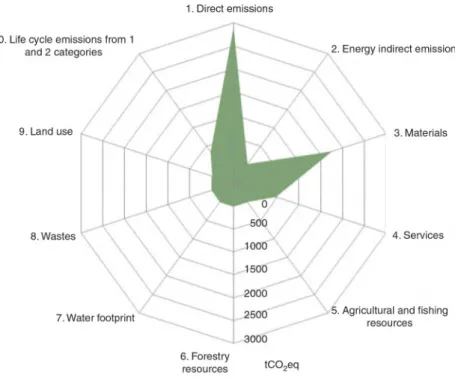
Fig. 1 shows the structural composition of the total CF according to MC3 categories. The main source of ernissions is the Direct emissions' category, followed by the Materials category (32.0% of total emissions). In the Direct ernissions' category, the consumption of kerosene accounts for the highest contribution (50.4% of total emissions). In the Materials cate-gory, the consumption of transport vehicles has the highest
Table l. Inputs and carbon footprint of Hispánica de Aviación SA (t C02eq) by scope and MC3 category
Scope/MC3 category (units) Input Emission
l. Direct emissions
l. l. Petrol (L) 34 626.98 85.57
1.2. Gasoil (L) 15 902.56 41.57
l.3. Kerosene (L) 757 975.02 2771.09 2. Indirect emissions
2.1. Electricity (Kwh) 110 541.33 21.00
3. Other indirect emissions
3.1. Materials (€) 3 745 030.96 1756.36
3.2. Services and contracts (€) 2 051 443.60 471.11
3.3. Agricultura! and fishing resources (€) 30 658.68 5.96
3.4. Forestry resources (€) 3 325.57 8.37
3.5. Water footprint (m3) 697.44 1.71
3.6. Land use (ha) 41.02 - 14.50
3.7. Waste and discharge (t) 5.61 0.47
3.8. Scope l and 2 life cycle emissions 348.41
percentage (27. 7% of total emissions ), followed ata distan ce by furniture and oils (1.4% and 1.3%).
Data from the four management areas are shown in Fig. 2. The total CF from each of General administration and Helitan-ker maintenance is 995 t C02eq (18% of total ernissions). Helitanker operations have the highest contribution (3326 t C02eq, or 61 % of total emissions ), with the lowest being from Airfield and helibase (186 t C02eq, or 3% oftotal emissions).
The mean annual flight distance covered by each of the 15 helitankers in operation is 34 000 km (±11 895 km standard deviation). These results added together for all helitankers totalled a corporate distance of 509 995 km in 2012. Taking into account the total corporate emissions, the average ernis-sions are 10.8 Kg C02eq km-1.
fil General administration
• Airfield and helibase
: Helitankers in operation
61% 111 Helitankers in maintenance
Fig. 2. Structural composition of the carbon footprint of Hispánica de
Aviación SA according to management areas.
1. Direct emissions
1 O. Lile cycle emissions from 1 and 2 categories
9. Land use
8. Wastes
7. Waterfootprint
6. Forestry resources
2. Energy indirect emissions
1 3. Materials
4. Services
Discussion
The relevance of this study is reinforced by the possibility of including new environmental criteria such as CF in sustainable decision making. The results can be analysed from different points of view. First, we evaluate the method's characteristics and influence. Second, we assess the results to understand their implications and to identify future actions.
The strengths and weaknesses of MC3 have already been
outlined by Alvarez et al. (2014). This method offers the chance
to work with easy-to-obtain data, and correctly assesses the amount of direct and indirect GHG emissions. In the current study it is worth highlighting one main strength and one
weakness. One strength is the complete consideration of other
indirect emissions thanks to the use of accounting reports and the use of input-output analysis for CF. Besides, it should be noted that GHG inventories from transport activities are now shifting from direct emissions to the indirect emissions in the upstream supply chain, and those caused by the use and disposal
of products (CDP 2013). Helicopter emissions are commonly
estimated following IPCC guidelines based only on fue!
con-sumption (Eggleston et al. 2006b). Several examples use these
recommendations (FOCA 2009; Linares Bejarano 2011;
Merkisz et al. 2012; Grogan 2013). In our experience, these studies fail to account for emissions that should be included; specifically, 49.6% of total emissions due to ali consumption
and waste generated from helicopter activity.
The main weakness of the study is that the results for product CF should be considered as an approximation. Despite our
improvements over former studies (FOCA 2009; Linares
Bejar-ano 2011; Merkisz et al. 2012; Grogan 2013 ), a life cycle phase statement is required for the correct assessment of product CF
(ISO 2013a). Manufacture and disposal life cycle emissions in
addition to operation life cycle ernissions should be considered in future studies. The reviewed studies show significant
differ-ences in consumption depending on the propulsion system (e.g.
Grogan 2013), and the helitanker's ernissions may vary with the
service provided. Each service may produce different emissions
based on the fire activity, weather conditions and terrain slopes. The functional unit should therefore be defined in terms of the type and specific service provided by the helitanker.
Our results may be of substantial interest in the field of helitanker services and to helicopter services in general. The CF results provide an analytical basis for the implementation of carbon management plans in HASA. Obviously, reductions in
fue! consumption are needed in order to enhance sustainability,
and here we should indica te the recommendations ofDrozd et al. (2012). Nevertheless, our study allows assessment in categories that are not commonly reported and could produce high effec-tive reductions in total ernissions. To give a few examples:
(1) materials from maintenance services (28% of total
emis-sions) should be evaluated in order to pursue reductions by
buying products covered by environmental declarations;
(2) gasoil emissions from office boiler consumption (1 % of total ernissions) could be reduced by replacing gasoil with natural gas or biomass fue!. Further, the comparison of con-sumption pattems across management areas and years revealed interesting findings (data not shown) that led to the integration ofnew schemes for sustainable development in HASA. Finally,
in addition to reduction measures, the company could enact compensation measures such as reforestation in permitted areas around the 'El Tiétar' airfield.
Taking into account our results for ernissions per km, it may
be possible to tradeoff the emissions from helicopter operation
against the avoided emissions from wildfire. This simplification
<loes not consider the distance covered by on-site operations (i.e. loading and unloading), as well as other valuable environmental assessments such as the loss of biodiversity and soil erosion, which should not be ignored in a comprehensive view of ali environmental effects (Campbell and Tilley 2014). These fea-tures (including flood risk) are particularly relevant in the Mediterranean region where effective wildfire suppression
may produce important changes (Certini et al. 2011 ). Therefore,
this tradeoff could never be a criterion for decision making, but may give us further insight into the relevance of wildfire ernissions and the importance of developing effective
techni-ques for wildfire detection and suppression.
Conclusions
This study provides further evidence of the value of
imple-menting sustainable indicators in decision making. Our
expe-rience should be considered as a pilot study to demonstrate the feasibility and practicality of integrating one of these new sus-tainable indicators - the CF - in decision making. Despite the focus on the participation ofhelitankers in wildfire suppression, these criteria may be useful in other more general aspects of helicopter services such as crew transportation and aerial
reconnaissance.
In fact, the results may be of considerable interest to the air transport sector in general, and to helicopter services in particu-lar. The differences in the helicopter emissions in the review can
be explained by the assumptions ofthe method. MC3 was easily
implemented, and provided a broad field of action in terms of reduction, compensation and communication. Thanks to the wide range of consumption categories, the results can be used as a baseline to measure the effects offuture change in policies and technical measures on reducing consumption and material-associated GHG emissions. Moreover, the assessment using MC3 has raised awareness ofthe integration ofnew schemes for sustainable development. Further work is currently ongoing to assess CF by specific helitanker unit and service.
Our experience indicates the need to reinforce strategies based on the implementation of sustainable indicators such as
CF. These new criteria may be useful in making decisions aimed
at bringing benefits in sustainable development. Govemment authorities should be aware of this new capability in aerial firefighting and promote its inclusion in public procurement as a new criterion for award.
Acknowledgements
References
Alvarez S, Rubio A (20 l 5a) Carbon footprint in Green Public Procurement: a case study in the services sector. Journal of Cleaner Production.
doi: JO. JO J 6/J.JCLEPR0.20 J5.0J .048
Alvarez S, Rubio A (20 J 5b) Compound method based on financia! accounts versus process life cycle analysis in product carbon footprint: a
compar-ison using wood pallets. Ecological Indicators 49, 88-94. doi: JO. JO J6/ J.ECOLIND.20 J 4. J 0.005
Alvarez S, Blanquer M, Rubio A (20J4) Carbon footprint using the compound method based on financia! accounts. The case ofthe School of Forestry Engineering, Technical University of Madrid. Journal of Cleaner Production 66, 224-232. doi: JO.JO J 6/J.JCLEPR0.20 J3. J J .050 Alvarez S, Sosa M, Rubio A (20 J 5) Product and corporate carbon footprint
using the compound method based on financia! accounts. The case of
Osorio wind farms. Applied Energy 139, J96-204. doi:JO.JOJ6/J.APE NERGY.20J4.J l.039
Ambrosia VG, Buechel SW, Brass JA, Peterson JR, Davies RH, Kane RJ,
Spain S (J998) An integration ofremote sensing, GIS, and information
distribution for wildfire detection and management. Photogrammetric
Engineering and Remate Sensing 64(10), 977-985.
Barbot C, Betancor O, Socorro MP, Viecens MF (20J4) Trade-offs
between environmental regulation and market competition: airlines,
emission trading systems and entry deterrence. Transport Policy 33,
65-72. doi: JO.JOJ6/J.TRANPOL.20J4.02.008
Bonan GB (2008) Forests and climate change: forcings, feedbacks, and the
climate benefits offorests. Science 320(5882), J444-J449. doi: JO. J J26/ SCIENCE.JJ55J2J
Bowman DMJS, Batch JK, Artaxo P, Bond WJ, Carlson JM, Cochrane
MA, D' Antonio CM, Defries RS, Doy le JC, Harrison SP, Johnston FH,
Keeley JE, Krawchuk MA, Kull CA, Marston JB, Moritz MA, Prentice IC, Roos CI, Scott AC, Swetnam TW, van der Werf GR, Pyne SJ (2009) Fire in the Earth system. Science 324(5926), 48J-484. doi: JO. J J26/SCIENCE. J J63886
Butchart SHM, Walpole M, Collen B, van Strien A, Scharlemann JPW,
Almond REA, Baillie JEM, Bomhard B, Brown C, Bruno J, Carpenter KE, Carr GM, Chanson J, Chenery AM, Csirke J, Davidson NC,
Dentener F, Foster M, Galli A, Galloway JN, Genovesi P, Gregory RD,
Hockings M, Kapos V, Lamarque J-F, Leverington F, Loh J, McGeoch
MA, McRae L, Minasyan A, Hernández Morcillo M, Oldfield TEE,
Pauly D, Quader S, Revenga C, Sauer JR, Skolnik B, Spear D,
Stanwell-Smith D, Stuart SN, Symes A, Tierney M, Tyrrell TD, Vié J-C, Watson R (20 JO) Global biodiversity: indicators of recent declines.
Science 328(5982), J J64-J J68. doi: JO.J J26/SCIENCE.J J875J2 Cagiao J, Gómez B, Doménech JL, Mainar SG, Lanza HG (20 J J)
Calculation of the corporate carbon footprint of the cement industry by the application of MC3 methodology. Ecological Jndicators 11(6),
J526-J540. doi: JO. JOJ6/J.ECOLIND.20J l.02.0J3
Cagiao J, Labella Hidalgo S, Carballo-Penela A, Gómez Meijide B (20J2) A new perspective for labeling the carbon footprint against climate
change. In 'Global warming - impacts and future perspective' (Ed. DBR Singh) Available at http://cdn.intechopen.com/pdfs-wm/39J95.
pdf [Verified 9 June 20 J 5].
Campbell ET, Tilley DR (20J4) Valuing ecosystem services from Maryland forests using environmental accounting. Ecosystem Services 7, J4 J-J 5 J. doi: JO. JO J 6/J.ECOSER.20 J3. J0.003
Carballo-Penela A (20J O) "Desarrollo sostenible y ecoetiquetado de bienes y servicios." (AENOR: Madrid)
Carballo-Penela A, Doménech J (2010) Managing the carbon footprint of
products: the contribution of the method composed of financia!
state-ments (MC3). International Journal of Lije Cycle Assessment 15,
962-969. doi: JO. J 007/S J J367-0 J0-0230-J
Carballo-Penela A, Doménech JL, García-Negro M do C,
Sebastián-Villasante C, Rodríguez-Rodríguez G, González-Arenales M (2008)
Análisis comparativo de la huella ecológica de dos empresas del sector
pesquero gallego. Observatorio Iberoamericano del Desarrollo Local y la Economía Social 2(4), J-30. Available at http://www.eumed.net/rev/ oidles/04/pqnvra.htrn [Verified 9 June 20 J 5]
Carbonfeel (20J3) Bookfeel tria! version. Fund. Funciona. Available at
http://www.carbonfeel.org/Carbonfeel_2/BookFeel.htrnl [Verified 9
June 20J5]
CDP (Carbon Disclosure Project) (20 J3) Global 500 climate change report
20 J3. (CDP: London, UK) Available at https://www.cdp.net/cdpresults/
cdp-global-500-climate-change-report-20 J 3.pdf [Verified 9 June 20 J 5] Certini G, Nocentini C, Knicker H, Arfaioli P, Rumpel C (20 J J) Wildfire
effects on soil organic matter quantity and quality in two fire-prone
Mediterranean pine forests. Geoderma 167-168, J48-J 55. doi: JO.JO J6/ J.GEODERMA.20J l.09.005
Commission Decision (2000) 2000/532/EC: Commission Decision of3 May
2000 replacing Decision 94/3/EC establishing a list ofwastes pursuant to
Article J(a) of Council Directive 75/442/EEC on waste and Council
Decision 94/904/EC establishing a list of hazardous waste pursuant to
Article J(4) of Council Directive 91/689/EEC on hazardous waste (notified under document number C(2000) J J47) (Text with EEA
relevance ). Available at http://eur-lex.europa.eu/smartapi/cgi/sga_doc?
smartapi!celexplus!prod!CELEXnumdoc&numdoc=32000D0532&lg=en
[Verified 9 June 20 J 5]
De la Cruz Leiva JL, Carballo-Penela A, Domenech JL (20J J) Enfoques
metodológicos para el cálculo de la Huella de Carbono. Obs. la
Soste-nibilidad España. Available at http://www.carbonfeel.org/Carbonfeel_
2/Bitacora/Entradas/20 J 1/9/ J 5 _Informe_Enfoques_metodologicos_para_
el_caclulo_de_la_Huella_de_Carbono_del_Isntituo_de_la_Sostenibilidad_
en_Espana_files/Informe%200SE.pdf [Verified 9 June 20 J 5]
Doménech JL (2007) 'Huella Ecológica y Desarrollo Sostenible.' (AENOR:
Madrid)
Drozd GT, Miracolo MA, Presto AA, Lipsky EM, Riemer DD, Corporan
E, Robinson AL (20 J 2) Particulate matter and organic vapor emissions from a helicopter engine operating on petroleum and Fischer-Tropsch fuels. Energy & Fuels 26(8), 4 756-4 766. doi: JO. J 02 l/EF30065 J T Eggleston S, Buendia L, Miwa K, Ngara T, Tanabe K (Eds) (2006a) '2006
IPCC Guidelines for National Greenhouse Gas Inventories. Volume 4:
Agriculture, forestry and other land use.' (Institute for Global
Environ-mental Strategies (GES): Hayama, Japan)
Eggleston S, Buendia L, Miwa K, Ngara T, Tanabe K (2006b) '2006 IPCC
Guidelines for National Greenhouse Gas Inventories. Volume 2: Energy.' (Eds NT Eggleston, TK Eggleston, HS, L Buendia, K Miwa)
(Institute for Global Environmental Strategies (GES): Hayama, Japan)
Fischlin A, Midgley GF, Price JT, Leemans R, Gopal B, Turley C,
Rounsevell MDA, Dube OP, Tarazona J, Velichko AA (2007) Impacts,
adaptation and vulnerability. Contribution ofWorking Group II to 'IPCC Fourth Assessment Report on Climate Change 2007.' (Eds ML Parry, OF Canziani, JP Palutikof, PJ Van der Linden, CE Hanson)(Cambridge University Press: Cambridge, UK) Available at http://www.ipcc.ch/pdf/ assessment-report/ar4/wg2/ar4-wg2-chapter4.pdf [Verified 9 June
20J5]
Flannigan MD, Amiro BD, Logan KA, Stocks BJ, Wotton BM (2006) Forest tires and climate change in the 2Jst century. Mitigation and Adaptation Strategies for Global Change 11(4), 847-859. doi: JO. J 007/
s
J J 027-005-9020-7FOCA (Federal Office of Civil Aviation) (2009) 0/3/33/33--05--020 Guid-ance on the determination ofhelicopter emissions. (FOCA: Bern).
Greenhalgh S, Ranganathan J, Sundin H (Eds) (2010) 'The GHG protocol
for project accounting.' (World Resources Institute and World Business Council for Sustainable Development: Washington, DC)
Grigel J (J974) Role of the helitanker in forest fire control. Available at
http://nofc.cfs.nrcan.gc.ca/bookstore_pdfs/J J 748.pdf [Verified 9 June
Grogan P (2013) C02 emissions calculator for travel including small
fixed-wing and helicopter aircraft - generic.xls. Available at https://www.
google.es/url? sa =t&rct=j &q=&esrc=s&source=web&cd= 1 &cad=rj a&
uact=8&ved=OCDEQFjAA&url=http://post.queensu.ca/-groganp/C02% 20emissions%20calculator%20for%20travel%20including%20small% 20fixed-wing%20and%20helicopter%20aircraft%20-%20generic.xls&
ei=npcyU6e_BMiYOAXj3oHoCw&usg=AFQjCNFKJa9qE-u8YUGDYo_
ekw4jU5GViw&sig2= 1 Gi0khmyoucv4FOeOs2-2Q&bvm=bv.63738703,d. d2k [V erified 9 June 2015]
ISO (International Organization for Standardization) (2006) ISO 14064 -1:2006 Greenhouse gases - Part 1: specification with guidance at the organization leve! for quantification and reporting of greenhouse gas emissions and removals. Available at http://www.iso.org/iso/ catalogue_detail?csnumber=3838 l [Verified 9 June 2015]
ISO (International Organization for Standardization) (2013a) ISO/TS 14067:2013 Greenhouse gases - Carbon footprint of products -Requirements and guidelines for quantification and communication. (ISO: Geneva, Switzerland.)
ISO (International Organization for Standardization) (2013b) ISO/TR 14069:2013 Greenhouse gases -Quantification and reporting of
green-house gas emissions for organizations -Guidance for the application of ISO 14064-1. (ISO: Geneva, Switzerland)
Korner C (2005) Tropical forests dynamics in response to a COrrich
atrnosphere. In 'Tropical forests and global atmospheric change.' (Eds Y Malhi, O Phillips) pp. 67-73. (Oxford University Press: Oxford, UK)
Linares Bejarano CA (2011) Environmental impact assessment of the
operation of conventional helicopters at mission leve!. Thesis, Cranfield University, UK. Available at https://dspace.lib.cranfield.ac.uk/handle/
182617167 [Verified 16 June 2015]
Majeau-Bettez G, Str0mman AH, Hertwich EG (2011) Evaluation of process-and input-output-based life cycle inventory data with regard to truncation and aggregation issues. Environmental Science & Technol-ogy 45(23), 10170-10177. doi: 10.1021/ES201308X
Meigs GW, Turner DP, Ritts WD, Yang Z, Law BE (2011)
Landscape-scale simulation of heterogeneous fire effects on pyrogenic carbon
emissions, tree mortality, and net ecosystem production. Ecosystems 14(5), 758-775. doi:I0.1007/S10021-0l l-9444-8
Merkisz J, Markowski J, Pie lecha J, Pie lecha I (2012) Exhaust emissions
from the PZL SW-4 PUSZCZYK helicopter based on the measurements of the concentrations of exhaust components in the exhaust gases during
a pre-flight test. Journal of Polish CIMAC 7(2), 123-130.
Miller JR, Morton LW, Engle DM, Debinski DM, Harr RN (2012) Nature reserves as catalysts for landscape change. Frontiers in Ecology and the
Environment 10(3), 144-152. doi:I0.1890/100227
Miyoshi C (2014) Assessing the equity impact of the European Union Emission Trading Scheme on an African airline. Transport Policy 33, 56-64. doi: 10.1O16/J. TRANPOL.2014.02.01 O
Moore P, Hardesty J, Kelleher S, Maginnis S, Myers R (2003) Forests and
wildfires: fixing the future by avoiding the past. Paper presented at the
'XII World Forestry Congress', 21-28 September 2003, Quebec, CA. A vailable at http://www.fao.org/docrep/article/wfc/xii/0829-b3 .htrn [Verified 9 June 2015]
Pan Y, Birdsey RA, Fang J, Houghton R, Kauppi PE, Kurz W A, Phillips OL, ShvidenkoA, LewisSL, CanadellJG, CiaisP, JacksonRB, Pacala SW, McGuire AD, Piao S, Rautiainen A, Sitch S, Rayes D (2011) A large and persistent carbon sink in the world's forests. Science
333(6045), 988-993. doi: 10.1126/SCIENCE.1201609
Peters GP (201 O) Carbon footprints and embodied carbon at multiple scales.
Current Opinion in Environmental Sustainability 2( 4), 245-250.
doi: 10.1O16/J.COSUST.2010.05.004
Peters GP, Weber CL, Guan D, Hubacek K (2007) China's growing C02
emissions: a race between increasing consumption and efficiency gains.
Environmental Science & Technology 41(17), 5939-5944. doi: 10.1021/ ES070108F
Ricondo & Associates (2008) Appendix F. Air quality analysis. In 'Final environmental assessment for the proposed South Nevada Regional Heliport', p. 50. (Clark County Department of Aviation: Clark County,
NV) Available at http://www.ricondoprojects.com/Heliport/F _AQ.pdf.
[Verified 9 June 2015]
Roca LC, Searcy C (2012) An analysis of indicators disclosed in corporate
sustainability reports. Journal of Cleaner Production 20(1 ), 103-118. doi: 10.1O16/J.JCLEPR0.2011.08.002
Solomon S, Qin D, Manning M, Chen Z, Marquis M, Averyt KB, Tignor M,
Miller HL (Eds) (2007) 'Contribution ofWorking Group I to the Fourth Assessment Report ofthe Intergovernmental Panel on Climate Change,
2007: The physical science basis.' (Cambridge University Press: Cambridge, UK). Available at http://www.ipcc.ch/publications_and_
data/ar4/wg l/en/contents.htrnl [Verified 9 June 2015]
Sommers WT, Loehman RA, Hardy CC (2014) Wildland fire emissions, carbon, and climate: science overview and knowledge needs. Forest
Ecology and Management 317, 1-8. doi:I0.1016/J.FOREC0.2013.
12.014
Stocker TF, Qin D, Plattner GK, Tignor M, Allen SK, Boschung J, Nauels A,
Xia Y, Bex V, Midgley PM (Eds) (2013) 'Climate Change 2013: The physical science basis. Summary for policymakers.' Contribution of Working Group I to the IPCC Fifth Assessment Report on Climate
Change 2013. (Cambridge University Press: Cambridge, UK)
Suh S, Huppes G (2005) Methods for life cycle inventory of a product.
Journal of Cleaner Production 13(7), 687-697. doi: 10.1016/J.JCLE
PR0.2003.04.001
Suh S, Lippiatt BC (2012) Framework for hybrid life cycle inventory databases: a case study on the Building for Environmental and Economic
Sustainability (BEES) database. International Journal of Lije Cycle Assessment 17(5), 604--{í 12. doi: 10.1007/S 11367-012-0393-Z Wiedmann T, Minx J (2008) A definition of 'carbon footprint.' In
'Ecologi-cal Economics Research Trends', (Ed. CC Pertsova) pp. 1-11. (Nova Science Publishers: Hauppauge, NY) Available at https:// www.nova-publishers.com/catalog/product_info.php?products_id=5999 [Verified 9 June 2015]
WiedmannT, WiltingHC, LenzenM, LutterS, PalmV (20ll)QuoVadis