of substances that may damage the environment and human health, including greenhouse gas emissions. In this respect, the regulation recognizes the need to minimize the emission of harm ful substances to the atmosphere, waters and soil. Another cate gory (BRCW 7 Sustainable use of natural resources) is dedicated to the use of raw materials in an environmentally con scious manner. This category focuses on the use of materials that are recyclable and compatible with the surrounding environment in terms of degradability and harmlessness at the end of their use ful lives. CPR sustains the need to use a life cycle approach to eval uate the environmental performance of construction materials, thus considering impacts attributable to all stages in its value chain from raw material extraction to final disposal. The technical imple mentation of this life cycle approach is described in EN 15804 Sustainability of construction works, Environmental product declara tions, Core rules for the product category of construction products[6].
In line with these ideas, experimental results have been partic ularly promising regarding the incorporation of Waelz slag into fired bricks. This inorganic residue, consisting of a mixture of Fe2O3 (56%) and CaO (16%)[7], is generated in large amounts in Waelz plants dedicated to the industrial recovery of ZnO/PbO from Electric Arc Furnace dust[8]. This slag is classified in the European List of Waste[9]as a non hazardous waste. However, its disposal by landfilling represents a serious environmental risk and involves considerable economic costs for this industrial activity. Experi mental investigations have proven the optimum technological properties of ceramic bricks incorporating up to 20% Waelz slag and the reduced energy requirements involved in the firing process [8]. Despite potential benefits, the commercial production of bricks containing waste materials is still very marginal. This has been associated in part to unclear transmission of information to indus try and the public in general regarding the environmental sound ness of these materials[1]and also the limited amount of work dedicated to evaluate the overall environmental benefits of this approach. However, European strategies, like the Action Plan for Circular Economy[10], can contribute to enhance the benefits of reintroduce waste flows to new production processes. The pro posed actions will contribute to ‘‘closing the loop” of product life cycles through greater recycling and re use, and bring benefits for both the environment and the economy.
Life Cycle Assessment (LCA) is a methodology widely used to quantify potential impacts and damage to the environment associ ated with process and products, including the value chain of con struction materials[11,12]. LCA conducted on standard products from the brick manufacturing industry[13 16]have shown that environmental impacts are primarily associated with energy con sumption in the firing process. Impact on climate change reported in the literature for fired clay bricks usually range between 132 and 295 kg of CO2eq./tonne of brick[15,17,18], depending primarily on the scope of the LCA, characteristics of the firing process and brick quality. The use of LCA to investigate the benefits of waste incorpo ration into fired bricks is very limited. Bories et al.[19]applied a cradle to gate approach to demonstrate the improved performance of fired clay bricks when incorporating agricultural wastes as pore forming agent.
The aim of this investigation is to provide additional informa tion about the environmental consequences of incorporating Waelz slag into fired bricks. The analysis has been performed using LCA methodology and a cradle to grave approach. The analyses have been carried out using primary inventory data obtained experimentally for the emission of air pollutants during the firing process and for the leaching of potentially toxic inorganic species in landfill sites at the end of the useful lives of the ceramic bricks. Impact savings due to avoiding the landfilling of the Waelz slag were also considered. A series of scenarios have been defined describing the transport of raw materials and residues, processing
and manufacturing of fired clay bricks, and the end of life of the construction products. The analysis also covers the effect of alter native waste management scenarios regarding the landfilling and recycling of Construction and Demolition Waste (CDW).
2. Methodology
2.1. Life cycle assessment of fired clay bricks containing Waelz slag
2.1.1. Goal and scope definition
The main goal of this investigation is to quantify the environ mental benefits associated with the incorporation of Waelz slag into fired clay bricks, as an alternative to the final disposal of this residue by landfilling. In addition, a secondary goal has also been set involving the analysis of environmental benefits resulting from meeting the recycling objectives for Construction and Demolition Waste (CDW) set under the EU Waste Framework Directive for 2020. This investigation has been carried out using Life Cycle Assessment (LCA) methodology according to standard procedures described under ISO 14040 and ISO 14044[20,21].
This LCA has been based on an earlier experimental work car ried out by authors of the same research group describing the characteristics of ceramic bricks incorporating different propor tions of this non hazardous residue. This investigation proved that fired clay bricks containing up to 20 wt% Waelz slag complied with all the technological specifications and also with the environmen tal requirements regarding the leaching of potentially hazardous components when disposed of by landfilling [8]. Inventory data for air emissions during the firing process and the leaching of toxic compounds during landfilling derive from this preceding investi gation [8,22]. Since both products, the conventional bricks and the waste incorporating bricks, are capable of accomplishing the same functional requirements, the functional unit for this investigation was selected on a product mass basis as ‘‘1 tonne of bricks”.
The LCA has been performed following a cradle to grave approach and considering the following four life cycle phases:
RAW MATERIALS: including extraction of raw materials (natu ral clay and/or Waelz slag) and transportation to the brick man ufacturing plant,
MANUFACTURING: including the fabrication of the standard or Waelz slag containing ceramic bricks,
RECYCLING: transport of bricks to the recycling facility at the end of their useful lives, shorting of raw materials and process ing for aggregate production.
LANDFILLING: transport of used bricks from construction site to disposal facility, construction and operation of landfill site, and leaching of toxic inorganics.
Owing to their limited contribution, and also due to the fact that they have a similar contribution in all the scenarios considered, the following processes were left out of the boundaries of the analysis: machinery and equipment at brick manufacturing plant, landfill site and CDW recycling plant; and brick utilization phase (includ ing transport to the construction site, construction activities and demolition of building at the end of its useful life).
2.1.2. System boundaries and scenarios
Fig. 1shows the life cycle diagram and system boundaries of the three analysis scenarios considered in this investigation:
for raw materials (clay and Waelz slag) and CDW in the recycling phase were provided by local brick manufacturers and CDW recy cling plants in Cantabria (Spain); iv) materials and energy inputs at the landfill site were adapted from data reported in national regu lations[26]using the methodology proposed at[27]. Ecoinvent v.3 was used for background inventory data[28]and specific datasets used in the modelling of the systems are included inTables 1 3.
2.1.4. Life cycle impact assessment methodology
Life Cycle Impact Assessment (LCIA) methods ReCiPe Midpoint (Europe H) v. 1.13 and ReCiPe Endpoint (Europe H/H) were used
to transform emission values into impact category indicators and damage indicators, respectively. ReCiPe Midpoint (Europe H) v.1.13 is also used to normalize emission values. This selection is based on the recommendations proposed in the product category rules established for construction materials ISO 15804:2012 [6] and the need for consistency in the application of midpoint and endpoint methods (ReCiPe created by the same developers as an updated version of CML 2001 and Ecoindicator 99). Ten impact cat egories were considered for midpoint analysis including: Climate change, Ozone depletion, Terrestrial acidification, Freshwater eutrophication, Human toxicity, Photochemical oxidant formation, Table 1
Inventory data for RAW MATERIALS and MANUFACTURING adjusted to 1 tonne of bricks including: extraction and transport of raw materials (top), energy inputs at the brick manufacturing plant (middle) and direct emissions from thermal processing of raw materials (natural clay and Waelz slag) during firing.
Elementary flow Unit Standard brick (B-S1)
Waelz slag brick (BW-S1)
LCIA dataset
Extraction and transport of raw materials
Clay tonne 1.25 1 Clay/CH/pit operation/Conseq, U
Waelz slag tonne 0 0.2 –
Transport clay tkm 0 0 –
Transport Waelz to manufacturing plant
tkm 0 27.6 Transport, freight, lorry 16–32 metric tonne, EURO5 {GLO}| market for | Alloc Def, U
Energy and material inputs at brick manufacturing plant
Electricity MWh 50 42.5 Electricity, medium voltage/ES/market for/Conseq, U
Natural Gas MJ 1664 1433 Electricity, high voltage/ES/ Electricity production, natural gas, at conventional power plant /Conseq, U
Diesel MJ 405 347 Diesel, burned in building machine/GLO/market for / Conseq, U
Brick production facility p* 3.3*106 3.3*10 6 Brick production facility {RoW}| brick production facility construction | Alloc Def, U
Direct emissions due to thermal transformation of raw materials (natural clay and Waelz slag)[22]
CO2 g 6487 5030 Emissions to air – CO2
SO2 g 0 1763 Emissions to air – SO2
NOX g 1177 922 Emissions to air – NOX
HCl g 0 597 Emissions to air – HCl
HF g 116 772 Emissions to air – HF
(*
) ‘‘p” is used as a convention in ecoinvent datasets to designate the number of ‘‘Construction of landfill site” units associated with a functional unit of the system (1 tonne of bricks).
Table 2
Inventory data for the RECYCLING and LANDFILLING of 1 tonne of bricks including: energy, material and transport inputs derived from disposal activities (top), leaching of toxic species at landfill site (middle), and energy and transport inputs of recycling under waste management scenarios S1 and S2.
Elementary flow Unit Standard brick
Waelz slag brick LCIA dataset
B-S1 BW-S1 BW-S2
Energy and material inputs at landfill site – landfilling of CDW
Landfilling CDW % 47 47 30
Construction of landfill site p 0.31*106 0.31*106 0.20*106 Inert material landfill {RoW}| construction | Alloc Def, U
Transport CDW to landfill tkm 103 103 66.0 Transport, freight, lorry 16–32 metric tonne, EURO5 {GLO}| market for | Alloc Def, U
Clay for daily cover in landfill kg 16.2 15.3 9.78 Clay {RoW}| clay pit operation | Alloc Def, U
Sand for intermediate cover in landfill kg 3.44 3.25 2.07 Gravel, round {RoW}| gravel and sand quarry operation | Alloc Def, U Electricity for landfill operation kWh 0.081 0.081 0.052 Electricity, medium voltage {ES}| market for | Alloc Def, U
Diesel for landfill operation MJ 10.8 10.2 6.51 Diesel, burned in building machine {GLO}| market for | Alloc Def, U Water for landfill operation kg 22.1 22.1 14.1 Water, fresh
Leaching of toxic species at landfill site–landfilling of CDW
Zn mg 282 329 210 Emissions to soil – Zn
Ba mg <d.l. 517 330 Emissions to soil – Ba
Mo mg <d.l. 1410 900 Emissions to soil – Mo
Recycling of CDW
Recycling CDW % 53 53 70
Transport CDW to CDW plant tkm 122 122 162 Transport, freight, lorry 16–32 metric tonne, EURO5 {GLO}| market for | Alloc Def, U
Electricity for shorting (before plant) kWh 1.96 1.96 2.59 Electricity, medium voltage {ES}| market for | Alloc Def, U Diesel for shorting (before plant) MJ 2.17 2.17 2.86 Diesel, burned in building machine {GLO}| market for | Alloc Def, U Electricity for CDW treatment plant kWh 0.44 0.44 0.58 Electricity, medium voltage {ES}| market for | Alloc Def, U Diesel for CDW treatment in plant MJ 7.09 7.09 9.4 Diesel, burned in building machine {GLO}| market for | Alloc Def, U Recycled products (as avoided
impacts)
t 0.53 0.53 0.70 Gravel, crushed {CH}| production | Alloc Def, U
Particulate matter formation, Terrestrial and Freshwater ecotoxic ity and Fossil depletion. The endpoint methodology considered three categories: Depletion of resources, Damage to human health and Damage to ecosystem quality. Endpoint indicators were aggre gated using the weighing factors proposed by the ReCiPe authors. SimaPro v8.3 software was used to build the models and perform calculations.
Regarding air emissions, it is noteworthy considering in the dis cussion that ReCiPe Midpoint (Europe H) v. 1.13 stipulates that HF emissions have an effect only on the Human toxicity category while HCl emissions are not considered in any of the impact cate gories evaluated. Soil emissions resulting from leaching of inorgan ics (As, Ba, Cr, Cu, Mo, Pb, Zn) from bricks and Waelz slag have effects on the Human toxicity, Terrestrial ecotoxicity and Freshwa ter ecotoxicity categories. In contrast, chloride (Cl ) and fluoride (F ) emissions in the leachates are not considered in any of the cat egories of this LCIA methodology.
3. Results and discussion
3.1. Impact oriented analysis of standard and Waelz slag bricks
Fig. 2illustrates the impacts associated with the life cycle of 1 tonne of standard bricks produced from 100 wt% natural clay. The impact on climate change of the system represents 238 kg of CO2 eq./tonne of bricks, a value that is comparable to those reported by other authors for the fabrication of fired clay bricks as[13,14,17]showing values of 221, 271 and 195 kg of CO2eq./ tonne of bricks respectively. Most of this impact (80%) is attributa ble to the manufacturing phase, in particular the combustion of fossil fuels (49.9% to natural gas and 15.9% to diesel) and the use of electricity (10.1%) during the firing process. Only 2.7% of the impact on this category correspond to direct emissions derived from the thermal transformation of the natural clay (6.49 kg of CO2eq./tonne of bricks, as shown in the inventory data ofTable 1). The landfilling and recycling phases each one account for 8% of this impact category, while the extraction of the raw materials (natural clay) and its transport from the quarry to the brick factory con tribute to only 4% of the total.
The manufacturing stage is also the main contributor to impact generation on all other categories (between 66% and 86%). This is due, in most cases, primarily to the consumption of natural gas and other energy requirements. However, in the case of the terres trial acidification category, most of the impact (47% of the total,
equivalent to 1.42 kg SO2 eq./tonne of brick) is attributable to NOx emitted directly by the clay during the calcination process. In the case of the human toxicity category, not only the NOx emis sions, but also direct emissions of HF due to calcination of the clay are the main contributors (30.9 kg of 1,4 DB eq./tonne of bricks, representing 42% of the total).
On the contrary, for the terrestrial ecotoxicity category, the environmental deterioration is mainly attributable to the end of life phase. In particular, brake wear emissions associated with transport activities is the most damaging action, contributing to 57% and 62% of the impact on this category in the landfilling and recycling phases, respectively.
Fig. 3 shows the environmental performance of 1 tonne of bricks manufactured with 20 wt% Waelz slag with information about the contribution of different life cycle phases. As explained in the methodology section, this system scenario takes into consid eration emission saving caused by avoiding the disposal of 200 kg of Waelz slag. Savings calculated for the Waelz slag landfilling sys tem are represented as negative impact values and deduced from the ones calculated for the Waelz slag bricks.
The environmental profile of Waelz slag bricks is very similar to that observed in standard bricks where most impact categories are dominated by the manufacturing phase (between 65% and 93%). Regarding the climate change category, the results show that impact generated by Waelz slag bricks (210 kg of CO2 eq./tonne of bricks) is 11.8% lower than that of conventional bricks. Impact savings from avoiding the landfilling of the slag only contributes to reducing 4 kg of CO2eq./tonne of bricks. The rest (24 kg of CO2 eq./tonne of bricks) is due primarily to the inferior energy require ments (natural gas, diesel and electricity) during the manufactur ing stage. Being Waelz slag a metallurgical waste generated at very high temperatures, it does not undergo the endothermic transformations (mainly dehydration and decarbonation reactions) which occur in the conversion of natural clay when fired. The lower fuel requirements and temperatures achieved result in reduced NOx and CO2emissions, as shown in the inventory data ofTable 1. However, the presence of sulphur, fluorine and chlorine in the slag favours the air emission of SO2, HCl and HF into the air during firing.
This prevalence of the manufacturing phase does not occur in the terrestrial ecotoxicty category. As discussed in the analysis of standard bricks, this observation is attributable primarily to the high impact generated by transport activities in the recycling and landfilling stages of the system.
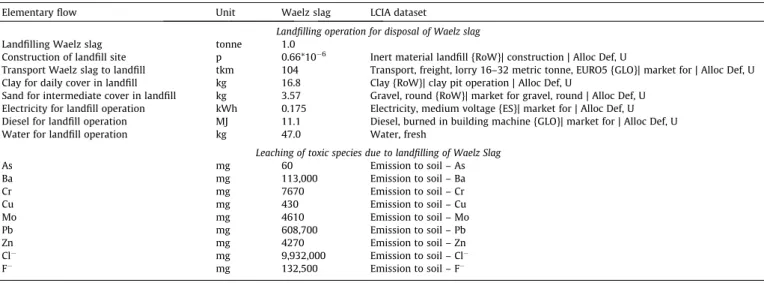
Table 3
Inventory data for the disposal of 1 tonne of Waelz slag by landfilling including: landfill operation (top) and leaching of toxic species.
Elementary flow Unit Waelz slag LCIA dataset
Landfilling operation for disposal of Waelz slag Landfilling Waelz slag tonne 1.0
Construction of landfill site p 0.66*10 6 Inert material landfill {RoW}| construction | Alloc Def, U
Transport Waelz slag to landfill tkm 104 Transport, freight, lorry 16–32 metric tonne, EURO5 {GLO}| market for | Alloc Def, U Clay for daily cover in landfill kg 16.8 Clay {RoW}| clay pit operation | Alloc Def, U
Sand for intermediate cover in landfill kg 3.57 Gravel, round {RoW}| market for gravel, round | Alloc Def, U Electricity for landfill operation kWh 0.175 Electricity, medium voltage {ES}| market for | Alloc Def, U Diesel for landfill operation MJ 11.1 Diesel, burned in building machine {GLO}| market for | Alloc Def, U Water for landfill operation kg 47.0 Water, fresh
Leaching of toxic species due to landfilling of Waelz Slag
As mg 60 Emission to soil – As
Ba mg 113,000 Emission to soil – Ba
Cr mg 7670 Emission to soil – Cr
Cu mg 430 Emission to soil – Cu
Mo mg 4610 Emission to soil – Mo
Pb mg 608,700 Emission to soil – Pb
Zn mg 4270 Emission to soil – Zn
Cl mg 9,932,000 Emission to soil – Cl
[25] N. Quijorna, G. San Miguel, A. Andrés, Environmental assessment of the incorporation of Waelz slag into clay-based ceramic construction materials, in: Int. Conf. Environ. Sci. Technol., Rhodes, 2011.
[26] Order AAA /661/2013 on waste disposal in landfills, 2013.
[27] N. Yang, A. Damgaard, F. Lü, L.-M. Shao, L.K.-S. Brogaard, P.-J. He, Environmental impact assessment on the construction and operation of
municipal solid waste sanitary landfills in developing countries: China case study, Waste Manag. 34 (2014) 929–937, https://doi.org/10.1016/j. wasman.2014.02.017.