Acta Botanica Malacitana 28: 47-58 Malaga, 2003
VARIATION OF SPECIFIC MORPHOLOGICAL
TRAITS AND PLOIDY LEVEL OF FIVE
AEGILOPS
L.
SPECIES IN MOROCCO.
Bouchra BELKADI, Nourredine ASSALI, Ouafae BENLHABIB
ABSTRACT. Variation of specific morphological traits and ploidy level of five Aegilops L. species in Morocco.The genus Aegilops L. represents an important natural source of useful genes for wheat breeding, with particular emphasis on biotic and abiotic stress resistance. For successful crosses, the primarily step is to select appropriate Aegilops accessions. In this paper, we studied five Moroccan species of an Aegilops collection on the basis of spike structure and chromosome number. Twenty-eight specific morphological characters were used to differentiate the species. Statistical analyses, in particular the DFA, allowed the characterization of the genetic variability of the species; the two first standardized axes explained 96,2% of the total variability and 100% of the entities were classified within their own group. In addition, the dendrogram constructed using morphological data reveals a significant variability within and between species. Cytogenetic study revealed four species, A. geniculata Roth, A. triuncialis L., A. ventricosa Tausch and A. peregrina Maire & Weiller, to be tetraploid. However, A. neglecta Req. ex. Bertol., where only two accessions are represented in the collection, revealed to be hexaploid, and can then be classified as A. neglecta subsp. recta Chennav.
Key words. Aegilops, Variation, Morphology, Ploidy, Morocco.
RÉSUMÉ. Variation des caracteres morphologiques specificities et niveau de plordie de an(' espéces Aegilops L. au Maroc. Le genre Aegilops L. représente une importante source de genes, potentiellement utilisables dans Pamelioration des blés cultivés (Triticum spp.) notamment pour la resistance aux stress biotiques et abiotiques. Le choix des accessions Aegilops á employer, dans un programme d' hybridation interspécifique, necessite une caractérisation taxonomique et une evaluation préalables. L'objectif de ce travail a ete d'étudier des accessions, appartenant á 5 especes marocaines constituant une collection d'Aegilops, sur la base de caracteres morphologiques specifiques de l'épi et du niveau de ploYdie. La caractérisation phénotypique a été basée sur l'étude de 28 caracteres morphologiques qui discriminent entre les especes. Les resultats des analyses statistiques, en particulier de l'AFD, ont permis de caractériser la variabilite génetique de ces especes et ant donne un pourcentage d'appartenance á l'espece de 100%. Aussi, les deux premiers axes standardises expliquent 96,2% de la variabilité totale. Un demlrogramme a éte aussi construit, revelant une variabilite interspecifique. L'étude cytogenétique a révélé une tetraploYdie pour A. geniculata Roth, A. triuncialis L., A. ventricosa Tausch et A. peregrina Maire & Weiller. Quant á A. neglecta Req. ex. Bertol., une hexaploYdie a été mise en evidence pour les deux uniques accessions disponibles dans la collection, permettant de leur attribuer le nom A. neglecta subsp. recta Chennav. Mots clés. Aegilops, Variation, Morphologic, Plolidie, Maroc.
INTRODUCTION
especially since it was confirmed to have aclose relationship with cultivated wheat. The genus Aegilops L. has been one of the Aegilops L. belongs to the family of Poaceae
48 B. Belkadi eta?.
in
his book "Genera Plantarum" (Jussieu,1789). Since then, several authors have
concentrated their studies on this genus
(Boissier, 1884; Zhukovsky, 1928; Eig, 1929;
Sears, 1941; Kihara, 1946; Bor et al., 1968;
Hammer, 1980; Baum et al., 1987; Perino &
Prceddu, 1990 and Van Slageren, 1994).
Aegilops species are widely represented
in Mediterranean and West Asian regions
(Sakamoto & Kobayashi, 1980). They are well
adapted to diverse disturbed environments, pastures, edges and within cultivated fields; which translate a huge morphological variability of the spike.
According to the classification of Van
Slageren, the Aegilops genus comprises 22
diploid, tetraploid and hexaploid species (Van
Slageren, 1994). The genus would probably
originate from Transcaucasia (Hammer, 1980).
All species are annual and autogame. The diversity of Aegilops make its taxonomy especially difficult. Therefore, for a proper evaluation of the species, it is necessary to
check the ploidy level and the chromosome
morphology. Indeed, an unacquainted observer may fail to distinguish between certain Aegilops
species with different ploidy levels (tetra- vs
hexaploid) if the observations are based only
on morphological characteristics.
Cytogenetic studies of this genus have
been especially used to establish genetic relationships in biosystematics research, and for assisted crop improvement programs. It is known that Aegilops species forms series of
allopolyploids ranging from diploids (2n= 4x=
14) to hexaploids (2n= 6x= 42), with a basic
set of chromosomes x= 7 (Sakamura, 1918).
Senjaninova — Korczagina was probably the
first author who worked on chromosome morphology in Aegilops (Senjaninova —
Korczagina, 1932). Chennaveeraiah described
the chromosomes morphology of 21 Aegilops
diploids and polyploids (Chennaveeraiah,
1960). Despite this large amount of works
(Zurabishvili et al., 1978; Wains & Barnhart,
1991), there is still a need to extend cytogenetic
investigation to further geographical areas. However, the majority of these studies were criticized for their limitation to few accessions of each species.
In Morocco, it has been reported, in an old herbarium database, seven tetraploid
species of Aegilops (Kimber & Feldman, 1987;
Van Slageren, 1994). Only five species were
collected in 1994 - 1995 and identified on the basis of the morphological features of their inflorescences (Benlhabib et al., 2001).
According to Kihara (1946) and Kimber (1983),
their genome formula has been determined as:
A. geniculata Roth (MU), A. triuncialis L.
(UC), A. ventricosa Tausch (DN), A. neglecta
Req. ex. Bertol. (UM or UMN) and A. peregrina
Maire & Weiller (SU). They were distributed
mainly in the northern area of the Rif mountains, the Central Plateaus of SaYs and
Zaeir, the High and Middle Atlas mountains
and the western coastal area from south of
Tanger to north of Agadir. The first two species
are widely distributed throughout the country.
A. ventricosa grows on intermediate to high
altitudes sites in humid and cold areas. A.
neglecta seems to prefer littoral zones and never grows on dense surfaces but rather as
loosely dispersed population (Benlhabib et al.,
2001). A. peregrina was recently collected in
Rabat areas; it has been mentioned in Morocco
previously in the "Flore de l'Afrique du Nord"
(Maire, 1955), in the "Nouvelle flore d'Algérie
et des régions désertiques méridionales"
(Querzel & Santa, 1962-1963) and in the
"Catalogue des plantes vasculaires du Nord du
Maroc incluant des clés d' identification"
(Valdés et al., 2002).
In order to understand the taxonomic position of those Aegilops species growing in
Morocco, a biosystematic study with several approaches was conducted. The present work deals with specific morphological traits and
ploidy level. This characterization would allow
and to study the phenotypical variability within three of the five species of the collection.
MATERIALS AND METHODS
SAS program (SAS institut, 1989).
A discriminate factorial analysis (DFA)
was also carried out on the correlation matrix of the traits using the STATITCF program.
Plant Material
The morphological characterization was performed on dried plants belonging to the genus Aegilops that have been collected during summer seasons of 1994 and 1995 from different regions of Morocco. These plants were collected from natural populations growing on roadsides, pastures and edges of cultivated fields. Benlhabib eta!. (2001) have described in detail these collection sites and populations. On the other hand, cytogenetic
study was carried on root tips of some seedling samples of the collection.
The entire collection enclosing 151
accessions is maintained, by the Cereal
Cytogenetic and Biotechnology Laboratory at
the Agronomy Plants Breeding Department;
I.A.V. Hassan II, as herbarium and stored seeds
at —20°C. It is composed by 115 A. geniculata,
25 A. triuncialis,7 A. ventricosa, 2 A. neglecta
and 2 A. peregrina accessions.
Morphological data
One hundred thirty nine accessions among the 151 collected were characterized using 28
specific morphological traits. The traits studied included characteristics of the spike, spiklets,
glume, lemma, palea and awns (tab. 1). Three
to six representative spikes were used in this investigation.
Statistical analysis
The variance analysis was used to test the significance of the variation among accessions for the 28 traits studied. The correlation coefficients between traits were estimated by the mean value of accessions over locations. Analysis of variance, means and coefficient of variation for traits were calculated with the
Characters Abbreviation
Spike length SL
Spike wide SW
Spiklets number S N
Number of steril spiklets NSS
Number of rudimentary spiklets NRS
Awns number on lower glumes ANLG
Awns number on upper glumes ANUO
Teeth number on lower glumes TNLG
Teeth number on upper glumes TNUG
Length of lower glumes LLG
Length of upper glumes LUG
Wide of lower glumes WLG
Shortest awns of the lower glumes S ALG
Longest awns of the lower glumes LALG
Shortest awns of the upper glumes SAUG
Longest awns of the upper glumes LAUG
Length of lower lemmas LLL
Length of upper lemmas LUL
Awns number on lower lemmas ANLL
Awns number on upper lemmas ANUL
Teeth number on lower lemmas TNLL
Teeth number on upper lemmas TNUL
Shortest awns of the lower lemmas SALL
Longest awns of the lower lemmas LALL
Shortest awns of the upper lemmas SAUL
Longest awns of the upper lemmas LAUL
Length of lower palea LLP
Length of upper palea LUP
50 B. Belkadi et al.
Euclidean distance was calculated upon the three first standardized principal components, this distance called "Mahalanobis generalized distance" was used (Llaurad6 & Moreno-Gonzalez, 1993).
Cluster analysis using the unweighted pair group method (UPGMA) based on arithmetic averages were carried out using the Cluster
procedure of SAS Software 1987 (SAS institut,
1989). The euclidean distances among
populations calculated on the first three standardized axes were computed in this procedure. Dendrograms showing the phenotypic relationships were obtained by the TREE procedure of SAS (SAS institut, 1989).
Cytological data
The five Aegilops species collected in
Morocco were used for chromosomal analysis. Two to four accessions per species were analyzed with the cytological method described
by Sharma (1982). Sterilized seeds were germinated in Petri dishes at room temperature. Young root tips were pre-treated with 2 or 4%
alpha-bromonaphtalene solution for 24 hours,
then fixed in a mixture of ethanol and glacial
acetic acid (3:1, v/v) before their storage at
4°C. Fixed root tips were hydrolyzed in IN
hydrochloric acid at 60°C for 10 min, stained
in 1% carmine solution for I to 2 hours, then
squashed in 4% acetic acid. Cells with well-spread chromosome complements were scored and photographed for chromosomal morphology determination. Photographs were taken with an Olympus micromaster camera at
400x magnification.
RESULTS AND DISCUSSION
Ploidy level
The observation of somatic metaphase plates of each species shows a constant chromosome number between scored cells. Table 2 summarized the ploidy levels of
Moroccan Aegilops studied and the genomic
constitution (column 5) as established by
Kihara (1946) and Kimber (1983) on the base
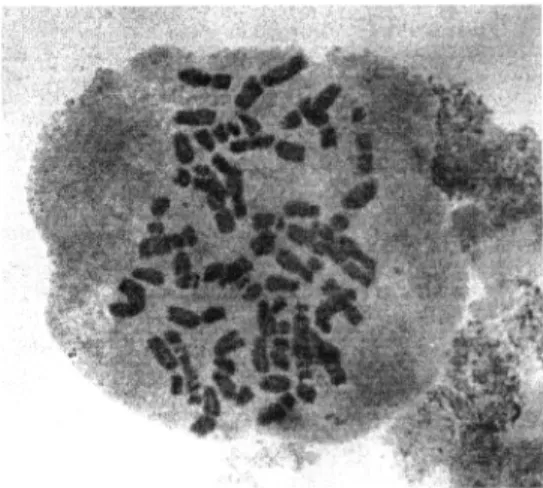
of meiotic chromosome pairing in hybrids. We have been able to confirm the
tetraploid level (2n= 4x = 28) of the four
species: A. geniculata (fig. 1), A. triuncialis, A. ventricosa and A. peregrina (A. variabilis
Eig.) as have been mentioned by several authors
(Chennaveeraiah, 1960; Gupta & Baum, 1986
and Kimber & Feldman, 1987). Both accessions
of A. neglecta presented however a hexaploid
number of chromosomes (2n =6x= 42). It can be then classified as "A. neglecta subsp. recta
Chennav" or "A. recta" according to Kimber
and Feldman (1987) (fig. 2). The hexaploid
form of A. neglecta species has not been mentioned by Kimber and Feldman (1987)
neither in Morocco nor in North Africa. Kimber
& Feldman (1987) have reported that this
hexaploid cytotype or race is relatively common
in Greece and western Turkey and is found in
Portugal, Spain, France, Yugoslavia and Italy.
Van Slageren (1994) was however astonished
that the hexaploid form A. neglecta is present
in those countries without mentioning Algeria from where the lectotype specimen of A.
neglecta subsp. recta is originates. In Morocco,
Kimber & Feldman (1987) reported the
tetraploid form of A. neglecta, which doesn't
exist within the studied collection. This
cytotype has certainly not been crossed during
the Aegilops prospecting trip.
The two forms of the A. neglecta constitute
a taxonomic difficulty since they cannot be
distinguished on the basis of their phenotype.
In fact, when based only on the morphological
traits of the spike, spiklets, sterile glumes,
lemmas and paleas, both 52 and 66 accessions
are classified as A. neglecta with no regards to
the cytotype group. Kimber & Feldman (1987)
described the hexaploid form with a fertile
terminal spiklet whereas the tetraploid form
Species Number of Accession
Accession reference
Origin Genome ploidy level
A. geniculata 4 24 Oujda 3 km from Beni Drar MU 2n= 4x= 28 51 Larach-Ksar al kebir 8 km
to Ksar al kebir
70 15 km from Aguelmous to Kenifra (467°, 273°, 1000m)
80 13 km from AM louh to Azrou
A. triuncialis 4 1 14 km from Rabat to UC 2n=4x= 28 Meknés
7 2 km from El Hajeb to Azrou
30 1 km from Ben abdellah to Targoust
120 20 km from Alt Atab to Ouzoud
A. ventri cosa 4 12 I km to Azrou DN 2n=4x=28 15 10 km of lfrane to Azrou
20 Sefrou, Station expérimentale Annacer 68 6 km from Oul mes to
Aguelmous (444,310,1000)
A. neglectassp. recta
2 52 17 km from Ksar El Kebir
to Souk Al Arbaa
UMN 2n= 6x= 42
66 6 km from Oulmés to Aguelmous
A. peregrina 2 151 Rabat road to Casablanca SU 2n=4x=28 152 Rabat to Casablanca,
ceinture verte
Table 2. Ploidy level of species and their origin. Niveau de plordie des espéces et leurs origines.
conditions. Van Slageren (1994) thinks that the fertility of upper spiklet cannot be a
discriminat character between the two species. His justification is that under favorable
conditions, the upper spiklet of the tetraploid species can carry seeds. On the other side,
terminal spiklet of hexaploid form can be sterile
as is the case of our two Moroccan accessions of A. neglecta. Therefore, the examination of the ploidy is indispensable to confirm the cytotype group. Then, more investigation between both tetraploYd and hexaploYd forms of A. neglecta is needed as prospecting sites in
52 B. Belkadi et al.
Figure 1. A. geniculata Roth.
A. neglecta has been reported (Valdés et al., 2002).
The cytological analysis of natural populations remains an effective tool to check the taxonomic classification of a specie (Davis
& Heywood, 1973). Nevertheless, the
chromosome number, is generally not enough to establish the relationship between species. According to Chennaveeraiah (1960), morphological characterization of the chromosomes shows differences that influence plant shape, which make it tool useful in some systematical works. The wide variations in the chromosome morphology explain the huge morphological variation found among accession originated from different geographical areas of a same polyploid
specie (Zohary & Feldman, 1962).
In addition, diversity in chromosome shape (length, width) has been observed while studying the genomes (result not shown). Two explanations to this variation are plausible, either chromosome have different sizes and/or forms, or the method of preparing slides causes heterogeneity in chromosome compaction. Therefore, using other cytological methods, such as the binding techniques or the in situ hybridization, could help in producing accurate data.
Morphological characterization a) Morphological variation:
Figure 2. A. neglecta subsp. recta Chennav.
The variance analysis performed on 28
quantitative morphological descriptors showed that the differences between species are statistically significant (tab. 3). Most coefficients of variation were ranged between
0- 30%. The number of teeth on upper and
lower glumes (TNUG, TNLG) and the number of teeth on upper lemma (TNUL) reached 90,
129, and 257 % of variation, respectively. Few
traits presented less than 10% of variation, such as the number of rudimentary spiklets
(NRS). They do not discriminate between
species but stand for specific descriptor of the genus. Slight variations can be of particular value for some species diagnostic; for instance the presence of teeth on lower and upper glumes
(TNLG, TNUG), one awn on lower and upper
lemmas (ANLL, ANUL) and one awn on upper
glume (ANUG), which are all specific to A.
ventricosa.
A. neglecta and A. peregrina data couldn't be analyzed by the statistical methods, because they were only two accessions within the collection.
A. geniculata species presented the largest number of significant traits. This variation is related to the diversity of its habitats (Allard,
1988). In fact, A. geniculata was collected
Aegylops A. genieulata A. triuncialis A. ventricosa Characters Mean cv inter Mean CV intra Mean CV intra Mean CV intra
SL 34,35 28,8 *** 24,9 14,6 *** 59,2 10,3 *** 85,1 16,23 ***
SW 5,10 25 *** 5,32 25,5 *** 4,36 19 NS 3,65 21,5 NS
SN 4,32 15 *** 3,67 15 NS 5,06 10,5 NS 9,60 9,5 ***
NSS 1,00 56 *** 1,03 54 NS 0,80 *** 1,00
N RS 1,35 2 *** 1,03 18 NS 2,77 16,5 NS 0,34 132 NS
ANLG 3,56 28 4,09 22 *** 2,82 13,5 NS 0,13 264 NS
ANUG 4,14 22 *** 4,78 22 *** 3,00 0 NS 1,00
TNLG 0,16 129 *** 0,03 548 NS 0,08 310 ** 1,86 18,5 NS
TNUG 0,11 90 *** O NS 0,00 NS 1,78 23,5 NS
L LG 4,00 23 *** 4,13 23 ** 3,50 20 NS 3,73 23 NS
LUG 4,55 24,5 *** 3,96 28 ** 6,87 13,5 NS 5,69 24 NS
WLG 2,00 31,5 *** 1,97 34,5 ** 2,45 16,5 NS 2,19 33
SALG 14,95 40 *** 14,26 36 NS 22,91 40,5 NS 0,00
LALG 21,80 25,5 *** 21,42 24,5 ** 30,15 24 NS 0,00
-SAUG 21,39 33 *** 15,3 34,5 NS 50,98 25 NS 9,69 48 NS
LAUG 29,97 22 24,27 21 ** 62,00 17,5 NS 9,69 48 NS
LLL 8,25 9 *** 7,93 10 NS 9,65 6,5 NS 7,39 14 NS
LUL 4,79 27 *** 3,86 31 NS 8,09 11 NS 6,04 36 NS
A NLL 2,14 29,5 *** 2,30 30 *** 2,06 12 * 1,00 O
-ANUL 2,74 27 *** 2,86 28 *** 3,00 0 NS 1,00
o
-TNLL 0,79 66 *** 0,67 75 0,98 38 * 1,13 30,5 NS
TNUL 0,14 257 *** 0,08 429 0,00 NS 1,08 54 NS
SALL 7,86 60,5 *** 9,33 54 2,27 74,5 NS 9,2 1 36 NS
LALL 13,86 30 *** 16,58 27 5,43 34,5 9,2 1 36 NS
SAUL 10,90 65 10,87 51 *** 7,77 117 NS 25,34 32 ***
LAUL 22,15 34 *** 18,83 28,5 ** 38,65 31 NS 25,34 32 * **
LLP 8,39 10 *** 8,11 10 ** 9,88 7 NS 6,69 19 NS
LUP 4,97 30 *** 3,94 38,5 ** 8,51 10 NS 6,08 22
NS: no significant; *: significant at 5%; **: significant at 1%; ***: significant at 1%0.
Table 3. Means and coefficients of variation of morphological traits studied. Moyennes et coefficients de variation des caracteres morphologiques étudiés.
over 1700m of altitude, down to coastal zones such as Rabat and Kenitra area.
The studied descriptors were related; many were significantly correlated (tab. 4). The highest correlations was those between spike length SL and the number of spikelets SN (r=
0.866), and between the longest LAUG and
shortest awn of the upper glume S AUG
(r=0.93). The correlation between both traits is
expected since they are biologically dependent.
In fact, these correlations indicated probably
that two linked genetic factors are controlling both traits. Less predictable correlation are
those between the number of rudimentary
spiklets NRS and the shortest and longest awns
of upper glumes (SAUG and LAUG). Negative correlations were those between awns number on lower ANLG or upper ANUG glumes from one side and the number of spiklets SN or the spike length SL from the other side.
b) Discriminate factorial analysis:
Genetic distances between groups are
based on similarities and give good picture of the relationship between accessions.
Mahalanobis distance estimated through
calculation showed that the closest two species
are A. geniculata and A. triuncialis (d = 2,61)
while the farthest species are A. recta and A. peregrina (d = 7,79). This statement confirms
54 B. Belkadi et al.
SL SN ANLG ANUG SAUG LAUG LAUL
SL SN ANLG ANUG SAUG LAUG LAUL
1.000 0.866 -0.674 -0.681 0.523 0.453 0.593
1.000 -0.709 -0.649 0.154 0.069 0.320
1.000 0.802 -0.196 -0.052 -0.174
1.000
-0.335 -0.192 -0.208
1.000 0.930 0.745
1.000
0.802 1.000
Table 4: Correlation coefficients between some traits in Aegilops. Coefficients de corrélation entre
quelques caracteres chez les Aegilops.
agromorphological traits of the same collection
(2001).
Plotting accessions in new groups showed that they were assembled within their own species. The discriminate analysis confirm that all the 28 traits used in this study are
characteristic to the species and are therefore useful for classification. In Benlhabib et al.'s investigations, where agro-morphological criteria were used, only 86,6 % of the variation could be explained by the same analysis method. For instance, 13.4 % of A. geniculata
accessions was misclassified. This dispersion is explained by the morphological and
phenological diversity within this species as
stated by Zaharieva while describing Bulgarian collection (Zaharieva, 1999).
The discriminate factorial analysis (DFA)
evaluates the discriminating degree of the used traits. The analysis computes new homogeneous groups with optimal similarities. A such method was largely used by several authors when studying Aegilops and Triticum genus (Baum,
1977).
Hackel, (1887), Pilger (1945) and Maire
(1955) classified the Triticeae genera on
morphological traits. Stebbins and Crampton
(1959) have evaluated the usefulness of many
characters specific to Triticeae of North
America. Later on, various numerical
techniques were used on different morphological characters of Triticeae by Baum
(1978a, 1978b) and Baum et al. (1987) in order
to define an "Operational Taxonomic Units"
(OTUs). They evaluated the significance of 45
traits and their relationships for the classification and diagnosis purposes.
The first three principal axes accounted
for 98,7% of the total variation. Axis 1 alone
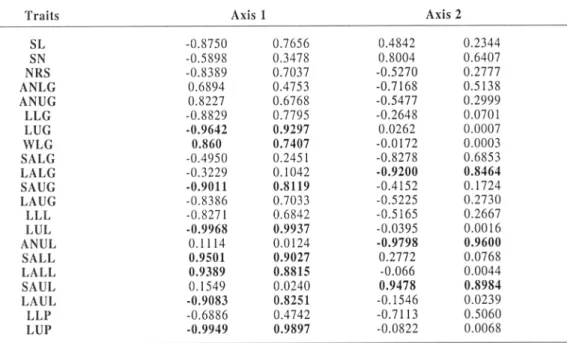
accounts for 68,6% variation. The relative magnitude of eigenvectors from the first axes (tab. 5) indicates that the lengths of upper
glume (LUG), lemma (LUL) and palea (LUP),
the shortest awns of upper glume (SAUG), the wide of lower glume (WLG) and the longest awns of upper lemma (LAUL) and shortest awns of lower lemma (SALL) were determinant for the affectation of the accession within the clusters. The second axis, which accounted
13,48% of variation, is significantly linked to
three criteria, the awns number of the upper lemma (ANUL), the longest awns of the lower
glumes (LALG) and the shortest awns of the
upper lemma (SAUL). This analysis underlines that the shape of upper and lower glumes and the awn length of upper lemma are the traits, which have the largest contribution in the phenotypic variation observed among Aegilops
accessions and between the species.
Plotting the accessions along the two first axes differentiates clearly between the five species (fig. 3). In spite of the high number of accessions studied, A. geniculata was projected on the positive side of the first axis forming a
DISCRIMINANT AXES
Traits Axis 1 Axis 2
SL -0.8750 0.7656 0.4842 0.2344
SN -0.5898 0.3478 0.8004 0.6407
NRS -0.8389 0.7037 -0.5270 0.2777
ANLG 0.6894 0.4753 -0.7168 0.5138
ANUG 0.8227 0.6768 -0.5477 0.2999
LLG -0.8829 0.7795 -0.2648 0.0701
LUG -0.9642 0.9297 0.0262 0.0007
WLG 0.860 0.7407 -0.0172 0.0003
SALG -0.4950 0.2451 -0.8278 0.6853
LALG -0.3229 0.1042 -0.9200 0.8464
SAUG -0.9011 0.8119 -0.4152 0.1724
LAUG -0.8386 0.7033 -0.5225 0.2730
LLL -0.8271 0.6842 -0.5165 0.2667
LUL -0.9968 0.9937 -0.0395 0.0016
ANUL 0.1114 0.0124 -0.9798 0.9600
SALL 0.9501 0.9027 0.2772 0.0768
LA LL 0.9389 0.8815 -0.066 0.0044
SAUL 0.1549 0.0240 0.9478 0.8984
LAUL -0.9083 0.8251 -0.1546 0.0239
LLP -0.6886 0.4742 -0.7113 0.5060
LUP -0.9949 0.9897 -0.0822 0.0068
For every axis: Column one: correlations between classes. Column two: correlations square
Table 5. Eigenvectors of axes 1 and 2 in the FDA. Contribution des variables á l'explication des axes 1 et
2 de l'AFD.
characterized by an ovoid shape of the spike with 3-4 spiklets. The lower spiklets is
subventricose. Most of the characters studied
were variable except the length of lower
glumes, lemmas and paleas. This variation is
in agreement with other investigations
(Zaharieva et al, 1999) which reported a large
variation in relation to the growing environment and to the specific adaptation of this species. The distinctive characters of A. geniculata from the four others species were ANUG and ANLL.
The number of awns on the upper glume of A.
geniculata is generally 3 but can vary from 2 to
6 and the number of awns on the lower lemma is 2 plus one tooth.
A. ventricosa was projected on the extreme positive side of axis 2 which separate it from A. triuncialis, A. peregrina and A. reta. A.
ventricosa is characterized by its highest
spiklets number (SN) and the only one awn on
the upper glume and lemma (ANUO, ANUL).
It also has a long spike, an oval spiklets, a strongly overlapping glumes and thick tips with two teeth separated with a broad sinus.
A. triuncialis was projected at the negative sides of the two axes not far from A. peregrina
and A. recta confirming the close relationship between those three species. A. triuncialis is characterized by a subcylindrical spike. Its
glumes are coriaceous with 2-3 awns. The
central awn of the glumes of lower spiklets is shorter than the laterals. The central awn of the
glurnes of the terminal spiklets is contrarily
longer and wider than the laterals and is often the longest awn on the spike.
A. peregrina and A. recta both were
. •
56 B. Belkadi et al.
peregrina were close to each others with 50 % similarity; both of them were close to A. recta
which was in turn more close to A. triuncialis.
The four former species are forming a cluster
with 25% similarity and are sharing together the U genome, which has probably a specific effect. Such similarity has been mentioned in a
study based on RAPD markers (Monte et al., 1999). The last sub cluster corresponds the A. vent ricosa group, which is clearly dissimilar from the other species which are not carrying D genome. It is established that D genome has
undergone during its evolution few changes in
comparison to other genomes, and seems therefore to be more homogeneous and have better distinctiveness within the Triticeae genus (Badaeva et al., 1996 and Damania, 1993).
Fig 3. Plot of the discriminant scores of the 28 characters of on the first two axes. Legend: * A. geniculata; X A truncalis; • A. ventricosa; 0 A. triaristata;* A. peregrina.Project ion (les accessions Aegilops sur les deux premiers axes sur la base des
28 caracteres.
recta has a lanceolate spike, narrowly ovoid in
the upper part. Its glumes are coriaceous, broad and shorter than the lemma which separate the hexaploid from the tetraploid forms according to Kimber & Feldman (1987). A. peregrina has a broad spike with 2 to 3 rudimentary spiklets. Its glumes are tough and rough with equally
long, wide and parallel nerves.
c)
Cluster
analysis:In order to establish the relationship between Aegilops species collected in Morocco,
a dendrogram was constructed based on the similarity matrix (fig. 4). This tree shows a
good separation between five clusters each corresponding to a define species. This clendrogram is in perfect agreement with the DFA analysis, but also provides additional information concerning the relationship between the accessions. A. geniculata and A.
CONCLUSION
The cytological investigation indicates that the studied collection of Moroccan
Aegilops contains four tetraploid (A.
geniculata, A. triuncialis, A. ventricosa and A.
peregrina)
and one hexaploid (A. neglectasubsp.
Recta)
species. The study of themorphological traits carried on a set of 28 discriminating characters, confirmed a large phenotypic variation both between and within species. Through numerical analysis, specific traits were clearly justified to be useful for the species identification.
The approch used in this study was however insufficient to establish the genetic structure of the Moroccan Aegilops. Therefore,
DNA analyses combined with morphological and cytogenetic techniques is needed for such objective. The genetic resources, their classification, conservation and utilization are
essential for sustainable agriculture and crop improvement. For effective plant germoplasm exploration, one must link between classical and new molecular techniques. In coming
Euclidean distance
0,00 5,00 10,00
A. ventricosa
A. peregrina
el. gel:kaki('
A. recta
A. friuncialis
Fig 4. Dendrogram of 139 Moroccan Aegilops accessions obtained by analysis of 28 specific morphological traits. Dendrogramme de 139 accessions Aegilops Marocaines obtenues par analyse de 28 caracteres morphologiques spéctfiques.
genetic structure of the whole collection of Moroccan Aegilops where molecular markers are being used. Studying the genetic variability within the Moroccan Aegilops collection should
be potentially of great value for the wheat improvement programs within the country and worldwide.
ACKNOWLEDGEMENTS. This work was supported by a Research Project of the Franco-Maroccan cooperation PRAD (Projet de Recherche Agronomique pour le Développement) n° 99-2. We thank F. Gabon for help with data statistical analysis.
REFERENCES
ALLARD, R. W. -1988- Genetic changes associated with the evolution of adapted ness in cultivated plants and their wild progenitors. Journal of Heredity 79 : 225-238.
BADAENA E.D., B. FRIEBE & B.S. GILL —1996-Genome differentiation in Aegilops 2. Physical mapping of 5S and 18S-26S ribosomal RNA gene families in diploid species. Genome 39:
1150-1158.
BAUM, B. -1977- Taxonomy of the tribe Triticeae (Poaceae) using various numerical techniques.l. Historical perspectives, data accumulation, and character analysis. Can. J. Bat. 55: 1712-1740.
BAUM B. —1978a- Taxonomy of the tribe Triticeae (Poaceae) using various numerical techniques.H. Classification. Can. J. Bat. 56: 27-56. BAUM B. —1978b- Taxonomy of the tribe Triticeae
(Poaceae) using various numerical techniques.I11. Synoptic Key to genera and synopses. Can. J. Bol. 56: 374-385.
BAUM BR., J.R. ESTES & P.K. GUPTA-1987-Assessment of the genomic system of classification in the Triticeae. Am. J. Bot. 74:
1388-1395.
BENLHABIB O., G. DIRIA, M. BOUHSSINI S. LHALOUI &M. NACHIT-2001- Characterization of Moroccan Aegilops ssp. for germoplasm enhancement, Actes I.A.V: 21(4): 193-198. BOISSIER P. E. -1884- Flora Orientalis 5:2, Basel,
Geneva, Switzerland.
BOR N.L. GRAMINEAE, IN. TOWNSEND C. C., GUEST E., AL-RAWI E. AND A. (eds.) -1968-Flora of Iraq , vol. 9, Baghdad, Iraq: Ministry of Agriculture.
CHENNAVEERAIAH, M.S.-1960- Karyomorphologic and cytotaxonomic studies in Aegilops. Acta hortigotoburgensis 23: 85-178.
DAMANIA A. B. —1993- Biodiversity and wheat Improvement, Jhon Wiley & Sons, ICARDA. DAVIS P.H. & V.H. HEYWOOD —1973- Principals
of Angiosperm plant taxonomy. Robert E. Krieger publishing company, Huntington, New York.
EIG A. -1929a- Monographische-Kritische Uebersicht der Gattung Aegilops, Fedde Repport. Reg. Veget. Beib., Band Lv. Berlin 55: 1-228. GUPTA P.K. & B.R. BAUM-1986- Nomenclature
and related taxonomic issues in wheat, triticales and some of their wild relatives. Taxon 35: 145. HACKEL E. -1887- Gramineae, in Die Natiirlichen pflanzenfamilietz, vol2 (2), A. Engler and Prantel: 76-89.
HAMMER K. -1980- Zur Taxonomic and Nomenklatur der Gattung Aegilops L. Feeddes Report. 91: 225-58.
K1HARA H. —1946- Genomeanalyse bei Triticum und Aegilops IX. Systematischer Aufbau der Gattung Aegilops auf genomanalytischer Grundlage. Cytologia 14: 135-144.
K1MBER G. & M. FELDMAN —1987- Wild wheat, An introduction, special Report 353, University of Missouri, USA.
58 B. Belkadi eta!.
Macmillan India, New Mill, In: Swaminathan, M.S., Gupta P.K. and Sinha U.: 213-224. LLAURADÓ M. & J. MORENOGONZALEZ
-1993- Classification of northen Spanish populations of maize by numerical taxonomy I. Morphological traits. Maydica 38: 151-152. JUSSIEU, A.L. -1789- Genera plantarum, 28. LOVE, A. -1984- Conspectus of the Triticeae.
Feddes Repert. 95 : 503-504.
MAIRE, R. —1955- Flore de l'Afrique du nord. Le chevalier P, III Paris VI: 349-365.
MONTE J.V., C. CASANOVA & C. SOLER —1999-Genetic variation in Spanish populations of the genus Aegilops revealed by RAPD. Agronomic. 19: 419-427.
PERINO P. & E. PORCEDDU-1990- Wheat genetic resources in Ethiopia and the Mediterranean region, In Srivastava, J.P. and Datnania, A.B. (eds) Wheat Genetic Resources: Meeting Diverse Needs. Chichester, UK: John Wiley. PILGER, R. —1945- Additamenta agrostologica I.
Triticeae, Bot. Jahrb. Syst. Pflanzengesch. Pflanzengeogr. 74: 1-13.
QUERZEL T. & S. SANTA -1962/1963- Nouvelle flore de l'Algérie et Des Régions Désertiques Méridionales. 2 tomes, centre national de la recherche scientifique, Paris, 157.
SAKAMOTO S. & H. KOBAYASHI —1980-Variation and geographical distribution of cultivated plants, their wild relatives and weeds native to Turkey, Greece and Romania. Reprint from: Tani Y., Preliminary report of comparative studies on the agrico-pastoral peoples in southwestern Eurasia, II. Research Institute for the Humanistic Studies, Kyoto University, Japan: 41-104.
SAKAMURA, T. —1918- Kurze Mitteilung uber die chromosomenzahlen und die verwandt Schaftsverhaltnisse der Triticum-Arten. Bol. Mag., Tokyo 32: 151-152.
SAS INSTITUT —1989- SAS/STAT user's guide, version 6, 4th edn SAS institut Inc., Cary, North Carolina.
SEARS, E.R. —1941- Amphidiploids in the seven-chromosome Triticcae, Univ. Missouri Coll. Agrie. Agric. Ever. Sta., Res. Bull. 336: 1-46. SENJANINOVA-KORCZAGINA, M.V. —1932-Karyo-systematical investigation of the genus Aegilops L. Bull. App!. Bot., Gen. Pl. Breeding, Ser.2, vol. 11, 1: 60-66.
SHARMA, H.C.-1982- A technique forsomatic counts from root tips of cereal seedlings raised by embryo culture. Current Science 55: 143-144.
STEBBINS, G.L. & B. CRAMPTON —1959- A suggested revision of the grass genera of temperate North America. Recent Adv. Bol. 1: 133-145.
VALDÉS, B., M. REJDALI, A. ACHHAL EL KADMIR1, S.L JURY & J.M. MONTSERRAT -2002- Catalogue des plantes vasculaires du nord du Maroc, incluant des clés d' identification. Consejo Superior dc Investigaciones Cicntificas 2: 807-809.
VAN SLAGEREN, M.W. —1994- Wild wheats: A monograph of Aegilops L. and Amblyopyrun. (Jaub. & Spach) Eig (Poaceae), Agricultural University ICARDA, Wageningen, the Netherlands.
WAINS, J.G. & D. BARNHART —1991-Biosystematic research in Aegilops and Triticum. Hereditas 116: 207-212.
ZAHAR1EVA, M. N., J. DAVID, D. THIS & P. MONNEVEUX —1999- Analyse de la diversité génétique d' Aegi lops geniculata Roth en Bulgarie. Cahiers Agricultures 8: 181-188. ZHUKOVSKY, P.M.-1928- A critical-systematical
survey of the species of the genus Aegilops L. Bull. App!. Botany, Genet. Plant Breeding
18:417-609.
ZOHARY, D. & M. FELDMAN —1962-Hybridization between amphidiploids and the evolution of polyploids in the wheat (Aegilops-Triticum) group, Evolution 16: 44-61. ZURABISIIVILI, T.G., A.B. IORDANSKY & N.S.
BADAEV —1978- Linear differentiation of cereal chromosomes. II. Polyploid wheats. Theor. Appl. Genet. 51: 201-210.
Aceptado para su publicación en septiembre de 2003