Could it be possible to replace DERIVE with MAXIMA?
By Alfonsa García1, Francisco García2, Gerardo Rodríguez3, Agustín de la Villa4 1
Dpto. de Matemática Aplicada, E.U. Informática, Universidad Politécnica de Madrid, Spain, [email protected] 2
Dpto. de Matemática Aplicada, E.U. Informática, Universidad Politécnica de Madrid, Spain, [email protected] 3
Departamento de Matemática Aplicada, E.P.S. de Zamora, Universidad de Salamanca, Spain, [email protected] 4
Departamento de Matemática Aplicada y Computación, ETSI (ICAI), Universidad Pontificia Comillas and Departamento de Matemática Aplicada, E.U.I.T.I, Universidad Politécnica de Madrid, Spain, [email protected]
In recent years, a considerable number of teachers in Spain have been using DERIVE to teach math subjects in High Schools and Universities. This software has been used by the authors of this work as a support tool in Mathematics courses for Engineering. Since Texas Instruments does not support DERIVE, we were faced with finding an alternative software product, and considering the possibility of using a public-domain software such as MAXIMA. Here we make a comparative study of DERIVE and MAXIMA as support tools for a Calculus course for first year Engineering students. First we have a brief look at the use of both systems in Spain and our experience with them. Then, we make a comparative study of DERIVE and MAXIMA, following a specific protocol based on a Systemic Model of Software Quality. Finally, we perform a quantitative evaluation and we conclude that MAXIMA can be used to carry out learning activities similar to those that we have been doing with DERIVE.
1 INTRODUCTION
For more than twenty years, many University teachers across the world have been using Computer Algebra Systems (CAS) as a support for the teaching of Maths subjects in Engineering studies. Along this period, all CAS have improved their performance, which has facilitated their use in the teaching-learning and assessment processes. However, the issue of which is the best CAS to be used in teaching Calculus remains open. All possible answers have their own advantages and disadvantages: Matlab, which is the most widely used mathematical software in Engineering, Mathematica or Maple with many features, DERIVE or MAXIMA, with fewer capabilities but easier to use, etc.
There has been some recent researchabout the choice of appropriate digital tools for mathematical learning (see, for example, Bokhove and Drjvers, 2010, Mora et al., 2010, or D’Ambrosia, 2009) and different models for software evaluation. Here we restrict our enquiry to comparing DERIVE and MAXIMA.
DERIVE is a CAS widely used by the authors of the present paper, which have been active members of the DERIVE community, with publications such as García et al. 1992, 1994, 2001, 2007, 2009.
MAXIMA is an open source CAS, descendant of Macsyma, the CAS developed at the MIT in the sixties (http://maxima.sourceforge.net). Furthermore, MAXIMA is a free software package and this is the reason for its expansion
in Spanish Universities at times of budget restrictions, accompanied by new methodological trends that will hopefully propitiate autonomous work by students.
For students, free software ensures the freedom to run the program on their personal computers and provides the teacher with additional advantages when planning and developing the subject (Mora et al., 2010).
In Lera (2010), Sonia Lera reports the result of an enquiry performed with 480 mathematics teachers from 158 Engineering Schools at 44 Spanish Universities. Among the 112 replies collected from 36 different Universities, there were 6 centres that did not use any mathematical software and, among those that did claim to use it, the one most widely used was Matlab. According to the replies, there are currently 44 centres using DERIVE in 13 different universities, and 20 centres (in 12 universities) using MAXIMA. In some cases, the instructors have stated their wish to change the CAS, but they have not had the time required to adapt their material. There are also centres that have used DERIVE and that are currently using MAXIMA.
2 RESEARCH METHOD
To attempt to answer the question proposed in the title of this contribution, we shall endeavour to make a comparative study of DERIVE and MAXIMA as mathematical software for a Calculus subject in the first year of Engineering studies, following a protocol similar to that proposed in Andrade de Casañas (2006), which is based on a Systemic Model of Software Quality (see Mendoza et al., 2001 and Ortega et al., 2003). The procedure was as follows:
1. An assessment of the general characteristics of the both CAS and their adaptation to the needs foreseen. 2. Gauging the results of a real experiment for testing
the software with students.
3. Implementation and analysis of a wide battery of tests to cover the spectrum of needs of a Calculus course in different types of engineering studies.
4. A quantitative evaluation based on a standard model. In the following sections we comment each one of these steps.
3 GENERAL CHARACTERISTICS
automation of certain tasks, enhance the acquisition of competences by “solving mathematical problems in Engineering”. With this in mind, it is possible to establish the following as essential requisites for mathematical software:
1. Ease of use, so that students can draw maximum benefit, from the very first contact with it.
2. A high capacity for symbolic and numerical calculation and graphical capacities for the mathematical tasks to be carried out.
3. The availability of specific programming language, which will allow simple algorithms to be implemented.
4. Portability and interoperability, so that the results obtained can be exported to other tools.
5. Accessibility and ease of installation, so that students can work at home.
6. Good maintenance, so that possible errors can be solved and the program can be adapted to scientific and technological advances.
7. Wide diffusion and accessible documentation. As mentioned above, we have considered DERIVE as a highly suitable CAS for mathematics subjects in the first year of Engineering studies. However, the impossibility of updating new versions of DERIVE implies that its appreciation has fallen considerably, especially regarding items 5, 6 and 7. Taking our own experience into account, we attempted to look for an accessible tool that would allow us to carry out learning activities similar to those that we have been implementing with DERIVE. We chose MAXIMA, because it is a freely available and powerful open-source CAS that is steadily being improved by an energetic team of volunteers.
The initial results of an evaluation of MAXIMA were fairly similar to that of DERIVE with respect to the first and second criteria, and clearly better in the rest. In a preliminary comparison, the interactivity of the graphic windows and the possibility of displaying Greek letters and special mathematical symbols on the screen, can be considered advantages of DERIVE. Some advantages of MAXIMA would be:
1. If the input is modified and the command is executed the new output automatically replaces the previous one, which allows “modifiable examples” to be performed. If in an exercise already solved a student wishes to change the data, it is merely necessary to substitute the initial input and execute again.
2. A more natural programming language, which has allowed our students to implement, in an autonomous way, simple algorithms.
3. Ease in translating the results of calculations performed with MAXIMA to other files.
4 A REAL EXPERIMENT FOR TESTING
MAXIMA WITH STUDENTS
During the 2009-2010 academic year, MAXIMA was used in teaching of Mathematical Analysis of the degree courses in Computer and Software Engineering at Polytechnic University in Madrid (UPM).
The practical sessions in the laboratory were similar to those carried out with DERIVE in previous academic years, for analogous subjects. The work aimed at adapting them to MAXIMA was carried out by Alfonsa García, Francisco García, J. Ignacio Gómez, Rafael Miñano, and Blanca Ruiz, all of them instructors at the Computer Sciences School of the UPM.
As done with DERIVE, no specific time was dedicated to teaching the students how to use the tool. The students did not find greater difficulties in directly addressing the math exercises, and the teacher’s help was limited to commenting some of the features of the program and the corresponding instructions, when they appeared.
For the students, the implementation of simple algorithms has been easier with MAXIMA.
The most significant differences between the two programs were found in working with recursive sequences whose evaluation is more efficient with MAXIMA. We explain the differences with several examples:
i) Fibonacci numbers
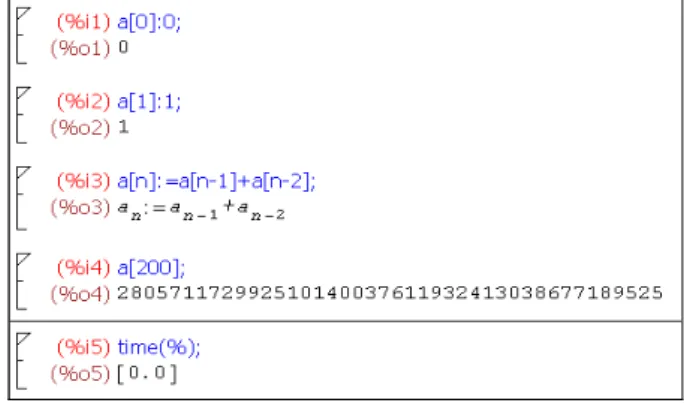
With MAXIMA it is very easy to compute the Fibonacci numbers efficiently (see Figure 1). With DERIVE it is possible to define the sequence with a command IF, but it is not efficient. The definition with the ITERATES function is more efficient but less natural.
Figure 1: Fibonacci sequence ii) Solutions of Difference Equations
The function solve_rec can be used for solving a wide range of Difference Equations with MAXIMA. With this function, certain recurrences can be solved without previous normalization. For example, the explicit form of xn, such that xn=xn−1+n x, 1=1, can be found as shown in Figure 2.
Figure 2: Solving Difference Equations
normalize it (writing xn+1 =xn+ +n 1) and use the command
LIN1_DIFFERENCE(1, n+1,n,1,1).
Note that something similar happens when working with Ordinary Differential Equations.
Sometimes the output of solve_rec command is unexpected. For example, solving a second-order difference linear equation, with constant coefficients and complex roots for the characteristic polynomial, as the sequence of real numbers xn+2 = −xn, x1=1,x2 =4 (see Figure 3).
Figure 3: xn is a real sequence
The solution is a real sequence but, with the MAXIMA output, it is not evident that xn is a real number. It is necessary to use the commands rectform and expand to obtain the expression
sin 4 cos
2 2
n n
π⋅ π⋅
− ⋅
⎛
⎞
⎛
⎞
⎜
⎟
⎜
⎟
⎝
⎠
⎝
⎠
With DERIVE this solution can be obtained directly using the command LIN2_CCF_BV(0,1,0,n,1,1,2,4).
Additionally, DERIVE has the function
GEOMETRIC1 to solve geometric recurrences, which appear upon modelling the complexity of the divide and conquer algorithms.
MAXIMA has been used for both learning activities and evaluation, and the results of the assessments show that there are no significant differences that can be attributed to the software.
We compared the results of two assessment proofs in the 2008-09 and 2009-10 academic years. In both of them an exercise to be solved with software was proposed.In 2008-09 students used DERIVE and in 202008-09-10 they used MAXIMA. The results were quite similar. The average scores with MAXIMA were slightly lower than the average scores with DERIVE. However, the percentage of those who correctly solved the exercise was greater in 2009-10 with MAXIMA, than in 2008-09 with DERIVE.
5 SYSTEMATIC TEST
In this phase, we first designed and ran, with both programs, a large battery of tests relating to sixty typical features, corresponding to tasks for which at some time we have used software in our experiences with CAS in Calculus subjects.
The list of features (see Table 1) was validated, by consulting different teachers of Calculus. Most of the tests were successfully overcome by both programs. For DERIVE we used version 6 for Windows and in the case of MAXIMA we used wxMaxima 0.84 version for Windows.
Then, with a view to systematically exploring the needs of a Calculus course for Engineering, the second comparative test involved the use of MAXIMA for solving the problems proposed in our book, García et al. (2008), which had already been solved with DERIVE in a document included in the CD accompanying the book. The exercises solved to date correspond to the chapter addressing real and complex numbers, elementary functions, limits and continuity, derivability, and integration. Along general lines, the results of both types of software were similar. Working with real numbers, MAXIMA does not solve equations with absolute values. Regarding complex numbers, in general it is necessary to ask MAXIMA for further simplifications of the results or use the possibility of the different expressions of complex numbers (converting to Cartesian form, polar, De Moivre or exponential form) to obtain suitable outputs. Nevertheless, the good use of these options and the trigonometric simplifications mean that both programs have the same features. The general aspects in the study of functions, such as domain, parity, period, composition of functions, etc., can be performed with both programs. It is striking that MAXIMA does not solve inequations, which makes it harder to calculate function domains. Limits and continuity can be treated with MAXIMA and DERIVE with no problems, although with the following caveats: MAXIMA does not compute the limits of piece-wise functions, for which it would be necessary to define the different pieces and find the corresponding limits. It also has problems with the absolute value (see Figure 4).
Figure 4: Problems arising from simplifying an absolute value
Regarding derivatives, the features are similar, with the exception that with DERIVE the piece-wise functions can be handled better.
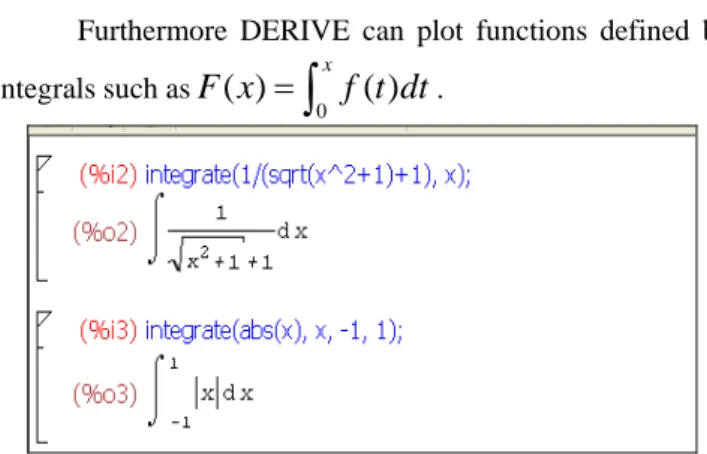
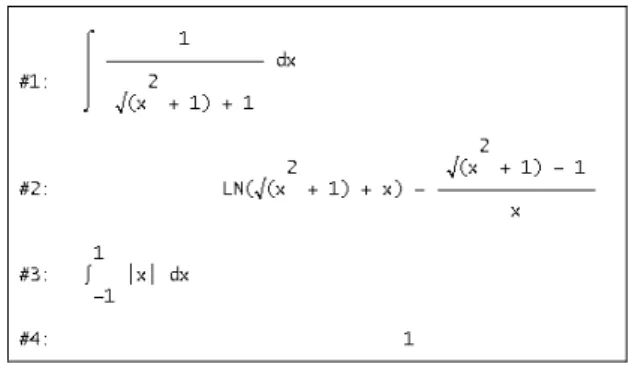
Concerning integrals, at first sight, MAXIMA offers fewer features than DERIVE (see Figure 5 and 6).
Furthermore DERIVE can plot functions defined by integrals such as
0
( )
x( )
F x
=
∫
f t dt
.Figure 6: Integrals with DERIVE
6 QUANTITATIVE EVALUATION
After the real experience and testing, we consider that we are able to make a quantitative comparison. In the ISO 9126 documents, the software quality characteristics are defined as:
• Functionality: Suitability, Accuracy, Security, Interoperability.
• Reliability: Maturity, Recoverability, Fault Tolerance.
• Usability: Understandability, Learnability, Operability.
• Efficiency: Time behavior, Resource behavior.
• Maintainability: Analyzability, Changeability, Stability, Testability.
• Portability: Adaptability, Conformance, Replaceability.
It should be noted that our assessment was conditioned by the teaching Calculus requirements. Accordingly, we designed a specific model. First, we observed that the levels of Reliability and Efficiency of the software were adequate for both MAXIMA and DERIVE. Thus, for the comparative evaluation we assessed the software according to four categories, which in order of importance are as follows:
• Functionality (40%) • Usability (40%) • Maintainability (10%) • Portability (10%).
To analyse the Functionality aspect from the point of view of the teaching of Calculus, we used the 60 features defined in the battery of tests as metrics and we normalized the assessment of each of those metrics, with scores between 1 and 5, with the following criteria:
1. It does not work.
2. It works, but the result is unsatisfactory.
3. In general it works, although in some foreseeable cases it does not.
4. It works well, although in some cases it takes longer than desirable or the output is hard to handle.
5. It works efficiently and the output is the expected one.
Both MAXIMA and DERIVE meet the requisite of functionality, consisting of that 75% of the metrics evaluated should have a value equal to or greater than 4. This means that both can be used as a support tool in a Calculus course for Engineers. Detailed results of the assessment of both CAS can be seen in Table 1.
Metrics Der. Max.
1. Use of variables 5 5
2. Operations with rational numbers 5 5
3. Functions on integer numbers 5 5
4. Real numbers 5 5
5. Complex numbers 5 5
6. Absolute values and phase angle 5 5
7. Exponential and logarithmic functions 5 4
8. Trigonometric functions 5 5
9. Simplification of algebraic expressions 5 4
10. Factorization of polynomials 5 5
11. Solutions of a polynomial equation 5 4
12. Solutions of a trigonometric equation 4 4
13. Solutions of exponential or logarithmical equations 4 3
14. Equations with absolute values 5 1
15. Solutions of an inequation 5 1
16. Solutions of a system of equations 5 5
17. Assuming properties of variables 4 4
18. Definition of functions 5 5
19. Making tables of values [x,f(x)] easily 5 5
20. Elementary programming 4 5
21. Explicit plots 5 5
22. Implicit plots 5 4
23. Parametric plots 5 4
24. Polygonal plots 5 5
25. Animation of graphs 5 4
26. Limits 5 5
27. Limits of piece-wise functions 4 3
28. Derivatives 5 5
29. Derivatives of piece-wise functions 4 2
30. Easy proof for the nth derivative 4 4
31. Programming Newton-Raphson method 5 5
32. Taylor polynomial 5 5
33. Interpolating polynomial 4 5
34. Integrals 5 3
35. Functions for to aid integration 5 4
36. Functions defined by integrals 5 3
37. Improper integrals 5 5
38. Gamma and Beta functions 5 5
39. Programming trapezoidal and Simpson rules 5 5
40. Recursive sequences 4 5
41. Limits of sequences 4 3
42. First-order linear difference equations 5 4
43. Second-order linear difference equations 5 4
44. Geometric recurrences 4 1
45. Some simplifications for finite sums of n elements 5 3
46. Sum of geometric series 5 5
47. Sum of arithmetic-geometric series 5 1
48. Approximate sum of series 5 5
49. Applying criteria of convergence for series 5 3
50. Functional series 3 5
51. Plot of surfaces 4 5
52. Graphs of curves in 3D 4 5
53. Polar/cylindrical /spherical coordinates 4 3
54. Partial derivatives 5 5
55. Gradient 5 5
56. Hessian 5 5
57. Jacobian 5 5
58. Curl of vector fields 5 5
59. First-order linear ODE´s 5 5
60. Second-order linear ODE´s 5 5
Mean values 4.73 4.17
To analyze usability, we first evaluated, with scores normalized between 1 and 5, the general variables shown in Table 2.
Characteristic DERIVE MAXIMA
Accessibility and easy installation 3 5
Learning time 5 5
Accessible documentation 4 4
User-friendly interface 4 4
Graphic interface 5 4
Presentation on screen 5 4
Help systems 5 3
Mean value 4.43 4.14
Table 2: Characteristics of Usability
However, bearing in mind our needs we did not wish only to assess general conditions but also to see how easy it might be for each of the tasks to be performed. Therefore, we also evaluated, from the point of view of usability, each of the metrics shown in Table 1, assigning a score of between 1 and 5 according to the following criteria:
1. The way of doing it is not intuitive and I have not found it on the help page.
2. The way of doing it is not very intuitive and the help offered is not very explicit.
3. The corresponding command key is in the menu/and or the help page, but the help offered is not sufficiently clear.
4. The way of doing it is intuitive or there is a command key on the menu, although I have had to consult the help page.
5. It has been easy for me to do it and the output is easy to handle.
The mean scores obtained were 4.6 for DERIVE and 4.26 for MAXIMA. The scores were weighted with the mean values of Table 1 to obtain the final assessment of usability: 4.51 and 4.20, respectively.
Actually, the evaluation, both in terms of functionality and usability, is not completely objective because the assessors have more experience with DERIVE than with MAXIMA. However, regarding portability and maintainability, the advantage for MAXIMA is clear. Finally, Table 3 shows the scores in the four categories and the final quantitative evaluation:
Category DERIVE MAXIMA
Functionality (40%) 4.73 4.17 Usability (40%) 4.51 4.20
Portability(10%) 3 5
Maintainability(10%) 1 4
Final score 4.096 4.24 Table 3: Quantitative evaluation
7 CONCLUSIONS
To conclude we must address the question proposed in the title of the paper. Without any doubt, the answer is YES.
Let us offer some remarks to complement and extend our answer. In a general way, both CAS are exchangeable and the features are similar. Some advantages and disadvantages, taking into account the parameters to be measured and enumerated in paragraph 3, have been mentioned along the paper. For us, former users of DERIVE, the transition to MAXIMA has been easy and this opinion can be subscribed by all users of DERIVE and MAXIMA.
ACKNOWLEDGEMENTS
We thank our fellow teachers, Blanca Ruiz and Rafael Miñano, for all suggestions they have sent along the evaluation work and we would like to thank our students for their collaboration in the project, in particular to Gorka Madariaga and Sonia Lera.
REFERENCES
Andrade de Casañas, M. (2006) Modelo de evaluación para determinar la calidad de software de apoyo a la enseñanza de la física, basado en la concepción integrativo-adaptativa, Rev. Mexicana de Física, 52(3), 26-27.
Bokhove, C., Drijvers, P. (2010) Digital tools for Algebra Education: Criteria and Evaluation, International Journal of Computers for Mathematical Learning, 15(1), 45-62.
D’Ambrosia, B. K. (2009) Using the TI-Nspire CAS software as a classroom demonstration tool. Proceedings of the 21 Annual International Conference on Technology in Collegiate Mathematics, New Orleans, Louisiana.
García, A. (Ed) (1994) Prácticas de Matemáticas con Derive, Madrid: Clagsa (or Mathematisches Praktikum mit DERIVE, Addison-Wesley, (Deutschland), 1995)
García, A., Carreño, J.J., García, F., Martínez, A. (2007) Una experiencia prolongada de uso de CAS. Proceedings of II Jornadas de Innovación Educativa de la EPS de Zamora.
García, A., García, F., López, A., Rodríguez, G., De la Villa, A. (2008) Cálculo I. Teoría y problemas de Análisis Matemático en una variable, Madrid: CLAG.
García, A., García, F., Rodríguez, G., De la Villa, A. (2001) Some unexpected results using Computer Algebra Systems. The International Journal of Computer Algebra in Mathematics Education, 8(3), 239-252.
García, A., Miñano, R., Rincón, F. (1992) Using Derive to teach Mathematics for Computer Science Students. International Spring School of the Didactics of Computer Algebra, Krems, Austria, 147-157.
Lera, S. (2010) Evaluación comparativa de software matemático (in progress). E.U. Informática (UPM).
Mendoza, L., Pérez, M., Griman, A. (2005) Prototipo de modelo sistémico de calidad (MOSCA) del software. Computación y Sistemas, 8, 196-217.
Mora, A., Galán, J.L., Aguilera, G., Fernández, A., Mérida, E. Rodríguez, P. (2010) Scilab and Maxima Environment: Towards Free Software in Numerical Analysis, International Journal for Technology in Mathematics Education, 17(2), 75-80.
Ortega, M., Pérez, M., Rojas, T. (2003) Construction of a Systemic Quality Model for evaluating a software Product. Software Quality Journal, 11(3), 219-242.
BIOGRAPHICAL NOTES