WORKING PAPER
Economic Fluctuations, Child Mortality and Policy
Considerations in the Least Developed Countries
Salvador Pérez-Moreno1 · M. Carmen Blanco-Arana2 · Elena Bárcena-Martín3
Abstract
Between 1990 and 2010 child mortality decreased in general terms in the Least Developed Countries (LDCs), although the differences between countries over time are significant. This paper examines the relationship between short-term economic fluctuations and changes in child mortality in the LDCs during the period 1990-2010. Unlike other studies, we consider a large group of LDCs and provide empirical evidence of the asymmetrical effects of variations in Gross Domestic Product per capita on the evolution of child mortality rate in periods of economic recession and expansion. The significance of said effects diminishes when other relevant socio-economic control variables are considered. Considerable development policy implications may be derived from this analysis in order to achieve the Millennium Development Goal 4 target, as it contributes to explain the effects of economic fluctuations on child survival in the LDCs.
Key words: Economic fluctuations · Child mortality · Least developed countries · Panel data
1
Department Applied Economics (Economic Policy), University of Malaga, Campus El Ejido, E-29071 Málaga, Spain. (Phone: +34-952131280. Fax: +34-952137259. E-mail: [email protected]).
2
Department Applied Economics (Economic Policy), University of Malaga, Campus El Ejido, E-29071 Málaga, Spain. (Phone: +34-952131283. Fax: +34-952137259. E-mail: [email protected]).
3
1.
Introduction
On the basis of Amartya Sen’s (1999) concept of development as freedom, the reduction of child mortality in the developing world can be conceived, in itself, as a significant contribution to development, insofar as premature death constitutes a basic denial of the most fundamental freedom of human beings.
The 1989 United Nations Convention on the Rights of the Child acknowledged that every child has the right to life and, at the same time, asserted that governments must do all they can to ensure that children survive and develop to their full potential. Under this premise, in 2000 the United Nations Millennium Summit agreed, as the Millennium Development Goal (MDG) 4, to reduce by two-thirds the under-five mortality rate between 1990 and 2015. That is, from 87 deaths per 1,000 live births in 1990 to 29 in 2015.
Undoubtedly, in the last two decades child deaths have decreased considerably. According to the United Nations Inter-agency Group for Child Mortality Estimation (UN-IGME) (2012), between 1990 and 2010 the under-five mortality rate dropped by more than one-third, from 88 deaths per 1,000 live births to 57. Although this rate is not decreasing fast enough –especially in sub-Saharan Africa and Southern Asia– to achieve the MDG target, these estimates show that the total number of under-five deaths decreased globally from more than 12 million per year in 1990 to 7.6 million in 2010. This drop has been mainly achieved thanks to progress made in disease prevention, improvements in nutrition and healthy eating, and the improvement of health care services (see Onis et al., 2000; Costa
et al., 2003; Harper et al., 2009; Baird et al., 2009; Lykens et al., 2009; Rajaratnam et al., 2010; Pérez de Armiño, 2011; Ickowitz, 2012, among others).
Obviously, said progress has been neither regular nor uniform over time in all countries and regions1, influenced in part by the specific economic circumstances present in
the different geographic surroundings at specific period of time. In this sense, it seems evident that economic cycles constitute a significant issue to consider in analyzing progress for children and, in particular, in terms of child survival (see, e.g., UNICEF, 2012).
1 Since 1990 Northern Africa, Eastern Asia, Latin America and the Caribbean, South-eastern Asia,
Western Asia and the developed regions have reduced their under-five mortality rate by 50 per cent or more. By contrast, the highest rates of child mortality are still in sub-Saharan Africa –where 1 in 9 children dies before age 5, more than 16 times the average for developed regions (1 in 152)– and Southern Asia (1 in 16). As under-five mortality rates have fallen more sharply elsewhere, the disparity between these two regions and the rest of the world has grown (see UN-IGME, 2012).
As we know, business cycles are inherent to the operation of the economy. Ascending and descending fluctuations of production and employment, among others economic variables, characterize market economies. Thus, periods of prosperity are followed by periods of economic downturn. The Great Depression of 1929, the Oil Crisis of the seventies, the Asian Crisis of 1997 and the Great Recession starting in 2007 are some of the most noteworthy examples of economic recessions of the last century.
In the case of developing countries –where about 30 per cent of all deaths occur in childhood, compared with just 1 per cent in richer countries (Cutler et al., 2006)–, phases of recession entail an additional economic setback for these impoverished economies, leading to the worsening of living conditions for their inhabitants, in particular for the most vulnerable sectors of the population –including children–. In fact, in periods of economic recession household income is likely to fall, many families have to cut back on expenditure for food and health, and children have to stop going to school in order to work; and at the same time the State has to reduce public spending. All of which has negative repercussions on children’s welfare and ultimately on child and infant mortality (see Cutler et al., 2002; Mendoza, 2009; Ferreira and Schady, 2009; Espey et al., 2010; McCord, 2010; Bhalotra, 2010; Agüero and Valdivia, 2010; Richardson, 2010; Gaiha et al., 2012, among others).
In this paper we examine the relationship between short-term economic fluctuations and variations in child mortality in the Least Developed Countries (LCDs) during the period 1990-2010. While the literature on the effects of short term economic oscillation on child mortality in developing countries focuses on country-specific studies or on groups of countries from different income categories, this work takes into account a large group of the countries with the lowest human development indices and provides empirical evidence based on analysis of variance (ANOVA) and regression analysis for panel data.
The remainder of the paper is as follows. Section 2 reviews the literature and summarizes the main findings. Section 3 describes the data and methodology. Section 4 presents and discusses the results, and section 5 concludes.
2.
Background
There is a significant literature on the effects of economic fluctuations on health outcomes for children in countries that span the development spectrum (for a review, see, e.g., Ferreira and Schady, 2009). These authors point out that such effects obviously vary
among countries –and even within countries–, although the effects on health tend to be essentially pro-cyclical (the situation worsens in recessions).
Regarding developing countries, there are some country-specific studies which consider the impacts of economic recessions on child mortality and morbidity. A handful refer to Latin America, including Cutler et al. (2002), on Mexico; Costa et al. (2003), on Brazil; Paxson and Schady (2005), and Agüero and Valdivia (2010), on Peru; Miller and Urdinola (2010), on Columbia; others focus on Asia, including Rukumnuaykit (2003), and Block et al. (2004), on Indonesia; Lin (2006), on Taiwan; and Bhalotra (2010), on India; whilst in respect to Africa, there are studies such as Hoddinott and Kinsey (2001), on Zimbabwe; and Alderman et al. (2005), on Ethiopia.
The evidence regarding middle-income Latin American countries is ambiguous. In Mexico Cutler et al. (2002) observed an increase of 0.06 per cent in the rate of child mortality in respect to the period before the 1995/1996 crisis. Likewise, the deep economic crisis in Peru at the end of 1980 led to a 2.5 per cent increase in the rate of child mortality (Paxson and Schady, 2005). In this context, Agüero and Valdivia (2010) confirmed that a reduction of 1 per cent in GDP per capita is associated to an increase in the rate of child mortality ranging from 0.3 to 0.39 per cent in Peru during said period. In contrast, in Brazil there is evidence of a sustained descent in infant mortality at times of economic recession (Costa et al., 2003), and in the rural areas of Columbia as well, where infant and child survival actually improved during economic downturns (Miller and Urdinola, 2010).
Greater homogeneity is observed in the countries of Asia. On the one hand, Rukumnuaykit (2003) shows that the 1997 financial crisis in Indonesia had adverse impacts on neonatal mortality in both urban and rural areas. Along this line, Block et al. (2004) highlight the disastrous nutritional consequences of that financial crisis on child development. On the other hand, in the case of Taiwan Lin (2006) found that neonatal and post-neonatal mortality rates and unemployment rates are strongly correlated, highlighting that the poor are more vulnerable in times of economic crisis. In this way, Bhalotra (2010) showed that shocks to state-level income in India cause substantial variation in infant mortality in rural Indian households. She also expected income effects to be larger in poorer countries, but the direction of cyclical mortality is unclear a priori because of the uncertain sign and size of relative price effects.
In respect to African countries, which are the ones that have the highest rates of child mortality, the literature generally focuses on issues such as the effects of drought on child
mortality2, rather than on the direct incidence of economic oscillations on child survival. In any event, some studies stress aspects related to child mortality, such as the case of the study carried out by Alderman et al. (2005) on Ethiopia, which highlighted how food aid can significantly mitigate the negative effects of economic disruption on child welfare. .
On the other hand, other papers simultaneously consider a group of developing countries, although almost devoid of LDCs. For instance, Houweling et al. (2005) used a cross-national analysis of 43 middle-income countries, from different continents, using wealth group specific under-5 mortality rates as outcome. Relative effects were estimated using OLS regression. They underlined some determinants of child mortality, taking into account three important issues for child survival: the level of socio-economic development, political development and the government’s commitment in the field of health. They detected that the key factor to explain the differences in levels of child mortality is GDP per capita, so that in countries with a GDP per capita that is 10 times greater, child mortality is 4.4 times lower.
Baird et al. (2009) revisited the discussion of the relationship between health and income and researched the impact of short term fluctuations in GDP per capita on infant mortality using a dataset of 59 developing countries –36 middle-income countries and 23 low-income countries– between 1975 and 2004 through panel data (using fixed effects). They suggested that in developing countries, infants, and in particular girls, are more likely to die when there is a negative economic shock, especially when these shocks are severe3. The main finding of their work is that there is a negative and robust relationship between GDP per capita and infant mortality: on average, a one per cent decrease in GDP per capita results in an increase in infant mortality from 0.24 to 0.40 per 1,000 children born.
Schady and Smitz (2009) used a sample of 17 diverse countries, 11 middle-income countries and 6 low-income countries from 1977 to 2007 through panel data. This study showed that in 5 countries of their sample, the average year-on-year decline in infant mortality was larger when growth was positive than when it was negative. This is not the
2 Hoddinott and Kinsey (2001), for example, confirm that the negative impact of the 1994-1995 drought
in Zimbabwe was greater on children that lived in poor households. The core finding is that children aged 12 to 24 months lose 1.2–2 cm of growth in the aftermath of a drought.
3 Baird el al. (2009) estimate that a one per cent change in GDP per capita changes the mortality of boys by approximately 0.27 per thousand children born, and that of girls by 0.53 per thousand. The authors suggest that this could be due to the greater vulnerability of girls in respect to boys in their first year of life, and greater family protection of boys at times of economic recession.
4
case, however, for the other 12 countries, where declines in infant mortality were larger in recessions than during expansions. On balance, infant mortality appears to be pro-cyclical or acyclical.
Fernández and López-Calva (2010) focused on five middle-income American countries: Argentina, Brazil, Jamaica, Mexico and Peru. They applied a difference-in-difference approach, fixed effects models and instrumental variables, depending on the availability of data at the country level and the peculiarities of each country’s past crisis episodes. In general, they observed that economic downturns have a negative impact on child mortality, and underlined that there is also strong evidence that recessions are associated with increases in child and overall poverty in all of the five countries studied.
Anderson et al. (2011) used descriptive analysis to assess how economic shocks, including the global financial crisis of 2008/2009, affected the poor in developing countries over the period 2000-2010, focusing particularly on vulnerable children in 19 developing Asia countries –13 middle-income countries and 6 low-income countries–. They highlighted that while much progress had occurred in Asia, there remained some very high burdens of newborn and child mortality and morbidity. The inability to reduce these levels further in recent decades of rapid economic growth makes them vulnerable to slower progress during a global crisis-induced slowdown.
Finally, Renton et al. (2012) pointed out that in the poorest countries economic growth may be regarded as a requirement for health improvement. They analyzed the relationship between economic growth and some health indicators, including the rate of child mortality, among others. They considered 102 developing countries –63 middle-income countries and 39 low-middle-income countries– with five-year intervals over the period 1970-2000, through cross-sectional time-series regression analysis using a random effect model. They concluded that socio-economic changes are likely to be an important source of health improvement in the developing world, although their findings are not sufficient to assert that economic growth causes health improvements and therefore reduces child mortality.
In this paper we attempt to contribute to the studies on the relationship between child mortality and GDP fluctuations by testing this relationship in a large and relatively homogeneous set of low development countries over a long period of time, allowing the possibility of assessing asymmetric effects during phases of growth and decline of business cycles.
3. Data and Methodology
This section describes the database and discusses the methodological approach proposed to analyze impacts of short term economic fluctuations on child mortality in the LDCs. This group of countries currently comprises 48 countries. The United Nations basically uses three criteria to identify the LDCs: i) a low-income criterion, based on a three-year average estimate of the gross national income (GNI) per capita; ii) a human resource weakness criterion, involving a composite Human Assets Index (HAI) based on indicators of nutrition, health, education, and adult literacy; and iii) an economic vulnerability criterion, involving the percentage of population displaced by natural disasters and a composite Economic Vulnerability Index (EVI) based on indicators such as the instability of agricultural production, the instability of exports of goods and services, the economic importance of non-traditional activities, merchandise export concentration, and the handicap of economic smallness.
These countries constitute the poorest and weakest segment of the international community and, although there are significant differences between them, they all present the lowest human development index ratings of all countries in the world. In addition, their living conditions are very poor and highly vulnerable to economic shocks.
3.1. Data
We build a database of panel data for the period 1990-2010 with statistical information on child mortality, Gross Domestic Product (GDP) per capita and a number of control explanatory variables of the levels of child mortality in the LDCs.
Data on child mortality are estimates generated by the Inter-Agency Group for Child Mortality Estimation taken from Childinfo (UNICEF, 2012). In particular, we use the under-five mortality rate, a health-related MDG indicator that measures the risk of dying in infancy and early childhood. Specifically, it refers to the probability (expressed as a rate per 1,000 live births) of dying under age five.
Despite considerable progress in reducing child mortality, the data show that there remains a large gap between developed and developing countries in the risks of dying before age 5. The highest rates of child mortality are in sub-Saharan Africa and Southern Asia. En 2010 the highest rates of child mortality in the LDCs were in Somalia (180), Mali (178.1), Burkina Faso (176.2), Sierra Leone (174), Chad (173.4), Congo DR (169.9), Haiti
(164.8), Angola (160.5), Central African Republic (158.8), Guinea-Bissau (149.5) and Afghanistan (149.2). In contrast, the lower rates of child mortality in LDCs were in Vanuatu (13.9), Maldives (15), Samoa (20.2), Solomon Islands (26.7), Tuvalu (32.5), Bangladesh (47.8) and Kiribati (48.6). In general, the trend of rate evolution in the period analyzed is downward, although some countries have shown upward trends in certain years (Lesotho in 1995-2000, Rwanda in 1990-1995 and Haiti in 2005-2010). In particular, between 1990 and 2010 the biggest decrease of child mortality rates occurred in Niger, Malawi, Liberia, Timor-Leste, Sierra Leona, Guinea, Madagascar, Bangladesh, Nepal and Lao PDR, whereas countries with the smallest decrease, or even an increase4, were Haiti, Somalia, Lesotho,
Central African Republic, Samoa, Congo DR and Mauritania.
On the other hand, data on GDP per capita are taken from World Development Indicators (World Bank, 2012), and correspond to real GDP per capita in constant 2005 international US dollars, adjusted for differences across countries at purchasing power parity (PPP).
Apart from the economic context, it is widely accepted that under-five mortality levels are influenced, among other factors, by education, particularly of mothers; by the availability, accessibility and quality of health services; and overall by diverse manifestations of extreme poverty, such as undernutrition, material deprivation, environmental risks, etc. According to the literature (Costa et al., 2003; Kabir et al., 2003; Cutler et al., 2006; Baird et al., 2009; Ferreira and Schady, 2009; Fernández and López-Calva, 2010; Renton, 2012; Ickowitz, 2012, among others) and the available panel data, we consider the following indicators from World Development Indicators (World Bank, 2012) as explanatory control variables of the state and evolution of child mortality: i) female enrollment ratio in primary education; ii) proportion of children immunized against measles; iii) prevalence of HIV; iv) crude birth rate; and v) net official development assistance.
In respect to women’s education, studies have shown that more education for women implies better health for their children. As pointed out by Cutler et al. (2006), women, as primary caretakers, are most likely to implement the behaviors that can improve their children's health. Thereby, more educated mothers will have healthier babies. In addition,
4 In the case of Haiti, the rate of child mortality increased considerably between 1990 and 2010, rising
from 150.5 to 164.8.
Baird et al. (2009) assert that the mortality of infants born to mothers with low education levels is significantly more sensitive to changes in economic conditions than that of children born to mothers with higher education levels. In this respect, Mostafavi (2009) observes that in Iran from 1990 to 1999 the infant mortality rates for educated and uneducated mothers were 26 and 56 deaths per thousand live births, respectively. Likewise, Van der Klaauw and Wang (2011) focus on rural areas of India and show that child mortality can be substantially reduced by improving the education of women.
Another group of factors that has a particularly strong effect on child mortality is related to health. In this group two aspects should be differentiated: on one hand, children’s health, with enormous direct influence on child mortality in LCDs. According to Costa et al.
(2003), antimeasles immunization coverage among infants can be used as a marker for children’s general access to healthcare. Along this line, Kabir et al. (2003) highlight that in India’s rural areas children aged 12-59 months who did not receive measles vaccination in infancy were three times more likely to die than those vaccinated against measles. However, there are wide variations in immunization coverage among countries and territories. In some developing countries immunization rates increased substantially, while in others, especially in sub-Saharan Africa, childhood immunization rates even plummeted during 1980-2001, leaving millions of children vulnerable to life-threatening vaccine-preventable childhood diseases (WHO, 2003). In general, in the LDCs the increase of immunization coverage against measles in the last two decades has been noteworthy, rising from 55 per cent in 1990 to 77 per cent in 2010 (World Bank, 2012), despite the fact that the number of children dying from the disease continues to be high in certain areas of these countries due to insufficient coverage. In our case, we have included measles vaccination of children 12 to 23 months old, an indicator included in the MDG 4, as a control variable.
On the other hand, we have also considered the human immunodeficiency virus infection/acquired immunodeficiency syndrome (HIV/AIDS), a disease with great impact in LDCs. In some areas, especially in sub-Saharan Africa, the HIV/AIDS epidemic is affecting children in many harmful ways, making them vulnerable, leaving them orphaned and threatening their survival (UNICEF, 2006). Zaba et al. (2005) particularly highlight that in Uganda, Tanzania and Malawi HIV directly impacts on child mortality through transmission of the virus to newborns by infected mothers. Globally, the annual number of people newly infected with HIV continues to decline, although there is stark regional variation. In sub-Saharan Africa, where most of the people newly infected with HIV live, an estimated 1.9
million people became infected in 2010. In addition, sub-Saharan Africa is also the region with the highest prevalence of HIV infection among women of reproductive age (WHO, 2011). Taha et al. (2012) explain that between 1989 and 2009, HIV infection among mothers and children contributed to high levels of child mortality in the African setting. Given this state of affairs, prevalence of HIV has been used in the paper as a control variable.
In respect to socio-demographic factors, we have used the crude birth rate, given its possible connection to child mortality. In this context, in Mexico and Colombia Paz (1999) observed that there was a connection between fertility regulation, education and infant mortality, insofar as women with higher levels of education had fewer number of children than women without any education, thanks to family planning policies, which in turn reduced child mortality. Fand Schady (2009) explained that during recessions some changes take place in the composition of women giving birth. They argued, e.g., that higher-risk women may be less likely to postpone birth during a recession and this, in turn, could lead to worse health outcomes for young children during a crisis.
Finally, official development assistance (ODA) can be considered as a key variable, as aid is theoretically oriented, among other MDGs, towards the eradication of extreme poverty and hunger and reduction of child mortality. However, some studies question its effectiveness in respect to progress for child survival. For example, for a sample of 56 developing countries between 1970 and 1993, Burnsider and Dollar (1999) found no relationship between ODA and child mortality. Regarding Asian LDCs, Cuenca and Rodríguez (2010) point out that international cooperation is inappropriate and insufficient to reach the MDGs and should be accompanied by greater trade openness. In turn, Hsu et al. (2012) show that the rate of increase of ODA to health in general, and to maternal, newborn and child health in particular, has been slowing since 2008, there being a large financing gap to reach MDGs 4. In addition, they underline the need to improve the efficiency and effectiveness of aid for such health activities. In this work we include the ODA as a control variable in order to assess the extent to which ODA contribute to reducing child mortality in the LDCs.
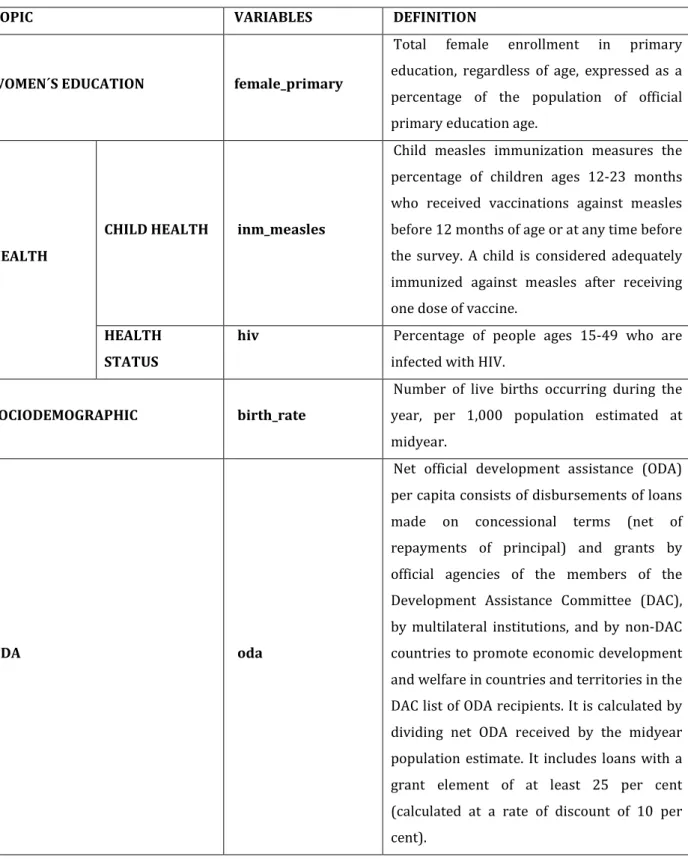
Table 1 contains the definitions of the control variables grouped in four categories:
Table 1: Control variables
TOPIC VARIABLES DEFINITION
WOMEN´S EDUCATION female_primary
Total female enrollment in primary education, regardless of age, expressed as a percentage of the population of official primary education age.
HEALTH
CHILD HEALTH inm_measles
Child measles immunization measures the percentage of children ages 12-23 months who received vaccinations against measles before 12 months of age or at any time before the survey. A child is considered adequately immunized against measles after receiving one dose of vaccine.
HEALTH STATUS
hiv Percentage of people ages 15-49 who are
infected with HIV.
SOCIODEMOGRAPHIC birth_rate
Number of live births occurring during the year, per 1,000 population estimated at midyear.
ODA oda
Net official development assistance (ODA) per capita consists of disbursements of loans made on concessional terms (net of repayments of principal) and grants by official agencies of the members of the Development Assistance Committee (DAC), by multilateral institutions, and by non-DAC countries to promote economic development and welfare in countries and territories in the DAC list of ODA recipients. It is calculated by dividing net ODA received by the midyear population estimate. It includes loans with a grant element of at least 25 per cent (calculated at a rate of discount of 10 per cent).
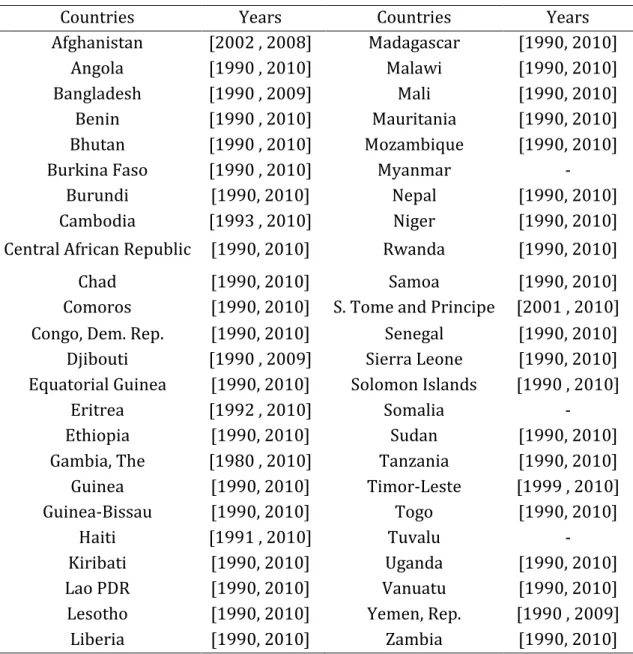
In this study we work with an unbalanced panel of 45 countries –all the LDCs except Myanmar, Somalia and Tuvalu, for which statistical information is not available– for the period between 1990 and 2010, involving 894 observations. Table 2 shows the countries and years analyzed. By regions the panel comprises 32 countries from Sub-Saharan Africa, 1
from Latin America and the Caribbean, 7 from South Asia, and 5 from East Asia and the Pacific.
Table 2: Countries and years
Countries Years Countries Years Afghanistan [2002 , 2008] Madagascar [1990, 2010]
Angola [1990 , 2010] Malawi [1990, 2010] Bangladesh [1990 , 2009] Mali [1990, 2010] Benin [1990 , 2010] Mauritania [1990, 2010] Bhutan [1990 , 2010] Mozambique [1990, 2010] Burkina Faso [1990 , 2010] Myanmar -
Burundi [1990, 2010] Nepal [1990, 2010] Cambodia [1993 , 2010] Niger [1990, 2010] Central African Republic [1990, 2010] Rwanda [1990, 2010] Chad [1990, 2010] Samoa [1990, 2010] Comoros [1990, 2010] S. Tome and Principe [2001 , 2010] Congo, Dem. Rep. [1990, 2010] Senegal [1990, 2010] Djibouti [1990 , 2009] Sierra Leone [1990, 2010] Equatorial Guinea [1990, 2010] Solomon Islands [1990 , 2010]
Eritrea [1992 , 2010] Somalia - Ethiopia [1990, 2010] Sudan [1990, 2010] Gambia, The [1980 , 2010] Tanzania [1990, 2010] Guinea [1990, 2010] Timor-Leste [1999 , 2010] Guinea-Bissau [1990, 2010] Togo [1990, 2010]
Haiti [1991 , 2010] Tuvalu - Kiribati [1990, 2010] Uganda [1990, 2010] Lao PDR [1990, 2010] Vanuatu [1990, 2010] Lesotho [1990, 2010] Yemen, Rep. [1990 , 2009] Liberia [1990, 2010] Zambia [1990, 2010] Given the limitations of existing data on the respective control variables for the LDCs, we should bear in mind that on introducing said variables in our models the number of countries analyzed descended to 33, involving 496 observations. In this case, by regions our analysis comprises 27 countries from sub-Saharan Africa, 1 from Latin America and the Caribbean and 5 from South Asia.
3.2. Methodology
Our main aim is to analyze the effect of changes in the GDP per capita on variations of the child mortality rate and to test if such effect differs in periods of expansion and recession. We do not know of other studies that try to measure such impact allowing for asymmetric effects. In order to test these effects, for each country we separate periods of increase and decrease of GDP per capita and calculate annual average changes in the rate of child mortality for each expansive and recessive period, respectively. First we carry out an analysis of variance (ANOVA) to check the equality of means hypothesis on rates of variation of the child mortality rate in respect to two levels, namely the increase and decrease of GDP per capita:
0 Exp Rec 1 Exp Rec
H : μ = μ
(1) H : μ ≠μ
where µExp corresponds to the average child mortality rate in periods of interannual
increase of GDP per capita and µRec is the same in respect to periods of interannual decrease
of GDP per capita.
Certain correlation is expected between the rate of variation of the child mortality rate in period t and the rate of variation in period t-1. In order to verify the existence of temporal correlation in the errors of the child mortality rate, the Wooldridge (2002) serial autocorrelation test of errors for panel data models is performed5. In the event that a serial
correlation should exist, it will have to be corrected in the estimates we make.
Next, after verifying the existence of differences in changes of the child mortality rate in expansive and recessive periods, we estimate a panel data model to account for the asymmetric effect of GDP per capita variations on child mortality rate evolution. Due to the simplification offered by an OLS, the correlation of individual errors with the observations is not corrected, and in consequence estimates made with this methodology will be biased (Breusch and Pagan, 1980). Thus, the use of the panel data seems to be essential, as this permits controlling the existence of individual effects not controlled by the explanatory variables observed in the model; it also permits controlling through variables that change over time.
5 For a more ample discussion of this test, see Wooldridge (2002).
12
As mentioned above, in our model we consider that the business cycle might have
asymmetric effects on child mortality rates, given that the effect of the evolution of GDP per capita could differ in periods of expansion and contraction:
2 2
it 0 11 it 12 it 21 it 22 it it i it
y =β +β Exp +β Exp +β Rec +β Rec +γx +ζ +ω (2)
where yit is the variation of the child mortality rate (U5MR), Expit is the variation of
GDP per capita in periods of economic expansion whereas Recit refers to the variation of
GDP per capita in periods of economic recession, xit are the control variables mentioned
earlier, ζi is the intercept for each country, and ω
it are the individual level residuals, in
which the existence of serial correlations will be taken into account for the correct estimate. We have chosen a quadratic model to capture the possible non linear relationship between periods of GDP per capita expansion and recession and the child mortality rate.
4. Results
4.1. Analysis of Variance
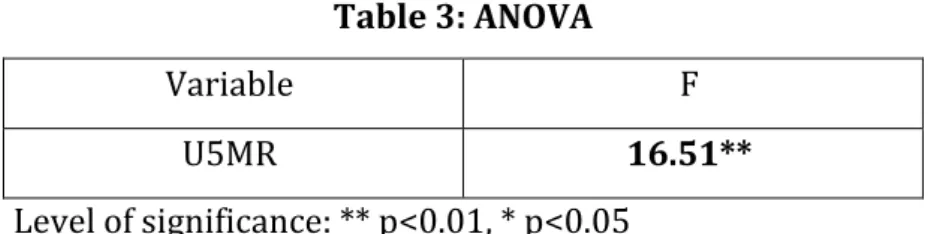
The results of the analysis of variance for the variation of the child mortality rate are shown below (Table 3).
Table 3: ANOVA
Variable F
U5MR 16.51**
Level of significance: ** p<0.01, * p<0.05
We reject the null hypothesis and in consequence we can assert that there is a statistically significant difference in the evolution of the child mortality rate in periods of GDP per capita increase and decrease. This confirms the hypothesis of the existence of asymmetrical effects of GDP per capita in periods of growth and recession on the variations in the rate of child mortality.
4.2. The Wooldridge Test
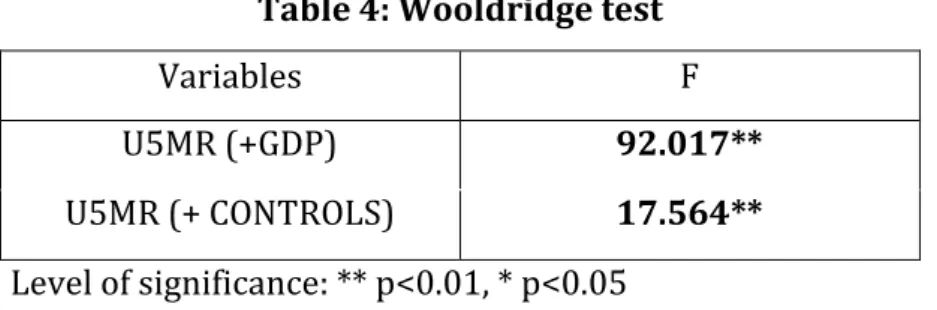
The results of the Wooldridge test are shown below (Table 4). We consider two specifications of our model: the first refers to the model only considering the effects of periods of economic expansion and recession, whereas the second specification considers the entire model, taking into account all the explanatory control variables indicated above.
Table 4: Wooldridge test
Variables F
U5MR (+GDP) 92.017**
U5MR (+ CONTROLS) 17.564**
Level of significance: ** p<0.01, * p<0.05
We reject the null hypothesis, and consequently we assume the existence of first-order serial correlation (AR1) in the errors, which will have to be taken into account in our estimates.
4.3. Regression Analysis
Aside from the effects of economic fluctuations on child mortality highlighted by the empirical literature (see Paxson and Schady, 2005; Schady and Smitz, 2009; Agüero and Valdivia, 2010; Bhalotra, 2010; Fernández and López-Calva, 2010; Anderson et al., 2011; Renton et al., 2012), we question whether economic cycles have asymmetric effects on child mortality. On the basis of the results obtained in the analysis of variance, we consider a model that differentiates periods of economic expansion and contraction by including temporal variables that identify periods of GDP per capita growth and decline. Application of a quadratic model permits verifying the possible non linear relationship between the rate of child mortality and GDP per capita.
The results of the estimate by means of a model with random effects6 are shown in
Table 57. We first estimate the null model, model (1), which contains no explanatory
6 We applied the Hausman test and the results suggest an estimate through random effects (RE).
14
variable. In this model we observe that the overall change in the child mortality rate is estimated to be -0.024. The term random intercept, ζi, is the country residual which
indicates whether the country has a mean variation in the child mortality rate higher than the average ζi>0 or below average ζi <0. The likelihood ratio test statistic shows the
overwhelming evidence of country effects on the variation of the child mortality rate in the null model.
Table 5: U5MR
Variables (1) (2) (3)
Exp - -0.083* -0.025
[0.042] [0.019]
Exp2 - 0.058 0.097
[0.035] [0.095]
Rec - 0.015 0.052
[0.067] [0.031]
Rec2 - 0.724** 0.353
[0.189] [0.246]
female_primary - - -0.014*
[0.005]
inm_measles - - 0.006
[0.005]
hiv - - 0.130**
[0.045]
birth_rate - - 0.031*
[0.014]
oda - - -0.000
[0.001]
7 Given that the figure for the child mortality rate for Haiti in 2010 is clearly an
atypical value mainly caused by the effects of the earthquake (164.8), we have also estimated the different models excluding said figure, and have obtained similar results.
15
constant -0.024** -0.023** -0.052**
[0.003] [0.004] [0.016]
Number of countries 45 45 33
Log-likelihood - 1579.555** 1675.040**
var(ζi)
8e-5** 8.12e-5** 0
Note: standard errors are shown in brackets. Level of significance: ** p<0.01, * p<0.05
In model (2), as explanatory variables we introduce the variation in GDP per capita, differentiating periods of recession and expansion to test for asymmetric effects (Table 5), taking into account disparities in economic conditions over time across LDCs. Firstly, we observe that economic growth has a significant negative linear impact on child mortality rate, reducing child mortality in a proportional way. On the other hand, the rise in the child mortality rate in periods of decline is increasingly larger, given the concave, quadratic functional form that relates both variables. Thus, the differentiated specification between periods of growth and decline to analyze the existence of asymmetrical effects of GDP per capita changes on the rate of child mortality highlights that said effects are in fact asymmetric. Specifically, variations of GDP per capita have a greater effect on changes of the child mortality rate in periods of decline than in periods of growth, insofar as a decrease of GDP per capita entails a greater variation than an increase of GDP on the rates of child mortality.
In this model, the random-error component ζi shows that the national intercepts have
substantial variability. Each estimated intercept can be viewed as an indicator of national residual attitude for child mortality, representing the variation across LDCs that still remains even after controlling for the evolution of the GDP per capita, and needs to be further investigated.
In a third specification, model (3), we additionally introduce control variables. In this case the evolution of GDP per capita is no longer significant in favor of certain control variables.
Concerning women’s education, the results reveal a statistically significant influence on the evolution of child mortality, whereby a larger percentage of women enrolled in primary schooling tends to reduce child mortality in the LDCs.
In respect to the health variables, the results are significantly different amongst variables. The variable for child health hardly has any influence on the evolution of child mortality. This global result is consistent with the particular conclusion of Kabir et al. (2003), who conclude that the measles vaccine seems to have a non-specific reducing effect on overall child mortality in rural India. In contrast, the variables regarding diseases that have a major impact on the population of LDCs, such as HIV/AIDS, tuberculosis and malaria, seem to have a significant effect on the evolution of the child mortality rate. In particular, the percentage of population infected by HIV/AIDS may be regarded as a variable that clearly influences the rate of child mortality.
The crude birth rate significantly affects changes of the child mortality rate. The higher the birth rate, the greater the probability of an increase of the child mortality rate. In this sense, we should recall that during recessions there are changes in the composition of women giving birth. This is because decreases in women’s wages, caused by an aggregate shock, have income and substitution effects on fertility. The income effect would imply a reduction in the number of children that are desired. However, children are time intensive, so the substitution effect would result in women having more children during a crisis. The relative magnitude of the income and substitution effects on fertility is likely to vary across women and may be correlated with the characteristics that help determine child health. Thus, higher-risk women may be less likely to postpone birth during a recession and this, in turn, could lead to worse health outcomes for young children during a crisis (see Ferreira and Schady, 2009).
Lastly, our empirical evidence reveals that official development assistance is not significant in order to explain differences of child mortality in the LDCs across countries over time, which is consistent with other studies that question the impact of ODA on child mortality (e.g., Burnsider and Dollar, 1999; Hsu, et al., 2012).
Note that in this model variance of the random intercepts is no longer significantly different from zero (Table 5), so that we cannot assure that there are different effects amongst countries when we include said control variables.
5.
Conclusions and Policy Implications
The reduction of child mortality is one of the most strongly and universally supported development goals. Despite the progress made in recent decades, child mortality is not
decreasing fast enough to achieve the MDG 4 target, especially in a number of LDCs. As such progress can be considerably influenced by short term economic fluctuations, there exists a notable literature on the effects of economic oscillations on child mortality across a wide range of development levels. In the case of developing countries, the literature focuses on country-specific studies or on groups of countries, frequently from diverse income categories, with less presence of the LDCs –the countries with highest rates of child mortality–, due in part to data limitations.
In this paper we empirically analyze the relationship between short-term economic fluctuations and child mortality in the LCDs during the period 1990-2010 by using analysis of variance (ANOVA) and regression analysis for panel data. First of all, by differentiating periods of growth and of decline of GDP per capita, we observe that the evolution of GDP per capita has significant repercussions on the changes of child survival. However, said influence is asymmetrical, so that periods of economic decline have a more than proportional negative effect on child mortality rates, whereas the influence of GDP per capita growth on child mortality rates is linear. When we introduce explanatory control variables in our models, the influence of GDP per capita descends significantly in favor of other variables used. In this sense, our model seems to highlight that economic conditions in themselves do not determine progress in child survival, but rather that their importance is mainly due to their connection to a number of socio-economic factors closely related to child mortality. Specifically, amongst the explanatory control variables introduced, women’s level of education, the prevalence of HIV/AIDS and the crude birth rate are highly significant. In contrast, measles vaccination does not seem to have a significant effect on the reduction of child mortality, due in part to the fact that in certain LDCs this coverage is insufficient and unequally distributed in their territories. In addition, and in keeping with previous studies, the effect of ODA on child mortality in these countries is not globally statistically significant, questioning once again the effectiveness of aid.
Indeed, we can conclude that economic growth entails a limited positive effect on the reduction of child mortality, and must necessarily be accompanied by the application of specific policies that favor said reduction, particularly in the field of health, nutrition and education. In contrast, economic decline seems to have a more than proportional impact on child mortality, it being essential to encourage child survival policies, including social protection policies, during periods of economic recession.
In terms of development policies in the LDCs, possible reinforcement strategies should be also considered in order to mitigate the negative effects of economic fluctuations and reduce their under-five mortality rates. A key issue is the concentration of resources in countries, areas and households with the most child deaths, given the increasing concentration of under-five deaths among countries, and within countries by geographic location and by household income/wealth, among other factors. In fact, within the LDCs there are wide inequalities in health status, access to and use of essential services and health risks. In this sense, it is important to emphasize that equity is fundamental to achieve the MDGs, as the most geographically isolated households and most marginalized groups within countries have the highest burden of under-five deaths and therefore the greatest potential for child survival gains. Moreover, UNICEF (2010) warns that the global context for development is changing. The food and financial crises, together with climate change, rapid urbanization and escalating numbers of humanitarian crises threaten hard-won MDG gains for children. These shifts most profoundly affect the poorest countries and their most impoverished communities.
Many of the deaths occurring in the LDCs are easily preventable and effective interventions exist to address all of the main causes of child deaths especially related to infant and maternal health care and nutrition. In many territories the investment to deal with such causes is still insufficient. In addition to medical and nutritional factors, investment in education, infrastructure, water and sanitation, and income- and employment-generation are regarded as essential components of a comprehensive plan to reduce child mortality. These interventions should be accompanied by policies to protect the income of socioeconomically disadvantaged households and to maintain or expand basic public services during economic downturns. The pro-poor management of recessions needs to ensure that situations of transitory poverty do not evolve into structural poverty due to the absence of well-designed policies and well-managed budgets. In any event, the responsibility for dealing with these challenges must be shared by the whole international community, from donor countries and their citizens to countries concerned and their diverse socio-economic groups.
6.
REFERENCES
AGÜERO, J.M. and VALDIVIA, M. (2010): “The permanent effects of recessions on child health: evidence from Peru”, Estudios Económicos, 25 (1), pp. 247-274.
ALDERMAN, H., CHRISTIANSEN, L. and YAMANO, T. (2005): ”Child Growth, Shocks, and Food Aid in Rural Ethiopia”, American Journal of Agricultural Economics, 87(2): 273- 88.
ALVES, D. and BELLUZO, W. (2004): “Infant mortality and child health in Brazil”, Economics and Human Biology, 1, pp. 391-410.
ANDERSON, I., AXELSON, H. and TAN, B.K. (2011): “The other crisis: the economics and financing of maternal, newborn and child health in Asia”, Health Policy and Planning, 26, pp. 288-297.
BAIRD, S., FRIEDMAN, J. and SCHADY, N. (2009): “Aggregate Income Shocks and Infant Mortality in the Developing World”, Policy Research Working Paper 4346, Washington, DC: World Bank.
BHALOTRA, S. (2010): “Fatal fluctuations? Cyclicality in infant in India”, Journal of Development Economics, 93 (1), pp. 7-19.
BLOCK, S.A., BLOEM, M.W., KIESS, L., KOSEN, S., MOENCH-PFANNER, R. and TIMMER, C.P. (2004): “Macro shocks and micro outcomes: child nutrition during Indonesia’s crisis”, Economics and Human Biology, 21 (1), pp. 21-44.
BREUSCH, T. and PAGAN, A. (1980): “The Lagrange Multiplier test and its applications to model specification in econometrics”. Review of Economic Studies, 47, 239-253.
BURNSIDER, C. and DOLLAR, D. (1999): “La ayuda, el sistema de incentivos y la reducción de la pobreza”, ICE, Revista de Economía, 778 pp. 31-42.
COSTA, M.C.N., ANDRADE MOTA, E.L., PAIM, J.S. and VIEIRA DA SILVA L.M. (2003): “Infant mortality in Brazil during recent periods of economic crisis”, Revista de Saúde Pública, 37 (6), pp. 699-706.
CUENCA, E. and RODRÍGUEZ, J.A. (2010): ”Measurement of disparities between indicators associated with the welfare in Least Developed Countries (LDCs) of Asia”, Revista de Economía Mundial, 25, pp. 83-108.
CUTLER, D., DEATON, A. and LLERAS-MUNEY, A. (2006): “The determinants of mortality”,
Journal of Economic Perspectives, 20 (3), pp. 97-120.
CUTLER, D.M., KNAUL, F., LOZANO, R., MÉNDEZ, O. and ZURITA, B. (2002): “Financial crisis, health outcomes and ageing: Mexico in the 1980s and 1990s”, Journal of Public Economics, 84 (2), pp. 279-303.
ESPEY, J., HARPER, C. and JONES N. (2010): “Crisis, care and childhood: the impact of economic crisis on care work in poor households in the developing world”, Gender & Development, 18 (2), pp. 291-307.
FERNÁNDEZ A. and LÓPEZ-CALVA, F. (2010): “Transitoty shocks, permanente effects: impact of the economic crisis on the well-being of households in Latin America and the Caribbean”, Estudios Económicos, 25, pp. 3-35.
FERREIRA, F.H.G. and SCHADY, N. (2009): “Aggregate economic shocks, child schooling, and child health”, World Bank Research Observer, 24 (2), pp. 147-181.
GAIHA, R. (2012): “On hunger and child mortality in India”, Journal of African Economies, 47 (1), pp. 3-17.
HARPER, C., ESPEY, J., JONES, N. and MCKAY, A. (2009): “Children in times of economic crisis: Past lessons, future policies”, London: ODI.
HAUSMAN, J.A. (1978): “Specification test in econometrics”. Econometrica, 49 (6), pp. 1251-1272.
HAUSMAN, J.A. and TAYLOR, W.E. (1986): “Panel data and unobservable individual effects”.
Econometrica, 49, pp. 1377-1398.
HODDINOTT, J. and KINSEY, B. (2001): “Child growth in the time of drought”, Oxford Bulletin of Economics and Statistics, 63 (4), pp. 409-436.
HOUWELING, T.A.J., KUNST, A.E., LOOMAN, C.W.N. and MACKENBACH, J.P. (2005): “Determinants of under-5 mortality among the poor and the rich: A cross-national analysis of 43 developing countries”, International Journal of Epidemiology, 34 (6), pp. 1257-1265.
HSU, J., PITT, C., GRECO, G., BERMAN, P. and MILLS, A. (2012): ”Countdown to 2015: Changes in official development assistance to maternal, newborn, and child health in 2009-10, and assessment of progress since 2003”, The Lancet, 380 (9848), pp. 1157-1168.
ICKOWITZ, A. (2012): “Wealthiest is not always healthiest: What explains differences in child mortality in West Africa”, Journal of African Economies, 21 (2), pp. 192-227. KABIR, Z., LONG, J., REDDAIAH, V.P., KEVANY, J. and KAPOOR, S.K. (2003): “Non-specific
high vaccination coverage: a population-based case-control study”, Bulletin of the World Health Organization, 81 (4).
LIN, S.J. (2006): “The effects of economic instability on infant, neonatal and postneonatal mortality rates: Evidence from Taiwan”, Social Science and Medicine, 62 (9), pp. 2137-2150.
LYKENS, K., BAE, S., NDUKWE, E. and SINGH, K.P. (2009): “Social, Economic, and Political Factors in Progress Towards Improving Child Survival in Developing Nations”,
Journal of Health Care for the Poor and Underserved, 20 (4), pp. 137-148.
MCCORD, A. (2010): “The impact of the global financial crisis on social protection in developing countries”, International Social Security Review, 63 (2), pp. 31-45.
MENDOZA, R.U. (2009): “Aggregate Shocks, Poor Households and Children”, Global Social Policy, 9 (Suppl), pp. 55-78.
MILLER, G., and URDINOLA, P. (2007). “Time Vs. Money in Child Health Production: The Case of Coffee Price Fluctuations and Child Survival in Colombia.” Unpublished manuscript, Stanford University.
MOSTAFAVI, S. F. (2009): “Estimating the causal effect of maternal education on infant mortality with dhs data for iran”, Institute for Management and Planning Studies, Tehran, Iran. Paper submitted to the XXVI IUSSP International Population Conference, Marraketch, 2009.
ONIS, M., FRONGILLO, E.A. and BLÖSSNER, M. (2000): “Is malnutrition declining? An analysis of changes in levels of child malnutrition since 1980”, Bulletin of the World Health Organization, 78 (10), pp. 1222-1233.
PAXSON, C. and SCHADY, N. (2010): “Does money matter? The effects of cash transfers on child development in rural Ecuador”, Economic Development and Cultural Change, 59 (1), pp. 187-229.
PÉREZ DE ARMIÑO, K. (2011): “Crisis alimentaria y lucha contra el hambre en África subsahariana. La cuestionable contribución de los ODM”. Revista de Economía Mundial, 27, pp. 117-148.
RAJARATNAM, J.K., MARCUS, J.R., FLAXMAN, A.D., WANG, H., LEVIN-RECTOR, A., DWYER, L., COSTA, M., LOPEZ, A.D. and MURRAY, C.J.L. (2010): “Neonatal, postneonatal, childhood, and under-5 mortality for 187 countries, 1970–2010: a systematic analysis of progress towards Millennium Development Goal 4”, The Lancet, 375/973, pp. 1998-2008.
RENTON, A., WALL, M. and LINTOTT, J. (2012): “Economic growth and decline in mortality in developing countries: An analysis of the World Bank development datasets”,
Public Health, 26, pp. 551-560.
RICHARDSON, D. (2010): “Child and Family Policies in a Time of Economic Crisis”, Children & Society, 24 (6), pp. 495-508.
RUKUMNUAYKIT, P. (2003). “Crises and Chile Health Outcomes: The Impacts of Economic and Drought/Smoke Crises on Infant Mortality in Indonesia.” Unpublished manuscript, Michigan State University.
SCHADY, N. and SMITZ, M.F. (2010): “Aggregate economic shocks and infant mortality. New evidence for middle-income countries”, Economic Letters, 108 (2), pp. 145-148. SEN, A. (1999): “Development as Freedom”. Oxford: Oxford University Press.
TAHA, T.E., DADABHAI, S.S., SUN, J., RAHMAN, M.H., KUMWENDA, J. and KUMWENDA, N. (2012): “Child mortality levels and trends by HIV status in Blantyre, Malawi: 1989-2009”, Journal of Acquired Immune Deficiency Syndromes, 61 (2), pp. 226-234.
UNICEF (2006): “Africa´s orphaned and vulnerable generations”, CHILDREN AFFECTED BY AIDS, New York: UNICEF.
UNICEF (2010): “Achieving the MDGs with Equity”, Progress for Children No 9, New York: UNICEF, 2010.
UNICEF (2012): “A report card on adolescents”, Progress for Children No 10, New York: UNICEF.
UNITED NATIONS (1989): Convention on the Rights of the Child, G.A. Res. 44/25, U.N. 20 of November 1989.
UNITED NATIONS INTER-AGENCY GROUP FOR CHILD MORTALITY ESTIMATION (2012): Levels and Trends in Child Mortality, New York: UNICEF.
WOOLDRIDGE, J. (2002): “Econometric Analysis of Cross Section and Panel Data”, MIT Press.
WORLD BANK (2012): World Development Indicators 2012, World Bank.
WORLD HEALTH ORGANIZATION (2003): “State of the World´s vaccines and immunization”, The State of the World´s 2003. Switzerland: WHO.
WORLD HEALTH ORGANIZATION (2011): “Epidemic update and health sector progress towards universal access”, GLOBAL HIV/AIDS RESPONSE, Progress Report, 2011.Switzerland: WHO.
ZABA, B., WHITWORTH, J., MARSTON, M., NAKIYINGI, J., RUBERANTWARI, A., URASSA, M., ISSINGO, R., MWALUKO, G., FLOYD, S., NYONDO, A. and CRAMPIN, A. (2005): “HIV and mortality of mothers and children: Evidence from cohort studies in Uganda, Tanzania and Malawi”, Epidemiology, 16, pp. 275-280.