CCCB
Montalegre,5 / 08001 T. 933064 100 / www.cccb.org
INDEX
5 Exhibitions6 In the chinese city
7 Illuminations. Visionary Catalonia
8 Bamako 07. African Photography Meetings 9 Gangs of the 80s
10 The jazz century
11 Cerdà and the Barcelona of the Future
12 In collaboration with...
12 World Press Photo
13 Cultural activities
14 Cicles and festivals
25 Festivals in collaboration with Other proposals
36 Urban Itineraries
39 Debate and refl ection
40 New Humanism 45 City and Public Space
51 In collaboration with...
57 Friends of the cccb
59 Educational service
61 Open CCCB
62 Online Projects
64 Beyond the CCCB
64 Exhibitions 66 Screenings
67 Debates 68 Networks
69 CCCB Holdings
70 Archive 73 Publications 75 Audiovisuals Publications
77 General data
78 CCCB staff
79 Collaborating Institutions and companies 80 Visitor fi gures
82 Budget
83 List of speakers of debates and lectures 85 Venue hire
Dates Fins al 22 de febrer Amb la col·laboració de Bancaja i el patrocini del Consorci
EXHIBITIONS
2009
Edition
CCCB
Graphic design
Postdata disseny i comunicació
Printer
EXHIBITIONS EXHIBITIONS
For over a decade, China has been immersed in major processes of transformation, which are leading Chinese cities to change at an unstoppable pace in a cycle of construc-tion and destrucconstruc-tion that is transforming them profoundly and with remarkable speed.
This exhibition situated these changes within the conti-nuum of the country’s history and culture. It aimed to present the reality of the city past and present by exploring four of its aspects: town planning, architecture, landscape and infrastructure. It also offered an opportunity to compare these realities with the Chinese and Western imaginaries, and with mechanisms of information and propaganda. The exhibition took as its basis the presentation of archeolo-gical documents, art works, models, archival images and contemporary creation. A series of characters and key concepts from Chinese civilization (garden, writing and culture, earth and man, water, fengshui, construction and destruction, and family) formed a base for a dynamic reading of Chinese territory and everything that affects the current population of more than three billion people. Woven through these concepts, the exhibition presented six cities as examples of these urban transformations: Suzhou, Xi’an, Chongqing, Canton Shanghai and Beijing.
In this context, fi lms took on a particular importance. Five Chinese fi lm directors contributed a fi lmmaker’s perspective on fi ve of the cities included in the exhibition. The presti-gious director Jia Zhangke orchestrated the work of four of his colleagues: Chen Tao, Peng Tao, Li Hong Qi and Han Jie. Jia Zhangke himself, who directed the portrait of the city of Suzhou in a short fi lm called Cry me a River, which was screened in the offi cial out-of-competition program at the 65th Venice Film Festival.
RELATED ACTIVITIES
Does Beijing still exist? Film program
Dates: January 14, 17, 21, 24, 28 and 31 See page15
Debate Origins. Qingtian: Chinese immigration in Barcelona
Date: January 23 See page 48
Premiere of the documentary Zone of Initial Dilution (2006), by Antoine Boutet
Date: February 14
The exhibition concluded with this excellent documentary made by Antoine Boutet, after working in China over a six-month period, which was screened a week before the exhibition closed.
The fi lm analyses the profound urban transformations taking place in China’s Three Gorges region as a result of the construction of the largest hydroelectric dam in the world. The “zone of initial dilution” concept, which engineers use to defi ne the perimeter of a watercourse that has been contaminated by waste which then gradually dissolves into the general fl ow, illustrates the current situation of this region, in which many customs and traditional activities are being sacrifi ced in the name of progress. The fi lm shows the state of different places and cities on the banks of the Yangtze river, some of which are in ruins or no longer there, while others are booming, trying to restrict the consequences that the planned fi nal rise in water levels will have on the landscape and towns.
Talks for School Groups
See page 60
This exhibition was designed as an overview of the philosophy and creation that came out of Catalonia from the time of Ramon Llul up until the present, featuring a majority of visionary creators and artists.
The intuition and vision of unique individuals who were permeable to the currents of European thought and to new revolutionary ideologies have made Catalonia a land ahead of its time. This exhibition took us into the work of these fi gures from the worlds of art and literature, science and thought, who opened up new horizons and broke molds.
An exhibition on the visionaries and those touched with madness, whose legacy opened the gateways of modernity in Catalonia over the course of eight centuries:
Abad, Alomar, Barba, Barradas, Bataille, Ben, Bey, Berenguer, Beuys, Bofi ll, Bonastruc ça Porta, Brossa, Buigas, Casas Abarca, Casellas, Català i Pic, Cerdà, Chomón, Clapés, Clavé, Cirlot, Colom, Colomer, Comas i Solà, Cravan, Cresques, Cristòfol, Cuixart, Dalí, Deulofeu, Duchamp, Einstein, Eulàlia, Fageda, Ferrant, Ferrer i Guàrdia, Foix, Fontcuberta, Fortuny y Madrazo, Francés, GATCPAC, Gaudí, González, Gual, Guimerà, Jujol, Junyent, Lamolla, Le Corbusier, Letamendi, Llull, Man Ray, Marçal, Marinel·lo, Masó, Massanet, Masson, Mestre de Cabestany, Mestres, Mestres Quadreny, Mir, Miralda, Miralles, Miralles, Miró, Montoliu, Monturiol, Noguera,
Nogueras i Oller, Pablo, Perejaume, Perucho, Picabia, Picasso, Pla Janini, Ponç, Portabella, Prunés, Pujols, Recha, Riba, Ribé, Riera, Romero, Rossell, Rubió i Tudurí, Sabatés, Salvat-Papasseit, Santos, Santos Torroella, Sarró, Sayrach, Serra, Sibiuda, Sisa, Sucre, Tàpies, Torres-García, Valldosera, Varo, Verdaguer, Vilanova, Vilatobà, Villèlia, Viura, Xifra, Xiró, Zanné, Zush/Evru.
The exhibition included 800 works of art and science. Some areas of the exhibition were enhanced by installa-tions created by a contemporary artist whose work shares similar themes and philosophy.
The exhibition was structured around thirteen thematic areas headed by the letters that make up the word “illuminations” in Catalan (IL·LUMINACIONS), with each letter also invoking a Latin expression, and as such it offered a thematic rather than a chronological overview.
RELATED ACTIVITIES
Flashes of Genius. Alongside the exhibition
Dates: March 18, 19 and 20 See page 49
Talks for School Groups
See page 60
ILLUMINATIONS
VISIONARY CATALONIA
IN THE CHINESE CITY
PERSPECTIVES ON THE TRANSMUTATIONS OF AN EMPIRE
Dates November 4, 2008 – February 22, 2009
Venue Sala 3
Curator Frédéric Edelmann with the collaboration of Françoise Ged
Production CCCB and Cité de l’Architecture et du
Patrimoine
With the collaboration of Fundación Bancaja, the sponsorship of Consorci de la Zona Franca and the support of Conseil Général des Hauts- de-Seine, Musée Albert-Kahn
Part of the European Year of Intercultural Dialogue
Architectural design Emba_Estudi Massi-Bosch Arquitectes
Interior graphic design Estudi mm! Mònica Mestanza, Rosa Rodríguez
Image and promotional graphic design David Lorente
Dates February 17 – May 24
Venue Sala 2
Curator ilar Parcerisas
Production CCCB and the Departament de Cultura i Mitjans de Comunicació, Generalitat de Catalunya
Architectural design Lluís Pau / Estudi IDP
Interior graphic design La Japonesa
Image and promotional Lali Almonacid
EXHIBITIONS EXHIBITIONS
The theme of the seventh Bamako Rencontres Africaines de la Photographie, entitled The City and Beyond, was urban life.
The 7th Bamako emphasized the fragility of the city and urban life, the networks of relationships between individuals and social groups, the unfi nished construc-tions and the disconcert of those who dwell in them. It also looks at examples of forms of resistance, everyday struggles, the defi ant vision of young people and their creativity. The images capture and reveal an exploration of an urban reality that is undefi ned, always changing, in a constant process of construction and reconstruction. Just like a living city.
The new selection of the Rencontres at the CCCB included a homage to the prominent photographer Serge Jonqué (1951-2006) and a monographic exhibition dedicated to Samuel Fosso (Cameroon, 1962), one of Africa’s great contemporary creators. For the fi rst time, this seventh Bamako introduced the section New Images, a selection of independent creative videos that aim to break away from the stereotypes usually associated with Africa. The CCCB exhibition offered a broad selection of around 200 photographs and videos of the most interes-ting projects presented in 2007, as well as printed and fi lm documentation.
The selection was structures as follows:
• almost 150 photographs from the international exhibi-tion;
• the monographic showcase, dedicated to Samuel Fosso (Cameroon, 1962);
• the special tribute to the recently deceased Serge Jongue (France-Guyana, 1951-2006);
• a selection of the artistic videos presented in the new section New Images.
RELATED ACTIVITIES
Histories of Africa through Self-Portraits. A conversation with Samuel Fosso
Date: February 24 See page 49
Africa are Voices
Conference on African Literatures in Barcelona
Dates: April 20-22 See page 50
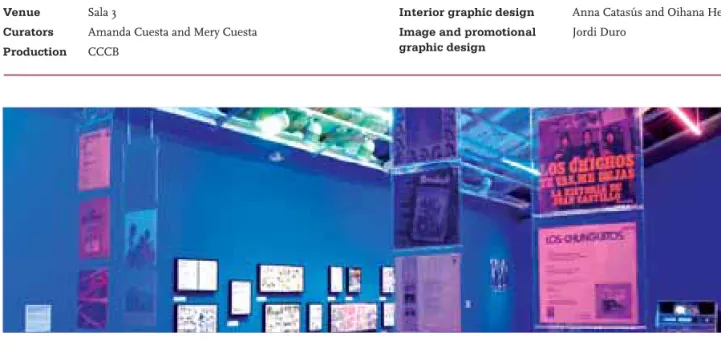
Dates May 25 – September 6
Venue Sala 3
Curators Amanda Cuesta and Mery Cuesta
Production CCCB
Architectural design Estudi Bonjoch, S.L.
Interior graphic design Anna Catasús and Oihana Herrera
Image and promotional Jordi Duro
graphic design
This exhibition looked at a Spanish fi lm genre that peaked between 1978 and 1985 and featured “quinqui” or juvenile delinquent culture, focusing on the feedback relationship between fi lms and the press of the time. The exhibition was also a faithful refl ection of the urban, social, political and economic changes that were sweeping through the country at that time.
The codes of representation of juvenile delinquency in
quinqui cinema have survived up until now, and after undergoing an aesthetic makeover, the quinqui stereotype is still a source of endless fascination.
The point of departure for the exhibition was the fi gure to the “quinqui” coined by the phenomenon of juvenile delinquent fi lm. The social emergency plans that were implemented in the sixties resulted in an extremely low quality urban environment. In 1975, 25% of the population over 14 was excluded from the educational system, and to make it worse, the legal working age (like the criminal age of responsibility) was set at 16, so the streets were the only option available to many young kids. At the same time, the introduction of heroine wreaked havoc. The legacy of Franco’s dictatorship was a particularly repressive and punitive system. That generation of young people was the fi rst in Spain to participate in youth culture trends. The avoidance tactics of teenagers were sex and drugs, as well as forms of expression from pop culture that projec-ted images of rebelliousness, escapism and marginality, such as comics and music. In a climate of social unrest, heightened by the media, juvenile delinquents became public enemy number one. One of the key elements for understanding how juvenile delinquents were iconized is by looking at their presence in the media. El Vaquilla and El Jaro, true fringe heroes, were the brightest stars in this universe thanks to the fi lm biopics: Navajeros, the Perro callejeros saga, and Yo.
The last section of the exhibition looked at the survival of the quinqui phenomenon after its peak, and the tragic end of many of its stars, in fi ction and in reality. With the generation that followed, the concept of the 80s quin-qui underwent an aesthetic makeover and rose up as an authentic icon of cool. The myth is still going strong today, particularly on the Internet.
RELATED ACTIVITIES
Inaugural Concert of the Exhibition
Organized by Macarras Old School Date: May 25
Street Rumba is the music linked to juvenile delinquency in the eighties, and its translation into fi lm. Groups like Los Chichos, los Chungitos, Bordón 4 and Las Grecas are the key fi gurers of the genre. This music allows us to make a leap to the present day. The legacy of the music and sub-ject matter of this “other movida” of the eighties has been picked up by a multitude of young groups who work pay tribute to their predecessors but also work with the same subject matter and musical mood today, in the barrios, on the streets – the same territories were the genre was born more than twenty years ago. This concert, led by José El Pantanito, who oganizes “neocalorrismo” events and directs the production company Rumba Tunning, offered a lineup of voices from today’s young street Rumba, who performed
quinqui repertoire classic hits such as “Maldita Droga” (Tony el Gitano), “La cachimba” (Las Grecas), and “Soy un perro callejero” (Los Chichos).
Talk for School Groups
See page60
BAMAKO 07.
AFRICAN PHOTOGRAPHY MEETINGS
IN THE CITY AND BEYOND
GANGS OF THE 80S
CINEMA, PRESS AND THE STREETS
Dates February 24 – June 1
Venue Sala -1
Curator Pep Subirós
Production CCCB and CULTURESFRANCE / Rencontres Africaines de la Photographie, Bamako and the Mali Ministry of Culture
Architectural design Alejandro Quintillá-Bracha Berkovitch
EXHIBITIONS EXHIBITIONS
Dates July 21 – October 18
Venue Sala 2
Curator Daniel Soutif
Production CCCB, Museo d’Arte Moderna e Contemporanea di Trento e Rovereto (MART) and Musée du Quai Branly, Paris
With the collaboration of Bancaja and the sponsorship of the Consorci de la Zona Franca
Architectural design BOPBAA
Interior graphic design Estudi Canó
Image and promotional Mariona Garcia
graphic design
Jazz, together with fi lm and rock was one of the most important artistic happenings of the 20th Century. The exhibition offered an across-the-board reading of its com-plex history, using a chronological structure to provide a narrative thread that follows a timeline marking the main events in the history of jazz. At the same time, it showed how the sound of jazz has tinged all the other arts, from painting to photography, fi lm to literature, as well as gra-phic design and cartoons.
The exhibition guided visitors on a journey through the rich feedback between Jazz and other arts, from the fi rst artists to notice and use this fertile relationship in the earliest days of jazz, such as Picabia, Gleizes, Man Ray and Janco, to artists like Otto Dix, Max Beckmann and Frantisek Kupka, those from the famous Harlem Renais-sance, like Aaron Douglas, Palmer Hayden, Archibald Motley and William H. Johnson and American modernist painters like Arthur Dove and Sturat Davis. The story continued after World War II, with essential artists like Mondrian, Matisse and Jackson Pollock and Afro-Ame-rican artists like Jacob Lawrence, Romare Bearden, Bob Thompson and Jean-Michel Basquiat, bringing us right up to the present. In a reciprocal fashion, many musicians – from Django Reinhardt to Louis Armstrong and from George Wettling to Miles Davis – created visual works that show the fertile, dense interactions between music and painting.
The exhibition included an impressive set of record slee-ves, posters, publicity material, pamphlets and concert handbills that made it possible to appreciate the impor-tance of graphic art in the jazz aesthetic, comics with big
or small stories of black American music, and fi lms that have focused on jazz as their subject matter or as a soun-dtrack for their stories.
RELATED ACTIVITIES
Inaugural concert at Caixa Catalunya’s La Pedrera
Date: July 28
In conjunction with the exhibition, Caixa Catalunya’s La Pedrera presented a rereading of the history of jazz. A quartet of leading internationally recognized musicians invited the audience on a journey that took them from the swing of Louis Armstrong and Benny Goodmman to Charlie Parker, Chet Baker and Miles Davis, and ended with the most contemporary jazz.
Trumpet: Raynald Colom Double bass: Tom Warburton Drums: Marc Ayza
Piano: Joan Díaz
CCCB Jam Sessions: Within Arm’s Reach
Dates: September 10, 17, 24, and October 1, 8, 15, 2009 See page 22
BCNmp7. Jazz Marathon
Date: September 17 See page 18
Talks for School Groups
See page 60
CERDÀ AND THE BARCELONA OF THE FUTURE
REALITY VERSUS PLAN
Dates October 19, 2009 – February 28, 2010
Venue Sala 3
Curators Joan Busquets and Miquel Corominas
Production Ajuntament de Barcelona and CCCB
An activity of Cerdà
the Year of
Architectural design Sara Bartumeus and Anna Renau
Interior graphic design Lamosca
Image and promotional Dani Navarro
graphic design
This exhibition is one of the events organized for Cerdà Year and highlights the urbanistic richness of the Cerdà Project by analyzing the present of the Eixample and envi-saging the future of the city of Barcelona.
This exhibition narrated the application and realization of Cerdà’s project over the last 150 years and the way in which its specifi c construction has given form to the present-day container and content of the Eixample and, accordingly, of the city of Barcelona. The exhibition immersed visitors into present-day reality to discover and interpret a series of forms of urban organization that have produced a compact, comfortable city, with an urban form that is highly appreciated.
The show took the pulse of the Eixample today, a district that is home to over 300,000 people and work place to more than 260,000, run through by Catalonia’s most complex transport and service network. The exhibition layout introduces us to the subterranean life of the Eixam-ple and rediscovers its inner courtyards (many of which are still unknown), the most highly populated city blocks and the ones that host most economic activity.
More than 200 documents, including plans, models, installations, statistics, audiovisuals and even artistic manifestations (Joan Fontcuberta, Maria Rubert) helped to give us a better understanding of the functioning of Barcelona’s Eixample and discover similar urbanistic models around the world, such as New York’s Manhattan, which has a comparable urban layout to that of the Eixam-ple, with some surprisingly similar urban characteristics.. However, an examination of the implementation of Cerdà’s Plan not only gives us keys for interpreting the present, it can also help us to envisage Barcelona’s future. The experience of the Eixample has to serve as a model for envisioning the territorial growth of Barcelona throughout its metropolitan area. The exhibition raised some questions on this issue, and attempted to offer some answers.
Schools program
See page 60
EXHIBITIONS IN COLLABORATION WITH...
WORLD PRESS PHOTO 08
INTERNATIONAL PROFESSIONAL PHOTOJOURNALISM EXHIBITION
Dates November 10 – December 13
Venue Sala -1
Production Photographic Social Vision Foundation with the collaboration of CCCB
For the fi fth consecutive year, Photographic Social Vision Foundation, in collaboration with the CCCB, organized the exhibition World Press Photo.
The World Press Photo exhibition, a collection of the winning entries in the World Press Photo Competition, is internationally recognized as the world’s major touring showcase of photojournalism. Thus, it was not just an exhibition of the best photographs of 2008, but also a historic document of the main news events of the year. Each year, an independent, thirteen-member internatio-nal jury chooses the winning photographs from sub-missions by photojournalists, agencies, newspapers and photographers around the world. The photos compete in 11 categories: news events, current affairs, people in the news, sports, action photography, sports reportage, contemporary issues, daily life, portraits, nature and art and entertainment.
Each year, the winning photographs are exhibited in 80 cities in 40 countries, on condition that all works have to be shown without censorship of any kind. The fact that thousands of visitors from around the world see this exhi-bition shows photography’s power to overcome linguistic and cultural boundaries.
World Press Photo provides images that become part of the collective memory. Stunning images that have changed, on many occasions, the course of history and public opinion.
CULTURAL
CULTURAL ACTIVITIES CICLES AND FESTIVALS CULTURAL ACTIVITIES CICLES AND FESTIVALS
Dates September 2008 – June 2009
Organized by CCCB
The CCCB’s Xcèntric program continues along the path of drawing attention to a non-mainstream area in which very interesting things take place, and to the fact that there has been a shift in cinema that has taken it beyond commercial movie theatres. New forms of fi lmmaking also need new forms of exhibition, and even new ways of writing about it. With this in mind, Xcèntric once again offered the opportunity to present, watch and study these other kinds of fi lms that don’t simply languish on the fringes, but end up, or will even-tually end up, occupying a central position in the history of the moving image.
Films by: Harun Farocki, Robert Drew, Audrius Stonys, Emile de Anto-nio, Pere Portabella, Ben Rusell, Andy Warhol, Christian Hincker, Char-les Burns, Marie Calliou, Lorenzo Mattotti, Richard McGire, Marcel
Hanoun, Pavel Kogan, Aleksandr Sokurov, Sergei Paradjanov, Herz Frank, João Moreira Salles, Ralph Steiner, Carter Tutti, David Rimmer, Jean Mitry, Julie Murray, Paul Sharits, Robert Breer, Brady Lewis, Jennifer L. Bunford, Pip Chodorov, Ernesto Baca, Derek Jarman, Helen Hill, Claudio Caldini, Jan Kounen, John Porter, Joseph Morder, Dónal Ó’Céilleachair, Stan Brakhage, Daniela Cuglian-dolo, Chris Kennedy, Kika Thorne, Ricard Colas y Martin Gracineau, Jürgen Reble, Peter Tscherkassky, José Ernesto Díaz-Noriega, David Domingo, Juan Bufi ll, Virginie Manuel, Eugeni Bonet, Marcel Pey, Oriol Sánchez, Albert Alcoz, Oriol Sánchez, Maxi Viale, Eugènia Bal-cells, Pere Ginard, Laura Ginès and Manuel Huerga, among others. The new web with information on current and past programs was laun-ched in 2009: www.cccb.org/xcentric
A large, darkened room, a huge panoramic screen, interactive instruments like joystick noses, a face-capturing hut, an interactive magic carpet and hypersensitive microphones. These are the elements that made up Metamembrana, an interactive landscape that offered us a glimpse into the living universe of Membranes, the latest imaginary personal cosmogonic creation by internationally acclaimed artist Marcel·lí Antúnez Roca.
Metamembrana, the third part of the project Membrana, was simul-taneously connected in fi ve cities. Five doorways into a new lands-cape in which we discover a battle
between the Whites and the Blues, the Triumph of Death, the fruits of the Tree of Paradise, Rumbarock Ravalero and Auca from Porcoboc, among others.
The interactive installation Meta-membrana was jointly produced with Anella Cultural, an initiative that encourages experimentation with new applications in digital arts.
Metamembrana was shown simulta-neously at the CCCB, Espai Zero1 in Olot, Cal Massó in Reus, Espai d’Arts at Roca Umber Fàbrica de les Arts in Granollers and Sala Sant Joan in Lleida.
This program constructed a modest cinematic account of the spectacular transformation of the capital of the Popular Republic of China. Through a collection of images that take us back to the early 20th Century thanks to the operators of the great Albert Kahn, to the Beijing of artist Cao Fei’s
Second Life, via the people’s Beijing of Shi Hui, the Beijing of dreams of the 1950s and the “unoffi cial city” of the 90s, it portrayed a city that could be an ancient capital, the city of Imperial power up until the present day. The program included the fi lms: Wo zhe yi beizi (My Life), Shi Hui, 1950;
Beijing zazhong (Beijing Bastards), Zhang Yuan, 1992; Voyage à Pékin
1908-1909, Museo Albert Kahn, 1909;
Clean, Zhao Liang, 1997; Wangque de yitian (A Missing Day), Liu Wei, 2005; City Scene, Zhao Liang, 2004;
Construction: Bored Youth, Zhao Liang, 2000-2007; Qianmenqian
(Among the Ruins), Olivier Meys, Weng Living, 2008; Somewhere, Cheng Xiaoxing, 2008; RMB City / City Planning, Cao Fei, 2007; y Meishi Jie (Meishi Street), Cao Fei, Ou Ning, 2006, 85 min.
Programmed by: Marie-Pierre Duhamel-Muller.
An activity related to the exhibition
In the Chinese City. An overview of an empire’s mutations.
As part of the Xcèntric program, homage to cinema fi lmed on super-8, with pieces from the sixties up until the present. The year’s most “pop” fi lm program featured great fi lm-makers like Derek Jarman and Peter Tscherkassky, side by side with young and amateur fi lmmakers.
We presented the Spanish premiere of the group Mobileskino (Basel) with an original installation and a live show by Los Superocheros (Ams-terdam), both specially created for Xcèntric.
XCÈNTRIC. THE CCCB’S CINEMA
8TH SEASON, FEATURING EXPERIMENTAL,
DOCUMENTARY AND ESSAY FILMS
SÚPER-8
LITTLE BIG FORMAT
Dates January 8, 9, 10 and 11
Organized by CCCB
Dates January 14 – February 8
Organized by CCCB and Anella Cultural
METAMEMBRANA. INTERACTIVE LANDSCAPE
INSTALLATION BY MARCEL·LÍ ANTÚNEZ FOR THE ANELLA CULTURAL
DOES BEIJING STILL EXIST?
FILM PROGRAM
Dates January 14, 17, 21, 24, 28 and 31
CULTURAL ACTIVITIES CICLES AND FESTIVALS CULTURAL ACTIVITIES CICLES AND FESTIVALS
I + C + I
RESEARCH AND INNOVATION IN THE CULTURAL SPHERE
Dates January 27, March 3, March 31, April 28, June 3, September 29 and October 27
Organized by CCCB
Audiovisual creators are increasingly focused on current issues, and they are able to respond quickly to impor-tant social and human events. The Off-Program aims to identify works produced as a result of the fi lmmaker’s solidarity and commitment to social issues. Where possi-ble, the screenings are accompanied by presentations by the director or other people who are directly affected or involved in these issues.
The 2009 sessions kicked off with La Forteresse, a docu-mentary made by Fernand Melgar in which a camera crosses the threshold of a migrant detention center in Switzerland for the fi rst time. The screening was followed by a debate with the director and Manmen Castellano (Andalucía Acoge), Isabel Martínez (SOS Racismo) and Xavier Montanyà (journalist).
The second session featured Rough Cut, by Firouzeh Khosrovani. Rough Cut is a short documentary that refl ects on how cultural impositions in Iran are inscri-bed onto the bodies of the women, which are a territory of confl ict in the patriarchal order. The screening was followed by a debate with the director and Shahram Kholdi, assistant professor and PhD candidate in Middle Eastern Studies at Manchester University, and Rosa Maria Calaf, journalist and president of the Centre Internacio-nal de Premsa de Barcelona. The activity was organized in conjunction with the activities of the 17th International Women’s Film Festival of Barcelona.
The third session took place over two days, based around the documentary La perifeèria com a confl icte. De les banlieues a Can Tunis (The Periphery as Confl ict. from the banlieues to Can Tunis), a refl exion on the events that have taken place in the outlying neighborhoods of some French cities in recent years, a social confl ict that is still to be resolved. On the second day, a debate was held with Rodrigo Lopes, a Paris-based photojournalist from Madrid, Diary Discourse, French-Mali director of the Generation Court Festival, Side Mohammed Bark at, a French-Algerian philosopher, José González Miranda, director of the documentary Can Tunis, and Josep Maria Martí Font, journalist.
I+C+i is a program of talks focusing on the integration of research, development and innovation processes in the world of culture. Structured into four main themes (the crisis and transformation of formats, the concept of programming, diffusion and communication of cultu-ral projects and dynamics of innovation), each session tackles some of the dilemmas that emerge from cultural praxis and the processes of change affecting cultural institutions and the traditional agents of knowledge transmission.
In 2009, I+C+i explored further within its four thema-tic blocks with Bernard Stiegler, director of the Institute de Recherche et d’Innovation de París, who analyzed amateur culture; Roger Bernat, Roberto Fratini, Pedro Soler and Yaiza Hernández, who discussed the role of the audience; Michel Bauwens, Ismael Peña and Olivier Schulbaum, who talked about Peer to Peer (P2P) in a ses-sion organized by Platoniq; Bruno Giussani, who talked about performative lectures, and José Luis de Vicente, who imparted a workshop; David de Ugarte, who led us into the relationships between DIY, signifi cation and inte-llectual property; and Ramon Sangüesa, who explained the citilab model.
The big leap forward in 2009 was the full incorporation of the I+C+i blog (www.cccb.org/icionline) and social net-works in each session, which made it possible to extend the debate beyond the physical presentations, incorpora-ting audience participation and the exchange of informa-tion, and also to broadcast the talks live online.
OFF-PROGRAM
UNPLANNED REGULAR AUDIOVISUAL PROGRAM
Dates February 11, June 13, July 12 and 14
CULTURAL ACTIVITIES CICLES AND FESTIVALS
Date February 13
Organized by CCCB and Animac
The groups who have featured in past seasons of BCNmp7 and defi ned the event include Oval, Russian Red, Jarboe, Ajo y Mastretta, Jonathan Richman, Kiko Veneno, Muchachito, Ceza, Charlie Gillet, Nouvelle Vague and Ciudadano.
In its fourth year, BCNmp7 continued to explore alternative visions of today’s music scene, and present concerts that showed some of the fusions and frictions that infl uence different musical genres. With names like Jeremy Jay, Marina Gallardo, Joe Cre-púsculo, Nudozurdo, Slaraffenland, Stag Hare, Qa’a, Little Miss Lullis and her Folky Ferran, Au, Cluster, The Far Saints, The White Jazz Quartet, El Tío Carlos and Calima, the 2009 program kicked off with a mini-festival featuring groups from the emerging national and international scene. It also dedicated one session to analyzing the repercussions of the “Barcelona sound” and presented the infl uence of several groups from the Brooklyn music scene in the creation of a new sound.
To mark the twentieth anniversary of the Associació de Músics de Jazz i Música Moderna de Catalunya (AMJM), and in conjunction with the exhibition The Jazz Century, the last session of BCNmp7 turned into a musical marathon in which partici-pating groups showed the evolution of jazz in our country, eventually arriving at its most authentic expres-sion in the jam sesexpres-sion that brought this great show to an end. Five hours of music. Eight consecutive perfor-mances on two different stages, and, to fi nish off, a jam session open to all the musicians who chose to partici-pate.
February 21: Emergència Fest / April 2: City, rumba and fusion / May 13: Music in your head / June 11: Digital Global Radio / September 17: Jazz Marathon
The program included the collabo-ration of Analogic Té, Icat fm, Juan Carlos Rodríguez and Ico Romero, Invisible Culture and Associació de Músics de Jazz i Música Moderna de Catalunya (AMJM).
In its second season, Xperimenta continued to generate discussion and refl ection around experimen-tal cinema and its potential for the future, in an attempt to contextua-lize a kind of cinema that has often been branded cryptic and elitist. Xperimenta ’09 offered a didactic approach to “fringe cinema” that opened up lines of dialogue for the initiated and roads to discovery for those who are interested in fi lmic practices other than mainstream cinema. Over three days, the CCCB put the spotlight on experimental cinema, a genre that is becoming increasingly important in light of the latest trends in the audiovisual sector, as a key cinematic strategy
that provides an insight into certain shifts in recent cultural practices. Spanish premiere of Mock up on Mu (Craig Baldwin, USA, 2008). Round table discussions with Valie Export, Abigail Child, Claudio Caldini, Yann Beauvais, Lisl Ponger, Peter Thomas, Duncan Reekie, John Sundholm, Michael Zryd, Alberte Pagán and Antonio Weinrichter, among others. 16 mm fi lm works-hop with Bruce McClure. Found footage fi lm session with Craig Baldwin and Peter Tscherkassky. Program of screenings introduced by the fi lmmakers.
This activity marked the start of a collaboration between the CCCB and Animac (International Animation Film Festival of Catalonia) aimed at producing activities related to anima-tion fi lm. This fi rst event took place before the start of the festival, which was held in Lleida between February 23 and March 1.
To coincide with the Spanish premiere of the Oscar-nominated fi lm Waltz with Basher, directed by Ari Flaxman, the CCCB and Animac organized a workshop session with the animator of the fi lm, Barak Dory, open to anybody
interested in animation fi lm. It aimed to show and explore working processes and new techniques applied to this type of cinema.
Dates February 21, April 2, May 13, June 11, September 17
Organized by CCCB
Now is a project focusing on the scientifi c, technological, artistic, social and spiritual transformations that are taking place at the start of the 21st Century. It involves a process of research, production and diffu-sion that brings together local and international agents who are actively involved in activities and alternatives that favor a paradigm change in the information and knowledge society and in globalised cultures.
Dates March 25 to 28, and November 26 to 28
Organized by CCCB
Dates February 26 – March 1
Organized by CCCB
ANIMAC
BCNMP7
MUSIC IN PROCESS
XPERIMENTA’09
CONTEMPORARY VIEWS OF EXPERIMENTAL CINEMA
NOW
MEETINGS IN THE PRESENT CONTINUOUS
In the fi rst 2009 session held from March 25 to 28, Serge Latouche, Susan George, Joan Martínez Alier and Jordi Pigem, among others, discussed the economic crisis and the sociopolitical paradigms that the world is currently experiencing. The issues discussed included de-growth theories and refl ections on the connections between art, science, technologies, nature and design, which can offer ways to confront this crisis of paradigms.
To coincide with the International Year of Astrophysics, several works-hops led by Jordi Isern and targeted at teenagers led by Jordi Isern were also held, in collaboration with the Centro de Estudios Espaciales (CEE-CISC). The idea was to encourage the use of new networks such as the “Anella Cultural”, a tool that allows teenagers
all over Catalonia to connect to each other, in order to encourage them to learn about our skies and the origin of the universe.
The second 2009 NOW session, held from September 26 to 28, was focused solely on the sun as a source of energy and an infl uence in the cultural, biological and astrophysical spheres. Thom Hartmann, Jeremy Legget and Herman Scheer talked about the fate of the Earth, solar energy and the promotion of renewa-ble energies. In addition, mini-wind power and autonomous architecture workshops were held, and the fi lm
The Eleventh Hour was screened. The second 2009 NOW session was a collaboration between the CCCB and Fundació Terra.
In 2009, the CCCB organized the seventh season of the Gandules open-air cinema program, which has become one of Barcelona’s key summer cinema events.
In conjunction with the exhibition The Jazz Century,
Gandules 2009 dealt with rhythms, forms and stories that “play” the camera. While the African musical Diaspora spreads its rhythms throughout the world (jazz, blues, tango, reggae, hip hop, etc.), fi lmmakers discover gestures, improvise, invent movements and set themsel-ves free to accompany the music. Musical stories that connect narratives, communities, feelings and eras, and refl ect particular places and social unrest. Tours, con-certs, essays. On radio, television and the Internet. Personal stories and collective tales. Music that moves, traveling through the world and mixing its roots, reinven-ted by fi lmmaking that plays, interprets, projects and acts.
In 2009, Gandules also produced four short fi lms by four women fi lmmakers: Al anochecer ya murmura el bosque by Eva Randolph, Rêverie by Ana de Pfaff, Goteras en el cielo
by Alba Ocaso and On avait tant dansé by Núria Esquerra. The pre-opening took place on August 3, with Nicolas Klotz and Elisabeth Perceval. The activity consisted of a workshop session in which the fi lmmaker Nicolas Klotz (director of Heartbeat Detector), accompanied by the stars of his new fi lm, Low Life, held a live rehearsal in the CCCB Auditorium.
Some 8,500 people passed through the CCCB courtyard in the course of the twelve free programmed sessions. For the second year in a row, the Grec
Festival and the CCCB presented Fast Forward, a festival that explores new work that is currently brewing in the performing arts, and unearths the least visible material from key crea-tive centers around the planet. Each season focuses on a specifi c country, and 2009 turned its atten-tion to Italy. This time, six compa-nies working with the country’s most cutting-edge performing arts were invited to present eight diffe-rent pieces. Audiences were able to create their own itinerary and select the works that most interested them from a program that included syn-thesized music, dance, theatre and unclassifi able performances,
combi-ning video, 3D animation, pieces in a darkened room... In total, around 2000 people attended Fast Forward. The performances were: Seigradi, concert for voice and synthesized music, by Santasangre; Crac, by Motus; A elle vide, by Dewey Dell; La
più piccola distanza and La timidezza della ossa, by Pathosformel; Tentativi di volo, a performance for a darkened room, by Ortographe; and Àrebours 100 and Pietro, by Daniele Albanese - Compagnia Stalk.
Contemporary Catalan cinema reso-nates meaningfully with images that are being created by artists in many different parts of the world. The vitality of cinema made in Catalonia is expressed in the works of emer-gent fi lmmakers, whose aesthetic and thematic decisions lead them to enter into cinematic dialogue with other contemporary fi lmmakers. These dialogues are not based on similarity so much as placing the creative concerns of the fi lmmakers up against each other. Cinergies aims to show how these cinematic connec-tions work and how different forms of fi lmmaking can talk to each other beyond the time and place in which they have been created.
The 2009 dialogue took place between Jaime Rosales and Wang Bing (China), who attempted to create a correspondence between their respective fi lm imaginaries, but without the usual exchange of let-ters. Instead of the epistolary genre, the fi lmmakers created a short story about two geographical and cultura-lly distant worlds that opened up the dialogue in this third session.
CINERGIES
FAST FORWARD
THE FUTURE OF THE PERFORMING ARTS. OUT OF ITALY
GANDULES
PLAYING CINEMA
Dates June 1 and 2
Organized by CCCB and the Departament de Cultura i Mitjans de Comunicació, Generalitat de Catalunya
Dates July 18 and 19
Organized by Institut de Cultura de Barcelona and the CCCB
As part of the Grec Festival
Dates August
Production CCCB
Sponsored by Moritz
Nano is a new CCCB activity for children and their families. A group of activities structured around some of the key issues in today’s world, conceived for boys and girls of the 21st century. Nano is a physical event, but it is not a festival: it is a cultural activity adapted to the sensibility and needs of children and families, which refl ects on current issues in a playful and creative way.
The fi rst Nano event, held during the weekend of October 17 and 18, offered a program of activities (workshops, games, projections, theatre, concerts, etc.) related to issues like mobility and sustainable urban design, agricultu-ral biodiversity, animal rights, global citizenship and many more. All of
this, designed to arouse the interest of grown ups and children, and with the intention of creating experiences to be shared.
The fi rst Nano received a warm response from visitors, the media and social networks. The partici-pants were: Agnès Agboton, Anímic, Arquikids, Don Simón y Telefunken, Dud, Martha Escudero, Guillamino, Xavi Lozano, Miquel Àngel Marín, Orchestra Fireluche, Petit Comitè de RobinSons, Anna Sadurní, Tarpuna Iniciatives Sostenibles and Utani.
Fila Zero continues to work towards familiarizing fi lm students and pro-fessionals with the most interesting and diverse cinema being made in this country, by offering the opportu-nity to meet the creators and engage in discussion about their work In the 2009-10 season, it began a collabo-ration with the CCCB in Barcelona, which hosted Fila Zero screenings in its auditorium.
October 27: preview of the fi lm La mujer sin piano (Woman without a Piano), by Javier Rebollo.
The fi rst session of Fila Zero for 2009-2010 featured one of the
lea-ding and most promising fi lm direc-tors of the new generation. Javier Rebollo presented his unreleased latest fi lm, La mujer sin piano, sta-rring Carmen Machi, which won the Best Director award at the Donostia-San Sebastián Film Festival.
December 15: Gordos, by Daniel Sán-chez Arévalo.
The fi lm was presented by Núria Vidal (ESCAC) and the director. The screening was followed by a discus-sion between the fi lmmaker and the audience.
NANO
FILA ZERO
Dates October 27 and December 15
Organized by ESCAC and CCCB
Dates October 17 and 18
Organized by CCCB
In conjunction with the exhibition on jazz, six jazz sessions were organized by six of the jazz clubs that currently hold jam sessions in their venues. Six sessions of improvisation between musicians from different bac-kgrounds and generations, who came together to create a unique combination of sounds.
The participating clubs were:
The Jazz Sí Club at the Taller de Músics, one of the fi rst centers that trained new generations of jazz musicians in the democracy that followed Franco’s dictatorship, and who are now internationally renowned. Inseparable from the Raval neighborhood, the Taller has played a leading role in the defense of live music. The pianist Joan Díaz, deputy director of the Institut Superior d’Estudis Musi-cals Taller de Músics is one of the organizers of the jams that are held each week in the school’s club, the Jazz Sí. Gràcia Jam Sessions, which organizes jam sessions in small bars in the Gràcia neighborhood such as Helio-gàbal, Elèctric and Continental and in other bars around the city, such as the Harlem Jazz Club, Robadors23, Monasterio and Jazz Clot Underground. It offers a natu-ral, acoustic context that has proved popular with a very broad audience. The guitarist Andreu Zaragoza brings his vision of proximity and new sounds to the Heliogàbal every Tuesday.
What The Fuck, at Jamboree, one of the city’s most emblematic clubs located at Plaça Reial, is the birthplace of one of the jam sessions with most personality. From tradition to the most avant-garde expression. From musi-cians of great stature to an endless reserve of new talents. Famous musicians from around the world have dropped in to these What The Fuck Sessions, which have been
inspired by Aurelio Santos every Monday for the past eight years.
Escola de Bellaterra, which has been a nucleus for lear-ning jazz over the last twenty years. Many of the musi-cians trained in the seventies have become involved in training the new generations. In between the two centers of jazz in Barcelona and Terrassa, the Friday night jams at Bellaterra have become a unmissable source of projects, in the midst of an informal family environment. Re-Generació 3, the venue run by the Associació de Músics de Jazz, where jam sessions take place every day of the week. A way of working and greeting people. The fi rst years of musicians to graduate from the ESMUC ESMUC (Escola Superior de Música de Catalunya) are grouped under the umbrella of an association led by the pianist Jordi Berni in order to ensure they have a space where they can come together and provoke and revolu-tionize jazz in the city at a time of struggle for live music venues.
Nova Jazz Cava-Jazz Terrassa, run by the Club de Jazz d’Amics de les Arts de Terrassa, which is celebrating its fi fty-year anniversary. Over the past fi fteen years, hun-dreds of musicians from around the world have played on the stage of their club, Nova Jazz Sala, the venue for one of the city’s longest-running jam sessions. The club has become the Mecca of jazz in Catalonia, witness of the great jazzman of history and an instigator of their meeting with the great local musicians.
An activity related to the exhibition The Jazz Century
CCCB JAM SESSIONS “WITHIN ARM’S REACH”
Dates September 10, 17, 24, and October 1, 8, 15, 2009
Organized by CCCB
Date November 6
Co-production CCCB and RTVE
Public presentation of the pilot pro-gram Soy cámara (I am a Camera). The CCCB has extended its progra-mming beyond the walls of the buil-ding and is producing a television program for TVE’s Cultural Channel. It can also be seen on www.rtve.es. The fi rst episode of Soy cámara.
The CCCB program was structured around the CCCB itself and three of its activities, presenting them in an interconnected way. It was a 28-minute pilot program that showed the physical features, façades, inner workings and surroundings of the centre. It also conjured up the working class nature of the neighbor-hood in which it is located.
Meanwhile, the three activities (the exhibitions Gangs of the 80s, The Jazz Century and the Hipnotik concerts) were interspersed with each other and used to illustrate the idea of how “cultures” that emerge from the frin-ges become the subject of academic and even exhibition/museistic study. This episode offered alternating sequences of images of the centre, its operation, its activities, and archival images to create a kind manifesto, a way of understanding culture as a space for enjoyment, denunciation and refl ection, through sharing, memory and exhibition.
The Denominació d’origen (DO) pro-ject run by the Xarxa de Televisions Locals (XTVL) has reached its fi fth anniversary. During this time, it has co-produced and broadcast 113 series by emerging directors and producers with formats and contents that are free and transgressive. The CCCB Auditorium hosted the screening of a selection of fi ction, documentary, videoart and animation productions made during these fi ve years of DO.
Tuesday December 22 at 7.30pm: Offi cial presentation with Marc Melillas, general director of XAL,
Lau Delgado, and Pere Gibert, the creator and coordinator of the DO project, respectively, accompanied by directors and producers who have worked with them over these fi ve years of DO.
SOY CÁMARA. (I AM A CAMERA).
THE CCCB PROGRAM
DENOMINACIÓ D’ORIGEN (D0).
5TH ANNIVERSARY
Dates December 22, 2009 – January 10, 2010
CULTURAL ACTIVITIES FESTIVALS IN COLLABORATION WITH
The Infl uencers is a three-day think tank dedicated to unusual media-based projects, creative experiments that cut across disciplines and fi elds, in an attempt to discover strange, innovative ways to transmit messages in a media environment that is increasingly defi ned by distraction and background noise. The guests were independent artists and collectives with projects based on methods reminiscent of guerrilla war tactics: speed, cunning, economy of means and high visibility during brief key moments. This is guerrilla-communication.
The participants in 2009 were Swoon, a street artist from New York, the enig-matic and acclaimed urban artist Blu, Charles Todd, creator of fl ash-actions in unconventional urban spaces, Zto-hoven, a subversive media space collec-tive, and the Wu Ming Foundation and Survival Research Laboratories.
THE INFLUENCERS
ART, GUERRILLA COMMUNICATION, RADICAL ENTERTAINMENT
Dates February 5, 6 and 7
Organized by d-i-n-a.net and 0100101110101101.org
With the collaboration of the CCCB, the Department de Cultura i Mitjans de Comunicació, Generalitat de Catalunya, the Institut de Cultura de Barcelona and the Instituto Italiano di Cultura
LP’09 – Dance... or not has an antifreeze effect on the minds of observers, boosts personal criteria and favors opportunities for personal and collective sensibilities. A program that turns to movement as the best way to “publish” the ideas, processes and action of guest artists, offering a vision of the evolution of dance as a vehicle for perception and knowledge. The second LP program presented over 40 recently created works that offered a vision of the evolution of dance and the role of the body in today’s society. Works that hazard new dramaturgies in diffuse spaces that stay away from the spectacular and invite audiences to refl ect and participate in the construction of meanings through the gaze. Mauricio González, Vera Mantero, Angélica Liddell, Félix Fernández, Juan Navarro/Javier Corcobado,
Alejandra Pombo, Teo Baró, Roger Bernat, Ariadna Estalella, Bea Fernán-dez, Aimar Pérez Galí/Ricardo San-tana/Guillem Mont de Palol, Cecilia Vallejos, Norberto Lopes, Silvia Sant Funk, João Costa Lima/Cecilia Cola-crai, Maria Montseny/Anna Rubirola, Carla Fernández/Olatz de Andrés, Masu Fajardo, deepblue, Paula Caspão/Valentina Desideri, Vincent Dunoyer, Patrícia Portela, Olga Mesa, Ivana Müller, Cuqui Jerez, María Jerez, Juan Domínguez, Montse Penela, Aggtelek, Annika Larsson, Rubén Santiago, Alejandro Vidal, Nicola Unger, Elena Albert and Car-melo Salazar made up the program of the LP’09 festival.
The CCCB and the Mercat de les Flors were the main venues for the festival as it continued to strive for the renewal of languages, based on a commitment to risk and experimen-tation.
LP’09
DANCE… OR NOT
Dates March 6 to 15
Organized by La Porta Barcelona
With the collaboration of CCCB, Department de Cultura i Mitjans de Comunicació, Generalitat de Catalunya, Institut de Cultura de Barcelona and Mercat de les Flors
CULTURAL ACTIVITIES FESTIVALS IN COLLABORATION WITH
Dates March 19 to 21
eme3 began in 1999 as a cutting-edge architecture “market”. Its structure is inspired by traditional markets, in which a wide variety of projects offer a range of diffe-rent readings. The idea is to bring together new creators in the fi eld of emerging architectures, in a space that encourages experimenta-tion, exhibition and debate. To use architecture as a base from which to explore current issues and fi nd solu-tions to specifi c problems. During the three-day festival, the “market” hosts a series of lectures, debates, fi lm screenings and workshops.
In 2009, the festival brought toge-ther thinkers, artists, students and professionals from architecture and other disciplines, in order to refl ect on and experiment with new scena-rios that have emerged as a result of the collapse. It worked as a market for displaying and hosting installa-tions in cubic meters, urban projects, workshops, lectures, debates, music and fi lm. The projects were exhibited at the CCCB, while other activities took place in different venues around the city.
Book World is the big book fair for children: a very special Sant Jordi celebration full of stories, writers, shows, cinema, exhibitions, music, magic... in an atmosphere of literary scenarios that take little ones on a journey to the imaginary world of books.
Món Llibre was held for the fourth time in 2009. Throughout the whole weekend, girls and boys enjoyed around 150 activities at the CCCB, Plaça Joan Coromines and the MACBA, organized with the colla-boration of publishers of children’s
literature from around the country, who brought appetizing activities and hundreds of books to the event. Adventure and horror stories, stories of fairies and witches, animal fables, compilations of riddles and stories from around the world were the ins-piration for storytellers, workshops, animations and games. In addition, visitors could look through books, read them, and, if they brought along a book they had already read, they could even trade it on the swapping market!
EME3
COL·LAPSE
4TH ARCHITECTURE FESTIVAL
MÓN LLIBRE
Dates April 18 and 19
Organized by Institut de Cultura de Barcelona
The eleventh Barcelona Asian Film Festival came to an end after scree-ning around sixty works by Asian directors, most of them very recently produced. This challenge is met by the 100,000 retinas team year after year with, a professional approach and the support of a loyal following. In 2009, a new NETPAC (Network for the Promotion of Asian Cinema) prize was added to the usual BAFF Awards.
The awards went to the following winners:
—Golden Durian: Breathless by Yang Ik-June (South Korea, 2008). —Special Mentions: Sell Out! by Yeo Yoon Han (Malaysia, 2008) and Agra-rian Utopia by Urophong Raksarad (Thailand, 2008).
—Cinematk Award: Serbis by Bri-llante Mendoza (Philippines, 2008). —NETPAC Award: Claustrophia by Ivy Ho (Hong Kong, 2009).
—D-Cinema Award to the Best Film:
Jay by Francis Xavier Pasion (Philippi-nes, 2008).
—Special Mention: Daytime Drinking
by Noh Yeong-seok (South Korea, 2008).
—Audience Award: Love Exposure by Sion Sono (Japan, 2008).
Once again, the CCCB hosted the D-cinema section (a space for the more innovative and experimental side of the festival) and espacio anime
(a selection of video and animation programs), as well as a showcase of the other sections.
De perlas presented a program consis-ting of young and established artists, musicians who are at the height of their careers or on their way up and young artists who are just starting out, but all of them having one thing in common: they are all “pearls”, with their nuances of their own that give them authenticity and beauty. The voices of La Macanita, Espe-ranza Fernández, José Miguel Cerro “Chiqui” and Dolores Agujetas contributed the mystery and power of fl amenco singing, or “cante”. Dancing was brought to the stage by Rafaela Carrasco, Isabel Bayón, Toni el Pelao & La Uchi, and the show
Piano abierto by Dorantes, with the
special collaboration of Joaquín Grilo and Pastora Galván.
The main attraction -- the opening night of the 16th Festival de Fla-menco de Ciutat Vella and the Perlas emergentes program -- was presented by Enrique Morente and Tomatito, together for the fi rst time in Catalo-nia.
The program closed with the second Ciutat Vella Flamenco Audiovisual Festival, P’ALUCINE, in collaboration with Carmelitas, Estudio de Cine and the Loop Festival.
BAFF
9TH BARCELONA ASIAN FILM FESTIVAL
FESTIVAL DE FLAMENCO DE CIUTAT VELLA
DE PERLAS
Dates May 19 to 23
Organized by Taller de Músics, CCCB and Distrito Ciutat Vella
With the collaboration of Institut Català de las Indústries Culturals and the support of Instituto de las Artes Escénicas y de la Música
Dates May 1 to 9
Organized by 100,000 retinas
With the collaboration of CCCB, Institut de Cultura de Barcelona, Casa Asia, Institut Català de les Indústries Culturals and the Spanish Ministry of Culture
Dates May 26 to 31
Organized by OVNI. OVNI (Observatori de Video no Identifi cat)
With the collaboration of CCCB, Department de Cultura i Mitjans de Comunicació, Generalitat de Catalunya, Institut de Cultura de Barcelona, Videolab and Cintex
Dates June 18, 19 and 20
Organized by Advanced Music, CCCB and Institut de Cultura de Barcelona
Date June 5 Date June 21
Organized by Advanced Music
Video screenings, presentations and debates allowed OVNI 2009 Rhi-zomes to refl ect on two core areas that are inseparable, to the eyes of the OVNI collective: fi rstly, a form of social and cultural critique that points towards more equitable and less aggressive forms of commu-nity and social organization, that provides multiple perspectives for approaching current global and local confl icts and can help us to predict or learn about other ways of understan-ding issues such as work, housing, communication and technology; and secondly, an inner search, a form of inner experience that questions the way in which human beings interpret themselves. Both branches
entail revising our collective imagi-naries on wellbeing, wealth, happi-ness, security, knowledge, etc. Presentations included John Zerzan, Espai en Blanc, Abdennur Prado and Alberto Arce.
In its sixteenth year, Sónar continued to strengthen its reputation as one of the most prestigious events of its kind in Europe, with its commitment to advanced music projects and cutting-edge art.
The program included performan-ces by Grace Jones, Orbital, Animal Collective, Fever Ray, Richie Hawtin, James Murphy & Pat Mahoney (LCD Soundsystem disco set), Late of the Pier, Jeff Mills, Moderat, La Roux, Little Boots, dan le sac vs. Scroobius Pip, Deadmau5, Carl Craig, Crookers, Filastine, Buraka Som Sistema, Joker, Luomo, Martyn, Beardyman, Konono Nº 1, Micachu and The Shapes, Roland Olbeter + Tim Exile + Jon Hopkins, Alva Noto, Agoria, The Wizard, Breakbot, Young Fathers, GoldieLocks, Bass Clef, Bomb Squad, DSL, Jamie Woon, SebastiAn, Lars
Horntveth + BCN216, Marcel Dett-mann, Heartbreak, Busy P., Ebony Bones, Institut Fatima, The Gaslamp Killer, Mike Slott, Culoe de Song, Natalia Lafourcade, Tarántula vs. La Orquesta del Caballo Ganador, Omar Souleyman, Rustie, Bullion, Cécile, Mary Anne Hobbs, Michna with Raw Paw, Rob da Bank, Muhsinah, Car-dopusher and James Pants, as well as a broad, non-stop simultaneous program of lectures, exhibitions, installations, audiovisual screenings in all kinds of formats, software and medialab presentations, and a pro-fessional fair. As a whole, it offered an overview of the latest trends in electronic music, multimedia art, video and fi lm.
In its 200,000 years of existence, mankind has broken the equilibrium of almost 4,000 million years of the earth’s evolution. There is a conside-rable prize to be paid, but it is too late to be pessimists.
After three years of production, Yann Arthus-Bertrand presented his unpublished images of more than 50 countries seen from the sky, which share his capacity for amazement and also his concerns. His fi lm lays one further stone in the building that we all have to rebuild together. Simultaneous premiere in Barcelona and 50 countries around the world.
The day after the festival for adults, Advanced Music launched a new project for younger audiences: Sónar Kids. An introduction to advanced music, art and creativity for children and parents that aims to become a festival in its own right.
To this end, acclaimed artists like Mala Rodríguez, Beardyman, Lau-rent Garnier, Miqui Puig and Puppe-tmastaz performed on the festival’s stages. Young punters were also able to participate in Djing, skate, fi ngerskate and beatboxing works-hops, among others. This fi rst Sónar Kids met with the support of a large family audience throughout the day.
OVNI 2009
RHIZOMES
SONAR 2009
ADVANCED MUSIC AND MULTIMEDIA ART
HOME, BY YANN ARTHUS-BERTRAN
IN CONJUNCTION WITH INTERNATIONAL ENVIRONMENT DAY
SONAR KIDS
Dates July 1 to 4
Organized by Asociación Cultural Conservas
With the collaboration of CCCB, Institut de Cultura de Barcelona, Departament de Cultura i Mitjans de Comunicació, Generalitat de Catalunya, Diputació de Barcelona, the Spanish Ministry of Culture, Goethe-Institut, Casa América, Institut Français
and Secretaria de Política Lingüística, Generalitat de Catalunya
Dates July 10, 11 and 12
Organized by Associació Marató de l’Espectacle
With the collaboration of CCCB, Institut de Cultura de Barcelona, Departament de Cultura i Mitjans de Comunicació, Generalitat de Catalunya, Instituto de las Artes Escénicas y de la Música and Diputació de Barcelona.
Inn Motion is a biennial festival that forms part of the Grec festival and presents live art, performance, mul-timedia, installations, visual theatre, urban interventions, contemporary dance, practical workshops, actions and DJ sessions. The festival featu-res projects that seek to remove the boundaries between different artistic disciplines and fi nd new forms of communication through the fusion of art, thought, science and techno-logy and by generating new ways of understanding “art” in relation to social change and the transformation of the collective imaginary.
Inn Motion is a Conservas project directed by Simona Levi. Inn Motion participants in 2009 were: Julio Wallovits, Gary Stevens, Action
Hero, YesMen, Valeriano López, Luigi Coppola, James Picker, Shu lea Cheang, Emanuel Andels, Derivart, The Natural Theatre, Manah de Pauw y Bernard van Eeghem, Aram Bartholl, Datenstrudel Belarus Free Theatre, Màquina de Turing, djd!, K-seo y off://tv, Interruptions, J. Toret, Robin Bank, They Rule, Natalie Jeremijenko, Ada Colau, AVV L’Òstia, ofi cina 2004, Valery Alzaga, Gerardo Pisarello, Davide Barillari, Merijn Oudenampsen, Ghalia Elsrakbi, Consume hasta morir, Marinaleda, Coop 57, Universidad Nómada, Antiadvertising Agency, BLF, Übermorgen, Telekommunisten and eXgae.
Dance Days (Dies de Dansa, DDD), the International Festival of Dance in Urban Landscapes, was held for the eighteenth time in 2009. Over three days, buildings, parks, streets and squares came to life in an encoun-ter between dance, audiences and urban space. The aim was to bring contemporary dance in all its formal variety to audiences of all ages and levels, free of charge, to deepen choreographic work in urban space and to generate debate and refl ection around public space. To this end, some of the performances by Spa-nish and international dancers were created specifi cally for each space. Each evening, the Pati de les Dones, packed with a loyal audience, hosted the Moving Space program. This
showcase offered short pieces free of charge, with works by Nicanor de Elia (Argentina/France), Compagnie 7273 (Switzerland), Lakka (Brazil), Styl O’Styl (France), Pijin Neji (Japan), Cecilia Colacrai & Jorge Albuerne (Spain), Maura Morales (Cuba), Compagnie Chatha (France/Tunisia), Company Decalage (United King-dom), Art Trànsit Dansa (Catalonia), Kompanie Janet Rühl & Arnd Müller (Germany/Catalonia), La Intrusa Danza (Basque Country), Rootles-sRoot Company (Greece), Britta Lie-berknecht (Germany), Lali Ayguade & Ramon Graell (Catalonia), Paula Muela & Andrea Quintana (Spain) and Roberto Olivan, Roberto Magro & Ben Fury (Spain/Italy/Belgium).
DANCE DAYS
INTERNATIONAL FESTIVAL OF DANCE IN URBAN LANDSCAPES
Dates July 5 and 12
Organized by Marató de l’Espectacle
With the collaboration of the CCCB
Dates September 12 and 13
Organized by Hipnotik Festival
With the collaboration of the CCCB
Dance for the Family s a fun and innovative working process that connects art in general, and particu-larly dance, with the family. Dance in the Family uses playful and healing activities to encourage creativity and imagination, and deepen interperso-nal bonds between the members of a family and between various families. Music, movement, improvisation, games, massages, the written word, exercises in trust and role-swapping are some of the resources used.
Over 50 families enjoyed the two sessions programmed, which were taught by leading professionals such as Sol Picó, Mariona Sagarra, Andrés Corchero, Àngels Margarit, Damián Muñoz and Virginia García, Neus Ferrer, Enric Ases and Esmeralda Berbel.
Hipnotik is an event all about Hip Hop culture, which attracted more than 21,000 young people aged 15 to 30 since it was fi rst held at the CCCB four years ago. Year after year, it has become one of the benchmark events for hip hop music culture.
Hipnotik is a multidisciplinary festival that covers the four principal forms of expression in Hip Hop: dance (break dance), music (DJ), words (rap) and plastic arts (graffi ti), as well other forms also infl uenced by this global movement.
In its sixth year, Hipnotik 2009 offe-red a wide range of activities such as workshops, MC battles, breakdance: Crew to Crew, Playground Hipnotik, the 3rd Video Competition: hipnotik aktion, the third Photographic Com-petition:: fotohipnotik, lectures and a graffi ti competition, with the par-ticipation of Anarkatack, Sin ánimos de ofender, Urban, Chyntia montaña, Indie, Trece14, le.Flaco, Rosarosario, Black akademy records, Gran Pueblo, Marco Fonktana, mai, JnaturalL, Demo and Hermanos Herméticos.
DANCE FOR THE FAMILY
HIPNOTIK MEETING 2009
25 YEARS OF HIP HOP IN SPAIN
CULTURAL ACTIVITIES FESTIVALS IN COLLABORATION WITH CULTURAL ACTIVITIES FESTIVALS IN COLLABORATION WITH