In the school, setting peer social adjustment has been associated with a good climate of cooperation and learning (Gifford-Smith & Brownell, 2003; Hamm & Faircloth, 2005; Hartup, 2005), lower risk of bullying and cyberbullying (Casas, Del Rey & Ortega-Ruiz, 2013), as well as of factors related to substance use, social anxiety, depression and suicide (McGloin, Sullivan, & Thomas, 2014; Smithyman, Fyreman, & Asher, 2014).
Some studies have reported that social adjustment is an indicator of the quality of interpersonal peer relations (Buhrmester, Furman,
Wittenberg, & Reis, 1988; Ryan & Shim, 2008), as they refer to the attitudes and behaviours manifested in egalitarian relationships such as friendship, cooperation and mutual acceptance (Del Rey, Casas, & Ortega, in press). Others studies have gone further to establish that social adjustment involves the perception of respect, mutual support, group belonging, ability to express opinions and a willingness to work together (Connolly, 1989; Rodkin & Ryan, 2012).
Whereas research has focused on the consequences associated with maintaining social adjustment among peers, some studies recognize that variables of an individual nature, such as empathy (Jolliffe & Farrington, 2006), prosociality (Gutiérrez, Escarti, & Pascual, 2011) and self-esteem (Fuentes, García, Gracia, & Lila, 2011), shape social adjustment. However, it is necessary to further the study of other contextual dimensions and social cognitions that may also explain this adjustment. In this line, it has been
ISSN 0214 - 9915 CODEN PSOTEG Copyright © 2016 Psicothema www.psicothema.com
In
fl
uence of social motivation, self-perception of social ef
fi
cacy
and normative adjustment in the peer setting
Mauricio Herrera López
1, Eva M. Romera Félix
2, Rosario Ortega Ruiz
2and Olga Gómez Ortiz
21 Universidad de Nariño (Colombia), and 2 Universidad de Córdoba (España)
Abstract
Resumen
Background: The fi rst objective of this study was to adapt and test the psychometric properties of the Social Achievement Goal Scale (Ryan & Shim, 2006) in Spanish adolescent students. The second objective sought to analyse the infl uence of social goals, normative adjustment and self-perception of social effi cacy on social adjustment among peers. Method:
A total of 492 adolescents (54.1% females) attending secondary school (12-17 years; M = 13.8, SD = 1.16) participated in the study. Confi rmatory factor analysis and structural equation modelling were performed. Results:
The validation confi rmed the three-factor structure of the original scale: social development goals, social demonstration-approach goals and social demonstration-avoidance goals. The structural equation model indicated that social development goals and normative adjustment have a direct bearing on social adjustment, whereas the social demonstration-approach goals (popularity) and self-perception of social effi cacy with peers and teachers exert an indirect infl uence. Conclusions: The Spanish version of the Social Achievement Goal Scale (Ryan & Shim, 2006) yielded optimal psychometric properties. Having a positive motivational pattern, engaging in norm-adjusted behaviours and perceiving social effi cacy with peers is essential to improving the quality of interpersonal relationships.
Keywords: social goals, social adjustment, normative adjustment, social effi cacy.
Infl uencia de la motivación social, la percepción de efi cacia y el ajuste normativo en el ajuste entre iguales.Antecedentes: el primer objetivo fue adaptar y comprobar las propiedades psicométricas de la Escala de Metas Sociales —Social Achievement Goal— (Ryan & Shim, 2006) en adolescentes españoles escolarizados. El segundo objetivo buscó analizar la infl uencia de las metas sociales, el ajuste normativo y la autopercepción de efi cacia social sobre el ajuste social entre iguales.
Método: participaron 492 adolescentes (54.1% chicas) de Educación Secundaria Obligatoria (12-17 años; M= 13.8; DT= 1.16). Se realizaron análisis factoriales confi rmatorios y modelos de ecuaciones estructurales.
Resultados: la validación confi rmó la estructura de la escala original, en tres factores: metas sociales de desarrollo, metas de popularidad y metas sociales de evitación. El modelo de ecuaciones estructurales indicó que las metas sociales de desarrollo y el ajuste normativo infl uyen de manera directa sobre el ajuste social; las metas sociales de popularidad y la autopercepción de efi cacia en el desempeño social con compañeros y profesores infl uyeron indirectamente. Conclusiones: la versión española de la Escala de Metas Sociales —Social Achievement Goal— (Ryan & Shim, 2006) arrojó óptimas propiedades psicométricas. Disponer de un patrón motivacional positivo, mostrar conductas ajustadas a las normas y percibirse efi caz en el desempeño social con los iguales es clave para mejorar la calidad de las relaciones interpersonales.
Palabras clave: metas sociales, ajuste social, ajuste normativo, efi cacia social.
Psicothema 2016, Vol. 28, No. 1, 32-39 doi: 10.7334/psicothema2015.135
Received: May 24, 2015 • Accepted: November 19, 2015 Corresponding author: Eva M. Romera Félix
Facultad de Ciencias de la Educación Universidad de Córdoba
reported that interaction with teachers affects the quality of peer relationships, but it must be mediated by the development of responsible behaviour and adjusted to classroom norms (Hughes & Kwok, 2006). Students who have positive relationships with their teachers display greater confi dence in their abilities and are more motivated to behave responsibly and engage in academic activities in the classroom (Wentzel, 2010). In turn, cooperative behaviours, the assertive defence of one’s rights and integration in group activities involves maintaining positive relationships with peers (Pozzoli, Gini, & Vieno, 2012). However, the need to deepen the understanding of this dynamic relationship between interaction with teachers and social adjustment has also been recognized.
Social adjustment among peers is associated with normative adjustment insofar as the latter regulates and guides relational processes and infl uences the behaviour and attitudes of students towards their classmates (Hughes & Kwok, 2006). Normative adjustment is understood as the set of attitudes and behaviours relating to compliance with basic social schemes that promote coexistence and interaction (Pozzuoli et al., 2012). Although it is assumed that this normative adjustment guides behaviours considered appropriate and desirable in the classroom, it is necessary to further investigate its relationship with social adjustment (Rodkin & Ryan, 2012).
It has been shown that peer social adjustment is infl uenced by self-perception of social effi cacy or satisfaction with social performance (Connolly, 1989; Rose-Krasnor, 1997; Ryan & Shim, 2008). Self-perception of social effi cacy refers to the cognitive schemas that support the beliefs and attitudes that individuals hold about their ability to successfully perform a social task (Rodebaugh, 2009). Unlike social adjustment, whose interpersonal nature includes the context and mutual interaction (Gilman & Anderman, 2006), self-perception of social effi cacy is a concept of an intrapersonal nature (metacognitive scenario). Such schemas are considered key mediators of social adjustment, because through them an individual can be willing to interact with others, thus establishing a motivational cycle which, in addition to fostering the search for new interactions, enhances processes of self-management and the awareness of one’s own social competence (Connolly, 1989; Dupont, Galand, Nils, & Hospel, 2014). Some studies suggest that a positive self-perception about one’s own social performance benefi ts the practice of social learning (Rodkin & Ryan, 2012).
Ryan and Shim (2006; 2008) have recognized the infl uence of social goals on relations among students, which are defi ned as cognitive representations about desired outcomes in the social setting (Mouratidis & Sideridis, 2009). Social goals are objectives that guide and regulate behaviour (Rodkin, Ryan, Jamison, & Wilson, 2013), commitment and social responsibility (Hulleman, Schrager, Bodmann, & Harackiewicz, 2010). Ryan and Shim (2006) defi ned three types of goals: a) social development goals, which are related to social self-learning and efforts to improve interpersonal skills; b) social demonstration-approach goals (popularity), which involve seeking recognition and garnering positive judgments from others to demonstrate that one is socially competent; and c) social demonstration-avoid goals, which refer to the effort to avoid doing things that elicit negative judgments or criticisms from others. Recent research has linked social development goals with the perception of support, the building of social responsibility and general positive and adaptive social
adjustment with low levels of aggression. In contrast, popularity goals are associated with the pursuit of social status and group acceptance and avoidance goals are associated with maladaptive behaviours and therefore not associated with social adjustment (Dan, Ilan & Kurman, 2014; Hulleman et al., 2010; Ryan & Shim, 2008).
In Spain, the study of social goals has been oriented towards physical education and enhancing sports performance through an integrated approach combining social goals, cognitions and achievement goals (Moreno, Parra, & González-Cutre, 2008). However, new tools are needed to assess social goals within the framework of coexistence and social climate. This study examines this particular sphere and aims to: 1) analyse the psychometric properties of the Spanish version of the Social Achievement Goal Scale (Ryan & Shim, 2006); and 2) determine the predictive value of self-perception of social effi cacy both with teachers and peers, normative adjustment and social goals on social adjustment among peers. The general hypothesis was that social goals will have an infl uence on social adjustment among peers, and that interaction with teachers will have an indirect effect.
Method
Participants
The sample was incidental and comprised 492 students (54.1% females) enrolled in the four levels or years comprising Compulsory Secondary Education (known as ‘ESO’ or Educación Secundaria Obligatoria in Spanish) (1st year = 19.7%; 2nd year = 26.2%; 3rd
year = 30.7%; 4th year = 23.4%). The age of the participants ranged
from 12 to 17 years (M = 13.8, SD = 1.16).
Instruments
To measure social goals, we used the Social Achievement Goal Scale(Ryan & Shim, 2006), which includes 12 items structured into three factors: (a) social development(SDevG hereafter) (e.g. “In general, I strive to develop my interpersonal skills, that is, the skills that allow me to relate better with others”); (b) social demonstration-approach (popularity) (SPopG hereafter) (e.g. “It is important to me that others think of me as popular”); and (c) social demonstration-avoid(SAvG hereafter), (e.g. “My goal is to avoid doing things that would cause others to make fun of me”). Responses were measured using a 7-point Likert-type scale ranging from 1 (not at all true) to 7 (very true). The internal consistency of each factor and of the overall scale was adjusted (original sample: αSDevG = .80, αSPopG = .85, αSAvG = .81; study sample: ΩSDevG = .78, ΩSPopG = .89, ΩSAvG = .77). The values of the
confi rmatory factor analysis (CFA) of the original scale were: χ2 =
76.86; χ2/51 = 1.51, p = .011; NNFI = .98; CFI χ= .98 and RMSEA
= .047. The validation of the factorial structure of the scales is shown in the results section.
exhibited good internal consistency (original sample: αSoA= .79;
αNorA= .87; study sample: ΩSoA = .81, ΩNorA = .82). The CFA indices
of the original instrument were: χ2 = 3489.84; p<.01; CFI = .96;
GFI = .95; NNFI = .96 and RMSEA = .05.
To measure self-perception of social effi cacy, two items were used: “I feel I do things well (I feel successful) in relationships with my friends and classmates” and “I feel I do things well (I feel successful) in my relationships with my teachers”. Some studies use latent variables consisting of one or two items for designing partially or fully disaggregated models and in partial least squares (PLS) submodels (Jarvin, Mackenzie, & Podsakoff, 2003; Rial, Varela, Braña, & Lévy, 2000). Although this is not a widespread practice, it has been proven to lead to optimal results (Bollen & Ting, 2000; Coffman & MacCallum, 2005). Responses were measured using a 7-point Likert-type scale (7 = very true).
Procedure
The research design was transversal, ex-post-facto retrospective with a single group and multiple measures (Montero & León, 2007). After obtaining permission from the administrative bodies of the schools and the express authorization of the families by means of signed consent, the questionnaire was administered on a fully anonymous and voluntary basis. The average time required to complete the questionnaire was 30 minutes.
Data analysis
CFA was performed to determine the internal structural validity of the instruments. Given the absence of multivariate normality and the ordinal nature of the variables, the weighted least squares (WLS) estimation method using polychoric correlation matrices was selected (Bryant & Satorra, 2012; Flora & Curran, 2004). The same method was also used for the SEM models. The indices considered to verify the fi t of the CFA and the SEM models were: chi-square (χχ2), the normed chi-square (χχ2/df) (< 5) (Carmines
& McIver, 1981), the comparative fi t index (CFI >.95), the non-normed fi t index (NNFI; > .95) and the root mean square error approximation (RMSEA; <.08) (Byrne, 2014). CFA and SEM were performed using LISREL 9.1 software (Jöreskog & Sörbom, 2012).
The internal consistency analysis was performed with McDonald’s omega test (Ω) (Elousa-Oliden & Zumbo, 2008) because the questionnaire variables were categorical and refl ected the absence of multivariate normality. The analysis was performed with Factor 9.2 software (Lorenzo-Seva & Ferrando, 2006).
Results
Scale validation
To validate the Social Achievement Goal Scale (Ryan & Shim, 2006), the “parallel back-translation” procedure was used (Brislin, 1986). The translated version was piloted with 80 students who assessed the level of understanding of each item. The results were then incorporated into the fi nal version.
A theoretically plausible uni-factor model was initially hypothesized, obtaining inadequate fi ts (χ2 = 506.80; χ2/54 = 9.3,
p<.01; NNFI = .85; CFI = .88; RMSEA = .13). The original structure
was then verifi ed, obtaining optimal fi t indices that confi rmed the three-factor structure: (χ2 = 150.52; χ2/51 = 2.95, p<.01; NNFI =
.97; CFI = .97; RMSEA = .063). The correlation analysis indicated a weak relationship between SDevG and SPopG and a moderate relationship between SAvG and SDevG and between SAvG and SPopG (see Figure 1).
For the NorA and SoA scales, we fi rst hypothesized a two-factor model combining both scales, and obtained inadequate fi ts (χ2 = 125.11; χ2/53 = 2.36, p<.001; NNFI = .94; CFI = .94;
RMSEA = .053). For this reason, we then proceeded to test the two scales separately, achieving optimal results. For the NorA scale, adequate fi ts were obtained (χ2 = 9.56; χ2/5 = 1.91, p<.01;
NNFI = .98; CFI = .99; RMSEA = .035). For the SoA scale, it was necessary to eliminate two items in order to obtain optimal indices (χ2 = 22.15; χ2/14 = 1.58, p<.01; NNFI = .97; CFI = .98;
RMSEA = .034).
Explanatory model of adjustment among peers
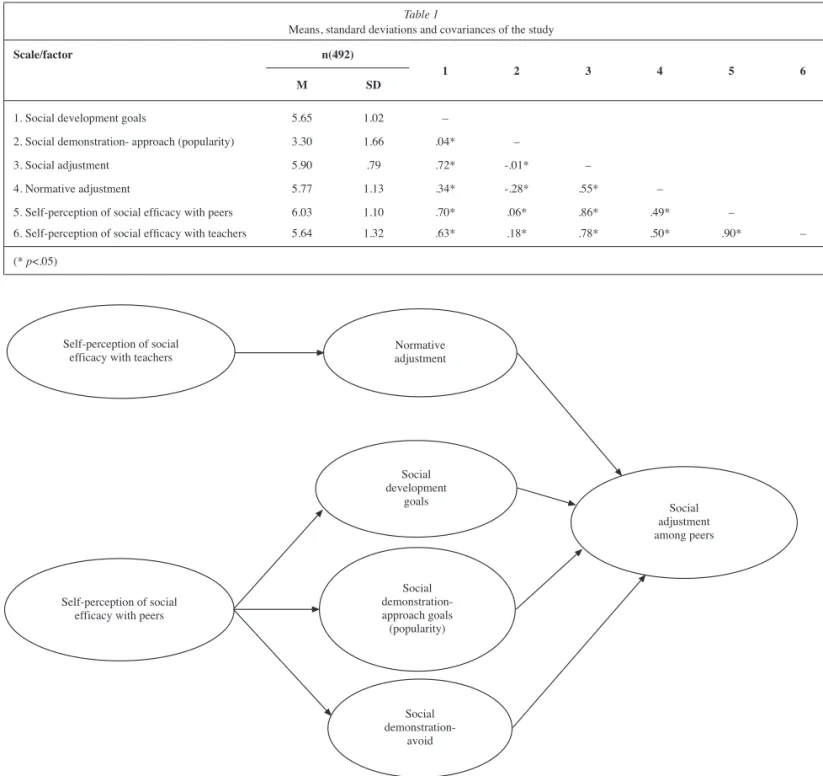
The analysis of covariance revealed a strong relationship between self-perception of social effi cacy with peers and self-perception of social effi cacy with teachers, and both with SoA and SDevG. NorA showed a moderate covariance with SoA and self-perception of social effi cacy with peers and teachers. Weak covariances were also obtained between self-perception of social effi cacy with peers and SPopG and SPopG with SDevG. A negative relationship was found between NorA and SPopG and SPopG with SoA (see Table 1).
We began with a hypothetical theoretical model in which self-perception of social effi cacy among peers has a direct infl uence on SoA mediated by SDevG, SPopG and SAvG. Moreover, the relationship between SoA and self-perception of social effi cacy with teachers was mediated by NorA (see Figure 2). Although this model explained a high percentage of the variance of SoA (82% error = .17), the fi t indices were not optimal (χ2 = 2047.66; χ2/290
= 7, p<.01; CFI = .94; NNFI = .94; RMSEA = .11).
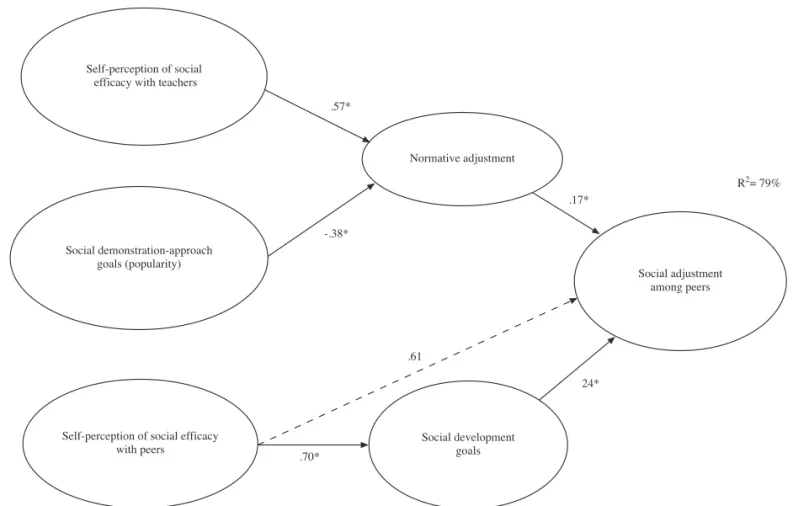
Considering the results of the previous model, we proceeded to eliminate the direct relationship between SAvG, SPopG and SoA given the low standardized weights. Given that the covariance analysis indicated a moderate relationship between SPopG and NorA, this relationship was included to generate an indirect infl uence between these goals and SoA. A direct relationship between self-perception of social effi cacy with peers and SoA was also included, in line with the fi ndings of the covariance analysis (see Figure 3).
The resulting model showed that self-perception of social effi cacy with peers (β= .61, p<.05), SDevG (β= .24, p<.05) and NorA (β= .17, p<.05) were the variables that had a direct infl uence on SoA. Self-perception of social effi cacy with peers showed an indirect infl uence on SoA through its relationship with SDevG (β = .70, p<.05). This relationship explained 49% of the variance of SDevG (error = .51).
Through their relationship with NorA, self-perception of social effi cacy with teachers (β= .57, p<.05) and SPopG (β= –.38, p<.05) had an indirect infl uence on SoA. These relationships explained 39% of the variance of NorA (error = .61).
These direct and indirect relationships explained 79% of the variance of SoA among peers (error = .21). The indices obtained for the fi nal SEM model showed an adequate fi t (χ2 = 807.81;
Discussion
The fi rst objective was to validate the Spanish version of the Social Achievement Goal Scale of Ryan and Shim (2006). The psychometric analysis confi rmed the original three-factor structure of the scale: social development, social demonstration-approach and social demonstration-avoid. The validation permits
having an instrument with recognized validity and optimal psychometric properties that has been translated and adapted to the Spanish school setting to facilitate the inclusion of social goals as an important dimension of the social life of students and hence their impact on coexistence and the school climate.
The second objective sought to determine the relationships of infl uence of social goals, normative adjustment and
self-En general me esfuerzo por desarrollar mis habilidades interpersonales (es decir, las habilidades que me permiten relacionarme mejor con las personas) [In general, I strive to develop my interpersonal skills]
Me gusta tener amigos que promuevan que yo aprenda más cosas sobre sí mismo [I like friendships that challenge me to learn new things about myself]
Me siento exitoso cuando aprendo algo nuevo sobre cómo relacionarme mejor con los demás [I feel successful when I learn something new about how I relate to other people]
Es importante para mí mejorar la calidad de mis relaciones con mis amigos [It is important to me to work on improving the quality of my relationships with my friends]
Es importante para mí tener amigos “guays” [It is important to me to have “cool” friends]
Yo quiero ser amigo de los chicos y chicas populares [I want to be friends with “popular” people]
Es importante para mí que otros piensen que soy popular [It is important to me that others think of me as popular]
Es importante para mí ser visto con muchos amigos [It is important to me to be seen as having a lot of friends]
Mi meta es evitar hacer cosas que puedan causar que otros se rían de mí [My goal is to avoid doing things that would cause others to make fun of me]
Me sentiría exitoso si pudiera evitar ser socialmente torpe [I would be successful if I could avoid being socially awkward]
En las situaciones sociales me siento exitoso si puedo evitar que los demás piensen que soy un “friki” o “bicho raro” [In social situations, I feel successful if I manage to avoid having others think I am a geek]
Intento no meter la pata cuando estoy fuera de casa con gente [I try not to goof up when I am out with people]
.57
.42
.38
.49
.32
.14
.14
.16
.37
.53
.45
.55
Metas de desarrollo [social development goals]
Metas de popularidad [social demonstration-approach goals]
Metas de evitación [social
demonstration-avoid goals] .65*
.76*
.79*
.71*
.83*
.93*
.93*
.92*
.79*
.69*
.74*
.67*
perception of social effi cacy on social adjustment among peers. In this regard, the resulting model revealed that social development goals have a direct infl uence on social adjustment among peers. Engaging in positive motivational behaviour based on this type of social goals appears to encourage attitudes of respect, acceptance, mutual support and overall social competence (Hulleman et al., 2010; Ryan, Kiefer, & Hopkins, 2004), key aspects in improving the quality of relationships between peers (Wentzel, 2010).
Normative adjustment was also found to have a direct infl uence on social adjustment among peers, thus indicating that the positive endorsement of classroom norms and academic tasks and activities by students favoured interaction processes (Day, Hamm, Lambert, & Farmer, 2014). This result highlights the importance of behavioural norms that not only regulate the common conduct
related to academic tasks, but also support the quality of peer relationships (Bowker & Spencer, 2010).
The fi nal model indicated that there was an indirect relationship between self-perception of social effi cacywith peers and social adjustment through social development goals. This suggests that a positive perception of oneself as a social agent is associated with an optimal attitude that motivates the search for better performance with peers (Ryan & Shim, 2006). It could therefore be assumed that confi dence in one’s ability to have successful relationships will garner positive feedback when one has social development goals, in an equilibrium between individual cognitive elements and interactive or social elements (Caprara & Steca, 2005).
The results also showed that social demonstration-approaches (popularity) indirectly influence social adjustment through normative adjustment, on which they have a negative infl uence. Table 1
Means, standard deviations and covariances of the study
Scale/factor n(492)
1 2 3 4 5 6
M SD
1. Social development goals 5.65 1.02 –
2. Social demonstration- approach (popularity) 3.30 1.66 .04* –
3. Social adjustment 5.90 .79 .72* -.01* –
4. Normative adjustment 5.77 1.13 .34* -.28* .55* –
5. Self-perception of social effi cacy with peers 6.03 1.10 .70* .06* .86* .49* –
6. Self-perception of social effi cacy with teachers 5.64 1.32 .63* .18* .78* .50* .90* –
(* p<.05)
Normative adjustment
Social development
goals
Social demonstration-approach goals (popularity)
Social
demonstration-avoid
Social adjustment among peers Self-perception of social
efficacy with teachers
Self-perception of social efficacy with peers
This suggests that, from the perspective of students, achieving notoriety or popularity forms part of social adjustment (Ryan & Shim, 2008), but these goals are not always consistent with classroom or institutional norms (Day et al., 2014). As social demonstration-approaches (popularity) are related to maladaptive behaviours, aggression and increased moral disengagement, as the model has shown, normative adjustment must mediate to benefi t peer relationships (Rudolph, Abaied, Flynn, Sugimura, & Agoston, 2011).
As hypothesized, self-perception of social effi cacy with teachers had a direct infl uence on social adjustment through normative adjustment. This suggests that teachers do not exert a signifi cant infl uence on the interpersonal relations of peers, or that the relations among peers respond to other patterns and dynamics that do not wholly involve teachers and other adults (Hughes & Kwok, 2006; Ortega & Mora-Merchán, 2008; Ryan & Shim, 2008).
The fi nal model showed no relationship between social demonstration-avoid and social adjustment, suggesting that social objectives designed to prevent criticism and failed relationships with others are not involved in establishing quality relationships. This is consistent with studies that associate such behaviour with social isolation and anxiety, which undermine and prevent the formation of positive peer interactions (Elliot & Dweck, 2005; Ryan & Shim, 2008).
The results and analysis provide elements for designing educational programmes aimed at improving the school climate and coexistence. Although there is a tendency to work on improving
certain social skills, such as empathy and assertiveness, our fi ndings underline the need to strengthen the acquisition of social development goals, self-confi dence in social performance, and adherence to norms to benefi t interpersonal relationships among students. The study also refl ects the need to delve deeper into the role of teachers in building stronger interpersonal relationships with students.
The limitations of the study arise from the transversal nature of the analysis, which to some extent restricts causal inferences and constrains the interpretation of the directionality of the relationship. It would therefore be desirable to develop longitudinal studies to strengthen the predictive model. Another limitation is the use of disaggregated items to measure self-perceived satisfaction with social performance. In a future line of research it would be of interest to focus on the relationship with teachers in greater depth.
Acknowledgements
This work was produced as part of the project “Estudio de la competencia para la gestión de la vida social y su estabilidad en estudiantes de Primaria y Secundaria en Andalucía”, funded by Andalusian Centre of Studies (PRY040/14) (Ministry of the Presidency, Andalusian Community). And “Sexting, ciberbullying y riesgos emergentes en la red: claves para su comprensión y respuesta educativa (EDU2013-44627-P), funded by the National Research Plan I+D”.
Self-perception of social efficacy with peers Social demonstration-approach
goals (popularity) Self-perception of social
efficacy with teachers
Social development goals
Social adjustment among peers Normative adjustment
.57*
-.38*
.17*
R2= 79%
24*
.70*
.61
Bollen, K. A., & Ting, K. (2000): “A tetrad test for causal indicators”.
Psychological Methods, 5, 3-22.
Bowker, J. C., & Spencer, S. V. (2010). Friendship and adjustment: A focus on mixed-grade friendships. Journal of Youth and Adolescence, 39, 1318-1329.
Brislin, R. W. (1986). The wording and translation of research instruments. In W. Lonner & J. Berry (Eds.), Field methods in cross-cultural research (pp. 137-164). Beverly Hills, CA: Sage.
Bryant, F. B., & Satorra, A. (2012). Principles and practice of scaled difference Chi-Square testing. Structural Equation Modeling: A Multidisciplinary Journal, 19, 372-398.
Buhrmester, D., Furman, W., Wittenberg, M., & Reis, H. (1988). Five domains of interpersonal competence in peer relationships. Journal of Personality and Social Psychology, 55, 991-1008.
Byrne, B. (2014). Structural Equation Modeling with Lisrel, Prelis, and Simplis: Basic Concepts, Applications, and Programming (Multivariate Applications Series) (Reprint Edition). New Jersey: Psychology Press.
Caprara, G. V., & Steca, P. (2005). Effective and social self-regulatory effi cacy beliefs as determinants of positive thinking and happiness.
European Psychologist, 10, 275-286.
Carmines, E., & McIver, J. (1981). Analyzing models with unobserved variables. In G. Bohrnstedt & E. Borgatta (Eds.), Social measurement: Current issues (pp. 65-115). Beverly Hills, CA: Sage.
Casas, J., Del Rey, R., & Ortega-Ruiz, R. (2013). Bullying and cyberbullying: Convergent and divergent predictor variables. Computers in Human Behavior, 29, 580-587.
Coffman, D., & MacCallum, R. (2005). Using parcels to convert path analysis models into latent variable models. Multivariate Behavioral Research, 40, 235-259.
Connolly, J. (1989). Social self-effi cacy in adolescence: Relations with self-concept, social adjustment, and mental health. Canadian Journal of Behavioral Science, 21, 258-269.
Dan O., Ilan, O. B., & Kurman, J. (2014). Attachment, self-esteem and test anxiety in adolescence and early adulthood. Educational Psychology,
34, 659-673.
Day, K., Hamm, J., Lambert, K., & Farmer, T. (2014). Social integration and students’ perceptions of the transition to middle school. Journal of Educational and Developmental Psychology, 4, 10-26.
Del Rey, R., Casas, J. A., & Ortega, R. (in press). Development and validation of Schoolwide Climate Scale. The Journal of Early Adolescence.
Dupont, S., Galand, B., Nils, F., & Hospel, V. (2014). Social Context, Self-perceptions and Student Engagement: A SEM investigation of the self-system model of motivational development (SSMMD). Electronic Journal of Research in Educational Psychology,12, 5-32.
Elliot, A. J., & Dweck, C. (2005). Handbook of competence and motivation. New York: Guilford Press.
Elousa-Oliden P., & Zumbo, B. D. (2008). Coefi cientes de fi abilidad para escalas de respuesta categórica ordenada [Reliability coeffi cients for ordered categorical response scales]. Psicothema, 20, 896-901. Flora, D. V., & Curran, P. J. (2004). An empirical evaluation of alternative
methods of estimation for confi rmatory factor analysis with ordinal data. Psychological Methods,9, 466-491.
Fuentes, M. C., García, J. F., Gracia, E., & Lila, M. (2011). Autoconcepto y ajuste psicosocial en la adolescencia [Self-concept and psychosocial adjustment in adolescence]. Psicothema, 23, 7-12.
Gifford-Smith, M. E., & Brownell, C. A. (2003). Childhood peer relationships: Social acceptance, friendships, and social network.
Journal of School Psychology, 41, 235-284.
Gilman, R., & Anderman, E. M. (2006). The relationship between relative levels of motivation and intrapersonal, interpersonal, and academic functioning among older adolescents. Journal of School Psychology,
44, 375-391.
Gutiérrez, S. M., Escarti, C. A., & Pascual, B. C. (2011). Relaciones entre empatía, conducta prosocial, agresividad, autoefi cacia y responsabilidad personal y social de los escolares [Relations between empathy, prosocial behavior, aggression, self-effi cacy and personal and social responsibility of school]. Psicothema, 23, 13-19.
Hamm, J. V., & Faircloth, B. S. (2005). The role of friendship in adolescents’ sense of school belonging. New Directions for Child and Adolescent Development, 107, 61-78.
Hartup, W. W. (2005). Peer interaction: What causes what? Journal of Abnormal Child Psychology, 33, 387-394.
Hughes, J. N., & Kwok, O. (2006). Classroom engagement mediates the effect of teacher-student support on elementary students’ peer acceptance: A prospective analysis. Journal of School Psychology, 43, 465-480. Hulleman C. S., Schrager, S. M., Bodmann, S. M., & Harackiewicz, J.
M. (2010). A meta-analytic review of achievement goal measures: Different labels for the same constructs or different constructs with similar labels? Psychological Bulletin, 136, 422-449.
Jarvin, C. B., Mackenzie, S. B., & Podsakoff, P. M. (2003). A critical review of construct indicators and measurement model misspecifi cation in marketing research. Journal of Consumer Research, 30, 199-218. Jolliffe, D., & Farrington, D. P. (2006). Development and validation of the
Basic Empathy Scale. Journal of Adolescence, 29, 589-611.
Jöreskog, K. G., & Sörbom, D. (2012). LISREL 9.1 [Computer software].
Lincolnwood, IL: Scientifi c Software International.
Lorenzo-Seva, U., & Ferrando, P. J. (2006). FACTOR: A computer program to fi t the exploratory factor analysis model. Behavioral Research Methods, Instruments and Computers, 38, 88-91.
McGloin, J. M., Sullivan, C. J., & Thomas, K. J. (2014). Peer infl uence and context: The interdependence of friendship groups, schoolmates and network density in predicting substance use. Journal of Youth and Adolescence, 43, 1436-1452.
Montero, I., & León, O. G. (2007). Guía para nombrar los estudios de investigación en Psicología [Guide for naming research studies in Psychology]. International Journal of Clinical and Health Psychology, 7, 847-862.
Moreno, J. A., Parra, N., & González-Cutre, C. (2008). Infl uencia del apoyo a la autonomía, las metas sociales y la relación con los demás sobre la desmotivación en educación física [Infl uence of autonomy support, social goals and the relationship with others on demotivation in physical education]. Psicothema, 20, 636-641.
Mouratidis, A., & Sideridis, G. D. (2009). On social achievement goals: Their relations with peer acceptance, classroom belongingness, and perceptions of loneliness. The Journal of Experimental Education, 77, 285-307.
Ortega, R., & Mora-Merchan, J. (2008). Las redes de iguales y el fenómeno del acoso escolar: explorando el esquema dominio-sumisión [Peer networks and the bullying phenomenon: Exploring the dominance-submission scheme]. Infancia y Aprendizaje,31, 515-528.
Pozzoli, T., Gini, G., & Vieno, A. (2012). The role of individual correlates and class norms in defending and passive bystanding behavior in bullying: A multilevel analysis. Child Development, 83, 1917-1931. Rial, A., Varela, J., Braña, T., & Lévy, J-P. (2000). El valor de la marca
a partir de su relación con el consumidor [The brand value from its relationship with the consumer]. Psicothema, 12, 247-254.
Rodebaugh, T. L. (2009). Self-effi cacy and social behavior. Behaviour Research and Therapy, 44, 1831-1838.
Rodkin, P. C., & Ryan, A. M. (2012). Child and adolescent peer relations in educational context. In K. R. Harris, S. Graham & T. Urdan (Eds.),
APA education psychology handbook: Individual differences and cultural and contextual factors (Vol. 2, pp. 363-389).Washington, D.C.: American Psychological Association.
Rodkin, P., Ryan, A., Jamison R., & Wilson T., (2013). Social goals, social behavior, and social status in middle childhood. Developmental Psychology, 49, 1139-1150.
Rose-Krasnor, L. (1997). The nature of social competence: A theoretical review. Social Development, 6, 111-135.
Rudolph, K. D., Abaied, J. L., Flynn, M., Sugimura, N., & Agoston, A. N. (2011). Developing relationships, being cool, and not looking like a loser: Social goal orientation predicts children’s responses to peer aggression. Child Development, 82, 1518-1530.
Ryan, A. M., Kiefer, S. M., & Hopkins, N. B. (2004). Young adolescents’ social motivation: An achievement goal perspective. In P. R. Pintrich & M. L. Maehr (Eds.), Advances in motivation and Achievement (Vol. 13, pp. 301-330). Greenwich, CT: Jai Press.
Ryan, A. M., & Shim, S. S. (2006). Social achievement goals: The nature and consequences of different orientations toward social competence.
Personality and Social Psychology Bulletin, 32, 1246-1263.
Ryan, A. M., & Shim, S. S. (2008). An exploration of young adolescents’ social achievement goals and social adjustment in middle school.
Journal of Educational Psychology, 100, 672-687.
Smithyman, T., Fyreman, G., & Asher Y. (2014). Long-term psychosocial consequences of peer victimization: From elementary to High School.
School Psychology Quarterly. American Psychological Association, 29, 64-76.