Research, theorizing, and practical applications of organization justice (OJ) have been rising signifi cantly in the last thirty years. OJ is a construct introduced by Greenberg (1987) to refer to people’s perceptions of fairness in organizations. Specifi cally, it is concerned with the ways in which employees determine whether they have been treated fairly in their jobs and the ways in which these determinations infl uence other work-related variables. This conceptualization of justice focuses on justice not as it should be (Greenberg, Bies, & Eskew, 1991), but as it is perceived by individuals. In this sense, understanding matters of justice requires an understanding of what people perceive to be fair. This descriptive orientation has been of keen interest for scientists from many disciplines (Cohen, 1986).
One reason for the increase of interest in OJ is that it is an important predictor of different work attitudes and behaviors (Cropanzano, Byrne, Bobocel, & Rupp, 2001). Meta-analytic fi ndings linking justice perceptions to work attitudes and performance have fuelled widespread interests in applying justice interventions to improve effectiveness in organizations (Cohen-Charash & Spector, 2001; Colquitt et al., 2013).
Research has shown that employees’ perceptions of fairness are positively related to organizational commitment (DeConick, 2010), perceived organizational support (Cohen-Charash & Spector, 2001), leader-member exchange (Colquitt et al., 2013), task performance (Masterson, Lewis, Goldman, & Taylor, 2000), trust (DeConick, 2010), organizational citizenship behavior (Colquitt et al., 2013), and job satisfaction (Patlán-Pérez, Martínez, & Hernández, 2012).
On the other hand, justice perceptions are negatively related to turnover intentions (Folger & Cropanzano, 1998), counterproductive work behaviors (Bechtoldt, Welk, Hartig, & Zaph, 2007), absenteeism (De Boer, Bakker, Syroit, & Schaufeli, 2002), burnout (Liljegren & Ekberg, 2009), and different forms of workplace aggression (Hershcovis et al., 2007).
Spanish version of Colquitt’s Organizational Justice Scale
Liliana Díaz-Gracia
1, Claudio Barbaranelli
2and Bernardo Moreno-Jiménez
11 Universidad Autónoma de Madrid and 2 Università degli Studi di Roma “La Sapienza”
Abstract
Resumen
Background: Organizational justice (OJ) is an important predictor of different work attitudes and behaviors. Colquitt’s Organizational Justice Scale (COJS) was designed to assess employees’ perceptions of fairness. This scale has four dimensions: distributive, procedural, informational, and interpersonal justice. The objective of this study is to validate it in a Spanish sample. Method: The scale was administered to 460 Spanish employees from the service sector. 40.4% were men and 59.6% women. Results: The Confi rmatory Factor Analysis (CFA) supported the four dimensions structure for Spanish version of COJS. This model showed a better fi t to data that the others models tested. Cronbach’s alpha obtained for subscales ranged between .88 and .95. Correlations of the Spanish version of COJS with measures of incivility and job satisfaction were statistically signifi cant and had a moderate to high magnitude, indicating a reasonable degree of construct validity. Conclusions: The Spanish version of COJS has adequate psychometric properties and may be of value in assessing OJ in Spanish setting.
Keywords: Organizational Justice Scale, Spanish validation, confi rmatory factor analysis, work incivility, job satisfaction, service sector.
Versión española de la Escala de Justicia Organizacional de Colquitt.
Antecedentes: la justicia organizacional (JO) es un predictor importante de diferentes actitudes y conductas organizacionales. La Escala de Justicia Organizacional de Colquitt (EJOC) fue desarrollada para evaluar las percepciones de justicia de los empleados. Tiene cuatro dimensiones: justicia distributiva, procedimental, informativa e interpersonal. El objetivo de este estudio es validarla en una muestra española. Método: la escala fue administrada a una muestra de 460 trabajadores españoles del sector servicios. El 40,4% fueron hombres y el 59,6% mujeres. Resultados: el Análisis Factorial Confi rmatorio (AFC) apoyó la estructura de cuatro dimensiones para la versión española de la EJOC. Este modelo mostró un mejor ajuste de los datos que los otros modelos probados. El alfa de Cronbach obtenido para las subescalas varió entre .88 y .95. Las correlaciones de la versión española con las escalas de incivismo y satisfacción laboral fueron estadísticamente signifi cativas y de una magnitud moderada a alta, lo que indica un grado razonable de validez de constructo. Conclusiones: la versión española de la EJOC tiene propiedades psicométricas adecuadas y puede ser de utilidad en la evaluación de la JO en el entorno español.
Palabras clave: Escala de Justicia Organizacional, validación española, análisis factorial confi rmatorio, incivismo laboral, satisfacción laboral, sector servicios.
Received: May 13, 2014 • Accepted: September 5, 2014 Corresponding author: Liliana Díaz-Gracia
Facultad de Psicología Universidad Autónoma de Madrid 28049 Madrid (Spain)
There are many classifi cations concerning the dimensions of OJ. Initially, research focused on distributive justice (DJ), which describes the fairness of the outcomes an employee receives, especially the degree to which outcomes are equitable (Adams, 1965). In the mid-seventies, some researchers took a step forward considering procedural justice (PJ), which refl ects the perceived fairness of decision-making processes and the degree to which they are consistent, accurate, and ethical (Leventhal, 1980). PJ is fostered through voice during a decision-making process or infl uence over the outcome (Thibaut & Walker, 1975). Subsequently, the interactional justice concept was introduced, defi ned as the interpersonal treatment people receive as procedures are enacted (Bies & Moag, 1986). Interactional justice has been shown to comprise two distinct components: informational justice (INFJ), the perceived adequacy of explanations for decision processes and outcomes, and interpersonal justice (INTJ), the perceived degree of dignity and respect shown by authorities (Greenberg, 1993).
Various measurement scales of OJ have been developed, among others: DJ (Price & Mueller, 1986), PJ and DJ (Konovsky, Folger, & Cropanzano, 1987), PJ and INTJ (Moorman, 1991), Interactional Justice (Aquino, 1995).
Colquitt (2001) explored the theoretic dimensions of justice, based on the four-factor structure suggested by Greenberg (1993), validating a new OJ measure: Colquitt’s Organizational Justice Scale (COJS). He compared multiple a priori factor structures, including one-factor, two-factor, three factor, and four-factor conceptualizations in two independent studies, one in a university setting, and the other in a fi eld setting. Confi rmatory factor analysis (CFA) illustrated that the best fi tting model was the four-factor model and the worst was the one-four-factor model. These results suggest that OJ is best conceptualized as four distinct dimensions: DJ, PJ, INTJ, and INFJ.
Currently, COJS is one of the most widely used OJ scales in English-speaking countries (Maharee-Lawler, Rodwell, & Noblet, 2010). However, validations of this scale in Spanish-speaking countries have not been found, except for a Chilean and an Argentinian adaptation, neither of them published in scientifi c journals (Mladinic, 2002; Omar, Oggero, Maltaneres, & Paris, 2003).
In Spain, the only available measurement of OJ (Moliner, Martínez-Tur, & Carbonell, 2003; Moliner, Martínez-Tur, Peiró, Ramos, & Cropanzano, 2008) used items from different OJ scales. However, there are no specifi c adaptations of Colquitt’s scale. It is important to validate the COJS in our context, taking into account its relevance and its international use to measure OJ in work and organizational psychology research. Its theoretical bases as well as its psychometric characteristics in U.S. samples are excellent.
Therefore, the purpose of the present research is to analyze the psychometric properties of the Spanish version of COJS in a sample of Spanish employees from service sector.
Method
Participants
Participants were 460 Spanish employees in different companies and organizations from the service sector (commerce, tourism, hotel industry, information technology, transport, business services, gaming, real estate, fi nancial, health and social services). Distribution by sex for the whole sample amounted to 185 men
(40.4%), and 273 women (59.6%). Mean age was 35 years (SD = 11.13); the age of the entire sample ranged from 18 to 67 years old. The majority of the respondents lived with a partner (52.2%) and did not have children (60.07%). In terms of their level of education, the majority had a university degree (44.3%), followed by workers with high school education (27.6%). Regarding their occupational characteristics, 79.6% held subordinate positions, and 20.4% had supervisory responsibilities; 69.8% had permanent contracts, and 30.2% had temporary contracts. Most workers had a compressed work schedule (37.4%), followed by workers with a split shift (35.3%); the majority worked 40 hours per week in companies with more of 250 employees (51.1%). Within the service sector, the majority worked in business service (28.6%), followed by commercial activities (23.7%).
Missing data on COJS items were about 8%, and 5% with only one item missing, 1.8% with 2 to 4 missing items, and 1.8% with more than 8 missing items. These participants were excluded from the analyses. Items with missing values were substituted with the item mean before conducting the analysis with Mplus.
Instruments
The Spanish Version of Colquitt’s Organizational Justice Scale. This is based on Colquitt’s four-dimensional measure that includes: DJ (four items), PJ (seven items), INTJ (four items), and INFJ (fi ve items) (see Table 1). Response options are delivered on a Likert scale ranging from 1 (to a small extent) to 5 (to a large extent), with higher scores indicating a higher level of perceived OJ. The psychometric characteristics of the original scales, as far as the factorial structure is concerned, were examined in two different samples, one composed of 301 university students and the other of 337 employees in a fi eld setting, where a four-factor model was confi rmed in both samples as the best fi tting one. The subscales obtained reliability indices for DJ, PJ, INTJ, and INF, respectively, in the university and in the fi eld samples: .92, .78, .79, .79, and .93, .93, .92, and .90 (Colquitt, 2001).
Workplace Incivility Scale (Cortina, Magley, Williams, & Langhout, 2001). This scale was used to measure the frequency of participants’ experiences of incivility (e.g., disrespect, rudeness). The questionnaire consists of 7 items with a fi ve-point Likert-type scale (ranging from 0 to 4). Sample items include “put you down or was condescending to you” and “made demeaning or derogatory remarks about you”. The original scale obtained an internal consistency of .89. A Spanish adaptation of the scale was done for this study, taking into account the general rules of translation and test adaptation (Hambleton, Merenda, & Spielberger, 2005). The Spanish version obtained satisfactory internal consistency of .92.
Procedure
The fi rst step in data collection was to contact different associations and companies from the service sector, inviting them to participate in the research project. Thereafter, meetings were held with company delegates to outline the objectives of the study. Once they agreed to participate in the study, the protocols were provided, including a presentation letter, an informed consent letter, a questionnaire with instructions to complete it, and an envelope to send it back to the researchers. Participation was voluntary (all participants signed the informed consent), and all information received was confi dential.
The adaptation of the COJS to Spanish was done taking into account the international methodological standards recommended by the ITC when adapting an instrument to a foreign language (Hambleton et al., 2005; Muñiz & Bartram, 2007). The COJS was fi rstly translated into Spanish by two translators who were fl uent in Spanish and English. The translations were discussed with seven experts, and some corrections were made. The back translation was conducted by two bilingual professors with no previous knowledge of the scale. This back-translated version was compared with the original English version. A pilot study was carried out with 30 employees from the service sector to evaluate the language forms and ensure a proper understanding of the scale.
Data analysis
Statistical analysis was conducted using SPSS 19.0 and Mplus 7.1 software. Descriptive statistics of every item were calculated.
Dimensionality or factorial structure was studied by means of CFA. Maximum likelihood robust estimators were used from the Mplus 7.1 software (Muthén & Muthén, 1998-2013) due to the presence of non-negligible skewness in some items (see the results section). Following Colquitt (2001), four different CFA were explored: (a) a one-factor model, in which all justice items were indicative of a general OJ factor; (b) a two-factor model—DJ and PJ—, with PJ subsuming INFJ and INTJ; (c) a three-factor model—DJ, PJ, and INTJ (subsuming both INFJ and INTJ); (d) a four-factor version corresponding to the four dimensions of OJ conceptualized by Colquitt (2001).
Based on Hoyle’s (1995) recommendations, and according to a multifaceted approach to the assessment of tmodel fi t (Tanaka, 1993), we considered the following goodness of fi t indices: (a) incremental fi t indices comparing the model of interest with a null or independence model (Bentler, 1990), such as Comparative fi t index (CFI), and Tucker and Lewis index (TLI): values of .90 to .95 indicating acceptable fi t and values above .95 indicating good fi t (Hu & Bentler, 1999); (b) root mean square error of approximation (RMSEA), which estimates lack of model fi t
Table 1
Spanish version of Colquitt’s Organizational Justice Scale
Justicia distributiva [DJ]
Las siguientes preguntas hacen referencia a las recompensas (ej., aumentos de salario, ascensos, reconocimiento, etc.) que como empleado has recibido. Hasta qué punto: [The following items refer to your outcome. To what extent:]
1. ¿Tus recompensas refl ejan el esfuerzo que has puesto en tu trabajo? [Does your outcome refl ect the effort you have put into your work?] 2. ¿Tus recompensas son apropiadas para el trabajo que has terminado? [Is your outcome appropriate for the work you have completed?] 3. ¿Tus recompensas refl ejan que has contribuido a la organización? [Does your outcome refl ect what you have contributed to the organization?] 4. ¿Tus recompensas son justas teniendo en cuenta tu desempeño? [Is your outcome justifi ed, given your performance?]
Justicia procedimental [PJ]
Las siguientes preguntas hacen referencia a los procedimientos o criterios utilizados para alcanzar tus recompensas (ej., logro de objetivos, esfuerzo, horas trabajadas, etc.). Hasta qué punto: [The following items refer to the procedures used to arrive at your outcome. To what extent:]
1. ¿Has sido capaz de expresar tus puntos de vista y sentimientos ante los procedimientos utilizados para dar recompensas? [Have you been able to express your views and feelings during those procedures?]
2. ¿Has tenido infl uencia sobre las recompensas obtenidas a partir de dichos procedimientos? [Have you had infl uence over the outcome arrived at by those procedures?] 3. ¿Los procedimientos para dar recompensas han sido aplicados consistentemente (de la misma manera a todos los empleados)? [Have those procedures been applied consistently?] 4. ¿Los procedimientos para dar recompensas han sido aplicados de manera neutral (sin prejuicios)? [Have those procedures been free of bias?]
5. ¿Los procedimientos para dar recompensas se han basado en información precisa? [Have those procedures been based on accurate information?]
6. ¿Has sido capaz de solicitar las recompensas laborales que mereces según dichos procedimientos? [Have you been able to appeal the outcome arrived at by those procedures?] 7. ¿Los procedimientos para dar recompensas se han basado en estándares éticos y morales? [Have those procedures upheld ethical and moral standards?]
Justicia interpersonal [INTJ]
Las siguientes preguntas hacen referencia a tu jefe o supervisor (quien establece los procedimientos). Hasta qué punto: [The following items refer to (the authority fi gure who enacted the procedure). To what extent:]
1. ¿Te ha tratado de manera educada? [Has (he/she) treated you in a polite manner?] 2. ¿Te ha tratado con dignidad? [Has (he/she) treated you with dignity?] 3. ¿Te ha tratado con respeto? [Has (he/she) treated you with respect?]
4. ¿Ha evitado chistes o comentarios inapropiados? [Has (he/she) refrained from improper remarks or comments?]
Justicia informativa [INFJ]
Las siguientes preguntas hacen referencia a tu jefe o supervisor (quien establece los procedimientos). Hasta qué punto [The following items refer to (the authority fi gure who enacted the procedure). To what extent:]
1. ¿Ha sido sincero en la comunicación contigo? [Has (he/she) been candid in (his/her) communications with you?]
2. ¿Te ha explicado detalladamente los procedimientos que utilizará para recompensarte por tu trabajo? [Has (he/she) explained the procedures throughly?] 3. ¿Las explicaciones con respecto a los procedimientos para recompensarte han sido razonables? [Were (his/her) explanations regarding the procedures reasonable?] 4. ¿Te ha comunicado detalles relacionados con tu trabajo de manera oportuna? [Has (he/she) communicated details in a timely manner?]
5. ¿Parece que tiene en cuenta las necesidades específi cas de los empleados para comunicarse con ellos? [Has (he/she) seemed to tailor (his/her) communications to individuals’ specifi c needs?]
and compensates for model complexity: values of .05 or lower indicate a well-fi tting model, .05 to .08 indicate a moderate fi t, and .10 or greater indicate poor fi t (Browne & Cudeck, 1993); (c) standardized root mean square residual (SRMR), an index based on the residual covariance matrix, which assesses the discrepancy between observed and predicted covariances: values of .08 or lower indicate good fi t (Hu & Bentler, 1999).
Scale and item reliability were assessed by means of Cronbach’s alpha, item-total correlations and Cronbach’s alphas without the item, as well as with supplementary indices derived from CFA.
Finally, to explore concurrent validity, the four justice dimensions were correlated with the incivility scale and the dimensions of job satisfaction, and six multiple regression analyses were performed considering as predictors the four COJS subscales, and as dependent variables the incivility and job satisfaction scales.
Results
Item analysis
Regarding the distributional properties of the 20 items, means ranged from 1.95 to 3.76 (M = 2.69, SD = 0.59), standard deviations ranged from 1.09 to 1.34 (M = 1.21, SD = 0.08), skewness ranged from -0.85 to 0.97 (M = 0.13, SD = 0.56), and kurtosis ranged from -1.21 to 0.1 (M = -0.71, SD = 0.41). Values of skewness and kurtosis were comprised between -1 and 1 (with the sole exception of INFJ, where kurtosis values exceeded -1, but were far below -2). Hence, there was evidence of deviation from the normal distribution. However, all the DJ and PJ items showed some fl oor effects, with percentages of responses in the lower response category exceeding 15%, whereas all the INTJ items showed some ceiling effect, with percentages of responses in the higher response category exceeding 15%. The INFJ items did not reveal either of these effects. Due to the opposite direction of these effects, we believe that they refl ect the perceptions of OJ in the organizations considered in this study, rather than an artifact due to the utterances used to defi ne the response format anchors.
Analysis of scale dimensionality
Table 2 displays the fi t indices of the four CFA models testing the dimensionality or factor structure of COJS. These results show that the models positing one, two, or three factors showed inadequate fi t indices (Hu & Bentler, 1999). Comparatively, the best fi tting model was the one positing four factors: however, while the values of the fi t indices for this model were generally
acceptable, they revealed an imperfect fi t. Interestingly, these values were fairly similar to those reported in the original study (Colquitt, 2001, Table 2). To examine the possible sources of miss-fi t, model modifi cation indices (MI) were examined: model fi t would have improved, especially if some covariances among residuals had been estimated and, in particular, those regarding some PJ items (1-2, 3-4, 3-6) and INFJ items (2-3). There are, however, neither methodological nor theoretical reasons to include these covariances in the model; in fact, their inclusion would render model results less generalizable and more dependent on the specifi city of the sample from which they were obtained.
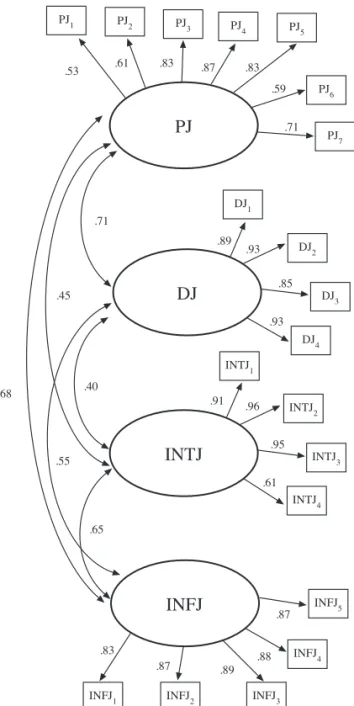
Figure 1 presents factor loading estimates derived from the Mplus completely standardized solution. All factor loadings were statistically signifi cant and far above .50. Moreover, the average variance extracted (AVE) was 52% for PJ and above 70% for the
Table 2
Goodness of fi t indices for the tested models
χ2 df TLI CFI RMSEA SRMR
1-factor 2,015.79 170 .52 .57 .15 .12
2-factor 1,434.89 169 .67 .71 .13 .12
3-factor 0, 995.68 167 .78 .81 .10 .07
4-factor 0, 412.07 164 .93 .94 .06 .05
Note:TLI = Tucker and Lewis index; CFI = comparative fi t index; RMSEA = root mean square error of approximation; SRMR = standardized root mean square residual. All chi-squares were statistically signifi cant at p<.001
PJ1 PJ2 PJ3 PJ4 PJ5
PJ6
PJ7
DJ1
DJ2
DJ3
DJ4
INTJ1
INTJ2
INTJ3
INTJ4
INFJ5
INFJ4
INFJ3 INFJ2
INFJ1
PJ
DJ
INTJ
INFJ
.53 .61 .83 .87 .83
.59
.71
.89 .93
.85
.93
.91 .96
.95
.61
.87
.88 .89 .87
.83 .65 .55
.40 .68
.45 .71
Figure 1. Factor loadings and factor correlations of the four-factor confi rmatory factor analysis model.
other three forms of justice and thus, far above the recommendations of Fornell and Larcker (1981). Factor correlations were generally very high, ranging from .40 (INTJ with DJ) to .71 (DJ with PJ). One may question whether these correlations are too high to guarantee adequate discriminant validity. Two results allow us to rebut this argument: (a) the factor model positing a unique justice factor fi ts the data worse than the model separating the four different forms of justice. This is also confi rmed when a fi fth model (aggregating only PJ and DJ) was performed. This model obtained the following fi t indices, which were worse than those of the four-factor model: χ2(167) = 750, RMSEA = .09, TLI = .86, CFI = .87, SRMR = .08; (b) the 99% confi dence interval estimate for the correlation between PJ and DJ does not include 1, as its upper and lower limits were, respectively .79 and .63.
The results obtained justify the factorial validity of the Spanish version of the instrument. Moreover, these results are fully comparable with those obtained by Colquitt (2001) both at the level of global fi t of the four-factor model and of the values of item factor loadings. Defi nitely, while convergent validity is confi rmed by strong correlations between the items of the scales and the latent variables that they were supposed to measure, discriminant validity is confi rmed by correlations between factors far below 1.
Reliability analysis
Reliability estimates were derived from the results of CFA as well as from traditional indices based on the classical test theory. Scale reliabilities were fairly high, considering both Cronbach’s alpha (with values of .88 for PJ, .95 for DJ, .91 for INTJ, and .94 for INFJ, thus far above the value of .70 recommended by Nunnally and Bernstein, 1994) and the composite reliability index (with values of .88 for PJ, .94 for DJ, .92 for INTJ, and .94 for INFJ, thus far above the .70 value recommended by Bagozzi and Yi, 2012). Each scale item contributed to the respective scales fairly well, with item reliability indicators (derived from CFA) ranging from .28 to .92 (M = .68, SD = .20) and item-total corrected correlations ranging from .56 to .89 (M = .78, SD = .11).
Concurrent validity
Concurrent validity of the Spanish version of COJS was examined through its relations with the work incivility and job satisfaction subscales. Table 3 presents zero-order correlations between the scales. In general, correlations were moderate (about |.30| or below), whereas higher correlations (about |.40| to |.50|) were those involving satisfaction with supervision and incivility. However, the high correlations among the four COJS subscales prevent us from disentangling more clearly which specifi c justice dimensions are uniquely associated with the incivility and satisfaction scales. To clarify this issue, six regression analyses were performed considering as predictors the four COJS subscales and as dependent variables incivility and satisfaction scales. Results of these analyses are presented in Table 3. Although signifi cantly correlated with all variables, PJ had no signifi cant unique effect on any of the variables, and its impact was mainly subsumed by the other forms of OJ, with which it had high correlations (see Figure 1). DJ was mainly related to satisfaction with pay (with a unique effect of about .40) and promotion (with a lower but signifi cant unique effect of about .30). INTJ was mainly related to satisfaction with supervision (with a unique contribution
of about .30), and incivility (with a unique contribution of about -.30). Finally, INFJ was mainly related to satisfaction with work and with supervision (with signifi cant unique effects of about .30), and incivility (with a unique contribution of about -.30). In general the variance explained by the four justice scales was lower as far as satisfaction with work, pay, promotion and coworker were concerned (from 13% to 21%), but higher for incivility (27%) and especially for satisfaction with supervision (41%).
Discussion
COJS is one of the most widely used OJ scales worldwide, with strong theoretical bases and proven psychometric properties in different countries (e.g., Colquitt, 2001; Olsen, Myrseth, Eidhamar, & Hystad, 2012). To our knowledge, despite the importance of this scale, no Spanish adaptations had been previously performed. Hence, the main purpose of the present study was to validate the Spanish version of COJS (Colquitt, 2001) in a Spanish sample.
Findings from this study confi rm its validity. Our results were consistent with those reported in previous studies (e.g., Colquitt, 2001; Olsen et al., 2012), which indicated a four-factor solution: DJ, PJ, INTJ, and INFJ. These aspects of OJ are separate but related. The present study showed that the Spanish COJS had satisfactory reliability. Although correlations between subscales were high, their distinctiveness was demonstrated.
Concurrent validity was established with moderate to high correlations with other reliable instruments developed to assess job satisfaction and work incivility. As expected, justice subscales showed signifi cant and positive associations with all fi ve subscales of job satisfaction (mainly supervision satisfaction), and negative associations with incivility. These results also observed in the study by Patlán-Pérez et al. (2012). Regression analyses indicated stronger relations between DJ and pay satisfaction, and between INTJ and INFJ and supervision satisfaction, as in previous studies (Masterson et al., 2000). In contrast, there are no relations between PJ and job satisfaction subscales, consistent with previous fi ndings, such as those of Cropanzano and Prehar (1999), who found that INTJ affected satisfaction with supervisor more than PJ.
Table 3
Results of regression and correlation analysis
PJ DJ INTJ INFJ R2 AR2
Work β
r -.05** -.22**
-.07** -.22**
-.08** -.26**
-.31*** -.35***
.14 .13
Pay β
r -.10** -.32**
-.37**
-.39** -.02** -.14**
-.05*** -.19***
.17 .16
Promotion β
r -.13** -.42**
-.27**
-.43**
-.04** -.25**
-.11*** -.35***
.22 .21
Supervision β
r -.06** -.45**
-.02** -.43**
-.26**
-.54**
-.34*** -.59***
.42 .41
Coworkers β
r -. 01** -.27**
-.12** -.28**
-.14** -.30**
-.21*** -.36***
.16 .14 Incivility β r -.03** -.33** -.02** -.29** -.27** -.46** -.30*** -.49*** .28 .27
Note:PJ = Procedural Justice, DJ = Distributive Justice, INTJ = Interpersonal Justice, INFJ = Informational Justice, AR2 = adjusted R2
Our study has several limitations. Firstly, as in any study using self-report measures, the results might be infl uenced by participants’ acquiescence and need for social desirability. Moreover, this sample is not representative of the general population, although it represents an important productive sector. Generalizations will require further studies which will also incorporate other occupational groups.
We believe there are a number of different research directions that can extend the results of our study. First, the Spanish adaptation of COJS presents adequate psychometric properties, which allow the use of the scale in Spanish-speaking samples. Second, as previously noted, scientifi c literature has pointed out
the importance of OJ perception, and the ways this perception infl uence other work-related variables like commitment, turnover intentions, task performance, counterproductive work behaviors, etc. (e.g., Bechtoldt et al., 2007; DeConick, 2010). Hence, the adaptation of the COJS to Spanish will allow researchers to study the association of this construct with different work attitudes and behaviors, as well as to use it in applied settings when OJ is an issue in Spanish work contexts. Finally, this adaptation of the COJS represents a tool that could allow more reliable research of justice perception in organizations. Moreover, it could help professionals, managers, and Human Resources departments to understand the impact of this variable on workers’ performance and well-being.
References
Adams, J.S. (1965). Inequity in social exchange. In L. Berkowitz (Ed.),
Advances in experimental social psychology (Vol. 2, pp. 267-299). New York, NY: Academic Press.
Aquino, K. (1995). Relationships among pay inequity, perceptions of procedural justice, and organizational citizenship. Employee Responsibilities and Rights Journal, 8, 21-33.
Bagozzi, R., & Yi, Y. (2012). Specifi cation, evaluation, and interpretation of structural equation models, Journal of the Academy of Marketing Science,40, 8-34.
Bechtoldt, M., Welk, C., Hartig, J., & Zaph, D. (2007). Main and moderating effects of self-control, organizational justice, and emotional labor on counterproductive behavior at work. European Journal of Work and Organizational Psychology, 16, 479-500.
Bentler, P. (1990). Comparative fi t indexes in structural models.
Psychological Bulletin, 107, 238-246.
Bies, R., & Moag, J. (1986). Interactional justice: Communication criteria of fairness. In B.H. Sheppard, R.J. Lewicki, & M.H. Bazerman (Eds.),
Research on negotiations in organizations (pp. 83-99). Greenwich, CT: JAI Press.
Browne, M., & Cudeck, R. (1993). Alternative ways of assessing model fi t. In K.A. Bollen & J.S. Long (Eds.), Testing structural equation models
(pp. 136-162). Beverly Hills, CA: Sage.
Cohen, R.L. (1986). Justice:Views from the social sciences. New York: Plenum.
Cohen-Charash, Y., & Spector, P. (2001). The role of justice in organizations: A meta-analysis. Organizational Behavior and Human Decision Processes, 86, 278-321.
Colquitt, J. (2001). On the dimensionality of organizational justice: A construct validation of a measure. Journal of Applied Psychology, 86, 386-400.
Colquitt, J., Scott, B., Rodell, J., Long, D., Zapata, C., Conlon, D., & Wesson, M. (2013). Justice at the millennium, a decade later: A meta-analytic test of social exchange and affect-based perspectives. Journal of Applied Psychology, 98, 199-236.
Cortina, L.M., Magley, V.J., Williams, J.H., & Langhout, R.D. (2001). Incivility in the workplace: Incidence and impact. Journal of Occupational Health Psychology, 6, 64-80.
Cropanzano, R., Byrne, Z.S., Bobocel, D., & Rupp, D. (2001). Moral virtues, fairness heuristics, social entities, and other denizens of organizational justice. Journal of Vocational Behavior, 58, 164-209. Cropanzano, R., & Prehar, C. (1999, April). Using social exchange theory
to distinguish procedural from interactional justice. Paper presented at the annual meeting of the Society for Industrial and Organizational Psychology, Atlanta, GA.
De Boer, E., Bakker, A., Syroit, S., & Schaufeli, W. (2002). Unfairness at work as a predictor of absenteeism. Journal of Organizational Behavior, 23, 181-197.
DeConick, J. (2010). The effect of organizational justice, perceived organizational support, and perceived supervisor support on marketing employees’ level of trust. Journal of Business Research, 63, 1349-1355.
Folger, R., & Cropanzano, R. (1998). Organizational justice and human resource management. Thousand Oaks, CA: Sage.
Fornell, C., & Larcker, D. (1981). Evaluating structural equation models with unobservable variables and measurement error. Journal of Marketing Research, 18, 39-50.
Greenberg, J. (1987). A taxonomy of organizational justice theories.
Academy of Management Review, 12, 9-22.
Greenberg, J. (1993). The social side of fairness: Interpersonal and informational classes of organizational justice. In R. Cropanzano (Ed.),
Justice in the workplace: Approaching fairness in human resource management (pp. 29-103). Hillsdale, NJ: Erlbaum.
Greenberg. J., Bies, R., & Eskew, D. (1991). Establishing fairness in the eye of the beholder: Managing impressions of organizational justice. In R. Giacalone & P. Rosenfeld (Eds.), Applied impression management: How image making affects managerial decisions (pp. 111-132). Newbury Park, CA: Sage.
Hambleton, R., Merenda, P., & Spielberger, C. (Eds.) (2005). Adapting educational and psychological tests for cross-cultural assessment. Hillsdale, NJ: Erlbaum.
Hershcovis, M., Turner, N., Barling, J., Arnold, K., Dupré, K.E., Inness, M., …, & Sivanathan, N. (2007). Predicting workplace aggression: A meta-analysis. Journal of Applied Psychology, 9, 228-238.
Hoyle, R. (1995). Structural equation modeling. Concepts, issues, and applications London: Sage.
Hu, L., & Bentler, P. (1999). Cutoff criteria for fi t indexes in covariance structure analysis: Conventional criteria versus new alternatives.
Structural Equation Modeling, 6, 1-55.
Jöreskog, K., & Sörbom, D. (1996). LISREL 8: Users reference guide. Chicago, IL: Scientifi c Software International.
Konovsky, M., Folger, R., & Cropanzano, R. (1987). Relative effects of procedural and distributive justice on employee attitudes.
Representative Research in Social Psychology, 17, 15-24.
Leventhal, G.S. (1980). What should be done with equity theory? New approaches to the study of fairness in social relationship. In K.J. Gergen, M.S. Greenberg, & R.H. Willis (Eds.), Social exchange: Advances in theory and research (pp. 27-55). New York: Plenum. Liljegren, M., & Ekberg, K. (2009). The associations between perceived
distributive, procedural, and interactional organizational justice, self-rated health and burnout. Work, 33, 43-51.
Maharee-Lawler, S., Rodwell, J., & Noblet, A. (2010). A step toward a common measure of organizational justice. Psychological Reports, 106, 407- 418.
Masterson, S., Lewis, K., Goldman, B., & Taylor, M. (2000). Integrating justice and social exchange: The differing effects of fair procedures and treatment on work relationships. Academy of Management Journal, 43, 738-748.
Moliner, C., Martínez-Tur, V., & Carbonell, S. (2003). ¿Cuántas dimensiones tiene la justicia organizacional? [How many dimensions does organizational justice have?]. Revista de Psicología Social Aplicada, 13(3), 91-106.
Moliner, C., Martínez-Tur, V., Peiró, J.M., Ramos, J., & Cropanzano, R. (2008). Organizational justice and extra-role customer service: The mediating role of well-being at work. European Journal of Work and Organizational Psychology, 17, 327-348.
Moorman, R.H. (1991). Relationship between organizational justice and organizational citizenship behaviors: Do fairness perceptions infl uence employee citizenship? Journal of Applied Psychology, 76, 845-855. Muñiz, J., & Bartram, D. (2007). Improving international tests and testing.
European Psychologist, 12, 206-219.
Muthén, L., & Muthén, B. (1998-2013). Mplus user’s guide. Seventh edition. Los Angeles, CA: Muthén & Muthén.
Nunnally, J., & Bernstein, I. (1994). Psychometric theory (3rd ed.). New York: McGraw-Hill.
Olsen, O., Myrseth, H., Eidhamar, A., & Hystad, S. (2012). Psychometric properties of a four-component Norwegian Organizational Justice Scale. Psychological Reports, 110, 571-588.
Omar, A., Oggero, H., Maltaneres, V., & Paris, L. (2003, March). Análisis de la estructura factorial de una escala para explorar justicia organizacional [Factorial structure analysis of a scale to explore organizational justice]. Paper presented at the 1st Marplatense Congress of Psychology, Mar de la Plata, Argentina.
Patlán-Pérez, J., Martínez, E., & Hernández, R. (2012). El clima y la justicia organizacional y su efecto en la satisfacción laboral [Climate and organizational justice and its effect on job satisfaction]. Revista Internacional Administración & Finanzas, 5, 1-20.
Price, J., & Mueller, C. (1986). Handbook of organizational measurement. Marshfi eld, MA: Pittman.
Stanton, J., Sinar, E., Balzer, W., Julian, A., Thoresen, P., Aziz, S., …, & Smith, P.C. (2001). Development of a compact measure of job satisfaction: The abridged Job Descriptive Index. Educational and Psychological Measurement, 61(6), 1104-1122.
Tanaka, J. (1993). Multifaceted conceptions of fi t in structural equation models. In K.A. Bollen & J.S. Long (Eds.), Testing structural equation model (pp. 10-40). Newbury Park, CA: Sage.