Shape Memory Alloy-based High Phase Order Motor
Claudio Rossi , Zongjian Yuan , Chao Zhang , Antonio Barrientes and William Coral
Keywords: Shape Memory Alloys, Stepper Motor, Artificial Muscles, Smart Materials, High Phase Order Motor.
Abstract: In this paper, we present our current work in the design and characterisation of a new shape memory alloy
(SMA)-based High Phase Order Motor (HPOM). The motor can be used either in stepping mode or in servo
mode of operation. Each phase of the motor consists of an SMA wire with a spring. The principle of operation
of the HPOM is presented. In its operation the motor resembles a stepper motor though the actuation principles
are different and hence has been characterised similar to a stepper motor.This motor can be actuated in either
direction depending on which SMA is actuated, which are presented in this work. The motor is modelled and
simulated and the results of simulations and experiments are presented.
1 INTRODUCTION
The Shape memory effect refers to the ability of
cer-tain materials to "remember" a determined shape at
a specified temperature (Coral et al., 2012). Due to
their unique behaviour, they are also called intelligent
or smart material. Generally, NiTi (Nickel-Titanium)
SMAs are the most common alloys used. NiTi SMAs
work based on the shape memory effect, which
es-sentially takes place by the influence of temperature.
Heating this material by joule effect we obtain a
con-traction in the material, i.e. applying an electric
cur-rent we can heat this material and thus produce
move-ment. By definition, the electric resistivity is linked
to the length of material, this means that the internal
electrical resistance of the SMA changes when it
con-tracts. Basically this allows us to use the SMA as an
actuator and sensor simultaneously. In fact, most of
the applications involving position linear control of
SMAs, feedback electrical resistance measurements
to estimate the motion generated by the actuator. This
avoids the inclusion of external position sensors for
closing the control loop.
Due to its characteristics compared to
conven-tional technologies such as hydraulic/pneumatic
ac-tuators or electric motors/servomotors the SMAs
of-fer improvements in the size, weight, strength, etc.
for this reason in Robotics some applications have
been developed using SMA (Rossi et al., 2010),(Rossi
et al., 201 la) (Rossi et al., 2013), and (Colorado et al.,
generating continuous motion. The SMA wire based
motor presented has better dynamic response
com-pared to the motors that use SMA strips or springs.
Analyzing the energy efficiency in the SMA
actua-tor, it can never have a greater efficiency compared to
a Carnot cycle between heating and cooling
tempera-tures. Therefore, an SMA actuator will never compete
directly with classical electric actuators. But the SMA
has very high power to weight ratio and power to
vol-ume ratio compared to the conventional electric
actu-ators and hydraulic actuactu-ators (Reynaerts and Brussel,
1998). There are several applications where the
en-ergy efficiency is not significant but a large power has
to be generated with a compact size and light weight
actuator. Therefore, SMA has found wide usage in
Space, Robotics and Medical application due to its
compact size, light weight, extremely cheap, capable
of working at low voltages, easily available
commer-cially
1non magnetic property, large force-weight
ra-tio, large life cycles, negligible volume, sensing
ca-pability, noise-free operation, smooth and
insensitiv-ity to space radiations, namely, electrons, protons and
heavy ions. The experience gained during the last
years at the Bioinspired Systems Lab
2of CAR
UPM-CSIC with previously designed robots has
demon-strated that by (i) finding suitable niches of
applica-tion, (ii) dedicated mechatronics design, and (iii)
ad-hoc control strategies, SMAs can effectively be used
as an alternative actuation technology in a wide
spec-trum of applications and robotic systems.
2 MECHANICAL DESIGN
Following the same principle of a conventional
elec-tric motor, the proposed actuator is composed of two
parts, stator and rotor. Here, the stator and the rotor
are called, respectively, break and plate. Both parts
of the actuator have been prototyped in ABS and
pro-duced with a 3D Printer. Three groups of SMA work
on the actuator. We name them as group A, B, C (see
Figures 2 and 4). All SMAs adopted have a diameter
of 150µm , a pull force of 321 grams-force, a power
consumption of 410mA at room temperature, and a
nominal contraction time of 1 second. Note that
con-traction time can be improved by overloading (Rossi
et al., 2010). The diameter size of the SMA wires has
been chosen as a trade-off between current
consump-tion, pull force and contraction time.
NiTi (Nickel-Titanium), such as NiTinol® are the most commonly commercially available SMAs.
2http://www.disam.upm.es/˜crossi/Bio_Inspired_Robots/
Bio_Home.html.
2.1 Brake
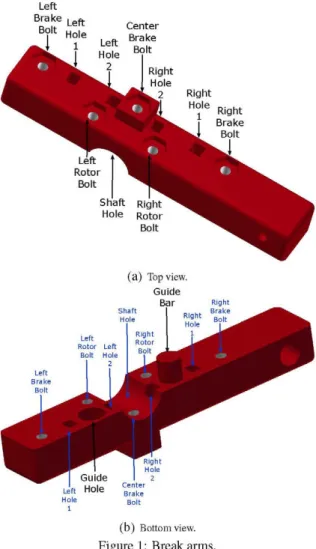
Is composed by two identical arms, each facing each
other. The figure 1 shows the Top and Bottom view
in one of this arms. This part moves the shaft in both
directions (clockwise and counterclockwise) or block
and prevent undesirable movements. Both functions
by grasping the shaft between the Shaft Hole. This
functions are achieved by controlling the contraction
of the SMAs located within the two brake arms as
show in the figure 2.
Left B r a k e
B o l t Left Hole
1 Left Hole 2
Center Brake Bolt
Right Hole
2 Right Hole n. . .
1 Right Brake
Bolt
Shaft Right Hole Rotor
Bolt
(a)
Shaft Hole
Top view.
G U I D E BAR Right
Brake Bolt Left
Rotor Left Bolt Hole 2 Left
Brake Bolt
G U I D E
Left H O L E
Hole 1
Center Brake Bolt
( b ) Bottom view.
Figure 1: Break arms.
A
Left Brake
Bolt
Al
Left Hole 1
B
Center Brake Bolt
A2
Left Hole 2
til b¿ Right Right Hole Hole 2 1
SMA "Group C"
El
y Arm 1
E2
A r m 2 CI C2
Right Right Hole Hole 1 2
DI D2
Left Left Hole Hole|
C 2 1 D
Center Left Brake Brake Bolt Bolt
Guide Guide Bar Hole
Figure 2: Arrangement of the SMA wires actuating the break.
Figure 3: Forces acting on the brake.
FT1 = FS 1 + FS 1
1
FS1 = F S M A1
2
FT1 =FSMA1
FT2 =FSMA2
FSMA1 =FSMA2
FT = FT1 +FT 2
(1)
(2)
(3)
2.2 Plate
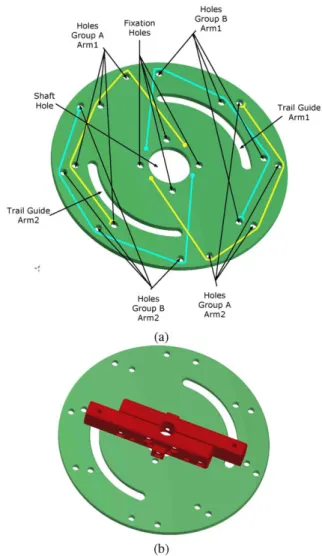
This is the base where the brake is housed. Is
com-posed by only one part. The most function of this
part is to houses the SMAs that allow to rotate the
brake, that will act as a rotor. The radius of the
plate is set in such a way to allow arranging a large
segment of the SMAs, which is passes through set
of guides. Such arrangement, shown in Figure 4 is
needed since the SMA wires only contracts
approxi-mately a 4% of their length, and this group of SMAs
determines the number of degrees that the brake can
rotate. The speed and the amount of rotation over the
brake is determined controlling the contraction of the
SMAs. Two pairs of SMA wires that can be actuated
individually or at same time depending of the amount
of force to be applied to the break to rotate the shaft
(when it is blocking it) and how much force is to be
applied.
The Group A allows to rotate the brake clockwise and the Group B counterclockwise. Each phase is composed by one ”Group A and B ” the Figure 4a show only one phase. Each time that another phase is required (for improved speed) we only need to add other plate more like in a sandwich. Note that at rest position SMAs A are fully extended, while SMAs B are loose, in such a way not to prevent SMAs A to contract. When SMAs A are contracted, SMAs B will be fully extended and thus ready to contract to bring the brake back to the start position.
The force applied to the brake to rotate it for ev-ery wire is 321 grams-force this because the friction between the SMA and the screw is negligible.
Holes G r o u p A
A r m 1
Fixation Holes
Holes G r o u p B
A r m 1
Shaft Hole
Trail Guide^ A r m 2
Trail Guide A r m 1
Holes G r o u p B
A r m 2
Holes G r o u p A
A r m 2
(a)
(b)
3 O P E R A T I O N P R I N C I P L E
3.1 Principle of One Way Shape
Memory Effect
The ability to remember a predetermined shape af-ter several deformation is called Shape Memory Ef-fect (SME). The Martensite phase transformation is responsible for the shape changes with tempera-ture variation. Commonly SMA wires are made of metal alloys (nickel-titanium) and they are known as NiTi. The NiTi alloy is trained to remember a short length at high temperature by heat treatment. In cold state (Martensite) the SMA is malleable and can be stretched to a longer length with a small force. Nor-mally in SMA actuators a biasing force is applied dur-ing the cold condition to stretch the SMA wire to a designed length faster. this process is known as pre-loading. Pre-loading is usually done by using a spring in series with the SMA wire or a weight (W) to gen-erate force by gravity (figure5). When the SMA is heated to high temperature (Austenite), SMA shrinks to the trained length. While shrinking, the SMA be-comes hard, and can pull much larger force than what is required to stretch SMA at low temperature. The proposed High Phase Order motor is designed using one way SMA wires.
/ / / / / / / / / / / / / / / / / /
w
w
/ / / / / / / / / / / / / / / / / / / / / / / / / / Low High Temperature Temperature
Figure 5: One way SMA actuation.
3.2 Shape M e m o r y Alloy-Based H P O M
O p e r a t i n g P r i n c i p l e
The principle of functioning can be explained in 5 steps (always actuating the SMA Groups A, B, and C) as shown below.
• Step 1 : The ”Group C” (phase 1) is actuated and the shaft is locked.
• Step 2: While the ”Group C” (phase 1) is actuated , the ”Group A or B” (phase 1) (depending on the the way of rotation, clockwise or counterclock-wise) is actuated simultaneously. To simplify the explanation we decided to actuate the ”Group A ”
• Step 3: When the ”Group A ” (phase 1) is fully contracted we release it and the ”Group C” from the phase 2 is actuated.
• Step 4: The ”Group C” (phase 1) is released and the ”Group A ” (phase 2) is actuated.
• Step 5: When the ”Group A ” (phase 2) is fully contracted we release it and the ”Group C” from the phase 2 is released.
4 M O D E L I N G A N D C O N T R O L
Both parts (brake and plate) are controlled with a PID controller with an external force feedback loop con-trol. Using the changes over the internal resistance of the SMA it is possible to implement as well a posi-tion control. Force/posiposi-tion control strategies provide an effective framework to deal with tasks involving interaction with the environment.
4.1 System Identification and
Controller
Using the force feedback loop we can linearize the behaviour of the SMA. In this way we obtain experi-mentally the model for the brake and plate. The input signal used to actuate the SMA and the output sig-nal obtained by the force sensor due to this action is show in the Figure 6. After system identification, car-ried out using the ”ident” tool box of M A T L A B ® , the transfer function obtained is:
G(s) 0.002697s+ 0.0001736 s2 + 0.02438s + 0.003559
The step response of G(s) in open loop is shown in Figure 7.
For the control, we used a PID (proportional-integral-derivative) controller, which responds to the equation:
ft
u(t) = Kpe(t) + K¡ e^dt + Kj 0
de(t
dt (4)
Voltage Vs Time
/
/
/
/
i
\
\
í \
/
/
/
/
/
/ ,
í \
1
\
\
Í
5 0 0
4 0 0
3 0 0
2 0 0
1 0 0
Step Response
10 20 30
Time
(a) FORCE V S T I M E
40 50
i
0 1 0 2 0 3 0 T I M E (b)
4 0 5 0
Figure 6: SMAs step response in open loop (a) Input, Volt-age (V) Vs Time (s), (b) Output, Force (gf) Vs Time (s).
Step Response
0.08
0.07
0.06
0.05 jj
0.04
0.03
0.02
0.01
0,
\System: G
¡Peak amplitude: 0.0853 ¡Overshoot (%): 74.9 jAt time (seconds): 37.8
200 300
Time (seconds)
Figure 7: G(s) Step response in open loop.
loop of the system to be controlled. The PID
con-troller gains obtained are:
K
p= 50000, K
i= 1000, K
d= 100
and the transfer function including the PID
con-troller and the feedback is:
2.697s
3+135s
2+8.95s+0.01736
GLC3(s) =
3.697s
3+135s
2+8.953s+0.01736
Figure 8. shows the step response of function
GLC3(s).
4.2 Control Schema
In the control system (Fig. 9), the force error is
con-verted in a suitable reference trajectory for the inner
position controller which is defined in the Cartesian
space or the angular space (De Schutter and van
Brus-sel, 1988). When there are no constraints due to the
1.05
1
0.95
0.9
0.85
0.8
0.75
07 0 0.1 0.2 0.3
Time (seconds)
i : : : : : = : : : : : = : = : :
0.4 0.
Figure 8: Step response function GLC3(s). Peak Response 0.338s, Settling Time 0.106s, Rise Time 0.06s.
environment, the force controller will be without ef-fect and the position controller will continue to con-trol the system. When constraints appear, the force controller allows the control of the generated efforts. This configuration makes it possible to control the force and the position simultaneously. The force trol loop is designed to prevail over the position con-trol loop the event of a conflict (Ferguene and Re-douane, 2009). This means that the force controller dominates the position controller
• a -
Controller Force xcPosition Controller
Figure 9: Control schema (Xd: Desired Position; Fd: De-sired Force; X: Modifier resulting from the force control loop; XC: Position command; U: Control Reference; Fe: Environment Force).
5 EXPERIMENTAL RESULTS
This section primarily describes the experimental
tests, along with a comparison of the results with
the-oretical predictions. The experimental tests were
per-formed at different excitation frequencies but same
amplitude while keeping the same input signal (sine
wave)
The experimental setup for the system
identifi-cation was made using the Control Electronic
Cir-cuit (CEC) (Rossi et al., 2010), (Rossi et al., 2011a),
(Rossi et al., 2011b). Its allows to measure voltages
and current through the SMA wires as well as to
pro-gram the PIC microcontroller embedded on the circuit
to directly control the SMA without external devices.
It is also possible to communicate with this through
the I2C Bus, SPI Bus or Serial Port. Using the voltage
and current we can estimate the value and the changes
0
Ad
+
AX U
+
F i Actuator Output
Figure 10: Experimental testbed, Plate and Brake.
Figure 11: Experimental testbed.
over the internal resistance in the SMA and is possible
in this way to know the actual percentage of
shrink-ing. The method consists in measuring the electrical
resistance of an SMA element (Teh and Featherstone,
2008), calculating a maximum safe heating current
as a function of measured resistance, and ensuring
that the actual heating current does not exceed this
maximum value. In fact resistance is being used as a
form of temperature measurement, and the maximum
safe heating current is designed to prevent
overheat-ing. The force response is measured using a Nano
17 transducer (ATI Industrial Automation, ) through
a data acquisition card (NI-DAQ) NI PCI-6220
(Na-tion Instruments, ). It has a 0.318 gram-force of
res-olution. The figure 10 shows the testbed used. This
also shows the data acquisition device (DAQ)
USB-1208FS (Measurement Computing, ) used to
mea-sure the voltages from the CEC and the USB-ISS
al-lows communication between the Computer and CEC
through I2C Bus. The complete setup is depicted in
figure 11.
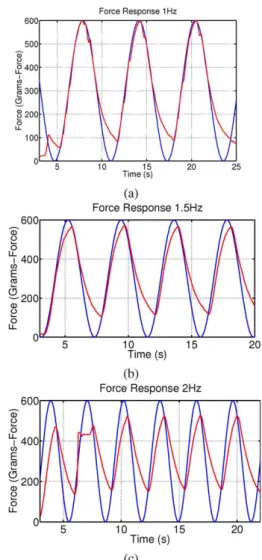
When the frequency increase the tracking error
also increases but increasing the ISMA the speed
sponse improves. In this way the tracking error is
re-600i 500 4 0 0 300 200K 100
0'
600i
400
200
Force Response 1Hz
15 Time (s)
(a)
Force Response 1.5Hz
10
Time (s) 15 20
(b)
Force Response 2Hz 600i
400
10 15 Time (s)
(c)
20
Figure 12: Experimental results: (a) Force response at 1 Hz, (b)1.5 Hz, (c) 2 Hz.
duced. Theoretically the maximum force produced
from the SMA in the Group A was 642 grams-force
experimentally we obtained a force (frequency 1Hz)
of 600 grams-force.
6 CONCLUSIONS
In this study we built and characterised a novel
actua-tor based in Shape Memory Alloy (SMA) wires. The
actuator can be instrumented to measure input power
and output force and SMA electric resistance for a
wide variety of force inputs and actuation speeds.
Be-cause each of the force inputs are replicable, the
ac-tuator can be actuated with thousands of
combina-tions of force parameters while providing valuable
data on force and power. The broad range of
capa-bilities of this actuator make it an excellent tool to be
5 10 20 25
0 5
0.5
0 . 4
0.3
0 . 2
0.1
M h
M ni \ r,
: L I : i
VI IU
III
1 0 1 5
TIME(S)
(a)
2 0 2 5
0
-|^
\ \
I \
\-5 1 0 1 5 2 0
TIME (S)
(b)
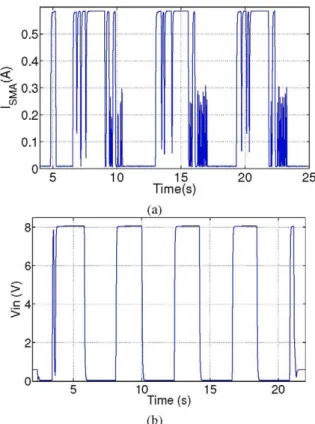
Figure 13: Experimental results: (a)ISMA (A) Vs Time (s) at 1Hz, (b)Vinput (V) Vs Time (s) at 1.5 Hz.
used like a steeper motor (because we can control the contraction length and have resolution of steps from less than a millimeterr) or continuous motor in ap-plications where the weight a size are critical, and in particular to make less complex robots reducing the control and hardware cost.
ACKNOWLEDGEMENTS
William Coral acknowledge to the Administrative Department of Science, Technology and Innova-tion (COLCIENCIAS) (grant call 568 2013) and COLFUTURO (grant call 2012) from Colombia for its support. The authors acknowledge the support of the Robotics and Cybernetics Group at the Cen-tre for Automation and Robotics UPM-CSIC, the project ROBOCITY 2030 (Community of Madrid S-0505/DPI/000235) and the project ROTOS (Ministry of Science And Innovation of Spain DPI2010-17998).
REFERENCES
ATI Industrial Automation. F/T Sensor: Nano17.
http://www.ati-ia.com. Accessed June 6, 2013.
Colorado, J., Barrientos, A., and Rossi, C. (2012). Biome-chanics of smart wings in a bat robot: morphing wings using SMA actuators. Bioinspiration & Biomimetics. Coral, W., Rossi, C., and Montan˜o, J. C. (2012).
SMA-Based Muscle-Like Actuation in Biologically Inspired Robots: A State of the Art Review. page 30. INTECH. De Schutter, J. and van Brussel, H. (1988). Compliant robot motion ii. a control approach based on external control loops. International Journal of Robotics Research., 7(4):18–33.
Ferguene, Farid, T. and Redouane (2009). Dynamic exter-nal force feedback loop control of a robot manipulator using a neural compensator, application to the trajec-tory following in an unknown environment. Interna-tional Journal of Applied Mathematics and Computer Science, 19(1):113–126.
Kuo, B. C. (1979). Step motors and control systems. Incre-mental motion control. SRL Pub. Co.
Kuo, B. C. and Tal, J. (1979). Incremental Motion Con-trol: Step motors and control systems, edited by B. C. Kuo. Incremental Motion Control. SRL Publishing Company.
Kuribayashi, K. (1989). A new servo motor using shape memory alloy. In Industrial Electronics Society, 1989. IECON ’89., 15th Annual Conference of IEEE, pages 139–144 and 238–243.
Measurement Computing. USB-1208FS.
http://www.mccdaq.com/usb-data-acquisition/USB-1208FS.aspx. Accessed June 6, 2013.
Nation Instruments. NI PCI-6220.
http://sine.ni.com/nips/cds/view/p/lang/es/nid/14130. Accessed June 6, 2013.
Otsuka, K. and Wayman, C. M. (1998). Mechanism of shape memory effect and superelasticity. Shape mem-ory materials.
Reynaerts, D. and Brussel, H. V. (1998). Design aspects of shape memory actuators. Mechatronics, 8(6):635– 656.
Rossi, C., Colorado, J., Coral, W., and Barrientos, A. (2011a). Bending continuous structures with SMAs: a novel robotic fish design. Bioinspiration & Biomimet-ics, 6(4):045005.
Rossi, C., Coral, W., and Barrientos., A. (2010). SMA Con-trol for Bio-mimetic Fish Locomotion. In Interna-tional Conference on Informatics in Control, Automa-tion and Robotics (ICINCO), Madeira.
Rossi, C., Coral, W., and Barrientos, A. (2013). Robotic Fish to Lead the School. In Palstra, A. P. and Planas, J. V., editors, Swimming Physiology of Fish, pages 407–421. Springer Berlin Heidelberg.
Rossi, C., Coral, W., Colorado, J., and Barrientos, A. (2011b). A motor-less and gear-less bio-mimetic robotic fish design. In Robotics and Automation (ICRA), 2011 IEEE International Conference on, pages 3646–3651.
Teh, Y. H. and Featherstone, R. (2008). An architecture for fast and accurate control of shape memory alloy actuators. International Journal of Robotics Research, 27(5):595–611.
0 5
8
6