1
The effect of the halide anion on the optical properties of lead halide perovskites
César Tablero Crespo
Instituto de Energía Solar, E.T.S.I. de Telecomunicación, Universidad Politécnica de Madrid,
Ciudad Universitaria s/n, 28040 Madrid, SPAIN. e-mail: [email protected]
Abstract
Lead halide perovskites are promising semiconductors for solar energy conversion
because of their electronic and optical properties. Using first principles we obtain these
properties for the chlorine, bromine and iodine lead halide perovskites. In order to
analyze the contributions of the different atoms and orbitals to the absorption
coefficient, we split them into a many-species expansion. It allows the atomic and
orbital contributions to be identified and quantified as a photon energy function.
Keywords: Perovskites; Optical properties; Photovoltaic; Semiconductors.
1. Introduction
Lead halide perovskites CH NH PbX (X=I, Br, Cl) with the methyl-ammonium 3 3 3
organic cation [CH NH ]3 3 are increasing in interest because of their optical and
electrical properties (photoluminescence, electroluminescence, etc). In particular,
perovskite solar cells are promising candidates for photovoltaics with efficiencies of
15-20 % [1,2]. The best solar cells have been obtained from CH NH PbI which has a 3 3 3
bandgap of 1.55 eV, close to the optimum one for photovoltaic performance (~1.3 eV
for a sunlight spectrum with the maximum concentration) [3–5]. Besides these
compounds having low non-radiative recombination rates compared to other thin-film
2
relatively small difference between the open-circuit voltage of the experimental cells
and their energy bandgap transformed into voltage.
The increasing interest in perovskite does not only lie in the solar cell efficiencies
but also in the novel device structures and new perovskite materials [6–8].
Organic/inorganic perovskites are compounds normally with anAMX structure, where 3
A is a large organic/inorganic cation, M a smaller metal cation and X an anion from the
halide series. They form an MX octahedral structure (Figure 1). In the 6 CH NH PbX3 3 3
organic lead halide perovskites analyzed in this work, the cation A is organic
(Methyl-ammonium[CH NH ]3 3 ), M=Pb, and X=I, Br, Cl. Both the optical absorption and the
photoluminescence is related mainly to the Pb and X combination. The compounds with
X=I have smaller bandgaps and light emission at longer wavelengths while the
bromides (X=Br) display higher bandgap and luminescence at shorter wavelengths [9–
11]. Modification of the halide anion X changes the bond distance and/or angle of X–
-Pb–X. It is one of approaches for tuning the bandgap energy.
A detailed knowledge of the absorption coefficient is necessary for the optical
design of single-gap and multi-junction solar cells. So far, only limited information on
the CH NH PbX optical properties is available [10,12–15]. In addition to the 3 3 3
absorption coefficient, knowledge of the different contributions to the absorption
coefficient can make it possible to identify the substitutions of organic/inorganic cations
and anions that do not degrade the optical properties, and therefore the absorptive
capacity of solar radiation.
To go deeply into both total and partial (split into the species contributions)
absorption coefficients, the electronic and optical properties of several halide
perovskites are evaluated using first principles. First we describe the methodology used
3
into species contributions without simplifications in the methodology section. Then we
describe, compare and discuss the results. Finally, we summarize the main conclusions.
2. Methodology
Calculations were made using density functional theory (DFT) [16,17] with periodic
boundary conditions on the lead halide perovskites (CH NH PbX , X=I, Br, Cl). The 3 3 3
generalized gradient approximation for the exchange-correlation functional was used as
parameterized by Perdew-Burke-Ernzerhof [18]. The outermost electrons are treated as
valence electrons represented by a basis set made up of localized pseudoatomic orbitals
[19]. The interactions of the valence electrons with the remaining ions is modeled by the
Troullier–Martins [20] pseudopotentials expressed in the Kleinman–Bylander [21,22]
form. The parameters of the structure used in the calculation were taken from reference
[23]: a = 6.460 Å, b = 6.442 Å, c = 6.526 Å, α = 87.424°, β = 86.798°, γ = 92.852° for
X=I, a = 6.050 Å, b = 6.035 Å, c = 6.103 Å, α = 86.957°, β = 85.914°, γ = 92.957° for
X=Br, and a = 5.761 Å, b = 5.747 Å, c = 5.824 Å, α = 86.793°, β = 85.328°, γ = 93.215°
for X=Cl. The irreducible Brillouin zone for the electronic properties was sampled using
256 special k points.
The optical properties were obtained from the complex dielectric function e2using
the Kramers-Kronig relationships [24]. It is obtained as a photon energy function E
using the band energies E, the band occupations f, and the momentum matrix
elements p between all of the bands:
2
2 2
1
( ) ( ) ( )
e E C d f f p E E E
E
k (1)
405 special k points in the irreducible Brillouin zone were used for the optical
4
AB A B
p
p (intra-species if A=B) or angular momentum inter-speciescontributions ( )A B
A B
AB AB
l l
l A l B
p
p contributions. The pAB transition momentummatrix element couples the basis set functions on the A and B atoms of different
species, and
(
p
AB)
l lA B the lAshell-states located at the A atoms and the lBshell-stateslocated at the B atoms. The standard notation s, p, d, etc for l=0, 1, 2, etc is used.
With this breakdown the optical properties, depending on p 2
, involve terms like
| ( ) | | ( ) |
A B C D
AB CD l l l l
p p . Then the optical properties can be split as a many-species
expansion up to 4 species. In particular, for the absorption coefficient: ( ) AS 34.
The first term ( ) S
A BAB, with A BA B
AB
AB l A l B l l
, includes intra-species(A=B) and inter-species (A≠B) terms. A34 includes the coupling of three or four
different non-equivalent species terms. In general( )S A34, and the absorption
coefficient can be approximated by ( )S . Nevertheless, the influence of this term
will be evaluated in this work.
Note that the intra-species contributions, AB and ABA B l l
with A=B, contain all
transitions between states of the atoms of the same species. They involve intra- and
inter-atomic matrix elements. The intra-atomic elements correspond to transitions
between states within an atom. Therefore they correspond to mono-centric matrix
elements. The inter-atomic elements relate transitions between states of two atoms of
the same species but at different position, i.e. they involve bi-centric matrix elements.
When A≠B the transitions always involve transitions between atoms of different species
and located at different positions. Therefore they are always inter-atomic with bi-centric
5 3. Results and discussion
From a structural point of view, the organic halide perovskites CH NH PbX (X=I, 3 3 3
Br, Cl) consist of a framework of corner-sharing metal halide octahedra PbX with the 6
methylammonium cations [CH NH ]3 3 fitting in the empty spaces between the
octahedra (Figure 1). The bandgaps of these compounds have previously been studied
both experimentally and theoretically. The range of experimental halide perovskites
bandgaps reported in the literature are: 1.55-1.61 eV (1.55 [25], 1.61 [26]) for X=I,
2.00-2.44 eV (2.00 [25], 2.3 [27], 2.44 eV [15]) for X=Br, and 2.88-3.13 eV
(2.88-3.13[10], 3.11 eV [25]) for X=Cl. The bandgaps obtained theoretically using DFT with
several exchange-correlation functionals and basis sets are in the range 1.23-1.85 eV
(1.23-1.85 eV [28], 1.53 [29], 1.57 [30]) for iodine, 1.80 [30]-1.89 [29] eV for bromide,
and 2.34 [30]-2.36 [29] for chloride perovskites. These calculated bandgaps are in
general good agreement with reported experimental values. The bandgaps obtained with
more sophisticated and more computationally expensive methods, such as GW are
1.31-1.73 [31–33] for X=I, 2.34– 2.83 [32,34] for X=Br, and 3.07– 3.59 [32,34] for X=Cl.
The bandgaps obtained in this work are 1.60, 2.12, and 2.50 eV for X=I, Br, and Cl
respectively. These values are within those obtained experimentally except in case of
X=Cl where it is slightly underestimated. Nonetheless, this value is closer to the
experimental values than many of the values reported theoretically in the literature.
An analysis of the projected density of states (PDOS) reveals that the valence band
(VB) top is made up predominantly of the p(X) orbitals, and the bottom of the
conduction band (CB) is mainly of a p(Pb) character with a smaller contribution from
the p(X) orbitals (Figure 2). It is in agreement with other references in the literature
[29,30,35]. Therefore for CH NH PbX mixed-halide compounds the p(X) states have 3 3 3
6
therefore influencing the energy bandgap. Since the energies of the p(X) states are
p(Cl)<p(Br)<p(I) (Figure 2), the bandgaps in ascending order are for X=I, Br and Cl
halide perovskites. The increase in the bandgap energy can be consistent with the ionic
character of the Pb-X bond in the PbX octahedra. 6
Halide perovskites are one of the most promising compounds for the next
generation of solar cells. A great deal of experimental effort has been made on the
optical properties [10,12–15,36]. The sunlight absorption is determined mainly by the
absorption coefficient. But the absorption coefficient, measured experimentally or
calculated theoretically, does not give us any information on the main contributions of
the species or the orbitals. For this reason we have developed a method for splitting the
optical properties into different contributions (methodology section). This allows us to
analyze the main contributions and to relate the optical properties with the composition
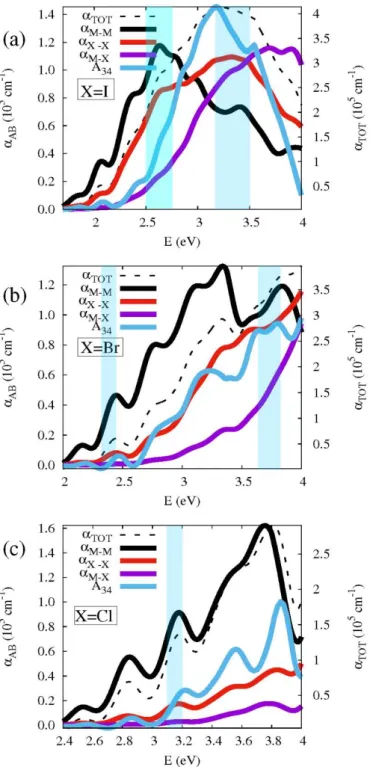
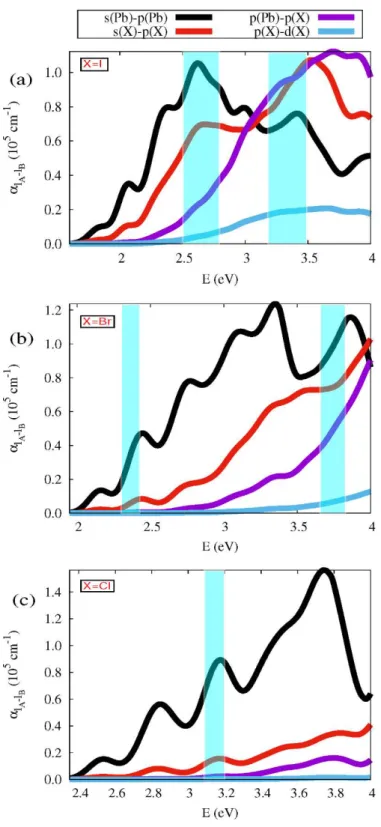
and the structure of the materials. The optical absorption coefficients split into
intra-species transition and angular momentum intra-species contributions are shown in Figures 3
and 4 respectively. Our result reproduces the spectral features of the experimental room
temperature absorbance spectrum from reference [12] for CH NH PbX (X=I, Br, Cl). 3 3 3
In Figures 3 and 4 the shaded areas correspond to these experimental absorption bands.
For the iodine (X=I) perovskite (Figure 3a) the optical absorption band between 2.5-2.7
eV is due to the Pb-Pb intra-specie transition. When these transitions are split further
into the most important angular momentum species contributions (Figure 4a) the results
indicate that these transitions mainly came from of the s(Pb)-p(Pb), and with a lower
proportion of s(I)-p(I) and p(Pb)-p(I). In agreement with our results this band had been
attributed [13] to the transition from Pb2+
6s to Pb2+
6p . Our results also reproducethe experimental large absorption band between 3.2-3.5 eV [12], and the decrease
7
about, in descending order of importance, by the I-I, Pb-I and Pb-Pb species transition
(Figure 3a), i.e. mainly by s(I)-p(I), p(Pb)-p(I) and s(Pb)-p(Pb) (Figure 4a). Our results
are also in accordance with those of reference [14] in which three peaks appear in the
absorption spectra at about 1.65, 2.20, and 3.10 eV. The first peak at about 1.65 eV is
mainly due to the s(Pb)-p(Pb) excitation. The second, which peaks around 2.20 eV, is
also mainly because of the s(Pb)-p(Pb) transitions, with a lower contribution of the
s(I)-p(I) excitation. Finally, the peak at around 3.10 eV is due to similar contributions from
s(Pb)-p(Pb), s(I)-p(I), and p(Pb)-p(I).
In contrast to the iodine perovskite, the X=Cl and Br compounds show sharper
absorption peaks (Figure 3b, 3c, 4b, and 4c). The peaks in the spectra of chlorides are
sharper than those of bromides and the bromides are sharper than those of iodides. As
before, our results agree well with the optical absorption and photoluminescence
experimental results [10,12,15]. The main contributions to the absorption coefficient
can be deduced from these figures. The band absorption peaks with X=Cl shifted
towards high energy with respect to the X=Br peaks are in agreement with the
experimental absorbance spectrum [12]. Therefore, the bandgap and the absorption
coefficient can be shifted monotonously towards high energy with an increase in the Cl.
This is because the electronegativity of the Cl is larger than that of the Br and I. The
bandgaps (energy difference between the CB and VB edges) are mainly determined by
the p(X) (p(Pb)) states which made up mostly the top of the VB (bottom of the CB). As
the p(Cl) states have lower energy (due to larger Cl electronegativity) than the other
p(Br) and p(I) states, the VB top for X=Cl has lower energy (Figure 2), i.e. larger
bandgap. The absorption coefficient is different from cero for energies larger than the
energy bandgap. Therefore also the absorption coefficient moves towards higher energy
8
energy of the anion states (because of the higher electronegativity) the resulting energy
bands are narrower (Figure 2) resulting in sharper absorption peaks.
In all lead halide perovskites with the methylammonium cation, for energy close
to the bandgap, the most important contributions are the Pb-Pb intra-species transitions,
and with a lower proportion the X-X. Therefore the optical properties are determined
mainly by the PbX octahedra. The methylammonium cations do not directly contribute 6
the VB and CB band edges. Neither do they contribute with terms of one and two
species (intra- and inter-specie terms respectively) to the optical properties. However,
this organic cation indirectly affects the Pb−X bonds, and therefore, the geometry and
the electronic and optical properties [12].
In order to evaluate the contribution of the organic cation to the optical
properties in greater depth, the contributions of three and 4 species terms (A ) are also 34
shown in Figure 3. The 3 and 4 species terms are only present when the number of
species in the compound is greater than 3 and 4 respectively. Its contribution tends to be
greater when the species number is larger. For the perovskites analyzed in this work,
with five species (C, H, N, Pb, and X), the number of one (intra-specie), two
(inter-specie), three, and four different species terms in the split of the absorption coefficients
are 5, 10, 10, and 5 respectively. Therefore the number of 3 and 4 species terms is
similar to the number of intra and inter-species terms. This does not happen in the most
common binary semiconductors (II-VI, II-VI, etc) where the 3 and 4 species terms are
absent. Note that this decomposition is exact and serves to evaluate the different
contributions to the absorption coefficient. Sometimes the interpretation of the
contributions to the optical properties is done qualitatively using the PDOS. But the
PDOS does not take into account the transition probabilities. For this reason the
9
is appropriate for understanding electronic structures, but inappropriate for analyzing
photo-excitation properties.
From the Figure 3, the three and four species contributions are lower than the
Pb-Pb intra-specie contribution, except for the X=I and energies between 2.3-3.8 eV.
Therefore, this term is as important as the aforementioned ones (I-I, Pb-I and Pb-Pb) for
the experimental large absorption band between 3.2-3.5 eV [12]. It indicates that the
organic cation contributes indirectly to the optical properties via three and 4 species
terms.
The content of lead in these compounds can generate environmental and toxicity
problems. This aspect is increasingly important in the legislations of many countries.
Therefore, although technically these lead compounds are promising for solar cells,
their future development may be negatively affected by these problems. Therefore it
would be suitable to replace the Pb with other cations to avoid them. This replacement
of the Pb by another element M should maintain the high values of the absorption
coefficient without deteriorating the perovskite absorption capacity.
4. Conclusions
The electronic and optical properties of lead halide perovskites are obtained
using first principles based on the DFT. The edges of the VB and CB are predominantly
made up of p(X) and p(Pb) states respectively. Because of the importance of the
absorption coefficient on the solar radiation absorption capacity we have obtained the
differences between the halide anions, compared them with experimental results, and
analyzed them.
In order to relate the atomic composition and the structure with the optical
10
This allows us to identify and quantify the different contributions to the optical
properties as a function of the photon energy without approximations. Near the gap the
most important contribution is brought about by Pb-Pb (s(Pb)-p(Pb)) intra-species
transitions. The characteristic absorption band above 3 eV is brought about mainly by
s(Pb)-p(Pb), and with a lower contribution by p(Pb)-p(X) and s(X)-p(X) transitions.
These latter contributions decrease from iodine to chlorine, i.e. when increasing the
electronegativity of the halide. Therefore, in order to avoid the toxicity problems
generated by lead and maintain high absorption, it would be necessary to replace the Pb
with another element M that also had a high M-M intra-specie contribution to the
absorption coefficient.
In the case of iodine, the organic cation, via terms of 3 and 4 species, also
contribute indirectly to the experimental absorption band between 3.2-3.5 eV.
Acknowledgments
This work has been supported by the National Spanish project INVENTA-PV
(TEC2015-64189-C3-1-R, MINECO/FEDER) and the European Commission through
11
Lists of references
[1] J. Burschka, N. Pellet, S.-J. Moon, R. Humphry-Baker, P. Gao, M.K. Nazeeruddin,
M. Grätzel, Sequential deposition as a route to high-performance
perovskite-sensitized solar cells, Nature. 499 (2013) 316.
[2] M.A. Green, A. Ho-Baillie, H.J. Snaith, The emergence of perovskite solar cells,
Nat. Photonics. 8 (2014) 506.
[3] A. Luque, A. Martí, Theoretical Limits of Photovoltaic Conversion, in Handbook of
Photovoltaic Science and Engineering, Edited by A. Luque and S. Hegedus, John
Wiley & Sons Ltd, 2003.
[4] P. Würfel, Physics of Solar Cells. From Principles to New Concepts, WILEY-VCH
Verlag GmbH & Co, KGaA, 2005.
[5] M.A. Green, Third Generation Photovoltaics. Advanced Solar Energy Conversion,
Springer-Verlag Berlin Heidelberg, 2003.
[6] T. Zhou, M. Wang, Z. Zang, X. Tang, L. Fang, Two-dimensional lead-free hybrid
halide perovskite using superatom anions with tunable electronic properties, Sol.
Energy Mater. Sol. Cells. 191 (2019) 33–38.
doi:https://doi.org/10.1016/j.solmat.2018.10.021.
[7] X. Zeng, T. Zhou, C. Leng, Z. Zang, M. Wang, W. Hu, X. Tang, S. Lu, L. Fang, M.
Zhou, Performance improvement of perovskite solar cells by employing a CdSe
quantum dot/PCBM composite as an electron transport layer, J. Mater. Chem. A. 5
(2017) 17499–17505. doi:10.1039/C7TA00203C.
[8] M. Wang, Z. Zang, B. Yang, X. Hu, K. Sun, L. Sun, Performance improvement of
perovskite solar cells through enhanced hole extraction: The role of iodide
concentration gradient, Sol. Energy Mater. Sol. Cells. 185 (2018) 117–123.
12
[9] E. Mosconi, A. Amat, M.K. Nazeeruddin, M. Grätzel, F. De Angelis,
First-Principles Modeling of Mixed Halide Organometal Perovskites for Photovoltaic
Applications, J. Phys. Chem. C. 117 (2013) 13902–13913. doi:10.1021/jp4048659.
[10] G.C. Papavassiliou, G.A. Mousdis, I.B. Koutselas, Some new organic–inorganic
hybrid semiconductors based on metal halide units: structural, optical and related
properties, Adv. Mater. Opt. Electron. 9 (n.d.) 265–271.
doi:10.1002/1099-0712(199911/12).
[11] K. Tanaka, T. Takahashi, T. Ban, T. Kondo, K. Uchida, N. Miura, Comparative
study on the excitons in lead-halide-based perovskite-type crystals CH3NH3PbBr3
CH3NH3PbI3, Solid State Commun. 127 (2003) 619–623.
doi:https://doi.org/10.1016/S0038-1098(03)00566-0.
[12] N. Kitazawa, Y. Watanabe, Y. Nakamura, Optical properties of CH3NH3PbX3
(X = halogen) and their mixed-halide crystals, J. Mater. Sci. 37 (2002) 3585–3587.
doi:10.1023/A:1016584519829.
[13] M. Hirasawa, T. Ishihara, T. Goto, Exciton Features in 0-, 2-, and 3-Dimensional
Networks of [PbI6]4- Octahedra, J. Phys. Soc. Jpn. 63 (1994) 3870–3879.
doi:10.1143/JPSJ.63.3870.
[14] J.-H. Im, C.-R. Lee, J.-W. Lee, S.-W. Park, N.-G. Park, 6.5% efficient
perovskite quantum-dot-sensitized solar cell, Nanoscale. 3 (2011) 4088–4093.
doi:10.1039/C1NR10867K.
[15] S. Brittman, E.C. Garnett, Measuring n and k at the Microscale in Single
Crystals of CH3NH3PbBr3 Perovskite, J. Phys. Chem. C. 120 (2016) 616–620.
13
[16] W. Kohn, L.J. Sham, Self-Consistent Equations Including Exchange and
Correlation Effects, Phys Rev. 140 (1965) A1133–A1138.
doi:10.1103/PhysRev.140.A1133.
[17] J.M. Soler, E. Artacho, J.D. Gale, A. García, J. Junquera, P. Ordejón, Daniel
Sánchez-Portal, The SIESTA method for ab initio order- N materials simulation, J.
Phys. Condens. Matter. 14 (2002) 2745.
[18] J.P. Perdew, K. Burke, M. Ernzerhof, Generalized Gradient Approximation
Made Simple, Phys Rev Lett. 77 (1996) 3865–3868.
doi:10.1103/PhysRevLett.77.3865.
[19] O.F. Sankey, D.J. Niklewski, Ab initio multicenter tight-binding model for
molecular-dynamics simulations and other applications in covalent systems, Phys
Rev B. 40 (1989) 3979–3995. doi:10.1103/PhysRevB.40.3979.
[20] N. Troullier, J.L. Martins, Efficient pseudopotentials for plane-wave
calculations, Phys Rev B. 43 (1991) 1993–2006. doi:10.1103/PhysRevB.43.1993.
[21] L. Kleinman, D.M. Bylander, Efficacious Form for Model Pseudopotentials,
Phys Rev Lett. 48 (1982) 1425–1428. doi:10.1103/PhysRevLett.48.1425.
[22] D.M. Bylander, L. Kleinman, 4f resonances with norm-conserving
pseudopotentials, Phys Rev B. 41 (1990) 907–912. doi:10.1103/PhysRevB.41.907.
[23] C. Kim, T.D. Huan, S. Krishnan, R. Ramprasad, A hybrid organic-inorganic
perovskite dataset, Sci. Data. 4 (2017) 170057.
[24] G.F. Bassani, Electronic states and optical transitions in solids, Pergamon Press,
Oxford,New York, 1975.
[25] H.S. Jung, N.-G. Park, Perovskite Solar Cells: From Materials to Devices, Small.
14
[26] L.-C. Chen, C.-Y. Weng, Optoelectronic Properties of MAPbI3
Perovskite/Titanium Dioxide Heterostructures on Porous Silicon Substrates for
Cyan Sensor Applications, Nanoscale Res. Lett. 10 (2015) 404.
doi:10.1186/s11671-015-1114-x.
[27] N.J. Jeon, J.H. Noh, W.S. Yang, Y.C. Kim, S. Ryu, J. Seo, S.I. Seok,
Compositional engineering of perovskite materials for high-performance solar cells,
Nature. 517 (2015) 476.
[28] N. Hernández-Haro, J. Ortega-Castro, Y.B. Martynov, R.G. Nazmitdinov, A.
Frontera, DFT prediction of band gap in organic-inorganic metal halide perovskites:
An exchange-correlation functional benchmark study, Chem. Phys. 516 (2019) 225–
231. doi:https://doi.org/10.1016/j.chemphys.2018.09.023.
[29] C. Grote, B. Ehrlich, R.F. Berger, Tuning the near-gap electronic structure of
tin-halide and lead-halide perovskites via changes in atomic layering, Phys Rev B.
90 (2014) 205202. doi:10.1103/PhysRevB.90.205202.
[30] E. Mosconi, A. Amat, M.K. Nazeeruddin, M. Grätzel, F. De Angelis,
First-Principles Modeling of Mixed Halide Organometal Perovskites for Photovoltaic
Applications, J. Phys. Chem. C. 117 (2013) 13902–13913. doi:10.1021/jp4048659.
[31] E. Mosconi, P. Umari, F. De Angelis, Electronic and optical properties of
MAPbX3 perovskites (X = I, Br, Cl): a unified DFT and GW theoretical analysis,
Phys Chem Chem Phys. 18 (2016) 27158–27164. doi:10.1039/C6CP03969C.
[32] M. Bokdam, T. Sander, A. Stroppa, S. Picozzi, D.D. Sarma, C. Franchini, G.
Kresse, Role of Polar Phonons in the Photo Excited State of Metal Halide
Perovskites, Sci. Rep. 6 (2016) 28618.
[33] W. Gao, X. Gao, T.A. Abtew, Y.-Y. Sun, S. Zhang, P. Zhang, Quasiparticle
15
coupling, and self-energy effects, Phys Rev B. 93 (2016) 085202.
doi:10.1103/PhysRevB.93.085202.
[34] I.E. Castelli, J.M. García-Lastra, K.S. Thygesen, K.W. Jacobsen, Bandgap
calculations and trends of organometal halide perovskites, APL Mater. 2 (2014)
081514. doi:10.1063/1.4893495.
[35] S.X. Tao, X. Cao, P.A. Bobbert, Accurate and efficient band gap predictions of
metal halide perovskites using the DFT-1/2 method: GW accuracy with DFT
expense, Sci. Rep. 7 (2017) 14386. doi:10.1038/s41598-017-14435-4.
[36] S. De Wolf, J. Holovsky, S.-J. Moon, P. Löper, B. Niesen, M. Ledinsky, F.-J.
Haug, J.-H. Yum, C. Ballif, Organometallic Halide Perovskites: Sharp Optical
Absorption Edge and Its Relation to Photovoltaic Performance, J. Phys. Chem. Lett.
5 (2014) 1035–1039. doi:10.1021/jz500279b.
[37] C.T. Crespo, CuNbO3 as a solar energy converter to fuel and electricity, Sol.
Energy Mater. Sol. Cells. 179 (2018) 305–311.
16
List of figures
Figure 1: Crystalline structure of the Perovskite CH NH PbX semiconductors. The 3 3 3
17
Figure 2: CH NH PbX (X=Cl, Br, and I) PDOS on species states with a greater 3 3 3
contribution to the VB and CB edges. The CB edge has been chosen as the origin of the
18
Figure 3: CH NH PbX absorption coefficient split into the most important species 3 3 3
contributions (left y axis) with (a) X=I, (b) X=Br, and (c) X=Cl. The total absorption
coefficient is represented in the right-hand y axis. The shaded areas correspond to the
absorption peaks of the room temperature absorbance experimental spectrum from
reference [12]. A represents the contribution of 3 and 4 species terms to the 34
19
Figure 4: Most important angular momentum species contributions to the
3 3 3
CH NH PbX absorption coefficient with (a) X=I, (b) X=Br, and (c) X=Cl. The shaded
areas correspond to the absorption peaks of the room temperature absorbance