1 23
International Journal of
Biometeorology
ISSN 0020-7128
Int J Biometeorol
DOI 10.1007/s00484-013-0766-4
Summer rainfall variability in European
Mediterranean mountains from the
sixteenth to the twentieth century
reconstructed from tree rings
D. Ruiz-Labourdette, M. Génova,
1 23
ORIGINAL PAPER
Summer rainfall variability in European Mediterranean
mountains from the sixteenth to the twentieth century
reconstructed from tree rings
D. Ruiz-Labourdette&M. Génova&M. F. Schmitz&
R. Urrutia&F. D. Pineda
Received: 7 March 2013 / Revised: 8 November 2013 / Accepted: 14 November 2013
#ISB 2013
Abstract Since the end of the last glacial period, European Mediterranean mountains have provided shelter for numerous species of Eurosiberian and Boreal origin. Many of these species, surviving at the southern limit of their range in Europe and surrounded by Mediterranean ones, are relatively intolerant to summer drought and are in grave danger of loss, as a result of increasingly long and frequent droughts in this region. This is the case of the Scots pine (Pinus sylvestris) and the Austrian pine (Pinus nigra ssp. salzmannii) which are found on Central Iberian Peninsula at the edge of their natural range. We used a tree ring network of these two species to reconstruct past variations in summer rainfall. The reconstruc-tion, based upon a tree ring composite chronology of the species, dates back to 1570 (adjusted R2= 0.49, P < 0.000001) and captures interannual to decadal scale variability in summer precipitation. We studied the spatial representative-ness of the rainfall patterns and described the occurrence rate of extremes of this precipitation. To identify associations between macroclimatic factors and tree radial growth, we employed a principal component analysis to calculate the
resultant of the relationship between the growth data of both species, using this resultant as a dependent variable of a multiple regression whose independent variables are monthly mean temperature and precipitation from the average records. Spatial correlation patterns between instrumental precipitation datasets for southern Europe and reconstructed values for the 1950–1992 period indicate that the reconstruction captures the regional signal of drought variability in the study region (the origin of this precipitation is convective: thermal low pressure zones induced in the inland northeastern areas of the Iberian Peninsula). There is a clear increase in the recurrence of extreme dry events as from the beginning of twentieth century and an abrupt change to drier conditions. There appears to be a tendency toward recurrent exceptionally dry summers, which could involve a significant change for the Eurosiberian refu-gee species.
Keywords Austrian pine . Climate change . Dendrochronology . Drought . Iberian Peninsula . Mediterranean forest . Scots pine
Introduction
The Mediterranean mountains constitute the southern edge of the geographical area of numerous Eurosiberian species (Hampe and Petit2005). They contain one of Europe's highest levels of flora diversity, likely resulting from the alternation between cold and warm periods during the Quaternary. Such an alternation caused the disappearance of many species from the temperate regions of the northern hemisphere, along with their temporary presence in more southerly latitudes, less affected by glaciations (Gómez-Campo 1985; Costa et al.
1998; Hewitt 2000; Sáinz and Moreno 2002; Väre et al.
2003; Vargas2003; Martín-Bravo et al.2010). Many species sought refuge in the Mediterranean mountains, where the
D. Ruiz-Labourdette (*)
:
M. F. Schmitz:
F. D. Pineda Departamento de Ecología, Universidad Complutense de Madrid, 28040 Madrid, Spaine-mail: [email protected]
D. Ruiz-Labourdette
Departamento de Medio Ambiente, Arnaiz Consultores S.L., 28045 Madrid, Spain
M. Génova
Departamento de Botánica, Escuela Universitaria de Ingeniería Técnica Forestal, Universidad Politécnica de Madrid, 28040 Madrid, Spain
R. Urrutia
Laboratorio de Dendrocronología, Facultad de Ciencias Forestales y Recursos Naturales, Universidad Austral de Chile, Casilla 567, Valdivia, Chile
Int J Biometeorol
DOI 10.1007/s00484-013-0766-4
topography resulted in a variety of microclimates providing suitable habitats during both warm and cold periods (Bennett et al.1991; Taberlet and Cheddadi2002). Increased diversity in the mountains of the Mediterranean Basin resulted from the arrival of Eurosiberian species and from the high degree of speciation which in turn was due to geographic isolation (Sáinz and Moreno2002). At present, these mountains con-stitute cool wet islands of biodiversity in a warm dry area, with species of Eurosiberian and Boreal origin seeking refuge at the summits and in mid-mountain areas, and xerophyllous Mediterranean ones adapted to warm summers with high water deficit occupying lower altitudes (Pauli et al.2012).
The Mediterranean region lies in a transition zone between the arid climate of North Africa and the temperate and rainy climate of Central Europe. Given this location, even minor changes in atmospheric dynamics have the potential to signif-icantly affect climate in the Mediterranean Basin (Lionello et al.
2006). In projections of climate change, the Mediterranean Basin has been identified as one of the most vulnerable areas (Giorgi2006) and is expected to undergo sharp increases in temperatures and aridity in comparison with other regions (Cubash et al. 1996; IPCC 2007). Aridification of southern Europe's climate enables us to predict that Mediterranean mountains will become warmer and drier than other European mountains, with an increase in interannual temperature and rainfall variability (Morales et al. 2005; Gritti et al. 2006; Nogués-Bravo et al.2007,2008; Giorgi and Lionello2008). Current predictions of the effects of climate change indicate that the highly diverse genetic heritage of Mediterranean mountains will be significantly disturbed by the increased summer water deficit, and several authors have indicated a current readjust-ment of the biogeographic character of these mountains (Goodess and Jones2002; Peñuelas and Boada2003; Sanz-Elorza et al.2003; Sanz et al.2003; Mendoza et al.2006; Jump et al.2006; Wilson et al.2007; Camarero and Gutiérrez2007; López-Moreno et al.2008; Linares and Carreira2009; Pauli et al.2012).
On the Iberian Peninsula, the few climate reconstructions existing to date show a gradual warming process as from the beginning of the twentieth century compared with the period of cooling and erratic rainfall that occurred between the four-teenth and ninefour-teenth centuries (Sanz 2003; Font 1988; Rodrigo et al. 1999). The climate record of the last few decades shows a clear acceleration of this warming as from the 1980s (Raso 1997; Granados and Toro 2000; Agustí-Panareda and Thompson2002; Macias et al. 2006) with an apparent decrease in rainfall from the 1990s (Rodrigo et al.
1999,2000; De Luis et al.2000; Sanz 2003; Lehner et al.
2006).
In the current context of change, Pilcher et al. (1984) and Grudd et al. (2002) have provided calendrical records of long tree ring chronologies which enable reconstruction of climate variability in the past. In the Mediterranean mountains,
however, most studies of dendroclimatic reconstruction have as yet involved little in-depth analysis of trends in series or in the cyclical patterns of climate and its possible effects on species distribution (Munaut and Serre-Bachet 1982; Till and Guiot 1990; Gutiérrez 1992; Fernández et al. 1996; Génova and Fernandez 1999; Génova 2000; Macias et al.
2006; Andreu et al.2007, among others).
The main objective of this study involved developing a multicentury low-frequency summer precipitation reconstruc-tion in Mediterranean-type mountains, specifically for the central Iberian Peninsula, from tree ring chronologies of Scots pine (Pinus sylvestris L.) and Austrian pine (Pinus nigra Arnold ssp.salzmannii). Both species are located in this peninsula at the edge of their phytogeographical range (Fernández et al.1996; Génova and Fernández1999; Génova
2000). Here, the summer water deficit contrasts with the temperature limitation observed by other authors at higher latitudes in Europe, where summertime water availability does not constitute a limiting factor (Grace and Norton 1990; Rolland and Schueller 1994; Guerrero et al. 1998; Kirchhefer2001; Tardif et al.2003; Koprowski et al.2012). The specific objectives involved (a) recognizing the most relevant modes of temporal variability in the summer precip-itation reconstruction in order to better understand the main periodicity characterizing summer precipitation variability, (b) assessing changes in variability during the last century com-pared to the previous ones, (c) comparing this reconstruction with previous tree ring precipitation records on the Iberian Peninsula and (d) establishing the spatial representativeness of the reconstructed precipitation patterns on the Iberian Peninsula.
Materials and methods
Study area and species
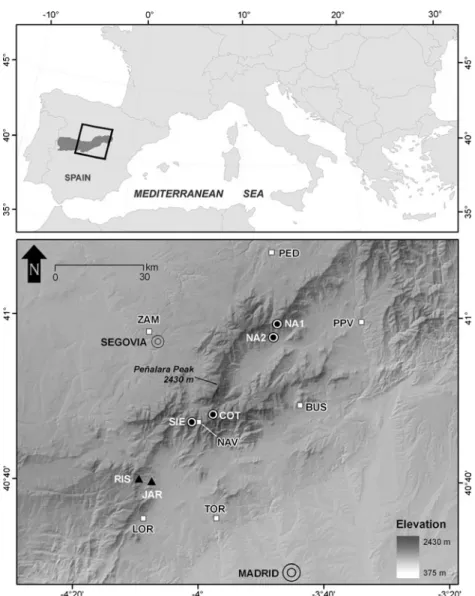
We studied the Guadarrama Mountains (Guadarrama National Park, 40°50′ to 41°15′N; 3°30′ to 4°20′W), in the Central Range of the Iberian Peninsula (Fig.1). Granitic and meta-morphic materials predominate in this area (Muñoz and Sanz-Herráiz 1995), where average elevation is 2,000 masl and maximum altitude is 2,430 m. The regional climate is a Mediterranean mountainous one, with simultaneous rainfall minima and temperature maxima during summer, which gives rise to severe water stress. Rainfall occurs mainly during the cold period (spring, autumn and winter) and is caused by successive depressions from the Atlantic Ocean. During the summer, low rainfall is recorded. It is of convective origin and is conditioned orographically (Ruiz-Labourdette et al.2011a). The vegetation in the altitudinal belt (1,500–2,100 m) com-prises forests ofP. sylvestrisand small marginal stands ofP. nigrassp. salzmannii. The former is a typically Eurosiberian
Int J Biometeorol
conifer and one of the more cold-tolerant pines, but it is intolerant to summer drought (Critchfield and Little 1966; Gandullo and Sánchez-Palomares1994). In the study area, it constitutes one of the southernmost relict populations of the cold ecological optimum pine forests of Eurasia, as well as an isolated genetic pool (Comps et al.1991; Prus-Glowacki and Stephan1994; Rubiales et al.2010). The speciesP. nigra is somewhat more tolerant to summer drought, although it also grows better with summer rain events (Costa et al. 1998; Génova and Fernández1999; Leal et al.2008). Its population in the study area is the westernmost of this species in Europe. The subspecies salzmanniiis endemic to the Iberian Peninsula and presents better adaptation to climate continentality and summer drought than others (Costa et al.1998). Below the pine forest lies a belt of Eurosiberian broadleaved forests, with Fagus sylvatica L., Quercus petraea (Matts.) Liebl. and Fraxinus excelsiorL. in the zones remaining wet in summer. Sub-Mediterranean broadleaved forests comprising oak (Quercus pyrenaica Willd.) are present in the intermediate rainfall areas, and Mediterranean forests comprising Holm
oak (Quercus ilex L. subsp.ballota (Desf.) Samp.) are char-acteristic in the piedmont areas presenting a higher summer water deficit. Above the pine forests, there is a belt of high-altitude Mediterranean scrub (Juniperus communis L. ssp. alpina (Suter) Celak,Cytisus oromediterraneus Riv. Mart.), and on the mountaintops, one can find high-altitude psycroxerophilous herbaceous communities with Festuca ovina L. subsp. indigesta (Bss.) Hach. Synopses of flora and vegetation are given in Rivas-Martínez (1987), Luceño and Vargas (1991), Martínez (1999), Martínez and Costa (2001) and Ruiz-Labourdette et al. (2011a).
Tree ring network
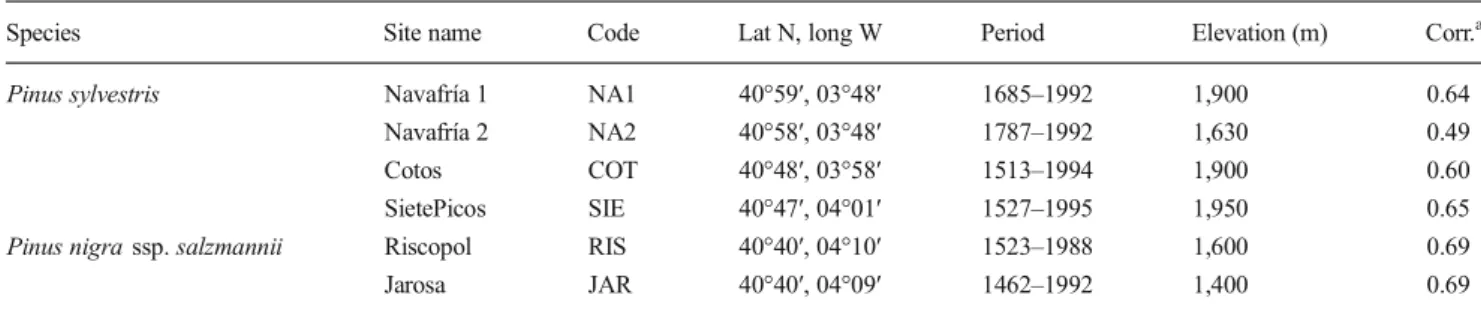
Six annual ring width chronologies of P. sylvestris and P. nigra were compiled and revised for this study from the collections of Génova (1994), Génova and Fernández (1999) and Génova (2000) (Table1). Tree ring sampling sites are shown in Fig.1. Two radii from at least ten individuals were collected in each of these sites. Tree rings were measured to Fig. 1 Central Range of the
Iberian Peninsula and below the study area.Circles and triangles
indicate the location of theP. sylvestrisandP. nigrassp.
salzmanniitree ring
chronologies, respectively.White squaresindicate the temperature and precipitation meteorological stations used in the
reconstruction. The cities of Segovia and Madrid are shown. Site codes are given in Tables1
and2
Int J Biometeorol
the nearest 0.001 mm, cross-dated and standardised with the use of standard dendrochronological techniques (Holmes
1983; Stokes and Smiley 1996; Fritts 2001). Cross-dating verifies the assignment of a calendar year to each ring in each sample by comparison of the growth patterns among the different cores and sections. We examined the quality of the cross-dating using the software COFECHA (Holmes 1983) and CrossdateR (Bigler 2006) to detect measurement and cross-dating errors. We detrended ring widths into dimension-less indices to remove the effects of changes in tree growth that resulted from aging, to homogenise the mean and vari-ance and to produce a standard chronology for the site. To this end, we employed the negative exponential, the best fit among various equations tested, to eliminate the tendencies resulting from the increase in age (we subsequently smoothed the residuals obtained by means of a function spline). Prior to the use of the negative exponential for all their time series detrending, we visually inspected the curve fitting by means of individual time series. This standardisation process elimi-nates variability in the tree ring series unrelated to climate (e.g., tree aging or forest disturbances, Fritts2001).
In order to preserve a high percentage of the low-frequency variance, we accomplished standardisation by fitting each ring width series to a negative exponential or linear regression curves, with ARS41win (Cook and Krusic2006).
The highly significant correlations between chronologies of the same species enabled them to be grouped into two com-posite chronologies. These chronologies were obtained by analysing, with the above-mentioned software, all the radii of the individual sites included in each composite. The quality of the tree ring chronologies was assessed by means of running series of Rbar, the mean correlation coefficient of all possible pairings among tree ring series from individual cores, comput-ed for a specific common time interval. We uscomput-ed a 50-year window with a 25-year overlap. The expressed population signal (EPS) statistics, which quantify the degree to which a particular sample chronology portrays a hypothetical chronol-ogy that would have been infinitely replicated (Briffa1995), was used to assess the quality of the composite chronologies. To denote a good level of common signal fidelity between trees
in the reconstruction (Wigley et al.1984), we calculated the EPS before and after combining the chronologies. For the reconstruction, we only used the portion of the chronologies falling above the threshold (0.85). We determined the EPS for the final chronology using the tree means from all sites included in each composite chronology. Thus, we obtained two EPS values, one for each species (Cook and Kariukstis1990).
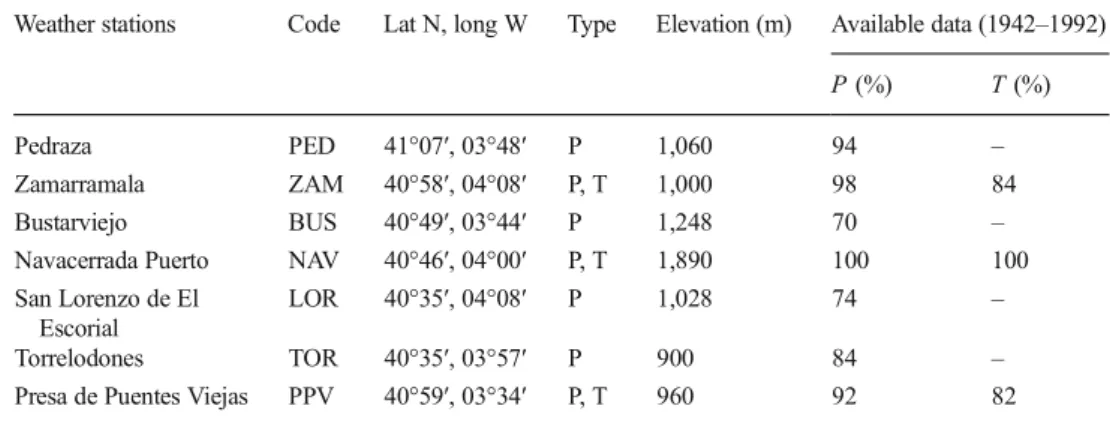
For climate data, we analysed monthly temperature and precipitation records from 64 rain and 41 temperature stations providing data for the twentieth century in the study area. Climatic records were provided by the Spanish State Meteorology Agency (AEMET). We selected these stations, considering (a) temporal stability (only stations with complete or almost complete records were used, and a minimum of 70 % of monthly data was required); (b) density (spatial coverage of the stations); and (c) homogeneity of time series. We applied a Mann–Kendall to the stations and detected no inhomogeneities in the stations chosen. We discarded stations with a significance level≥0.05. Following these criteria, we selected seven meteorological stations (Fig.1and Table2).
We filled gaps in monthly data by considering data from other stations in the study area by means of AnClim software (Stepanek2007). The stations selected to complete the monthly data did not present anomalous patterns in monthly plots (un-explained outliers) and showed significant correlations among each other (P<0.05). Thus, we obtained the most reliable instrumental records to maximise the regional climatic signal. We used the completed series to compile the regional averages of total precipitation and temperature for the Guadarrama Mountains. To obtain suitable climatic data for the reconstruc-tion, monthly precipitation and temperature values of the sta-tions were divided by the means of the 1942–1992 period; hence, a percentage (%/100) was calculated for every month and for each station. The procedure made all the stations comparable regardless of the absolute climatic values.
Climate reconstruction
To identify associations between macroclimatic factors and tree radial growth, we first performed a principal component Table 1 Characteristics of tree ring chronologies from the Central Iberian Peninsula (site codes are used in Fig.1). Calculations are performed for each of the species. The correlation was calculated for the 1513–1992 (P. sylvestris) and 1462–1992 (P. nigrassp.salzmannii) periods
Species Site name Code Lat N, long W Period Elevation (m) Corr.a
Pinus sylvestris Navafría 1 NA1 40°59′, 03°48′ 1685–1992 1,900 0.64
Navafría 2 NA2 40°58′, 03°48′ 1787–1992 1,630 0.49
Cotos COT 40°48′, 03°58′ 1513–1994 1,900 0.60
SietePicos SIE 40°47′, 04°01′ 1527–1995 1,950 0.65
Pinus nigrassp.salzmannii Riscopol RIS 40°40′, 04°10′ 1523–1988 1,600 0.69
Jarosa JAR 40°40′, 04°09′ 1462–1992 1,400 0.69
a
Mean of the correlations is indicated for each tree ring chronology with all the others (P<0.001)
Int J Biometeorol
analysis (PCA) of the tree rings with indices from the two composite chronologies (P. sylvestris 483 annual records,P. nigra531 annual records, 423 observations in common). We attempt to obtain the resultant of the relationship between the growth data of both species. Given that the covariance be-tween both series of data, previously standardised, provides the value of the correlation coefficient, the PCA can be used as a tool for obtaining the corresponding equation of this resul-tant (dependent variable) (Lara et al.2008). We subsequently used this resultant as a dependent variable of a multiple regression whose independent variables are monthly mean temperature and precipitation from the average records (Lara et al.2001). The statistical association between the PCA axis and each climate variable was examined over the common period for the chronologies and the instrumental climatic record (1942–1992). As tree radial growth is influenced by climatic conditions several months prior to ring formation (Fritts2001; Lara et al.2005), we included both the previous and current growing seasons in this analysis. Consequently, correlations between ring width and climate data were calcu-lated for 18 months, starting in May of the previous growing season and ending in October of the current one. We also calculated correlations for various monthly combinations, fol-lowing the methods described by Blasing et al. (1984).
The reconstruction equation for summer precipitation was estimated by regressing the precipitation record on the PC1 obtained from the two composite tree ring chronologies that significantly correlated with precipitation. The complete ob-servation period (1942–1992), common both to the tree ring and the precipitation data, was used for calibration, and the
‘leave-one-out cross-validation’method was used to validate the regression model (Michaelsen1987). In this method, a model is calibrated on all values but one; this value is then estimated and the process repeated until each value in the calibration period has been subjected to this process (Woodhouse and Lukas2006). The strength of the regression model was characterised by the adjustedR2and theF level was estimated as a goodness-of-fit test. We assessed the ca-pacity of the regression model to reconstruct summer
precipitation using the reduction of error statistic (RE), the root mean squared error (RMSE) and the coefficient of effi-ciency (CE) (Fritts1976; Cook et al.1999).
We tested autocorrelation of the residuals from regression with the Durbin–Watson statistic (Draper and Smith1981).
Results
The chronology ofP. sylvestrissurpasses the upper EPS value of 0.85 in the 1545–1995 period and that of P. nigra in the 1570–1992 period. We therefore chose the common period (1570–1992) in both chronologies to perform the reconstruc-tion (Table3).
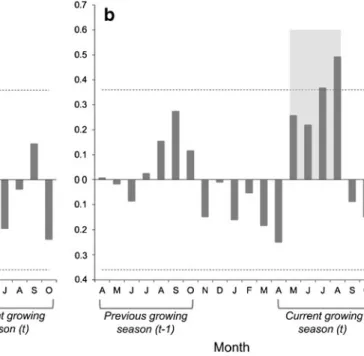
Figure2shows correlation functions between radial growth (PC1ordination axis of regional residual chronologies) and monthly temperature and precipitation data. Only summer rainfall in the current growing season presented a statistically significant correlation, having a positive effect on tree ring width (P>0.95,r>0.36). We selected the summer season for the reconstruction, as this is the combination of monthly rainfall showing the highest correlation with tree growth (P>0.95, r=0.64). In contrast, temperature has a negative effect on tree ring width in the same period and a positive effect in spring, but correlations were not strong enough to permit suitable reconstruction of past temperature variations.
The regression model used to reconstruct summer rainfall as a function of tree rings was
SRt¼−0:0168þ0:1239PC1
where SRtis estimated summer rainfall (May to August) in the
Guadarrama Mountains of year t, and PC1 is the principal component amplitude from the two composite tree ring chro-nologies for yeart. The model explained 49 % of the total variance in summer precipitation (Fvalue=47.43, verification RE=0.45, RMSE=0.138, CE=0.148). The residuals of this regression were distributed normally (Shapiro–Wilk'sWtest; Table 2 Instrumental
meteoro-logical stations from Central Spain used in the analysis. Their locations in the study area are shown in Fig.1
Ppluviometric,Tthermometric
Weather stations Code Lat N, long W Type Elevation (m) Available data (1942–1992)
P(%) T(%)
Pedraza PED 41°07′, 03°48′ P 1,060 94 –
Zamarramala ZAM 40°58′, 04°08′ P, T 1,000 98 84
Bustarviejo BUS 40°49′, 03°44′ P 1,248 70 –
Navacerrada Puerto NAV 40°46′, 04°00′ P, T 1,890 100 100
San Lorenzo de El Escorial
LOR 40°35′, 04°08′ P 1,028 74 –
Torrelodones TOR 40°35′, 03°57′ P 900 84 –
Presa de Puentes Viejas PPV 40°59′, 03°34′ P, T 960 92 82 Int J Biometeorol
P=0.321) and not significantly autocorrelated (Durbin–Watson statistic=2.04).
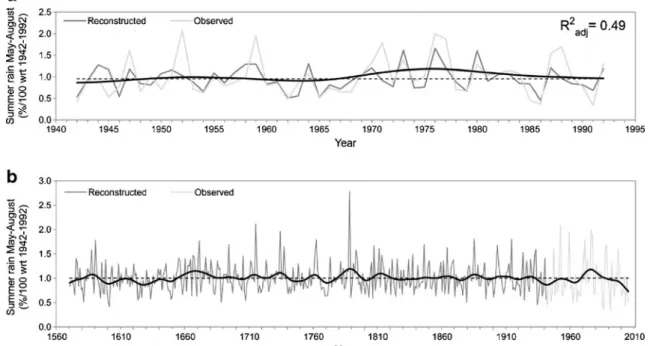
The predicted series capture both high- and low-frequency variations in the instrumental record observed (Fig. 3a). Examination of the summer rainfall reconstruction (Fig.3b) and data records observed indicates (a) moderate to severe multi-decadal drought events centred in the first half of the seventeenth century (1600–1630); (b) moderate wetter condi-tions for the 1650–1680 period; (c) moderate drought condi-tions for the 1750–1770 period; (d) severe wet conditions centred in 1780; (e) decadal severe droughts around 1940 and 1965; and (f) multi-decadal moderate wet conditions from 1970 to 1990, with an abrupt change to drier conditions as from 1990s, the largest change being within the 1570–2005 series.
Figures4and5show the analysis of the variability in the reconstructed summer precipitation series (1570–1992). The significant periodicity of the summer rainfall reconstruction across the time–frequency domain, detected with the use of wavelet power spectrum and periodogram (Urrutia et al.
2011), shows that there is a dominant interdecadal mode close
to 25 years, of the intermittent type. This periodicity, which can be seen in the spline of Fig.3b, is nearly constant for the analysed series, with breaks in the second half of 1600 and in the middle of the 1800s. In addition, throughout most of the series, a short period (2–4 years), also intermittent and less marked than the previous one can be observed.
Figure5shows the evolution of summer rain extremes for the 1570–1990 period, based both on reconstructed (1570– 1941) and on observed (1942–2005) data and for four types of extreme events, identified by the use of percentiles in the distribution (Jones et al.1999): extreme wet events (summer rainfall >90 percentile of the summer rainfall series) and extreme dry events (<10 percentile of the summer rainfall series). We used a randomisation test to test for the existence of significant trends in the temporal series of extreme events. We employed a Monte Carlo approach in which the permuta-tions are found by random selection. The total number of permutations was 10,000 for each series. In both cases, the tendency of the series was significantly different from random (Pobserved≥expected=0.000001).
Table 3 Characteristics of the composite tree ring chronologies. The values of the correlation with summer rainfall (May–August) for the 1942–1992 period are indicated
Species Number of series Number of trees Max. age (years) Period Period (EPS>0.85) Corr. (1942–1992)
Pinus sylvestris 112 59 482 1513–1995 1545–1995 0.56
Pinus nigrassp.salzmannii 49 26 506 1462–1992 1570–1992 0.67
EPSexpressed population signal
Fig. 2 Correlation functions forP. sylvestrisandP. nigrassp.salzmannii
in the Guadarrama Mountains. The correlation coefficients compare the first PCA ordination axis of regional residual chronologies of both species with regional mean monthly temperatures (a) and regional total monthly precipitation (b) over the 1942–1992 period. Thelight grey bar shows
the value of the correlation coefficient considering total precipitation in May, June, July and August. Positive correlation indicates that above-average radial growth is associated with above-above-average values of precip-itation or temperature.Dashed linesindicate significant correlations (P< 0.05;r>0.36 or <0.36)
Int J Biometeorol
These results indicate that in the Central Mountains of the Iberian Peninsula, the recurrence intervals of extreme droughts are 4.5 and 9 years, respectively. During the first half of the 1600s, the wet and extreme events were scarce. The dry ones, however, were relatively abundant. This behaviour coincided with the precipitation minimum observed in this period. There was a predominance of wet extremes during the second half of the seventeenth century, coinciding with the absolute maximum of the series, two phases of stability (ab-sence of extremes) during the 1720–1770 and 1840–1900
periods and a sharp rise in the occurrence of extreme dry events starting in the twentieth century.
To determine the spatial representation of the climatic signal of this reconstruction, we calculated correlation maps comparing (a) the reconstructed May–August precipitation with the 0.25°×0.25° gridded May–August precipitation from the E-OBS 3.0 dataset for their 1950–1992 common period (Haylock et al.2008) and (b) the reconstructed summer pre-cipitation for the 1942–1992 period with the HadSLP2 2°×2° gridded May–August sea level pressure (Allan and Ansell Fig. 3 Tree ring reconstruction of summer rainfall for the Central Range
of the Iberian Peninsula.a Summer precipitation observed and recon-structed from tree rings (May–August) during the 1942–1992 calibration period with spline of observed data (continuous black line).b Recon-structed and observed summer precipitation plotted annually from 1570
to 2005 with spline of reconstructed data (continuous black line). The spline used to emphasise the long-term variations is a cubic spline version designed to reduce 50 % of the variance in a sine wave with a periodicity of 25 years (Cook and Peters1981)
Fig. 4 Periodicity analysis of reconstructed summer rainfall series.aWavelet power spectra. Thewhite lineindicates the cone of influence; points outside have been influenced by the boundaries of the time series.bGlobal wavelet power spectrum (95 % confidence interval shown as a
red line). In the spectra, one can observe peaks withP<0.05 between 25 years (low frequency) and 2–4 years (high frequency) Int J Biometeorol
2006) (Fig.6). The correlation coefficients 0.5<x<−0.5 are significant at theP<0.005 level.
Discussion
Our results indicate a significant correlation between summer rainfall (May–August) and a composite tree ring chronology based upon two species ofPinus. The significant correlation between the growth of P. sylvestris and of P. nigra ssp. salzmannii with summer rainfall enabled reconstruction of this climate variable with a model that explains much of the total variance (adjustedR2=0.49,P<0.000001). The recon-struction performed herein is currently the most accurate for the Central Mountains of the Iberian Peninsula.
The spatial correlation patterns between instrumental and reconstructed values (Fig. 6a) show how the reconstruction captures the regional signal of drought variability in the target region of the northeastern mountains of the Iberian Peninsula (correlations of up to 0.6). The May–August pressure map (Fig.6b) shows that this area is influenced in summer by the thermal low pressure zones induced in the northeastern areas of the Iberian Peninsula. This indicates that the summer rain-fall recorded in this region is basically of convective origin and results from this low pressure (Fernández 1986; Ruiz-Labourdette et al.2011a).
Most of the reconstructed series (sixteenth to the twentieth century) is within the dry, wet and irregular rainfall period described by other authors for the Iberian Peninsula (Sanz
2003; Font1988; Martín-Vide and Barriendos1995; Rodrigo et al. 1999). Rainfall minima of the reconstruction were Fig. 5 Temporal evolution of
summer rainfall extremes for the 1570–1990 period in the Guadarrama Mountains. The extreme event years are defined through the following percentile thresholds (P): severe wet events (summer rainfall>P90 %), severe drought (<P10 %). It shows the running 10-year cumulative number of events per decade
Fig. 6 Spatial correlation patterns betweenathe E-OBS 3.0 (Haylock et al.2008) 0.25°×0.25° gridded May–August precipitation and the reconstructed May–August precipitation for the 1950–1992 period.b The HadSLP2 (Allan and Ansell2006) 2°×2° gridded May–August sea
level pressure and the reconstructed summer precipitation for the 1942– 1992 period. Correlation coefficients 0.5<x<−0.5 are significant at the
P<0.005 level
Int J Biometeorol
observed in the 1600–1630, 1750–1770, 1940 and 1965 pe-riods. Maximum precipitation was observed during the 1650– 1680, in the 1780s and in the 1970–1990 periods. The recon-struction precipitation maximum of the 1780s, coinciding with the rainfall maximum detected on the Iberian Peninsula, was identified by different authors (Font1988; Fernández et al.
1996; Sanz and Creus1999) by means of historic documentary sources as one of the periods exhibiting the greatest climatic extremes of the last few centuries in the area. The instrumental data records show an abrupt change to drier conditions during the 1990s (Fig.3). This last abrupt decadal scale change is the largest of the 1570–2005 series, coinciding with the decrease in rainfall detected on the peninsula by Rodrigo et al. (1999,
2000), De Luis et al. (2000), Sanz (2003) and Lehner et al. (2006) and with the summer warming of the Central Mountains of the peninsula as from the 1980s (Raso1997; Granados and Toro2000; Agustí-Panareda and Thompson2002).
The low-frequency climatic variability of the reconstructed series shows that one of the most important oscillatory modes involves a quasi-periodicity of approximately 25 years. This pattern is mostly constant throughout the series and is only interrupted in the second half of the 1600s and halfway through the 1800s. Currently, no studies demonstrate this quasi-periodicity of the rainfall pattern in Europe. Other authors have detected rhythms in tree growth related with drought conditions every 18.6 years in the North America (Currie1984; Cook et al.
1997) or with the 22-year Hale solar cycle (Murphy et al.1994; Villalba et al.1996). The other oscillatory mode, exhibiting a short periodicity (<4 years) observed in Europe (Burroughs
1992; Jiménez et al.2001), presents no significant correlations with the return periods of the North Atlantic Oscillation or the El Niño Southern Oscillation climatic indices. The relationship between this quasi-periodicity and climate forcings requires further investigation.
Reconstruction (1950–1992) and climatic records (1942– 2005) also show an apparent increase in the recurrence of extreme dry events from the start of the twentieth century in these mountains, which becomes sharper in the 1990s. This increase is consistent with that observed by Manrique and Fernández-Cancio (2000), Tardif et al. (2003), Camarero and Gutiérrez (2004), Andreu et al. (2007) and Macias et al. (2006) in the Pyrenees and by Ceballos et al. (2004) and Galán et al. (1999) on Spain's Central Plateau. We believe that the value of the present paper lies in the first combination of the six sites studied in two composite chronologies and in the joint analysis thereof in order to obtain regional chronol-ogies that can be useful for understanding past climate in southwestern Europe.
This supports the results indicating a global tendency to-wards a greater recurrence of extreme drought and heat waves in southern Europe (Easterling et al.2000; Goodess and Jones
2002; Beniston et al. 2007; Lehner et al.2006; Giorgi and Lionello2008; Fischer and Schär2010).
Ecological perspective in the projected trend of global warming
Regional climate change projections for mountains on the Iberian Peninsula were conducted by Nogués-Bravo et al. (2007), AEMET (2008) and Giorgi and Lionello (2008). These simulations provide a collective picture of substantial drying and warming in the warm season—a precipitation decrease exceed-ing 25–30 % and warming exceeding 4–5 °C for the 2071–2100 period in relation to the 1961–1990 reference period, under the A2-IPCC emission scenario (medium–high emissions).
These forecasts invite us to imagine the consequences of these changes for the southerly limit of the distribution ranges of numerous Eurosiberian refugee species in the Mediterranean mountains. Here, the cause of stress is fundamentally water related (Kramer et al.2000; Giménez-Benavides et al. 2007; Acosta et al.2008) and warming and desiccation would cause radical re-ordination of plant communities in these mountains. Since the end of the last glaciation, relict Mediterranean popu-lations of Eurosiberian and Boreal species that have found refuge in these mountains constitute one of the southernmost formations of these species in Eurasia. These populations are typical of shade-adapted species (unlike what occurs with this same species in forests in central and northern Europe), which favours survival of seedlings during summer (Escudero et al.
1997; Martínez-Vilalta and Piñol2002; Castro et al.2004). The conditions observed of exceptional soil moisture, similar to those in the regions of origin of these species in central and northern Europe, might constitute the key to their growth and reproduction. The exceptionally wet summers, with a recur-rence of approximately 9 years, could give rise to mass recruit-ment episodes, sufficient to guarantee the medium- and long-term survival of these northern species in the Mediterranean climate (Rojo and Montero 1996; Castro et al.2004). This might perhaps enable exceptional recruitment of root reserves that would be useful for subsequent growth cycles (Fritts2001; Lara et al.2005). The decrease in frequency of these wet events therefore implies a northward latitudinal displacement of these forests in the Mediterranean region, together with a substantial reduction thereof, as was modelled by Benito et al. (2006,2008), García and Allué (2010), Keenan et al. (2011), Ruiz-Labourdette et al. (2011b), Engler et al. (2011) or Thuiller et al. (2011). Changes in this sense can perhaps be observed in Mediterranean mountains—Pinus uncinata (Camarero and Gutiérrez 2007), Taxus baccata (Sanz et al. 2009) or Abies pinsapo (Linares and Carreira 2009). Our results indicate that the direct and indirect effects of extreme events on Mediterranean ecosystems might be greater than those caused by the mean change trends (Peñuelas et al. 2000; Walther et al. 2002; Gutschick and BassiriRad 2003; Groom et al.
2004; Pausas 2004; Pausas and Fernández-Muñoz 2012). The only vestiges of Eurosiberian and Boreal species on the central Iberian Peninsula might disappear with an increase
Int J Biometeorol
in summer drought (Fernández-González et al.2005). This loss of species might be intensified by isolation within a warm and dry matrix (Petit et al.2005) at the southern limit of their biogeographical distribution. In consonance with the behav-iour patterns observed in other Mediterranean mountains, there might be a progressive displacement of the cold humid conifers (P. sylvestris,P. nigra) and cold temperate deciduous species (Q. petraea,F. sylvatica,Corylus avellana,F. excel-sior,Betulasp., etc.) by species exhibiting less water require-ments—Q. pyrenaica, Quercus faginea and Juniperus thurifera (Sobrino et al. 2001; Peñuelas and Boada 2003; Sanz-Elorza et al. 2003; Valladares et al. 2005, 2008; Mendoza et al.2006; Jump et al.2006). In the same sense, the forests of Mediterranean mountains might be subjected to new disruptive factors resulting from increased temperature, summer desiccation, a greater recurrence of extreme drought and heat waves, such as the spread of exotic thermophilous or xerophyllous species (Brasier1996; Gritti et al.2006), per-haps increasing the frequency of natural and man-made fires (Piñol et al. 1998; Pausas 2004; Moriondo et al. 2006; Bowman et al. 2009; Pausas and Fernández-Muñoz 2012), or a higher incidence of pests heretofore only observed at lower elevations (Hódar et al. 2003). These changes can seriously affect biodiversity in these mountains, which con-stitute the low-latitude limit or rear edge of numerous Eurosiberian species (Hampe and Petit2005) and Europe's highest rates of endemisms (Vennetier and Ripert 2009; Thuiller et al.2011).
Acknowledgments This study was funded by Madrid Regional Gov-ernment's Environment and Land Management Department (Consejería de Medio Ambiente y Ordenación del Territorio de la Comunidad de Madrid
-Proyecto de Investigación Ecológica, Estudios e Investigaciones Ambientales en la Comunidad de Madrid) and Project 239/03-34/03 of the Spanish Ministry of the Environment and Project FB-AEMT-OAPN-OECC Agreement (2013-14) of Fundación Biodiversidad (Investigación de Resultados de la Red de Seguimiento del Cambio Global-RSCC). We wish to thank the EU-FP6 project ENSEMBLES for the E-OBS dataset and the ECA&D project for the data provided.
References
Acosta B, Sánchez L, Del Pozo A, García E, Casado MA, Montalvo J, Pineda FD (2008) Grassland species composition and morpho-funcional traits along an altitudinal gradient in a Mediterranean environment: relationship whit soil water availability and evapora-tive dynamic. Acta Oecol 30:1–12
AEMET (2008) Generación de escenarios regionalizados de cambio climático en España. Agencia Estatal de Meteorología, Gobierno de España, Madrid
Agustí-Panareda A, Thompson R (2002) Reconstructing air temperature at eleven remote alpine and arctic lakes in Europe from 1781 to 1997 AD. J Paleolimnol 28:7–23
Allan R, Ansell T (2006) A new globally complete monthly historical gridded mean sea level pressure dataset (HadSLP2): 1850-2004. J Clim 19:5816–5842
Andreu L, Gutiérrez E, Macías M, Rivas M, Bosch O, Camarero JJ (2007) Climate increases regional tree-growth variability in Iberian pine forests. Glob Chang Biol 13:804–815
Beniston M, Stephenson D, Christensen O et al (2007) Future extreme events in European climate: an exploration of regional climate model projections. Clim Chang 81:71–95
Benito M, Blazek R, Neteler M, Sánchez de Dios R, Sáinz H, Furlanello C (2006) Predicting habitat suitability with machine learning models. The potential area ofPinus sylvestris L. in the Iberian Peninsula. Ecol Model 197:383–393
Benito M, Sánchez de Dios R, Sáinz H (2008) Effects of climate change on the distribution of Iberian tree species. Appl Veg Sci 11:169–178 Bennett KD, Tzedakis PC, Willis KJ (1991) Quaternary refugia of North
European trees. J Biogeogr 18:103–115
Bigler C (2006) CrossdateR, a visualization tool to assess the quality of crossdated tree-ring series. Institute of Terrestrial Ecosystems ETH, Zurich
Blasing TJ, Solomon AM, Duvick DN (1984) Response functions revisited. Tree-Ring Bull 44:1–15
Bowman DM, Balch JK, Artaxo P et al (2009) Fire in the earth system. Science 324:481–484
Brasier CM (1996) Phytophthoracinnamomi and oak decline in southern Europe. Environmental constraints including climate change. Ann Sci For 53:347–358
Briffa KR (1995) Interpreting high-resolution proxy climate data: the example of dendroclimatology. In: Von Storch H, Navarra A (eds) Analysis of climate variability: applications of statistical techniques. Springer, Berlin, pp 77–94
Burroughs WJ (1992) Weather cycles: real or imaginary. Cambridge University Press, Cambridge
Camarero JJ, Gutiérrez E (2004) Pace and pattern of recent treeline dynamics: response of ecotones to climatic variability in the Spanish Pyrenees. Clim Chang 63:181–200
Camarero JJ, Gutiérrez E (2007) Response ofPinus uncinatarecruitment to climate warming and changes in grazing pressure in an isolated population of the Iberian System (NE Spain). Arct Anctart Alp Res 39:210–217
Castro J, Zamora R, Hódar J, Gómez JM (2004) Seedling establishment of a boreal tree species (Pinus sylvestris) at its southernmost distri-bution limit, consequences of being in a marginal Mediterranean habitat. J Ecol 92:266–277
Ceballos A, Martínez-Fernández J, Luengo-Ugidos MA (2004) Analysis of rainfall trends and dry periods on a pluviometric gradient repre-sentative of Mediterranean climate in the Duero Basin, Spain. J Arid Environ 58:215–233
Comps B, Thiebaut B, Merzeau D (1991) In: Mueller-Starck G, Zieh M (eds) Genetic variation in European populations of forest trees. Sauerlander's Verlag, Frankfurt, pp 110–124
Cook ER, Kariukstis L (1990) Methods of dendrochronology: application in the environmental sciences. Kluwer Academic, Dordrecht Cook ER, Krusic PJ (2006) ARSTAN_41: a tree-ring standardization
program based on detrending and auto-regressive time series model-ing, with interactive graphics. Tree-Ring Laboratory, Lamont Doherty Earth Observatory of Columbia University, New York Cook ER, Meko DM, Stahle D, Cleaveland MK (1999) Drought
recon-structions for the continental United States. J Clim 12:1145–1162 Cook ER, Meko DM, Stockton CW (1997) A new assessment of possible
solar and lunar forcing of the bidecadal drought rhytm in the western United States. J Clim 10:1343–1356
Cook ER, Peters K (1981) The smoothing spline: a new approach to standardizing forest interior ring-width series for dendroclimatic studies. Tree-Ring Bull 41:45–53
Costa M, Morla C, Sáinz H (eds) (1998) Los bosques ibéricos. Una interpretación geobotánica. Planeta, Madrid
Critchfield WB, Little EL (1966) Geographic distribution of the pines of the world. Forest Service, Washington DC
Int J Biometeorol
Cubash U, von Storch H, Wastewitz J, Zorita E (1996) Estimates of climate change in Southern Europe derived from dynamical climate model output. Clim Res 7:129–149
Currie R (1984) Evidence for 18.6 year lunar nodal drought in western North America during the past millennium. J Geophys Res 89: 1295–1308
De Luis M, Raventós J, González-Hidalgo JC, Sánchez JR, Cortina J (2000) Spatial analysis of rainfall trends in the region of Valencia east Spain. Int J Clim 20:1451–1469
Draper NR, Smith H (1981) Applied regression analysis. Wiley, New York
Engler R, Randin C, Thuiller W et al (2011) 21st century climate change threatens mountain flora unequally across Europe. Glob Chang Biol 7:2330–2341
Easterling D, Meeh GA, Parmesan C, Changnon SA, Karl TR, Mearns LO (2000) Climate extremes: observations, modeling, and impacts. Science 289:2068
Escudero A, Barrero S, Pita JM (1997) Effects of high temperatures and ash on seed germination of two Iberian pines (Pinus nigras sp
salzmannii,P. sylvestrisvar.iberica). Ann Sci For 54:553–562 Fernández F (1986) El clima de la Submeseta Meridional. Universidad
Autónoma de Madrid, Madrid
F e r n á n d e z A , G é n o v a M , C r e u s J , G u t i é r r e z E ( 1 9 9 6 ) Dendroclimatological investigation covering the last 300 years in central Spain. In: Dean JS, Meko DM, Swetnam TW (eds) Tree rings, environment and humanity. Radiocarbon. University of Arizona Press, Tucson, pp 181–190
Fernández-González F, Loidi J, Moreno JC (2005) Impactos sobre la biodiversisdad vegetal. In: Moreno JM (ed) Evaluación preliminar de los impactos en España por efecto del cambio climático. Ministerio de MedioAmbiente, Madrid, pp 183–247
Fischer EM, Schär C (2010) Consistent geographical patterns of changes in high-impact European heatwaves. Nat Geosci 3:398–403 Font I (1988) Historia del clima de España. Cambios climáticos y sus
causas. InstitutoNacional de Meteorología, Madrid Fritts HC (1976) Tree rings and climate. Academic, London Fritts HC (2001) Tree rings and climate. Blackburn, Caldwell
Galán E, Cañada R, Rasilla D, Fernández F, Cervera B (1999) Evolución de las precipitaciones anuales en la Meseta Meridional durante el siglo XX. In: Raso JM, Martín-Vide J (eds) La climatología española en los albores del siglo XXI. Asociación Española de Climatología, Madrid, pp 169–180
Gandullo JM, Sánchez-Palomares O (1994) Estaciones ecológicas de los pinares españoles. ICONA, Madrid
García JM, Allué C (2010) Effects of climate change on the distribution ofPinus sylvestrisL. stands in Spain. A phytoclimatic approach to defining management alternatives. For Syst 19:329–339
Génova M (1994) Dendroecología dePinus nigra subsp.salzmannii
(Dunal) Franco yPinus sylvestrisL. en el Sistema Central y en la Serranía de Cuenca (España). Unpublished PhD thesis, Universidad Autónoma de Madrid
Génova M, Fernández A (1999) Tree rings and climate ofPinus nigra
subsp.salzmanniiin central Spain. Dendrochronologia 17:75–85 Génova M (2000) Tree rings and pointer years of Sistema Central
(Spain) in the last four hundred years. Bol Real Soc Esp Hist Nat 96:33–42
Giménez-Benavides L, Escudero A, Irondo JM (2007) Reproductive limits of a late-flowering high-mountain Mediterranean plant along an elevational climate gradient. New Phytol 173:367–382 Giorgi F, Lionello P (2008) Climate change projections for the
Mediterranean region. Glob Planet Chang 63:90–104
Giorgi F (2006) Climate change hot-spots. Geophys Res Lett 33, L08707 Gómez-Campo C (1985) The Iberian Peninsula. Plant conservation in the
Mediterranean area. Junk, Dordrecht
Goodess CM, Jones PD (2002) Links between circulation and changes in the characteristics of Iberian rainfall. Int J Clim 22:1593–1615
Grace J, Norton DA (1990) Climate and growth ofPinus sylvestrisat is upper altitudinal limit in Scotland: evidence from tree growth-rings. J Ecol 78:601–610
Granados I, Toro M (2000) Recent warming in a high mountain lake (Laguna Cimera, Central Spain) inferred by means of fossil chiron-omids. J Limnol 59:109–119
Gritti ES, Smith B, Sykes MT (2006) Vulnerability of Mediterranean Basin ecosystems to climate change and invasion by exotic plant species. J Biogeogr 33:145–157
Groom PK, Lamont B, Leighton S, Leighton P, Burrows C (2004) Heat damage in sclerophylls is influenced by their leaf properties and plant environment. Ecoscience 11:25–33
Grudd H, Briffa KR, Karlen W, Bartholin TS, Jones PD, Kromer B (2002) A 7400-year tree-ring chronology in northern Swedish Lapland: natural climatic variability expressed on annual to millen-nial timescales. The Holocene 12:657–665
Guerrero J, Camarero JJ, Gutiérrez E (1998) Crecimiento estacional y caída de acículas dePinus sylvestrisyP. uncinata. Investig Agrar 7:155–166 Gutiérrez E (1992) Dendrochronological study ofFagus sylvaticaL. in the Montseny mountains (Spain). Acta Oecologica Oecologia Planctarum 9:301–309
Gutschick VP, BassiriRad H (2003) Extreme events as shaping physiol-ogy, ecolphysiol-ogy, and evolution of plants: toward a unified definition and evaluation of their consequences. New Phytol 160:21–42 Hampe A, Petit J (2005) Conserving biodiversity under climate change,
the rear edge matters. Ecol Lett 8:461–467
Haylock MR, Hofstra N, Klein AMG, Klok EJ, Jones PD, New M (2008) A European daily high-resolution gridded dataset of surface temper-ature and precipitation for 1950–2006. J Geophys Res 113, D20119 Hewitt GM (2000) The genetic legacy of the Quaternary ice ages. Nature
405:907–913
Hódar JA, Castro J, Zamora R (2003) Pine processionary caterpillar
Thaumetopoea pityocampaas a new threat for relict Mediterranean Scots pine forests under climate warming. Biol Conserv 110:123–129 Holmes RL (1983) Computer-assisted quality control in tree-ring dating
and measurements. Tree-Ring Bull 43:69–75
IPCC (2007) Climate Change 2007. Impacts, adaptation and vulnerability. Southern Europe. Working Group II Contribution to the Intergovernmental Panel on Climate Change. Cambridge University Press, Cambridge
Jiménez P, Andreo B, Durán JJ, Carrasco F et al (2001) Estudio de las variaciones climáticas e hidrológicas ocurridas durante el último siglo a partir de análisis correlatorio y espectral de series temporales de datos registrados en el sur de la Península Ibérica. In: Pulido PA (ed) V Simposio sobre el agua en Andalucía. Universidad de Almería, Almería, pp 63–72
Jones PD, Horton EB, Folland CK, Hulme M, Parker DE, Basnett TA (1999) The use of indices to identify changes in climatic extremes. Clim Chang 42:131–149
Jump A, Hunt JM, Peñuelas J (2006) Rapid climate change-related growth decline at the southern range edge ofFagus sylvatica. Glob Chang Biol 12:2163–2174
Keenan T, Serra JM, Lloret F, Ninyerola M, Sabate S (2011) Predicting the future of forests in the Mediterranean under climate change, with niche- and process-based models: CO2matters! Glob Chang Biol 17:565–579
Kirchhefer AJ (2001) Reconstruction of summer temperatures from tree-rings of Scots pine (Pinus sylvestrisL.) in coastal northern Norway. The Holocene 11:41–52
Kramer K, Leinonen I, Loustau D (2000) The importance of phenology for the evaluation of impact of climate change on growth of boreal, temperate and Mediterranean forests ecosystems: an overview. Int J Biometeorol 44:67–75
Lara A, Villalba R, Urrutia R (2008) A 400-year tree-ring record of the Puelo River summer–fall streamflow in the Valdivian Rainforest eco-region, Chile. Clim Chang 86:331–356
Int J Biometeorol
Lara A, Aravena JC, Villalba R, Wolodarsky-FrankeA LB, Wilson R (2001) Dendroclimatology of high-elevation Nothofagus pumilio
forests at their northern distribution limit in the central Andes of Chile. Can J For Res 31:925–936
Lara A, Villalba R, Wolodarsky-Franke A, Aravena JC, Luckman BH, Cuq E (2005) Spatial and temporal variation inNothofagus pumilio
growth at tree line along its latitudinal range (35°40′-55°S) in the Chilean Andes. J Biogeogr 32:879–893
Leal S, Eamus D, Grabner M, Wimmer R, Cherubini P (2008) Tree rings ofPinus nigra from the Vienna basin region (Austria) show evi-dence of change in climatic sensitivity in the late 20th century. Can J For Res 38:744–759
Lehner B, Döll P, Alcamo J, Henrichs H, Kaspar F (2006) Estimating the impact of global change on flood and drought risks in Europe: a continental, integrated assessment. Clim Chang 75:273–299 Linares JC, Carreira JA (2009) Temperate-like stand dynamics in relict
Mediterranean-fir (Abiespinsapo, Boiss.) forests from southern Spain. Ann For Sci 66:610
Lionello P, Malanotte-Rizzoli P, Boscolo R et al (2006) The Mediterranean climate, an overview of the main characteristics and issues. In: Lionello P, Malanotte-Rizzoli P, Boscolo R (eds) Mediterranean climate variability. Elsevier, Amsterdam, pp 1–26 López-Moreno JI, Beniston M, García-Ruiz JM (2008) Environmental
change and water management in the Pyrenees: facts and future perspectives for Mediterranean mountains. Glob Planet Chang 61: 300–312
Luceño M, Vargas P (1991) Guía botánica del Sistema Central español. Pirámide, Madrid
Macias M, Andreu L, Bosch O, Camarero J, Gutiérrez E (2006) Increasing aridity is enhancing silver fir (Abies alba Mill.) water stress in its south-western distribution limit. Clim Chang 79:289– 313
Manrique E, Fernández-Cancio A (2000) Extreme climatic events in dendroclimatic reconstructions from Spain. Clim Chang 44:123– 138
Martín-Bravo S, Valcárcel V, Vargas P, Luceño M (2010) Geographical speciation related to Pleistocene range shifts in the western Mediterranean mountains. Taxon 59:466–482
Martínez F (1999) Los bosques dePinus sylvestrisL. del Sistema Central español. Distribución, historia, composición florística y tipología. INIA, Madrid
Martínez F, Costa M (2001) La interpretación de los bosques dePinus sylvestrisL. del Sistema Central español en la literatura geobotánica y forestal. Bol R Soc Esp Hist Nat 96:27–68
Martínez-Vilalta J, Piñol J (2002) Drought-induced mortality and hydrau-lic architecture in pine populations of the NE Peninsula. For Ecol Manag 161:247–256
Martín-Vide J, Barriendos M (1995) The use of rogation ceremony records in climatic reconstruction. A case study from Catalonia (Spain). Clim Chang 30:201–221
Mendoza I, Castro J, Zamora R (2006) Can global change alter species composition of Mediterranean forests? An experimental approach in Sierra Nevada National Park. In: Price MF (ed) Global change in mountain regions. Sapiens, Dumfrieshire, pp 184–186
Michaelsen J (1987) Cross-validation in statistical climate forecast models. J Appl Meteorol Climatol 26:1589–1600
Morales P, Sykes M, Prentice IC et al (2005) Comparing and evaluating process-based ecosystem model predictions of carbon and water fluxes in major European forest biomes. Glob Chang Biol 11: 2211–2233
Moriondo M, Good P, Durao R, Bindi M, Giannakopoulos C, Corte-Real J (2006) Potential impact of climate change on fire risk in the Mediterranean area. Clim Res 31:85–95
Munaut AV, Serre-Bachet F et al (1982) The Mediterranean area. In: edsHugues MK et al (eds) Climate from tree rings. Cambridge University Press, Cambridge, pp 151–154
Muñoz J, Sanz-Herráiz C (1995) Guía física de España. Vol. 5: Las montañas. Alianza Editorial, Madrid
Murphy JO, Sampson H, Veblen TT, Villalba R (1994) Regression model for the 22-year Hale solar cycle derived from high altitude tree-ring data. Proc Astron Soc Aust 11:157–163
Nogués-Bravo D, Araujo M, Errea MP, Martínez-Rica JP (2007) Exposure of global mountain systems to climate warming during the 21st century. Glob Environ Chang 17:420–428
Nogués-Bravo D, Araujo MB, Lasanta T, López JI (2008) Climate change in Mediterranean mountains during the 21st century. Ambio 37:280–285
Pauli H, Gottfried M, Dullinger S et al (2012) Recent plant diversity changes on Europe's mountain summits. Science 336:353–2355 Pausas JG (2004) Changes in fire and climate in the Eastern Iberian
Peninsula (Mediterranean basin). Clim Chang 63:337–350 Pausas JG, Fernández-Muñoz S (2012) Fire regime changes in the
Western Mediterranean Basin: from fuel-limited to drought-driven fire regime. Clim Chang 110:215–226
Peñuelas J, Boada M (2003) A global change-induced biome shift in the Montseny mountains (NE Spain). Glob Chang Biol 9:131–140 Peñuelas J, Filella I, Lloret F, Piñol J, Siscart D (2000) Effects of a severe
drought on water and nitrogen use byQuercus ilex andPhillyrea latifolia. Biol Plant 43:47–53
Petit RJ, Hampe A, Cheddadi R (2005) Climate changes and tree phylogeography in Mediterranean. Taxon 54:877–885
Pilcher JR, Baillie MGL, Schmidt B, Becker B (1984) A 7.272-year tree-ring chronology for western Europe. Nature 312:150–152 Piñol J, Terradas J, Lloret F (1998) Climate warming, wildfire hazard, and
wildfire occurrence in coastal eastern Spain. Clim Chang 38:345–357 Prus-Glowacki W, Stephan BR (1994) Genetic variation of Pinus sylvestris from Spain in relation to other European populations. Silvae Genet 43:7–14
Przybylak R, Koprowski M, Zielski A, Pospieszyńska A (2012) Tree rings of Scots pine (Pinus sylvestrisL.) as a source of information about past climate in northern Poland. Int J Biometeorol 56:1–10 Raso JM (1997) The recent evolution of mean annual temperatures in
Spain. In: Martín-Vide J (ed) Advances in historical climatology in Spain. Oikos-Tau, Barcelona, pp 202–223
Rivas-Martínez S (1987) Mapa de series de vegetación de España. Ministerio de Agricultura, Pesca y Alimentación, Madrid Rodrigo FS, Esteban-Parra MJ, Pozo-Vázquez D, Castro-Díez Y (1999)
A 500-year precipitation record in southern Spain. Int J Climatol 19: 1233–1253
Rodrigo FS, Esteban-Parra MJ, Pozo-Vázquez D, Castro-Díez Y (2000) Rainfall variability in southern Spain on decadal to centennial times scales. Int J Climatol 20:721–732
Rojo A, Montero G (1996) El pino silvestre en la Sierra de Guadarrama. Ministerio de Agricultura, Madrid
Rolland C, Schueller F (1994) Relationships between mountain pine and climate in the french Pyrenees (Font-Romeu) studied using the radiodensitometrical method. Pirineos 143:55–70
Rubiales JM, Garcia-Amorena I, Hernández L, Génova M, Martínez F, Gómez Manzaneque F, Morla C (2010) The Late Quaternary dy-namics of pinewoods in the Iberian mountains. Rev Palaeobot Palynol 162:476–491
Ruiz-Labourdette D, Martínez F, Martín-López B, Montes C, Pineda FD (2011a) Equilibrium of vegetation and climate at the European rear edge. A reference for climate change planning in mountainous Mediterranean regions. Int J Biometeorol 55:285–301
Ruiz-Labourdette D, Nogués-Bravo D, Sáinz H, Schmitz MF, Pineda FD (2011b) Forest composition in Mediterranean mountains projected to shift under climate change along the whole elevational gradient. J Biogeogr 39:162–176
Sáinz H, Moreno JC (2002) Flora vascular endémica española. In: Pineda FD, De Miguel JM, Casado MA, Montalvo J (eds) La diversidad Biológica de España. Pearson, Madrid, pp 175–195
Int J Biometeorol
Sanz JJ, Potti J, Moreno J, Merino S, Frías O (2003) Climate change and fitness components of a migratory bird breeding in the Mediterranean region. Glob Chang Biol 9:461–472
Sanz M, Creus J (1999) La variabilidad del clima español en el pasado. Frecuencia de valores extremos de temperatura y precipitación reconstruidas desde el s. XV. In: Raso JM, Martín-Vide J (eds) La Climatología española en los albores del siglo XXI. Oikos-Tau, Barcelona, pp 501–510
Sanz M (2003) Temperaturas y precipitaciones en la mitad norte de España desde el siglo XV. CPNA Diputación General de Aragón, Zaragoza
Sanz R, Pulido F, Nogués-Bravo D (2009) Predicting mechanisms across scales: amplified effects of abiotic constraints on the recruitment of yewTaxus baccata. Ecography 32:993–1000
Sanz-Elorza M, Dana ED, González A, Sobrino E (2003) Changes in the high-mountain vegetation of the Central Iberian Peninsula as a probable sign of global warming. Ann Bot 92:273–280
Sobrino E, González-Moreno A, Sánz-Elorza M, Dana ED, Sánchez-Mata D, Gavilán R (2001) The expansion of thermophilic plants in the Iberian Peninsula as a sign of climatic change. In: Walther GR, Burga CA, Edwards J (eds) Finguerprints of climate change-adapted behavior and shifting species ranges. Kluwer Academic, New York, pp 163–184 Stepanek P (2007) AnClim software for time series analysis. Masaryk
University, Brno
Stokes MA, Smiley TL (1996) An introduction to tree-ring dating. University of Arizona Press, Tucson
Taberlet P, Cheddadi FR (2002) Quaternary refugia and persistence of biodiversity. Science 297:2009–2010
Tardif J, Camarero JJ, Ribas M, Gutiérrez E (2003) Spatiotemporal variability in radial growth of trees in the Central Pyrenees: climatic and site influences. Ecol Monogr 73:241–257
Thuiller W, Lavergne S, Roquet C, Boulangeat I, Lafourcade B, Araújo M (2011) Consequences of climate change on the tree of life in Europe. Nature 470:531–534
Till C, Guiot J (1990) Reconstruction of precipitation in Morocco since 1100 A.D. based onCedrus atlanticatree ring widths. Quat Res 33: 337–351
Urrutia R, Lara A, Villalba R, Christie DA, Le Quesne C, Cuq E (2011) Multicentury tree ring reconstruction of annual streamflow for the Maule River watershed in south central Chile. Water Resour Res 47: 1–15
Valladares F, Peñuelas J, De Luis E (2005) Impactos sobre los ecosistemas terrestres. In: Moreno JM (ed) Evaluación preliminar de los impactos en España por efecto del cambio climático. Ministerio de MedioAmbiente, Madrid, pp 65–112
Valladares F, Zaragoza-Castells J, Sánchez D et al (2008) Is shade beneficial for Mediterranean shrubs experiencing periods of extreme drought and late-winter frosts? Ann Bot 102:923–933
Väre H, Lampinen C, Humphries C, Williams P (2003) Taxonomic diversity of vascular plants in the European alpine areas. In: Nagy L, Grabherr G, Körner C et al (eds) Alpine biodiversity in Europe. Springer, Berlin, pp 133–148
Vargas P (2003) Molecular evidence for multiple diversification patterns of alpine plants in Mediterranean Europe. Taxon 52:463–476 Vennetier M, Ripert C (2009) Forest flora turnover with climate change in
the Mediterranean region: a case study in Southeastern France. For Ecol Manag 258:56–63
Villalba R, Boninsegna A, Lara A, Veblen T, Roig F, Aravena JC, Ripalta A (1996) Interdecadal climatic variations in millennial temperature reconstructions from southern South America. In: Jones PD, Bradley RS, Jouzer J (eds) Climatic variations and forcing mecha-nisms of the last 2000 years. NATO ASI Series 141. Springer-Verlag, Berlin, pp 161–189
Walther GR, Post E, Convey P et al (2002) Ecological responses to recent climate change. Nature 426:389–395
Wigley TML, Briffa K, Jones PD (1984) On the average value of correlated time series, with applications in dendroclimatology and hydrometeorology. J Appl Meteorol Clim 23:201–213
Wilson RJ, Gutiérrez D, Gutiérrez J, Montserrat VJ (2007) An elevational shift in butterfly species richness and composition accompanying recent climate change. Glob Chang Biol 13:1873–1887
Woodhouse CA, Lukas J (2006) Multi-century tree-ring reconstructions of Colorado streamflow for water resource planning. Clim Chang 78:293–315
Int J Biometeorol