
Business project of "VBF Ltd"
69
0
0
Texto completo
(2)
(3) Summary. Throughout the following study has been analyzed the viability of a newly created company, "VBF Ltd". VBF Ltd stands for “Vehicles Become Furniture Limited Society”, dedicated to the production of furniture from vehicles in poor condition. This project focuses on the many aspects that make different our company. On the one hand, our products are high quality furniture made from the recycling of vehicle parts. On the other hand, the difference and design compared to traditional furniture. These two main competitive advantages are those that provide added value to the activity of our business. The results of the project show the profitability that the company may have in the future.. Keywords: Vehicles, furniture, recycling, quality, design….
(4)
(5) INDEX 1. INTRODUCTION ...................................................................................................... 7 2. EXTERNAL ANALYSIS ............................................................................................ 8 2.1. General Environment ..................................................................................................... 8 2.1.1. Political Factors........................................................................................................ 8 2.1.2. Economic Factors .................................................................................................... 9 2.1.3. Socio- Cultural Factors ......................................................................................... 12 2.1.4. Technological Factors ........................................................................................... 14 2.1.5. Ecological Factors ................................................................................................. 16 2.1.6. Legal Factors.......................................................................................................... 17 2.2. Specific environment .................................................................................................... 17 2.2.1. Threat of New Entrants ......................................................................................... 18 2.2.2. Bargaining Power of Buyers ................................................................................ 18 2.2.3. Threat of Substitute Products or Services ......................................................... 18 2.2.4. Bargaining Power of Suppliers ............................................................................ 19 2.2.5. Rivalry between Competing Firms ...................................................................... 19 3. INTERNAL ANALYSIS ............................................................................................ 22 3.1. Company resources ..................................................................................................... 22 3.1.1. Tangible Resources .............................................................................................. 22 3.1.2. Intangible Resources ............................................................................................ 24 3.1.3. Human resources .................................................................................................. 24 3.2. VRIO analysis ................................................................................................................ 25 4. SWOT ANALYSIS................................................................................................... 27 4.1. Strengths ........................................................................................................................ 27 4.2. Weaknesses .................................................................................................................. 28 4.3. Opportunities ................................................................................................................. 29 4.4. Threats ........................................................................................................................... 30 5. MARKETING PLAN ................................................................................................ 32 5.1. Mission, vision and values ........................................................................................... 32 5.2. Objectives ...................................................................................................................... 32 5.3. Market analysis and demand ...................................................................................... 34 5.4. Target audience and segmentation ........................................................................... 37 5.5. Positioning ..................................................................................................................... 38 5.6. Strategies ....................................................................................................................... 40. 3.
(6) 5.6.1. Corporative strategy .............................................................................................. 40 5.6.2. Competitive strategy ............................................................................................. 41 5.7. Marketing MIX ............................................................................................................... 42 5.7.1. Product .................................................................................................................... 42 5.7.2. Price......................................................................................................................... 43 5.7.3. Distribution .............................................................................................................. 43 5.7.4. Communication ...................................................................................................... 43 6. PRODUCTION PLAN AND OPERATIONS ............................................................. 44 6.1. Primary Activities .......................................................................................................... 45 6.2. Support Activities .......................................................................................................... 46 6.3. Quality System .............................................................................................................. 47 6.4. Calculations of Average Cost and Average Price .................................................... 49 7. CULTURE AND POLICY OF HUMAN RESOURCE ................................................ 50 8. ECONOMIC-FINANCIAL PLAN .............................................................................. 55 8.1. Investment needed ....................................................................................................... 55 8.2. Estimated expenditure ................................................................................................. 56 8.3. Financing needed ......................................................................................................... 56 8.4. Estimated incomes ....................................................................................................... 57 8.5. Income Statement......................................................................................................... 57 8.7. Public Treasury ............................................................................................................. 58 8.8. Balance Sheet ............................................................................................................... 59 8.9. Payback, NPV and IRR................................................................................................ 59 9. CONCLUSION ........................................................................................................ 60 10. BIBLIOGRAPHY ................................................................................................... 61. 4.
(7) INDEX OF FIGURES, TABLES AND GRAPHICS Figure 1: Grant according to the points ......................................................................... 9 Table 1: Evolution of Gross Domestic Product in Spain .............................................. 10 Graphic 1: Spanish Unemployment Rate .................................................................... 10 Table 2: Last CPI Data of Spain .................................................................................. 11 Graphic 2: Evolution of the annual growth of the population of Spain by semesters (2011-2016) ................................................................................................................ 12 Graphic 3: Spanish Demographic Projection 2016-2066 ............................................. 13 Graphic 4: Pyramid of Spanish Population .................................................................. 14 Graphic 5: Evolution of Spending on R&D in Spain ..................................................... 15 Graphic 6: R&D expenditure of the Autonomous Communities with respect to GDP ... 15 Table 3: Main Competitors .......................................................................................... 22 Figure 2: Tools Budget................................................................................................ 23 Table 4: VBF‟s VRIO Analysis .................................................................................... 26 Table 5: SWOT Analysis ............................................................................................. 31 Graphic 7: Furniture Exports (annual variation in %) ................................................... 35 Graphic 8: Bandwagon Effect ..................................................................................... 37 Graphic 9: Positioning Map ......................................................................................... 39 Table 6: Ansoff Matrix ................................................................................................. 40 Tables 7: Three Generic Competitive Strategies of Porter .......................................... 41 Figure 3: Porter‟s Chain Value .................................................................................... 44 Figure 4: PDCA Cycle of Edwards Deming ................................................................. 48 Table 8: Acquisition Cost ............................................................................................ 49 Table 9: Cost of a Staff Person ................................................................................... 54 Table 10: Income Statement ....................................................................................... 57 Table 11: Monthly Fee of ENISAs Loan ..................................................................... 58 Table 12: Operations of Public Treasury ..................................................................... 58 Figure 5: VBF‟s First Year Balance Sheet ................................................................... 59 Table 13: Payback, NPV and IRR of VBF ................................................................... 60. 5.
(8) 6.
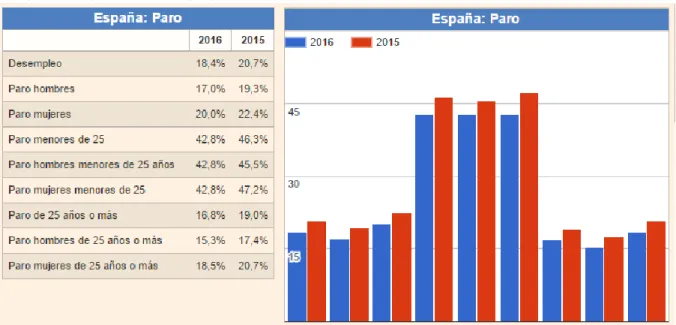
(9) 1. INTRODUCTION. The business idea described in this paper is focused on the new company "Vehicles Become Furniture Limited Society", abbreviated VBF Ltd, whose commercial activity is, in brief, to make home furniture using recycled scrap vehicles in order to give them another utility. The company is located in the city of Barcelona, whose location is favorable and advantageous to create and expand a new concept of furniture given the great amount of suppliers, potential customers and events related to our product with considerable influx of people. The idea of VBF is to stock furniture in a factory and sell it in a strategically selected point of sale. In addition, this stock will be reduced since the company intends that the force of revenue comes from custom orders of future clients. VBF Ltd has four product lines. The first three that are mentioned below are the most defined groups. The first line corresponds to Rest and Comfort, the second line is Lightning, and the third line Decoration. Finally the fourth line is called Conventional, it would include all products that do not match the first three lines. The objective of this business project is to analyze the profitability and viability of the company based on the type and characteristics of the supply. The products of VBF will be based on two identifying characteristics of the company. The first feature is ECOLOGICAL. The company is using "scrap metal" to produce an attractive and quality product. VBF wants to offer its customers an additional option when it comes to choosing what to do with their old or bumpy car. The second feature is UNIQUE. The company is convinced that its products will be a new trend for the home of its customers where there will not be two equal products. As a consequence, when running the company based on customer demands, each will have their preferences and needs at least two different designs for the same product. As aforementioned, the objective of the project is to analyze the profitability and viability of this business, but at an academic level there are specific objectives as: ●. Carry out an analysis of the context: both externally and internally, taking into account the characteristics of the market where the company will develop its activity.. ●. Make a diagnosis of the context: identify the positive and negative aspects and factors that can affect the company after the context analysis.. ●. Set a series of objectives which the company will achieve.. 7.
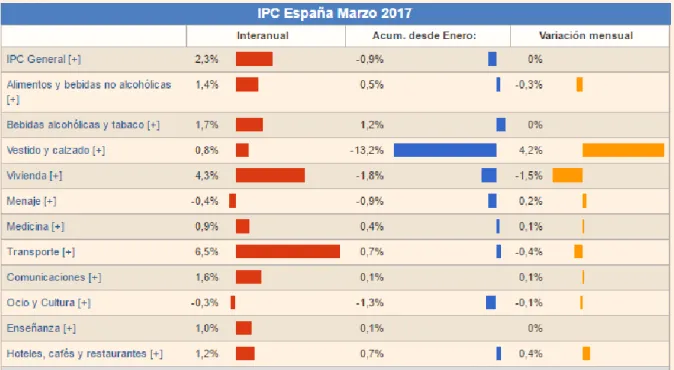
(10) ●. Define the strategies and action plans to be followed by the company regarding market conditions.. ●. Set a budget and a projection of possible expenses and income that reflect the possible results of launching this project.. 2. EXTERNAL ANALYSIS. 2.1. General Environment It is well known that analyzing the environment that surrounds your company is important to be able to develop any strategy. In order to do this, every company must perform the so-called PESTEL analysis. The acronyms of PESTEL are given by the political, economic, social, technological, ecological and legal factors.. 2.1.1. Political Factors According to Pascual Parada (2013), Strategy and Operations Consultant for Business Growth, political factors should include different government policies, corporate subsidies, fiscal policies in different countries, and changes in trade agreements, among others. Spain is a country where two main parties have ruled, the center-right Partido Popular and the center-left Partido Socialista, that is, there was a two-party system. Nowadays, four political forces are known in Spain, adding to the previous two is the leftist Unidos Podemos, and Ciudadanos (without clear ideology). Nowadays, there are two serious issues that are unbalancing the country's politics. On the one hand, cases of corruption and bonuses in the Partido Popular which threaten the credibility of the government. On the other hand, the attempts at independence that are emerging in the so-called "Paisos Catalans" following the Esquerra Republicana de Catalunya, which has called referendums considered unconstitutional. If these referendums were approved or if Cataluña finally achieved independence, there could be negative consequences for Spain. The Spanish Ministry of Economy, Industry and Competitiveness has approved financial support for the creation of companies in Cataluña through its web ipyme.com. This financial support can be found in the Official Gazette of the province of Barcelona. 8.
(11) number 77 of April 21, 2017 (Extracto-Convocatoria) and in the Official Gazette of the province of Barcelona number 56 of March 21, 2017 (Regulatory Bases). The government assesses from 2 to 8 points the difference between investment and expenditure of each company, and the financial support is given according to your score.. Figure 1: Grant according to the points. Source: Official Gazette of the province of Barcelona. 2.1.2. Economic Factors There are different factors that Pascual Parada (2013) advises us to examine in economic terms. For instance, unemployment rate, economic cycles of the country, levels of inflation … Since 2008 Spain has been immersed in a severe economic crisis caused mainly by the economic crisis worldwide and the bursting of the so-called “housing bubble”. The main adverse effects for the country have been the increase in unemployment rates and the growth of public debt. As we can see in the following table, the annual Gross Domestic Product (GDP) in Spain stands at 3.2% and has increased its absolute value by 38.212 million euros, which shows the economic recovery that is experiencing the country compared to the years 2012 And 2013. Similarly, the GDP per capita has also increased by 800€ and grew 1.2% over 2015.. 9.
(12) Table 1: Evolution of Gross Domestic Product in Spain. Source: Datoseconómicos.com If we talk about unemployment, the news are also positive for Spain, since unemployment rates has continued to fall since 2013, where there was a historic 26.94% unemployment rate. At the end of 2016, unemployment rate in Spain stood at 18.6%, 2.3% less than 2015. The negative aspect of this reduction is that it has been based on temporary jobs with reduced wages.. Graphic 1: Spanish Unemployment Rate. Source: Datoseconómicos.com. 10.
(13) Finally, Consumer Price Index (CPI), which indicates the evolution of consumption of goods and services in Spain, stands at 2.3%, although there is no monthly variation, the accumulated inflation is -0.9%. It can be highlighted the higher price of clothes and the lower price of houses.. Table 2: Last CPI Data of Spain. Source: Datoseconómicos.com Although the situation of Spanish people is not very good, it must be acknowledged that economic data have evolved over the last 3 years and that is why they are expected to increase or remain in 2017. At international level, Brexit in the United Kingdom and the elections in France are very much in mind, since the results of both can bring different economic changes at European and world level.. 11.
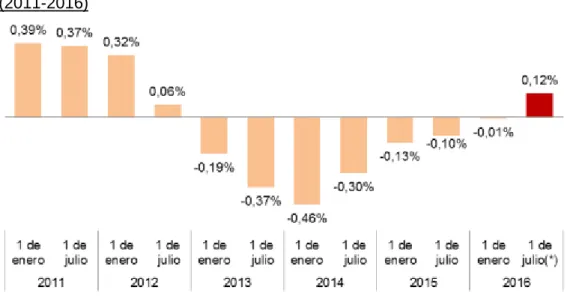
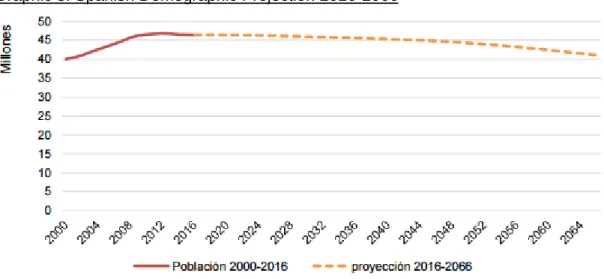
(14) 2.1.3. Socio- Cultural Factors In this section, it is convenient to analyze the demographic situation of the country as well as the trend that will continue in years to come.. Graphic 2: Evolution of the annual growth of the population of Spain by semesters (2011-2016). Source: Instituto Nacional de Estadística (INE) According to the latest demographic data provided by the Instituto Nacional de Estadística (INE), in 2016 Spain registered a positive increase in population after 3 years. The reasons for this increase are several. Even though there was a decrease of the Spanish population due to the difference between death and birth rates, there has been an increase people who obtained Spanish citizenship. It should also be noted that the number of emigrations has been reduced by providing a positive immigration balance. These demographic trends mean that today, Spanish population counts approximately 46,450,000 inhabitants. Another statistical study conducted by the SSO reveals that the Spanish population could decrease more than 5 million people during the next 50 years.. 12.
(15) Graphic 3: Spanish Demographic Projection 2016-2066. Source: Instituto Nacional de Estadística (INE) These forecasts are due to the increase of the death rate in relation to the decrease of the birth rate. In other words, Spanish population would become older. This is due to the fact that women will take longer to have children and will be fewer women in childbearing age. Although life expectancy remains high, death rate will continue to rise due to the aging population. According to this study, Spanish population could be reduced to 8 million people, but considering the entry of immigrants and the data of emigration of Spaniards, it is considered that the population could increase 3 million, which results in the 5 million commented previously. Looking statistics down other point of view, it could be said that in 50 years Spanish population will decrease in 11% if this trend continues. Following this trend, Spain‟s population pyramid would be represented as follows:. 13.
(16) Graphic 4: Pyramid of Spanish Population. Source: Instituto Nacional de Estadística (INE) As we can see, younger population will tend to be reduced in the next 15 years, and even more after 50 years. The majority of the population will be composed of men and women between 55 and 59 years old.. 2.1.4. Technological Factors This section is more complex to analyze since technological innovation is developing every day. Therefore, it will be analyzed the national investment rate in this field and how Spain stands out for Europe or the world. Latest data provided by the Spanish Statistical Office published in 2016, show that in 2015 the Spanish state invested 1.22% of GDP in Research & Development (R&D). The graph provided by the SSO shows that the largest investment in R&D was made in the business sector, reaching 0.64% of GDP. In second place, higher education, with 0.34%. Lower rates were found in public administrations and private non-profit institutions, with 0.23% and 0.2% respectively.. 14.
(17) Graphic 5: Evolution of Spending on R&D in Spain. Source: Instituto Nacional de Estadística (INE) These data are collected based on the average investment made by each autonomous community in R&D.. Graphic 6: R&D expenditure of the Autonomous Communities with respect to GDP. Source: Instituto Nacional de Estadística (INE) It is remarkable the contribution of four communities to the development of R&D such as País Vasco, Cataluña, Madrid and Navarra. Instead, communities such as Castilla La Mancha, Islas Baleares and Canarias are the ones who spend less.. 15.
(18) It is fair to mention the work on innovation presented by Spain in the world according to Juan Carlos Cárdenas article about the Marca España project (2015). Which is a project to improve the image of Spain abroad and in the nation itself: -. Spain is a worldwide reference in the infrastructure sector (transport, air or civil work).. -. Leader in the rail transport sector, due to the design and installation of highspeed lines. Our country has the second longest-high speed line in the world.. -. One of the leading producers and exporters of graphene, material of wide technological applications.. -. It is at the forefront in generation and distribution of energy of all kinds.. -. World-wide referent in health, not only for being the country with more organ donation, but also for being a pioneer in the development of anti-cancer drugs.. -. The aeronautical sector is one of the most innovative sectors of Spain and a world reference.. 2.1.5. Ecological Factors In this section, the different environmental laws and treaties against climate warming should be collected such as the Kyoto Protocol, the Paris Conference and the new United Nations Framework Convention on Climate Change. However, there are data that concerning VBF. Eurostat Agency, which belongs to the European Union, has revealed that Spain is one of the closest countries to achieve the goal of recycling 95% of Out of Use Vehicles, and reuse them at 85%. Taking into account that from the year 2000 to 2014, there has been a 17.5% increase in terms of vehicle recycling, these data show Spain's commitment to European regulations. This percentage of vehicle recycling has increased thanks to technological advances in the process of fragmentation and postfragmentation. In addition, since 2003 and in compliance with Royal Decree 1383/2002 of the Ministry of the Environment, which was issued following an European Directive, all Spanish scrapyards had a period of 2 years to become Authorized Reception and Decontamination Centers (ARDC). All the information in order to achieve this process of scrapping and applicable to vehicle repair and maintenance garages can be found in the Environmental Information Guide for the Automotive Sector published by the Official Chamber of Commerce, Industry and Navigation of Mallorca, Ibiza and Formentera.. 16.
(19) 2.1.6. Legal Factors The factors are legal regulations that the company must meet before the start of its business activity, during its business activity and in the future. An article of Diana Wicks on the web La Voz de Houston (2017) describes the licenses that a company that is going to dedicate to the production and sale of furniture must meet: -. Business License: grants the permission to carry out the business activity.. -. Conditional Permission: depending on the location of the factory, the company may need this permission due to the noise and inconvenience generated by VBF to the city's neighbors.. -. Seller Permission: Important to be able to exercise the right to wholesale or retail of furniture. It also helps to track company costs and quantify taxes.. -. Fire Department Permit: Some activities such as welding may cause undesirable fires. This is the reason why the city's fire department offers welder handling practices to obtain this permit.. Obviously, there are other regulations such as the recently amended Labor Risk Prevention Act 31/1995 in 2014 and published by the Official State Gazette. Finally, taking into account that the company has a website, the company must comply with four more laws: -. Law 7/1996 of 15 January, of the Retail Trade.. -. Law 7/1998 of 13 April, General Conditions of Contract.. -. Royal Decree 1/2007 of 16 November, General Law for the Protection of Consumers and Users.. -. Law 34/2002 of Services Information Society and Electronic Commerce.. 2.2. Specific environment When someone wants to start a business in a sector, it is important to know if that sector is profitable and, above all, the competition that the company is going to face. For this reason, it is necessary to use Porter‟s Five Forces analysis. Porter‟s Five Forces are the threat of new competitors, bargaining power of suppliers, bargaining power of customers, threat of substitute products or services, and the rivalry between competing firms.. 17.
(20) 2.2.1. Threat of New Entrants The furniture sector is growing since 2015, especially thanks to the export rates of Spanish manufactures. In addition, the lower price of housing and the decrease in unemployment rates has caused that people who can afford it or take advantage of the moment will surely buy furniture. There is no up-to-date information of the growth of companies in this sector. Although it is believed that it will have increased, the fact is that it is an industry that requires a strong initial investment and several licenses. Therefore, it is difficult to enter the market. It should also be added that the population already knows which companies in the sector prefer or have a better image, which can be considered another barrier to entry for new companies.. 2.2.2. Bargaining Power of Buyers In this industry the bargaining power of the customer is quite large. While choosing furniture, the customer can think of design, quality, price, dimensions, color, etc. There are infinite reasons to buy or stop buying a product. The advantage of the companies who produce custom-made furniture is that it is easier for us to adapt the product to the customer. The problem is that if we do not convince the customer with our product, our image as a company can be damaged.. 2.2.3. Threat of Substitute Products or Services Furniture is one of the products of which is replaced by another identical. For example, a dining table can only be replaced by another dining table. What makes furniture substitute or not in this sector is the price, style, design, quality, materials ... In other words, what makes furniture replace another are the characteristics. Regarding materials, furniture can be made of wood, iron, aluminum, steel, plastic... A plastic table would be a substitute product of any other table. It fulfills the same function. In the same way, people can substitute an iron table for another one of wood simply by changing style.. 18.
(21) 2.2.4. Bargaining Power of Suppliers The main source of materials for the business are scrap yards. For this reason, it is necessary to know the approximate number existing both in Spain and in the Autonomous Community of Cataluña. To do this, one must look for the National Classification of Economic Activities (NCEA) number 4677, Wholesale trade of scrap and waste products. If the information obtained in the digital newspaper ElEconomista.es (2017) is correct, currently in the Catalan community there are 192 scrapyards or companies that are engaged in the treatment of scrap and waste, of which 151 are in the province of Barcelona. On the other hand, and using the same source of information, in Spain there are about 1164 companies with this NCEA. Thus, it could be said that VBF has a long list of potential suppliers, which makes the bargaining power of these suppliers relatively small. In addition, there are also auctions of vehicles damaged nationally and internationally where it would be possible to obtain more material. VBF wants to pay suppliers in 3 or 4 months maximum in order to prevent excessive raw material costs. The forces that can make this business are the following: . Suppliers have a new customer.. . The price of the materials sold in the scrapping can be several times in a short time, even worth less.. . Their profit margin may increase with this opportunity.. 2.2.5. Rivalry between Competing Firms This force of Porter refers to the companies that compete directly with VBF in terms of industry and product. Given the possible increase in rivalry, variation in demand and prices, among others, it is important to carry out this analysis between competitors to find out if company's strategy is suitable or if it has to be redesigned. According to the latest reports from the Ministry of Industry, Energy and Tourism, in 2014 Spain had 12,355 companies: 12,346 are SMEs and the other 9 large companies. These 12,355 companies represented 6.56% of the total industry covered by Ministry‟s reports. Nowadays, current figures of companies in the sector of the manufacture of furniture are not available.. 19.
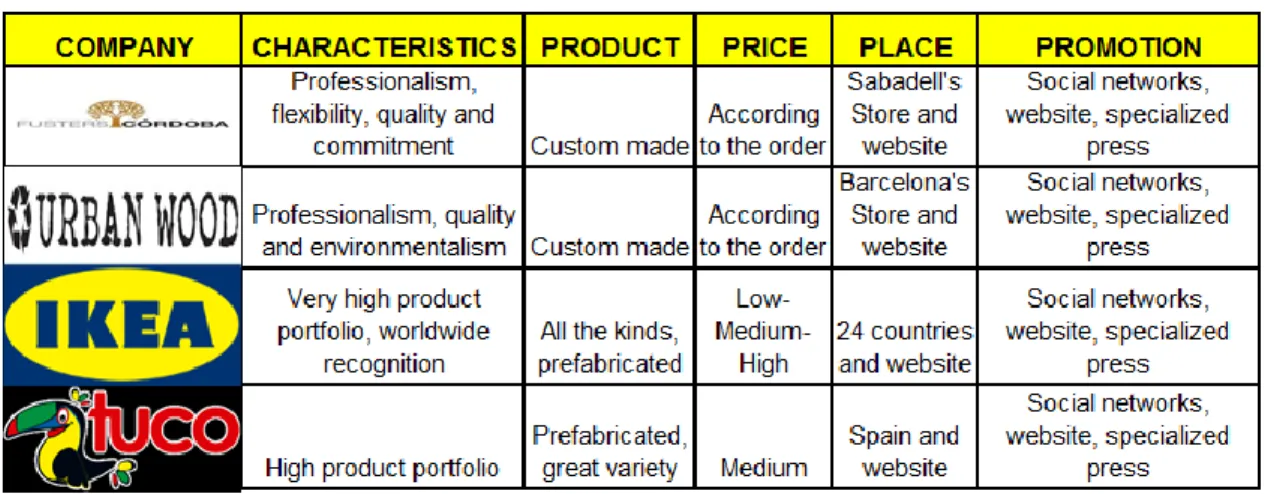
(22) However, the Furniture Manufacturing Sector (NCEA 2009 # 31) is composed of: -. Manufacture of office furniture and commercial establishments (NCEA 2009 # 31.01).. -. Manufacture of kitchen furniture (NCEA 2009 # 31.02).. -. Manufacture of mattresses (NCEA 2009 # 31.03).. -. Manufacture of other furniture (NCE 2009 # 31.09).. Taking this into consideration, it is necessary to know who competes with VBF. VBF would be included among the companies of manufacture of other furniture. As the company is not dedicated to produce mattresses, that part of the competition is not important for us. On the other hand, depending on the customer, being it a private individual or another company, it is possible that some of our products could be placed as office or kitchen furniture. Nevertheless, there is a point in which all the companies agree: the consumer. Nowadays, companies have to go further: not only the consumer must be satisfied, but companies have to perform better than the competition. There are four levels of competition based on the consumer's perspective on products. Level 1. Competition in the Form of Product: It refers to all products and brands that cover the same market segmentation. It is the most severe competition. Applied to our sector, the competition that belongs to this level would be companies producing custom-made furniture. One of the companies that would represent this level is Fusters Córdoba SL, located in Sabadell, which has excellent reviews in terms of product, price and punctuality. Level 2. Product Category Competition: Products and brands with similar characteristics but with a different style. At this level we can find the company URBANWOOD, a company that is dedicated to the production of furniture with recycled wood and treated with natural products. They are also located in the area of Barcelona, and their products as well as recycled, but offer another decorative style. Level. 3. Generic Competition: Products and brands that meet the same needs of the customer, taking as a reference the benefits that the consumer can obtain. In this third level enters any company that is dedicated to selling furniture. One of the largest and with greater presence in the market is IKEA.. 20.
(23) Level 4. Competition Level Budget: Products or services that have the same budget. In this case, it is important to convince the consumer that a piece of furniture custommade is better than a prefabricated piece of furniture such as TUCO. Once our competition has been identified, it needs to be analyzed. To this end, we will mention their strongest characteristics and information about their products and their prices. The main features of Fusters Córdoba, according to its website and the opinions of its clients, is its professionalism, flexibility, quality and commitment. Four clearly defined features. However, it is impossible to estimate the price of their products and services, since in the end this varies according to the size of the order. Regarding the second level, URBANWOOD has similar characteristics to Fusters Córdoba, with the exception that its furniture are made of recycled wood. Apart from being a new and attractive trend, it reflects a constant concern for the environment. Here we can read a small text from their web page. Why must we recover the wood? Because nowadays thousands of tonnes of wood end up in landfills whose recovery would avoid felling millions of trees. Because it is necessary to enhance the waster for a better use of natural resources and for respect to the environment. Because sustainability is to use rationally the natural resources ensuring their availability for future generations.. At the third level, there is Ikea. The Swedish giant represents the top of the furniture vendors. Their main advantage the wide variety of all types of furniture they offer and, above all, its price. For example, in dining tables, they have stock ranging from 29€ to 350€. Depending on the product the price difference can be more noticeable. The last level is filled by TUCO. This company has a smaller variety than, for instance IKEA, but there is little difference in price between both companies, although the furniture of TUCO seems to have a better finish and quality.. 21.
(24) Table 3: Main Competitors. Source: Own elaboration. 3. INTERNAL ANALYSIS. 3.1. Company resources This section defines the resources that the company will have since its foundation and their cost. Tangible and intangible resources will be estimated as well as human resources and finally the VRIO analysis of Barney & Griffin will be made. 3.1.1. Tangible Resources Tangible resources are those that have a material part, that is, they are measurable and quantifiable. Financial assets are among tangible resources. The company will be located on two different places: a factory here the furniture will be produced, and a store, although sales and orders can also be made in the factory too. The monthly amount of the two spaces is 2775€ per month and about 33300€ per year (40293€ with taxes). The retention that the company will have to do is 19%, therefore each quarter VBF will be retained 1581.75€ ((2775 x 19%) x 3). Although it may seem a considerable expense, the location of the two premises is conducive to the business. On the one hand, the factory is located in Calle dels Motors, in Sants-Monjuïc very close to the Fira de Barcelona, one of the centers where we can present several opportunities to offer our products. On the other hand, the point of sale is located in Passatge de Bocabella, to the Dreta de L'Eixample, which is a busy place where lots of people who live in Barcelona walk every day, but it is also close to major attractions such as Arc de Triomf and Sagrada Family, so lots of tourists would also see our store. In addition, it is just a few minutes by car from the most exclusive areas. 22.
(25) of Barcelona such as Sant Gervasi, Les Tres Torres, Passeig de Gracia, Pedralbes and Sarrià. VBF must also consider the cost of the basic material needed to carry out its business activity. The equipment is purchased from the company EquipoTaller of Mérida (Badajoz) whose cost amounts to 7675.76€ (6343.60€ + taxes) which includes: tire separator, tire balancer, car lift, jack jack, impact gun, oil catcher, 20 ton press , folding crane, garage hose, air compressor, two 7-bin tool trolleys equipped, a welding machine, and for the three factory employees, three workbenches, three led flashlights, and three matching uniforms made up of safety boots, jacket and pants.. Figure 2: Tools Budget. Source: www.equipotaller.es For the cleaning of the recycled pieces, the company will also have a sand chamber (sandblast) by value of 600€, 726€ counting taxes. The offices will have three computers worth 600€ each with a printer 100€, 2100€ with taxes, which final cost is 2541€. Finally, VBF has a new Hyundai H350 van with value of 27,000€ (21330€ + taxes). With this van the company plans to make the different deliveries near the store and bring new products from the factory to the point of sale. The total value of tangible resources must be 61573.6€ without VAT. The amortizable value would be 28273.6€. If we draw a straight line amortization to an average of 14 years expecting the residual value of all resources to be 3000€, the annual amortization fee will be 1805.26€.. 23.
(26) On the other hand the equipment for the information process has a ceiling of 8 years of amortization, therefore 2100 € with a residual cost of 300 € will have an amortization of 225€. The accounting amortization carried out is fiscally admissible according to the Tax Agency. 3.1.2. Intangible Resources Intangible resources are those resources that cannot be quantified or measured, since they are immaterial. The company will invest 1500€ (1815 with taxes) in the design of its own website. Clients can access different sections: -. Company: Here, customers can obtain different information about VBF.. -. Purchase: In this section, customers will see all the available stock of the store.. -. Historical: This section contains photos of the most striking and elaborate products that VBF has done. Customers will see the high performance of our employees and get an idea of the results of placing an order to the company.. -. Contact : Customers can ask for information.. -. Order: This section will allow clients specify the type of furniture he/she wants, giving us the greatest possible details. Likewise, the company will contact the customer, so there is no misunderstanding in the order and is done as desired by the customer.. On the other hand, the company will also be present in the most used social networks, such as Facebook or Instagram. The amortization of the website will be 70€ with a residual value of 100€ in 20 years. The company estimates an expenditure on supplies of 8000€ per year that will increase by 500€ year after year. 3.1.3. Human resources Human resources section is very important for the company because using its experience, skill and creativity, the company will continue developing. The staff of the company is made up of 5 people: -. Two people making furniture: The function of these three people is to create the stock of the company using all the tangible resources mentioned before. Each one has its own table where they can carry out individual projects, but for large orders they will work as a team. The idea is that they self-manage work complying with client's guidelines and delivery dates. In addition, they will be 24.
(27) required to record all the costs that were required for each processing, from the acquisition of the raw material to the end of the product. These tasks demand a great responsibility of the workers. -. A person dealing with sales: the mission of the seller is mainly to sell, but he or she has other duties as taking orders, controlling stock in store and transferring furniture from the factory to the point of sale.. -. Another person in charge of the web and administrative tasks: this person will be in the office of the factory. Her/his duties are meeting possible online demands and updating the website. He/she will also perform administrative and customer service duties. Moreover, he/she can also develop other tasks such as purchasing building materials through our suppliers or on the internet.. -. The owner with functions in administration and management: The functions of the owner are several, starting with administration and accounting functions. He will have to go from the factory to the point of sale and vice versa to control the situation of each one and to supervise the work. Above all, the role of the owner is to keep the team motivated and get what they need to work comfortably and at maximum performance.. The company will have a flat organization where all workers are at the same level and none of them is above the other. In addition, this will ensure that all employees participate in future decisions of the company. In this way VBF makes everyone participate and employees will feel grateful to belong to the company.. 3.2. VRIO analysis To establish something as important as a business strategy, VBF has to perform an analysis of tangible, intangible and human resources to choose which business strategy would be most convenient with the resources available. This type of analysis designed by Barney & Griffin in 1992 is called VRIO Analysis. The goal is to identify if your resources have some kind of advantage over others. In order to perform this, this analysis assesses value, rarity, inimitability and organization. Firstly, VBF must ask these questions to each of its resources regarding its value, its rarity, its inimitability and its organization.. 25.
(28) -. Value: Does this resource add value to the company?. -. Rarity: Could this recourse be considered a unique resource? No one else has it? Does it provide an advantage over others?. -. Inimitable: Is this a resource that others cannot copy?. -. Organization: Does the company's policy and culture help to enhance the value, rarity and inimitability of our resources?. If the answer is “no” at all points, the company is in competitive disadvantage. If the answer is yes in one of the sections, the company has competitive parity in that resource. If the answer is yes in two sections, the company has a temporary competitive advantage. If the answer is yes in three sections, the VBF has a competitive advantage yet to be exploited. Finally, if the company gets 4 affirmations, the resource is a sustainable competitive advantage. After answering yes or no to these questions, the result of the analysis can be seen as follows:. Table 4: VBF‟s VRIO Analysis. Source: Own Elaboration As we can see, the resource that shows the greatest competitive advantage in the company is its product, which contributes value, is rare, since none or very few companies are engaged in the elaboration of furniture based on vehicles. It is unique, two pieces of furniture are not the same, and the organization of the company is successful. On the other hand, intangible and tangible resources and human resources are only competitive parity. With only a competitive advantage the company could be in trouble if it turns out that it is not as strong as estimated. Therefore, as the company evolves, it will have to develop new advantages in other parts in order to become more competitive not only in the elaboration section.. 26.
(29) 4. SWOT ANALYSIS. A SWOT analysis is a tool that allows us in a simple way, identifying our own strengths and weaknesses, and the opportunities and threats of the market, to make a diagnosis of the company before taking a strategic decision for the future. The SWOT analysis is configured according to the elements and factors that influence the internal level of the company as in the external level. At an internal level, formed by the strengths and weaknesses, the company must identify those aspects that will allow them a position in the market (strength), and the points that must correct as soon as possible because they can turn down the aspirations to grow as a company (weaknesses). Regarding external factors, the company should take advantage of advantageous situations and protect themselves from unfavorable situations. We are talking about threats and opportunities. Obviously, threats are factors that the company cannot control and must defend itself against them (competitors, economic and demographic factors…). In the case of opportunities, agents that are also not under the control of the company are presented as options for business growth. The company must make the most of these opportunities.. 4.1. Strengths - Different Product: “VBF” want to express in each of their orders that the product produced is different and unique. It is not made with traditional materials that can be found in other furniture stores. It is made based on recycled material and unusual elements. It is manufactured based on the request of the client and creates a new style of decoration. -. Quality and Comfort: In spite of having products made from hard and heavy materials, the company focuses on lightening and remodeling them to be as comfortable as possible with very high quality standards. Thus, the customer will be able to place the product where he / she considers and at the same time he / she will enjoy a lot in terms of aesthetics and comfort.. -. Ecological Product: Maybe, the main characteristic of the product is its elaboration using recycled elements. Social awareness of the environment has grown over the years and reinforcing that awareness with a product that 27.
(30) effectively values the environment makes it more attractive to potential customers. -. Location: The company is located in Barcelona, one of the largest, richest and most highly populated cities of Spain, but above all, it has the Montmeló circuit where Formula 1 and MotoGP grand prix are disputed. These sporting events encourage hundreds of thousands of people every year. In addition, the premises are close to the "Fira de Barcelona", where various thematic fairs are held, both for vehicles and furniture. Another advantage of the location is the proximity to tourist attractions such as the Sagrada Familia and the Arc de Triomf, as well as Barcelona's most exclusive neighborhoods: Sant Gervasi, Pedralbes, Sarrià, Paseo de Gracia y Las Tres Torres.. -. Personalized Attention: “VBF” will have a relatively small stock but can show that is able to use different parts of vehicles, so the customer can get an idea of our capabilities. The company should focus on satisfying these types of customers who will be the ones who will recommend us or not, that is, buzz marketing. Therefore meeting customer expectations is key to the future of the company.. -. Originality: It is one of the strengths of the company,. Cars, motorcycles, trucks, many vehicles have hundreds of pieces and many of them usable. The purpose is to imagine and make all possible furniture as a result of an element (the part of the vehicle). Before the different types of furniture and uses, the originality that “VBF” can have in the elaboration of these is an addition to the success.. 4.2. Weaknesses - Price: A different product usually is translated into a higher price, so our products will not be available to many potential customers, which is a major disadvantage in this sector. However, depending on the order the price is changing and there are other factors that can reduce the final price. -. New Company: Beginnings are not easy, especially for a company. It is a small company in a sector where there is a lot of competition, with a daring product that will take time to make itself known. Of course the monetary aspect also influences.. -. Extension of Models and Uses: There is a wide variety of furniture: Living room furniture, bathroom furniture, bedroom furniture, garden furniture, terrace. 28.
(31) furniture. It is like a tree with many branches and many leaves, so “VBF” will need a lot of originality and innovation, but it will achieve several types of furniture that the company cannot offer what could lead to losing customers and benefits. -. Get Materials: One of the problems that surely “VBF” is going to find is the search of materials to transform them into furniture. Even with the existence of scrapping to acquire this material, there is a contract which, if the owner of the vehicle signs it, the scrapping must compulsorily press, reducing our opportunities to obtain material. On the other hand, at first our supplier network will be small and “VBF” will have to spend a lot of time and money searching for materials for ourselves.. -. Deliveries: One of the problems that “VBF” have at the beginning is deliveries. Having staff and transportation to make deliveries is very expensive, so in the beginning “VBF” will have a van to be able to assist customers near our location, but for big and heavy packages the company will hire delivery companies.. 4.3. Opportunities - Economic Recovery of Spain: According to Jose Luis Bajo‟s article on the digital magazine elEconomista.es (2016), Spain is close to rebuilding the precrisis economic levels in 2017 or next year so “VBF” can possibly have more customers and more profit. -. Fashion Changes: Fashion can change or every year or every moment, so it can be either a great threat or a great opportunity for a furniture company. The problem is that you cannot "control" fashion unless you are a very recognized and powerful company. Even with this, if the style of your furniture strikes you can survive these changes.. -. Motor Events: One of our strengths is the location of the company, in Barcelona, not only because it is a rich city with great demography, but also because of the Montmeló circuit. The events of Formula 1 and MotoGP move hundreds of thousands of people, but more events of this type are done throughout the year. Placing a stand with own stock and with images of other orders, we can draw the attention to many fans who want to give a new touch to your home. There are also several specialized pages that are dedicated to call events in different parts of Spain as eventosmotor.com. Motor events will be a great opportunity to show our products and reach customers.. 29.
(32) -. Furniture Fairs: The premises are close to the "Fira de Barcelona", where various thematic fairs are held, both for vehicles and furniture.. -. Export growth: In 2015 a report from the Technological Institute for Metalworking, Furniture, Wood, Packaging and Allied Products revealed that the furniture production sector is recovering thanks to exports that increased by 10% more than in 2014. Therefore, VBF should adapt as quickly as possible to benefit from this growth.. 4.4. Threats - Abundance. of. Competitors:. According. to. the. digital. magazine. elEconomista.es (2017), currently in Spain in the sector CNAE (4759) "Retailing of furniture, lighting equipment and other articles of domestic use in specialized establishments", there are 4,990 companies which share the billing Sector amounting to 4.712.394.712€. Because of this "VBF" has to seize any opportunity to get a share of this market. -. Fashion Changes: Fashion can change or every year or every moment, so it can be either a great threat or a great opportunity for a furniture company. The problem is that you cannot "control" fashion unless you are a very recognized and powerful company.. -. Extension of Models and Uses: As I mentioned before, the furniture is like a tree with many branches and many leaves, so the company need a lot of originality to be able to make any furniture with what “VBF” have. However there will be difficult to make or impossible furniture, which could detract customers and benefits. If other companies develop other types of furniture and "VBF" cannot imitate them, it could not answer this threat.. -. Existence of Substitute Products: Using recycling for furniture is not a new activity, there are companies that, for instance, recycle wood for the subsequent elaboration of furniture, which results in a rustic product, cheaper and can have the same functions as buying furniture in specialized stores. EcoDeco, MuebleReciclado and UrbanWood are some names of companies that are dedicated to the production of recycled wood furniture.. -. Cataluña Independence: Although it is difficult to achieve independence, there are companies that have decided to move their headquarters outside Cataluña. If independence became real, the consequences for companies in the Catalan provinces would be uncertain.. 30.
(33) Table 5: SWOT Analysis STRENGTH. WEAKNESS. Different Product. Price. Quality and Comfort. New Company. Ecological Product. Extension of Models and Uses. Location. Get Materials. Personalized Attention. Deliveries. Originality. OPPORTUNITIES. THREATS. Economic Recovery of Spain. Abundance of Competitors. Fashion Changes. Fashion Changes. Motor Events. Extension of Models and Uses. Furniture Fairs. Existence of substitute Products (recycled wood furnitures). Export growth. Cataluña Independence Source: Own elaboration.. 31.
(34) 5. MARKETING PLAN. 5.1. Mission, vision and values The mission of the company “VBF” is to provide high quality furniture using recycled parts of vehicles for all those customers who want to decorate their home with a new, engine motor related and environmentally friendly style. The Vision of Vehicles Become Furniture is to create a new trend where the factors modernity, quality and comfort are present for the customer in products considered unique because they have a recycled origin, being this identity against the competition and the changes taking place in the sector. The values on which the company is based are the following ones: -. Quality: Products and services offered are excellent.. -. Originality: It is the engine of the company. As “VBF” grows, it will develop new and unique products that can bring new services or new ways of working.. -. Commitment and responsibility: On the one hand, the company undertakes that workers have ideal and stable working conditions. On the other hand, the commitment with the customers regarding product, service and deadlines. Moreover, the company has a great responsibility with the environment.. -. Teamwork: The company encourages group integration and a good positive environment, as well as taking into account the opinion of its employees in the projects.. 5.2. Objectives The objectives must be mainly developed with respect to the vision of the company. By doing this we will establish a basis that will allow us to achieve our vision more quickly. Of course, the main objective of the company is to offer quality furniture using recycled vehicles to customers who want a new style of decoration in their houses, accompanied with a good customer service. This satisfaction is what we need to create long-term relationships and easily expand our brand and product. These are the objectives with which VBF is committed: 1. Improve brand image: We must ensure that the VBF brand is associated with quality recycled products, with an inimitable design that brings a new style to customers' homes.. 32.
(35) 2. Achieve the loyalty of more than 50% of our annual customers: It is very important for the company to establish relationships with long-term clients, not only to have the opportunity to sell more, but to ensure that those satisfied customers help us to get more customers who want this type of relationship with us. In other words, we want to achieve a positive customer‟s opinion.. 3. Increase our number of customers by 5% every year: If we achieve the above objectives, it is very likely that the company will increase its customers at least 5% per year. Since furniture is not a product that is renewed every year, it is advisable to expand our customer base year after year. For this reason, VBF will have to continue adapting its products to the type of consumer, either an individual or a company.. 4. Build a broad and professional supplier network: The material we need to make our products can be difficult to obtain without a network of contacts that provide them. Scrap yards, upholsterers, companies selling vehicles or any contact that helps us to get the material or give value to the product will be important to achieve business objectives. Moreover, there is also the possibility of participating in national and international auctions, in which the company can find vehicles that fit the orders.. 5. Improve the originality of the products: The furniture can be one of the objects with greater variety in shapes and styles. Due to this variety, we have to achieve not only a style of our own, but also be very imaginative in the development of the type of furniture we are going to produce, Bathroom furniture, a kitchen cabinet, garden furniture… In addition, the development of new products can lead to the development of our production techniques that will be very beneficial for future orders.. 6. Make our product known throughout Spain: It is necessary for the survival of the company to get as many customers as possible and we cannot only depend on the potential clients of our location. That is why we will promote in various media at a national level (television, radio), and international level (internet).. 33.
(36) 7. Have more means of distribution in 4 years: Having trucks and employees for the delivery of the products is a high cost for a newly created company. For this reason VBF aims, as it grows, to save enough money for, in 4 four years, offer its own delivery network for the client, in order to offer a better service and to ensure that the delivery has been properly delivered. Until that moment, deliveries will be done by logistic companies.. 8. Get a liquid paint booth in the next years: A liquid paint booth is not only expensive, but requires professional installation and considerable space. For this reason the company considers the commission to paint the products to garages until the company grows enough and the influx of orders would be high.. 9. Increase sales annually by 300 units: It is difficult to estimate the profit percentage of a newly created company, and given its activity, it is easier to score goals based on units sold. That is why the company has decided to impose this annual target on the previous year as a benchmark for business growth.. 10. Ability to export furniture in the next 10-12 years: Based on the news published by ANIEME (Spanish National Association of Furnitures Manufacturers and Exporters), in 2016 the levels of exports in Spain increased if compared to 2015 (1,003 million of euros). Catalonia and the Valencian Community were the first and second place in the export ranking with 25.7% and 23.7%. For this reason and given the figures of the foreign market, VBF must get contacts outside of Spain to enter the group of companies exporting furniture.. 5.3. Market analysis and demand When it comes to starting a business, the first thing to do is to study whether the size of the market is big enough to make a profit out of it. As bigger the size and more profitable the market, the competition will be tougher. In addition, it is also advisable to gather enough information to verify how the market will evolve in future.. 34.
(37) Since the beginning of the crisis in 2007, the furniture industry had declined by 60%. The explosion of the housing bubble, the massive increase of unemployment, the reduction of wages, among others, caused seriously damaged the business.. Graphic 7: Furniture Exports (annual variation in %). Source: Instituto Nacional de Estadística (INE) As you can see in the chart, not only Spain, but all companies in the world of this sector had suffered the effects of the crisis. What has allowed companies to survive have been the exports during these years, but in terms of the national trade Spain has lived 7 years of drought until 2015. In an article published by ElMundo on the latest data from the furniture manufacturing sector, it says that, based on the report of the sector observatory DBK, 2015 has reflected a 5% growth in the national turnover of furniture. This is due to the growth of the housing market, where newly built unfurnished housing has been the most demanded. On the other hand, the article also justifies this growth by increasing salaries and reducing difficulties in obtaining financing. The economic data of this study have resulted in that in 2015 the turnover of the furniture sector has increased to 2,450 million euros. In addition, 83% of sales were. 35.
(38) made in specialized companies, and the remaining 17% is distributed among largescale companies, hypermarkets and department stores. The trend is expected to continue rising in 2016 and 2017, increasing each year by 5% to 2.7 billion euros. Interestingly, the segment of luxury furniture was not affected due to sales growth in the Russian market. A news item posted on the website of luxury furniture company Soher, backed by several studies, says that the luxury furniture market bills 338 billion euros a year worldwide and is the second most consumed category after Fashion, jewelry and cosmetics. This segment is also expected to grow 3.38% annually through 2018 due to exports in France, United Kingdom, Portugal, Germany, Italy, Morocco and above all Russia, which is experiencing real estate growth and will soon celebrate 2018 World Cup. Finally, a final piece of information provided by the Spanish Statistical Office tells us about the Drag Effect or Bandwagon Effect. It is known as the fashion effect, in which it is estimated that if one thinks or performs an action, psychologically another individual will perform that same action. Speaking in terms of supply and demand, the study of SSO has revealed that in case of changing the demand for furniture by 1%, the productivity of the sector would increase by 1,134%. This demonstrates the existence of atomic competitiveness in this industry where 85% are independent establishments.. 36.
(39) Graphic 8: Bandwagon Effect. Source: Spanish Statistical Office (SSO). 5.4. Target audience and segmentation The target audience is considered all those people to whom our product is directed in order to satisfy a need that we have previously detected. In the case of VBF which manufactures furniture from recycled vehicles, it has to segment this target audience into several parts. The resulting segmentation will introduce the different groups of people that fulfill a series of characteristics and, therefore, will determine our potential client. ●. Motor Fans: People belonging to this segment have a lifestyle closely related to the motor world. For example, they go to motor events, go on a motorcycle to make routes, they like to fix cars ... VBF believes that this type of people who express their passion in such a way can also have a decorative style that reflects it in their homes thanks to our products.. ●. Consumers between 35 and 65 years old: VBF has chosen this age range according to market studies Spanish population does not get emancipated until 30 years, according to Natalia Jimenez‟s article on ElMundo.es (2016). The article refers to various causes such as youth unemployment, temporary work. 37.
(40) and the state of the housing sector, also probably due to the difficulties that the banks put in order to obtain a mortgage. Assuming that our client has stable work and financial sustainability, this is the age group in which people usually acquire their first homes and decorate them, being able to place our products into their style. On the other hand, it is usual to redecorate the house or make changes over the years, for that reason we have extended the maximum age to 65 years. At that age we consider the client,retired or next to his retirement, will have no interest in redecorating his house. ●. Other Business: The window is the main mean used by stores to get people's attention. The more original or flashy, the more likely a customer will stop to look at the store and get into it. It also very important is the decortation of the inside. That is why "curious" and quality furniture such as VBF can help businesses to be remembered more easily.. These three groups are what will form our target audience, being the fans of the engine and other businesses our strongest segments. The age range estimated by the company, being quite broad we consider that it will not have as much frequency of sale as the previous two, but it will be equally profitable. All customers should have a medium-high income because the company usually will be engaged in orders that may have a considerable price variation as requested, but available stock will generally have a higher average prices than other stores.. 5.5. Positioning Positioning is the position that associates the customer with the brand of the company compared to other companies that are engaged in the same market. For that reason, to facilitate the position of VBF with respect to the other companies, we will generate what is known as Positioning Map. It has located rival companies mentioned in the section on external analysis (Item 3) and VBF. The customer's perception will be based on the price and quality perceived by him.. 38.
(41) Graphic 9: Positioning Map. Source: Own Elaboration As we can see, price and quality of VBF are superior to those of its competitors. The closest company to our price and quality would be Fusters Córdoba. On the other hand, URBAN WOOD is positioned slightly lower because, although their furniture is from high quality, they are slightly cheaper. Finally we find TUCO and IKEA in a lower position. TUCO has a portfolio of prices with a standard quality at an affordable price, while IKEA stands for its low prices and costs, which is reflected in its product quality.. 39.
(42) 5.6. Strategies. 5.6.1. Corporative strategy According to Pascual Parada (2014), strategies are means of growth and business consolidation. One of the most widely used and well-known tools is the Ansoff Matrix (Igor Ansoff, 1957). The Ansoff Matrix is a 2x2 table where two strategies are considered depending on the market and the product. If both the product and the market are defined, the strategy is called Market Penetration Strategy. If it is a new product for a defined market, it is called Product Development Strategy. If it is an existing product who can satisfy a new market, it is a Market Development Strategy. Finally, if both the product and the target market are new, the strategy to follow is a Diversification Strategy.. Table 6: Ansoff Matrix. Source: Internet 40.
(43) In our case, strategy to be followed is Product Development. The objective of this strategy is to sell a new product to the same customers that already buy in the market. Why does VBF use this strategy? Although VBF products are furniture, they are not conventional furniture. They are made with parts of vehicles refined, treated and modified to provide comfort and superior quality. There are many other companies that are dedicated to recycling materials to make furniture, for example, using wood. They don‟t consider their furniture as others that you could find in any store. Therefore the company must make an extra effort to understand what the customer demands and ensure that the product is tailored to their needs.. 5.6.2. Competitive strategy There are three generic strategies developed by Porter: Cost Leadership, Differentiation and Focus.. Tables 7: Three Generic Competitive Strategies of Porter. Source: Internet According to Julio Cesar Méndez‟s article on the web gestiopolis.com, cost leadership is achieved by reducing as much as possible the cost of any link in the production chain, offering a very competitive price and greater participation in the market.. 41.
(44) On the contrary, differentiation is about products / services perceived by the customer as exclusive ignoring their cost. Finally, the focus is on finding a very specific segment of customers that the company can satisfy, but that segment must be large enough to be profitable. VBF's competitive strategy is differentiation. As our product is the best asset to place our products in the market, the logical choice is to follow this strategy. If VBF uses its creativity with the materials available to make customers perceive the product as unique and exclusive, ignoring its possible high price, the company will have a competitive advantage difficult to imitate.. 5.7. Marketing MIX. 5.7.1. Product Vehicles Become Furniture is dedicated to the elaboration of furniture recycling parts of vehicles, for that reason the product can be adapted to furniture of any type. For furniture of any kind we understand kitchen furniture, garden furniture, living room furniture, bedroom furniture, garage furniture... Therefore the applications are very varied, everything depends on the project demanded by the client. For the elaboration of the furniture the company can resort to different pieces of different vehicles to make unique furniture. The most common parts would be cars, motorcycles, trucks… There are also be used wheels, steering wheels, headlights, motors, axles, and suspensions ... VBF used the 100% of these materials to make chairs, tables, sofas, armchairs, lamps, cabinets and decoration. Everything to please the customer and their expectations. The company has decided to classify its products into different groups: . Rest and comfort: In this group, as its name says, would comprise all the products dedicated to the rest of the client. They are products of great comfort and, generally of greater size than other companies.. . Lightning: This group contains all those products with electrical components that require electricity for their performance.. . Decoration: Elements of decoration that make client's home more attractive.. . Conventional: It groups all household commodities not included in the above categories.. 42.
(45) 5.7.2. Price The price is the final value by which the product will be sold. The company will have stock at its point of sale which will already have its assigned price. But as the company will produce on the basis of the orders received, the price of the product will take into account the cost of acquiring materials, labor, the cost of anything needed in the process of elaboration and finally a percentage as profit margins of the product. Prior to its elaboration, it is agreed with the client a budget based on what they ask for and try to adjust to that budget all the process. The advantage the customer can find with us is our predisposition to produce a quality product within the margins demanded by the customer. In this way VBF imply that it is a flexible company.. 5.7.3. Distribution As mentioned earlier, the company has a Hyundai H350 van to carry products from the factory to the point of sale. Another use that we will give to this van is the delivery for orders in the province of Barcelona. The delivery in the provinces of Girona, Lleida and Tarragona will have an extra cost. All orders from outside the Autonomous Community of Catalonia will be sent through transport companies where both the company and the client will bear the expenses. In the next years, the company expects to have a truck to carry out the deliveries throughout Spain and thus ensure a delivery without incidents in the product and supervised by itself and not by third parties.. 5.7.4. Communication In terms of communication, the company seeks, firstly, that the customer is attracted by a new and unique style, and secondly, that these products are available for sale. The company has a website to promote itself, which has a section of all the products made, where customers can appreciate the different uses that VBF has given to recycled parts and the originality of the products made. VBF also has social networks available, where photos, discounts and news can be posted to our potential clients. Nowadays, social networks are a massive tool for attracting customers.. 43.
(46) The greatest effort that the company will make in their communication strategy is focusing that their products are made with recycled materials and their furniture is highquality and first- class.. 6. PRODUCTION PLAN AND OPERATIONS. When we talk about the production plan and operations, we refer to the Porter's Value Chain (1985). The value chain covers all activities from pre-production to after-sales that give value to a company's product or service. It is clear that the more control a company has of the costs consuming its products the more variations it can make in the value chain to increase profit margins, which would imply a competitive advantage over other companies.. Figure 3: Porter‟s Chain Value. Source: Internet. As can be seen in the figure, Porter's value chain is composed of two groups, Primary Activities and Support Activities. 44.
(47) 6.1. Primary Activities They are all activities involved in the creation of the product, sale and transfer to the consumer, and any after-sales service offered by the company. Primary activities are composed of the following categories: ●. Inbound Logistics: The first chain link is inbound logistics. It is essential for any company to have total control of the goods that go into storage and is needed for the production of its products. In the case of VBF, the location of the company is suitable to find the materials needed to make furniture. As already mentioned, in the province of Barcelona there are about 151 scrap yards, which means that the chances of finding good material are high. In addition as the company will operate on an order basis, storage costs are lower than in other companies, which is a bigger margin for us.. ●. Operations: The next step is to bring the raw material to the area of operations. In this area the company will carry out the necessary activities and changes in the product in order to obtain the final product. This section is where higher value takes the product and greater cost has to handle the company. Different aspects can influence such as the state of the raw material or the level of transformation of the product which determines its increase of value and its cost of production.. ●. Outbound Logistics: Once the product is finished it is time to deliver it to clients. If it is an order to a customer, it would be delivered directly to him. In the case of being for a company, it should be transferred to the point of sale of the company.. As mentioned in previous sections, the company will delivery anywhere within the autonomous community of Cataluña, while orders out of this community will have to be sent through transport companies. Depending on the size of the product, the company will hire one company or another. If it is small furniture with a maximum weight of 20kg the company will contact SEUR, whose price for loads under 3kg are from 12 €, for loads up to 10kg the transport price is from 19 € and loads up to Maximum of 20kg cost from € 26. On the other hand for deliveries of bulky products the company will use USHIP. USHIP allows individuals and companies to post their shipments in order that carriers can take care of their delivery. These platforms help us to reduce the delivery prices that. 45.
Figure
+7





Outline
Documento similar
Due to its technical characteristics and the radio spectrum considered in its deployment, 5G can be seen as one of the technologies that could generate the greatest benefits for
One such science project is GOYA (formerly known as COSMOS), which has been linked with EMIR since its start. GOYA is a very challenging project even on a 10m class telescope,
• Dust cooling can provide an efficient transition to the type of low- mass star formation that we see today. • The upper mass function is roughly Salpeter-like due to competitive
As we mentioned in the introduction, it is classically known (see [3]) that at the basis of the analysis of the observability properties of the continuous
(2006) describe business model as the company's unique value proposition (business concept), how it uses its sustainable competitive advantage to perform better than its rivals
We can define the capabilities as the activities that the organization does better than its competitors and depend on its own resources. In the case of SEUR, the main advantage
Spatial analysis of health events (spatial epidemiology) is a discipline that, despite still being in the development phase, can already claim its own domain in the field of
We can see that, for most of the series this normalization has achieved its objective, translating the series into another one that for most of the days is precisely the
