
Insulin like growth factor I restores the reduced somatostatinergic tone controlling growth hormone secretion in cirrhotic rats
5
0
0
Texto completo
(2) Castilla-Cortázar et al. tion (5–10). In fact, the somatostatinergic tone can be assessed by estimating the GH response to the cholinergic agonist PD (7, 8). The liver is the major source of circulating IGFI, and it has been demonstrated that the failing liver produces reduced amounts of IGF-I, resulting in increased GH levels because of loss of negative feedback (1). Diminished serum levels of IGF-I and increased concentrations of GH characterise the altered GH/IGF-I axis occurring in advanced liver cirrhosis (1, 3). In the early stage of hepatic disease, serum levels of IGF-I are normal, but treatment with IGF-I has beneficial effects in experimental liver cirrhosis, suggesting that this is a tissular condition of ‘IGF-I deficient state’. In fact, IGF-I administration to rats with early liver cirrhosis improves intestinal absorption of nutrients, food efficiency, liver function, osteopenia and hypogonadism (11–16). The aims of this study were to evaluate the somatostatinergic tone controlling GH secretion in experimental cirrhosis; and to study whether IGF-I treatment influences this response in cirrhosis. We therefore tested the inhibitory action of PD in cirrhotic rats under basal conditions and following treatment with low doses of IGF-I.. jugular vein (0.5 ml) immediately after extraction at time 10. This design was used to eliminate endogenous pulsate GH peaks, a potentially confounding factor. All procedures were performed in conformity with The Guiding Principles for Research Involving Animals. GH and IGF-I determinations. Serum GH and IGF-I levels were assessed by RIA, using kits from Amersham Life Science (BiotrakTM) and from Nichols Institute Diagnostics (S. Juan Capistrano, CA, USA), respectively. Statistical study. Data were expressed as mean∫SEM. To analyse the homogeneity among groups, the Kruskall– Wallis test was used, followed by multiple post-hoc comparisons using Mann–Witney U-tests with the Bonferroni adjustment. The Wilcoxon signed rank test was used to compare GH values before and after PD administration in the same animals. Any p-value ⬍0.05 was considered statistically significant. Calculations were performed with the SPSS program, version 6.0 (SPSS Inc., Chicago, IL, USA).. Materials and Methods Animals and experimental design. Liver cirrhosis was induced with CCl4-inhalation for 11 weeks in male Wistar rats, and phenobarbital (LuminalA, Bayer, Leverkusen, Germany) in drinking water (400 mg/l), for 11 weeks, as previously described (11–13). The animals were then divided into two groups: CIπIGF (nΩ12) which received IGF-I treatment for 12 days (sc, 2 mg¿100 g body wtª1¿dª1) and CI (nΩ12) which received saline sc. Healthy controls (CO, nΩ12) were studied at the same time and received saline. On day 13, animals from each group were subdivided into two groups (nΩ6) in order to explore the effect of a PD intrajugular bolus (10 mg¿100 g pcª1, MestinonA Roche, Madrid, Spain) (17) or saline on GH serum levels. There were then six experimental groups: CO, COπPD, CI, CIπPD, CIπIGF, and CIπIGFπPD. The left carotid artery and the right jugular vein were catheterised using AbbocathA-T VenisystemsTM 26 G¿19 mm 3/4 G944 (Abbot Ireland, Sligo, Ireland) catheters. Blood (approx. 1 ml, each time) was collected from the artery at 0, 10, 20, 30 and 60 min and stored at ª20 æC until used. A saline bolus (in animals from groups CO, CI and CIπIGF) or a PD bolus (in rats from COπPD, CIπPD, CIπIGFπPD) was administered into the 406. Results Confirmation of liver cirrhosis. Liver cirrhosis was histologically proven in all animals treated with CCl4. Cirrhotic animals showed splenomegaly (spleen weight, g, CIΩ1.4∫0.2; CIπIGFΩ1.4∫0.1; both groups p⬍0.001 vs controls, COΩ0.8∫0.0), but no ascites. Assessment of SS tone. In the first step, the response to PD was evaluated in animals from the COπPD, CIπPD and CIπIGFπPD groups, comparing GH levels at baseline and GH concentrations after PD bolus. GH baseline values were determined from the mean of two samples obtained before PD bolus. Pyridostigmine induced a peak of GH levels in control rats and in cirrhotic animals previously treated with IGF-I. However, failure of PD to modulate the GH response was observed in the untreated cirrhotic rats (CI group). On day 13, IGFI levels were similar in the three experimental groups, as is usual in this early stage of cirrhosis (COΩ1040∫60; CIΩ1100∫55; CIπIGFΩ 1042∫40 ng/mL, pΩns). However, as we have previously reported in this condition, the bioavailability of IGF-I in cirrhotic rats was reduced (13)..
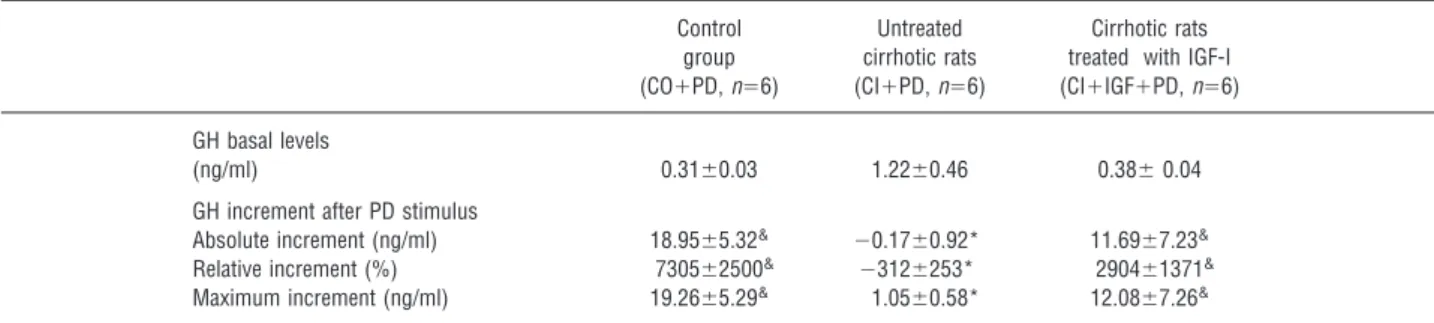
(3) IGF-I on SS tone in cirrhotic rats Table 1. Growth hormone (GH) values at baseline and GH increment after pyridostigmine (PD) bolus in the three experimental groups. GH basal levels (ng/ml) GH increment after PD stimulus Absolute increment (ng/ml) Relative increment (%) Maximum increment (ng/ml) &. Control group (COπPD, nΩ6). Untreated cirrhotic rats (CIπPD, nΩ6). Cirrhotic rats treated with IGF-I (CIπIGFπPD, nΩ6). 0.31∫0.03. 1.22∫0.46. 0.38∫ 0.04. 18.95∫5.32& 7305∫2500& 19.26∫5.29&. ª0.17∫0.92* ª312∫253* 1.05∫0.58*. 11.69∫7.23& 2904∫1371& 12.08∫7.26&. p⬍0.05 between baseline values and peak and increments in the same group; * p⬍0.05 vs CO group.. Table 1 shows GH values at baseline and GH peaks and GH absolute and relative increments after PD. In CO and CIπIGF groups, significant differences were found between baseline values and GH peaks as well as between baseline levels and absolute and relative increments (Wilcoxon Signed Rank test). However, no response was observed in the untreated cirrhotic group. On the other hand, in order to eliminate endogenous pulsatile GH peaks, the means of all determinations of GH at different times were assessed (in a similar way to the area under the curve). The means from groups with or without PD bolus were compared (Fig. 1). Controls, which received a sa-. line bolus (CO), showed values not significantly different from those found in the cirrhotic groups (CO: 1.69∫0.93; CI: 1.55∫0.55; CIπIGF: 1.17∫0.26, ng/ml). Controls, which received a bolus with PD, exhibited higher levels of GH than untreated controls (COπPD: 4.24∫2.74 ng/ml, p⬍0.001 vs CO), suggesting a normal SS tone. However, no response to PD was found in untreated cirrhotic rats (CIπPD: 1.29∫0.38, pΩns vs CI), showing that these animals have a low SS tone because PD had no effect on GH release, although its major mechanism is SS inhibition. Interestingly, IGF-I-treated cirrhotic rats which received PD, showed a significant GH response (CIπIGFπPD: 2.77∫1.60). This finding suggested that IGF-I treatment induces recovery of SS tone in cirrhotic animals. These results showed that the CIπIGF group had a GH response similar to that of the CO group and quite different from that exhibited by the CI group. Discusion. Fig. 1. Growth hormone (GH) response to pyridostigmine or saline bolus in the three experimental groups. Increased GH levels were observed after pyridostigmine (PD) stimulus in healthy controls (COπPD, nΩ6) and in cirrhotic animals treated with insulin-like growth factor-I (IGF-I) (CIπIGFπPD, nΩ6) as compared to the control group (CO, nΩ6) and the cirrhotic group treated with IGF-I (CIπIGF, nΩ6), which received a bolus of saline. However, PD did not influence GH levels in the untreated cirrhotic group (CIπPD, nΩ6), showing similar values to those found in untreated cirrhotic rats (CI, nΩ6) which received a bolus of saline instead of PD. Each diagram represents the mean∫SEM of GH determinations at six different points (basal and after bolus – saline or PD) in a similar way to the area under the curve. ** p⬍0.01, *** p⬍0.001.. In physiological conditions, IGF-I is produced in the liver by GH stimulus. In turn, IGF-I inhibits GH secretion acting on the hypothalamus by two feedback mechanisms: the first by inhibiting GH gene expression (17) and the second by stimulating the secretion of SS (18, 19), that inhibits GH production. This normal GH/IGF-I axis is altered in cirrhosis (1, 3), but the mechanisms involved are not well understood. This study provides evidence that reduced control of GH secretion by SS is the main factor involved in this altered axis. In addition, it shows that IGF-I administration restores the normal influence of SS on GH production. According to previous studies, PD administration to normal rats was followed by significant increases in GH levels (6, 7, 20). Assuming that cholinergic agonists stimulate GH secretion through inhibition of SS release (6), the GH response to PD can be considered as an indirect estimate of the hypothalamic somatostatinergic tone 407.
(4) Castilla-Cortázar et al. controlling GH secretion. Therefore, the lack of GH response to PD seen in cirrhotic rats suggests a reduced influence of SS on GH secretion. This finding has also been described in diabetes, another condition characterised by low GH-IGF-I axis activity (21). The administration of low-dose IGF-I to cirrhotic rats was effective in normalising the GH response to PD, demonstrating that the reduced somatostatinergic tone was restored to values similar to those found in control rats. There is much evidence indicating that GH synthesis and release are modulated by GH secretion and by IGF-I levels acting at the hypothalamic and pituitary level (19–21). Previous studies suggested that IGF-I effects are mainly mediated by interaction with SS rather than with GHRH (22). Although a contribution of GHRH cannot be ruled out, our results also argue in favour of mediation of the somatostatinergic tone in the effects of IGFI on the somatotropic axis in cirrhotic rats. As mentioned above, an altered GH/IGF-I axis occurs in advanced liver cirrhosis with reduced serum concentrations of IGF-I and increased levels of GH. Animals included in the present work had compensated cirrhosis. In this early stage of the hepatic disease, it has been proved that serum levels of IGF-I are normal (13). However, IGF-I availability seems to be reduced, as we have previously reported (13). In fact, basal levels of GH are moderately increased in untreated cirrhotic animals (Table 1), suggesting a loss of negative feedback. Indeed, treatment with IGF-I induces recovery of SS tone, suggesting again that this is a tissular condition of ‘IGF-I deficient state’. Interestingly in previous works, it has been demonstrated that IGF-I administration to rats with early liver cirrhosis (with normal serum levels of IGF-I) improved intestinal absorption of nutrients, food efficiency, liver function, osteopenia and hypogonadism (11–16). In conclusion, as it occurs in normal conditions, the cholinergic system is a fundamental modulator of GH secretion in liver cirrhosis. Since rats with early cirrhosis display a reduced somatostatinergic tone, which can be restored to the normal state by IGF-I supplementation, it is suggested that IGF-I is necessary to maintain the normal influence of SS on GH secretion in this clinical condition. This evidence points to SS as the main factor involved in the feedback regulation between GH and IGFI in liver cirrhosis. Acknowledgements The authors wish to express their gratitude to Dr. Bruce Scharschmidt, Chiron Company (USA), for generously giving the IGF-I used in this study. We are also deeply indebted to. 408. Mrs Cristina Chocarro and Mercedes Fernández-Soliño for their expert technical assistance; and to Mrs. C. Alonso-Borrás, Mr. J.Celaya and ‘‘Fundación Echébano’’ for their financial collaboration. Supported by the Program ‘‘IπD’’, ‘‘Comisión Interministerial de Ciencia y Tecnologı́a (CICYT). Gobierno de España’’, SAF 99/0072.. References 1. D A, R R, G A, H S C, H J, W R. Growth hormone, insulin-like growth factorI, and insulin-like growth factor binding proteins 1 and 3 in chronic liver disease. Hepatology 1995; 21: 680–8. 2. M S, G M, M K, B U, S NE. Urinary growth hormone (U-GH) excretion and serum insulin-like growth factor 1 (IGF-1) in patients with alcoholic cirrhosis. J Hepatol 1993; 17: 315–20. 3. H N, K H, I K, et al. Serum growth hormone-binding protein, insulin-like growth factor-I, and growth hormone in patients with liver cirrhosis. Metab Clin Exp 1992; 41: 377–81. 4. C A, R P, U D, G J, C G. Insulin-like growth factor-I: a good indicator of functional hepatocellular capacity in alcoholic liver cirrhosis. J Endocrinol Invest 1991; 14: 317–21. 5. R S B, H G S, D’E S D, G P W, T C. Acetylcholine inhibits the release of somatostatin from rat hypothalamus in vitro. Endocrinology 1980; 107: 1837–42. 6. L V, T A, R M, G E, M F, M̈ EE. Cholinergic agonista, antagonist drugs modulate the growth hormone response to growth hormone releasing hormone in the rat: evidence for mediation by somatostatin. J Endocrinol 1986; 111: 271–8. 7. T A, P G, C P. Involvement of the somatostatin, cholinergic systems in the mechanism of growth hormone auto feedback regulation in the rat. J Endocrinol 1988; 117: 273–81. 8. P A, M C, C F F, D C. Effect of enhancement of endogenous cholinergic tone with pyridostigmine on the dose-response relationships of growth hormone (GH)-releasing hormone-induced GH secretion in normal subjects. J Clin Endocrinol Metab 1990; 70: 324–7. 9. K M, F L A. The role of the cholinergic pathway in growth hormone feedback. J Clin Endocrinol Metab 1991; 72: 1081–7. 10. C E, I E, B GM. A new test for the diagnosis of growth hormone deficiency due to primary pituitary impairment: combined administration of pyridostigmine and growth hormone-releasing hormone. J Endocrinol Invest 1990; 13: 307–16. 11. C-Ć I, P J, U E, et al. Impaired intestinal sugar transport in cirrhotic rats: correction by low doses of insulin-like growth factor I. Gastroenterology 1997; 113: 1180–7. 12. C-Ć I, P A, A J, et al. Effect of insulin-like growth factor-I on in vivo intestinal absorption of D-galactose in cirrhotic rats. Am J Physiol 1999; 276 (Gastrointest Liver Physiol 39): G37–G42. 13. P A, C O A, M B, et al. Low doses of Insulin-like growth factor-I improve nitrogen retention and food efficiency in rats with early cirrhosis. J Hepatol 1997; 24: 267–79. 14. C-Ć I, Ǵ M, M B, et al. Hepatoprotective effects of Insulin-like growth factor I in rats with carbon tetrachloride-induced cirrhosis. Gastroenterology 1997; 113: 1682–91..
(5) IGF-I on SS tone in cirrhotic rats 15. C A, C-Ć I, Ǵ M, et al. Osteopenia in rats with liver cirrhosis: beneficial effects of IGF-I treatment. J Hepatology 1998; 28: 122–31. 16. C-Ć I, Ǵ M, Q J, et al. Insulin-like growth factor-I reverts testicular atrophy in rats with advanced cirrhosis. Hepatology 2000; 31: 901–10. 17. C M C, T R, G M, et al. Effects of GH and IGF-I administration on GHRH and somatostatin mRNA levels: I. A study on ad libitum fed and starved adult male rats. J Endocrinol Invest 1997; 20: 144–50. 18. B M, S M, F L A, F S, C L, H R L. Somatomedin C mediates growth hormone negative feed-back by effects on both the hypothalamus and the pituitary. Science 1981; 212: 1279–81.. 19. B J, B-P M T, E J. Neuroendocrine regulation of growth hormone. Eur J Endocrinol 1995; 132: 12–24. 20. W W B, W S D, V D M, G A. Pyridostigmine-mediated growth hormone release: evidence for somatostatin involvement. Endocrinology 1992; 130: 1445–50. 21. N J A, G A, W W B. Hypothalamic regulation of impaired growth hormone secretion in diabetic rats. Neuroendocrinology 1992; 55: 506–11. 22. T G S. Evidence for autoregulation of growth hormone secretion via the central nervous system. Endocrinology 1980; 107: 2117–25.. 409.
(6)
Figure
Documento similar
(A) Relative GH receptor (GHR) protein levels in control rats (C); rats receiving acute central administration of insulin (CI); pair-fed rats (PF); pair-fed rats treated with
Serum levels of vascular endothelial growth factor-A 165 , soluble vascular endothelial growth factor receptor 1, and hepatocyte growth factor were assessed by
Methods Cross-sectional, multicentre, observational study conducted to determine the effectiveness—measured by control of serum insulin-like growth factor 1 (IGF-1) —of
In particular, we performed simultaneously a like- lihood analysis of the recent expansion data (SnIa, CMB shift parameter and BAO) together with the growth rate of structure data,
Anti-epidermal growth factor receptor therapy in combination with chemoradiotherapy for the treatment of locally advanced anal canal carcinoma: results of a phase I
Conversely, the evaluation of mRNA levels of genes encoding pro-in flammatory cytokines [interleukin-1 beta (IL-1 b ), tumor necrosis factor alpha (TNF a ), and transforming
In conclusion, the circulating levels of the novel insulin- like adipokine ISM1 are significantly higher in pubertal chil- dren with obesity and are associated with BMI Z-score and fat
We observed that the leptin levels were associated with marker of insulin resistance which was also reported in previous cross‐sectional and longitudinal studies in children 31,32
