
Exploring the effects of a genre based pedagogy approach intervention in TOEIC candidates : a study on reading comprehension
94
0
0
Texto completo
(2) Table of Contents. Table of Contents ..............................................................................................................i Table of Figures ............................................................................................................... ii Abstract ............................................................................................................................iv 1. Introduction .................................................................................................................. 1 2. Research Questions and Objectives ............................................................................ 5 2.1 Research Questions ............................................................................................................ 5 2.2 Objectives ........................................................................................................................... 5 2.2.1 General Objective ......................................................................................................... 5 2.2.2 Specific Objectives ....................................................................................................... 6. 3. Theoretical Framework ............................................................................................... 6 3.1 Reading Comprehension ................................................................................................... 6 3.2 Genre-based Approach ...................................................................................................... 8. 4. Methodology ............................................................................................................... 12 4.1 Observation and Problem Identification ....................................................................... 12 4.2 Context and Participants ................................................................................................. 13 4.2.1 Sampling Technique ................................................................................................... 13 4.3 Instruments and Data Collection .................................................................................... 13 4.3.1 Pre-test and Post-test .................................................................................................. 14 4.3.2 Survey ......................................................................................................................... 19 4.4 Research Design ............................................................................................................... 19 4.4.1 Material Design Explanation ...................................................................................... 20 4.4.2 Intervention Procedure ............................................................................................... 20 4.5 Ethical Considerations .................................................................................................... 29. 5. Results and Analysis .................................................................................................. 29 5.1 Pre-test General Results .................................................................................................. 29 5.1.1 Pre-test Genre Results ................................................................................................ 30 5.1.2 Pre-test Single Passage Genre Results ....................................................................... 30 5.1.3 Pre-test Double Passage Genre Results ...................................................................... 34 5.1.4 Pre-test Question Type Results .................................................................................. 36 5.2 Post-test General Results ................................................................................................. 38 5.2.1 Post-test Genre Results ............................................................................................... 38 5.2.2 Post-test Single Passage Genre Results ...................................................................... 38 5.2.3 Double Passage Genre Results ................................................................................... 43 5.2.4 Post-test Question Type Results ................................................................................. 45 5.3 Subjects’ Improvement Analysis .................................................................................... 47 5.3.1 Pre-test and Post-test Relative Improvement ............................................................. 47 5.4 Survey Results .................................................................................................................. 48. i.
(3) 6. Discussion .................................................................................................................... 50 6.1 Pre-test and Post-test ....................................................................................................... 51 6.2 The Impact of Genre-based Approach in TOEIC Candidates .................................... 52 6.3 Reading Comprehension Performance .......................................................................... 54. 7. Strengths and Limitations ........................................................................................ 57 8. Conclusions and Projections ..................................................................................... 58 9. References ................................................................................................................... 60 10. Annex ......................................................................................................................... 64 Annex A .................................................................................................................................. 64 Annex B ................................................................................................................................... 65 Annex C .................................................................................................................................. 82 Annex D .................................................................................................................................. 83 Annex E ................................................................................................................................... 89. Table of Figures. Figure 1. The components of reading comprehension, from identifying words to comprehending texts. Adapted from Perfetti (1999). Retrieved from Snowling and Hulme (2005). ................................................ 8 Figure 2. Sydney School Teaching-learning Cycle. Retrieved from Deyfrus et al. (2016). ........................ 10 Figure 3. Pre-test Types of Questions Rate of Occurrence. ........................................................................ 15 Figure 4. Pre-test Genres and Rate of Occurrence. .................................................................................... 15 Figure 5. Post-test Types of Questions and Rate of Occurrence. ................................................................ 16 Figure 6. Post-test Genres and Rate of Occurrence. ................................................................................... 17 Figure 7. Pre-test Text and Question Types Example. ................................................................................ 18 Figure 8. Post-test Text and Question Types Example. ............................................................................... 18 Figure 9. Cyclical AR model adapted from Kemmis and McTaggart. Retrieved from Burns (2009). ........ 20 Figure 10. Day 1, Students' Intervention Material. ..................................................................................... 22 Figure 11. Day 2, Try a TOEIC Question Activity. Retrieved from Students' Intervention Material. ........ 25 Figure 12. Day 3, Target 3, Notices and Understanding Meaning in Context Questions. ......................... 27 Figure 13. Day 4, Activity 1. Text, Questions, and Answer Analysis. ......................................................... 28 Figure 14. Pre-test General Results. ........................................................................................................... 30 Figure 15. Pre-test Single Passage Genre Achievement. Articles. .............................................................. 31 Figure 16. Pre-test Single Passage Genre Achievement. Letter.................................................................. 31 Figure 17. Pre-test Single Passage Genre Achievement. Advertisement. ................................................... 32 Figure 18. Pre-test Single Passage Genre Achievement. Invoice. .............................................................. 32 Figure 19. Pre-test Single Passage Results. Instructions. ........................................................................... 33 Figure 20. Pre-test Single Passage Genre Results. Notice.......................................................................... 33 Figure 21. Pre-test Double Passage Genre Results. Schedule and E-mail. ................................................ 34 Figure 22. Pre-test Double Passage Genre Results. Letter and Letter. ...................................................... 34 Figure 23. Pre-test Double Passage Genre Results. Memo and Letter. ...................................................... 35 Figure 24. Pre-test Double Passage Genre Results. Notice and Letter. ..................................................... 35 Figure 25. Pre-test Question Type Results. Inference Questions. ............................................................... 36 Figure 26. Pre-test Question Type Results. Explicit Information Questions............................................... 37. ii.
(4) Figure 27. Pre-test Question Type Results. Understanding Meaning ......................................................... 37 Figure 28. Post-test General Results. .......................................................................................................... 38 Figure 29. Post-test Single Passage Genre Results. Invitation. .................................................................. 39 Figure 30. Post-test Single Passage Genre Results. Article. ....................................................................... 39 Figure 31. Post-test Single Passage Genre Results. Schedule. ................................................................... 40 Figure 32. Post-test Single Passage Genre Results. Advertisement. ........................................................... 40 Figure 33. Post-test Single Passage Genre Results. Report. ....................................................................... 41 Figure 34. Post-test Single Passage Genre Results. Fax. ........................................................................... 41 Figure 35. Post-test Single Passage Genre Results. Notice. ....................................................................... 42 Figure 36. Post-test Single Passage Genre Results. Memo. ........................................................................ 42 Figure 37. Post-test Double Passage Genre Results. Fax and Notice. ....................................................... 43 Figure 38. Post-test Double Passage Results. Advertisement and E-mail. ................................................. 43 Figure 39. Double Passage Genre Results . E-mail and E-mail. ................................................................ 44 Figure 40. Post-test Double Passage Genre Results. Article and Telephone Message. ............................. 44 Figure 41. Post-test Question Type Results. Inference Questions. .............................................................. 45 Figure 42. Post-test Question Type Results. Explicit Information Questions. ............................................ 46 Figure 43. Post-test Question Type Results. Understanding Meaning in Context Questions. .................... 46 Figure 44. Pre-test and Post-test Relative Improvement. ............................................................................ 48 Table 1. Survey Results. Likert Scale Questions and Answers. ................................................................... 49 Table 2. Survey Results. Open-ended Questions and Answers. ................................................................... 50. iii.
(5) Abstract This paper reports on a small-scale action-research intervention that explored the effects of genre-based pedagogy approach in TOEIC candidates. Six participants attended a total of four sessions where a genre-based TOEIC Reading Comprehension Training Course took place. Effects were assessed analysing reading comprehension performance in pre and post-test results. Additionally, students’ opinions provided the qualitative aspect of this study and data were analysed accordingly. Results showed the application of genre-based approach is an effective method to improve reading comprehension in TOEIC candidates. In addition, survey results reported participants’ positive perceptions towards the methodology applied during the intervention, and the impact this project had in their Reading Comprehension performance.. iv.
(6) 1. Introduction Instruction and assessment on reading comprehension is arguably the most significant result of policy reform movements that plan to improve reading curriculum and training—or, as Snow (2003) and Israel & Duffy (2014) suggest, it should be. The importance on comprehension has been strengthened through the consideration of difficulties that older readers face, and for whom comprehension is the main objective and barrier (Biancarosa & Snow, 2006). However, comprehension has not always been considered as a modal index of reading competence and performance. In fact, if we explored the history of reading instruction, we would observe that all assignments that have ever been given by teachers promote comprehension, nevertheless, it was not until well into the 20th century that comprehension or ‘understanding’ was considered as an indicator of reading accomplishment (Pearson, 2014). In view of the fact that reading comprehension represents a relevant competence today, it has been considered for years one of the central aspects to be measured in international standardised tests, such as the Cambridge English as a Second Language Exams, the Test of English as a Foreign Language, or the Test of English for International Communication (TOEIC), which range across different levels of English language proficiency (Castello, 2008). The importance of reading comprehension and its testing in today’s world can be observed, for example, in the fact that several tertiary education institutions in Chile such as Pontificia Universidad Católica de Chile, DUOC UC, and Universidad de Chile require that students pass an international standardised English test in order for them to obtain their university degrees regardless their area of study. Additionally, a significant number of companies and institutions are including the knowledge and usage of the English language in their future employee specification form (Mäkiö, 2016). This is why research in the search for appropriate training approaches, creating material and, certainly, English language testing seem to represent a significant task in the language teaching field. To illustrate the gap this study attempts to narrow, let us set context to briefly explore how preparation of TOEIC candidates is approached by one of the many 1.
(7) tertiary education institutions in Chile where this exam is compulsorily administered in students, the School of Economics and Business of Universidad de Chile (FEN), in comparison to the Reading to Learn programme, a reportedly successful literacy training methodology (Acevedo & Rose 2007). This methodology is an important part of the foundations on which this study was built as will be presented below. FEN, where the present investigation took place, requires all students to pass the Listening & Reading version of the Test of English for International Communication (TOEIC). For this reason, the FEN English program offers English language courses to its students, which point to awarding them with the TOEIC certificate. As we are discussing reading comprehension in the context of TOEIC preparation, it seems essential to explore the types of texts that are included in the TOEIC test particularly, which may contain e-mails, brochures, regulations, policy changes, announcements, presentations, letters, resumes, proposals and reports. The 2018 revised version, has even included more multiple sources of material to read, and contains items such as online chats, instant messaging, or text messaging involving multiple writers (TestDEN©, 1997-2017). In this context, Rose (2016) suggests offering students strategies to comprehend factual texts providing them with fundamental skills for reading specialised, technical or academic language. Moreover, research by Acevedo and Rose (2007) shows that following this method, the so-called Reading to Learn program, that follows a staged fashion has resulted in a successful approach to intervention in groups of underachieving students in a range of teaching/learning contexts. Through this method, literate language features are modelled applying the teaching-learning cycle that has been proposed in the framework of genre pedagogy, which is applied under the processes of deconstruction, joint construction, and independent construction of texts, allowing teachers to scaffold the practice until knowledge extends (Martin, 2009) benefitting both underachieving and the most competent students in the class. In general terms, this cycle seeks that teachers enable students to learn on the content of texts, by offering explanations of language. 2.
(8) functions in social context, recognizing the features of each type of text students are asked to comprehend. With this in mind, when we observe the FEN English language program and how these English language classes are planned, although well intended, there is no mention of a specific and appropriate Reading Comprehension component that is clearly defined and staged and that explicitly teaches skills according to the different types of texts that may appear on the test. This situation tends to produce a differentiated curriculum that makes students rely on their personal reading habits and/or techniques because there is absence of guidance and clarity about the different social purposes the various genres fulfil, which generally results in disparate understanding among learners and maintains stratified outcomes (Acevedo & Rose, 2007). Hence, training material and methodology for the practice of reading comprehension that are being used and applied in this context, do not correlate with the expected course outcome, reported by students’ test results that reflect low rates of success in the TOEIC reading comprehension section. Taking into account the core principles of the Reading to Learn program1, the present study aims at appropriate compilation and staged implementation of activities planned under the Reading to Learn approach, highlighting the use of the genre-based pedagogy framework, aiming at a more effective training and development of reading skills in students who have already participated in English language classes at FEN, and who have failed the exam because of poor performance in the reading component of the TOEIC exam. This study adopted the structure of an action-research project that was composed by four staged cycles: plan, act, observe, and reflect (Burns, 2009). Therefore, the performer teacher played an active role as teacher-researcher. 1. Namely, that a) Reading is a fundamental mode of learning. Therefore explicit teaching of reading needs to be integrated with teaching the curriculum at all levels, and all teachers need skills to teach reading and writing in their subject areas. b) All students can and should be taught the same level of skills in reading and writing across the school curriculum so that the gap between more and less successful students narrows. c) Learning takes place when teachers support students to do learning tasks that are beyond their independent assessed abilities, thereby allowing for learning activities to be designed to support all students to succeed at the same high level (Acevedo & Rose, 2007).. 3.
(9) The fact that the English language course program at FEN does not take account of appropriate staging, and explicit teaching of patterns when training students for reading comprehension, is seen in this research as one of the fundamental reasons to the problem of underachievement in reading performance among students. Additionally, lack of suitable material logically results in unsuccessful comprehension, which was reported after the application of the final assessment of the Inglés Básico course. Failing forces unsuccessful students to take the English language course for a second time2. The group under study in the present investigation belongs to the Inglés Básico level, which is actually the group that has reported the highest rate of TOEIC failure. Therefore, a sensible selection and compilation of TOEIC reading material was applied to plan lessons following the genre-based pedagogy approach framework. This was done in order to help them raise awareness of the different social purposes and structures of the genres that are included in the TOEIC. Considering the striking improvements in literacy outcomes the methodology applied in this study has provided (Acevedo & Rose 2007). This intervention was planned in the hope that the developed materials can be used in other classrooms so as to replicate such a successful language in context training method, as a contribution to our context of English as a Foreign Language (EFL), also considering Brumfit’s view of Applied Linguistics as “the theoretical and empirical investigation of real-world problems in which language is a central issue” (Brumfit, 1995, p.27). Finally, it was expected that the project’s participants would benefit from a staged training method that would not only have participants follow phases mechanically but that also involved observation, reflection, and taking action. This is why the principles of action-research in combination with genre-based pedagogy played an essential role in this study expecting to help participants to have a more effective reading comprehension performance, and better test scores.. 2. To provide a general overview of students’ performance, we can observe the results chart (see Annex A) that shows that a total of 1,043 (100%) students took the TOEIC in the fall 2018 semester, 908 (87,06%) students passed the test and 135 (12,94%) students failed it.. 4.
(10) In my experience as an international exam instructor and assessor, I have always considered official exam preparation courses and materials as not being used to reach their full potential. To put it another way, such courses and materials are rather focused on test format and not so much on content. What is more, students are generally expected to read, comprehend and respond as if we were certain they understand what they are reading. However, they have not been trained to build skills for comprehension if all they do in class is to answer mock tests. This situation became my motivation. At first I started offering private lessons following new approaches to comprehension and training, now, I have taken the problem to the action-research arena because I have seen students overcome frustration when trained appropriately, and following an actionresearch model with a group of students who really need to pass a test, allows for observation and reflection, which are fundamental aspects for improvement. 2. Research Questions and Objectives 2.1 Research Questions •. How does the implementation of genre-based pedagogy approach impact on the TOEIC reading comprehension outcomes?. •. Does the implementation of genre-based pedagogy improve students’ reading comprehension?. 2.2 Objectives 2.2.1 General Objective The general objective of this study is to explore the effects of implementing genre-based approach in TOEIC candidates, in order to assess whether better awareness on the different purposes and genres, and type of questions that compose the Reading Comprehension section helps students improve their performance and more importantly, their understanding of a variety of written texts. Furthermore, this study seeks to. 5.
(11) determine whether there is correlation between intervention results and participants’ perceptions towards the intervention. 2.2.2 Specific Objectives 1. To raise awareness in students about the social purposes and structures of the different genres that may appear in the TOEIC exam 2. To provide students with reading strategies pointing to the language features and types of questions that are used in the different TOEIC genres through staged and explicit instruction 3. To assess students’ reading comprehension performance through the analysis of pre-test and post-test results 4. To analyse students’ perceptions about the intervention and correlate them with intervention results 3. Theoretical Framework This section contains a state of the art summary about genre-based pedagogy instruction applied with the intention of exploring its reported effects on reading comprehension performance in different groups of individuals. The following sections that define and illustrate reading comprehension and genre-based pedagogy will account for the framework underpinning this study. 3.1 Reading Comprehension Reading comprehension is considered a fundamental skill that allows for learning across all fields because it makes possible for readers to access knowledge of any kind. This is why, several scholars have attempted to define what reading is and how its processes operate, for instance, scholars as early as Goodman (1967) suggested that reading is not only a process of identifying letters, words and sentences that lead to understanding, in fact, it has been considered as an activity in which the reader, the text and the process of interpretation interact (Carrell & Eisterhold, 1983). As an illustration,. 6.
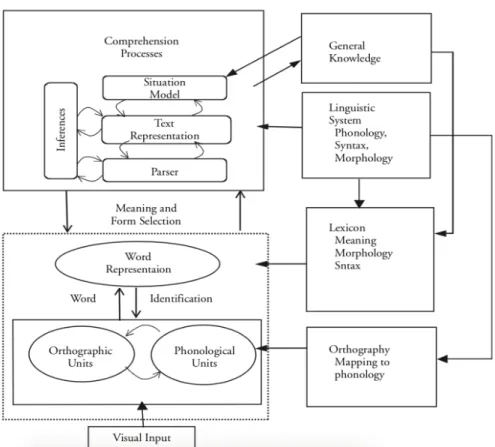
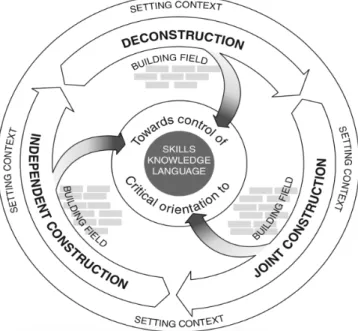
(12) Falk (1978) argues that interactions and their contexts take place at least at three levels: visual processing, linguistic processing and content processing. Accordingly, readers make use of elements such as contexts, purposes, grammar knowledge, word knowledge, discourse conventions, world knowledge and metacognitive awareness in the meaningmaking process. As Koda (2004) explains, comprehension takes place when readers extract and integrate information from a text and combine it with their background knowledge. As it has been said, reading comprehension is constantly influenced by linguistic knowledge and background knowledge is incorporated when mental processes occur with the purpose of reaching understanding. Because of this, different scholars have organised the aspects and stages into models that explain the connections between the components of reading comprehension. For example, Snowling and Hulme (2005) proposed a framework that presents the constituents of reading comprehension and how they are related. Figure 1 shows that linguistic features interact with background knowledge towards the representations of meaning and form, this, being initiated by visual input. A similar model (see Figure 2) has been lately developed following a genre-based approach to reading comprehension (Dreyfus, Humphrey, Mahboob & Martin, 2016). That is to say, if we compare both representation models, the Situation Model can refer to the phase of Deconstruction, while Text Representation can refer to the Joint Construction phase, and Parser can be related to the Independent Construction phase, where learners are expected to reach text production without being assisted (Dreyfus et al., 2016). These models refer to reading comprehension components and point to the ways in which they are related, however, because of the nature of this study, materials, class staging and implementation were based on the Sydney School Genre Teaching Learning Cycle model (Dreyfus et al., 2016). According to Acevedo and Rose (2007), the lesson cycle consists of six steps with the ultimate goal of having students understand and create texts according to the genre(s) they are being taught. Despite this, due to the focus of this project, only steps one and two were implemented followed by comprehension exercises and a post-test.. 7.
(13) Figure 1. The components of reading comprehension, from identifying words to comprehending texts. Adapted from Perfetti (1999). Retrieved from Snowling and Hulme (2005).. 3.2 Genre-based Approach Genre-based approach is grounded on three theoretical traditions: Vygotsky’s model of learning as a social process, Bernstein’s model of education as pedagogic discourse, and Halliday’s Systemic Functional Linguistics theory (Rose, 2005). SFL theory (Halliday, 1978; 1994) highlights the close relation between language and social purposes. It refers to an approach to understanding possible phases in language development, and it accordingly sees language as a resource that allows us to construe social meanings (Rose, 2006). In this way, such systemic grammar is available for us to share experiences and interact with each other; hence, its relevance lies on the fact that it operates as a meaning-making resource. On the other hand, its functional perspective has focused on examining the operation of language in context, considering that speakers are the ones who shape the ‘linguistic system’ (Ghio & Fernández, 2008).. 8.
(14) SFL theory offers a plethora of possible application scenarios (Halliday, 1994), some examples are science (Halliday & Martin, 1993), mathematics (O’Halloran, 2005), history (Coffin, 2006), etc. But, according to Schleppegrell (2014), education has been one of the most fruitful ones, particularly in the area of Discourse Analysis applied under the genre-based pedagogy approach. Moreover, the broad applicability of SFL reflects its flexibility allowing us to recognise the nature of language in use, and how texts model and are modelled by the various social contexts in which they take place (Schleppegrell, 2014). Genre-based pedagogy origins go back to the times when the need for providing equal opportunities to students was made relevant, precisely in the late 1970s, when explicit writing instruction was clearly an abandoned practice in the English language classrooms in Australia. Without explicit teaching, the writing of children from literate middle class families logically developed faster in comparison to learners from oral cultural backgrounds, demonstrating little elaboration by the time they reached high school (Rose, 2008). This situation led children to rely on their real-life experiences as models for accomplishing written tasks in the various genres they were asked to elaborate their texts. In this context, inequality was pointed out by Rose (2005), who stated that the most obvious and significant difference is in the preparation of children in literate middle class families who experience an average of 1,000 hours before starting school (Rose, 2005). In contrast, learners from oral cultural backgrounds may experience little or none. As a result, individuals brought up within literate family contexts turned out to be more successful than their counterparts, Indigenous Australian children who were raised in families with oral tradition. Consequently, fostering equality in the classroom, which entails the analysis of the types of texts that students are expected to write in the primary school, and the main dimensions of genre pedagogy allowed for a consistent method that sees genre as Martin (1992) described it, “a staged, goal-oriented social process…” (p. 505). Hence, this method follows the phases of deconstruction, joint construction and individual construction for supporting all students. 9.
(15) to write successfully, were the major dimensions comprised in the genre writing pedagogy that was developed in the 1980s (Rose, 2008). A sensibly designed learning cycle resulted from the disruptive idea of changing the power relation imposed by the curriculum (see Figure 2). In each cycle application, it is ensured that all students have equal participation. First, Deconstruction consists of teachers guiding students to recognise the context, staging and key linguistic features in model texts, of the genre they are expected to write. Second, Joint Construction implicates guiding the whole class to construct another text in the same genre. Finally, Independent Construction involves students writing a third text, in the same genre, on their own. All three stages of the pedagogy comprise constructing the ground so as to familiarise students with the content of the texts they are reading and writing, and setting context to help students understand the social purpose of the genre (Rose, 2008).. Figure 2. Sydney School Teaching-learning Cycle. Retrieved from Deyfrus et al. (2016).. In this way, the existing gap between the successful and the less successful learners is narrowed, and as a consequence all students are benefitted. This regulated process deems learners’ stages not only by taking their knowledge into consideration but. 10.
(16) also by considering early adolescence as a critical period, physically, emotionally and intellectually, (Rose, 2006). Learning is then seen as a social process in which teachers act as facilitators of models by guiding students in the course of negotiation of meaning. To illustrate the effectiveness of the genre-based pedagogy approach we can refer to Kalali (2015), who attempted to determine whether genre-based instruction improves the L2 reading comprehension of Iranian EFL learners. Results showed that there was a statistically significant difference between the L2 reading comprehension of the participants who went under a genre-based instruction and the ones who did not. Similarly, Reza & Hejazi (2015) conducted a study where they explored the influence of teaching reading comprehension under the principles of genre analysis. After data analysis was conducted, results revealed that those participants taught under the genrebased approach performed significantly better than the participants in the control group. In the same way, Minaabad & Khoshkholgh (2012), attempted to scrutinize the effect of genre-based pedagogy on English for specific purpose leaners’ reading comprehension, and the interaction between participants’ reading comprehension achievement together with their general English language proficiency. Results revealed genre-based pedagogy implementation has a significant effect on English for specific purpose learners’ reading comprehension. Also, the interaction between participants’ English language proficiency and their reading comprehension achievement was proved. In a similar fashion, Rozimela (2014) explored how a random sample of thirty-four participants understood the characteristics of ten texts of five different genres and comprehended the texts. The study results showed correlation between the variables measured. Participants whose genre awareness was good performed at a higher level than those with less genre awareness. Moreover, other factors that influence individuals’ reading comprehension were also revealed, such as background knowledge about text content and contextrelated lexis. The above-mentioned investigations account for the successful implementation of the genre-based pedagogy approach in different contexts, research results show its application has a highly positive impact when the expected outcome is to help students 11.
(17) improve their reading comprehension and performance in international standardised English language testing. 4. Methodology This section reports on the procedures that were used in order to create and conduct the present study’s intervention plan, including the Observation and Problem Identification, Setting, Participants, Sampling Selection and Description, Instruments and Data Collection, Research Design, Research Material Design Explanation, Intervention Procedure, and Ethical Considerations. 4.1 Observation and Problem Identification At FEN, all students must pass the TOEIC test in order to graduate. Several students have to retake English courses and one of the problems that needs to be tackled is lack of understanding when answering TOEIC Part 7, which is the Reading Comprehension component of the test. English language classes at FEN are planned, although in a well-intended manner, in a quite unspecific way. Comparing the methodology suggested in the FEN syllabus with the successfully applied Reading to Learn program, there seems to be lack of a Reading Comprehension component that is clearly defined and staged and that explicitly teaches skills according to the different types of texts that may appear in the test. Such situation results in an imbalanced curriculum because it forces students to trust their individual reading habits and strategies due to the lack of support to understand the diverse purposes genres have, which generally produces incongruent comprehension in students (Acevedo & Rose, 2007). Therefore, as stated earlier, both materials and methodology that are used for the practice of reading comprehension in this context, do not relate logically to the expected course objectives. This becomes evident when we observe students’ test results that report low levels of success in the TOEIC reading comprehension component.. 12.
(18) 4.2 Context and Participants This project was carried out at FEN on the following dates: October; Wednesday st. 31 , November; Wednesday 7th, Friday 9th, Wednesday, 14th from 14:45-15:20. Twenty students were invited to participate because they met the sampling requirements, that is to say, they had already participated in English language classes at FEN and had failed because of poor performance in the reading component of the TOEIC exam. After the last call to participate, eleven students enrolled. When the intervention cycles finished six out of ten participants had completed the program in full, that is why, data collected to assess these study’s effects are taken from those six individuals. Participants belong to different undergraduate programs offered at FEN Business administration, Management information systems and Accounting. For confidential purposes, subjects will be referred to as subjects A, B, C, D, E, and F. 4.2.1 Sampling Technique The sampling technique used was the non-probability convenience sampling, thus, the selection of participants followed opportunity criteria because individuals were invited to participate according to the teacher-researcher needs for the study (Dornyei, 2007). A total of eleven students enrolled for the course, as stated above only six of them completed the full intervention sessions. 4.3 Instruments and Data Collection There are different sections that compose the TOEIC test, the specific papers candidates at FEN are required to answer are the Listening and Reading components. Candidates have 2,5 hours to answer a total of 200 questions, 100 questions correspond to the listening section, which is divided into Part 1: Photographs (10 questions), Part 2: Question-response (30 questions), Part 3: Conversations (30 questions), Part 4: Talks (30 questions). In addition, other 100 questions assess the Reading component in this exam. This component is divided into Part 5: Incomplete sentences (40 questions), Part 6: Text. 13.
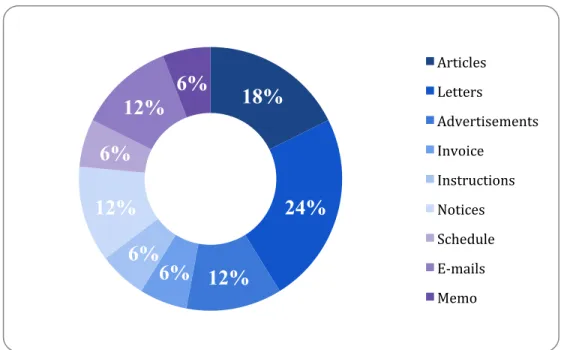
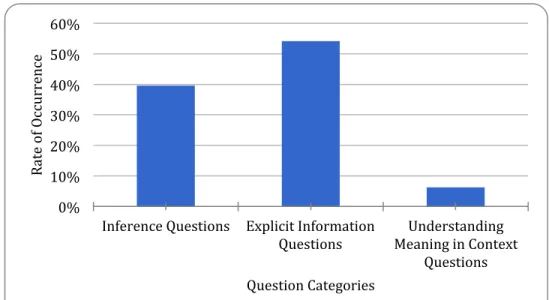
(19) Completion (12 questions), and Part 7: Reading Comprehension (28 Single Passages Questions, and 20 Double Passages Questions), (Collins UK, 2012). Because of the nature of this study, and with the objective of collecting data, test results from a Reading Comprehension TOEIC, Part 7, that students answered on September 24th, 2018, served the purpose of a pre-test. Once the intervention cycles finished, on November 19th, 2018 the final course TOEIC exam was implemented, candidates’ answers from Part 7 worked as post-test data. 4.3.1 Pre-test and Post-test The pre-test and post-test administered in this project represent official certifications, and it is because of the importance of such material that Universidad de Chile has requested confidentiality with the intention of preventing material from being copied and redistributed. Hence, the tests are not included in the Annex section. This is why the complete test will be described and categorised. Figures displaying some text examples and the three types of questions from pre and post-tests will be exposed below with the intention of offering a picture of the test format. In order to illustrate the Pre and Post-test Question types and Genres, let us describe them by categories. The pre-test administered in this study was composed by a total of 48 questions. As in every TOEIC version, three types of questions were asked, as shown in Figure 3, Inference Questions represent a 21% occurrence rate, Explicit Information Questions represent a 71%, and Understanding Meaning in Context Questions an 8%. As we can observe in Figure 4, the genres that triggered the test questions in the pre-test included: 3 articles (18%), 4 letters (24%), 2 advertisements (12%), 1 invoice (6%), 1 instruction (6%), 2 notices (12%), 1 schedule (6%), 2 e-mails (12%), and 1 memo (6%). In sum, seventeen texts that ranged across nine genres composed the pre-test.. 14.
(20) 80% Rate of Occurrence. 70% 60% 50% 40% 30% 20% 10% 0% Inference Questions. Explicit Information Questions. Understanding Meaning in Context Questions. Question Categories Figure 3. Pre-test Types of Questions Rate of Occurrence.. Articles. 6% 12%. Letters. 18%. Advertisements Invoice. 6%. Instructions. 12%. 24%. 6% 6% 12%. Notices Schedule E-mails Memo. Figure 4. Pre-test Genres and Rate of Occurrence.. The post-test was composed by 48 questions. As a TOEIC test, students were required to answer to three types of questions: 40% of the post-test questions were 15.
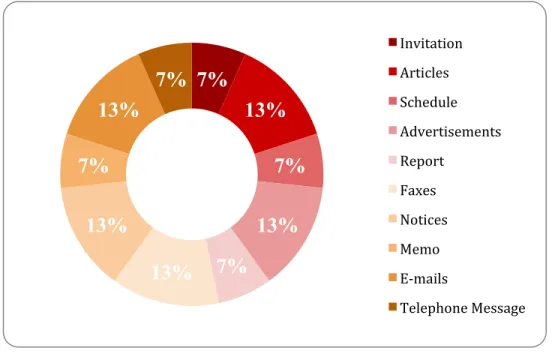
(21) Inference Questions (19 out of 48), Explicit Information Questions 54% (26 out of 48), and Understanding Meaning in Context Questions 6% (3out of 48) (See Figure 5). The genres that triggered questions in this exam included: 1 invitation (7%), 2 articles (13%), 1 schedule (7%), 2 advertisements (13%), 1 report (7%), 2 faxes (13%), 2 notices (13%), 1 memo (7%), 2 emails (13%), and 1 telephone message (7%), (See Figure 6). In other words, fifteen texts that range across ten genres were used to trigger the 48 reading comprehension questions in the post-test.. Rate of Occurrence. 60% 50% 40% 30% 20% 10% 0% Inference Questions. Explicit Information Questions. Understanding Meaning in Context Questions. Question Categories Figure 5. Post-test Types of Questions and Rate of Occurrence.. 16.
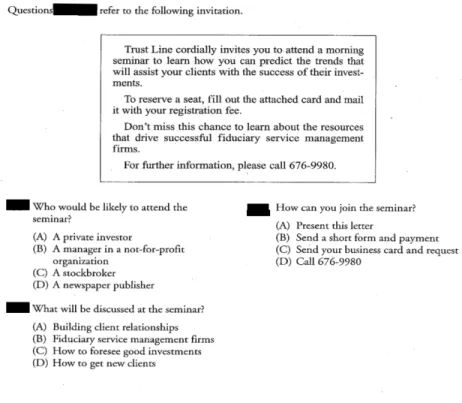
(22) Invitation Articles. 7% 7% 13%. 13%. Schedule Advertisements. 7%. 7%. Report Faxes. 13%. 13% 13%. 7%. Notices Memo E-mails Telephone Message. Figure 6. Post-test Genres and Rate of Occurrence.. As the test could not be displayed in the Annex section, figures 7 and 8 are exposed as examples below. Figure 7 shows an Article that tested two types of questions in the Pre-test. The three ‘WH’ questions displayed in the image correspond to the Question Category: Explicit Information Questions. The question: The word previous in line 9 is closest in meaning to, falls under the category of Understanding Meaning in Context Questions. On the other hand, Figure 8 exposes an Invitation that triggers questions in the Post-test, the question: Who would be likely to attend the seminar? corresponds to the category of Inference Questions. The other two questions belong to the category Explicit Information Questions.. 17.
(23) Figure 7. Pre-test Text and Question Types Example.. Figure 8. Post-test Text and Question Types Example.. 18.
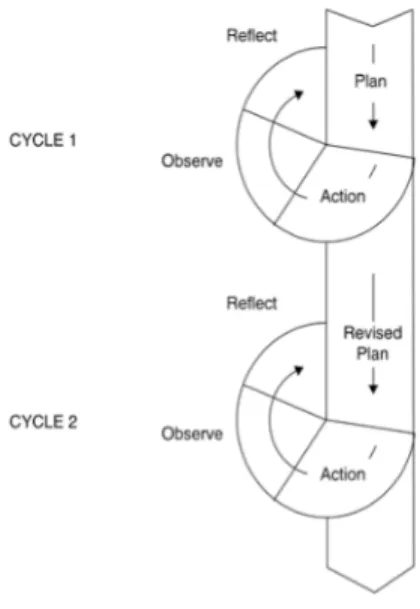
(24) 4.3.2 Survey A survey was conducted with two objectives (1) to encourage reflection towards the learning process in students, according to the action research design this project followed, and (2) to explore students’ perceptions towards the intervention methodology and its effects on their comprehension of English language texts. The rationale behind the application of a survey rests on Biemer and Lyberg’s (2003) idea that observations made on a sample, in accordance with a measurement process, can be complemented with a survey that explores participant perception and behaviours through questions, reflecting research objectives. This survey was created through the online survey creator SurveyMonkey Inc. (1999), it was composed by 6 questions, 4 Likert Scale questions, and 2 open-ended questions (see Annex C). The survey was written in Spanish language with the intention of allowing students to be as clear as possible when offering insights about their appreciation (since their English level is low) towards the effects of the project implementation and results. Survey access was shared as a link via E-mail the final day of the project application, on November 14th, 2018. 4.4 Research Design An action-research design was applied in this investigation, following the participatory approach, which means it emphasised individuals’ participation encouraging cycles of reflection and taking action (Dick, 1993). Hence, the proposed methodological design for this project was based on the Cyclical AR model of Anne Burns (2009), adapted from Kemmis and McTaggart (see Figure 9). Because of this projects’ nature, instruments provided both quantitative and qualitative data, then they were analysed accordingly.. 19.
(25) Figure 9. Cyclical AR model adapted from Kemmis and McTaggart. Retrieved from Burns (2009).. 4.4.1 Material Design Explanation After conducting a systematic literature and TOEIC material review, the Collins Skills for the TOEIC Test Listening and Reading (Collins UK, 2012) preparation book was selected as the main source for adapting material and creating the Students’ Booklet (see Annex B) used in this study. The rationale behind choosing this book rests on the connection between the staged and classified study orientation this book suggests to TOEIC candidates, and the nature of this study, that is based on the application of a Genre Based Approach, in which similar training mechanisms operate focused primarily on the idea of staged teaching-learning processes that should take place for knowledge to extend. 4.4.2 Intervention Procedure Four sessions were applied in this intervention plan, in each session 2 cycles took place in parallel fashion: (1) the action research cycle and its four steps: (a) Observation of the phenomenon, (b) reflection, (c) planning, and (d) taking action during and after each of the sessions, and the Sydney School Genre Teaching Learning Cycle 20.
(26) (see Figure 2) up to the Deconstruction (detailed reading) stage. The teacher carried out the orientation phase in which the genre context was set, texts were deconstructed by making use of information included in the Students’ Intervention Booklet, language features, types of questions, and genre purposes were explicitly taught. Then detailed reading took place. At this stage, the teacher supported students to read each sentence followed by (or in parallel fashion, doing) whole class check of understanding. Finally, students answered reading comprehension activities that served the purpose of training (not grading and with the purpose of observation and reflection) how the deconstruction strategies help them improve their comprehension. During the implementation, the AR phase of observation took place, after each session, reflection, planning, and taking action, concerning teaching aspects that may need change or a different approach in class were crucial for the expected outcomes of this project. The four sessions this project entailed were implemented as follows: Day 1: a) Presentation of TOEIC Genres, structures, and purposes. b) Getting familiar with the TOEIC Types of questions. c) Genre Identification and Classification activity Days 2, 3, and 4: a). 10 minutes: Presenting the type of texts for today. Then preparing for reading, this stage orients students to the topic as it unfolds through the text. b). 15 minutes: Detailed reading, the teacher supports all students to each sentence in a short passage. c). 10 minutes: Reading comprehension activity (familiarising students with the question types). d). 10 minutes: whole class check and reflection (see Annex D).. 21.
(27) 4.4.2.1 Day 1 Wednesday October 31st, 2018 Class time: 14:45-15:30, 45 minutes. Number of attendees: 11 As an introductory session, intervention objectives, organisation and materials were shared with students. Materials were collected and redistributed during each session to prevent students from losing them. The objective of this class was to help students familiarise with the TOEIC genres and the way information is organised in each type of passage. The texts were presented by categories, and subcategories when necessary. The specific genres studied comprised (a) General Correspondence and the subcategories of Letters, E-mails, Memos, (b) Advertisements, (c) Notices, (d) Articles, and the subcategories of Academic and Magazine articles, (e) Instructions, (f) Forms, and (g) Graphical texts, that may include both text and charts, tables, graphs, and schedules (see Annex B). As texts were being read and analysed, typical organisation for each text was explicitly presented to the class (see Figure 10).. Figure 10. Day 1, Students' Intervention Material.. 22.
(28) After presenting students with all the types of texts, they had to match real texts with the categories studied. Students were encouraged to analyse texts structurally and functionally, a whole class check was done following that method on each text and category, always reflecting not only on incorrect answers but also on correct ones. 4.4.2.2 Day 2 Wednesday November 7th, 2018 Class time: 14:45-15:30, 45 minutes. Number of attendees: 6 Four types of texts were used to be studied and analysed in this class. The first genre studied was a Letter, the Sydney School Genre Teaching Learning Cycle (see Figure 2) phases were applied up to the Deconstruction (detailed reading) stage. First, the orientation stage helped learners set the text context. The letter was deconstructed and students were allowed to use Day 1’s material as a matrix for deconstruction (Typical Organization information, see Annex B, Day 1, pp. 1-2) language features, types of questions, and genre purposes were explicitly pointed out. The second stage was detailed reading, at this stage, students were supported to read each sentence, and then text understanding was assessed through whole class check. Finally, students answered a post analysis question with the purpose of observation and reflection on incorrect and correct answers. Brochures were the second Target Genre during this session. The main focus at this stage of the class was to offer students strategies that allow them to make good choices when answering Inference, and Explicit Information questions. For example, when answering Inference questions candidates are expected to choose answer options that generalise specific information, that is to say the passage may give the exact information about an event. Then the correct answer may involve determining whether something another event took place before or after the date given. On the other hand, when answering Explicit Information questions, candidates are expected to identify clues the passages contain for them to be able to choose correct answers, participants were instructed to always return to the passage so they find the parts that support their. 23.
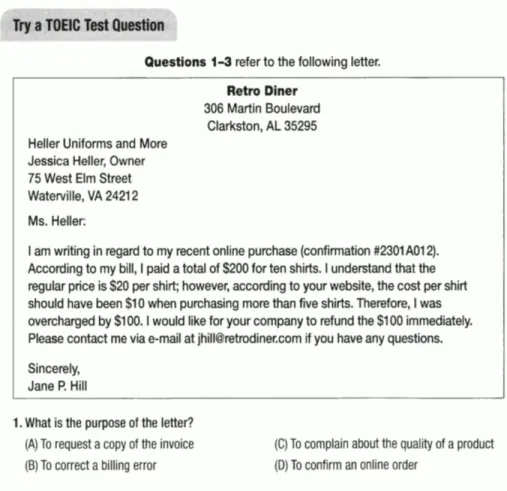
(29) choices, if finding information to support choices is not possible, they were taught to reconsider their choices. After reading the Brochure passage as a class, following the stages from the Teaching Learning Cycle previously described, students had to identify correct inferences out of three Inferences made based on the Brochure. The systematic analysis of the information given led most participants to the correct answers, this was reported after performing whole class check and reflection stages. Students were explicitly encouraged to underline or highlight the specific parts that supported their answers. This strategy seemed to clarify doubts students had from past experiences with the exam as one of expressed they had never ‘…even thought about highlighting information from the texts’, and another participant expressed she ‘…never knew how to answer, or what to do to answer these type of questions’. Finally, the closing activities during Day 2, were called Try a TOEIC question (see Annex B, pp. 7-8). These questions exposed participants to TOEIC-like texts and types of questions. The idea behind these two activities was to have students answer questions by first, identifying types of texts and their parts, and then applying the strategies practised to answer both Explicit Information Questions and Inference Questions (See Figure 11). The activities worked well, candidates demonstrated security, as they did not take long to answer the questions, most of them chose the correct options. After comparing answers, incorrect and correct choices were analysed and reflected.. 24.
(30) Figure 11. Day 2, Try a TOEIC Question Activity. Retrieved from Students' Intervention Material.. 4.4.2.3 Day 3 Friday November 9th, 2018 Class time: 14:45-15:30, 45 minutes. Number of attendees: 9 The first Target Genre for this session was E-mails. After carrying out the teaching Learning Cycle stages, candidates were asked to place a check mark next to the items displayed in two lists in case they had been mentioned in the text. This activity provided candidates with strategies to answer Explicit Information questions, analysis and reflection were done after allowing participants some time to think about their answers and make a choice. This activity was 100% successful and students scored a. 25.
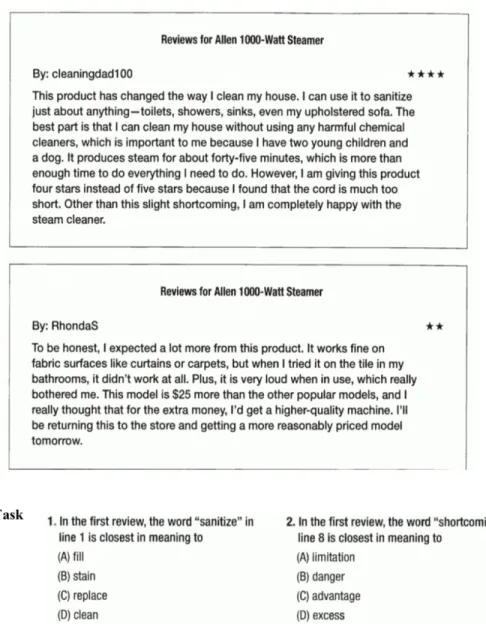
(31) 100% each, they had supported their answers with information from the text and were able to justify their correct choices. Notices corresponded to Target 2 during this third intervention session. In this case, two notices triggered the first double passage question studied in the intervention. Stages of orientation and detailed reading took place, and then participants had to answer an Inference question. Most of them made use of the strategies shared during Day 2, they identified and highlighted relevant information in the texts that helped them support their choice, which was visibly positive because it led subjects who made use of it to the correct alternative. Day 3 final Targets were Reviews. After conducting the phases of Orientation and Deconstruction (Detailed Reading), candidates were presented with the last type of question they had to be prepared to answer: Understanding Meaning in Context questions. They were taught to always pay attention to patterns, context, and co-text, because a word placed in different contexts can change in meaning. According to participants, question 1 was easier for them to understand and answer correctly because, as they reported, context, (in the first line the writer says: This product has changed the way I clean my house.) and similarities between the words sanitize and the word sanitizar used in their L1 to refer to the same concept (see Figure 12). On the other hand, question 2 appeared to be a little more difficult for students to answer, when answer analysis and reflection finished it could be noticed that all students had identified the word shortcoming had a negative connotation but 5 out of the 9 participants present chose the correct alternative.. 26.
(32) Figure 12. Day 3, Target 3, Notices and Understanding Meaning in Context Questions.. 4.4.2.4 Day 4 Wednesday November 14th, 2018 Class time: 14:45-15:30, 45 minutes. Number of attendees: 8 As this session was the last intervention session, it was planned to be an alternatives analysis session so as to offer candidates strategies to recognise the correct. 27.
(33) choice and also to differentiate alternatives that seek to confuse us by giving similar but erroneous information, the ones that are not even mentioned in texts from correct answers. The instructor had students analyse alternatives for three Explicit Information questions triggered by a single passage, which was a Letter. First, students answered the questions, after that, they had to check their answers by comparing their choices to the correct alternative explanations exposed for each option (see Figure 13) followed by Answer Analysis activities matching rationale for incorrect alternative with the rest of the options. The same methodology was used in the second activity, where participants had to answer two questions followed by Answer Analysis activities related to an Advertisement. Finally, they had to answer double passage questions and respond to Answer Analysis activities. The two passages were one Schedule and one E-mail.. Figure 13. Day 4, Activity 1. Text, Questions, and Answer Analysis.. 28.
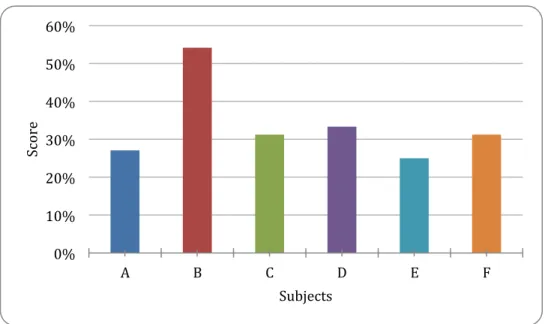
(34) 4.5 Ethical Considerations With regard to ethical considerations, permission to conduct this study was obtained following a protocol explained in the subsequent lines. The first stage was to inform the head of the English program at FEN, who was then authorized to allow this project to be carried out. Later, an informed consent form was given to each participant to make them become fully aware of the nature of the study and its purposes. Participants were informed that their contribution in this study is strictly voluntary and anonymous; any information obtained in connection with this study that could be identified with them will remain confidential (see Annex D). When collecting data, it is important that the researcher identifies and monitors when (whether) biases that might impact the interpretation of the data are present so as to avoid them (Dornyei, 2007, p. 34). 5. Results and Analysis This section reports on data obtained from the applications of Pre-test, Post-test, and Survey. Information has been quantified, categorised, and exposed as bar charts with the objective of presenting data in a clear and condensed manner so as to emphasise the most relevant results’ features. Information will be displayed in the following order, Pretest Results, Post-test Results, and Survey Results. Finally, summarised results will be exposed using Relative Change as a metric of assessment, which will be referred to as Relative Improvement. 5.1 Pre-test General Results Results obtained from the Pre-test reported an average of 34% achievement in the Reading Comprehension component. With the intention of illustrating results, in Figure 14 we can observe subjects’ individual percentage of achievement.. 29.
(35) 60% 50%. Score. 40% 30% 20% 10% 0% A. B. C. D. E. F. Subjects Figure 14. Pre-test General Results.. 5.1.1 Pre-test Genre Results According to the Instrument and Data Collection section, (see section 4.3 above) the Reading Comprehension component in the TOEIC exam entails 28 Single Passage questions and 20 Double Passage questions. Therefore, subjects’ achievement in Single Passage questions and Double Passage questions per genre will be exposed below aiming at presenting data in a classified and clear fashion. 5.1.2 Pre-test Single Passage Genre Results The first genre that will be presented is: Articles. In Figure 15, we can observe the rate of achievement per subject according to this Genre. Three different articles were tested in the Single Passage questions. The bars show that subject B was the most successful subject, with a score of 64% followed by subjects A, E, and F who scored 55%, then subject C 36%. Finally, the participant who scored the lowest achievement rate in the Article genre was Subject D with 27%.. 30.
(36) Articles 70% 60% 50% 40% 30% 20% 10% 0% A. B. C. D. E. F. Figure 15. Pre-test Single Passage Genre Achievement. Articles.. The second genre assessed in the Pre-test was a Letter. Figure 16 shows that subject B obtained the highest score for a second time, 75% of achievement. Subjects C and F achieved the same score, 25%. No score was reported from subjects A, D, and E.. Letter 80% 70% 60% 50% 40% 30% 20% 10% 0% A. B. C. D. E. F. Figure 16. Pre-test Single Passage Genre Achievement. Letter.. 31.
(37) Third, results on an Advertisement text exposed a more even answer achievement distribution in comparison with the results exposed above. Contrary to the previous Genre Achievement data, this time the highest scores were obtained by subjects D and F who obtained a score of 100% followed by subjects B and E who scored 80% (see Figure 17). Subjects C, and A obtained a 60% and a 40% respectively.. Advertisement 120% 100% 80% 60% 40% 20% 0% A. B. C. D. E. F. Figure 17. Pre-test Single Passage Genre Achievement. Advertisement.. Results show a strongly marked pattern in the assessment of the fifth genre Invoice, as Figure 18 illustrates. In this case, subjects B and F obtained a score of 50%. Students A, C, D, E, obtained 0%.. Invoice 60% 50% 40% 30% 20% 10% 0% A. B. C. D. E. F. Figure 18. Pre-test Single Passage Genre Achievement. Invoice.. 32.
(38) The fifth genre is Instructions, Figure 19 below shows Subjects B, D, and, F scored 50%, while subjects A and C, scored 25%. Subject E, obtained the lowest score 0%.. Instructions 60% 50% 40% 30% 20% 10% 0% A. B. C. D. E. F. Figure 19. Pre-test Single Passage Results. Instructions.. The final single passage genre results correspond to a Notice (see Figure 20). Scores show subject D obtained the highest result, 100%, subject B scored 50%, and subject A, C, E and F 0%.. Notice 120% 100% 80% 60% 40% 20% 0% A. B. C. D. E. F. Figure 20. Pre-test Single Passage Genre Results. Notice.. 33.
(39) 5.1.3 Pre-test Double Passage Genre Results The first Pre-test Double Passage results correspond to the genres Schedule and E-mail genres. The bar chart below (see Figure 21), reveals that subjects B and C were the only subjects who scored a percentage of 40% and 20% respectively.. Schedule and E-mail 50% 40% 30% 20% 10% 0% A. B. C. D. E. F. Figure 21. Pre-test Double Passage Genre Results. Schedule and E-mail.. The second Double Passage scores correspond to results of questions triggered by two Letters (see Figure 22). Subjects A and B obtained 60% score, while subject C scored 80%. Finally, subjects D, E and F showed a poor performance of 0%.. Letter and Letter 90% 80% 70% 60% 50% 40% 30% 20% 10% 0% A. B. C. D. E. F. Figure 22. Pre-test Double Passage Genre Results. Letter and Letter.. 34.
(40) Third, the genres Memo and Letter were assessed in the Pre-test. In Figure 23, it is possible to observe that subject D scored 40%, while subjects B, C and E, scored the same 20%. Subjects A and F scored 0%.. Memo and Letter 45% 40% 35% 30% 25% 20% 15% 10% 5% 0% A. B. C. D. E. F. Figure 23. Pre-test Double Passage Genre Results. Memo and Letter.. Finally, results from questions on the genres Notice and Letter showed an achievement of 40% from subjects B and D in this genre questions, while subjects A and E obtained 20%, and subject C and F 0% (see Figure 24).. Notice and Letter 50% 40% 30% 20% 10% 0% A. B. C. D. E. F. Figure 24. Pre-test Double Passage Genre Results. Notice and Letter.. 35.
(41) 5.1.4 Pre-test Question Type Results Participants’ Inference Questions scores can be observed below (see Figure 25) this category represents 20% of the total questions asked. In the figure it is possible to notice that subjects, B and E scored 50% in this category, followed by subjects D and F who scored 40% of the total questions. Finally, we can observe that subjects A and C scored 30%.. 60%. Rate of Success. 50% 40% 30% 20% 10% 0% A. B. C. D. E. F. Subjects Figure 25. Pre-test Question Type Results. Inference Questions.. The second Type of Questions category was Explicit Information questions, which represents 72% of the total questions asked. Figure 26, illustrates subjects results in this category. As we can see, in general, scores were not higher than a 35% except for subject B, who scored 56% followed by subject C with 35%, subject D 32%, subject F 29%, subject A 26%, and finally subject E, who had the lowest score of 21% of correct answers.. 36.
(42) 60% 50%. Score. 40% 30% 20% 10% 0% A. B. C. D. E. F. Subjects Figure 26. Pre-test Question Type Results. Explicit Information Questions.. The third and final question type is Understanding Meaning in Context, which represents an 8% of the total questions asked in the Pre-test. As Figure 27 illustrates, subject B obtained the maximum score in this category, 50%, followed by subjects A, D, and F, who scored 25%, subjects C and E obtained the lowest score of 0% of correct answers.. 60% 50% Score. 40% 30% 20% 10% 0% A. B. C. D. E. F. Subjects Figure 27. Pre-test Question Type Results. Understanding Meaning. 37.
(43) 5.2 Post-test General Results Post-test Results averaged 43%. Figure 28 below shows total achievement per subject where we can appreciate that subject B presents the highest rate of achievement, 54%, among participants, followed closely by subject C, who obtained 50%. Then subject F achieved 46%, and subjects D and A, obtained 40% and 38% respectively. Finally, subject D scored the lowest number, 33%.. 60% 50%. Score. 40% 30% 20% 10% 0% A. B. C. D. E. F. Subjects Figure 28. Post-test General Results.. 5.2.1 Post-test Genre Results Post-test Genre Results will be presented in a similar fashion as in the Pre-test section. Hence, first, 28 Single Passage questions results will be shown per genre, then 20 Double Passage questions results will be presented. 5.2.2 Post-test Single Passage Genre Results The first text that was evaluated in the Post-test corresponds to an Invitation. Results reported all participants scored 0% as we can observe in Figure 29.. 38.
(44) Invitation 100% 80% 60% 40% 20% 0% A. B. C. D. E. F. Figure 29. Post-test Single Passage Genre Results. Invitation.. The second genre tested was an Article that is illustrated in Figure 30.The graph reveals subject E scored the highest achievement rate in this genre. Also, subjects A, D and F scored 75%, while subject B and C obtained 50%, and subject C shows the lowest result, 25%.. Article 120% 100% 80% 60% 40% 20% 0% A. B. C. D. E. F. Figure 30. Post-test Single Passage Genre Results. Article.. 39.
(45) The third genre was a Schedule. The graph below (see Figure 31) shows a more even score number than previous data as subjects A, B, C, D and F scored the same percentage 67%, while subject E was the only subject who obtained a different score of 33%.. Schedule 80% 60% 40% 20% 0% A. B. C. D. E. F. Figure 31. Post-test Single Passage Genre Results. Schedule.. In a similar fashion, in the fourth genre assessed, an Advertisement, most of the subjects obtained a similar score except for the ones who obtained the maximum and minimum values, subjects D and E, who scored 100% and 33% respectively. As mentioned above, subjects A, B, C and F obtained the same score 67% (see Figure 32).. Advertisement 120% 100% 80% 60% 40% 20% 0% A. B. C. D. E. F. Figure 32. Post-test Single Passage Genre Results. Advertisement.. 40.
(46) Scores were lower in the fifth genre, Report, as sown below (see Figure 33). While subject F scored the highest percentage 80%, scored declined as follows: subject B obtained 60%, subjects A and D 40%, and subjects C and E 20%.. Report 100% 80% 60% 40% 20% 0% A. B. C. D. E. F. Figure 33. Post-test Single Passage Genre Results. Report.. More homogeneous scores can be observed in the sixth genre assessed, Fax. Subjects A and C scored 75%, while subjects B, D, E and F scored 50% (see Figure 34).. Fax 80% 70% 60% 50% 40% 30% 20% 10% 0% A. B. C. D. E. F. Figure 34. Post-test Single Passage Genre Results. Fax.. 41.
(47) The seventh genre was a Notice text. As the graph illustrates, subjects A, B, C and F scored the same percentage 50%. Subjects D and E obtained 0% (see Figure 35).. Notice 60% 50% 40% 30% 20% 10% 0% A. B. C. D. E. F. Figure 35. Post-test Single Passage Genre Results. Notice.. The final genre in the Single Passage questions section was a Memo. In figure 36 below, we can observe a homogeneous distribution of results. Subjects B and C obtained 75%, subjects A and F obtained 50%, and subjects D and E obtained 25%.. Memo 80% 70% 60% 50% 40% 30% 20% 10% 0% A. B. C. D. E. F. Figure 36. Post-test Single Passage Genre Results. Memo.. 42.
(48) 5.2.3 Double Passage Genre Results The first double passage genres were Fax and Notice. Subjects C and F obtained the highest score of 60% achievement. Subject B scored 40% while subjects A, D and E scored 20% (see Figure 37).. Fax and Notice 80% 60% 40% 20% 0% A. B. C. D. E. F. Figure 37. Post-test Double Passage Genre Results. Fax and Notice.. The second double passage questions genres were Advertisement and E-mail. Even though half sample participants, namely subjects B, C and D scored the highest rate of achievement: 80%, 60% and 60% respectively, subjects E, F, and A scored 20%, 20%, and 0% respectively (See Figure 38).. Advertisement and E-mail 100% 80% 60% 40% 20% 0% A. B. C. D. E. F. Figure 38. Post-test Double Passage Results. Advertisement and E-mail.. 43.
(49) The third double passage in the Post-test corresponds to E-mail and E-mail. In this category, we can observe that subject B scored the highest achievement rate of 60%. This value is followed by results from subjects C, E and F, who scored 40%. The lowest percentage of achievement, which was 0%, was shown by subject D (see figure 39).. E-mail and E-mail 80% 60% 40% 20% 0% A. B. C. D. E. F. Figure 39. Double Passage Genre Results . E-mail and E-mail.. The final double passage questions genres in the Post-test included Article and Telephone Message texts. Results show that subject C obtained the maximum score of 60%, while subjects B, D and E obtained 40%. Subjects A and F obtained the lowest scores of 20% and 0% respectively (see Figure 40).. Article and Telephone Message 70% 60% 50% 40% 30% 20% 10% 0% A. B. C. D. E. F. Figure 40. Post-test Double Passage Genre Results. Article and Telephone Message.. 44.
(50) 5.2.4 Post-test Question Type Results Subjects’ Inference Question scores are illustrated in the graph below (see Figure 41). Inference Questions represent 40% of the total questions asked in the Post-test. Results reveal that subject B obtained the highest score of 42%, followed closely by subjects A and C who scored 37%. Subjects D, e and F obtained the same result, 21%.. 45% 40% 35% Score. 30% 25% 20% 15% 10% 5% 0% A. B. C. D. E. F. Subjects Figure 41. Post-test Question Type Results. Inference Questions.. The second type of question was Explicit Information Questions, which represents a 54% of the total Post-test Reading Comprehension Questions. Subject B obtained the highest score of 69%, while subjects C and F obtained the same score of 62%. Subject D scored 54%, and subjects A and E scored the same percentage of 42% (see Figure 42).. 45.
(51) 80% 70%. Score. 60% 50% 40% 30% 20% 10% 0% A. B. C. D. E. F. Subjects Figure 42. Post-test Question Type Results. Explicit Information Questions.. The third and final type of question was Understanding Meaning in Context Questions. This category represents a 6% of the total questions asked in the Post-test. Subject F obtained the Highest score of 67%, well ahead of subjects C, D and E, who obtained 33%, while subjects A and B scored 0% (see Figure 43).. 70% 60%. Score. 50% 40% 30% 20% 10% 0% A. B. C. D. E. F. Subjects Figure 43. Post-test Question Type Results. Understanding Meaning in Context Questions.. 46.
(52) 5.3 Subjects’ Improvement Analysis Results show subject B obtained the highest scores in most of the categories in the Post-test, except for the Genre Invitation and the question type Understanding Meaning in Context. Subject B obtained the highest score in both Pre-test and Post-test, however, the score was the same in both cases, 54%. Subject A showed significant improvement, particularly in the category of Notice, reporting an improvement from 0% to 50%, as well as subjects C and F, who showed the same percentage of improvement in this type of text. Subject E improved particularly in the category of General Correspondence, which is visible in the Pre-test Single Passage questions Letter, and Double Passage questions from Letter and Letter where this participant scored 0% in comparison to Post-test results where this participant scored 50%, and 40% in Fax’s Single Passage questions and E-mail and E-mail Double Passage questions respectively. Finally subject D, who obtained 0% in most of the General Correspondence and Schedule genres in the Pre-test, increased his/her score in 50% in General Correspondence Single Passage questions, and in 67% in Schedule Single Passage questions. 5.3.1 Pre-test and Post-test Relative Improvement Relative Improvement was calculated after detailed data categorisation and analysis. The graph below (see Figure 44) shows the percentage of improvement obtained by each of the participants in this study. Results reveal that all participants improved their performance in the TOEIC Reading Comprehension section. Subject B shows an improvement of 0% as this participant obtained the same score in both Pre and Post-tests. Subject C improved by 60%, followed by subject F, who shows a Relative Improvement of 46.7%. Subject A shows an improvement of 38.5%, followed closely by subject E, who shows 33.3% Relative Improvement. Finally, subject D presents an improvement of 18.8%. In sum, results show improvement in five out of six participants. There was no report of a participant reporting a lower score in comparison with Pre-test results. 47.
(53) 70,0% 60,0%. Score. 50,0% 40,0% 30,0% 20,0% 10,0% 0,0% A. B. C. D. E. F. Subjects Figure 44. Pre-test and Post-test Relative Improvement.. 5.4 Survey Results Survey results are presented in the table below, they have been categorised for analysis purposes divided into Likert Scale questions (see Table 1), and Open-ended questions (see Table 2). Subjects are identified with letters as in the graphs above but they do not necessarily correspond to the same participants, as survey response was anonymous. Table 1 below, shows 100% of the participants rated the intervention with 5 stars, being 5 stars the maximum number in the band. All participants informed the intervention was useful for their reading comprehension, additionally, all of them would recommend this methodology to other students. Also, 100% participants think this methodology is appropriate for preparing TOEIC, and finally, all the sample subjects would take a class based on this methodology if the faculty offered it. Table 2, reports on the open-ended question answers students provided in this survey. Question 5, gave us the possibility to examine subjects’ perceptions towards the intervention and its methodology. All participants reported the intervention was a useful. 48.
(54) method to study for the TOEIC. Some participants, for example, subject E suggested they would like this methodology applied in their classes. Also, question 6 let us scrutinise whether participants perceived an improvement in their reading comprehension thanks to this intervention. Answers were positive in 100% of the answers, all subjects reported they felt their comprehension improved and helped them understand texts easily. Subjects’ reflections included in these answers will be analysed further on in the discussion section.. Table 1. Survey Results. Likert Scale Questions and Answers.. 49.
Figure
+7
Documento similar