
Thermoeconomic optimization of solar polygeneration plants for producing electricity, desalted water, cooling, and process heat
178
0
0
Texto completo
(2) PONTIFICIA UNIVERSIDAD CATOLICA DE CHILE SCHOOL OF ENGINEERING. THERMOECONOMIC OPTIMIZATION OF SOLAR POLYGENERATION PLANTS FOR PRODUCING ELECTRICITY, DESALTED WATER, COOLING, AND PROCESS HEAT.. ROBERTO EDUARDO LEIVA ILLANES. Members of the Committee:. Dr. RODRIGO ESCOBAR Dr. JOSÉ MIGUEL CARDEMIL Dr. FRANCISCO SUAREZ Dr. DAVID WATTS Dr. DIEGO ALARCÓN Dr. JORGE VÁSQUEZ Thesis submitted to the Office of Graduate Studies in partial fulfillment of. the requirements for the Degree of Doctor in Engineering Sciences.. Santiago de Chile, September, 2018.
(3) Dedicated to my father, mother, friend, and beloved God.. iii.
(4) AKNOWLEDGEMENTS My gratitude to: - Dr. Rodrigo Escobar and Dr. José Miguel Cardemil, my main supervisor and cosupervisor of my dissertation, for their advices, trust, discussions and valuable feedback during these years. - Plataforma Solar de Almeria-PSA, Spain, that is the largest and one of the most relevant solar thermal research center in Europe and worldwide, where I did an eight-month research internship, and had the privilege of working with Dr. Diego Alarcón, Director of the Solar Desalination Unit. Thanks for his valuable comments. His discussions contributed significantly to this research. Additionally, to thank all those who gave me the opportunity to discuss my research topic, I refer to other PSA researchers, such as, Dra. Patricia Palenzuela, Dr. Eduardo Zarza, Dra. Loreto Valenzuela, Dr. Bartolome Ortega, and also to Mrs. Carmen Montesinos, PSA Secretary. - Center for Energy Resources and Consumption Research (CIRCE), and Department of Mechanical Engineering - University of Zaragoza, Spain, that is an important research center in thermoeconomic and energy. Where, I did a three-month research internship and had the privilege of working with Dr. Javier Uche and Dra. Amaya Martinez. Thanks for their suggestions, constructive dialogues, and their kindness. Their discussions contributed significantly to this research, also. Additionally, I attended the subject “Tools for Industrial Energy Analysis” of the European Master in Renewable Energy taught by professors Dr. Antonio Valero and Dr. Cesar Torres. Note that Dr. Antonio Valero and his research group developed an important thermoeconomic method that I applied in chapter 4 of this dissertation. - The research team of Dr. Rodrigo Escobar and José Miguel Cardemil (Group of Solar Energy - DICTUC, Center for Solar Energy Technologies - Fraunhofer Chile Research, and Energy Center - PUC). Special mention to Cristian Cortés, Alan Pino, Carlos Felbol, Carlos Valenzuela, and Carlos Mata, among others. - CONICYT, that awarded me a National Doctoral Scholarship. In particular CONICYTPCHA/Doctorado_Nacional/año2013-folio21130634. iv.
(5) - Pontificia Universidad Católica de Chile (PUC), School of Engineering, that awarded me a Doctoral Scholarship, which was complemented with the CONICYT Scholarship. - FONDECYT project Nº 1130621, which funded part of this research project as well as visits from high-level specialists such as Dr. Adrian Bejan, who along with Dr. George Tsatsaronis and Dr. Michael Moran developed one of the most widely used thermoeconomic method that was applied in chapters 2 and 3 of this dissertation. - Universidad Técnica Federico Santa María (UTFSM), my employer, for giving me the support and ease to combine work with this research project, which made possible to complete this PhD program. - My family, for their patience, understanding, support, and help at all times.. v.
(6) CONTENTS AKNOWLEDGEMENTS ....................................................................................................iv CONTENTS .........................................................................................................................vi LIST OF TABLES ...............................................................................................................ix LIST OF FIGURES ............................................................................................................ xii NOMENCLATURE ...........................................................................................................xiv RESUMEN. ............................................................................................. xvii. ABSTRACT. ...............................................................................................xix. LIST OF PAPERS................................................................................................................. 1 1.. INTRODUCTION ....................................................................................................... 4 1.1. Context .................................................................................................................. 4 1.2. Objectives ............................................................................................................. 6 1.3. Hypotheses ............................................................................................................ 7 1.4. Methodology ......................................................................................................... 8 1.5. Contents and research contributions ..................................................................... 9 1.5.1. Contents ..................................................................................................... 9 1.5.2. Results ..................................................................................................... 10 1.5.3. Contributions ........................................................................................... 13 1.5.4. Perspectives of future work ..................................................................... 14. 2.. THERMOECONOMIC ASSESSMENT OF A SOLAR POLYGENERATION PLANT FOR ELECTRICITY, WATER, COOLING, AND HEATING IN HIGH DIRECT NORMAL IRRADIATION CONDITIONS. ............................................. 16 2.1. Introduction ......................................................................................................... 16 2.1.1. Polygeneration technologies ................................................................... 19 2.1.2. Integration scheme .................................................................................. 20 2.2. Methodology ....................................................................................................... 23 2.2.1. Design and modeling of a polygeneration plant...................................... 26 2.2.2. Thermoeconomic evaluations ................................................................. 33 2.2.2.1. Thermodynamic model ........................................................................ 35 2.2.2.2. Economic model ................................................................................... 35 vi.
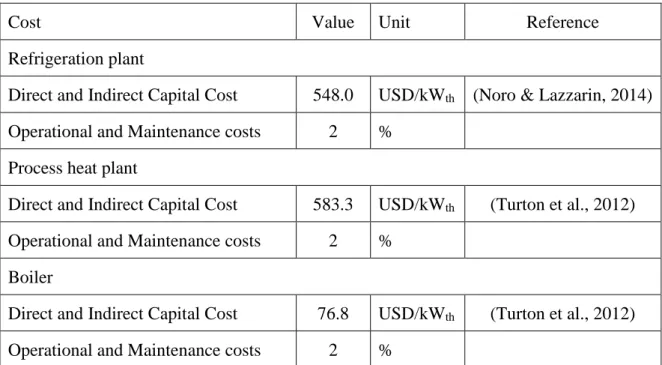
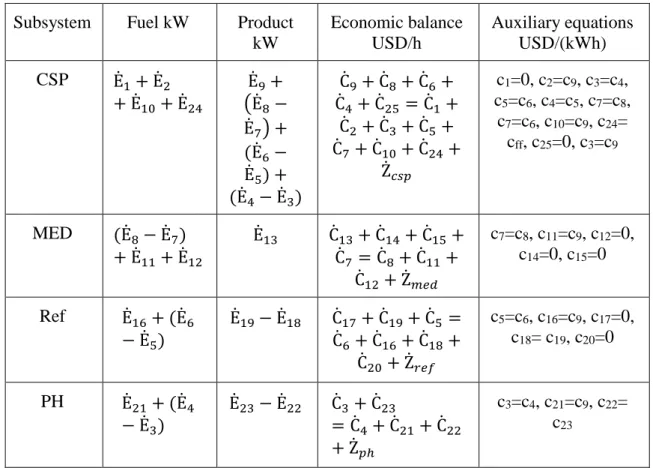
(7) 2.2.2.3. Thermoeconomic model ....................................................................... 38 2.3. Results and discussion. ....................................................................................... 42 2.3.1. Production and thermoeconomic assessment in base cases. ................... 42 2.3.2. Sensitivity analysis of investment cost, fuel cost and demand. .............. 46 2.3.3. Effects of sizing solar multiple and TES. ................................................ 49 2.4. Conclusions......................................................................................................... 52 3.. COMPARISON. OF. THE. LEVELIZED. COST. METHOD. WITH. THE. THERMOECONOMIC METHOD - COST ALLOCATION IN A SOLAR POLYGENERATION PLANT TO PRODUCE POWER, DESALTED WATER, COOLING, AND PROCESS HEAT. ........................................................................ 54 3.1. Introduction ......................................................................................................... 54 3.1.1. Solar polygeneration plant ...................................................................... 57 3.1.2. Assessment of a solar polygeneration plant ............................................ 58 3.2. Methodology ....................................................................................................... 62 3.2.1. Design parameters ................................................................................... 63 3.2.2. Economics considerations ....................................................................... 70 3.2.3. Energy and exergy evaluation ................................................................. 73 3.2.4. Levelized cost method ............................................................................. 76 3.2.5. Thermoeconomic method ........................................................................ 78 3.3. Results and discussion. ....................................................................................... 79 3.3.1. Production and cost in the base case. ...................................................... 79 3.3.2. Production and cost as functions of sizing SM and TES. ....................... 87 3.4. Conclusions......................................................................................................... 91 4.. EXERGY COST ASSESSMENT OF CSP DRIVEN MULTI-GENERATION SCHEMES: INTEGRATING SEAWATER DESALINATION, REFRIGERATION, AND PROCESS HEAT PLANTS. ............................................................................ 93 4.1. Introduction ......................................................................................................... 93 4.2. Methodology ....................................................................................................... 97 4.2.1. Stand-alone systems ................................................................................ 98 4.2.2. Cogeneration schemes ........................................................................... 102 vii.
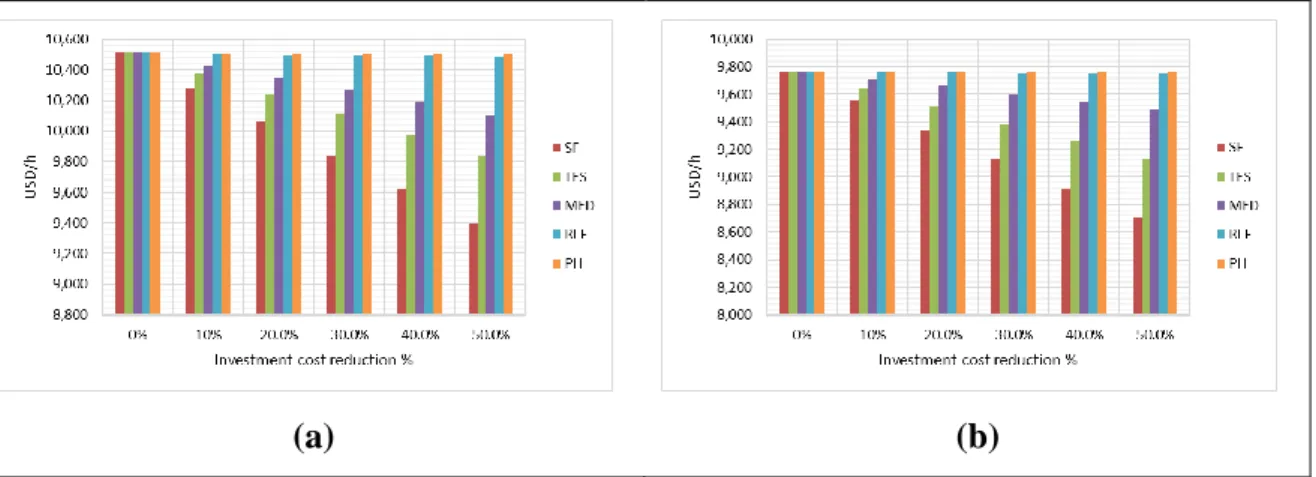
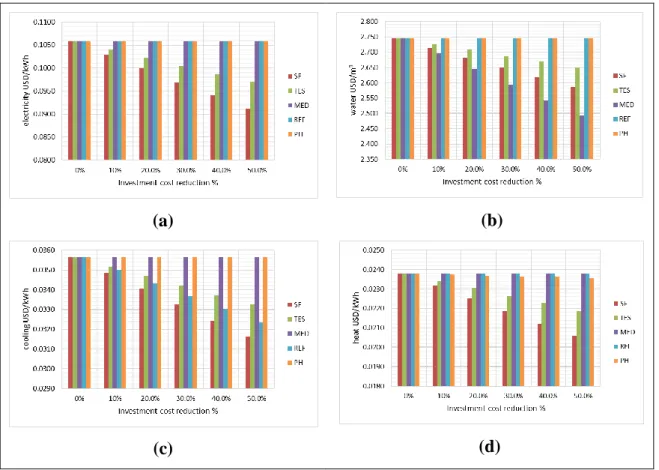
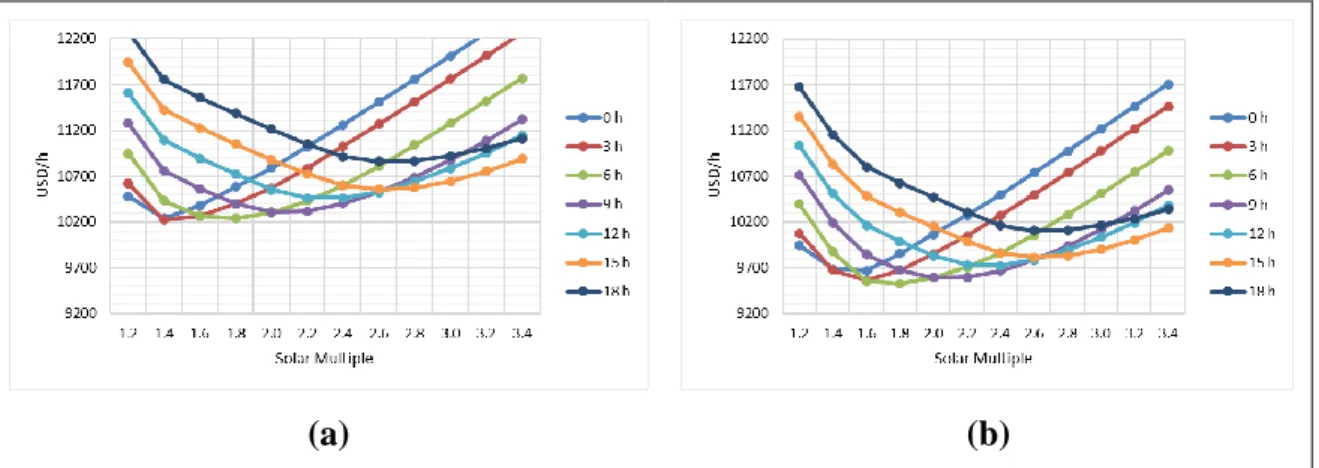
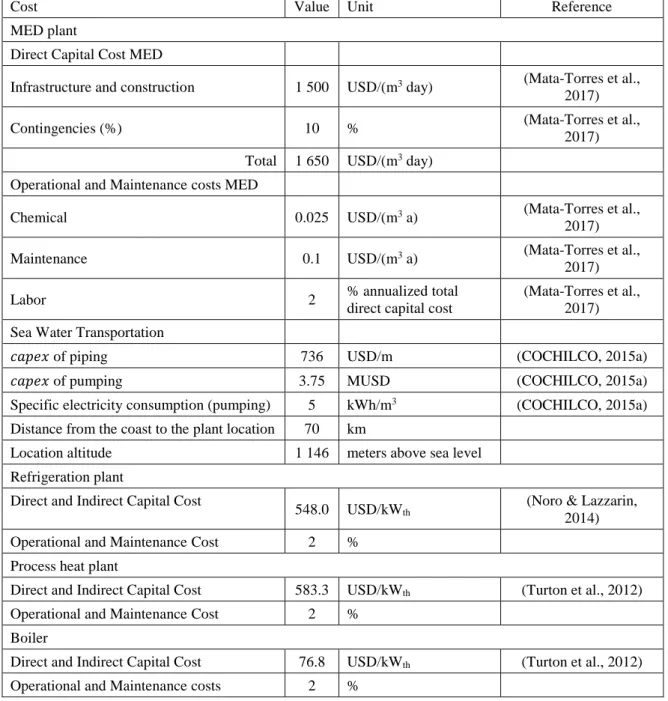
(8) 4.2.3. Trigeneration schemes........................................................................... 104 4.2.4. Polygeneration schemes ........................................................................ 105 4.2.5. Exergoeconomic method ....................................................................... 109 4.3. Results and discussion ...................................................................................... 117 4.3.1. Stand-alone plants ................................................................................. 117 4.3.2. Cogeneration plants ............................................................................... 122 4.3.3. Trigeneration plants............................................................................... 124 4.3.4. Polygeneration plants ............................................................................ 125 4.4. Conclusions....................................................................................................... 129 5.. CONCLUSIONS ..................................................................................................... 131. REFERENCES .................................................................................................................. 134 APPENDICES ................................................................................................................... 141 APPENDIX A: Model development kit (MDK) of software IPSEpro. ................... 141 APPENDIX B: Validation of the stand-alone CSP plant. ....................................... 143 APPENDIX C: Exergy rate and unit exergy cost in polygeneration plants. ........... 144 APPENDIX D: Exergy rate and unit exergy cost in stand-alone systems. ............. 146 APPENDIX E: Flowchart of the simulation in chapter 3. ....................................... 148 APPENDIX F: Flowchart of the simulation in chapter 4. ....................................... 149 APPENDIX G: Cost decomposition in the cogeneration plants.............................. 150 APPENDIX H: Cost decomposition in the trigeneration plants. ............................. 153 APPENDIX I: Cost decomposition in the polygeneration plants. ........................... 157. viii.
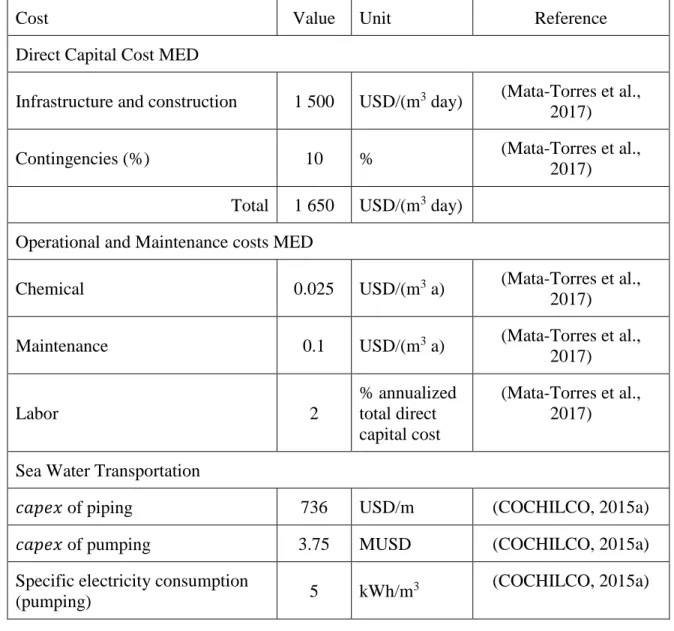
(9) LIST OF TABLES Table 2- 1: Main parameters of polygeneration plants at design point. .............................. 31 Table 2- 2: Specific cost for CSP plant. .............................................................................. 36 Table 2- 3: Specific cost for a MED plant. ......................................................................... 37 Table 2- 4: Specific cost for a refrigeration plant, process heat plant and boiler................ 38 Table 2- 5: Economic balance in polygeneration plant. Poly 1 and Poly 2. Poly 1 does not have stream 25. .................................................................................................. 39 Table 2- 6: Economic balance cost in stand-alone CSP plant. ............................................ 39 Table 2- 7: Economic balance cost in stand-alone MED plant. .......................................... 40 Table 2- 8: Economic balance cost in stand-alone refrigeration plant. ............................... 40 Table 2- 9: Economic balance cost in stand-alone process heat plant. ............................... 40 Table 2- 10: Annual productions and exergy efficiencies in base cases. ............................ 44 Table 2- 11: Exergy cost rate of products and unit exergy costs. ....................................... 44 Table 2- 12: Thermoeconomic indicators in polygeneration schemes. ............................... 46 Table 3- 1: Specific cost for the CSP plant. ........................................................................ 71 Table 3- 2: Specific cost for a MED plant, refrigeration plant, process heat plant and boiler. ........................................................................................................................... 72 Table 3- 3: Energy and exergy efficiencies. ........................................................................ 75 Table 3- 4: Unit exergy cost of electricity, water, cooling and heat. .................................. 79 Table 3- 5: Energy and exergy efficiencies. ........................................................................ 82 Table 3- 6: Unit exergy costs and levelized costs. .............................................................. 84. Table 4- 1: Cogeneration plants. ....................................................................................... 103 Table 4- 2: Trigeneration plants. ....................................................................................... 105 Table 4- 3: Polygeneration plants...................................................................................... 108 Table 4- 4: Fuel-Product definition of the stand-alone CSP plant. ................................... 114 Table 4- 5: Fuel-Product definition of the stand-alone MED plant. ................................. 115 Table 4- 6: Fuel-Product definition of the stand-alone REF plant. ................................... 115 Table 4- 7: Fuel-Product definition of the stand-alone PH plant. ..................................... 116 Table 4- 8: Unit exergy cost, exergy cost, and exergy efficiency in stand-alone plants. .. 118 ix.
(10) Table 4- 9: Unit exergy cost, total exergy cost of product, and exergy efficiency in cogeneration plants. ......................................................................................... 123 Table 4- 10: Unit exergy cost, total exergy cost of product, and exergy efficiency in trigeneration plants. ......................................................................................... 124 Table 4- 11: Unit exergy cost, total exergy cost of product, and exergy efficiency in polygeneration plants (CSP-MED-REF-PH). ................................................. 126 Table B-1: Comparison between IPSEpro/Matlab model and SAM model …………… 143. Table C- 1: Exergy rate and unit exergy cost in Poly 1. ................................................... 144 Table C- 2: Exergy rate and unit exergy cost in Poly 2. ................................................... 145. Table D- 1: Exergy rate and unit exergy cost in Stand-alone CSP plant. ......................... 146 Table D- 2: Exergy rate and unit exergy cost in Stand-alone MED plant. ....................... 146 Table D- 3: Exergy rate and unit exergy cost in Stand-alone REF plant. ......................... 147 Table D- 4: Exergy rate and unit exergy cost in Stand-alone PH plant. ........................... 147. Table G- 1: Cost decomposition of Generator and MED in CSP-MED plants................. 150 Table G- 2: Cost decomposition of Generator and REF in CSP-REF plants.................... 151 Table G- 3: Cost decomposition of Generator and PH in CSP-PH plants. ....................... 152. Table H- 1: Cost decomposition of Generator, MED, and REF in CSP-MED-REF plants (Trigen 1 and Trigen 2). .................................................................................. 153 Table H- 2: Cost decomposition of Generator, REF, and PH in CSP-REF-PH plants (Trigen 3 and Trigen 4). .................................................................................. 154 Table H- 3: Cost decomposition of Generator and MED in CSP-MED-PH plants (Trigen 5 to Trigen 8). ..................................................................................................... 155 Table H- 4: Cost decomposition of PH in CSP-MED-PH plants (Trigen 5 to Trigen 8).. 156. Table I- 1: Cost decomposition of Generator and MED in CSP-MED-REF-PH plants (Poly 1 to Poly 4). ..................................................................................................... 157 x.
(11) Table I- 2: Cost decomposition of REF and PH in CSP-MED-REF-PH plants (Poly 1 to Poly 4). ............................................................................................................ 158. xi.
(12) LIST OF FIGURES Figure 2- 1: Flowchart of the overall simulation................................................................. 24 Figure 2- 2: Polygeneration plant configuration. Poly 1. CSP + MED + REF + PH. ......... 27 Figure 2- 3: Polygeneration plant configuration. Poly 2. CSP + MED + REF + PH. ......... 28 Figure 2- 4: Aggregation level for thermoeconomic assessment. (a) Polygeneration plant for Poly 1 and Poly 2 (Poly 1 does not have stream 25), (b) Stand-alone CSP, (c) Stand-alone MED, (d) Stand-alone refrigeration, e) Stand-alone process heat. ................................................................................................................ 34 Figure 2- 5: (a) Monthly productions from the solar. (b) Monthly percentage production from the solar and from the backup. .............................................................. 43 Figure 2- 6: Sensitivity analysis of investment cost. Effect in total exergy cost rate of products. (a) Poly1. (b) Poly 2. ...................................................................... 47 Figure 2- 7: Sensitivity analysis of investment cost in Poly 1. Effect in unit exergy cost of: (a) electricity, (b) water, (c) cooling, (d) heat. ............................................... 48 Figure 2- 8: Sensitivity analysis of: (a) fuel cost, (b) cooling demand, (c) heat demand, (d) fresh water demand. ....................................................................................... 49 Figure 2- 9: Total exergy cost rate of products as a function of the solar multiple and the hours (h) of TES. (a) Poly 1. (b) Poly 2. ........................................................ 50 Figure 2- 10: Unit exergy cost for Poly 1 configuration (a) electricity, (b) water, (c) cooling, (d) heat.............................................................................................. 51 Figure 3- 1: Stand-alone CSP plant. DNI: direct normal irradiance, CST: cold storage tank, FWP: feed water preheater, G: generator, HP: high pressure, HST: hot storage tank, LP: low pressure. ................................................................................... 65 Figure 3- 2: MED plant. ...................................................................................................... 66 Figure 3- 3: Refrigeration plant. .......................................................................................... 66 Figure 3- 4: Process heat plant. ........................................................................................... 67 Figure 3- 5: CSP polygeneration plant. ............................................................................... 69 Figure 3- 6: Polygeneration plant. (a) Sankey diagram. (b) Grassmann diagram. .............. 81 Figure 3- 7: Monthly capacity factor in polygeneration plant. ........................................... 84 xii.
(13) Figure 3- 8: Comparison between the levelized cost method and thermoeconomic method in polygeneration plant. Monthly UEC and LC of: (a) electricity, (b) water, (c) cooling, (d) process heat. .......................................................................... 86 Figure 3- 9: Capacity factor in the polygeneration plant. ................................................... 88 Figure 3- 10: Unit exergy cost (UEC) of electricity (a), water (b), cooling (c), and heat (d), versus Levelized electricity cost (LEC), Levelized water cost (LWC), Levelized cooling cost (LCC), and Levelized heat cost (LHC). .................... 89. Figure 4- 1: Configuration CSP plant (physical structure of the system). CST: cold storage tank, FWP: feed water preheater, G: generator, HP: high pressure, HST: hot storage tank, LP: low pressure. ...................................................................... 99 Figure 4- 2: Configuration stand-alone MED plant (simplified physical structure of the system). ........................................................................................................ 100 Figure 4- 3: Configuration stand-alone REF plant (physical structure of the system). .... 101 Figure 4- 4: Configuration stand-alone PH plant (physical structure of the system). ....... 102 Figure 4- 5: Configuration CSP-polygeneration schemes. (a) Poly 1, (b) Poly 2, (c) Poly 3, (d) Poly 4. ..................................................................................................... 108 Figure 4- 6: Cost decomposition in stand-alone CSP plant. ............................................. 120 Figure 4- 7: Cost decomposition in stand-alone MED, REF, and PH plants. ................... 121 Figure 4- 8: Unit exergy cost of each product in stand-alone plants and polygeneration schemes. ....................................................................................................... 127 Figure 4- 9: Cost decomposition in polygeneration schemes. ………..…………..……. 128 Figure A-1: Polygeneration library ……………………………………………...………142. Figure E- 1: Flowchart of the simulation in chapter 3. ..................................................... 148. Figure F- 1: Flowchart of the simulation in chapter 4....................................................... 149. xiii.
(14) NOMENCLATURE a: annum or year A: solar field aperture area, m2 BS: backup fossil fuel energy system capex: capital expenditure, USD cff: fossil fuel cost, USD/(kWh) C: exergy cost 𝐂P : exergy cost of the product 𝐂Pe : exergy cost of product due to irreversibilities of the components 𝐂Pr : exergy cost of product due to the residues allocation 𝐜e : unit exergy cost of the external resources 𝐜R : unit exergy cost of the residues 𝐶̇ or 𝐶𝑗̇ : exergy cost rate, USD/h ̇ : exergy destruction cost rate, USD/h 𝐶𝐷,𝑘 ̇ : exergy fuel cost rate, USD/h 𝐶𝐹,𝑘 ̇ : exergy product cost rate, USD/h 𝐶𝑃,𝑘 c: unit exergy cost, USD/(kWh) or kW/kW cfr: capital recovery factor, % COP: Coefficient of performance, COCHILCO: Chilean Cooper Commission CSP: concentrated solar power CST: cold storage tank 𝐷𝑁𝐼: direct normal irradiance, W/m2 𝐸: exergy flow e: exergy specified, kJ/kg 𝐸̇ : time rate of exergy or exergy rate, kJ/s 𝐸̇𝑠𝑢𝑛 : exergy rate from sun, kJ/s 𝐸̇𝐷 : exergy destruction rate, kJ/s 𝐸̇𝐹,𝑘 : exergy fuel rate, kJ/s xiv.
(15) 𝐸̇𝑃,𝑘 : exergy product rate, kJ/s 𝐸̇𝐿,𝑘 : exergy loss rate, kJ/s EPC: engineering, procurement, and construction F: fuel 𝑭𝑒 : vector of external resources ⟨𝑭𝑷⟩: matrix composed of distribution coefficients FWP: feed water preheater G: generator HP: high pressure HST: hot storage tank I: irreversibility i: discount rate, % 𝑲𝐷 : diagonal matrix of unit exergy consumptions 𝑘: unit exergy consumptions 𝑓𝑘 : exergoeconomic factor, % LiBr/H2O: Lithium bromide / water LP: low pressure LCC: levelized cooling cost, USD/(kWh) LEC: levelized electricity cost, USD/(kWh) LHC: levelized process heat cost, USD/(kWh) LWC: levelized water cost, USD/m3 MED: multi-effect distillation n: number of time periods, years 𝑜𝑝𝑒𝑥: operational expenditure or operation and maintenance cost, USD/a P: product Pelect: electricity selling price in the grid for industrial use, USD/(kWh) PH: process heat plant Poly: Polygeneration 𝑄̇ : heat rate, kJ/s xv.
(16) REF: Refrigeration plant RO: reverse osmosis 𝑟𝑘 : relative cost difference, % SAM: system advisor model software SF: solar field T0: reference temperature, °C TES: thermal energy storage 𝑼𝐷 : identity matrix 𝑉𝐷 : dissipative system components 𝑦: distribution coefficients 𝑊̇ : work rate, kJ/s 𝑍̇: non-exergy-related cost rate, USD/h 𝑍̇𝑘𝐶𝐼 : capital investment cost rates, USD/h 𝑍̇𝑘𝑂𝑀 : operating and maintenance cost rates, USD/h Greek symbols 𝛽𝑖𝑟 : residue cost distribution ratio 𝜓: exergy efficiency 𝜏: average annual time of plant operation at nominal capacity. xvi.
(17) PONTIFICIA UNIVERSIDAD CATOLICA DE CHILE ESCUELA DE INGENIERIA. OPTIMIZACIÓN TERMOECONÓMICA DE UNA PLANTA DE POLIGENERACIÓN SOLAR PARA LA PRODUCCIÓN DE ELECTRICIDAD, AGUA DESALINIZADA, REFRIGERACIÓN, Y CALOR DE PROCESO. Disertación enviada a la Dirección de Investigación y Postgrado en cumplimiento parcial de los requisitos para el grado de Doctor en Ciencias de la Ingeniería. ROBERTO EDUARDO LEIVA ILLANES RESUMEN Esta investigación se centra en la evaluación termoeconómica para la producción conjunta de electricidad, agua, refrigeración, y calor de proceso en plantas de poligeneración solar, con el fin de crear una base de conocimiento científico para el desarrollo de tecnologías de plantas de potencia de concentración solar (CSP) en zonas con altas condiciones de irradiación solar, y el uso racional y óptimo de recursos en esquemas de poligeneración para aumentar la eficiencia global de conversión de energía del sistema, y minimizar los costos de los productos finales. El objetivo principal de esta disertación es modelar, evaluar y optimizar plantas de poligeneración solar, configuradas con una planta CSP con un campo de colectores solares cilindro parabólico, almacenamiento térmico de energía y un sistema de respaldo, un módulo de destilación multi-efectos (MED), un módulo de refrigeración de absorción de simple efecto (REF), y un módulo de calor de proceso (PH), donde el motor impulsor es la planta CSP, considerando que las plantas de poligeneración se localiza en una zona con altas condiciones de irradiación solar y de demanda de energía y agua. Las plantas de poligeneración solar se simulan en un régimen transitorio, en una ubicación representativa con altas condiciones de irradiación solar, como en el norte de Chile. En el desarrollo de esta disertación se utilizaron los programas IPSEpro, Microsoft Excel, MATLAB, EES, y el módulo ExIO como complemento de Microsoft Excel. Para ampliar el análisis termoeconómico en la evaluación de esquemas de poligeneración solar, la metodología incluye el uso de dos métodos termoeconómicos; el primero, basado en el método de costo de exergía, se utilizó para evaluar el costo real de cada producto, en el análisis de sensibilidad del costo de inversión, costo de combustible y de la demanda, y para evaluar los efectos del tamaño del campo solar y el dimensionamiento del almacenamiento de energía térmica. Se investigaron tres configuraciones: dos esquemas de poligeneración y uno de sistemas independientes. Además, se comparó con el método de costo nivelado en términos de asignación de costos y del costo especifico unitario de cada xvii.
(18) producto. Mientras que el segundo método, basado en el método de exergoeconomía simbólica, se utilizó para analizar en profundidad el proceso de formación de costos de exergía, comparándolo con sistemas independientes, y para establecer la mejor configuración en cogeneración, trigeneración y poligeneración. En el cual, se investigaron veintiún configuraciones: ocho de cogeneración, ocho de trigeneración, cuatro esquemas de poligeneración, y uno de sistemas independientes. Esta disertación fue desarrollada a través de tres artículos científicos. Este estudio revela que una planta de poligeneración solar es más eficiente y rentable que las plantas independientes para una zona con altas condiciones de irradiación solar y proximidad a centros de consumo, como las industrias mineras, que requieren operación continua y suministro de energía y agua con una demanda fundamentalmente constante. Además, de acuerdo con el mercado del norte de Chile, las configuraciones de poligeneración solar son competitivas en cuanto a la producción de electricidad, agua dulce, refrigeración y producción de calor. A su vez, las plantas de poligeneración solar podrían aumentar el beneficio económico vendiendo créditos de carbono y créditos de cuotas de energía renovable basados en el Protocolo de Kyoto y la legislación chilena, respectivamente. También revela que el método termoeconómico es un método de asignación de costos equitativo y racional que es adecuado para ser aplicado en una planta de poligeneración solar. Otro resultado es que este método se recomienda cuando se necesita un análisis más preciso para evaluar los costos de los diferentes productos y para evaluar los beneficios de una planta de poligeneración, en comparación con las plantas independientes. Por otro lado, el método de costo nivelado es un método simple y rápido, y no se requiere un profundo conocimiento de termodinámica, siendo recomendable cuando es necesario realizar un primer acercamiento de los costos de cada producto. Otro resultado importante es que los equipos claves en los cuales el diseño debería ser mejorado en las plantas de multigeneración solar son: colectores solares, subsistemas productivos (plantas MED, REF, y PH), evaporador, y recalentador. También, las configuraciones recomendadas en las plantas de multi-generación solar (cogeneración, trigeneración, y poligeneración) son aquellas en las cuales la planta MED reemplaza al condensador, y la planta REF, así como el módulo PH, se acoplan a las extracciones de turbina. Los resultados obtenidos brindan información útil para señalar el potencial que ofrece la poligeneración solar y podría constituir una guía para comprender estos métodos. Miembros de la Comisión de Tesis Doctoral: Dr. RODRIGO ESCOBAR Dr. JOSÉ MIGUEL CARDEMIL Dr. FRANCISCO SUÁREZ Dr. DAVID WATTS Dr. DIEGO ALARCÓN Dr. JORGE VÁSQUEZ Santiago, septiembre 2018 xviii.
(19) PONTIFICIA UNIVERSIDAD CATOLICA DE CHILE ESCUELA DE INGENIERIA. THERMOECONOMIC OPTIMIZATION OF SOLAR POLYGENERATION PLANTS FOR PRODUCING ELECTRICITY, DESALTED WATER, COOLING, AND PROCESS HEAT. Dissertation submitted to the Office of Research and Graduate Studies in partial fulfillment of the requirements for the Degree of Doctor in Engineering Sciences by ROBERTO EDUARDO LEIVA ILLANES ABSTRACT This research is centered on thermoeconomic assessment of the joint production of electricity, fresh-water, cooling and process heat for solar polygeneration plants, to create scientific knowledge basis for the development of concentrated solar power (CSP) technologies in zones with high direct irradiation conditions, and the rational and optimal use of polygeneration schemes to increase the overall system energy conversion efficiency and minimize the costs of the final products. The main objective of this dissertation is to model, evaluate, and optimize solar polygeneration plants in thermoeconomic terms, configured by a CSP parabolic trough collector field, thermal energy storage and backup system, a multi-effect distillation (MED) module, a single-effect absorption refrigeration (REF) module, and a process heat (PH) module, whose prime mover is the CSP plant, and considering that the polygeneration plants are located in an area with high solar irradiation conditions, and large demands of energy and water. The solar polygeneration plants are simulated in a transient regime, in a representative location with high irradiation conditions, such as in northern Chile. In the development of this dissertation IPSEpro, Microsoft Excel, MATLAB, EES (Engineering Equation Solver), and the ExIO module as a complement of the Microsoft Excel software were used. In order to expand thermoeconomic analysis in the assessment of solar polygeneration schemes, the methodology includes the use of two thermoeconomic methods. The first method, based on the exergy costing method, was used to assess the actual cost of each product; to conduct a sensitivity analysis of investment, fuel cost and demand, and to evaluate the effects of solar field size and the sizing of thermal energy storage. Three configurations are investigated: two polygeneration schemes and one considering standalone systems. Furthermore, this method was compared with the levelized cost method in terms of the costs allocation and the unit specific cost of each product. Whereas the second xix.
(20) method, based on the symbolic exergoeconomic method, was used to analyze in depth the process of exergy cost formation, compare with stand-alone systems, and establish the best configuration in cogeneration, trigeneration and polygeneration schemes, in which twentyone configurations are investigated: eight of cogeneration, eight of trigeneration, four polygeneration schemes, and one considering stand-alone systems. This dissertation was developed through three journal papers. This study reveals that a solar polygeneration plant is more efficient and cost-effective than stand-alone systems for a zone with high irradiation conditions and proximity to consumption centers, such as mining industries, which require continuous operation and energy supply with fundamentally constant demand. Furthermore, according to northern Chilean market, solar polygeneration configurations are competitive regarding electricity, fresh-water, cooling and heat productions. Additionally, solar polygeneration plants might increase the economic profit by selling carbon credits and credits of renewable-energy quotas based on the Kyoto Protocol and Chilean legislation, respectively. Also reveals that the thermoeconomic method is an equitable and rational cost allocation method which is suitable for applying in a solar polygeneration plant. Another result is that this method is recommended when a more precise analysis it is necessary to assess the proper costs of different products, and for assessing the benefits of a polygeneration plant, when compared to stand-alone systems. On the other hand, the levelized cost method is a simple and fast method, and a deep knowledge of thermodynamics is not required, being recommended when it is necessary to perform a first approached of the costs of each product. Another important result is that the key equipment, in which the design should be improved in solar multi-generation plants, are: solar collector, productive subsystems (MED, REF, and PH plants), evaporator, and reheater. Also, the recommended configurations for the integrated solar multi-generation plants (cogeneration, trigeneration, and polygeneration) are those, in which the MED plant replaces the condenser of the power cycle, and the refrigeration plant, as well as the process heat module are coupled to turbine extractions. Those plants were the most cost-effective configuration. The results delivered provide useful information that could serve to decision-makers to point out the actual potential offered by solar polygeneration systems, and could constitute a guide to understand these methods. Keywords: solar energy, concentrated solar power, polygeneration, thermoeconomic analysis, multi-effect distillation, absorption refrigeration.. Members of the Doctoral Thesis Committee: Dr. RODRIGO ESCOBAR Dr. JOSÉ MIGUEL CARDEMIL Dr. FRANCISCO SUÁREZ Dr. DAVID WATTS Dr. DIEGO ALARCÓN Dr. JORGE VÁSQUEZ Santiago, September 2018 xx.
(21) 1 LIST OF PAPERS The papers published, accepted or submitted during this PhD project are listed below. The papers are co-authored. The author of this dissertation executed the major work in writing these papers such as: creating methodology and models, simulations, interpretation of results and discussion. The contribution of the co-authors in writing these papers has been discussions, suggestions, and critical review.. This dissertation is based on the next journal papers, referred to in the text by their Roman numerals. I.. R. Leiva-Illanes, R. Escobar, J. M. Cardemil, and D. Alarcón-Padilla, “Thermoeconomic assessment of a solar polygeneration plant for electricity, water, cooling and heating in high direct normal irradiation conditions”. Energy Conversion and Management, vol. 151, May, pp. 538–552, 2017.. II.. R. Leiva-Illanes, R. Escobar, J. M. Cardemil, and D. Alarcón-Padilla, “Comparison of the levelized cost and thermoeconomic methodologies – Cost allocation in a solar polygeneration plant to produce power, desalted water, cooling, and process heat”. Energy Conversion and Management, vol. 168, pp. 215–229, Jul. 2018.. III.. R. Leiva-Illanes, R. Escobar, J. M. Cardemil, D. Alarcón-Padilla, J. Uche, and A. Martínez “Exergy cost assessment of CSP driven multi-generation schemes: Integrating seawater desalination, refrigeration, and process heat plants”. (Submitted to Energy Conversion and Management journal).
(22) 2 Additionally, the author has published different conference papers, such as International congress: 1.. R. Leiva, T. Kaelbel, R. Escobar. “Modelamiento de una planta CSP operando en esquema de poligeneración”. XI Congreso Iberoamericano de Energía Solar (CIES) y XXXVIII - Semana Nacional de Energía Solar (SNES), Querétaro, México, octubre 2014.. 2.. R. Leiva-Illanes, R. Escobar, J. Cardemil. “Exergoeconomic assessment of a solar polygeneration plant”. Conference Proceedings, Solar World Congress 2015. Daegu, Korea, November 2015.. 3.. R. Leiva, R. Escobar, J. Cardemil. “Exergoeconomic and techno-ecnonomic analysis of a solar multi-generation plant with thermal energy storage”. Conference Proceedings, EuroSun 2016. Palma de Mallorca, Spain, October 2016.. 4.. R. Leiva, R. Escobar, J. Cardemil. “Modeling of solar polygeneration plant”. Conference Proceedings, SolarPACES Conference 2016. Abu Dhabi, UAE, October 2016.. 5.. R. Leiva-Illanes, R. Escobar, J. M. Cardemil, D. Alarcón-Padilla, J. Uche, and A. Martínez. “Exergy cost decomposition and comparison of integrating seawater desalination plant, refrigeration plant, process heat plant in a concentrated solar power plant”. Conference Proceedings, Solar World Congress 2017. Abu Dhabi, UAE, October 2017..
(23) 3 National congress: 1.. R. Leiva I., T. Kaelbel, R. Escobar. “Modelamiento de una planta de concentración solar operando en poligeneración”. XIV Jornadas de Mecánica Computacional – JMC 2014, Talca, Chile, octubre 2014.. 2.. R. Leiva I., R. Escobar. “Modelamiento y evaluación exergoeconómica de una planta CSP+MED”. XIV Jornadas de Mecánica Computacional – JMC 2015, Concepción, Chile, octubre 2015.. 3.. R. Leiva I., R. Escobar. “Modelamiento y evaluación exergoeconómica de una planta de cogeneración solar”. XVI Congreso Chileno de Ingeniería Mecánica - COCIM 2015, Valparaíso, Chile, noviembre 2015..
(24) 4 1.. INTRODUCTION. 1.1. Context The mining industry in zones with high direct normal irradiation conditions, such as northern Chile presents a high demand of electricity, fresh-water, process heat, and industrial refrigeration. These products are feasible to produce in stand-alone plants that consume mainly fossil fuels. However, given the advantages offered by operating in a polygeneration scheme, it is interesting to consider the evaluation of a polygeneration plant to produce these four products or to operate in a cogeneration or trigeneration scheme. Polygeneration system is an integration process, which produces more than one product from one or more natural resources (Serra et al., 2009), whose advantages are: allowing to reduce both primary energy consumption and CO2 emissions, avoiding the waste heat, reducing the transmission and distribution network and other energy losses, as well as decreasing energy dependency at the country level, and contributing to the diversification of energy sources (Al Moussawi et al., 2016). On the other hand, since in the north of Chile there is a high availability of solar irradiation (Escobar et al., 2014) is that a concentrated solar power (CSP) plant could be a cost-effective option to produce electricity because this type of plant allows operating directly from solar energy, storing the thermal energy captured, and operating in hybrid form using fossil fuel backup, which allows to operate in stable and constant conditions, and thus does not affect the performance of plants that are integrated into the polygeneration scheme. Therefore, CSP plants have the potential to play an important role in the production of electricity from non-conventional renewable energies, which constitute an opportunity for sustainable development. Considering that the power block, in the CSP plant, rejects heat to the environment, this heat could be recovered by technologies driven by thermal energy. Therefore also, a CSP plant is feasible to integrate it with other technologies to produce other products, such as process heat, steam, hot water, fresh-water, and cooling (Modi et al., 2017). Given the above, in this research is proposed analyzing the integration of a CSP plant that operates in polygeneration schemes where the CSP plant analyzed consists of a solar field with parabolic trough collectors, a thermal energy storage system, a power block, and a backup energy system. The CSP plant is the prime mover into the solar polygeneration plant..
(25) 5 Note that the prime mover, that converts thermal or chemical energy into power, is the heart of any polygeneration system (Al Moussawi et al., 2016). The technologies driven by thermal energy for producing desalted water, cooling, and process heat consist of a multieffect distillation plant, a single-effect LiBr-H2O absorption refrigeration plant, and a countercurrent heat exchanger module, respectively. These technologies were selected because they are commercially available and allow operating within temperature ranges of the coupling points in the CSP plant. These points were selected according to the operating temperature constraints, imposed by each technology and aiming to cause the minimum penalty in terms of power production. The process of integration of those plants is described in detail in chapters 2, 3, and 4. Due to the complexity of dealing with many energy flows in polygeneration schemes, the integration and assessment of such technologies should be evaluated applying a rational method. A method for the allocation of resources and products allows solving this problem, considering all input and output from the system, investments, operation and maintenance costs, as well as the production units of each product. For solving this problem, several allocation cost methods have been proposed in the literature, which in general are classified in thermodynamic, economic, and thermoeconomic methods (or exergoeconomic). The thermodynamic methods are based on the First and/or Second Law of the Thermodynamics (Beretta et al., 2014; Gochenour, 2003; Tereshchenko & Nord, 2015; Ye & Li, 2013). The economic methods are similar to thermodynamic ones depending on whether lowering power or heat costs are in priority (Gochenour, 2003; Nuorkivi, 2010). Finally, the thermoeconomic methods are based on the Second Law of the Thermodynamics and economic principles (Abusoglu & Kanoglu, 2009; Bejan et al., 1996; Serra et al., 2009). However, in the evaluation of solar polygeneration plants, two methods are used: the thermoeconomic method and the levelized cost method, although, this research is based mainly on the thermoeconomic method that is described in chapters 2, 3, and 4 while the levelized cost method is described in chapter 3. Based on a literature review, which is explained in chapters 2, 3 and 4, the following knowledge gaps have been identified: i. Few articles reported in the literature have applied thermoeconomic assessment to solar polygeneration systems, considering a concentrated solar power plant as prime mover. In.
(26) 6 that context, some important aspects have yet to be investigated, such as the different relationships between fuels and products, the effect of investment, fuel cost, and demand in the products costs; as well as the sizing of the solar field and the TES for these solar polygeneration systems considering high irradiation conditions. This solar polygeneration plant is very attractive in zones presenting high irradiation conditions, scarcity of water, availability of flat terrain, and proximity to consumption centers, such as the mining industries in Northern Chile, Northern-Africa and Australia. ii. Different studies have focused on assessment of CSP-polygeneration systems by the levelized cost method (Short et al., 1995) and other by the thermoeconomic method (Bejan et al., 1996); however, the results from each method are unlike and produce significant differences. Hence, it is not clear which method is more appropriate for assessing a solar polygeneration plant and which is the effect and impact of using one or other method, in terms of the complexity of calculations, rules and rationality of cost allocation, and the applicability to compare between stand-alone systems and polygeneration plants. iii. CSP could be integrated into polygeneration schemes (Modi et al., 2017) and different studies have focused mainly on the final cost of each product. However, such those studies do not consider the evaluation of the process of exergy cost formation, the decomposition of each cost, and the configuration from stand-alone systems, following with cogeneration plants, trigeneration and finally polygeneration plants to find out new opportunities for savings, in terms of energy resources, in this complex integrated system. This dissertation has been divided into three research papers, where each one covers one of the gaps indicated above, and it is developed in chapters 2, 3, and 4 respectively. The contribution of this dissertation seeks to fill those knowledge gaps. The objectives, hypotheses, methodology, content and contributions of the dissertation are presented below. 1.2. Objectives The main objective of this dissertation is to model, evaluate, and optimize solar polygeneration plants in thermoeconomic terms, configured by a CSP parabolic trough collector field, thermal energy storage and backup system, a multi-effect distillation module, a single-effect absorption refrigeration module, and a process heat module to produce power, desalted water, cooling, and process heat, whose prime mover is the CSP plant, and.
(27) 7 considering that the polygeneration plants are located in an area with high solar irradiation conditions, and large demands of energy and water to create scientific knowledge basis for the development of concentrated solar power (CSP) technologies, and the rational and optimal use of polygeneration schemes to increase the overall system energy conversion efficiency and minimize the costs of the final products. The specific objectives of this dissertation are: i) To assess and optimize a solar polygeneration plant using a thermoeconomic method to determine the actual cost of each product; to conduct a sensitivity analysis of investment cost, fuel cost, and demand; and to evaluate the effects of solar field size and the sizing of thermal energy storage. ii) To evaluate a solar polygeneration plant using the levelized cost and the thermoeconomic methods to analyze the costs allocation process, the unit specific costs of each product, as well as the energy and exergy efficiencies, and the main advantages of both methods evaluated. iii) To analyze in depth the process of exergy cost formation in solar multi-generation plants, that include cogeneration, trigeneration, and polygeneration schemes, to compare with stand-alone systems, to find out new opportunities for savings, and to establish the best configuration in a cogeneration, trigeneration and polygeneration scheme, in terms of unit exergy cost of the product, total exergy cost of product, and exergy efficiency. 1.3. Hypotheses i) Concentrated solar power plant can supply thermal energy to produce desalted water, cooling, and process heat, under different polygeneration schemes in high direct normal irradiation conditions. ii) A solar polygeneration plant, in zones with high direct normal solar irradiation conditions and large demands of energy and water, can operate more efficiently than stand-alone systems in thermodynamic and economic terms. iii) The thermoeconomic method is appropriate for evaluating and comparing solar polygeneration schemes and stand-alone systems. iv) The thermoeconomic method makes a rational allocation of resources, so it is appropriate to be used in the assessment of polygeneration systems..
(28) 8 v) The exergy cost theory provides a general criterion that enables to assess the efficiency of polygeneration systems and rationally explains the process of cost formation of products. 1.4. Methodology In general, the methodology considers first the modeling of stand-alone systems and their validation, following with the integration of those plants in solar multi-generation schemes, that include cogeneration, trigeneration, and polygeneration schemes, which are modeled considering solar energy and natural gas as primary resources, and the demand from the mining industry, that operates continuously and consequently presents a constant demand. The solar multi-generation schemes integrated consist of a concentrated solar power, a multieffect distillation plant, a single-effect absorption refrigeration plant, and a process heat module. The solar polygeneration plants are simulated considering a meteorological year (Escobar et al., 2014), from the simulations, the production of the plants are determined in hourly, monthly, and annual base. The specific methodology applied in each research is explained in extenso in chapters 2, 3 and 4, respectively. Each chapter responds to a specific objective, thus, chapter 2 is associated with the first specific objective, chapter 3 with the second, and chapter 4 with the third. Secondly, it is defined an aggregation level in each system, and it is applied the thermoeconomic and levelized cost methods. In chapter 2, it is applied the thermoeconomic method, based on the exergy costing method (Bejan et al., 1996), that was used to assess the actual cost of each product, to conduct a sensitivity analysis (investment, fuel cost and demand), and to evaluate the effects of solar field size and the sizing of thermal energy storage. Three configurations are investigated: two polygeneration schemes and one considering stand-alone systems. In chapter 3, it is compared the thermoeconomic method (Bejan et al., 1996) and the levelized cost method (Short et al., 1995) in terms of the costs allocation and the unit specific cost of each product to analyze the costs allocation process, the unit specific costs of each product, as well as the energy and exergy efficiencies, and the main advantages of both methods evaluated. Two configurations are analyzed and compared: a polygeneration scheme and stand-alone systems. Finally, in chapter 4, it is applied the thermoeconomic method, based on the symbolic exergoeconomic method.
(29) 9 (Torres et al., 2008; Usón et al., 2012; Valero et al., 2013), that was used to analyze in depth the process of exergy cost formation to compare with stand-alone systems, and establish the best configuration in cogeneration, trigeneration, and polygeneration schemes. Twenty-one configurations are investigated: eight of cogeneration, eight of trigeneration, four polygeneration schemes, and one considering stand-alone systems. Note that chapters 2, 3, and 4 are associated with the journal papers I, II, and III respectively. Each research paper is an independent research that is concatenated with the previous research. The present work was executed with the help of commercially available process simulation software, such as IPSEpro (modules PSE, MDK, and PSXLink) (SimTech GmbH, 2011), Microsoft Excel, MATLAB, EES (Engineering Equation Solver), and the ExIO (Torres & Valero, 2012) module as a complement of the Microsoft Excel; the post-processing was performed by MATLAB and Microsoft Excel. 1.5. Contents and research contributions 1.5.1. Contents The present dissertation is organized in five chapters, with this introduction first. Chapter 2, 3, and 4 respond to the first, second, and third specific objective of the dissertation, respectively. These chapters constitute each one of the research paper (journal paper I, II, and III) and contain the state of the art, the literary revision, the methodology, the results, and the conclusions of this research within its scope. With the purpose of maintaining their purity and comprehension, it has avoided changing them, except if necessary. In this way, each chapter is an autonomous unity and can be read without the strict need of reading the rest of the chapters. Although this facilitates the reading of the document, it has the inevitable drawback of having to provide some redundant contents between the different chapters, especially in the introduction and the section of the different methodologies. The content of each chapter is indicated below: - In chapter 2, a thermoeconomic assessment of the joint production of electricity, freshwater, cooling, and heat for a solar polygeneration plant is carried out. The aims are to assess the actual cost of each product; to conduct a sensitivity analysis of investment, fuel cost, and demand; and to evaluate the effects of solar field size and the sizing of thermal.
(30) 10 energy storage, for a polygeneration plant located in an area with high solar irradiation conditions, where there is demand for its production. The solar polygeneration plant is configured by a concentrated solar power parabolic trough collector field with thermal energy storage and backup system, multi-effect distillation module, single-effect absorption refrigeration module, and process heat module. The solar polygeneration plant is simulated in a transient regime, in a representative location with high irradiation conditions, such as in northern Chile. Three configurations are investigated: two polygeneration schemes and one considering stand-alone systems. - In chapter 3, a comparison between the levelized cost and the thermoeconomic methods were applied to assess the performance of a solar polygeneration plant. The aim is to analyze the costs allocation process, the unit specific costs of each product, as well as the energy and exergy efficiencies. The methodology is applied in a case of study configured by a concentrated solar power with thermal energy storage and backup system, combined to a multi-effect distillation plant, an absorption refrigeration plant, and a process heat module. - In chapter 4, a thermoeconomic analysis of solar multi-generation plants, which includes cogeneration, trigeneration, and polygeneration schemes, for the joint production of electricity, fresh-water, cooling, and process heat is carried out to analyze in depth the exergy cost formation process and compare them with stand-alone systems. That comparison allows determining the best configuration in a cogeneration, trigeneration, and polygeneration scheme, in terms of unit exergy cost of the product, total exergy cost of product, and exergy efficiency. The solar multi-generation plant considers a concentrated solar power as prime mover, which is integrated to a multi-effect distillation, an absorption refrigeration, and a process heat plants. Twenty-one configurations are investigated: eight of cogeneration, eight of trigeneration, four polygeneration schemes, and one considering stand-alone systems. - Finally, chapter 5 presents the main conclusions of this dissertation. 1.5.2. Results The results of this dissertation are explained in chapters 2, 3, and 4, but the main ones are explained as follows:.
(31) 11 - In terms of total exergy cost rate of products, unit exergy cost, and exergy efficiency, the solar polygeneration schemes are more economically attractive than stand-alone systems with high irradiation conditions and proximity to consumption centers (papers I, II, and III). - The recommended configuration for a solar polygeneration plant is the one where the MED plant has replaced the condenser of the CSP plant, the refrigeration plant is coupled in a turbine extraction, and the process heat plant is coupled between feed water preheaters. This plant was the most cost-effective configuration (paper I). - In conformity with North Chilean market, the solar polygeneration plants are competitive. Moreover, solar polygeneration plants might increase the economic profit with the sale of carbon credits according to the Kyoto Protocol and the sale of credits, according to the renewable energy quota established by Chilean legislation (paper I). - The sensitivity analysis of investment cost shows that the investment costs of solar field and TES are more influential on the total exergy cost rate and unit exergy cost of the plant. Therefore, the key areas where cost reductions need to be achieved are the solar field and TES (paper I). - The thermoeconomic method is a good method for optimization a solar polygeneration plant because it uses exergy as a criterion to allocate costs and allows to perform an assessment considering the conversion efficiencies and economic benefits offered by the system (paper I). - When more than one product is produced, there are common costs associated with the products concerned, and it is necessary to determine the share of costs attributable to one or another product. So, the cost allocation procedure needs an additional rational analysis to prevent allocation from being arbitrary (paper II). - The levelized cost method and the thermoeconomic method are used extensively in the evaluation of this kind of plants, in which levelized cost method is a simple and fast method, and a deep knowledge of thermodynamics is not required. In the absence of a detailed knowledge of the plant, the level cost method is a good alternative and presents reasonable results. Therefore, this method is recommended when it is necessary to perform a first approximation of the costs of each product, but comparing between polygeneration plant and the stand-alone systems could lead to inaccurate conclusions..
(32) 12 On the other hand, the thermoeconomic method is an equitable distribution of the appropriate share of non-exergy-related cost rate (𝑐𝑎𝑝𝑒𝑥 and 𝑜𝑝𝑒𝑥) and exergy cost rate in each product. It is based on the Second-Law of Thermodynamics and the Economics, in which all costs from resources consumed are charged to their useful products. This method is recommended when it is required to perform a more precise analysis of the costs of each product, and to assess the benefits of polygeneration schemes, compared to the stand-alone systems. The disadvantages of the thermoeconomic method are its complexity and additional knowledge about the internal parameters of the plant, which could not be available (paper II). - The electricity cost calculated through the levelized cost method is higher than that estimated by the thermoeconomic method. In contrast, the water, cooling, and process heat costs are lower since in the levelized cost method, the allocation of cost does not charge all internal cost to MED, REF, and PH plants (paper II). - The minimums unit exergy cost and levelized cost happened at the same sizing of SM and TES, however, the unit costs have different values. Hence, independently of the method employed, in an optimization process for sizing of SM and TES, the same results are delivered. Nevertheless, the thermoeconomic method allows measuring in the same unit resources and products of very different nature, such as energy and water (paper II). - The best configurations for the integrated solar multi-generation plants (cogeneration, trigeneration, and polygeneration) are those in which the MED plant replaces the condenser of the power cycle and the REF plant, as well as the PH module are coupled to turbine extractions. Those plants deliver lower unit exergy costs of electricity, water, cooling, and heat (paper III). - The main components that contribute to the costs formation of electricity in a solar polygeneration plant, in descending order of importance, are: solar collectors, evaporator, and reheater. In the case of the other products generated, the main components are dissipative device systems (MED and REF), solar collectors, productive subsystems (MED, REF, and PH), evaporator, and reheater. These components constitute the key equipment where the design should be improved in order to reduce the costs of products to which is necessary to first consider them in an in-depth process of analysis and optimization (paper III)..
(33) 13 - The integrated solar multi-generation plants, that include cogeneration, trigeneration, and polygeneration schemes, are more cost-effective than stand-alone systems since these produce the lower unit exergy cost of electricity, water, cooling and heat under the conditions analyzed (paper III). 1.5.3. Contributions The major contributions of this dissertation are the following. Note that the detailed contributions are explained in chapters 2, 3, and 4. -. It provides an exhaustive review of the literature about: ▪ Solar polygeneration plants that use as prime mover a CSP plant (Paper I). ▪ Levelized cost and thermoeconomic methods used in a CSP polygeneration plant (Paper II). ▪ Symbolic exergoeconomic methodology that is part of the exergy cost theory (Paper III). The reviews are a contribution in its own right.. - It demonstrates that the five hypotheses raised are correct (Papers I, II, and III). - It develops a thermoeconomic model for solar polygeneration plants and stand-alone systems which is flexible and could be adapted to other configurations (Papers I, II, and III). - It develops a levelized cost model for solar polygeneration plants and stand-alone systems that could be adapted to other cases of polygeneration schemes (Paper II). - It develops three case studies, two of them regarding solar polygeneration plants and the third one considering stand-alone systems. These case studies illustrate different potential configurations to be installed in zones with high direct normal irradiation conditions. The results delivered provide useful information that could serve to decision-makers to point out the actual potential offered by solar polygeneration systems (paper I). - It demonstrates that the thermoeconomic method is a good method for optimization the solar polygeneration plants because it uses exergy as a criterion to allocate costs and allows to perform an assessment considering the conversion efficiencies and economic benefits offered by the system (papers I and II)..
(34) 14 - It might constitute a guide to understand the levelized cost and the thermoeconomic methods, and to evaluate CSP-polygeneration system (paper II). - It develops twenty different configurations of multi-generation plants: eight of cogeneration, eight of trigeneration, four polygeneration schemes, and one considering stand-alone systems (paper III). - It determines the best configurations for the solar multi-generation plants (cogeneration, trigeneration, and polygeneration), in which the MED plant replaces the condenser of the power cycle, and both the REF plant and the PH module are coupled to turbine extractions (paper III). - It determinates the key equipment through which the design might be improved to reduce the products costs in the solar multi-generation plants (cogeneration, trigeneration, and polygeneration). They are: solar collector, productive subsystems (MED, REF, and PH plants), evaporator, and reheater (paper III). 1.5.4. Perspectives of future work As future studies, there are three interesting lines: - To analyze other configurations of solar polygeneration plants using a concentrated solar power plant as prime mover, in which other alternative technologies provide desalted water and cooling, such as, multi-stage flash, reverse osmosis, and vapor compression refrigeration machine. This will allow complementing and expanding the scope of analysis regarding the equipment that can be connected to a CSP-polygeneration plant. - To perform a thermoeconomic diagnosis of the operation of a CSP-polygeneration plant to determine the malfunction and dysfunction, in which, according to Valero and Torres (2004), the malfunction or endogenous irreversibility of a process is the variation of its irreversibilities due to a degradation of its efficiency, while the dysfunction or exogenous irreversibility of a process is the variation of its irreversibility due to the changes in its production demand. - To analyze the effects on the products specific costs when the CSP plant is operated in a polygeneration scheme considering different modes of operation, such as generation only from solar field, generation from TES, generation from BS, generation from solar (solar field and TES), generation from TES and BS, and so on. The aim is to determine the.
(35) 15 hourly products specific costs during a year. Additionally, it is interesting to analyze the case of operating the power block in part-load conditions and its effect over other plants..
(36) 16 2.. THERMOECONOMIC POLYGENERATION COOLING,. AND. ASSESSMENT PLANT. HEATING. FOR IN. OF. A. ELECTRICITY, HIGH. DIRECT. SOLAR WATER, NORMAL. IRRADIATION CONDITIONS. Abstract A thermoeconomic assessment of the joint production of electricity, fresh-water, cooling and heat for a solar polygeneration plant is carried out. The aims are to assess the actual cost of each product, to conduct a sensitivity analysis of investment, fuel cost and demand, and to evaluate the effects of solar field size and the sizing of thermal energy storage, for a polygeneration plant located in an area with high solar irradiation conditions and where there is demand for its production. The solar polygeneration plant is configured by a concentrated solar power (CSP) parabolic trough collector field with thermal energy storage and backup system, multi-effect distillation (MED) module, single-effect absorption refrigeration module, and process heat module. The solar polygeneration plant is simulated in a transient regime, in a representative location with high irradiation conditions, such as in northern Chile. Three configurations are investigated: two polygeneration schemes and one considering stand-alone systems. This study reveals that a solar polygeneration plant is more efficient and cost-effective than stand-alone systems for a zone with high irradiation conditions and proximity to consumption centers, such as mining industries, which require continuous operation and energy supply with fundamentally constant demand. Furthermore, according to northern Chilean market, solar polygeneration configurations are competitive regarding electricity, fresh-water, cooling and heat productions. Additionally, solar polygeneration plants can increase the economic profit by selling carbon credits and credits of renewable-energy quotas based on the Kyoto Protocol and Chilean legislation, respectively. 2.1. Introduction Energy and fresh water are scarce in many places, especially in locations presenting high irradiation conditions, such as desert and arid zones. Thus, the use of solar energy for.
(37) 17 producing energy and fresh water is an opportunity for economic development, energy security and climate change mitigation. Northern Chile, North-Africa and Australia are places with high irradiation conditions, availability of flat terrain, and with high consumption centers such as mining industries. Northern Chile is a good example for analysis, where its scarcity of energy and water, combined with the large mining facilities in the area, have pushed the demand for electricity, water, cooling and industrial process heat at competitive costs (COCHILCO, 2015a, 2015b). In fact, electricity, water and fuel prices have reached historical highs, negatively affecting the competitiveness of companies operating in the region. According to the Chilean Energy Ministry (2017), in 2015 the mining industry consumed 17 % and 34.4 % of the energy and electricity generated in the country, respectively, while other industries account for 23 % and 24.4 % respectively. Chile has a geography that provides an extraordinary variety of climatic conditions and availability of water resources and solar energy. Chile extends 4 270 kilometers from north to south. The north is mostly arid desert, the central zone having a more Mediterranean and the south being temperate and wet. Mining is mainly concentrated in the northern regions where minerals are more abundant. The arid Atacama Desert in northern Chile contains great mineral wealth, principally copper. So, the energy consumption in northern Chile is mostly related to mining industries, which require continuous operation and energy supply with fundamentally constant demand. The main sources of energy supply for mining are electricity and fuels. The demand for electricity in 2015 was 18.7 TWh and 12.8 TWh in northern Chile and the cooper mining industry, respectively. At regional level, the electricity demand of the cooper mining industry was 11.0 TWh in the Antofagasta region (COCHILCO, 2015b). Similarly, the demand for process heat and cooling in northern Chile is almost exclusively associated with mining. According to Chilean Cooper Commission (COCHILCO), the demand for fuels in 2015 was 21.2 TWh in the copper mining industry, of these 16.7 TWh was used in ore transportation trucks, and 4.5 TWh in mining processes that requiring process heat such as smelting, refineries, leachable mineral treatments, and services (COCHILCO, 2016). Of these processes, the leachable mineral treatments, and services require low temperatures, and its process heat demand was about 1.15 TWh. At the regional level, the fuel demand for copper mining industry was 12.1 TWh in the Antofagasta region, and the demand of the leachable mineral treatments, and services was about 0.6 TWh. On the other hand, water.
(38) 18 consumption in Chile is: 77.8 % of agriculture, 9.1 % of industry, 7.2 % of mining, and 5.9 % of drinking water. The proportions vary greatly between regions depending upon the climatic conditions. The water consumption of the copper mining industry in 2015 was of 15.8 m3/s, which is forecast to increase to around 21.5 m3/s by 2026 due to the development of new projects and reduced ore concentration. At the regional level, the freshwater consumption of the copper mining industry in 2015 was of 5.7 m3/s in the Antofagasta region (COCHILCO, 2015b). In contrast, Chile presents high availability of solar energy, especially in the northern region, which stands out as one of highest solar radiation rates worldwide. In this area, the annual average of daily global horizontal irradiation reaches levels higher than 8 kWh/m2 and the daily average of direct normal irradiation presents values higher than 10 kWh/m2 (Escobar et al., 2015). Hence, considering the large demand for electricity, fresh water and process heat, among other utilities, in northern Chile, and the high solar energy availability, I propose to analyze the potential for implementing polygeneration schemes driven by solar energy. A polygeneration scheme is an integrated process, which has three or more outputs that include energy flows, produced from one or more natural resources. Polygeneration systems can be classified as either topping, or bottoming cycle systems (Al Moussawi et al., 2016). In a topping cycle, the priority is power production, i.e. the supplied fuel is first used to produce power and then thermal energy. It is the most popular and widely used method of polygeneration. In contrast, in a bottoming cycle, the priority is heat production, i.e. high temperature thermal energy is the primary product produced by the process and the heat rejected from the process is recovered to generate power. A polygeneration scheme has comparative advantages over individual stand-alone systems, since it allows for reduction in both the primary energy consumption and the emissions of greenhouse gasses by displacing fossil fuels. A polygeneration scheme allows for the integration of different technologies, maximizing the rational use of resources. Due to the complexity of dealing with several energy flows, the integration of such technologies could be evaluated through a thermoeconomic approach, which combines both economic and thermodynamic relations, aiming to reduce the total exergy cost rate of the products. That approach allows performing a complete assessment, considering the conversion efficiencies and economic benefits offered by the system (Dincer & Rosen, 2012)..
Figure

+7


Documento similar
Convection heat loss from cavity receiver in parabolic dish solar thermal power system: A review. Application of phase change materials for thermal energy storage in concentrated
The construction of the plant was born from a collaborative project between Audi AG, ETOGAS GmbH (formerly named Solar Fuel GmbH), the Centre for Solar Power and Hydrogen Research
In [5], Jones and Stone shows the calculated positions of the heliostat beam on the target at 1-hour increments, implementing fixed values for three main types of geometric
This work proposes to use the heat surplus produced by domestic solar thermal panels, used with the main purpose of providing domestic hot water, to drive an AC that can remove
The Symposium focused on turbine blade cooling (both external and internal heat transfer); heat transfer in combustors, to disks, in labyrinth seals, and in
In winter time, solar energy is collected by the solar roof to assist the conditioning system in heating the building and producing domestic hot water.. Figure 4, shows a
A characterization of the heat exchanger performance is necessary to assess the relation between heat transfer enhancement and augmentation of power consumption (pumping and
To measure the values for air velocity within the cooling tower, water mass flow, thickness of the water film, and the size of droplets, the equipment used is a
