
Morphological and Phylogenetic Characterization of New Gephyrocapsa Isolates Suggests Introgressive Hybridization in the Emiliania/Gephyrocapsa Complex (Haptophyta)
14
0
0
Texto completo
(2) 324 E.M. Bendif et al. 1 bp in the 28S rDNA region, also grouped E. huxleyi with the new Gephyrocapsa isolates and apart from G. oceanica. Specifically, the G. muellerae morphotype strains clustered with the mitochondrial  clade of E. huxleyi, which, like G. muellerae, has been associated with cold (temperate and sub-polar) waters. Among putative evolutionary scenarios that could explain these results we discuss the possibility that E. huxleyi is not a valid taxonomic unit, or, alternatively the possibility of past hybridization and introgression between each E. huxleyi clade and older Gephyrocapsa clades. In either case, the results support the transfer of Emiliania to Gephyrocapsa. These results have important implications for relating morphological species concepts to ecological and evolutionary units of diversity. © 2015 Elsevier GmbH. All rights reserved. Key words: Coccolithophores; Emiliania huxleyi; Gephyrocapsa muellerae; Gephyrocapsa oceanica; hybridization; species concept; phylogeny.. Introduction Emiliania huxleyi Lohmann (Hay et al. 1967) and Gephyrocapsa oceanica Kamptner (Kamptner 1943) are the most abundant extant coccolithophore morphospecies and thus play key roles in ocean carbon cycling due to their importance as both primary producers and calcifiers. These two morphospecies are in the family Noëlaerhabdaceae, within the Isochrysidales (Edvardsen et al. 2000), a monophyletic order within the haptophyte class Prymnesiophyceae. Along with other members of the noëlaerhabdaceaen genera Gephyrocapsa and Reticulofenestra Hay, Mohler and Wade (Hay et al. 1966), they inhabit coastal shelf and open ocean environments and are abundant in modern oceans and in fossil assemblages (Young et al. 2003). The ubiquitous E. huxleyi frequently forms extensive “milky water” blooms in high latitude coastal and shelf ecosystems (Winter et al. 1994). Gephyrocapsa oceanica, which is restricted to lower latitude waters, also occasionally blooms in transitional coastal waters in the Pacific Ocean (e.g., Blackburn and Cresswell 1993; Kai et al. 1999). Other related extant morphospecies seem to exhibit more discrete distributions, possibly restrained by more stringent environmental tolerances. For example, Gephyrocapsa muellerae Bréhéret (Bréhéret 1978) is associated with cool nutrient-rich waters, whereas Gephyrocapsa ericsonii McIntyre and Bé (McIntyre and Bé 1967) is present in lower latitude waters (Ziveri et al. 2004). The question of how the E. huxleyi morphospecies (or species-complex) successfully colonized very diverse surface ocean habitats while its close relatives remained more ecologically restricted has broader implications for understanding controls on phytoplankton adaptation to new and changing habitats.. The bloom-forming E. huxleyi has long been a model for culture-based ecophysiological studies (Paasche 2001; Westbroek et al. 1993). This status has been reinforced by establishment of genetic resources including EST libraries (von Dassow et al. 2009; Wahlund et al. 2004), mitochondrial and plastid genome sequences (Sanchez Puerta et al. 2004, 2005) and a full draft genome assembly that has been compared by genomeresequencing (Read et al. 2013) and comparative genome hybridization (Kegel et al. 2013) of 15 other strains (von Dassow et al. 2014). These latter studies notably suggested that extensive genome variability (as much as 25% variability in gene content) might occur between strains of the E. huxleyi morphospecies (we use the term morphospecies to highlight that it might be considered to represent a complex of cryptic species with similar morphologies). E. huxleyi and G. oceanica strains are numerically abundant in culture collections; for example, the Roscoff Culture Collection (RCC, France), the Provosoli-Guillard National Center for Marine Algae and Microbiota (NCMA, USA), and the National Institute for Environmental Studies Microbial Culture Collection (NIES, Japan), distribute, respectively 486, 23, and 12 strains of E. huxleyi and 85, 2, and 15 strains of G. oceanica. Other morphospecies of the Noelaerhabdaceae have been lacking from culture collections, limiting the ability to reconstruct the recent evolutionary history of this important group. Noëlaerhabdaceaen coccolithophores share a distinctive coccolith structure, with R-unit crystals forming the grill, both shields and the two-layered tube, while the V-units are vestigial (Hoffmann et al. 2014; Young et al. 1992). Gephyrocapsa morphospecies are distinguished from other noelaerhabdaceaen genera by the extension of a few of the inner tube crystals on opposite sides of the.
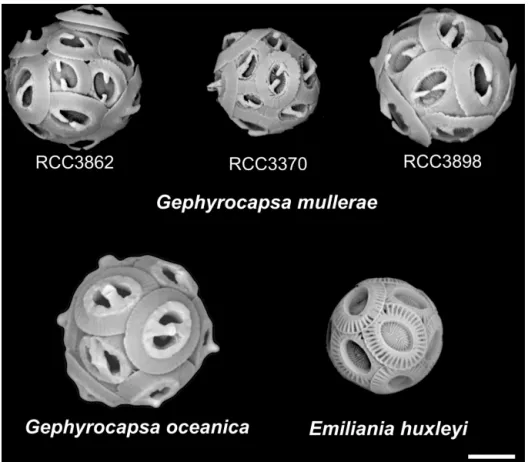
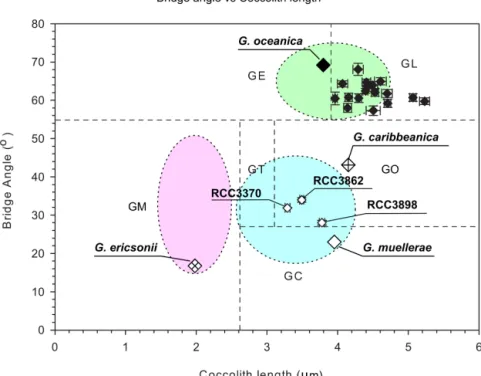
(3) Introgressive Hybridization in the Emiliania/Gephyrocapsa Complex 325. Figure 1. SEM images of the three new isolates of Gephyrocapsa muellerae and of representative strains of Gephyrocapsa oceanica and Emiliania huxleyi. Scale = 2 m.. coccolith to form a conjunct bridge over the central area of the coccolith. From paleontological evidence, it has been hypothesized that Emiliania evolved from the Gephyrocapsa complex via Gephyrocapsa protohuxleyi McIntyre (McIntyre 1970), a taxon often considered to be a conspecific variant of the extant morphospecies G. ericsonii (e.g. Cros and Fortuño 2002; Young et al. 2004). The first appearance of E. huxleyi in the fossil record was relatively recent (290 Ka; Raffi et al. 2006), while Gephyrocapsa were first unambiguously present in the Pliocene, around 3.5 Ma (Samtleben 1980). There are a few older records (e.g., Jiang and Gartner 1984; Pujos 1987) but these are not well-documented. Gephyrocapsa became abundant from around 1.7 Ma (Raffi et al. 2006) with a succession of different morphospecies occurring (Matsuoka and Okada 1990). The dominant noëlaerhabdaceaen taxon shifted to G. muellerae around 110 Ka and then to E. huxleyi around 87 Ka (Hine and Weaver 1998; Thierstein et al. 1977). Different morphometric concepts have been used to distinguish and describe Gephyrocapsa morphospecies or morphotypes for taxonomic. and stratigraphical use, especially in the fossil record. The simplest concept for distinguishing Gephyrocapsa morphospecies was proposed by McIntyre et al. (1970) using only coccolith size and bridge-angle. He defined three main morphospecies occurring in the Holocene, G. oceanica (bridge angle >45◦ ), Gephyrocapsa caribbeanica Boudreaux and Hay (Hay et al. 1967); bridge angle <45◦ ), and G. ericsonii (small coccoliths, <2.2 m in length). The name G. caribbeanica has since been shown to be properly applied to a rather different fossil morphospecies and the extant morphotype is now termed G. muellerae (Young et al. 2003). Adopting a similar concept, Bollmann (1997) conducted an extensive study of Holocene (sediment) assemblages of Gephyrocapsa, leading to definition of 6 informally named types that were related to environmental conditions and biogeography. The six types (Fig. 2) are: Gephyrocapsa Equatorial (GE; equatorial type having a mean bridge angle >56◦ and mean coccolith length between 3.1 and 3.9 m), Gephyrocapsa Oligotrophic (GO; subtropical central gyre, bridge angle 27-56◦ , coccolith length > 3.1 m), Gephyrocapsa Transitional (GT; transitional zones.
(4) 326 E.M. Bendif et al.. Figure 2. Scatter plots of mean coccolith length versus mean bridge angle of morphotypes defined in Holocene sediment samples with plotted original descriptions of Gephyrocapsa caribbeanica, Gephyrocapsa ericsonii, Gephyrocapsa muellerae and Gephyrocapsa oceanica and applied concept (circle for G. ericsonii, G. muellerae and G. oceanica; after Bollmann 1997 and Young et al. 2003): Gephyrocapsa Equatorial (GE), Gephyrocapsa Oligotrophic (GO), Gephyrocapsa Transitional (GT), Gephyrocapsa Cold (GC), Gephyrocapsa Larger (GL), Gephyrocapsa Minute (GM), compared to the 3 Gephyrocapsa muellerae isolates and 16 Gephyrocapsa oceanica culture strains. Error bars represent the standard error.. (mean sea surface temperature between 19 and 20 ◦ C), bridge angle 27-56◦ , coccolith length 2.4 - 3.1 m), Gephyrocapsa Cold (GC; transitional to subarctic cold waters, bridge angle <27◦ , coccolith length > 2.4 m), Gephyrocapsa Larger (GL; high productivity temperate zones, bridge angle >56◦ , coccolith length > 3.9 m), and Gephyrocapsa Minute (GM; no clear environmental preference, bridge angle 20-50◦ , coccolith length < 2.4 m). These designations were tentatively related by Bollmann (1997) to previously described mosphospecies (GE = G. oceanica, GC = G. muellerae, GO = caribbeanica, GM = G. aperta Kamptner (Kamptner 1956), GT = G. margereli Bréhéret (Bréhéret 1978), GL = G. oceanica rodela Samtleben (Samtleben 1980), but their genetic relatedness and biological significance are not known. Bollmann and Klaas (2008) showed that in the plankton there was continuous variation between the morphotypes GE and GL (I.e. within G. oceanica) but that GM (i.e. G. ericsonii) and GC (i.e. G. muellerae) were morphologically discrete, they did not find the morphotypes GT or GO in the plankton.. Molecular phylogenetic studies using marker genes have proven useful for resolving the taxonomic pertinence of phenotypic microdiversity. For the Noëlaerhabdaceae, the use of classical markers revealed a close genetic relationship between E. huxleyi and G. oceanica: the two morphospecies have identical sequences of nuclear 18S rDNA (Edvardsen et al. 2000; Medlin et al. 1996) and plastidial rbcL (Fujiwara et al. 2001), probably due to the recentness of their diversification. More recent studies were able to separate these morphospecies, partially with analysis of the plastidial tufA gene (Cook et al. 2011; Medlin et al. 2008), and completely with the nuclear 28S rDNA (Liu et al. 2009) and various mitochondrial genes (Bendif et al. 2014; Hagino et al. 2011). The variability of the plastidial tufA gene and the mitochondrial cox1 and cox3 genes among G. oceanica strains suggested potential cryptic differentiation within this morphospecies, while the inability of tufA to completely separate E. huxleyi and G. oceanica strains suggested that this gene may have been subject to incomplete lineage sorting or past and/or recent introgressive hybridization events (Bendif et al..
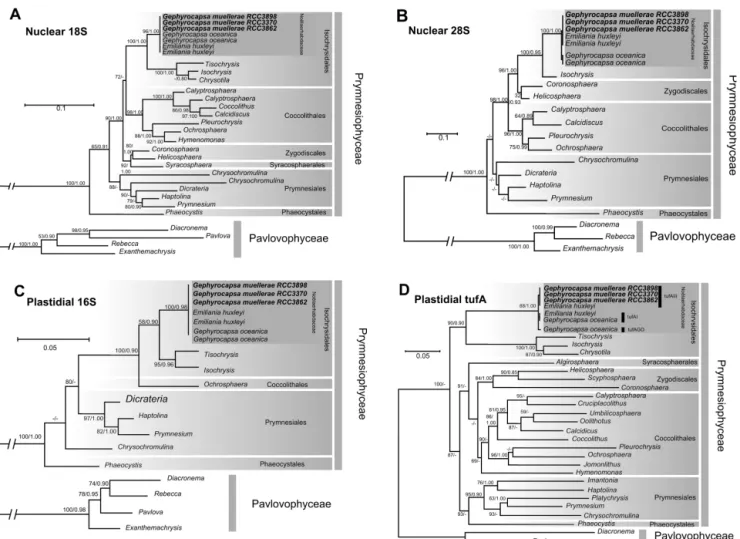
(5) Introgressive Hybridization in the Emiliania/Gephyrocapsa Complex 327. 2014). At the species level, the phylogenetic discordance between the plastidial and mitochondrial gene sequences could be interpreted by different evolutionary hypotheses in attempting to resolve the morphological concept of E. huxleyi and G. oceanica. At the genus level, it has been suggested that E. huxleyi and G. oceanica could be considered con-generic (Bendif et al. 2014), a status that can be resolved by the genetic characterization of other Gephyrocapsa morphospecies for which phylogenetic positions remain unknown. In this study, we conducted morphological and phylogenetic characterization of 3 new monoclonal strains of Gephyrocapsa. These strains were isolated by single cell sorting of calcified cells using a novel flow cytometric methodology (von Dassow et al. 2012) from samples from a coastal upwelling zone in the Eastern South Pacific Ocean (near Coquimbo, Chile). Initial Scanning Electron Microscopy (SEM) observations indicated that these strains were morphologically distinct from G. oceanica and had affinity to G. muellerae, which suggested that further analysis might be able to reveal important new information about the evolution of the Noelaerhabdaceae. Here we report the results of quantitative morphological analyses by SEM and molecular phylogenetic analyses based on sequences of the nuclear 18S and 28S rDNA, the plastidial 16S rDNA and encoded elongation factor tufA gene, and the mitochondrial cytochrome c oxidase 1 and 3 (cox1 and cox3) genes.. Results Description and Identification The three new culture isolates were identified as Gephyrocapsa due to the presence of a bipartite bridge over the central area of the coccoliths (Fig. 1). Coccospheres of the three strains varied in size from 3.9 to 7.2 m, coccoliths from 2.8 to 4.5 m (mean 3.5 m), and bridge angle from 15.4 to 41.1◦ (mean 31.3◦ ; Table 1). In the classification scheme of Bollmann (1997), the three strains corresponded to morphotype GO, whereas G. oceanica strains clustered in the GL morphotype (Fig. 2). Bollmann (1997) associated the GO morphotype with the morphospecies G. caribbeanica, but the mean morphometric measurements of the 3 new strains more closely corresponded to those of the holotype description of G. muellerae that has mean coccolith length of 3.9 m and bridge angle of 23◦ , compared to 4.1 m and 45◦ respectively for G. caribbeanica. Finally G. caribbeanica as originally. described by Hay et al. (1967) and as used by most authors is a form with a narrow central area almost filled by a wide bridge, this form is very abundant prior to the first occurrence of E. huxleyi (e.g. Hine and Weaver 1998) but is absent from the modern plankton (Young et al. 2003).. Phylogenetic Analyses The 3 strains were examined by sequencing partial fragments of nuclear 18S and 28S rDNA, plastidial 16S rDNA and tufA, and mitochondrial cox1 genes, and the complete mitochondrial cox3 gene. Comparison with haptophyte nuclear 18S and 28S rDNA sequences retrieved from Genbank confirmed the phylogenetic position of the G. muellerae strains within the Noelaerhabdaceae, clustering with the E. huxleyi - G. oceanica complex (Fig. 3). 18S rDNA sequences were identical for all of the strains in this complex (Fig. 3A), whereas the 28S rDNA exhibited a difference of 1 nucleotidic substitution between G. oceanica and G. muellerae sequences, the latter being identical to all E. huxleyi sequences (Fig. 3B). The plastidial 16S rDNA sequences of the 3 G. muellerae strains also confirmed the position of these strains within the Noelaerhabdaceae (Fig. 3C). The 16S rDNA sequences from G. muellerae were identical to those of E. huxleyi and G. oceanica retrieved from Genbank. Plastidial tufA sequence phylogenies (Fig. 3D, Supplementary Material Fig. S1) clustered G. muellerae within the tufAII haplogroup defined by Bendif et al. (2014), previously composed exclusively of E. huxleyi strains. The three G. muellerae sequences were identical to other E. huxleyi strains within the tufAII haplogroup (Supplementary Material Fig. S1), and differed by 15 substitutions from the tufAI group that includes both E. huxleyi and G. oceanica strains, and by the same number of substitutions from the tufAGO group comprised exclusively of G. oceanica strains. Unrooted cox1 and cox3 phylogenies including E. huxleyi and G. oceanica sequences retrieved from Genbank, together with sequences from the three new G. muellerae strains produced topologies that were similar to those reported by Bendif et al. (2014) (Supplementary Material Fig. S2A,B). The G. muellerae sequences clustered within the  haplogroup of E. huxleyi for both genes. For cox1, the three sequences were identical to other sequences from the  haplogroup except that of the E. huxleyi strain RCC174, which exhibited 1 substitution. The G. muellerae cox3 sequences differed by only 3 substitutions from E. huxleyi sequences in the  haplogroup, differences that were not greater than.
(6) Morphospecies. RCC#. Strain name. Locality. Isolator. Date of Isolation. Latitude. Longitude. Coccosphere Diameter. Gephyrocapsa muellerae Gephyrocapsa muellerae Gephyrocapsa muellerae Gephyrocapsa oceanica Gephyrocapsa oceanica. 3862. CHC126. Tongoy. 2011. -30.25. -71.70. 5.63. 3898. CHC194b. Tongoy. 2011. -30.25. -71.70. 6.30. 3370. CHC184. Tongoy. 2011. -30.25. -71.70. 5.49. 1281 1282. THAU1 ESP6M11. 2000 1999. -31.93 41.47. 115.73 2.32. 7.81 8.13. Gephyrocapsa oceanica. 1284. ESP6M3. I. Probert. 1999. 41.47. 2.32. 7.11. Gephyrocapsa oceanica. 1286. AS62E. I. Probert. 1999. 37.28. -0.80. 7.77. Gephyrocapsa oceanica Gephyrocapsa oceanica Gephyrocapsa oceanica Gephyrocapsa oceanica Gephyrocapsa oceanica Gephyrocapsa oceanica Gephyrocapsa oceanica. 1292 1300 1305 1306 1307 1316 1317. PR3F1 PZ3-1 PC65 PC64 PC51 LK9 JS10. I. Probert I. Probert I. Probert I. Probert I. Probert I. Probert I. Probert. 2001 2001 1998 1998 1998 1999 1998. 14.82. -67.05. 38.23 38.23 38.20 45.00 36.25. -9.72 -9.72 -9.63 -1.08 -1.58. 7.18 7.81 7.34 7.78 7.61 7.78 6.98. Gephyrocapsa oceanica Gephyrocapsa oceanica Gephyrocapsa oceanica. 1318 1319 1320. THAU4 NS6-2 ESP6M6. I. Probert I. Probert I. Probert. 2000 2002 1999. -31.93 -36.67 41.47. 115.73 16.77 2.32. 6.71 7.22 7.12. Gephyrocapsa oceanica. 1562. NIES1000. Indian Ocean Mediterranean Sea Mediterranean Sea Mediterranean Sea Atlantic Ocean Pacific Ocean Atlantic Ocean Atlantic Ocean Atlantic Ocean Atlantic Ocean Mediterranean Sea Indian Ocean Atlantic Ocean Mediterranean Sea Pacific Ocean. P. von Dassow P. von Dassow P. von Dassow I. Probert I. Probert. 1999. 34.08. 139.57. 7.77. Gephyrocapsa oceanica. 1839. B50. M. Kawachi I. Probert. 2008. 39.10. 5.35. 7.27. Mediterranean Sea. StDev. StError. Coccolith length. StDev. StError. Bridge Angle (). StDev. StError. Morphotype. 0.58 0.93 0.52 0.82 1.00. 0.05 0.11 0.05 0.16 0.20. 3.49 3.78 3.29 4.29 5.23. 0.34 0.31 0.38 0.49 0.52. 0.03 0.04 0.03 0.07 0.07. 34.01 28.03 31.89 68.10 59.77. 6.85 4.90 7.09 8.53 6.96. 0.60 0.62 0.08 1.58 0.90. GO GO GO GL GL. 328 E.M. Bendif et al.. Table 1. Average characteristics of measured isolates in this study. In situ temperatures are mentioned in bracket for the Gephyrocapsa muellerae strains..
(7) GL GL GL GL GL GL GL GL GL GL GL GL GL GL 0.81 1.03 0.65 0.98 1.65 0.94 1.04 0.94 1.06 1.16 0.97 1.26 1.29 0.80 64.31 59.22 62.47 60.71 60.48 63.93 61.78 64.96 60.79 58.02 62.08 57.30 63.63 64.73 0.07 0.05 0.04 0.04 0.03 0.07 0.08 0.08 0.05 0.06 0.05 0.10 0.05 0.06. 6.26 7.60 7.22 7.59 9.17 7.30 7.08 7.27 8.23 9.11 7.36 9.44 9.32 6.31. Bridge Angle (). the variability among E. huxleyi sequences within this haplogroup. Interestingly, some environmental sequences previously reported from waters near the site of isolation of the G. muellerae isolates (Beaufort et al. 2011) clustered together with the G. muellerae sequences, varying by only 1 bp (Supplementary Material Fig. S2B). Comparison of mitochondrial genes and plastidial gene phylogenies (e.g, between cox3 and tufA) revealed some topological incongruency in grouping the different strains, depicting different phylogenetic signals (Fig. 4). Topology tests rejected significantly any congruence (P values below 0.05) between tufA and cox3 phylogenies (Supplementary Material Table S1). In total, 9 of the 13 identified cases of incongruency involved G. oceanica strains. All G. oceanica strains grouped in the cox3 ␥ clade, but these 9 strains grouped in the chloroplastidial tufAI clade, which is shared among G. oceanica and E. huxleyi strains originating from warmer waters. Within the mitochondrial compartment, congruence was also rejected (except by the most conservative S-H criteria) between cox1 and cox3 phylogenies (Supplementary Material Table S1). However, incongruence between cox1 and cox3 was all at only fine-scale tree topologies, with the separation of the ␣, , and ␥ clades being completely congruent between cox1 and cox3 (Supplementary Material Fig. S2A, B).. StError. 0.13 0.13 0.10 0.14 0.13 0.14 0.15 0.14 0.13 0.12 0.08 0.14 0.04 0.09 0.79 0.74 0.62 0.75 0.70 0.79 0.36 0.79 0.69 0.66 0.73 0.74 0.08 0.74. 4.07 4.70 4.39 5.06 3.96 4.50 4.70 4.60 4.15 4.14 4.53 4.50 4.43 4.41. 0.54 0.46 0.46 0.56 0.32 0.58 0.52 0.61 0.41 0.47 0.39 0.75 0.58 0.48. Discussion. StDev. Table 1 (Continued ). Coccolith length. StDev. StError. StDev. StError. Morphotype. Introgressive Hybridization in the Emiliania/Gephyrocapsa Complex 329. The identification of the new culture strains reported here as corresponding most closely to G. muellerae was based on coccolith morphometry and fine structure (specifically the fact that the open central area and raised bridge of their coccoliths are distinct from the closest fossil alternative G. caribbeanica). This identification is also consistent with their origin from cooler waters, typical of the environmental distribution of G. muellerae and different from those of G. oceanica: G. muellerae is found in productive regions with mean sea surface temperatures (SST) <21 ◦ C (Young et al. 2003), whereas G. oceanica, with a much higher bridge angle, is typically found in waters of mean SST of 18-30 ◦ C. The three strains isolated here were isolated from samples collected from the Humboldt Current System, where highly productive cool water flows northward with coastal SSTs in the range of 12-19 ◦ C (Hormazabal et al. 2001; Thiel et al. 2007). More specifically, they were isolated from a strong upwelling center when SST was ≤ 13 ◦ C..
(8) 330 E.M. Bendif et al.. Figure 3. Molecular phylogenies of the Haptophyta inferred from comparisons of nuclear 18S rDNA sequences (A), of nuclear 28S rDNA sequences (B), of plastidial 16S rDNA sequences (C) and from comparison of plastidial tufA gene sequences (D). Support values at each node are presented for ML/Bayes analyses. Bootstrap values larger than 50 and posterior probabilities larger than 0.80 are shown. Lesser values are represented by “–.”.. For the rest of the discussion we therefore refer to the new strains as G. muellerae. To our knowledge, no Noëlaerhabdacean taxon other than E. huxleyi or G. oceanica has ever previously been successfully isolated and maintained in culture. This highlights the potential of single-cell sorting by flow cytometry for initiation of cultures of species that may be less amenable to isolation by traditional methods. The new strains characterized here specifically represent an important source of information for understanding evolutionary succession in the plankton, as G. muellerae was the numerically dominant coccolithophore morphotype prior to being replaced by E. huxleyi in the fossil record. The close relationship between E. huxleyi and G. oceanica was first highlighted by Kamptner (1956) who noted the high degree of homology of the structure of coccolith elements between. these morphospecies. Reinhardt (1972) first formally proposed the combination Gephyrocapsa huxleyi based on this similarity in coccolith structure, but this proposal has not been widely followed in subsequent literature. The phylogenetic position of G. muellerae, assessed here using gene markers from 3 genomic compartments, further challenges the classical taxonomic separation of the genera Gephyrocapsa and Emiliania. In both independent (Figs 3-4) and concatenated phylogenies (not shown), the nuclear 28S rDNA, the plastidial tufA, and the mitochondrial cox1 and cox3 genes all unambiguously classified the G. muellerae isolates as distinct from G. oceanica and closely associated with E. huxleyi. Much of the high genomic variability exhibited among strains classified as E. huxleyi has been shown to be related to changes in the life cycle and biotic pressure (von Dassow et al. 2014), implying.
(9) Introgressive Hybridization in the Emiliania/Gephyrocapsa Complex 331. Figure 4. Comparison of cox3 and tufA phylogenies. Incongruent positions are indicated with dashlines. Support value for each nodes are presented for ML. Bootstrap values larger than 50 are shown.. that some E. huxleyi genotypes cannot interbreed. This already suggests that E. huxleyi might be considered to include a complex of cryptic species with differing ecologies. Consistent with this, the plastidial (tufA) and mitochondrial (cox1 and cox3) genes exhibited different phylogenetic structures, but in both cases Emiliania and Gephyrocapsa appeared polyphyletic, with G. muellerae clustering within the E. huxleyi mitochondrial clade  and plastidial clade tufAII. This might suggest that different E. huxleyi lineages evolved from different Gephyrocapsa lineages which each experienced the loss of the central bridge and decrease in the degree of calcification of distal shield elements (i.e.. convergent evolution). If this were the case, the different lineages classified by morphology as E. huxleyi should not be considered as a species or a species-complex, but rather as non-sister lineages of a larger Gephyrocapsa species complex. An intriguing alternative hypothesis is that the E. huxleyi morphospecies did arise once (from an unspecified Gephyrocapsa lineage), but that some populations colonizing low-latitude waters might have hybridized with G. oceanica populations, whereas E. huxleyi that colonized colder waters might have hybridized with G. muellerae populations (the E. huxleyi lineages may have subsequently diverged into more than one cryptic.
(10) 332 E.M. Bendif et al.. species). Hybridization and introgression have been estimated to be important in the speciation of up to 25% of terrestrial plant species (Baack and Rieseberg 2007) and have been extensively documented in zooplankton, molluscs, fish, and birds (Baack and Rieseberg 2007). To date, hybridization and introgression have been poorly documented in planktonic protists, but have been reported between cryptic sub-species of the diatoms Pseudonitzschia multistriata and P. pungens (respectively Casteleyn et al. 2009 and D’Alelio et al. 2009). The hybridization/introgression hypothesis could explain the incongruences between phylogenies and morphology, and would be consistent with ecological associations: G. muellerae and E. huxleyi mitochondrial clade  are both associated with cold (temperate and sub-polar) waters, whereas both G. oceanica and the E. huxleyi mitochondrial clade ␣ strains that group with G. oceanica by tufA are associated with warmer waters (Hagino et al. 2011). Kamptner (1943) first suggested that Gephyrocapsa and Emiliania might be capable of hybridizing due to observation of confusing combinations of both coccolith types on single coccospheres occurring in some sediment samples (as documented in, e.g., Clocchiatti 1971). However, such anomalous coccospheres containing coccoliths normally regarded as forming on discrete morphospecies have been termed “xenospheres”, on the basis that they are considered to be artefactually-formed coccospheres, for example by attachment of loose coccoliths to a coccosphere post-mortem, and have never been observed in water column samples (discussed in detail in Young and Geisen 2002). Hybrid noëlaerhabdaceans might occur in nature, but it is very unlikely that it would be possible to conclusively identify them based on morphological evidence. Finally, incomplete lineage sorting of plastidial and mitochondrial genomes as distinct Gephyrocapsa lineages diverged, with a single lineage leading to the E. huxleyi morphospecies, cannot be ruled out as a potential explanation for our results. It is generally challenging to resolve the roles of incomplete lineage sorting versus hybridization and introgression (reviewed in Twyford and Ennos 2012). Potential approaches include application of microsatellite markers (that exist for E. huxleyi: Iglesias-Rodriguez et al. 2006; KruegerHadfield et al. 2014) or next-generation sequencing technologies (Twyford and Ennos 2012). However, during our sampling effort, G. muellerae represented <2% of the culture strains obtained, the rest corresponding to E. huxleyi. Thus a key. challenge to applying either population genetics or population genomics tests will be to increase the number of clonal isolates of G. mullerae and other Noëlaerhabdacean morphospecies successfully cultured, which will also improve phylogenetic resolution.. Concluding Remarks Regardless of which of the alternative hypotheses presented here is supported or rejected by future studies, our results conclusively show that Emiliania should be transferred to Gephyrocapsa, because generic-level separation reflects neither the structural similarity, the evolutionarily history, nor the ecology of these important organisms. However, whether or not G. huxleyi makes sense as a single taxonomic unit is still unclear. At a broader level, this study highlights the challenge of reconciling morphological and genetic species concepts for microbial eukaryotes. Species- and genus-level classifications of mineralizing eukaryotic microbes (such as coccolithophores, foraminifera, diatoms, and certain dinoflagellates), and the association of morphological classifications with distinct ecological conditions, are crucial in studies of aquatic environments, both as indicators for present-day ecological status and of paleo-climates. It has so far been possible to manipulate the life cycle and breeding in culture of very few representatives of microbial eukaryote plankton (discussed in von Dassow and Montresor 2011) to directly investigate breeding barriers and biological species concepts. Further efforts to isolate representatives of new lineages of “model” groups into culture, combined with molecular, genomic, and morphometric approaches, may provide a clearer picture of the evolution of morphological characters and how they can be reliably used in plankton ecology and paleo-oceanography.. Methods Origin, isolation, culture and morphological characterization of analyzed strains: The new G. muellerae strains were isolated as follows: seawater was collected in Niskin bottles from 5 m and 30 m depth at three sites of strong coastal upwelling in front of Punta Lengua de Vaca and Tongoy Bay along the Chilean coast (Lat/Long: -30.15◦ /-71.60◦ ; -30.20/71.59; -30.25◦ /-71.65◦ ) from the R/V Stella Maris II on 12 and 13 October 2011. Surface water temperature at these stations was 12.5 ◦ C, 12.4 ◦ C, and 13.0 ◦ C, respectively. Water samples were initially filtered through 20 m or 40 m nitex, and stored dark and cool (<15◦ ) for transport to the laboratory in Concepción, Chile for flow cytometric sorting within 48 hours of collection. Prior to sorting, samples were filtered through.
(11) Introgressive Hybridization in the Emiliania/Gephyrocapsa Complex 333 12 m pore-size polycarbonate membrane filters using gravity alone to remove microplankton. To concentrate heavy (mineralized) nannoplankton cells, 2 subsamples of 50 ml were concentrated by centrifugation for 10 min at 500x g + 3 min at 1000x g, 45 ml of supernatant was discarded, and the two subsamples were combined and centrifuged again, to concentrate 100 ml to approximately 2 ml. Calcified phytoplankton (chlorophyll-fluorescent particles depolarizing forward scatter light) were detected with an InFlux flow cytometer equipped with a small particle detector and Brewster’s Angle polarization detector for FSC optics (von Dassow et al. 2012) and individual cells were sorted in purity mode into 100 l of K/5 medium. After 1 month of incubation in the same conditions as described above, individual colonies were harvested and transferred to the Roscoff Culture Collection (RCC) for culturing. All Gephyrocapsa strains (Table 1) from the RCC were maintained in K/2(-Si,-Tris,-Cu) medium (Keller et al. 2000) at 17 ◦ C with 50 mol-photons. m-2. s-1 illumination provided by daylight neon tubes with a 14:10 h L:D cycle. Living cells were observed with an Olympus BX51 light microscope equipped with differential interference contrast (DIC) optics. For scanning electron microscopy (SEM), cells were grown until early exponential phase and then filtered onto polycarbonate filters that were dried in a vacuum desiccator before being sputter coated with a thin layer of Au/Pd. Observations were made with a Phenom ProX Desktop SEM (Phenom-World, Eindhoven, Netherlands) and measured using ImageJ software (http://imagej.nih.gov/ij/). Morphometric measurements were carried out according to Bollmann (1997) with a minimum of 60 isolated coccoliths and coccospheres analysed per sample. DNA extraction, amplifications and molecular analysis: Total DNA was isolated from all of the strains using a DNA purification kit (Macherey Nagel). Nuclear 18S and 28S rDNA, plastidial 16S rDNA and tufA, mitochondrial cox1 and cox3 genes were amplified using the primers used in Bendif et al. (2014) using the GoTaq Polymerase kit (Promega). A standard PCR protocol was used with a thermal cycler T1 (Biometra): 2 min initial denaturation at 95 ◦ C, followed then by 35 cycles of 30s at 95 ◦ C, 30s annealing at 55 ◦ C and 1 min extension at 72 ◦ C. A final 5 min extension step at 72 ◦ C was conducted to complete the amplification. Amplification products were analyzed by electrophoresis on a 1% agarose gel to control amplification success. Amplifications were sequenced on an ABI PRISM 3100xl DNA auto sequencer (Perkin-Elmer) using the ABI PRISM BigDye Terminator Cycle Sequencing Kit (Perkin-Elmer). Sequences chromatograms were checked using FinchTV (http://www.geospiza.com/Products/finchtv.shtml). Accession numbers of new or updated sequences are provided in Supplementary Table 2. For each gene, an alignment was preformed adding a large set of sequences from other Noelaerhabdaceae and haptophytes with the online version of the multiple alignment program MAFFT (http://align.bmr.kyushu-u.ac.jp/mafft/software, Katoh and Standley 2013) and then manually checked using SEAVIEW (Gouy et al. 2010) as a sequence editor. Final sequence lengths and completion were as in Bendif et al. (2014). Appropriate models for DNA substitution were estimated with JModeltest2 (Darriba et al. 2012) which selected the same models as in Bendif et al. (2014) for each gene. Phylogenetic trees were constructed using two phylogenetic methods: maximum likelihood (ML) using TREEFINDER (Jobb et al. 2004) and Bayesian analysis with Mr. BAYES v3.1.2 (Huelsenbeck and Ronquist 2001). The robustness of the branching of trees was tested by bootstrapping for the ML inference where bootstrap. values were based on 1000 replicates. Bayesian analysis was conducted with two runs of four Markov chains, for at least 5 000 000 generations, sampling every 100th generation to reach minimum likelihood convergence. The burn-in option was set discarding 25% from the 50 000 trees found. We note that we show unrooted trees for cox and tufA to avoid phylogenetic bias because the nearest potential outgroup for rooting, Isochrysis, is too divergent, with mutations potentially occurring at different rates, and would introduce a bias in phylogenetic interpretation. Tree incongruences were assessed using most used topology tests, the K-H test (Kishino and Hasegawa 1989), the S-H test (Shimodaira and Hasegawa 1999), and the AU test (Shimodaira 2002). The null distribution was generated by nonparametric boostrapping and log likelihood scores of trees constrained by topological conflicts and test values including Pvalues were calculated using the program TREEFINDER.. Acknowledgement We thank Beatriz Yanicelli of the Universidad Católica del Norte (Chile) for access to water samples from the R/V Stella Maris II, Osvaldo Ulloa of the Universidad de Concepción (Chile) for access to the InFlux cytometer in his lab, Daniella Mella and Carlos Henriquez of the Pontificia Universidad Católica de Chile (Santiago, Chile) in getting samples and isolating the new strains, Daphne Grulois of the Station Biologique de Roscoff, and Morgan Perennou and Gwen Tanguy from the GENOMER platform at the Station Biologique de Roscoff (France) for technical assistance with sequencing. We are also grateful to the three anonymous reviewers for their constructive comments. This work was supported by FONDECYT (Regular grant 1110575 to PvD), the European Research Council under the European Community’s Seventh Framework Programme (EC-FP7) via a Marie Curie Intra-European Fellowship (grant FP7-PEOPLE-2012-IEF; EMB), and the ASSEMBLE program (grant 227799; EMB, IP) and via the French ANR project EMBRC-France (IP), and the International Research Network “Diversity, Evolution and Biotechnology of Marine Algae” (GDRI N◦ 0803 ; IP, PvD).. Appendix A. Supplementary Data Supplementary data associated with this article can be found, in the online version, at http://dx.doi.org/10.1016/j.protis.2015.05.003.. References Baack EJ, Rieseberg LH (2007) A genomic view of introgression and hybrid speciation. Curr Opin Genet Dev 17:513–518.
(12) 334 E.M. Bendif et al. Beaufort L, Probert I, de Garidel-Thoron T, Bendif EM, RuizPino D, Goyet C, Buchet N, Coupel P, Grelaud M, Rost B, Rickaby REM, de Vargas C (2011) Sensitivity of coccolithophores to carbonate chemistry and ocean acidification. Nature 476:80–83 Bendif EM, Probert I, Carmichael M, Romac S, Hagino K, de Vargas C (2014) Genetic delineation between and within the widespread coccolithophore morphospecies Emiliania huxleyi and Gephyrocapsa oceanica (Haptophyta). J Phycol 50:140–148 Blackburn S, Cresswell G (1993) A coccolithophorid bloom in Jervis Bay. Australia. Mar Freshw Res 44:253–260 Bollmann J (1997) Morphology and biogeography of Gephyrocapsa coccoliths in Holocene sediments. Mar Micropaleontol 29:319–350 Bollmann J, Klaas C (2008) Morphological variation of Gephyrocapsa oceanica Kamptner 1943 in plankton samples: Implications for ecologic and taxonomic interpretations. Protist 159:369–381 Bréhéret J (1978) Formes nouvelles quaternaires et actuelles de la famille des Gephyrocapsaceae (Coccolithophorides). C R Hebd Séances Acad Sci 287:447–449 Casteleyn G, Adams NG, Vanormelingen P, Debeer AE, Sabbe K, Vyverman W (2009) Natural hybrids in the marine diatom Pseudo-nitzschia pungens (Bacillariophyceae): Genetic and morphological evidence. Protist 160: 343–354 Clocchiatti M (1971) Sur l’éxistence de coccosphères portant coccolithes de Gephyrocapsa oceanica et de Emiliania huxleyi (Coccolithophoridés). C R Hebd Séances Acad Sci 273:318–321 Cook SS, Whittock L, Wright SW, Hallegraeff GM (2011) Photosynthetic pigment and genetic differences between two southern ocean morphotypes of Emiliania huxleyi (Haptophyta). J Phycol 47:615–626 Cros L, Fortuño JM (2002) Atlas of Northwestern Mediterranean coccolithophores. Sci Mar 66:1–182 D’Alelio D, Amato A, Kooistra WHCF, Procaccini G, Casotti R, Montresor M (2009) Internal transcribed spacer polymorphism in Pseudo-nitzschia multistriata (Bacillariophyceae) in the Gulf of Naples: Recent divergence or intraspecific hybridization? Protist 160:9–20. von Dassow P, John U, Ogata H, Probert I, Bendif EM, Kegel J, Audic S, Mella Flores D, Lescot M, Wincker P, Da Silva C, Claverie JM, Doney S, Glover DM, de Vargas C (2014) Loss of sex in open oceans accounts for genome variability in a cosmopolitan phytoplankton. ISME, http://dx.doi.org/10.1038/ismej.2014.221 Edvardsen B, Eikrem W, Green JC, Andersen RA, Moon-van der Staay SY, Medlin LK (2000) Phylogenetic reconstructions of the Haptophyta inferred from 18S ribosomal DNA sequences and available morphological data. Phycologia 39:19–35 Fujiwara S, Tsuzuki M, Kawachi M, Minaka N, Inouye I (2001) Molecular phylogeny of the Haptophyta based on the rbcL gene and sequence variation in the spacer region of the RUBISCO operon. J Phycol 37:121–129 Gouy M, Guindon S, Gascuel O (2010) SeaView version 4: A multiplatform graphical user interface for sequence alignment and phylogenetic tree building. Mol Biol Evol 27:221–224 Hagino K, Bendif EM, Young JR, Kogame K, Probert I, Takano Y, Horiguchi T, de Vargas C, Okada H (2011) New evidence for morphological and genetic variation in the cosmopolitan coccolithophore Emiliania huxleyi (Prymnesiophyceae) from the cox1b-atp4 genes. J Phycol 47:1164–1176 Hay W, Mohler H, Wade M (1966) Calcareous nannofossils from Nal’Chik (Northwest Caucasus). Ecol Geol Helvet 59:379–399 Hay WW, Mohler HP, Roth PH, Schmidt RR, Boudreaux JE (1967) Calcareous nannoplankton zonation of the Cenozoic of the Gulf Coast and Caribbean-Antillean area, and transoceanic correlation. Trans Gulf Coast Assoc Geol Soc 17:428–480 Hine N, Weaver P (1998) Quaternary. In Bown P (ed) Calcareous Nannofossil Biostratigraphy. Chapman Hall, Cambridge, pp 266–283 Hoffmann R, Wochnik AS, Heinzl C, Betzler SB, Matich S, Griesshaber E, Schulz H, Kučera M, Young JR, Scheu C, Schmahl WW (2014) Nanoprobe crystallographic orientation studies of isolated shield elements of the coccolithophore species Emiliania huxleyi. Eur J Miner 26:473–483 Hormazabal S, Shaffer G, Letelier J, Ulloa O (2001) Local and remote forcing of sea surface temperature in the coastal upwelling system off Chile. J Geoph Res 106:16657–16671 Huelsenbeck JP, Ronquist F (2001) MR BAYES: Bayesian inference of phylogenetic trees. Bioinformatics 17:754–755. Darriba D, Taboada GL, Doallo R, Posada D (2012) jModelTest 2: more models, new heuristics and parallel computing. Nat Methods 9:772–772. Iglesias-Rodríguez DM, Probert I, Batley J (2006) Microsatellite cross-amplification in coccolithophores: application in population diversity studies. Hereditas 143:99–102. von Dassow P, Montresor M (2011) Unveiling the mysteries of phytoplankton life cycles: Patterns and opportunities behind complexity. J Plankton Res 33:3–12. Jiang M, Gartner S (1984) Neogene and Quaternary calcareous nannofossil biostratigraphy of the Walvis Ridge. Init Repts DSDP 74:561–595. von Dassow P, Van Den Engh G, Iglesias-Rodriguez D, Gittins JR (2012) Calcification state of coccolithophores can be assessed by light scatter depolarization measurements with flow cytometry. J Plankton Res 34:1011–1027. Jobb G, von Haeseler A, Strimmer K (2004) TREEFINDER: a powerful graphical analysis environment for molecular phylogenetics. BMC Evol Biol 4:18. von Dassow P, Ogata H, Probert I, Wincker P, Da Silva C, Audic S, Claverie JM, De Vargas C (2009) Transcriptome analysis of functional differentiation between haploid and diploid cells of Emiliania huxleyi, a globally significant photosynthetic calcifying cell. Genome Biol 10:R114. Kai M, Hara T, Aoyama H, Kuroda N (1999) A massive coccolithophorid bloom observed in Mikawa Bay. Japan. J Oceanogr 55:395–406 Kamptner E (1943) Zur Revision der Coccolithineen-Spezies Pontosphaera huxleyi Lohmann. Anz Akad Wiss 80:43–49.
(13) Introgressive Hybridization in the Emiliania/Gephyrocapsa Complex 335 Kamptner E (1956) Das Kalkskelett von Coccolithus huxleyi (Lohmann) Kamptner und Gephyrocapsa oceanica Kamptner (Coccolithineae). Arch Protistenkd 101:171–202. Kegel JU, John U, Valentin K, Frickenhaus S (2013) Genome variations associated with viral susceptibility and calcification in Emiliania huxleyi. PLoS One 8(11):e80684. Read BA, Kegel J, Klute MJ, Kuo A, Lefebvre SC, Maumus F, Mayer C, Miller J, Monier A, Salamov A, Young JR, Aguilar M, Claverie JM, Frickenhaus S, Gonzalez K, Herman EK, Lin YC, Napier J, Ogata H, Sarno AF, Shmutz J, Schroeder D, de Vargas C, Verret F, von Dassow P, Valentin K, Van de Peer Y, Wheeler G, Emiliania huxleyi Annotation Consortium, Dacks JB, Delwiche CF, Dyhrman ST, Glöckner G, John U, Richards T, Worden AZ, Zhang X, Grigoriev IV (2013) Pan genome of the phytoplankton Emiliania underpins its global distribution. Nature 499:209–213. Keller MD, Seluin RC, Claus W, Guillard RRL, Provasoli L, Pinter IJ (2000) Media for the culture of oceanic ultraphytoplankton. J Phycol 36:633–638. Reinhardt P (1972) Coccolithen. Kalkiges Plankton seit Jahrmillionen. Die Neue Brehm Bücherei No 453, Ziemsen, Wittenberg, 99 p. Kishino H, Hasegawa M (1989) Evaluation of the maximum likelihood estimate of the evolutionary tree topologies from DNA sequence data, and the branching order in hominoidea. J Mol Evol 29:170–179. Samtleben C (1980) Die Evolution der CoccolithophoridenGattung Gephyrocapsa nach Befunden im Atlantik. Paläontol Z 54:91–127. Katoh K, Standley DM (2013) MAFFT multiple sequence alignment software version 7: Improvements in performance and usability. Mol Biol Evol 30:772–780. Krueger-Hadfield SA, Balestreri C, Schroeder J, Highfield A, Helaouët P, Allum J, Moate R, Lohbeck KT, Miller PI, Riebesell U, Reusch TBH, Rickaby REM, Young JR, Hallegraeff G, Brownlee C, Schroeder DC (2014) Genotyping an Emiliania huxleyi (Prymnesiophyceae) bloom event in the North Sea reveals evidence of asexual reproduction. Biogeosciences 11:5215–5234 Liu H, Probert I, Uitz J, Claustre H, Aris-Brosou S, Frada M, de Vargas C (2009) Extreme diversity in noncalcifying haptophytes explains a major pigment paradox in open oceans. Proc Natl Acad Sci USA 106:12803–12808 Matsuoka H, Okada H (1990) Time-progressive morphometric changes of the genus Gephyrocapsa in the Quaternary sequence of the tropical Indian Ocean, Site 709. Proc Ocean Drill Program 115:255–270 McIntyre A (1970) Gephyrocapsa protohuxleyi sp. n. a possible phyletic link and index fossil for the Pleistocene. Deep Sea Res Oceanogr Abstr 17:187–190 McIntyre A, Bé A (1967) Modern coccolithophorids of the Atlantic Ocean - I. Placoliths and cyrtoliths. Deep Sea Res Oceanogr Abstr 14:561–597 McIntyre A, Bé A, Roche M (1970) Modern Pacific Coccolithophorida: A paleontological thermometer. Trans N Y Acad Sci 32:720–730 Medlin LK, Sàez AG, Young JR (2008) A molecular clock for coccolithophores and implications for selectivity of phytoplankton extinctions across the K/T boundary. Mar Micropaleontol 67:69–86 Medlin LK, Barker GLA, Campbell L, Green JC, Hayes PK, Marie D, Vaulot D (1996) Genetic characterisation of Emiliania huxleyi (Haptophyta). J Mar Sys 9:13–31 Paasche E (2001) A review of the coccolithophorid Emiliania huxleyi (Prymnesiophyceae), with particular reference to growth, coccolith formation, and calcification-photosynthesis interactions. Phycologia 40:503–529. Sanchez Puerta MV, Bachvaroff TR, Delwiche CF (2004) The complete mitochondrial genome sequence of the haptophyte Emiliania huxleyi and its relation to heterokonts. DNA Res 11:1–10 Sanchez Puerta MVS, Bachvaroff TR, Delwiche CF (2005) The complete plastid genome sequence of the haptophyte Emiliania huxleyi: A comparison to other plastid genomes. DNA Res 12:151–156 Shimodaira H (2002) An approximately unbiased test of phylogenetic tree selection. Syst Biol 51:492–508 Shimodaira H, Hasegawa M (1999) Multiple comparisons of log-likelihoods with applications to phylogenetic inference. Mol Biol Evol 16:1114–1116 Thiel M, Macaya EC, Acuña E, Arntz WE, Bastias H, Brokordt K, Camus PA, Castilla JC, Castro LR, Cortés M, Dumont CP, Escribano R, Fernandez M, Gajardo JA, Gaymer CF, Gomez I, González AE, González HE, Haye PA, Illanes J-E, Iriarte JL, Lancellotti DA, Luna-Jorquera G, Luxoro C, Manriquez PH, Marín V, Muñoz P, Navarrete SA, Perez E, Poulin E, Sellanes J, Sepúlveda HH, Stotz W, Tala F, Thomas A, Vargas CA, Vasquez JA, Vega JM (2007) The Humboldt Current System of Northern and Central Chile: oceanographic processes, ecological interactions and socioeconomic feedback. Oceanogr Mar Biol Annu Rev 45:195–344 Thierstein H, Geitzenauaer K, Molfino B, Shackelton N (1977) Global synchroneity of late Quaternary coccolith datum levels: Validation by oxygen isotopes. Geology 5:400–404 Twyford AD, Ennos RA (2012) Next-generation hybridization and introgression. Heredity 108:179–189 Wahlund TM, Hadaegh AR, Clark R, Nguyen B, Fanelli M, Read BA (2004) Analysis of expressed sequence tags from calcifying cells of marine coccolithophorid (Emiliania huxleyi). Mar Biotechnol 6:278–290. Pujos A (1987) Late Eocene to Pleistocene medium-sized and small-sized “Reticulofenestrids”. Abh Geol B A 39:239–277. Westbroek P, Brown CW, Brummer GJ, Bleijswijk JV, van der Wal P, Brownlee C, Conte M, Egge J, Fernández E, Jordan R, Knappertsbusch M, Stefels J, Young JR, Veldhuis M (1993) A model system approach to biological climate forcing. The example of Emiliania huxleyi. Glob Planet Change 8: 27–46. Raffi I, Backman J, Fornaciari E, Palike H, Rio D, Lourens L, Hilgen F (2006) A review of calcareous nannofossil astrobiochronology encompassing the past 25 million years. Quat Sci Rev 25:3113–3137. Winter A, Jordan R, Roth P (1994) Biogeography of Living Coccolithophores in Ocean Waters. In Winter A, Siesser WG (eds) Coccolithophores. Cambridge Univ Press, Cambridge, pp 161–177.
(14) 336 E.M. Bendif et al. Young JR, Geisen M (2002) Xenospheres-associations of coccoliths ressembling coccospheres. J Nannoplankt Res 24:127–135 Young JR, Henriksen K, Probert I (2004) Structure and Morphogenesis of the Coccoliths of the CODENET Species. In Thierstein H, Young J (eds) Coccolithophores: From Molecular Process to Global Impact. Springer-Verlag, Heidelberg, pp 191–216 Young JR, Didymus JM, Brown PR, Prins B, Mann S (1992) Crystal assembly and phylogenetic evolution in heterococcoliths. Nature 356:516–518. Young JR, Geisen M, Cros L, Kleijne A, Sprengel C, Probert I, Sprengel C, Østergaard JB (2003) A guide to extant coccolithophore taxonomy. J Nannoplankt Res Spec Issue 1: 1–125 Ziveri P, Baumann KH, Böckel B, Bollmann J, Young JR (2004) Biogeography of Selected Holocene Coccoliths in the Atlantic Ocean. In Thierstein H, Young J (eds) Coccolithophores: From Molecular Process to Global Impact. Springer-Verlag, Heidelberg, pp 403–428. Available online at www.sciencedirect.com. ScienceDirect.
(15)
Figure

+2

Documento similar