
Large group collaboration with pre defined collaborative patterns of interaction
160
0
0
Texto completo
(2) PONTIFICIA UNIVERSIDAD CATOLICA DE CHILE ESCUELA DE INGENIERIA. LARGE-GROUP COLLABORATION WITH PRE-DEFINED COLLABORATIVE INTERACTION PATTERNS. TAL YOSEF ROSEN. Members of the Doctoral Thesis Committee: MIGUEL NUSSBAUM VOEHL VALERIA PAZ HERSKOVIC MAIDA ÁLVARO SALINAS ESPINOSA RUBÉN MITNIK ASUN NIAN SHING CHEN JORGE VÁSQUEZ PINILLOS Thesis submitted to the Office of Research and Graduate Studies in partial NIAN SHING CHEN fulfilment of the requirements for the Degree of Doctor in Engineering NIAN SHING CHEN Sciences. NIAN SHING CHEN Santiago de Chile, November, 2015 NIAN SHING CHEN NIAN SHING CHEN.
(3) To my loved ones; especially to my father, who I know is watching somewhere from above.. ii.
(4) ACKNOWLEDGEMENTS I would like to thank everyone who has helped in my development as a researcher. I would like to thank my friends, loved ones and my family. I would especially like to thank my mother, who has always been there for me, unconditionally.. A special thank you to Professor Miguel Nussbaum, who has provided me with his unconditional support and dedication over the last few years. Without him, none of this would have been possible.. I would also like to thank everyone who has worked with me in some way during my research: Eyal Szewkis, José Pedro Abalos, Francisca Readi, Cristián Alcoholado, Arturo Tagle, Josefina Hernández, Carlos Alario-Hoyos, Martín González, David Peña, José Tomás Contreras, Joaquín Torres, Macarena Oteo and Anita Díaz. I would like to thank all of the undergraduate students who helped with the studies in the schools, as well as the schools themselves, the teachers and students, who opened their doors to allow this research to take place.. Finally, I would like to thank my friends Daniela Caballero and Andrea Vásquez, with whom I shared some unforgettable moments and who, thanks to their knowledge and support, helped me to develop this thesis.. iii.
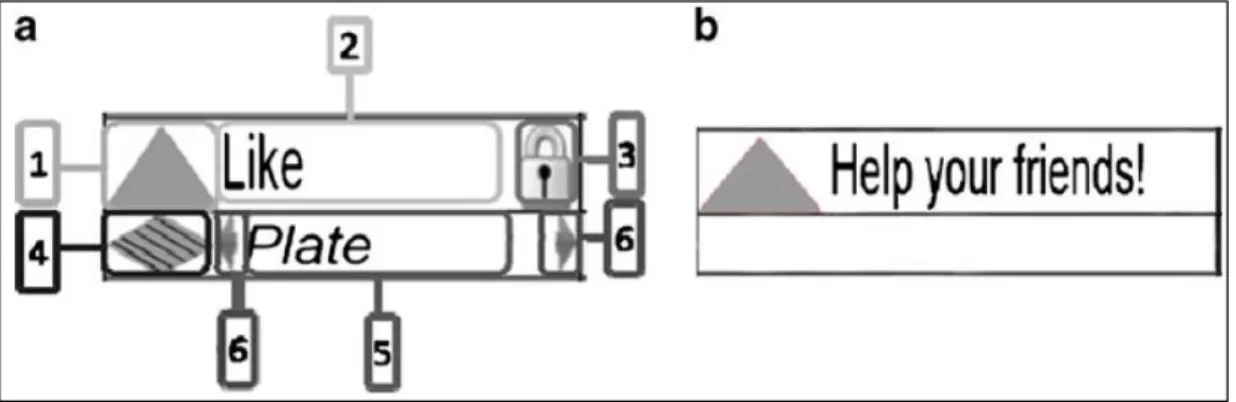
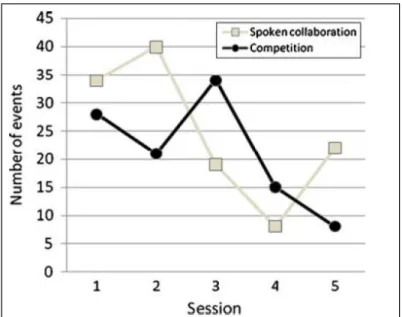
(5) INDEX Page DEDICATION ............................................................................................................. ii ACKNOWLEDGEMENTS ........................................................................................iii INDEX OF TABLES .................................................................................................. vi INDEX OF FIGURES ................................................................................................ vii SUMMARY ................................................................................................................ ix ABSTRACT ............................................................................................................... xii 1.. INTRODUCTION .............................................................................................. 1 1.1 Theoretical background .............................................................................. 1 1.1.1 Collaboration.................................................................................... 1 1.1.2 Technology for collaborative problem solving ................................ 3 1.1.3 Large-group collaboration................................................................ 4 1.1.4 Collaborative interaction patterns .................................................... 7 1.1.5 Silent collaboration ........................................................................ 13 1.1.6 Collaborative configurations .......................................................... 14 1.1.7 Settings ........................................................................................... 15 1.2 Objectives ................................................................................................. 16 1.3 Research questions ................................................................................... 17 1.4 Research hypotheses................................................................................. 17 1.5 Methodology ............................................................................................ 18 1.6 Results ...................................................................................................... 22 1.7 Thesis outline ........................................................................................... 23 1.8 Thesis structure......................................................................................... 25. 2.. COLLABORATION WITHIN LARGE GROUPS IN THE CLASSROOM .................................................................................................. 29 2.1 Abstract .................................................................................................... 29 2.2 Introduction .............................................................................................. 29.
(6) 2.3 Conditions for collaborative learning ....................................................... 34 2.4 Silent collaboration with an interpersonal computer ................................ 36 2.5 Experimental work ................................................................................... 44 2.6 Conclusions .............................................................................................. 53 3.. SILENT COLLABORATION WITH LARGE GROUPS IN THE CLASSROOM .................................................................................................. 55 3.1 Abstract .................................................................................................... 55 3.2 Introduction .............................................................................................. 55 3.3 Silent collaboration interaction pattern .................................................... 60 3.4 Experimental design ................................................................................. 67 3.5 Results ...................................................................................................... 72 3.6 Discussion ................................................................................................ 77 3.7 Conclusions and future work.................................................................... 79. 4.. THE. IMPACT. OF. TECHNOLOGY. IN. LARGE. GROUP. COLLABORATIVE LEARNING.................................................................... 81 4.1 Abstract .................................................................................................... 81 4.2 Introduction .............................................................................................. 81 4.3 Methodology ............................................................................................ 83 4.4 Measurements and procedures ................................................................. 94 4.5 Results ...................................................................................................... 97 4.6 Discussion .............................................................................................. 101 4.7 Conclusions ............................................................................................ 102 5.. RESEARCH LIMITATIONS, CONCLUSIONS AND FUTURE WORK.... 104. BIBLIOGRAPHY .................................................................................................... 111 A N N E X E S ......................................................................................................... 122 ANNEX A: SILENT VS. SPOKEN COLLABORATION IN SMALL GROUPS FOR NUMBERING PRACTICE ................................................................... 123.
(7) INDEX OF TABLES Table 1-1: Examples of collaborative interaction patterns. ................................................... 9 Table 1-2: Summary of the thesis structure......................................................................... 25 Table 2-1: How the conditions for collaboration were achieved ........................................ 50 Table 2-2: Comparison between pre-test and post-test results in the EG............................ 50 Table 2-3: Post-test comparison between CG and EG ........................................................ 52 Table 2-4: Correlation values for Figure 2-7....................................................................... 52 Table 3-1: Description of the activities in S1-S5 for Matrix and Cloze.............................. 69 Table 3-2: Total number of events registered from sessions S2 to S5 per participant in Matrix mode (MT) and Cloze mode (CT), standard deviation Mσ and Cσ respectively, and average number of events per participant per session (from S2 to S5) in Matrix mode (MA) and Cloze mode (CA). Spoken collaboration events are marked in bold ..................................................................................................................... 71 Table 3-3: Fulfilment of collaboration conditions in the two studies ................................. 77 Table 4-1: Description of the activities in S1-S7 in the SDG and PCs in network groups .................................................................................................................................. 86 Table 4-2: Main differences and similarities between both applications ............................ 93 Table 4-3: Theoretical fulfilment of the conditions required for collaboration .................. 94 Table 4-4: Total number of events registered from sessions S1 to S7 per participant in the PCs in network and SDG groups. Spoken collaboration events are highlighted in bold .................................................................................................................................. 97 Table 4-5: Pre-test and post-test results (SD: standard deviation, Δ: difference) ............... 97. vi.
(8) INDEX OF FIGURES Figure 1-1: Iterative design, questions and improvements.................................................. 21 Figure 1-2: Connections between the research questions, hypotheses, objectives, papers and results. ............................................................................................................... 28 Figure 2-1: Layout of the game ........................................................................................... 37 Figure 2-2: Children interacting with the interpersonal computer ...................................... 38 Figure 2-3: Personal control ................................................................................................ 41 Figure 2-4: Feedbacks after exchanges have been made..................................................... 43 Figure 2-5: Software appropiation ...................................................................................... 46 Figure 2-6: Comparison between spoken collaboration and competition ........................... 47 Figure 2-7: a Comparison between spoken events and incorrect exchanges. b Comparison between spoken collaboration events and cancellations. c Comparison between cancellations and incorrect exchanges .................................................................. 48 Figure 3-1: Application interface for a Matrix activity that consists of classifying a set of words. The top half represents the 20 problems to solve as part of the collaborative activity. The bottom half represents a board with an acceptors’ area (top two rows) and facilitators’ area (bottom two rows). Each acceptor and facilitator is assigned a cell on the corresponding board. All of the students work synchronously on the board ......................................................................................................................... 59 Figure 3-2: Application interface for a Cloze activity that consists of filling in the blanks. The top half represents the 14 problems to be solved as part of the collaborative activity. The bottom half represents a board with the acceptors’ area (top two rows) and facilitators’ area (bottom two rows). Each acceptor and facilitator is assigned a cell on the corresponding board. All of the students work synchronously on the board ......................................................................................................................... 60 Figure 3-3: a) Example of acceptor’s Personal Space. b) Example of facilitator’s Personal Space..................................................................................................................... 64 Figure 3-4: Average number of spoken and silent collaboration events per pupil per minute in the studies with Matrix (top) and Cloze (bottom) ............................................... 74 Figure 4-1: (a) Lab setting with PCs (b) Classroom setting with shared display ................ 86 vii.
(9) Figure 4-2: (a) PC acceptor interface (b) PC facilitator interface ....................................... 88 Figure 4-3: (a) Detailed view of the acceptor’s interaction space (b) Detailed view of the facilitator’s interaction space ......................................................................................... 92 Figure 4-4: Interface statuses .............................................................................................. 92 Figure 4-5: Shared display interface (Rosen et al., 2014) ................................................... 93 Figure 4-6: (a) Effectiveness of suggestions in the PCs in network and SDG group (b) Number of silent and spoken collaboration events per student in both groups ........... 100. viii.
(10) PONTIFICIA UNIVERSIDAD CATOLICA DE CHILE ESCUELA DE INGENIERIA. COLABORACIÓN EN GRUPOS GRANDES CON PATRONES DE INTERACCIÓN COLABORATIVOS DEFINIDOS Tesis enviada a la Dirección de Postgrado en cumplimiento parcial de los requisitos para el grado de Doctor en Ciencias de la Ingeniería. TAL YOSEF ROSEN RESUMEN La colaboración ha sido motivo de gran interés en los últimos años, lo cual se puede ver a través de que ha sido definida como una componente esencial de las habilidades del siglo XXI y porque se ha incluido la resolución de problemas colaborativos al estudio PISA 2015. Es por esto que la inclusión del desarrollo de esta habilidad a la sala de clases es relevante.. El área de Computer-Supported Collaborative Learning (CSCL) ha demostrado en distintos ámbitos que es posible introducir la colaboración en el aula. Sin embargo, la bibliografía presenta trabajos principalmente con grupos pequeños y no con grupos grandes. Las investigaciones se han centrado en analizar cuáles son las acciones necesarias que tienen que hacer los alumnos en forma individual para completar una tarea en particular, y no en las acciones necesarias que debe realizar el grupo completo para trabajar colaborativamente. Por otra parte, cuando grupos grandes trabajan colaborativamente emergen problemas de coordinación y comunicación que hay que tener en cuenta. El objetivo de esta tesis es determinar y analizar patrones de interacción colaborativos explícitos silenci osos para grupos grandes dentro de la sala de clases, que promuevan la colaboración y faciliten la interacción de los integrantes del grupo.. Con el fin de obtener una comprensión sobre la colaboración silenciosa en grupos grandes, se realizaron diferentes estudios. El primero, siendo la aproximación inicial a estos temas, fue un estudio en el cual se analizaron las condiciones necesarias para lograr aprendizaje ix.
(11) colaborativo en la sala de clases y en el cual se diseñó e implementó el primer patrón explicito colaborativo silencioso. De aquí, se descubrió que los patrones explícitos colaborativos de interacción sí pueden ser una solución para hacer colaborar a grupos grandes de estudiantes, pero también se encontró que al utilizar este patrón surgían problemas de comportamiento inesperados en los estudiantes. A partir de estos aprendizajes, se diseñó la siguiente experiencia. El objetivo principal del segundo estudio fue extender el dominio de los patrones de interacción explícitos, lo cual se hizo creando un segundo patrón explícito de colaboración silencioso. El último estudio se focalizó en profundizar el conocimiento sobre la colaboración silenciosa, en términos de cómo es influenciada dependiendo en donde se utiliza. Para esto el estudio se realizó en dos contextos distintos, la sala de clases y el laboratorio de computadores.. A partir de los estudios realizados, esta tesis brinda diversos resultados. Los principales son que las dinámicas de colaboración silenciosa presentan una buena usabilidad, lo que demostró que son fáciles de usar y aprender por los estudiantes. Además, estos pueden ser aplicados en diversos ambientes, con diferentes actividades y dinámicas, promoviendo la motivación y participación de los estudiantes. Por último, el espacio físico en donde se utilizan las dinámicas de colaboración silenciosa influye en la calidad de la colaboración, por lo que es relevante considerarlo al momento de llevar la colaboración al aula.. Como esta tesis estuvo enmarcada en un contexto específico en términos de edad de los estudiantes con los que se trabajó, contenidos y actividades, se proponen trabajos futuros en torno a la colaboración silenciosa en distintos niveles educativos, con distintas necesidades curriculares, y de esta manera observar el impacto y alcance que esta tiene. Por otro lado, se observó que la colaboración silenciosa puede ser un buen medio para hacer colaborar a estudiantes con necesidades educativas especiales, por lo que se propone estudiar la colaboración silenciosa en estudiantes con distintas capacidades de aprendizaje.. Esta tesis contó con el apoyo del Centro de Estudios de Políticas y Prácticas para la Educación (CEPPE-UC), CONICYT CIE-01. x.
(12) Palabras Claves: Colaboración en grupos grandes; Colaboración silenciosa; Single Display Groupware; Shared Display; Computer Supported Collaborative Learning. Miembros de la Comisión de Tesis Doctoral: Miguel Nussbaum Valeria Herskovic Álvaro Salinas Rubén Mitnik Nian Shing Chen Jorge Vásquez Santiago, Noviembre, 2015. xi.
(13) PONTIFICIA UNIVERSIDAD CATOLICA DE CHILE ESCUELA DE INGENIERIA. LARGE-GROUP COLLABORATION WITH PRE-DEFINED COLLABORATIVE INTERACTION PATTERNS Thesis submitted to the Office of Graduate Studies in partial fulfilment of the requirements for the Degree of Doctor in Engineering Sciences. TAL YOSEF ROSEN ABSTRACT Collaboration has been an area of great interest in recent years. This is reflected in the fact that it has been defined as an essential component of the so-called 21st century skills, as well as the inclusion of collaborative problem solving in PISA 2015. Given this, it is important that this skill is developed in the classroom.. The field of Computer-Supported Collaborative Learning (CSCL) has shown that collaboration can be introduced into the classroom in different areas. However, the literature primarily reports studies with small groups, rather than in large-group settings. Studies have focused on analysing what actions students must carry out individually in order to complete a specific task, rather than analysing the actions that must be carried out by the whole group in order to work collaboratively. On the other hand, by working collaboratively in large groups, problems with coordination and communication arise that must be taken into consideration. The objective of this thesis is to determine and analyse explicit silent collaboration interaction patterns for large groups within a classroom that promote collaboration and facilitate the interaction of the members of the group.. In order to understand silent collaboration in large groups, various studies were conducted. In the first of these studies, which represented an initial approach to understanding these matters, the necessary conditions for collaborative learning in the classroom were analysed xii.
(14) and the first explicit silent collaboration interaction pattern was designed and implemented. This study revealed that explicit collaborative interaction patterns present a viable solution for having large groups of students collaborate, although it also revealed that using the pattern led to unexpected behavioural issues among the students. This latter point was taken into consideration when designing the following study. The main objective of the second study was to extend the domain of the explicit interaction patterns. This was achieved by creating a second explicit silent collaboration interaction pattern. The final study focused on providing more in-depth knowledge of silent collaboration, in terms of how it is influenced depending on where it takes place. In order to do so, the study was conducted in two different settings: the classroom and the computer lab.. Based on these studies, this thesis provides a series of results. The main findings are that the dynamics of silent collaboration appear to be highly usable, demonstrating that they can be easily learnt and used by the students. Furthermore, these dynamics can be applied in different settings, with different activities and dynamics, while encouraging student participation and motivation. Finally, the physical space in which the dynamics of silent collaboration take place influences the quality of collaboration. This is therefore important to consider when introducing collaboration into the classroom.. As this thesis was framed within a specific context in terms of the age of the students that participated, as well as the contents and activities, future work is suggested based on silent collaboration at different levels of education, and with different curricular needs, so as to observe the scope and impact of silent collaboration. Additionally, it was observed that silent collaboration may be an effective means for having students with special educational needs collaborate. It is therefore recommended that silent collaboration be studied among students with special educational needs and/or students with different learning difficulties.. This thesis received support from the Center for Research in Educational Policy and Practice, CONICYT Grant CIE-01.. xiii.
(15) Key Words: Large-group Collaboration; Silent Collaboration; Single Display Groupware; Shared Display; Computer Supported Collaborative Learning. Members of the Doctoral Thesis Committee: Miguel Nussbaum Valeria Herskovic Álvaro Salinas Rubén Mitnik Nian Shing Chen Jorge Vásquez Santiago, November, 2015. xiv.
(16) 1 1.. INTRODUCTION. This thesis studies large-group collaboration within the classroom. Collaboration has been widely studied in the literature, with the findings showing that collaborative work has advantages over individual work.. There are several difficulties faced by collaborative work. One such difficulty is how to transfer collaboration to the classroom, while another, more practical, difficulty is how to find the necessary tools for collaboration. Additionally, collaborative tools have been focused on small groups, while large groups, which bring their own problems and benefits, have been left out. 1.1. Theoretical background. Collaboration has been a cause of great interest within educational research in recent years (Johnson & Johnson, 2002). It has been defined as an essential component of the so-called 21st century skills (Bruns, 2007), which, as well as the inclusion of collaborative problem solving in PISA 2015 (OECD, 2013), demonstrates the importance of incorporating such problems and skills into the classroom. 1.1.1 Collaboration Collaboration and cooperation are two subtly different worlds. Cooperation is based more on dividing tasks among participants, with a focus on sub-tasks that are performed individually (Dillenbourg, 1999), with coordination required only at the end in order to bring together the individual results (Dillenbourg, Baker, Blaye & O’Malley, 1996). In this sense, each person is only responsible for a fraction of the.
(17) 2 problem (Roschelle & Teasley, 1995). Collaboration, on the other hand, is based on a coordinated effort to solve a problem as a group (Roschelle & Teasley, 1995).. Collaborative work is particularly interesting as there are several benefits to it over individual work. When students work collaboratively, they perform better (than when working individually) (Roschelle & Teasley, 1995; Gokhale, 1995; Laal & Ghodsi, 2012; Cen, Ruta, Powell & Ng, 2014), and develop social and communication skills (Laal & Ghodsi, 2012). These benefits are the main motivation for introducing collaborative work into the classroom.. Certain conditions must be met in order for collaborative work to take place. Firstly, there must be a common goal (Dillenbourg, 1999). Secondly, there must be positive interdependence between peers (Johnson & Johnson, 1999), which is the perception that a group member is connecting with the others in such a way that they cannot be successful unless the others are also successful. Thirdly, there must be coordination and communication between peers (Gutwin & Greenberg, 2004) in order to meet the common goal. Fourthly, there must be individual accountability (Slavin, 1996), whereby each member of the group is responsible for their own actions. There must also be awareness of peers’ work (Janssen, Erkens, Kanselaar & Jaspers, 2007) so that each member of the group can be aware of the other members’ progress. Finally, there must be joint rewards (Axelrod & Hamilton, 1981) so that every member of the group wins or loses equally, with the objective being that everyone wants to maximize their reward..
(18) 3. Collaboration in the classroom Wallace, Scott, Stutz, Enns & Inkpen (2009) argue that working in a shared, physical space brings huge benefits, such as being more aware of the activity that is taking place and the efficiency of communication. Being in the same physical space creates a community of learners, where the students work with their classmates and teachers to meet the educational objectives, and also each student become responsible for their own learning (Brown & Campione, 1996). 1.1.2 Technology for collaborative problem solving Collaborative learning (CL) is commonly defined as “a situation in which two or more people learn or attempt to learn something together” (Dillenbourg, 1999, p. 1). One way of achieving CL is through Computer-Supported Collaborative Learning (CSCL), which is the study of how people can learn collaboratively while being mediated by a computer (Stahl, Koschmann & Suthers, 2006). One of the most important aspects of CSCL research is that technology allows the processes of interaction and learning to be analysed in collaborative activities (Cress, Stahl, Ludvigsen & Law, 2015). Also, Roschelle et al. (2004) suggest that CSCL influences learning, motivation and engagement.. Infante, Hidalgo, Nussbaum, Alarcón & Gottlieb (2009) state that there are different ways of implementing CSCL: one such way is to use wirelessly interconnected handheld devices (Single Input/Single Display), while a second is to use Single Display Groupware (SDG) or Multiple Input/Single Display. In the former case, where each.
(19) 4 student has their own device, the network is used to create a series of small groups, thus enabling different activities to be carried out (Cortez, Nussbaum, Rodriguez, Lopez & Rosas, 2005; Zurita & Nussbaum, 2004). In the latter case, the SDG technology allows several users located in the same physical space to share a single screen using individual input devices (Moraveji et al., 2008). A cost-effective way to work interactively in the classroom is through SDG, using the mouse as an input device. Alcoholado et al. (2012) used SDG in this way so that students could work individually on mathematics exercises. 1.1.3 Large-group collaboration The literature does not specify the exact number of students that constitute a large group within the classroom. There is a suggestion that large-scale work could be possible with up to thousands of students in an online, synchronous setting, with smallscale work taking place in groups of 2 to 3 students (Dillenbourg, Järvelä & Fischer, 2009). For this reason, large groups will be defined in this thesis as groups of at least 12 students.. The majority of studies to have used CSCL within the classroom have focused on small groups. Zurita & Nussbaum (2004) and Van Diggelen & Overdijk (2007) featured small-group collaboration; Hung, Young & Lin (2009) developed a collaborative game for learning English vocabulary; and Zea, Sánchez & Gutiérrez (2009) created a collaborative game for teaching vowels. In these cases, the research was focused on small groups, where each participant had their own input device. However, there have also been attempts to use CSCL with all of the students in a classroom. CollPad.
(20) 5 (Nussbaum et al., 2009) is a system for building responses as a group to open questions defined by the teacher. The students first solve the problem individually, before solving it collaboratively in small groups. The whole class then arrives at a final answer, with the teacher mediating a discussion of the answers obtained by the different groups. Group Scribbles (Roschelle et al., 2007) uses a similar method, where individual work and teacher mediation are used to support and encourage teachers to use new methods of collaboration and coordination in the classroom. Both approaches are characterized by including individual participation and teacher mediation, as well as by the fact that each student has their own personal device, which is wirelessly connected to their classmates’ devices.. One study that tried to encourage interaction and coordination in large groups within the classroom using tabletops (interactive tables that are used to collaborate, mainly in small groups) was Martinez-Maldonado, Dimitriadis, Martinez-Monés, Kay & Yacef (2013). However, these are quite expensive and not every school can afford themselves such luxury. When using tabletops, the teacher or the application divides the class into small groups. These groups then have to solve the same problems independently. If the problem is too complex to be solved by the small groups, it is sometimes divided into smaller sub-problems using collaborative patterns such as Jigsaw (Hernández-Leo et al., 2011). However, doing this means that each small group only solves one subproblem in depth, thus losing perspective of the original problem. Furthermore, there are certain contexts in which complex problems cannot be divided, or in which the.
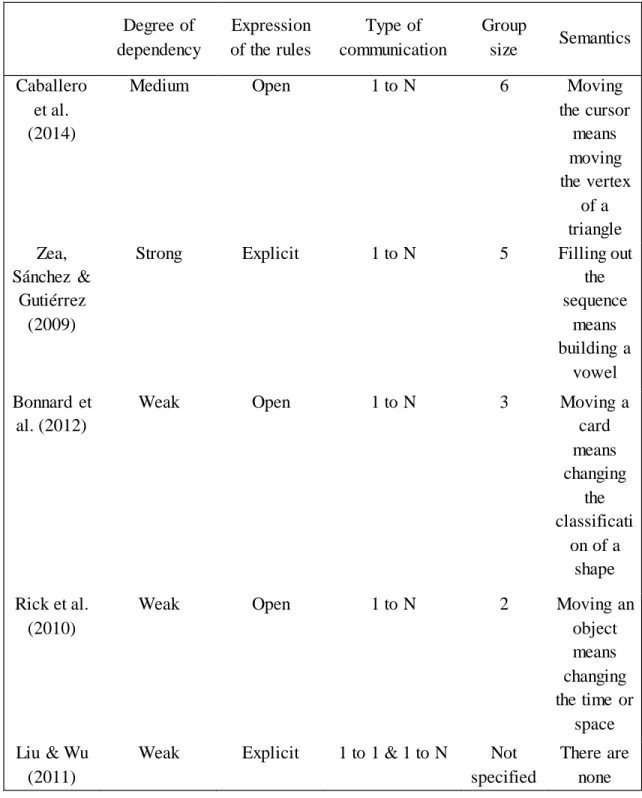
(21) 6 teachers explicitly want the students to learn how to work in large groups (Guha, Druin & Fails, 2013).. The use of CSCL supported by SDG is ideal for large-group collaborative activities within the classroom (Pavlovych & Stuerzlinger, 2008). This is particularly the case because the use of these technologies encourages interaction during an activity, as well as participation and engagement among the students (Infante et al., 2009). Using CSCL with large groups allows more robust and varied ideas to be developed (Roschelle et al., 2004). Furthermore, working in large groups provides more information and points of view than individual work, while the group can also motivate an individual student to perform better (Alavi, 1994). Additionally, being in the same physical space and using SDG improves group problem solving (Chung, Lee, & Liu, 2013), while also taking advantage of the teacher’s presence in order for them to provide explanations whenever they see fit (Black, 2005).. Despite the multiple advantages, adopting collaborative practices with children in the classroom is a challenge (Boticki, Wong & Looi, 2013; Stanton, Neale & Bayon, 2002). This is especially the case when all of the students in the classroom try to solve a shared problem. In these cases, coordination and communication problems often arise, complicating the collaborative learning process (Bertucci, Conte, Johnson & Johnson, 2010). For example, there are students that refuse to participate (Marjanovic, 1999) and shy students who find it hard sharing their ideas. Furthermore, working in large groups may generate a large number of verbal interactions (Strijbos & Martens,.
(22) 7 2001) and interactions that have nothing to do with the activity, especially when working with children. This can lead to a noisy environment (Miner, 1992) that is not suitable for learning.. One possible solution for having large groups collaborate is to use the internet. Curtis & Lawson (2001) explored learning through asynchronous online learning and discovered that, despite there being effective collaboration, there were deficiencies in the communication as it was not face to face. One solution to this was to divide the problem into smaller parts so as to facilitate communication. McBrien, Cheng & Jones (2009) studied a synchronous online distance system and tried to reduce the amount of communication problems by providing different media such as audio, video, chat and shared electronic whiteboards, among others. Despite their satisfaction, the students mentioned that the lack of non-verbal communication lessened their educational experience. Furthermore, there were often problems with the speed of the network, which led to a poor quality of audio and video transfer.. One way that can help solve the problems that are present in a distance learning setting, as well as the problems when introducing collaboration into the classroom detailed above, is to use silent collaboration interaction patterns. 1.1.4 Collaborative interaction patterns An interaction pattern, or collaboration script (Kobbe et al., 2007), is how the interaction between students in order to solve a collaborative activity is defined. Collaboration is not an innate human skill and therefore requires learning and practice.
(23) 8 (Dillenbourg et al., 1999). Furthermore, when a collaborative situation presents itself there is no guarantee that the expected interactions will actually occur (Dillenbourg, 1999). One way of improving the effectiveness of collaborative learning is to structure the students’ interactions (Dillenbourg, 2002).. Interaction patterns can be characterized by the following: a). Their degree of dependency, i.e. the need for each student to communicate. and coordinate with the others in order to complete the activity. Weak dependency is when a student within a group can complete the activity on their own. Medium dependency is when the students need each other in order to complete the activity, but where there may be one or more member of the group that does not participate. Finally, strong dependency is when a student cannot complete the activity witho ut active collaboration from all of the other members of the group. b). How the rules are expressed, i.e. whether or not there are clear rules as to. how the students must interact. The rules of an interaction pattern can be explicit or implicit/open. Explicit rules clearly state the way in which the students must interact. Implicit/open rules, on the other hand, leave it up to the students to find ways to collaborate, i.e. there are no pre-defined rules for interacting. c). The type of communication, i.e. the number of people with which any. given student can communicate. This can be 1 to 1, when the communication is between one student and another, and 1 to N, when the communication is between one student and the rest of the group. d). The size of the group. The number of students that can use the interaction. pattern at any one time. e). The semantics of the action, i.e. the meaning of the actions. For example,. “to click” in one interaction pattern could mean to ask for help, while in another it could mean to end a turn or move..
(24) 9 Examples of the aforementioned characteristics are detailed in Table 1-1 below. Table 1-1: Examples of collaborative interaction patterns. Degree of dependency. Expression of the rules. Type of communication. Group size. Caballero et al. (2014). Medium. Open. 1 to N. 6. Zea, Sánchez & Gutiérrez (2009). Strong. Explicit. 1 to N. 5. Bonnard et al. (2012). Weak. Open. 1 to N. 3. Moving a card means changing the classificati on of a shape. Rick et al. (2010). Weak. Open. 1 to N. 2. Moving an object means changing the time or space. Liu & Wu (2011). Weak. Explicit. 1 to 1 & 1 to N. Not specified. There are none. Semantics Moving the cursor means moving the vertex of a triangle Filling out the sequence means building a vowel.
(25) 10 In Caballero et al. (2014) the objective was to create and classify triangles. In order to do so, each student had a mouse cursor, which, when joined with the cursor of at least one other member of the group, formed the vertex of a triangle. The only possible action that could be performed by the students was to move their cursors until they formed a triangle. The degree of dependency is medium as it was possible for one of the group members not to participate and for the group to still complete the activity. The expression of the rules is open, as the way in which the students have to interact is not defined. This is because at the beginning of the activity an instruction is given to the students such as “build an isosceles triangle”, but this could be achieved by communicating verbally, using signs or even communicating through the software. The type of communication is 1 to N, as every action that is carried out by a member of the group can be seen immediately by the whole group. The group size was defined as being up to 6 students and the semantics were based on the fact that moving the cursor represented a change in the position of the vertices in a triangle. The study by Zea et al. (2009) sets out a game for teaching vowels. Each student must fill out blank spaces until forming the vowel that has been requested. The degree of dependency is strong, as in order to advance from one activity to the next, all of the students in the group must complete the activity and be given feedback. The expression of the rules is explicit as there is only way to communicate, which is giving feedback and validating a classmate’s work using the software. The type of communication is 1 to N, as every member of the group is aware of their classmates’ work. The group size was defined as 5 students and the semantics were based on the fact that filling out blank spaces in a given sequence represents building a vowel. The work by Bonnard et al. (2012).
(26) 11 describes a study for teaching the classification of geometric shapes using technology through means of a projector that projects an image onto a table, as well as physical paper cards. The possible actions for the students consisted in moving the physical paper cards, which represented a geometric shape, and placing them on the projected image on the table according to the classification that was requested. The degree of dependency is weak as any student in a group could finish the activity on their own. The expression of the rules is open as there is not a clear definition of the way in which the students have to coordinate and communicate with one another. The type of communication is 1 to N as the members of the group were physically next to each other and, therefore, any communication by a group member is immediately received by the others. The group size was defined as 3 students and the semantics were based on the fact that moving each physical card represents a change in the classification of that shape. Rick et al. (2010) describe a study using tabletops to teach young children about space and time by ordering objects on the interactive table. In one activity, the students had to arrange certain events so as to demonstrate a perception of time. In another activity, they had to arrange tables and chairs within a virtual classroom in order to demonstrate a perception of space. The degree of dependency is low as any student could finish the activity on their own, without needing their classmates. The expression of the rules is open as the way in which the students have to coordinate and communicate with each other is not made explicit. The type of communication is 1 to N as the members of the group are physically next to one another, and therefore, they are able to see each other’s work. The group size was defined as 2 students and the semantics were based on the fact that moving each object on the interactive table.
(27) 12 represents a change in either time or space. The final example is the work by Liu & Wu (2011), which used an online game to teach students about software engineering through a series of questions and answers. The degree of dependency is low as the students can advance through the game without needing any help. The expression of the rules is explicit as the students can only interact with one another through the game’s chat service. The communication can be 1 to 1 or 1 to N as the chat could be private or public. The group size is not mentioned, but it was designed as a multiplayer game, suggesting that it can support groups of up to at least 6 students. The game does not feature any semantics as in order to advance through the game the students had to directly answer questions relating to programming.. In addition to these characteristics, interaction patterns can support collaborative work in different ways. In the research by Pinelle, Gutwin & Greenberg (2003), the terms teamwork and taskwork are defined. Teamwork is defined as the actions that are required in order to complete a task as a group. Taskwork, on the other hand, is defined as the actions that are needed in order to complete a task (generally as individual students), i.e. the tasks that must be completed by an individual within a group (Wallace, 2012). This is related to interaction patterns, as different interaction patterns support teamwork in different ways, such as coordination, communication and maintaining awareness of the activity (Wallace et al., 2009). To exemplify these terms, in Alcoholado et al. (2012) taskwork is made explicit by virtue of every student having their own individual space on the shared display where they can complete mathematics exercises individually. In this case, teamwork does not exist as the students work.
(28) 13 independently. In Wallace, Scott, Lai & Jajalla (2011) a study was conducted with groups of 3 students using multiple screens. This study involved a task called Job Shop Scheduling, which consists of emulating a process for optimizing the output of a manufacturing plant. In this study, each student had a laptop which displayed information that was only visible to them and where they completed their taskwork. Furthermore, each group had a shared screen where they could discuss and negotiate the decisions made by each student, i.e. the shared screen was there to support teamwork. 1.1.5 Silent collaboration Computer-mediated communication (CMC) is defined as any human communication that takes place using an electronic device (McQuail, 2005). Silent collaboration can be placed within the field of CMC as it uses a computer in order mediate communication, without the need for spoken communication. This is one solution that allows large groups of students to collaborate when spoken communication is difficult (Chapter 2). Silent collaboration is ideal for solving problems that arise when collaborating in large groups. Some of the advantages of CMC include giving students more time to think before giving an opinion (compared to face-to-face communication) (Moore, 2002), reducing conflicts between team members (Bhappu & Crews, 2005) and allowing students to participate more equally (Van Der Meijden & Veenman, 2005).. Given the above, our first research question asks: “How can large groups collaborate simultaneously in the classroom using an explicit interaction pattern?” Unlike the.
(29) 14 studies described above (Table 1-1), this study is based on working with large groups, rather than small groups or dividing the problem into sub-tasks. 1.1.6 Collaborative configurations Activities are a set of planned actions led by teachers and/or students, inside or outside the classroom, individually or in groups, where the final goal is to meet the teaching aims and objectives (Recursos, 2015). Such activities can be represented in different ways. For example, when teaching Spanish grammar, activities are used in which the blank spaces in a text must be filled out, using words from a set list, or activities in which phrases from two columns must be joined so that the resulting phrase is coherent. There is a wide range of different possible activities (Harris, Mishra & Koehler, 2009). Examples of studies using activities within education include Szewkis et al. (2011), who introduces Spanish grammar activities using a word grid to classify words, and Alcoholado et al. (2012), who introduces addition activities in mathematics using number grids.. The concept of collaborative configuration will be defined as an interaction pattern and the corresponding type of activity, or mode of representation, used by an application. To exemplify the concept of collaborative configuration, the study by Caballero et al. (2014) uses a configuration that features an interaction pattern with an open expression of the rules (Table 1-1), and mathematics activities based on creating triangles.. Based on the above, our second research question asks: “Can large-group collaboration in the classroom be implemented using different silent collaboration configurations.
(30) 15 (dynamics/activities)?” Answering this question will allow the advantages of collaborating in large groups to be reinforced, as well as mitigating the aforementioned problems that come with such collaboration. 1.1.7 Settings We define the setting as being the physical space in which an application is set and used. Today, the majority of face-to-face collaborative applications are being used in the classroom or computer lab, which generally have computers with multiple input devices (keyboard and mouse) that are set out one next to the other (traditional configuration of a computer lab) (Zurita & Nussbaum, 2004). The different physical spaces (settings), impact the use of technology (Shannon & Cunningham, 2009). Furthermore, the setting can also influence the interaction and therefore the group’s learning (Mercier, Higgins & Joyce-Gibbons, 2014).. Within the literature, the researchers that have shown the most interest in how the setting influences learning have been those that work with tabletops (interactive tables that can be used for collaboration, mainly in small groups). For example, Antle, Bevans, Tanenbaum, Seaborn & Wang, (2011) studied how, when working with tabletops, different layouts change the way in which students interact with the technology. In the work of Higgins, Mercier, Burd & Hatch (2011), where the use of tabletops in education is analysed, the authors explain that the majority of existing studies are based on the interaction between the human and the computer, i.e. how people interact when using the technology, but that there is little information about how these interactions might affect learning..
(31) 16 Furthermore, there are few studies in which the research topic refers to directly relating learning outcomes with the setting in which the learning takes place, such is the case in Inayat, Amin, Inayat & Salim (2013). In this study, the authors look at the role of collaboration in a web-based application for college students and its impact on learning. Another example is Brooks (2011), who studied the relationship between learning environment and learning gains, by assessing two classes taught by the same teacher but changing the physical spaces.. Given the above, it could be suggested that the literature focuses on collaborative interactions and that there is little information on how this might affect learning and how it relates to the physical space in which it takes place. Furthermore, there is little information and evidence regarding the relationship between settings and silent collaboration. This gives rise to the third research question, which asks: “How do the setting (physical space) and technology affect silent collaboration?” 1.2. Objectives. The objectives of this thesis are the following: a). To design and validate explicit mechanisms for silent collaboration. interactions where large groups collaborate simultaneously in the classroom. b). To design and validate different collaboration configurations by studying. the behaviour of the different explicit mechanisms for silent collaboration interaction patterns. c). To study how the different explicit mechanisms for silent collaboration. interaction patterns behave under different conditions (technology/setting/type of activity)..
(32) 17 These specific objectives are in line with the general objective of the thesis, which is to study explicit mechanisms for silent collaboration interaction patters that enable and encourage large-group collaboration within the classroom. Given the above, this thesis looks to add to the literature by 1) generating explicit, silent collaboration interaction patterns, by developing new teamwork strategies, where the whole class works on the same task in large groups, and 2) analysing the advantages and disadvantages of silent collaboration and demonstrating the benefit of working with silent collaboration in the classroom or computer lab. 1.3. Research questions. The following research questions therefore guide this thesis: a). How can large groups collaborate simultaneously in the classroom using. an explicit interaction pattern? b). Can large-group collaboration in the classroom be implemented using. different silent collaboration configurations (dynamics/activities)? c). How do the setting (physical space) and technology affect silent. collaboration? 1.4. Research hypotheses. The following hypotheses were used to frame the work conducted for this thesis: a). Explicit silent collaboration interaction patterns, allow large-group. collaboration in the classroom. b). There is at least two different silent collaboration configurations that can. be implemented using explicit silent collaboration interaction patterns, while maintaining the conditions that favour large-group collaboration in the classroom..
(33) 18 c). The setting and technology affect the results in terms of collaboration and. learning. 1.5. Methodology. The methodology that was used to carry out this project was based on Design-Based Research (Design-Based Research Colective, 2003). Design-Based Research is a model that looks to study complex problems in real-life educational settings (Alvarez, Alarcon & Nussbaum, 2011). The methodology consisted of the following steps: a). Design and development of the interaction pattern. To start with, a review of the literature and/or real-life collaborative situations was conducted in order to look for indications as to what is essential in a collaborative interaction pattern. The pattern had to meet the conditions for collaboration and allow students to collaborate silently. This is detailed in sub-sections 2.2 and 2.3, where the necessary conditions for successful collaboration and their importance are analysed. These conditions are also mentioned in sub-sections 3.2 and 4.2, as well as in the introduction to Annex A, as the conditions for collaboration are important when it comes to designing any sort of element that is related to collaboration, whether it be the interaction pattern or type of activity. b). Design, development and validation of the collaborative learning software. In this stage, the software was designed and implemented, based on the design from point a) above, so that that the system would adapt to the desired educational goals. The software design process can be found in sub-sections 2.4, 3.3 and 4.3, as well as in the sub-section titled ‘Description of the tools used’ in Annex A. Fulfilment of the collaboration conditions for each software is analysed in tables 2-1, 3-3 and 4-3, as well as Table 4 in Annex A. Following this, it was necessary to start with a cycle of testing, during which time it was validated that the system worked correctly. In order to do so, the system had to be tested in a setting that was as close as possible to the real setting until there were no errors and all of the established usability functions and.
(34) 19 parameters had been met. This was done at least once for each piece of software (unless errors were found) using students from a school other than the one where the study took place. c). Design, development and validation of the educational instruments. Although the project consisted of developing collaborative systems that allowed predefined interaction patterns to be promoted, it must not be forgotten that this was done in an educational context. For this reason, activities that were pedagogically appropriate for the context had to be designed and developed. These activities also had to be coherent with the school’s own curriculum. The activities were conducted with students in 6th grade using language arts topics such as grammar and reading comprehension. However, when designing the activities, care was also taken to ensure that they could be adapted for other topics and/or grade levels. Details of the activities that were carried out can be found in sub-sections 2.5, 3.4 and 4.3, as well as in the ‘Methodology’ section of Annex A. The activities included in Annex A featured activities for teaching mathematics. The types of activities that were used (matrix and cloze) can be used for multiple subjects (for example, they could be used for classifying countries and cities for geography, or for completing sequences of a process in natural sciences). In addition to the activities, as the study was conducted in an educational setting, the learning also had to be measured. In order to do so, a multiple choice and/or fill-in-the-blanks test was developed. This test was administered before the intervention (pre-test), as well as after the intervention (post-test) in order to measure possible learning gains. This is detailed in sub-sections 2.5, 4.4 and 4.5, as well as in the ‘Results’ section of Annex A. The aforementioned instruments had to be validated before they could be used in the full study. In order to do so, the activities were validated by teachers from the schools that participated in the study, while the test was validated in a school that was not involved in the study. This was done at the same time as the validation of the software mentioned in b). d). Experimentation. Once the collaborative system and educational instruments had been validated, the study was conducted. In order to do so, previous coordination work had to be carried.
(35) 20 out with the school. The distribution of the experimental and/or control groups depended on whether or not the study aimed to compare two technologies and one or two interaction patterns. This process is detailed in sub-sections 2.5, 3.4 and 4.3, as well as in the ‘Methodology’ section of Annex A. In general terms, the study in chapter 2 featured a control group and experimental group, while the studies in chapters 3 and 4, as well as Annex A, featured two experimental groups in order to compare two technologies or two interaction patterns. e). Data gathering. In this stage, the data obtained during the experimentation stage was gathered, classified and organized. Data was taken from the software logs, classroom observations, pre- and post-tests, as well as recordings and surveys. The logs provided the number of correct and incorrect answers and the number of silent collaboration events, among others. The observations provided information on variables such as boredom, competition, spoken collaboration, disruptions, questions about the software, and tiredness, among others. This was done so as to assess progress and differences in behaviour and collaboration for the applications that were implemented as a result of the chosen silent collaboration interaction patterns. This is detailed in sub-sections 2.5, 3.4, 4.3 and 4.4, as well as in the ‘Methodology’ section of Annex A. f). Data analysis and writing papers. Finally, the gathered data was analysed so as to draw conclusions and prove or disprove the original hypotheses. This is detailed in sub-sections 2.5, 2.6, 3.5, 3.6, 3.7, 4.5, 4.6 and 4.7, as well as in the ‘Results’, ‘Discussion’ and ‘Conclusions’ sections of Annex A. Furthermore, this process led to papers being written, showcasing the results that were obtained. By being based on Design-Based Research, this thesis followed an iterative design methodology, both for developing the software as well as for conducting the studies, taking into account the knowledge that was acquired during each study..
(36) 21. Figure 1-1: Iterative design, questions and improvements. The first iteration was useful for developing the concept of silent collaboration and creating the first pre-defined collaborative interaction pattern (Chapter 2). It was observed that the pattern served its purpose but, due to its design, the students tended to put unnecessary pressure on one another by raising their voice. This led to the creation of a second interaction pattern, as well as the question of how to extend silent collaboration (Chapter 3). Finally, having seen the potential for silent collaboration, the question was asked as to which technology is most effective for silent collaboration and how might the physical space in which the interaction pattern is used influence the interaction between students (Chapter 4). Finally, a fourth study was conducted (Annex A). Following the previous studies, it was still left as pending to show that it was possible to work with silent collaboration in various settings, grade levels and subjects. Furthermore, a more in-depth study of silent collaboration was pursued by creating a.
(37) 22 dynamic that allowed for argumentation to take place silently. This was done because exposure to collaborative argumentation can help students learn to think critically and independently about important issues and contested values, as well as contributing to deeper conceptual learning and helping develop social awareness and collaborative ability in more general terms (Andriessen, Baker & Suthers, 2013). This problem is related to the thesis as it uses silent collaboration and showed that silent collaboration can be used in various contexts. This study featured students from 3 rd grade studying topics related to mathematics. The objective was to try and compare how student behaviour changes between students working in small groups through spoken collaboration, versus silent collaboration. In order to do so, the use of silent argumentation with the students that were collaborating silently was explored. 1.6. Results. The studies in this thesis have produced a series of results that are described below: a). One solution for having large groups collaborate in the classroom is to use. explicit silent collaboration interaction patterns (sub-section 2.6). b). The dynamics of silent collaboration are easy to use and learn.. Furthermore, they increase student motivation and participation, usually boosting learning (sub-sections 2.5, 2.6, 3.5, 3.6, 4.5 and 4.6). c). There. are. at. least. two. different. collaborative configurations. (dynamics/activities) in which silent collaboration can be implemented. Furthermore, these configurations generate an environment that is both silent and suitable for learning (sub-sections 3.5 and 3.7). d). There is a relationship between the difficulty of an Activity and the. collaboration events that arise when trying to solve the problem (sub-section 3.5)..
(38) 23 e). When comparing SDG in the classroom with PCs in network in the lab,. we observe that the technology that is used for silent collaboration and the setting or physical space in which silent collaboration takes place, has an impact on the number of collaboration events and also affects the quality of the collaboration (sub-sections 4.4, 4.5, 4.6 and 4.7).. In the fourth study (Annex A), the results showed that silent collaboration led to improved results (compared to spoken collaboration), but the silent argumentation tool that was proposed was not used as expected.. 1.7. Thesis outline. This thesis is based on three studies that were carried out in order to meet the proposed objectives that are detailed above. The focus of each chapter is described below: a). Chapter 2. The focus of this chapter is on putting forward a solution to show that it is possible for large groups of students to collaborate synchronously within the classroom. The theoretical framework of this chapter includes the conditions that are necessary for carrying out collaborative work. A collaborative interaction pattern called Exchanges was defined and tested. The experimental setting consisted of a control group where the students worked only with conventional non-digital resources, which consisted of guides for both teachers and students on the language contents to be assessed; the experimental group by contrast, spent 60% of the time with the same conventional nondigital resources and 40% of the time with the CSCL system. The ease with which the students could learn to use the software was then analysed. Following this, the manner in which the collaboration conditions were met was described and the impact on learning was evaluated. Finally, the impact of silent versus spoken collaboration was analysed. The findings of this chapter show that using explicit silent collaboration.
(39) 24 interaction patterns is one possible solution that allows large groups to collaborate within the classroom. The findings also showed that this dynamic helped increase student motivation and participation, boosting learning. The chapter was based on Paper 1: Collaboration between large groups in the classroom. b). Chapter 3. The focus of this chapter is on showing that silent collaboration is possible through several different collaborative configurations (dynamics/activities). A new explicit collaborative interaction pattern called Suggestions was developed and tested. A usability test was conducted, as well as a comparison between silent and spoken collaboration (using two pieces of software that featured the same dynamic but differed in the type of activity that they used. This activity has similar cognitive processes from the one presented in chapter 2: to identify, sort and classify. But differs in that this activity requires an understanding of the context before it can be resolved). The way in which the conditions for collaborative learning were met was also described. The findings from this chapter show that it is possible to create different collaborative configurations using silent collaboration. They also show that these configurations promote a silent environment that is suitable for learning. Furthermore, they reveal that there is a relationship between the difficulty of a problem and the number of collaboration events that are produced when trying to solve the problem. This chapter was based on Paper 2: Silent collaboration with large groups in the classroom. c). Chapter 4. The focus of this chapter is on analysing the impact that the physical space and technology have on factors such as learning and collaboration. A usability test was conducted and the way in which the conditions for collaborative learning were met was described. Finally, the impact on learning was evaluated and a comparison was made between spoken and silent collaboration using two applications that used the same interaction pattern but differed in terms of the physical space in which they were used. The findings from this chapter show that the technology used for silent collaboration has an impact on the number of collaboration events. They also show that the physical.
(40) 25 space affects the quality of collaboration. This chapter was based on Paper 3: The impact of technology in large group collaborative learning. 1.8. Thesis structure. The structure of this thesis is based on the research objectives described in section 1.2. Table 1-2 provides a summary of the objectives, hypotheses, research questions, papers and results that are included in this thesis. Figure 1-1 provides a model to demonstrate the connections between these components. Table 1-2: Summary of the thesis structure Hypotheses H1. Explicit silent collaboration interaction patterns,. allow large-group. collaboration in the classroom. H2. There is at least two different silent collaboration configurations that can be implemented using explicit silent collaboration interaction patterns, while maintaining the conditions that favour large-group collaboration in the classroom.. H3. The setting and technology affect the results in terms of collaboration and learning.. Research Questions Q1. How can large groups collaborate simultaneously in the classroom using an explicit interaction pattern?. Q2. Can large-group collaboration in the classroom be implemented using different silent collaboration configurations (dynamics/activities)?. Q3. How do the setting (physical space) and technology affect silent collaboration?.
(41) 26 Objectives O1. To design and validate explicit mechanisms for silent collaboration interactions where large groups collaborate simultaneously in the classroom.. O2. To design and validate different collaboration configurations by studying the behaviour of the different explicit mechanisms for silent collaboration interaction patterns.. O3. To study how the different explicit mechanisms for silent collaboration interactions behave under different conditions (technology/setting/type of activity).. Papers P1. Collaboration between large groups in the classroom. The authors are Szewkis, E., Nussbaum, M., Rosen, T., Abalos, JP., Denardin, F., Caballero, D., Tagle, A. and Alcoholado,. C. It was published in 2011 in the. International Journal of Computer Supported Collaborative Learning (6:561–575) and can be accessed digitally through DOI 10.1007/s11412011-9123-y. P2. Silent collaboration with large groups in the classroom. The authors are Rosen, T., Nussbaum, M., Alario-Hoyos, C., Readi, F. and Hernandez, J. It was published in 2014 in the journal IEEE Transactions on Learning Technologies (7:197-203) and can be accessed digitally through DOI 10.1109/TLT.2014.2318311.. P3. The impact of technology in large group collaborative learning. The authors are Rosen, T., Nussbaum, M., Peña, D., Contreras, J., Torres, J. and Oteo, M. Submitted for publication in the journal Educational Technology & Society.. P4. Annex A: Silent vs. Spoken collaboration in small groups for numbering practice. The authors are Rosen, T., Nussbaum, M.,.
(42) 27 Contreras, J., Torres, J. and Oteo, M. Submitted for publication in the journal Computer Assisted Learning. Results R1. One solution for having large groups collaborate in the classroom is to use explicit silent collaboration interaction patterns.. R2. The dynamics of silent collaboration are easy to use and learn. Furthermore, they increase student motivation and participation, usually boosting learning.. R3. There. are. at least two. different. collaborative configurations. (dynamics/activities) in which silent collaboration can be implemented. Furthermore, these configurations an environment that is both silent and suitable for learning. R4. There is a relationship between the difficulty of an Activity and the collaboration events that arise when trying to solve the problem.. R5. When comparing SDG in the classroom with PCs in network in the lab, we observe that the technology that is used for silent collaboration and the setting or physical space in which silent collaboration takes place, has an impact on the number of collaboration events and also affects the quality of the collaboration..
(43) 28. Figure 1-2: Connections between the research questions, hypotheses, objectives, papers and results..
(44) 29 2.. COLLABORATION. WITHIN. LARGE. GROUPS. IN. THE. CLASSROOM 2.1. Abstract. The purpose of this paper is to show how a large group of students can work collaboratively in a synchronous way within the classroom using the cheapest possible technological support. Making use of the features of Single Display Groupware and of Multiple Mice we propose a computer-supported collaborative learning approach for big groups within the classroom. The approach uses a multiple classification matrix and our application was built for language-learning (in this case Spanish). The basic collaboration mechanism that the approach is based upon is “silent collaboration,” in which students -through suggestions and exchanges- must compare their ideas to those of their classmates. An exploratory experimental study was performed along with a quantitative and qualitative study that analyzed ease of use of the software, described how the conditions for collaborative learning were achieved, evaluated the achievements in learning under the defined language objectives, and analyzed the impact of silent and spoken collaboration. Our initial findings are that silent collaboration proved to be an effective mechanism to achieve learning in large groups in the classroom. 2.2. Introduction. Many authors have claimed that collaboration has become an important subject in the area of education (Johnson & Johnson, 2002; Roschelle & Teasley, 1995). It has been.
(45) 30 defined as an essential component of twenty-first century skills (Bruns, 2007), and thus its adaptation to the classroom is crucial.. Social interaction and the ability to share and consider other points of view add a component that is not present in individual learning. Vygotskian and Piagetian researchers have inferred that “development may occur when two participants differ in terms of initial level of competence about some skill or task, work collaboratively on it, and arrive at shared understanding” (Tudge, 1992). Collaborative learning can be very effective and useful (Gokhale, 1995), because it can develop generic communication, collaboration and team building skills, as well as assisting teachers in the management of the class (Allen et al., 2006).. Computer-supported collaborative learning (CSCL) studies how people can learn collaboratively while being mediated by a computer (Stahl et al., 2006). Several initiatives have been implemented in CSCL for the classroom and some examples of these experiences are described by Zurita & Nussbaum (2004) and Van Diggelen & Overdijk (2007) who performed small group collaborations; Hung et al. (2009) who developed a collaborative English vocabulary-acquisition-game system; and Zea et al. (2009) who made a collaborative video-game to teach vowels. In these cases, the research focused on small groups, where each participant had his own device.. We can also find examples of CSCL in large groups. An illustrative case is Wikipedia, a free online encyclopedia written collaboratively by thousands of contributors from.
(46) 31 around the world (Kittur & Kraut, 2008). There are also experiments using Massively Multiplayer Online Games (MMOGs). Girvan & Savage (2010) used the virtual world Second Life in order to examine how communal constructivism could be an appropriate collaborative pedagogic tool, and Bennerstedt & Linderoth (2009) studied how collaborative interaction takes place among players in an MMOG game. A final example is Jara et al. (2009), who worked with virtual laboratories, a web-learning resource which incorporates collaborative learning practices through the Internet.. Wallace et al. (2009) argue that working in a common physical space can provide great benefits, such as “improved activity awareness and coordination, improve communication efficiency by enabling non-verbal communication such as gestures, and facilitate grounding via a shared visual reference.” A knowledge community, where students work with their peers and teachers on their goals in the same space makes all students accountable for their learning (Brown & Campione, 1996). Beers et al. (2007) indicate that for collaborative learning to be effective, individual learners have to achieve a sufficiently common cognitive frame of reference that does not appear by itself, but has to be negotiated. Technology can support this process, and (Roschelle et al., 2004) indicate that CSCL influences learning, motivation, commitment and the development of mutual understanding, and that CSCL for large groups, such as a whole classroom, allows the development of more robust and more varied ideas..
(47) 32 Single Display Groupware (SDG) allows multiple collocated users, each with his own input device, to share a common screen (Moraveji et al., 2008), which is useful when developing a collaborative activity where interaction with each member of a large group within the classroom is desired (Pavlovych & Stuerzlinger, 2008). It has also been shown that when several users, each with his own personal input device but with a shared screen, have to interact to complete an activity, there is greater participation and student engagement (Infante et al., 2009; Scott et al., 2003).. The quality of this engagement depends on the metacognitive awareness developed through a reciprocal process of exploring one another’s viewpoints in order to construct a shared understanding. The tasks chosen need to be appropriate to the capabilities of the learners’ requirements and to the collaboration process, and structured so that children must work together for successful completion (Nussbaum et al., 2009). Collaboration should occur among children with different skill levels or perspectives, which would create the socio-cognitive conflict necessary from a Piagetian perspective, and so providing the cognitive restructuring that underpins cognitive change (Fawcett & Garton, 2005; Teasley, 1995).. Besides the web-based collaborative approaches previously indicated, there have been a number of attempts at achieving CSCL with all students in the classroom. CollPad (Nussbaum et al., 2009) is an open-ended-question constructivist approach; students first solve the problem individually, then in small groups work collaboratively to reach a collective answer, based on their replies, and finally the teacher guides a classroom.
Figure


+7





Documento similar