
In vitro digestibility of food grade emulsions
112
0
0
Texto completo
(2) PONTIFICIA UNIVERSIDAD CATOLICA DE CHILE ESCUELA DE INGENIERIA. IN VITRO DIGESTIBILITY OF FOOD-GRADE EMULSIONS. ELIZABETH TRONCOSO AHUÉS. Members of the Committee: JOSÉ M. AGUILERA EDUARDO AGOSIN GEORGINA DÍAZ VILBETT BRIONES NOEMÍ ZARITZKY CRISTIÁN VIAL Thesis submitted to the Office of Research and Graduate Studies in partial fulfillment of the requirements for the Degree of Doctor in Engineering Sciences. Santiago de Chile, December, 2013.
(3) Dedicated to all people who always supported and encouraged me to complete this work. ii.
(4) ACKNOWLEDGEMENTS First and foremost I offer my sincerest gratitude to the people behind this work. I owe a special debt to Humberto, my great life partner who keeps me in balance. Thank you for being my love, my friend. He has made my life happy, exciting and fun, and without him I would have had many more stressful and worrisome moments.. I wish to express my sincere gratitude to my advisor José Miguel Aguilera, for all his support, help and constructive criticism, and for providing me with strong academic foundations.. I would like to thank all my labmates. In special, I thank Rommy for all the support with knowledge and for being a wonderful friend. It is a great pleasure to acknowledge the contribution of Debbie Meza from the Office of Research and Graduate Studies who helped bring this work to fruition.. I would like to thank the National Commission for Science and Technology (CONICYT) for my doctoral fellowship and my research stay at the University of Massachusetts - Amherst. I must mention my special acknowledgement to professor David Julian McClements for accepting me as visiting scholar at the Biopolymers and Colloids Research Laboratory in the Department of Food Science at the University of Massachusetts. I express a strong sense of gratitude to people who helped me during my stay in Amherst. Also, I have to thank Uri Lesmes and Jean Alamed at UMASS for their valuable comments and critical reading of the manuscripts.. This research was funded by the National Commission for Science and Technology (CONICYT) project FONDECYT 1095199.. iii.
(5) LIST OF CONTENTS DEDICATORY. ii. ACKNOWLEDGEMENTS. iii. ABSTRACT. vii. RESUMEN. ix. LIST OF PAPERS. xi. 1. INTRODUCTION. 1. 1.1. Nutrient bioavailability is affected by the food matrix. 2. 1.2. Lipid food structures. 4. 1.3. Structuring emulsion-based lipid food matrices to improve bioavailability. 6. 1.4. Scope and objectives of this thesis. 8. 1.5. Outline of the thesis. 9. 2. FOOD MICROSTRUCTURE AND DIGESTION. 13. 2.1. Introduction. 13. 2.2. Food structures. 14. 2.3. The reactor inside our bodies. 15. 2.4. Food structures in the mouth. 16. 2.5. Food structures in the stomach. 16. 2.6. Food structures in the intestine. 17. 2.7. Conclusions. 21. 3. RHEOLOGICAL AND MICROSTRUCTURAL CHARACTERIZATION OF. WPI-STABILIZED. O/W. EMULSIONS. EXHIBITING. TIME-. DEPENDENT FLOW BEHAVIOR. 23. 3.1. Introduction. 23. 3.2. Materials and methods. 26. 3.2.1. Materials. 26. 3.2.2. Emulsion formation. 26 iv.
(6) 3.2.3. Rheological properties of O/W emulsions. 27. 3.2.4. Modeling of flow behavior of the O/W emulsions. 27. 3.2.5. Modeling of the time-dependent rheological behavior of the O/W. 28. emulsions 3.2.6. Microstructural characterization of the O/W emulsions. 29. 3.2.7. Statistical analysis. 30. 3.3. Results and discussion. 30. 3.3.1.. Rheological behavior of WPI-stabilized O/W emulsions. 30. 3.3.2.. Modeling of the constant shear rate test by the SK model. 39. 3.4. Conclusions 4. FABRICATION,. 42 CHARACTERIZATION. AND. LIPASE. DIGESTIBILITY OF FOOD-GRADE NANOEMULSIONS. 46. 4.1. Introduction. 46. 4.2. Materials and methods. 48. 4.2.1. Raw materials. 48. 4.2.2. Solution preparation. 49. 4.2.3. Nanoemulsion preparation. 50. 4.2.4. Characterization of nanoemulsions properties. 52. 4.2.4.1. Particle size measurements. 52. 4.2.4.2. Particle electrical charge measurements. 52. 4.2.4.3. Appearance of nanoemulsions. 53. 4.2.4.4. Microscopic analysis. 53. 4.2.5. In vitro digestion model. 54. 4.2.6. Statistical analysis. 55. 4.3. Results and discussion. 55. 4.3.1. Effect of disperse phase composition and solvent evaporation on. 55. particle size 4.3.2. Interpretation of droplet size changes induced by the emulsification v. 58.
(7) process and physicochemical properties of the phases 4.3.3. The appearance of nanoemulsions. 61. 4.3.4. The electrical charge on oil droplets surface in the nanoemulsions. 62. 4.3.5. In vitro digestibility of nanoemulsions. 64. 4.4. Conclusions 5. INFLUENCE. 68 OF. PARTICLE. DIGESTIBILITY. OF. SIZE. ON. THE. IN. PROTEIN-COATED. VITRO LIPID. NANOPARTICLES. 73. 5.1. Introduction. 73. 5.2. Materials and methods. 75. 5.2.1. Materials. 75. 5.2.2. Solution preparation. 75. 5.2.3. Nanoemulsion preparation. 76. 5.2.4. Characterization of nanoemulsions properties. 76. 5.2.4.1. Particle characteristics. 76. 5.2.4.2. Microstructure analysis. 77. 5.2.5. In vitro digestion model. 77. 5.2.6. Data analysis. 79. 5.3. Results and discussion. 79. 5.3.1. Influence of organic phase composition on particle size. 79. 5.3.2. Electrical characteristics of lipid nanoparticles. 83. 5.3.3. In vitro digestibility of the nanoemulsions. 85. 5.4. Conclusions. 90. 6. GENERAL CONCLUSIONS AND FUTURE PROSPECTS. 95. 6.1. General conclusions. 95. 6.2. Future prospects. 97. vi.
(8) Abstract. PONTIFICIA UNIVERSIDAD CATOLICA DE CHILE ESCUELA DE INGENIERIA. IN VITRO DIGESTIBILITY OF FOOD-GRADE EMULSIONS Thesis submitted to the Office of Research and Graduate Studies in partial fulfillment of the requirements for the Degree of Doctor in Engineering Sciences by. ELIZABETH TRONCOSO AHUÉS. ABSTRACT As foods rather than nutrients become a primary consideration in the search for better health and well-being, the role of food structure becomes prominent. In this scenario, a better understanding of the structural changes of lipid foods in the gastrointestinal tract and interactions taking place will allow the rational design of foods. The hypothesis of this work is that it is possible to design new emulsion-based foods by using proper techniques to control rheological and microstructural properties, and the in vitro lipid digestion. The overall objective of this thesis was to increase our knowledge about the impact of different factors controlling food digestion in model lipid food systems with the aim of developing product concepts that have tailor-made physical and nutritional properties. Oil-in-water (O/W) emulsions-based foods stabilized by proteins (whey protein isolate, WPI, and β-lactoglobulin, BLG) or non-ionic surfactants (Tween 20) were fabricated in order to characterize them and correlate their structural properties with their rheological behavior and in vitro lipid digestion under conditions simulating those in the small intestine. Experimental methods to determine rheological properties, micro and macrostructural properties (oil droplet diameter, droplet size distribution, electrical charge, morphology, and appearance), and in vitro digestibility (release of free fatty acids) were developed. Using different rheological tests that simulated shear forces present in the gastrointestinal tract, it was found that the decrease in the apparent viscosity of WPI-stabilized O/W emulsions (diameter < 1.0 μm) could be due to shearvii.
(9) Abstract. induced structural changes when a constant shear rate was applied. This behavior could be related to the disruption of the emulsion flocs and the rearrangement of the oil droplets promoted by the flow field. On the other hand, a combination of high-pressure homogenization and solvent (hexane) displacement techniques was used to fabricate O/W nanoemulsions stabilized by Tween 20 and BLG. The influence of particle diameter (< 180 nm) on the in vitro digestion of lipid droplets was examined using simulated small intestine conditions. Lipid droplets with different sizes were prepared by varying the oil-to-solvent ratio in the disperse phase prior to homogenization. The fraction of free fatty acids (FFAs) released from emulsified triacylglycerols during digestion was measured by an in vitro model (pH-Stat titration). Nanoemulsions stabilized by non-ionic surfactant exhibited a lag-period before any FFAs were released. After the lag-period, the digestion rate increased with decreasing oil droplet diameter (increasing specific surface area). The total amount of FFAs released from the emulsions increased from 61% to 71% as the mean droplet diameter decreased from 172 nm to 60 nm. For nanoemulsions stabilized by BLG, the lipid digestion rate initially decreased with decreasing particle diameter (for diameter = 170-119 nm), but then it increased (for diameter = 118-96 nm). This dependence is contrary to the usual assumption that lipid digestion increases with increasing lipid surface area. All these results suggest that a better understanding of the microstructure and colloidal basis of emulsion-based food systems has an important effect on lipid digestion. Members of the Doctoral Thesis Committee: José M. Aguilera Eduardo Agosin Georgina Díaz Vilbett Briones Noemí Zaritzky Cristián Vial Santiago, December, 2013 viii.
(10) Resumen. PONTIFICIA UNIVERSIDAD CATOLICA DE CHILE ESCUELA DE INGENIERIA. DIGESTIBILIDAD IN VITRO DE EMULSIONES DE GRADO ALIMENTARIO Tesis enviada a la Dirección de Investigación y Postgrado en cumplimiento parcial de los requisitos para el grado de Doctor en Ciencias de la Ingeniería.. ELIZABETH TRONCOSO AHUÉS. RESUMEN Como los alimentos, más que los nutrientes, son esenciales en la búsqueda de una mejor salud y bienestar, el rol de la estructura alimentaria se hace prominente. Así, una mejor comprensión de los cambios estructurales de alimentos lipídicos en el tracto gastrointestinal, y las interacciones que toman lugar, permitirán el diseño racional de alimentos. La hipótesis de este trabajo es que es posible diseñar nuevos alimentos basados en emulsiones para controlar sus propiedades reológicas y microestructurales, y su digestión lipídica in vitro. El objetivo general de esta tesis fue incrementar nuestro conocimiento acerca del impacto de factores diferentes que controlan la digestión de alimentos lipídicos con el propósito de desarrollar productos con propiedades físicas y nutricionales hechas a la medida. Se fabricaron emulsiones aceite-en-agua (O/W) estabilizadas por proteínas (aislado de suero proteico, WPI, y β-lactoglobulina, BLG) o surfactante no iónico (Tween 20) para caracterizarlas y correlacionar sus propiedades estructurales con su conducta reológica y digestión in vitro bajo condiciones que simulan a las del intestino delgado. Se desarrollaron métodos experimentales para determinar propiedades reológicas, propiedades micro y macroestructurales (diámetro de gota, distribución de tamaño, carga eléctrica, morfología y apariencia), y digestibilidad in vitro (liberación de ácidos grasos libres). Usando tests reológicos diferentes tratando de simular fuerzas de corte presentes en el tracto gastrointestinal, se encontró que el descenso en la viscosidad aparente de emulsiones O/W estabilizadas con WPI (diámetro ix.
(11) Resumen. < 1.0 μm) sometidas a una tasa de corte constante podría deberse a cambios estructurales inducidos por el esfuerzo de corte. Esta conducta podría deberse a la destrucción de flóculos de la emulsión y al reordenamiento de las gotas de aceite producto del campo de flujo. Por otra parte, se usó una combinación de técnicas de homogenización a presión alta y desplazamiento de solvente (hexano) para fabricar nanoemulsiones O/W estabilizadas por Tween 20 y BLG, examinando la influencia del diámetro de partícula (< 180 nm) de las nanoemulsiones en la digestión in vitro de lípidos. La preparación de nanoemulsiones con diferentes diámetros de partícula se realizó variando la razón aceite/solvente en la fase dispersa, previo a la homogenización. La fracción de ácidos grasos liberados se midió con un modelo in vitro (titración pH-Stat). Nanoemulsiones estabilizadas con surfactante no iónico exhibieron un período lag antes de la liberación de ácidos grasos y, luego de este período, la tasa de digestión se incrementó al reducir el diámetro de partícula (mayor área superficial específica). La cantidad total de ácidos grasos liberados aumentó de 61% a 71% al reducir el diámetro de partícula de 172 nm a 60 nm. Para nanoemulsiones estabilizadas con BLG, la tasa inicial de digestión descendió al reducir el diámetro de partícula de 170 nm a 118 nm, pero luego se incrementó al reducir el diámetro de 118 nm a 96 nm. Esta dependencia es contraria a la suposición usual de que la digestión de lípidos aumenta con el incremento del área superficial. Estos resultados sugieren que un mejor entendimiento de la microestructura y bases coloidales de emulsiones de grado alimentario tiene un efecto importante en la digestión de lípidos. Miembros de la Comisión de Tesis Doctoral: José M. Aguilera Eduardo Agosin Georgina Díaz Vilbett Briones Noemí Zaritzky Cristián Vial Santiago, Diciembre, 2013 x.
(12) LIST OF PAPERS This thesis is based on the following papers, referred to in the text by their respective Roman numerals (II-V). Chapter II:. Food microstructure and digestion. Troncoso, E. and Aguilera, J. M. Food Science and Technology Journal, 23(4), 30-33 (2009).. Chapter III: Rheological and microstructural characterization of WPI-stabilized O/W emulsions exhibiting time-dependent flow behavior. Bellalta, P., Troncoso, E., Zúñiga, R. N. and Aguilera, J. M. LWT-Food Science and Technology, 46(2), 375-381 (2012). Chapter IV: Fabrication, characterization and lipase digestibility of food-grade nanoemulsions. Troncoso, E., Aguilera, J. M. and McClements, D. J. Food Hydrocolloids, 27(2), 355-363 (2012). Chapter V:. Influence of particle size on the in vitro digestibility of protein-coated lipid nanoparticles. Troncoso, E., Aguilera, J. M. and McClements, D. J. Journal of Colloid and Interface Science, 382(1), 110-116 (2012).. Book chapter This Doctoral thesis was also the substantive basis for writing the following book chapter: iga, R. N. and Troncoso, E. (2012). Improving nutrition through the design of food matrices. In: B. Valdez (Ed.), Scientific, Health and Social Aspects of the Food Industry (pp. 295-320). Rijeka, Croatia: InTech. ISBN: 978-953-307-916-5. Proceedings Parts of this work have also been presented at four international and national congresses under the following references: Troncoso, E., Aguilera, J. M. and McClements, D. J. Lipid nanoparticles stabilized by proteins: Formation, characterization, and in vitro digestibility. In: Proceedings of the. xi.
(13) 16th World Congress of Food Science and Technology (IUFoST), August 13-16, Foz de Iguazú, Brasil (2012). Troncoso, E., Aguilera, J. M. and McClements, D. J. In vitro digestion of edible nanoemulsions. In: Proceedings of the 25th Interamerican Congress of Chemical Engineering. 18th Chilean Congress of Chemical Engineering, November 14-17, Santiago, Chile (2011). Troncoso, E., Aguilera, J. M. and McClements, D. J. Development of nanoemulsions by a process based on an emulsification-evaporation technique. 11th International Congress of Engineering and Food (ICEF 11), May 22-26, Athens, Greece (2011). Bellalta, P., Troncoso, E., Zúñiga, R. N. and Aguilera, J. M. Rheological and microstructural characterization of WPI-stabilized emulsions formed by ultrasound. 11th International Congress of Engineering and Food (ICEF 11), May 22-26, Athens, Greece (2011).. xii.
(14) 1. INTRODUCTION Control of digestion and the release of nutrients from the food matrix is an alternative approach to attack the obesity problem and other food-related diseases, such as cardiovascular disease, hypertension, type II diabetes mellitus, and even cancer. The concept of a food matrix points to the fact that nutrients are contained into a larger continuous medium that may be of cellular origin (i.e., fruits and vegetables) or a structure produced by processing, where nutrients interact at different length scales with the components and structures of the medium (Aguilera and Stanley, 1999). Research on human digestion has often been undertaken with a view to changing the rates of digestion and delivery sites of macronutrients that might affect satiety and thus caloric intake. Several aspects of human eating behavior and food digestion may be relevant for identifying effective measures to treat or prevent food-related diseases. Although most of people in developed and developing countries eat an unbalanced diet, an increasing part of the consumers are progressively more aware of the relationship between diet and health. Thus, the demand for functional food products that address specific health benefits is growing steadily (Palzer, 2009). The food industry is currently responding by reformulating its products, especially looking at salt, sugar and fat content with a particular emphasis on healthier fat compositions (Lundin et al., 2008). New designed foods with lower amounts of fat, controlled release of bioactives, in-body self-assembly structures or slowly digestible starches are being developed by the food industry. The structure of these products must be modified accordingly to equalize the physical (e.g., rheology) and sensory (e.g., taste, release of aromas) properties of the original food. Therefore, designed food structures are required to diminish the sensorial impacts of such product modifications. The food industry has gathered considerable information about the composition, biochemistry, structure, and physical properties of foods. The principles of process engineering of biomaterials and the fundamental role of food structure in understanding the behavior of foods during processing are well established (Aguilera, 2005; German and Watzke, 2004). This knowledge is the basis for the food industry to formulate, 1.
(15) process, preserve and distribute foods. Although the total amount of a nutrient in natural and formulated foods may be obtained from composition tables, its bioavailability (i.e., the rate and extent to which a nutrient contained in a food is absorbed and become available at the site of action) depends on many factors, for instance, food microstructure, processing conditions, presence of other components, among others (Parada and Aguilera, 2007). However, there is still a lack of information about the performance of foods inside our body, which has limited the capacity of the industry to create products with tailored nutritional properties. Therefore, this thesis is an attempt to relate how the changes induced in food matrices, mainly focused on lipid food matrices like oil-in-water (O/W) emulsions, affect their physicochemical properties and nutrient bioavailability. Although food digestibility and nutrient bioavailability are subjects in vogue today, a better understanding of the relationship between food properties, digestion and absorption would help in the rational design of foods with enhanced nutritional properties.. 1.1. Nutrient bioavailability is affected by the food matrix The food industry is extremely innovative in terms of new products, but is highly traditional in term of processes. For a particular food product, a limited range of unit operations have been employed for some considerable time, and the same process lines are used to make a range of different product structures. The actual challenge is to develop novel functional structures through innovative processing or new units operations. It is conceivable that enhanced nutritional properties of foods may be achieved by proper assembly of hierarchical structures from the microscopic level up to the macroscale (i.e., bottom up approach). These new fabrication techniques will require understanding and precise control of assembly processes at all scales. Nutrient bioavailability is gaining considerable attention in food technology. While one of the ongoing concerns of the food industry has always been to produce and provide the consumer with safe food, the nutritional and caloric composition is now becoming equally important. For this reason, during the last years considerable research has been. 2.
(16) conducted to modify food matrices, on the basis of their physicochemical properties and possible effects on food digestion. For instance, the direct effect of physical properties (e.g., microstructure, particle size and physical state) of foods has been evaluated by its influence on nutrient absorption. So, different intentional modifications could be induced by food technologists to design and fabricate foods with controlled nutrient bioavailability. Foods can be viewed as delivery systems of macro and micronutrients to improve nutrition. Delivery systems to encapsulate, protect and deliver bioactive components are widely used by the pharmaceutical industry to carry these active agents to specific locations within the gastrointestinal tract (GIT) and release them at controlled rates. Using this knowledge the food industry, through the design of food matrices, is developing similar systems to encapsulate, protect and deliver food components. However, the effectiveness of the encapsulation process relies on the preservation of the bioavailability of the encapsulated component and the release of it in the correct portion within the GIT. As mentioned before, not much is known about the influence of food structure and its breakdown on nutrient release in the GIT. This point is of primary importance because only what is released can be bioavailable for absorption (Parada and Aguilera, 2007). In order to produce structured foods and develop a strategy for controlled release of food nutrients at desired sites in the GIT, it is essential to understand the kinetics of food disintegration and predict its digestion and subsequent metabolism. The biochemical, physiological, and physicochemical parameters that influence these processes need to be understood. This knowledge will benefit the food-processing industry in developing proper food structures for health purposes. The possibility of predicting the release of nutrients from food matrices under simulated GIT conditions is of upmost relevance in order to be able to define relationships between the food matrix and nutrients, as well as for looking at the interaction of ingredients with the enzymes involved in the digestive process. Although in vivo methods provide direct data of bioavailability, ethical restrictions and complex protocols when humans are used in biological research limit. 3.
(17) this type of studies (Parada and Aguilera, 2007). Therefore, the need for validated in vitro methods is urgent in order to evaluate and compare the effect of the microstructure on the amount and the rate of nutrients release in the GIT.. 1.2. Lipid food structures It is usually considered that in a normal diet, some 25 to 30% of the total calories are conveniently supplied as lipid. Certain lipids are needed for good health (e.g., essential fatty acids and fat-soluble vitamins). Nevertheless, the over-consumption of some dietary lipids (e.g., cholesterol, saturated fats, and trans-fatty acids) increases the prevalence of some public health problems, including cardiovascular disease and obesity (Simopoulus, 1999). In this scenario, an improved knowledge of lipid structure could address the rational design of dietary lipids to enhance or retard lipid digestion, aspect having strong nutritional and health impact. Lipids are a chemically heterogeneous group of compounds characterized by being insoluble in water, but soluble in organic solvents. In general, lipids are conformed by fats and oils. The basic unit of natural fats and oils is the triacylglycerol (TAG) molecule;. however,. others. molecules,. such. as. monoacylglycerols. (MAG),. diacylglycerols (DAG), and phospholipids (PL), can be dietary lipids too. The TAG molecule consists of a glycerol backbone to which are acylated three fatty acids (FA). Two FAs are at the ends of the glycerol molecule (sn-1 and sn-3 positions) pointing in one direction, while the third FA molecule in the middle (sn-2 position) is pointing in the opposite direction. The dietary FAs molecules that compose the TAG structure may vary in the number of carbon atoms and the presence of double bounds from saturated FA to unsaturated FA. The type and position of the FA chains on the glycerol backbone affect the structure of TAG molecule and, consequently, its bioavailability. TAGs containing short- and medium-chain FA have higher rate of FA release during lipolysis than for long-chain FA, and is faster for FA at the sn-1 and sn-3 positions than at sn-2 position (Fave et al., 2004). On the other hand, a typical TAG molecule can exhibit three physical states: crystal, bulk, and interface. These physical states will determine the. 4.
(18) properties and characteristics of the physical state of the lipid phases in foods, which vary from liquid to crystalline phases. The lipid phases in most foods are usually liquid at body temperature (~37ºC), but in some foods they may be either fully or partially crystalline. The crystallinity of the lipid phase may alter the ability of enzymes to digest the emulsified lipids. For example, the release rate of a lipophilic drug can be decreased with increasing crystallinity degree of lipid droplets (Olbrich et al., 2002). Hence, according to the above-mentioned aspects, the composition, structural organization and physical state of the lipid phase will control lipid digestion. In addition, lipids have the property of forming in the presence of water different self-assembled structures. These mesophase structures include monolayers, micelles, reverse micelles, bilayers, and hexagonal phases. The behavior of lipids in aqueous medium is determined by intrinsic parameters such as lipid polarity, length and branching of acylated FAs, presence of double bounds, among others (Ulrich, 2002). Mesophase structures of lipids have different sizes and configurations and for this reason, they are found many applications in food, pharmaceutical, and cosmetics industries. Nowadays, bilayer vesicles (i.e., often called liposomes) have received widespread attention because of their ability to entrap functional components. This characteristic allows use of these structures as drugdelivery vehicles for controlling the release of incorporated agents. The lipid molecules in foods may be organized into a number of different forms, including as bulk, structural, emulsified, colloidal, or interfacial structures (McClements, 2005). However, invariably, all ingested lipids end up as an emulsion either by gastric emulsification or prior to ingestion during the manufacturing process. The structure of these emulsions is determined by the nature of the lipid phase, the aqueous phase and the interface (Lundin et al., 2008). Particularly, the properties of the interface modulate lipid digestion. The interface of emulsified lipids is determined by the physicochemical properties of the lipid droplets, such as size (which determines the interfacial area of lipid droplets), structure, and the molecular structure of the triglycerides that constitute the lipid droplet (Armand et al., 1999). Several works have investigated the impact of emulsion structure on lipid digestion. For example, it has been demonstrated that a lower. 5.
(19) initial fat droplet size facilitates fat digestion by lipase (Armand et al., 1999). Additionally, the composition of the emulsion interface can limit the lipase activity. Interfaces composed by phospholipids limit fat digestion in the absence of bile salts because there are few possible points where lipase can access the emulsified substrate (Wickham et al., 1998). In principle, rational design of lipid structures may be a useful tool for food processors to control lipid digestibility and bioavailability. Nevertheless, there is clearly a need for further research to establish the key physicochemical factors that impact the performance of food lipids inside the gastrointestinal tract.. 1.3. Structuring emulsion-based lipid food matrices to improve bioavailability Currently, much attention has been paid to the formulation of emulsion-based food systems to encapsulate, protect and/or release lipophilic constituents. A variety of emulsion-based delivery systems are available, including conventional emulsions, nanoemulsions, solid lipid particles, multiple emulsions, and multilayer emulsions (Figure 1.1). Due to their compositional and structural complexity, the structural design of these systems is still very far from being an exact science and further research is still needed to achieve a detailed understanding of the molecular characteristics, structural organization, physicochemical properties, and functional performance of these delivery systems (McClements et al., 2009).. Figure 1.1. Examples of different emulsions-based delivery systems Conventional emulsions consist of oil droplets (diameter ~ μm) dispersed in an aqueous medium, with the oil droplets being surrounded by emulsifier molecules. O/W emulsions 6.
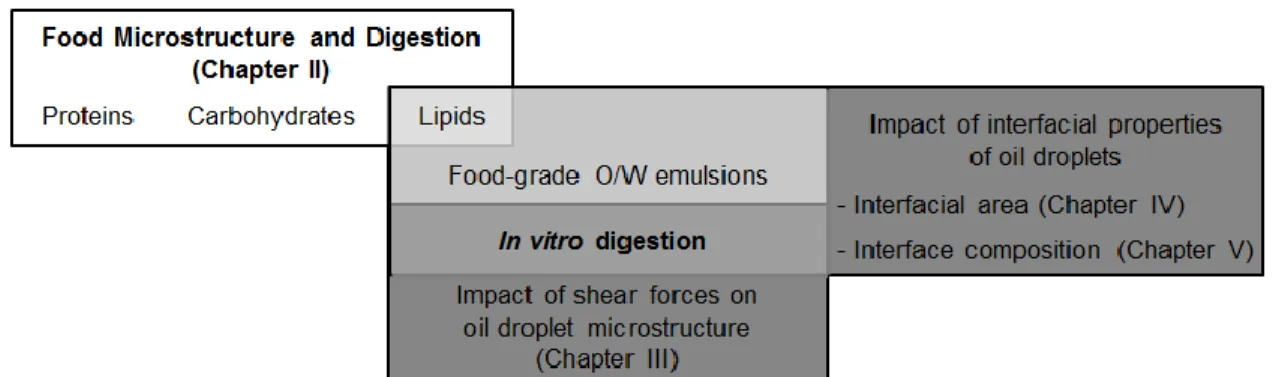
(20) contain a non-polar region (the oil phase), a polar region (the aqueous phase), and an amphiphilic region (the interfacial layer). Then, within O/W emulsions it is possible to incorporate functional agents that are polar, non-polar, and amphiphilic (McClements, 2005). Nevertheless, conventional emulsions have some limitations (e.g., physical instability) that promote the development of more sophisticated structured systems. Like conventional emulsions, nanoemulsions consist of small oil droplets (diameter < 200 nm) dispersed within a continuous phase, with each droplet being surrounded by a protective coating of emulsifier molecules. For certain applications, nanoemulsions do have a number of advantages over conventional emulsions due to their relatively small particle size: (i) they scatter light weakly and so tend to be transparent; (ii) they have high physical stability; (iii) they have unique rheological characteristics; and, (iv) they can greatly increase the bioavailability of encapsulated lipophilic components (Mason et al., 2006). Additionally, the very small oil droplet size in nanoemulsions increases the digestion rate and the total amount of free fatty acids released during digestion in comparison with conventional emulsions (Li & McClements, 2010). This last characteristic may be of interest for the design of lipid food for humans with disorders that prevent efficient digestion or absorption of lipids (e.g., cystic fibrosis or pancreatitis) (Fave et al., 2004). Multiple emulsions are systems in which dispersed droplets contain smaller droplets inside (Figure 1.1). Particularly, water-in-oil-in-water (W/O/W) emulsions consist of small water droplets contained within larger oil droplets that are dispersed in an aqueous continuous phase. In these systems, functional components can potentially be located in a number of different ways. Water soluble components can be incorporated into the inner or outer water phase, while oil soluble components can be incorporated into the oil phase. Potential advantages of multiple emulsions over conventional emulsions as delivery systems are: (i) functional ingredients could be trapped inside the inner water droplets and released at a controlled rate in the GIT; (ii) functional ingredients could be protected from chemical degradation; and (iii) reduction of the overall fat content of food products by loading the oil phase with water droplets (McClements et al., 2009).. 7.
(21) The quality and functional performance of conventional O/W emulsions can be improved by the formation of multilayered interfaces using the layer-by-layer electrostatic deposition technique (Guzey & McClements, 2006). Multilayered emulsion delivery systems may have a number of advantages over conventional single-layered emulsions: (i) improved physical stability to environmental stresses; (ii) greater control over the release rate of functional agents due to the ability to manipulate the thickness and permeability of the laminated interfacial coating; and (iii) ability to trigger release of functional agents in response to specific changes of environmental conditions in the GIT, such as dilution and/or pH (McClements et al., 2009). On the other hand, it is possible to control the physical location of a lipophilic component and to slow down molecular diffusion processes using conventional emulsions by crystallizing the lipid phase. These systems are known as solid lipid particle emulsions, which consist of emulsifier coated (partially) solid lipid particles dispersed in an aqueous continuous phase (Figure 1.1) (Videira et al., 2002). By controlling the morphology of the crystalline lipid matrix it is possible to obtain more precise control over the release kinetics of functional compounds. Additionally, both lipophilic and hydrophilic bioactives can be incorporated within the same system using solid lipid particle emulsions (McClements et al., 2009). Hence, there are a large number of different ways that can be used by food manufacturers to embed lipophilic compounds within food matrices with different degradation rates. However, the selection of a particular matrix is a matter of functional preference.. 1.4. Scope and objectives of this thesis From the above presentation it is clear that the subject of controlling lipid food structure in processed foods will increasingly attract the attention of researchers in the field and the related industries. More research will be needed on new lipid structures to regulate lipid digestion and its subsequent bioavailability. This thesis covers an untapped area of food engineering science, namely that of breakdown of food emulsions inside the gastrointestinal tract. The fundamental hypothesis of this work is that it is possible to. 8.
(22) design new emulsion-based foods by using proper techniques to control the in vitro lipid digestion. Therefore, the overall objective of the present thesis was to increase our knowledge about the impact of different factors controlling food digestion in model lipid food systems with the aim of developing product concepts that have tailor-made physical and nutritional properties. In order to achieve this aim, the thesis was divided into the following specific objectives:. . Review the impact of food microstructure on digestion, analyzing the sequential degradation of food nutrients during their passage in the GIT (Chapter II).. . Study the time-dependent rheological properties of protein-stabilized O/W emulsions to establish relationships between structure and shear rate similar to those found in the GIT, and relating this information with the microstructure of the emulsions (Chapter III).. . Study the effect of the organic phase composition on the particle size distribution, electrical characteristics, microstructure, and appearance of nanoemulsions stabilized by a small molecule non-ionic surfactant (Tween 20) and, subsequently, the influence of particle size on the in vitro digestibility of emulsions under simulated small intestinal conditions (Chapter IV).. . Study the impact of interfacial properties on the in vitro digestibility of proteincoated lipid nanoparticles (Chapter V).. 1.5. Outline of the thesis The central theme of this thesis is the study of in vitro digestibility of O/W emulsions, analyzing different factors that control their performance in the GIT. In Chapter 2, a brief review of the existing relationship between food microstructure and digestion of different macronutrients is conducted, since this is a prerequisite to make a global analysis of the subject covered in this work. Chapter 3 presents the rheological and microstructural characterization of protein-stabilized O/W emulsions and their timedependent flow behavior, as possibly found in the GIT when this kind of structures are. 9.
(23) digested. Chapter 4 investigates the fabrication and characterization of food-grade nanoemulsions and their digestibility by lipase. In this chapter, the influence of particle size on the in vitro digestion of nanoemulsions containing lipid droplets (corn oil) stabilized by a non-ionic surfactant (Tween 20) was examined using simulated small intestine conditions. In Chapter 5, the influence of particle size on the in vitro digestion of BLG-coated lipid nanoparticles was also examined using simulated small intestine conditions. Nanoemulsions were prepared by high-pressure homogenization and organic solvent (hexane) evaporation. The effect of the initial organic phase composition on the size, microstructure, electrical properties, and digestion of the lipid nanoparticles was evaluated. Finally in the Chapter 6, the main findings of the previous chapters are discussed. A summary of the contents of the Chapters II to V is schematically presented in Fig. 1.2, showing the relationship between the different chapters of this thesis.. Figure 1.2. Overview of the studies comprising this thesis.. 10.
(24) REFERENCES Aguilera, J. M. (2005). Why food microstructure?. Journal of Food Engineering, 67(12), 3-11. Aguilera, J. M., and Stanley, D. W. (1999). Microstructural Principles of Food Processing and Engineering. 2nd Edition. Aspen Publishers Inc., Gaitherburg, MA. Armand, M., Pasquier, B., André, M., Borel, P., Senft, M., Peyrot, J., Salducci, J., Portugal, H., Jaussan, V., and Lairon, D. (1999). Digestion and absorption of 2 fat emulsions with different droplet sizes in the human digestive tract. American Journal of Clinical Nutrition, 70(6), 1096-1106. Fave, G., Coste, T., and Armand, M. (2004). Physicochemical properties of lipids: New strategies to manage fatty acid bioavailability. Cellular and Molecular Biology, 50(7), 815-831. German, J. B., and Watzke, H. J. (2004). Personalizing food for health and delight. Comprehensive Reviews in Food Science and Food Safety, 3(4), 145-151. Guzey, D., and McClements, D. J. (2006). Formation, stability and properties of multilayer emulsions for application in the food industry. Advances in Colloid and Interface Science, 128-130(1), 227-248. Li, Y., and McClements, D. J. (2010). New mathematical model for interpreting pH-Stat digestion profiles: Impact of lipid droplet characteristics on in vitro digestibility. Journal of Agricultural and Food Chemistry, 58(13), 8085-8092. Lundin, L., Golding, M., and Wooster T. J. (2008). Understanding food structure and function in developing foods for appetite control. Nutrition & Dietetics, 65(3), 79-85. Mason, T., Wilking, J., Meleson, K., Chang, C., and Graves, S. (2006). Nanoemulsions: Formation, structure, and physical properties. Journal of Physics: Condensed Matter, 18(41), 635-666. McClements, D. J. (2005). Food emulsions: Principles, Practice, and Techniques. CRC Press, Boca Raton, FL. McClements, D. J., Decker, E., Park, Y., and Weiss, J. (2009). Structural design principles for delivery of bioactive components in nutraceuticals and functional foods. Critical Reviews in Food Science and Nutrition, 49(6), 577-606.. 11.
(25) Olbrich, C., Kayser, O., and Muller, R. (2002). Lipase degradation of Dynasan 114 and 116 solid lipid nanoparticles (SLN) - Effect of surfactants, storage time and crystallinity. International Journal of Pharmaceutics, 237(1-2), 119-128. Palzer, S. (2009). Food structures for nutrition, health and wellness. Trends in Food Science and Technology, 20(5), 194-200. Parada, J., and Aguilera, J. M. (2007). Food microstructure affects the bioavailability of several nutrients. Journal of Food Science, 72(2), 21-32. Simopoulos, A. (1999). Essential fatty acids in health and chronic disease. American Journal of Clinical Nutrition, 70(3), 560-569. Ulrich, A. (2002). Biophysical aspects of using liposomes as delivery vehicles. Bioscience Reports, 22(2), 129-150. Videira, M., Botelho, M., Santos, A., Gouveia, L., de Lima, J., and Almeida, A. (2002). Lymphatic uptake of pulmonary delivered radiolabelled solid lipid nanoparticles. Journal of Drug Targeting, 10(8), 607-613. Wickham, M., Garrood, M., Leney, J., Wilson, P., and Fillery-Travis, A. (1998). Modification of a phospholipid stabilized emulsion interface by bile salt: Effect on pancreatic lipase activity. Journal of Lipid Research, 39(3), 623-632.. 12.
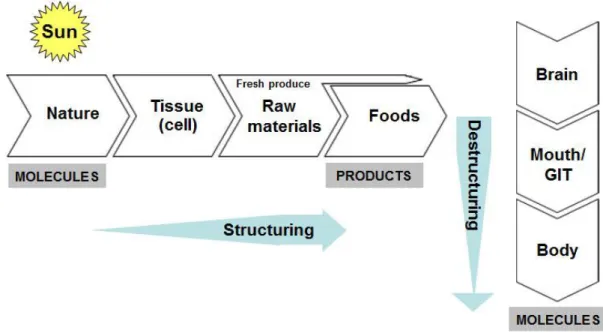
(26) 2. FOOD MICROSTRUCTURE AND DIGESTION. 2.1. Introduction The fundamental role of food structure in understanding the behavior of foods during processing and eating is well established (Aguilera, 2005). New interest has arisen regarding the function that food structure may play once foods are inside the body and, consequently, in our nutrition, health and well-being (Figure 2.1). Attention is further supported by the increased belief that foods and not nutrients are the fundamental unit of nutrition (Jacobs and Tapsell, 2007).. Figure 2.1. Foods we eat: from molecules to products and back to molecules. While food processing induces structure formation, digestion is basically a destructuring step. Thus, the release of nutrients from the food matrix (the composite containing the nutrients in a food) as well as the interactions between food components and restructuring phenomena during transit in the digestive system becomes far more important than the original contents of nutrients. In this respect, Lundin et al. (2008) have recently stated that there is an emerging interest in the impact of food structure on 13.
(27) digestive behavior and its relationship to human nutrition, because the interactions between individual macronutrients (protein, fat and carbohydrate) control in many cases the rate of digestive processes, such as proteolysis and lipolysis, influence satiety and condition the absorption of nutrients. This chapter summarises some of the major findings presently available on the effect of food microstructure on the digestive process.. 2.2. Food structures We ingest nutrients in the form of microstructures spanning in size from nanometers to a few millimeters (Aguilera and Stanley, 1999). In plant tissue, major food components such as starch, storage proteins and most lipids are contained in discrete, homogeneous packets embedded in the cellular cytoplasm. Other food molecules are hierarchically assembled into functional structures as is the case of the cellulose and pectin in plant cell walls and of collagen and the myofibrillar proteins in muscle tissues. Some key food molecules are bound or enclosed in organelles, and thus are not readily available. Moreover, during processing or cooking new structures are formed and further complex interactions, yet to be resolved, develop from the molecular level to the micron scale (see Figure 2.2). This is the chemical and structural panorama of the food we eat and digestion has to liberate and breakdown molecules to a state in which they can be absorbed, but in so doing restructuring and interactions take place complicating further our understanding of nutrient release and its bioaccessibility (Parada and Aguilera, 2007). For instance, the presence of an insoluble state (e.g., clotted milk proteins, precipitated polysaccharides or highly viscous fibre) is known to delay gastric emptying (Hoebler et al., 2002). In summary, when it comes to nutrition, health and wellbeing, the microstructure of foods within our bodies matters.. 14.
(28) Figure 2.2. Some hierarchical structures of major food components as may be present in foods. 2.3. The reactor inside our bodies The GIT is a versatile multi-compartment reactor that operates on a variable solid/liquid feed but delivers more or less standardised products. The main organs of the GIT include the mouth, the stomach and the small intestine. The GIT is connected to the vascular, lymphatic and nervous systems allowing the regulation of the digestive response, delivery of absorbed compounds to organs in the body and the regulation of food intake (Schneeman, 2002). In the GIT, the structure of foods undergoes major size reduction. 15.
(29) facilitating the release of nutrients embedded in the food matrix so they may be subjected to enzymatic action and eventually absorbed. Mouth and stomach are the major compartments where foods are disintegrated into smaller sizes, whereas the small intestine is the major site of macromolecular breakdown and nutrient absorption. In the GIT, both mechanical forces and chemical reactions breakdown ingested food into small molecules, and the kinetics of digestion depends on the particular physicochemical characteristics of the flowing contents as well as on physiological conditions. Disintegration and dissolution are affected by the formulation and processing conditions (e.g. shear, mixing, heat) used at the manufacturing/preparation stage (Kong and Singh, 2008). Using starch as an example, equal amounts consumed in foods prepared using different added ingredients (e.g. presence of sugar) and water contents, and subject to diverse forming and heating conditions will differ in their kinetics of digestion. Before absorption in the gut, any compound of interest has to be bioaccessible, meaning that it has to be in a molecular dispersed state, colloidal form, or within a micellar system in the case of hydrophobic materials.. 2.4. Food structures in the mouth The oral step is rapid but plays an important role in reducing particle size, mixing, hydrating and lubricating the contents with saliva so that a bolus is formed and swallowed. Mastication increases the surface area of food pieces but it may be quite inefficient in breaking open some plant tissues as demonstrated by the presence of intact cells of nuts in the faeces (Ellis et al., 2004). While a small portion of starch is hydrolysed by the enzyme α-amylase due to the short retention time, almost no protein or fat digestion occurs in the mouth.. 2.5. Food structures in the stomach The motility of the stomach mixes the ingested bolus with gastric juice, which contains acid and digestive enzymes (e.g. gastric lipase, pepsin and mucin), inducing further reduction of particle size, remixing and phase separation. Dietary lipid is dispersed into a 16.
(30) finely divided emulsion by the peristalsis of the stomach, creating a lipid-water interface where enzymatic hydrolysis by gastric lipases takes place. In healthy humans, gastric lipase leads to the hydrolysis of 10-30% of ingested TAGs, the main hydrolytic products being DAGs and free fatty acids (FFAs). It has been shown in vitro that some components of dietary fibre interfere with the lipid emulsification process, leading to a smaller area of “clean” interface and consequently to lower TAG lipolysis (Armand, 2007). Likewise, the nature of a preexisting adsorbed layer on fat droplets conditions hydrolysis. Proteins stabilising an emulsion may undergo conformational changes by the acidic environment of the stomach, especially if they are denatured and become aggregated, thus affecting lipolysis. The emulsion leaving the stomach contains emulsified lipids as fine droplets (i.e. < 0.5 μm in diameter) as well as a hydrolysed lipid fraction. The action of pepsin on proteins results in a mixture of polypeptides, oligopeptides and some free amino acids. In any case, the efficacy of proteolysis in the stomach depends on the structural changes of individual proteins or protein assemblies, as affected by the lower pH and ionic strength. For example, casein, unlike whey proteins, coagulates in the stomach and as a result the overall gastric emptying time for casein is longer. This reduced postprandial increase in plasma amino acids compared to that of noncoagulating whey proteins, has led to the concept of “fast” and “slow” proteins (Hall et al., 2003).. 2.6. Food structures in the intestine The peristaltic motor activity propels the chyme along the length of the intestine where it is exposed to pancreatic enzymes (such as pancreatic lipase, co-lipase, trypsin, chymotrypsin and carboxipeptidases) and bile salts, while mixed with phospholipids and sloughed intestinal cells. In the case of lipids, the combined action of bile and pancreatic juice brings about a marked change in the physicochemical form of the luminal lipid emulsion. Pancreatic lipase is secreted into the duodenum, and in the presence of colipase it hydrolyses the remaining TAGs to form MAGs and FFAs. Pancreatic lipase. 17.
(31) (and gastric lipase as well) acts on emulsified substrates, thus, the physicochemical properties of the emulsion-water interface largely determine the extent of enzyme binding and consequent lipolysis. Finally, lipid digestion continues in the small intestine with desorption and dispersion of insoluble lipid into an absorbable form. Digested lipids are solubilised in the lumen of the intestine into at least two types of nanostructures: bile salt micelles and unilamellar vesicles. These assemblies deliver digested lipids to an aqueous-enterocyte layer where they are subsequently absorbed into the enterocyte´s brush border membrane lining the surface of the small intestine (Singh and Horne, 2009). Figure 2.3 shows a scheme of the digestive process for lipid foods in the GIT.. Figure 2.3. Schematic diagram of the digestive process of an oily plant food. The dynamics of digestion of fatty foods in the GIT leads to the breakdown of complex structures, which disassemble during transit or may remain intact. Adapted from Porter et al. (2007).. 18.
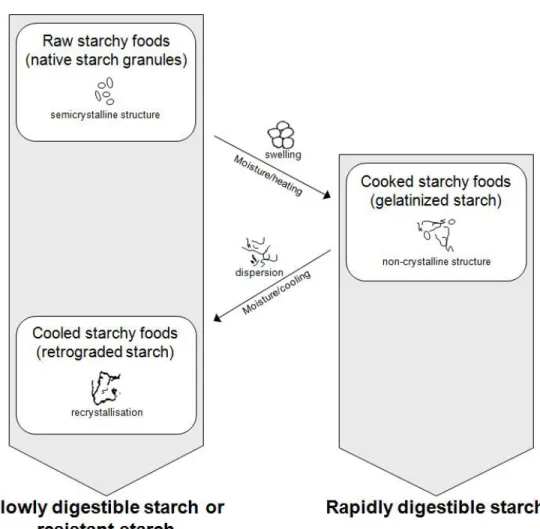
(32) The final steps in the digestion of proteins take place in the intestinal lumen and are associated with small intestinal mucosal cells, which contain a number of peptidases. The collective result of the action of proteases in the GIT is to reduce the majority of dietary protein to a mixture of free amino acids, dipeptides and tripeptides, making them available to the various carrier-transporters of the brush border membrane. However, the physical and chemical state of proteins, affected by the environment of the GIT or previous proccesing (e.g. thermal treatment), might change the intestinal transport properties as has been shown for allergenic proteins. Harsh conditions in the GIT, interaction with lipids and the formation of larger aggregates contribute to the allergenicity of plant food proteins (Breiteneder and Mills, 2005). Thermal denaturation not only affects the physical state of proteins but also their susceptibility to the pepsin and the trypsin/chymotrypsin mixture. The presence of plant hydrocolloids (e.g. pectins) and their nonspecific interactions with some proteins reduces the accessibility of proteases to cleavage sites. Complex carbohydrates are digested to monosaccharides, mostly glucose, galactose and fructose, prior to absorption in the small intestine. Intestinal digestion occurs through reactions mediated by pancreatic α-amylases and by disaccharidases anchored to the brush border surface of the enterocytes. Enterocytes are then responsible for the complete absorption of the sugars into the body and once absorbed, galactose and fructose are mostly converted to glucose for metabolism or storage (Wright et al., 2003). The physical form of food is the major determinant of the rate of digestion of both starches and sugars. The extent of starch digestion within the small intestine is variable, depending on its physical form and a substantial amount of undigested starch enters the colon, where may be fermented by bacteria or simply appear in faeces. The degree of gelatinisation of starch granules and of recrystallisation of the released polymers is of vital importance in the breakdown to sugars because both phenomena influence the susceptibility to enzymatic degradation. In this context, a classification of starchy foods based on intrinsic factors (i.e. physical structure) has been proposed for starch digestibility in the small intestine as it may vary from a rapid digestion to indigestibility. 19.
(33) (i.e. resistant starch) (Figure 2.4) (Lehmann and Robin, 2007). The incomplete digestion of starch is related to the matrix surrounding starch, the nature and physicochemical properties of the starch per se at the granule and molecular levels (e.g. granule size and amylose/amylopectin ratio), and the presence of other dietary components (e.g. sugar, dietary fibre and lipid). The “encapsulation” of starch granules by a protein network is an important factor in explaining the slow degradation of starch by α-amylase in pasta, which may limit its accessibility due to different structural factors, such as porosity, compactness and tortuosity of the protein matrix, and structure of starch.. Figure 2.4. Digestibility of starch in the small intestine according to the structural changes of starch granule induced by processing.. 20.
(34) 2.7. Conclusions As foods rather than nutrients become a primary consideration in the search for better health and well-being, the role of food structure becomes even more prominent. A better understanding of the structural changes in the gut and interactions taking place will allow the rational design of foods and bioactive supplements for specific conditions. This is not an easy task since we eat meals that vary in the quantity and quality of food components as well as in the type of matrices in which they are contained. Experimental apparatus that simulate the dynamics in the GIT on real foods are urgently needed to rapidly screen the effects of food microstructure and then proceed to validation by expensive in vivo human experiments.. References Aguilera, J. M., and Stanley, D. W. (1999). Microstructural Principles of Food Processing and Engineering. 2nd ed. Aspen Publishers Inc, Gaithersburg, MD. Aguilera, J. M. (2005). Why food microstructure?. Journal of Food Engineering, 67, 311. Armand, M. (2007). Lipases and lipolysis in the human digestive tract: where do we stand?. Current Opinion in Clinical Nutrition and Metabolic Care, 10, 156-164. Breiteneder, H., and Mills, E. N. C. (2005). Plant food allergens – structural and functional aspects of allergenicity. Biotechnology Advances, 23, 395-399. Ellis, P. R., Kendall, C. W. C., Ren, Y., Parker, C., Pacy, J. F., Waldron, K. W., and Jenkins, D. J. A. (2004). Role of cell walls in the bioaccessibility of lipids in almond seeds. American Journal of Clinical Nutrition, 80, 604-613. Hall, W. L., Millward, D. J., Long, S. J., and Morgan, L. M. (2003). Casein and whey exert different effects on plasma amino acid profiles, gastrointestinal hormone secretion and appetite. British Journal of Nutrition, 89, 239-248. Hoebler, C., Lecannu, G., Belleville, C., Devaux, M. -F., Popineau, Y., and Barry, J. L. (2002). Development of an in vitro system simulating bucco-gastric digestion to assess the physical and chemical changes of food. International Journal of Food Science and Nutrition, 53, 389-402.. 21.
(35) Jacobs, D. R., and Tapsell, L. C. (2007). Food, not nutrients, is the fundamental unit in nutrition. Nutrition Reviews, 65, 439-450. Kong, F., and Singh, R. P. (2008). Disintegration of solid foods in human stomach. Journal of Food Science, 73(5), 67-80. Lehmann, U., and Robin, F. (2007). Slowly digestible starch - its structure and health implications: A review. Trends in Food Science & Technology, 18, 346-355. Lundin, L., Golding, M., and Wooster, T. J. (2008). Understanding food structure and function in developing food for appetite control. Nutrition & Dietetics, 65(3), S79-S85. Parada, J., and Aguilera, J. M. (2007). Food microstructure affects the bioavailability of several nutrients. Journal of Food Science, 72, 21-32. Porter, J. H., Trevaskis, N. L., and Charman, W. N. (2007). Lipids and lipid-based formulations: optimizing the oral delivery of lipophilic drugs. Nature Reviews Drug Discovery, 6, 231-248. Schneeman, B. O. (2002). Gastrointestinal physiology and functions. British Journal of Nutrition, 88(2), S159-S163. Singh, H., Ye, A., and Horne, D. (2009). Structuring food emulsions in the gastrointestinal tract to modify lipid digestion. Progress in Lipid Research, 48, 92-100. Wright, E. M., Martín, M. G., and Turk, E. (2003). Intestinal absorption in health and disease-sugars. Best Practice & Research Clinical Gastroenterology, 17(6), 943-956.. 22.
(36) 3. RHEOLOGICAL AND MICROSTRUCTURAL CHARACTERIZATION OF WPI-STABILIZED O/W EMULSIONS EXHIBITING TIME-DEPENDENT FLOW BEHAVIOR. Abstract The rheological behavior of O/W emulsions stabilized by WPI and its relationship with their possible microstructural changes was studied. Sunflower oil-in-water emulsions (50, 55, and 60 g oil/100g) were prepared by ultrasound. Rheological properties of the emulsions were determined by: flow curve test, constant shear rate test, and hysteresis loop test. In order to evaluate microstructural changes in the emulsions induced by shear rate, droplet size and droplet size distributions were obtained using image analysis techniques. Emulsions containing 50 and 55 g oil/100g showed a Newtonian behavior, whereas emulsions with 60 g oil/100g exhibit shear thinning behavior. Under constant deformation, the emulsions presented a decrease in their apparent viscosity. The hysteresis loop test revealed that increasing oil content increases the degree of thixotropy of the emulsions. Additionally, before and after the application of the constant deformation test, droplet size distributions did not show differences, reflecting that the decrease in the apparent viscosity with time may be generated by breakdown and further deformation and/or reorganization of oil droplets flocs. In turn, experimental data obtained from the constant shear stress test was fitted using a structural kinetic model. The rate constant (k) values showed no particular trend with oil content and shear rate, indicating that probably wall slip occurred at high shear rates and high oil contents.. 3.1. Introduction Considerable research has been carried out by food scientists to establish the physicochemical and structural basis of food properties. For many years, food science has attempted to identify relationships between food composition, structural. 23.
(37) organization and interactions of food components, and the bulk physical and sensory properties of foods, such as texture, appearance, flavor, and shelf life (Aguilera, 2005). Thus, the principles of process engineering of biomaterials and the fundamental role of food structure in understanding the behavior of foods during processing are well established (Aguilera, 2005; German and Watzke, 2004). This knowledge is the basis for the development of novel food matrices with targeted health and nutritional benefits. In addition, although the total amount of a nutrient in natural and processed foods may be obtained from composition tables, its bioavailability depends on many factors, such as food microstructure, processing conditions, digestion conditions and presence of other components. However, there is still a lack of clarity concerning the performance of foods inside our body, which has limited the capacity of the industry to create products with tailored nutritional properties. Particularly, emulsion-based food products have been widely studied due to their natural or commercial availability, exhibiting a wide variety of different physicochemical and organoleptic characteristics. Many natural and processed foods consist either partly or wholly as emulsions or have been in an emulsified state at some time during their production; such foods include milk, cream, butter, margarine, mayonnaise, sauce, among others (McClements, 2005). The understanding and manipulation of bulk properties of emulsion systems are of utmost importance in the food industry. Shelf life, mouth-feel and flow properties, to name a few, are to great extent determined by interactions present between the system’s constituents. Crucial for creating the desired structure is an excellent control of the bulk properties during processing of foods by the manufacturer. An important challenge for food emulsion science is therefore to understand, monitor and control the changes in colloidal interactions, rheology and microstructure during processing (Dalgleish, 2006). The rheological properties of emulsions are needed to design in a more rational fashion new emulsion-based foods and also processing operations which depend on the way that foods behave when flows (e.g., flow through a pipe, stirring in a mixer, passage through a heat-exchanger, etc.). In particular, the time-dependency of the flow properties of food. 24.
(38) emulsions is of great practical importance in pumping or mixing operations, which must be carefully controlled so that the food sample has an apparent viscosity that is suitable for the next processing operation (McClements, 2005). In this scenario, rheological measurements are frequently used by food scientists as an analytical tool to provide fundamental insights about the structural organization and interactions of the components within emulsions. For example, measurements of viscosity versus shear rate can be used to estimate the strength of the colloidal interactions between droplets of fluid emulsions (Tadros, 2004). The chemical composition and microstructure are known to have a significant effect on the rheological properties of food products and, consequently, on the performance of various end-use applications, including food digestion. In particular, food emulsions are compositionally and structurally complex materials that exhibit a wide range of different rheological behaviors, ranging from low-viscosity fluids (such as milk and fruit juice beverages) to fairly hard solids (such as refrigerated margarine or butter), according to the structure, dimensions, and organization of the components in food emulsions. This variability in the rheological properties of food emulsions is dominated by the fact that the droplets are flocculated, and so it is important to understand the factors that determine the structure of these systems. In general, food emulsions contain droplets that can present various types of colloidal interactions acting between them (e.g., van der Waals, electrostatic, steric, hydrophobic, and depletion), which dramatically influence the rheology of food emulsions. For example, two emulsions with the same droplet concentration could have rheological properties varying from a low-viscosity Newtonian liquid to a highly viscoelastic material, depending on the nature of the colloidal interactions (McClements, 2005). In order to deepen into the structural changes of food emulsions under shearing, as those found during gastric and intestinal digestion, rheological studies can be conducted to predict these changes. As an example, when food emulsions are subjected to shear forces induced by different processing conditions, the rate at which an emulsion changes its structural organization and the mechanism by which this process occurs depend on its. 25.
(39) composition and microstructure, as well as on the environmental conditions it experiences (Aguilera and Stanley, 1999). Further, according to the flow conditions, reversible and irreversible structural changes can be induced in food emulsions (Bower et al., 1999). The characterization of time-dependent rheological properties of food systems requires establishing relationships between structure and flow (Abu-Jdayil, 2003). This information is particularly useful for food manufacturers who need to formulate emulsions with enhanced shelf-life or promote emulsion instability in a controlled fashion. Hence, the objective of this study was to investigate the rheological properties of O/W emulsions stabilized by WPI during controlled rheological tests as affected by the oil content and shear rate, relating this information with the microstructure of these emulsions.. 3.2. Materials and methods 3.2.1. Materials Whey protein isolate (BiPRO™, Davisco Foods International Inc., Le Sueur, MN, USA) was employed as the sole emulsifying agent to stabilize the O/W emulsions. A commercial brand of sunflower oil (Natura™, Córdoba, Argentina) was used as dispersed phase. Distilled water was employed in the preparation of all the formulations.. 3.2.2. Emulsion formation Emulsions were prepared from a dispersed and an aqueous phase. The dispersed phase consisted of sunflower oil, whereas aqueous phase corresponded to emulsifier solutions prepared by stirring for at least 2 hours WPI powder into distilled water a 25ºC, avoiding foam formation. These solutions were kept at 4°C for at least 12 h to ensure complete hydration of proteins. pH of continuous phase was measured with a digital pH-meter (pH 200, Hanna Instruments, Italy) and presented a value of 7.0 ± 0.1 for all samples. To elaborate the O/W emulsions, sunflower oil was added dropwise to emulsifier solutions while mixing at 25ºC using a stirring plate at 960 rpm for 1 min, forming a pre-. 26.
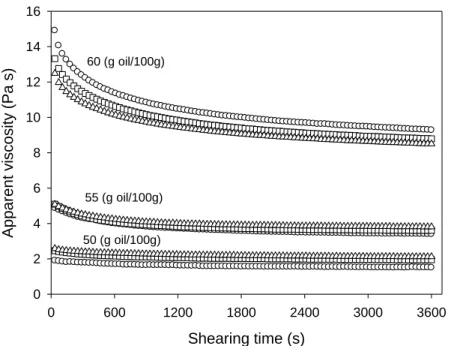
(40) emulsion with different oil contents (50, 55 and 60 g oil/100g) and with a constant oilto-protein mass ratio of 15:1. The final emulsion formation was carried out using an ultrasonic processor (Branson Sonifier 450, Branson Ultrasonics, Danbury, CT, USA) with a 19 mm stainless steel ultrasound probe used to sonicate the pre-emulsion. The ultrasound probe was adjusted 1 cm below the surface of the sample. Sonication was performed in pulsed mode (frequency: one pulse per second, pulse duration: 0.3 s) at a nominal power level of 100 W for 180 s.. 3.2.3. Rheological properties of O/W emulsions All rheological tests were made in a controlled shear rate rheometer (Rheolab MC20, Physica Inc., Stuttgard, Germany). Samples were carefully poured into the rheometer cup and allowed to stand at least 10 min before shearing. Test temperature was set at 25 ± 0.1ºC using a thermoregulated water bath (Viscotherm VT10, Physica Inc., Stuttgard, Germany). The test geometry was a coaxial cylinder geometry conforming to DIN 53019 (bob radius: 22.5 mm; length: 67.5 mm; cup radius: 24.4 mm). The rheological characterization of the emulsions was performed using three different tests: i) flow curve test, where the shear rate was increased linearly from 0 to 500 s-1 during 60 min; ii) constant shear rate test, where the emulsions were subjected to deformation by applying different shear rates (100, 300 and 500 s-1) during 60 min; iii) hysteresis loop test, where the shear rate was increased linearly from 0 to 500 s-1 during 60 min (upward ramp) and then the shear rate was decreased from 500 to 0 s-1 during 60 min (downward ramp).. 3.2.4. Modeling of flow behavior of the O/W emulsions Over the range of shear rates, the experimental flow curves of the emulsions were described by a Power Law model as follows:. K m. (3.1). 27.
(41) where τ is the shear stress (Pa), K is the consistency index (Pa sm), is the shear rate (s1. ), and m is the flow behavior index (dimensionless). For a Newtonian emulsion m = 1,. for an emulsion which exhibits shear thinning behavior m < 1, and for an emulsion which exhibits shear thickening m > 1.. 3.2.5. Modeling of the time-dependent rheological behavior of the O/W emulsions To understand the time-dependent behavior of the O/W emulsions, data from the constant shear rate test was fitted to a structural kinetic (SK) model. This model assumes that the change in the time-dependent rheological behavior is associated with shearinduced breakdown of the internal structure of non-food and food products (Abu-Jdayil, 2003; Cheng and Evans, 1965; Mallik et al., 2010; O’Donnell and Butler, 2002). Hence, the SK model can be expressed as an n-order kinetic equation that describes the structural breakdown under shearing by means of a time-dependent structural parameter (λ, dimensionless):. d n k e dt. (3.2). In the above equation, the rate constant k (s-1) is function of shear rate, λe is the structural parameter at the equilibrium state (t = ∞), and n (dimensionless) is the reaction order. At a constant shear rate, Eq. 3.2 can be integrated and rearranged to yield:. 0 1 n n 1 k t 0 e 1n. (3.3). where λ0 is the structural parameter at the fully-structured state (t = 0). Because λ cannot be obtained from experimental measurements, this structural parameter can be expressed in terms of the instantaneous apparent viscosity as follows,. , t . e 0 e . (3.4). being η the apparent viscosity (Pa s) at time t, η0 the initial apparent viscosity at the fully-structured state (t = 0), and ηe the apparent viscosity at the equilibrium state (t = ∞). Then, substituting Eq. 3.4 into Eq. 3.3 yields,. 28.
(42) e 0 e . 1 n. 1 n 1 k t. (3.5). Although the above equation is only valid for constant shear rate conditions, this expression allows a simple way for the determination of the kinetic parameters (k and n) using the experimental values of apparent viscosity obtained from the constant shear rate test. However, due to a constant value in the apparent viscosity was not found for some experimental tests at the end of the constant shearing time, the ηe values for all experiments were obtained by non-linear regression (Eq. 3.6) using the data from the constant shear rate test,. e a expbt . (3.6). where a and b are empirical parameters of the model proposed.. 3.2.6. Microstructural characterization of the O/W emulsions Microstructure of the emulsions was analyzed before and after the constant shear rate test. This microstructural characterization was carried out in terms of droplet size and droplet size distribution. Droplet diameter was determined from images of the O/W emulsions obtained with a light microscope (Olympus BX50, Optical Co. Ltd., Tokyo, Japan) and recorded with a digital CCD camera (CoolSnap-Pro Color, Photometrics Roper Division, Inc., Tucson, AZ, USA). Previous to this analysis, emulsion samples were diluted with emulsifier solution at a ratio 1:10 (v/v) to avoid the overlapping and agglomeration of oil droplets, which it can affect the further image analysis and processing. Dilution was made using the same protein concentration present in the continuous phase (Nandi et al., 2001). Image processing for droplet size analysis was carried out automatically using a segmentation algorithm developed under Matlab environment (Matlab 7.6, R2009a, The MathWorks Inc, MA, USA), mainly based on mathematical morphology. Briefly, the data processing of the digitalized images consisted of different steps, including contrast enhancement, different filter operations followed by an automatic segmentation. This. 29.
(43) procedure allowed considerable reduction of the data analysis time without losing accuracy. A substantial number of droplets (N > 2500) were counted in order to obtain oil droplet diameters (D) and oil droplet size distributions in each sample. Droplet size distributions were generated by grouping the droplets into classes belonging to a common interval. Droplet size frequency distributions were computed using MS-Excel (MicrosoftTM Excel 2007). Volume frequency of any class interval was calculated as the number of oil droplets in that class (class frequency) divided by the total number of oil droplets, and expressed as a percentage. In order to characterize the cumulative droplet size distributions, the cut-off diameters at 10% (D10), 50% (D50), and 90% (D90) on the cumulative frequency distribution curve were determined.. 3.2.7. Statistical analysis Analysis of variance (ANOVA) tests were used to analyze the data at a confidence level of 95%. The Kolgomorov–Smirnov test (confidence level of 95%) was used to compare the particle size distributions obtained before and after the constant shear rate test. The significance level for all findings reported as statistically significant was that all pairs of curves the distance between them (distance K–S) must not be statistically different (p > 0.05) (Ramírez and Aguilera, 2011). In both statistical tests, Statgraphics Plus version 5.1 (Manugistics Inc., Statistical Graphics Corporation, Rockville, USA) was used.. 3.3. Results and discussion 3.3.1. Rheological behavior of WPI-stabilized O/W emulsions The composition of food emulsions has marked effects on their rheological properties. In order to better understand this point, this work focused on the impact of oil content in WPI-stabilized O/W emulsions on their susceptibility to rheological properties changes. This type of emulsion can be used as model system to enhance the understanding of the structural stability of food emulsions subjected to shear stresses.. 30.
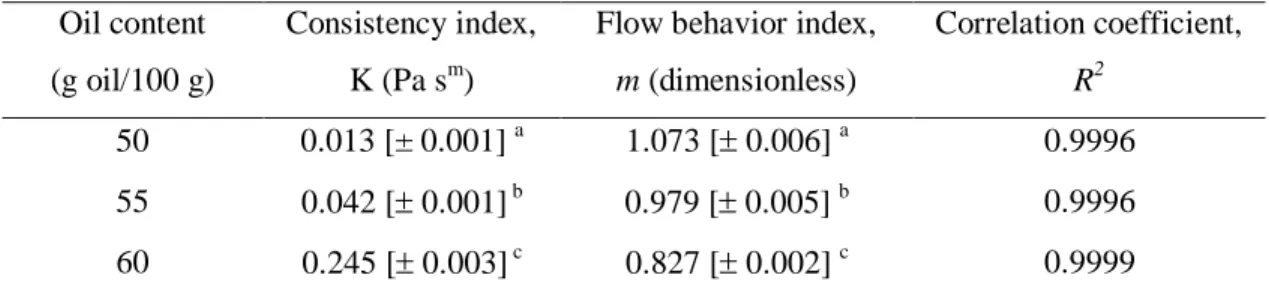
(44) As it was expected, the oil content affected the rheological behavior of O/W emulsions when subjected to shear forces (Figure 3.1). Emulsions containing 50 and 55 g oil/100g presented a Newtonian behavior, whereas emulsions containing 60 g oil/100g showed a non-Newtonian behavior. Over the range of shear rates studied rheological properties of the emulsions were described by a Power Law model (Equation 3.1), with regression coefficients (R2) > 0.99 (see Table 3.1). The rheological parameters obtained from the Power Law model are also presented in Table 3.1. 50. Shear stress, (Pa). 40. 30. 20. 10. 0 0. 100. 200. 300. 400. 500. Shear rate, (s ) -1. Figure 3.1. Rheogram for O/W emulsions containing different oil contents: (○) 50 g oil/100 g; (□) 55 g oil/100 g; and ( ) 60 g oil/100g. Lines refer to the data generated by the Power Law model. Table 3.1. Rheological parameters obtained from the Power Law model. Oil content. Consistency index,. Flow behavior index,. Correlation coefficient,. (g oil/100 g). K (Pa sm). m (dimensionless). R2. 50. 0.013 [± 0.001] a. 1.073 [ 0.006] a. 0.9996. 55. 0.042 [ 0.001] b. 0.979 [ 0.005] b. 0.9996. 60. 0.245 [ 0.003] c. 0.827 [ 0.002] c. 0.9999. - Values in brackets are the 95% confidence intervals of the regression parameters - Columns with different letters indicate significant differences (p < 0.05). 31.
Figure


+7


Documento similar