
The application of SMART (synthesis of skills, motivation, appropriate, relevant, tangible product), in the process of inter learning of English language in Primero de Bachillerato General Unificado, class “J” at Unidad Educativa “Capitan Edmundo Chiribo
73
0
0
Texto completo
(2)
(3)
(4)
(5) GENERAL INDEX. COVER COMMITTEE MEMBERS CERTIFICATE. I II. CERTIFICATE OF AUTHENTICITY. III. ACKNOWLEDGEMENT. IV. GENERAL INDEX GENERAL INDEX TABLE GENERAL INDEX GRAPHIC SUMMARY. V VI VII VIII. INTRODUCTION. X. CHAPTER I. 1. 1. REFERENCE FRAMEWORK. 1. 1.1. Formulation problem. 1. 1.2. Approach to the problem. 1. 1.3. Statement to the problem. 2. 1.4. Guideline questions. 2. 1.5. Objectives. 2. 1.5.1. General. 2. 1.5.2. Specifics. 3. 1.6. Substantiation. 3. CHAPTER II. 5. 2. THEORETICAL FRAME. 5. 2.1. Background investigations on the problem. 5. 2.2. Theoretical foundation. 5. 2.2.1. Importance of synthesis of skills in inter- learning process. 5. 2.2.2. Motivation in inter- learning process. 7. 2.2.3. The importance of appropriate topics in inter- learning process. 7. 2.2.4. Relevant in teaching learning process. 8. 2.2.5. Tangible product in teaching learning process. 9. 2.2.6. English language learning. 9. 2.2.7. Strategies to learn oral expression in foreign languages. 10. 2.2.8. Creating a learning environment. 11.
(6) 2.2.9. Methodology based in tasks/projects. 11. 2.2.10. Establishment of classroom routines. 12. 2.2.11. Rights of the food way of living. 12. 2.2.12. Legal dispositions. 13. 2.3. Hypotheses. 13. 2.4. Variables. 13. 2.4.1. Independent variable. 13. 2.4.2. Dependent variable. 13. 2.5. Basic terms definitions. 13. CHAPTER III. 15. 3. METHODOLOGICAL FRAME. 15. 3.1. Type of study. 15. 3.1.1. Type of Research. 15. 3.1.2. Investigation level. 16. 3.2. Population and Sample. 17. 3.2.1. Population. 17. 3.2.2. Sample. 17. 3.3. Procedures. 17. CHAPTER IV 4. Processing, analysis and interpretation of results. 19. 4.1.1. Processing, analysis and interpretation of results before the S.M.A.R.T. 19. methodology was put into practice 4.1.2. Processing, analysis and interpretation of results after the S.M.A.R.T. 29. methodology was put into practice 4.1.3. 4.1.4. Contrast of the questionnaires before and after the smart methodology was applied. 39. Interpretation of results from the observation sheets. 41. CHAPTER V 5. CONCLUSIONS AND RECOMMENDATIONS. 43. 5.1. Conclusions. 43. 5.2. Recommendations. 44. BIBLIOGRAPHY. 45. ANNEXES. 47.
(7) GENERAL INDEX TABLE. Table 1:. Population. 17. Table 2:. Escucha videos. 19. Table 3:. Habla en inglés. 20. Table 4:. Escribe en inglés. 21. Table 5:. Lee en inglés. 22. Table 6:. Clase dinámica. 23. Table 7:. Interés por aprender inglés. 24. Table 8:. Gusto por los temas. 25. Table 9:. Entiende con claridad. 26. Table 10:. Practica el idioma Inglés. 27. Table 11:. Pregunta cuando no entiende. 28. Table 12:. Escucha videos. 29. Table 13:. Habla en Inglés. 30. Table 14:. Escribe en Inglés. 31. Table 15:. Lee en Inglés. 32. Table 16:. Clase dinámica. 33. Table 17:. Interés por aprender Inglés. 34. Table 18:. Gusto por los temas. 35. Table 19:. Entiende con claridad. 36. Table 20:. Practica el idioma Inglés. 37. Table 21:. Pregunta cuando no entiende. 38. Table 22:. Contrast of the questionnaires before and after the Smart methodology. Table 23:. was applied. 39. Results from the observation sheets. 41.
(8) GENERAL INDEX GRAPHIC. Graphic 1:. Escucha videos. 19. Graphic 2:. Habla en Inglés. 20. Graphic 3:. Escribe en Inglés. 21. Graphic 4:. Lee en Inglés. 22. Graphic 5:. Clase dinámica. 23. Graphic 6:. Interés por aprender inglés. 24. Graphic 7:. Gusto por los temas. 25. Graphic 8:. Entiende con claridad. 26. Graphic 9:. Practica el idioma Inglés. 27. Graphic 10:. Pregunta cuando no entiende. 28. Graphic 11:. Escucha videos. 29. Graphic 12:. Habla en Inglés. 30. Graphic 13:. Escribe en Inglés. 31. Graphic 14:. Lee en Inglés. 32. Graphic 15:. Clase dinámica. 33. Graphic 16:. Interés por aprender inglés. 34. Graphic 17:. Gusto por los temas. 35. Graphic 18:. Entiende con claridad. 36. Graphic 19:. Practica el idioma Inglés. 37. Graphic 20:. Pregunta cuando no entiende. 38. Graphic 21:. Questionnaires before that the smart methodology was applied.. 40. Graphic 22:. Questionnaires after that the smart methodology was applied.. 40. Graphic 23:. Interpretation of results from the observation sheets. (Before). 42. Graphic 24:. Interpretation of results from the observation sheets. (After). 42.
(9)
(10)
(11)
(12)
(13)
(14) CHAPTER I 1.. REFERENCE FRAMEWORK. 1.1. Formulation problem. The application of smart (synthesis of skills, motivation, appropriate, relevant, tangible product), in the process of inter- learning of English language in Primero de Bachillerato General Unificado, class “J” at Unidad Educativa “Capitan Edmundo Chiriboga”, in the city of Riobamba, during the academic year 2014 - 2015”. 1.2. Approach to the problem. To learn English as part of the curriculum in the classrooms always has been necessary and essential to open doors to new knowledge and science experiences, since the new demands of today's world so disposes. Today speak or write English is not enough, but also requires learning its origin, its evolution and its importance worldwide.. To learn a foreign language involves some difficulties, especially because it has not a frequent use, it has a range of problem in its pronunciation, vocabulary, grammar and also to encourage students’ interest and motivation to learn a new language. The before mentioned problems play an important role, since it helps us as researchers to find the flaws and weaknesses of the student at the time of learning the English language. Unidad Educativa “Capitán Edmundo Chiriboga” is an institution which its funda mental vision is “to form citizens with skills and abilities that let them to be a support in the Ecuadorian society” and in consequence inside de academic curriculum. English has an important role within the inter- learning process since it is aimed to promote and contribute to the individual, cultural and educational development of an entire nation.. Among all the problems detected there is demotivation to learn the English language, lack of didactic materials, appropriate classrooms to teach the language and few use of the TICS to become the teaching learning process more interactive; for a successful and 1.
(15) quality learning is essential and necessary to have a few good educational resources, without these features it is obvious that what is pretend to education (evolve and transform it) not be held by the factors mentioned above.. The traditional method based in a book and content repetition has not given the opportunity to motivate and rise interest in the students to learn English language, for that reason actions and strategies are needed to better develop the teaching learning process of English language.. 1.3. Statement of the proble m. What benefits will give the application of S.M.A.R.T. (synthesis of skills, motivation, appropriate, relevant, tangible product) in the English teaching- learning process in the first BGU, classroom “J” at Unidad Educativa “Capitan Edmundo Chiriboga” in Riobamba city during the school year?. 1.4. Guideline questions. . Is the teacher methodology appropriate for English language learning?. . Does teacher methodology account with the didactic resources for English. learning? . Are the done tasks appropriate for learning process?. . Are goals and objectives in English learning achieved?. . Is the technology transference based on English improvement?. 1.5. Objectives. 1.5.1 General. “To apply a pedagogical proposal supported by the use of S.M.A.R.T (synthesis of skills, motivation , appropriate, relevant, tangible product) to improve the. English teaching. learning process in the First BGU classroom “J” at Unidad Educativa “Capitán Edmundo Chiriboga”. 2.
(16) 1.5.2 Specifics . To design activities supported by the S.M.A.R.T. (Synthesis of Skills, Motivation, Appropriate, Relevant, Tangible Product) to improve the English teaching- learning process.. . To use activities based in the S.M.A.R.T. (Synthesis of Skills, Motivation, Appropriate, Relevant, Tangible Product) to improve the English teaching- learning process.. . To evaluate results obtained by the teachers using all the activities involved in the S.M.A.R.T.. (Synthesis of Skills, Motivation, Appropriate, Relevant, Tangible. Product). 1.6. Substantiation. The society and world globalization have encourage to the human being to create common ways of communication between the different races, cultures and ideologists, the English language is used as the universal language in all the process of government, culture and business, which are relevant in the process of globalization for the continuous development of humanity.. Ecuador is not out of the modernization and inclusion wave inside the globalization process that include the English language as a door to enter in new markets and knowledge society, which argues that Ecuador is in a process of change with a view to a new development, taking into account their cultural, tourist, social and commercial side.. Today the English language plays an important role in our country, because it is not only seen as a simple subject more in the teaching- learning process, but its importance is essential in all social aspects; thus Ecuadorian society is challenged to break paradigms in what once was considered a utopia, learning to speak English. With the implementation of the LOEI in our country the English teaching- learning process is changing, since one of its main aspects is to strengthen the English education; there are some strategies as teachers’. 3.
(17) training, didactic materials given by the government and a new curriculum that will encourage students to learn in a better way. Unidad Educativa “Capitán Edmundo Chiriboga” committed with the Riobambeña youth express its desire to support all the initiatives that permit a better teaching- learning process and for this reason, open its door to university students whose will apply the SMART as a new method for teaching and learning English, in which featuring of a good classroom environment, a willingness to learn the language, a good atmosphere of classes, good design in the lesson plan; (either the daily, weekly or monthly) including classes and activities, with the unique purpose for improving the quality of education with respect to the English language.. Teacher's obligation is to create in students a sense of love and passion for learning the English language and that sense as university students, it has acquired throughout the university career; therefore, as students from the English Languages School it is important to have the strong to start a new challenge that will help to develop activities to motivate to students to learn English language.. 4.
(18) CHAPTER II. 2.. THEORETICAL FRAME. 2.1. Background investigations on the problem.. At the moment no previous research on the problem with respect to the above issue, since the same (S.M.A.R.T.) is maintained as a new item which involves the four existing skills for English inter- learning process.. 2.2. Theoretical foundation.. 2.2.1 Importance of synthesis of skills in inter- learning process. Teaching English has become in the last century in a globalized world need and one of the most spoken languages in the world, there is the growing need to train our students with the basic tools to understand the language and communicate, the main purpose is to teach students to achieve mastery of the four skills supporting comprehension and expression through exercises of reading, writing, listening and speaking, while to interact and share with their peers what they have learned in class. Talking about the four skills seem wearisome to some teachers because every day they face difficult situations in the classroom with students, teachers have to be very careful in the preparation of the cla sses, innovate, reflect, look or design suitable materials and try to create different ways to make students learn easily and meaningfully. (DUSSAN, 2012). In this part Dussan explained how important are the four skills inside the English learning process, since our globalized world it requires, besides, join speaking, listening, writing and reading, make easier and meaningful learning and teaching English because students are challenged to put in practice their four skills always so it is going to be greatfull for students’ knowledge.. It is very important taking into account that when Dussan talked about integrating the four skills in English classes, skills are split into two groups: Receptive and Productive skill so, 5.
(19) in this way results easier to make activities if written or oral. The receptive skills include listening and reading while the productive ones are speaking and writing.. As stated by (Al-Jawi, www.uqu.edu.sa, 2010) Receptive skills are the ways in which people extract meaning from the discourse they see or hear, for example when students watch TV, read a story or a magazine, listen to the news, or speak about something; they employ their previous knowledge and deploy a range of receptive skills in order to develop the intellectual capacity and fulfill with the purpose.. Al-Jawi talks about how previous knowledge is activated when students use the four skills while they are learning English, due to all English that they have learnt is implemented when the students are doing the task into the classroom.. The productive skill focuses on speaking and writing, because students need to produce the language and communicate the ideas with their classmates. As stated by (Nasr., 1994) in the process of language learning, it is of significance to note that, looking at the four skills backwards (or from the bottom up), it would not be difficult to realize that writing anything would be much easier if one has read it and seen it first, that reading anything (aloud) would be much easier if one has spoken it first, and that uttering anything would be much easier if one has heard it first. In other words, the four skills in the process of language learning are dependent upon each other in that order.. Taking something from the above, it would not be possible for teachers to develop their classes focusing just on one or two skills, since one is linked with each other. The integration of the four skills is usually an overwhelming process for teachers due to the time spent on class preparation is more than they think but this would be the starting point for the motivation of students in English class inasmuch as they are always on the look-out for what the teacher can provide level of knowledge, the teacher's role would be kinesthetic in the process.. Nasr mentioned that the four skills are connected each other and that is correct learning English results easier when you have already known what you have to do, when you read something is easier write something about it, in the same way read and then speak about what you read. 6.
(20) 2.2.2 Motivation in inter- learning process. Motivation is one of influential factor in English learning. Motivation is a factor of high or low of the goal (Brown, 2001). It is the key of success in learning process. Without motivation, the goal of learning is difficult to be reached. By having motivation students will be enthusiastic and predisposed in teaching learning process so they will be challenged to study English well. For example, a student who does not have motivation in learning English will be lazy and disinterested to learn English since there is no any encouragement that impulses him or her in learning English.. Every learner must have motivation in English learning. Without motivation, the goal of learning is difficult to be reached. Motivation is a factor of high or low of the goal (Brown, 2001). So, motivation is stimulus that comes from inside of individual (intrinsic motivation) and also can be influenced by external factor (extrinsic motivation). The motivation function is as supporter or stimulus for student in English learning so the goal of learning can be reached easily.. High or low motivation which is had by students influences the process and the success of learning process. If a student does not have any motivation to learn English, he or she will be lazy to learn English because there is no any stimulus that drives him or her in learning English. In contrary, the student having high motivation will learn English hard. For example, a student who study in Australia is motivated to study English because he wants to be able to communicate by using English. He will struggle to learn English to survive in Australia because English is the national language. (Abdussalim, 2008).. According to some pedagogists there two kinds of motiva tions, called extrinsic and intrinsic motivations, which are so important into teaching- learning process. The teachers of the new age need to know in a deep way these motivations.. 2.2.3 The importance of appropriate topics in inter- learning process.. To get good results into inter- learning process, education must have important topics which will be appropriates for students, bearing in mind the level, interests and students’ goals. 7.
(21) Appropriation refers to the process through which a person adopts the pedagogical tools available for use in particular social environments (e.g., schools, preservice programs) and through this process internalizes ways of thinking endemic to specific cultural practices (e.g., using phonics to teach reading). Wretch stresses the ways in which appropriation is a developmental process that comes about through socially formulated, goal-directed, and tool- mediated actions. The extent of appropriation depends on the congruence of a learner's values, prior experiences, and goals with those of more experienced or powerful members of a culture, such as school-based teachers. Through the process of appropriation, learners reconstruct the knowledge they are internalizing, thus transforming both their conception of the knowledge and, in turn, that knowledge as it is construed and used by others. (Leont'ev, 1981). Basically the importance of appropriate topics for English students is that if teachers, teach something that is not for the age, culture, and personal experiences of the learners, they are going to feel desmotivated because the topics are not relevant for them and usually the topics are not suitable for them.. 2.2.4 Relevant in teaching learning process. In education, the term relevance typically refers to inter- learning experiences that are either directly applicable to the personal aspirations, interests, or cultural experiences of students (personal relevance) or that are connected in some way to real- world issues, problems, and contexts (life relevance).. a). Personal relevance: occurs when inter- learning is connected to an individual. student’s interests, aspirations, and life experiences. Advocates argue that personal relevance, when effectively incorporated into instruction, can increase a student’s motivation to learn, engagement in what is being taught, and even knowledge retention and recall.. b). Life relevance: occurs when inter-learning is connected in some way to real-world. issues, problems, and contexts outside of school. Life relevance is generally intended to equip students with practical skills, knowledge, and dispositions that they can apply in various educational, career, and civic contexts throughout their lives. As with personal 8.
(22) relevance, advocates contend that life relevance can improve engagement, motivation, and learning acquisition. (curriculum, 2014). 2.2.5. Tangible product in teaching learning process. The Tangible Product is something you create as a result of new knowledge and/or skills produced during the inter-learning process. The Tangible Product must be a challenge for you to create. Usually, it can be held or touched. In some cases, the Tangible product in students is the teachers goal, is what the learners have to have at the end of the unit with a new knowledge constructed by all the relevant and appropriate topics along the unit and along the year, tangible product is the result of a good job between teachers and students.. 2.2.6 English language learning. English is the foreign language with a great amount of use around the world and it is spoken by many academic professional from different social status. In the educational field English is inside the curriculum in the primary and secondary education. According to different researchers in the three first years English is used as a tool of communication among towns of English as a mother tongue and to access directly to fonts of scientist, human and technology knowledge.. In high school there is a greater emphasis in the structuralism frame and English as a communicative tool and text translators are the base goals. However, in spite of the curriculum applied in the schools only few people learn to speak English during their school years of studies. “In the educational field it was thinking that only the teacher has the knowledge inside the classroom, so the students do not have an active participation, learning was only teacher centered” (Bastidas, 2014) said that teaching was only the transmission of knowledge and values, being the teacher the subject and the student the object of learning. Since this point of view the teaching learning process was unidirectional making the teacher active and the student passive without participation in his/her own lea rning.. 9.
(23) Some changes has made during the last years in all aspects of society, as a consequence, this changes has also affected in the teaching- learning process, it means, teacher stops being a simple knowledge transmitter and became an experiences facilitator, plan the teaching- learning process, encourage, motivate, reinforce and help to the students to establish problems to generate discussions and is capable to evaluate his students and at the same time to evaluate themselves. (Allriggh, 2014). The student, on the other hand, becomes in an active subject inside the educative process, a being that think, create, transform, get information, ask, critic, discuss, organize and plan his own learning and also is able to auto evaluate. Inside this new concept ion the teacher will not be the only that gives information, also the student has the opportunity to provide with his own knowledge and ideas to get a significant and effective learner. So the teacher’s function will be to orientate and guide all the students’ activities and create the optimal conditions to have the learning process.. All these transformations also had impact in the teaching of some specific foreign languages, especially the English language, because of the importance of this language around the world. English is the science and technology language.. The knowledge transmission is focus in the student, the teacher facilitates communicative and educational activities. In the English as a second or foreign language the teacher is a facilitator with needs and experimented autonomies by students.. 2.2.7 Strategies to learn oral expression in foreign languages “The methodology to the teaching learning process of foreign languages must be focus towards the execution of exercises and activities to support students during their learning process and to successfully cover their necessities. ” (Met & Galloway, 2006). The oral communication teaching is a challenge to the teacher. A reason could be because in most of the cases the students do not have facilities to practice speaking English out of the classroom and on the other hand the teacher does not have all the necessaries tools to teach or simply uses a traditional education based only in grammar structures.. 10.
(24) The communicative method is an approach that understand the language as a way to have interpersonal communication, in this case the English language, working with abilities, integrated skills (oral production, writing production, oral comprehension and reading). (Met & Galloway, 2006) Inside the communicative method there are some control activities that are decreasing, they have three stages:. a.. Presentation. This is a phase where the student must understand the meaning of. the contents. b.. Practice., phase of the learning where students remember all the elements in the. contents previously learned, c.. Production, in this stage students control with autonomy the acquired knowledge. and use then in context to communicate in English. Listening is the skill that permit to the person understand the message, it is necessary to know the phonological sounds, grammar to avoid misunderstanding in the messages. Three lines of actions are suggested to find an adequate work environment.. 2.2.8 Creating a learning environment. To reach the goal the methodology used must organized the classroom in a way that give possibilities and boost the teaching and students to accept the teaching learning process, communication situations and to let the strategic thinking development and lost the fear to communicate in other language. (Gutiérrez, 2004). 2.2.9 Methodology based in tasks/projects. This help to the inclusion and development of general and communicative competences, offering a natural context using a new language and develop new learning. Promotes the interaction and negotiation of meanings enhancing the learning, giving situations where the student has to take a decision and assume responsibilities in individual and collective way about forms to organize the classroom work and to select tasks and final products. (Peña & J., 2009). 11.
(25) 2.2.10 Establishment of classroom routines. At the end of the class a group evaluation must be done about the knowledge learned in the class hour. This activity is integrated in a natural way as part of the class while the teacher is teaching new idiomatic expressions and students get familiarized with the routine. (Oviedo, 2013). 2.2.11 Rights of the good way of living. Article 27. Education will focus on the human being and will guarantee holistic human development, in the framework of respect for human rights, a sustainable environment, and democracy; education will be participatory, compulsory, intercultural, democratic, inclusive and diverse, of high quality and humane; it shall promote gender equity, justice, solidarity and peace; it will encourage critical faculties, art and sports, individual and community initiatives, and the development of competencies and capabilities to create and work.. Education is indispensable for knowledge, exercise of rights and building a sovereign country and it is a key strategy for national development. Unidad Educativa “Capitán Edmundo Chiriboga” is a fiscal institution ruled by the Constitution of Ecuador and the Organic Law of Education that are responsible for the good performance of a quality education that promotes the National Government.. 2.2.12 Legal Dispositions Article 3. The State’s prime duty: Guaranteeing without any discrimination whatsoever the true possession of the rights set forth in the Constitution and in international instruments, especially the rights to education, health, food, social security and water for its inhabitants.. 12.
(26) 2.3. Hypotheses. The application of SMART (Synthesis of Skills, Motivation, Appropriate, Relevant, Tangible Product), let the inter-learning process in the first year J of Unidad Educativa “Capitan Edmundo Chiriboga”.. 2.4. Variables. 2.4.1 Independent variable Application of SMART (Synthesis of Skills, Motivation, Appropriate, Relevant, Tangible Product).. 2.4.2 Dependent variable Inter- learning process of English in the first year J in Unidad Educativa “Capitan Edmundo Chiriboga”. 2.5 Basic terms definitions. Motivation: Motivation is something that supports someone to do something. Harmer reported in his book “English Language Teaching” that motivation is some kind of internal drive which pushes someone to do some things in order to achieve something. (Harmer, 1988). Types of motivations. a). Extrinsic Motivation: "Extrinsic motivation refers to our tendency to perform. activities for known external rewards, whether they be tangible (e.g., money) or psychological (e.g., praise) in nature." (Brown, 2007) b). Intrinsic Motivation: "Intrinsic motivation occurs when we act without any. obvious external rewards. We simply enjoy an activity or see it as an opportunity to explore, learn, and actualize our potentials." (Coon, 2010). 13.
(27) Relevance: In education, the term relevance typically refers to learning experiences that are either directly applicable to the personal aspirations, interests, or cultural experiences of students or that are connected in some way to real- world issues, problems, and contexts.. Listening: the ability to listen and understand in English is important and must be practice in a strategic way. Listening is not only an important exercise that let the student to get used to the English phonology to later pronounce correctly, it also gives trust and fluency to speak, so quick mental activity to choose the correct lexical group to speak.. Speaking: a good pronunciation is important to have an effective communication. To learn pronunciation and notice all the sounds that maybe we do not have in our mother tongue, to imitate and repeat or even discriminate stress. There are activities that can be developed to practice the stress in words and correct intonation of phrases.. Reading: to read in English increase the vocabulary. More important is to motivate the brain to infer meaning in context and no in an isolate word or the use of dictionary by each new word. In reading new words are learned at the same time that reinforced the previous knowledge to incorporate them in the different forms of communication.. Writing: writing activities can help to the oral expression in an indirect form and can be used as previous activities or like individual studies. If the goal is to improve the oral expression the writing activity must not be complex.. Multiple Intelligence : Intelligence is located in different areas of our brain, connected among them and can work individually having the property of widely development if it has the appropriate environment to do it.. Goals: The final purpose plan in the English teaching learning process.. Resources: All the materials that a teacher has to develop activities with students to get a goal.. Planning Lessons: Writing plans done daily, weekly, monthly or annual where the teacher plans activities and task to the teaching learning process. 14.
(28) CHAPTER III 3.. METHODOLOGICAL FRAME. SMART (Synthesis of Skills, Motivation, Appropriate, Relevant, Tangible Product), has an unique purpose of evolving the way of teaching and learning English, all framed in the principles that SMART set, as: the significant development of the join of the four skills of English, including: listening, speaking, reading and writing; . A motivation according to the subject being treated.. . Themes and activities appropriate to the level and students’ interest, which are. relevant and applicable not only in class but in their daily life.. S.M.A.R.T. was carried out taking into account the following aspects:. 3.1. Type of study. 3.1.1 Type of Research. a). Inductive. The inter-learning process in the students of first year “J” at Unidad Educativa “Capitan Edmundo Chiriboga”, it developed in a particular form to a generalized system that implement an efficient comprehension of the language so it will be generalized in all the others classrooms.. The inductive method was reflected in the research project, since it is the most common method, and which is suitable with the S.M.A.R.T methodology where the steps were :. Observation and facts recording. - In this process, necessary information was collected under observation; procedure in which there were facts which were transcendental for this study.. 15.
(29) Analysis and facts classification. - Previously information were analyzed and classified, to then be able to contrast these data. Inductive derivation of a generalization from the facts.- this aspect was one of the most important, since at this point, a hypothesis was postulated, it provided a solution to the problem; method which departed from the general to the specific.. b). Analytical. During the development of the research all the causes that help and affect the English interlearning process were analyzed, observations were made and this method helped to create a proposal, to find conclusions and recommendations.. It was important to apply the analytical method, due to analyze the environment and the teaching- learning process was essential for the development of the proposed objectives; is worth mentioning that in this process were analyzed after and before, to check the effectiveness of S.M.A.R.T.. 3.1.2 Investigation Level. a). Exploratory. - The first year of Baccalaureate class “J” at Unidad Educativa. “Capitan Edmundo Chiriboga” was observed during English classes.. Exploratory because it significantly helped to study the environment in which the English language was taught and if it was or not the knowledge assimilated and implemented by students. This helped to respond to proposes made in the guidelines questions. . Is the teacher methodology appropriate for English language learning?. . Does teacher methodology account with the didactic resources for English. learning? . Are the done tasks appropriate for learning process?. . Are goals and objectives in English learning achieved?. . Is the technology transference based on English improvement?. 16.
(30) b). Descriptive.- The English teaching learning process was described totally in the. classroom chosen to this. first year “J” at Unidad Educativa “Capitán Edmundo. Chiriboga”. The purpose was to describe situations and events which happe ned in class. For example; how certain phenomenon was manifested, in this case, teaching and learning. The purpose of applying the descriptive study was to evaluate the aspects obtained throughout the project and thus make reliable conclusions.. 3.2. Population and Sample. 3.2.1 Population. The population in this research is:. Table 1: Population. Description English teachers to first year in the High School Students from first year “J” Unidad Educativa “Capitán Edmundo Chiriboga”. Total. Number of people 2 42 44. Produced by: Oswaldo Chafla and Royer Ortega. 3.2.2 Sample Due to the population was too small, the sample in this study was the population.. 3.3. Procedures. Graduates of Language School of Facultad de Ciencias de la Educación, Humanas y Tecnologías de la Universidad Nacional de Chimborazo Chafla Vargas Edwin Oswaldo and Ortega Logroño Royer Rodolfo committed to development and educational advancement of the English language in the city of Riobamba and Ecuador have bee n proposed and at the same time carried out the new methodology called SMART (Synthesis 17.
(31) Of Skills, Motivation, Appropriate, Relevant, Tangible Product); which was applied in an intermediate course since, as a new methodology took into account: level, the four English skills already developed and the previously acquired knowledge by the students.. The application of the new methodology was carried out in the 2014-2015 school year, stage in which was achieved all the objectives proposed at the beginning of the project; This took place at Unidad Educativa "Capitán Edmundo Chiriboga" from the city of Riobamba, in Primero de Bachillerato class "J". The techniques used were two:. a). Survey: Survey technique which was used in order to obtain primary information,. being applied to a small sample, in this case the students before mentioned and in this way this results can be projected on the total population. In order to S.M.A.R.T be reliable and applicable, in this technique, a very useful and important tool was taken into account since it helped the projection of the advancement of education that nowadays takes place in local educational institutions.. Questionnaire: tool that was aimed at students, consisting in it 20 questions which were formulated taking into account the relevance and importance for students interests in the field of English. It was decided to carry out a questionnaire since this tool gives quantitative, qualitative and significant information.. b). Observation: Observation technique, due to its usefulness, is a method that can be. used, along with others, to gather information. Of the different types of observation, the used in this research was the field observation. In order to S.M.A.R.T be reliable and applicable, in this technique, a very useful and important tool was taken into account since it helped the projection of the advancement of education that nowadays takes place in local educational institutions.. Observation sheet: being put into action on two occasions by the graduates; the first time was before run S.M.A.R.T. and the second time was when this methodology was applied. This tool helped to visualize the atmosphere of the teaching- learning process in the English class from a different perspective. The observation made in the observation sheet were developed considering the position as future teachers of the country.. 18.
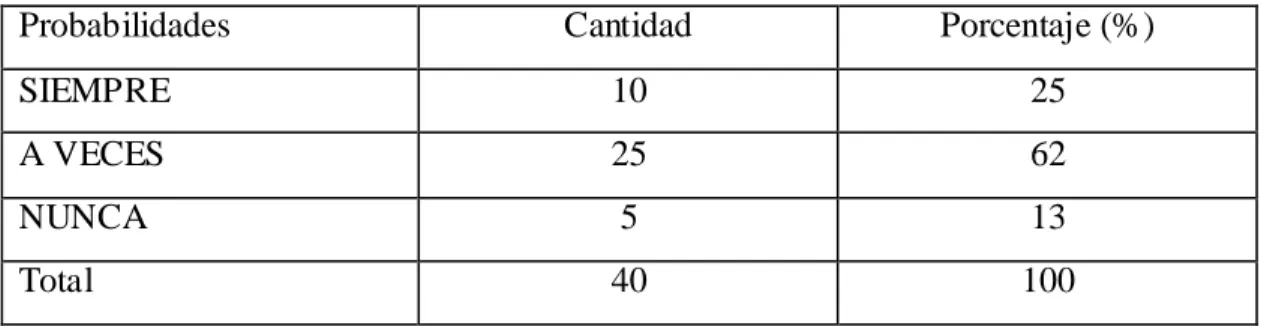
(32) CHAPTER IV 4.1 Processing, analysis and interpretation of results 4.1.1 Processing, analysis and interpretation of results before the S.M.A.R.T methodology was put into practice.. Table 2: Escucha videos ¿Con qué frecuencia usted escucha o ve videos en inglés? Probabilidades. Cantidad. Porcentaje (%). SIEMPRE. 10. 25. A VECES. 25. 62. NUNCA. 5. 13. Total. 40. 100. Source: Survey Produced by: Oswaldo Chafla and Royer Ortega. Graphic 1: Escucha videos. ¿Con qué frecuencia usted escucha o ve videos en inglés? 13%. 25%. 62% SIEMPRE. A VECES. NUNCA. Source: Table 2 Produced by: Oswaldo Chafla and Royer Ortega. Analysis: Graphic 1 indicates that 25% of students answered the question saying always, 62% said sometimes and the last 13% said never. Inte rpretation: Therefore, this graphic shows that 62% of students agree with in English classes sometimes they listened and watched videos, in order to developed the skills.. 19.
(33) Table 3: Habla en inglés ¿Con qué frecuencia realiza actividades para hablar en inglés durante la clase?. Probabilidades. Cantidad. Porcentaje (%). SIEMPRE. 9. 22. A VECES. 26. 65. NUNCA. 5. 13. Total. 40. 100. Source: Survey Produced by: Oswaldo Chafla and Royer Ortega. Graphic 2: Habla en inglés. ¿Con qué frecuencia realiza actividades para hablar en inglés durante la clase? 13%. 22%. 65% SIEMPRE. A VECES. NUNCA. Source: Table 3 Produced by: Oswaldo Chafla and Royer Ortega. Analysis: Graphic 2 shows that 22% of students said always, 65% of them said sometimes and 13% said never.. Inte rpretation: Therefore, this graphic concludes that 65% of students adduce that the teacher sometimes used activities for developing listening skill.. 20.
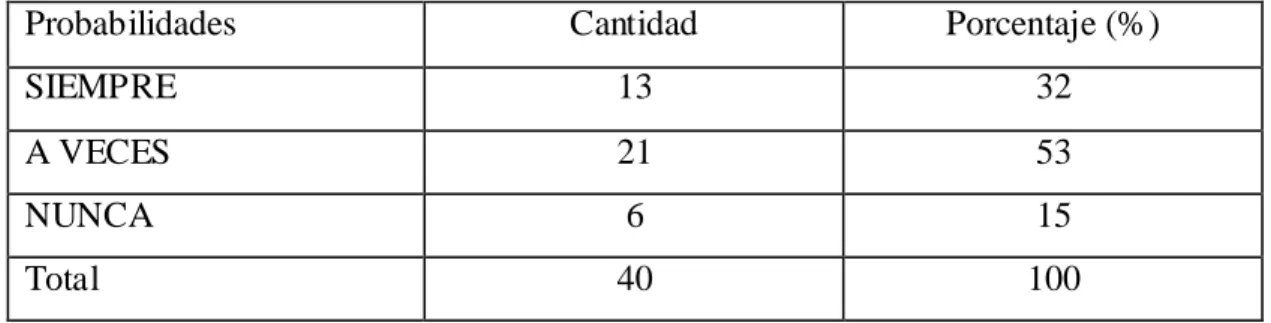
(34) Table 4: Escribe en inglés ¿Con que frecuencia usted escribe en inglés en la clase?. Probabilidades. Cantidad. Porcentaje (%). SIEMPRE. 13. 32. A VECES. 21. 53. NUNCA. 6. 15. Total. 40. 100. Source: Survey Produced by: Oswaldo Chafla and Royer Ortega. Graphic 3: Escribe en inglés. ¿Con que frecuencia usted escribe en inglés en la clase? 15% 32% 53%. SIEMPRE. A VECES. NUNCA. Source: Table 4 Produced by: Oswaldo Chafla and Royer Ortega. Analysis: Graphic 3 indicates that 35% of students answered the question saying always, 53% said sometimes and the last 15% said never.. Inte rpretation: According to Graphic 3, 53% of English classes, the teacher use writing activities in order to developed this important skills.. 21.
(35) Table 5: Lee en inglés Con que frecuencia usted lee en las clases de inglés?. Probabilidades. Cantidad. Porcentaje (%). SIEMPRE. 8. 20. A VECES. 24. 60. NUNCA. 8. 20. Total. 40. 100. Source: Survey Produced by: Oswaldo Chafla and Royer Ortega. Graphic 4: Lee en inglés. ¿Con que frecuencia usted lee en las clases de inglés? 20% 20%. 60%. SIEMPRE. A VECES. NUNCA. Source: Table 5 Produced by: Oswaldo Chafla and Royer Ortega. Analysis: Graphic 4 indicates that 20% of students answered the question saying always, the most of students said 60% said sometimes, and other 20% said never.. Inte rpretation: Therefore, this graphic shows that the majority with the 60 % of students agree with in English classes sometimes they read in English, let them to develop the skill.. 22.
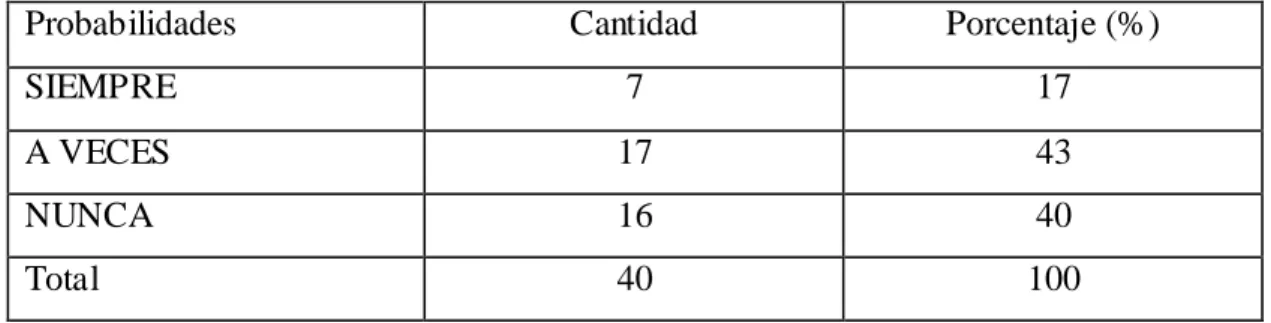
(36) Table 6: Clase dinámica ¿Se inicia la clase con dinámicas relacionadas al tema?. Probabilidades. Cantidad. Porcentaje (%). SIEMPRE. 7. 17. A VECES. 17. 43. NUNCA. 16. 40. Total. 40. 100. Source: Survey Produced by: Oswaldo Chafla and Royer Ortega. Graphic 5: Clase dinámica. ¿Se inicia la clase con dinámicas relacionadas al tema? 17% 40% 43%. SIEMPRE. A VECES. NUNCA. Source: Table 6 Produced by: Oswaldo Chafla and Royer Ortega. Analysis: Graphic 5 shows that 17% of students said always in this question, 43% said sometimes and a big part of them said 40% said never.. Inte rpretation: Therefore, this graphic shows that the 43% of students affirm that, sometimes their English classes started with a motivation.. 23.
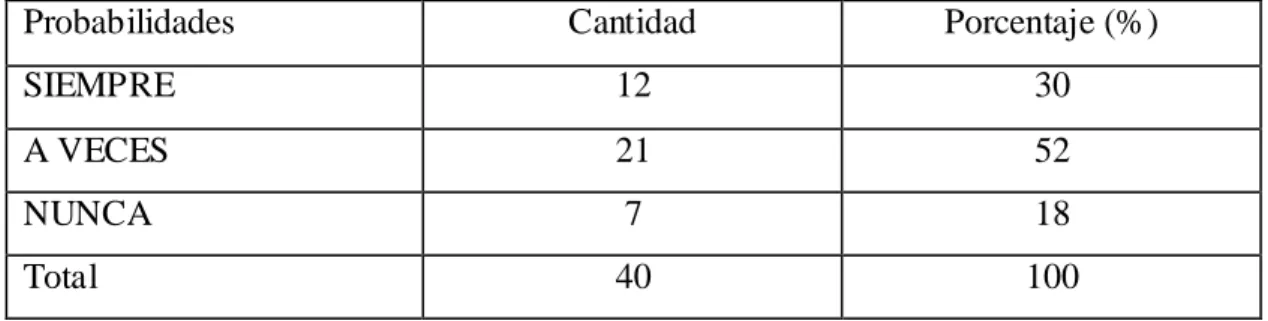
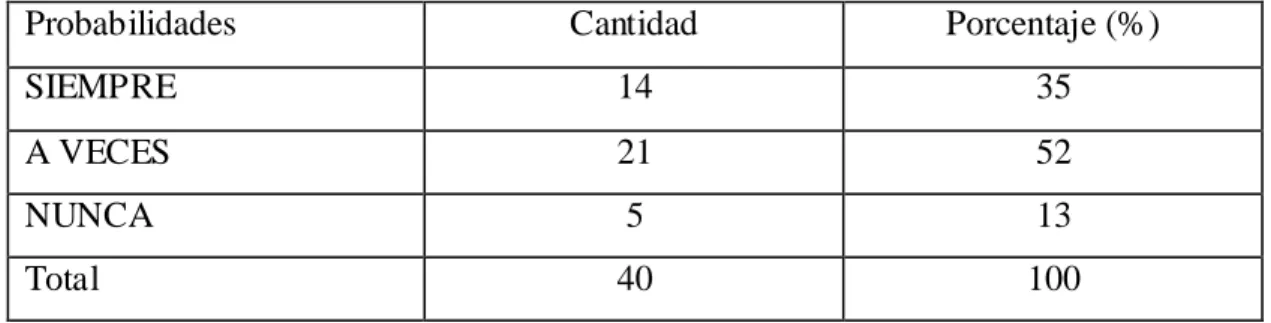
(37) Table 7: Interés por apre nde r inglés Le despierta el interés por aprender el idioma inglés luego de realizar la dinámica?. Probabilidades. Cantidad. Porcentaje (%). SIEMPRE. 12. 30. A VECES. 21. 52. NUNCA. 7. 18. Total. 40. 100. Source: Survey Produced by: Oswaldo Chafla and Royer Ortega. Graphic 6: Interés por aprender inglés. ¿Le despierta el interés por aprender el idioma ingles luego de realizar la dinámica?. 18% 30% 52% SIEMPRE. A VECES. NUNCA. Source: Table 7 Produced by: Oswaldo Chafla and Royer Ortega. Analysis: Graphic 6 indicates that 30% of students said always, 52%, being the majority, said sometimes and 18% of them, said never.. Inte rpretation: Therefore, this graphic shows that the 52% of students are not being motivated with the type of motivation that the teacher did before started the class.. 24.
(38) Table 8: Gusto por los temas ¿Le gustan los temas que se trata en la materia de inglés?. Probabilidades. Cantidad. Porcentaje (%). SIEMPRE. 14. 35. A VECES. 21. 52. NUNCA. 5. 13. Total. 40. 100. Source: Survey Produced by: Oswaldo Chafla and Royer Ortega. Graphic 7: Gusto por los temas. ¿Le gustan los temas que se trata en la materia de inglés? 13%. 35% 52%. SIEMPRE. A VECES. NUNCA. Source: Table 8 Produced by: Oswaldo Chafla and Royer Ortega. Analysis: Graphic 7 indicates that 35% of students answered the question saying always, 52% said sometimes and the last 13% said never.. Inte rpretation: Therefore, this graphic shows that 52% of students feel comfortable with the topics that the teacher used in English classes.. 25.
(39) Table 9: Entiende con claridad ¿Entiende con claridad los temas tratados en el aula?. Probabilidades. Cantidad. Porcentaje (%). SIEMPRE. 12. 30. A VECES. 25. 62. NUNCA. 3. 8. Total. 40. 100. Source: Survey Produced by: Oswaldo Chafla and Royer Ortega. Graphic 8: Entiende con claridad. ¿Entiende con claridad los temas tratados en el aula? 8%. 30% 62%. SIEMPRE. A VECES. NUNCA. Source: Table 9 Produced by: Oswaldo Chafla and Royer Ortega. Analysis: Graphic 8 shows that 30% said always in this question, 62% said sometimes and the last 8% said never.. Inte rpretation: Therefore, this graphic shows that the 62% of students said that sometimes they understood the topics taught by the teacher.. 26.
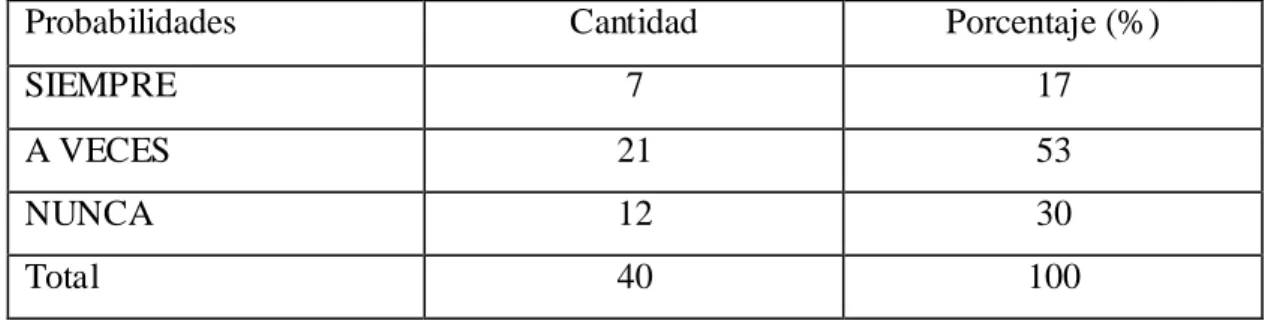
(40) Table 10: Practica el idioma Inglés ¿Practica el idioma inglés con el resto de sus compañeros?. Probabilidades. Cantidad. Porcentaje (%). SIEMPRE. 7. 17. A VECES. 21. 53. NUNCA. 12. 30. Total. 40. 100. Source: Survey Produced by: Oswaldo Chafla and Royer Ortega. Graphic 9: Practica el idioma Inglés. ¿Practica el idioma inglés con el resto de sus compañeros? 30%. 17%. 53% SIEMPRE. A VECES. NUNCA. Source: Table 10 Produced by: Oswaldo Chafla and Royer Ortega. Analysis: Graphic 9 indicates that 17% of students answered the question saying always, 53% said sometimes and 30% said never.. Inte rpretation: Therefore, this graphic indicates that 53% of students not always put in practice the knowledge that they have learned into the classroom and outside.. 27.
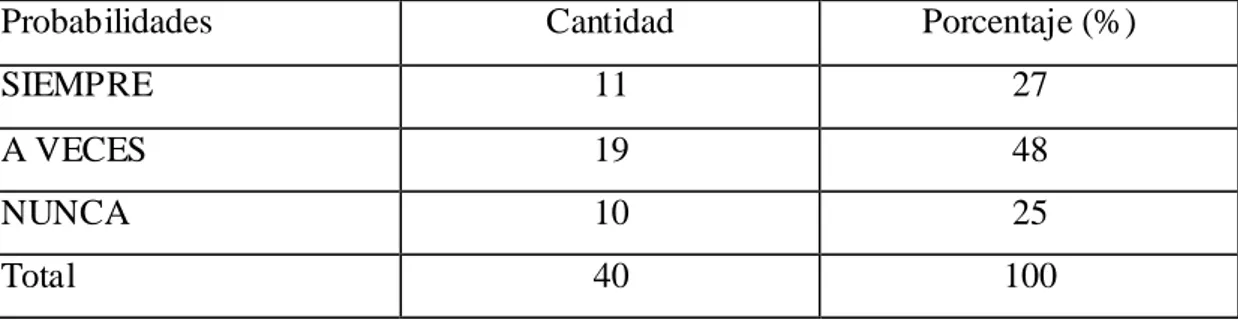
(41) Table 11: Pregunta cuando no entiende ¿Usted pregunta cuando no entiende el tema tratado en la clase de inglés?. Probabilidades. Cantidad. Porcentaje (%). SIEMPRE. 11. 27. A VECES. 19. 48. NUNCA. 10. 25. Total. 40. 100. Source: Survey Produced by: Oswaldo Chafla and Royer Ortega. Graphic 10: Pregunta cuando no entiende. ¿Usted pregunta cuando no entiende el tema tratado en la clase de inglés? 25%. 27%. 48% SIEMPRE. A VECES. NUNCA. Source: Table 11 Produced by: Oswaldo Chafla and Royer Ortega. Analysis: Graphic 10 indicates that 27% of students answered the question saying always, 48% said sometimes and the last 25% said never.. Inte rpretation: Therefore, in this graphic most of the students with 62% said that they did not ask for information to the teacher, in order to clarify the doubts.. 28.
(42) 4.1.2 Processing, analysis and interpretation of results after the S.M.A.R.T methodology was put into practice.. Table 12: Escucha videos ¿Con qué frecuencia usted escucha o ve videos en inglés?. Probabilidades. Cantidad. Porcentaje (%). SIEMPRE. 27. 67. A VECES. 12. 30. NUNCA. 1. 3. Total. 40. 100. Source: Survey Produced by: Oswaldo Chafla and Royer Ortega. Graphic 11: Escucha videos. ¿Con qué frecuencia usted escucha o ve videos en inglés? 3% 30% 67%. SIEMPRE. A VECES. NUNCA. Source: Table 12 Produced by: Oswaldo Chafla and Royer Ortega. Analysis: In this question 67% of students said always, 30% of them answer sometimes, and just 3% said never.. Inte rpretation: Therefore, the majority with 67% said that they always do activities where listen and watch videos in order to develop these skills.. 29.
(43) Table 13: Habla en Inglés ¿Con qué frecuencia realiza actividades para hablar en inglés durante la clase?. Probabilidades. Cantidad. Porcentaje (%). SIEMPRE. 26. 65. A VECES. 14. 35. NUNCA. 0. 0. Total. 40. 100. Source: Survey Produced by: Oswaldo Chafla and Royer Ortega. Graphic 12: Habla en Inglés. ¿Con qué frecuencia realiza actividades para hablar en inglés durante la clase? 0% 35% 65%. SIEMPRE. A VECES. NUNCA. Source: Table 13 Produced by: Oswaldo Chafla and Royer Ortega. Analysis: In this question 65% of students answered the question saying always, 5% did it saying sometimes, and 0% said never.. Inte rpretation: Therefore, students with 65% of them said that they always did speaking activities for developing the skills.. 30.
(44) Table 14: Escribe en Inglés ¿Con que frecuencia usted escribe en inglés en la clase?. Probabilidades. Cantidad. Porcentaje (%). SIEMPRE. 16. 40. A VECES. 24. 60. NUNCA. 0. 0. Total. 40. 100. Source: Survey Produced by: Oswaldo Chafla and Royer Ortega. Graphic 13: Escribe en Inglés. ¿Con que frecuencia usted escribe en inglés en la clase? 0% 40% 60%. SIEMPRE. A VECES. NUNCA. Source: Table 14 Produced by: Oswaldo Chafla and Royer Ortega. Analysis: In this question 40% of students answered the question with always, 60% of them said sometimes, and 0% said never.. Inte rpretation: Therefore, 60% of English classes they used and did activities where they developed their writing skill.. 31.
(45) Table 15: Lee en Inglés ¿Con que frecuencia usted lee en las clases de inglés?. Probabilidades. Cantidad. Porcentaje (%). SIEMPRE. 17. 42. A VECES. 22. 55. NUNCA. 1. 3. Total. 40. 100. Source: Survey Produced by: Oswaldo Chafla and Royer Ortega. Graphic 14: Lee en Inglés. ¿Con que frecuencia usted lee en las clases de inglés? 3%. 55%. SIEMPRE. 42%. A VECES. NUNCA. Source: Table 15 Produced by: Oswaldo Chafla and Royer Ortega. Analysis: This graphic shows that 42% of students answered the question saying always, 55% did it saying sometimes, and 3% said never.. Inte rpretation: Therefore, 55% of students said that in English classes, sometimes the teacher used Reading activities for helping them in Reading skills.. 32.
(46) Table 16: Clase dinámica ¿Se inicia la clase con dinámicas relacionadas al tema?. Probabilidades. Cantidad. Porcentaje (%). SIEMPRE. 34. 85. A VECES. 6. 15. NUNCA. 0. 0. Total. 40. 100. Source: Survey Produced by: Oswaldo Chafla and Royer Ortega. Graphic 15: Clase dinámica. ¿Se inicia la clase con dinámicas relacionadas al tema? 15%. 0% 85%. SIEMPRE. A VECES. NUNCA. Source: Table 16 Produced by: Oswaldo Chafla and Royer Ortega. Analysis: In this question the big majority of students answered always with 65%, 15% did it saying sometimes, and 0% said never.. Inte rpretation: Therefore, 85% of the students said that the teacher always started the classes with a motivation.. 33.
(47) Table 17: Interés por apre nde r Inglés ¿Le despierta el interés por aprender el idioma inglés luego de realizar la dinámica?. Probabilidades. Cantidad. Porcentaje (%). SIEMPRE. 26. 65. A VECES. 14. 35. NUNCA. 0. 0. Total. 40. 100. Source: Survey Produced by: Oswaldo Chafla and Royer Ortega. Graphic 16: Interés por aprender Inglés. ¿Le despierta el interés por aprender el idioma ingles luego de realizar la dinámica? 0% 35% 65%. SIEMPRE. A VECES. NUNCA. Source: Table 17 Produced by: Oswaldo Chafla and Royer Ortega. Analysis: In this question 65% of students answered the question saying always, 35% did it saying sometimes, and 0% said never.. Inte rpretation: Therefore, 65% of students are always motivated for learning English after the motivation was done.. 34.
(48) Table 18: Gusto por los temas ¿Le gustan los temas que se trata en la materia de inglés?. Probabilidades. Cantidad. Porcentaje (%). SIEMPRE. 29. 72. A VECES. 11. 28. NUNCA. 0. 0. Total. 40. 100. Source: Survey Produced by: Oswaldo Chafla and Royer Ortega. Graphic 17: Gusto por los temas. ¿Le gustan los temas que se trata en la materia de inglés? 0% 28% 72%. SIEMPRE. A VECES. NUNCA. Source: Table 18 Produced by: Oswaldo Chafla and Royer Ortega. Analysis: In this question 65% said always, 5% said sometimes, and 0% said never.. Inte rpretation: Therefore, 72% of students answered that always they feel comfortable with the topics that the teacher teach in class.. 35.
(49) Table 19: Entiende con claridad ¿Entiende con claridad los temas tratados en el aula?. Probabilidades. Cantidad. Porcentaje (%). SIEMPRE. 24. 60. A VECES. 16. 40. NUNCA. 0. 0. Total. 40. 100. Source: Survey Produced by: Oswaldo Chafla and Royer Ortega. Graphic 18: Entiende con claridad. ¿Entiende con claridad los temas tratados en el aula? 0% 40% 60%. SIEMPRE. A VECES. NUNCA. Source: Table 19 Produced by: Oswaldo Chafla and Royer Ortega. Analysis: In this question 60% of students answered the question saying always, 40% did it saying sometimes, and 0% said never.. Inte rpretation: Therefore, 60% of students said that always they understand all what the teacher taught.. 36.
(50) Table 20: Practica el idioma Inglés ¿Practica el idioma inglés con el resto de sus compañeros?. Probabilidades. Cantidad. Porcentaje (%). SIEMPRE. 13. 32. A VECES. 22. 55. NUNCA. 5. 13. Total. 40. 100. Source: Survey Produced by: Oswaldo Chafla and Royer Ortega. Graphic 19: Practica el idioma Inglés. ¿Practica el idioma inglés con el resto de sus compañeros? 13% 32% 55% SIEMPRE. A VECES. NUNCA. Source: Table 20 Produced by: Oswaldo Chafla and Royer Ortega. Analysis: In this question 32% of students answered the question saying always, 55% did it saying sometimes, and 13% said never.. Inte rpretation: Therefore, 55% of students said that they sometimes use the English that they learned along the day with their classmates.. 37.
(51) Table 21: Pregunta cuando no entiende ¿Usted pregunta cuando no entiende el tema tratado en la clase de inglés?. Probabilidades. Cantidad. Porcentaje (%). SIEMPRE. 18. 45. A VECES. 10. 25. NUNCA. 12. 30. Total. 40. 100. Source: Survey Produced by: Oswaldo Chafla and Royer Ortega. Graphic 20: Pregunta cuando no entiende. ¿Usted pregunta cuando no entiende el tema tratado en la clase de inglés? 30%. 45%. 25%. SIEMPRE. A VECES. NUNCA. Source: Table 21 Produced by: Oswaldo Chafla and Royer Ortega. Analysis: In this question 45% of students said always, 25% said sometimes, and 30% said never.. Inte rpretation: Therefore, 45% of students said that they always asked for information to their teacher in order to clarify their ideas and doubts.. 38.
(52) 4.1.3 Contrast of the questionnaires before and after the smart methodology was applied. Table 22: Contrast of the questionnaires before and after the Smart methodology was applied PREGUNTAS # 1 2. 3 4 5 6. 7. 8 9 10. 11. 12 13 14 15 16. 17. 18 19. 20. ANTES A VECES. NUNCA. SIEMPRE. 10. 25. 5. 27. 12. 1. 9. 26. 5. 26. 14. 0. 13. 21. 6. 16. 24. 0. 8. 24. 8. 17. 22. 1. 7. 17. 16. 34. 6. 0. 12. 21. 7. 26. 14. 0. 24. 11. 5. 20. 19. 1. 14. 21. 5. 29. 11. 0. 12. 25. 3. 24. 16. 0. 13. 21. 6. 18. 15. 7. 18. 18. 4. 17. 18. 5. 7. 21. 12. 13. 22. 5. 8. 25. 7. 14. 11. 15. 6. 23. 11. 32. 8. 0. 13. 21. 6. 23. 17. 0. 11. 19. 10. 18. 10. 12. 13. 23. 4. 22. 15. 3. 14. 21. 5. 13. 21. 6. 12. 16. 12. 3. 14. 23. 5. 24. 11. 2. 20. 18. 229. 423. 148. 394. 309. 97. SIEM PRE ¿Con qué frecuencia usted escucha o ve videos en inglés? ¿Con qué frecuencia utiliza realiza actividades para hablar en inglés durante la clase? ¿Con que frecuencia usted escribe en inglés en la clase? ¿Con que frecuencia usted lee en las clases de inglés? ¿Se inicia la clase con dinámicas relacionadas al tema? ¿Le despierta el interés por aprender el idioma ingles luego de realizar la dinámica? ¿Realiza las actividades dispuestas por el docente y otras más? ¿Le gustan los temas que se trata en la materia de inglés? ¿Entiende con claridad los temas tratados en el aula? ¿Se siente a gusto con el material didáctico usado en el aula? ¿Es apropiado el ambiente de clase para enseñar y aprender inglés? ¿Practica el idioma inglés con el resto de sus compañeros? ¿Con que frecuencia realiza interpretaciones en inglés? ¿En el aula, el idioma predominante es el inglés? ¿Los temas impartidos son de su interés? ¿Usted pregunta cuando no entiende el tema tratado en la clase de inglés? ¿Siente las ganas de colaborar y/o participar durante toda la clase? ¿Siente seguridad al momento de una evaluación en inglés? ¿Busca en internet aspectos que no quedaron claros acerca de la clase impartida? ¿Practica el idioma inglés fuera del aula? TOTAL. DESPUES A VECES. NUNCA. Produced by: Oswaldo Chafla and Royer Ortega Source: Questionnaires. 39.
(53) Contrast of the questionnaires before and after that the smart methodology was applied in graphics.. Graphic 21: Questionnaires before that the smart methodol ogy was applied.. Graphic 22: Questionnaires after that the s mart methodology was applied.. Analysis: From the 100% of the. Analysis: From the 100% of the. surveyed students, at the end of the. surveyed students, at the end of the. survey showed that 29% of the. survey results, showed that, the majority. questions were answered with always,. with. the 53% of the questions, being the. answered with always, the 39% of the. majority,. questions,. were. answered. with. 49%. of the. were. questions. answered. were. with. sometimes and; while the 18% of. sometimes and; while the 12% of. questions were with never.. questions were with never.. Inte rpretation: The results obtained. Inte rpretation: In this graphic from the. from the surveys show that the. results obtained in the surveys, it is clear. students do not felt motivated to learn. how the new methodology change the. English, they do not put in practice. way of inter- learning process in the. the four skills together and they do. course, since the students showed that. not feel comfortable with the teacher,. they felt motivated to learn English,. teach her classes because the topics. showed that they put in practice the four. are not suitable for them. In other. skills together all the days and the most. words the methodology that the. important. teacher used was not the correct for. comfortable with the teacher and the. teaching English.. topics, and because the topics are. thing. is. that. they. feel. suitable for them. In other words the methodology that the teacher used was better for teaching English. 40.
(54) 4.1.4. Interpretation of Results from the observation sheets.. Table 23: Results from the observation s heets N. ANTES. OBSERVACIONES. DESPUES. SIEMPRE A VECES NUNCA SIEMPRE A VECES NUNCA 1. 2 3 4 5 6 7. Se pone en práctica las cuatro destrezas del Inglés de forma conjunta en una sola clase El estudiante se siente a gusto a la hora de poner en práctica las destrezas del Inglés El estudiante domina las cuatro destrezas. X. X. X. X. X. Se ejecutan actividades relacionadas con el método S.M.A.R.T. La motivación tiene relación con el tema propuesto Se siente motivado a la hora de realizar cualquier actividad de la materia de Inglés El estudiante muestra creatividad al momento de desarrollar la actividad. X X. X. X. X. X. X. X. X. 8. El estudiante muestra interés a la hora de aprender el idioma. X. X. 9. Los temas tratados en el aula son apropiados para el estudiante. X. X. 10. El estudiante utiliza de manera apropiada el material didáctico. X. X. 11. Es apropiado el ambiente de la clase en el cual se imparte el idioma. X. X. 12. El estudiante experimenta el idioma Inglés con el resto de sus compañeros. 13. El estudiante comprende los tópicos y los ejecuta sin problema alguno. X. 14. En el aula, el idioma predominante es el Inglés. X. 15 Los contenidos son flexibles y acordes a la realidad actual Los temas de estudio tratados, 16 generan preguntas, dudas y/o comentarios La colaboración y el cooperativismo 17 son notables en los estudiantes El estudiante se siente confiado al 18 momento de ser evaluado con lo previamente aprendido. X. X X. X. X X. X. X. X X. 19 Busca información de diversas fuentes. X. El estudiante se muestra 20 constantemente activo por aprender el idioma. X. TOTAL 1 Produced by: Oswaldo Chafla and Royer Ortega. X. 11. 8. X X X 10. 9. 1. Source: Observation sheets. 41.
(55) Inte rpretation of results from the observation sheets in graphics. Graphic 23: Interpretation of results from the observation s heets. (Before). Graphic 24: Interpretation of results from the observation sheets (After). Graphic "Before". 5%. Graphic "After". 5%. SIEMPRE. 40%. A VECES. 55%. 45%. SIEMPRE. 50%. A VECES. NUNCA. NUNCA. Analysis: The observation sheets. Analysis: The observation sheets. show that the 5% of the question. show that the 50% of the question. made in the sheets were answered. made in the sheets were answered. with always and. with always and. sometimes. and. the 55% with the. 40%. were. the 45% with. sometimes and a small part with 40%. answered with never.. were answered with never.. Inte rpretation: Therefore, the results. Inte rpretation: Therefore, it is clear. obtained in the observation sheets. that with the new methodology the. show that students in English classes. students have a better environment. were passive all the time, they were. into. not motivated at all, students just put. English classes now were active all. in practice one or two skills no more,. the. they do not feel the necessity to learn. students used the four skills in. English and also the topics were not. different activities, and also the topics. suitable and interesting for them.. were suitable and interesting for them,. the. time,. classroom,. they. were. students. in. motivated,. that’s why they were acting different in English classes.. 42.
(56) CHAPTER V. 5 CONCLUSIONS AND RECOMMENDATIONS. 5.1 Conclusions. Through the analysis and interpretation of the results obtained in the surveys, the following conclusions can be extracted:. . The design of activities based on S.M.A.R.T. methodology helped to improve English teaching- learning process.. . The use of activities based on S.M.A.R.T methodology, improved English teaching- learning process.. . S.M.A.R.T. methodology was effective into the English teaching- learning process.. 43.
(57) 5.2 Recommendations. From the results obtained in S.M.A.R.T. methodology applied to students in Primero de Bachillerato, Paralelo “J” at Unidad Educativa “Capitán Edmundo Chiriboga” can establish the following recommendations:. . To implement S.M.A.R.T. methodology to the lesson plan in which design activities, taking into account the motivation, appropriate and relevant topics which consist in the level and age of the students, getting as a result a tangible product.. . To set a specific time in which carry out all activities previously designed to achieve a meaningful English teaching learning.. . To evaluate the individual and group performance making discussions, interviews or surveys in order to implement the S.M.A.R.T. methodology.. . Further, to implement into the English area S.M.A.R.T. methodology at all educational levels at Unidad Educativa “Capitán Edmundo Chiriboga”, implementing the new methodology from the adjustment period of adaptation, ergo the first weeks of the school year.. 44.
(58) BIBLIOGRAPHY. Abdussalim, A. (9 de december de 2008). http://ajiabdu.blogspot.com/. Obtenido de http://ajiabdu.blogspot.com/2008/12/importance-of- motivation- in-teaching.html Al-Jawi.. (2010).. Obtenido. de. http://uqu.edu.sa/files2/tiny_mce/plugins/filemanager/files/4281126/lectures_of_M ethodology_2/receptive_skills.pdf Al-Jawi.. (31. de. 14. de. 2010).. www.uqu.edu.sa.. Obtenido. de. http://uqu.edu.sa/files2/tiny_mce/plugins/filemanager/files/4281126/lectures_of_M ethodology_2/receptive_skills.pdf Allriggh, D. (2014). The Importance of SMART in classroom languagelearning Applied Linguistic. New York: Mc-Graw Hill. Ary, D., & Jacobs, L. (2000). INTRODUCCIÓN A LA INVESTIGACIÓN PEDAGÓGICA. México: Mc Graw-Hill. Ausubel, D. (1989). Teoría del Constructivismo Social. Madrid: Editorial Vija. Ausubel, D., & Novak, J. (2013). Psicología de la Educación . México: Trillas. Bastidas, P. (2014). Estrategias y Técnicas didácticas. Quito: S&A Editores. Brown, h. D. (2001). Teaching by Principles An Integrative Approach to Language Pedagogy. New York: Longman. Brown, L. V. (2007). Psychology of motivation. New York: Nova Publishers. Brunner, J. (2000). Desarrollo Cognitivo y Educacional. Barcelona: Editorial Morata. Coon, D. &. (2010). Introduction to psychology. Belmont: Wadsworth. curriculum, H. (26 de Agosto de 2014). http://edglossary.org/. Obtenido de The glossary of education reform.: http://edglossary.org/hidden-curriculum DUSSAN, Y. P. (7 de 12 de 2012). http://yesseniaperezdussan.blogspot.com/. Obtenido de http://yesseniaperezdussan.blogspot.com/2012/12/importance-of- integrating- fourskills.html Gagné, R. (1986). Las condiciones del Aprendizaje. California: Editorial Lawrence. García Hoz, D. (2006). Principios de Pedagogía Sistemática. Madrid: Rialp. Gutiérrez, L. (2004). Manual del Educador Eficaz. Lima: La Luz. Harmer, J. (1988). The Practice of English Language Teaching. england: Longman. Kerlinger, F. (2011). Enfoque conceptual de la investigación del comportamiento. México: Mc Graw-Hill.. 45.
(59) Lakatos, I. (2000). The Metodology of scientific of research programmes. Londres: Cambridge University. Leont'ev. (1981). Problems of the Development of Mind. Moscow: Progress Publisher. Litlewood, W. (2011). Comunicative Language Teaching. Londres: University Press. Maria, Q. (2009). Alternativa metodológica para la enseñanza aprendizaje de la comprensión auditiva del Inglés. México: Trillas. Mattos, L. (2005). Compendio de la Didáctica General. Rio de Janeiro: Kapeluz. Met, & Galloway. (2006). Research in Foreing Language. New York: Macmillan. Mory, S. (2004). Enseñanza individual y trabajo por equipos. Buenos Aires: Kapeluz. Nasr., R. T. (1994). Whole Education. New York and London: University Press of America. Novak, J. (2015). Teoría y Práctica de la Educación . Madrid: Alianza España. Oviedo, J. (2013). Programa de formación de capacitadores técnico pedagógicos en el área de planificación curricular. Quito: PUCE-CONFEDEC. Peña, & J. (2009). Alternativa metodológica para reforzar el desarrollo de la competencia comunicativa oral en In glés. México: Trillas.. 46.
(60) ANNEXES. 47.
(61) 48.
(62) 49.
(63) 50.
(64) 51.
(65) 52.
(66) 53.
(67) 54.
(68) 55.
(69) 56.
(70) 57.
(71) 58.
(72) 59.
(73) 60.
(74)
Figure

+7


Documento similar
I can find colours, shapes and opposites in the classroom I can read the words for different colours and shapes I can answer questions about the colours I am wearing I can give
ABSTRACT Transformation of the Specialized Knowledge of Future Primary Teachers on Fraction Division
From the phenomenology associated with contexts (C.1), for the statement of task T 1.1 , the future teachers use their knowledge of situations of the personal
In the preparation of this report, the Venice Commission has relied on the comments of its rapporteurs; its recently adopted Report on Respect for Democracy, Human Rights and the Rule
In two dimensions, we have considered the prob- lem of prescribing Gaussian and geodesic curvatures on topological disks via confor- mal transformation of the metric, while we
As generalization depends precisely on the degree of conditioning of this common element, this mechanism can elegantly explain perceptual learning within standard
In the “big picture” perspective of the recent years that we have described in Brazil, Spain, Portugal and Puerto Rico there are some similarities and important differences,
Critical period effects in second language learning: The influence of maturational state on the acquisition of English as a second language.. Encyclopedic dictionary of
Critical Period effects in second language learning: The influence of maturational state on the acquisition of English as a Second Language.. The high school achievement of
