
Background knowledge in english reading alongside visuals to promote critical thinking
93
0
0
Texto completo
(2) ACCEPTANCE NOTE ____________________________ ____________________________ ____________________________ ____________________________ ____________________________ ____________________________. __________________________________ Juror president´s sign. __________________________________ Juror´s sign. __________________________________ Juror´s sign Bogotá D. C., Noviembre de 2017..
(3) ACKNOWLEDGMENTS This monograph is the result of a long and meaningful process which, besides my effort, included different participants who made this possible. First of all, I want to express my gratitude to my advisor Nelson Mellizo Guaqueta, whose accurate recommendations guided me through the process and helped me improve my language skills. Furthermore, I would like to thank Nidia Gómez, the homeroom teacher who I was assigned at school, she not only helped me a lot during the intervention but taught me several strategies to be a good teacher; I could learn a lot from her for my future profession. Additionally, I express my gratitude to the school Colegio Técnico Domingo Faustino Sarmiento and specially the group 301 because thanks to them I had my first experience with a real educational context, what was really significant for me. Finally, I would like to thank Universidad Pedagógica Nacional for the teacher training I had during the whole undergraduate program and for having given me enough tools to carry out my project..
(4) FORMATO RESUMEN ANALÍTICO EN EDUCACIÓN - RAE Código:. Versión: 01. Fecha de Aprobación:. Página 4 de 93. 1. Información General Tipo de documento. Trabajo de grado. Acceso al documento. Autor(es). Universidad Pedagógica Nacional. Biblioteca Central Background Knowledge in English Reading alongside Visuals to promote Critical Thinking (Conocimiento previo en la lectura en inglés junto con ayudas visuales para promover el pensamiento crítico) Farfán Zabala, Jhon Alexander. Director. Mellizo Guaqueta, Nelson. Publicación. Bogotá. Universidad Pedagógica Nacional, 2017. 82 p.. Unidad Patrocinante. Universidad Pedagógica Nacional BACKGROUND KNOWLEDGE IN ENGLISH CRITICAL THINKING; VISUAL LITERACY.. Titulo del documento. Palabras Claves. READING;. 2. Descripción El presente trabajo de grado es una investigación acción de tipo cualitativa que se realizó en el colegio técnico Domingo Faustino Sarmiento, en la sede B con estudiantes de tercero (301). En este estudio la enseñanza del inglés se basó principalmente en la lectura de textos junto con imágenes, estos basados en problemáticas sociales para promover una perspectiva crítica inicial en los estudiantes. Para conseguir lo anterior, se adoptó la lectura basada en los conocimientos previos del lector, en donde aspectos como la edad, el género, la cultura y el uso de lengua tienen un papel relevante en el entendimiento de un texto. Puesto que los estudiantes no tenían un gran dominio del inglés, los textos trabajados en clase siempre fueron acompañados por ayudas visuales que llevaron a los estudiantes a comprender los textos, activar conocimientos previos y proponer soluciones frente a las situaciones abordadas. 3. Fuentes Airasian, P., and Gay, LR. (n.d) Action research. Retrieved from http://www.wou.edu/~girodm/library/ch9.pdf Avgerinou, M. (2002). A review of the concept of visual literacy. British Journal of Educational Technology, 28(4), 280 – 291..
(5) Bada, S. (2015). Constructivism learning theory: a paradigm for teaching and learning. IOSR Journal of Research & Method in Education, 6, 66-70. Bamford, A. (2003). The visual literacy white paper. Australia. Adobe Systems Pty Ltd. Benavides, D., Murcia, L., and Niño, M. (2009). Observing before learning: visual material for the learning of English as a Foreign Language. HOW, 16, 93-111. Bloom, B. (1956). Taxonomy of educational objectives. Michigan, United States of America. Colegio Técnico Domingo Faustino Sarmiento IED. (2016). Plan anual de asignatura. Colegio Técnico Domingo Faustino Sarmiento IED. (2016). PEI: “Calidad educativa para la formación integral y laboral. Community Handbook (pp. 7 – 13). Subdirección de imprenta distrital. Bogotá, Colombia. Dilley, A., Kaufman, J., Kennedy, C., and Plucker, J. What we know about critical thinking. Massachusetts: P21. Ferrance, F. (2000). Action research. LAB - Brown University. Gómez, L., and Leal, M. (2015). Encouraging Critical Thinking Development in an EFL Classroom through Urban Legends. Folios. (43). 137-152 Goodman, K. (1967). Reading: a psycholinguistic game. Journal of the Reading Specialist. 126135. Gregersen, T. (2007). Language learning beyond words: incorporating body language into classroom activities. Reflections on English Language Teaching, 6, (1). 51-64 Hancock, B. Ockleford, E. Windridge, K. (2009). An Introduction to Qualitative Research. The NIHR RDS EM / YH. Kalmbach, D. Carr, P. (2010). Becoming a teacher through action research. Routledge. Kemmis, S. (2007). Action research as a practice-changing practice. Krashen, S. (2009). Principles and practice in second language acquisition. California -First internet edition. Krashen, S., and Terrel, T. (1995). The natural approach: language acquisition in the classroom. Prentice Hall Europe. Krathwohl, D. (2002). A Revision of Bloom’s Taxonomy: an overview. In Theory into practice. Revising Bloom’s Taxonomy. (212-218). Lee, H. (2011). Using picture books in EFL college reading classrooms. Lipman, M. (1988). Critical thinking: What can it be? Association for supervision and curriculum development..
(6) Markle, T., Rich, Pand West, R. (2011). Beyond transcription: technology, change, and refinement of method. Forum Qualitative Sozialforschung / Forum: Qualitative Social Research, 12(3). Matthews, T., and Palmer, M. (2015). Learning to see the infinite: measuring visual literacy skills in a 1st year seminar course. Journal of the Scholarship of Teaching and Learning, 15(1). 1-9. Mikhailova, T. (2008). Improving students’ Reading Skills through the use of the WFR activities. HOW, 15, 49-62. Mikulecky, B. (2008). Teaching reading in a second language. Pearson. Ministerio de Educación Nacional. (2006). Estándares básicos de competencias en lenguaje, matemáticas, ciencias y ciudadanas. Ministerio de Educación Nacional – Colombia. Moore, B., and Parker, R. (2009). Critical Thinking. New York: The Mcgraw Hill Companies. Paivio, A. (2006). Dual coding theory and education. Retrieved from http://coral.ufsm.br/tielletcab/Apostilas/DCT_Paivio.pdf Porras, N. (2009). Teaching English through stories: a meaningful and fun way for children to learn the language. PROFILE, 12(1), 95-106. Quinn, M. (1999). Enhancing the Quality and Credibility of Qualitative. Health Services Research. 1189 – 1208. Ruiz, S. (2013). Working by projects: A way to Enrich Critical Thinking and the Writing Process in a Third Grade EFL Classroom. Colombian Applied Linguistics Journal. 15(2), 205-220 Sarmiento, M. (2010). A guided reading of images: a strategy to develop critical thinking and communicative skills. Colombian Applied Linguistics Journal.12(2), 72-86. Seglem, R., and Witte, S. (2009). You gotta see it to believe it: teaching visual literacy in the English classroom. Journal of Adolescent & Adult Literacy,53(53), 216–226 Sjøberg, S. (2007). Constructivism and learning. International Encyclopaedia of Education. Norwey – Elsevier. Sternberg, R. (1986). Critical thinking: its nature, measurement and improvement. Washington, DC: National Institute of Education. Stokes, S. (n.d.) Visual literacy in teaching and learning: a literature perspective. Electronic Journal for the Integration of Technology in Education, Vol. 1 (1). Suba: Estratificación Socioeconómica Urbana. (2013). Retrieved from http://www.sdp.gov.co/portal/page/portal/PortalSDP/InformacionTomaDecisiones/Estratifi cacion_Socioeconomica/Mapas/IE003-LocSuba-V02.pdf.
(7) Suryanto. (2014). How can visual literacy support English language teaching? Lingua, Jurnal Bahasa & Sastra, 15(1), 35 – 43. Taber, S. (2011). Constructivism as educational theory: contingency in learning, and optimally guided instruction. Educational Theory, 39-61. Thornbury, A. (2007). How to teach vocabulary. Malaysia. Pearson – Longman. Urquhart, A. H., and Weir, C. J. (1998). Reading in a second language: Process, product, and practice. London and New York: Longman. Varaprasad, C. (2009). Teaching reading in an ESL and EFL setting: a comparison. ELTWorldOnline.com, 1. Vygotsky, L. (1930). Mind in society: the development of higher psychological processes. Harvard University Press. Villanueva, E. 2006. Applying current approaches to the teaching of reading. English Teaching Forum. (1). 8-15. Wolfinger, H. (2002). On writing field notes: collection strategies and background expectancies. Qualitative Research, 2(1), 85-95. Wright, A. (1997). Pictures for language learning. Cambridge, United Kingdom: Cambridge University Press. Yanow, D. (2004). Studying physical artifacts: An interpretive approach. In Rafaeli, A., and Prat, M. Artifacts and organizations: beyond mere symbolism. (pp. 41-60). New Jersey, United States: Lawrence Erlbawn Associates, Inc.. 4. Contenidos Este estudio está dividido en seis partes. Inicia con los contextos externo e interno de la institución, la delimitación y problema de investigación con sus respectivos objetivos general y específicos. El segundo capítulo presenta el marco teórico compuesto por el estado del arte y el desarrollo de los constructos teóricos de base para esta investigación. Posteriormente, se muestra el diseño metodológico, las fases, categorías de análisis e indicadores que fueron relevantes en el desarrollo de la intervención. El siguiente capítulo presenta el enfoque pedagógico y las etapas de la intervención, la cual estuvo dividida en tres fases: las dos primeras estaban basadas en la lectura literal de palabras, oraciones y párrafos y la segunda en la lectura de cuentos desde una perspectiva más crítica. En el quinto capítulo se dan a conocer los resultados obtenidos en la investigación junto con su respectivo análisis. Finalmente, se presentan las conclusiones y recomendaciones a tener en cuenta para futuros proyectos. 5. Metodología Este estudio se llevó a cabo a través de cinco etapas. La primera constó del periodo de observación y recolección de datos iniciales a partir de diarios de campo para identificar el posible problema a tratar en esta investigación. En la siguiente etapa se realizaron una entrevista a la profesora, un.
(8) cuestionario a los niños y un test de inglés para delimitar la problemática. Acto seguido, se analizaron estos datos para poder plantear el problema y los objetivos de investigación y así preparar la intervención. La cuarta etapa consistió en la implementación de diferentes actividades y su respectiva recolección de datos para dar solución al problema identificado; ésta se realizó comenzando con la lectura literal y asociación de palabras con imágenes para luego pasar a la lectura de párrafos y textos de manera literal y crítica; los datos en esta etapa se recolectaron a partir de diarios de campo, grabaciones de audio y los talleres realizados por los estudiantes. Finalmente, se analizaron los datos con el fin de identificar el grado de éxito del estudio y además generar conclusiones al respecto. 6. Conclusiones En este estudio se puede evidenciar que se puede trabajar la lectura en inglés con estudiantes que recién comienzan con su proceso de aprendizaje de la lengua extranjera. Esto se logró al incluir diferentes medios de input durante la lectura como lo son los textos, la lectura en voz alta, la inclusión de imágenes y los movimientos tanto del profesor como de los estudiantes. Además, a través de esta metodología los estudiantes tuvieron la posibilidad de reflexionar sobre temas que atañen a su contexto inmediato como la contaminación, la destrucción del medio ambiente o incluso el matoneo o bullying, lo cual permitió a los estudiantes alcanzar diferentes niveles de pensamiento crítico. En relación con la lengua inglesa, los estudiantes fueron capaces de leer y entender textos basados en el vocabulario que aprendieron al inicio de la intervención, de esta manera lograron aprender nuevas palabras, entenderlas en contexto y aprender más vocabulario a través de la lectura. En conclusión, la lectura en inglés se puede abordar con estudiantes de cualquier nivel siempre y cuando el input sea preciso y comprensible, el uso de la lengua adecuado y adaptado al nivel de los estudiantes e incluir temas que estén estrechamente relacionados con el contexto del estudiante para hacer del proceso algo entendible y a su vez más significativo. Elaborado por: Revisado por:. Farfán Zabala, Jhon Alexander Mellizo Guaqueta, Nelson. Fecha de elaboración del Resumen:. 19. 11. 2017.
(9) Content table Abstract………………………………………………………………….………………....1 Chapter I. Contextualization and research problem………………….………………...3 Local context…………………………………………………….……………….…3 Institutional context…………………………………………….…………………. 4 Population……………………………………………………….………………….5 Diagnosis……………………………………………………….…………………...7 Statement of the problem………………………………………………………….10 Rationale…………………………………………………………………….……..11 Research question………………………………………………………………….13 Research objectives…………………….…………………………………………..13 Chapter II. Theoretical framework and literature review…………….……………….15 State of the art………………………… …………………………………………..15 Theoretical framework…………………………………………………………….19 Chapter III. Research design…………………………………………………………….28 Research type………………………………………………………………………28 Method of research………………………………………………………………...29 Categories of analysis…………………………………………….………………..30 Data collection instruments..…………………………...…………………………31 Ethical considerations……………………………………………………………..33 Chapter IV. Instructional design…………………………………………………….…..34 Pedagogical approach……………………………………………………………..34 Stages of the intervention………………………………………………………….37 Chronogram………………………………………………………………………..38 Chapter V. Data analysis and findings…………………………………………………..40 Limitations…………………………………………………………………………40 Data analysis……………………………………………………… ………………41 Chapter VI. Conclusions and implications……………………………………………...55.
(10) Results review……………………………………………………………………..55 Conclusions……………………………………………………………………….56 Implications…………………………………………………………………….…58 Further research………………………………………………………………….59.
(11) List of tables Table 1……………………………………………………………………..………………15 Table 2……………………………………………………………………..………………30 Table 3……………………………………………………………………..………………38 List of appendices Appendix 1: Consent form…………………………………………………………….…66 Appendix 2: Questionnaire…………………………………………………………….…69 Appendix 3: Field note sample…………………………………………………………...72 Appendix 4: Diagnostic test………………………………………………………………73 Appendix 5: Teacher’s interview………………………………………………………...75 Appendix 6: Lesson Plan sample………………………………………………………...76 Appendix 7: My First Reading…………………………………………………………..78 Appendix 8: Littering and recycling…………………………………………………….79 Appendix 9: Occupation………….………………………….…………………………...79 Appendix 10: Selfishness…………………………………………………………………80 Appendix 11: Domestic Animals…………………………………………………………82 Appendix 12: No More bullying: Equality and Equity…………………………………82.
(12) Abstract This Action Research study intends to promote reading in the EFL classroom through a staged process from words to stories by means of activities which included pondering topics based on social issues to promote initial critical views. This project was held with 3rd graders from the school Doming Faustino Sarmiento. Before the intervention, students had little and almost no English knowledge, yet later students were able to understand stories written in English while learning and enjoying the process. Findings reveal that by using a comprehensible input based on contextualized texts with adapted language alongside visuals and movements while reading, students understood easily, what was evidenced through their opinions and reflections about the issues they read and saw. Key words: Background knowledge in English Reading, Critical thinking, Visual Literacy. 1.
(13) CHAPTER I Contextualization and research problem This chapter outlines a description of the external and internal contexts of the institution. The population is depicted taking into consideration aspects such as cognitive, socio-affective, cultural and linguistic characteristics, and the rationale, the statement of the problem, the research question, and the research objectives are laid out. Characterization Local Context This research project was carried out at the institution Colegio Técnico Domingo Faustino Sarmiento, at branch B. This institution is composed by four branches: A for high school; B and D for elementary and C for preschool. All headquarters of the school, apart from branch C (located in la Castellana), are located in Rionegro neighborhood, which, according to Estratificación socio-económica de Bogotá (2013), belongs to stratum three. These branches belong to Barrios Unidos district in the north of Bogotá. Branch B is located at Carrera 91 A # 60 - 61. This place is composed of a building (just one floor) which has six classrooms, a computer room, a play center and a soccer field for the students’ recess time. Considering the surroundings of the branch, it is an urban area with few stores nearby. In terms of transportation, the neighborhood is well located because it is near Suba Avenue and Rionegro’s Transmilenio station; something which makes easier the students’ access to the school.. 2.
(14) In regards to the observed population, they are third graders and they take classes at classroom 301. This classroom is a convenient place for the students because it is big enough for them to be comfortable, interact and carry out different activities within the place. It has enough light due to six long light bulbs and a huge window on the right side of the room. It also has 32 chairs and 34 tables (two additional ones to put items on them) and a big table with two chairs for the teacher. Concerning the walls, they are decorated with craft papers with texts and drawings made by students. Besides, the classroom is equipped with some pedagogical resources. The classroom has a suitable board, a tape recorder and some books of different subjects to be used in class activities. The teacher also has the possibility to ask for resources such as a video beam, a computer or access to a play center. However, the teacher does not use the play center because of the students’ behavior. There are no other resources such as TV, visual aids or other items for teaching and learning. Institutional context According to the school´s Community Handbook (2016), the institution has as the basis for its teaching the idea of entrepreneurship and leadership. Students are educated to be autonomous and are also expected to develop critical thinking with the aim to transform their own reality. The institution intends to train students to be active participants in their community. On the one hand, as a mission, the school plans to accompany and attend students during their personal growth process. The school does it by constantly motivating students for acquiring knowledge and growing in values. It is done aiming at fostering students’ autonomy and creativity.. 3.
(15) On the other hand, as a vision, the school plans to encourage students’ interpersonal development for them to be good professionals in the future. The institution intends not only to keep implementing the importance of business and financial operations, recreation and English (emphasis of the school), but to broaden and complement those areas with the most advanced scientific knowledge. In this way students are seen as future professionals with a complex knowledge from different fields. Additionally, in order to reach such aims, the school follows the principles of the SocioConstructivism. The school conceives learning as a process which implies teachers and students in relation to their surroundings. The institution adopted this pedagogical model because it fits well with its objectives due to the importance of learning by interaction not only among individuals but also with their own context. The above is evidenced in the school’s annual plan. According to Plan Anual de Asignatura (2016), 3rd graders belong to Cycle 2, in which they have to propose solutions to generate changes to specific problems in their context. It is done to give students the chance of making choices and proposing alternatives to become good citizens. Furthermore, the subjects’ annual plan shows that the school’s academic English program also contributes to the school’s aims. The institution intends to provide students an appropriate learning environment to understand English through emotional and cultural communicative situations for them to transform their reality. The English program includes topics related to the family, the environment, places in the community, districts, means of transportation, pollution among others. These topics show the importance that the context and its population have for the institution, what is closely related to the Socio-Constructivist approach the school has adopted.. 4.
(16) Population The instruments used for the characterization were a questionnaire, a diagnostic test and a teacher’s interview (See appendices 2, 4 and 5). These instruments were elaborated to get information about socio demographic aspects of the population such as age, gender, family composition and housing area. Cognitive, socio-affective, cultural and linguistic characteristics were identified by analyzing students’ strengths and weaknesses with their English and their liking for other subjects, classes at school and free time activities. Findings were complemented with the observed classes. Basically, group 301 is composed of 10 girls and 18 boys; all of them within a range from 8 to 10 years old. The majority of students come from Suba District, from neighborhoods such as Bilbao, Miraflores, Tibabuyes, Compartir; places which belong to strata two and three (Estratificación socio-económica de Bogotá, 2013). Approximately half of the group belongs to nuclear families whereas the other half lives only with their mothers; most of them also live with different relatives such as cousins, aunts or grandparents. Family members are used to helping their children with homework, yet mothers are the ones who help them the most. Considering their cognitive aspects, most of the students seemed to be visual learners. When carrying out different tasks, students demonstrated they understood better a topic if it was explained throughout the use of drawings on the board or on their notebooks and by looking at objects like flashcards and the repetition of movements. It was possible to state that students found amusing activities which involved images and movements. Activities which did not maintain them active or in constant movement got them bored easily.. 5.
(17) Taking into consideration student’s cultural and socio-affective characteristics, in the observed classes it was noticed that they always had to work individually, yet they interacted a lot among them. They enjoyed speaking, and even in individual activities, they tried to help each other, especially the ones who showed more difficulties. Nevertheless, they could be mean when correcting their classmates, especially when talking aloud to share class tasks results, and they used to interrupt each other when speaking. Related to the students’ English linguistic characteristics, they had only learnt vocabulary before the intervention. The teacher had taught students some vocabulary such as numbers, colors, family members and a few adjectives, yet they showed problems to remember those words. Perhaps it was due to the fact that those words were not used communicatively and they were not practiced outside the classroom. They could not understand what English words and phrases meant and replied to greetings or commands more by repetition rather than understanding, so that they could not create sentences.. Diagnosis The diagnosis was carried out through three data collection instruments: a questionnaire, field notes, an English diagnostic test and a teacher’s interview (See appendices 2,3, 4 and 5). The objective was to gather data about the students’ motivation and liking for English, aspects about their behavior and their English knowledge.. Furthermore, it is worth mentioning that the observed classes were not only English but also Math and Spanish because the teacher in charge of the group was not an English teacher. Even so, certain generalities were identified in regards to students’ behavior, participation in class, motivation for learning and even strengths and weaknesses when learning. Considering the 6.
(18) few observed English classes, it was noticed that the teacher had taught students some vocabulary rather than focusing on communication. Considering students’ motivation and liking for learning, students were motivated for learning. According to the questionnaire, 100% of the students affirmed they liked the English class due to the learning of new words or the language as a whole. They showed interest for learning English because they used to ask the teacher-researcher when they were going to have activities in English.. However, their liking for learning was not just for English; the teacher and themselves asserted they also loved learning mathematics, arts and physical training, but sometimes they showed the opposite. Despite of the interest students seemed to have for learning, sometimes they got bored or disinterested about the class activities if they were not exciting or if they did not involve movement. Regarding students’ behavior in class, it is worth saying that students were so energetic and competitive. In all the observed classes they had to work sat down, working in exams, reading or practicing topics by heart such as the multiplication tables or singing. They could not always stay on their chairs and they started walking around the classroom looking for the teacher’s approval in the activities or talking to each other. About being competitive, students always wanted to stand out over the other ones when they thought they were right. The problem was that they could be a bit mean when identifying that someone was wrong because they used to correct each other in a mean way.. 7.
(19) Considering students’ English knowledge, the teacher’s interview, observations and a look at the students’ notebooks were done to check what they probably knew. It was evidenced that the teacher had taught students words such as qualifying adjectives, some nouns, commands and greetings. The teacher affirmed she had difficulties with teaching them pronunciation in English because the words are written and pronounced differently. She also said she had only taught them vocabulary, what is evidenced because students had these words written, in copies or even drawn in their notebooks.. Additionally, as a result of the observed classes, initially it was thought that what they knew was especially by memory and repetition, yet it was imperative to gather more data about their actual English knowledge. It was evidenced that they seemed to understand some commands and greetings such as good afternoon or how are you? but this situation was apparently a matter of repetition rather than an activity they were aware of. Consequently, a diagnostic test with short activities to evaluate some vocabulary students had studied and the four language skills was applied to confirm how much they knew and whether the assumption about their learning by memory was reliable.. Firstly, aiming at evaluating speaking, the diagnostic test started with greetings and short questions intending to have a short talk with the students. It was not possible to evaluate this skill because, apart from greetings, students seemed not to understand other type of questions. The same situation occurred during the observed classes.. Secondly, considering vocabulary, it was found that students knew a few words. In the vocabulary section of the diagnostic test students had to paint images according to the color they saw and then wrote the word in English for such images. For the coloring task, 84% of the 8.
(20) population could do it correctly, but only 26% could write the words the images represented almost perfectly because some of them had spelling mistakes or missing words. 58% of the students painted the drawings almost correctly but with no written words and the last 16.1% of them did almost nothing.. Thirdly, reading and writing skills were evaluated through an I.D. card which students had to fill up with their personal information. They were not evaluated with a text because they were still learning how to write and read in their mother tongue. They had to read the information in the I.D. and then complete some gaps with specific words regarding personal details such as name, age or grade. 81.5% only wrote the name but the other information; 9.3% wrote three more details and 9.3% completed almost all the information. Fourthly, listening was assessed by playing “Simon Says” with body parts and by a format of word and image recognition. When playing the game, most of the students were able to follow the instructions correctly. As they had studied that vocabulary recently, commands were included in the activity to confuse them but they did not have problems with that. According to the test, 65% of the population did the task perfectly, 25% had almost everything correct and only 9.3% did almost nothing. Apparently, students understood listening tasks easily when they were associated with imagery.. Furthermore, due to the latter information complemented with the observed classes, it was possible to state that despite of the fact that students remembered some vocabulary, they could not make sentences. The words they knew were mainly nouns and adjectives but verbs, reason why they did not have enough vocabulary to convey ideas. Most of the students were not aware of the English knowledge they had and it was confirmed that what they knew was by 9.
(21) repetition because they only replied to greetings or commands but when being asked to say them first they did not know what to do.. Therefore, the problem with this population was the lack of authentic communicative skills. Students knew some words, yet they were not closely related to each other. They also used some English but mechanically and in some cases by mimicking or imitating past behaviors without being totally aware of the meaning of the words they said. It was also evidenced that their receptive skills were stronger than the productive ones.. Statement of the problem. Despite of the fact that the population was composed of third graders, they were not able to communicate as it was expected for their level. According to Estándares Básicos de Competencias en Lenguas Extranjeras (2006), students from 1st to 3rd grade are supposed to express and understand basic information in English. Students from these grades are expected to make descriptions about their feelings, their relatives, people from the community and objects.. Unlike the language standards, there were some weaknesses regarding the English knowledge they were supposed to have in 3rd grade. Students’ vocabulary was limited and replied to commands and short sentences like greetings just by memory and repetition. They could recognize some vocabulary, yet the words they knew did not have a connection from one another.. Hence, due to these facts, students were not able to make at least a simple description. Wilkins (as quoted in Thornbury, 2002, p.13) outlines that “without grammar very little can be conveyed, without vocabulary nothing can be conveyed”. With no vocabulary it was not possible 10.
(22) to think on communication; there was no way for students to be able to make or understand basic descriptions or to communicate in a very basic way without it.. Consequently, the main problem students had was the lack of basic English knowledge to understand any type of message. It means that this project’s population had no communication skills in English because they had not overcome the level of vocabulary acquisition and they had only learnt words with no relation among them. The population in this project had little or no English comprehension.. Rationale. This project aimed at helping students build strong bases in English by focusing on receptive skills. The students’ main problem lay on no communication skills in English, yet they showed they had good receptive skills, so that the intervention was based on a well-designed input. It was divided in three main components: background knowledge in English reading, visual aids to reinforce language understanding, and critical thinking to make the process something meaningful beyond the merely learning of language structures.. First of all, the language receptive skills were considered to best way to start with language learning. According to Krashen and Terrell (1995) “If it is true that we acquire language via comprehensible input, and if language acquisition is central, not language learning, then it follows that the most important element of any language teaching program is input” (p.55). As the population in this study already comprehended briefly the written system of their native language, both receptive skills were supposed to be useful to be the basis of the intervention process.. 11.
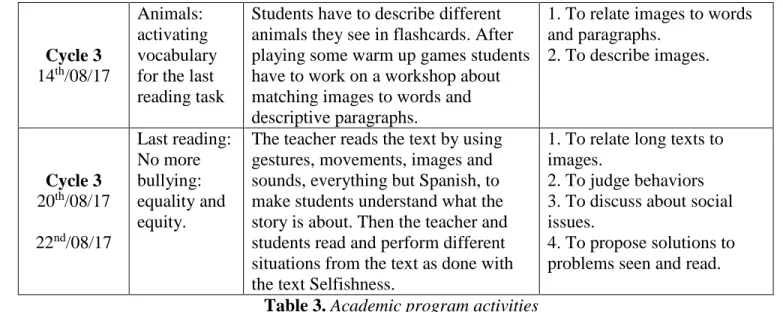
(23) Reading was therefore chosen as the main input for this study. This skill was chosen as a basis of the project considering that these students, according to the observation process, seemed to be visual learners. However, the intention was not to leave behind the other skills; listening is linked to reading when reading aloud the vocabulary or the texts. Speaking and writing also helped to check how much students were learning during the intervention process but in a lesser degree.. In addition, as students are getting started with English and are more likely to learn by observing, visuals were considered important to reinforce their initial reading process. Krashen (2009) asserts that the world is full of input; limitation that a classroom has because everything is outside it. Wright (1997) adds that by including visuals into the classroom it is possible to bring that outside world in a limited space like the classroom. Visuals were so beneficial and helpful for students to understand what the words and texts convey.. Moreover, the topics worked on the intervention dealt with social issues to foster Critical Thinking, complement the main input and check if it was being understood. It was intended to use visuals and texts to provide a meaningful context which included new and basic vocabulary blended with social issues students dealt or will deal with in their lives. Pollution, selfishness, bullying, and other concerns were a part of the intervention for students first read, visualize, comprehend and then state their opinion by describing them literally and critically, in English and in Spanish if necessary not to lose relevant students’ ideas.. Hence, the aim of this project was to use reading linked with illustrations in order to facilitate students’ English learning and to solve the problems which were identified during the observations. In this way students could develop not only their English skills but their visual 12.
(24) skills, critical thinking, creativity and interpretation abilities, making the English learning process something meaningful.. Research question. How Visual Literacy through a Critical Approach fosters Background Knowledge in EFL Reading for third graders at Colegio Técnico Domingo Faustino Sarmiento?. General objective. To determinate how Visual Literacy through a Critical Approach fosters Background Knowledge in EFL Reading for third graders at Colegio Técnico Domingo Faustino Sarmiento.. Specific objectives . To determine how effective visuals are to help the students build up vocabulary to understand descriptions, sentences and texts in English.. . To identify how visuals alongside texts and stories in English activate students’ language and experiential background knowledge.. . To recognize which critical thinking skills emerge when reading images linked with texts in English.. 13.
(25) CHAPTER II Theoretical framework and literature review In this chapter, the state of the art and the theoretical framework are laid out. First, research projects which have similarities with the present one are highlighted. Then, the concepts of Background knowledge in EFL reading, Critical Thinking and Visual Literacy, are defined. State of the art The studies in this section (See table 1) were chosen bearing in mind certain criteria. First, three main aspects were the basis: Background Knowledge in English Reading, Critical Thinking and Visual Literacy; aiming at having studies closely related to the specific objectives this study has. Second, the year of publication and the setting considering studies from 2008 on due to their validity nowadays. Regarding the setting, it is composed of research projects in Bogotá, Colombia and abroad (two studies each) with the aim to have different perspectives of the project’s validity. Aspects like the population’s age were also considered in order to have closer similarities to this research study. Title Encouraging Critical Thinking Development in an EFL Classroom through Urban Legends.. Teaching English Through Stories: A Meaningful and Fun Way for Children to Learn the Language.. Author Mariela Leal Hernández Luis Fernando Gómez Rodríguez Nohora Inés Porras González. Observing before Learning: Visual Material for the Learning of English as a Foreign Language. Diana Benavides Liliana Murcia Mabel Niño. A Guided Reading of Images: A Strategy to Develop Critical Thinking and Communicative Skills.. Marisol Sarmiento Sierra. Improving Students’ Reading Skills through the Use of the WFR Activities. Tatiana Mikhailova. 14. Setting Bogotá-Colombia Universidad Pedagógica Nacional Bucaramanga-Colombia Universidad Cooperativa de Colombia Bogotá-Colombia Universidad de La Salle. Bogotá-Colombia Universidad Distrital Francisco José de Caldas Bucaramanga-Colombia Universidad Industrial de Santander. Year 2015. 2009 2009. 2010. 2008.
(26) Working by projects: A way to Enrich Critical Thinking and the Writing Process in a Third Grade EFL Classroom. Using Picture Books in EFL College Reading Classrooms. Sandra Dolores Ruiz Niño. Learning to see the infinite: Measuring visual literacy skills in a 1st year seminar course.. Michael S. Palmer Tatiana Matthews. Hsiang-Ni Lee. Bogotá-Colombia Colombian Applied Linguistics Journal Taiwan National Taitung University United States University of Virginia. 2013. 2011. 2015. Table 1. Antecedents The first study is Encouraging Critical Thinking Development in an EFL Classroom through Urban Legends, an action research made with 11th graders by Leal and Gómez in 2015. Their aim was to incorporate social issues by including urban legends in the English class through the Revised Bloom’s Taxonomy and a staged reading process. Findings revealed that students developed basic and high critical thinking skills when pondering about the readings and their own context while improving their English. In the present project the goals were similar because reading was approached by stages and topics were pondering considering students’ context and common concerns of their own. The second research study is Teaching English Through Stories: A Meaningful and Fun Way for Children to Learn the Language, an action research project carried out by Porras in 2009 with 1st, 2nd and 3rd graders. Stories were created based on students’ liking to make the English learning an entertaining experience for them. The reading process was divided in three stages (pre-reading, while-reading and post-reading) composed of games, visuals, among others, to facilitate students’ understanding. Students motivation, participation in class activities and reading comprehension was fostered meanwhile they enjoyed learning. The latter agrees with this research because of the staged reading process, the use of visuals to facilitate students’ comprehension and the creation of the stories by the researcher.. 15.
(27) The third study is Observing before Learning: Visual Material for the Learning of English as a Foreign Language, an action research study made by Benavides, Murcia and Niño in 2009. Their purpose was to include visuals aids to complement what the school had proposed for the 3rd and 5th graders’ English class. Results show that students’ English level improved because it was easier for them to learn new words by relating them to images, they were motivated to participate in class and the indiscipline diminished. This study agrees with the present one considering the inclusion of visuals to the whole intervention to facilitate students’ understanding and to get students attentive and interested. The fourth research project is A Guided Reading of Images: A Strategy to Develop Critical Thinking and Communicative Skills, a qualitative descriptive research held by Sarmiento in 2010. Her objective was to help 3rd graders improve their English and develop critical thinking by a staged image reading based on the Revised Bloom’s Taxonomy, so that Spanish was included not to lose students’ relevant contributions. Findings showed students could reach high thinking levels in Spanish while using and learning vocabulary in English. This research is related to the present one concerning the use of visuals, critical thinking and the inclusion of Spanish for students to convey their reflections accurately. The fifth study is Improving Students’ Reading Skills through the Use of the WFR Activities, an action research carried out by Tatiana Mikhailova with 7th graders in 2008. This study aimed at augmenting students’ vocabulary and improving students’ pre-reading, reading strategies and comprehension skills through Warming up for Reading activities (WFR), activities composed of games, puzzles and visual aids. Due to the intervention students got enthusiastic with reading activities, acquired more vocabulary and improved their personal relations. Focusing on pre-reading activities was also relevant in the present study because it was necessary 16.
(28) to provide students enough vocabulary and background knowledge through amusing activities for them to understand reading tasks. The sixth study is Working by projects: A way to Enrich Critical Thinking and the Writing Process in a Third Grade EFL Classroom carried out by Ruiz in 2013. Her goal was to work by projects in order to promote students’ writing skills through the Revised Bloom’s Taxonomy by focusing on the school’s project regarding recycling and other environmental issues in order to foster students’ critical thinking. By project work students’ writing, confidence when using English, critical thinking and interaction in class were well promoted. Ruiz’ study agrees with the present one because they both blend the learning of an English skill and the importance of critical thinking to hold a meaningful process. The seventh project is Using Picture Books in EFL College Reading Classrooms, made by Lee with young university students in 2011. Lee´s goal was to work on students´ reading comprehension and English learning by implementing children´s illustrated books to make innovative classes. Findings show that students had favorable attitudes towards reading because they had easy and understandable English through books which were beautifully written and illustrated, well designed and especially because they dealt with ageless pondering topics. The present study as well as Lee´s work with material adapted for children because the colorful pictures, easy vocabulary, pondering and contextualized issues facilitate students understanding and motivate them to participate in class. The eighth project is Learning to see the infinite: Measuring visual literacy skills in a 1st year seminar course, made by Matthews and Palmer in 2015. This qualitative study intended to work in the students´ visual literacy skills development by conveying first what they saw literally and then critically. Results show students developed skills to give arguments and make 17.
(29) them reliable. The present project is related to Matthews’ due to the importance of visuals aids and the relevance of literal and critical analysis by giving strong arguments to support opinions about what students interact and deal with. The studies above were relevant regarding the proximity they had with this project´s aims. First, reading considering language and experiential background has been broadly explored in some of these studies showing excellent results. Similarly, critical thinking, especially by using the Bloom´s Revised Taxonomy, was a great contribution to this study considering that it allows students reach different thinking levels that permit the researcher mix it with the reading process. The inclusion of visuals in the above projects has obtained excellent attainments: it enhances students’ motivation, facilitates vocabulary learning, retains their attention, diminishes indiscipline and other advantages. Therefore, the pathway chosen in this project seemed to be reliable. Theoretical framework In this section the theoretical aspects which support this research project are defined. From the views of different authors, the concepts of Reading, Critical Thinking and Visual Literacy are defined. Background knowledge in English reading Reading is a skill which has been broadly defined, yet in here the definitions are addressed to understand background relevance in English reading. First, Reading is defined considering mainly the relation between the reader and the text (The Schema theory), then, how the reader activates Schemata and after that, how to activate L2 learners’ schemata.. 18.
(30) Reading has been defined from many different perspectives, but in here the definition is focused only on reading printed texts. According to Urquhart and Weir (1998) “Reading is the process of receiving and interpreting information encoded in language from via the medium of print” (p.22). That is to say, reading is decoding and interpreting printed language, yet it is not a simple process. According to Goodman (1967) “Reading is a psycholinguistic guessing game (…) an interaction between thought and language” (p. 127). The author argues that it does not have to do only with the identification of every single element in a text but a skilled process of choosing enough elements to make the correct guesses and anticipate what is not seen in the text. It means that the process of interpretation when reading is closely related to the readers’ thought and readers do not have a passive role in it. Likewise, Mikulecky (2008) adds that the reading process is a conscious and unconscious process in which the reader turns to his or her Schemata in order to understand a text. The Schemata is composed of the experience a reader has, what is composed of the person’s language, cultural and experiential background which complement the being. When reading, the schemata helps a reader understand any text; this perspective is known as The Schema Theory. The Schema Theory makes reference to the relation between the text and the reader, in which the reader constructs meaning due to his or her schemata. According to Villanueva (2006) the reader plays an active role in understanding a text due to his or her background knowledge. Aspects such as the reader’s age, gender, language level, experience and culture are key factors when reading. The more familiarized a reader is with a text, the more possibilities to understand it.. 19.
(31) Villanueva (2006) also argues that The Schema Theory can be applied into L2 reading. In the case of EFL and ESL learners can have problems when reading texts written in the target language due to cultural differences because their interpretation depends on their first language and cultural schemata. It is important to choose texts that are meaningful for learners to understand and also be able to activate schemata. The author states that there are three useful steps to activate it and make a text comprehensible: Pre-Reading (Activate schemata for students understand the text), During-Reading (Monitoring the reading process, and Post-Reading (Evaluating interpretation). Additionally, Krashen (2009) outlines that reading in L2 must focus on how understandable the reading process is. Meanings have to be comprehended thanks to the context, so that in the educational field, teachers have to supply and bring that context into the classroom. According to Krashen (1995), “Language is best taught when it is being used to transmit messages, not when it is explicitly taught for conscious learning” (p.55), that is to say, the better the input, the more comprehension. The understanding of a message is more important than the understanding of every single word or grammatical structures, and meanings must be inferred by the context. Furthermore, Krashen (2009) highlights that reading may be comprehensible input on the condition that they fulfill certain features. First, a text must deal with the readers’ own liking and concerns to be interesting and relevant for them. It also needs to be assigned according to the students’ level; it does not have to be grammatically sequenced not to become a boring and frustrating task (unless the reader agrees or asks for that) and the quantity has to be well chosen because something too long would frustrate the reader. If a reading task accomplishes these characteristics, it may be a pleasing process. 20.
(32) Thus, reading in the EFL classroom is a process which implies the input’s precision to be comprehensible to activate students’ schemata. In this project, reading was understood from this perspective considering the proximity English had with students’ own background regarding English knowledge and life experiences. Critical thinking In this section, Critical Thinking is defined considering characteristics of its complexity, the relevance it has in the educative field, how to carry it out in education from the Bloom’s Taxonomy and implications for this project. First, Lipman (1988) defines Critical Thinking as critical skillful and responsible thinking that facilitates good judgment because it (1) relies on criteria, (2) is self-correcting, and (3) is sensitive to context (p.39). The author divides critical thinking in two: judgments (opinions and ideas conveyed) and criteria (reasons to support a judgment, they have to be trustworthy). He argues that thinking has to be strengthen on firmly basis in order to learn how to reason more logically. On the other hand, Moore and Parker (2009) assert that Critical Thinking has to do with the evaluation of claims in order to make the right choices. They highlight that the basics of critical thinking are claims, issues and arguments. Claims are understood here as what people convey or express about anything. Issues make reference to take the claim into a question in order to know how reliable it is. Arguments are the way to state if a claim is true or false by providing consistent reasons; they are divided into two: a premise which states an idea, and a conclusion which supports what has been stated first. In this way, a phenomenon can be approached and developed by a constant analysis.. 21.
(33) Likewise, Sternberg (1986) adds an important concept as a complement to critical thinking: the metacognition. As components of thinking critically, this author proposes a taxonomy subdivided into three categories. First, metacomponents rely on monitoring one’s own cognition by practices such as evaluating problems or making decisions. Second, performance components consider aspects like reading, visualization, deductive and inductive reasoning (aspects related to stimuli). Third, knowledge-acquisition components are related to acquiring knowledge by learning to select and telling apart the relevant information. The latter shows the complexity of thinking critically. Considering the above, it is understandable why Critical Thinking has also been relevant for educative processes and assessment. Lipman (1988) argues that it might improve education because it develops students’ understanding of information they perceive and its respective conveying. As a result, according to Bonk, Smith and Halpern (as quoted in Dilley, Kaufman, et all. n.d.) assessments have been broadly considered to “be based on simulations that approximate real-world problems and issues and that reflect “authentic” problems, contexts, and performances” (p.3). The role of education here is that of a created environment which adapts situations for students to face them critically. One of the most important models in education for helping students develop critical thinking has been the Bloom’s Taxonomy. Bloom (1956) designed a taxonomy to categorize educational behaviors from simple to complex: knowledge, comprehension, application, analysis, synthesis and evaluation. He outlines that this taxonomy is characterized for being a hierarchy leveled framework composed of categories and subcategories in which, a simple behavior plus another one might turn into a more complex behavior. In order to reach higher thinking levels, it is necessary to go one by one.. 22.
(34) Moreover, Krathwohl (2002) proposes a revised version of Bloom’s Taxonomy which has important changes. First, the revised taxonomy is divided into two dimensions: The Knowledge dimension: factual, conceptual, procedural, and metacognitive; and The Cognitive Process dimension: remember, understand, apply, analyze, evaluate and create. Each category also has specific sub-categories which makes each category more complex. The author argues that this new taxonomy is not as rigid as the original version, allowing teachers to classify easily objectives and goals for their school projects. Regarding the Revised Bloom’s Taxonomy and the capability to follow a not hierarchized order, it was possible for this project to focus on some of their thinking levels. This study considered mainly the Cognitive Process dimension, specially the sub-categories remember, understand, and evaluate. Even so, this project did not exclude the possibility to find other thinking levels or sub-categories from the taxonomy. Visual Literacy Visual Literacy is defined regarding its components and characteristics, then its advantages for education and its use in it are stated and finally, its specific use for second language instruction. According to Wileman (as quoted in Stokes, n.d, p.12), Visual Literacy makes reference to “the ability to ‘read,’ interpret, and understand information presented in pictorial or graphic images”. In other words, “visual literacy is what is seen with the eye and what is ‘seen’ with the mind” (Bamford, 2003, p.1). Visuals connect a literal side in which features and situations are seen and another side which throws lights to different kinds of interpretations in regards to the message the image intends to present.. 23.
(35) Considering the above, Bamford (2003) points out that an image is a complex element, which has its own grammar composed of syntax and semantics. In regards to syntax, an image contains elements such as shape, size, visual-text relationship, framing, color and so on. Regarding semantics, closely related to semiotics, it implies the interpretation of a given image as a result of reader’s cultural and experiential background. A visual literate person is the one who is able to understand these aspects in order to decipher the meaning of an image. Additionally, visual literacy does not mean passiveness when reading images, in fact, image readers may also construct meaning and communicate by means of visuals. According to Braden and Hortin (as quoted in Seglem and Witte, 2009), “Visual literacy is the ability to understand and use images, including the ability to think, learn and express oneself in terms of images” (p. 217). It means that by visuals one is able to be a productive and a receptive communicator who expresses his or her feelings and ideas. Consequently, visuals are appropriate to engage students to work on class activities if they find them interesting, so that they may improve other skills while learning. According to Baca (as quoted in Avgerinou, 2002, p. 284), visual literacy refers to the use of visuals for the purposes of: communication, thinking, learning, constructive meaning, creative expression, aesthetic enjoyment. It makes visual literacy a useful competence for education because by reading visuals people develop their creativity and imagination. Moreover, by using pictures it is also possible to promote and facilitate language skills in the L2, a relevant fact for this study in which reading in EFL is expected to be improved. Paivio (2006) states that “combining pictures, mental imagery, and verbal elaboration could be an effective method in promoting understanding and learning from text by students ranging from grade school to university level” (p. 11). For this author, the verbal system depends on a 24.
(36) nonverbal base, and they are closely related within the reader’s mind in which a concept might have more than one referent. Besides, Wright (1997) says that the use of visuals contributes to understand easily the meanings of words by creating the contexts in which the words are derived from into the classroom and also that they offer the opportunity to respond non-verbally. By using visuals, it is possible to create appropriate learning environments which simulate the outside world, giving learners the opportunity to interact with places, people, objects or even phenomena which they could not be exposed to in their actual setting. Thus, as the author remarks, pictures bring the outside world into the classroom. Hence, using visuals in the EFL classroom might be beneficial for both students and teachers due to their advantages. Pictures may contribute to foster students’ interest and motivation, to present the language in context and to give a specific reference point or stimulus (Wright, A., 1997, p. 2). This author also alleges that visuals are easy to prepare and organize, interesting, meaningful and that they have enough amount of language because through the use of pictures it is possible to work with language from perspectives such as vocabulary, structures, functions, situations and skills. Visual Literacy was implemented in this project due to its accuracy to facilitate L2 understanding. Visuals were excellent tools to help children activate schemata, not only related to language but their background knowledge, so that texts were easily understood thanks to the use of other way of reading to complement the process.. 25.
(37) CHAPTER III Research design In this chapter aspects such as the research type and method; the population and sampling; and the data collection instruments are presented. It is mentioned how validity is ensured by triangulation and how ethical problems are avoided. Research Type This project agrees with the qualitative research’s features. Hancock, Ockleford, and Windridge (2009) point out that this type of research focuses on the importance of how people understand the reality from a psychological and a social perspective. Thus, the subjectivity of each individual in the present project was an important aspect to analyze considering not only the participants but the context and how the latter influenced the students. Moreover, they also highlight that a qualitative research is a systematic and flexible process which while being held presents unexpected information. Obtained data cannot be evaluated with quantities but with descriptions and interpretations which have to be supported by theory. It makes the information reliable because in spite of the fact that it is not analyzed under the scope of quantities, it considers theories based on studies from different fields of knowledge. Additionally, Kalmbach and Carr (2010) argue that results obtained are believable and trustworthy if they are analyzed through multiple sources. The subjective information is taken as relevant and reliable because it gets the same or similar results from different perspectives of data collection and analysis. The description of details has to be organized and supported by theory in order to avoid biases.. 26.
(38) Method of Research This study was carried out as an action research project. According to Kemmis (2007), Action Research is a transformation process of the understanding on practices, what is done by people and how the relationships among individuals and the context are carried out. This process of transformation is held by the researcher and the population in equal terms because “action research treats theorists as practitioners and practitioners as theorists” (Kemmis, 2007, p. 6). Therefore, the researcher and the population have an intellectual participation in the research process and they both contribute to solve the identified problem. Likewise, Ferrance (2000) outlines that Action Research in the educative field is a process in which the main objective is the looking for solutions to real problematics of the students’ context and the improvement of the teaching strategies. This concept is pertinent in the educative field because it deals with subjective issues regarding students’ learning processes. It is also relevant considering that education has several ways to be approached and it is in a constant process of transformation. In addition, an action research project is divided into stages aiming at making it a cyclic process. Ferrance (2000) proposes six steps for an action research study: identifying the problem, gathering data, interpreting data, acting on evidence, evaluating results and next steps. During the intervention, weaknesses and strengths are analyzed to improve within and even at the end of the process to identify problems for further research. This author remarks that it is important to understand action research as a never-ending work. Action research was pertinent for this study due to the accurate steps it offers to improve constantly during the process for the profit of the students’ learning process.. 27.
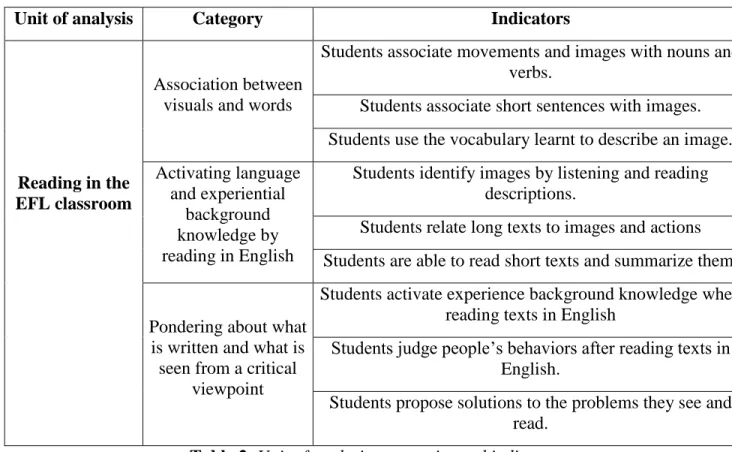
(39) Categories of analysis The table below shows the unit of analysis, categories and indicators taken into account to create the activities for the interventions; aspects which are analyzed in Chapter V. Unit of analysis. Category. Association between visuals and words. Indicators Students associate movements and images with nouns and verbs. Students associate short sentences with images. Students use the vocabulary learnt to describe an image.. Reading in the EFL classroom. Activating language and experiential background knowledge by reading in English. Pondering about what is written and what is seen from a critical viewpoint. Students identify images by listening and reading descriptions. Students relate long texts to images and actions Students are able to read short texts and summarize them. Students activate experience background knowledge when reading texts in English Students judge people’s behaviors after reading texts in English. Students propose solutions to the problems they see and read.. Table 2. Unit of analysis, categories and indicators Population and sampling The population of this study consisted of 28 third graders which sample was done with 16 students. They belong to the group 301 (afternoon shift) which is composed of 10 girls and 18 boys aged between 8 to 10 years old. The sampling was taken considering half of the population (50%), percentage which is also divided in three: 33% students with low English skills, 33% with medium level and, 33% with high level. The main criterion to do so was done aiming at identifying the students learning process and its evolution through three different perspectives in order to contrast them and make results reliable. 28.
(40) Triangulation According to Quinn (1999), triangulation makes reference to the analysis of data by means of more than one technique to avoid the mistakes of using just one instrument. This author states that the use of different tools enriches the analysis because when using just one instrument results can be weak. These weaknesses are solved when reinforcing the study by using more than one tool as it was done in this study. The author also points out that triangulation provides cross data validity checks which give the possibility to compare and contrast the information to make the results something meaningful, accurate and valid. Data Collection Instruments In this study data were obtained throughout three instruments: field notes, audio recordings and artifacts. These instruments were chosen due to the accuracy and pertinence they offer in regards to the qualitative data for the present study. Field notes. According to Van Maanen (as quoted in Wolfinger, H. 2002. p. 86) “field notes are gnomic, shorthand reconstructions of events, observations, and conversations that took place in the field”. Wilkinson and Birmingham (2003) state that they permit the researcher to gather data about not only what is observed with the eyes but what is perceived with the other senses; they are very useful to analyze individuals` activities. Through this instrument it was possible to register students` normal behavior in the classroom, how they carried out the activities proposed in this study, how they interacted among them and their attitudes towards certain tasks. Audio recordings. It is a mean of gathering information by means of technology that, according to Markle, West, and Rich (2011), allows the researcher to record the participants’ 29.
(41) own words in order to analyze and interpret them through the transcription. Airasian and Gay (n.d) add that recorded conversations can be either planned or spontaneous (p. 268). This instrument was chosen because it permitted to record spontaneously students’ initial critical views when discussing about reading tasks. Artifacts. According to Yanow (2004), human communication is not only conveyed by the language but also by two categories of artifacts: acts and objects. Mehrabian (as cited in Yanow. 2004) also argues that 93% of communication belongs to acts and objects. Yanow adds that physical artifacts done by individuals convey meanings such as values, beliefs and feelings. In this regards, the students’ creations in this project state something about their ways of thinking and other important and meaningful facts. These data collection instruments were chosen considering the stages in which the intervention was divided. Field notes were an important part during the whole intervention, giving the researcher the possibility to write down all situations held in the classroom and analyze them. Audio was recorded to gather data from the students’ initial critical viewpoints. Artifacts were taken and analyzed aiming at seeing students’ reading comprehension and how critical students were. All information gathered from these different perspectives was analyzed altogether through the triangulation process mentioned previously. Ethical considerations It is worth mentioning that all gathered information from the students is confidential. Before gathering data, application of instruments and lessons, students´ parents were informed through a consent form (see appendix 1) about this study, because the population is under 18. 30.
Figure

Documento similar
It appears that students have little problem distinguishing the grammatical categories in Spanish, identifying their functions in sentences and texts, and knowing the form
It appears that students have little problem distinguishing the grammatical categories in Spanish, identifying their functions in sentences and texts, and knowing the form
to what extent they employ the vocabulary, style and compositional patterns typical of their field of knowledge, the ones used by and expected by the discursive community they
• While undergraduate students in Saudi universities are expected to have desired English language skills in order to further advance in their specialized areas of study, writing
We obtained a corpus to contrast the terms used in the articles written in English and in the articles written in Spanish in order to study what types of translations are made
Taking into account that the tendency in Spanish schools is to establish a bilingual primary education system (Spanish and English), those students who do not major in English
According to the Oxford English Dictionary, the emphatic uses of right are now archaic in formal contexts, but they relate to the many intensive uses of the term in
Our conclusion is that the main predictor for students grading learning in English or using part of the material in English is the previous basic knowledge on the subject, and of
