
Oral production Enhancement through the use of Colombian legends
70
0
0
Texto completo
(2) NOTE OF ACCEPTANCE. __________________________________ __________________________________ __________________________________ __________________________________ __________________________________ __________________________________ __________________________________ __________________________________. ______________________________ Signature. ______________________________ Signature. ______________________________ Signature. Bogotá D.C. November 2018.
(3) ABSTRACT. The purpose of this research is to evidence the oral production enhancement through the use of Colombian legends whiting a Framework of literacy as a situated practice. This Project describes an action research experience carried out at Rafael Bernal Jimenez School that was developed with 40 students of ninth grade, which ages range in between 13 and 16 years old. This study intended to show how students can improve their oral production focusing on the advantages of using Colombian Legends as an interesting and meaningful input that let them to relate the information given to their own life experiences. During the pedagogical intervention data was collected from the students’ opinions and class work as well as from the researchers’ observations field notes, voice recordings and surveys. Student’s progress is analyzed in order to arrive at the conclusion of the effectiveness of Colombian Legends.. Key words: Oral production, Colombian Legends, Literacy as a situated practice..
(4) Tipo de documento. 1. Información General Trabajo de grado. Acceso al documento. Universidad Pedagógica Nacional. Biblioteca Central.. Título del documento. Oral production Enhancement through the use of Colombian legends. (Mejoramiento de la producción oral a través de las leyendas colombianas).. Autor(es). Avila Bohórquez, Mayra Alejandra.. Director. Martínez, Diana.. Publicación. Bogotá. Universidad Pedagógica Nacional, 2018. 53 p.. Unidad Patrocinante. Universidad Pedagógica Nacional.. Palabras Claves. ORAL PRODUCTION; COLOMBIAN LEGENDS; LITERACY AS A SITUATED PRACTICE.. 2. Descripción Trabajo de grado realizado para identificar, analizar y describir el mejoramiento de la producción oral en inglés a través de la utilización de leyendas Colombianas con estudiantes entre 13 y 16 años en el Colegio Rafael Bernal Jiménez en Bogotá. Este proyecto se llevó a cabo a través de una investigación acción de tipo cualitativo en la cual por medio de los distintos medios de recolección de datos se logró obtener información de los avances positivos de sus producciones orales, además de esto su disposición y fluidez en la lengua extranjera presentaron un mejoramiento significativo. Gracias al Input dado por medio de las leyendas colombianas los estudiantes demostraron que hacer uso de textos dirigidos a contextos reales les facilita en gran medida expresar sus ideas, compartir pensamientos y experiencias.. 3. Fuentes Ahmed, S.2017. Authentic ELT Material in the language classroom and Overview.Volume 4..
(5) Burns, A., & Joyce, H. (1997). "Focus on speaking. “Sydney: National Center for English Language Teaching and Research.. Cohen, A. (1996). Developing the ability to perform speech acts. "Studies in Second Language Acquisition. Cunningworth, A. (1984). Evaluating and selecting EFL materials. London: Heineman Ellis, R. (2014). Principles of instructed second language learning. In M. CelceMurcia, D. Brinton and M. Snow (eds.), teaching English as a second or foreign language (4th ed.) (pp. 31–45). Boston, MA: Cengage Learning.. Fillmore, C. J. (1979). On fluency. In C. J. Fillmore, D. Kempler, & W. S. Y. Wang (Eds.),Individual differences in language ability and language behavior (pp. 85102). New York: Academic Press.. Fraser, H 2001. Teaching pronunciation: A handbook for teachers and trainers. Canberra: Department of Education Training and Youth Affairs.. Frye, Northrop. 1964.The educated imagination. Indiana, Indiana University Press. Linguistic input in formal second language learning: The issue of syntactic gra'dationand read ability in ESL materials. TESOL Quarterly.. Garcia, E.; Gil, J. y Rodriguez, G. (1994). "Análisis de datos cualitativos en la investigación sobre la diferenciación educativa", Revista de Investigación Educativa, 23 (1), pp. 183-195.. Grundy, S. (1987). Curriculum: product or praxis? Lewes: Falmer Press Miles, M.B, and Huberman, A.M. (1994). Qualitative Data Analysis, 2nd Ed., p.10-12 Newbury Park, CA: Sage.. Hall, J.K., Walsh, M., 2002. “Teacher-student interaction and language learning”. Annual Review of Applied Linguistics, 22, 186–203.. Halliday, M.A.K. (1975). Learning how to mean: Explorations in the development of language. London: Edward Arnold. (New York: Elsevier, 1977)..
(6) Hilgard, E.R., Atkinson, R.C. and Atkinson, R.L. (1979). Introduction to psychology (7th ed.). New York: Harcour.. Harmer, J. (1994). How to teach English: An introduction to the practice of English language teaching. Harlow: Longman.. John B . Carroll .(1968). Development of Native Language skins beyond the early years.. Gillard J. (2009) Minister for Education Teaching and Learning Languages: A Guide was funded by the Australian Government Department of Education, Employment and Workplace Relations. Krashen, S., & Terrell, T. (1983). The Natural Approach: Language Acquisition in the Classroom. New York: Press. Malinowski, Bronislaw, 1923. The Problem of Meaning in Primitive Languages. Supplement I in C.K. Ogden and I.A. Ministerio de educación nacional.(2006). Estándares Básicos de competencias en lenguas Extranjeras: Ingles. Colombia: Imprenta Nacional.. Mercer, N. & Dawes, L. (2008). The value of exploratory talk. In Mercer, N. & Hodgkinson, S. (Eds.). Exploring talk in schools. Los Angeles, London, New Delhi: SAGE, 55-72. Morley, J 1994. Pronunciation pedagogy and theory: New views, new directions.Alexandria, VA: TESOL.. Nunan, D. (1991). Language Teaching Methodology, New Jersey: Prentice Hall. International.. Povey, J. 1972.Literature in TESL programs: The language and the culture. Teaching English as a second language. New York.. Richards, J. C., Platt, J., & Weber, H. (1985). Longman dictionary of applied linguistics. London: Longman. Rodríguez , G.; GIL, J. y Garcia, E. (1996). Métodos de investí- gación cualitativa, Málaga, Aljibe. Straus, A. Corbin, J. (1990). Basics of Qualitative Research. Grounded Theory Procedures and Techniques, Newbury Park, Sage..
(7) Van, T. (2009). The relevance of literary analysis to teaching literature in the EFL Classroom. English Teaching Forum 2-9 (3).. 4. Contenidos El presente trabajo está dividido en 6 capítulos: Capítulo I- En este capítulo se da conocer el problema de investigación, la población y se dan a conocer los objetivos. Capítulo II- Marco Teórico: En este capítulo se presenta la teoría que se uso para soportar y desarrollar el proyecto de investigación, así mismo, se incluye otras investigaciones similares donde se exponen evidencias de cómo este recurso facilita a los estudiantes a mejorar su producción oral. Capítulo III- Diseño Metodológico: En este capítulo se presenta el tipo de investigación que sigue el proyecto, así como el tipo de estudio, las unidades de análisis que surgieron a través de las intervenciones y los tipos de instrumentos de investigación que se implementaron. Capítulo IV-Propuesta de intervención pedagógica: En este capítulo se da a conocer la teoría del enfoque pedagógico así como los ciclos de intervención. Capítulo V- Análisis de datos: En este capítulo se dan a conocer los resultados obtenidos basados en el análisis de cada una de las categorías identificadas durante el proceso de recolección de datos. Capítulo VI- conclusiones y recomendaciones: En este capítulo se exponen las conclusiones y las recomendaciones pertinentes de acuerdo a los resultados vistos en la investigación.. 5. Metodología El presente proyecto de investigación se llevó a cabo bajo los parámetros de la investigaciónacción e investigación cualitativa en la cual se siguieron los siguientes pasos: 1. Observación y desarrollo del problema: las observaciones se realizaron desde el octavo semestre, donde se dieron a conocer las debilidades y fortalezas del curso. 2. Propuesta en intervención: A partir del problema que se identificó en el grupo se realizaron las intervenciones pertinentes y se crearon actividades que ayudaran a resolver las falencias detectadas. 3. Análisis de Datos: Después del proceso de recolección de datos tanto de encuestas, field notes, como voice records se hizo el respectivo análisis y se comprobaron los resultados. 4. Conclusiones: De acuerdo a toda la información analizada se dio respuesta a la pregunta planteada en este proyecto de investigación.. 6. Conclusiones.
(8) Teniendo en cuenta el análisis de los datos se llegó a la conclusión que el impacto de usar Legendas Colombianas dirigidas hacia contextos reales de los estudiantes fortalece y mejora la producción oral en el aprendizaje de una lengua extranjera. Además, la combinación del aprendizaje previo con la información puesta en contexto crea estudiantes más activos en el proceso de aprendizaje y enseñanza. Por otro lado, se pudo asegurar que el uso correcto y constante de un input influencia de manera significativa al mejoramiento de las habilidades orales en términos de fluidez, precisión, e interacción generando en el estudiante más confianza y una producción más coherente y efectiva.. Elaborado por: Revisado por:. Avila Bohorquez,Mayra Alejandra. Martinez, Diana.. Fecha de elaboración del Resumen:. 15. 11. 2018.
(9) Contenido CHAPTER 1: .................................................................................................................................................................... 11 THE PROBLEM ............................................................................................................................................................... 11 1.1. Contextualization of the problem ............................................................................................................. 11. 1.2 Problem statement ............................................................................................................................................. 12 1.3 Research question............................................................................................................................................... 15 1.3.1 General Objective: ..................................................................................................................................... 15 1.3.2 Specific Objectives: ................................................................................................................................... 15 1.4 Rationale of study ............................................................................................................................................... 15 CHAPTER 2: STATE OF ARTS AND THEORETICAL FRAMEWORK........................................... 18 2.1 State of Arts .......................................................................................................................................................... 18 2.2 Theoretical Framework ................................................................................................................................... 21 2.2.1 Speaking ......................................................................................................................................................... 21 2.2.3 Oral skills....................................................................................................................................................... 21 2.2.4 Literature as an input in the EFL ........................................................................................................ 24 2.3.5 Literacy as a situated practice .............................................................................................................. 25 CHAPTER 3 : RESEARCH METHODOLOGY .................................................................................................... 27 3.1 Research Paradigm ............................................................................................................................................ 27 3.2 Type of study ........................................................................................................................................................ 27 3.3 UNIT OF ANALYSIS ....................................................................................................................................... 28 3.2 POPULATION .................................................................................................................................................... 30 3.3 Participants ........................................................................................................................................................... 31 3.4 Data Collection instruments and procedures ......................................................................................... 32 3.4.1 Survey. ............................................................................................................................................................ 33 3.4.2 Field notes. .................................................................................................................................................... 33 3.4.3 Recording and transcriptions. .............................................................................................................. 34 3.4.4 Artifacts.......................................................................................................................................................... 34 3.5 Ethical consideration......................................................................................................................................... 35 CHAPTER 4:.................................................................................................................................................................... 36 PEDAGOGICAL INTERVENTION AND IMPLEMENTATION .......................................................... 36 4.1 Vision of language .............................................................................................................................................. 36 4.2 Vision of learning................................................................................................................................................ 37 4.3 Instructional design ........................................................................................................................................... 37 4.3.1 Implementation and planning............................................................................................................... 37 4.3.1.1 First cycle: February 26th -April13th........................................................................................... 39 4.3.1.2 Second cycle April 20th– June 1st ...................................................................................................... 39 4.3.1.3 Third cycle August 10th– September 2018 ................................................................................... 39.
(10) CHAPTER 5: DATA ANALYSIS AND FINDINGS ....................................................................................... 43 5.1 Category 1: FORM ............................................................................................................................................ 44 5.1.1 Fluency ............................................................................................................................................................ 44 5.1.2 Accuracy ......................................................................................................................................................... 48 5.2 Category 2 : Content ......................................................................................................................................... 52 5.2.1 previous knowledge-connection with the reality ................................................................................ 52 5.2.2 Interaction ..................................................................................................................................................... 54 CHAPTER 6: CONCLUSIONS ............................................................................................................................... 58 6.1 Conclusions ............................................................................................................................................................ 58 6.2 General recommendations.................................................................................................................................. 59.
(11) CHAPTER 1: THE PROBLEM 1.1 Contextualization of the problem The ninth graders were observed more than 8 times during the English and immersion classes in which they provided information about their weaknesses and strengths with regards of the four English communicative skills: listening, reading writing, and speaking; the results showed that most of the students wanted to improve their oral skills, even though, they said they had weaknesses in the others skills too. Based on the observations and the survey made at the beginning of this intervention, most of them said they like the English classes, but they wanted to do playful activities in which they can have the opportunity to interact with their classmates and develop group activities in order to have more conversational interaction and improvement. Taking into account the other abilities it was possible to identify weaknesses too, but those were not so marked as in the oral process. As to the listening skill the students did not present too many difficulties due to most of the time the teacher used to communicate in a simple way that was easily understood, sometimes she included new words and expressions that were explained in both languages if it was necessary; moreover, the teacher included in some classes listening exercises about the vocabulary that she was working at that moment and also short dictations activities. This information helped to conclude that in general all the students showed a positive performance in the listening skill; even though, they have to keep working to achieve a better level in this ability. Similarly, in the reading ability, the students expressed that it was easier to read texts than talk about any specific topic; they also affirmed that in their English classes it was very common to solve workshops and answer question related to it. In that way, during those reading exercises it was possible to recognize that some students enjoyed reading, but others just.
(12) developed it because they have to, besides that, most of them provide very short answers or very specific information instead of giving complete answers. Furthermore, during the writing exercises it was easy to identify that there was a lack of some grammar rules, vocabulary and also a lack of attention in terms of following the instructions given by the teacher. Also, there were some students’ writings that had almost the same information, however, most of their writings had interesting ideas and they were very creative, although, they always asked for more time to finish the proposed activities. Finally, related to the speaking ability, it was identified that the students had a negative performance of the speaking process due to several factors such as shyness, lack of confidence, fear of being criticized and bothered by their classmates, low or no participation during the classes and if they decided to participate all their answers or opinions were in Spanish. Another point was that they did not have activities where they could practice their speaking because most of the time the teachers focused on the other abilities. Another problem responded to the few English hours they have during the pre-school and primary processes, just two hours a week. For that reason, when they started the basic secondary level and the middle level they present a lot of difficulties because they do not have the necessary level or skills when they arrive at this point. Due to this, their learning process is much slower because the students still have flaws in relation to previous topics or the correct development of certain skills that are essential to have a complete learning and most of all meaningful process.. 1.2 Problem statement It is convenient to consider “Los Estándares Básicos de Competencias en Lenguas Extranjeras-Inglés” on the speaking aspect, where they stated that the students at this point.
(13) should be in level B1, classified as independent users where they should understand the main points of different abstract topics found in school, family, environment, their free time, among others. Also, they have to be able to describe experiences, events, dreams, and ambitions based on their own context, as well as give arguments about different opinions and situations. In this perspective, in terms of speaking, there are two categories in which the students should be evaluated, the first one is the spoken interaction in which the students should be able to participate into unexpected conversations about familiar topics or everyday topics. The second one is the spoken production, in this part the students have to give reasons and explanations for opinions; also, they have to be able to narrate a story or relate the plot of a book or film and describe their reactions. Accordingly, this is an ideal that in this classroom has not been reached yet and according to all the observations made and the information collected in class by means of field notes, a survey, and an interview to the teacher in charge, the students showed difficulties mainly related to oral production. Based on the analysis of those elements, it was evident that there was a low use of the target language during classes and also a lack of participation, most of the time because they did not have strong inputs that let them to have enough bases for answering questions, developing readings or comprehension activities. Thereby, the main limitation was detected when they had to express their ideas or give their opinions because when they had to interact among them,they used Spanish or very weak English statements or they simply refused to share their thoughts all the time; some of them participated but just in front of the teacher as they felt embarrassment and uncomfortable every time they had to give an opinion in front of their partners. During almost all the classes in which they were observed they showed also a very weak development of the oral skills regards to reading comprehension activities and its.
(14) socialization with all their classmates. This is most likely due to the fact that they presented difficulties understanding the contents and the meanings of the workshops and texts they read. Those texts were difficult for them and had few connections with their reality; consequently, they could not give strong ideas and arguments that let them go beyond the literal context. As in reading, there was not a meaningful connection between what they learnt and their context because the grammar most of the time was explained in such an isolated way. As a result of it, their oral production was very restricted, that is why they were not able to keep long talks or at least short coherent conversations that allow the students make connections about different topics in different real speaking situations. Furthermore, the students did not have enough tools that help them to improve and motivate their oral communications skills since most of the activities developed during classes were repetitive: grammar practices, solutions of workshops, and questions about vocabulary or say the same words many times, etc. However, the students were active and they liked to participate when the teacher asked questions or when she gave them grammar exercises or readings to be developed during the class but with a constant monitoring in order to complete the activities on time, verify that they were speaking English in the classroom and practicing the thematic they were working on. Due to students did not feel comfortable when talking, it was visible the lack of fluency and their fears to express ideas using English, not just because the lack of vocabulary, but for the lack of practice and also, the negative and selfless attitude when they had to do it.. Lastly, it is remarkable that when the teacher presented a topic related to their real life or with similarities to their context, they showed more motivation and they liked to participate a lot, even, they made mistakes when they were talking but they continued giving their.
(15) arguments or ideas about the topic. Furthermore, all of them agreed that English is a very important tool for the future and they wanted to improve it because they dreamt to have better employment opportunities and better living conditions.. Taking into account the previous information, the following research question was defined: 1.3 Research question What is the impact of using Colombian legends to enhance oral production development in EFL within a framework of literacy as a situated practice on ninth graders at Rafael Bernal Jimenez School?. 1.3.1 General Objective: To identify impact of using Colombian Legends to enhance the oral production in English within a framework of literacy as a situated practice on ninth graders at Rafael Bernal Jimenez School. 1.3.2 Specific Objectives: 1. To analyze how the use of Colombian legends enable the students to have an improvement in their oral production. 2. To describe how the use of Colombian legends may have an influence in the improvement of the students’ oral production in terms of form and content.. 1.4 Rationale of study According to Colvin (1997) English is an important basic tool for people from other languages communities who want to have access to better jobs, to be able to participate in training programs or institutions of higher education or to interact with people, all require the ability to understand and speak English. For all those reasons, it is very important to learn a.
(16) new language as a whole and part of that process is developed mainly by the constant used of different speaking activities to encourage students to produce longer discourses and improve their oral abilities. He also remarks that this improvement depends on the type of language the teachers use in this learning process as it has to be authentic and relevant; authentic in the sense that it has to be the type of language people actually speak and relevant because the language has to be related to the students’ needs and interests, in this sense, the goal will be reached easily and the students will expand their oral skills in a very contextualized way. According to that, it was necessary to develop the students’ oral productions because it is a tool required in academic and professional environments. Therefore, developing oral skills enable the learners communicate and interact in a meaningful way and also go forward the literal meaning. In that sense, the students will be motivated to see and use the foreign language as a way of social interaction in which they are going to learn from others and also they are going to have the opportunity of getting acquainted outside and inside the classroom, giving them the possibility of making friends in different stages not just in the academic context. Regarding the previous information, it is indispensable to use different ways to develop the oral skills in the EFL classrooms; in this case, the reading of Colombian Legends is a meaningful tool due to it encourages the students to talk about real interesting topics and conflicts such as loss of values, family values, monsters, death, dangerous people, human behaviors, and appearance nature, natural disasters, among others. All those topics, helped the students to make connections with their real lives and their own context, allowing them to find motivation since the information given was not isolated or out of context. Those topics were included in the lesson plans and in different activities that were developed during the English classes. In addition, the use of Colombian legends within a framework of literacy as a situated practice should be considered as a very convenient and accurate tool given, that it may present.
(17) an authentic development of oral skills because it integrates not just a social. But a cultural, moral and pedagogical aspect, making possible that the students build a real language in use developing their critical thinking and enhancing their communicative abilities..
(18) CHAPTER 2: STATE OF ARTS AND THEORETICAL FRAMEWORK. This chapter presents the theoretical constructs that support this study which are: oral speaking skills, Colombian legends in the EFL and literacy as a situated practice as well as some research studies related to this project.. 2.1 State of Arts It is important to consider some studies related to the enhancement of oral skills through the use of collaborative learning, Colombian legends and many others strategies, methods and resources. The first study that I consider relevant is The importance of teaching listening and speaking skills by Segura (2004) that was done in Madrid, Spain with a Group of 150 students, 55 boys and 95 girls between the age of 14 and 18 years old who are enrolled in middle and high school. The aim of this research was to show the importance of listening and speaking skills in the classroom in order to get a perfect acquisition of the foreign language through a series of motivating activities and techniques suggested, with the aim to facilitate a linguistic and cultural immersion that is essential to communicate successfully inside and outside the classroom. The results obtained in this investigation showed that listening and speaking are complex skills that need to be developed with a lot of practice in the classroom, promoting the interaction between the students. Also, the author recommends doing activities outside school using new technologies, techniques, and materials. Finally, she concludes that teachers must support students in their education and encourage them to use English, developing lessons where the students can learn the foreign language entirely. This study has a relation with this project because they also focus on helping learners to understand the importance of learning English using oral communications skills in different.
(19) situations in their lives. Also, because they want to give opportunities to the students to use their speaking skills in real situations, giving them more motivation using interesting topics, which can result easy for them.. Moreover, there is another proposal called Vocabulary learning process through the use of myths and Legends (2016) done in the National Pedagogical University by Joan Sebastian Acevedo Acosta at Gustavo Morales School. The interest of this action research project came from the need of implementing different habits of analysis and interpretation in the students, through the creation of spaces where they could increase their vocabulary, permitting them to produce new ideas to go beyond the evident things.The participants in this study were 29 fifth graders, 16 males and 13 females between the age of 10 and 11 years old. It was a qualitative research study which aim was to learn vocabulary while reading myths and legends. Also, it involved the students through the literature, specifically myths and Colombian legends because they provide a valuable authentic material that develops the personal and cultural enrichment. This action research study showed that the students were able to use the vocabulary in different contexts with a communicative purpose thanks to the combination between the students’ context and previous knowledge about the legends, allowing them associate the words with their immediate atmosphere.. Additionally, Developing Oral Skills through Communicative and Interactive Task by Gutierrez (2005) is a study carried out at Britalia High School located in Kennedy District, Bogota. The purpose of this research was to inquire about the development of oral production and how task-based approach can contribute to improve the quality and the development of students´ speaking skills, since her starting point was the lack of oral practices. The author’s project includes the application of some communicative and interactive where learners can.
(20) negotiate and establish social relations with others. As final results she concluded that the taskbased learning proved to be effective as it let the students express their ideas, feelings, and opinions freely; also, that the students could obtain a certain level of knowledge and proficiency in English but above all, the students were able to express and communicate orally, using meaningful and effective language without the pressure of time or grades. That idea is similar to this research, considering that the teacher has to provide interesting topics that are currently related to their ages and contexts to encourage the students to face real communication in a foreign language. Additionally, there is another project called “Storytelling: an aid to develop oral skills among third graders” made by Cardenas (2016) this project aimed to promote students' oral production through storytelling in a foreign language, in a female group of 36 students which age range between seven and nine years old. In this qualitative research it was found that several skills were developed by means of the implementation of storytelling as it helped the students to foster the acquisition of the different oral skills in a natural and contextualized way, such as content, fluency, intonation, speech pauses, among others; also, the use of grammar rules, and vocabulary had a significant improvement. In addition, students learnt how to construct a message in order to describe appearance, another person or even an imaginary character. At the end of the interventions, most of the students were able to use appropriate pauses having less hesitation and a better oral production. This previous work is relevant in relation to the current project due to it shows appropriate results of using short stories as a methodology. In other words, the project done before evidence that the implementation of short stories is a meaningful strategy for developing an appropriate communicative and oral interaction..
(21) 2.2 Theoretical Framework. 2.2.1 Speaking Talking about speaking brings at first time the concept of repetition, but it goes beyond. It is important to change this concept and transform it, because the learners should practice the language they are learning using situations that are real or similar to their lives, something outside the classroom that help them incorporate in their learning process options to express their thoughts, ideas, their likes and connect it their social context problematic. According to Burns and Joyce (1997) speaking is an interactive process of constructing meaning that involves producing and receiving information. Its form and meaning are dependent on the context in which it occurs, including the participants themselves, their collective experiences, the physical environment, and the purposes for speaking. It is often spontaneous, open-ended, and evolving. In addition, Lindsey and Knight (2006) point out that we speak for many reasons, for example, to be social because we want other people to do something and also because we want to do something for someone else, to respond to someone else, to express our feelings or opinions about something, to exchange information, to refer to an action or event in the past, present or future, the possibility of something happening. Additionally, Bailey and Savage (1994) agree that speaking is an “activity requiring the integration of many subsystems, all these factors combine to make speaking a second or foreign language a formidable task for language learners. Yet for many people, speaking is seen as the central skill” (p. 6).As it also improves other abilities, because learners develop their vocabulary and grammar skill and apply these elements for example, when reading and writing (Backer and Westrup, 2003).. 2.2.3 Oral skills.
(22) According to Burns and Joyce (1997) the speaking process requires that learners not only know how to produce specific linguistic competences such grammar, pronunciation or vocabulary but also that they understand when, why and in what way they have to produce the speech, so a learner must know the interaction pattern to have a natural exchange process. In order to have a successful oral production, Brown (2007) proposes some micro skills which are focused on language forms, for example: ● Grammar rules, related to the study of words and the ways the words work together in a sentence, creating and combining signs with the purpose of achieving a meaningful communication (Perez, 1986). Following this definition the importance of working with grammar as an input was essential for this research study because the students became aware of the grammatical structures when talking allowing them to have a more comprehensive oral production. ● Vocabulary range, defined as the total of words that are needed to express and communicate ideas. In that sense, Gardner (2009) states that vocabulary is not only limited to the meaning of words but also it is related to how people use and learn them. Also, Nunan (1991) points out that vocabulary is essential for successful second language use because without and extensive vocabulary the learners will be unable to use structures and functions to have a comprehensible communication. This skill was relevant to this project considering that part of their input was related to the vocabulary that had to be contextualized to have a perfect comprehension of the texts and the speaking activities. ● Fluency and accuracy: according to Richards, Platt and Weber (1985) fluency can be defined as "the features which give speech the qualities of being natural and normal, including native-like use of pausing, rhythm, intonation, stress, rate of speaking, and use of interjections and interruptions" (p. 108). The authors also mention that a fluent.
(23) speaker produce spoken language naturally, talk with good but not necessarily perfect intonation, vocabulary or grammar, communicate ideas effectively and produce a steady speech avoiding comprehension difficulties. Work on this characteristic permitted the students have meaningful oral productions clear and easy to understand.. On the other hand, the definition of accuracy is stated by Brown (2001) as the correctness of the language being produced by the speaker and the ability to produce grammatically correct sentences. Also, it refers to the correct use of words pronounced correctly and the appropriate use of language in terms of the situation and the context.. ● Pronunciation: according to Morley (1994) and Fraser (2000) pronunciation refers to the production of sounds that we use to make meaning; it refers to aspects of speech such as intonation, phrasing, stress, timing, rhythm and how the voice is projected. Also, based on the American Heritage Dictionary (1992) pronunciation is defined as a way of speaking a word, especially a way that is accepted or generally understood. In that sense, it is important to consider pronunciation as a vital skill for oral communications and a very important part of the communicative competence in this project since it helped the students to avoid misunderstandings and ineffective communication productions.. Brown (2007) also mentions skills oriented towards the language functions in the speaking context, referring to the use of different sociolinguistics features in face to face conversations and pragmatics conventions. Also, they allude to transmit connections between events, ideas, situations but also to develop and use strategies such as emphasizing, rephrasing, providing a context, asking for help and so on..
(24) 2.2.4 Literature as an input in the EFL Literature is seeing as a language learning material and it is considered as a promising tool for language learning purposes. According to Maley (1989) literature deals with things which are interesting in nature, and motivation is especially achieved when students are exposed to what they really enjoy because they find interesting work on things that have a meaningful context. In this respect, literature promotes cultural and intercultural awareness especially in the era of globalization, therefore, this author states that literature deals with universal concepts such as love, hatred, death, nature etc, that are common to all languages and cultures, the similarities and even differences between cultures and languages that allow us to understand the whole world. In this aspect, literature is a perfect input to enhance language learners´ competences. Due to its authenticity, literature can also develop sociolinguistic and pragmatic knowledge which are two of the main components of the communicative competent models, and according to McKay (2001) these characteristics are found just in contextualized language such as literary text, especially dramas and plays. On the other hand, Tabataba’I (2011) mentions that the events in a poem, novel or short story can be associated with the learners own experiences in real life, promoting the students a reflection on the events and make critics about it. Langer (1997) also states that literature allows students to reflect on their lives and can open “horizons of possibility, allowing students to question, interpret, connect and explore” (p.607). Additionally Mckay (1982) argues that if literary texts are to be used successfully in the classroom, they must be carefully selected and approached in a manner which promotes an aesthetic interaction between the reader and the text . She highly remarks that the literature does indeed have an important place in the ESL curriculum because it can provide a key to motivate.
(25) the students to read in English. For all students, literature is an ideal vehicle for illustrating language use and for introducing cultural assumptions. Furthermore, she says that the key success in using literature in the ESL class is selecting carefully the kind of texts that are going to be used: “it is important to select themes with which the students can identify. Certainly, one common experience of most ESL students is their struggle with a language and culture with which they are unfamiliar. Thus, literature which deals with either of these themes should be highly relevant to them” (p.532). In this respect, Cunningsworth (1984) comments that there is a need for using texts which are in use in real life transactions, authentic texts, that are an alternative to simplified texts and imply a second perspective on language acquisition. In that sense, in the words of Ahmed (2017) all good and authentic material has comprised the characteristics of having the language input and Skill development, creating a positive impression in learner’s mind and also showing useful information for the readers, who can familiarize easily and create a thought provoking insight. According to the previous statements, it is relevant to work with authentic material and interesting themes; hence this research project used Colombian Legends to enhance students’ oral skills in ESL. In this current proposal, the students will learn vocabulary in context and also, they will use the input given to create an easier way of natural conversation, where they will connect their real life situations with the texts.. 2.3.5 Literacy as a situated practice Barton and Hampton (1949) define literacy practices as the general cultural ways of utilizing reading, written or spoken language which people draw upon their lives; in few words is what people do with literacy. This is not just related to behavior but also involve values,.
(26) attitudes, feelings and social relationships, including people’s awareness, constructions and discourses of literacy. These processes are internal to the individual, but practices are social processes, which connect people with one another and they include shared cognitions represented in ideologies and social identities. In the same manner Street (1996) considers the nature of literacy focusing not so much on the acquisitions of skills, but as a social practice; for that reason, he considers literacy practices as the way people address reading and writing activities in cultural contexts. Following the previous ideas, for this research project literacy practices deal with the relations built between people by means of communicative practices. For this reason, a community resource is created where the students find the way to share and express their ideas and personal experiences based on the interaction with others, using Colombian legends in a situated practice due to the reading topics related to the own students’ context..
(27) CHAPTER 3: METHODOLOGICAL DESIGN. In this chapter the reader is going to find the methodological component of this research project, in which the research paradigm and the type of study is included. Moreover, the data collection instruments and procedures, and the data analysis methodology, as well as some ethical issues are going to be presented.. 3.1 Research Paradigm. This project is a qualitative research project due to it identified a difficulty in a specific educational context. This is a project which attempts to solve problems and improve different practices related to the enhancement of oral skills inside and outside the classroom, considering social aspects that students live every day.. According to Denzin and Lincoln (2011) qualitative research consists of a set of interpretive, material practices that make the world visible. They turn the world into some series of representations, including field notes, interviews, conversations, photographs and recordings. Qualitative research involves an interpretative, naturalistic approach to the world and study things in their natural settings, attempting to make sense of or interpret phenomena in terms of the meaning people bring to them. 3.2 Type of study Due to the characteristics of this project this is an action research study which objective is to collect information and analyze human behavior and opinions in a specific context to understand their reality and solve the academic limitations related to oral skills. According to Mills (2003), action research is any systematic inquiry conducted by teacher researchers to gather information about the ways that their particular school operates, how they.
(28) teach and how well their students learn. The information is gathered with the goals of gaining insight, developing reflective practice, effecting positive changes in the school environment, and on educational practices in general and improving student outcomes. In addition to the previous statement, Lewin (1993) states that action research gives credence to the development of powers of reflective thought, discussion, decision and action by ordinary people participating in collective research on troubles that they have in common. Action research brings a lot of positive behavioral changes and at the same time, knowledge and theory will be generated.. 3.3 UNIT OF ANALYSIS The unit of analysis was the students’ oral production, specifically in aspects as fluency, accuracy, pronunciation, interaction previous knowledge-connection with the reality and interaction..
(29) UNITS OF ANALYSIS. CATEGORIES. SUBCATEGORIES. FLUENCY. INDICATORS. . FORM . PREVIOUS KNOWLEDGECONNECTION WITH THE REALITY. CONTENT. STUDENTS’ VNN PRODUCTI ON. STUDENTS’ ORAL PRODUCTION. ACCURACY. INTERACTION. Table 1. Unit of analysis.. Students communicate with each other in a natural way. -Students produce a steady speech avoiding too much hesitation and pauses. Students produce grammatically correct sentences during their oral production. Students use the grammar topics worked in class during their oral activities Students make an appropriate use of language making a suitable connection of the topic, the situation and the context.. ● Students Connect and activate previous ideas of the different Colombian Legends worked in class. ● Students relate the Colombian legends with situations or fact of their own environment and personal experiences. Students interact with the teacher and their classmates having conversation about the topics. Students have active participation during the activities and help the others to improve their communicative dialogue..
(30) 3.2 POPULATION 3.2.1 THE CONTEXT This research project was carried out at Rafael Bernal Jimenez, which is an official mixed school located in Barrios Unidos neighborhood and belongs to Secretaria de Educación de Bogotá. This institution is located near the transmilenio station NQS/ calle 75, this is one of the main streets to access the school, as well as AV calle 80 and Av Cra 68. Furniture stores, carpentries and many commercial stores surround this institution. Currently, this institution has three branches, the first one is the branch A located at Cr 53 #75-17 , in which the basic secondary and middle secondary levels are taught, including morning and afternoon sessions. Inside the branch A the school counts with an English immersion classroom, two laboratories, one for sciences and the other one for physics. Also, there is a field where the students can play and develop their physical education’s activities. At middle secondary level the students have 4 English hours a week. The second one is branch B Gloria Gaitan, where the students complete the pre-school and primary school education in morning sessions and they have just two English hours a week, this branch is located at Cr 54 # 78-85, and the third is branch C, “Jardin infantil la inmaculada” this is a kindergarten that was given to “Lorencita Villegas School”. Rafael Bernal Jimenez School has as a mission to educate people based on humanistic thinking and technological knowledge that transforms the students, generating a new critical, developer and transformative society. Its vision is to be recognized in 2019 for its leadership and the pedagogical and administrative use of the Tic as a technological tool, motivating and innovated focusing on reaching the educational excellence. It also has an institutional PEI called ¨ Formacion con trascendencia humana para el liderazgo en la Ciencia y Tecnología¨ whose aim is to help the students to construct a life.
(31) project. This school has developed cross cutting projects such as the field Project that is based on science technology, communication, historical and mathematical thinking, arts and physical education as well as the projects of education for democracy and bilingualism which aim is to encourage the promotion of culture and citizen participation and enhance the learning of a second language, specifically English. 3.3 Participants The population for this research project was a group of eight graders, specifically 802,but they moved on to ninth grade after that. There were 40 students; 21 boys and 19 girls. Their ages ranged in between 13 and 16 years old, most of them had been studying at this school since the primary education and live with their parents and just a few of them live just with their moms and some relatives. The share similar socio-economic status (middle -low) some of the students quit school to start working and help their families or to become independent. They have four hours a week of English but one of those hours are taken in an immersion classroom with a different teacher. They have a low English level due to the fact that they have few English classes in the lower levels, in addition, another problem that increased their lack of English learning was the transition of a different English teacher constantly and during that process the students stop having English classes, sometimes for three weeks or more. It was possible to identify that this group presented diverse behaviors towards the English classes due to they had changed their English teachers frequently. It was noticeable that the students presented more enthusiasm with one teacher than with the other, since they showed more participation, a better attitude and they answered to the questions voluntarily. However, this behavior occurred when the teacher presented interesting topics or when she contextualized what they were learning with real -life situations..
(32) On the other hand, the students presented indiscipline and there was a lack of respect towards the teachers. They said bad words and they did not pay attention to the instructions and orders given, therefore it was necessary a constant repetition and supervision from the teachers, likewise, the treatment among themselves was different and was not appropriate. The group itself was less sociable because there were some new students and there were students that came from a different group of ninth graders. Most of them preferred to seat alone far from the others or in couples next to the windows. This issue made that the absence of interest became stronger during the teacher’s explanations. However the only way they were receptive was under the condition of a grade or a teacher’s signature in their English notebooks. They were not autonomous and the teacher asked them several times to write everything on their notebooks for they to remember what they were working on . According to the interview applied at the beginning of this research process the teacher expressed concern about one of the main difficulties she noticed in this group and it was the lack of interest and pro-activeness when she tried to implement new activities to her English classes. It was hard for her try to satisfy and please all the students because not everyone showed the same satisfaction.. 3.4 Data Collection instruments and procedures This research used different data collection instruments such as surveys, field notes, audiotapes, and transcriptions as well as the artifacts in order to carry out the process of triangulation. According to Jackob (2001) triangulation is a process of verification that increases validity by incorporating several viewpoints and methods. The purpose of triangulation in specific contexts is to obtain confirmation of findings through converge of.
(33) different perspectives. Also, Cohen and Manion (2000) define triangulation as an “attempt to map out, or explain more fully, the richness and complexity of human behavior by studying it from more than one standpoint “(p. 254).. 3.4.1 Survey. A survey is defined by Check Schutt (2000) as an instrument that involves the collection of information from a sample of individuals through their responses and questions and it is an efficient method for systematically collecting data from a wide variety of individuals and educational settings. For this research project a survey was applied at the end of the investigation to collect students’ perceptions about the process done by the researcher and how oral skills could be improved through the implementation of Colombian legends.. 3.4.2 Field notes. Based on Schwandt (2007), field notes are created by the researcher during the act of qualitative fieldwork to remember and record the behaviors, activities, events, and other features of an observation. Field notes are intended to be read by the researcher as evidence to produce meaning and an understanding of the culture, social situation, or phenomenon being studied. The notes may constitute the whole data collected for a research study and were useful for this project since all the information was taken into consideration in order to improve each intervention. The first note was written on August 14th, 2017 and from then, until the end of September 2018. In every intervention it was possible to have a field note with the purpose of having a view of the development of the project (Annex 2). With the use of this tool it was easy to identify aspects such as fluency, grammar, accuracy interaction, and pronunciation when students participated in different oral production and interaction activities..
(34) 3.4.3 Recording and transcriptions. According to Sadalla and Larocca (2004) the audio recording is also suitable for studying complex phenomena such as teaching practice, full of liveliness and dynamism. In Addition, Kalmbach and Carr (2010) point out that digital audio is classified within the data- collection tools for observation. Therefore, this technique allows the recording of students’ oral production during interaction and communication. Also Freeman (1998) asserts that an audio or video recording gives a complete evidence of what happened and which can be reconsidered. Those instruments are extremely important in this research project because it is a way to show evidence about the process of enhancement of oral skills in the students, consequently in every final activity of the lesson plans and their oral presentations were recorded in order to accurately track their process; in terms of oral production the main information collected was related to students’ fluency, pronunciation, use of grammar and accurate vocabulary, previous knowledge, connection with their reality and interaction.. 3.4.4 Artifacts. Based on Goetz & Lecompte (1984) artifacts are described as things that people make. Usually are types of physical documentation that demonstrate students’ process during the class. One of the forms of assessing and proving the students’ performance in communicative tasks is collecting a physical document. Kalmbach and Carr (2010) declare that: An artifact is any kind of physical documentation that sheds additional light on your research question and topic. Having as a reference the previous statement, in this project students’ drafts and dialogues were used to demonstrate students’ process for organizing their ideas before talking in public..
(35) 3.5 Ethical consideration In order to have an appropriate development of this research project, it was necessary to ask the students and their parents for permission through a consent form (annex 3). This consent was handed to the students in order to let them know about the project, the type of data to be collected and to remark the privacy and confidentiality of all the information they provide during the research process..
(36) CHAPTER 4: PEDAGOGICAL INTERVENTION AND IMPLEMENTATION. This proposal emphasized on the use of Colombian Legends as a tool in an EFL classroom, as a way to enhance students` oral skills; in that sense the following chapter presents the pedagogical intervention and implementation of this project, which includes the visions of language, learning, curriculum, and classroom, as well as the time table activities and possible impact of the results.. 4.1 Vision of language Malinowski (1923) introduces the idea of language as action that makes things happen as well as facilitate reflection. He also describes the importance of the context of the situations to understand the meaning of any piece of languages. Moreover, Halliday (1975) who elaborated Malinowski’s concept, states that language is a vehicle in which facts and experiences of the world are taken into the oral production as well as the social meanings relating to the speaker, as attitudes, beliefs and social relationship with others. For that reason, it is important for this study to create connection between what the students learn and their real life to create an appropriate environment of learning in the classroom due to one of the purposes of this research is to encourage the students to talk by means of making connections with different social situations..
(37) 4.2 Vision of learning Learning is considered by Hilgard and Atkinson (1979) as a relatively permanent change in behavior that occurs as a result of practice. Learning defined from a social perspective is a change in conduct having a cognitive and an affective component, which is the result of interaction activities, discussion sessions, dialogues and role-plays improvisations and debates. For this project the vision of learning is centered in the student. According to Bruner (1986) Learning is a process considered active in which the student based on his knowledge creates ideas or concepts. Thus the student’s role and their active participation in the different activities is essential to the satisfactory development of the investigation but also for their learning process. 4.3 Instructional design 4.3.1 Implementation and planning This research project aims to describe the impact of using Colombian legends to enhance the oral skills in English within a framework of literacy as a situated practice, developing group activities in order to find motivation, confidence and a better speaking environment to generate more interaction. All the activities were planned with the purpose of improving their English learning process where the literature, especially the Colombian Legends, are the communicative bridge which enable the students have more participation and opportunities to talk. That is why, the type of teaching sequence created by Harmer (2001) was taken into account for this research project during the development of every lesson; this teaching model is designed for any level of school and it is called E.S.A (Engage, Study, Activate). The first element is Engage which main purpose is to get the students talking and thinking in English by making the students interested in the subject, in the class, and in the language point, during this engagement phase the teacher tries to arouse students interest,.
(38) curiosity, attention, and motivate them to participate through the use of different elements such as pictures, videos, audios, stories or anecdotes. This author states that if the students are involved they are going to learn because they are not just doing what they have to do but they are interested in what is going on Harmer (2001). The second phase is the Study where the students are asked to focus on language or information and how it is constructed. They can have a variety of study styles, for example, they can use language evidence to discover grammar for themselves, and they can work in groups reading a text a story to learn more vocabulary or understand the grammar structure through a story. However, the author points out that whatever the style is, study means any stage at which the construction of language is the main focus. Finally, the last element is Activate, that describes the exercises and activities that are designed to motivate the students to use the language and the information they have learned. During this phase the students do not focus on language construction or patterns but use their language knowledge in a specific situation or topic, in other words, they have to put their learning process into a realistic context. Taking into account the elements mentioned above, every session was designed based on three steps: the first one was the explanation of the activity in which the input was given; this had to be contextualized according to the legend, the vocabulary and the grammar settings with the help of different didactic supplies. The second step was related to the activities that they developed, taking into account all the information given and the legend that was going to be worked with the presence of questions and helpful material and cover possible gaps in knowledge. Finally, the last step was when the students had to use all the input given and into practice, having short conversations between the partners or interacting with the teacher..
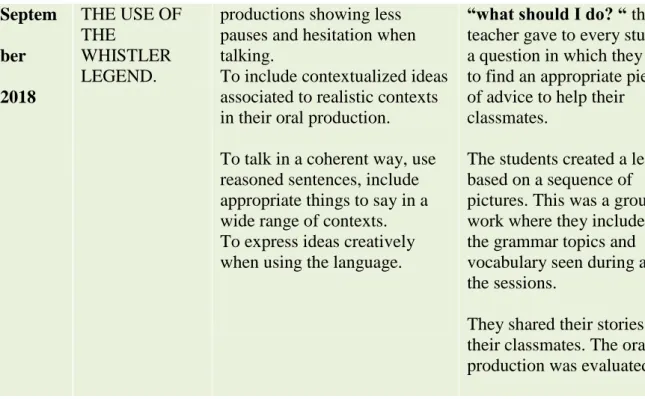
(39) According to the previous information the following curricular plan shows how the proposal was developed according to the objectives and also to the school’s curriculum: 4.3.1.1 First cycle: February 26th To April13th ¨I CAN TALK ¨ is the first cycle where the teacher introduced the topic about the Colombian Legends for letting the students have an overview of the main topic that was going to be worked in class. Also, a variety of vocabulary and grammar related to the first Colombian legend “The weeping woman”, where they worked on addressing topics related to appearance, beauty and how to describe their family and friends. In this first cycle was important to motivate the students and give them enough tools and the accurate input to be prepared for the future oral production activities, the speaking goals for this cycle were improvement of the fluency, learn more vocabulary make correct use of grammar and encourage the students to find similarities with the legends and their own experiences. 4.3.1.2 Second cycle April 20th To June 1st “I CAN TALK MORE” is the second phase, where the students were able to have more participation due to the previous input they have had, they worked on the second legend that was “The Mother Mountain” which allow the students talk about the weather, natural disasters in Colombia and the consequences of not taking care of the nature and the environment. Also, they had to interact more with their classmates and ask about their activities and interests. In this cycle was important to encourage the students participation and interaction not just with their classmates but also with the teacher, the speaking goals were that the students express their ideas and opinions more openly showing fewer hesitations and pauses taking into account the oral skills and the use of the vocabulary in context without fearing judgment. 4.3.1.3 Third cycle August 10th to September 2018.
(40) “I AM STILL TALKING” In this cycle, the students applied all the information about the legends, vocabulary, grammar, the input given during all the sessions and also the connection of real life experiences were exposed during their oral production. In this phase, the students worked with “The Whistler” which allowed the students talk about moral dilemmas and give a suitable piece of advice to determined situations in life making use of some modals. They also had to create a new legend taking into account all the information that was worked in the classes; in addition, they had to present their stories and characters to the whole class. This lesson was divided into three parts. The first one was an explanation about the activity they had to develop and a guide about how they could create a short legend. The second one was about creating the main character based on a sequence of images that the teacher gave them, they also have to organize their ideas and had everything ready for the last part, where they talked about their legend and the relations these legends had with their context. It was expected that the students talked without awkward pauses for a relatively long time, spoke in coherent, reasoned sentences, and had appropriate things to say in a wide range of contexts (Fillmore, 1979). TIME TABLE CYCLE I CAN TALK Februar y 26th April13 th. TOPIC DESCRIBING MYSELF, MY FAMILY AND FRIENDS THROUGH THE USE OF THE WEEPING GIRL LEGEND. GOALS To remind what a legend is and its characteristics To identify how the students describe different objects and people and also themselves. To relate the legend, the grammar and the vocabulary with their real life experiences. To start using new words, and apply the grammar topics during their oral production.. ACTIVITIES The students had to describe the weeping girl appearance and answer simple questions related to the reading. Every student had to describe a specific picture about the weeping girl. They had five minutes to prepare their speaking based on some specific questions previously mentioned. They had described some of their family members using the adjectives of personality and appearance and also the correct intensifiers..
(41) I CAN TALK MORE April 20th– June 1st. UNDERSTATI NG OF MY SURROUNDIN GS, THE WEATHER AND THE ENVIRONMEN T THROUGH THE USE OF THE MOTHER MOUNTAIN LEGEND.. To show the students vocabulary in context related to the natural disasters and weather in Colombia. To describe the natural disasters in Colombia linking the information with the mother mountain legend. To ask follow -up questions to keep the conversation going and encourages the students to participate and create a more comfortable environment for talking. To connect the grammar, the vocabulary, the Mother Mountain Legend, the natural disasters vocabulary and the information about Colombia’s Natural disasters in the students’ oral production. To work on fluency and accuracy skills having continuity and a good speed during the oral production being aware of the context.. The students had to describe what they do and what are their classmates routines using the frequency adverbs through a reading, writing, listening, pair work and Speaking activity called “Partners’ Monday to Friday routine” The students developed another activity called “Breakfast at my house” where the students had to complete statements using correctly the frequency adverbs and also the simple present tense the interaction was a very important tool. An speaking activity was developed to practice fluency, pronunciation, interaction and accuracy , it was a guess game called “How often do you…?” where one student will interview another student to know how often their partners do different activities. Finally, every couple was in front of the class sharing their information, doing the role play .During this oral production the teacher evaluated the oral skills.. I AM STILL TALKI NG August 10th–. GIVING ADVICE AND HELP OTHERS THROUGH MY OPINIONS AND MY POINTS OF VIEW THROUGH. To describe orally possible solutions, possibilities and give some advice to real problems about my classmates or general situations in life. To express opinions easily and show autonomous participation. To use all the information given in any of their oral. The students based on the legends that have been worked on in class, will have to give advice and possibilities to the characters and situations of the legends. As a speaking activity called.
(42) Septem ber. THE USE OF THE WHISTLER LEGEND.. 2018. productions showing less pauses and hesitation when talking. To include contextualized ideas associated to realistic contexts in their oral production.. “what should I do? “ the teacher gave to every student a question in which they had to find an appropriate piece of advice to help their classmates.. To talk in a coherent way, use reasoned sentences, include appropriate things to say in a wide range of contexts. To express ideas creatively when using the language.. The students created a legend based on a sequence of pictures. This was a group work where they included all the grammar topics and vocabulary seen during all the sessions. They shared their stories to their classmates. The oral production was evaluated.. Table 2.Time table..
(43) CHAPTER 5: DATA ANALYSIS AND FINDINGS. This chapter presents the procedures followed to organize and analyze all the information collected during the interventions in the current research. In order to obtain accurate results it was taken into account the framework developed by Miles and Huberman (1994), who identified three important stages that are essential in order to have a suitable analysis of the qualitative data. This analysis must be systematic, follow a sequence and an order. The phases are:. DATA REDUCTION. DATA DISPLAY. CONCLUSIONS ANDDRAWINGS. Three stages are going to be explained with the aim of understanding the methodology and how it was possible to portray the categories and subcategories that emerged from this research process. 1. Data reduction this stage refers to the process of selecting, focusing, simplifying, abstracting and transforming the data that appears in the data collection instruments such as field notes, transcriptions or surveys; this first step often forces to decide the type of the data that should be emphasized and minimized for the purposes of the research. Having as a reference this definition, this element was seen in this project when the information was collected and organized, furthermore, in this step it was necessary to decide which information was relevant to answer the research question, underlining expressions, highlighting new words, phrases and sentences related to the.
(44) use of legends while reading the field notes and making the transcriptions of the voice records.. 2. Data display is the second stage where the information is organized, compressed and assembled. A display can be an extended piece of text, diagram, chart or matrix that provides a new way of organizing the information collected; additionally, data display allows the researcher to establish categories or themes that may emerge from the data, that go beyond those that were discovered during the initial process of data reduction, so a process of comparing and contrasting appears here to discover the patterns as part of an ongoing analytic process. For this research project, data was summarized in a chart with categories and subcategories of analysis to have a more effective and organized way of interpreting the information.. 3. Conclusion drawing and verification involves stepping back to consider what the analyzed data mean and to evaluate its implications for the questions posed; these findings allow the researcher to conclude if the project has presented the expected results or if new information has not been considered by the researcher. In this stage, the hypothesis presented has to be validated and fitted into the framed of the project.. The results of this last step are presented in the following paragraphs: 5.1 Category 1: FORM In this category punctual aspects of oral production related to Form are going to be described, specifically two important elements: fluency and accuracy. 5.1.1 Fluency.
Figure

Documento similar
1. S., III, 52, 1-3: Examinadas estas cosas por nosotros, sería apropiado a los lugares antes citados tratar lo contado en la historia sobre las Amazonas que había antiguamente
In the previous sections we have shown how astronomical alignments and solar hierophanies – with a common interest in the solstices − were substantiated in the
This project is going to focus on the design, implementation and analysis of a new machine learning model based on decision trees and other models, specifically neural networks..
From the results reported above, we draw the following conclusions: (i) the behavior observed along this section is not specific for the Soekris device but is generalized to all
Government policy varies between nations and this guidance sets out the need for balanced decision-making about ways of working, and the ongoing safety considerations
To address this pattern of communication chaos, mass media, global health experts, and international development agencies during the crisis urgently called for the development
Content-validation questionnaire of a meta-model to ease the learning of data visualization concepts
This research was partially funded by the Spanish Government Ministry of Economy and Competitiveness through the DEFINES project grant number (TIN2016-80172-R) and the Ministry
Findings in the present research allow the following analysis and discussion axis proposal: a negative logic in the development of the use of information on reputation to
