Advance Access publication 2016 May 12
Globular cluster scale sizes in giant galaxies: orbital anisotropy
and tidally underfilling clusters in M87, NGC 1399 and NGC 5128
Jeremy J. Webb,
1,2‹Alison Sills,
1William E. Harris,
1Mat´ıas G´omez,
3Maurizio Paolillo,
4,5,6Kristin A. Woodley
7and Thomas H. Puzia
81Department of Physics and Astronomy, McMaster University, Hamilton, ON L8S 4M1, Canada 2Department of Astronomy, Indiana University, Bloomington, IN 47405, USA
3Departamento de Ciencias Fisicas, Facultad de Ciencias Exactas, Universidad Andres Bello, Rep´ublica 220, Santiago, Chile 4Department of Physical Sciences, University of Napoli Federico II, via Cinthia 9, I-80126 Napoli, Italy
5INFN – Napoli Unit, Department of Physical Sciences, via Cinthia 9, I-80126 Napoli, Italy 6Agenzia Spaziale Italiana Science Data Center, Via del Politecnico snc, I-00133 Roma, Italy
7University of California Santa Cruz, University of California Observatories, 1156 High Street, Santa Cruz, CA 95064, USA 8Institute of Astrophysics, Pontificia Universidad Cat´olica de Chile, Avenida Vicu˜na Mackenna 4860, Macul 7820436, Santiago, Chile
Accepted 2016 May 9. Received 2016 May 9; in original form 2015 July 9
A B S T R A C T
We investigate the shallow increase in globular cluster half-light radii with projected galacto-centric distanceRgcobserved in the giant galaxies M87, NGC 1399, and NGC 5128. To model
the trend in each galaxy, we explore the effects of orbital anisotropy and tidally underfilling clusters. While a strong degeneracy exists between the two parameters, we use kinematic studies to help constrain the distance Rβ beyond which cluster orbits become anisotropic, as well as the distanceRfα beyond which clusters are tidally underfilling. For M87 we find Rβ>27 kpc and 20<Rfα<40 kpc and for NGC 1399Rβ>13 kpc and 10<Rfα<30 kpc.
The connection ofRfαwith each galaxy’s mass profile indicates the relationship between size
andRgc may be imposed at formation, with only inner clusters being tidally affected. The
best-fitting models suggest the dynamical histories of brightest cluster galaxies yield simi-lar present-day distributions of cluster properties. For NGC 5128, the central giant in a small galaxy group, we findRβ>5 kpc andRfα>30 kpc. While we cannot rule out a dependence on Rgc, NGC 5128 is well fitted by a tidally filling cluster population with an isotropic distribution
of orbits, suggesting it may have formed via an initial fast accretion phase. Perturbations from the surrounding environment may also affect a galaxy’s orbital anisotropy profile, as outer clusters in M87 and NGC 1399 have primarily radial orbits while outer NGC 5128 clusters remain isotropic.
Key words: globular clusters: general – galaxies: kinematics and dynamics.
1 I N T R O D U C T I O N
The tidal field of a galaxy influences its globular cluster (GC) popu-lation by imposing a maximum size that each cluster can reach (e.g. von Hoerner1957; King1962; Innanen, Harris & Webbink1983; J´ordan et al.2005; Bertin & Varri2008; Binney & Tremaine2008; Renaud, Gieles & Christian2011). This maximum size is often re-ferred to as the tidal radiusrt, the Jacobi radius, or the Roche lobe
of the cluster. In all cases, it marks the distance from the cluster at which a star will become unbound as it feels a stronger acceleration
E-mail:[email protected]
towards the host galaxy than it will towards the GC. von Hoerner (1957) predicted that
rt=rgc
M
2Mg 1/3
(1)
for a cluster of massMon a circular orbit of radiusrgc, whereMgis
the enclosed galactic mass.
Under the assumption that a galaxy can be approximated by an
isothermal sphere (Mg(rgc)∝rgc), we expectrt∝r
2 3
gc. Since there
is no observational evidence that cluster central concentration c changes strongly withrgc, the mean half-light radiusrhwill follow
the same scaling relation asrt(Harris1996; van den Bergh2003).
For the Milky Way, which gives us the only cluster population for which we have three-dimensional positions and proper motions, we
C
findrh∝rgc0.58±0.06using positions and half-light radii from Harris
(1996; 2010 edition) and proper motions from Dinescu, Girard & van Altena (1999) and Casetti-Dinescu et al. (2007,2013). This is a mild but notable discrepancy from the nominal value of 23.
Taking into consideration that only the projected galactocentric distanceRgccan be determined for GCs in other galaxies, the
rela-tionship between size and distance takes the formrt∝Rαgc, where
α∼0.4–0.5 for typical radial distributions (cluster density∝r−2 gc).
However, observations in other galaxies appear to disagree with theoretical predictions. From a study of six giant elliptical galaxies, Harris (2009b) found the combined data set was best fitted by an
α of 0.11. This value is in agreement with observational studies of NGC 4594 (α=0.19±0.03; Spitler et al.2006; Harris et al.
2010b), NGC 4649 (α=0.14±0.06; Strader et al.2012), M87 (α=0.14±0.01; Webb, Sills & Harris2013b), NGC 4278 (α= 0.19±0.02; Usher et al.2013), and NGC 1399 (α=0.13±0.03; data from Puzia et al.2014). Looking at the metal-poor (blue) and metal-rich (red) cluster subpopulations in NGC 5128 separately, G´omez & Woodley (2007) foundα= 0.05± 0.05 for the blue clusters andα=0.26±0.06 for the red clusters. Only the clus-ter population of the giant elliptical galaxy NGC 4365 in the Virgo cluster has a measuredαof 0.49±0.04 that is comparable to the ex-pected range of 0.4–0.5 (Blom, Spitler & Forbes2012), which may indicate the galaxy has a different dynamical age or has undergone a different formation scenario than the galaxies listed above.
The discrepancy between equation (1) and observed values of
αmay be attributed to assuming that all GCs have circular orbits in spherically symmetric isothermal tidal fields and that they fill their theoretical rt. The first assumption is required in order for
the tidal field experienced by the cluster to be static. However, galaxies will not necessary have isothermal mass profiles or be spherically symmetric. A non-isothermal mass profile will alter the expected value ofα, with a more strongly increasing cumulative mass with radius (d(log(Mg(rgc)
d(log(rgc) >1) resulting in smaller values of α. Furthermore, no known GC has a truly circular orbit (Dinescu et al. 1999; Casetti-Dinescu et al. 2007, 2013). Eccentric orbits then subject the cluster to tidal heating and tidal shocks which can provide outer stars enough energy to escape the cluster and energize inner stars to larger orbits (e.g. K¨upper et al.2010; Renaud et al.
2011; Webb et al.2013a; Kennedy 2014). Clusters on eccentric orbits are also able to recapture temporarily unbound stars since the cluster’s instantaneousrtis also time dependent.N-body models of
GC evolution have shown that despite spending the majority of their lifetimes at apogalacticon, clusters with eccentric orbits lose mass at a faster rate (Baumgardt & Makino2003) and appear smaller (Webb et al. 2013a) than clusters with circular orbits at apogalacticon. Hence incorporating the effects of orbital eccentricity on cluster evolution could reduce the discrepancy between theoretical and observed values ofα. The situation will be complicated further if the cluster has an inclined orbit in a non-spherically symmetric potential (Madrid, Hurley & Martig 2014; Webb et al. 2014) or if the cluster has been accreted by the host galaxy via a satellite merger such that its current orbit does not reflect the tidal field in which it formed and evolved (Miholics, Webb & Sills2014,2015; Bianchini et al.2015; Renaud & Gieles2015).
The second assumption, that all clusters fill their theoreticalrt, we
now understand is also unrealistic. While a GC will naturally expand due to two-body interactions (Henon1961), it is possible that cer-tain clusters formed compact enough or expand slowly enough such that they have yet to reach the point of filling theirrtand effectively
evolve in isolation. Observationally for such clusters, their limiting
radiusrL(the radius at which the cluster’s density falls to zero) is
less thanrt. Observations of Galactic GCs have shown that only
approximately 1
3 of the population are tidally filling, in the sense
thatrL∼rt(Gieles, Heggie & Zhao2011). The remaining clusters
in the Milky Way are still in the expansion phase and are considered to be tidally underfilling. Underfilling clusters have also been found in NGC 4649, where Strader et al. (2012) found no evidence for tidal truncation for clusters beyond 15 kpc and in NGC 1399, where Puzia et al. (2014) found no evidence for truncation beyond 10 kpc. Alexander & Gieles (2013) were able to reproduce the observed size distribution of Galactic GCs by assuming that all clusters form initially compact and then expand naturally via two-body interac-tions until they become tidally filling. After 12 Gyr of evolution, inner clusters which experience a strong tidal field and have small tidal radii have expanded to the point of being tidally filling. Outer clusters, with large tidal radii, still remain tidally underfilling af-ter 12 Gyr since the ouaf-ter tidal field is weak. Allowing clusaf-ters to become more underfilling with increasingrgcoffers a second
ex-planation as to why observed values ofαare noticeably less than theoretical predictions.
Understanding how the factors discussed above can influenceα allows us to use the size distribution of GC populations to constrain many properties of their host galaxy, including its mass and orbital anisotropy profiles. In two previous studies of the giant elliptical galaxy M87 (Webb, Sills & Harris2012; Webb et al.2013b), we explored the effects of orbital anisotropy and tidal filling on its GC population out to 110 kpc. We found that it was possible to reproduce the observed relationship betweenrhandRgcin M87 by allowing
cluster orbits to be preferentially radial. However, the degree of radial anisotropy required to reproduce the size distribution of inner and outer region clusters was quite different. This discrepancy was partially minimized by allowing orbital anisotropy to change with rgc, but the degree of radial anisotropy in the outer regions of M87
was still much higher than kinematic studies suggested (Cˆot´e et al.
2001; Strader et al. 2011). We were also able to match theory and observations by allowing all clusters to be underfilling, but we only explored the effects of clusters being underfilling by the same amount at allrgc.
Given that clusters form with some initial size distribution and can be found over large ranges inRgc, clusters can underfill theirrt
either because the local tidal field is weak or they formed extremely compact. The situation is complicated even further by the possibility that some clusters in a galaxy may be accreted. If a cluster that was tidally filling in its original host galaxy is accreted and ends up with an orbit at a largeRgc, it can appear to be extremely underfilling. So
instead orbital anisotropy and tidal filling are likely to be functions ofrgc(e.g. Cˆot´e et al.2001; Prieto & Gnedin2008; Zait, Hoffman
& Shlosman2008; Gnedin & Prieto2009; Weijmans et al.2009; Ludlow et al. 2010; Kruijssen et al.2012; Alexander & Gieles
2013). The next step is to then incorporate these two parameters into our model as functions ofrgc.
In this study, we consider the combined effects of orbital anisotropy and tidal filling on GC populations in the giant galaxies M87, NGC 5128, and NGC 1399. Since we are focused on giant elliptical galaxies which are spherically symmetric over the range of Rgcthat our observational data sets cover, orbital inclination is not a
contributing factor. It should be noted that some studies have found that M87 is not spherically symmetric at largerRgcand that its
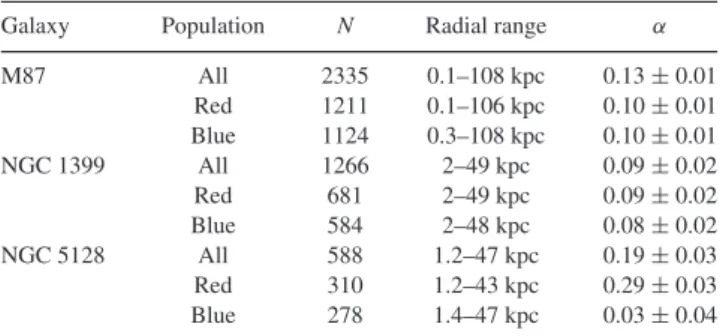
Table 1. Properties of observed globular cluster populations.
Galaxy Population N Radial range α
M87 All 2335 0.1–108 kpc 0.13±0.01
Red 1211 0.1–106 kpc 0.10±0.01 Blue 1124 0.3–108 kpc 0.10±0.01
NGC 1399 All 1266 2–49 kpc 0.09±0.02
Red 681 2–49 kpc 0.09±0.02
Blue 584 2–48 kpc 0.08±0.02
NGC 5128 All 588 1.2–47 kpc 0.19±0.03
Red 310 1.2–43 kpc 0.29±0.03
Blue 278 1.4–47 kpc 0.03±0.04
which have measured its mass profile (McLaughlin1999; Strader et al.2011; Agnello et al.2014; Zhu et al.2014). However, inclina-tion will have to be considered in future studies if our approach is to be applied to non-spherically symmetric elliptical galaxies and disc galaxies. We also assume that all clusters in a given population have spent their entire lifetimes in the host galaxy. Miholics et al. (2014) showed that after a cluster is accreted by a host galaxy its size responds to its new potential within 1–2 GC relaxation times and evolves as if it has always orbited in the host galaxy. So while accreted clusters may maintain a kinematic signature of the accre-tion process, theirstructuralparameters (which is the focus of this study) will reflect theircurrentorbit in the host galaxy.
In Section 2 we introduce the three observational data sets used in our study and in Section 3 we re-introduce the theoretical model used to reproduce the observations. In Section 4 we first study how allowing the orbital anisotropy and tidal filling properties of clusters to change withrgcaffects the distribution of cluster sizes in each
galaxy. We then explore the degeneracy between these two factors and make use of previous kinematic studies of each population to constrain our models even further. The best-fitting theoretical model for each galaxy is then discussed and the results of all three galaxies are compared in Section 5. We summarize our findings in Section 6.
2 O B S E RVAT I O N S
In the following sections we summarize the data sets for M87, NGC 1399, and NGC 5128 used in this study. Table1lists the total number of GCs, radial range, and the measured value ofαfor each data set.αis the slope of a log–log plot of medianrhversus
Rgc, where the medianrhis calculated within radial bins containing
5 per cent of the total cluster population. We also list the same properties when clusters are split into red and blue subpopulations. Red and blue clusters in M87 and NGC 1399 have very similar values ofα, with the global M87 population having a slightly higher value ofαoverall. Red and blue clusters in NGC 5128 on the other hand have very different vales of α, with therh of red clusters
increasing steeply withRgccompared to blue clusters. Overall, the
increase inrhwithRgcis much steeper in NGC 5128 than in M87
or NGC 1399.
While the colour and luminosity ranges of the M87 data set are both thoroughly covered down to very low luminosity, in both NGC 1399 and NGC 5128 the data are incomplete for GCs much fainter than the luminosity function turnover. However, as we dis-cuss in Sections 3.2 and 3.3, the incompleteness in mass range is factored into our model. The main parameter extracted from each data set is the GC half-light radius, which is measured by fitting the surface brightness profile of each cluster with a King (1962) profile. For M87 (Webb et al.2013b) and NGC 5128 (G´omez & Woodley
2007; Woodley et al.2010a), surface brightness profile fits are done
using the commonly used toolISHAPE(Larsen1999) and allowing the
central concentration to be variable. For NGC 1399,GALFIT(Peng
et al.2010) is used to fit GC surface brightness profiles with King (1962) models (Puzia et al.2014).rhhas been shown to be a robust
parameter that can repeatedly be recovered using different surface brightness profile models (Webb et al.2012) and different fitting routines (Webb et al.2013a; Puzia et al.2014) (includingISHAPE
andGALFIT) when cluster sizes are comparable to the point spread function. Therefore using different fitting routines to measure clus-ter sizes in NGC 1399 will have a minimal effect on the results of this study, especially since our results only rely on the relative trends within each galaxy. Additionally, even though cluster sizes are measured in different wave bands, many studies have found that there are minimal differences when comparing sizes measured with different filters (e.g. Harris et al.2010a; Strader et al.2012; Webb et al.2013b). And, since similar constraints are used to confirm GC candidates and minimize contaminants (magnitude, colour, quality of fit, and size), the observational data sets are as homogeneous as possible.
2.1 M87
M87 is a giant elliptical galaxy located at the centre of the Virgo cluster, with a distance modulus of (m−M)0=30.88 (Pierce et al.
1994; Tonry et al.2001).Hubble Space Telescope(HST) Advanced Camera for Surveys (ACS)/Wide Field Camera (WFC) images of the central 12 kpc of M87 in theF814W(I) andF606W(V) filters are taken from program GO-10543 (PI: Baltz). The more recently completed program GO-12532 (PI: Harris) provided a combination of eight ACS and WFC3 fields of view in theF814WandF475W filters of the outer regions of M87 ranging from 10 to 110 kpc. See Webb et al. (2012,2013b) for a detailed description of how cluster candidates are selected and sizes are measured.
2.2 NGC 1399
NGC 1399 is a giant elliptical galaxy located at the centre of the For-nax cluster, with a distance modulus of (m−M)=31.52 (Dunn & Jerjen2006; Blakeslee et al.2009). In this study we utilize archival HSTimages of NGC 1399 from program GO-10129 (PI: Puzia). The 3×3 ACS mosaic in theF606Wfilter covers approximately 10×10 arcmin2out to a projected distance of approximately 50 kpc.
A description of how cluster candidates are selected and how sizes are measured can be found in Puzia et al. (2014). It should be noted that while Puzia et al. (2014) introduced a cluster size cor-rection function based on artificial cluster experiments, we use the uncorrected cluster sizes to keep the observational data sets in this study as homogeneous as possible. Hence the quoted value ofαfor NGC 1399 in Table1differs slightly from Puzia et al. (2014).
2.3 NGC 5128
NGC 5128 (Cen A) is a giant galaxy that is found in relative iso-lation, with a distance modulus of (m−M)=27.92 (Harris et al.
3 M O D E L
Our model (first introduced in Webb et al.2012and modified in Webb et al.2013b) generates a mock GC population that has the same distributions in projected distance, velocity, and mass as the observed data set. The model also has the capability to model sub-populations with different radial profiles and velocity dispersions separately, which we apply to the red and blue subpopulations in each galaxy. The central concentration distribution and mass to light ratios of model clusters are set equal to the Milky Way cluster pop-ulation. Since our model has been modified to be applicable to any galaxy, we will re-introduce it here.
The projected radial distribution of clusters in each galaxy is obtained by fitting the observed number density profile (n(Rgc))
with a modified two-dimensional Hubble profile:
n(Rgc)=
The red and blue radial distributions of GCs in M87 have pre-viously been shown to follow a Hubble profile (Harris2009a), and fitting equation (2) to all three of our observed data sets yields re-ducedχ2(χ2
ν) values of order unity (see Sections 3.1–3.3 for the
best-fitting values of n0and R0for red and blue clusters in each
galaxy). Assuming the two-dimensional Hubble profile continues beyond the range of our observational data sets, equation (2) is then transformed to obtain the three-dimensional radial distribution from which cluster positions are randomly sampled (Binney & Tremaine
2008). Each model cluster is then assigned a three-dimensional velocity based on the observed global line-of-sight velocity disper-sion. Before assigning velocities, we first consider the anisotropy parameter (β), which is one of our two free parameters and controls the degree of orbital anisotropy within the GC system.βis defined as (Binney & Tremaine2008)
β=1−σ
coordinate. In all cases,σθ andσφ are assumed to be equal. The isotropic case (β = 0) means thatσr= σθ = σφ are all equal
to the line-of-sight velocity dispersion and velocities are randomly drawn from a Gaussian distribution. Ifβincreases from zero, then
σr increases whileσθ and σφ decrease such that the average of
all three values still matches the observations and orbits become preferentially radial. The opposite occurs ifβdecreases from the isotropic case and orbits become preferentially circular.
We also allow forβto change as a function ofrgc. We assume
the orbital anisotropy profile of a given galaxy is of the form
β(rgc)=
where the anisotropy radiusRβ replacesβas one of the free pa-rameters in our model. This form ofβ(rgc) is in agreement with
theoretical and observational studies which find that inner cluster orbits are primarily isotropic while orbits become preferentially ra-dial withRgc(e.g. Cˆot´e et al.2001; Fall & Zhang2001; Vesperini
et al.2003; Gnedin & Prieto2009; Ludlow et al.2010; Kruijssen et al.2012). We also note that other functional forms of equation (4) have been suggested in the literature, but studying the effects of dif-ferentβ(rgc) profiles is beyond the scope of this study and will be
addressed in the future.
0 20 40 60 80 100
0
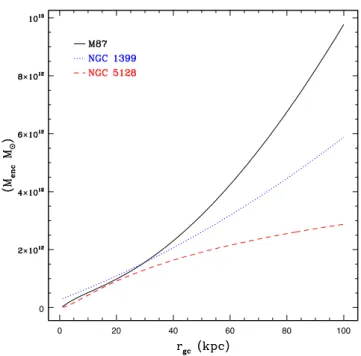
Figure 1. Total enclosed mass as a function of rgc for M87 (black),
NGC 1399 (blue), and NGC 5128 (red).
Once a value of β has been given to each cluster, a mass is assigned based on the observed luminosity function of the data set. The mass to light ratio of the model clusters is as-sumed to be equal to the mean value of MLV =2 found by McLaughlin & van der Marel (2005) for Milky Way GCs. The central concentration (c) of each cluster (log of the ratio between the cluster’s core radius rc to its limiting radius
assigned based on the distribution of Milky Way GCs (Harris
1996), which is Gaussian with a mean ofc=1.5 and dispersion of 0.4.
Once each model cluster has been generated, the mass profile of the selected galaxy (see Fig.1and Sections 3.1–3.3) is used to calculate the theoretical value ofαthat is expected assuming all clusters have circular orbits. Knowing the gravitational potential field also allows for the orbit of each individual cluster to be solved (Binney & Tremaine 2008). The resulting distribution of orbital eccentricities (and its dependence onrgc) will then be dependent on
β, the velocity dispersion of the GC population, and the mass profile of the host galaxy. Hence two galaxies can have similar values ofβ but different distributions of cluster orbits.
Using the formalism of Bertin & Varri (2008), we next calculate each cluster’srt at perigalacticon rp. For clusters with eccentric
orbits we use their orbital frequency at rp to calculate rt as
opposed to=((dG(r)/dr)rp/rp) 1
2 which assumes the cluster
has a circular orbit atrp(Moreno, Pichardo & Vel´azquez2014). We
then determinerLatrpbased on our second free parameterRf= rrLt,
also known as the tidal filling parameter. HenceRfis a measure of
how filling a cluster is atrp, with clusters that fill only a fraction of
their permittedrthavingRf<1.
We next assume that each model cluster can be represented by a King (1962) model, such that the limiting radius atrp and the
previously assigned central concentration set the cluster’s surface brightness profile. However,Rf, rL, and rh corresponding to the
surface brightness profile are only valid when the cluster is located atrpand will change as a function of orbital phase. Tidal heating,
as a cluster moves away fromrpwill causerhandrLto increase
as a function of orbital phase. We therefore correct the modelrh
values for orbital eccentricity following Webb et al. (2013a,b), with rh increasing by a maximum of 30 per cent for highly eccentric
clusters. No corrections are necessary forrLandRfsince we do not
compare these values to observations.
Similar toβ,Rfcan also be a function of a cluster’s location in
the tidal field. We specifically allowRfto change as a function of
rgcvia
where the filling radiusRfαbecomes the free parameter. This form
ofRfensures clusters become less tidally filling as the tidal field
becomes weaker (Alexander & Gieles2013).
Finally, to best match the observed data sets, we apply magnitude and size cut-offs to the simulated data set such that the model does not produce GCs that may exist but would not be observed. We also check to make sure the simulation does not produce any clusters with evaporation or infall times due to dynamical friction less than any observed clusters.
The individual input parameters and mass profiles of each galaxy are discussed in Sections 3.1–3.3. Since each galaxy has multiple estimations of various input parameters, we use the best available data that are also in line with the assumptions made by our model. Perhaps the most influential input parameter is our choice of mass profile. While a complete study of the effects that different mass profiles will have on our results is beyond the scope of our study, we note a different rate of increase in mass withrgcwill result in clusters
having different values ofrt. More specifically a steeper increase in
enclosed mass withrgcwill result in a shallower increase inrtwith
rgc. If the true values ofrtare smaller than the values calculated
using the adopted mass profiles, then GCs must be more tidally filling and/or have a lesser degree of radial anisotropy. Hence our estimation ofRfwill be a lower limit and our estimation ofβwill
be an upper limit. The opposite will be true if the mass profile is shallower.
3.1 M87
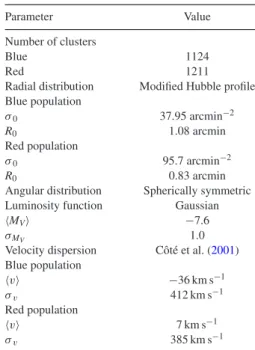
The radial profile and luminosity function of our M87 data set are listed in Table2, along with the velocity dispersion parameters as-signed to our theoretical cluster population. While observations of inner clusters sample the entire luminosity function, we incorporate into our model the fact that the luminosity function of outer clus-ters is only∼50 per cent complete beyond the luminosity function turnover. In a kinematic study of the GC population of M87, Cˆot´e et al. (2001) found that blue clusters have a mean velocity (minus the galaxy’s systemic velocity) of−36 km s−1with a dispersion of
412 km s−1while red clusters have a mean velocity of 7 km s−1and
a dispersion of 385 km s−1. They also suggested that the velocity
dispersion may increase withRgc. However more recent studies by
Strader et al. (2011) and Zhu et al. (2014) found that the global velocity dispersion stays relatively constant withRgc. Because of
the larger data sets of Strader et al. (2011) and Zhu et al. (2014) and their more rigorous treatment of outliers, we will assume the velocity dispersion of M87 is constant at allrgc. There is also no
evidence in any of the galaxies presented in this study that either the mean velocity or velocity dispersion is dependent on cluster luminosity.
Table 2. Simulated M87 globular cluster population input parameters.
Velocity dispersion Cˆot´e et al. (2001) Blue population
The galactic potential of M87 is taken directly from McLaughlin (1999) and has the form
The stellar mass component (equation 7) was determined by fitting model mass density profiles for spherical stellar systems (Dehnen 1993; Tremaine et al.1994) to B-band photometry (de Vaucouleurs & Nieto1978), assuming the stellar mass-to-light ratio of M87 is independent of radius. The dark matter component of M87 (equation 8) was determined by combining X-ray observations of hot gas in the extended M87 halo, dwarf elliptical galaxies, and early-type Virgo galaxies to generate a Navarro–Frenk–White (NFW) dark matter halo (Navarro, Frenk & White1997).
The overall mass profile is in general agreement with the more recent kinematic study of M87 performed by Strader et al. (2011), though the latter found evidence for a larger dark matter component within 20 kpc. Using the Strader et al. (2011) data set, Agnello et al. (2014) also derived stellar and dark matter mass profiles for M87 by separating its cluster population into three subpopulations and noting their distinct radial distributions and velocity dispersions as a function ofRgc. The total mass of M87 as determined by Agnello
et al. (2014) is comparable to McLaughlin (1999), although Agnello et al. (2014) found a more gradual increase in dark matter mass than McLaughlin (1999). Using an even larger GC data set than Agnello et al. (2014) over a wider range ofRgc, Zhu et al. (2014) found a
lower total mass within 100 kpc than McLaughlin (1999). However the gradient in the mass profiles of McLaughlin (1999) and Zhu et al. (2014), which is the key factor in setting how rtincreases
withrgc, are very similar out to anRgc of 80 kpc. As noted by
Table 3. Simulated NGC 1399 globular cluster
pop-Velocity dispersion Schuberth et al. (2010) Blue population
differences between the mass profiles discussed above are minimal (within theRgcrange of our observed data set) and the McLaughlin
(1999) model incorporates X-ray observations, we will utilize the mass profile as determined by McLaughlin (1999).
3.2 NGC 1399
The radial profile and luminosity function of our NGC 1399 data set are listed in Table3. Note that we have incorporated into our model that the luminosity function of our data set is only complete to an absolute magnitude of−5.7. The velocity dispersion param-eters assigned to our theoretical cluster population are taken from the most recent kinematic study of the NGC 1399 GC population, where Schuberth et al. (2010) found that blue clusters have a mean velocity of 11 km s−1with a dispersion of 358 km s−1and the red
clusters have a mean velocity of 31 km s−1with a dispersion of
256 km s−1. While Schuberth et al. (2010) also suggested that the
velocity dispersion of red and blue clusters may change withRgc, we
will assume these values remain constant withRgcto stay consistent
with our model for M87.
Schuberth et al. (2010) also derived a mass profile for NGC 1399 based on GC kinematics, although the authors assumed a value for the anisotropy parameterβ. To stay consistent with the mass profile used for M87, we take the galactic potential of NGC 1399 as derived fromROSATHigh Resolution Imager data by Paolillo et al. (2002). X-ray emission from hot gas in NGC 1399 was used to make enclosed total mass (stars and dark matter) estimates at various distances. Since we require a functional form for the mass profile of each galaxy in order to solve the orbits and calculate the size of each model cluster, and since the data do not reflect a standard NFW profile, we fit the mass profile from Paolillo et al. (2002) with a quadratic function:
Mtot(r)=2.74×10¹¹M +3.73×10¹⁰M
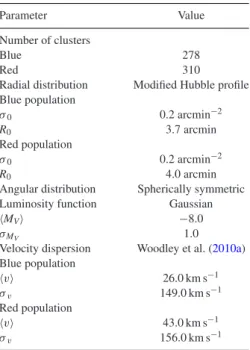
Table 4. Simulated NGC 5128 globular cluster pop-ulation input parameters.
Velocity dispersion Woodley et al. (2010a) Blue population
The radial profile and luminosity function of our NGC 5128 data set are listed in Table4. We have incorporated into our model the fact that our NGC 5128 cluster data set is only 60 per cent com-plete fainter than the luminosity function turnover. The velocity dispersion parameters assigned to our theoretical cluster population (also in Table4) are taken from Woodley et al. (2010a). In a kine-matic study of over 600 GCs, they determined that blue GCs have a mean velocity of 26 km s−1with a dispersion of 149 km s−1and
red clusters have a mean velocity of 43 km s−1with a dispersion of
156 km s−1. Similar to NGC 1399, Woodley et al. (2010a) found
ev-idence that the velocity dispersion of red and blue clusters changes withRgc. However with no quantitative analysis of this radial
vari-ation, we again assume these values remain constant withRgc. It is
interesting to note that the velocity dispersions of the NGC 5128 cluster populations are approximately a factor of 2 smaller than in M87 and NGC 1399. This difference must have to do with M87 and NGC 1399 being massive galaxies located at the centres of a rich galaxy cluster while NGC 5128 is more or less in isolation. We will discuss the impact of environment further in Section 5.
A mass profile of NGC 5128 that uses X-ray emission from hot gas currently does not exist. Instead we take the potential of NGC 5128 from enclosed total mass estimates from Woodley et al. (2010a) based on the kinematics of the NGC 5128 cluster popu-lation, which makes assumptions regarding the anisotropy profile of the cluster population. While we note that the mass profile of NGC 5128 has been determined via a different method than M87 and NGC 1399, it is in agreement with previous estimates taken from studies of HIgas shells (Schiminovich et al.1994), planetary nebulae (Peng, Ford & Freeman2004a; Woodley et al.2007), and other cluster data sets (Peng, Ford & Freeman2004b) and will still accurately reflect the trueMtot(r). Fitting the total mass estimates
with a NFW profile (Navarro et al.1997), we find
Mtot(r)=1.74×10¹⁴M
ln(1+r/8.2 kpc)− (r/8.2 kpc) (1+r/8.2 kpc) .
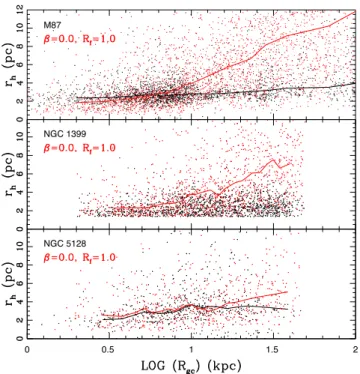
Figure 2. rhversus logRgcfor observed globular clusters (black) and model
clusters (red) in M87 (top), NGC 1399 (middle), and NGC 5128 (bottom) assuming clusters have an isotropic distribution of orbits and are all tidally filling. The solid lines represent the medianrhcalculated with radial bins
containing 5 per cent of the observed cluster population.
4 R E S U LT S
4.1 The isotropic and tidally filling case
We first compare our observed data sets to a baseline set of models in which the clusters are tidally filling with an isotropic distribution of orbits. To best compare to observations the three-dimensional po-sitions of our model clusters are projected on to a two-dimensional plane. In Fig.2we have plotted the measuredrhof observed GCs
(black) and theoretically determinedrhof model clusters (red) in
all three galaxies. The solid lines show the medianrhas a function
ofRgc.
Given the radial distribution of GCs and the mass profiles of M87 and NGC 1399, assuming each model cluster has a circular orbit at its currentrgc would yield values ofα equal to 0.6. For
NGC 5128, despite its shallower mass profile the radial distribution of GCs is such thatα =0.46 (again assuming all clusters have circular orbits). Unfortunately, especially in the cases of M87 and NGC 1399, an isotropic distribution of orbits does not eliminate the difference between observed and theoretically predicted vales of
α. For M87 and NGC 1399, allowing clusters to have an isotropic distribution of orbits results inα=0.55. In the case of NGC 5128, the observations are surprisingly well matched by the isotropic case withα=0.25, with the model only slightly overestimating cluster sizes at largeRgc. NGC 5128 is better fitted by theβ = 0 and
Rf=1 model than M87 and NGC 1399 because its mass profile
and smaller observed velocity dispersion results in clusters having a higher mean eccentricity and a smallerα. Since clusters are brought deeper into the potential well of the galaxy, they must also be more tidally filling (despite the galaxy being less massive) to match the higher global value ofα=0.19 observed in NGC 5128.
Kinematic and structural studies of M87 and NGC 1399 do not support the idea of cluster populations being isotropic and tidally
filling. Studies of galaxy formation and structure suggest that clus-ter orbits become preferentially radial and clusclus-ters become more tidally underfilling with increasingrgc. As previously discussed in
this study and in Webb et al. (2013a),αwill be further decreased by allowing either the anisotropy parameterβto increase or the tidal filling parameterRf to decrease. Increasing βserves to decrease
cluster sizes as it results in cluster orbits being preferentially ra-dial, bringing them deeper into the galactic potential of the galaxy. Decreasing Rf also results in clusters being compact and tidally
underfilling, such that their observed size is less thanrtand they
evolve as if they were in isolation. However, in Webb et al. (2013a) we only studied the effects of radially constant values ofβandRfon
GC sizes. We explore the effects of these two parameters changing withrgcin the following subsections.
4.2 The effects of orbital anisotropy and tidally underfilling clusters
To explore the effects of radially dependentβandRf, we re-run
our simulations for 0<Rβ <100 kpc and 0<Rfα <100 kpc in
search for the combination which provides the strongest agreement between our theoretical and observed cluster populations. We have initially assumed that red and blue clusters in each galaxy have the same orbital anisotropy and tidal filling profiles. To compare theory and observations, we determine the medianrhin 20 radial bins each
containing 5 per cent of the total population. A median half-light radius is also calculated for each mock GC population using the same radial bins as the observations. To measure how well a model reproduces the observed data set, we calculate theχ2
ν between the
two median profiles via
χ2 ν =
1
N−n−1
N
i
(rh,obs(Rgc,i)−rh,mod(Rgc,i))2
rh,obs(Rgc,i)+rh,mod(Rgc,i) , (11)
whereNis the total number of bins (20),nis the total number of fitted parameters (2),rh,mod(Rgc,i) is the median half-light radius of
the model in theith radial bin, andrh,obs(Rgc,i) is the median
half-light radius of the observations in theith radial bin. Theχ2 ν value
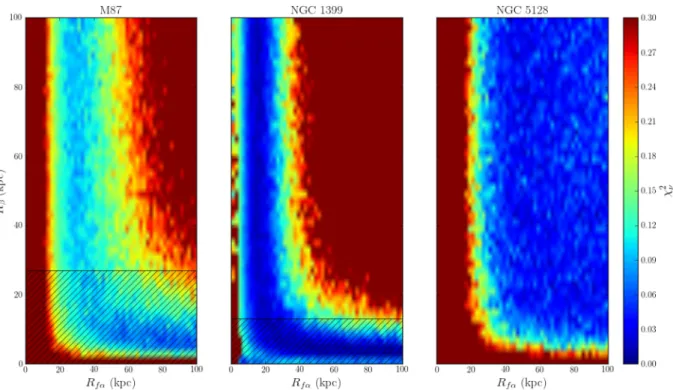
between our model and the observations is shown for the entireRβ andRfαparameter space in Fig.3.
For M87 and NGC 1399, we see that highRβ–lowRfα models
can fit the observations just as well as lowRβ–highRfα models. The degeneracy is due to the previously mentioned fact that both parameters are used to decrease cluster sizes. In NGC 5128 the degeneracy is less clearly defined due to the smaller number of clusters and their significantly smaller observed velocity dispersion. A smaller velocity dispersion means that even moderate changes in Rβ will not strongly affect the global kinematic properties of the model cluster population. With a lower number of clusters to sample the velocity dispersion with, the effect that changingRβ has on the model population is minimized further. Only very low values ofRβ, such that the relative values ofσr,σθ, andσφdiffer
dramatically, will the kinematic and structural properties of model clusters be noticeably altered. Hence any combination of moderate to large values of bothRβ andRfαyields a model population that
is primarily isotropic and provides a match between theoretical and observed cluster sizes.
A second key issue that adds to the degeneracy betweenRβand Rfα is the limited range in Rgc of our data sets. It is difficult to
rule out higher values of Rβ or Rfα based on cluster size alone
Figure 3. Degeneracy betweenRβandRfαfor fits to the total cluster populations of M87 (left), NGC 1399 (middle), and NGC 5128 (right). Orbits go from
preferentially radial to isotropic asRβ increases and clusters become preferentially tidally filling asRfαincreases. The colour scale corresponds to theχν2
between our theoretical model and observations. Hatched out regions can be excluded based on kinematic studies of each galaxy (see Sections 4.4.1–4.4.3).
the anisotropy or tidal filling profiles of inner region clusters, and only affect the outermost clusters in each galaxy. In order to remove some of the degenerate solutions in Fig.3and identify acceptable values ofRβ andRfα we must therefore look beyond our own ob-servational data sets and models.
4.3 Removing degenerate solutions
The degeneracy betweenRβandRfα in each galaxy indicates that there are multiple models which yield low values ofχ2
ν between the
observed and theoretical medianrhprofiles. To better constrain the
parameter space, and eliminate some of the degeneracy between the two parameters, we can draw upon previous observational stud-ies of each GC population. Kinematic studstud-ies of each galaxy have led to estimates of the global value ofβ, with some studies even suggesting possible anisotropy profiles. In order to eliminate some of our degenerate model solutions without placing undue weight on these previous studies, we only eliminate values ofRβthat produce cluster populations with mean values ofβthat are outside the range of measured global values ofβor outside theβrange implied by an anisotropy profile. For a model consisting ofNGCs, the meanβ is simplyβ =
N
n=1β(n)
N , whereβ(n) is the value ofβat the given
cluster’srgc.Rfαon the other hand cannot as easily be constrained,
as many issues including the initial size distribution of GCs, their tidal histories, and their merger/accretion histories can produce a range of differentRf profiles. Therefore we will focus on finding
values ofRβ that are also in agreement with kinematic studies of each galaxy.
4.3.1 M87
For M87, many kinematic studies exist that yield conflicting values ofβandRβ. A study by Strader et al. (2011) inferred high global
values ofβ(∼0.4). Studies by Romanowsky & Kochanek (2001) and Murphy, Gebhardt & Adams (2011) on the other hand found that GCs in M87 are for the most part isotropic, with Murphy et al. (2011) inferring a small degree of radial anisotropy beyond 30 kpc. These three studies however go against the general findings of Deason et al. (2012), who in a study of 15 elliptical galaxies concluded that the distribution of cluster orbits in elliptical galaxies are primarily isotropic with a slight preference towards tangential orbits in some cases. This result was also found in M87 by Agnello et al. (2014). The most recent study regarding the kinematics of M87 by Zhu et al. (2014), which has the largest GC kinematic data set to date out to 180 kpc, suggested that inner cluster orbits are tangentially biased (β= −0.2) withβincreasing to 0.2 at 40 kpc and then decreasing back to 0 at 120 kpc. While the anisotropy profile suggested by Zhu et al. (2014) is in disagreement with Strader et al. (2011), it agrees with the results of Romanowsky & Kochanek (2001) and Murphy et al. (2011) while supporting the work of Deason et al. (2012) that the profiles might be partially tangentially biased. The fact that Zhu et al. (2014) found thatβbegins to decrease again at larger Rgcagrees with the general behaviour ofβpredicted by Agnello
et al. (2014), but it does not support the idea that outer clusters have preferentially tangential orbits. Because of the large data set and detailed method for determining the anisotropy profile of M87, we will use the results of Zhu et al. (2014) to remove degenerate model solutions that reproduce the distribution of cluster sizes in M87.
Based on the anisotropy profile suggested by Zhu et al. (2014), we exclude degenerate solutions where the meanβis greater than 0.2. Hence we can eliminate all models withRβ less than 27 kpc. Based on this constraint and our model fits to the distribution of cluster sizes in M87, it appears thatRfα must be between 25 and
being tidally affected to being tidally unaffected. HavingRfαwithin
this range results in the outermost clusters havingRfvalues between
0.06 and 0.14. Both of these values are comparable to the minimum Rfvalues in the Milky Way, which are approximately equal to 0.1.
And since the outer clusters in M87 (many of which could have been tidally truncated before being accreted by M87) orbit in weaker tidal fields than the majority of Galactic GCs, we do not feel thatRfαcan
be constrained any further without additionalrhmeasurements of
clusters beyond 40 kpc. To visualize the constraints that have now been placed onRβandRfα, models that do not agree with the results
of Zhu et al. (2014) have been hatched out in Fig.3.
4.3.2 NGC 1399
For NGC 1399, the degeneracy is larger than in M87 because the observational data set contains almost half as many GCs and spans only1
3the range inRgc. Schuberth et al. (2010) modelled the cluster
populations withβvalues between 0 and 0.5. Assuming the mean globalβis less than 0.5, thenRβmust be greater than 13 kpc. Sim-ilarly to M87, this constraint and our model fits to the distribution of cluster sizes allows us to setRfα between 5 and 35 kpc. Since
our NGC 1399 data set only reaches out to 40 kpc,Rfα cannot be constrained any further and we can only conclude that the high Rβ–lowRfαregion (upper left of Fig.3) is acceptable. A detailed studied of GC sizes in the outer regions of NGC 1399 will likely allow us to constrainRf even further. For visualization purposes,
models outside of the kinematically constrained range have been hatched out of Fig.3.
Comparing the acceptable ranges inRfαfor M87 and NGC 1399 indicates thatRfαis likely a reflection of tidal field strength. If we
refer back to Fig.1,Mg(rgc) increases at a slower rate in NGC 1399
resulting inrtincreasing at a faster rate compared to M87. If we
assume the initial distribution of cluster sizes and their subsequent expansion is self-similar between galaxies, then thergc at which
GCs are no longer tidally affected will be smaller in NGC 1399. Hence the allowed range inRfαfor NGC 1399 should centre around a smallerRgcthan M87, as observed. Furthermore, since the range in
Rfαsuggests that clusters in both galaxies become underfilling rather quickly, it is possible that the mild increase inrhwithRgcobserved
in these galaxies is imprinted upon cluster formation. Hence only the innermost GCs and GCs with highly eccentric orbits will have their structural parameters altered by the tidal field of the galaxy.
4.3.3 NGC 5128
In a kinematic study of NGC 5128, Woodley et al. (2010a) also found that clusters could be approximated as having an isotropic distribution of orbits, with only a minor degree of radial anisotropy in the outermost regions (if at all). This is not surprising, since NGC 5128 was well fitted by an isotropic and tidally filling GC population in Section 4.1. Unfortunately, since no upper limit was placed on the global value ofβwe cannot constrain the parameter space beyond theχ2
νvalues presented in Fig.3. Hence we are forced
to consider all models withRβ greater than 5 kpc andRfα greater than 30 kpc. So while our model and kinematic studies support the conclusion that NGC 5128 is most likely isotropic and tidally filling, we cannot rule out a slow increase inβor decrease inRfwith
rgcbased on the kinematic and structural studies presented here.
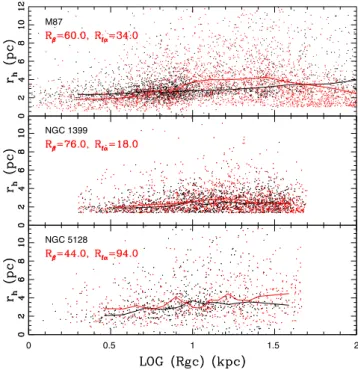
Figure 4. rh versus logRgc for observed globular clusters (black) and
model clusters (red) in M87 (top), NGC 1399 (middle), and NGC 5128 (bottom). Model clusters have anisotropy and tidal filling profiles as given by equations (4) and (5), with the best-fitting values ofRβandRfαindicated
in each panel. The solid lines represent the medianrhcalculated with radial
bins containing 5 per cent of the observed cluster population.
4.4 The orbital anisotropy and tidal filling profiles of M87, NGC 1399 and NGC 5128
We are now in a position to use our models to estimate the true values ofRβ and Rfα. The best-fitting models are illustrated for
each galaxy in Fig.4. In all cases theχ2
ν between the observed and
theoretical medianrhprofiles is less than unity. We also have plotted
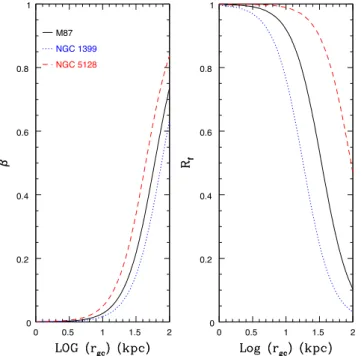
in Fig.5theβ(rgc) andRf(rgc) profiles which correspond to each
best-fitting model.
The allowed range of models for M87 hasRβ > 27 kpc and 20<Rfα<40 kpc. NGC 1399 on the other hand has a wider range
of acceptable models withRβ >13 kpc and 10<Rfα <30 kpc. However within these ranges, the best-fitting models to M87 and NGC 1399 are very similar, with M87 having aRβ =60 kpc and Rfα=34 kpc and NGC 1399 havingRβ=76 kpc andRfα=18 kpc.
So while cluster orbits become more radial withrgc, it appears that
the decrease inRf is relatively steep, reaching values of 0.5 at 34
and 18 kpc for M87 and NGC 1399, respectively. At the same time, the orbital anisotropy parameterβreaches 0.5 at approximately 60 and 76 kpc in M87 and NGC 1399, respectively. Hence our models suggest NGC 1399 might be slightly more isotropic than M87, in agreement with Strader et al. (2011).
The accepted range of models for NGC 5128 is quite different from either M87 or NGC 1399, withRβ>5 kpc andRfα>30 kpc. The best-fitting model wasRβ=44 kpc andRfα=94 kpc. However,
as previously mentioned, the lower velocity dispersion and small number of clusters in NGC 5128 means that even withRβ=44 kpc the model population is not significantly different from theβ=0 case. The highRfα is required because the mean eccentricity is
higher in NGC 5128 than the other two galaxies (given a mean
Figure 5. The anisotropy profile (left-hand panel) and filling profile (right-hand panel) that produce the theoretical distribution of cluster sizes that best matches the observed distributions in M87 (black), NGC 1399 (blue), and NGC 5128 (red).
of uncertainty associated with the best-fitting model to NGC 5128 due to the significant amount of degeneracy betweenRβandRfα. In fact, we cannot clearly distinguish between the best-fitting model in Fig.5and other model solutions that also accurately reproduce the distribution of cluster sizes. We even caution against introducing radial profiles in eitherβorRfin the first place, since theχν2for the
NGC 5128 model withβ=0 andRf=1 is only slightly improved
compared to invokingβandRfprofiles.
Comparing Fig.4to the isotropic and tidally filling cases (Fig.2), we see that for M87 and NGC 1399 we have significantly im-proved the discrepancy between theoretical and observed cluster sizes. However, in the case of M87, the discrepancy is still not com-pletely removed. In M87, our model slightly underestimates cluster sizes within 10 kpc, over estimates cluster sizes between 10 and 50 kpc, and again underestimates cluster sizes in the outer regions. To achieve a better agreement between theoretical and observational sizes, we take a closer look in the next section at the properties of the red and blue subpopulations in each galaxy.
4.5 Separating the metal rich and metal poor subpopulations
In the previous section, we made the initial assumption that all clusters in a single galaxy share the sameβandRfprofiles. However,
it has long been known that GC populations in many types of galaxies can be divided into at least two subpopulations based on colour (e.g. Zepf & Ashman1993; Larsen et al.2001; Peng et al.
2006; Harris2009a). Colour bimodality within cluster populations is often attributed to metallicity, with metal-poor clusters being bluer than metal-rich clusters (e.g. Zepf & Ashman1993; Brodie & Strader2006). Since this bimodality is observed over a wide range of galaxy masses and types (Harris, Harris & Hudson2015), it is believed that the production of a two (or more) component GC population is an important step inherent to all galaxy formation and evolution mechanisms.
Figure 6. rh versus log Rgc for observed metal-poor globular clusters
(black) and model clusters (blue) in M87 (top), NGC 1399 (middle), and NGC 5128 (bottom). Model clusters have anisotropy and tidal filling profiles as given by equations (4) and (5), with the best-fitting values ofRβandRfα
indicated in each panel. The solid lines represent the medianrhcalculated
with radial bins containing 5 per cent of the observed cluster population. Observational studies have identified many structural and kine-matic differences between these two subpopulations. A common observation within GC populations (including the populations pre-sented here) is that red GCs have half-light radii that are on av-erage 20 per cent (∼0.4 pc) smaller than blue GCs (e.g. Kundu & Whitmore1998; Kundu et al.1999; Larsen et al.2001; J´ordan et al.
2005; Harris2009b; Harris et al.2010b; Paolillo et al.2011; Blom et al.2012; Strader et al.2012; Woodley2012; Usher et al.2013). The size difference is likely due to the red and blue subpopula-tions having different formation, dynamical, and stellar evolution histories (e.g. Kundu & Whitmore1998; J´ordan2004; J´ordan et al.
2005; Harris2009b; Schulman, Glebbeek & Sills2012; Sippel et al.
2012). As discussed in Section 4.3, kinematic studies of GC popula-tions find that red and blue subpopulapopula-tions have noticeably different radial profiles and velocity dispersions, with some studies even sug-gesting that red and blue clusters have differentβprofiles as well (e.g. Cˆot´e et al.2001; Schuberth et al.2010). Therefore, we have elected to repeat the fitting process, but with the red and blue clus-ters modelled separately. The final comparison between our models and observations is illustrated in Fig.6for metal-poor clusters and in Fig.7for metal-rich clusters.
By modelling metal-poor and metal-rich clusters separately we slightly improve theχ2
ν between the observed and theoretical
me-dianrhprofiles of M87 and NGC 1399, with allχν2values again
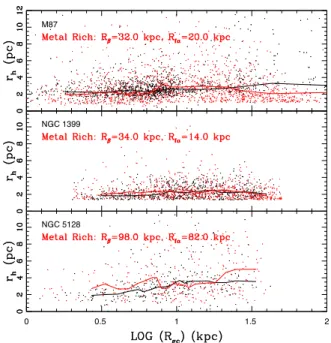
being less than 1. For M87, our model suggests that red clusters have a smallerRβ(more radial orbits) than blue clusters. Our study also finds that red clusters become tidally underfilling very quickly withrgccompared to blue clusters. The differentRfprofiles are in
agreement with observational studies that found red clusters are on average smaller than blue clusters at allRgc. For NGC 1399, the
Figure 7. rhversus logRgcfor observed metal-rich globular clusters (black)
and model clusters (red) in M87 (top), NGC 1399 (middle), and NGC 5128 (bottom). Model clusters have anisotropy and tidal filling profiles as given by equations (4) and (5), with the best-fitting values ofRβandRfαindicated in each panel. The solid lines represent the medianrhcalculated with radial
bins containing 5 per cent of the observed cluster population.
have lower values ofRβandRfαthan blue clusters. The only
differ-ence between the two galaxies is that clusters in NGC 1399 become underfilling slightly quicker than M87, which is likely a result of the tidal field in NGC 1399 being weaker than in M87 since it is less massive.
In NGC 5128, allowing red and blue clusters to have different values ofRβandRfαyields much higherχν2values than either the
isotropic and tidally filling case or when the subpopulations were given the sameRβandRfαvalues. While this observation may be a
result of the previously discussed issues regarding the degeneracy betweenRβ andRfα in NGC 5128, it appears the galaxy is still best described as a singular tidally filling population with a mostly isotropic distribution of orbits.
5 D I S C U S S I O N
Our model reproduces a realistic GC system by allowing cluster orbits to become more radial withrgc, letting clusters become less
tidally filling withrgcand includes the possibility of modelling the
red and blue cluster subpopulations separately. After applying the model to M87, NGC 1399, and NGC 5128 we can now discuss the best-fitting profiles to each galaxy in further detail.
5.1 M87
The lowestχ2
νbetween our model and observed GCs occurred when
red and blue clusters were modelled independently. The fact that the best-fitting model for red and blue clusters implies the population becomes radially anisotropic withrgcis in agreement with the idea
that giant galaxies form through the hierarchical merging of dwarf galaxies that combine to form a central massive galaxy (Kravtsov & Gnedin2005; Tonini2013; Kruijssen2014; Li & Gnedin2014). While some clusters will form early in the small haloes which make up the host galaxy, most of the GC population in a giant galaxy has
been added via the accretion of dwarf galaxies. With Wu et al. (2014) finding that massive galaxies with a large population of accreted stars will have a high degree of radial anisotropy at largergc, a
similar result can be expected for outer GCs in massive galaxies. The identification of shells, arcs, and streams of kinematically distinct GCs in M87 suggests that the outer regions of M87 have been built up via a continuous infall of material that is still ongoing today (Strader et al.2011; Romanowsky et al.2012; D’Abrusco et al.2013,
2014a; D’Abrusco, Fabbiano & Brassington 2014b; D’Abrusco, Fabbiano & Zezas2015; Longobardi et al.2015). Strader et al. (2011) and Romanowsky et al. (2012) also suggested that clusters beyond 40 kpc are being dynamically perturbed by nearby galaxies. Continuous perturbations could also result in many of the outer clusters being energized to eccentric orbits and further increase the degree of radial anisotropy in the outer regions of brightest cluster galaxies (BCGs).
Models of giant galaxies that form via the accretion of smaller galaxies also found the majority of clusters which form in the central host are metal rich while the majority of accreted clusters are metal poor, suggesting that metal-poor clusters may have a higher degree of orbital anisotropy than metal-rich ones (Kruijssen2015). Our models do not support this statement, suggesting that kinematic evidence of cluster accretion may become non-existent not long after a dwarf merger event. Minor mergers with galaxies that contain their own bi-modal GC population may also erase any relationship between orbital anisotropy and cluster type that was established when the central galaxy first formed. However, we also cannot rule out greater differences between the red and blue anisotropy profiles due to the clear degeneracy betweenRβandRfα. We do find evidence in M87 that metal-rich clusters are more underfilling than blue clusters at allRgc, which indicates metal-rich clusters either
form more compact than metal-poor clusters or expand at a slower rate.
Unfortunately, our best-fitting model to M87 still produces too many small clusters at low and highRgc. Factors which may explain
this difference between our model and observed cluster sizes include our choice for the functional form of theβprofile in equation (4), our assumption thatn(Rgc) continues beyond the observational data
set and the possible existence of a third cluster subpopulation with an intermediate metallicity between red and blue clusters found by Strader et al. (2011) and Agnello et al. (2014). With respect to the functional form of theβprofile, allowing inner clusters to have preferentially tangential orbits and outer clusters to have a near isotropic distribution of orbits (the latter of which was found by Zhu et al.2014) would increase the meanrhof clusters in the
inner and outer regions of M87. Additionally, in the Agnello et al. (2014) model of M87, the velocity dispersion for each subpopula-tion changes as a funcsubpopula-tion ofRgcwhich would also affect how the
distribution of cluster orbits changes withRgc. Future applications
of our model will take into consideration the existence of more than two subpopulations, radially dependent velocity dispersions, different extrapolations ofn(Rgc), and different functional forms of
β(rgc).
5.2 NGC 1399
The model which best reproduces the observed distribution of clus-ter sizes in NGC 1399 is also found when modelling the red and blue subpopulations separately. The best-fitting values ofRβandRfαin
the tidal field of NGC 1399 being weaker than M87. Unfortunately the degeneracy between the two parameters in each galaxy is such that we cannot conclude whether or not both galaxies have theexact same anisotropy and tidal filling profiles. It is interesting to note that our model of NGC 1399 predicts the same flattening in therh–Rgc
profile at large distances that our M87 model did, but in the case of NGC 1399 the observational profile supports this trend. Hence the decrease inβinferred by Agnello et al. (2014) and Zhu et al. (2014) either does not occur in NGC 1399 and our functional form ofβ(rgc) is correct or the cluster population has not be studied out
to large enoughRgc.
The general case of orbits becoming more radial and clusters becoming more underfilling withrgcis still prevalent in both M87
and NGC 1399. The fact that both galaxies are at the centre of large clusters is likely the common factor, as they formed via the hierarchical merging of smaller galaxies and neighbouring galax-ies are continuously perturbing the outer cluster populations (e.g. D’abrusco et al.2016). Hence the outer regions of these galaxies cannot truly reach equilibrium. As we will see for NGC 5128 in the following section, a galaxy in isolation may in fact come closer to some sort of dynamical equilibrium.
5.3 NGC 5128
The mass profile and radial distribution of GCs in NGC 5128 are such thatαis already quite low (0.46) if cluster orbits are all as-sumed circular. Allowing for an isotropic distribution of orbits, with the smaller velocity dispersion of NGC 5128, results in clusters hav-ing a higher mean eccentricity than either M87 or NGC 1399 and therefore a smaller mean size at a givenrgc. Furthermore,
assum-ing an isotropic distribution of orbits, the radial distribution and velocity dispersion of GCs in NGC 5128 combine with its mass profile to yield a shallower increase inrhwithRgcthan either M87
or NGC 1399. Hence for NGC 5128, the distribution of cluster sizes is already well reproduced assuming the red and blue clus-ter populations are both primarily isotropic and tidally filling. For models whereβandRfare functions ofrgc, we see the degeneracy
betweenRβ and Rfα in NGC 5128 is quite different from either M87 or NGC 1399. While differences between the galaxies can be attributed to them having different mass profiles and GC radial distributions, the key issues are the lower velocity dispersion and small number of the observed GCs in NGC 5128 compared to M87 and NGC 1399.
The lower velocity dispersion and smaller number of the observed GCs in NGC 5128 result in there being almost no significant dif-ference between the kinematic and structural properties of models withβ=0 andRf=1 and models with moderate to high values
ofRβ andRfα. And as discussed in Section 4.4, we were unable to
constrain the degeneracy betweenRβ andRfαbased on kinematic studies of NGC 5128. Trying to model the red and blue cluster pop-ulations separately also did not improve the fit to the observations, indicating both subpopulations have the same kinematic properties. With Woodley et al. (2010a) suggesting that the kinematic proper-ties of NGC 5128 indicate very little (if any) radial anisotropy is present in NGC 5128, any model withβ ∼0 cannot be ruled out. Measuring GC sizes over a larger range inRgcand a more detailed
study of anisotropy in NGC 5128 are necessary in order to place stronger constraints onRβ and Rfα and minimize the uncertainty associated with best-fitting anisotropy and tidal filling profiles.
IfNGC 5128 has a primarily isotropic population, it would sug-gest that NGC 5128 was assembled during an initial fast accretion phase (e.g. Biviano & Poggianti2009) and has undergone few recent
major mergers. Hence over 12 Gyr, any clusters accreted during this initial fast accretion will have their radial orbits decay and will have been pulled towards the centre of the galaxy (Goodman & Binney
1984; Lee & Goodman1989; Cipolina & Bertin1994). NGC 5128 is known to have several observational features (e.g. central black holes, jets, dust lanes) that are also seen in the majority of giant elliptical galaxies and are consistent with a history of mergers and on-going accretion events (van Dokkum2003; Harris et al.2010a; Rejkuba et al.2011). However, since NGC 5128 is not a BCG like M87 and NGC 1399, it has likely not undergone as many merg-ers or accretion events. Furthermore, NGC 5128 does not have any massive galaxies or satellites nearby to perturb the outer cluster population.
6 C O N C L U S I O N S A N D F U T U R E W O R K
We have successfully reproduced the distributions of GC sizes in three giant galaxies (M87, NGC 1399, and NGC 5128) by allowing cluster orbits to become more radial and clusters to become more underfilling withrgc, in line with models and observations of galaxy
structure and cluster populations (e.g. Cˆot´e et al.2001; Prieto & Gnedin2008; Zait et al.2008; Gnedin & Prieto2009; Weijmans et al. 2009; Ludlow et al. 2010; Kruijssen et al. 2012; Strader et al.2012; Alexander & Gieles2013; Puzia et al.2014). For M87 and NGC 1399, both galaxies that are located at the centres of galaxy clusters, the global cluster populations have a high degree of radial anisotropy at largerrgcand are primarily underfilling in the
outer regions. Our findings are consistent with kinematic studies of each galaxy (e.g. Cˆot´e et al.2001; Schuberth et al.2010; Woodley et al.2010a,b; Murphy et al.2011; Agnello et al.2014; Zhu et al.
2014), the assembly of giant galaxies via mergers and dwarf galaxy accretion (e.g. Schuberth et al.2010; Kruijssen et al.2012), and the evolution of GC populations (Alexander & Gieles2013; Webb et al. 2013a). NGC 5128 on the other hand was more difficult to model due to the lower number of observed clusters, but to first order appears to be nearly isotropic and tidally filling out to largeRgc.
The best-fitting orbital anisotropy and filling profiles of each of these galaxies come with significant uncertainty due to the strong degeneracy betweenRβandRfα. Both parameters serve to decrease cluster size withrgc. For M87 and NGC 1399, both data sets can
be fitted by either a lowRβ–highRfα or lowRfα–highRβ model. However, kinematic studies of M87 and NGC 1399 allow us to rule out the lowRβ–highRfαcases, and we can accurately interpret M87
as havingRβ >27 kpc and 20<Rfα <40 kpc and NGC 1399
havingRβ>13 kpc and 10<Rfα<30 kpc. The best-fitting models
are Rβ = 60 kpc andRfα = 34 for M87 andRβ = 76 kpc and Rfα=18 for NGC 1399. Hence in both galaxies the orbits become
moderately radial and clusters become tidally underfilling withrgc.
The fact that the acceptable range inRfαis lower for NGC 1399 is
consistent with the galaxy’s mass profile increasing at a shallower rate, which suggests the present day relationship betweenrhandRgc
is set upon cluster formation. Assuming clusters in both galaxies formed with the same initial distribution inrh, only the innermost
clusters and clusters with eccentric orbits will have expanded to the point of becoming tidally filling, with clusters in NGC 1399 becoming tidally underfilling at a lowerRgcthan M87.
Unfortunately, since NGC 5128 is best fitted by models with Rβ > 5 kpc andRfα > 30 kpc the degeneracy between the two
parameters is much different than in M87 and NGC 1399. We attribute the larger uncertainty inRβandRfαto the lower velocity