SDSS IV MaNGA: Dependence of Global and Spatially Resolved SFR
–
M∗
Relations on
Galaxy Properties
Hsi-An Pan1 , Lihwai Lin1 , Bau-Ching Hsieh1 , Sebastián F. Sánchez2, Héctor Ibarra-Medel2 , Médéric Boquien3, Ivan Lacerna4,5, Maria Argudo-Fernández3, Dmitry Bizyaev6,7 , Mariana Cano-Díaz2 , Niv Drory8 , Yang Gao9,
Karen Masters10 , Kaike Pan6 , Martha Tabor11, Patricia Tissera12 , and Ting Xiao9,13
1
Academia Sinica, Institute of Astronomy and Astrophysics(ASIAA), P.O. Box 23-141, Taipei 10617, Taiwan;[email protected] 2
Instituto de Astronomía, Universidad Nacional Autonóma de Mexico, A.P. 70-264, 04510, México, D.F., México
3
Unidad de Astronoma, Universidad de Antofagasta, Avenida Angamos 601, Antofagasta 1270300, Chile
4
Instituto Milenio de Astrofísica, Av. Vicuña Mackenna 4860, Macul, Santiago, Chile
5
Instituto de Astrofísica, Pontificia Universidad Católica de Chile, Av. V. Mackenna 4860, 782-0436 Macul, Santiago, Chile
6
Apache Point Observatory and New Mexico State University, P.O. Box 59, Sunspot, NM, 88349-0059, USA
7
Sternberg Astronomical Institute, Moscow State University, Moscow
8
McDonald Observatory, The University of Texas at Austin, 1 University Station, Austin, TX 78712, USA
9
Shanghai Astronomical Observatory, Chinese Academy of Sciences, 80 Nandan Road, Shanghai 200030, Peopleʼs Republic of China
10
Institute of Cosmology and Gravitation, University of Portsmouth, Dennis Sciama Building, Burnaby Road, Portsmouth PO1 3FX, UK
11
School of Physics and Astronomy, University of Nottingham, University Park, Nottingham, NG7 2RD, UK
12Departamento de Ciencias Fsicas, Universidad Andres Bello, Av. Republica 220, Santiago, Chile 13
Department of Physics, Zhejiang University, Hangzhou 310027, Peopleʼs Republic of China Received 2017 October 5; revised 2018 January 12; accepted 2018 January 12; published 2018 February 21
Abstract
The galaxy integrated Hαstar formation rate–stellar mass relation, or SFR(global)–M*(global)relation, is crucial for understanding star formation history and evolution of galaxies. However, many studies have dealt with SFR using unresolved measurements, which makes it difficult to separate out the contamination from other ionizing sources, such as active galactic nuclei and evolved stars. Using the integralfield spectroscopic observations from SDSS-IV MaNGA, we spatially disentangle the contribution from different Hα powering sources for ∼1000 galaxies. Wefind that, when including regions dominated by all ionizing sources in galaxies, the spatially resolved relation between Hαsurface density(ΣHα(all))and stellar mass surface density(Σ*(all))progressively turns over at the highΣ*(all)end for increasingM*(global)and/or bulge dominance(bulge-to-total light ratio, B/T). This in turn leads to theflattening of the integrated Hα(global)–M*(global)relation in the literature. By contrast, there is no noticeableflattening in both integrated Hα(HII)–M*(HII)and spatially resolvedΣHα(HII)–Σ*(HII)relations when only regions where star formation dominates the ionization are considered. In other words, theflattening can be attributed to the increasing regions powered by non-star-formation sources, which generally have lower ionizing ability than star formation. An analysis of the fractional contribution of non-star-formation sources to total Hα luminosity of a galaxy suggests a decreasing role of star formation as an ionizing source toward mass, high-B/T galaxies and bulge regions. This result indicates that the appearance of the galaxy integrated SFR–M*relation critically depends on their global properties (M*(global)and B/T)and relative abundances of various ionizing sources within the galaxies.
Key words:galaxies: evolution –galaxies: formation–galaxies: star formation
1. Introduction
The relation between galaxy star formation rate (SFR)and stellar mass(M*)provides key constraints on the star formation history and mass assembly of galaxies. Star-forming galaxies, populated by disk-dominated galaxies, form a tight relationship on the SFR–M* plane, the so-called “star-forming main sequence,” which can be described by a power-law relation (Noeske et al. 2007; Elbaz et al. 2011; Catalán-Torrecilla et al.2015; Lee et al.2015). On the other hand, the quiescent population, primarily composed of bulge-dominated galaxies (e.g., Wuyts et al. 2011), has a much lower specific star formation rate (sSFR≡SFR/M*) with respect to the main sequence. Several studies have suggested that the main-sequence relation flattens at the high-mass end, possibly due to the growth of the bulge, which lowers the global sSFR of a galaxy (Noeske et al. 2007; Abramson et al.2014; Whitaker et al.2015; Catalán-Torrecilla et al.2017).
Although the SFR–M* relation has been reported by a variety of different data sets, its appearance can vary
significantly from one occurance to another. A key uncertainty occurs in the SFR measurement. Hαis frequently utilized as an SFR indicator. However, it has long been known that a young star is not the only powering source of Hα. Other sources, such as active galactic nuclei(AGNs)and the old stellar population, also contribute to Hα(Yan & Blanton2012; Singh et al.2013; Belfiore et al.2016)and therefore affect the SFR–M*relation. Since star formation is an intrinsically local process, further insight into the nature of the SFR–M*relation would require spatially resolved data to understand what processes drive the connection between SFR and M*. Using spatially resolved spectroscopy, recent studies have shown that there also exist a tight correlation between SFR and stellar mass surface density for nearby and distant star-forming galaxies (Nelson et al. 2012; Wuyts et al. 2013; Cano-Díaz et al. 2016; Abdurro’uf & Akiyama2017; Hsieh et al.2017; Ellison et al.
2018). Recently, Hsieh et al.(2017)extended the study to the quiescent population using the MaNGA survey (Mapping Nearby Galaxies at APO; Bundy et al.2015)and found that the
emission line fluxes, even classified as LI(N)ER,14 are also correlated with the underlying stellar mass surface density. Therefore, it is essential to separate out the contribution of non-star-forming regions when measuring the SFR based on emission line methods. This also has an important application to galaxy formation models, as the SFR–M*relation is often used to validate the subgrid physics modeling (Lagos et al.
2016; Tissera et al. 2016).
The main goal of this paper is to show that the galaxy SFR–M* relation is sensitive to whether or not the “contamination” is removed. Since Hαdoes not only trace star formation, throughout the paper, we refer to the SFR–M* relation as the Hα–M* relation. SFR axis and sSFR lines are provided for readers to compare with other studies.
We present our study as follows: In Section 2, we describe our sample and data, and present the traditional global Hα–M* relation making use of the total Hα luminosity and M* of galaxies. Section 3 compares the spatially resolved Hα–M* surface density relation before and after the non-star-formation sources are removed. Section 4 quantifies the contribution of the non-star-formation source as a function of galaxy properties and compares the integrated Hα–M*relations with and without the non-star-formation contributions being removed. The main results are summarized in Section 5.
2. Data and the Traditional Global Hα–M*Relation
2.1. MaNGA Survey
The advent of the MaNGA survey(Bundy et al.2015; Law et al. 2015; Yan et al. 2016a), which spatially resolves stellar and gas properties, offers an excellent opportunity to examine the Hα–M*relation. MaNGA is part of the fourth generation of the Sloan Digital Sky Survey (SDSS-IV; Gunn et al. 2006; Blanton et al.2017) and aims to obtain the spatially resolved spectroscopy of 10,000 galaxies with median redshift∼0.03 by 2020. Further details on the MaNGA sample selection can be found in Wake et al. (2017). MaNGA has a wavelength coverage of 3600–10300Å, with a spectral resolution varying fromR∼1400 at 4000ÅtoR∼2600 around 9000Å(Smee et al.2013; Yan et al.2016b). MaNGA usesfive different types of IFU, ranging in diameter from 19 (12 5) to 127 fibers (32 5). The IFUs are installed in six SDSS cartridges. Each MaNGA cartridge has 17 science IFUs15 and 12 seven-fiber IFUs for calibration. The IFU sizes and the number density of galaxies on the sky were designed jointly to allow more efficient use of IFUs(e.g., to minimize the number of IFUs that are unused due to a tile with too few galaxies), and to allow us to observe galaxies in the redshift range to at least 1.5 effective radii(Drory et al.2015; Wake et al. 2017).
This study draws data from the fourth MaNGA Product Launches (MPL-4), corresponding to SDSS DR13 (Albareti et al. 2017). The observational data was reduced using the MaNGA data-reduction-pipeline(DRP; Law et al.2016).
2.2. Local and Global SFR and M*Measurements
The reduced spaxel-wise data cubes were analyzed using the Pipe3D pipeline to extract the physical parameters from each of
the spaxels in each galaxy. Pipe3D fits the continuum with stellar population models and measures the nebular emission lines. Details of the procedures and uncertainties of the process are described in Sánchez et al. (2016a, 2016b) and Sanchez et al.(2017).
We briefly summarize thefitting of stellar continuum and the derivation of emission lineflux here. The stellar continuum was first modeled using a simple-stellar-population (SSP) library with 156 SSPs, comprising 39 ages and 4 metallicities (Cid Fernandes et al.2013; Sánchez et al.2016b). Before thefitting, spatial binning is performed to reach a signal-to-noise ratio (S/N)of 50 across thefield of view. Then the stellar population fitting was applied to the coadded spectra within each spatial bin. Finally, the stellar population model for spaxels with continuum S/N>3 is derived by rescaling the best-fitted model within each spatial bin to the continuumflux intensity in the corresponding spaxel. The stellar mass is obtained using the stellar populations derived for each spaxel, then normalized to the physical area of one spaxel to get the surface density(Σ*) in units of M☉kpc−2. The stellar mass per spaxel is also coadded to derive the integrated stellar mass of the galaxies (M*(global)).
The stellar population models are subtracted from the data cube to create an ionized gas emission line cube(with noise). The emission linefluxes were measured spaxel by spaxel. The SFR was derived using the Hα emission line. It is again possible to compute the total Hαluminosity(Hα(global))and SFR (SFR(global)) by integrating the spatially resolved quantities over spaxels. The integrated Hα luminosity was derived using the Hαfluxes for all the spaxels with S/N>3. To study the effect of non-star-formation-powered Hαon the Hα–M*relation, we use a set of emission line ratios to spatially distinguish the ionization mechanisms of Hα in galaxies (see Section 3.2). To ensure reliable emission line ratios, we also limit the spatially resolved analysis to spaxels16with S/N(Hα), S/N(Hβ), S/N([OIII]), and S/N([NII])>3. The fluxes are converted to luminosities and corrected for extinction. The method described in the Appendix of Vogt et al.(2013)is used to compute the reddening using the Balmer decrement at each spaxel of the IFU cube. The extinction-corrected Hα luminosity is converted into SFR surface density (ΣSFR in M☉yr−1kpc−2)using the empirical calibration from Kennicutt (1998)that adopts the Salpeter IMF.
Inclination correction is applied to the Hα luminosity and stellar mass of all spaxels of a galaxy equally. The galaxy inclination measured by the disk ellipticity in Simard et al. (2011)is adopted (see the next section). Such a correction is based on the assumption of thin disks, whereas for round bulges or more spheroidal galaxies it may systematically overestimate the effect of projection and thus underestimate the Hαluminosity and stellar mass. However, we also note that the correction does not affect the sSFR related quantities since it is applied to both Hα luminosity and stellar mass.
MaNGA galaxies are selected to have spectroscopic cover-age to 1.5–2.5 effective radii(Re). The exact range varies from galaxy to galaxy. The mean offset between the Pipe3D M*(global) and the aperture-corrected NSA17 stellar mass is 0.07 dex, corresponding to the difference between the adopted cosmologies and the differences in IMFs. We then assume that
14
Low-ionization(nuclear)emission line regions. There is growing evidence that LI(N)ER is not exclusively powered by the central AGN, but also ionizing sources in the galactic disk(e.g., Belfiore et al.2016).
15
The MaNGA science IFU complement is 2×19-fiber IFU, 4×37-fiber IFU, 4×61-fiber IFU, 2×91-fiber IFU, and 5×127-fiber IFU per cartridge.
16
Hereafter, the term spaxel refers to only spaxels with S/N>3 in the emission linefluxes and continuum used.
17
the aperture effect has a minimal impact on the stellar mass. To estimate how much of the SFR in a galaxy may be unaccounted for due to thefinitefiber aperture, we assume that Hαfollows a simple exponential profile out to infinite radius. The disk exponential profile in the r-band of each galaxy derived by Simard et al.(2011)is adopted. We estimate the total SFR out to infinite radii and SFR inside the MaNGA IFUs for all galaxies, andfind that most of the star formation (on average, 84±15%)occurs within the MaNGA IFUs. In light of this, we assume that the aperture effect does not significantly affect the SFR measurement as well.
MaNGA targets galaxies in the redshift range 0.01< z<0.15 (Wake et al. 2017). Since the spatial resolution is different across the sample, we repeat the analysis in this work by using the subsamples selected by distance. The main results are not severely affected by the varying physical size of spaxels.
2.3. The Bulge–Disk Decomposition
Galaxy structural parameters are taken from the bulge–disk decomposition catalog from Simard et al.(2011). Simard et al. (2011) perform the two-dimensional bulge and disk decom-positions using the GIM2D software package (Simard et al. 2002)on the g-band andr-band images of SDSS DR7 galaxies. In the model, the bulge Sérsic index(n)is treated as a free parameter and the disk component has n=1. Structural parameters measured in the r-band are used in this work. We use the bulge-to-total light ratio (B/T) as a proxy for bulge dominance. The bulge and disk regions are separated by the radius at which 50% of the light is contributed by the bulge and disk component respectively. Specifically, for each galaxy, we look for the intersection of the one-dimensional fractional
r-band Sérsic profile of the bulge and the exponential profile of the disk. It must be noted that the radius does not indicate the physical size of the bulge, but the boundary of the bulge-dominated and the disk-bulge-dominated regions.
The sample has been selected to only include galaxies that have measurements from both Pipe3D and Simard et al.(2011). With this requirement, 1037 out of ∼1400 galaxies in MPL-4 are left.
2.4. Traditional Global Hα–M*Relation
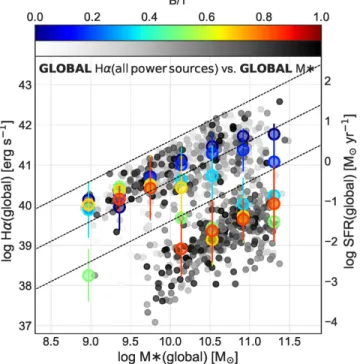
Figure 1 shows the Hα(global)–M*(global) relation using total Hα luminosity and M* of galaxies. The small circles present the individual galaxies color-coded by B/T from white to black. The dashed lines denote log(sSFR/yr−1) of −9.5, −10.5, and −11.5 (from top to bottom). As reported in the literature, galaxies populate two distinct sequences, with a clear separation between star-forming and quiescent galaxies.
To characterize the dependence of the Hα(global)–M*(global) relation on B/T andM*(global), we binned the galaxies by these two quantities. Big circles are the median values of Hα(global)of the whole sample in differentM*(global)bins, colored according to B/T (following the scheme of Figure2 in Whitaker et al. 2015). The discontinuity in the median values of Hα (global)at log(M*(global)/Me)∼10 is caused by a decreasing number of quiescent targets on the low-mass end.
As has been noticed by many authors(e.g., Wuyts et al.2011), the sequence with a lower Hα(global)-to-M*(global) ratio, i.e., lower sSFR(global), is occupied prevalently by bulge-dominated galaxies (B/T 0.2), whereas the star-forming sequence is composed of all populations (but note that disk-dominated galaxies with B/T<0.2 appear to be almost exclusively star-forming galaxies). Aflattening of the lower-B/T galaxies(∼0.2) at log(M*(global)/Me)>11 is observed. This has been explained as the increasing fraction of the mass being given by bulges that have begun to quench, indicating a transition from disk- to bulge-dominated properties.
3. Spatially Resolved Hα–M∗Relation
3.1. Spatially Resolved Hα–M∗Relation Using All Spaxels in Galaxies
The spatially resolvedΣHαand Σ*maps of MaNGA allow
us to probe the driver of the Hα(global)–M*(global)relation in more detail. Figure 2(a) presents the inclination-corrected spatially resolvedΣHα(all)–Σ*(all)relation using all spaxels of galaxies. The galaxies are binned by theirM*(global)and B/T: from the upper left to the bottom right subpanel, galaxies go from disk-dominated to bulge-dominated. The number of galaxies in each bin is indicated in the upper left corner. Bulge and disk regions are shown by red and blue contours, respectively. The number of spaxels in each subpanel ranges from∼900 to 39,000 for the bulge and∼6500 to 70,000 for the disk.
For galaxies with log(M*(global)/Me)<10, bulge and disk lie along a similar ΣHα(all)–Σ*(all) relation. As the stellar mass increases to 10<log(M*(global)/Me)<11, the high-mass ends of the bulge sequence start to move downward(i.e., decrease in theΣHα(all)-to-Σ*(all)ratio). The decrease is more pronounced in
the high-B/T galaxies than in the low-B/T galaxies. In the most massive galaxies (log(M*(global)/Me)>11), the entire bulge sequence drops below the relations of the lower-mass objects. Meanwhile, the disk sequence also shows a slight drop in the
Figure 1.Integrated Hα(global)–M*(global)relation for individual galaxies
(small circles)derived from the Pipe3D analysis, color-coded by their B/T from white to black. Colored circles are the median values of log(Hα(global)/ erg s−1)of the whole sample in differentM
ΣHα(all)-to-Σ*(all) ratio at the log(M*(global)/Me) and B/T values above 10 and 0.4, respectively(lower-right subpanel). The combination of these leads to the high-M*(global)and/or high-B/T systems being pulled off the main sequence on the integrated Hα(global)–M*(global) plane. Such turnover also indicates the inside-out quenching of galaxies. The quenching process is beyond the scope of the present paper, but is of major importance in the context of galaxy evolution(e.g., Li et al.2015; González Delgado et al.2016; Belfiore et al.2017; Lin et al.2017; Spindler et al.2017; Ellison et al.2018).
3.2. Spatially Resolved Hα–M*Relation Using Star Formation Spaxels in Galaxies
We now turn our attention to the powering source of Hα. It is known that massive stars are not the only sources capable of providing ionizing photons. To disentangle different powering sources, we use the emission line ratio diagnostics, the BPT diagram (Baldwin et al.1981)and Hαequivalent width(EW) to spatially identify the regions ionized by different physical processes in each galaxy. The emission line regions are classified into star-forming HIIregions, LI(N)ER, Seyfert, and composite regions (mix of multiple sources) based on their locations on the [OIII] 5007/Hβ versus [NII]6584/Hα plane (Kewley et al. 2001; Kauffmann et al. 2003; Cid Fernandes et al. 2010). In addition, the criterion of EW>6Å is also applied when selecting star-forming regions(Sánchez et al.2014; Sanchez et al.2017).
Armed with the spatially resolved ionization sources of each galaxy, we use the identified HII spaxels to construct the
ΣHα(HII)–Σ*(HII)relation driven by star formation alone. The result is presented in Figure2(b). For the star-forming regions,
ΣHα(HII) and Σ*(HII)are much more tightly correlated than that including all ionized regions of the galaxies. Moreover, the bulge sequence shifts upward to be close to that of the disk. In other words, at least for the star-forming regions, the
ΣHα(HII)-to-Σ*(HII) ratio of bulge and disk, which is proportional to the local sSFR, do not differ significantly from each other. In light of this, the turnover seen in the
ΣHα(all)–Σ*(all)relation can be attributed to non-HIIregions; moreover, the non-HIIionizing sources tend to generate lower Hα luminosity than that of star-forming regions and the difference can vary by up to an order of magnitude. Therefore, the total Hα luminosity of a galaxy strongly depends on the relative proportion between HIIand non-HIIregions.
Another notable feature in Figure 2(b) is the lack of HII
spaxles toward higher masses and higher B/T. The number fraction of galaxies with HII spaxels relative to the total number of galaxies in each bin is given in the upper left corner of each subpanel. The fraction is generally inversely correlated withM*(global)and B/T, suggesting a decreasing role of star formation as an ionizing source toward mass and high-B/T galaxies.
4. Revisiting the Integrated Relations
The previous section indicates that the flattening of the spatially resolved bulge sequence can be attributed to the non-HII sources, which generally have lower ionizing ability compared to young stars, and such contributions become more
significant with increasingM*(global)and B/T. It is therefore worth quantifying the contribution of non-HII powering sources in different galaxy populations and sub-galactic structures, and revisiting the integrated Hα–M* relation of galaxies.
4.1. Quantitative Contribution of Non-HIIPowering Sources
The box plots in Figure 3 describe the distribution of the fraction of non-HIIcontribution in the total Hαluminosity of a galaxy (fnon-HII) in different M*(global) bins. Three columns
from the left, respectively, present the fraction of Hαcontributed by composite, LI(N)ER, and Seyfert, respectively, e.g., in the left-most column, fnon-HII=Hα(composite)/Hα(global). The green line drawn across the box is the sample median. The ends of the box are the upper and lower quartiles (the interquartile range, IQR), i.e., 50% of the sample is located in the box. The two whiskers (vertical lines) outside the box extend to 1.5×IQR, i.e., 99% of the sample is inside the caps of the whiskers. In the following paragraphs, we will discussfnon-HIIas
a function ofM*(global), B/T, and galactic substructures. Figure3(a)presents the dependence offnon-HIIon the bulge
dominance, B/T. The upper and lower rows show the results for B/T<0.2 and >0.2, respectively. Several features are readily apparent. Most notably, the (nonzero) medianfnon-HII
increases in general with increasing M*(global) in both populations, suggesting that the non-HIIsources become more important with increasing M*(global) (see also Catalán-Torrecilla et al. 2017). For some M*(global)bins, the median and the whiskers are subsumed in a single location due the large number of galaxies with smallfnon-HII.
Moreover, in the bulge-dominated galaxies, the non-HII
contribution is exclusively dominated by LI(N)ER, whereas the three mechanisms all make a certain contribution, but typically lower than LI(N)ER in the high-B/T galaxies, in the disk-dominated galaxies. This originates from the fact that the old stellar population, such as post-AGB stars, have become the main source of ionizing photons after star formation has ceased (Yan & Blanton2012; Singh et al.2013; Belfiore et al.2016; Hsieh et al. 2017). As a whole, the rightmost column shows that fnon-HII increases from less than a percent for
log(M*/Me)<10 to a few to several tens of percent at log(M*/Me)>10. Besides, high-B/T galaxies generally display a higher, or just comparable, median fnon-HII to the
low-B/T galaxies over the entire range of masses.
Figure 3(b) explores the dependence of fnon-HII on
sub-galactic regions. The upper and lower rows show the disk and bulge regions, respectively. Bulges generally exhibit a higher fraction of non-HIIcontribution than the disks, and the nonzero median fnon-HII increases with increasing M*(global). When
accounting for all non-HIImechanisms(the rightmost column), medianfnon-HIIis no higher than 20%(mostly below 10%)for
disks across all stellar mass bins, and increases to several tens of percent in bulges when log(M*/Me) exceeding 10. The result is consistent with the study based on a 2D spectral decomposition of the bulge and disk component ( Catalán-Torrecilla et al. 2017). The high fnon-HII of the bulge is
presumably due to the fact that the non-HII sources (e.g., AGNs, evolved stars, and shocks) are naturally found most often in this old central component. The above-mentioned characteristics echo the turnover feature of the bulge
ΣHα(all)–Σ*(all) relation toward higher masses and higher B/T in Figure2(a).
4.2. Revisiting the Integrated Hα–M*Relation
How does the integrated Hα–M* relation look after excluding the non-HII contribution? Figure 4 shows the integrated Hα(HII)–M*(HII) relation in panel (a), the Hα(HII)–M*(global) relation in panel (b), and the traditional Hα(global)–M*(global) relation in panel (c) (same as in Figure1), where Hα(HII)and M*(HII)represent Hα andM* integrated over only HIIspaxels in galaxies. Symbol styles and colors are the same as in the Figure1. We note here that the Hα (HII) distribution could become highly skewed if there are extreme values, such as a value of zero. In this case, the standard deviation, which is shown as error bars here, would become meaningless. This only affects Figure2(b), so the error bars are thus omitted in this plot.
Figure4(a)represents the integrated relation for star-forming regions. When only looking at star-forming regions, the Hα(HII)–M*(HII) relation shows a relatively tight sequence. The figure is simply an integrated version of Figure 2(b). As noted before, the spatially resolved relations become similar for the bulge and disk when accounting for only star-forming regions. This leads naturally to the tight and close to linear correlation in the integrated Hα(HII)–M*(HII)relation.
We now shift our focus to the Hα(HII)–M*(global) relation in Figure 4(b). For reference, the traditional Hα(global)–M*(global)relation is displayed in Figure4(c). The most noticeable feature in Figure 4(b) is the emergence of galaxies with low Hα(HII)-to-M*(global)ratios(lower than the Hα(global)-to-M*(global) ratios of quiescent galaxies in the traditional relation). This population is largely comprised of the quiescent galaxies, which are dominated by non-HIIregions. Note that since a significant fraction of the highest-B/T and highest-mass galaxies have little to no Hαfrom star formation, the median Hα(HII)of these populations drops to close to zero. It is also worth noting that the strong sequence of quiescent galaxies observed in the traditional relation becomes scattered in the Hα(HII)–M*(global)relation; no clear scaling relation is found between Hα(HII) and M*(global) for this population. Such a lack of bimodality in the SFR distribution at a given stellar mass is very similar to that using the SSP-based SFR by González Delgado et al.(2016)and using MAGPHYS18rather than based on Hαby Eales et al.(2018).
Thus what processes fundamentally drive the two strong sequences in the traditional Hα(global)–M*(global) relation in Figure 1? From left to right, the four panels in Figure 5, respectively, present the Hα luminosity integrated over star formation spaxels (same as Figure 4(b)), composite spaxels, LI(N)ER spaxels, and Seyfert spaxels againstM*(global). The high Hα-to-M* ratio regime is heavily populated by star formation, while other mechanisms occupy the low ratio regime. The Hα(composite)–M*(global)and Hα(Seyfert)–M*(global)relations show relatively large scatter for a givenM*(global), on the other hand, Hα(LI(N)ER) and M*(global) appear to be more tightly correlated to each other. The relation is very similar to the quiescent population in the traditional Hα(global)–M*(global) relation. In other words, Hαpowered by LI(N)ER is directly correlated with the underlying stellar mass. This has been explained as the hot, evolved stars as the dominant mechanism powering the Hα emission in quiescent galaxies (e.g., Belfiore et al. 2016; Hsieh et al.2017). Our Figure3is also in line with this scenario.
18
Finally, we remind the reader that the non-HII spaxels are not necessarily devoid of star formation, but are simply dominated by mechanisms other than star formation. That is to say, the Hα(global)–M*(global) relation and the Hα(HII)–
M*(global)relation represent bracketing scenarios, as the true SFR of the galaxies would be found between Hα(HII)and Hα (global). Moreover, the flatting(or turnover)of the integrated SFR–M*relation would become more pronounced as we move
from the traditional integrated SFR(global)–M*(global)relation to the true SFR versusM*(global)relation.
5. Summary
In this work, we present the analysis of the global and spatially resolved Hα–M*relations using a sample of ∼1000 galaxies from the MaNGA survey(Section2). By virtue of the
Figure 3.Box plots showing thefnon-HIIdistribution for each of theM*(global)bin. In each plot, the median is indicated by the green bar in the middle. The ends of
the box are the upper and lower quartiles(the interquartile range, IQR), 50% of the sample is located in the box. The two whiskers(vertical lines)outside the box extend to 1.5×IQR, 99% of the sample is inside the caps of the whiskers. In some stellar mass bins, the median and the whiskers are subsumed in a single location due the large number of galaxies with smallfnon-HII. Panel(a)showsfnon-HIIin each B/T for eachM*(global). The upper row shows the results for galaxies with
B/T<0.2(disk-dominated galaxies), the lower row shows galaxies with B/T>0.2(bulge-dominated galaxies). From left to right, the subpanels present thefnon-HII
of composite, LI(N)ER, and Seyfert, respectively. Panel(b)shows the dependency offnon-HIIon galactic subregions, with disks in the upper row and bulges in the
spatially resolved spectroscopic data from MaNGA, we spatially identified the regions ionized by different physical processes in each galaxy(Section3). Our main conclusions are summarized below.
1. When all Hα powering mechanisms are considered, the spatially resolved ΣHα(all)–Σ*(all) relation of bulges progressively turns over to below the disk sequence for increasing values of M*(global) and/or B/T (Figure 2(a)). At the same time, the disk sequence is relatively insensitive to galaxy stellar mass and B/T. This in turn leads to the frequently reported flattening of the integrated Hα(global)–M*(global) relation in the litera-ture(Figure1).
2. On the other hand, we find little evidence for the flattening of both integrated Hα(HII)–M*(HII) and spatially resolved ΣHα(HII)–Σ*(HII)relations when the star-forming regions alone are considered (Figures 2(b) and 4(a)).
3. The fractional contribution of non-HII sources to total Hαluminosity of a galaxy increases with increasing B/T
andM*(global), and increases from disk to bulge regions, suggesting a decreasing role of star formation as an ionizing source toward high-mass, high-B/T galaxies and bulge regions(Section4.1and Figure 3). Moreover, the non-HII sources tend to have lower ionizing ability compared to star formation.
4. We discussed the difference between the traditional Hα(global)–M*(global) relation and Hα(HII)–M*(global) relation(Section4.2and Figure4). There is no clear scaling relation between Hα(HII)andM*(global)for the quiescent population. The strong quiescent sequence in the traditional Hα(global)–M*(global) relation is primarily driven by LI(N)ER emissions as shown by our Figure5 and Hsieh et al.(2017).
Taken together, our results imply that the appearance of the galaxy SFR–M*relation critically depends on the global properties of galaxies(e.g., stellar mass and B/T)and relative abundances of various ionizing sources within the galaxies. The results also emphasize the necessity of spatially resolved spectroscopy to understand the origin of the galaxy SFR–M*relation.
Figure 4.Integrated HαandM*relations. Individual objects are shown by small circles. Colored circles are the median values of log(Hα)of the whole sample in differentM*and B/T bins. The error bars are given by the standard deviation in each bin. The dashed lines represent log(sSFR/yr−1)of−9.5,−10.5, and−11.5
(from top to bottom).(a)Integrated Hα(HII)–M*(HII)relation, where Hα(HII)andM*(HII)represent the Hαluminosity and stellar mass integrated over only HII spaxels in galaxies. In other words, thefigure represents the integrated relation for star-forming regions.(b)Integrated Hα(HII)vs.M*(global)relation. Since the zero-Hα(HII)are taken into account when computing the median Hα(HII) (color circles), the standard deviation becomes meaningless due to the highly skewed Hα(HII) distribution. The error bars are thus omitted in this plot.(c)Traditional integrated Hα(global)–M*(global)relation, same as Figure1.
We thank the anonymous referee for constructive comments that improved the paper. The work is supported by the Ministry of Science and Technology of Taiwan under grantsMOST 103-2112-M-001-031-MY3 and 106-2112-M-001-034-. S.F.S. thanks the CONACyt programs CB-180125 and DGAPA-PAPIIT IA101217 grants for their support of this project. M.B. was supported by the MINEDUC-UA project, code ANT 1655. This project makes use of the MaNGA-Pipe3D data products. We thank the IA-UNAM MaNGA team for creating this catalog, and the ConaCyt-180125 project for supporting them. Funding for the Sloan Digital Sky Survey IV has been provided by the Alfred P. Sloan Foundation, the U.S. Department of Energy Office of Science, and the Participating Institutions. SDSS-IV acknowledges support and resources from the Center for High-Performance Computing at the University of Utah. The SDSS website ishttp://www.sdss.org. SDSS-IV is managed by the Astrophysical Research Consortium for the Participating Institutions of the SDSS Collaboration, including the Brazilian Participation Group, the Carnegie Institu-tion for Science, Carnegie Mellon University, the Chilean Participation Group, the French Participation Group, Harvard-Smithsonian Center for Astrophysics, Instituto de Astrofísica de Canarias, The Johns Hopkins University, Kavli Institute for the Physics and Mathematics of the Universe (IPMU)/University of Tokyo, Lawrence Berkeley National Laboratory, Leibniz Institut für Astrophysik Potsdam (AIP), Max-Planck-Institut für Astro-nomie (MPIA Heidelberg), Max-Planck-Institut für Astrophysik (MPA Garching), Max-Planck-Institut für Extraterrestrische Physik (MPE), National Astronomical Observatories of China, New Mexico State University, New York University, University of Notre Dame, Observatário Nacional/MCTI, The Ohio State University, Pennsylvania State University, Shanghai Astronomical Observatory, United Kingdom Participation Group, Universidad Nacional Autónoma de México, University of Arizona, University of Colorado Boulder, University of Oxford, University of Portsmouth, University of Utah, University of Virginia, University of Washington, University of Wisconsin, Vanderbilt University, and Yale University.
ORCID iDs
Hsi-An Pan https://orcid.org/0000-0002-1370-6964
Lihwai Lin https://orcid.org/0000-0001-7218-7407
Bau-Ching Hsieh https://orcid.org/0000-0001-5615-4904
Héctor Ibarra-Medel https://orcid.org/ 0000-0002-9790-6313
Dmitry Bizyaev https://orcid.org/0000-0002-3601-133X
Mariana Cano-Díaz https://orcid.org/0000-0001-9553-8230
Niv Drory https://orcid.org/0000-0002-7339-3170
Karen Masters https://orcid.org/0000-0003-0846-9578
Kaike Pan https://orcid.org/0000-0002-2835-2556
Patricia Tissera https://orcid.org/0000-0001-5242-2844
References
Albareti, F. D., Allende Prieto, C., Almeida, A., et al. 2017,ApJS,233, 25 Abdurro’uf, & Akiyama, M. 2017,MNRAS,469, 2806
Abramson, L. E., Kelson, D. D., Dressler, A., et al. 2014,ApJL,785, L36 Baldwin, J. A., Phillips, M. M., & Terlevich, R. 1981,PASP,93, 5 Belfiore, F., Maiolino, R., Bundy, K., et al. 2017, MNRAS, submitted
(arXiv:1710.05034)
Belfiore, F., Maiolino, R., Maraston, C., et al. 2016,MNRAS,461, 3111 Blanton, M. R., Bershady, M. A., Abolfathi, B., et al. 2017,AJ,154, 28 Bundy, K., Bershady, M. A., Law, D. R., et al. 2015,ApJ,798, 7 Cano-Díaz, M., Sánchez, S. F., Zibetti, S., et al. 2016,ApJL,821, L26 Catalán-Torrecilla, C., Gil de Paz, A., Castillo-Morales, A., et al. 2015,A&A,
584, A87
Catalán-Torrecilla, C., Gil de Paz, A., Castillo-Morales, A., et al. 2017,ApJ, 848, 87
Cid Fernandes, R., Pérez, E., García Benito, R., et al. 2013,A&A,557, A86 Cid Fernandes, R., Stasińska, G., Schlickmann, M. S., et al. 2010,MNRAS,
403, 1036
da Cunha, E., Charlot, S., & Elbaz, D. 2008,MNRAS,388, 1595 Drory, N., MacDonald, N., Bershady, M. A., et al. 2015,AJ,149, 77 Eales, S., Smith, D., Bourne, N., et al. 2018,MNRAS,473, 3507 Elbaz, D., Dickinson, M., Hwang, H. S., et al. 2011,A&A,533, A119 Ellison, S. L., Sanchez, S. F., Ibarra-Medel, H., et al. 2018,MNRAS,474, 2039 González Delgado, R. M., Cid Fernandes, R., Pérez, E., et al. 2016,A&A,
590, A44
Gunn, J. E., Siegmund, W. A., Mannery, E. J., et al. 2006,AJ,131, 2332 Hsieh, B. C., Lin, L., Lin, J. H., et al. 2017,ApJL,851, L24
Kauffmann, G., Heckman, T. M., Tremonti, C., et al. 2003, MNRAS, 346, 1055
Kennicutt, R. C., Jr. 1998,ARA&A,36, 189
Kewley, L. J., Dopita, M. A., Sutherland, R. S., Heisler, C. A., & Trevena, J. 2001,ApJ,556, 121 Sanchez, S. F., Avila-Reese, V., Hernandez-Toledo, H., et al. 2017, RMxAA,
in press(arXiv:1709.05438)
Sánchez, S. F., Pérez, E., Sánchez-Blázquez, P., et al. 2016a, RMxAA,52, 21 Sánchez, S. F., Pérez, E., Sánchez-Blázquez, P., et al. 2016b, RMxAA,52, 171 Sánchez, S. F., Rosales-Ortega, F. F., Iglesias-Páramo, J., et al. 2014,A&A,
563, A49
Simard, L., Mendel, J. T., Patton, D. R., Ellison, S. L., & McConnachie, A. W. 2011,ApJS,196, 11
Simard, L., Willmer, C. N. A., Vogt, N. P., et al. 2002,ApJS,142, 1 Singh, R., van de Ven, G., Jahnke, K., et al. 2013,A&A,558, A43 Smee, S. A., Gunn, J. E., Uomoto, A., et al. 2013,AJ,146, 32 Spindler, A., Wake, D., Belfiore, F., et al. 2017,MNRAS, in press
Tissera, P. B., Pedrosa, S. E., Sillero, E., & Vilchez, J. M. 2016,MNRAS, 456, 2982
Vogt, F. P. A., Dopita, M. A., & Kewley, L. J. 2013,ApJ,768, 151 Wake, D. A., Bundy, K., Diamond-Stanic, A. M., et al. 2017,AJ,154, 86 Whitaker, K. E., Franx, M., Bezanson, R., et al. 2015,ApJL,811, L12 Wuyts, S., Förster Schreiber, N. M., Nelson, E. J., et al. 2013,ApJ,779, 135 Wuyts, S., Förster Schreiber, N. M., van der Wel, A., et al. 2011,ApJ,742, 96 Yan, R., & Blanton, M. R. 2012,ApJ,747, 61