
TítuloDeveloping a Secure Low Cost Radon Monitoring System
18
0
0
Texto completo
(2) Sensors 2020, 20, 752. 2 of 18. Radon (Rn) is a colorless natural radioactive gas, with no smell or taste, which occurs in different forms, all of them with the same atomic number but different atomic mass, called isotopes [2]. As time passes by, the radon degrades by losing atomic mass¸ emitting radiation and transforming into another radioactive element. This is repeated cyclically until a stable state is reached, in this case until the radon is transformed into lead. The emitted radiation comprises alpha particles, beta particles and gamma rays, which can be a problem in terms of prolonged exposure to it [3]. Radon is measured in terms of its radioactivity (curies or becquerels). Both the curie (Ci) and the becquerel (Bq) indicate the amount of radioactive material that decays every second (1Ci = 37 billion Bq = 37 billion decays/second). The radiation dose of radon and its progeny (elements in which radon decays) is measured in terms of the energy they impart to the tissue (in units called gray or rem for general population exposure or levels for occupational exposure) [2]. The most common isotopes of radon are formed naturally from the degradation of uranium or thorium. Among those isotopes, the most common is radon-222 (222Rn), about 80% of the total, which emits alpha particles during its decay process, transforming into a polonium-218 atom (218Po), which also emits an alpha particle, transforming into a radioactive lead atom (214Pb). In the last stage of the radioactive decay of the radon progeny, a stable lead atom is formed, the latter being a non-radioactive element. The half-life of 222Rn is 3.82 days; that is, after 3.82 days, the initial amount is reduced by half. However, both uranium and thorium have very high half-lives (4470 and 14,000 million years, respectively) so that their presence, and consequently that of radon, will continue to exist indefinitely at virtually the same levels as today. Therefore, the greatest emphasis should not be placed on its complete elimination, but on its adequate detection and adequate response to minimize prolonged exposure to it. Because the radon progeny often adheres to dust, the greatest probability of exposure is due to the simple act of breathing the suspended dust, since the radon progeny is found in almost all of the air [1]. Depending on the size, the radioactive particles can be deposited in the lungs and deliver a dose of radiation to the lung tissue. The radon concentration in the atmosphere is usually measured in Becquerels per cubic meter (Bq/m3 ) or picocuries per liter (pCi/L), with a pCi/L being equivalent to 37 Bq/m3 [1,2]. The actual levels of radon in the open air are generally very low (0.4 picocuries/L or 14.8 Bq/m3 is the average radon activity in the air in the United States), but may vary according to the location and soil geology. The actual levels also vary depending on weather conditions such as precipitation and temperature reversals. In indoor air, for example at home, schools or in office buildings, radon levels and their progeny are generally higher than outdoors. The fluctuations are important but can range from 10 Bq/m3 to 10,000 Bq/m3 , according to reports from the World Health Organization [4]. The type of construction can affect radon levels; however, there may be high levels of radon in homes of all types—old or new homes, homes with air currents, homes with insulation, and homes with or without a basement. With radon having a higher density than air, its concentration is higher the lower the height of the house compared to the upper floors. Atmospheric conditions, local geology, building materials, ventilation habits, and the way housing was built are some of the factors that affect radon levels in homes [1,2]. Radon typically moves through the earth into the air and passes into homes through cracks and other holes in the foundations, due in part to convection flows. It can also be found in the water coming from underground flows and/or wells due to its contact with areas that are rich in non-decayed elements. There are really no reliable techniques valid to know the radon level in a location, except for measurements, if possible, which are prolonged in time and not punctual. Radon has been declared a human carcinogen by the United States Environmental Protection Agency (USEPA) and the International Agency for Research on Cancer (IARC) [3]. In Spain, the pioneering studies regarding the taking of environmental measurements date from the end of the 1980s [5]. These studies highlighted the high concentrations of radon in several regions, including, among others, Galicia..
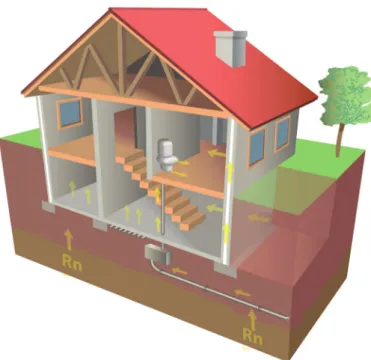
(3) Sensors 2020, 20, 752. 3 of 18. The European Union (EU) has indicated in its guidelines a reference level of 300 Bq/m3 3 of 18 of annual average exposure that should not be exceeded in homes and centers or work sites (E2013/59/EURATOM the need forfor member states to to include in (E2013/59/EURATOM[6]). [6]).This Thissame sameguideline guidelinemakes makesexplicit explicit the need member states include their technical building codes the problem related to radon detection and mitigation. On a comparative in their technical building codes the problem related to radon detection and mitigation. On a 3 level, the threshold established by the US by Environmental Protection Agency Agency is 148 Bq/m comparative level, thevalue threshold value established the US Environmental Protection is 148 3 (4pCi/L) [7] and[7] theand threshold set by the Organization is only 100 Bq/m Bq/m3 (4pCi/L) the threshold set World by the Health World Health Organization is only 100[4]. Bq/m3 [4]. Recently, the Nuclear Safety Council made a map of exposure to residential radon, Recently, the Nuclear Safety Council made a map of exposure to residential radon, shown shown in in Figure 1, which shows that the areas that are most at risk are Galicia, the south and west of Castilla Figure 1, which shows that the areas that are most at risk are Galicia, the south and west of Castilla y y León, One of León, the the North North of of Extremadura Extremadura and and the the Community Community of of Madrid. Madrid. One of the the most most probable probable causes causes derives derives from from the the mainly mainly granitic granitic soils soils of of these these areas, areas, therefore therefore with with significant significant amounts amounts of of uranium uranium present in the granite. present in the granite. Sensors 2020, 20, 752. Figure 1. 1.Map Map of potential radon potential in Spain (Nuclear Council). Available at Figure of radon in Spain (Nuclear Safety Council).Safety Available at https://www.csn.es/ https://www.csn.es/mapa-del-potencial-de-radon-en-espana . The of an area is mapa-del-potencial-de-radon-en-espana. The radon potential of an arearadon is thepotential 90th percentile (P90) the 90th percentile (P90) of the radon distribution of buildings in an area. For example, P90 for of the radon distribution of buildings in an area. For example, P90 for a concentration of 300 Bq/m3a 3 indicates that 90% of buildings have concentrations below that threshold, concentration of 300 indicates that 90% ofBq/m buildings have concentrations below that threshold, while the remaining 10% while the remaining 10% exceeds them. exceeds them.. Figure 2, 2, extracted extractedfrom fromthe theCartography Cartographyofofthe theRadon RadonPotential Potential Spain, possible routes In Figure ofof Spain, thethe possible routes of of entry of radon a house schematized. entry of radon in ainhouse areare schematized. As we can see in Figure 1, most most of of Spain’s Spain's radon levels are above the 100 100 Bq/m Bq/m33 base level of the WHO handbook handbook [4], [4], and and approximately approximately 50% 50% of of Spain’s Spain’s radon radon levels levels are are above above200 200Bq/m Bq/m33.. This work WHO was carried carried out in Galicia, Galicia, in the the northwest northwest of Spain, where the indoor radon level could be above 3 Bq/m3. TheWHO WHOhandbook handbookstates states “...establishing a national annual average concentration reference 400 Bq/m . The “...establishing a national annual average concentration reference level 3, but if this level cannot be reached under the prevailing country-specific conditions, the level 1003 Bq/m of 100ofBq/m , but if this level cannot be reached under the prevailing country-specific conditions, the reference reference level Bq/m toradon the high radon levelsour of Spain, system uses the3 level should notshould exceednot 300exceed Bq/m3300 ”. Due to3”. theDue high levels of Spain, systemour uses the 300 Bq/m 3 300 Bq/m ofhandbook the WHO as handbook asgas the level radonthreshold. gas level threshold. limit of thelimit WHO the radon.
(4) Sensors 2020, 20, 752 Sensors 2020, 20, 752. 4 of 18 4 of 18. Figure Radon accesses accesses to to aa home: home: access access through through cracks cracks in in the the subsoil, subsoil, accumulation accumulation in in lower lower floors floors Figure 2. 2. Radon and/or and/or basements basements due due to to poor poor ventilation, ventilation, through through water water pipes pipes that that are are contaminated contaminated in in the the subsoil subsoil and transfer radon to higher levels, where it is filtered through taps, toilets and/or showers. and transfer radon to higher levels, where it is filtered through taps, toilets and/or showers.. 2. Research Problem 2. Research Problem The main objective of this work was to prove the feasibility of a low-cost radon gas monitoring The main objective of this work was to prove the feasibility of a low-cost radon gas monitoring system that would help to reduce the radon gas concentration levels. We attempt to prove it by creating system that would help to reduce the radon gas concentration levels. We attempt to prove it by a low-cost system, based on open source technologies, to monitor radon levels and implement both a creating a low-cost system, based on open source technologies, to monitor radon levels and basic radon level prediction and an alert system to inform an interested party of the presence of radon implement both a basic radon level prediction and an alert system to inform an interested party of gas by predicting its concentration before reaching a dangerous level, allowing one to take measures to the presence of radon gas by predicting its concentration before reaching a dangerous level, allowing avoid the raise of the radon gas level. one to take measures to avoid the raise of the radon gas level. As a secondary objective, and given that high radon concentrations cause health problems [3], As a secondary objective, and given that high radon concentrations cause health problems [3], we need to secure our system to minimize the impact that either attacks or their effects could have on we need to secure our system to minimize the impact that either attacks or their effects could have the health of the people where the radon levels are measured due to data forging, which introduces on the health of the people where the radon levels are measured due to data forging, which false information into the system. introduces false information into the system. 2.1. Radon Detection 2.1. Radon Detection When making measurements to determine radon concentration, there are different options, both making to determine concentration, there are different both shortWhen and long term.measurements All of them usually provideradon reliable measures, but it must be takenoptions, into account shortradon and long term. All of them usually provide reliable measures, but it must be taken intohumidity. account that concentration will be conditioned by factors such as temperature, pressure and/or that radon concentration will be conditioned by factors such as temperature, pressure For this reason, long-term measurements are recommended, to mitigate their punctual influenceand/or as far humidity. as possible.For this reason, long-term measurements are recommended, to mitigate their punctual influence as far as Depending onpossible. the sampling time, three methodologies or approaches can be discussed: Depending on the sampling time, three methodologies or approaches can be discussed: • •Instantaneous methods: the the measurement is carried outout based on on samples of aofshort period of Instantaneous methods: measurement is carried based samples a short period timeof(between approximately 1 and 201 min). Its minutes). main advantage is the speed concerning the time (between approximately and 20 Its main advantage is the speed obtainment of results, and that they are possible through the use of low-cost measurement systems. concerning the obtainment of results, and that they are possible through the use of low-cost These methods aresystems. commonly used in initial measurement These methods areapproaches. commonly used in initial approaches. • •Continuous reading methods: thesethese are based on theonpassage of a continuous and constant flow of Continuous reading methods: are based the passage of a continuous and constant air through a detector, which performs the measurement over long periods of time. They are very flow of air through a detector, which performs the measurement over long periods of time. reliable provide a great that deal provide of information, the analysis of fluctuations Theymethods are verythat reliable methods a greatessential deal of for information, essential for the in concentration. They are more expensive than the previous ones. analysis of fluctuations in concentration. They are more expensive than the previous ones..
(5) Sensors 2020, 20, 752. •. 5 of 18. Integrated methods: they measure concentration over days, or at most several months. They are the most used since they are considered suitable for carrying out inspection studies prior to the decision to take corrective measures.. Regarding the type of equipment used to carry out the measurements, we can talk about scintillation cells/pulse ionization chambers, solid trace detectors or activated carbon detectors: •. •. •. Scintillation cells/pulse ionization chambers: these consist of metallic cylinders, with a transparent end, and coated inside by a uniform layer of zinc sulfide that is activated against alpha-type emissions. They allow for online measurements through a photomultiplier tube to determine the concentration of radon in the air. The pulse ionization chamber technology is similar to that of scintillation cells in the sense that it also uses a metallic cylinder, probes and an amplifier to detect the secondary charges which were generated from collisions between the air in its interior and the α-particles caused by radon or radon’s progeny. Solid trace detectors: these are passive systems that are based on the use of materials in which the traces of radon and its descendants are impressed after a period of exposure, generally prolonged. These are subsequently analyzed in the laboratory to determine the number of traces under the microscope and, therefore, the radon concentration. Active carbon detectors: like the previous exampless, these are also passive detectors. These are based on the ability of activated carbon to retain radon. Unlike the previously mentioned systems, they work by measuring the amount of gamma radiation emitted in periods of generally less than one week.. 2.2. Analysis of Previous Work After reviewing the state of the art on radon gas monitoring devices, whole systems, and the related academic work, we arrived at the conclusions that follow. Several commercial devices measure radon gas concentration, but either they are too expensive for the average householder (mid to high-end devices are in the thousands of euros) [8], or they are cheap but lack characteristics such as internet connectivity and need a specific desktop software for collecting the data [9], do not allow the user to send the data to a specific backend and the data gathering is not easy [10–12] or are slow because they need to be placed for a long time (several days to months) in the same location and then analyzed in a laboratory to measure the radon exposure of the device [13]. Regarding the type of connectivity of the devices, some devices allow the user to collect the data via USB [9] or Bluetooth [12] or send them to the manufacturer backend via Wifi [12]. There is one academic work that created a system (but not a production-ready product) that used a commercial device and added LoRaWAN connectivity to send data to their system [14]. These technologies do not properly cover the characteristics of the northwest of Spain. Not all households and public spaces have WiFi connectivity and Galicia has an old population that is not technology savvy, so we need a device that requires minimal configuration. Although LoRaWAN could be the solution for such scenarios, it requires one to have (or to install) a LoRa gateway in the region where the device is going to be used and Spain lacks a proper LoRa network deployment. We consider that Sigfox technology is more appropriate for such cases. As LoRaWAN, Sigfox is one of the so-called low power wide area networks (LPWANs), which also uses an ultra-narrow frequency band to achieve high levels of coverage while consuming low levels of energy, but the main difference is that Sigfox, contrary to LoraWAN, does not require a gateway in the region where the device is going to be used. There has also been some research done on mapping radon for a given area [15,16] but this work used a commercial device [12] to manually gather the data, instead of creating a new, and modifiable system that could be used in our work. There was also some research done in the same region as this work, for instance [17] where the researchers bypassed a commercial device (Safety Siren Pro Series 3 Radon Gas Detector), used for instantaneous or continuous measurements of radon gas concentration, to relay the information to.
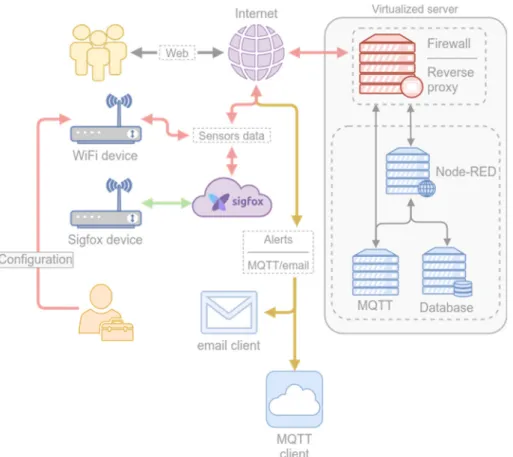
(6) Sensors 2020, 20, 752. 6 of 18. their system via a WiFi SoC. However, it lacked the security aspect we think such a system should have and we think just WiFi connectivity is not the appropriate approach, as previously explained. As we said previously, we must take into account that radon concentration will be conditioned by factors such as temperature, pressure and/or humidity. The commercial radon measuring devices presented just measure radon, and the previous work previously explained did not gather these variables. High radon concentrations pose a health risk and, since security is one of the largest challenges for the internet of things, we think that security has to be taken into account when developing a radon monitoring system. The works previously mentioned lacked in such aspects. The work we present in this paper resolve these issues by creating a fully-fledged device that measures radon concentration, temperature, humidity, barometric pressure, and air quality, both with WiFi and Sigfox connectivity and a secure backend that is responsible for managing all the information the devices collect, predicting radon concentrations, issuing alerts if a high radon concentration is predicted, and showing the data and alert status on a web. 3. Materials and Methods If we want to control the radon levels in a habitable space, we need to renew the air the space contains. In regular size spaces, this can be done by opening a window or door, allowing the clean air to fill the space. In bigger or more isolated spaces, we would need to use an air flow control system that can process the volume of air of the space in a reasonable time (1 h), replacing it with clean air. The system we propose has as its objective to inform the user, ahead of time, that a regular-sized space is going to have a high radon concentration. This will allow the people that occupy said spaces to avoid the rise in radon concentrations. To achieve these objectives, the radon control system uses radon sensors to monitor radon levels and uses the MQTT, email and visual alerts to inform interested parties. 3.1. System Architecture The system was designed to continuously sample radon levels in close to real-time; a real-time system would just detect a particle collision, while this measure needs to be integrated over time (usually 10 min to 1 h), extrapolated for a longer time frame and compared to the limit used in the system (regulatory limits are usually established for annual continuous levels). To create a close to real time system, we needed to use an instant method that reads the radon level without the need of human interaction for analyzing the samples, so we chose an instant system based on an ionization chamber. The radon control system architecture is shown in Figure 3. The system is comprised of two parts: the devices (sensors) and the server (backend). The devices send data periodically to the server. The server stores the data and makes a prediction of the radon level for each device. If a high radon concentration is predicted for a given device, the server sends an MQTT message to an MQTT topic associated with the device. The MQTT message also triggers the sending of an email to the addresses associated with the device. Once the radon concentration level is below the threshold, the server sends a message indicating that levels are back to normal (via a MQTT message to the device MQTT topic and the corresponding email message). The implementation of each component of the system and the security implementation are detailed in the ensuing sections..
(7) Sensors 2020, 20, 752. 7 of 18. Sensors 2020, 20, 752. 7 of 18. Figure 3. Architecture of the radon detection and alert system. Figure 3. Architecture of the radon detection and alert system.. 3.2. Devices (Sensors) 3.2. Devices (Sensors) The main objective of this work was to create a secure system to monitor radon levels and The main of this work was to and create secure system to monitor radon levels and implement bothobjective a basic radon level prediction an aalert system to inform the interested parties of implement basic radon level prediction system inform the interested parties of future high both radona levels. The devices developedand for an thisalert project weretodesigned around a radon sensor. future high radon levels. The devices developed for this project were designed around a radon sensor. As we previously said, we chose an instant sensor based on a pulsed ionization chamber: the RD200M As we previously said, we chose an instant sensor based on a pulsed ionization chamber: the RD200M sensor [18]. Its main characteristics are: sensor [18]. Its main characteristics are: 3. • •Sensitivity: 0.810.81 cphcph at 1at Bq/m 3. Sensitivity: 1 Bq/m • Measurement range: from 7.4 to 3.700 Bq/m3 . 3 • Measurement range: from3 7.4 to 3.700 Bq/m . • Precision: ±10% at 370 Bq/m . • Precision: ±10% at 370 Bq/m3. • Default 10 min collision integration period. • Default 10 minutes collision integration period. • Each sensor is individually calibrated. • Each sensor is individually calibrated. • It has a built-in vibration sensor for preventing errors in radon detection. • It has a built-in vibration sensor for preventing errors in radon detection. As we previously explained, our system uses a 300 Bq/m3 threshold for issuing the alerts. 3 threshold As we previously system uses a 300Bq/m the alerts. The The RD200M sensor can explained, read radonour concentration from 7.4 to 3.700 Bq/m3 , sofor itsissuing characteristics make it 3, so its characteristics make it RD200M sensor can read radon concentration from 7.4 to 3.700 Bq/m suitable to use in our system. suitable to use in our system.was to use the system to collect a high volume of data to be able to A secondary objective create better predictors in the future. We think that there are other environmental variables that could influence radon levels. In order to collect data and, in future works, verify this assessment, we incorporated several environmental sensors, along with the radon sensor, in the devices developed for this project: • •. The BME280 sensor [19]: a digital sensor for measuring relative humidity, barometric pressure and ambient temperature. The CCS811 gas sensor solution [20]: a digital gas sensor for monitoring indoor air quality..
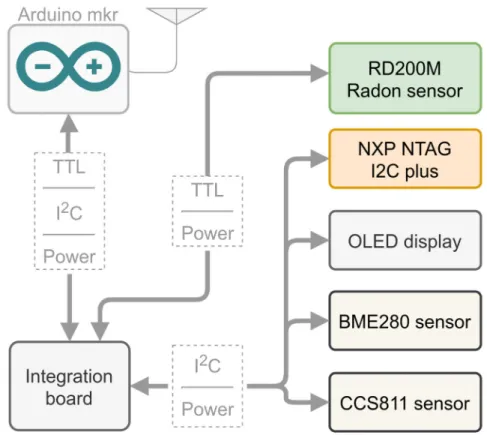
(8) Sensors 2020, 20, 752. 8 of 18. In summary, we have sensors to collect the following data: radon concentration, temperature, humidity, barometric pressure, and air quality. The data from all these sensors are collected by a processing unit and sent to the server developed in this work. The schema of the devices is shown in Figure 4. The processing units were developed using the Arduino mkr microprocessor family. These microprocessors are based on the ARM Cortex-M0+ CPU (running at up to 48 MHz). We chose this platform for the prototypes because the ARM Cortex-M0+ processor is a high-performance processor and it is energy-efficient at the same time. This high-performance processor is needed to process all the data from the different sensors and to secure all the communications with the server Sensors 2020, 20, 8 of 18 (explained in752 a later section).. Figure4.4.Sketch Sketchof ofthe thedevices devicesdeveloped: developed:processing processingunit unitand andantenna, antenna,integration integrationboard, board,RD200M RD200M Figure 2 radonsensor, sensor,OLED OLEDscreen, screen, NXP NXP NTAG NTAG II2CCplus, plus,CCS811 CCS811sensor sensor and and BME280 BME280 sensor. sensor. radon. processing unit samples sensor but to thecollect radonaone every 5 s, and the to radon sensor every AThe secondary objective was to each use the system high volume of data be able to create 10 min. After receiving dataWe from the radon sensor sends environmental the data to the server (this sampling better predictors in the the future. think that there areit other variables that could period is recommended by the radon sensor manufacturer in order to integrate the measured collisions influence radon levels. In order to collect data and, in future works, verify this assessment, we for a reasonable amount of time). incorporated several environmental sensors, along with the radon sensor, in the devices developed Asproject: we said before, the system’s devices use two different communication technologies: WiFi and for this Sigfox. The WiFi device is used in locations where a WiFi network is available and we have access to it. • The BME280 sensor [19]: a digital sensor for measuring relative humidity, barometric WiFi technology is widely known and we will not expand on its inner workings, but we will explain pressure and ambient temperature. how we secured the WiFi communications with the server in the Security section. • The CCS811 gas sensor solution [20]: a digital gas sensor for monitoring indoor air quality. The other device uses the Sigfox Communication Network. Sigfox is one of the so-called low In summary, we have sensors to collect the following data: radon concentration, temperature, power wide area networks (LPWANs), which uses an ultra-narrow frequency band to achieve high humidity, barometric pressure, and air quality. The data from all these sensors are collected by a coverage while consuming low energy. Sigfox is based on a star topology and, for the region where the processing unit and sent to the server developed in this work. The schema of the devices is shown in devices were tested (northwest of Spain), it uses the configuration shown in Table 1. Figure 4. The processing units were developed using the Arduino mkr microprocessor family. These microprocessors are based on the ARM Cortex-M0+ CPU (running at up to 48MHz). We chose this platform for the prototypes because the ARM Cortex-M0+ processor is a high-performance processor and it is energy-efficient at the same time. This high-performance processor is needed to process all the data from the different sensors and to secure all the communications with the server (explained in a later section). The processing unit samples each sensor but the radon one every 5 seconds, and the radon sensor every 10 minutes. After receiving the data from the radon sensor it sends the data to the server (this sampling period is recommended by the radon sensor manufacturer in order to integrate the.
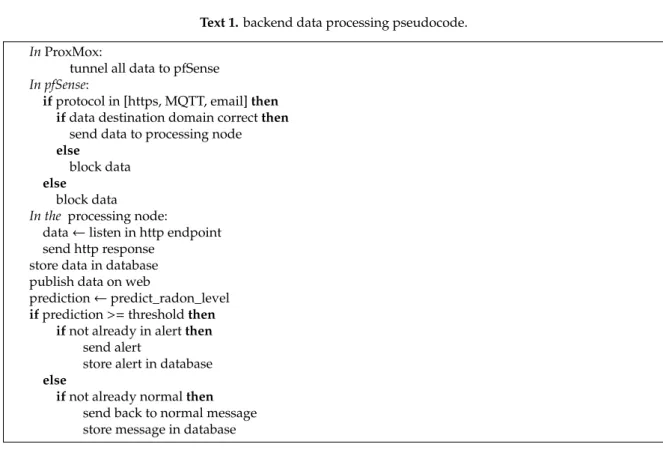
(9) Sensors 2020, 20, 752. 9 of 18. Table 1. Sigfox characteristics for Radio Configuration 1 (the one used in Spain). Center Frequency. Bandwidth. Data Rate (bit/s). Recommended Effective Isotropic Radiated Power. Constraints. 868.130 MHz. 200 kHz. 100 bit/s. 16 dBm. 140 messages/day. The transmission speed and maximum data exchange are lower than other LPWANs such as LORAWan and NBIOT [21], but the Sigfox network provides broader coverage. This is especially relevant for environmental monitoring because it allows using the devices in regions where the access to other communication networks is not possible, for instance, there are some rural areas in the northwest of Spain without internet access, hence using WiFi is not possible. Sigfox communications use a public band (868MHz). The European Telecommunications Standards Institute (ETSI) regulations stipulate that devices operating on a public band can only transmit 1% of the time over the course of 1 h. In Sigfox, this translates into 6 messages, of 12 bytes each, per hour, or 144 messages per day. This restriction is not imposed as a hardware limitation but it is a gentleman’s agreement. Despite the low data exchange rates, it is sufficient for sending the data that the devices developed in this work collect: our devices send data every 10 min, thereby we need to send 144 messages per day. In both cases, the devices send the data to a server that stores the data, makes a prediction and sends an alert if necessary. The structure and inner workings of the server are explained in the following section. 3.3. The Server (Backend) The backend functionality was implemented using a collection of virtual servers (see Figure 3). The virtual machines were created and managed using the Proxmox Open-Source Virtualization Platform (Proxmox VE [22]). Proxmox VE is an open-source platform for enterprise virtualization that integrates a KVM hypervisor and LXC containers, software-defined storage and networking functionality on a single platform. It allows the managing of high availability clusters and disaster recovery tools through a web management interface. All the communications that reach the Proxmox server are tunneled through a virtual machine where pfSense manages all the connections. PfSense is an open-source firewall, VPN, and router. It can be used to address firewall, routing and VPN server needs. It is also widely deployed to address secure networking needs and includes load balancing, traffic shaping, web content filtering, a transparent caching proxy, and reverse proxying among its features [23]. In our case, we used the pfSense firewalling capabilities to filter the connections that reach the server and its reverse proxy capabilities to route the data to the server that processes it (implemented using the HAProxy module, an open-source software that provides a high availability load balancer and proxy/reverse proxy server for TCP and HTTP-based applications). The pfSense node filters the data and redirects the filtered data to the data processing node. The data processing node is implemented using Node-RED, a programming tool for wiring together hardware devices and APIs [24]. Node-RED provides a browser-based editor that makes it easy to wire together processing flows using predefined nodes that can be easily deployed to its runtime. In summary, all the data that reach the backend are processed as explained in the pseudocode of Text 1..
(10) Text 1. backend data processing pseudocode. In ProxMox: Sensors 2020, 20, 752. tunnel all data to pfSense. 10 of 18. In pfSense: Text 1. backend data processing pseudocode. if protocol in [https, MQTT, email] then In ProxMox: if data destination domain correct then tunnel all data to pfSense send data to processing node In pfSense: else if protocol in [https, MQTT, email] then blockthen data if data destination domain correct send data to processingelse node else block data block data else In the processing node: block data In the processing node: data ← listen in http endpoint data ← listen in http endpoint send http response send http response store data in database store data in database publish data on web publish data on web prediction ← predict_radon_level prediction ← predict_radon_level if prediction >= threshold then if prediction >= threshold then if not already in alert then if not already in alert then send alert send alert store alert in database store alert in database else else if not already normal then if not already normal then send back to normal message send back to normal message store message in database store message in database. The database schema is shown in Figure 5. We used several sensors (devices) whose information The database schema is shown in Figure 5. We used several sensors (devices) whose information is stored in the sensor table. Each device’s measures are stored in the measure table. We used several is stored in the sensor table. Each device’s measures are stored in the measure table. We used several actuators (means of sending alerts/back to normal messages), such as email and MQTT messages, actuators (means of sending alerts/back to normal messages), such as email and MQTT messages, that that are stored in the actuator table. Each time a message is sent, it is stored in the action table. are stored in the actuator table. Each time a message is sent, it is stored in the action table.. Figure 5. Database schema. Figure 5. Database schema.. Step 4a merits a more detailed explanation—after storing the data for a given device, the server Stepthe 4a radon meritslevel a more storing the data forisa predicted given device, the server predicts fordetailed the nextexplanation—after hour. If a high radon concentration for the given predictsthe the radon levela for the next hour. If a high radon concentration is to predicted for interested the given device, server sends message to the actuators associated with the sensor inform the device, When the server sends level a message to the actuators associated with the sensor to inform parties. the radon is lower than the threshold, the server sends a message viathe theinterested actuators parties. When the radon level is lower than the threshold, the server sends a message via the actuators to indicate that the radon levels are back to normal. The estimation the server makes is done using to indicate that the radon levels are back to normal. The estimation the server makes is done linear regression based on an exponential moving average of the radon level slope (see Equationusing (1)): each time a radon value is received (every 10 min), the moving average of the slope of the radon level is calculated (using α = 0.85). Using the current radon measure and the averaged slope, we project the.
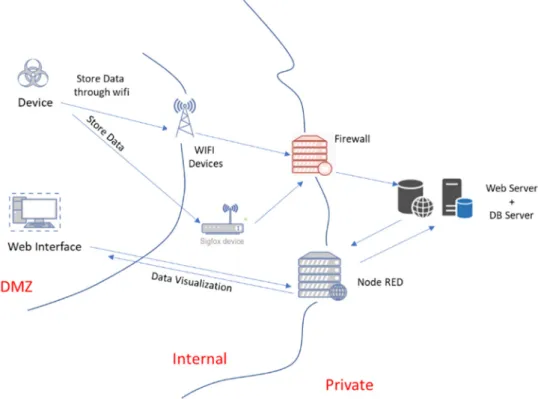
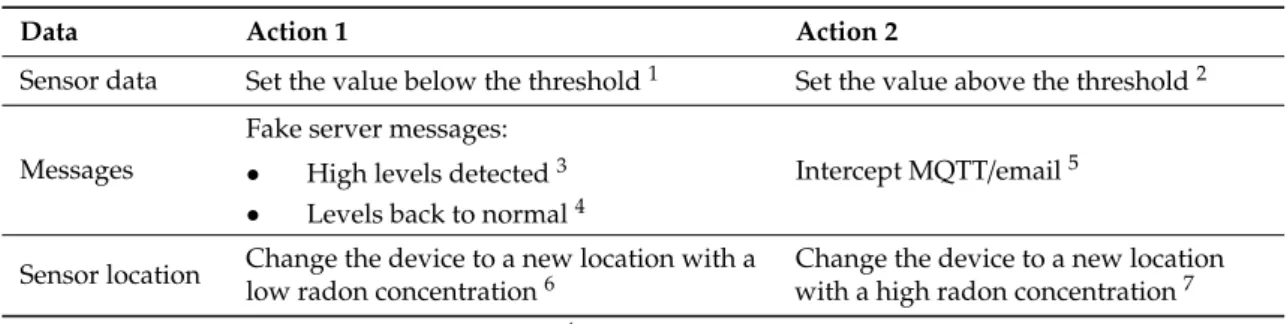
(11) Sensors 2020, 20, 752. 11 of 18. Sensors 2020, 20, 752 based on an exponential moving average of the radon level slope (see equation 11 of1): 18 linear regression each time a radon value is received (every 10 minutes), the moving average of the slope of the radon level is calculated (using α=0.85). Using the current radon measure and the averaged slope, we project radon level 1 h into the future (60 min). If the value we obtain is above the threshold (set to 300 Bq/m3 ) the radon level 1 hour into the future (60 minutes). If the value we obtain is above the threshold (set we log an alert into the database and send it (via MQTT and email). to 300Bq/m3) we log an alert into the database and send it (via MQTT and email).. slopet = (radon 𝑠𝑙𝑜𝑝𝑒 𝑟𝑎𝑑𝑜𝑛 – 𝑟𝑎𝑑𝑜𝑛 t -radon t−1 ) /10⁄10 slopeAvgt = α − 1)1∗ slopeAvg 𝛼 ∗∗slope 𝑠𝑙𝑜𝑝𝑒 ∗ 𝑠𝑙𝑜𝑝𝑒𝐴𝑣𝑔 𝑠𝑙𝑜𝑝𝑒𝐴𝑣𝑔 t + (α 𝛼 t−1 𝑟𝑎𝑑𝑜𝑛 𝑟𝑎𝑑𝑜𝑛 60 ∗ 𝑠𝑙𝑜𝑝𝑒 radont+60 = radon + 60 ∗ slope t t. (1). 4. Security Security 4. Given that that high high radon radon concentrations concentrations cause cause health health problems problems [3], [3], we we needed needed to to secure secure our our system system Given to minimize minimize either either attacks attacks or or their their effects. effects. Figure Figure 66 represents represents the the main main parts parts of of our our system, system, the the data data to flow between them and how they are located in the different areas of the communication network. flow between them and how they are located in the different areas of the communication network. The more more critical critical devices devices are are included included in in more more restricted areas. Two Two elements centralize and and secure secure The restricted areas. elements centralize the access access to to this this private zone: the the pfSense pfSense node node and and the the processing processing node node (based (based on on Node-RED Node-RED as as the private zone: previously explained). In the following paragraphs, we explain the possible problems the system could previously explained). In the following paragraphs, we explain the possible problems the system face and security approaches we used the in different layers.layers. could facethe and the security approaches weinused the different. Figure 6. Thread Thread model model of of the the radon radon monitoring monitoring system. Figure. The public public devices devices of of the the system, system, included included in in the the DMZ, DMZ, are are the the most most likely likely to to be be attacked. attacked. The Programming-related attacks, such as SQL-injection and cross-site scripting, were taken into account Programming-related attacks, such as SQL-injection and cross-site scripting, were taken into account using secure secure programming programming practices practices and and robust robust frameworks frameworks (like (like Node-RED) Node-RED) when when we we developed developed using the system. the system. Due must be be given given to to Due to to the the type type of of information information managed managed by by the the system, system, special special importance importance must securing measures measures to to avoid avoid data data forging forging attacks attacks (see (see Table Table 2)—if 2)—if the the system system is is not not secure, secure, aa hacker hacker securing could intercept the sensors data or the sending of a message and block them or replace them with false could intercept the sensors data or the sending of a message and block them or replace them with information or place the sensor in a new location with a different radon concentration level than the false information or place the sensor in a new location with a different radon concentration level than original placement. From all possible attacks, the most dangerous scenarios depicted in Table would the original placement. From all possible attacks, the most dangerous scenarios depicted in2Table 2 be Scenarios 1, 4, 5 and 6. would be Scenarios 1, 4, 5 and 6..
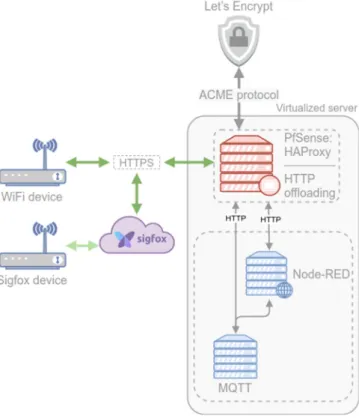
(12) Sensors 2020, 20, 752. 12 of 18. Table 2. Data tampering possibilities. Data Sensor data. Action 1. Action 2. Set the value below the threshold. 1. Set the value above the threshold 2. Fake server messages: Messages. • •. Sensor location. Intercept MQTT/email 5. High levels detected 3 4. Levels back to normal. Change the device to a new location with a low radon concentration 6 i. Change the device to a new location with a high radon concentration 7. ≡ scenario i.. In Scenario 1, a hacker changes the device data and sets (always or most of the time) the radon level the device sends to the server to a value under the threshold that we use to send the alerts. This attack would only be detected if someone is visualizing the radon levels the physical device is showing and realizes that the radon concentration levels the server stores are different than the measured ones. Scenarios 4 and 5 affect the alert messages (MQTT and email messages), i.e., the information the server sends to the interested parties advising them to take measures in order to avoid the raising of radon levels. In Scenario 4, a hacker impersonates the server and sends a message indicating that the radon levels are back to normal (this attack would be more effective if sent some time after the server send a message indicating future high radon levels). In Scenario 5, the hacker intercepts all messages, so the interested parties are unaware if a message was sent. This attack would only be detected if someone is actively visualizing the radon levels and realizes that the levels are high and an alert is not issued. The danger of all of these scenarios is that there could be a high radon concentration and we would not send an alert because we are unaware of it. If the alert is not sent, the interested parties would not take any action towards mitigating the radon levels. If this situation persists in time, it could have negative health consequences. In order to minimize the probability of each one of these scenarios occurring, we need to secure several paths of the system’s communication infrastructure. In Figure 1, we can see the communication paths: the green ones are the already secured paths, the red ones are not secured by default and need to be secured ad-hoc, and the orange ones can be easily secured with the tools that implement the corresponding functionality (MQTT or email server). We will explain how we secured the paths that needed to be secured ad-hoc. They can be classified into two categories: communication paths and configuration paths. Currently, the system’s sensor devices use two different communication technologies—WiFi and Sigfox—but we plan to incorporate and test more communication technologies in the future. When securing the communication paths, each technology has different requisites, but we tried to create a system that could be secured as independently as possible from the communication technology used. We want our system to use HTTPS for communication, so both endpoints have to be able to use SSL to encrypt the data using certificates (devices and backend). There are two nodes in the backend where we could encrypt the communication: in the pfSense node or the Node-RED node. We chose to use the former via the load balancer (HAProxy), using the technique known as SSL offloading. This relieves the Node-RED server of the processing burden of encrypting and decrypting traffic sent via SSL, freeing its resources to process data. The processing is offloaded to the pfSense server that encrypts the communication with the devices while using non-encrypted communication with Node-RED (the communication between HAProxy and Node-RED takes place in the Proxmox virtual network, so it does not need to be additionally secured). To use SSL certificates in pfSense, we used the ACME package. This software interfaces with Let’s Encrypt [25] (using the ACME protocol [26]) to handle the certificate generation, validation,.
(13) Sensors 2020, 20, 752 Sensors 2020, 20, 752. 13 of 18 13 of 18. the certificatefrom has Let’s authority overare thedomain domain in question. validation can andsystem renewalrequesting processes.the Certificates Encrypt validated. ThisThis validation ensures be performed inrequesting several ways, as by proving ownership of the domain’s DNS records or hosting that the system thesuch certificate has authority over the domain in question. This validation acan filebe onperformed a web server for the domain (we as usebythe latter). ownership By using a certificate from Let’s in several ways, such proving of the domain’s DNSEncrypt recordsfor or the data acommunication between (more between the devices hosting file on a web server for the thedevices domainand (wethe usebackend the latter). Byprecisely using a certificate from Let’s and the virtual running pfSense), the devices will trust and the connection willthe be Encrypt for the node data communication between the devices and the the certificate backend (more precisely between encrypted the need manually trusting an invalid each device. devices andwithout the virtual node for running pfSense), the devices willcertificate trust the in certificate and the connection Upencrypted to this point, we have secured one endpoint: a backend with HTTPS in (with certificates will be without the need for manually trusting an invalid certificate eachSSL device. management) firewalling reverseaproxies thewith dataHTTPS to the (with processing node (see Up to thisand point, we havecapabilities secured onethat endpoint: backend SSL certificates Figure 7). We need secure thecapabilities other endpoint—the devices. The WiFi devices the data directly management) and to firewalling that reverse proxies the data to the send processing node (see to the backend, so wetoonly needthe to other secureendpoint—the one hop in the devices. communication path. The Arduino model Figure 7). We need secure The WiFi devices send the data used fortothe WiFi devices theneed Arduino Mkrone WiFi model usespath. an ATECC508A directly the backend, so weisonly to secure hop1010. in theThis communication The Arduino CryptoAuthentication device—a co-processor key model used for the WiFi devices iscryptographic the Arduino Mkr WiFi 1010.with Thissecure model hardware-based uses an ATECC508A storage that allows us device—a to performcryptographic high-speed public key (PKI) algorithms [27]. Using thiskey capability CryptoAuthentication co-processor with secure hardware-based storage (and the appropriate library), we were able to send data securely [27]. via HTTPS (using SSL) directly to that allows us to perform high-speed public key (PKI) algorithms Using this capability (and the the backend.library), we were able to send data securely via HTTPS (using SSL) directly to the backend. appropriate. Secured communication schema. Figure 7. Secured. The Sigfox Sigfox devices–backend communication path path comprises comprises two two hops: the one one between between the the The devices–backend communication hops: the emitting device and the Sigfox Core Network and the one between the Sigfox Core Network and emitting device and the Sigfox Core Network and the one between the Sigfox Core Network and our our backend. backend. The first first hop hop (the (the Sigfox Sigfox network network between between the the devices devices and and the the Sigfox Sigfox Core Core Network) Network) is is already already The secured by design, shielding the Sigfox devices from the internet by a very strict firewall. The Sigfox secured by design, shielding the Sigfox devices from the internet by a very strict firewall. The Sigfox devices do not connect directly to the Internet, do not communicate using internet protocols (TCP/IP) devices do not connect directly to the Internet, do not communicate using internet protocols (TCP/IP) and are permanently connected to anyto network or base station. Thestation. devices operate predominantly and arenotnot permanently connected any network or base The devices operate offline. When a device requires data to be transmitted to the Internet, it broadcasts a message predominantly offline. When a device requires data to be transmitted to the Internet, radio it broadcasts a that ismessage picked up then transferred to transferred the Sigfox Core and radio thatbyisseveral picked base up bystations severaland baseisstations and is then to theNetwork Sigfox Core stored in the This network effectively provides an airprovides gap, making it Network andSigfox storedCloud in the service. Sigfox Cloud service. architecture This network architecture effectively an air impossible to maliciously access an endpoint via the internet. gap, making it impossible to maliciously access an endpoint via the internet.. Regarding the second hop, the Sigfox Cloud service can be configured to send each incoming message to a given callback URL, our backend in this case. Since we already gave the backend the.
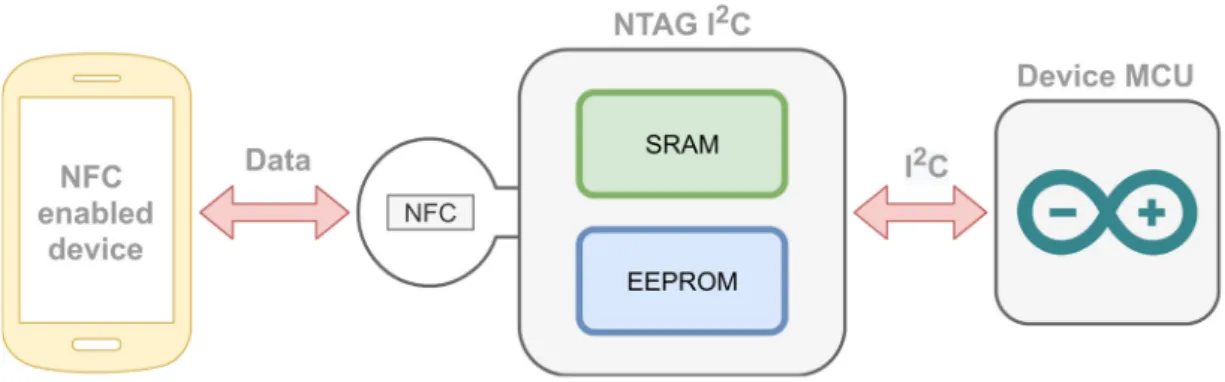
(14) Sensors 2020, 20, 752. 14 of 18. Regarding the second hop, the Sigfox Cloud service can be configured to send each incoming 14 of 18 message to a given callback URL, our backend in this case. Since we already gave the backend the ability to to process process HTTPS our backend in ability HTTPS messages, messages, we we only onlyhave haveto toconfigure configurethe theHTTPS HTTPSendpoint endpointofof our backend the Sigfox Cloud service as the callback URL to secure this hop. in the Sigfox Cloud service as the callback URL to secure this hop. The last last path path we we need need to to secure secure is is the the path path used used to to send send the the configuration configuration data data to to the the devices devices The (the configuration configuration path). path). Sigfox Sigfoxdevices devicesconnect connect directly directly to to the theSigfox Sigfoxnetwork network(they (theybroadcast broadcast aaradio radio (the message that is picked up by several base stations) without requiring any configuration. The WiFi message that is picked up by several base stations) without requiring any configuration. The WiFi devices need password of the network we want connect them to. them If this to. procedure devices need the theSSID SSIDand and password of WiFi the WiFi network wetowant to connect If this is not secure, it could be used in Scenario 6 (Table 2) to change the location of the device to a new one procedure is not secure, it could be used in Scenario 6 (Table 2) to change the location of the device with low radon levels, i.e., we could be having high radon levels without knowing it (and consequently to a new one with low radon levels, i.e., we could be having high radon levels without knowing it not acting on it). Tonot store the SSID we WiFi use the NTAG I2we C plus an NFC Forum (and consequently acting on it).and To WiFi store password, the SSID and password, use [28], the NTAG I2C plus 2 Type 2 Tag (passive) with I C interface. When an NFC-enabled device (such as a smartphone) is close 2 [28], an NFC Forum Type 2 Tag (passive) with I C interface. When an NFC-enabled device (such as the NTAG antenna, with the tag itand createswith an electric can an power the field NFC that chip atosmartphone) is close it toconnects the NTAG antenna, connects the tagfield andthat creates electric allowing the NTAG and between the NFC the enabled device. Once theenabled NTAG can powertwo-way the NFCdata chiptransfer allowingbetween two-way data transfer NTAG and the NFC 2 C bus. The data is powered, a microcontroller (MCU) can communicate with the NTAG using the I device. Once the NTAG is powered, a microcontroller (MCU) can communicate with the NTAG using transfer between the transfer NTAG and the MCU can be and either the NTAG SRAMvia (pass-through mode, the I2C bus. The data between the NTAG thevia MCU can be either the NTAG SRAM used for fast data exchange) or it could be via the NTAG EEPROM (used for non-volatile data storage). (pass-through mode, used for fast data exchange) or it could be via the NTAG EEPROM (used for This schemadata is illustrated Figure 8. is illustrated in Figure 8. non-volatile storage).in This schema Sensors 2020, 20, 752. Figure8. 8.WiFi WiFiconfiguration configuration of of the the device device via via NTAG NTAG I22C. C. Figure. This device deviceallows allowsus usto to use use an an NFC-enabled NFC-enableddevice deviceto tosend sendthe theWiFi WiFi configuration configuration data data to to the the This MCU (the (the Arduino devices). The configuration data consist of a of user, password, SSID, MCU Arduino Mkr Mkrused usedininthe the devices). The configuration data consist a user, password, and WiFi password. When the device is booting, it checks for a few seconds if new data can be SSID, and WiFi password. When the device is booting, it checks for a few seconds if new data canread be fromfrom the NTAG via I2via C. We the pass-through option of theofNTAG; the data flow flow fromfrom the NFC read the NTAG I2C.used We used the pass-through option the NTAG; the data the interface through an SRAM bufferbuffer to thetoI2the C serial bus interface (or vice NFC interface through an SRAM I2C serial bus interface (or versa). vice versa). The device’s MCU has a hardcoded user and password for administration purposes. When When aa The device’s MCU has a hardcoded user and password for administration purposes. newconfiguration configurationisisreceived receivedfrom fromthe theNTAG, NTAG,the theMCU MCUchecks checksififthe theuser userand andpassword passwordare arecorrect. correct. new In such a case, it stores the new SSID and WiFi password in the MCU EEPROM and uses it to connect In such a case, it stores the new SSID and WiFi password in the MCU EEPROM and uses it to connect to the the WiFi WiFi in in the the current current and and in in future future reboots. reboots. to 5. Results and Discussion 5. Results and Discussion The main objective of this work was to create a secure and low-cost radon monitoring and alert The main objective of this work was to create a secure and low-cost radon monitoring and alert system, based on open source technologies to prove its feasibility. We achieved this objective by creating system, based on open source technologies to prove its feasibility. We achieved this objective by devices, a collection of radon level, temperature, pressure, humidity, and air quality sensors with a creating devices, a collection of radon level, temperature, pressure, humidity, and air quality sensors processing unit and a communication module, integrated using a 3D printed case (see Figure 9 left, with a processing unit and a communication module, integrated using a 3D printed case (see Figure where the assembled device is shown), and a backend, a collection of servers responsible for managing 9 left, where the assembled device is shown), and a backend, a collection of servers responsible for all the information the devices collect, predicting radon concentrations, issuing alerts if a high radon managing all the information the devices collect, predicting radon concentrations, issuing alerts if a concentration is predicted, and showing the data and alert status on a web (see Figure 9 right). high radon concentration is predicted, and showing the data and alert status on a web (see Figure 9 right)..
(15) Sensors 2020, 20, 752. 15 of 18. Sensors 2020, 20, 752. 15 of 18. Figure9.9.Device device photo photo (left) (left) and Figure and system system web webinterface interface(right). (right).. Highradon radonconcentrations concentrationspose pose aa health health risk risk and, and, since High since security securityisisone oneof ofthe thelargest largestchallenges challenges for the internet of things, we secured the entire end-to-end communication path using several for the internet of things, we secured the entire end-to-end communication path using severaltools tools andtechniques techniquestotoavoid avoiddata dataforging forgingthat thatcould could create create aa health health hazard. hazard. and Asa aresult resultofofthis thiswork, work,we wehave have created created aa low-cost low-cost radon As radon level levelmonitoring, monitoring,prediction predictionand andalert alert systemthat thatgives givesradon radonlevel levelmeasures measures (and (and the the other other environmental environmental variables system variablesexplained explainedbefore) before)inin almost real-time, issuing an alert indicating that we need to take measures to reduce the radon levels almost real-time, issuing an alert indicating that we need to take measures to reduce the radon levels whenever the system predicts a high radon concentration. whenever the system predicts a high radon concentration. The system was created to inform, using alerts, that a high radon level is predicted for a given The system was created to inform, using alerts, that a high radon level is predicted for a given location. This enables taking action to avoid future high radon levels. Currently, the action has to be location. This enables taking action to avoid future high radon levels. Currently, the action has to be taken by a human operator. This action is usually opening a window or turning on an airflow control taken by a human operator. This action is usually opening a window or turning on an airflow control system. Figure 10 shows the radon levels in two scenarios for the same location. This location was system. Figure 10 shows the radon levels in two scenarios for the same location. This location was used as one of our testing sited due to its particularly high radon concentration. In the first scenario used as one of our testing sited due to its particularly high radon concentration. In the first scenario (Figure 10 up), the alert system was not activated—the system just stored the radon measures, (Figure 10 up), the alertradon system wasofnot justscenario stored the radon10measures, showing showing the natural level theactivated—the testing site. Insystem the other (Figure down), the alert the natural radon level of the testing site. In the other scenario (Figure 10 down), the alert system system was activated and a human operator was in charge of turning an airflow control system was on activated and a human operator was in charge of turning an airflow control system on or off (with or off (with each alert/”back to normal” message). Comparing these two scenarios, we can see that each alert/”back to normal” message). Comparing lower these the tworadon scenarios, canresults see that the system the system can satisfactorily be used to significantly levels.we These also indicate can satisfactorily be used to significantly lower the radon levels. These results also indicate that the that the selected radon sensor and the approach used when developing the system were appropriate selected radon sensor and the approach used when developing the system were appropriate for the for the intended usage. intended usage..
(16) Sensors 2020, 20, 752 Sensors 2020, 20, 752. 16 of 18 16 of 18. Figure 10. Radon levels for the same location. Up: alert system activated. Down: alert system activated 10.control Radon system levels for the same andFigure air flow operated bylocation. human. Up: alert system activated. Down: alert system activated and air flow control system operated by human.. The system created in this work and the data collected by it are set to be the bases for several The system created in this work and the data collected by it are set to be the bases for several future developments: future developments: • Create a full radon mitigation system: we plan to create a device that can control an airflow control • Create a full radon mitigation system: we plan to create a device that can control an airflow system. Pairing the radon control system with these devices, we can automatically activate the control system. Pairing the radon control system with these devices, we can automatically airflow when a high radon concentration is predicted. This would be more efficient than relying activate the airflow when a high radon concentration is predicted. This would be more on users to take measures to mitigate the radon concentration when an alert is issued. efficient than relying on users to take measures to mitigate the radon concentration when an • Use an AI-based predictor: the current radon level prediction is based on a linear regression using alert is issued. an exponential moving average of the radon level slopes. Using an AI model that uses all the • Use an AI-based predictor: the current radon level prediction is based on a linear regression variables the devices are collecting (radon level, temperature, pressure, humidity, and air quality) using an exponential moving average of the radon level slopes. Using an AI model that uses could create a better predictor that could help to minimize the radon levels. all the variables the devices are collecting (radon level, temperature, pressure, humidity, and air quality) could create a better predictor that could help to minimize the radon levels..
(17) Sensors 2020, 20, 752. 17 of 18. Author Contributions: Conceptualization, J.R.R., M.G. and A.A.; methodology, J.R.R., M.G. and A.A.; software, A.A.; validation, J.R.R., M.G. and A.A.; formal analysis, J.R.R., M.G. and A.A.; investigation, M.G. and A.A.; resources, J.R.R.; data curation, A.A.; writing—original draft preparation, A.A., M.G.; writing—review and editing, A.A., M.G.; supervision, J.D.; project administration, J.R.R. All authors have read and agreed to the published version of the manuscript. Funding: This project was funded by the Consolidation and Structuring of Competitive Research Units-Competitive Reference Groups (ED431C 2018/49) and Accreditation, Structuring, and Improvement of Consolidated Research Units and Singular Centers (ED431G/01), funded by the Ministry of Education, University and Vocational Training of the Xunta de Galicia endowed with EU FEDER funds. Acknowledgments: We would like to thank the CITEEC’s (https://www.udc.es/citeec/) Laboratory of Instrumentation and Intelligent Systems in Civil Engineering staff for their technical support. This research was supported by the Spanish Ministry of Economy, Industry and Competitiveness, R & D National Plan, via the project BIA2017-86738-R. This research and the APC were also supported by Instituto de Salud Carlos III, grant number PI17/01826 (Collaborative Project in Genomic Data Integration (CICLOGEN) funded by the Instituto de Salud Carlos III from the Spanish National plan for Scientific and Technical Research and Innovation 2013–2016 and the European Regional Development Funds (FEDER)—“A way to build Europe.”. This project was also supported by the General Directorate of Culture, Education and University Management of Xunta de Galicia ED431D 2017/16 and “Drug Discovery Galician Network” Ref. ED431G/01 and the “Galician Network for Colorectal Cancer Research” (Ref. ED431D 2017/23), and finally by the Spanish Ministry of Economy and Competitiveness through the funding of the unique installation BIOCAI (UNLC08-1E-002, UNLC13-13-3503) and the European Regional Development Funds (FEDER) by the European Union. Conflicts of Interest: The authors declare no conflict of interest.. References 1. 2. 3. 4. 5. 6.. 7. 8. 9. 10. 11. 12. 13. 14.. 15.. Fleischer, R.L. Radon in the environment—Opportunities and hazards. Nucl. Tracks Radiat. Meas. 1988, 14, 421–435. [CrossRef] Wilkening, M. Radon in the Environment; Elsevier Science Pub. Co.: New York, NY, USA, 1990. Health Effects of Exposure to Radon: BEIR VI; National Academies Press: Washington, DC, USA, 1999. World Health Organization. WHO Handbook on Indoor Radon: A Public Health Perspective; World Health Organization: Geneva, Switzerland, 2009. Quindos, L.S.; Fernandez, P.L.; Soto, J. National survey on indoor radon in Spain. Environ. Int. 1991, 17, 449–453. [CrossRef] EUR-Lex Council Directive 2013/59/Euratom of 5 December 2013 laying down basic safety standards for protection against the dangers arising from exposure to ionising radiation. Available online: https://eur-lex. europa.eu/legal-content/EN/TXT/?uri=CELEX%3A02013L0059-20140117 (accessed on 23 December 2019). US EPA. Consumer’s Guide to Radon Reduction: How to Fix Your Home. Available online: https://www. epa.gov/radon/consumers-guide-radon-reduction-how-fix-your-home (accessed on 23 December 2019). AlphaGUARD Professional Radon Monitor | Bertin Instruments. Available online: https://www.bertininstruments.com/product/radon-professional-monitoring/radon-alphaguard/ (accessed on 19 January 2020). RADEX MR107. Available online: https://www.quarta-rad.ru/en/catalog/dozimetr-radiometr-radon/datchikradona-RADEX-MR107/ (accessed on 19 January 2020). AlphaE-Handheld professional Radon monitor | Bertin Instruments. Available online: https://www.bertininstruments.com/product/radon-professional-monitoring/radon-alphae/ (accessed on 19 January 2020). Airthings Airthings Corentium Home | Radon Detector. Available online: https://www.airthings.com/home (accessed on 19 January 2020). Radon FTLab RadonEye (BLE). Available online: http://radonftlab.com/radon-sensor-product/rd200/ (accessed on 19 January 2020). Radon Test Kits-Radon Testing-Products | RadonAway. Available online: https://www.radonaway.com/ products/radon-testing/radon-test-kits.php (accessed on 19 January 2020). Lopes, S.I.; Pereira, F.; Vieira, J.M.N.; Carvalho, N.B.; Curado, A. Design of Compact LoRa Devices for Smart Building Applications. In Proceedings of the GreeNets; Afonso, J.L., Monteiro, V., Pinto, J.G., Eds.; Springer International Publishing: Cham, Swizterland, 2019; pp. 142–153. [CrossRef] Le, H.V. Measurement of Indoor Radon Concentration in Dalat area. Sci. Tech. Dev. J. 2018, 21, 71–76. [CrossRef].
(18) Sensors 2020, 20, 752. 16. 17. 18. 19.. 20. 21. 22. 23. 24.. 25.. 26. 27. 28.. 18 of 18. Kim, G.-S.; Hyon, T.-I. Indoor Air Quality Monitoring System for Underground Subway Stations. IJMTST 2019, 3, 1054–1058. Blanco-Novoa, O.; Fernández-Caramés, T.M.; Fraga-Lamas, P.; Castedo, L. A Cost-Effective IoT System for Monitoring Indoor Radon Gas Concentration. Sensors 2018, 18, 2198. [CrossRef] [PubMed] FTLab RD200M: Radon Sensor. Available online: http://radonftlab.com/radon-sensor-product/rd200m/ (accessed on 17 December 2019). Bosch Sensortec BME280 data sheet. Available online: https://www.bosch-sensortec.com/media/ boschsensortec/downloads/environmental_sensors_2/humidity_sensors_1/bme280/bst-bme280-ds002.pdf (accessed on 17 December 2019). AMS CCS811 Gas Sensor Solution Datasheet. Ultra-Low Power Digital Gas Sensor for Monitoring Indoor Air Quality. Available online: https://ams.com/ccs811#tab/documents (accessed on 23 December 2019). Sigfox Sigfox Device Radio Specifications. Available online: https://build.sigfox.com (accessed on 23 December 2019). Goldman, R. Learning Proxmox VE; Packt Publishing Ltd.: Birmingham, UK, 2016. Netgate the PfSense Book. Available online: https://docs.netgate.com/manuals/pfsense/en/latest/the-pfsensebook.pdf (accessed on 23 December 2019). Lekić, M.; Gardašević, G. IoT sensor integration to Node-RED platform. In Proceedings of the 2018 17th International Symposium INFOTEH-JAHORINA (INFOTEH), East Sarajevo, Bosnia-Herzegovina, 21–23 March 2018; pp. 1–5. [CrossRef] Aas, J.; Rescorla, E.; Schoen, S.; Warren, B.; Barnes, R.; Case, B.; Durumeric, Z.; Eckersley, P.; Flores-López, A.; Halderman, J.A.; et al. Let’s Encrypt: An Automated Certificate Authority to Encrypt the Entire Web. In CCS ’19: Proceedings of the 2019 ACM SIGSAC; ACM Press: London, UK, 2019; pp. 2473–2487. [CrossRef] Kasten, J.; Barnes, R.; Hoffman-Andrews, J.; McCarney, D. Automatic Certificate Management Environment (ACME). Available online: https://tools.ietf.org/html/rfc8555 (accessed on 23 December 2019). Microchip Technology Inc. ATECC508A CryptoAuthentication Device Complete Data Sheet. Available online: http://ww1.microchip.com/downloads/en/DeviceDoc/20005927A.pdf (accessed on 20 December 2019). NXP Semiconductors NTAG I2C Plus: NFC Forum T2T with I2C Interface, Password Protection and Energy Harvesting. Available online: https://www.nxp.com/docs/en/data-sheet/NT3H2111_2211.pdf (accessed on 22 December 2019). © 2020 by the authors. Licensee MDPI, Basel, Switzerland. This article is an open access article distributed under the terms and conditions of the Creative Commons Attribution (CC BY) license (http://creativecommons.org/licenses/by/4.0/)..
(19)
Figure

+7

Documento similar