
TítuloBehaviour and optimization of a novel monolith bioreactor for wasre gas treatment
10
0
0
Texto completo
(2) 478. YAOMIN JIN, MARÍA C. VEIGA AND CHRISTIAN KENNES. are currently largely used for efficiently treating air polluted with volatile organic compounds (VOCs), odorous compounds, and other air pollutants. Conventional biofilters are usually packed with natural carriers, such as compost, peat or soil. They decay over time, causing compaction, clogging, short circuiting and increased headloss across the bed. In addition, using biofiltration to control hydrophobic compounds is difficult because of mass transfer rate limitations. For biotrickling filters, packed with inert carrier materials (Kennes and Veiga, 2002), the circulating trickling liquid allows controlling the pH value and supplies the fixed biofilm with the essential inorganic nutrients. However, the trickling phase and the presence of the liquid film slow down the transfer of pollutants and oxygen from the gas to the liquid phase. Over the recent past decades, great efforts have been dedicated to the development of new bioreactor configurations in order to improve the mass transfer. Poppe and Schippert (1992) demonstrated the advantages of adding water-immiscible organic solvents to the liquid phase of bioscrubbers for the elimination of hydrophobic VOCs. By adding organic solvents with high boiling points in a range of 10-30% of the total volume, 100 to 1000 times larger amounts of hydrophobic target compounds were absorbed in the scrubber solution. In the bioreactor, the target compounds were transferred from the organic phase to the water phase driven by a concentration gradient between oil and water as biological degradation of the compounds occurred in the water phase. This new technique was demonstrated by treatment of a mixture of 13 volatile compounds in air by a two-stage scrubber. The optimization of such twoliquid-phase systems is nowadays widely being studied (Daugulis, 2001). Reij et al. (1997) used a microporous hydrophobic membrane as a support for biofilms that remove the poorly soluble propene from air. In the membrane bioreactor, the pollutant in the gas phase is transferred through a membrane to the biofilm, attached to the other side of the membrane, where nutrients and oxygen are provided (Kennes and Veiga, 2001). Vinage and von Rohr (2003) developed the rotating biological contactor for waste gas treatment. The polluted air passes through the headspace of the reactor, containing discs mounted on a rotating shaft that serve as support for a biofilm. The shaft in rotated (~ 2 rpm), and the discs are partially wetted in water containing nutrients and other additives (Kennes and Veiga, 2001). The movement of the discs favors mass transfer and the control of the fixed biomass. Kan and Deshusses (2003) developed a new vapor phase bioreactor named the foamed emulsion bioreactor (FEBR) that overcomes some of the limitations of biofilters and biotrickling filters. The FEBR consists of an emulsion of highly active pollutant-degrading microorganisms and a water-immiscible organic phase, which is made into a foam with the air being treated. The monolith, which is widely used as catalyst support for gas treatment, e.g., cleaning of automotive exhaust gases and industrial off gases, can be tailored to meet the needs of a relatively inexpensive, light weight, inert, bioreactor packing that.
(3) BEHAVIOUR AND OPTIMIZATION OF A NOVEL MONOLITH BIOREACTOR FOR WASTE. 479. provides a high specific surface area (surface-to-volume) to greatly increase the mass transfer rate. Typical monoliths consist of many parallel channels separated by thin, porous ceramic walls, representing a collection of parallel microreactors. They are formed in several configurations, usually from cordierite (2MgO·2Al2O3·5SiO2) or similar silica-alumina compounds. The geometry of monolithic supports yields one major advantage over particulate packing materials since they offer very little resistance to flow. Reactors using monolithic catalyst supports may be an attractive alternative to conventional multi-phase reactors and have been used in bioconversion and fermentation processes. Nevertheless, hardly any study has been done on their application in environmental technology. In monolithic channels bubble-train or Taylor flow usually occurs. Gas bubbles and liquid slugs move with constant velocity through the monolith channels approaching plug flow behavior. The gas is separated from the catalyst by a very thin liquid film and during their travel through the channels the liquid slugs show internal recirculation. These two properties result in optimal mass transfer. The present work is related to the study and development of a novel monolith bioreactor for the treatment of waste gases containing volatile organic compounds, i.e. toluene and methanol. The feasibility of using monolith bioreactors for treating VOC-polluted air has been proved. The effect of operating conditions as the gas flow rate, liquid flow rate, and the inlet loading rate of the system have been studied.. 2 MATERIALS AND METHODS 2.1 MICROBIAL CULTURES AND CULTURE MEDIUM Studies undertaken in our group on toluene-treating monolith bioreactors were performed with a microbial consortium from a conventional biofilter treating the same pollutant. Batch experiments and growth of the inocula were undertaken with an aqueous culture medium containing (per liter): 4.5 g KH2PO4, 0.5 g K2HPO4, 2.0 g NH4Cl and 0.1 g MgSO4·7H2O (Jin et al., 2005). The culture medium was autoclaved at 120 oC for 20 min before adding filter-sterilized solutions of vitamins and trace minerals. Experiments on the removal of methanol were conducted with a pure culture of Candida boidinii. The nutrient solution used both for batch assays and for bioreactor studies contained the following macronutrients (per liter): 2 g KH2PO4, 2 g K2HPO4, 0.4 g NH4Cl and 0.2 g MgCl2·6H2O, and 0.01 g FeSO4·7H2O. The culture medium was sterilized at 120 oC for 20 minutes..
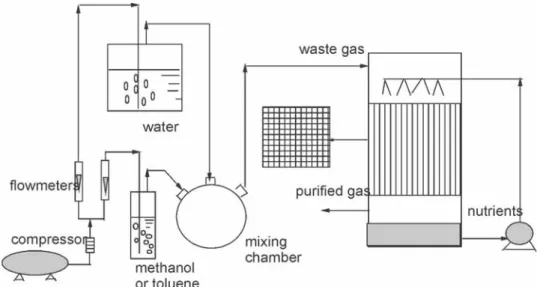
(4) 480. YAOMIN JIN, MARÍA C. VEIGA AND CHRISTIAN KENNES. 2.2 MONOLITH SUPPORT The ceramic monolith packing has the following characteristics: geometry: square ducts; length: 150 mm; cross section: 100×100 mm; number of channels: 26×26; channel width: 3.0 mm; weight: 850 kg.m-3; geometric surface: 800 m2.m-3; voids fraction: 64%. Details of the composition and the preparation procedure of the monolith used in this work are proprietary information of Rauschert Verfahrenstechnik GmbH (Germany). 2.3 EXPERIMENTAL SETUP The schematic of the monolith bioreactor used in this study is shown in Figure 1 and has been described previously in detail (Jin et al., 2006). The reactors were usually maintained at room temperature. The polluted gas was fed to the bioreactors by mixing a large air stream flowing through a humidification chamber with a smaller air stream passing through a flask containing the pollutant, i.e. either toluene or methanol. The bioreactors were fed in a downflow mode.. Figure 1. Schematic of the laboratory scale monolith bioreactor.. 2.4 ANALYTICAL METHODS Methanol or toluene concentrations were measured by means of a HP-6890 gas chromatograph (Agilent Technologies, Spain) equipped with a 30 m×0.53 mm HP-PLOT Q column and a flame ionization detector, operating in splitless mode. Oven temperature was 130 °C, while both the injector and detector temperature was.
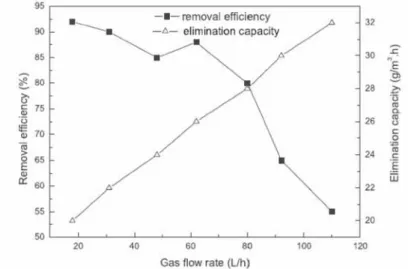
(5) BEHAVIOUR AND OPTIMIZATION OF A NOVEL MONOLITH BIOREACTOR FOR WASTE. 481. 150 °C. Samples were injected using a 2.5 cm3 gas-tight Hamilton syringe. Under these conditions, the retention time of methanol and toluene were 3.5 min and 4.3 min, respectively (Prado et al., 2005). Similarly, CO2 concentrations were measured on another Hewlett-Packard 5890 series II GC equipped with a thermal conductivity detector (TCD). The CO2 concentrations were determined at an injection temperature of 90 °C, an oven temperature of 25 °C and using a TCD at 100 °C.. 3 RESULTS AND DISCUSSION 3.1 STARTUP OF THE BIOREACTORS The microbial consortia used to inoculate the bioreactors were obtained from either a previous bioreactor or from batch enrichments. The nutrient solution containing the desired biomass was continuously recirculated over the packing material. Simultaneously, a visible biofilm developed on the surface of the square channels of the monolith. Afterwards, the monolith was transferred to the bioreactor and VOCspolluted air was fed continuously. The start-up period of the bioreactor treating toluene lasted around 24 days with removal efficiencies of 60-100% while slowly increasing the load from 0.395 to 29.5 g-toluene.m-3.h-1. These data suggest that the start-up phase is quite slow for that pollutant. However, a shorter start-up period of a few days was required for the bioreactor treating methanol. After this period, the inlet concentration was kept at 200 mg.m-3 with an EBRT of 30 s, reaching an elimination capacity of 30 g.m -3.h -1, while maintaining the removal efficiency above 95%. Acclimated biomass allowed to shorten the start-up phase, as also observed by others (Veiga and Kennes, 2001). 3.2 INFLUENCE OF THE GAS FLOW RATE The influence of the gas flow rate on the reactor´s performance was evaluated in the bioreactor treating toluene. In the range of gas flow rates of 18 to 110 l.h-1, the removal efficiency first remained constant, around 90%, while gradually increasing the gas flow rate. When the gas flow rate was further increased, the biofilm thickness decreased due to the shear force. The mass transfer limitation step was determined by the laminar film thickness between the gas and liquid phase. When the gas flow rate was increased, the turbulence of the gas increased, and the laminar film became thinner. Hence, the resistance decreased and mass transfer was enhanced. The results show that the highest elimination capacity was reached at the highest gas flow rate, although this led to a lower removal efficiency (Figure 2)..
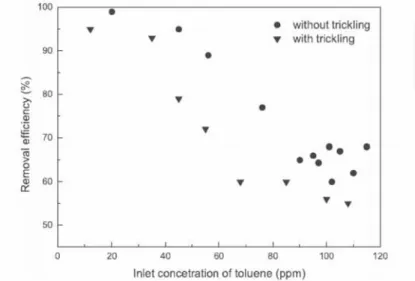
(6) 482. YAOMIN JIN, MARÍA C. VEIGA AND CHRISTIAN KENNES. Figure 2. Effect of the gas flow rate on toluene removal.. 3.3 INFLUENCE OF THE TRICKLING LIQUID PHASE The gas and liquid mixture travels through the channels of the monolith reactor. Depending on the flow rate of each phase and on the feed method, a number of different flow regimes can occur, such as dispersed bubble flow, bubble flow, aerated Taylor flow, Taylor flow, churn turbulent flow, slug flow, annular flow and mist flow. In the co-current downflow trickling operation, the gas and liquid phases travel in the same direction through the channels. In this operation mode the Taylor flow regime is preferred. In this regime the gas and liquid move through the channels as separate packages, ensuring plug flow behaviour. The gas bubbles are separated from the bio-catalytic wall, containing the attached biofilm, only by a thin liquid film. Gas adsorbed in this film can immediately be consumed by the bio-catalyst attached on the walls of the channels. Adsorbed gas that is not consumed at the film exchanges with the liquid plug. The recirculation pattern in the liquid plug facilitates a rapid exchange with the film. Because of these properties of Taylor flow in capillaries, a high gas-liquid mass transfer rate is obtained. In order to check the effect of the mode of feeding of the liquid phase, a toluenefed bioreactor was first operated in a trickling mode and later without trickling phase (no recirculation of the liquid medium) during the treatment of toluene. The flow rate of the gas and liquid were 80 and 1 l.h-1, respectively. The removal of toluene in the trickling mode was lower than without trickling phase in the experimental range of inlet concentrations used in this work (Figure 3). This seems to contradict the theory that Taylor flow could enhance the mass transfer from the gas phase to the liquid.
(7) BEHAVIOUR AND OPTIMIZATION OF A NOVEL MONOLITH BIOREACTOR FOR WASTE. 483. phase, which may be due to the following reasons: (1) when no liquid is recirculated in the reactor, the gas flow is uniform, and the liquid inside the channels forms a very thin film, then the resistance between the gas phase and the liquid phase is low, (2) in the trickling mode, although the Taylor flow generated by the liquid flow could enhance the mass transfer, the liquid was not uniformly distributed in the monolith. This could cause non-homogenous mass transfer in the different channels.. Figure 3. Performance of the monolith bioreactor with or without trickling phase.. 3.4 MONOLITH BLOCKAGE AND BIOMASS GROWTH The clogging of the monolith channels was first observed during the treatment of toluene. The pressure drop sharply increased from initially zero to 0.5 cm H2O. The biofilm growth made the gas flow and liquid flow regime become nonhomogenous, and the performance of the biofilter decreased dramatically. In order to remove excess biomass, a high flow rate of trickling liquid was used. The turbulence that was generated allowed to efficiently wash out part of the biofilm from the reactor. It seems that controlling the biofilm growth is a very important parameter for long term stable operation of monolith bioreactors, as also recently observed by others (Ebrahimi et al., 2006). This problem can be solved by optimizing the dimensions of the channels or by means of a high flow rate of the trickling liquid. Previous studies undertaken with smaller channels (channel width 1.27 mm instead of 3.0 mm) resulted in a still faster clogging. Studies on biomass accumulation were also performed with methanol. A low biomass growth rate acidophilic yeast, Candida boidinii, was inoculated for treatment.
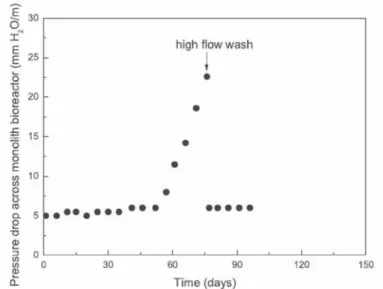
(8) 484. YAOMIN JIN, MARÍA C. VEIGA AND CHRISTIAN KENNES. of methanol. The pressure drop across the bioreactor indicates that biomass accumulation was relatively insignificant until day 50 of operation. The pressure drop remained around 6 mm H2O/m after 35 days operation. On day 60 of this operational period, the inlet loading of methanol was increased from 75 to 150 g.m-3.h-1, this high loading of methanol enhanced excess biomass growth causing clogging of the channels. Finally, the accumulated biomass led to a dramatic increase in pressure drop across the bioreactor on day 75. Biomass accumulation has also been observed on the top view of the monolith packing. In order to remove excess biomass, a high liquid flow rate was used (3 l.h-1) to generate shear forces and remove some biomass attached on the channel walls allowing the pressure drop to return to its original value, around 6 mm H2O.m-1. It is also important to note that the biomass accumulation, as reflected in Figure 4, had very little effect on methanol removal even at high values of the pressure drop. Physical operational problems are, however, encountered at such high pressures, necessitating backwashing to remove excess biomass. Overall, the monolith bioreactor showed a higher elimination capacity and much lower pressure drops compared to other conventional bioreactors, which could save on operation costs when the bioreactor is scaled up for application in the field.. Figure 4. Development of pressure difference across the monolith bioreactor..
(9) BEHAVIOUR AND OPTIMIZATION OF A NOVEL MONOLITH BIOREACTOR FOR WASTE. 485. 4 CONCLUSIONS According to the data available so far, it appears that monolith bioreactors are able to reach relatively high removal rates and very good performances compared to conventional systems. However, more research is still needed in order to confirm if such good results can be generalized to all monolith bioreactors and if they can be maintained over longer operation periods.. 5 ACKNOWLEDGEMENTS The present research was funded by the Spanish Ministry of Education and Science (Project CTM2007-62700/TECNO) and through European FEDER funds. Yaomin Jin was financially supported by the Xunta de Galicia through Project PGIDIT05PCIC10304PN.. REFERENCES Daugulis, A.J. (2001) Two-phase partitioning bioreactors: a new technology platform for destroying xenobiotics. Trends Biotechnol. 19: 457-462. Ebrahimi, S., Kleerebezem, R., Kreutzer, M.T., Kapteijn, F., Moulijn, J.A., Heijnen, J.J. and van Loosdrecht, M.C.M. (2006) Potential application of monolith packed columns as bioreactors, control of biofilm formation. Biotechnol. Bioeng. 93: 238-245. Jin, Y., Veiga, M.C. and Kennes, C. (2005) Autotrophic deodorization of hydrogen sulfide in a biotrickling filter. J. Chem. Technol. Biotechnol. 80(9): 998-1004. Jin, Y., Veiga, M.C. and Kennes, C. (2006) Development of a novel monolith-bioreactor for the treatment of VOC-polluted air. Environ. Technol. 27(11): 1271-1277. Kan, E. and Deshusses, M.A. (2003) Development of a foamed emulsion bioreactor for air pollution control. Biotechnol. Bioeng. 84: 240-244. Kennes, C. and Thalasso, F. (1998) Waste gas biotreatment technology. J. Chem. Technol. Biotechnol. 72(4): 303-319. Kennes, C. and Veiga, M.C. (2001) Bioreactors for Waste Gas Treatment. Kluwer Academic Publishers, Dordrecht, The Netherlands. Kennes, C. and Veiga, M.C. (2002) Inert filter media for the biofiltration of waste gases – characteristics and biomass control. Rev. Environ. Sci. Bio/Technol. 1: 201-214. Poppe, W. and Schippert, E. Das KCH-biosolv-ver-fahren in kombination mit einembiowäscher herkömlicher art-eine verfahrensentwicklung zur abluftreinigung fur wasserlösliche und schwer wasserlösliche schadstoffe. In Biotechniques for Air Pollution Abatements and Odour.
(10) 486. YAOMIN JIN, MARÍA C. VEIGA AND CHRISTIAN KENNES. Control Policies (Maastricht, The Netherlands, 1992), A. J. Dragt and J. van Ham, Eds., Elsevier Science Publishers B.V., pp. 71-76. Prado, O.J., Veiga, M.C. and Kennes, C. (2005) Treatment of gas-phase methanol in conventional biofilters packed with lava rock. Water Res. 39(11): 2385-2393. Reij, M.W., Hamann, E.K. and Hartmans, S. (1997) Biofiltration of air containing low concentrations of propene using a membrane bioreactor. Biotechnol. Prog., 13(4): 380-386. Veiga, M.C. and Kennes, C. (2001) Parameters affecting performance and modeling of biofilters treating alkylbenzene-polluted air. Appl. Microbiol. Biotechnol. 55: 254-258. Vinage, I. and von Rohr, R. (2003) Biological waste gas treatment with a modified rotating biological contactor. I. Control of biofilm growth and long-term performance. Bioprocess Biosyst. Eng. 26(1): 69-74..
(11)
Figure
Documento similar