1
“PEDRO RUIZ GALLO”
NATIONAL UNIVERSITY
POST GRADE SCHOOL
WORKSHOPS WITH A MEANINGFUL STRATEGY THAT USE ICT TO DO A SIGNIFICANT IMPROVEMENT IN WRITTEN PRODUCTION BASED ON
COMMUNICATIVE APPROACH BY DAVID NUNAN WITH II CYCLE OF SOFTWARE DEVELOPMENT STUDENTS AT SENATI – TARAPOTO –
PERU
This thesis is submitted to the Pedro Ruiz Gallo National University in partial completion of the requirements for the Master Degree in English
Didactics
AUTHOR:
JULISSA IDROGO CUBAS
TARAPOTO – PERÚ
2 WORKSHOPS WITH A MEANINGFUL STRATEGY THAT USE ICT TO DO A
SIGNIFICANT IMPROVEMENT IN WRITTEN PRODUCTION BASED ON COMMUNICATIVE APPROACH BY DAVID NUNAN WITH II CYCLE OF SOFTWARE DEVELOPMENT STUDENTS AT SENATI – TARAPOTO –
PERU
Submitted by: Supervised by:
_____________________________ _________________________ Lic. Julissa Idrogo Cubas Dra. Mary del Pilar Fernández Teddy
Thesis submitted to Pedro Ruiz Gallo National University in partial completion of the requirements for the Master Degree in English Didactics
APPROVED BY
_____________________________ ___________________________ Dra. Rosa Elena Sánchez Ramírez M. Sc. Beldad Fenco Peniche
CHAIR 1st INTERNAL EXAMINER
______________________________ M.Sc. María Elena Segura Solano
2nd INTERNAL EXAMINER
3
DEDICATION
4
ACKNOWLEDGEMENT
5
ANALYSIS OF THE RESEARCH OBJECT ...13
1. LOCATION OF THE OBJECT STUDY ...14
1.1. THE PROVINCE OF SAN MARTIN ...14
1.1.1. LIMITS ...15
1.1.2. ADMINISTRATIVE DIVISION ...15
1.1.3. DISTRICT OF TARAPOTO ...16
1.1.4. “SENATI” INSTITUTE ...17
1.2. HOW THE PROBLEM ARISES - DESCRIPTION OF THE OBJECT STUDY. ...21
1.2.1. HOW THE PROBLEM ARISES. ...21
INTERNATIONAL CONTEXT ...22
CONTEXT OF LATIN AMERICA ...22
PERUVIAN CONTEXT ...24
REGIONAL CONTEXT ...25
LOCAL CONTEXT ...25
1.2.2. DESCRIPTION OF THE OBJECT STUDY ...26
1.3. HOW THE PROBLEM IS MANIFESTED AND WHAT FEATURES IT HAS ....27
1.3.1. TYPES OF WRITING: ...27
EXPOSITORY ...27
DESCRIPTIVE ...28
PERSUASIVE ...28
NARRATIVE ...28
1.3.2. ELEMENTS OF WRITING ...28
STRUCTURE: ...28
6
CONTENT: ...30
1.4. DESCRIPTION OF THE METHODOLOGY ...30
1.4.1. RESEARCH DESIGN ...30
1.4.2. POPULATION AND SAMPLE ...31
1.4.3. MATERIALS, TOOLS AND TECHNIQUES OF DATA COLLECTION ...32
1.4.4. METHODS AND PROCEDURES FOR THE COLLECTION OF DATA ...32
1.4.5. STATISTICAL ANALYSIS OF DATA ...33
CHAPTER II ...34
THEORETICAL – CONCEPTUAL FRAMEWORK ...34
2.1. BACKGROUND FRAMEWORK ...35
INTERNATIONAL BACKGROUND: ...35
NATIONAL BACKGROUND: ...37
REGIONAL BACKGROUND: ...40
2.2. THEORICAL FRAMEWORK ...42
2.2.1. PHILOSOPHY OF LANGUAGE, GLASERSFELD ...42
THE VIEW OF LANGUAGE BY ERNST VON GLASERSFELD ...42
THE CONSTRUCTION OF “OTHERS” ...44
SOME SUGGESTIONS FOR TEACHING ...45
2.2.2. SOCIAL COGNITION, VYGOTSKY ...47
ZONE OF PROXIMAL DEVELOPMENT (ZPD) ...48
SOCIOCULTURAL THEORY...49
PSYCHOLOGY OF PLAY ...49
CULTURAL MEDIATION AND INTERNALIZATION ...50
2.2.3. COMMUNICATIVE APPROACH, DAVID NUNAN ...51
2.2.4. WRITING SKILL ...53
MODELS TO WRITE...54
2.2.5. MOBILE APPLICATION ...57
2.2.6. WEBSITES ...59
2.2.7. INDICATORS TO EVALUATE WRITING ...65
2.3. CONCEPTUAL FRAMEWORK...66
CHAPTER III ...68
OUTCOME OF THE RESEARCH INVESTIGATION ...68
3.1. ANALYSIS AND INTERPRETATION OF THE DATA ...69
7 3.2. THEORETICAL MODEL: ... ¡Error! Marcador no definido.
3.2.1. PROBLEMATIC REALITY: ...76
3.2.2. FOUNDATION:...77
3.2.3. PROPOSAL OBJECTIVES: ...77
3.2.4. RATIONALE THEORETICAL REALITY ...78
PEDAGOGICAL RATIONALE ...79
LEGAL RATIONALE ...79
EPISTEMOLOGICAL RATIONALE ...79
3.2.5. PROPOSAL STRUCTURE: ...80
CONCLUSIONS ...82
RECOMMENDATIONS ...83
BIBLIOGRAPHY ...84
8
RESUMEN
El presente trabajo de investigación es realizado con el objetivo de diseñar y proponer Talleres para Enseñanza del Idioma Inglés usando las TICs basados en el enfoque Comunicativo de David Nunan para desarrollar y mejorar de una manera significativa la habilidad de escritura en los alumnos del II ciclo de la Escuela de Tecnologías de la Información (ETI) SENATI – Tarapoto 2017.
Para diagnosticar el problema, se aplicó un pre-test, asimismo la rúbrica con los criterios de la habilidad de escritura fueron diseñados. Luego de obtenidos y analizados los resultados, los talleres para la enseñanza del idioma inglés se diseñó en base a: La Filosofía del Lenguaje de Ernst von Glasersfeld, Cognición Social de Lev Vygotsky y el Enfoque Comunicativo de David Nunan para desarrollar y mejorar de una manera significativa la habilidad de escritura en los estudiantes del II ciclo de la Escuela de Tecnologías de la Información (ETI) SENATI.
Los resultados obtenidos de los estudiantes del II ciclo de la Escuela de Tecnologías de la Información (ETI) SENATI, muestran la falta de la habilidad de escritura impidiendo así a los estudiantes estructurar oraciones, párrafos y textos e incluso lidiar con características especiales de escritura en el idioma inglés como son el vocabulario, gramática, entre otras lo cual conlleva a una argumentación y comunicación y además afrontar las dos características fundamentales al momento de escribir en inglés como es la cohesión y coherencia.
9
ABSTRACT
This research work is presented in order to design and propose workshops with a meaningful strategy that use ICT to do a significant improvement in written production to make a meaningful improvement on writing skill in students of II cycle of Information Technology school (ETI) SENATI – Tarapoto 2017.
To diagnostic the problem, a pre-test was applied to students and rubric matrix with writing criteria was designed and applied as well. After having the results, they were analyzed and workshops with a meaningful strategy that use ICT in English teaching activities based on: The Philosophy of Language by Ernst von Glasersfeld, Social Cognition by Lev Vygotsky and Communicative Approach by David Nunan which ones are supporting this propose called “Workshops with a meaningful strategy that use ICT to do a significant improvement in written production based on Communicative Approach by David Nunan With II Cycle of Software Development Students At Senati – Tarapoto – Peru”.
Students in II Cycle of Software Development Students At Senati in Tarapoto due to results obtained by the instrument applied show that they lack writing skill preventing students from building up sentences, paragraphs and texts, and to handle English writing features such as: vocabulary, grammar and so on leading to a really bad argument and communication and therefore with two main characteristics in English writing which are cohesion and coherence.
10
INTRODUCTION
From the ancient time, writing is an extension of human language across time and space. Writing most likely began because of political expansion in ancient cultures, which needed reliable means for transmitting information, maintaining financial accounts, keeping historical records, and similar activities.
At present, within the teaching-learning process of the English language, deficiencies have been evident in the ability of written production. In studies carried out by ESADE (2010), it was stated that 70% of Spaniards recognize that the English language is important, in addition the study reveals that 4% of the population study it, 17% read and write correctly, 14% understand it When they listen and 11% say speak well. Due to this problem, EECL (European Study of Language Competencies) recommends that teachers emphasize oral and written skills (writing and speaking) in the initial phase of teaching foreign languages.
In our country, it has also been observed that within the teaching-learning process there are deficiencies regarding the ability of written production, thus generating a problematic within the educational context. As main causes to this problem we have the lack of texting or writing activities; the teaching is based only through reading and practical exercises in grammar, without giving students the opportunity to write or speak in English. Another cause we have; The scarce vocabulary learned or taught. In order to express ourselves in a target language, we need to make use of a vocabulary that is adapted to the reality in which the individual develops, otherwise, difficulties arise to start a description.
11 The research problem was formulated at SENATI Institute in Tarapoto, specifically in the Information Technology School, the career of Software Development exactly, the problem of the development of the ability of the writing in recurrent form with students of the II cycle of the ETI has been presented. The peculiarities that have been presented are: motivation, nervousness, and incoherence in texts, deficiency in comprehension and other manifestations. The lack of motivation in students generates a distrust in them and therefore greater nervousness to develop the ability of written production, these factors have led to this problem; Being necessary to develop this ability through adequate strategies that allow them to write in the English language without feeling pressured, which leads to appropriate knowledge and use them collectively in real situations of writings, to achieve the desired results.
The research object is the teaching learning process that is the heart of education. It depends on the fulfillment of the aims and objectives of education. It is the most powerful instrument of education to bring about desired changes in the students. Teaching learning are related terms. In teaching - learning process, the teacher, the learner, the curriculum, the environment and other variables are organized in a systematic way to attain some pre-determined goal.
The objective is to propose workshops using the ITCs to do an important Improvement in written English Skill using meaningful strategies founded on Communicative Approach to express their own ideas on a text. The specific objectives to diagnose students’ level in writing skills, to design a theorical framework to support the proposal design, to select the ICT´s strategies which can apply in teaching process, to elaborate the instruments to evaluate and to propose workshops through activities based on Communicative Approach.
12 The research fieldwork is the teaching learning process of the writing skill in the II cycle of the Information Technology School at SENATI – in Tarapoto 2016.
The following scheme was designed for the presentation of this thesis:
The first chapter: This describes the location of the research objective, the limit and the administrative division of the province of San Martin. Then the history of the district of San Martin, leading to “SENATI - ETI” school in Tarapoto, how the problem arises, where is considered all the trends since the international context to the local one. Description of the characteristics of the problem and the methodology applied.
The second chapter: The theoretical framework is based on reviewed thesis where many research works had already studied the presented problem and main themes from three works were taken into account, as: : The Philosophy of Language by Ernst von Glasersfeld, Social Cognition by Lev Vygotsky and Communicative Approach by David Nunan.
The third chapter: The instruments of data collection obtained the necessary data which later on was analyzed and tabulated. Therefore, the proposal work was designed and elaborated based on the philosophical, didactical and technical work mentioned above. The principal elements of the proposal work were considered: topic, rationale, objectives, methodology, evaluation, recommendation, and bibliography.
13
CHAPTER I:
14 1. LOCATION OF THE OBJECT STUDY
1.1. THE PROVINCE OF SAN MARTIN
The Province of San Martín is one of the ten provinces that makes up the Department of San Martín, under the administration of the regional government of San Martín, Peru.
The history of the province of San Martin dates back to the time when the fierce chancas, persecuted by the Incas, make Lamas their new habitat and form an extensive cultural family known as "Motilones Lamistas"
They were the ones that in their search for food went down to the valley of Tarapoto, where the warriors and wild "Cumbazas" lived dedicated to the hunting and fishing between river Cumbaza and the ravine of the Choclino. At that time, where today stands the Plaza Alberto Leveau, there was the "Cocha" or lagoon of Suchiche, whose name comes from the group that initially inhabited it.
The confluence and fusion of families of these two ethnic groups in the "cocha" of Suchiche, which in time would be added other groups descendants of the Chancas, Pocras and Incas, as Chimbinos, Atumpampas and Patinos, became in the conformation of A resident group that established commercial relations with the Lamistas; Which, with its progressive growth, not only motivated the increase of the native population, but the establishment of the bases in the socio-economic development of San Martín.
Background of the creation of the district of Tarapoto
• D. February 7, 1866 - Establishing in Department, the Loreto Coastal Province
• Law 00201 - Creation of the Department of San Martin
• Law 00297 - Elections in San Martin 1906
• Law No. 9233 - Changing the name of Tarapoto with that of San Martin
15
1.1.1. LIMITS
In the north and by the east with the Department of Loreto In the south with the Province of Picota
In the west with the Province of Lamas.
MAP Nº 01:Map of the department of San Martín
Source: World Map
1.1.2. ADMINISTRATIVE DIVISION
The province has an extension of 5640 Km2 and is divided into 10 districts. TABLE Nº 01
POPULATION IN THE DEPARTMENT OF SAN MARTIN - 2007
Source: INEI, Censo Nacional del 2007: XI de Población y VI de Vivienda MALE FEMALE
16
1.1.3. DISTRICT OF TARAPOTO
The District of Tarapoto, known as the "City of Palms", is a thriving commercial hub in northern Peru, an hour by plane from Lima, situated in the San Martín Province of the San Martín Region, located in the high jungle plateau to the east of what is known as the selva baja (low jungle). Although Moyobamba is the capital of the region, Tarapoto is the region's largest city and is linked to the Upper Amazon and the historic city of Yurimaguas by a relatively well-maintained transandean highway, paved in 2008-9.
In the territories of San Martin developed ancient pre-Hispanic cultures as the Chachapoyas and then the Incas, leaving a legacy of important archaeological sites like the Gran Pajatén within Río Abiseo National Park, Cultural and Natural World Heritage Site (UNESCO).
From Tarapoto can enjoy many of its lagoons and waterfalls where the contact with nature and relaxation will make your visit a great experience. El Sauce lagoon, also known as the blue lagoon, is located only 35 kilometers south of the city and is itself a destination of lush landscapes and quiet waters, around which are located lodges that offer various programs to visit.
Contact with nature offers unique options for the observation of orchids and birds and a rich flora and fauna particular to the cloud forest zone and opportunities for adventure tourism such as white water rafting, jungle expeditions and treks.
17 Tarapoto is often used by tourists and local visitors as a base for excursions into the vast Amazon Rainforest. The region's main activities are tourism, commerce, agriculture and a thriving illicit "shadow economy" that includes production of coca leaves, extraction of lumber and trading in land concessions.
The folklore in the area also offers a variety of expressions, crafts, festivals, fine dining, traditional food such as juanes, tacacho with cured meat, cocona and grape juices and exotic liquors. It is almost obligatory visit the native community of Lamas to appreciate their peculiar customs, dress and architecture, people of many myths.
Tarapoto is home to the Universidad Nacional de San Martín, an important center of higher education serving the professional and technical needs of a region of high biodiversity. With its active nightlife, Tarapoto offers a wide variety of hotels and restaurants in and around the city. Moreover, the area's beautiful landscapes, waterfalls and lagoons form a tempting location for adventure tourism, such as river rafting and hiking in the tropical Andes, and attract numerous visitors to the "City of Palms".
1.1.4. “SENATI” INSTITUTE
“SENATI” is an institution at national level, the central cede is located in the capital of Peru - Lima. The other centers of professional training are distributed in different cities of our country, one of them is located in the city of Tarapoto-San Martin.
ORIGINS OF THE INSTITUTION
18 occupations of the manufacturing industrial activity and of the work of installation, repair and maintenance; For which financing was imposed a self-assessment or monthly financial contribution. In view of this entrepreneurs' initiative, SENATI was created on December 19, 1961 by Law No. 13771.
LEGAL NATURE
The National Service of Industrial Training SENATI, in accordance with Law No. 26272, as amended by Law No. 29672, is a legal person governed by public law, with technical, pedagogical, administrative and economic autonomy, with its own assets, private management, Not falling within the scope of the rules of the public sector administrative system, which is intended to provide vocational training and training to workers in productive activities considered in category D of the International Standard Industrial Classification (ISIC) of all Economic activities of the United Nations (Revision 3) and all other industrial activities of installation, repair and maintenance contained in any other category of the same classification. SENATI is governed by the provisions contained in Law No. 26272, its amendment to Law No. 29672, its Statute approved by the National Council, and Law No. 17045, which give it the nature of being a private management organization because it does not form Part of the Budget of the Public Sector and enjoys autonomy in its management and the national council has exclusive responsibility in the administration and application of the income of SENATI, as well as to dictate all the control rules that ensure the correct application of the income, In accordance with the purposes of SENATI.
FINANCING ACTIVITIES AND RESOURCES
19 The economic contribution contributed monthly by companies of more than 20 workers, with respect to personnel engaged in industrial manufacturing activity and to the work of installation, repair and maintenance. The amount of the contribution is equivalent to 0.75% of the total remuneration paid by companies to their workers. The contributing companies have the right to train future operative workers, as well as to train their employees in service.
➢ The resources generated by the provision of training and technical
assistance services.
➢ Those coming from the International and National Technical
Cooperation.
➢ Legal devices and rules governing the contribution to SENATI. ➢ Regulation of Organization and functions. (STATUTO DEL SENATI
APPROVED BY ITS NATIONAL COUNCIL). ➢ Contribution Regulation.
➢ Tributary Code.
➢ SENATI Organization and Functions Act No. 26272.
➢ Law No. 29672, Law authorizing SENATI to grant titles in the name
of the Nation.
MISSION: Train and train people for decent jobs and high productivity, in support of national industry in the global context, and to contribute to the improvement of the quality of life of society.
VISSION: Lead in Peru and Latin America, technical education for the development of employability and competitiveness of productive units.
FUNCTIONS
20 LEVELS
Depending on the different requirements that are presented in the occupational structure of the productive activity, SENATI has established training and professional training programs for the following occupational levels:
➢ Technical Operative Level. ➢ Technical Level Medium. ➢ Superior Technical Level.
METHODOLOGY
The most characteristic teaching methodology of SENATI is "learning by doing" and in real production conditions. Training in operational technical occupations is carried out mainly with the "Dual System SENATI-Empresa", which is characterized by alternating activities in Vocational Training Centers with practical learning within companies.
There are about 8,600 companies that, at a national level, participate in Dual Learning conducted by SENATI.
Functions of SENATI
The main function of SENATI is to provide training and professional training for industrial manufacturing activity and for installation, repair and maintenance. It also develops technical services.
For the fulfillment of its functions, SENATI has established a System of Training and Professional Training that responds to the real demands of the productive activity. This system has the following characteristics:
➢ Participation of entrepreneurs in management bodies and in the
21 ➢ Programs, professional profiles, curricular contents, methodologies
and organizational forms that follow the approach of vocational training by specific labor competencies.
➢ Technical-teaching and management personnel with industrial
experience, trained and perfected in highly developed countries of America, Europe and Asia.
➢ Training and professional training centers with modern and
permanently updated equipment.
➢ Innovative educational technology in the field of technical vocational
training, with national and international recognition.
➢ Experience in economic-financial management in accordance with
modern techniques of quality, productivity and profitability.
1.2. HOW THE PROBLEM ARISES - DESCRIPTION OF THE OBJECT STUDY.
1.2.1. HOW THE PROBLEM ARISES.
Writing is an essential skill, many students at high school are not interested in it. According to Robert Todd Caroll (1990), many students were never required to learn proper spelling or grammar. These poor students come to think that “English” and “writing” are nothing but spelling and grammar. To them, writing means inevitable failure. Good writing is sometimes they believe they will never be able to achieve, because they not only identify good writing with proper spelling and grammar etc. They are even not aware of the importance of writing skill in their learning.
22 motivations for my research. I choose this topic because I want to investigate the difficulties in writing skill among students at high school and find out the problems they commonly make so that I can suggest solutions to improve their writing skill.
INTERNATIONAL CONTEXT
Writing is one of the ways to transmit thoughts or ideas to the other people. Writing is also the important skill in studying English, which need great investment from the students. Many students in high school do not know the important of writing, so they only spend a few times for it. It is not true because good at writing can help them study other skills in English more effectively. Besides that, practicing writing skill will help students get acquainted with new types of writing as well as consolidate their writing skill. For example, students study writing skill from low to high, from basic to advance.
CONTEXT OF LATIN AMERICA
In Brazilian schools, especially public ones, a recurrent problem highlighted by teachers is that of teaching the subject to students who are not properly literate. This is understood here in its instrumental meaning, involving competence in reading and writing. It is a cause of wonder and complaints among teachers, and researchers, and reflects on the actual relationship that teachers have with their students. Together with other conditions, such as whether or not there exist writing materials for use in the classroom (books or reproductions of texts on pages), the representations of the characteristics of a student as more or less lettered direct the teacher towards determined didactic choices, which involve in turn, a more or less problematizing treatment of the history it is intended to teach. Furthermore, they collaborate to shape a certain relationship with writing in the classroom.
23 Education. I also discuss the expectation of history teachers in relation to students from the old fifth grade of primary school, now the sixth class. According to results which were collected from questionnaires and observation, the researcher will try to find out students’ problems in writing skill and the causes of those problems as well as survey how students learn writing skill.
Figure Nº 01: The students’ interest toward writing skill
Source: Results in Brazilian publics school.
According to Figure Nº 01, a small number of students like to learn writing skill. Only 15% of them are interested in writing. This indicates that writing is not a favorite subject to most of students. Observing two periods of writing, researcher recognized that not many students took part in writing tasks actively. It can be inferred that students’ attention to writing skill will be less than the others.
24 students in public and private schools, since the complaint usually presented refers especially to public school students. As we will see, there are actually relevant differences in student performance in the two networks in relation to their reading competence.
Education at the global level has been subject to significant changes at both the macro and micro levels, among which the use of information and communication technologies (ICTs), known as (ICT), can be mentioned, breaking with the traditional scheme of The formal classes, that is, within a space established since the appearance of the palace in Mesopotamia, called classrooms. Such is the impact of these, not only education is overwhelmed but also has begun to displace traditional media, such as television, radio, print, among others. In this sense, the attachment and interest on the part of the children and adolescents of the schools and schools toward these technologies is evident. To such an extent that Aguilar (2010) has called them "cyber-generation".
PERUVIAN CONTEXT
Piscitelli, A (2009), These "digital natives" as they are also called, handle cell phones or cell phones daily, personal computers, I pods, Tablets and a myriad of elements that day by day can be observed within the basic and diversified school in Peru. In spite of this, the national education system does not use these resources for the integral and quality education of the students, much less designs programs that include these elements within the range of educational opportunities.
25
REGIONAL CONTEXT
In our region San Martin; The area of the English language in the different public and private institutions is evident that within the teaching-learning process there are deficiencies in the majority of the students to develop the ability of the production of written texts, the cause of such deficiency is in writing activities and interactive exercises, reading and practical exercises in grammar, improper use of written texts, and a lack of vocabulary.
LOCAL CONTEXT
At SENATI institute, specifically in the Information Technology School, the problem of the development of the ability of written production recurrently with students of the II cycle of the professional career of Software Development is presented. The particularities that present these are: error in writing a text from L1 to L2, incoherence in written texts, deficiency in the understanding of texts and writing of the same, and motivates motivation. Motivation is a very important factor in students so if they do not have a reason or motivation to learn, this will generate a distrust in them and therefore greater nervousness to develop the ability of written production, these factors have led to this problematic; Being necessary to develop this ability through appropriate strategies that allow them to write in the English language without feeling pressured, which entails appropriating knowledge and using them collectively in real situations of writing, to achieve the desired results.
26 Teachers do not use a meaningful strategy to teach writing, their classes are not matching the students real life.
Students are not aware about the real importance of writing English they leave it, they neither write, speak nor listen any word that is a pitiful disadvantage for them.
1.2.2. DESCRIPTION OF THE OBJECT STUDY
The process of teaching is formed by steps which include planning, implementation, evaluation and revision. Thus, classroom assessments and feedback receiving are very important as well. A teacher must create an environment of mutual respect and trust by relying on students for feedback. Therefore, students can be a valuable resource for verifying whether the class pedagogy is or is not working. Self-examination with feedback from your students and the instructor are key to improving your teaching.
As for planning, in each level, goals might be settled, it must be tasked from the scale of an entire semester (syllabus) to a single class (lesson plan). Day – to –day aims should be explained and be more specific. In addition, the day-to-day teaching must fit into the larger goals of the course.
In the revision stage, pedagogic methods must be kept in consideration and it has to be focus on student learning. It must encourage a relationship of cooperation and mutual discovery.
27 students and the professor on a regular basis (not just at the end of the semester), they can modify and improve their teaching strategies. Assessments do not need to be overly complex or involved. In fact, the more focused teachers are in the assessment, the more impact the changes will have.
Finally, teacher should implement great ideas in teaching process. Teachers must know if they keep doing the same thing it may be easy and safe, but if something common has not been working right, change it would be the good thing not only for the teacher, but for the students. Willing changes and experiments will find it difficult but it can improve teaching skills and help get good students´ results.
1.3. HOW THE PROBLEM IS MANIFESTED AND WHAT FEATURES IT HAS
The students of II cycle of Software Development at “SENATI” Institute that is located in a city called “Tarapoto”, province of “San Martin”, department of “San Martin” in Peru, show a lack of writing skill and the failure is elicit in: Types of writing and elements of writing.
1.3.1. TYPES OF WRITING:
Students lack of knowing the existence styles in writing. Therefore, they just write without following a line.
Expository, descriptive, persuasive, and narrative are the 4 types of writing. Students do not differ and they mix it without knowing that each one is used for specific purpose. However, a single text may include more than one style.
EXPOSITORY
28 can be: textbooks, articles, recipes, news stories (not editorials or Op-Eds), business, technical, or scientific writing.
DESCRIPTIVE
This type of writing is often found in fiction, or nonfiction as well (for
example, memoirs, first-hand accounts of events, or travel guides). Writers
are painting a picture in words of a person, place, or thing for their
audience. Metaphor or other literary devices can be employed in order to describe the author’s impressions through their five senses (what they
hear, see, smell, taste, or touch). Convincing and explaining the audience are no the purposes but just describe things as they really are. Descriptive texts can be: Poetry, journal/diary writing, descriptions of Nature, fictional novels or plays
PERSUASIVE
This can be found in academic papers. Writers are trying to convince the audience of a position or belief. This contains the author’s opinions and biases, as well as justifications and reasons given by the author as evidence of the correctness of their position. They are cover letters, Op-Eds and Editorial newspaper articles, reviews of items, letters of complaint, advertisements and letters of recommendation.
NARRATIVE
Writers are not just trying to impart information, they are trying to construct and communicate a story, complete with characters, conflict, and settings. For example: Oral histories, novels/novellas, poetry (especially epic sagas or poems), short stories and anecdotes.
1.3.2. ELEMENTS OF WRITING
STRUCTURE:
29 In most of the assigned paper work students are asked to do, teachers ask them to work with the three elemental parts: introduction, supporting paragraphs making up the body of the work, and a conclusion. However, This general format is the root of the six common writing structures that can be used for both formal and informal written communication.
Categorical: It is a series of equally important topics are addressed.
Evaluative: A problem is introduced, and then pros and cons are weighed.
Chronological: It is the actual telling of the story than the end result, employ a chronological structure.
Comparative: There are more layers to the situation at hand that is being weighed.
Sequential: This structure is when people use how-to voice when a
step-by-step process is being described. Writers should use sequentially words like, "First," "Next," "Then," and "Finally" to clarify your instructions.
Causal: It discusses the causes and then the effects regarding a particular topic or issue in that order.
STYLE:
Every writer´s style is set on his or her own writing, making it unique. Writing style is dressed to fit the specific context, purpose, or audience.
The way each writer chooses words and structures sentences impact and effect the style.
Novelists such as Cesar Vallejo, Pablo Neruda, Gabriel Garcia Marquez are well known for their distinctive literary styles. But journalists, scientists, historians, and mathematicians also have distinctive styles, and they need to know how to vary their styles to fit different audiences.
30 Sentence fluency: A variety of sentences with different lengths and rhythms must be used to achieve different effects. It must be avoided monotony by varying their sentence structures. Sentence fluency is the flow and rhythm of phrases and sentences.
Voice: A writer’s voice can be impersonal or chatty, authoritative or
reflective, objective or passionate, serious or funny. It reveals the writer’s personality.
CONTENT:
Writers must think about the readers, by questioning these: how much information and detaildo they need? What kind of word must writers use: specialist terms or should you “translate” these to make oneself understood by a generalist reader? and how formal or informal should the writing be?
1.4. DESCRIPTION OF THE METHODOLOGY
1.4.1. RESEARCH DESIGN
This research adopts the following proposal design:
Key:
R = Observed Reality
0X = Observation of the problem
T = Theory (ies) that sustain(s) the research proposal
P = Research proposal (Treatment or solution to the problem)
R OX P
31 Analytical Design
The action plan for the development of this reserach was held in the following stages that are detailed below:
First stage: Perform trend analysis of the development of the teaching-learning process (writing skill) international level, America and Peru. To carry out this work was use the historical- logical method.
Second stage: Carry out the diagnosis in the field of study which was done by the method of instrument with writing story test for the students that will be applied just once.
Third stage: Design and substantiate formally strategies with the support of the methods of modulation and dialectical, For the purpose of establishing relationships and regularities of the processes and components, this, to justify the problem.
1.4.2. POPULATION AND SAMPLE
The population was defined by the II cycle of Software Development at “Senati” Institute located in a city called “Tarapoto”, district of “Tarapoto”, province of “San Martin”, department of “San Martin” in Peru.
The sample was defined by the II cycle of Software Development at Senati Institute and it is different to the population because it was chosen only one classroom from the whole that make up the population.
POPULATION MALE FEMALE TOTAL
Software Development
“Senati 80 125 205
SAMPLE MALE FEMALE TOTAL
32 1.4.3. MATERIALS, TOOLS AND TECHNIQUES OF DATA COLLECTION
1.1.1. Materials
• Printed papers
• Markers
• Pens
• Photocopies
• Computer
• Printer
1.1.2. TECHNIQUES, TOOLS AND DATA COLLECTION
RIMARY TECHNIQUES AND TOOLS QUANTITATIVE RESEARCH
TECHNIQUES TOOLS
OBSERVATION Observation guide
Pattern observation log
TEST Pre-test
SECUNDARY TECHNIQUES AND TOOLS QUALITATIVE RESEARCH
TECHNIQUE TOOLS
REGISTERING Bibliography Textual, quates
1.4.4. METHODS AND PROCEDURES FOR THE COLLECTION OF DATA METHODS
• To coordinate with the director at Senati Institute.
• To prepare the instrument for gathering information.
• To apply the instrument for gathering information.
33 • To analyze data.
• To code data.
• To present results.
PROCEDURES FOR THE COLLECTION OF DATA
• In the case of the primary data, it is collected, analysed and interpreted. The research to have truly information would be done by 80% of primary data.
• In the case of secondary data were taken on loan and are supplementary to the primary data. Comprise 20% of the research.
1.4.5. STATISTICAL ANALYSIS OF DATA
• Encode : Encode the tools.
34
CHAPTER II
35 2.1. BACKGROUND FRAMEWORK
Research in strategies to teach writing English is new in Tarapoto, but there are some research thesis about this topic in other countries far away from our reality.
INTERNATIONAL BACKGROUND:
Jáimez Sánchez in his thesis titled “The use of literary texts in the teaching of the English language through mobile learning in secondary education. University of Granada. Unpublished Doctorate Thesis, Granada, 2009.
Its general objective was to establish the basis for a curricular design where the language and literature is integrated in the teaching of English of the secondary in a course of 1st degree of Bachillerato.
His methodology was: The methodological objective, therefore, the use of the great variety of imaginative texts, especially literary texts that do not allow activities of comprehension, production and linguistic reflection combined with communicative tasks where personal involvement and creation play a decisive role , The same ones that are also reinforced through current mobile applications.
36 Pulido, Yerome in his thesis “The lexical interference Spanish (L1) - English (L2) and English (L2- Spanish (L1) in the written text of 9th grade students of the Bilingual Pio XII school (2010)”.
Its general objective was to analyze the most recurrent lexical interferences in three types of texts (narrative, expository and argumentative) written in Spanish and English of students of degree 9º of the Bilingual School Pío XII.
Their methodology was: The methodological objective is therefore the use of the great variety of imaginative texts, especially literary texts that allow students to perform activities of comprehension, production and linguistic reflection combined with communicative tasks where personal involvement and creation play A decisive role, which will also be reinforced through current mobile applications. The lexical interferences in the English text (narrative, expository and argumentative) are given mainly in the narrative text if the total number of interferences are taken into account.
Their conclusions were: The conclusions reached in this work are given from different perspectives. First, reference is made to the frequency of occurrence of lexical interferences in each of the languages studied. Second, we present the conclusions obtained regarding the analysis of the English text following the order of type of text, grammatical category and type of interference. Third, conclusions are drawn from the analysis of texts in Spanish following the order of type of text, grammatical category and type of interference. Fourth, other conclusions.
37 From the practical point of view, the finding, description and discussion of the lexical interferences found in the texts in English and Spanish of this study can be a useful tool for teachers who teach English as a foreign language in general, Different ways in which lexical interference occurs and to understand the reason for its appearance can generate a reflection, study and pedagogical action that has as purpose the creation of strategies for the teaching of English as a second language in terms of its receptive and productive phase in The areas of non-formal and informal education, of monolingual and bilingual subjects.
NATIONAL BACKGROUND:
De La Nuez, G and Sánchez, J in their thesis. “Use of mobile devices in teaching and learning English. Unpublished degree thesis Colegio Particular Mixto Wolfgang Goethe, Arequipa – 2013”
Its general objective was to analyze the strategies used by English teachers of the third year of high school at the National College "Teodoro Gómez de la Torre to identify their shortcomings and propose a guide with effective strategies to correctly develop the skills of writing in English in the school year 2012 2013.
Their methodology used was: The traditional approach to teaching writing, basic activities of language: listening, speaking, reading and writing are viewed separately and attempts to consolidate these skills and abilities in a piecemeal manner, even when the official programs Recommend that they be fulfilled in an interrelated way during the teaching process.
38 The extraordinary advance of mobile technology allows us to develop new forms of teaching and learning in formal and informal environments that motivate us to rethink our teaching practice. We have reflected through the discoveries in cognitive science about the basic concepts that have sustained and affected our educational reality, we have been confronted with the reality present in our universities in the gradual process of adaptation to the EHEA; Proposing something as usual as a tablet or a mobile to enhance innovation and we have finished with the presentation and We have finished with the presentation and analysis of different materials available for the devices in the network. We wish that all those who read the article can then apply it in their classes and continue to innovate to educate.
Chavez, Z - Murata, C and Uehara, Ana in their thesis “Descriptive study of the written descriptive production and written narrative production of the students of the 5th grade of primary education of the Educational Institutions of Fe y Alegría – Peru – 2012” Unpublished degree thesis. Lima Peru.
Its general objective was to determine the similarities and differences in written descriptive and narrative productions in children of the 5th grade of primary education of the Educational Institutions Fe y Alegría Peru, considering the sex and place of origin (Lima and Province).
His methodology used was: It corresponds to a comparative descriptive research because it will outline the most important characteristics of the line of study, in this case, the characteristics of written descriptive production and written narrative production of students in 5th grade education On which they will establish relations of comparison between them considering the variables gender, place of origin and regions according to the educational organization of Fe y Alegría Perú.
39 of primary education in Fe y Alegría Perú. There are significant differences in written descriptive production between children from Lima and provinces in favor of Lima in the 5th grade children of Fe y Alegría Perú. In the written narrative production in the students of the fifth grade of primary education of Fe y Alegría Peru is a greater percentage concentration in the average level. There are significant differences in written narrative production between boys and girls, in favor of girls in the 5th grade of primary education in Fe y Alegría Perú. There are no significant differences in written narrative production among children from Lima and province in children of the 5th grade of primary education in Fe y Alegría Peru. Fifth grade students from Fe y Alegría Perú in Lima and provinces have similar levels of descriptive and narrative writing.
Pérez, N in his thesis "Influence of the use of the Educaplay platform in the development of the ability to comprehend and produce written texts in the English area in 1st. High school year of a particular lime educational institution. Unpublished degree thesis, Lima, Peru – 2014”
Its general objective was to identify the type of learning strategies used by the students of the Graduate Degree in Modern Languages of the Javeriana University to promote the development of their production of written texts.
The methodology used was: This work is a quantitative research since it is a collection of quantitative data on variables, which are then studied and analyzed by statistical procedures (Hernández and Sampieri (2013)). "In a non-experimental study, no situation is constructed, but rather, there are already existing situations, so the researcher has no control over the variables, Can not manipulate them, nor can they influence them because they have already happened as well as their effects. "So, this work is non-experimental since no variable is intentionally manipulated, only a phenomenon is observed and described.
40 The results obtained with reference to the influence of the use of the platform to develop the ability to comprehend texts, we see that the percentage of influence was minimal, and having a higher percentage of variability in the post-test in this capacity.
REGIONAL BACKGROUND:
Arévalo, M and Horna, S in their thesis “Methodological strategies to develop the ability of the production of texts written in the English language in the students of the first level of secondary education of the Educational Institution "Francisco Izquierdo Ríos". Unpublished bachelor thesis, Morales, San Martin, Peru – 2009”
Its objective was to analyze the strategies used by English teachers of the first grade of secondary education of the Educational Institution Francisco Izquierdo Ríos to identify their shortcomings and to propose a guide with effective strategies to correctly develop the skills of writing in English in the academic year 2009.
Their methodology used was: The traditional approach to teaching writing, basic activities of language: listening, speaking, reading and writing are viewed separately and attempts to consolidate these skills and abilities in a piecemeal manner, even when the official programs Recommend that they be fulfilled in an interrelated way during the teaching process.
Their results were: The use of methodological strategies such as: we develop our production of texts by writing and painting about our experiences, allows students to develop the ability to produce written texts in a clear and coherent way.
The constant exercise of the production of texts: writing, dialoguing, painting, describing, narrating, reciting and creating, habituates the student to express himself freely and without fear.
41 Abanto, J; Garces, M and Torres, N in their thesis “Comics as a pedagogical tool in the classroom and its relation with the production of texts written in English, in the 1st grade of the I.E.P "San Antonio de Padua". Tarapoto, San Martin - Peru, 2011” Unpublished degree thesis, Tarapoto, Peru.
It’s General Objective was to determine the similarities and differences of the comics as a pedagogical tool in the classroom through the descriptive and narrative written productions in children of the 1st level of secondary education of the I.E.P "San Antonio de Padua". Tarapoto, San Martin - Peru, 2011.
His methodology used was: It corresponds to a comparative descriptive research because it will outline the most important characteristics of the line of study, in this case, the characteristics of the written descriptive production and the written narrative production of the first grade students On which they will establish relations of comparison between them considering the variables gender, place of origin and regions according to the educational organization of the EI San Antonio de Padua.
42 2.2. THEORICAL FRAMEWORK
2.2.1. PHILOSOPHY OF LANGUAGE, GLASERSFELD
Ernst von Glasersfeld (March 8, 1917 in Munich – November 12, 2010 in Leverett, Franklin County, Massachusetts) was a Emeritus Professor of Psychology at the University of Georgia, Research Associate at the Scientific Reasoning Research Institute, and Adjunct Professor in the Dept. Of Psychology at the University of Massachusetts, Amherst. He was a member of the Board of Trustees, American Society of Cybernetics, from whom he received the McCulloch Memorial Award in 1991; and a Member of the Scientific Board, Instituto Piaget, Lisbon.
He was considered as a philosopher and cybernetician, he spent large parts of his life in Ireland [1940s], in Italy [1950s] and the USA. Elaborating upon Vico, Piaget’s genetic epistemology, Bishop Berkeley’s theory of perception, James Joyce’s Finnegans Wake and other important texts, Ernst developed his model of Radical Constructivism - which is an ethos shared by all of these writers to one degree or another. Ernst von Glasersfeld’s literary estate is administered and curated at the Ernst-von-Glasersfeld-Archive at the University of Innsbruck. (VINCENT, 2012)
THE VIEW OF LANGUAGE BY ERNST VON GLASERSFELD
43 Processional, participatory and interactive of the subject, so that knowledge is an authentic construction operated by the person who being the main actors of their own learning.
Applied to a classroom with students, constructivism can create a context favorable to learning, with a motivational climate of cooperation, where each student rebuilds his learning with the rest of the group. On the other hand and also by way of example, from the instruction would choose a content to impart and would optimize the learning of that content through a method and objectives previously set, optimizing said process.
THE IMPORTANCE OF SOCIAL INTERACTION (STEFFE & GALE, 1995)
44 his explanations are not always immediately transparent – one finds that somewhere in almost every book he reiterates that the most important occasions for accommodation arise in social interaction. It is quite true that Piaget did not spend much time on working out the details of how social interaction is supposed to work. He was predominantly interested in something else, namely the logical structures by means of which the developing child organizes the world it experiences. For Piaget, just as for the contemporary radical constructivists, the “others” with whom social interaction takes place, are part of the environment, no more but also no less than any of the relatively “permanent” objects the child constructs within the range of its lived experience. That is to say, it is the subject’s interaction with constructs of its own that have proven viable and have been categorized as permanent external objects.
THE CONSTRUCTION OF “OTHERS”
45 yourself are using. In this way you construct “others” out of elements of yourself, and soon these others contribute to the image of your self. This hypothetical model, clearly, would need a lot of elaboration to become a plausible model. For the moment, it will have to do as an example. I am using it only to show that if we do not want to assume some innate or mystical knowledge of the “existence” of other thinking subjects, we must find a way of explaining our knowledge of others on the basis of individual experience. That is to say, we must generate an explanation of how “others” and the “society” in which we find ourselves living can be conceptually constructed on the basis of our subjective experience.
SOME SUGGESTIONS FOR TEACHING
46 chosen as one’s own. While the trainer focuses only on the trainee’s performance, the teacher must be concerned with what goes on in the student’s head. The teacher must listen to the student, interpret what the student does and says, and try to build up a “model” of the student’s conceptual structures. This is, of course, a fallible enterprise. But without it, any attempt to change the student’s conceptual structures can be no more than a hit or miss affair. In the endeavor to arrive at a viable model of the student’s thinking, it is of paramount importance to consider that whatever a student does or says in the context of solving a problem is what, at this moment, makes sense to the student. It may seem to make no sense to the teacher, but unless the teacher can elicit an explanation or generate an hypothesis as to how the student has arrived at the answer, the chances of modifying the student’s conceptual structures are minimal.
47 it as a kind of privileged truth. Let me close by saying that the best teachers have always known and used all this. But they have known and used it more or less intuitively and often against the official theory of instruction. Constructivism does not claim to have made earth-shaking inventions in the area of education; it merely claims to provide a solid conceptual basis for some of the things that, until now, inspired teachers had to do without theoretical foundation.
2.2.2. SOCIAL COGNITION, VYGOTSKY
Social interaction plays a fundamental role in the process of cognitive development. In contrast to Jean Piaget’s understanding of child development (in which development necessarily precedes learning), Vygotsky felt social learning precedes development. He states: “Every function in the child’s cultural development appears twice: first, on the social level, and later, on the individual level; first, between people (interpsychological) and then inside the child
"Learning is more than the
acquisition of the ability to think; it
is the acquisition of many
specialised abilities for thinking
about a variety of things." - Lev Vygotsky, Mind in Society, 1978
48 Lev Vygotsky was a prolific writer, publishing six books on psychology topics over a ten year period. His interests were quite diverse, but often centered on topics of child development and education. He also explored such topics as the psychology of art and language development. Vigostky life was cut tragically short in 1934, when he died of tuberculosis at the age of 38.
Some of the major theories developed by Lev Vygotsky include:
PEDAGOGY: ZONE OF PROXIMAL DEVELOPMENT (ZPD)
According to Vygotsky, (quoted by McLeod, 2012) the zone of proximal development is "the distance between the actual developmental level as determined by independent problem solving and the level of potential development as determined through problem solving under adult guidance, or in collaboration with more capable peers." Parents and teachers can foster learning by providing educational opportunities that lie within a child's zone of proximal development.
49 cognitive development, as opposed to a retrospective view that characterizes development in terms of a child’s independent capabilities.
SOCIOCULTURAL THEORY
Lev Vygostsky ( quoted by Cifuentes, 2016) also suggested that human development results from a dynamic interaction between individuals and society. Through this interaction, children learn gradually and continuously from parent and teachers. This learning, however, can vary from one culture to the next. It is important to note that Vygotsky's theory emphasizes the dynamic nature of this interaction. Society does not just impact people; people also impact their society. “Zone of proximal development” is Vygotsky’s term for the range of tasks that a child can complete. The lower limit of ZPD is the level of skill reached by the child working independently (also referred to as the child’s actual developmental level). The upper limit is the level of potential skill that the child is able to reach with the assistance of a more capable instructor.
PSYCHOLOGY OF PLAY
Less known is Vygotsky’s (quoted by Kumar, 2013) research on play, or children’s games, as a psychological phenomenon and its role in the child’s development. Through play the child develops abstract meaning separate from the objects in the world, which is a critical feature in the development of higher mental functions. Vygotsky gives the famous example of a child who wants to ride a horse but cannot. If the child were under three, he would perhaps cry and be angry, but around the age of three the child’s relationship with the world changes: “Henceforth play is such that the explanation for it must always be that it is the imaginary,
illusory realization of unrealizable desires. Imagination is a new formation
that is not present in the consciousness of the very raw young child, is
totally absent in animals, and represents a specifically human form of
50 The child wishes to ride a horse but cannot, so he picks up a stick and stands astride of it, thus pretending he is riding a horse. The stick is a
pivot. “Action according to rules begins to be determined by ideas, not by
objects.... It is terribly difficult for a child to sever thought (the meaning of
a word) from object. Play is a transitional stage in this direction. At that
critical moment when a stick – i.e., an object – becomes a pivot for
severing the meaning of horse from a real horse, one of the basic psychological structures determining the child’s relationship to reality is radically altered”.
As children get older, their reliance on pivots such as sticks, dolls and other toys diminishes. They have internalized these pivots as imagination and abstract concepts through which they can understand the world. “The old adage that ‘children’s play is imagination in action’ can be reversed: we can say that imagination in adolescents and schoolchildren is play without action”.
Vygotsky also referred to the development of social rules that form, for example, when children play house and adopt the roles of different family members. Vygotsky cites an example of two sisters playing being sisters. The rules of behavior between them that go unnoticed in daily life are consciously acquired through play. As well as social rules, the child acquires what we now refer to as self-regulation. For example, when a child stands at the starting line of a running race, she may well desire to run immediately so as to reach the finish line first, but her knowledge of the social rules surrounding the game and her desire to enjoy the game enable her to regulate her initial impulse and wait for the start signal.
CULTURAL MEDIATION AND INTERNALIZATION
51 interactions, a child came to learn the habits of mind of her/his culture, including speech patterns, written language, and other symbolic knowledge through which the child derives meaning and which affected a child's construction of her/his knowledge. This key premise of Vygotskian psychology is often referred to as cultural mediation. The specific knowledge gained by children through these interactions also represented the shared knowledge of a culture. This process is known as internalization.
Internalization can be understood in one respect as “knowing how”. For
example, riding a bicycle or pouring a cup of milk are tools of the society and are initially outside and beyond the child. The mastery of these skills occurs through the activity of the child within society. A further aspect of internalization is appropriation, in which the child takes a tool and makes it his own, perhaps using it in a way unique to himself. Internalizing the use of a pencil allows the child to use it very much for his own ends rather than drawing exactly what others in society have drawn previously. (VYGOTSKY, 1978)
2.2.3. COMMUNICATIVE APPROACH, DAVID NUNAN
David Nunan(born 11 October 1949 in Broken Hill, Australia) is an Australian linguist who has focused on the teaching of English. His ELT textbook series "Go For It!" is the largest selling textbook series in the world with sales exceeding 2.5 billion copies.
52 role as Dean of the Graduate School of Education and Professor of Teaching English to Speakers of Other Languages (TESOL) at Anaheim University where he has worked since 1996.
In 2000, Nunan served as President of TESOL Inc., the world's largest language teaching association, and was the second person to serve as President from outside North America. Previously Nunan has served as Chair and Professor of Applied Linguistics at the University of Hong Kong and has been involved in the teaching of graduate programs for such institutions as the University of Hawaii, Monterey Institute for International Studies, Sophia University, Chulalongkorn University, Thailand and many others. He is Academic Advisor to the GlobalEnglish Corporation, and is on the Executive Committee of The International Research Foundation for English Language Education. ( Goodreads Inc, 2018).
Nunan began his career in Teaching English as a Second Language (ESL) in Sydney, Australia before completing graduate studies in the United Kingdom. He has worked as a teacher, researcher and consultant in many countries including Australia, the United Kingdom, the United States, Thailand, Singapore, Japan, Hong Kong and in a number of Latin American countries.
He has written over 100 books and articles in the areas of classroom based research, curriculum development and discourse analysis. Recent books include What Is This Thing Called Language? (Palgrave/ Macmillan) and, with Kathi Bailey, Exploring Second Language Classroom Research (Heinle).
53 giving opportunities to use the language for real communicative purposes the teacher helps them to develop strategies for relating the structures of a language to the communicative functions they can perform.
2.2.4. WRITING SKILL
Tarigan (quated by Helmasena) writing is productive skills for writing an indirect communication and the nature of the character is very different from that expressed by speaking directly, therefore writing is included an ability. Writing is a person's ability to communicate information and ideas to someone, public, government. Also writing is not only an activity of arranging words into form of sentences, but also when people write, they should organize some interesting stuffs, which are experiences or ideas in written form.
Writing is a form of communication to deliver through or to express feeling through written form. (HARMER, 2004)
Activities is not easy to write because writing should be able to produce something new and can give you an idea or ideas to the reader through writing.
54 the university level ESL/EFL teacher is to bridge the linguistic and the cultural gap. Whether she is teaching basic writers or highly trained writers, she has to find a way to initiate the students into the culture of the university and at the same time help the students master the language of the discourse community they are heading for. (Bogazici University SFL, 2006).
WHAT IS THE DEFINITION OF TEXTS?
Texts are anything that is produced with the intent of conveying a meaning to an audience, incorporating both spoken and written acts of communication, and the associated use of images and visual and aural stimuli. Texts under this definition can be literary or non-literary. They include any communicative device used to convey a message or idea, for example: Single images/ films/ voice recordings/ books/ blogs/ twitters/ poetry/ prose.
These various types of texts make different demands on the readers, viewers or listeners. Thus they are open to various interpretations based on the context in which they are written and received. The texts used in this course give students the opportunity to understand them according to their form, content, purpose and audience and through the social, historical, cultural and workplace contexts that produce and value them.
MODELS TO WRITE
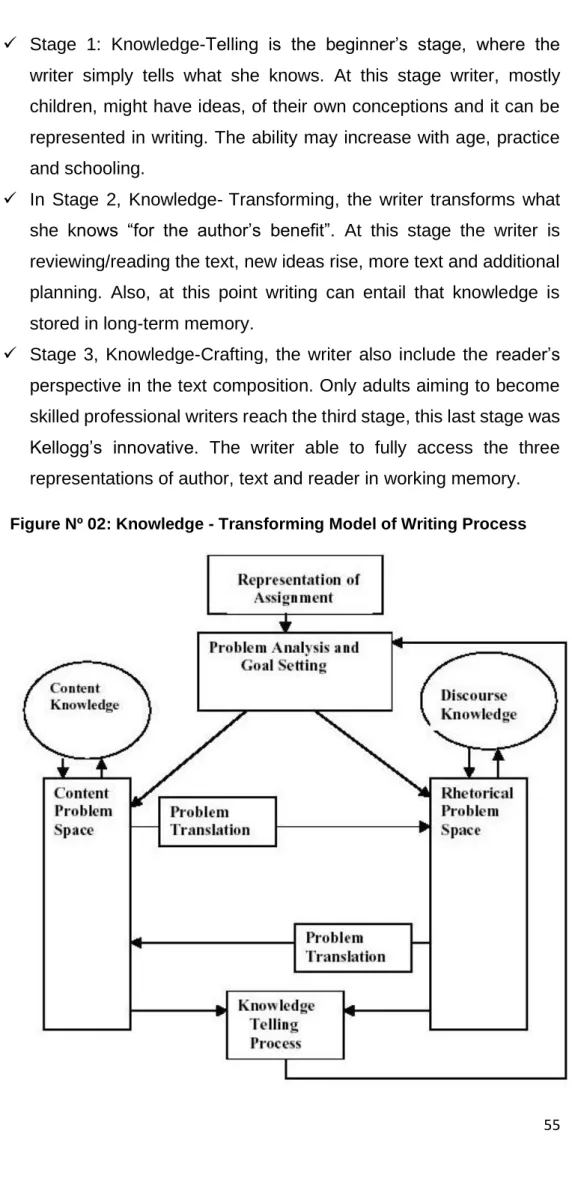
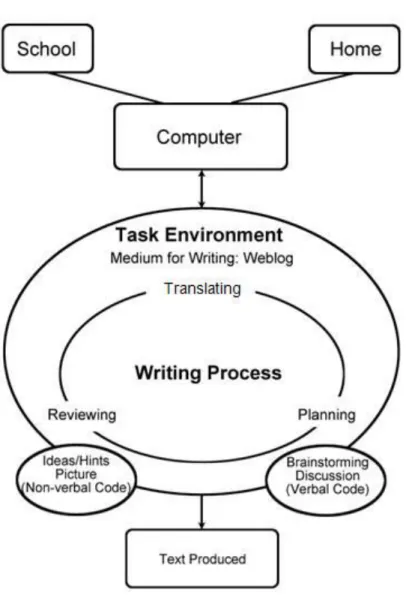
Since the beginning of the 1980s, there have been several writing models proposed with the aim of explaining the complexity and “major cognitive challenge” of writing.
Many authors have described that writing is a progression and a process that goes through stages, it mostly takes maturation, instruction and training to get through these stages.
There is a short list below trying to explain the process writing: