
Holistic evaluation of risk in the framework of the urban sustainability
11
0
0
Texto completo
(2) II Congreso Internacional de Medida y Modelización de la Sostenibilidad ICSMM 09 © CIMNE, Barcelona, 2009. HOLISTIC EVALUATION OF RISK IN THE FRAMEWORK OF THE URBAN SUSTAINABILITY Martha L. Carreño*, Omar D. Cardona2, Dora C. Suárez3, Alex H. Barbat4 *. Centro Internacional de Métodos Numéricos en Ingeniería - CIMNE Email: [email protected]. 2,3. Instituto de Estudios Ambientales – IDEA, Universidad Nacional de Colombia. Sede Manizales. Carrera 27 No.64-60. Manizales, Colombia. 4 Universidad Politécnica de Cataluña, C/ Gran Capitán SN, Mod C1, 08034 Barcelona, España Email2: [email protected] – Email3: [email protected] – Email4: [email protected]. Key words: Urban risk evaluation, holistic approach, socio-economic vulnerability. Abstract. The risk identification, assessment and reduction are indispensable steps on the way of the sustainable development of the countries. Risk assessment requires a multidisciplinary approach that takes into account not only the expected physical damage, the number and type of casualties or the economic losses, but also other social, organizational and institutional factors that contribute to risk. At urban level, for example, vulnerability should be related not only to the physical susceptibility of buildings and infrastructure, but also to the social fragility and the lack of resilience of the exposed community. The absence of institutional and community organization, weak preparedness for emergency response, political instability and lack of economic health, which are development problems, contribute to increasing of risk in a geographical area. This article presents and applies a methodology for evaluating risk in urban center using a holistic approach. A multidisciplinary estimation of risk to guide the decision making, that takes into account geophysical and structural aspects, and also social, economic, institutional variables, among others, is considered here as holistic approach, involving all the aspects and comprehensive. The paper includes four case studies, the cities of: Barcelona, Spain; Bogotá and Manizales, Colombia; and MetroManila, The Philippines.. 1 THE HOLISTIC APPROACH Risk is not only associated with the occurrence of intense physical phenomena, but also with the vulnerability conditions that favor or facilitate disasters when these phenomena occur. Vulnerability is related to social processes in disaster prone areas and is also usually related to the fragility, susceptibility or lack of resilience of the population when faced with various hazards. In other words, disasters are socio-environmental by nature and their occurrence is the result of socially created risk. This means that in order to reduce disaster risk, society must embark in a decision making processes. This process is not only required during the reconstruction phase immediately following a disaster, but should also be a part of overall national public policy formulation.
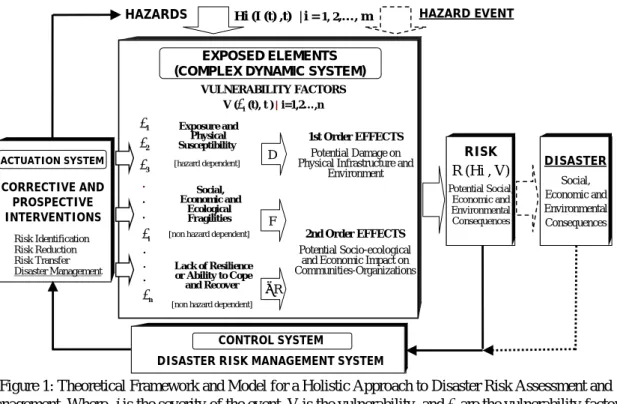
(3) Martha L. Carreño, Omar D. Cardona, Dora C. Suárez, Alex H. Barbat.. and development planning. This, in turn, requires institutional strengthening and investments in reducing vulnerability to support the sustainable development of countries1. An appropriate multidisciplinary risk evaluation by means of composite indicators can be a risk communication tool for decision-makers and stakeholders to achieve effective risk reduction. Cardona (2001) developed a conceptual framework and a model for seismic risk analysis of a city from a holistic perspective. It considers both “hard” and “soft” risk variables of the urban centre, taking into account exposure, socio-economic characteristics of the different localities (units) of the city and their disaster coping capacity or degree of resilience. The model was made to guide the decision-making in risk management, helping to identify the critical zones of the city and their vulnerability from different professional disciplines2. Figure 1 shows the theoretical framework of the holistic approach. HAZARDS. Hi (I (t) ,t) i = 1, 2,…, m. HAZARD EVENT. EXPOSED ELEMENTS (COMPLEX DYNAMIC SYSTEM) VULNERABILITY FACTORS V (εi (t), t ) i=1,2…,n. ε1 ε2 ACTUATION SYSTEM. ε3. CORRECTIVE AND PROSPECTIVE INTERVENTIONS. .. 9 9 9 9. Risk Identification Risk Reduction Risk Transfer Disaster Management. Exposure and Physical Susceptibility [hazard dependent]. .. Social, Economic and Ecological Fragilities. εi. [non hazard dependent]. .. . . .. εn. Lack of Resilience or Ability to Cope and Recover. 1st Order EFFECTS. D. Potential Damage on Physical Infrastructure and Environment. RISK. R (Hi , V) Potential Social, Economic and Environmental Consequences. F. DISASTER Social, Economic and Environmental Consequences. 2nd Order EFFECTS Potential Socio-ecological and Economic Impact on Communities-Organizations. ¬R. [non hazard dependent]. CONTROL SYSTEM DISASTER RISK MANAGEMENT SYSTEM. Figure 1: Theoretical Framework and Model for a Holistic Approach to Disaster Risk Assessment and Management. Where, i is the severity of the event, V is the vulnerability, and εi are the vulnerability factors. Adapted from [3,4,5,6].. Using the meta-concepts of the theory of control and complex system dynamics, to reduce risk it is necessary to intervene in a corrective and prospective way the vulnerability factors. Then risk management requires a system of control (institutional structure) and an actuation system (public policies and actions) to implement the changes needed on the exposed elements or complex system where risk is a socio-environmental process. This article presents an alternative method for urban risk evaluation based on Cardona’s model 2,7, using a holistic approach and describing seismic risk by means of indices. The proposed method is developed for a multi-hazard evaluation and therefore it is. 2.
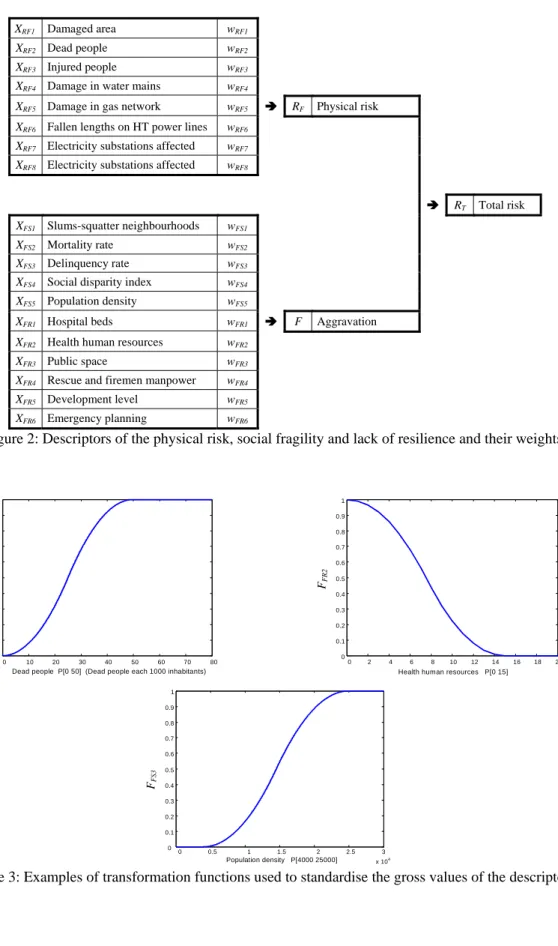
(4) Martha L. Carreño, Omar D. Cardona, Dora C. Suárez, Alex H. Barbat.. necessary to dispose of physical damage estimations for all the significant hazards. Often, when historical information is available, the principal hazard can be usually identified and thus the most potential critical situation. The holistic evaluation of risk by means of indices is achieved affecting the physical risk with an impact factor, obtained from contextual conditions, such as the socio-economic fragility and the lack of resilience, that aggravate initial physical loss scenario. Available data about these conditions at urban level are necessary to apply the method. The construction of a total risk index (urban seismic risk index, USRi, in the case of seismic risk), considering mainly the seismic hazard, took into account “harder” aspects of risk, based on the physical vulnerability of the urban center, but also the “softer” aspects, considering an aggravating coefficient obtained from the social fragility and the lack of resilience of the communities. The application examples are centred on the evaluation of the seismic risk from a holistic perspective. 2 EVALUATION METHODOLOGY The total risk is evaluated by means of the affecting of the physical risk by the aggravating coefficient. Therefore, the total risk can be expressed as follows: RT = RF (1 + F ). (1). where RT is the total risk index, RF is the physical risk index and F is the aggravating coefficient. This coefficient, F, depends on the weighted sum of a set of aggravating factors related to the socio-economic fragility, FFSi, and the lack of resilience of the exposed context, FFRj. m. m. i =1. j =1. F = ∑ wFSi × FFSi + ∑ wFRj × FFRj. (2). where wFSi and wFRj are the weights of each i and j factors and m and n are the total number of descriptors for social fragility and lack of resilience respectively Figure 2 shows the process of calculation of the total risk RT for the units of analysis, starting from the descriptors of physical risk, XRFi, and the descriptors of the aggravating coefficient F, XFSi and XRFi, using the weights wRFi, wFSi and wFRi of each descriptor. The aggravating factors FFSi and FFRj are calculated using transformation functions, examples of these functions are shown in Figure 38,9. These functions standardise the gross values of the descriptors transforming them in commensurable factors. The weights wFSi and wFRj represent the relative importance of each factor and are calculated by means of the Analytic Hierarchy Process (AHP)10.. 3.
(5) Martha L. Carreño, Omar D. Cardona, Dora C. Suárez, Alex H. Barbat.. XRF1. Damaged area. wRF1. XRF2 Dead people. wRF2. XRF3 Injured people. wRF3. XRF4 Damage in water mains. wRF4. XRF5 Damage in gas network. wRF5. XRF6 Fallen lengths on HT power lines. wRF6. XRF7 Electricity substations affected. wRF7. XRF8 Electricity substations affected. wRF8. XFS1 Slums-squatter neighbourhoods. wFS1. XFS2 Mortality rate. wFS2. XFS3 Delinquency rate. wFS3. XFS4 Social disparity index. wFS4. Ä. RF. Physical risk. Ä. XFS5 Population density. wFS5. XFR1 Hospital beds. wFR1. XFR2 Health human resources. wFR2. XFR3 Public space. wFR3. XFR4 Rescue and firemen manpower. wFR4. XFR5 Development level. wFR5. XFR6 Emergency planning. wFR6. Ä. F. RT. Total risk. Aggravation. 1. 1. 0.9. 0.9. 0.8. 0.8. 0.7. 0.7. 0.6. 0.6. FFR2. FRF2. Figure 2: Descriptors of the physical risk, social fragility and lack of resilience and their weights.. 0.5. 0.5. 0.4. 0.4. 0.3. 0.3. 0.2. 0.2. 0.1. 0.1. 0. 0. 10. 20. 30. 40. 50. 60. 70. 0. 80. 0. 2. 4. Dead people P[0 50] (Dead people each 1000 inhabitants). 6. 8. 10. 12. 14. 16. 18. 20. Health human resources P[0 15]. 1 0.9 0.8 0.7. FFS3. 0.6 0.5 0.4 0.3 0.2 0.1 0. 0. 0.5. 1. 1.5. 2. Population density P[4000 25000]. 2.5. 3 x 10. 4. Figure 3: Examples of transformation functions used to standardise the gross values of the descriptors11. 4.
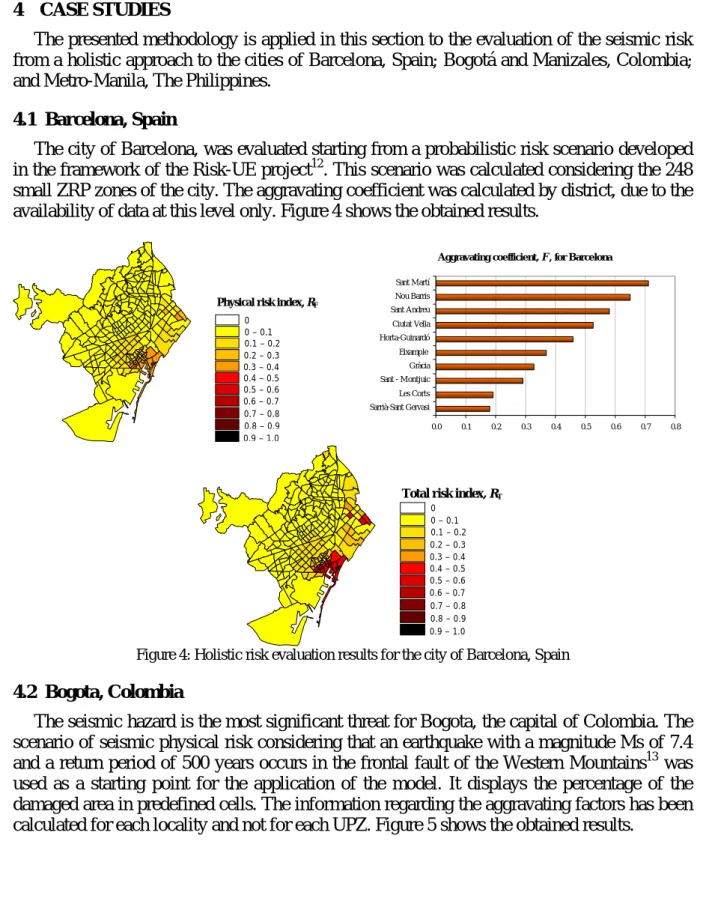
(6) Martha L. Carreño, Omar D. Cardona, Dora C. Suárez, Alex H. Barbat.. 4 CASE STUDIES The presented methodology is applied in this section to the evaluation of the seismic risk from a holistic approach to the cities of Barcelona, Spain; Bogotá and Manizales, Colombia; and Metro-Manila, The Philippines. 4.1 Barcelona, Spain The city of Barcelona, was evaluated starting from a probabilistic risk scenario developed in the framework of the Risk-UE project12. This scenario was calculated considering the 248 small ZRP zones of the city. The aggravating coefficient was calculated by district, due to the availability of data at this level only. Figure 4 shows the obtained results. Aggravating coefficient, F , for Barcelona Sant Martí Nou Barris. Physical risk index, RF. Sant Andreu. 0 0 – 0.1 0.1 – 0.2 0.2 – 0.3 0.3 – 0.4 0.4 – 0.5 0.5 – 0.6 0.6 – 0.7 0.7 – 0.8 0.8 – 0.9 0.9 – 1.0. Ciutat Vella Horta-Guinardó Eixample Gràcia Sant - Montjuic Les Corts Sarrià-Sant Gervasi 0.0. 0.1. 0.2. 0.3. 0.4. 0.5. 0.6. 0.7. 0.8. Total risk index, RT 0 0 – 0.1 0.1 – 0.2 0.2 – 0.3 0.3 – 0.4 0.4 – 0.5 0.5 – 0.6 0.6 – 0.7 0.7 – 0.8 0.8 – 0.9 0.9 – 1.0. Figure 4: Holistic risk evaluation results for the city of Barcelona, Spain. 4.2 Bogota, Colombia The seismic hazard is the most significant threat for Bogota, the capital of Colombia. The scenario of seismic physical risk considering that an earthquake with a magnitude Ms of 7.4 and a return period of 500 years occurs in the frontal fault of the Western Mountains13 was used as a starting point for the application of the model. It displays the percentage of the damaged area in predefined cells. The information regarding the aggravating factors has been calculated for each locality and not for each UPZ. Figure 5 shows the obtained results.. 5.
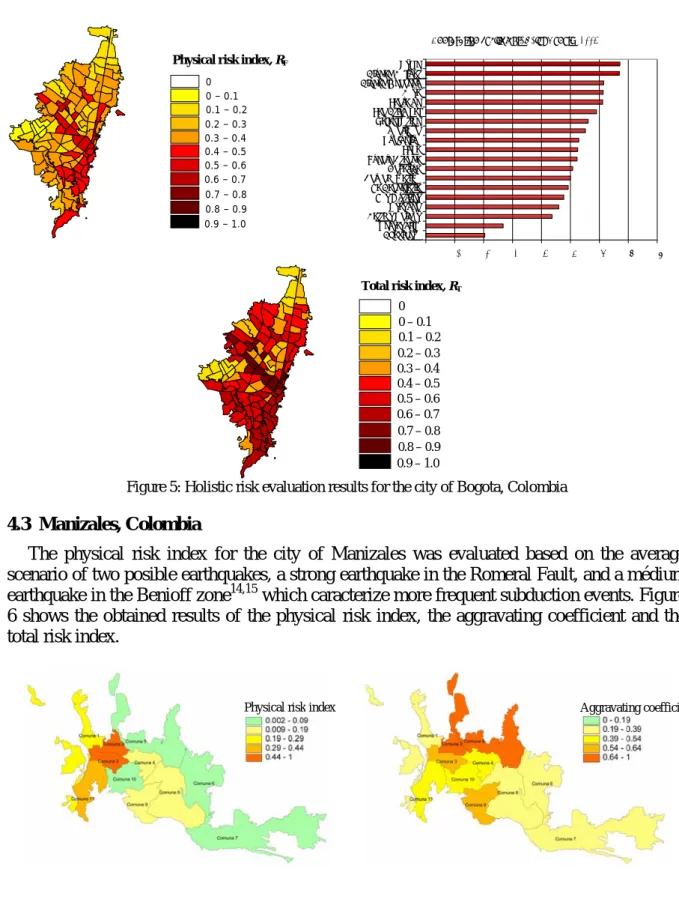
(7) Martha L. Carreño, Omar D. Cardona, Dora C. Suárez, Alex H. Barbat.. Aggravating coefficient, F , for Bogotá (2005). Physical risk index, RF. Usme Ciudad Bolívar Ciudad Kennedy Bosa Santa Fe San Cristobal Rafael Uribe Fontibon Tunjuelito Suba Puente Aranda Engativa Antonio Nariño La Candelaria Los Mártires Usaquen Barrios Unidos Teusaquillo Chapinero. 0 0 – 0.1 0.1 – 0.2 0.2 – 0.3 0.3 – 0.4 0.4 – 0.5 0.5 – 0.6 0.6 – 0.7 0.7 – 0.8 0.8 – 0.9 0.9 – 1.0. 0.0. 0.1. 0.2. 0.3. 0.4. 0.5. 0.6. 0.7. 0.8. Total risk index, RT 0 0 – 0.1 0.1 – 0.2 0.2 – 0.3 0.3 – 0.4 0.4 – 0.5 0.5 – 0.6 0.6 – 0.7 0.7 – 0.8 0.8 – 0.9 0.9 – 1.0. Figure 5: Holistic risk evaluation results for the city of Bogota, Colombia. 4.3 Manizales, Colombia The physical risk index for the city of Manizales was evaluated based on the average scenario of two posible earthquakes, a strong earthquake in the Romeral Fault, and a médium earthquake in the Benioff zone14,15 which caracterize more frequent subduction events. Figure 6 shows the obtained results of the physical risk index, the aggravating coefficient and the total risk index.. Physical risk index. Aggravating coefficient. 6.
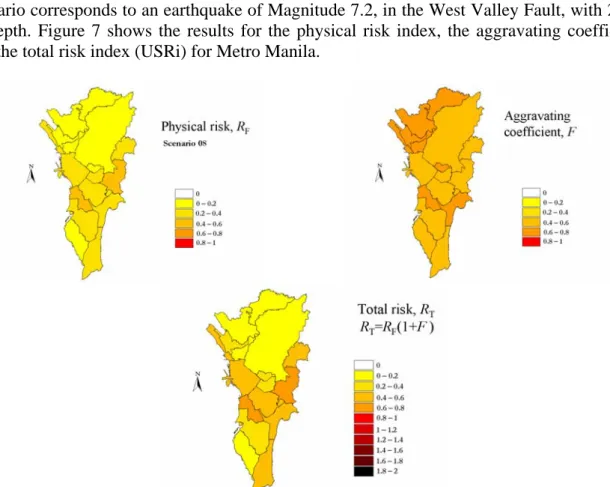
(8) Martha L. Carreño, Omar D. Cardona, Dora C. Suárez, Alex H. Barbat.. Total risk index. Figure 6: Holistic risk evaluation results for the city of Manizales, Colombia16. 4.4 Metro-Manila, The Philippines Metropolitan Manila, the capital city of the Philippines. The physical risk index was calculated using physical risk descriptors based on the earthquake damage MMEIRS-08, obtained from the Earthquake Impact Reduction Study of Metro Manila (MMEIRS). This scenario corresponds to an earthquake of Magnitude 7.2, in the West Valley Fault, with 2 km of depth. Figure 7 shows the results for the physical risk index, the aggravating coefficient and the total risk index (USRi) for Metro Manila.. Figure 7: Holistic risk evaluation results for the city of Metro-Manila, The Philipines11. 7.
(9) Martha L. Carreño, Omar D. Cardona, Dora C. Suárez, Alex H. Barbat.. 5 RESULTS COMPARISON The results obtained for the four cities have been compared among them. Table 1 shows the average risk values for the cities, corresponding to the most significant scenarios in each case. Metro Manila and Bogota are located in zones with intermediate seismic hazard, whereas Barcelona is located in a zone with low to moderate seismic hazard and Manizales is placed in a zone with a high seismic hazard. The average values obtained for the physical risk index, RF, reflect not only the seismic hazard but also the level of physical vulnerability in each city. It is interesting to remark that the results obtained for the aggravating coefficient, F, are not so different for the four cities. The highest value of physical risk is for Bogota, but the worst situation, taking into account the aggravating coefficient, is for Metro Manila. Index Physical risk, RF Aggravating coeff. F USRi = Total risk, RT. Barcelona 0.08 0.42 0.11. Bogota 0.32 0.55 0.50. Manizales 0.27 0.56 0.44. Metro Manila 0.24 0.59 0.38. Table 1 : Results comparison for Barcelona, Bogotá, Manizales and Metro Manila. 6 CONCLUSIONS -. -. Disaster risk estimation is an important task to ensure a sustainable development which requires a multidisciplinary approach that takes into account not only the expected physical damage, the number and type of casualties or economic losses, but also other social, organizational and institutional issues related to the development of communities that contribute to the creation of risk. The absence of institutional and community organization, weak preparedness for emergency response, political instability and the lack of economic health in a geographical area contribute to risk increasing. The model for holistic evaluation of risk facilitates the integrated risk management by the different stakeholders involved in risk reduction decision-making. It permits the follow-up of the risk situation and the effectiveness of the prevention and mitigation measures can be easily achieved. Results can be verified and the mitigation priorities can be established as regards the prevention and planning actions to modify those conditions having a greater influence on risk in the city. Once the results have been expressed in graphs for each locality or district, it is easy to identify the most relevant aspects of the total risk index, with no need for further analysis and interpretation of results.. 7 ACKNOWLEDGEMENTS The authors express gratitude to the Universities and Research Commissionate of the Generalitat de Catalunya, Beatriu de Pinos Grants Programme, and to the Spanish Ministry of Education and Science (HABITAT 2030-PSS-380000-2005-14 and SEDUREC, CONSOLIDER CSD2006-00060) by the European Commission (project Methods for the. 8.
(10) Martha L. Carreño, Omar D. Cardona, Dora C. Suárez, Alex H. Barbat.. Improvement of Vulnerability Assessment in Europe, MOVE, FT7-ENV-2007-1-211590). REFERENCES [1] IDB/IDEA, Indicators of Disaster Risk and Risk Management - Main Technical Report. IDB/IDEA Program of Indicators for Disaster Risk Management. National University of Colombia, Manizales, (2005). [2] O.D. Cardona Evaluación holistica del riesgo sismico utilizando sistemas dinamicos complejos [Holistic evaluation of the seismic risk using complex dynamic systems], PhD Thesis, Technical University of Catalonia, Barcelona, Spain, (2001). [3] O.D. Cardona and J.E. Hurtado, “Holistic seismic risk estimation of a metropolitan center”, in Proceedings of 12th World Conference of Earthquake Engineering, Auckland, New Zeland, (2000). [4] O.D. Cardona and A.H. Barbat, El Riesgo Sísmico y su Prevención, Cuaderno Técnico 5, Calidad Siderúrgica, Madrid. (2000). [5] IDEA, System of indicators for disaster risk management: Main technical report, IDB/IDEA Programme of Indicators for Disaster Risk Management (Manizales: UNC), (2005). [6] O.D. Cardona, “Disaster Risk and Vulnerability: Notions and Measurement of Human and Environmental Insecurity” in Coping with Global Environmental Change, Disasters and Security - Threats, Challenges, Vulnerabilities and Risks, Editors: H.G. Brauch, U. Oswald Spring, C. Mesjasz, J. Grin, P. Kameri-Mbote, B. Chourou, P. Dunay, J. Birkmann: Springer-Verlag (in press), Berlin - New York, (2009). [7] A.H. Barbat, and O.D. Cardona, “Vulnerability and disaster risk indices from engineering perspective and holistic approach to consider hard and soft variables at urban level”, IDB/IDEA Program on Indicators for Disaster Risk Management, http://idea.unalmzl.edu.co, Universidad Nacional de Colombia, Manizales, (2003). [8] M.L. Carreño, O.D. Cardona, AH Barbat, “Seismic risk evaluation for an urban centre”, Proceedings of the International Conference: 250th Anniversary of the 1755 Lisbon earthquake. Lisbon, (2005). [9] M.L. Carreño, Innovative techniques for seismic risk evaluation and risk management in urban centres: Ex-ante and ex-post actions (in Spanish), PhD Thesis, Technical University of Catalonia, Barcelona, Spain. (2006). [10] T.L. Saaty, Decision making for leaders the analytic hierarchy process for decisions in a complex world, Pittsburgh RWS, USA, (2001). [11] M.L. Carreño, Cardona OD Barbat AH, “Urban Seismic Risk Evaluation: A Holistic Approach”, Natural Hazards, 40 num 1, pp 137:172, DOI 10.1007/s11069-006-0008-8, (2007). [12] ICC/CIMNE, An Advanced Approach to Earthquake Risk Scenarios with Applications to Different European Towns, WP08, Application to Barcelona, RISK-UE Project, (2004). [13] Universidad de los Andes, Escenarios de riesgo y pérdidas por terremoto para Bogota, D.C, Centro de Estudios sobre Desastres y Riesgos CEDERI, Alcaldía Mayor de Bogotá,. 9.
(11) Martha L. Carreño, Omar D. Cardona, Dora C. Suárez, Alex H. Barbat.. Dirección de Prevención y Atención de Emergencias, DPAE, Bogota, Colombia, (2005). [14] CEDERI, Centros de Estudios sobre Desastres y Riesgos de la Universidad de los Andes, Microzonificación Sísmica de Manizales. Informe de Consultoría, Available at: http://www.manizales.unal.edu.co/gestion_riesgos/descargas/microzon/informe_final_figuras.pdf, (2002). [15] ERN, Evaluación de Riesgos Naturales, Metodología de Cálculo de Riesgo Sísmico para la Estimación de Pérdidas Probables, Informe de Consultoría. Diseño de Esquemas de Transferencia de Riesgo para la Protección Financiera de Edificaciones Públicas y Privadas en Manizales en el Caso de Desastres por Eventos Naturales, (2004) [16] D.C. Suárez, D.C, Desarrollo de Indicadores de Riesgo y Gestión del Riesgo a Nivel Urbano para el Diagnóstico y la Planificación en Manizales [Development of risk and risk management indicators at the urban level for Manizales diagnosis and planning]. Master Thesis directed by Cardona, O.D. Master in Environment and Development. National University of Colombia, (2008).. 10.
(12)
Figure
+3

Documento similar
Taking into account these results that suggested a potential influence of the TLR4 rs4986790 gene polymorphism in the risk of atherosclerosis, we conducted a study in a large series
This paper examines volatility and correlation dynamics in price returns of gold, silver, platinum and palladium, and explores the corresponding risk management
The GINI index shows that in Mediterranean Europe the rates of unemployment, risk of poverty, social exclusion, and social inequality were similar in 2019 to those during
For all these reasons, patients with adrenal insufficiency may be at higher risk of medical complications and eventually at increased mortality risk in the case
The paper is structured as follows: In the next section, we briefly characterize the production technology and present the definition of the ML index as the geometric mean of
In a similar light to Chapter 1, Chapter 5 begins by highlighting the shortcomings of mainstream accounts concerning the origins and development of Catalan nationalism, and
The RR values found in the VPR 2015 form’s indicators confirm that in contexts where protection of the victim is demanded based on the risk, the majority of risk indica- tors can
Díaz Soto has raised the point about banning religious garb in the ―public space.‖ He states, ―for example, in most Spanish public Universities, there is a Catholic chapel
