Sabela Calvo Ibáñez
Titora: Cristina Calvo Porral
The purchase
behavior for
sustainable
products: The case
of Ecoalf
Facultade de Economía e Empresa
Grao en Administración e Dirección de Empresas
Ano 2019
The purchase behavior for sustainable products: the case of Ecoalf
Resumo
Nas sociedades desenvolvidas existe unha preocupación crecente polo deterioro do
medio ambiente. Por este motivo, está a xurdir un segmento de mercado que reflicte
os valores relacionados co coidado do medio ambiente no seu proceso de decisión de
compra e nas súas decisións de consumo. Este traballo céntrase en primeiro lugar no
concepto de produto sostíbel e nas variábeis que afectan ao seu consumo.
Posteriormente, lévase a cabo unha investigación co fin de analizar como as variábeis
calidade, imaxe do produto, produto sostíbel e produto seguro inflúen na satisfacción
do consumidor e na intención de mercar este tipo de produtos, para o cal o traballo
centróuse na marca de moda sostíbel Ecoalf.
Os resultados obtidos suxiren que algunhas das variábeis estudadas afectan ao
consumo de produtos sostíbeis. En concreto, a imaxe de produto sostíbel, seguida da
percepción de produto seguro ou fiábel son as variábeis que máis inflúen tanto na
satisfacción do consumidor como na intención de mercar produtos da marca sostíbel
Ecoalf. A principal contribución deste traballo trátase do estudo empírico das variábeis
que inflúen na satisfacción e na intención de mercar unha marca sostíbel.
Palabras chave:Comportamento de compra, Consumidor, Sostibilidade, Ecoalf.
The purchase behavior for sustainable products: the case of Ecoalf
Resumen
En las sociedades desarrolladas existe una preocupación creciente por el deterioro del
medio ambiente. Por este motivo, está surgiendo un segmento de mercado que refleja
los valores relacionados con el cuidado del medio ambiente en su proceso de decisión
de compra y en sus decisiones de consumo. Este trabajo se centra en primer lugar en
el concepto de producto sostenible y en las variables que afectan a su consumo.
Posteriormente, se lleva a cabo una investigación con el fin de analizar cómo las
variables calidad, imagen del producto, producto sostenible y producto seguro influyen
en la satisfacción del consumidor y en la intención de comprar este tipo de productos,
para lo cual el trabajo se ha centrado en la marca de moda sostenible Ecoalf.
Los resultados obtenidos sugieren que algunas de las variables estudiadas afectan al
consumo de productos sotenibles. En concreto, la imagen de producto sostenible,
seguida de la percepción de producto seguro o fiable son las variables que más
influyen tanto en la satisfacción del consumidor como en la intención de comprar
productos de la marca sostenible Ecoalf. La principal aportación de este trabajo
consiste en el estudio empírico de las variables que influyen en la satisfacción y en la
intención de comprar una marca sostenible.
Palabras clave:Comportamiento de compra, Consumidor, Sostenibilidad, Ecoalf.
The purchase behavior for sustainable products: the case of Ecoalf
Abstract
In developed societies there is a growing concern for the deterioration of the
environment. For this reason, is emerging a market segment that reflects its values related to the care of the environment in its purchase decision process and in its consumption decisions. This project focuses firstly on the concept of sustainable product and on the variables that affect its consumption.
Afterwards, a research was carried out to analyze how the variables quality, product
image, sustainable product and safe product, influence on consumer satisfaction and
on the intention to purchase this type of products. For this purpose, the project has
focused on the sustainable fashion brand Ecoalf.
The results obtained suggest that some of the variables studied do affect the
consumption of sustainable products. In particular, the image of sustainable product,
followed by the perception of safe or reliable product are the variables that most
influence both consumer satisfaction and the intention to purchase products from the
Ecoalf sustainable brand. The main contribution of this project consists in the empirical
study of the variables that influence the satisfaction and the intention to buy a
sustainable brand.
Keywords: Purchase behavior, Consumer, Sustainability, Ecoalf.
The purchase behavior for sustainable products: the case of Ecoalf
Index
Introduction ... 8
1. The concept of “sustainable” product ... 9
1.1. “Sustainable marketing” and “Green marketing” ... 9
1.2. The concept of “sustainable” product ... 14
1.3. The market´s growing demand for “sustainable" products ... 19
1.3.1. The growing market share of sustainable products in Spain ... 24
1.3.2. Future trends in sustainability ... 26
1.4. Current legislation on “sustainable” products ... 28
1.4.1. Sustainable food products ... 28
1.4.2. Sustainable non-food products ... 30
1.5. Ecoalf: making products from recycled garbage ... 30
2. Theorical foundations ... 33
2.1. Variables influencing the purchase of “sustainable” products ... 33
2.1.1. The perceived product quality ... 33
2.1.2. The product image ... 37
2.1.3. The product sustainability ... 39
2.1.4. Reliable/safe product ... 42
2.2. Consequences of consumer´s behavior ... 44
2.2.1. Consumer satisfaction ... 44
2.2.1.1. The relationship between customer satisfaction and loyalty ... 45
2.2.2. Consumer´s purchase intention ... 48
3. Empirical study ... 51
3.1. Research objectives ... 51
3.2. Methodology ... 52
3.2.1. Sampling and fieldwork ... 52
3.2.2. Description of the sample ... 53
3.2.3. Variables and measurement scale ... 54
3.2.4. Data analysis ... 55
4. Findings ... 56
4.1. Descriptive analysis ... 56
4.2. Relationships between variables ... 57
4.2.1. Analysis of variables influencing consumer satisfaction ... 59
4.2.2. Analysis of variables influencing purchase intention ... 60
The purchase behavior for sustainable products: the case of Ecoalf
Index of figures
Figure 1: The Ecological purchase decision process... 20
Figure 2: Ecological food consumption in Spain (millions of €) ... 25
Figure 3: Per capita expenditure on ecological products 2016 ... 25
Figure 4: Evolution of the ecological production area in Spain (hectares) ... 26
Figure 5: EU Ecolabel ... 28
Figure 6: EU organic logo ... 28
Figure 7: Galicia´s ecological logo ... 28
Figure 8: Main inhibition factors in the consumption of sustainable products ... 40
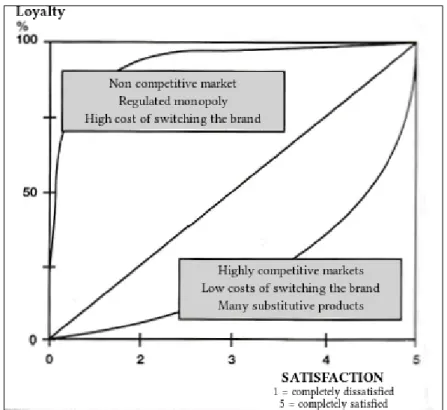
Figure 9: The relationship between satisfaction and loyalty ... 47
Figure 10: Theory of Planned Behavior ... 49
Figure 11: Hypoteses related to consumer satisfaction ... 59
Figure 12: Hypotheses related to purchase intention ... 59
Figure 13: Relationship for consumer satisfaction ... 60
The purchase behavior for sustainable products: the case of Ecoalf
Index of tables
Table 1: Comparison of conventional and sustainable Marketing orientations ... 11
Table 2: Environmental criteria ... 17
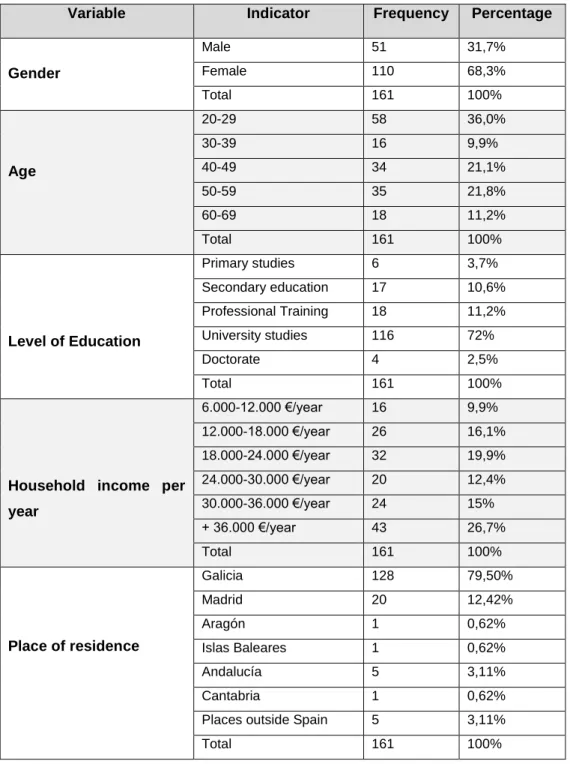
Table 3: Description of the sample ... 53
Table 4: Variables and measurement scale ... 54
Table 5: Means and standard deviations of variables ... 56
The purchase behavior for sustainable products: the case of Ecoalf
Introduction
In developed societies, there is currently a rising concern about the deterioration taking
place in our environment. This may explain why a new market segment that reflects its
environmental-care-related values in its purchasing decision process is beginning to
emerge. As a result of this increase in the environmental awareness of consumers,
each passing day sees more and more companies trying to promote their brands as
“green” in order to make their products look more desirable than those of the
competition.
The main interest of studying the purchase behavior of consumers in regards to
sustainable products is enabling the identification of which variables influence the
decision process. Knowing these variables is enormously useful for companies, as it
allows them to adopt appropriate marketing actions in order to lead purchase decision
towards a particular brand or type of product. Additionally, companies should keep in
mind that sustainable marketing acts as an agent of change within society and
performs a role beyond the purely business-oriented one.
The main objetive of this project is to ascertain which of said variables (perceived
quality, product image, sustainable product and safe/reliable product) have a more
significant influence over consumer satisfaction and the purchase intention of
sustainable products.
To address this goal, this project begins with a literature review, in an attempt to define
some key concepts. Secondly, each one of the aforementioned variables considered in
the present project will be analyzed and explained. Thirdly, the methodology employed
during the research will be explained in detail. And finally, the results obtained are
exposed and the main conclusions are presented, as well as the implications of the
The purchase behavior for sustainable products: the case of Ecoalf
1. The concept of “sustainable”
product
1.1. “Sustainable marketing” and “Green marketing”
The concept of Marketing recognises that organisations success in the marketplace
determining the current needs and wants of their target customers and fulfilling those
needs and wants more effectively and efficiently than other competitors (Kotler &
Armstrong, 2018, p.574). More precisely, Marketing focuses on meeting customers’
needs and wants and giving them what they want, so that companies increase their
sales and profits. However, satisfying consumers´ immediate needs and desires does
not always serve the long term interests of either customers or the business (Kotler et
al., 2013, p. 599).
In this context, arises the concept of sustainable Marketing, which understands that all human activity is dependent on the existence of the natural resources provided by
the planet; and acknowledges that long-term, sustainable economic viability only
derives from both environmental stability and societal equity. In fact, the sustainable
Marketing orientation aims to address these challenges (Emery, 2012, p. 24). Further,
the concept of sustainable Marketing is closely related with socially and environmentally responsible actions developed by companies that meet the actual
needs of consumers and companies, while also preserving or enhancing the ability of
future generations to meet their needs (Kotler et al., 2013, p. 599). Martin and
The purchase behavior for sustainable products: the case of Ecoalf
process of creating, communicating and delivering value to customers in such a way
that both natural and human resources are preserved or enhanced throughout these
processes. Considering the role of sustainable Marketing as the interface between companies and society, it has two main goals. First goal is Marketing sustainably,
which means designing and supporting organizational cultures and processes, so that
all the Marketing processes are environmentally and socially benign. Second goal is
Marketing sustainability, which is related with advancing and supporting a global culture of sustainable consumption; that is, a concept of cultural value and a set of
consumption practices which help sustainable consumption (Schouten, 2014).
Schouten (2014) defined sustainable Marketing as a means of doing things differently in order to help society in striving for environmental sustainability and social justice as
the norms (p.108). Similarly, Emery (2012) conceptualized sustainable Marketing as a holistic approach whose aim is to make sure that Marketing strategies and activities are
specifically designed to develop a company that is socially equitable, environmentally
friendly, economically fair and viable, in order to achieve benefits not only for current
generations, but also for future customers and employees, as well as for the society as
a whole (p.24).
According to Mitchell, Wooliscroft and Higham (2010), the sustainable Marketing
orientation is a type of Marketing management whereby the company uses sustainable
management principles to anticipate and meet customers’ needs through the effective
integration of comprehensive environmental intelligence with operational and Marketing
systems; apply profitable, socially and environmentally responsible value systems;
generate positive long-term outcomes in economic, social and environmental terms
that are aceptable for stakeholders, who obtain direct profits from companies and who
The purchase behavior for sustainable products: the case of Ecoalf
It is also important to remarkt that sustainable Marketing is a much more broader
concept than conventional Marketing, since sustainable Marketing develops a role in
society that goes beyond the purely business-oriented role (Kotler et al., 2008). In fact,
sustainable Marketing acts as an agent for change within society. But the central
premise of past conventional Marketing definitions was satisfying customer needs while
making a profit for the business (Emery, 2012, p. 7). Thus, “conventional Marketing
entails developing products that meet consumers´ needs at affordable prices and then
communicating the benefits of those products in a compelling way” (Ottman, 1998, p.
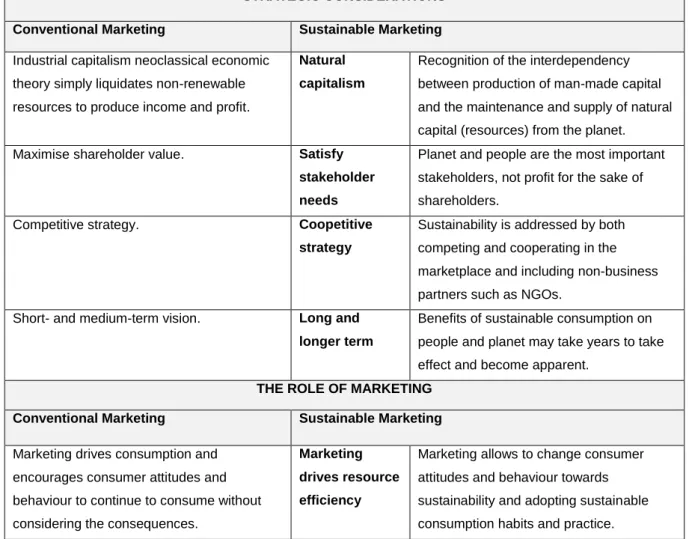
45). In this vein, Table 1 shows some of the main implications of the shift of paradigm
from conventional to sustainable Marketing orientations.
Table 1: Comparison of conventional and sustainable Marketing orientations
STRATEGIC CONSIDERATIONS and the maintenance and supply of natural capital (resources) from the planet. Maximise shareholder value. Satisfy
stakeholder
needs
Planet and people are the most important stakeholders, not profit for the sake of shareholders.
Short- and medium-term vision. Long and longer term
The purchase behavior for sustainable products: the case of Ecoalf
Marketing tactics are seen as complicit with the problems of overconsumption.
From non-compliance to compliance with legal restrictions. pollution reduced by the more effective use of natural and human resources.
Social and economic equity in the supply chain and environmental control.
MARKETING COMMUNICATIONS
Conventional Marketing Sustainable Marketing
Exaggeration in relation to product claims and benefits often accepted by consumers as normal practice.
Exaggeration
seen as
greenwash
Increasingly marketing savvy public, cynical of company claims. persuade, they will inform and educate into sustainable consumption habits and dissuade from unsustainable practice. Aim to persuade. Aims to
educate
Source: Emery (2012). Sustainable Marketing (p. 24).
Conversely, the term Green Marketing appear in the late 1980s and early 1990s. The American Marketing Association (AMA) held the first workshop on “Ecological
Marketing” in 1975 and the proceedings incorporated one of the first books about
The purchase behavior for sustainable products: the case of Ecoalf
Likewise, according to the American Marketing Association, the term Green Marketing
could be defined as three concepts: (1) Retailing definition, related with the Marketing of products that are assumed to be environmentally safe; (2) Social Marketing definition, related with the development and Marketing of products designed to minimize the negative impact on the natural environment or to improve its quality; and
third (3) Environments definition, meaning the efforts of organizations to produce, promote, package, and commercialize products in such a way that is sensitive or
responsive to the ecological and environmental concerns (IGI Global, 2017, p. 185).
Therefore, according to the American Marketing Association, Green Marketing could be
considered as the Marketing of those products that are assumed to be environmentally
safe; and in turn, the Green Marketing incorporates a broad range of activities,
including product modification, changes to the production processes, sustainable
packaging, as well as a modification of the advertising campaigns. More precisely, the
term Green Marketing refers to a holistic Marketing concept, wherein the production,
Marketing, consumption and disposal of products and services take place in such a
way that is less harmful to the environment, with an increasing awareness of the
implications of the global warming, the issue of non-biodegradable solid waste, and the
harmful impact of pollutants and so on. Hence, both marketers and consumers are
becoming increasingly sensitive to the need for a switch into green products and green
services (Miryala & Mennakanti, 2016, p. 148).
In the early 90s authors such as Peattie (1992) highlighted the concept of Green
Marketing. Peattie (1992) reported that the evolution of Green Marketing has three
stages. The first stage is labelled as ecological Green Marketing, and during this stage all the marketing activities are concerned with environment issues, providing some
The purchase behavior for sustainable products: the case of Ecoalf
and is characterized by the shift on the focus to clean technology, which involves
designing innovative new products, which are beneficial to pollution and waste issues.
Finally, the third stage is named as sustainable Green Marketing, which arises in the late 1990s and early 2000s (Laheri et al., 2014).
Later, Polonsky (1994) tried to provide a broad definition of Green Marketing. More
specifically, this author considers Green or Environmental Marketing consist of all
those activities designed in order to generate and ease any exchanges that satisfy
human needs or wants; so that these needs and wants are covered with a minimal
harmful impact on the natural environment (Gupta, Jankowska, & Maiti, 2007, p. 3).
However, there is a lack of consistency regarding the term Green Marketing, since this
is the term used by the industry to describe those activities which attempt to reduce the
negative effect of the products/services offered by companies, and that aims to make
the industry environmentally friendly (Miryala et al., 2016, p. 148).
Finally, it can be stated that the emergence and evolution of Green Marketing has
changed the concept of Marketing; and nowadays, companies have started promoting
their products and services including some green claims on them (Laheri et al., 2014,
p.148).
1.2. The concept of “sustainable” product
The Marketing mix is the set of marketing tools, namely product, price, placement and
promotion, that companies manage to obtain the required response from the target
The purchase behavior for sustainable products: the case of Ecoalf
companies can do in order to influence their products’ demand (Kotler, Armstrong &
Harris, 2013, p. 53).
In this context, the variable product could be defined as “anything that can be offered to a market for attention, acquisition, use or consumption that might satisfy a want or need” (Kotler et al., 2013, p. 238). The product is the most tangible and important
component of the marketing plan, given that without a product, there is nothing to
distribute, nothing to promote or nothing to price (Hundekar, Appannaiah, & Reddy,
2009, p.48). So, if the product fails to satisfy the consumers’ demand, no other
contributions of any of the other variables of the Marketing mix will improve the product
performance in the marketplace (Hundekar et al., 2009).
More precisely, the concept of sustainable product is broadly defined as the product that embraces positive social, environmental, ethical attributes; and is in essence,
associated with moral principles (Lluchs et al., 2010). These product attributes are
closely related to a variety of social issues, such as for example, fair labour practices or
adequate animal treatment; as well as environmental issues such as recycling or
reducing pollution (Luchs et al., 2010). In the same vein, Kang and Choi (2016)
consider sustainable products as those products manufactured taking into
consideration the social, environmental, and other ethical consecuences (p. 305).
The concept of sustainable product transcends any individual product dimension, such as packaging or recycled content. In this vein, authors such as Emery (2012) explain
that in order to consider a product as completely sustainable it should contribute to the
achievement of the sustainability agenda comprised in the Triple Bottom Line, term
coined by John Elkington in 1994 (p. 178). The Triple Bottom Line (Elkington, 1994)is
The purchase behavior for sustainable products: the case of Ecoalf
environmental, and economic performance of companies; and is receiving significant
attention related with its efficacy as a means for reporting the extent to which an
organization meets societal and environmental responsibilities (Brown, Marshall, &
Dillard, 2006, p. 3).
Regarding the three dimensions of products proposed by Kotler (1960), every product incorporates three different dimensions. First dimension is the core product,
which consists of the need that the product covers; for example, resting in a hotel. The
second dimension is the actual product, which is related with all the functional attributes of the product, such as the quality, the brand, the packaging, the style and
design. Finally, the third dimension is the augmented product, which consists of all aspects incorporated by the company to the real product in order to increase the added
value provided to customers, such as additional customer services, maintenance,
warranty, installation, delivery and financing (Camino & Garcillán, 2007, p. 268).
The sustainable products would be framed in the augmented product dimension; that is, the environmental issue could be considered as an additional benefit provided to
consumers, built on the basis of the core and actual product, since it fulfils the same
functions as similar non sustainable products, but the harm to the environment would
be lower throughout its life cycle (Díaz, 2002, p. 9).
One related term is the concept of ecological product. Some authors give the adjective of ecological to products, regarding to the concept of the product life cycle.
According to Calomarde (2000), there is not an ecological product by itself, since being ecological depends on the product environmental behavior throughout its entire product
life cycle: from the incorporation of the raw materials that compose it, its production
The purchase behavior for sustainable products: the case of Ecoalf
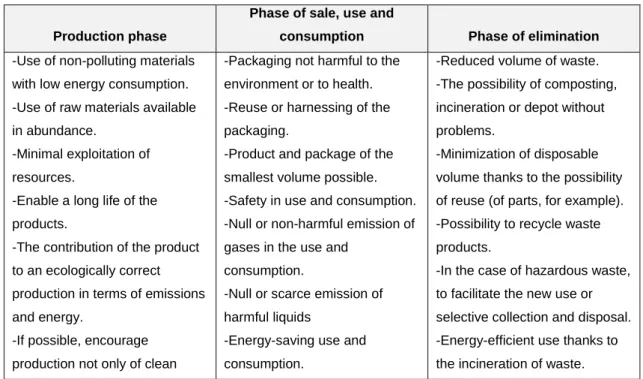
finally, the product’s reuse or disposal. Therefore, a product could be considered as
ecological when it fulfills the same functions as the non ecological products, but when
the product’s environmental damage is lower throughout its life cycle (p.57). Similarly,
Fraj and Martínez (2002) highlight the need to consider the ecological product based
on the examination of the product life cycle (p. 89).
However, it should be remarked that the product’s damage to the environment entails a
complex calculation, and that in many phases this is a subjective calculation.
Therefore, it is necessary to constantly evaluate the ecological and non-ecological
products by means of the analysis of their product life cycles. Nowadays, Marketing
authors and scholars have not formally established a technical methodology for
The purchase behavior for sustainable products: the case of Ecoalf
From the above, it can be assumed that in the Marketing area an ecological product is understood as the product that addresses the same needs and has the same
functionality than those non-ecological products; and at the same time entails a less
negative environmental impact throughout its production process, its use and its
disposal, compared to other products (Calomarde, 2000).
From the economic standpoint, there has been an increasing interest in reaching a
global agreement on the conceptualization of sustainable and ecological products, as
well as on developing a list of the environmental products. More precisely, this interest
emerged in the Doha Round of the World Trade Organization (WTO) (Hamwey, Pacini,
& Assunção, 2013, p. 158).
The participants, including the European Union, engaged in the negotiation of the
Environmental Goods Agreement (EGA) (since July 2014) trying to eliminate tariffs on
a number of important environment-related products. These include products that can
help achieve environmental and climate protection goals, such as generating clean and
renewable energy, improving energy and resource efficiency, controlling air pollution,
managing waste, treating waste water, monitoring the quality of the environment, and
The purchase behavior for sustainable products: the case of Ecoalf
trade and the dissemination of the use of such goods, giving an special treatment to
products that may contribute to sustainable development. The focus of the
Environmental Goods Agreement (being negotiated since July 2014) is to become a
dynamic list which would allow the incorporation of new products in future; but to date
there is a lack of an international definition or list of environmental products.
1.3. The market´s growing demand for
“sustainable"
products
The growing concern of developed societies for the environmental spoilage is not only
a social trend, but also a Marketing phenomenon. This concern is giving rise to a
market segment that reflects this environmental issue in its purchase decision process
(Mera & Palacios, 2004, p. 171). More specifically, the purchasing decision process
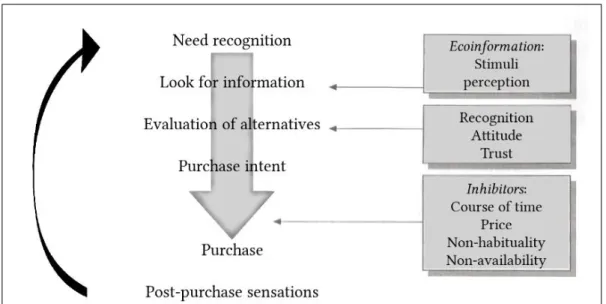
consists of five stages, namely the need recognition, information search, evaluation of alternatives, purchase decision and post-purchase behavior (Kotler et al., 2013, p. 161). In this context, the major interest of the research on consumer purchase behavior of sustainable products is that it allows the identification of those variables that
influence the decision process, and also it allows the adoption of effective Marketing
actions, so that the purchase decision is oriented towards certain brands or type of
products. Likewise, Calomarde (2000) identifies the variables that are considered as
relevant in the consumer's purchasing decision process of ecological products (p. 24)
The purchase behavior for sustainable products: the case of Ecoalf
Figure 1: The Ecological purchase decision process
Source: Calomarde (2000)
This process comprises five different stages, as follows. The first stage of the
consumer decision-making process is the need recognition that happens when
consumers are faced with an imbalance between their actual and desired states.
Further, the need recognition is triggered when a consumer is exposed to either an
internal or an external stimulus. Internal stimuli are those situations experienced by the own individual, such as hunger; while the external stimuli are influences from an external source, such as someone´s recommendation of a restaurant (Lamb, Hair, &
McDaniel, 2008, p. 140).
Once the need has arisen, the individual needs to satisfy it, and for this purpose, the
individual looks for information that allows identify the possible alternatives to cover
that need, through the desire of an ideal product. In this stage, the perception of the
previously received stimuli remains in the mind of the consumer as a set of complex
memories and images (Calomarde, 2000). If the company wants to stimulate the
individual again, it will be necessary to offer additional information that beggins the
The purchase behavior for sustainable products: the case of Ecoalf
deferred in time and, in general terms, these benefits are related to the higher order in
the Maslow scale (Calomarde, 2000). These benefits influence events in the sphere of
self-steem evaluations, since they produce self-satisfaction, because when the
individual develops ecological actions he/she protects the environment in the future;
and therefore, future generations will benefit from this action (Calomarde, 2000, p. 25).
The next stage consist on the evaluation of alternatives, whereby the consumer uses
information to evaluate alternative brands/products in the choise set (Kotler et al.,
2013, p. 162). The evaluation of alternatives depends on three interrelated variables:
Recognition. The information gathered by the consumer engenders recognition of brands and products, and the individual evaluates them according to his/her needs,
adopting an attitude towards these products or brands, and creating a level of
confidence in his/her mind. The recognition allows the inclusion of the product or
brand in the specific product category, in this case "ecological", to develop an
evaluation and differentiation from other products/brands in the same product
category (Calomarde, 2000, p. 26).
Attitude. The attitude is a predisposition to act in a certain way before a stimulus (Kotler et al., 2008), and is influenced by the extent to which the individual expects
that a certain brand/product meets his/her needs. By identifying the relevant
attributes and assessing the resulting benefits, the consumer developes a judgment
about the product/brand. The result of the evaluation varies according to the
importance given to each benefit; and this is the reason why promotion of ecological
The purchase behavior for sustainable products: the case of Ecoalf
The ecological benefits are not perceived physically and directly by the consumer. In
fact, these benefits are perceived as the removal of a perceived risk of a future
damage, such as preserving the biodiversity or natural resources in the future. The
belief of the individual that his/her behavior can contribute to solve a specific
environmental issue creates an attitude, which has been named as the “perceived efficiency of the consumer” (Berger & Corbin, 1992). Previous empirical evidence reveals the existence of a positive relationship between the “perceived efficiency of the consumer” and the behavior of conscious ecological consumption (Olaizola &
Molina, 2008, p. 2).
Finally, authors such as Santos (2002, p. 87) notes that consumers can be grouped
according to their attitude, their predisposition towards a specific behavior, to a set
of beliefs, valuations and to their tendency to act. The application of these
components of the attitude to the ecological purchase provides the following
categories: beliefs (cognitive component) would be considered as ecological consciousness; the valuation (emotional component) would be considered as a
ecostance; and finally the tendency to act (active component of attitude) is considered as ecoactivity.
Trust. Is considered as the degree of certainty that the consumer attributes to the evaluation made about the product or brand (Calomarde, 2000). Trust is both
influenced by the information received in a consistent way by the individual, and the
individual's own knowledge about the product or brand. The lack of confidence
decreases the purchase intention, so the gathering of information and control of the
ecological products, helps individuals to reduce their uncertainty and increase their
level of confidence. For this purpose, the eco-labeling systems have been created,
The purchase behavior for sustainable products: the case of Ecoalf
Integrated Management Systems packaging and packaging waste collection
(Calomarde, 2000, p. 27).
Then, the next stage of the purchase decision process is the purchase decision of the
consumer or the non purchase decision (Kotler et al., 2013, p. 162). More precisely,
once the consumers’ evaluation of alternatives has been made, the purchase or
non-purchase intention arises. However, there is a span of time between the evaluation of
alternatives and the physical purchase of the product or brand. Further, a series of
inhibitory factors negatively affect to the final completion of the purchase (Kotler et al.,
2013). Among these factors the following should be remarked:
Course of time. As a general rule, the purchase intention weakens in the course of time; and this is more or less as relevant for ecological products as it
is for other product categories, since it depends on the consumer involvement
in the purchase decision.
Price. The way in which price influences the purchase of ecological products is different in each purchase situation. Some previous research proposes that
consumers are willing to pay more for a product that is ecological, but there are
other purchase situations whereby the price prevents the purchase.
Lack of regularity. The lack of regularity of the product is also a strong inhibitor of purchase decisions. Different presentations of the same product or brand,
which improve the product from an ecological viewpoint, require an additional
communication effort so that consumers classify and evaluate these new
presentations positively in their minds, generating a favorable attitude towards
them.
The purchase behavior for sustainable products: the case of Ecoalf
reluctant to modifications that may affect their control positions or profit
margins. This factor negatively affects ecological products, as it also affects any
new product (Calomarde, 2000, p. 28).
Finally, the last stage of the purchase decision process is the post-purchase
behaviour. The reason is that after purchasing the product, consumers will experience
some level of satisfaction or dissatisfaction (Kotler et al., 2008). Therefore, the
marketer´s job does not end when the product is bought, but continues into the
post-purchase period. Consumer may evaluate all aspects of the post-purchase process, ranging
from the availability of information, the product’s price or the retail service to the
product’s performance (Cant et al. , 2009, p. 71).
1.3.1. The growing market share of sustainable products in Spain
Some previous studies report the importance of sustainable products for Spanish
consumers. More precisely, the study conducted by the Observatorio Cetelem (2018)
shows some interesting data regarding the frequency of sustainability and ecology
consideration by Spanish consumers. This study reports that the 41% of consumers
only sometimes consider the product’s sustainability or ecology, while the 20% never
consider sustainability in their purchase decisions, followed by the 16% of consumers
who rarely consider these isues (Observatorio CETELEM, 2018).
Regarding food products, according to the studies conducted by the Spanish Ministry
of Agriculture, Fishing and Food (MAPA), the total amount of consumption of ecological
or organic food products by Spanish consumers accounts for 1.962 million of euros in
year 2017. This amount of consumption is 16.4% higher than the total amount
consumed in year 2016, and almost doubles the amount of more than one million
The purchase behavior for sustainable products: the case of Ecoalf
increasingly present in the Spanish consumers’ shopping basket, and in turn, it can be
stated that this is a food sector increasing strength and business options, economic
activity and job creation in our country.
Figure 2: Ecological food consumption in Spain (millions of €)
NOTE: % Percentage increase in consumption over the previous year.
Source: own elaboration based on MAPA (2018).
The consumption of sustainable and ecological food products in Spain is still far away
from other European countries. However, there is a change in this trend and this food
sector has great capacity for growth. For example, in year 2013 Spanish consumers
spent 21,85 €/per capita/year in organic food products; while in year 2017, according to
MAPA the expenditure on organic food products increased up to 42,19 €/per
capita/year (Figure 3).
Figure 3: Per capita expenditure on ecological products 2016
The purchase behavior for sustainable products: the case of Ecoalf
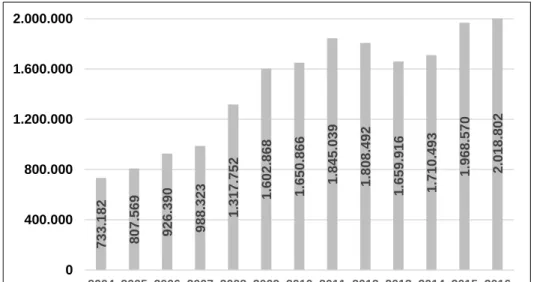
In addition, Spain is the main producer and supplier of organic food products in Europe.
More precisely, in year 2016 the area destined to ecological agriculture in Spain has
reached the amount of 2.018.802 hectares (Figure 4).
Figure 4: Evolution of the ecological production area in Spain (hectares)
Source: own elaboration based on MAPA data.
1.3.2. Future trends in sustainability
Today there is a growing trend in the consumption of sustainable and ecological
products, since consumers are increasingly aware and concerned about environmental
issues and the climate change. In this context, ecological products under an effective
control which guarantees a production respectful with rural and environmental
development, as well as with human health, is experiencing an increasing growth in
consumption, greater than for conventional food products (González-Adalid &
Munuera-Alemán, 2005, p. 50). Further, according to Schmid, Fontguyon and Sans
(2007) the factors influencing the purchase of organic products are health, animal
welfare and the products’ organoleptic qualities (p. 17). Consumers of organic products
"give greater importance when making purchases to the fact that the products they
consume are beneficial to their health, are less harmful for the environment, and do not
7
The purchase behavior for sustainable products: the case of Ecoalf
create social injustice" (Olaizola & Molina, 2008, p. 12). In the same vein “people who consume ecological products do so, because of strong personal convictions about healthy nutrition or environmental protection” (Gallo, Marín, & Flores, 2014, p. 148).
A key problem that consumers of sustainable products currently have is the large
number of labels that identify this type of products. Even though these labels are
created to provide higher levels of guarantee and credibility, the great variety of labels
can be a source of confusion for consumers. In this contex, authors such as García
(2016, p. 100) highlight that the “clear environmental information is required by the environmentally conscious consumer, as their consumption habits go beyond the act of purchase. This type of buyer acquires the product based on its environmental concern, and they experience a process of acquisition that is characterized by analyzing the whole cycle of life, from the cradle to the tomb of the product” (García, 2016, p. 100).
Therefore, it can be stated that ecological labelling is fundamental for the purpose of
selecting the desired ecological products. Consequently, the EU created its own
ecological label in 1992 (Figure 5), with the purpose of being an instrument to help
companies and consumers to improve their environmental performance, and provide
guidance and accurate, non-misleading and sciencific-based information on products
that reduce the environmental impact, compared to other products of the same
category. Moreover, this ecological label is used for electronic equipment, cleaning
The purchase behavior for sustainable products: the case of Ecoalf
Figure 5: EU Ecolabel Figure 6: EU organic logo
Regarding ecological food products, there is an official logo that identifies organic food
in the EU, which is compulsory from 1 July 2010, in accordance with Regulation (EC)
No 271/2010, 24 March 2010 (Figure 6). Interestingly, in Spain this EU logo coexists
with each one of the logos created by the autonomous communities, since these
communities have the competence to certify and authorize organic food (Figure 7).
Furthermore, some stamps have also been authorized by some control agencies which
coexist with the official labels. Therefore, it can be highlighted that this lack of
uniformity in ecological labelling leads to great misunderstanding.
Figure 7: Galicia´s ecological logo
1.4. Current legislation on “sustainable” products
1.4.1. Sustainable food products
The purchase behavior for sustainable products: the case of Ecoalf
The Regulation (EU) 2018/848 of the European Parliament will be compulsory from
year 2021, and defines organic product “as a product resulting from organic
production”. In addition, this norm defines organic production as the “use of production methods that comply with this Regulation at all stages of production, preparation and distribution”. Likewise, the norms states that products derived from hunting or fishing of
wild animals could not be considered as organic products.
Some of the general principles of organic production state that sustainable
management systems are based on the preservation of natural landscape elements,
such as natural heritage sites; the responsible use of energy and natural resources,
such as water, soil, organic materials and air; as well as highlights the exclusion of the
use of genetically modified organisms and the animal cloning from the whole organic
food chain.
It must be noted that in the EU the terms organic, ecologic and biologic are considered
as synonymous terms, as it can be derived from the Annex IV of the aforementioned
Regulation. Additionally, their derivatives and diminutives, such as “bio” and “eco”,
whether alone or in combination, may be used indistinctly in the EU for the labelling
and advertising of products.
On the other hand, in Spain, the Real Decreto 833/2014, of October 3rd, which
establishes and regulates the General Registry of Ecological Operators and creates the
Coordination Table for organic production is referred to the Council Regulation (EC) No
834/2007 of 28th June 2007 on organic production and labelling of organic products in
The purchase behavior for sustainable products: the case of Ecoalf
The Council Regulation (EC) takes the definition of “organic production” from the mere
fulfillment of it. Thus, organic production could be described (not defined) as “a general system of agrarian management and production of agro-food products that combines the best environmental practices, a high level of biodiversity, the preservation of natural resources and the application of stringent animal welfare standards, in accordance with the preferences of certain consumers for products obtained from natural substances and processes”. So, according to this Council Regulation ecologic, biologic and organic
could be considered synonymous in every EU country. However the Real Decreto
833/2014 is compulsory, the Regulation (EU) 2018/848 of the European Parliament
and the Council of 30th May 2018 on organic production and labelling of organic
products has repealed the Council Regulation (EC) No 834/2007.
1.4.2. Sustainable non-food products
There is a lack of definition for sustainable or ecologic non-food products. In fact,
according to Regulation (EC) No 66/2010 of the European Parliament and of the
Council of 25th November 2009 on the EU Ecolabel, the EU sustainability label can be
granted on the basis of criteria that will be based on the environmental performance of
the products. In order to determine such criteria, shall be considered for example: the
impact on climate change, the impact on nature and biodiversity, energy and resource
consumption, generation of waste, emissions to all environmental media and so on.
1.5. Ecoalf: making products from recycled garbage
Ecoalf is a Spanish sustainable fashion company, founded by Javier Goyeneche and
set up in year 2009. The company mission is to create the first generation of recycled
The purchase behavior for sustainable products: the case of Ecoalf
non-recycled garments and accessories. Further, the company vision is to stop using
natural resources in a careless way.
So, Ecoalf uses high quality reclycled fabrics to create eco-friendly products; turning
garbage into raw materials that are transformed into fabrics, soles, labels and recycled
linings. More precisely, this company uses different types of garbage in its
manufacturing process, as explained below:
Discarded plastic bottles. The company obtains a 100% recycled polyester filament from discarded plastic bottles that are used for making fabrics. With 70 PET
plastic bottles this company obtains one meter of fabric, and through recycling
bottles they save 20% of waste water, 50% of energy, 60% of air pollution.
Discarded fishing nets. The company obtains recovered nylon from the discarded fishing nets. Similarly, the company Ecoalf reduces the consumption of energy and
water, because recycled nylon requires half the amount of manufacturing stages
compared to the conventional chemical process. More precisely, with 135 grams of
discarded fishing nets Ecoalf obtains one meter of fabric. Through recycling nets,
the company contributes with the following environmental benefits: 27% less
consumption of natural resources, 28% reduction of green house gas emissions,
prevents marine pollution; every 1000 Kg of fabric reduces the equivalent CO2
emissions of a car driving 9800 Km, or production of 1000 Kg of fabric saves the
equivalent of 955 Kg of crude oil.
Seaweeds. The seaweeds are used in the manufacture of the sole of some of the shoes produced by Ecoalf.
The purchase behavior for sustainable products: the case of Ecoalf
which mixed with the leftovers of discarded plastic bottles are turned into recycled
cloth.
Used tires. The used tires are quite difficult to recycle because they contain metals. After two years of research, Ecoalf created a clean powder which is used in order to
manufacture reclycled flip-flops that come from 100% recycled tires, that do not
incorporate glue in their manufacturing process.
Recycled wool and post-industrial cotton. The recycled wood is one of the most recycled fibres, due to its long durability. Because of the low environmental impact,
the mechanical recycling process is a well-kown proccess to re-use wool fibres.
Similarly, through the use of recycled cotton Ecoalf saves 2500 litres of water in the
manufacturing proccess of every cotton T-shirt.
In addition, Ecoalf does not incorporate natural fur or leather in its garment collections.
The main reason is that the company is not able to guarantee the lack of use of chrome
in furs, as well as the origin of the animals and the non-abuse of them. Nowadays,
Ecoalf uses feathers certified with the Responsible Down Standards (RDS), an
standard that safeguards the welfare of geese and duks that provide feathers and
follows the chain of custody from the farm to the product. However, Ecoalf has
committed to continue increasing the use of synthetic padding in order to become
100% feather-free in all product ranges by 2020.
Finally, it should be remarked one of the most ambitious projects of the company:
“Upcycling the Oceans”, a project that started in year 2015. This project has been
developed with a goal that is threefold. In the first place, this project aims to remove
from our oceans all the wastage that damages the marine ecosystems. Secondly, the
The purchase behavior for sustainable products: the case of Ecoalf
Currently, this project has involved more than 3.000 fishermen in 37 Spanish ports, and
more than 330 tons of garbage have been recovered from the sea.
Considering all the reasons explained above, this company has been selected in order
to examine the sustainable Marketing orientation, since Ecoalf produces what the
consumers demand, while benefiting society and helping the environment. In the
sustainable Marketing orientation, the customer and societal welfare concerns strongly
influence business activities and also alter the companies’ strategic planning
(Viswanathan et al., 2009).
2. Theorical foundations
2.1. Variables influencing the purchase of
“sustainable”
products
2.1.1. The perceived product quality
Following Zeithaml (1988) quality can be defined broadly as superiority or excellence.
Accordingly, perceived quality can be conceptualized as “the consumer´s judgment about a product´s overall excellence or superiority”. Therefore, perceived quality is
different from objective or real quality. In fact the concept of perceived quality entails a
The purchase behavior for sustainable products: the case of Ecoalf
some situations resembles attitude, and an evaluation often made within the
consumer´s evoked set (Zeithaml, 1988). Likewise, regarding the concept of quality,
Santesmases-Mestre (2012) distinguishes between the objective quality of the product or service, which has a technical nature, is measurable and verifiable; and the
perceived quality, which is a subjective perception, being the evaluation of the consumer. That is, the objective or real quality aims to measure the objective and
verifiable characteristics of the products; while the perceived quality is the consumer's
appraisal of the superiority of a product. From the Marketing viewpoint, the perceived
quality is the most important, since it influences the consumer behavior (p.392).
Product quality is a complex and multidimensional concept, configured and conditioned
by a great number of attributes, that are specific for each product category or service.
The quality of a product is closely related with the compatibility and purpose of the
product itself, as well as with the consistency of the production with the desired or
expected level of quality (Talaya, 2008, p. 490). There is often a positive association
between quality and price; and for this reason, for many customers the price of a
product is a good indicator of quality.
Similarly, Kotler et al. (2013) highlights two different dimensions of the product quality:
level and consistency. When developing a product, the marketer in the first place must
choose a quality level that will support the product´s positioning. So, product quality means performance quality; that is, the ability of a product to perform its functions. Companies rarely try to offer the highest possible performance quality level; given that
only few customers could afford the highest levels of quality offered for any kind of
products, such as for example luxury products. On the contrary, companies choose a
quality level that matches their target market needs, and the quality levels of competing
The purchase behavior for sustainable products: the case of Ecoalf
consistency. In this context, product quality means conformance quality; that is, freedom from defects and consistency in delivering a level of performance; and for this reason, all companies should offer high levels of conformance quality (Kotler et al.,
2013). In this sense, a non-luxury product can have just as much quality as a luxury
product. That is, even though a non-luxury product does not perform at the same
quality level as a luxury product, it can deliver the quality that customers expect and
have paid for.
From the consumer standpoint a high quality product does not necessarily mean a
luxury product, but simply a product that satisfies him/her; that is, a product that
responds to the needs and expectations of a target market. Accordingly, product quality
can be defined as the characteristics of a product or service that bear its ability to
satisfy stated customer needs (Kotler et al., 2013, p. 244).
Companies manage total quality, prioritizing the integration of the quality of the good or service offered (objective aspect) and customer satisfaction (subjective) (Talaya, 2008,
p. 491). More precisely, total quality management involves breaking down the total quality into different dimension, so that performance standards can be established for
each component. In this context, Garvin (1987) proposes eight dimensions of total
quality, which are the following:
Product or service performance, that is related with the ability of the product to correctly perform their basic function.
Product features, which is related with the range of other advantages of the product, delivered with the basic service.
The purchase behavior for sustainable products: the case of Ecoalf
Conformance, that is related with the respect for policies and standards corresponding to a certain level of excellence.
Durability, which could be undestood as the duration of the product or the frequency of use before deterioration.
Serviceability, that means the amplitude, speed and efficiency of the services offered with the product, before, during and after the purchase.
Aesthetics, that are related with the design, appearance, color or taste of the product; thus, being the more subjective components.
Perceived quality, which is the reputation or perceived image of the product or brand.
Traditionally, quality management and control have been considered as purely
defensive actions, whose objective was to prevent manufacturing defects and the
reduction of damaged products. This function was usually developed in the production
department. However, today, following the example of the Japanese industry, quality
management is increasingly seen as a competitive strategic weapon. Accordingly,
quality management is developed in strategic Marketing, in order to define the level of
excellence expected for the products or services offered (Lambin, 2003, p. 568).
Chen and Chang (2013) report that environmental consciousness is more popular
today, and accordingly, they propose a new construct, green perceived quality. These authors refer to Zeithaml (1988) to define the concept of green perceived quality as
“the customer´s judgment about a brand´s (or a product´s) overall environmental excellence or superiority” (p. 66). Similarly, the study carried out by Chen, Lin, and
Chang (2014) indicates that green perceived quality is negatively related with
greenwash. The term greenwash is used in this resarch to express any communication
The purchase behavior for sustainable products: the case of Ecoalf
environmental performance, practices, or products (Lyon & Montgomery, 2015, p. 226).
Moreover, this study suggests that companies shoud decrease their greenwash
behaviors, and enhance their consumers´ green perceived quality. Futhermore,
companies may want to increase their customer´s “green word-of-mouth”, that is
defined as “the extent of to which a customer would infer friends, relatives, and colleagues about positive environmental message of a product or a brand”. In order to
increase the “gree word-of-mouth” companies need to improve their customer´s green
perceived quality.
2.1.2. The product image
Santesmases-Mestre (2012) highlights that product image is a mental representation of
the attributes and perceived benefits of the product or brand, being a multidimensional
phenomenon that depends on how such attributes and benefits are perceived (p. 414).
More specifically, the product attributes are those descriptive features that characterize
a product or service; that is, what a consumer thinks the product or service is or has
and what is involved with its purchase or consumption. The benefits are the personal
value consumers attach to the product or service attributes; that is, what consumers
think the product or service can do for them.
One related concept of product image is brand image. Following Keller (1993) brand
image or brand associations refer to “the set of associations linked to the brand that consumers hold in memory” (p. 2). More precisely, the brand associations can be classified into three major categories: attributes, benefits and attitudes. Similarly,
according to Kotler (2013), the brand image should incorporate the product´s distinctive
benefits and positioning. Even when competing product offerings look quite similar,
consumers may perceive differences based on the company or on the products’ brand
The purchase behavior for sustainable products: the case of Ecoalf
and Smidts (2018, p. 600) highlight that brand image is an imprecise construct, which
is generally understood as a broad set of mental associations that consumers have
related to a brand, through either exposure to Marketing or due to prior interactions
with the brand, during and after purchase.
Interestingly, the halo effect that product image exerts on consumers´ perceptions of
product attributes is described as “a subjective bias that causes the individual´s evaluation of one characteristic to impact his or her evaluation of other characteristics”
(Aghekyan, 2009, p. 2). Thus, consumer´s appraisal of specific product attributes of
branded products can be achieved by the overall impression of the general brand
image. For example, a favorable (or unfavorable) brand image can influence positively
(or negatively) on the evaluation of other product attributes of a branded product. As a
result, a strong and favorable brand image will positively bias costumers´ impression of
other attributes of the branded product. This phenomenon makes product brand image
one of the key elements leading to increase consumers´ puchase intentions
(Aghekyan, 2009).
Regarding the sustainable products, the concept of green brand image refers to “a set of perceptions of a brand in the consumer´s mind that are linked to environmental commitments and environmental concerns” (Chen et al., 2016, p. 1798). According to
Aghekyan (2009), green brand image is positively related to green brand equity (p. 20).
Green brand equity refers to “a set of brand assets and liabilities about green commitments and environmental concerns linked to a brand, its name and symbol, that add to or substract from the value provided by a product or service” (Chen et al., 2016,
p. 1799). The research developed by Olsen, Slotegraaf and Chandukala (2014) offers
The purchase behavior for sustainable products: the case of Ecoalf
environmentally sustainable new products, revealing that an emphasis on green new
products is not misguided, because it positively influences the change in brand attitude.
Similarly, according to Lin, Lobo, and Leckie (2017) more companies increasingly want
to place their brands as green brands, because of the increasing environmental awareness of consumers (p. 434). However, the opportunistic behaviour of some
companies which practice “greenwashing”, may lead to an increasing scepticism
towards green brands (Parguel, Benoît-Moreau, & Larceneux, 2011), weakening the
green brand image.
2.1.3. The product sustainability
There are different variables related with the purchasing process that influence
consumers when buying sustainable products. However, companies can manage and
take decisions on some of these variables (Olaizola & Molina, 2008, p. 1). Among
these variables the perceived consumer effectiveness and the perception of the
product and the marketing-mix variables should be highlighted.
Perceived Consumer Effectivenesss
A study conducted by Roberts (1996) revealed that the perceived consumer effectiveness was the most relevant and most accurate predictor of ecological consumption, with greater influence on the sustainable products’ purchasing
process than the socio-demographic variables -such as gender, age, level of
education or social class-, or psychographic variables -such as lifestyles, personality
or attitudes. More precisely the research developed by Roberts (1996) highlights
that the perceived consumer effectiveness was indentified as the most promising variable in explaining the ecologically conscious consumer behavior; as well as the
The purchase behavior for sustainable products: the case of Ecoalf
ecologically conscious consumer behavior advertising implications (Roberts, 1996, p. 228). More precisely, the individual´s belief that individuals could play an
important role in tackling environmental destruction (perceived consumer effectiveness) is likely the driving force behind ecologically conscious consumer behavior (Straughan & Roberts, 1999, p. 570).
Perception of the product and the marketing-mix variables
Sometimes, even though individuals show a favorable attitude towards the
environment, and to the purchase of organic products, and despite individuals could
perceive that this behavior can be effective for the protection of the environment, the
same individuals do not get to develop those actions, due to the presence of a
series of inhibition factors (Olaizola & Molina, 2008, p. 2), which are explained below (Figure 8).
Figure 8: Main inhibition factors in the consumption of sustainable products
The purchase behavior for sustainable products: the case of Ecoalf
The price of the sustainable product
When the price of these products are premium prices or high expensive prices, then
the product price can act as an inhibitor of the purchase (Meneses & García, 2004,
p. 41). More preciselly and following Calomarde (2000) “setting prices higher than
the competition for organic/sustainable products may be necessary for companies,
because of their higher costs (...) But it must be remarked that there is an upper limit
of the high prices, which is the value perceived by the consumer. Above this level,
the inhibitory effect of the purchase will be effective and the product will not be sold”
(Calomarde, 2000, p. 89). In this context, Gali (2013) reports that “a higher price is
applicable only if it matches its perceived value in the customer's minds. This
implies that sustainable products should be perceived as having higher value than
conventional products”.
The low availability and accessibility
Authors such as Bañegil & Chamorro (2002) emphasize that “the ecological
consumer finds it difficult to find in the sales lines products with the ecological
attributes he/she is looking for (...). Further, it is not known if the organic product is
not successful because the ecological demand is very weak or because the
ecological consumer does not have the possibility of expressing their awareness in
the sales lines” (p. 81). Likewise, Ruiz and Quesada (2000) emphasize the
ignorance of the existing offer and the limited offer. In this vein, Segador (1998)
points out the difficulty in finding organic foods as the major reason for not
consuming them.
The functionality and appearance of organic products
According to Molina, (2002) “companies must sell products that take care of the