Positive airway pressure and electrical stimulation methods for obstructive sleep apnea treatment: a patent review (2005-2014)
Daniel Álvarez1, Gonzalo C. Gutiérrez-Tobal1, Félix del Campo2,3, and Roberto
Hornero1
1Biomedial Engineering Group, E.T.S.I. Telecomunicación, Universidad de Valladolid,
Paseo de Belén 15, 47011, Spain.
2Pneumology Service, Hospital Universitario Río Hortega de Valladolid, c/ Dulzaina 2,
47013, Valladolid, Spain.
3Medicine, Dermatology and Toxicology Department, Facultad de Medicina,
Universidad de Valladolid, c/ Ramón y Cajal 7, 47005, Valladolid, Spain
Corresponding author: Roberto Hornero
E.T.S.I. de Telecomunicación
Universidad de Valladolid
Paseo de Belén 15
47011 - Valladolid (España)
Phone: +34 983185570
Fax: +34 983 423667
1
Positive airway pressure and electrical stimulation methods for obstructive sleep apnea treatment: a patent review (2005-2014)
Abstract
Introduction. Obstructive sleep apnea-hypopnea syndrome (OSAHS) is a major health problem
with significant negative effects on the health and quality of life. Continuous positive airway
pressure (CPAP) is currently the primary treatment option and it is considered the most effective therapy for OSAHS. Nevertheless, comfort issues due to improper fit to patient’s changing
needs and breathing gas leakage limit the patient’s adherence to treatment.
Areas covered. The present patent review describes recent innovations in the treatment of
OSAHS related to optimization of the positive pressure delivered to the patient, methods and
systems for continuous self-adjusting pressure during inspiration and expiration phases, and
techniques for electrical stimulation of nerves and muscles responsible for the airway patency.
Expert opinion. In the last years, CPAP-related inventions have mainly focused on obtaining
an optimal self-adjusting pressure according to patient’s needs. Despite intensive research
carried out, treatment compliance is still a major issue. Hypoglossal electrical nerve stimulation
could be an effective secondary treatment option when CPAP primary therapy fails. Several
patents have been granted focused on selective stimulation techniques and parameter
optimization of the stimulating pulse waveform. Nevertheless, there remain important issues to
address, like effectiveness and adverse events due to improper stimulation.
Article highlights
i) Limitations of current therapies support the need for novel alternatives in the context of
2
ii) A great amount of patents focus on automated adjustment of the delivered breathing gas
pressure in continuous positive airway pressure devices, which are the primary treatment
option.
iii) A novel approach based on electrical stimulation of the hypoglossal nerve currently focuses
the attention of the medical and scientific communities, as shown by the number of patents
granted on recent years.
iv) Implanted neurostimulators avoid common limitations of positive pressure-based devices
(uncomfortable masks, gas leakage) and surgical procedures (highly invasive, non-reversible)
becoming a promising treatment option for obstructive sleep apnea-hypopnea syndrome
patients who refuse positive airway pressure-based therapies.
Keywords: airflow limitation, continuous positive airway pressure, electrical nerve stimulation, hypoglossal nerve, obstructive respiratory event, obstructive sleep
apnea-hypopnea syndrome
1. Introduction
The obstructive sleep apnea-hypopnea syndrome (OSAHS) is a breathing disorder
characterized by temporary but recurrent complete occlusions (apneas) or partial collapses
(hypopneas) of the upper airway during sleep. These respiratory events lead to deep oxygen
desaturations, blood pressure and heart rate acute changes, increased sympathetic activity and
cortical arousals, which prevent patients from resting while sleeping [1, 2]. The prevalence of
OSAHS is notably higher in men than in women (2-4:1 ratio in community based studies) and
it increases with age, body mass index, neck circumference, and waist-to-hip ratio [1-3].
Skeletal and/or soft tissues abnormalities in craniofacial and upper airway structure play an
3
predisposition to OSAHS [4, 5]. Regarding related comorbidities, high-risk patients include
those with congestive heart failure, atrial fibrillation, treatment refractory hypertension, type 2
diabetes, stroke, nocturnal dysrhythmias, and pulmonary hypertension [6].
OSAHS has become a major health problem due to its high prevalence and severe negative
effects on health and quality of life [1, 2, 7]. Both adults and children can suffer from OSAHS.
Nevertheless, the conditions leading to airway obstruction, its consequences, and the treatment
are completely different. OSAHS is linked with the most important causes of death in adults
from industrialized countries. Metabolic deregulation and cardiovascular and cerebrovascular
diseases, such as atrial fibrillation, stroke, myocardial infarction and sudden cardiac death,
could affect people having untreated OSAHS [1, 2, 8]. Furthermore, people’s daytime
performance is severely affected and hypersomnolence due to OSAHS has been linked with a
higher probability for motor-vehicle collisions and occupational accidents [9, 10]. Regarding
children, untreated OSAHS leads to several negative consequences in the health and
development of infants, such as growth impairment, neuropsychological and cognitive deficits,
and/or even cardiovascular dysfunction [11].
Common epidemiological data reflects a high OSAHS prevalence in adults from western
countries: 1 to 5% of adult men and 2% of women. However, recent studies suggest that 20%
of adults could have at least mild OSAHS and 7% of adults moderate-to-severe OSAHS [2].
Similarly, the American Academy o Pediatrics recently reported that the prevalence of OSAHS
in children is in the range of 1% to 5% [11]. Life-threatening consequences have augmented
the interest of the general population on OSAHS, exponentially increasing the number of
patients for evaluation [12]. Nevertheless, OSAHS is still considered a highly underdiagnosed
and undertreated disease. Unlike its high prevalence and negative influence in the quality of
life, it is estimated that 90% of cases in men and 98% of cases in women may be undiagnosed
4
methodology and treatment compliance. Diagnosis starts with an initial subjective evaluation
of the sleep history, which highly depends on the symptoms reported by the patient. Next,
according to the risk for OSAHS determined by the physician, overnight attended in-laboratory
polysomnography (PSG) or portable monitoring (PM) at home is prescribed [6, 13]. In-lab PSG
has been the standard method for OSASH diagnosis. During PSG, the patient’s sleep is
monitored by means of several sensors during at least one whole night in hospital facilities. The
analysis and subsequent interpretation of the results is complex and time consuming, leading to
large waiting list [3, 14, 15]. Currently, portable home sleep monitoring has emerged as an
alternative for OSAHS diagnosis [3]. According to the AASM rules, PM may be used in
patients with a high pre-test probability of moderate-to-severe OSAHS and with no other major
comorbid condition or sleep disorder [6, 13, 15]. On the other hand, regarding OSAHS
treatment, there are different approaches, including non-invasive therapies such us positive
airway pressure (PAP) devices aimed at maintaining the patency of the upper airway, or
invasive and irreversible surgical operations that alter the patient’s anatomy, such as
maxillomandibular advancement, hyoid suspension or uvulopalatopharyngoplasty [3, 6].
Continuous positive airway pressure (CPAP) is the gold standard treatment for OSAHS [16].
According to the recommendations of the AASM, CPAP is indicated for the treatment of
moderate-to-severe patients [6]. Individual titration of the pressure level for each patient is
needed. The standard procedure is based on the determination of the continuous pressure that normalizes the patient’s sleep and breathing during in-lab PSG [17]. However, CPAP titration
at patient’s home is a widespread alternative procedure due to large waiting lists in many sleep
labs [18]. OSAHS is a chronic disease hence long-term treatment is needed. Existing therapies, however, are not consistently effective for all patients and user’s acceptance and therapy
5
The present review focuses on recent patents related to OSAHS treatment granted in the last
ten years (from 2005 to 2014). Firstly, inventions aimed at minimizing limitations of continuous
positive airway pressure (CPAP), which is currently the primary treatment option for OSAHS,
are analyzed. Finally, patents linked with electrical nerve stimulation of the hypoglossal nerve,
which have shown an increasing interest as a reliable alternative to CPAP, are also discussed.
2. Obstructive sleep apnea-hypopnea syndrome (OSAHS) 2.1. OSAS diagnosis
Diagnostic criteria for OSAHS are based on clinical signs and symptoms determined during (i)
an initial sleep evaluation including sleep oriented history and physical examination and (ii)
further comprehensive objective testing by means of in-laboratory full-night PSG [6]. Common
topics in the patient’s sleep history should include evaluation of snoring, witnessed apneas,
choking episodes, excessive daytime sleepiness, total sleep amount, nocturia, morning
headaches, sleep fragmentation, and decreased concentration and memory. High-risk patients
with nocturnal symptoms should undergo overnight PSG. For the remaining patients, the timing
of further sleep testing is determined by the presence of daytime symptoms or comorbidities
[6].
During standard PSG, neurophysiological and cardiorespiratory signals are recorded to
subsequently analyze sleep and breathing. Thus, electroencephalogram (EEG),
electrooculogram (EOG), chin and leg electromyogram (EMG), electrocardiogram (ECG),
airflow (AF) by means of thermistor and nasal prong pressure transducer, oximetry, body
position, snoring sounds, and video are commonly recorded during the whole night. Every sleep
study should be analyzed and interpreted by a qualified physician. The American Academy of
Sleep Medicine (AASM) Manual for the Scoring of Sleep and Associated Events define
inter-6
scorer variability and improving the quality of the diagnosis [6]. Apnea is defined as a
significant reduction (> 90%) of airflow for more than 10 s, whereas hypopnea is defined as a
decrease in respiratory flow of at least 50% (or alternatively 30%), accompanied by a
desaturation greater than or equal to 3% (alternatively 4%) and/or an EEG arousal. The
apnea-hypopnea index (AHI), which is the average number of apnea and apnea-hypopnea events per hour of
sleep, is the standard index used to diagnose OSAHS and establish its severity [21]. A positive
diagnosis is confirmed if AHI 15 or if AHI 5 e/h in a patient reporting any of the following
symptoms: daytime sleepiness, un-refreshing sleep, fatigue, insomnia, waking up breath
holding, gasping, or choking, or the bed partner describing loud snoring breathing interruptions
or both during the patient’s sleep [22]. Usually, OSAHS severity is defined as mild
(5AHI15), moderate (15AHI30), and severe (AHI>30) [6]. A split-night study, which
consists on an initial standard PSG followed by CPAP titration on the same night if an AHI
40 e/h is scored during 2 hours, is an alternative [23].
On the other hand, complete PSG is considered labor-intensive, expensive and time-consuming
[24], leading to increased waiting lists and delayed access to diagnosis and treatment [14]. Thus,
there is a great demand on new techniques aimed at simplifying the standard procedure and/or
reducing the number of PSGs needed (screening tests) [25]. The main alternatives to PSG focus
on portable monitoring [24, 26]. Portable monitors are usually classified as type 1 or standard
PSG; type 2, which include sleep staging and respiratory measures; type 3, which use at least
three respiratory channels; and type 4, which use at least one respiratory channel, usually
oxygen saturation or airflow [24]. In addition, automated signal processing techniques have
been widely applied during the last years to improve the diagnostic ability of single-channel
cardiorespiratory recordings. In this regard, single-lead ECG [27, 28], single-channel AF [29,
30, 31] and blood oxygen saturation (SpO2) from nocturnal pulse oximetry [25, 32, 33] have
7
physicians to uniformly classify and properly evaluate sleep testing devices, different studies
have been carried out during the last years [24, 26, 34].
2.2. OSAHS treatment
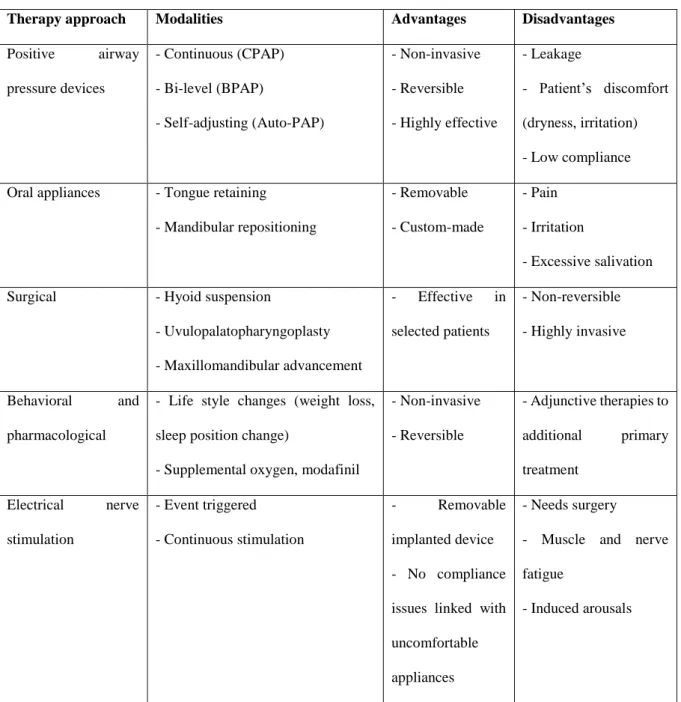
Surgical (nasal, oropharyngeal and hypopharyngeal procedures, maxillomandibular
advancement, and hyoid suspension), medical (CPAP, custom-made oral appliances),
behavioral (weight loss, positional therapy), and pharmacological (supplemental oxygen,
modafinil) approaches are currently the main alternatives for OSAHS treatment [3, 6, 20, 35,
36]. Table 1 summarizes the main alternatives currently available for OSAHS treatment, their
advantages and limitations.
CPAP, which was first described by Sullivan in 1981 [37], is considered the standard of care
for OSAHS [6, 38]. Currently, CPAP is the primary preferred treatment of mild, moderate and
severe OSAHS. It should be offered as an option to all severe patients or mild to moderate
patients showing daytime and/or nocturnal symptoms [6]. There are strong evidences on the
effectiveness of CPAP in decreasing symptoms of sleepiness, reducing cardiovascular risk, and
improving quality of life in patients suffering from moderate and severe OSAHS [20, 38, 39].
In addition, it has been shown that treatment with CPAP significantly reduces the mortality
associated to the disease [40]. On the other hand, although several studies report significant
benefits of CPAP treatment for mild patients, several uncertainties still remains [20, 38]. During
CPAP treatment, the patient sleeps wearing a mask connected to a gas flow generator via a
tubing system aimed at delivering a continuous positive pressure of air to keep the airway open
[3]. The therapy pressure is constant during the whole night and must be determined during a
sleep study (titration) to obtain the optimum value to maintain the airway patency. Though
non-invasive, simple and highly effective, CPAP treatment delivers the same constant high pressure
8
pressure at the beginning of the exhalation. C-Flex (Philips Respironics, Murrysville, PA, USA)
and EPR (ResMed, San Diego, CA, USA) are commercial solutions. Nevertheless, there is not
scientific evidence that this technical advancement leads to an improvement in adherence or
comfort. Side effects of CPAP are air leakage, skin irritation, mouth dryness, nasal discharge
and even claustrophobia and panic attacks [3, 19]. In fact, poor compliance (CPAP usage less
than 4 hours per night) ranges from 30% to 80% [41] and refusal of treatment is estimated in
up to 40-50% of patients [42].
Bi-level positive airway pressure (BPAP) is an improvement over conventional CPAP therapy. BPAP devices deliver two different pressures: a pressure during patient’s inspiration
(inspiratory pressure, IPAP) and a lower pressure during expiration (expiratory pressure, EPAP), which fits better with patient’s natural needs. Nevertheless, bi-level devices also
maintain a constant high pressure during the whole inspiration phase (aimed at overcoming
airway obstruction) and a different lower but constant pressure during the whole expiration
phase (aimed at decreasing the pressure against which the patient exhales) [3, 43]. Therefore,
BPAP therapy suffers from the same limitations than CPAP regarding comfort and treatment
compliance. Furthermore, fluctuations and asynchrony between pressure changes (from IPAP to EPAP and vice versa) and patient’s respiration can increase patient’s discomfort [43]. On the
other hand, it has been shown that pressure needed to avoid obstructive events varies during the
treatment period due to changes in weight, medication and habits, and even through each single
night, depending on sleep stage or body position [43, 44]. Autotitrating or auto-adjusting CPAP
(auto-PAP) is an alternative aimed at improving adherence to therapy. Auto-PAP devices
optimize the level of continuous pressure through the night, reducing overall mean pressure and minimizing patient’s discomfort due to size effects [19]. It is important to emphasize that BPAP
and APAP are technical advances with no proven enhancement over conventional CPAP from
9
no compliance or clinical benefits have been demonstrated [16]. Furthermore, there are several
studies reporting there is not significant improvement in comfort, patient’s quality of life,
treatment adherence and/or a decrease in symptoms when APAP devices are used instead of
conventional CPAP [19, 43, 45-50].
Common alternatives to CPAP treatment include oral appliances and surgical procedures, both
aimed at correcting anatomic abnormalities which lead to narrowing and obstruction of the
upper airway during sleep [51]. Regarding oral appliances, there exist two main approaches [6,
35]: (i) tongue retaining devices, which hold the tongue in a forward position with respect to
the resting position, and (ii) mandibular repositioning appliances, which cover the upper and
lower teeth and hold the mandible in an advanced position with respect to the resting position.
The later is currently the most widely used oral appliance [35]. Although CPAP is the most
reliable therapy and should be offered to all patients, oral appliances can be an effective
alternative treatment in patients with mild to moderate OSAHS who do not respond to positive
pressure delivery and/or life style modification strategies [6]. Oral appliances are the only
non-invasive alternative to CPAP that can reach favorable results within a short time. However, this
treatment modality is considered still underutilized [35]. Regarding surgical therapy, there are
different upper airway reconstructive procedures [6]. In this way, maxillomandibular
advancement osteotomy leads to a permanent increase in volume and reduction in length of the
upper airway that is correlated with improvement in AHI [52]. Therefore, it could be an
effective therapeutic option for severe OSAHS patients who do not respond to primary CPAP
or oral appliances [53]. Similarly, surgery can be also considered in mild OSAHS patients who
have severe but surgically-correctable obstructing anatomy [6]. However, surgical techniques
are highly invasive and irreversible hence there is still a great demand for novel feasible
10
Although oral appliances and surgical procedures are common alternatives in patients who are
intolerant to CPAP, they also have important limitations. To overcome these drawbacks, novel
non-CPAP therapies have emerged [52, 54]. The nasal expiratory positive airway pressure
(EPAP) (Provent sleep therapy, Ventus Medical Inc., USA) is a unidirectional flow-resistant
device aimed at regulating airflow through the nostrils (expiratory flow resistance without any
inspiratory resistance). Different studies have been conducted to assess its effectiveness [55,
56]. Significantly (p<0.001) reduction in AHI compared with initial PSG were reported in mild,
moderate and severe OSAHS patients. However, AHI reduction was less than 50% and severe
nocturnal desaturations and persistent nasal blockage were reported, which limit adherence to
treatment [54]. A novel oral pressure therapy (OPT) has been also proposed. Winx (Apnicure
Inc., USA) is a commercial OPT-based device that applies a vacuum to the oropharynx to pull
the soft palate forward and stabilize the tongue in order to maintain airway patency [54]. Colrain
et al. assessed the safety and effectiveness of the Winx device in a population composed of
mild-to-severe OSAHS patients. Clinically significant improvement in AHI, sleep quality and
continuity, and daytime sleepiness were reported [57]. Nevertheless, further work is needed to
confirm the effectiveness of such devices as reliable alternative to conventional CPAP therapy.
In contrast to the use of physical/technical devices, drug-based treatments have been also
proposed for OSAHS. Oral drugs approaches focuses on 5 strategies: increasing ventilatory
drive, increasing upper airway tone, decreasing REM sleep, increasing arousal threshold, and
increasing the cross-sectional area (or reducing the surface tension) of the upper airway through
topical therapy [52]. Although some drug-based therapies may be helpful, additional work is
still needed to demonstrate their long-term tolerability and efficacy [52].
Nerve stimulation to control the position of the tongue is a promising alternative. Upper airway
dilator muscles play an important role in maintaining upper airway patency during sleep [42].
11
muscles using implanted electrodes could lead to significant reductions in upper airway
resistance [42]. Moreover, selective stimulation of both the lateral XII nerve branches and the
medial nerve branch seems to increase maximum rate of airflow and mechanical stability [42,
58, 59]. Recent studies assessing efficacy of current commercial devices for electrical
neurostimulation report significant improvement in AHI and quality of life measures [60-62].
However, PSGs at 6 and 12-month follow up yielded an average decrease in AHI ranging from
53% to 68%, with a final average AHI varying from 9.0 (4.2 to 22.5 interquartile range) to 19.5
16.7 (mean standard deviation, SD), suggesting unequal efficacy, especially in obese
patients (BMI 35 kg/m2). On the other hand, limitations of this approach are coarse (non-selective) stimulation of nerves and muscles, fatigue associated to inappropriate stimulation
frequency and duration, induced arousals linked with inaccurate stimulation amplitude,
inaccurate detection of obstructive events, and asynchronous detection and stimulation modules
[42, 63]. Electrical stimulation of the whole nerve results in combined contractions of both
intrinsic and extrinsic muscles, and both retrusor and protrusor muscles, leading to undesirable
sensory stimulation and lateral deviation and retrusion of the tongue [63]. Another common
issue linked with artificial electrical stimulation of muscles is fatigue due to the stimulating
electrode is essentially in a fixed position and the same population of fibers is continuously
activated [63]. Although these technical issues have been solved in current available devices,
important limitations still remain, such as surgery related complications (transient tongue
paralysis), device malfunctions (transient asynchronous stimulation/interruption and electrode
breakage) and/or tongue abrasion [54, 60, 61].
In the following sections, recent granted patents (granted from 2005 to 2014) linked with
improvements of the standard therapy for OSAHS (CPAP) and the novel electrical nerve
stimulation are described. Table 2 summarizes reviewed patents. Firstly, inventions related to
12
proposed by the inventors: auto-adjusting PAPs, bi-level PAPs, and novel devices. Secondly,
patents linked with electrical nerve stimulation are analyzed. Inventions are grouped by type of
stimulation: continuous vs. event triggered. Finally, a methodology for assessing electrical
nerve stimulation-based therapy success before surgery is analyzed.
3. Positive airway pressure devices
Determining the minimum pressure that fits the patient’s needs has been a major goal of
research regarding CPAP treatment. It has been shown that this minimal pressure varies along
time according to different variables: sleep stage, body position, weight, medication, and/or patient’s habits [43, 44]. In this regard, Rapoport et al. have been granted a set of patents in
Australia [64], Europe [65, 66], Canada [67], and USA aimed at automatically detecting airflow
limitation and computing the optimal pressure for the user [68-72]. In [70], airflow limitation
is detected by computing four shape-based parameters derived from the present and the
preceding breaths: sinusoidal index, flatness index, respiratory effort index and relative flow
magnitude index. All these shape-derived parameters are combined (e.g. by logistic regression)
to obtain a single measure showing the probability that the current breath has a shape
characteristic of flow limitation. Finally, prior probability measures from preceding breaths
modify the weight of the current flow limitation index. The proposed self-adjusting system can
be used either with a positive pressure device or just for determining the frequency and severity
of flow limitations. Similarly, a system aimed at detecting airflow limitations is described in
[71]. The main novelty of this invention is the application of a pre-trained artificial neural network to classify individual patient’s breaths into the following classes: flow limitation is (i)
present, (ii) probably present, (iii) not probably present, and (iv) not present. Flow and/or pressure signals including a plurality of patient’s breaths are segmented and parameterized to
13
described, aimed at minimizing the airflow pressure while still avoiding flow limitation. The
proposed system increases or decreases the airflow pressure in response to inspiratory airflow
changes, such as significant deviation from a sinusoid, flattering or the presence of plateaus.
According to the inventors, a time weighted majority function is applied to the flow limitation
parameter values for a certain number of previous breaths and an automated decision tree is
used to decide whether to change the positive controlled pressure taking into account flow
limitation indexes of the current and the preceding breaths and previous decisions of the system.
Eklund et al. [73] have been granted a patent for the detection and treatment of disordered
breathing during sleep based on artificial neural networks. The invention automatically adjusts
the delivered pressure based on the presence of respiratory events. According to the inventors,
the flow or pressure signal in the CPAP circuit is continuously monitored using a constant
sampling frequency. This signal is periodically parameterized by computing respiration-related
variables (cepstrum coefficients and the energy trend parameter), which are fed to the artificial neural network (Kohonen’s self-organizing maps) in order to recognize patterns characteristic
of airflow limitation. Sleep disordered breathing is determined if the number of outputs of the
network during a selected interval exceeds a preselected threshold value. Accordingly, the
amount of breathing gas provided to the patient is increased until a normal breathing pattern is
re-established.
Similarly, Waxman et al. have been recently granted a patent for the detection and prediction
of physiological events in people suffering from sleep disordered breathing [74]. The proposed
system pre-processes (segmenting, transforming and encoding stages) physiological input data
and feeds a neural network to predict sleep-related breathing events within the next 60 s in order
to control airway pressure levels generated by PAP devices. In preferred embodiment, the
Authors propose to use the Wavelet transform in the pre-processing stage and the Large
14
Similarly, in [75], the Authors describe a learning control system based on one or a plurality of
artificial neural networks aimed at controlling the breathing support for increasing effectiveness
of PAP-based therapies.
The use of signal processing techniques is a common feature of this group of patents. They
apply different pattern recognition methodologies (logistic regression, neural networks and
decision trees) to detect respiratory events and regulate the pressure level while allowing
estimating the AHI during the treatment. This technology has been incorporated by different
CPAP manufactures, such as Philips Respironics, ResMed, Fisher & Paykel or Breas, enabling
clinician follow-up and CPAP effectiveness assessment. However, further studies are needed
to evaluate whether this information can improve CPAP adherence.
Detecting when the patient is asleep or awake is a novel promising approach for increasing patient’s comfort [76, 77]. In this regard, Rapoport et al. have been granted a patent for
adjusting the positive airway pressure supplied to a patient [78]. The patient’s breathing patterns
are analyzed by a signal processing algorithm in order to detect the following patient’s states:
(i) regular breathing, (ii) sleep disordered breathing, (iii) REM sleep, and (iv) troubled
wakefulness. The signal processing system monitors airflow and pressure signals from
conventional flow sensors coupled to the PAP device. If pure mouth breathing, erratic large
breaths with varying inspiratory times, or irregularity of intervals within breaths (but not cyclic
apneas) are detected, then the system determines whether the patient is awake and anxious or
distressed (troubled wakefulness). Then, the pressure applied by the PAP device can be lowered, which should improve the user’s comfort until the patient falls asleep. Resumption of
regularity or detection of cyclical and regular respiratory events characterizes breathing patterns
when a patient is asleep. In [79], the invention by Rapoport et al. describes a therapeutic
pressure mode when the system determines that the patient is asleep while a sub-therapeutic
15
invention described by Nightingale et al. [80], the proposed system provides a sub-therapeutic
pressure level at the beginning of the treatment session or when wakefulness is detected while
operating in a therapeutic delivery mode when the patient is asleep. The system determines if
the patient falls asleep by comparing the elapsed time since the last conscious user interaction with the system (e.g. activating a button from the user’s interface) or since the device was turned
on with a threshold. This value may be fixed (averaged user sleep patterns), settable (by the
user or the physician) or adaptive (dependant on current and/or past breathing patterns). In both
patent applications [79, 80] the Authors suggest to use the methodology proposed in [78] to
decide whether the patient is awake or asleep. Leading CPAP manufactures, such as ResMed
and Fisher & Paykel incorporate this technology into their commercial devices. Although some
studies have assessed the effectiveness of these techniques for sleep onset and awakening
detection [76, 77], further investigation is needed to evaluate their actual long-term influence on patient’s comfort and CPAP compliance.
A proportional PAP (PPAP) device has been granted in Australia [81], Canada [82], Europe
[83, 84] and the USA [85-87]. The main characteristic of the proposed invention is that the
breathing gas is delivered to the patient at a minimally sufficient pressure during at least a
portion of the breathing cycle to prevent airway collapse. Two operating parameters allow for
controlling the delivered pressure: (i) a first gain or inspiration gain, which modifies (multiplies)
the current estimated flow rate in order to compute the pressure during inspiration, and (ii) a
second gain or expiration gain, which is used during exhalation to reduce the delivered pressure
based on the current estimated flow rate. Patent [87] is a continuation of previous patent
documents. In this invention, it is described a method and an apparatus for determining whether
the patient is experiencing obstructive or central apneas based on the output of a sensor. A
comparison between a short-term average of peak inspiratory flow rate or tidal volume (e.g. a
16
apnea is detected, the system automatically increases the inspiration gain, waits approximately
1 second, and then decreases the pressure back to the original value. If a significant change in
the airflow is detected, then the system concludes that the airway is open (central apnea),
whereas if there is no significant change, the system concludes that the airway is closed
(obstructive apnea).
W.D. Childers & R.O. Childers [88, 89] have been granted a pair of patents linked with the
automated setting at-home of a PAP device in order to manage/adapt to patient-to-patient variations and/or changes in particular patient’s conditions. The proposed method and apparatus
includes 2 different operating modes: standard and custom. The custom operating profile is
characterized by customized parameters based on a prescription according to the patient’s
therapeutic needs, including increased maximum therapeutic pressure, initial pressure and
duration prior to an obstructive event and incident pressure and duration during an obstructive
event. In addition, operating parameters can be optimized for long term therapy or for transient
conditions (e.g. temporary nasal congestion). The inventors suggest the use of a backlit LCD
or OLED touch screen as user interface and an USB or wireless RFID link to communicate with
the system controller. The main novelty of this invention is the description of the user interface
for automated setting of the device at-home according to the changing patient’s therapeutic
needs. As previously stated, at-home diagnosis and treatment is the focus of physicians and
manufactures due to the chronic and variable nature of OSAHS. Therefore, novel devices may incorporate this technology to allow user interactions that could increase patient’s comfort and
treatment compliance.
Recently, J. Sun [90, 91] has been granted a patent for providing bi-level positive pressure to a
patient. Sun proposes a novel technique to avoid the delay between the detection of inspiration
and expiration stages in the respiratory cycle and the adjustment of the required pressure (IPAP
17
the end of the last expiration is lower that the optimal pressure needed to avoid the airway
collapse in the present inspiration. An expiratory unloading factor is computed based on the
correlation between the inspiratory (expiratory) pressure and the inspiratory (expiratory) motor
load generating the flow of air. Two sensors (an airflow pressure sensor and a load sensor) are
used to generate the pressure signal and the load signal. The expiratory unloading factor
indicates the difference in the motor load required to generate the inspiratory and expiratory
pressures at the patient interface.
M. D. Hallet [92] describes a method for providing bi-level automatic respiratory support for
treatment of sleep disordered breathing. This invention is aimed at automatically detecting the user’s need to initiate lung empting (expiration) in order to provide a lower pressure. In
addition, the system is also designed to minimize patient’s effort during inspiration to achieve
airway stability. Delivered pressure is governed by respiratory-related parameters, such as rate,
tidal volume, average minute ventilation, presence of residual inspiratory effort, and based on
average quiet, stable breathing levels over the past 2 to 10 minutes (moving average minute
monitoring). Upper and lower delivered pressures are adjusted if airway instability or
inspiratory flow resistance (flow limitation) are detected.
Although non-fixed pressure devices are becoming more commonly prescribed in some
countries [93], regarding the reviewed patent documents, there have been no major changes in
BPAP and APAP devices for OSAHS during the last decade. Comfort and effectiveness have
improved because PAP-based devices are smaller, integrate humidification, and airway
pressure is delivered in novel ways. Technological advances such as the use of multiple sensors,
signal processing algorithms and control modules have enabled fine control of the pressure
level delivered to the patient. Nevertheless, the operating principle, i.e. deliver a positive
pressure to maintain airway patency, is not different than in those manufactured in the last
18
A complete enclosure was developed by D. Grady [94] for the treatment of OSAHS, which
consists in a base connected to a bed, a canopy connected to the base and a sealing member that
connects the canopy to the base, so that both elements form a substantially airtight enclosure
around at least a portion of the bed. A conventional CPAP can be connected to generate
continuous positive airway pressure within the whole enclosure. The main feature of this
invention is that continuous positive pressure is delivered to the patient without the need for a
fitted mask, which avoids common compliance issues of conventional treatment. Additional
benefits described in the invention are control of humidity and temperature within the
pressurized enclosure and attenuation of sound and light in order to facilitate sleep. On the other
hand, the proposed invention is far away from the current trend of leading manufactures, which
focus on developing smaller and portable devices.
P.J. McAuliffe and D.L. Bullock [95-100] have been granted a set of patents for controlling the
pressure and/or flow rate of breathable gases by means of a flow diverter valve during
non-invasive positive pressure ventilation therapy. The aim of this invention is to reduce noise and
to improve the blower motor response time in order to prevent patient discomfort. To achieve
this goal, the inventors describe (i) a flow diverter valve with reduced noise, flow fluctuations
and increased response speed, and (ii) a valve assembly with a flow diverter rotatable vane that
does not choke a blower regardless of the vane position. The position of the rotatable vane changes according to patient’s needs dividing the airflow between an exhaust and an outlet port.
The aerodynamic characteristics of the vane (and thus the flow characteristics and the response
time) depend on specific parameters, such as the radii of curvature, the distance between centers
of the radii of curvature and the leading vane corners, the position of the rotator vane within the
device, and the width and length of the flow paths.
Previous reviewed patents focused on different methodologies for controlling the airflow
19
issue concerning the comfort and successfulness of the treatment is linked with the mask, which
is in direct contact with the patient. Mask technology focused the attention of manufactures
during the last years. In fact, performance of existing respiratory masks is noticeably higher
than preceding ones and may be responsible for the improvement in therapy compliance and user’s comfort over the past decade. The most important limitation of these masks is the
leakage, i.e. undesirable escape of the gas under pressure. This problem is two-fold: in one
hand, leakage negatively impacts the treatment efficiency and, on the other hand, it causes
important discomfort for the patient. The invention by Luca et al. [101] describes an improved membrane cushion able to provide efficient mask tightness whatever the patient’s
physiognomy. Fitness to different patient’s faces is achieved by using cushion membranes of
different thicknesses in different regions of the mask (upper nasal bridge, cheek regions on both
sides of the nose and lower chin region under the mouth). Efficient gas tightness and increasing
comfort for the patient depends on specific parameters specified by inventors, such as
thicknesses of internal and external membranes of the cushion in the different regions and a
variable number of cuts in the central portion of the cushion. Similarly, Lithgow et al. [102]
have been granted a patent for controlling the distribution of contact force of a respiratory mask around the patient’s face. In this invention, uncomfortable high pressure along sensitive regions
of the patient’s face, e.g. nasal bridge and lip region, is reduced to increase user’s comfort while
maintaining the cushion seal. This is accomplished by varying the size, shape, geometry and
materials of different external and internal structures of the cushion (membranes, rims, gusset
areas and outer/inner edges). In [103], Barnett et al. describe a nasal mask with a flexible sealing
element including a structural reinforcement area of increased thickness around the perimeter
of the cushion. A saddle shaped contoured area is included on each side of the sealing member,
each one having upper and lower protrusions for providing supporting contact with the face. In
20
nose receiving cavity. The degree of roll of the lip controls the contact area of the mask-patient interface and it can be increased or decreased depending on the desired seal and patient’s
comfort.
4. Electrical nerve stimulation
Recurrent airflow cessations characteristic of OSAHS have been linked with a decline in the
upper airway neuromuscular activity during sleep [104]. This knowledge has supported the
development of several patents related to electrical nerve stimulation of the hypoglossal nerve
as a novel treatment for OSAHS. In this regard, Lima & Craig [105, 106] have been granted
two patents for treating OSAHS based on a RFID-enabled microelectronic neurostimulator
system. A transponder located in the implant (a passive RFID transponder or an active
transponder) allows for the communication with the external subsystem. The inventors suggest that this external subsystem may be shaped for placement around a patient’s ear or with a patch
placed in the skin. Electrical nerve stimulation depends on patient-specific nerve physiology
and parameters that can be set in a controller (frequency, amplitude of the signal, number of
electrodes involved in the stimulation, among others). One of the main characteristics of this
invention is selective stimulation of both hypoglossus and styloglossus, which results in an
increased maximum rate of airflow and mechanical stability of the upper airway. This is done
by using a matrix arrangement of electrodes that provides multiple nerve stimulating points:
different nerve fascicles can be accessed enabling selective stimulation of a particular area of
the nerve. The patent describes different stimulation modes: continuous, i.e. constant
stimulation to maintain tongue muscle tone typically during sleep hours, and upon
preprogrammed conditions, i.e. under patient-specific intervals, both during sleep hours and
21
Recent patents by Meadows et al. granted in Australia [107] and USA [63, 108] described a
novel methodology for the selective electrical stimulation of the motor efferents of the
hypoglossal nerve. To achieve this goal, a programmable electrode is used. It is composed of a
plurality of contacts for the selective activation of targeted nerve fibers (motor neuron
subgroups) within a nerve bundle and, consequently, their associated motor groups (innervated
muscles). According to the inventors, the stimulation is controlled by different parameters, such
as stimulation onset, amplitude (gradual ramping from threshold to target amplitude), frequency
and duration. In addition, inventors describe a system to minimize fatigue based on the
modulation of the amplitude of the stimulating signal, so that stimulation is applied for a certain
amount of time and then stopped to let the muscles rest (stimulation duty cycle). Electrical
stimulation is applied to different fiber groups using different contacts placed in the fixed
stimulating electrode, so that none of the groups is activated long enough to cause significant
fatigue. In addition, the frequency of the stimulation is reduced because higher activation
frequency leads to higher fatigue. The inventors obtain the desired functional stimulation rate
as the sum of the rates of different fiber groups working together (overlapped activation) but
activated sequentially (delayed activation). According to the inventors, this activation
methodology allows for a continuous or near-continuous (open loop) stimulation of the tongue,
so that there is no need to synchronize activation and breathing or to monitor for apneas using
additional sensors and signal processing techniques. Therefore, the system complexity
decreases, as well as the surgical procedure complexity, power consumption, and the whole
cost.
A recent group of patents by McCreery [109-111] described an apparatus, a system and a
method for the treatment of OSAHS based on the electrical stimulation of the hypoglossal
nerve. The invention comprises a sensor to monitor both the position of the tongue and the force
22
surface of the tongue. In a normal state, the tongue is extended and contacts the sensor exerting
a force against it, whereas during apneic events the airway collapses due to the reduction of the
tone of the muscles of the upper airway accompanied by the prolapsed of the tongue base onto
the airway. The proposed system detects that the tongue is in a posterior position and delivers
a train of electrical stimuli to the branches of the motor nerves innervating muscles that protrude
the tongue to move it to an anterior position in order to avoid obstruction of the airway. The
proposed sensor comprises an emitter (e.g. LED) and a detector (e.g. phototransistor). The
position of the tongue is monitored measuring the intensity of pulsed infrared light from the
emitter that is back-scattered from the tongue to the detector.
A group of patents by Bolea et al. [112-116] describe a fully or partially implantable
neurostimulator system of the hypoglossal nerve. Claims in patent documents [112, 113, 115]
focus on different electrode configurations, whereas claims from patent [116] mainly focus on
signal processing and triggering techniques. In patent document [114], the inventors include
additional information about external control devices, physical electrode characteristics and
accommodation techniques, methods for detecting sensor failure, alternative nerve stimulation
sites (e.g. cranial root of the accessory nerve or superior laryngeal nerve), additional techniques
for automated monitoring and processing of respiration in order to trigger stimulation, and new
characteristics of the stimulating pulse waveform. In a preferred embodiment, electrical
stimulus is triggered as a function of the respiration, which is monitored by the implanted or
external respiration sensing leads in a close-loop feedback system. The following signal
processing stages are specified to obtain a usable trigger signal for stimulation: amplification,
filtering, artifact removal (cardiac and motion artifacts), detection of fiducial points (inspiration
and expiration onset derived from the first and second derivative of the respiratory signal), and
special events detection (obstructive and central apneas, hypopneas, sleep stages). The
23
variation (CV) of the PP magnitude, maximum and minimum PP amplitudes (PPmax and
PPmin), and PP range. According to the inventors, the stimulus is delivered just from the
beginning to the end of the inspiration phase of the respiratory cycle in order to minimize nerve
and muscle fatigue. A self-adjusting predictive trigger algorithm based on the estimation of the
inspiratory onset from previous respiratory cycles (reference/historical fiducial data) is used,
which is specific to a person, sensor location, sleep stage, and sleep position, among other
factors. Alternatively, the electrical neurostimulation system may also operate in an open-loop
process, where stimulus is derived according to a preprogrammed parameter setting.
In a patent by Tesfayesus et al. [117], a complementary methodology for assessing the
likelihood of therapeutic success of electrical stimulation of the hypoglossal nerve for treating
OSAHS before the surgery is described. According to the inventors, this stage is necessary
because response to hypoglossal nerve stimulation varies across subjects. To achieve this goal, the inventors propose a methodology for observing the patient’s upper airway during a tongue
protrusion maneuver, which mimics the effect of genioglossus activation by hypoglossal nerve
stimulation: the larger the airway size increase during the process, the larger subsequent
therapeutic benefit for the patient. The upper airway is observed by endoscopy while the patient
is awake and supine.
The Upper Airway Stimulation (UAS) system by Inspire Medical Systems Inc. (Maple Grove,
MN, USA) is a fully implanted device for electrical stimulation of the hypoglossal nerve. The
Inspire II is the second generation of the UAS system and it has been recently approved by the
Food and Drug Administration (FDA) for commercialization in the context of OSAHS treatment. It is important to point out that Inspire Medical Systems is a Medtronic’s spin-off,
which decided to spin out this technology and its related patents in 2007. In this regard, Inspire
Medical Systems is currently the owner of a significant patent portfolio related to electrical
24
approval. In addition, novel patents regarding the management of the implantable
neurostimulation system [118], a methodology for suitable patient selection for therapy [119],
and nerve cuff characteristics [120] have been recently granted. Furthermore, patent
applications associated with minimally invasive techniques for insertion of sensing and
stimulation leads [121, 122], suitable electrode positioning [123], and a methodology for
monitoring the respiratory effort to control the therapy level [124], are currently under review.
Regarding the granted patents, Christopherson et al. have been recently granted a system for
automatically initiating and adjusting therapeutic treatment of sleep apnea [118]. The patent
document focuses on an automatic therapy manager. The invention comprises a sensing module
aimed at monitoring respiration and body position (activity and posture sensors), an implantable
pulse generator in communication with the sensing module, and an automatic therapy manager
for delivering (or stopping) electrical nerve stimulation when sleep disordered breathing (or
normal sleep) is detected. The therapy manager is aimed at optimizing treatment (i) by
performing variable sampling of physiologic conditions (higher sampling rate during periods
of lower patient activity corresponding to higher likelihood of sleep) and (ii) by managing
transitions between states of operation according to physiological-based criteria (a severity
score based on quantity, duration and intensity of airway obstruction is computed and electrical
stimulation is delivered/stopped accordingly). On the other hand, this kind of therapy is more
expensive than the standard CPAP-based treatment and invasive surgery is needed to place the
implanted neurostimulator. Thus, patient eligibility is an important task to select patients who
will really benefit from this therapy in the context of electrical nerve stimulation. In this regard,
the invention by Q. Ni [119] describes a methodology for patient screening. Firstly, the method
builds an obstruction feature vector composed of the location, pattern, and degree of the
obstruction based on the analysis of upper airway images, as well as pressure and airflow
25
a patient candidate filter to the patient health history, composed of the CPAP compliance
history, co-morbidities, BMI, and the AHI. Finally, a patient evaluation module uses the patient
candidate information and the obstruction vector to automatically determine patient eligibility
for electrical nerve stimulation therapy. Regarding stimulation lead characteristics, the patent
by Johnson et al. describes an electrode cuff for easy placement as well as secure and suitable
electrical stimulation [120]. The invention illustrates the different modules composing the
electrode cuff, their lengths and widths, and the number, disposition, and separation of the
electrodes along the stimulation lead in different embodiments. In addition, a method of
implanting the detailed electrode cuff is described.
The Nyxoah’s neuromodulator (Nyxoah, Mont-Saint-Guibert, Belgium) is an ultra-small
system for electrical stimulation of the nerves of the tongue to prevent upper airway collapse.
Unlike similar solutions, the implant module is extremely small because it has no internal
battery: the energy is supplied by means of an external disposable battery patch. In addition,
there are no wires contacting the nerves because stimulation is performed through an electric field, which simplifies the surgery procedure. The Nyxoah’s technology is protected by a group
of granted patents. Patent documents by Mashiach and Mueller [125] and Mashiach [126]
describe a methodology to detect tongue movements based on the degree of coupling
(capacitive coupling, radiofrequency coupling, or inductive coupling) between a primary
antenna associated with an external processor and a secondary antenna integrated in an implanted unit in contact with the patient’s tongue muscle. The external processor determine if
a movement is indicative of a precursor to sleep disordered breathing and sends a control signal
to the implant in order to cause the contraction of the muscle. The characteristics of the
modulation control signal (voltage amplitude, current amplitude, pulse frequency, or pulse
26
the nerve to achieve effective neurostimulation. Patents by Mashiach [127-129] describe this
novelty. The noncontacting stimulation is based on the so called nerve modulation, which uses
field-generating electrodes to regulate nerve activity through delivery of energy. The internal
unit includes modulation electrodes located in the vicinity of the target nerve (the nerve to be modulated, e.g. next to the subject’s tongue in the vicinity of the hypoglossal nerve). These
electrodes generate an electric filed in response of a control signal so that a portion of the field
lines extend along the length of the nerve. Efficacy of modulation increases when parallel
electric field lines run partially or substantially parallel to the nerve fibers to be modulated. The
electric field provides energy to the nerve and creates an adequate voltage change to activate
the nerve and propagate an electrical signal. Regarding the power source of the battery-less
internal unit, the energy is transferred to the implant from the external unit by means of
electromagnetic signals, e.g. microwave, infrared, or radio-frequency. A control signal is
applied to the primary (external) antenna in order to supply power to the implant. Then, a new
signal is induced on the secondary (internal) antenna. This induced signal is transformed using
active and/or passive circuit components and supplied to the electrodes for generating the
electromagnetic field. Patent documents [129-131] describe the characteristics of the signals
used both to activate the implant and to cause muscular contraction.
Recent studies assessed long-term effects of commercial hypoglossal neurostimulator devices [60, 61]. In the study by Mwenge et al. [60], the AURA6000™ (ImThera, San Diego, CA,
USA) was implanted on a population of 13 severe OSAHS patients. After a 12-month-long
study, 10 patients showed a significant decrease in AHI, microarousal index and ODI. Fatigue
due to continuous stimulation was not reported [60]. By contrast, surgery related complications
(transient ipsilateral hemitongue paresis) and/or adverse events due to technical malfunction
(transient therapy interruption, inappropriate stimulation or even component replacement) were
27
UAS system (Inspire Medical Systems Inc., Maple Grove, MN, USA) was assessed in a
population composed of 126 participants with moderate-to-severe OSAHS. Both AHI and
ODI4 significantly decreased at the 12-month follow up compared with baseline scores. On the
other hand, some adverse events were also reported, which included device repositioning due
to serious discomfort (1.6% patients), temporary tongue weakness (18% patients), discomfort
due to inappropriate stimulation (40%), tongue soreness and/or abrasion (21%). Regarding
residual effects of hypoglossal neurostimulation therapy after treatment withdrawal, Rodenstein
et al. showed a significant clinical residual effect at least during one night, i.e. OSAHS
symptoms did not reappear when the treatment stopped [132]. Conversely, CPAP is
characterized by limited intranight and night-to-night effect. On the other hand, Woodson et al.
reported that apnea events and associated daytime symptoms reappeared after 1-week treatment
withdrawal [133]. Similarly, Eastwood et al. [62] recently carried out a multicenter study
involving 21 moderate-to-severe OSAHS patients to test the efficiency of the HGNS®
neurostimulator system (Roseville, MN, USA). After 3 month-long therapy, the Authors
reported a decrease in mean AHI by 56% (from 43 to 19), with decreases in total and
respiratory-related arousals (47% and 66%, respectively). Sleepiness, sleep quality and quality
of life questionnaire scores also improved [62]. However, 71% of patients reported at least one
adverse event including tongue abrasion. Furthermore, the results suggested that a BMI greater
than or equal to 35 kg/m2 would be an indicator of poor performance.
Appropriate identification of those patients more likely to benefit from electrical nerve
stimulation is an important task to optimize therapy success. In this regard, two relevant studies
have been carried out in the context of safety and efficacy assessment of the Inspire II UAS
system (Inspire Medical Systems Inc., Maple Grove, MN, USA) [134, 135]. In the study by
Van de Heyning et al., the device was implanted in a population of moderate to severe OSAHS
28
predictors [134]. Responders met the following criteria: BMI 32 kg/m2, 20 e/h < AHI 50 e/h, and did not show complete concentric collapse (CCC) at the level of soft palate, as
determined by drug-induced sleep endoscopy (DISE). The assessment of these predictors as
patient selection criteria reported significant reduction (p-value < 0.01) of AHI from baseline,
as well as significant improvement in the Epworth Sleepiness Scale (p-value < 0.01) and
Functional Outcomes of Sleep Questionnaire (p-value = 0.02) at 6-month postimplant
follow-up. Similarly, in the study by Vanderveken et al., the DISE procedure was assessed as a single
tool to predict therapy success before the UAS system implantation [135]. A population
composed of 21 patients with moderate to severe OSAHS (AHI 15 e/h) and BMI < 35 kg/m2 were involved in the study. Treatment success was defined as AHI < 20 e/h after treatment and
AHI reduction >50% from baseline. The results showed 81% (13/16) therapy success in the
subset of patients without CCC at the level of the palate, whereas no treatment success was
reported (0/5) in patients with CCC. Significant reduction of AHI (p-value < 0.001) from
baseline and significant improvement of EES (p-value = 0.02) were reported.
5. Conclusion
OSAHS is a highly prevalent disease that has become a major health problem. Despite its severe consequences to patient’s health and quality of life, it is considered underdiagnosed and
untreated. CPAP treatment is currently the standard of care for OSAHS. It is considered the
most effective method for avoiding obstruction of the upper airway during sleep. However,
several long-term trials have evidenced that patient’s adherence to therapy is not high enough.
In this regard, unnecessary high pressure while the patient is awake, insufficient pressure level during obstructive events and leakage due to poor fitness to patient’s physiognomy limit
patient’s comfort and treatment compliance. In order to overcome these limitations, several
29
detecting airflow limitation and computing the optimal pressure for the patient, according to
respiratory phases and changing needs during the night (normal vs. disturbance breathing and
sleep vs. awake). Nevertheless, while non-fix pressure devices incorporating these advances are
at present commonly prescribed, several studies have shown no clear evidences whether APAP
and BPAP yield to improved compliance, comfort, and nocturnal or daytime symptoms.
Therefore, based on current and extensive clinical experience, we can conclude that constant
CPAP may be as effective and preferred by patients as proposed PAP-based alternatives. On
the other hand, an important effort has been also carried out during the last decade to optimize patient’s masks in order to minimize breathing gas leakage, which has led to an actual
improvement in patient’s comfort. Alternative therapies to CPAP include behavioral,
pharmacological, and surgical approaches, as well as custom-made oral appliances. While
changes in life style and pharmacologic agents are usually adjunctive therapies aimed at
improving AHI, surgery and oral appliances are actual primary or secondary treatment options
for OSAHS. Nevertheless, less invasive and non-permanent alternatives are needed. In this
regard, stimulation of the hypoglossal nerve by means of implanted electrodes focuses the
interest of physicians and researchers. In this context, different patents have been granted,
mainly aimed at optimal selective stimulation of nerve and muscles responsible for airway
patency and automated triggering of the electrical stimulus. However, surgery related
complications and adverse events due to technical malfunction of the implanted neurostimulator
are important limitations. The large number of patent applications linked with OSAHS
treatment available in recent years points out the still increasing demand for reliable and
effective therapies for this disease.
30
CPAP is considered the most effective treatment for OSAHS and it is currently the standard of care. Despite being reliable and efficient, user’s discomfort limits patient’s adherence to the
treatment. CPAP devices have significantly evolved since this therapy was firstly described as
a non-invasive alternative to tracheotomy. Nevertheless, there is still room for improvement as
evidenced by the large number of patents granted in the last few years. The reviewed
CPAP-related inventions can be grouped on (i) techniques for computing the minimal pressure that fits the patient’s needs and (ii) apparatus for minimizing breathing gas leakage. The former mainly
depend on signal processing techniques for the segmentation of respiratory phases (inspiration
and expiration) and the detection of obstructive events, in order to gradually increase or
decrease the delivered pressure. However, few details are provided concerning the performance
of these techniques. The latter group of patents mainly depends on manufacturability and
reproducibility of the proposed devices. Some of the major companies operating in the sleep
apnea therapy market (ResMed Inc., Philips Respironics, Fisher & Paykel or Air Liquide) are
assignees of some of these patents. However, extensive research to obtain solid evidences on
the usefulness, benefits and differences with similar alternatives is needed for actual successful
commercialization. On the other hand, electrical stimulation of the hypoglossal nerve currently
focuses the attention of the researcher and medical community. In this regard, several patents
have been granted during the last years describing surgical implantation procedures, as well as
electrode and electrical stimulation characteristics. Furthermore, the FDA recently approved
the commercialization of the Inspire II, an implantable device based on electrical stimulation
of the hypoglossal nerve for the treatment of moderate to severe OSAHS patients who cannot
tolerate conventional CPAP therapy. Safety and effectiveness of this commercial device have
been assessed by means of significant clinical trials, which have led to several granted patents,
31
stimulation of nerves, the implant is significantly smaller than its competitors, electrodes do not
require contact with the nerve to deliver electrical stimulation, and the power source is an
external disposable battery patch, which simplifies surgery and maximizes the time until
replacement. Nevertheless, extensive assessment by means of large clinical tests is still needed
to confirm the safety and effectiveness of the device prior to commercialization. Despite the
role of the upper airway dilator muscles in maintaining the patency of the airway is well known,
some important issues remained regarding electrical neurostimulation for effective and
continued treatment of OSAHS. Accurate stimulation of suitable nerves and muscles and
fatigue prevention focused recent research. The reviewed patents linked with electrical
stimulation can be divided into (i) continuous stimulation vs. event triggered and (ii) coarse vs.
selective stimulation. In the first group, detection of obstructive events from respiratory-derived
signals is essential for triggering electrical stimulation just when needed in order to manage
fatigue. In the second group, feasible and reliable surgical techniques for the accurate
attachment of the implantable electrode to the nerve are essential. Despite its potential benefits
for some OSAHS patients who refuse CPAP, further research is still needed to make
hypoglossal nerve stimulation a feasible alternative therapy to oral appliances and upper airway
surgical procedures. Optimization of both the implantable device and the stimulation
parameters will focus future inventions in order to overcome technical malfunction of the
implanted neurostimulator reported in recent long-term studies. Overall, regarding both CPAP
and electrical stimulation approaches, advanced signal processing techniques could
significantly improve the effectiveness of these therapies. Biomedical signal processing
provides accurate tools for the detection of respiratory events, such as nonlinear forecasting,
statistical classifiers, neural networks, support vector machines, or ensemble learning, among