
Pregabalin beneficial effects on sleep quality or health related quality of life are poorly correlated with reduction on pain intensity after an eight week treatment course
12
0
0
Texto completo
(2) (Publicado en Clinical Neuropharmacology 35(1):21-24, 2012). Pregabalin beneficial effects on sleep quality or health-related quality of life are poorly correlated with reduction on pain intensity after an eight-week treatment course.. Santiago Perez-Lloret1 MD PhD, Gloria Meza Rojas2 MD, Maria Celia Menoni3 MD, Gabriela Ruiz4 MD, Carolina Velásquez2 MD, Hernán Rodriguez4 MD, María Verónica Rey1 PharmD, Daniel P. Cardinali 5 MD PhD, for the PGB study team.. 1. Pharmacology Department, Paul Sabatier University, Toulouse, France.. 2. Instituto Mutual de la Salud, Asunción, Paraguay.. 3 Servicio 4 Centro. de Endocrinología y Metabolismo del Hospital Central, Asunción, Paraguay.. Médico Santa Clara, Asunción, Paraguay.. 5 Departamento. de Docencia e Investigación, Facultad de Ciencias Médicas, Pontificia Universidad Católica Argentina, Buenos Aires, Argentina.. Running title: PGB effects on pain intensity, sleep quality and health-related quality of life. Words: Text: 1500, Abstract: 250, Figure: 3, Tables: 1.. Corresponding author: Santiago Perez Lloret MD PhD Department of Clinical Pharmacology, Faculty of Medicine, 37 Allées Jules Guesde, 31000, Toulouse, France Tel: +33 5 61 14 59 62 Fax: +33 5 61 14 56 42 e-mail: [email protected]. 1.
(3) Abstract. Background: Pregabalin (PGB) has been shown to improve sleep quality and Health-related Quality of Life (HRQoL) as well as pain intensity in neuropathic patients. Objectives: to explore the magnitude of the correlations between changes in pain intensity, sleep quality and HRQoL after PGB treatment. Methods: 138 patients suffering from neuropathic pain of any origin and without an adequate response to analgesics received an 8-week treatment course of PGB in an open-labeled fashion. Pain intensity, sleep quality and HRQoL outcomes were evaluated at baseline and at week 8 by means of an 11 points (0-10) numerical rating scale (NRS), the Pittsburgh Sleep Quality Index (PSQI) and the EuroQuol health-state visuoanalogic (EQ-5D VAS) score, respectively. Results: At week 8, mean PGB dose was 166.7±7.8 mg/day. Pain intensity NRS score, PSQI total score and EQ-5D VAS score were improved by 66.5±1.9%, 40.0±3.6% and 26.4±4.7% (all p<0.01) respectively. Correlations between percent change from baseline in pain NRS score and PSQI total score or EQ-5D VAS scores were r=0.36 (p<0.01, R2=0.11) and r=-0.20 (p<0.02, R2=0.05) respectively. A multivariate logistic regression analysis disclosed that PSQI score change below the median (i.e. a better outcome) was related to higher EQ-5D VAS score change (OR=2.15 [95%CI=1.09-4.25]) whereas pain intensity NRS score change below the median was not (1.58 [0.78-3.23]). Conclusion: In our study PGB-related improvements in sleep quality and HRQoL were marginally related to reductions in pain intensity in neuropathic patients. Improvement in sleep quality was a significant predictor of better HRQoL whereas pain intensity reduction was not. Keywords: pain, sleep quality, Health-related Quality of Life, pregabalin.. Introduction. Pregabalin (PGB) is an anticonvulsivant drug that binds to α2-δ subunit of the N-type voltagedependent Ca-channel (VDCC).1,2 VDCC-containing subunits appear to be involved in presynaptic regulation of neurotransmitter release. It has been shown that PGB is capable of inhibiting glutamate, noradrenaline, acetylcholine and substance P release at several different central nervous system locations including the neocortex, the amygdala, the hippocampus, the striatum, the spinal cord, the cerebellum and the habenula.3-5 PGB is approved by the United States Food and Drug Administration for the treatment of painful diabetic peripheral neuropathy, fibromyalgia, and postherpetic neuralgia, and as adjunctive therapy in adults with partial-onset seizure disorder.6 In Europe, pregabalin is also approved for neuropathic pain and generalized anxiety disorder.6. 2.
(4) PGB effects on sleep quality and Health-related Quality of Life (HRQoL) have been studied in many clinical trials. For example, a recent meta-analysis has shown that PGB 150-600 mg/day significantly improved pain-related sleep interference in patients with neuropathic pain 7. HRQoL was also improved by PGB.8,9 It has been suggested that improvements on sleep or HRQoL may be correlated to PGB analgesic effects,10 but the magnitude of such correlation remains unknown. Therefore, we conducted the present study aiming at further exploring the correlation between changes in pain intensity, sleep quality and HRQoL after a PGB 8-week treatment course Methods.. Study Sample. Eligible patients were men and women 18 years of age or older with a diagnosis of neuropathic pain of any origin and without an adequate response to analgesics. Female patients were required to be non-pregnant, non-lactating, postmenopausal, or surgically sterilized; women at risk of pregnancy were required to be using an appropriate method of contraception. Patients with pain lasting less than 3 months or with severe diseases or renal insufficiency were excluded. Patients were required to be on a stable analgesic regimen for the previous month and during the trial. Inadecuate response those analgesics was defined as a daily pain intensity below 4 on an 11 point numerical rating scale (NRS).11 Patients were recruited in the neurological or endocrinological departments of the Mutual Health Institue, Central Hospital or Santa Clara Medical Center, Asunción, Paraguay, between August 2008 and June 2010. Neuropathic pain diagnoses were established in all cases by study physicians. The study was approved by the Institutional Review Board at each center. It was conducted according to the Declaration of Helsinki. All the subjects gave their informed consent previous to participation in the study. Study design, treatments and outcomes. This was an open-label, uncontrolled study. Patients were evaluated at baseline and after 8 weeks of PGB treatment. PGB titration followed a semi-rigid scheme. Patients began with 75 mg/day and were up-titrated up to 300 mg/day at week 4. Afterwards, dose could be changed according to tolerability or efficacy. Pain, sleep and HRQoL outcomes were evaluated at baseline and at week 8. Pain was evaluated by means of a 11 points (0-10) NRS.11 Score for minimal, average or maximal pain intensity during the previous week or average intensity during the previous day were recorded. A single pain intensity NRS measure was then obtained by averaging individual pain intensity measures. Sleep was evaluated by the Pittsburgh Sleep Quality Index (PSQI).12 Finally, HRQoL was evaluated by the EuroQuol 5D scale (EQ-5D).13 The health state visuoanalogic scale (VAS) was used as the HRQoL outcome. Higher PSQI or pain intensity NRS scores represent a worse outcome, whereas higher EQ-5D VAS values represent a better one. The primary outcome of the study was the correlation between pain intensity NRS score and PSQI total score and EQ-5D VAS score.. 3.
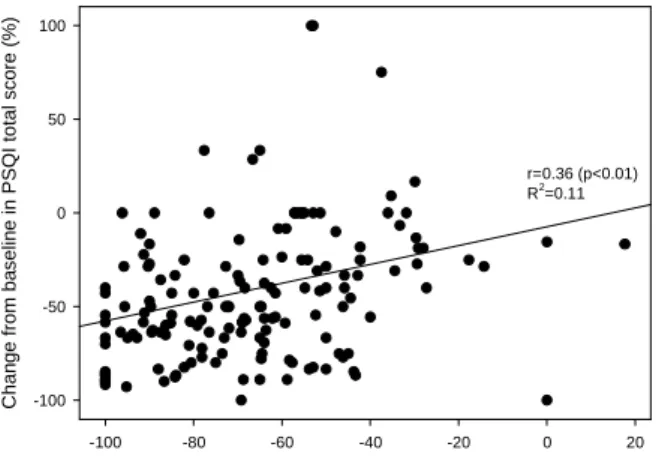
(5) Statistical analysis. Sample size was calculated with the primary outcome in mind. It was determined that 130 subjects would be needed to detect a correlation coefficient between pain intensity score and PSQI or EQ-5D scores of at least 0.25 (maximal allowed beta error=0.2, alfa error=0.025). This sample size would be enough for detecting odds ratios ≥ 2.3 when searching for independent predictors of improved HRQoL after PGB treatment. Thirteen additional subjects were also recruited to compensate for drop-outs.. Correlations between PSQI, EQ-5D VAS and pain intensity NRS scores were explored by parametric Pearson’s coefficient (r). R2 determination coefficients (i.e the proportion of variability in one of the variable that can be explained by variations in the other) were calculated as r*r. Significance of week 8-to-baseline changes in the explored outcomes were tested by paired ttest. Such differences are expressed as a percentage of change. Between-group t-tests were used for other comparisons. Finally, independent contribution of week 8-to-baseline changes in PSQI or pain scores to change in EQ-5D score was explored by logistic regression analysis. For this analysis, all outcomes were dichotomized to their medians. Results.. Ninety-seven percent of recruited subjects (138 out of 143) completed the study. Characteristics of final sample are shown in Table 1. Out of the 5 drop-outs, 2 were related to adverse events (severe dizziness or somnolence) while the other 3 withdrawn their consent. As can be seen, at week 8 most subjects were on moderate PGB doses. Compliance with treatment was good to excellent in 94% of patients. Most frequently reported co-morbidities were cardiovascular (44%, hypertension), endocrine (30%, diabetes, obesity, hypothyroidism) or rheumatic (23%, arthrosis or arthritis). Significant week 8-to-baseline differences in all explored outcomes were identified. Pain intensity NRS score was 5.7±0.2 (mean ± standard error of the mean) at baseline and 2.0±0.1 at week 8 (change= -66.5±1.9%, p<0.01, paired t-test). PSQI score was 10.4±0.3 at baseline and 5.4±0.3 at week 8 (change= -40.0±3.6%, p<0.01). Finally, EQ-5D VAS score was 50.7±1.8 at baseline and 76.7±1.4 at week 8 (change= 26.4±4.7%, p<0.01). Correlations between percent change from baseline in pain NRS score and PSQI total score or EQ-5D VAS were poor, as can be seen in Figure 1. Percent change from baseline in all explored outcomes was comparable in subjects manifesting nighttime pain complaints at baseline (PSQI question 5.h) or not (Figure 2). Median values for change from baseline in pain intensity NRS, PSQI total or EQ-5D VAS scores were -68%, -49% or 34%, respectively. A multivariate logistic regression analysis showed that improvement in PSQI total score was significantly related to improvement in EQ-5D VAS score (OR=2.15 [95%CI=1.09-4.25], p=0.03), while this was not the case for improvement of pain intensity NRS score (1.58 [0.78-3.23], p=0.21) as shown in Figure 3. Sleep quality-bypain intensity interaction was not significant.. 4.
(6) Fifty percent of patients reported an adverse event. Most frequent adverse events were somnolence (14 cases, mild=8, moderate=2, severe=2) and dizziness (14 cases, mild=8, moderate=5, severe=1). There were no serious adverse events.. Discussion. In this study significant but poor correlations between improvements in pain, sleep quality and HRQoL after an 8-w PGB treatment course were found. Correlations coefficients never surpassed 0.36 or R2= 0.11, meaning that only 11% changes in PSQI total scores or in EQ-5D VAS scores are expected following variations in pain intensity after PGB treatment. Therefore, PGB effects on sleep quality or HRQoL are only marginally related to improvements in pain in patients with neuropathic pain. The presence of a placebo-effect constitutes a relative limitation to our study. Indeed, PGB effects on pain, sleep quality and HRQoL are surely overestimated. Nonetheless, there is no reason to think that the placebo effect may have affected differently these measures, so the correlations between them are not biased. Confounding effects of nighttime pain or of pain origin were ruled out. PGB effects on other domains, such as mood, which are known to be improved by the drug14,15 were not explored, therefore their effects on sleep quality and HRQoL could not be studied. Finally, fibromyalgia patients were not included in our study. PGB is known to improve sleep quality and HRQoL in this group of patients.16 Nonetheless, as fibromyalgia is physiopathologically different from neuropathic pain, our results may not be applicable to this group of patients.. The results of our study further suggest that PGB may improve sleep by other mechanisms not related to pain improvement in neuropathic patients. Indeed, in rats PGB increased the duration of non-rapid eye movement sleep and decreased rapid eye movement sleep after either a nighttime or daytime dose.17 Similarly, in 24 healthy volunteers, PGB significantly increased slow-wave sleep both as a proportion of the total sleep period and the duration of stage 4 sleep as compared to placebo.18 PGB also reduced rapid eye movement sleep as a proportion of the total sleep period compared with placebo. Finally, PGB have been shown to be efficacious for Restless-Legs Syndrome.19 Our results further encourage the exploration of PGB efficacy on other sleep disorders, such as insomnia. Previous studies have suggested that even patients showing a mild analgesic PGB effect can experience clinically important changes in function and health status.10 Our results confirm that PGB-related improvement in HRQoL is not due entirely to its analgesic effects. Furthermore, our study showed that PGB-related improvement of sleep quality had a greater impact on HRQoL than pain improvement. Insomnia is associated with a number of adverse health outcomes such as poor physical health, poor mental health including symptoms of anxiety and depression, and decreased quality of life.20 Accordingly, improving sleep can lead in some cases to improvements in HRQoL,20 such as may be the case with PGB. In summary, our study showed that PGB-related improvements in sleep quality and HRQoL were marginally related to reductions in pain intensity. PGB may show a sleep promoting effect independent of the analgesic effect, which was in our study a major determinant of HRQoL improvement.. 5.
(7) Acknowledgements. This study was funded with an educational grant by Recalcine Laboratories. Recalcine was not involved in the design, conduction or analysis of the study.. Study Team. Dra. Daisy Arguello, Dra. Aida Caballero Cantero, Dra. Graciela Elizeche, Dra. Edith Falcon de Legal, Dra. Celia Menoni, Dra. Gloria Meza Rojas, Dra. Aurora Olmedo Bareiro, Dra. Tanya Paiva Rochol, Dr. Santiago Perez Lloret, Dr. Jose Luis Ippolito, Dra. Gabriela Ruiz, Dr. Hernán Rodríguez, Dr. José Sánchez Talavera, Dra. Carolina Velázquez, Dra. Elizabeth Valinotti. Conflict of interests. Authors declare no conflict of interests.. References.. 1. Hamandi K, Sander JW. Pregabalin: a new antiepileptic drug for refractory epilepsy. Seizure 2006;15:73-78. 2. Joshi I, Taylor CP. Pregabalin action at a model synapse: binding to presynaptic calcium channel alpha2-delta subunit reduces neurotransmission in mice. Eur J Pharmacol 2006;553:82-88. 3. Errante LD, Petroff OA. Acute effects of gabapentin and pregabalin on rat forebrain cellular GABA, glutamate, and glutamine concentrations. Seizure 2003;12:300-306. 4. Fehrenbacher JC, Taylor CP, Vasko MR. Pregabalin and gabapentin reduce release of substance P and CGRP from rat spinal tissues only after inflammation or activation of protein kinase C. Pain 2003;105:133-141. 5. Taylor CP, Angelotti T, Fauman E. Pharmacology and mechanism of action of pregabalin: the calcium channel alpha2-delta (alpha2-delta) subunit as a target for antiepileptic drug discovery. Epilepsy Res 2007;73:137-150. 6. Durkin B, Page C, Glass P. Pregabalin for the treatment of postsurgical pain. Expert Opin Pharmacother 2010;11:2751-2758. 7. Roth T, van SR, Murphy TK. The effect of pregabalin on pain-related sleep interference in diabetic peripheral neuropathy or postherpetic neuralgia: a review of nine clinical trials. Curr Med Res Opin 2010;26:2411-2419. 8. Attal N, Cruccu G, Baron R, et al. EFNS guidelines on the pharmacological treatment of neuropathic pain: 2010 revision. Eur J Neurol 2010;17:1113-1e88. 9. Wu SC, Wrobel JS, Armstrong DG. Assessing the impact of pharmacologic intervention on the quality of life in diabetic peripheral neuropathic pain and fibromyalgia. Pain Med 2007;8 Suppl 2:S33-S42. 10. Hoffman DL, Sadosky A, Dukes EM, et al. How do changes in pain severity levels correspond to changes in health status and function in patients with painful diabetic peripheral neuropathy? Pain 2010;149:194-201. 11. Dworkin RH, Turk DC, Farrar JT, et al. Core outcome measures for chronic pain clinical trials: IMMPACT recommendations. Pain 2005;113:9-19.. 6.
(8) 12. Buysse DJ, Reynolds CF, III, Monk TH, et al. The Pittsburgh Sleep Quality Index: a new instrument for psychiatric practice and research. Psychiatry Res 1989;28:193-213. 13. Brooks R. EuroQol: the current state of play. Health Policy 1996;37:53-72. 14. Marks DM, Pae CU, Patkar AA. Potential role of pregabalin in the treatment of lithium-induced tremor: a case report. Int J Neuropsychopharmacol 2008;11:879-881. 15. Rickels K, Pollack MH, Feltner DE, et al. Pregabalin for treatment of generalized anxiety disorder: a 4week, multicenter, double-blind, placebo-controlled trial of pregabalin and alprazolam. Arch Gen Psychiatry 2005;62:1022-1030. 16. Tzellos TG, Toulis KA, Goulis DG, et al. Gabapentin and pregabalin in the treatment of fibromyalgia: a systematic review and a meta-analysis. J Clin Pharm Ther 2010;35:639-656. 17. Kubota T, Fang J, Meltzer LT, et al. Pregabalin enhances nonrapid eye movement sleep. J Pharmacol Exp Ther 2001;299:1095-1105. 18. Hindmarch I, Dawson J, Stanley N. A double-blind study in healthy volunteers to assess the effects on sleep of pregabalin compared with alprazolam and placebo. Sleep 2005;28:187-193. 19. Allen R, Chen C, Soaita A, et al. A randomized, double-blind, 6-week, dose-ranging study of pregabalin in patients with restless legs syndrome. Sleep Med 2010;11:512-519. 20. Kyle SD, Morgan K, Espie CA. Insomnia and health-related quality of life. Sleep Med Rev 2010;14:6982.. 7.
(9) Change from baseline in PSQI total score (%). 100. 50 r=0.36 (p<0.01) 2 R =0.11 0. -50. -100 -100. -80. -60. -40. -20. 0. 20. Change from baseline in EQ-5D VAS score (%). Change from baseline in pain intensity NRS score (%). 100. 80. 60. 40 r=-0.20 (p<0.02) R2=0.05. 20. 0. -20 -100. -80. -60. -40. -20. 0. 20. Change from baseline in pain intensity NRS score (%). Figure 1.. Figure 1. Correlation between percent change from baseline in pain intensity NRS score with change in PSQI total score (upper panel) or EQ-5D VAS score (lower panel).. 8.
(10) p=0.24. Change from baseline (%). 40. 20. 0. -20. -40 p=0.27. -60. -80. p=0.38 Pain NRS Score. PSQI total score. EQ-5D VAS Score. Figure 2.. Figure 2. Change from baseline in PSQI scores, pain VAS scores or EQ-5D VAS scores ( Subjects without nighttime pain complaints, Subjects with nighttime pain complaints). Shown are means and 95% confidence intervals. Reported p-values were calculated by mean of between-group t-tests corrected for variance heterogeneity.. 9.
(11) p=0.03. Percentage of subjects with EQ5D VAS score change > median (better). 60 p=0.21 50. 40. 30. 20. 10. 0 >= median value (worse). < median value (better). Pain intensity NRS score change. >= median value (worse). < median value (better). PSQI total score change. Figure 3.. Figure 3. EQ-5D VAS score change in subjects with PSQI score or pain VAS score changes above or below median values. A multivariate logistic regression analysis disclosed that PSQI score change below the median (i.e. a better outcome) was related to higher EQ-5D VAS score change (OR=2.15 [95%CI=1.09-4.25]) whereas Pain intensity NRS score change below the median was not (1.58 [0.78-3.23]).. 10.
(12) Table 1. Sample characteristics. Variable. Value. Sample size. 138. Males. 86 (62%). Age (years-old). 56.6±1.2 2. Body Mass Index (kg/m ). 27.7±0.5. Pain etiology Diabetic neuropathy. 85 (61%). Post-herpetic neuralgia. 38 (28%). Other neuropathies*. 15 (11%). Pain duration (months). 24.5±2.3. Pain medication NSAIDs. 66 (47%). Opioids. 18 (13%). Antidepressants. 22 (16%). Vitamin B6 (adjuvant). 14 (10%). Benzodiacepines. 11 (8%). Gabapentin. 9 (6%). Antiepileptics. 9 (6%). Corticosteroids. 4 (3%). At Week 8 Pregabalin dose (mg/day). 166.7±7.8. 75 mg. 48 (35%). 150-225 mg. 57 (41%). 300-450 mg. 34 (24%). Compliance with therapy Every day. 85 (61%). Almost every day. 46 (33%). Sometimes. 8 (6%). Never. 0 (0%). N(%) or mean ± standard error of the mean are shown. * Including polyneuropathy, chronic radiculopathy and others.. 11.
(13)
Figure

Documento similar
While improvements were observed in all four patient groups and in practically all EQ-5D dimensions, after 3 months of follow-up varying proportions of patients still reported
The final solution for the CdVF-ER > 18 scale comprised 5 FQoL dimensions and 32 items divided as follows: Family climate (14 items), Autonomy of the person with IDD (12
De hecho, en el ámbito de la salud, se ha acuñado el término calidad de vida relacionada con la salud (CVRS o, en inglés, Health Related Quality of Life - HRQoL), que es un
External rotation ROM, and presence of DM, thyroid disorder and autonomic symptoms at baseline emerged to be prognostic factors for shoulder pain, disability and quality of life
Hence, this study was aimed at evaluating the association of both subjective (i.e., global Pittsburgh Sleep Quality Index [PSQI] score) and objective (i.e., total sleep time [TST],
A poor quality of life and worse disease control in the patients were associated with a poorer quality of life of the family, higher scores of anxiety and depression, and the
This booklet includes top tips for those who experience a mental health condition to help improve their quality of life and think about their sense of belonging and place in
An employee who sleeps 8 hours per night may still have poor sleep quality, preventing the individual from showing up for work at peak performance.. Additionally, sleep hygiene
