
TítuloOptimising the relaxivities of Mn2+ complexes by targeting human serum albumin (HSA)
21
0
0
Texto completo
(2) Introduction Derivatives of the tetraaza macrocycle 1,4,7,10-tetraazacyclododecane (cyclen) functionalised with different types and numbers of pendant arms have been investigated in detail in the last few decades due to several successful applications of their metal complexes.1 For example, lanthanide complexes of such ligands have proved useful as magnetic resonance imaging (MRI) contrast agents,2 radiopharmaceuticals for nuclear medicine techniques,3 Chemical Exchange Saturation Transfer (CEST) agents,4 and luminescent probes.5 The tetraacetic acid derivative (DOTA) is probably the most utilised, since it forms metal complexes characterised by high thermodynamic stability and marked kinetic inertness towards dissociation, hence favouring their use in in vivo applications.6 Complexes of Mn2+ containing coordinated water molecules have been attracting increasing attention due to their potential application as MRI contrast agents.7,8 We have recently initiated a research program to develop Mn2+ complexes that could represent an alternative to the classical Gd3+ MRI contrast agents.9–12 We have shown that Mn2+ complexes containing one or two water molecules coordinated to the metal ion present relaxation efficiencies comparable to those of the commercially available Gd3+ agents.11 Furthermore, we and others developed a family of macrocyclic and non-macrocyclic ligands containing lipophilic units that form micelles in solution and rather stable adducts with HSA, which results in relatively high relaxivities due to the elongation of the tumbling time of the complex in solution.13–15 Besides a potential lower toxicity of the Mn2+ complexes compared to the Gd3+ counterparts, redox responsive agents based on the Mn2+/Mn3+ pair were also proposed.16. Scheme 1. Structures of the ligands discussed in this work.. Macrocyclic ligands often form metal complexes with higher thermodynamic stability and kinetic inertness than related non-macrocyclic analogues. In the context of MRI agents, the stable complexation of the target metal ion is of great importance to avoid the release of the toxic free metal ion in vivo. For instance, the stability constants of Mn2+ complexes of cyclen-based ligands containing acetate pendant arms were studied in aqueous solution by means of potentiometric and microcalorimetric techniques, which afforded log K, ΔH° and TΔS° values for the complexation reactions. The metal complexes present high stability constants.
(3) due to both favourable enthalpic and entropic contributions. With the unique exception of DOTA (1,4,7,10tetraazacyclododecane-1,4,7,10-tetraacetic acid, Scheme 1), the entropic term is prevalent. Furthermore, it was also noticed that 1,4-H2DO2A (1,4,7,10-tetraazacyclododecane-1,4-diacetic acid) forms a more stable complex than the 1,7-H2DO2A isomer.17,18 The stability constant of the Mn2+ complex with the bis-amide derivative 1,4-DO2AM was found to be 2.5 log K units lower than that of [Mn(1,4-DO2A)]. However, the bis-amide ligand was found to be remarkably inert with respect to dissociation, with a dissociation half-life at pH 7.4 ca. 10 times higher than that of [Mn(1,4-DO2A)].19 We envisaged expanding the family of macrocyclic Mn2+ complexes based on cyclen while introducing hydrophobic units to target HSA. Towards this aim, we present here the cyclen-based ligands 1,4DO2AMBz and 1,4-BzDO2AM (Scheme 1), which contain two acetamide pendants at positions 1 and 4 of the cyclen ring and two benzyl groups either at positions 7 and 11 of the macrocycle (1,4-BzDO2AM) or as N-substitution of the acetamide pendants (1,4-DO2AMBz). The presence of two hydrophobic moieties favours the formation of adducts with Human Serum Albumin (HSA)20 through non-covalent interactions. We report a detailed investigation of the thermodynamic stability and dissociation kinetics of the Mn2+ complexes, as well as a 1H and 17O NMR relaxometric study to determine the parameters that govern the relaxivity of these complexes. Finally, the interaction of the complexes with HSA was assessed using relaxometric techniques.. Scheme 2. Synthesis of the ligands. (i) CH3CN, K2CO3, Δ, 24 h; (ii) diethyloxalate, EtOH, Δ, 24 h; (iii) benzyl bromide, CH3CN, K2CO3, Δ, 24 h; (iv) 5 M NaOH, Δ, 24 h; (v) N,N-dimethyl 2-chloroacetamide, CH3CN, K2CO3, Δ, 24 h..
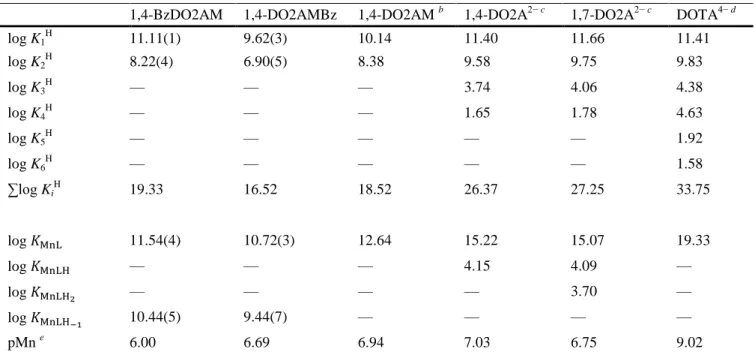
(4) Results and discussion Synthesis of the ligands The 1,4-DO2AMBz ligand was synthesised in two steps involving the preparation of sidearm 3 by a reaction of 2-bromoacetyl bromide and benzyl amine,21 followed by the regioselective cis alkylation of cyclen,22 which provided the 1,4-DO2AMBz ligand inca. 20% yield over the two steps after semipreparative HPLC purification. The 1,4-BzDO2AM ligand was synthesised starting from cyclen, which was converted into 1,4-dibenzyl-1,4,7,10-tetraazacyclotetradecane following the method of Handel.23 Thus, cyclen was protected using diethyl oxalate to give intermediate 4 (Scheme 2), which was subsequently alkylated with benzyl bromide using K2CO3 as a base. Basic deprotection of compound 5 and alkylation of the resulting intermediate with N,N-dimethyl 2-chloroacetamide gave the 1,4-BzDO2AM ligand in a decent 20% yield over the four steps. Ligand protonation constants and stability constants of the Mn2+ complexes The protonation constants of 1,4-DO2AMBz and 1,4-BzDO2AM ligands, defined in eqn (1), were determined by pH-potentiometry in 0.1 M KCl aqueous solution. The log KiH values are compared with those of 1,4-DO2AM, 1,4-DO2A2−, 1,7-DO2A2− and DOTA4− in Table 1.. 𝐾𝑖H = [H. [H𝑖 L] 𝑖−1 L][L]. with 𝑖 = 1, 2, … , 6.. (1). Table 1. Ligand protonation constants and stability and protonation constants of the corresponding Mn2+ complexes determined using potentiometric titrations (25 °C, 0.1 M KCl) a. log K1H. 1,4-BzDO2AM. 1,4-DO2AMBz. 1,4-DO2AM b. 1,4-DO2A2− c. 1,7-DO2A2− c. DOTA4− d. 11.11(1). 9.62(3). 10.14. 11.40. 11.66. 11.41. H. 8.22(4). 6.90(5). 8.38. 9.58. 9.75. 9.83. log K3. H. —. —. —. 3.74. 4.06. 4.38. log K4H. —. —. —. 1.65. 1.78. 4.63. H. —. —. —. —. —. 1.92. H. —. —. —. —. —. 1.58. 19.33. 16.52. 18.52. 26.37. 27.25. 33.75. log 𝐾MnL. 11.54(4). 10.72(3). 12.64. 15.22. 15.07. 19.33. log 𝐾MnLH. —. —. —. 4.15. 4.09. —. log 𝐾MnLH2. —. —. —. —. 3.70. —. log 𝐾MnLH−1. 10.44(5). 9.44(7). —. —. —. —. 6.00. 6.69. 6.94. 7.03. 6.75. 9.02. log K2. log K5 log K6 ∑log. pMn a. KiH. e. Standard deviations (3σ) are shown in parentheses. b Ref. 19. c Ref. 17. d Ref. 26. e Defined as −log[Mn]free with pH = 7.4, [Mn2+] = [L] = 10−5 M..
(5) The protonation scheme of 1,4-DO2AM has been studied in detail using both 1H-NMR spectroscopy and pH-potentiometry methods.19 Because of the similarities of 1,4-BzDO2AM, 1,4-DO2AMBz and 1,4DO2AM, we can assume that the first protonation occurs on the nitrogen atoms of the macrocycles N1 and N4, which are functionalised with the acetamide pendant arms (the protonation involves partially both Natoms). The second protonation takes place on the unsubstituted (1,4-DO2AMBz) or benzyl-substituted (1,4BzDO2AM) nitrogen atom N7 (or N10) to afford a trans bis-protonated species on N1/N7 or N4/N10. The protonation of trans nitrogen atoms minimises the electrostatic repulsion by allowing a larger charge separation of the protonated sites.24 Comparison of the protonation constants of 1,4-BzDO2AM and 1,4-DO2AMBz with those of 1,4-DO2AM indicates that the log K1H value of 1,4-BzDO2AM is slightly higher, whereas the log K1H and log K2H values of 1,4-DO2AMBz are significantly lower than those of 1,4-DO2AM. The basicity of the ring N-donor atoms might be influenced by four factors: (i) the electron withdrawing effect of the amide groups that reduces the basicity of the nitrogen donor atoms; (ii) the electron donor or acceptor behaviour of the substituents on the amide group; (iii) the electrostatic repulsion between the protonated ring N-donor atoms resulting in a lower basicity of the ring amines and (iv) the formation of H-bonding interaction between the protonated nitrogen and the amide O-donor atoms that could increase the amine basicity.25 Likely, the contribution of all these processes is responsible for the lower log KiH values of the nitrogen donor atoms of 1,4-DO2AMBz as compared to 1,4-DO2AM. The total basicity (∑log KiH) of 1,4-BzDO2AM is comparable to that of 1,4DO2AM, whereas the ∑log KiH value of 1,4-DO2AMBz is significantly lower (Table 1). The stability constants of the Mn2+ complexes of 1,4-BzDO2AM and 1,4-DO2AMBz are defined in eqn (2):. [ML]. 𝐾ML = [M][L]. (2). The stability constants of the 1,4-BzDO2AM and 1,4-DO2AMBz complexes have been calculated from the titration curves obtained at 1 : 1 metal to ligand concentration ratios. The best fits of the experimental data (volume of KOH added vs. pH) were obtained by using the model that involves the formation of ML species at equilibrium. However, the titration data of the Mn2+-1,4-BzDO2AM and Mn2+-1,4-DO2AMBz systems indicated the consumption of base at pH > 8.5 due to the formation of hydroxide species. This process was characterised by the equilibrium constant KMLH−1 defined according to eqn (3):. [ML]. 𝐾MLH−1 = [MLH. −1 ][H. +]. (3). The stability constants of the Mn2+ complexes formed with 1,4-BzDO2AM and 1,4-DO2AMBz are about 1 and 2 orders of magnitude lower than that of [Mn(1,4-DO2AM)]2+, respectively. The lower log KML value determined for the [Mn(1,4-DO2AMBz)]2+ complex is not surprising, as the total basicity of 1,4-DO2AMBz is about 2 log K units lower than that of 1,4-DO2AM. However, the stability constant of the [Mn(1,4BzDO2AM)]2+ complex is significantly lower than expected by taking into account the ∑log KiH values presented in Table 1. Because of the similar basicity of the N donor atoms in 1,4-BzDO2AM and 1,4DO2AM ligands, it can be assumed that the presence of the two bulky benzyl substituents introduces some.
(6) steric constraints for the coordination of the ligand to the relatively small Mn 2+ ion (97 pm for coordination number six, high-spin configuration).27 It should be noted that MnL complexes formed with 1,4-BzDO2AM, 1,4-DO2AMBz and 1,4-DO2AM ligands are characterised by lower stability constants than Mn(1,4-DO2A), Mn(1,7-DO2A), Mn(DO3A) and Mn(DOTA) complexes. The lower log KML values of the Mn2+-complexes formed with 1,4-DO2A-bisamide ligands can be explained by the lower affinity of Mn2+ ions to the non-charged amide oxygens with respect to the charged carboxylate O-donors and/or the significantly lower basicity (∑log KiH) of the ring N-atoms. The complexes of 1,4-BzDO2AM and 1,4-DO2AMBz form hydroxo species at pH values above ca. 8.0 and 7.0, respectively (Fig. 1). The complexes dissociate at relatively high pH, with 2.6% of the total Mn 2+ being in the form of the aqua ion at pH 6.0 for the Mn2+:1,4-BzDO2AM system and 22% for the Mn2+:1,4DO2AMBz system ([L] = [Mn2+] = 103 M). Thus, the [Mn(1,4-DO2AMBz)]2+ complex is somewhat more stable about neutral pH than the [Mn(1,4-BzDO2AM)]2+ analogue. This is also reflected in the pMn values (Table 1), which provide an indication of the stability of the complex at pH 7.4.. Fig. 1. Species distribution diagrams calculated for the 1,4-BzDO2AM:Mn2+ (top) and 1,4-DO2AMBz:Mn2+ (bottom) systems. [L] = [Mn2+] = 10−3 M..
(7) Transmetallation kinetics Before in vivo application, it is important to evaluate the kinetic inertness of any metal-complex and thus the possible release of free metal ions or ligands in the body.28 The kinetic inertness of a metal complex is characterised by the rates of its dissociation, which is typically measured under strongly acidic conditions ([H+] > 1.0 M).29 However, since these conditions differ considerably from the physiological ones, it is crucial to also consider the transmetallation reactions occurring with endogenous metal ions (Cu 2+, Zn2+ and Ca2+) at physiological pH. In fact, a Mn2+ complex in body fluids may interact with these ions resulting in the release of the Mn2+-ion. Therefore, in order to assess the kinetic inertness, the rates of the transmetallation reactions of Mn2+complexes with Cu2+ and Zn2+ ions are typically determined in the pH range 2–7.18,19,26 For Mn2+ DOTA-like complexes the metal ion is slowly released through the proton-assisted dissociation pathway, whereas the dissociation rate is generally not altered by the presence of Zn2+ and Cu2+.18,19,26 For the direct comparison of the kinetic properties of [Mn(1,4-BzDO2AM)]2+ and [Mn(1,4-DO2AMBz)]2+ with those of [Mn(1,4-DO2AM)]2+, [Mn(1,4-DO2A)], [Mn(1,7-DO2A)] and [Mn(DOTA)]2−, the method and the conditions used were the same as those previously reported.18,19,26 Thus, the rates of the transmetallation reactions of [Mn(1,4-BzDO2AM)]2+ and [Mn(1,4-DO2AMBz)]2+ were determined by relaxometry at 20 MHz and 25 °C in the pH range 4.5–6.5 using Zn2+ as the exchanging metal ion (eqn (4); L denotes either 1,4-BzDO2AM or 1,4-DO2AMBz).. MnL + Zn2+ ⇆ ZnL + Mn2+. (4). A 10- and 20-fold excess of Zn2+-ions were used in order to apply a pseudo-first-order kinetic model. Then, the rates of the reaction can be expressed using eqn (5):. −. 𝑑[MnL]𝑡 d𝑡. = 𝑘d [MnL]tot. (5). where kd is a pseudo-first-order rate constant and [MnL]t and [MnL]tot are the concentrations of the MnL species at time t and the total concentration of the complex, respectively. The calculated pseudo-first order rate constants for the transmetallation reaction of [Mn(1,4-BzDO2AM)]2+ and [Mn(1,4-DO2AMBz)]2+ with Zn2+ as a function of [H+] are shown in Fig. 2 (see also Fig. S7–S9, ESIi). The rates of the transmetallation reactions are directly proportional to the H+ concentration and independent of the concentration of Zn2+. The increase in the kd values with increasing [H+] can be interpreted in terms of the relatively slow proton assisted dissociation of the complex, followed by a fast reaction between the free ligand and the exchanging Zn2+ ions. The dependence of kd on [H+] can be expressed as a first-order function of [H+] by taking into account the proton-independent (eqn (6)) and proton assisted pathways (eqn (7)), which are characterised by rate constants k0 and k1, respectively:. 𝑘0. MnL → Mn2+ + L. (6).
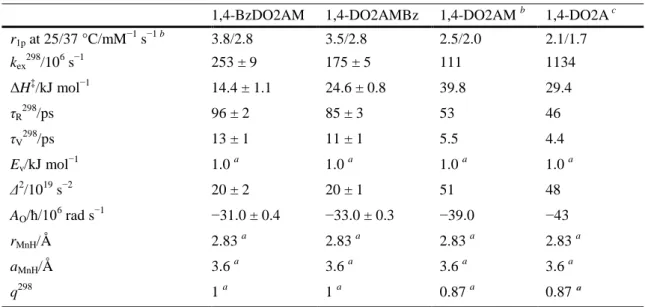
(8) 𝑘1. MnL + H + → Mn2+ + HL. (7). By taking into account all possible pathways the pseudo-first-order rate constant (kd) can be expressed by the following linear relationship:. 𝑘d = 𝑘0 + 𝑘1 [H + ]. (8). The fits of the experimental kd values provided small values of k0 with large standard deviations, which indicates that the spontaneous dissociation pathway does not contribute significantly to the dissociation of the complex under the applied conditions. The k1 rate constants characterising the proton-assisted dissociation of the [Mn(1,4-BzDO2AM)]2+ and [Mn(1,4-DO2AMBz)]2+ complexes (Table 2) are about 4 times higher than that of [Mn(1,4-DO2AM)]2+, but about three times smaller than those of the [Mn(1,4DO2A)] and [Mn(1,7-DO2A)] complexes. It is generally accepted that the proton assisted dissociation of Mn2+ complexes of DOTA-like ligands containing carboxylate pendant arms takes place by protonation at one of the carboxylate groups, which is then likely followed by proton transfer to the ring nitrogen, resulting in the cascade-like de-coordination of each donor atom with the release of Mn2+ from the coordination cavity.26 Since the replacement of the protonable carboxylate groups with non-protonable amide groups does not allow the formation of the protonated MnHL intermediate, it is likely that the proton assisted dissociation of Mn2+ complexes formed with DO2A-bisamides takes place by protonation of the ring N-atom followed by the release of the Mn2+ ion. By taking into account the k1 values of [Mn(1,4-BzDO2AM)]2+, [Mn(1,4DO2AMBz)]2+ and [Mn(1,4-DO2AM)]2+, it appears that the protonation of the ring N-atom in [Mn(1,4BzDO2AM)]2+ and [Mn(1,4-DO2AMBz)]2+ occurs more easily, which might be explained by a weaker interaction between the N donor atoms of 1,4-BzDO2AM and 1,4-DO2AMBz ligands and Mn2+. This hypothesis is in line with the lower stability constants of [Mn(1,4-BzDO2AM)]2+ and [Mn(1,4DO2AMBz)]2+ complexes (Table 1). The half-life (t1/2) of dissociation of [Mn(1,4-BzDO2AM)]2+ and [Mn(1,4-DO2AMBz)]2+ calculated for pH = 7.4 is about four times lower than that measured for [Mn(1,4DO2AM)]2+, but remains significantly longer than those reported for [Mn(1,4-DO2A)] or [Mn(1,7-DO2A)].. Table 2. Rate constants and half-lives at pH = 7.4 for the dissociation reactions of [Mn(1,4-BzDO2AM)]2+, [Mn(1,4-DO2AMBz)]2+and related complexes (0.1 M KCl, 25 °C) 1,4-BzDO2AM. 1,4-DO2AMBz. 1,4-DO2AM d. 1,4-DO2A2− e. 1,7-DO2A2− e. DOTA4− f. k0 (s−1). a. a. a. a. a. 1.8 × 10⁻⁷. k1 (M−1 s−1). 36 ± 2. 38 ± 2. 8.7. 99. 84. 0.04. k2 (M−2 s−1) b. —. —. —. 1.5 × 10⁶. 2.5 × 10⁶. 1.6 × 10³. log KMnLH c. —. 4.15. 4.48. 4.26. −1. kd (s ) pH = 7.4. 1.4 × 10. t1/2 (h) pH = 7.4. 136. a. — −6. 1.5 × 10 126. — −6. 3.5 × 10 556. −7. 3.9 × 10 49.4. −6. 3.3 × 10 58.3. −6. 2.6 × 10⁻⁶ 1070. The spontaneous dissociation of the complex characterised by k0 was found to be negligible. b k 2 rate constants characterizing the second-order dependence on H+ concentration. c Protonation constant characterising the protonated intermediate formed prior to complex dissociation. d Ref. 19. e Ref. 18. f Ref. 26..
(9) Fig. 2. kd values obtained for the transmetallation reactions of [Mn(1,4-BzDO2AM)]2+ with Zn2+ ([MnL] = 0.5 mM, [Zn2+] = 10 mM (blue circles) and 20 mM (red triangles), 0.1 M KCl, 25 °C).. 1. H and 17O NMR relaxometric studies. The r1p values of [Mn(1,4-BzDO2AM)]2+ and [Mn(1,4-DO2AMBz)]2+ as measured at 25 °C, 20 MHz and neutral pH are 3.8 and 3.5 mM−1 s−1, respectively. These values are considerably higher than that of [Mn(1,4DO2A)] and [Mn(1,4-DO2AM)]2+,9,19 suggesting that both complexes feature one coordinated water molecule and an enhanced inner sphere relaxivity associated with their larger size (longer τR). NMRD profiles were measured at 298 and 310 K over the proton Larmor frequency range 0.01–70 MHz, corresponding to magnetic field strengths varying between 2.343 × 10⁻⁴ T and 1.645 T (Fig. 3). The profiles have a rather simple functional form typical of low molecular weight complexes, displaying a region of constant relaxivity at low fields and a simple dispersion around 6–8 MHz, with a second region at high fields (>20 MHz) where the relaxivity tends to flatten out. The absence of a second dispersion at low fields (∼1 MHz) indicates that the scalar contribution to relaxivity is negligible.30 As for the parent [Mn(1,4-DO2AM)]2+ complex, relaxivity decreases by increasing temperature over the entire frequency range, clearly indicating that both Mn2+ chelates are in the fast-exchange regime and that r1p is only limited by the rotational correlation time. Given the relatively large number of parameters influencing the relaxivity of Mn2+ complexes, the water exchange kinetics of the coordinated water molecules were investigated by analysing the temperature dependence of the 17O NMR transverse relaxation rates (R2) and paramagnetic chemical shifts (Δω). The experimental data were measured using a highresolution NMR spectrometer, operating at 11.7 T, on aqueous solutions of the complexes (2–7 mM) at neutral pH. The data were then analysed according to the well-established set of Swift–Connick equations.31 The reduced R2 (1/T2r) and Δω values (Δωr) are presented in Fig. 4. The increase of 1/T2r with decreasing temperature over the whole temperature range investigated is a clear indication of a fast rate of exchange for the coordinated water molecule, in agreement with the qualitative analysis of the NMRD profiles recorded at different temperatures..
(10) Fig. 3. 1H NMRD profiles recorded at different temperatures for [Mn(1,4-BzDO2AM)]2+ (top) and [Mn(1,4DO2AMBz)]2+ (bottom). The lines represent the fits of the data as explained in the text.. As for the parent [Mn(1,4-DO2AM)]2+ complex, relaxivity decreases by increasing temperature over the entire frequency range, clearly indicating that both Mn2+ chelates are in the fast-exchange regime and that r1p is only limited by the rotational correlation time. Given the relatively large number of parameters influencing the relaxivity of Mn2+ complexes, the water exchange kinetics of the coordinated water molecules were investigated by analysing the temperature dependence of the 17O NMR transverse relaxation rates (R2) and paramagnetic chemical shifts (Δω). The experimental data were measured using a highresolution NMR spectrometer, operating at 11.7 T, on aqueous solutions of the complexes (2–7 mM) at neutral pH. The data were then analysed according to the well-established set of Swift–Connick equations.31 The reduced R2 (1/T2r) and Δω values (Δωr) are presented in Fig. 4. The increase of 1/T2r with decreasing temperature over the whole temperature range investigated is a clear indication of a fast rate of exchange for the coordinated water molecule, in agreement with the qualitative analysis of the NMRD profiles recorded at different temperatures..
(11) Fig. 4. Reduced transverse 17O NMR relaxation rates and 17O NMR chemical shifts measured for [Mn(1,4-DO2AMBz)]2+ (circles) and [Mn(1,4-BzDO2AM)]2+ (squares) at 11.74 T. The lines represent the fits of the data as explained in the text.. The 1H NMRD and 17O NMR data were fitted simultaneously according to the established theory of paramagnetic relaxation expressed by the Solomon–Bloembergen–Morgan32 and Freed33 equations for the inner- (IS) and outer-sphere (OS) proton relaxation mechanisms, respectively, and the Swift–Connick theory for 17O relaxation.31 Following a well-established practice, some parameters were fixed at reasonable values due to the large number of parameters that must be considered during the fitting: the hydration number q was fixed at 1; the distance between the metal ion and the protons of the bound water molecule, r, was fixed at 2.83 Å; a and D were set at 3.6 Å and 2.3 × 10⁻⁵ cm2 s−1 (at 25 °C), respectively; EV was fixed at 1.0 kJ mol−1. The values of ER (activation energy for the rotational motion of the complex) and ED (activation energy of D) were fixed at those found for [Mn(1,4-DO2A)]: 19.1 and 17.3 kJ mol−1, respectively. The relevant best-fit parameters are listed in Table 3 and compared with those of related macrocyclic Mn2+ complexes. The electron relaxation parameters, Δ2 and τV, are very similar for both macrocyclic complexes and similar to the values found for the parent complex. This represents a strong indication of the occurrence of strictly analogous solution structures for the three complexes. The rotational correlation time τR assumes values of 96 and 85 ps for [Mn(1,4-BzDO2AM)]2+ and [Mn(1,4-DO2AMBz)]2+, respectively. This nicely reflects the increased molecular mass of the benzyl substituted derivatives over the parent complex and confirms the limiting role of the rotational dynamics to the relaxivity of the complexes. In addition, the difference in r1p and τR values between the two chelates is well accounted for by their slightly different molecular masses. The rates of water exchange are about two times that of [Mn(1,4-DO2AM)]2+ and approximately half that of [Mn(EDTA)]2−. Thus, the introduction of hydrophobic substituents affects not only the rotational dynamics but also the water exchange dynamics of the complexes, likely by influencing the relative energy values of their six- and seven-coordinate states. The seven-coordinate complexes investigated here are expected to follow a dissociatively activated water exchange reaction proceeding through a six-coordinated transition.
(12) state. Most likely, the presence of the benzyl groups introduces some steric hindrance around the coordinated water molecule, which facilitates its departure in a dissociatively activated mechanism.. Table 3. Parameters obtained from the simultaneous analysis of 17O NMR and 1H NMRD data. r1p at 25/37 °C/mM−1 s−1 b 298. 6 −1. kex /10 s ‡. ΔH /kJ mol. −1. τR298/ps 298. τV /ps Ev/kJ mol. −1. 1,4-BzDO2AM. 1,4-DO2AMBz. 1,4-DO2AM b. 1,4-DO2A c. 3.8/2.8. 3.5/2.8. 2.5/2.0. 2.1/1.7. 253 ± 9. 175 ± 5. 111. 1134. 14.4 ± 1.1. 24.6 ± 0.8. 39.8. 29.4. 96 ± 2. 85 ± 3. 53. 46. 13 ± 1. 11 ± 1. 5.5. 1.0. Δ2/1019 s−2. a. 1.0. a. 1.0. 4.4 a. 1.0 a. 20 ± 2. 20 ± 1. 51. 48. AO/ħ/10 rad s. −31.0 ± 0.4. −33.0 ± 0.3. −39.0. −43. rMnH/Å. 2.83 a. 2.83 a. 2.83 a. 2.83 a. aMnH/Å. 3.6 a. 3.6 a. 3.6 a. 3.6 a. q298. 1a. 1a. 0.87 a. 0.87 ª. 6. a. −1. Parameters fixed during the fitting procedure. b Data from Ref. 19. c Data from Ref. 9.. DFT calculations DFT calculations were used to gain insight into the structure of the Mn 2+ complexes of 1,4-BzDO2AM and 1,4-DO2AMBz in solution. Geometry optimizations were performed on the [Mn(1,4BzDO2AM)(H2O)]2+·2H2O and [Mn(1,4-DO2AMBz)(H2O)]2+·2H2O systems, which contain two secondsphere water molecules besides the water molecule directly coordinated to the metal ion. The explicit inclusion of two second-sphere water molecules was found to be critical for an accurate calculation of Mn– Owater distances and 17O hyperfine coupling constants AO/ħ.11,34 Our calculations provided optimized geometries (Fig. 5) with coordination environments very similar to those calculated previously for [Mn(1,4DO2A)(H2O)],9 and that observed in the solid state for [Mn(1,4-DO2A)].17 Benzylation of the nitrogen atoms of the macrocycle provokes a significant lengthening of the Mn–N distances, which are significantly longer in the complex of 1,4-BzDO2AM compared to the 1,4-DO2AMBz derivative. The spin densities calculated at the nuclei of the coordinated water molecules provide AO/ħ values of −52.5 × 10⁶ and −47.3 × 10⁶ rad s−1 for the complexes of 1,4-BzDO2AM and 1,4-DO2AMBz, respectively. The calculated values are somewhat higher than those determined experimentally from the analysis of the 17O NMR data (Table 3), but still similar to those reported for different Mn2+complexes. This could be related to the difficulties in the experimental determination of AO/ħ values from the observed 17O NMR shifts, or perhaps to the fact that our DFT calculations neglected dynamic effects. Alternatively, a certain fraction of q = 0 complexes in solution could explain the lower experimental AO/ħ data..
(13) Fig. 5. Structures of the [Mn(1,4-BzDO2AM)(H2O)]2+·2H2O (top) and [Mn(1,4-DO2AMBz)(H2O)]2+·2H2O (bottom) systems obtained with DFT calculations (M062X/TZVP). The bond distances of the metal coordination environments are given in Å.. Human serum albumin (HSA) binding studies The presence of hydrophobic groups in the structure of 1,4-BzDO2AM and 1,4-DO2AMBz allows the complexes to bind HSA. The binding interaction has been investigated using the well-established proton relaxation enhancement (PRE) technique.14 This method consists in measuring the increase of the water proton longitudinal relaxation rate (R1) as a function of increasing concentration of the protein (at 20 MHz and 298 K in the present case, Fig. 6). R1 is enhanced by the increase of the fraction of the bound complex, characterized by a longer rotational correlation time. The fitting of the experimental data provides the values of the thermodynamic association constant, KA, the number of equivalent and independent binding sites, n, and the relaxivity of the resulting paramagnetic adduct, r1bound. All the data were fitted to 1 : 1 binding isotherms even though the presence of multiple affinity sites on HSA cannot be excluded for these complexes. The affinity of the complexes for the protein is influenced by the position of the pendant hydrophobic moieties, with the association constant KA obtained for [Mn(1,4-BzDO2AM)]2+ being ca. two times that obtained for [Mn(1,4-DO2AMBz)]2+ (Table 4). However, the relaxivity of the fully bound form is.
(14) considerably higher for the adduct formed by [Mn(1,4-DO2AMBz)]2+, which indicates that the relative position of the benzylic groups in the two complexes influences the motional coupling between the paramagnetic unit and the protein. We hypothesise that the presence of the two hydrophobic groups on the coordinating acetamide moieties limits the degree of local motions involving the coordination cage (longer effective rotational correlation time) and thus increases relaxivity. The association constants obtained for the Mn2+ complexes reported here are 2–3 times higher than those reported for Gd3+complexes bearing analogous targeting groups.35 However, these anionic Gd-chelates differ from the (cationic) Mn2+ complexes reported here in their overall charges.. Fig. 6. Changes in the observed longitudinal relaxation rates of water protons observed upon the addition of HSA to solutions of the [Mn(1,4-BzDO2AM)]2+ (0.139 mM), [Mn(1,4-DO2AMBz)]2+ (0.199 mM) and [Mn(1,4-DO2AM)]2+ (0.298 mM) complexes. The solid lines represent the least-squares fits of the data according to a 1 : 1 binding isotherm.. Table 4. Best-fit parameters obtained from the analysis of the 1H relaxometric titrations (20 MHz; 298 K) of the Mn2+ complexes of 1,4-BzDO2AM, 1,4-DO2AMBz and 1,4-DO2AM with HAS. −1. n·KA (M ) b. −1. −1 a. f. −1. −1 b. r1p (mM s ) r1p (mM s ) a. 1,4-BzDO2AM. 1,4-DO2AMBz. 1,4-DO2AM. 3909 ± 583. 1964 ± 342. 1213 ± 95. 18.5 ± 0.7. 27.4 ± 1.4. 5.6 ± 0.5. 3.8. 3.5. 2.5. Relaxivity of the complex fully bound to the protein. b Relaxivity of the free (unbound) complex.. A small but detectable relaxivity enhancement in the presence of HSA is observed also for [Mn(1,4DO2AM)]2+ (Fig. 6). In this case, only electrostatic forces govern the weak interaction and the binding sites.
(15) are localized on the negatively charged domain of the protein. The limited relaxivity gain (Table 4) suggests either a marked decrease of the rate of water exchange or a restricted access of bulk solvent molecules to the paramagnetic site. Clearly, the binding sites and the mechanisms of the relaxation enhancement are quite different for the parent [Mn(1,4-DO2AM)]2+ complex and the bis-benzyl derivatives. For these latter, the hydrophobic interaction predominates and drives the protein binding event.. Conclusions The chemical modification of the basic structure of 1,4-DO2AM, with the introduction of two benzyl groups either on the macrocycle or on the pendant arms, has a strong effect on various properties of the corresponding Mn2+ complexes. First, the complexes of the benzyl derivatives show higher r1p values. The increase of molecular mass appears to be translated entirely into an increase of relaxivity, thus suggesting a rather compact structure characterised by an isotropic tumbling motion. The high relaxivity values suggest the presence of one bound water molecule, although we cannot exclude the presence of a small population of the q = 0 isomer. In any case, the hydration state of the parent complex did not decrease upon the chemical modification. Second, the rate of water exchange has increased by a factor of ca. two as compared to the value of [Mn(1,4-DO2AM)]2+. This is likely related to the steric compression introduced by the benzyl groups around the water binding site. Third, the presence of the hydrophobic pendant groups enables the formation of non-covalent adducts with HSA, which are characterised by affinity constants and r1pb values quite comparable to those typical of the analogous Gd3+ complexes. The results reported in this work also highlight the difficulties to design Mn2+ complexes containing a coordinated water molecule and possessing a high thermodynamic stability and kinetic inertness, which represents a challenge for coordination chemistry. The introduction of benzyl groups was found to be detrimental for both the thermodynamic stability and kinetic inertness. These Mn(II) chelates are cationic and thus not suitable for in vivo applications. Previous data on lanthanide complexes of DOTA-tetraamide derivatives indicated that at low doses the compounds are not easy to dissociate in vivo and are well tolerated.36 This is due to their high degree of kinetic inertness. In order for the Mn(II) complexes to be employed at high doses in vivo, the kinetic inertia and the incorporation of negatively charged groups are important requirements. We are currently exploring chemical modifications of these and related ligands to obtain efficient and safer Mn2+-based MRI probes.. Experimental section General All chemicals were purchased from Sigma-Aldrich Co. and were used without further purification. The concentrations of the MnCl2 and ZnCl2 solutions were determined by complexometric titration with standardised Na2H2EDTA and xylenol orange (ZnCl2) or Eriochrome Black T (MnCl2) as indicators. The concentrations of the solutions of 1,4-BzDO2AM and 1,4-DO2AMBz were determined by pHpotentiometric titration in the presence and absence of a 50-fold excess of CaCl2. The pH-potentiometric titrations were carried out with a standardised 0.2 M KOH solution. 1H and 13C NMR spectra were recorded on a Bruker DRX 400 (9.39 T) and a Bruker Avance III (11.74 T) spectrometers. Chemical shifts are reported relative to TMS and were referenced using the residual proton solvent resonances. 37 Electrospray ionization mass spectra (ESI MS) were recorded on an SQD 3100 Mass Detector (Waters), operating in positive or negative ion mode, with 1% v/v HCOOH in methanol as the carrier solvent. HPLC analyses were.
(16) carried out on a Waters 1525EF liquid chromatograph equipped with a Waters 2489 UV/vis and a Waters SQD 3100 MS detectors and using a Waters Atlantis® T3 RPC18 column (150 mm × 4.6 mm, 5 μm). Preparative HPLC separations were carried out using a Waters Atlantis® T3 OBD RPC18 column (100 mm × 19 mm, 5 μm) and a Waters FCIII fraction collector. Synthesis of 2,2′-(1,4,7,10-tetraazacyclododecane-1,4-diyl)bis(N-benzylacetamide) (1,4-DO2AMBz) 2-Bromoacetyl bromide (1 mL, 11.5 mmol) and benzyl amine (1.14 mL, 10.4 mmol) were dissolved in CH2Cl2 (10 mL) and triethylamine (0.88 mL, 6.26 mmol) was added at 0 °C. The reaction mixture was stirred at 0 °C for 1 h, and then allowed to warm to room temperature. Water (15 mL) was added and the aqueous layer was extracted with CH2Cl2 (4 × 15 mL). The combined organic layers were washed with 5% HCl (50 mL), water, a saturated NaHCO3 solution (50 mL) and brine. The organic layer was dried over MgSO4 and then filtered. The solvent was removed under vacuum and the crude product 3 was purified by flash chromatography (petroleum ether : ethyl acetate 7 : 3) on silica gel. The formation of N-benzyl-2bromoacetamide (3)21was confirmed by mass spectrometry. ESI+/MS: m/z 228.0 ([C9H11BrNO]+). Cyclen (0.28 g, 1.6 mmol) was dissolved in acetonitrile (15 mL) and K 2CO3 (0.33 g, 2.4 mmol) was added. A solution of compound 3 (0.74 g, 3.3 mmol) in the same solvent (20 mL) was added dropwise. The mixture was heated to reflux for 24 h. Then, the solution was filtered to remove the excess of carbonate, and the solvent was removed. The resulting aqueous solution was dried and the crude product was then purified by semi-preparative HPLC-MS (solvent A: H2O, TFA 0.1%; solvent B: MeOH; 0–2 min 10% B and then gradient 10–100% B in 18 min; flow 20 mL min−1; retention time: 6.3 min) to obtain 140 mg of an orange oil (0.26 mmol, 18% yield). ESI-MS (m/z): found 467.5 [M + H+] (calc. for C26H38N6O2: 466.5). 1H-NMR (D2O, 500 MHz): δ 3.22 (σ CH2NH 4H) 3.05 (s, CH2CO, 4H), 2.85–2.65 (m, NCH2ring, 16H), 7.51–7.41 (m, CHAr, 10H); 13C-NMR (D2O, 125 MHz): δ 171.4 (C O), 131.0 (CH), 129.1 (CH), 57.7 (CH2), 53.5 (CH2), 53.0 (CH2), 50.0 (CH2), 48.9 (CH2), 36.6 (CH2). Synthesis of 2,2′-(7,10-dibenzyl-1,4,7,10-tetraazacyclododecane-1,4-diyl) bis(N,N-dimethylacetamide) (1,4BzDO2AM) Cyclen (0.5 g, 2.9 mmol) was dissolved in ethanol (15 mL) and diethyl oxalate (585 μL, 4.3 mmol) was added dropwise. The mixture was heated to reflux for 24 h and then the solvent was removed under vacuum to give intermediate 1,4,7,10-tetraazabicyclo[8.2.2]tetradecane-11,12-dione (4): ESI+/MS: m/z 227.2 ([C10H19N4O2]+). Compound 4 (0.64 g, 2.8 mmol) was dissolved in acetonitrile (15 mL), and benzyl bromide (840 μL, 7.0 mmol) and K2CO3 (2.35 g, 17 mmol) were added to the mixture. The mixture was heated to reflux for 24 h and then the solvent was removed under vacuum. The crude product 4,7-dibenzyl-1,4,7,10tetraazabicyclo[8.2.2]tetradecane-11,12-dione (5) was dissolved in CH2Cl2 (20 mL) and washed with water (3 × 15 mL). The product was purified by flash chromatography (98 : 2 DCM : MeOH, silica gel). ESI-MS (m/z): found 407.5 [M + H+]. Compound 5 was dissolved in 5 M NaOH (20 mL) and the mixture was stirred at 100 °C for 24 h. The solution was concentrated in a rotary evaporator to a volume of 10 mL and washed with CH2Cl2 (3 × 20 mL). The combined organic extracts were washed with water (3 × 20 mL). The organic layer was dried over MgSO4 and then filtered and concentrated under vacuum. ESI-MS (m/z): found 353.5 [M + H+]. The intermediate was used without any further characterization.23 Compound 6 (0.17 g, 0.5 mmol) and K2CO3 (0.63 g, 4.5 mmol) were suspended in ACN (10 ml) and N,N-dimethyl-2-chloroacetamide (105 μL, 1.01 mmol) was added dropwise. The mixture was stirred for 24 h and then the solvent was removed in vacuo. The crude product 8 was purified by flash chromatography (DCM : MeOH 99 : 1, silica gel) to obtain a pale yellow oil (0.46 mmol, 16% yield). ESI-MS (m/z): found 523.5 [M + H+] (calc. for C30H46N6O2: 522.5). 1H-NMR (D2O, 500 MHz): δ 4.31 (σ CH2 4H) 3.18 (s, CH2CO, 4H), 3.51 (s CH3 12H) 2.01–2.28 (m, NCH2 ring, 16H), 7.30–7.37 (m, CHAr, 10H); 13C-NMR (D2O, 125 MHz): δ 172.5 (C O), 137.8 (CH), 126.5.0 (CH), 127.0 (CH), 127.6 (CH) 49.5 (CH2), 50.1 (CH2), 50.6 (CH2), 51.2 (CH2), 51.9 (CH2), 55.0 (CH2) 41.9 (CH3)..
(17) Equilibrium measurements The protonation constants of 1,4-BzDO2AM and 1,4-DO2AMBz, as well as the stability and protonation constants of the Mn2+complexes formed with 1,4-BzDO2AM and 1,4-DO2AMBz were determined by pHpotentiometry. The pH-potentiometic titrations were performed at 1 : 1 metal-to-ligand concentration ratios (the concentration of the ligand was generally 0.002 M). For the calculation of the equilibrium constants the mL base–pH data were used, obtained in the pH range 1.7–12.0. For the pH measurements and titrations, a Metrohm 888 Titrando titration workstation and a Metrohm 6.0233.100 combined electrode were used. Equilibrium measurements were carried out at a constant ionic strength (0.1 M KCl) and at 25 °C in 8 mL samples. The solutions were stirred, and N2 was bubbled through them. KH-phthalate (pH = 4.005) and borax (pH = 9.177) buffers were used to calibrate the pH meter. For the calculation of [H +] from the measured pH values, the method proposed by Irving et al.was used.38 A 0.01 M HCl solution was titrated with the standardized KOH solution in the presence of 0.1 M KCl ionic strength, respectively. The differences between the measured (pHread) and calculated pH (−log[H+]) values were used to obtain the equilibrium H+ concentration from the pH values, measured in the titration experiments. The ion product of water was determined from the same titrations (HCl/KOH) using the data in the pH range of 11.5–12.0. Equilibrium constants were calculated using the PSEQUAD program.39 Kinetic studies The kinetic inertness of the Mn2+ complexes was characterised by the rates of the exchange reactions taking place between the MnL complexes and Zn2+. The rates of the metal exchange reactions of [Mn(1,4BzDO2AM)]2+ and [Mn(1,4-DO2AMBz)]2+ with Zn2+ were followed by measuring the water proton relaxation rates (1/T1) of the samples. The kinetic measurements were performed at 0.47 T (20 MHz) and 25 °C owing to the large differences in the relaxivities of [Mn(1,4-BzDO2AM)]2+ (r1p = 3.8 mM−1s−1) and [Mn(1,4-DO2AMBz)]2+ (r1p = 3.5 mM−1 s−1) and that of free Mn2+ (r1p = 8.0 mM−1 s−1). The longitudinal relaxation times were measured by the inversion recovery method (180° – τ–90°) by using 8 different τ values. The measurements were performed with 1.0 mM [Mn(1,4-BzDO2AM)]2+ and [Mn(1,4DO2AMBz)]2+ solutions in the presence of a 10 to 20-fold excess of Zn2+. The temperature was maintained at 25 °C and the ionic strength of the solutions was kept a constant (0.1 M KCl). For keeping the pH values constant, N-methylpiperazine (pH range of 4.1–5.2) and piperazine (pH range of 4.7–6.6) buffers (0.01 M) were used. The pseudo-first-order rate constants (kd) were calculated using eqn (9):. 𝑅1𝑡 = (𝑅10 − 𝑅1e )e−𝑘d 𝑡 + 𝑅1e. (9). where R01, Rt1, and Re1 are the relaxation rate (1/T1) values at the start of the reaction, at time t, and at equilibrium, respectively. The calculations were performed using the computer program Micromath Scientist, version 2.0 (Salt Lake City, UT, USA). 1. H NMRD and 17O NMR measurements. The water proton longitudinal relaxation rates as a function of pH (20 MHz) were measured with a Stelar Spinmaster Spectrometer FFC-2000 (Mede, PV, Italy) on about 0.6–2.0 mM aqueous solutions in nondeuterated water. The exact concentrations of Mn2+ ions were determined by the measurement of bulk magnetic susceptibility shifts of a tBuOH signal on a Bruker Avance III spectrometer (11.7 T).40 The 1H T1 relaxation times were acquired by the standard inversion recovery method with a typical 90° pulse width of 3.5 μs, 16 experiments of 4 scans each. The reproducibility of the T1 data was ±5%. The temperature was controlled with a Stelar VTC-91 airflow heater equipped with a calibrated copper-.
(18) constantan thermocouple (uncertainty of ±0.1 °C). The proton 1/T1 NMRD profiles were measured on a fast field-cycling Stelar SmartTracer relaxometer over a continuum of magnetic field strengths from 0.00024– 0.25 T (corresponding to 0.01–10 MHz proton Larmor frequencies). The relaxometer operates under computer control with an absolute uncertainty in 1/T1 of ±1%. Additional data points in the range 15–70 MHz were obtained on a Stelar relaxometer equipped with a Bruker WP80 NMR electromagnet adapted to variable-field measurements (see above). Variable-temperature 17O NMR measurements were recorded on a Bruker Avance III spectrometer (11.7 T) equipped with a 5 mm probe and a standard temperature control unit. Aqueous solutions of the complexes (4 mM) containing 2.0% of the 17O isotope (Cambridge Isotope) were used. The observed transverse relaxation rates were calculated from the signal width at half-height. DFT calculations Full geometry optimizations of the [Mn(1,4-DO2AMBz)(H2O)]2+·2H2O and [Mn(1,4BzDO2AM)(H2O)]2+·2H2O systems were performed employing DFT calculations at the M062X/TZVP41,42 level with the Gaussian 09 package (revision D.01).43 Solvent effects were included by using the polarizable continuum model (PCM), in particular, the integral equation formalism (IEFPCM) variant. 44 No symmetry constraints have been imposed during the optimizations. The stationary points found on the potential energy surfaces as a result of geometry optimizations were characterized via frequency analysis. Hyperfine coupling constants were calculated with the same computational approach using the EPR-III basis set of Barone for C, H, O and N.45. Acknowledgments L. T. and M. B. are grateful to the UNIUPO for support. A. F. acknowledges the MIUR (Italy) for a PhD grant. The authors C. P.-I. and D. E.-G. acknowledge the Ministerio de Economía y Competitivad (CTQ2015-71211-REDT and CTQ2016-76756-P) for generous financial support and the Centro de Supercomputación de Galicia (CESGA) for providing the computer facilities.. References 1. (a) G. J. Stasiuk and N. J. Long, Chem. Commun., 2013, 49, 2732; (b) P. Caravan, J. J. Ellison, T. J. McMurry and R. B. Lauffer, Chem. Rev., 1999, 99, 2293; (c) N. Cakić, S. Gündüz, R. Rengarasu and G. Angelovski,Tetrahedron Lett., 2015, 56, 759; (d) R. E. Mewis and S. J. Archibald, Coord. Chem. Rev., 2010, 254, 1686; (e) M. C. Heffern, L. M. Matosziuk and T. J. Meade, Chem. Rev., 2014, 114, 4496. 2. The Chemistry of Contrast Agents in Medical Magnetic Resonance Imaging, ed. A. E. Merbach, L. Helm and É. Tóth, 2nd edn, Wiley, New York, 2013. 3. (a) P. Blower, Dalton Trans., 2006, 1705; (b) K. Tanaka and K. Fukase, Org. Biomol. Chem., 2008, 6, 815. 4. (a) E. Vinogradova, A. D. Sherry and R. E. Lenkinski, J. Magn. Reson., 2013, 229, 155; (b) E. Terreno, D. Delli Castelli and S. Aime, Contrast Media Mol. Imaging, 2010, 5, 78; (c) G. Ferrauto, D. Delli Castelli, E. Di Gregorio, E. Terreno and S. Aime, Wiley Interdiscip. Rev.: Nanomed. Nanobiotechnol., 2016, 8, 602..
(19) 5. J.-C. G. Bünzli, Chem. Rev., 2010, 110, 2729. 6. E. Brücher, G. Tircsó, Z. Baranyai, Z. Kovács and A. D. Sherry, Stability and Toxicity of Contrast Agents, in The Chemistry of Contrast Agents in Medical Magnetic Resonance Imaging, ed. A. E. Merbach, L. Helm and É. Tóth, 2nd edn, Wiley, New York, 2013, ch. 4, pp. 157–208. 7. (a) D. Pan, A. H. Schmieder, S. A. Wickline and G. M. Lanza, Tetrahedron, 2011, 67, 8431; (b) B. Drahos, I. Lukes and E. Toth, Eur. J. Inorg. Chem., 2012, 1975; (c) M. Kueny-Stotz, A. Garofalo and D. Felder-Flesch,Eur. J. Inorg. Chem., 2012, 1987. 8. (a) J. Zhu, E. M. Gale, I. Atanasova, T. A. Rietz and P. Caravan, Chem. – Eur. J., 2014, 20, 14507; (b) E. M. Gale, I. P. Atanasova, F. Blasi, I. Ay and P. Caravan, J. Am. Chem. Soc., 2015, 137, 15548. 9. G. A. Rolla, C. Platas-Iglesias, M. Botta, L. Tei and L. Helm, Inorg. Chem., 2013, 52, 3268. 10. L. Tei, G. Gugliotta, M. Fekete, F. K. Kalman and M. Botta, Dalton Trans., 2011, 40, 2025. 11. (a) E. Molnar, N. Camus, V. Patinec, G. A. Rolla, M. Botta, G. Tircso, F. K. Kalman, T. Fodor, R. Tripier and C. Platas-Iglesias,Inorg. Chem., 2014, 53, 5136; (b) V. Patinec, G. A. Rolla, M. Botta, R. Tripier, D. Esteban-Gómez and C. Platas-Iglesias, Inorg. Chem., 2013, 52, 11173. 12. (a) M. Regueiro-Figueroa, G. A. Rolla, D. Esteban-Gómez, A. de Blas, T. Rodríguez-Blas, M. Botta and C. Platas-Iglesias,Chem. – Eur. J., 2014, 20, 17300; (b) A. Forgacs, M. Regueiro-Figueroa, J. L. Barriada, D. Esteban-Gómez, A. de Blas, T. Rodríguez-Blas, M. Botta and C. Platas-Iglesias, Inorg. Chem., 2015, 54, 9576. 13. A. Forgacs, R. Pujales-Paradela, M. Regueiro-Figueroa, L. Valencia, D. Esteban-Gómez, M. Botta and C. Platas-Iglesias,Dalton Trans., 2017, 46, 1546. 14. A. de Sa, C. S. Bonnet, C. F. G. C. Geraldes, É. Tóth, P. M. T. Ferreira and J. P. Andre, Dalton Trans., 2013, 42, 4522. 15. (a) S. Aime, P. L. Anelli, M. Botta, M. Brocchetta, S. Canton, F. Fedeli, E. Gianolio and E. Terreno, J. Biol. Inorg. Chem., 2002,7, 58; (b) R. Artali, Z. Baranyai, M. Botta, G. B. Giovenzana, A. Maspero, R. Negri, G. Palmisano, M. Sisti and S. Tollari, New J. Chem., 2015, 39, 539. 16. (a) G. S. Loving, S. Mukherjee and P. Caravan, J. Am. Chem. Soc., 2013, 135, 4620; (b) E. M. Gale, S. Mukherjee, C. Liu, G. S. Loving and P. Caravan, Inorg. Chem., 2014, 53, 10748. 17. A. Bianchi, L. Calabi, C. Giorgi, P. Losi, P. Mariani, D. Palano, P. Paoli, P. Rossi and B. Valtancoli, J. Chem. Soc., Dalton Trans., 2001, 917. 18. Z. Garda, A. Forgacs, Q. N. Do, F. K. Kalman, S. Timari, Z. Baranyai, L. Tei, I. Toth, Z. Kovacs and G. Tircso, J. Inorg. Biochem., 2016, 163, 206. 19. A. Forgacs, L. Tei, Z. Baranyai, I. Toth, L. Zekany and M. Botta, Eur. J. Inorg. Chem., 2016, 1165. 20. S. Aime, M. Botta, M. Fasano, S. Geninatti Crich and E. Terreno, J. Biol. Inorg. Chem., 1996, 1, 312. 21. H. Xie, D. Ng, S. N. Savinov, B. Dey, P. D. Kwong, R. Wyatt, A. B. Smith and W. A. Hendrickson, J. Med. Chem., 2007, 4898. 22. (a) C. Li and W.-T. Wong, J. Org. Chem., 2003, 68, 2956; (b) W. J. Kruper Jr., P. R. Rudolf and C. A. Langhoff, J. Org. Chem., 1993, 58, 3869..
(20) 23. F. Bellouard, F. Chuburu, N. Kervarec, L. Toupet, S. Triki, Y. Le Mest and H. Handel, J. Chem. Soc., Perkin Trans. 1, 1999, 3499. 24. A. Z. Garda, E. Ruscsak, D. Esteban-Gomez, A. de Blas, T. Rodriguez-Blas, L. N. P. Lima, M. Beyler, R. Tripier, G. Tircso and C. Platas-Iglesias, Dalton Trans., 2015, 44, 5017. 25. (a) A. Pasha, G. Tircsó, E. T. Benyo, E. Brucher and A. D. Sherry, Eur. J. Inorg. Chem., 2007, 4340; (b) Zs. Baranyai, E. Brücher, T. Iványi, R. Király, I. Lázár and L. Zékány, Helv. Chim. Acta, 2005, 88, 604–617. 26. B. Drahos, V. Kubicek, C. S. Bonnet, P. Hermann, I. Lukes and É. Tóth, Dalton Trans., 2011, 40, 1945. 27. R. D. Shannon, Acta Crystallogr., Sect. A: Cryst. Phys., Diffr., Theor. Gen. Cryst., 1976, 32, 751. 28. J. Crossgrove and W. Zheng, NMR Biomed., 2004, 17, 544. 29. P. Wedeking, K. Kumar and M. F. Tweedle, Magn. Reson. Imaging, 1992, 10, 641. 30. D. Esteban-Gómez, C. Cassino, M. Botta and C. Platas-Iglesias, RSC Adv., 2014, 4, 7094. 31. (a) T. J. Swift and R. E. Connick, J. Chem. Phys., 1962, 37, 307; (b) T. J. Swift and R. E. Connick, J. Chem. Phys., 1964, 41, 2553. 32. (a) I. Solomon, Phys. Rev., 1955, 99, 559; (b) I. Solomon and N. Bloembergen, J. Chem. Phys., 1956, 25, 261; (c) N. Bloembergen, J. Chem. Phys., 1957, 27, 572; (d) N. Bloembergen and L. O. Morgan, J. Chem. Phys., 1961, 34, 842. 33. J. H. Freed, J. Chem. Phys., 1978, 68, 4034. 34. C. Platas-Iglesias, D. Esteban-Gómez, L. Helm and M. Regueiro-Figueroa, J. Phys. Chem. A, 2016, 120, 6467–6476. 35. S. Aime, M. Botta, M. Fasano, S. Geninatti Crich and E. Terreno, J. Biol. Inorg. Chem., 1996, 1, 312. 36. M. Woods, P. Caravan, C. F. G. C. Geraldes, M. T. Greenfield, G. E. Kiefer, M. Lin, K. McMillan, M. I. M. Prata, A. C. Santos, X. Sun, J. Wang, S. Zhang, P. Zhao and A. D. Sherry, Invest. Radiol., 2008, 43, 861. 37. H. E. Gottlieb, K. Kottyar and A. Nudelman, J. Org. Chem., 1997, 62, 7512. 38. H. M. Irving, M. G. Miles and L. Pettit, Anal. Chim. Acta, 1967, 38, 475. 39. L. Zékány and I. Nagypál, in Computational Method for Determination of Formation Constants, ed. D. J. Legett, Plenum, New York, 1985, p. 291. 40. D. M. Corsi, C. Platas-Iglesias, H. van Bekkum and J. A. Peters, Magn. Reson. Chem., 2001, 39, 723. 41. Y. Zhao and D. G. Truhlar, Theor. Chem. Acc., 2008, 120, 215. 42. A. Schaefer, C. Huber and R. Ahlrichs, J. Chem. Phys., 1994, 100, 5829. 43. M. J. Frisch, et al.Gaussian, Inc., Wallingford, CT, 2009..
(21) 44. J. Tomasi, B. Mennucci and R. Cammi, Chem. Rev., 2005, 105, 2999. 45. N. Rega, M. Cossi and V. Barone, J. Chem. Phys., 1996, 105, 11060.. i. Electronic supplementary information (ESI) available: 1H and 13C NMR spectra of the ligands; additional relaxometric and kinetic data; optimized Cartesian coordinates obtained using DFT calculations. See DOI: 10.1039/c7dt01508a..
(22)
Figure

![Table 2. Rate constants and half-lives at pH = 7.4 for the dissociation reactions of [Mn(1,4-BzDO2AM)] 2+ , [Mn(1,4-DO2AMBz)] 2+ and related complexes (0.1 M KCl, 25 °C)](https://thumb-us.123doks.com/thumbv2/123dok_es/7285506.444016/8.892.68.825.893.1070/table-rate-constants-lives-dissociation-reactions-related-complexes.webp)
![Fig. 2. k d values obtained for the transmetallation reactions of [Mn(1,4-BzDO2AM)] 2+ with Zn 2+ ([MnL] = 0.5 mM, [Zn 2+ ] = 10 mM (blue circles) and 20 mM (red triangles), 0.1 M KCl, 25 °C)](https://thumb-us.123doks.com/thumbv2/123dok_es/7285506.444016/9.892.200.691.81.458/fig-values-obtained-transmetallation-reactions-bzdo-circles-triangles.webp)
+6
![Fig. 3. 1 H NMRD profiles recorded at different temperatures for [Mn(1,4-BzDO2AM)] 2+ (top) and [Mn(1,4- [Mn(1,4-DO2AMBz)] 2+ (bottom)](https://thumb-us.123doks.com/thumbv2/123dok_es/7285506.444016/10.892.235.658.79.786/fig-nmrd-profiles-recorded-different-temperatures-bzdo-ambz.webp)
![Fig. 4. Reduced transverse 17 O NMR relaxation rates and 17 O NMR chemical shifts measured for [Mn(1,4-DO2AMBz)] 2+ (circles) and [Mn(1,4-BzDO2AM)] 2+ (squares) at 11.74 T](https://thumb-us.123doks.com/thumbv2/123dok_es/7285506.444016/11.892.201.692.79.493/reduced-transverse-relaxation-chemical-shifts-measured-circles-squares.webp)
![Fig. 5. Structures of the [Mn(1,4-BzDO2AM)(H 2 O)] 2+ ·2H 2 O (top) and [Mn(1,4-DO2AMBz)(H 2 O)] 2+ ·2H 2 O (bottom) systems obtained with DFT calculations (M062X/TZVP)](https://thumb-us.123doks.com/thumbv2/123dok_es/7285506.444016/13.892.240.658.86.693/fig-structures-bzdo-ambz-systems-obtained-calculations-tzvp.webp)
![Fig. 6. Changes in the observed longitudinal relaxation rates of water protons observed upon the addition of HSA to solutions of the [Mn(1,4-BzDO2AM)] 2+ (0.139 mM), [Mn(1,4-DO2AMBz)] 2+ (0.199 mM) and [Mn(1,4-DO2AM)] 2+ (0.298 mM) complexes](https://thumb-us.123doks.com/thumbv2/123dok_es/7285506.444016/14.892.200.683.306.668/changes-observed-longitudinal-relaxation-observed-addition-solutions-complexes.webp)
Documento similar